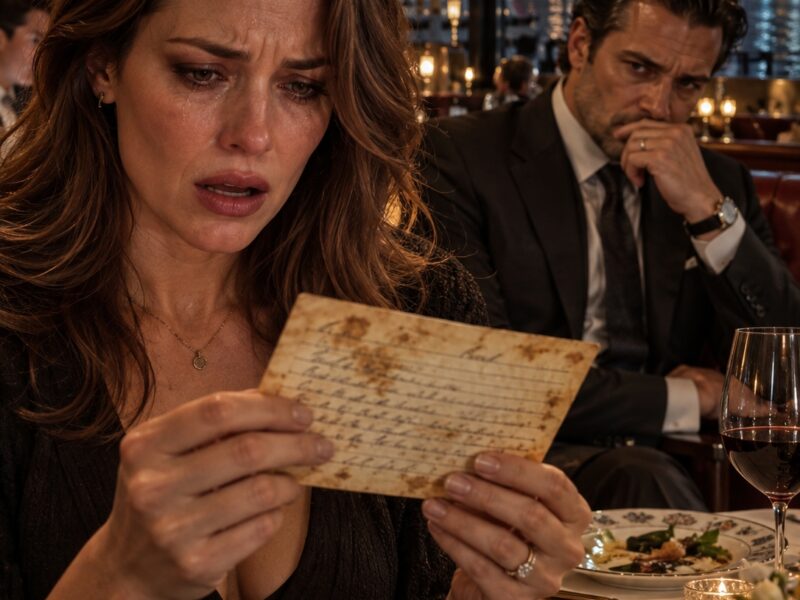
I Invited a Feared Mafia Boss to Dinner—But When He Saw My Dead Grandmother’s Recipe Card, His Reaction Revealed a Terrifying Secret…

The first time Gianni Bellori warned me that he was dangerous, he was holding two cases of canned peaches.
That should have made the warning ridiculous.
It didn’t.
He stood in the parking lot behind St. Bridget’s Parish in southeast Baltimore wearing a charcoal suit that probably cost more than my twelve-year-old Honda, his expression as unreadable as a locked door. Behind him, rain clouds pressed low over the row houses, turning every window gray. A black sedan waited at the curb with its engine running.
And beside the sedan stood a man built like a warehouse.
I looked from the driver to the stranger in the expensive suit, then to the six boxes of donated food he had just loaded into seventy-two-year-old Lillian Price’s battered Buick.
Nobody had asked him to help.
Nobody had been watching.
That was the part I couldn’t reconcile.
“Dinner starts at six,” I told him.
His eyes moved to mine.
Dark. Calm. Tired in a way expensive clothes couldn’t hide.
“I don’t think you should invite me to dinner, Miss.”
“Why?”
A beat passed.
Then he said quietly, “Because I’m too dangerous for dinner.”
Most sensible women would have taken that as useful information.
I have never been accused of being sensible at the correct moment.
I folded my arms.
“Fine.”
One eyebrow lifted.
“I’m hungry.”
For the first time, something almost human disturbed his expression.
Not quite a smile.
More like the memory of one.
Behind us, Lillian slammed her trunk.
“Well,” she announced, “if you two are going to flirt beside my peaches, at least move. I need to get home before Wheel of Fortune.”
“We’re not flirting,” I said.
The stranger looked at me.
“No,” he agreed.
Which somehow made it worse.
I pointed toward the church.
“Six o’clock. You helped carry food, so you earned a plate.”
“I don’t earn things that way.”
“At St. Bridget’s you do.”
He studied me as though I had just presented him with a contract containing an unexpected clause.
“You’ll change your mind when you know my name.”
“Then tell me your name at dinner.”
For several seconds, neither of us moved.
Finally he reached inside his coat.
The warehouse-shaped driver shifted immediately.
My pulse jumped.
But the stranger only removed a pen.
He took the grocery receipt sticking from one of the boxes, wrote something on the back, folded it once, and handed it to me.
His fingers never touched mine.
“Six,” he said.
“Six.”
Then he walked toward the black sedan.
I unfolded the receipt.
GIANNI BELLORI.
The name meant nothing to me for approximately three seconds.
Then Lillian leaned over my shoulder.
“Oh,” she said.
That was all.
Just oh.
But I had lived in Baltimore long enough to understand certain kinds of silence.
I looked again at the car.
Gianni Bellori.
Bellori shipping.
Bellori warehouses.
Bellori construction.
Bellori money.
Bellori men who never seemed to appear in newspaper photographs even when their companies appeared everywhere else.
There were stories about the family stretching back decades along the harbor. Some were probably exaggerated. Some probably weren’t. Their name floated through Baltimore the way storm warnings did—rarely discussed for pleasure, never ignored.
I looked at Lillian.
“You knew who he was?”
“No.”
“You don’t seem surprised.”
She shrugged.
“He carried my peaches.”
“Lillian.”
“What?”
“That man may be involved in organized crime.”
She considered this.
Then she opened the driver’s door.
“Well, he carried them very politely.”
And that, absurdly, was why I went to dinner.
At least that’s what I told myself.
The truth was more complicated.
My grandmother Rose had run the St. Bridget’s meal program for forty years. Above the kitchen door, in paint faded by steam and time, she had written the rule that governed nearly everything she believed.
FEED FIRST. ASK LATER.
Rose fed dockworkers, runaway teenagers, widows, drunks, exhausted mothers, unemployed fathers, one disgraced city councilman, and anyone else who came through that door.
She didn’t confuse kindness with stupidity.
That distinction mattered.
She could recognize a liar before he finished his first sentence.
She simply believed hunger should be dealt with before judgment.
Rose died two years earlier at eighty-three.
I inherited her recipe box, her Tuesday and Friday dinners, and, without realizing it, her terrible habit of making myself useful to everyone.
During the day, I worked patient benefits at a Baltimore hospital.
That title sounded respectable.
What it meant was that I spent my life arguing with insurance companies.
I was the woman who called four times.
The woman who knew which code had been entered incorrectly.
The woman who found the obscure form that got a cancer medication approved after three denials.
The woman who stayed until seven because somebody’s mother was being discharged with oxygen nobody had authorized.
I was good at it.
Too good, maybe.
People learned quickly that Maya Bennett could fix things.
So they brought me things to fix.
My younger sister Teresa loved me deeply and called me whenever her babysitter canceled.
Father Tom loved me and handed me volunteer schedules.
Francine loved me and asked me to cover the kitchen when her arthritis flared.
People at the hospital loved me and left impossible cases on my desk with sticky notes that said, “Maya miracle?”
Nobody was cruel.
That would have been easier.
They simply became accustomed to me being available.
At thirty-seven, I had somehow built a life in which everybody needed me and almost nobody wondered whether I was tired.
Teresa sometimes ended requests with the same joke.
“It’s not like you have a husband waiting at home.”
I always laughed.
Eventually you learn to laugh first.
It keeps other people from noticing which jokes hurt.
So perhaps that was why Gianni Bellori interested me.
He was the first man I had met in years who looked at me as though he was trying to determine who I was instead of what I could do for him.
That evening I chose Mancuso’s on Fleet Street.
Four tables.
Red vinyl chairs.
A menu older than I was.
Sal Mancuso treated senators, sanitation workers, and men rumored to own half the waterfront with exactly the same degree of impatience.
If Gianni wanted to frighten me, he would have to do it somewhere with plastic salt shakers.
He arrived at six precisely.
Alone.
The restaurant changed when he entered.
Conversations didn’t stop.
They softened.
Sal looked up from behind the counter and made the sign of the cross before apparently realizing he had done it.
I waved toward the back table.
Gianni removed his coat and sat across from me.
“You came,” I said.
“You said you were hungry.”
“I said you were.”
“You were correct.”
Sal brought bread.
Before Gianni could touch it, I raised one finger.
“I have rules.”
“I assumed you would.”
“Your security stays outside.”
He glanced toward the window.
“I came alone.”
“The car is half a block away.”
That almost-smile returned.
“Your observational skills are inconvenient.”
“I fight insurance companies professionally.”
“I’ve known extortionists with better manners.”
“Good. Then we understand each other.”
I raised a second finger.
“I choose where we eat.”
“Agreed.”
“Third, you don’t investigate people because I mention them.”
His expression changed slightly.
“My sister, Sal, Francine, Lillian, Father Tom. Nobody.”
“You think I investigate everyone I meet?”
“I think you know my full name already.”
Silence.
That was answer enough.
I leaned back.
“See?”
He considered me for a moment.
Then nodded.
“No investigations.”
“Good.”
“You negotiate often?”
“Every day.”
“With people like me?”
“Worse.”
That time he actually smiled.
It transformed his face so completely that I had to look at the menu.
We ate baked ziti.
Halfway through the meal, he put down his fork.
“You know who I am now.”
It wasn’t a question.
“I know what people say.”
“And you came anyway.”
“I also know what I saw.”
“What did you see?”
“You carrying Lillian’s groceries when nobody important was watching.”
His eyes narrowed slightly.
“That doesn’t erase anything else.”
“No.”
“Then why does it matter?”
“Because I prefer collecting my own evidence.”
For the first time that evening, Gianni had no answer.
Something shifted behind his eyes.
It was small.
A curtain moving in a house everyone assumed was empty.
We never called that first dinner a date.
That mattered later.
At the time, we were simply two people eating pasta and pretending not to notice the strange gravity developing between us.
When dinner ended, he walked me to my Honda.
Not too close.
He waited until I started the engine before stepping away.
In the rearview mirror, I watched one of the most feared men on Baltimore’s waterfront stand beneath a broken streetlamp until my car reached the corner.
I slept badly that night.
I expected him to disappear.
Instead, three days later, a folded note arrived at St. Bridget’s.
No flowers.
No expensive gift.
One sentence in old-fashioned handwriting.
Does Thursday count as dinner?
I laughed so loudly Lillian came out of the pantry.
“What?”
“Nothing.”
“Is it the tall one?”
“No.”
“Then why are your ears red?”
I wrote my answer on the back of the volunteer schedule.
Thursday. I choose the place.
He never argued about that rule.
And so Thursdays became ours.
Sometimes Tuesday too, after the parish dinner.
I chose places where power looked ridiculous.
A Polish restaurant on Eastern Avenue.
A twenty-four-hour diner near the interstate where the coffee could probably remove paint.
A tiny Lebanese place with six tables.
A seafood counter where customers ate from paper baskets.
Gianni always arrived without visible security.
The black sedan stayed somewhere down the block.
I pretended not to notice.
He pretended not to notice me pretending.
Something was being built between us one ordinary meal at a time.
I resisted naming it because unnamed things cannot disappoint you as efficiently.
By the third dinner, he automatically moved the sugar bowl to my left.
I’m left-handed.
By the fifth, he ordered my coffee before I arrived.
One sugar.
No cream.
He noticed that I usually gave my dessert to whichever server looked most exhausted.
He never mentioned it.
He simply started ordering two desserts.
I learned things about him too.
He stood when elderly people approached the table.
He thanked busboys by name.
He tipped generously but never theatrically.
He never raised his voice.
That last detail frightened me more than if he had.
His phone never rang.
It only illuminated.
Twice he stepped outside after looking at it.
One night, through a rain-streaked window, I watched a man argue with him beside the curb.
The man was angry.
Then Gianni said something I couldn’t hear.
The anger disappeared.
Not gradually.
Instantly.
The man nodded and left.
Gianni returned, dried his hands on a napkin and asked whether Francine’s wrist was feeling better.
That night I lay awake reminding myself that tenderness does not cancel danger.
Normal moments do not erase abnormal power.
I knew that.
Still, fear is information.
And the information I collected around Gianni contradicted itself.
He was clearly dangerous to cross.
Yet I had never felt handled by him.
Never cornered.
Never diminished.
He listened.
Do you know how intoxicating that can be when you have spent years being useful?
He asked questions and remembered the answers.
He knew which hospital administrator I hated.
He knew Teresa called too late.
He knew I sometimes sat in my car for ten minutes after work because it was the only place nobody could ask me for anything.
One Thursday he asked, “What do you do when nobody needs you?”
I laughed.
He didn’t.
“What?”
“You heard me.”
“I sleep.”
“That’s recovery. Not living.”
The answer irritated me because it was true.
“I don’t know.”
Gianni looked down at his coffee.
“That’s what I thought.”
“What do you do?”
He was quiet for so long I assumed he wouldn’t answer.
Finally he said, “I make sure nobody discovers I don’t know either.”
That was the first time I understood his loneliness.
Not the details.
Just its shape.
Then came the recipe card.
It happened on a Friday afternoon at St. Bridget’s.
By then Gianni had developed the peculiar habit of appearing at the parish without admitting he was volunteering.
He fixed things.
A loose hinge.
A wobbling table.
A cabinet latch.
Once, a leaking faucet.
Lillian called him “the tall one” as if Baltimore didn’t know his surname.
I was cleaning Rose’s old recipe box when a stained index card slipped through my fingers.
It landed beside Gianni’s shoe.
He bent and picked it up.
Then his face changed.
Not surprise.
Not recognition alone.
Something broke open.
For one second, Gianni Bellori looked defenseless.
The card held Rose’s baked-ziti recipe.
Forty years of tomato stains covered the edges.
Across the bottom, in her looping handwriting, she had written:
Feed first. Ask later.
Gianni stared at it.
“That was my grandmother’s,” I said.
His lips moved.
“Feed first,” he murmured, “ask later.”
Cold moved across my skin.
“How did you know that?”
He placed the card on the stainless-steel counter with extraordinary care.
Then he adjusted his cuffs.
I had learned what that gesture meant.
A door was closing inside him.
“Gianni.”
“It’s a good rule.”
“That wasn’t my question.”
“The pantry hinge needs another screw.”
I stared at him.
“You’re hiding from me behind hardware?”
“Apparently.”
And he walked away.
For the rest of the afternoon, the question followed me.
He knew Rose’s handwriting.
Or at least her words.
More than that, he had looked at the card as though it belonged to a dead person he had once loved.
I told myself there were obvious explanations.
Rose had fed thousands of people.
Maybe someone in the Bellori family had come through St. Bridget’s.
Maybe the saying had circulated.
Maybe—
No.
None of those explanations matched his face.
A few days later I caught him holding the back kitchen door open for Lillian.
He glanced toward the alley.
Only for a second.
But there was familiarity in it.
The kind you have with a place your body remembers.
Before I could ask him about it, Francine broke her wrist.
Our spring dinner was four days away.
Eighty people had prepaid eight dollars a plate.
Every caterer in southeast Baltimore was booked or charging more than the parish could afford.
Gianni arrived around noon and found me standing in the kitchen surrounded by grocery lists and despair.
“I’ll hire someone,” he said.
“No.”
He lowered his phone.
“Maya.”
“No hotel chicken.”
“You have eighty people coming.”
“Then we cook for eighty.”
“We?”
I took Rose’s faded floral apron from its hook and threw it at him.
He caught it against his chest.
For the first time since meeting him, Gianni Bellori looked genuinely alarmed.
“No.”
“Yes.”
“Absolutely not.”
“Too dangerous for an apron?”
He stared at the faded roses.
“I have survived situations you don’t want to know about.”
“And yet polyester frightens you.”
Twenty minutes later, the most feared man on Baltimore’s waterfront was wearing my grandmother’s floral apron and arguing with me about basil.
“The recipe says a handful,” I said.
“Whose handful?”
“Rose’s.”
“Rose is unavailable.”
“Mine, then.”
“You have small hands.”
“I have honest hands.”
“That isn’t a unit of measurement.”
By tray five, he had flour on both sleeves.
He was glaring at a colander like it had personally betrayed him when I started laughing.
Not polite laughter.
Not the controlled little laugh I used at work or with Teresa.
Real laughter.
The kind that bent me forward.
I had to sit on the flour bin.
When I looked up, Gianni was staring at me.
His expression had gone completely still.
“What?”
“There it is.”
“What’s there?”
“That laugh.”
My smile faded.
He looked back at the colander.
Then, almost casually, he said, “I’d wear something worse than this apron to hear that again.”
My heart made one painful, complicated movement.
Neither of us spoke for several seconds.
Then Francine shouted from her chair that we were burning the sauce.
We finished all eighty portions.
Everyone ate.
Nobody knew that the man washing sheet pans in the basement kitchen controlled companies worth more than the entire block.
That night, lying awake, I finally stopped lying to myself.
Whatever existed between us was no longer casual.
And whatever secret connected Gianni to Rose was no longer something I could ignore.
Then the letters arrived.
Cream envelopes.
Heavy paper.
A law firm return address.
Meridian Harbor Partners.
The first notice used gentle words.
Acquisition.
Redevelopment.
Revitalization.
Fair-market compensation.
Ninety days.
The language was clean.
The effect was brutal.
Meridian was assembling parcels across our section of southeast Baltimore for a massive waterfront development.
St. Bridget’s parish hall was inside the footprint.
So was Lillian’s apartment building.
Mancuso’s block.
The hardware store.
Two bodegas.
Six small businesses.
Forty homes.
Father Tom read the letter twice and swore so creatively I briefly reconsidered his vocation.
Within a week, the neighborhood divided into two camps.
Take the money.
Fight.
Some owners needed the money desperately.
Others had nowhere realistic to go.
Lillian’s building had tenants whose leases reached back decades. The relocation allowance Meridian offered wouldn’t cover a year in the neighborhoods where they were supposedly expected to move.
At the community meeting, a young representative in a navy suit used the word revitalization eleven times.
He never used the word displacement.
I knew that language.
Insurance companies used it every day.
When an institution wants to hurt you without feeling cruel, it invents vocabulary that removes the human being from the sentence.
That Thursday I told Gianni.
We were at the Polish place.
He had been cutting a pierogi in half.
His knife stopped.
Not surprise.
Stillness.
I knew the difference.
“How many parcels?” he asked.
I watched him.
“Why?”
“How many?”
“Forty homes. Six businesses. Parish property.”
“What firm sent the notice?”
I told him.
His jaw tightened.
“What deadline?”
“Ninety days.”
He nodded once.
I put down my fork.
“You knew.”
His eyes lifted.
“No.”
The answer came quickly.
And strangely, I believed him.
But only partly.
“You know something.”
“I know how projects like this work.”
“So do I.”
“Maya—”
“You changed.”
“I’m sitting here.”
“You know what I mean.”
His eyes held mine.
Then he did something Gianni almost never did.
He changed the subject.
“How is Francine’s wrist?”
That frightened me.
Over the next two weeks, Meridian became more aggressive.
A second letter arrived with a larger offer and a shorter incentive window.
Someone started a rumor that Sal had already sold Mancuso’s.
He hadn’t.
The rumor worked anyway.
That was the point.
Make resistance feel lonely.
Make everyone believe somebody else has already surrendered.
I spent nights searching public property records.
Meridian Harbor Partners disappeared behind one company, then another, then another.
The ownership trail was so carefully layered it felt deliberate.
Meanwhile, I kept having dinner with Gianni.
That sounds insane now.
Maybe it was.
But those tables had become the only place in my life where I wasn’t responsible for solving something.
And Gianni never offered to solve Meridian for me.
At the time, I interpreted that as respect.
Later I understood there were other reasons.
Then Baltimore got one of those storms that turns streets into rivers within twenty minutes.
Power failed across half the neighborhood during Friday dinner.
We got everyone home.
Gianni’s driver made four trips without being asked, taking elderly parishioners through the rain.
Eventually only Gianni and I remained inside St. Bridget’s.
No lights.
No volunteers.
No security.
Just emergency candles and rain beating against the windows.
We stacked chairs.
I don’t know why darkness makes confession easier.
Maybe because you don’t have to see the other person receiving your weakness.
“Everybody thinks I’m afraid of being alone,” I said.
Gianni stopped moving.
“I’m not.”
He waited.
“I’m afraid I’ll die and realize I was never actually in my own life.”
Rain hammered the glass.
“I keep carrying trays for everybody else. Fixing things. Showing up. Saying yes. And one day there won’t be anything left of me except a list of things I did for other people.”
My throat tightened.
“What if nobody ever knows the person carrying the trays?”
Gianni set down the chair in his hands.
Candlelight moved across his face.
“Do you want to know something I know?”
“Yes.”
“I’m not going to tell you how I learned it.”
“That sounds promising.”
He ignored that.
“Care becomes love when someone finally carries the person who has spent her life carrying everyone else.”
I stared at him.
“That’s not philosophy.”
“No.”
“Sounds expensive.”
His gaze dropped.
“It was.”
He walked me to my car beneath one umbrella.
He held it entirely over me.
By the time we reached the Honda, his coat was soaked.
Nine days later, I discovered who owned Meridian.
Not intentionally.
That almost made it worse.
A patient named Mrs. Calloway had an insurance dispute involving property liability. I went to public records looking for one thing and found another.
Meridian Harbor Partners.
I followed the registered agent.
Then the holding company.
Then another company.
Then a management entity.
And there it was.
Bellori Consolidated.
For forty minutes, I sat in my car outside the records office staring at the documents on my lap.
The previous months rearranged themselves into something ugly.
The peaches.
The dinners.
The sugar bowl moved to my left.
The floral apron.
Rose’s recipe card.
His questions about Meridian.
His familiarity with the parish alley.
Maybe he hadn’t discovered Rose accidentally.
Maybe he had discovered me.
Maybe every tender thing I had believed was spontaneous had been reconnaissance.
I drove to the harbor.
His people knew me by then.
That humiliation came later.
At the time, I was too angry to feel it.
They let me into his office.
Gianni stood near the windows with two men.
I dropped the folder onto his desk.
The sound cracked through the room.
“Tell me I’m wrong.”
Nobody moved.
Gianni looked at me.
“Leave us.”
The men disappeared.
I pointed at the folder.
“Tell me those dates are wrong.”
He said nothing.
“Tell me Bellori Consolidated doesn’t control Meridian.”
Silence.
“Tell me you didn’t know who I was before that parking lot.”
“Maya—”
“Tell me.”
“The acquisition was approved in March.”
His voice was low.
“Before I met you.”
My eyes burned.
“You knew about the letters before I told you.”
He didn’t answer.
“That night at the Polish restaurant. You knew.”
“Yes.”
The word landed between us.
“And Rose?”
His expression changed.
That was when I knew.
“You knew her.”
“Maya.”
“You knew her.”
He looked toward the rain beyond the windows.
I felt something inside me tearing faster than I could understand it.
“You investigated me.”
“No.”
“You knew her handwriting.”
“I said no.”
“Then explain it.”
His jaw tightened.
I waited.
He remained silent.
“Of course.”
I laughed once, but there was nothing amused in it.
“God, I was stupid.”
“You were not.”
“I invited you into her kitchen.”
“Maya—”
“I put her apron on you.”
Something flashed across his face.
Pain.
I hated him for having the right to look hurt.
“Don’t.”
“I never used you.”
“You bought my neighborhood.”
“I approved a project before I knew you existed.”
“And then you sat across from me every Thursday while I told you how terrified everyone was.”
“I know.”
“You let me fall in love with you while your company was threatening my home.”
The words escaped before I could stop them.
Love.
Neither of us moved.
I wished I could take the word back.
Gianni looked as if I had struck him.
Then he said, “Your grandmother deserves more respect than this conversation is giving her.”
It was the worst possible thing he could have said.
I walked out.
He didn’t follow me.
That hurt almost as much.
I drove home in the rain, put Rose’s recipe card back into her wooden box, sat at my kitchen table and cried until anger finally did what anger sometimes does best.
It made me useful to myself.
I opened the Meridian documents again.
This time I didn’t read them as a woman whose heart had been broken.
I read them as the woman who had spent fifteen years defeating systems designed to exhaust ordinary people.
Line by line.
Deadline by deadline.
There is always a weakness.
Insurance companies have them.
Hospitals have them.
Developers have them.
Powerful men have them.
Meridian’s weakness was financing.
Their favorable rate depended on acquiring every key parcel within a specific window.
Miss the window and the financing reset.
Expensively.
I kept reading.
At two in the morning I found an easement problem.
At three, a drainage corridor.
By sunrise, my kitchen wall was covered in index cards.
Rose’s recipe box sat beneath them.
The heartbreak was still there.
But after thirty-five, heartbreak doesn’t always make you helpless.
Sometimes it makes you precise.
The following Tuesday, thirty-one people came to St. Bridget’s.
I stood where Rose used to stand.
“I’m not going to tell anyone not to sell,” I said.
Lillian sat in the front row.
Sal stood near the coffee.
Families filled folding chairs.
“The money Meridian is offering is real. Some of you need it. Nobody here gets to shame anyone for that.”
People exchanged glances.
“But before anybody signs, we’re going to find out what our signatures are actually worth.”
That changed the room.
Over the next ten days, we organized.
Not dramatically.
No movie speeches.
Mostly coffee, spreadsheets, legal-aid calls and exhausted people reading documents they never wanted to understand.
I found eleven acres of unused industrial property three blocks east.
Already zoned.
Already serviced.
Owned by a port authority eager to sell.
Meridian could build its entire development there.
The profit margin would be lower.
But nobody would lose a home.
I turned it into a sixteen-page counterproposal.
Forty households and six businesses agreed to negotiate together.
Meridian raised its offer twice.
Nobody broke.
A Bellori attorney quietly offered to cover our legal expenses.
I sent one sentence back.
We aren’t for sale either.
Lillian framed a copy.
The night before the final meeting, Gianni came to St. Bridget’s.
Alone.
No sedan.
No driver.
No expensive armor except the coat on his back.
He stood outside the parish hall until I opened the door.
“You shouldn’t be here.”
“I know.”
“Then why are you?”
“Because there is something you should know before tomorrow.”
I almost shut the door.
He didn’t stop me.
That was why I listened.
“The original acquisition was approved before we met,” he said. “I can prove it.”
“I already know the date.”
“There’s more.”
I waited.
“After the night in the kitchen—the apron—I ordered the project redesigned.”
My fingers tightened around the door.
“What?”
“I told my people to find a way around St. Bridget’s and the residential blocks.”
“Why didn’t you tell me?”
“Because by then I wanted something from you.”
My heart thudded.
“What?”
“You.”
He said it without charm.
Without performance.
Almost with shame.
“And I didn’t want protecting the neighborhood to become the price you thought you owed me.”
I stared at him.
“So you said nothing.”
“Yes.”
“And let me think the worst.”
“I believed the redesign would be approved before any of this reached you.”
“That isn’t an excuse.”
“No.”
“You could have trusted me.”
“Yes.”
“You didn’t.”
“No.”
His willingness to agree made anger difficult to hold cleanly.
“Tomorrow decides the neighborhood,” I said.
“I know.”
“After that, we’ll see.”
He nodded.
Then he walked away.
I watched through the glass until he disappeared into the cold.
The final Meridian meeting took place in a glass conference room overlooking Baltimore Harbor.
Our coalition sat on one side.
Meridian sat on the other.
Gianni sat near the end.
Across from him was Victor Sands, his business partner of twenty years.
Victor was fifty-five, immaculate, calm in the way people are calm when consequences usually happen to somebody else.
We presented the alternative.
Sixteen pages.
Forty households.
Six businesses.
One redevelopment site.
Victor listened.
Then he closed the proposal.
“The original plan produces eleven percent more.”
Nobody spoke.
He looked at Gianni.
“You know what happens if we abandon that margin.”
“Yes.”
“Our partnership ends.”
Gianni remained still.
“I’ll buy your share at discount,” Victor continued. “You’ll spend years rebuilding what you lose.”
Gianni looked at me.
Only once.
Then at Victor.
“Use the industrial parcel.”
Victor removed his glasses.
“Excuse me?”
“Full development three blocks east. The parish stays. The apartments stay. Mancuso’s block stays.”
“You’re choosing a church basement over eleven percent?”
“No.”
Gianni’s voice remained quiet.
“I’m choosing the plan I already paid to redesign.”
Victor stared at him.
“You’re willing to destroy twenty years over this?”
Gianni didn’t look at me again.
“Submit your resignation.”
It took eleven seconds to end a twenty-year alliance.
That was when I understood something I had been too hurt to understand before.
This was not a performance designed to win me back.
He had no idea whether I would ever sit across from him again.
He paid anyway.
In money.
In influence.
In enemies.
Meridian accepted our counterproposal because eventually numbers become louder than pride.
The industrial parcel became the development site.
Lillian’s building received a forty-year preservation agreement.
Mancuso’s remained.
The bodegas remained.
St. Bridget’s remained.
Nobody called us heroes.
Good.
Most victories that actually matter are too boring for heroism.
They are contracts signed correctly.
Deadlines survived.
People refusing to be separated.
Two weeks later, Gianni asked to meet me.
Not at his office.
Not at Mancuso’s.
In Rose’s kitchen.
When I entered, her recipe card was lying on the stainless-steel table.
Gianni stood on the other side.
For a long time, neither of us spoke.
Then he touched the edge of the card.
“I was seventeen.”
My breath caught.
He continued.
“My uncle had decided I was old enough to learn the family business.”
There was no pride in the phrase.
“I had been told to do something that night.”
“What?”
His eyes met mine.
“Something I didn’t want attached to the boy I still was.”
I didn’t ask for details.
For once, I understood Rose’s rule.
He looked toward the back door.
“I came through that alley.”
Everything inside me went still.
“It was cold. I hadn’t eaten. I was scared, although at seventeen I would rather have died than admit that.”
His mouth tightened.
“I sat outside this kitchen trying to decide what kind of man I was willing to become.”
I could almost see him.
Not Gianni Bellori in the gray coat.
A frightened boy behind a church.
“And Rose found you.”
His eyes closed briefly.
“She had an apron with faded roses.”
My hand went to my mouth.
“She didn’t ask my name. Didn’t ask whose nephew I was. Didn’t ask what I had done or what I was thinking about doing.”
His voice roughened.
“She put baked ziti on a real plate. Not paper. I remember that.”
Of course Rose had.
“She told me people behave differently when you remind them they’re people.”
Tears blurred my vision.
“When I offered money, she refused it.”
He looked at the card.
“Then she showed me this.”
Feed first. Ask later.
“I came back the next week.”
I swallowed.
“She fed you again.”
“Yes.”
“How long?”
“Long enough.”
“Did she know who you were?”
“Eventually.”
“And?”
“She charged me with unloading deliveries.”
I laughed through my tears.
That sounded exactly like Rose.
Gianni’s expression softened.
“I’ve spent thirty-three years trying to deserve that plate.”
His hands clasped in front of him.
“Some years I did better than others.”
Now every mystery rearranged itself.
His familiarity with the alley.
The recipe card.
The rule.
His refusal to let Bellori projects touch churches or meal programs.
The look on his face when he saw Rose’s handwriting.
He hadn’t become decent because of me.
That would have been a cheaper story.
Rose had reached him decades before I knew he existed.
A woman in a faded apron had once fed a frightened seventeen-year-old boy before deciding what she thought of him.
And some part of that boy had spent his entire adult life trying to become worthy of the mercy she gave him before he earned it.
“You should have told me,” I whispered.
“Yes.”
No defense.
No excuse.
Just yes.
I wiped my face.
“That may be the most truthful thing you’ve ever said to me.”
“I know.”
He reached for his coat.
I expected him to ask whether I forgave him.
He didn’t.
That mattered.
“I’m not coming back to you tonight,” I said.
He nodded.
“I know.”
“I need to figure out who I am when nobody needs anything from me.”
He waited.
“Not the hospital. Not the parish. Not Teresa. Not you.”
“What do you need?”
“The winter.”
Something tender passed across his face.
“Take all of it.”
He put on his coat.
At the door, he stopped.
“I’ll be at Mancuso’s on Thursdays.”
I looked at him.
“In case you ever get hungry.”
Then he left.
I stood alone in Rose’s kitchen and cried.
For her.
For him.
And, finally, for myself.
The winter became mine.
I wrote grant applications for the meal program.
It turns out fifteen years of fighting insurance paperwork makes you terrifyingly good at government forms.
By February, St. Bridget’s had enough funding for four nights of meals each week and one paid program director.
Father Tom offered me the position.
For once, I didn’t immediately ask what everybody else needed.
I asked myself what I wanted.
Then I said yes.
I left the hospital.
They gave me a cake and a party.
Three people cried.
One administrator asked if I could stay available “just occasionally.”
I said no.
It felt incredible.
When Teresa called at eleven one night because her babysitter had canceled, she ended with the old joke.
“It’s not like you have—”
“No.”
Silence.
“What?”
“I can’t tonight.”
“Why?”
“I don’t need a reason.”
More silence.
Then something changed in my sister’s voice.
“Okay.”
I waited for anger.
Instead she said, “I love you.”
And for the first time in years, those words did not arrive carrying a task behind them.
“I love you too.”
In March, Francine returned part-time.
Lillian kept terrorizing delivery drivers.
Sal put a photograph of our coalition beside the cash register at Mancuso’s.
And on the first big spring dinner, I stood at St. Bridget’s entrance watching people arrive.
Dockworkers.
Young families.
An elderly widower.
A teenager pretending not to be hungry.
I finally understood Rose.
She had never simply run a soup kitchen.
She had built a place where people were allowed to be human before they had to explain themselves.
All those years, I thought I had inherited her job.
What I had actually inherited was her question.
Could I care for people without disappearing into their needs?
It took losing myself to understand the answer.
The first Thursday in April, I went to Mancuso’s.
Sal saw me through the window.
He said nothing.
He simply walked to the back table and pulled out the empty chair.
Gianni was already there.
Two coffees sat between us.
Mine had one sugar.
The cup was positioned on my left.
He looked older than he had in autumn.
Not physically.
Something in him had lost its armor.
“I heard you’re running the program,” he said.
“Director. Salary and everything.”
“Rose would have liked that.”
“Rose would have charged you for the coffee.”
A rare smile appeared.
Then disappeared.
He became serious.
“You know what my life is now.”
“Yes.”
“You know what it costs.”
“Yes.”
“You know the enemies I made.”
“I was in the room.”
He nodded.
“So I have to ask this plainly.”
I waited.
“Are you still willing to sit across from a dangerous man?”
Months earlier, that question would have frightened me.
Now I understood that danger was not the only thing a person could be.
Neither was kindness.
Neither was power.
Neither was fear.
Human beings were more inconvenient than that.
I looked at the man across from me.
The man beneath the broken streetlamp.
The man in Rose’s floral apron.
The man holding an umbrella entirely over me while rain soaked his own shoulders.
The man who had hidden the truth and broken my heart.
The man who had sacrificed eleven percent, a twenty-year alliance, and more money than I wanted to calculate for a decision he had made before knowing whether I would forgive him.
The seventeen-year-old boy sitting hungry behind a church in 1993.
All of them were true.
So was I.
“I spent thirty-seven years feeding everybody else,” I said. “And somehow I was starving in the middle of my own life.”
Gianni didn’t move.
“I kept thinking safety was what I needed.”
“What do you need?”
“My life.”
My voice trembled.
But I didn’t.
“I want my own life, Gianni.”
He nodded slowly.
“And?”
“And I want you in it.”
For once, the dangerous man looked afraid.
I reached across the table with my left hand.
He looked down at it.
Then placed his hand in mine.
“So yes,” I said. “We can have dinner.”
His fingers closed gently around mine.
“My table?”
I shook my head.
“My table.”
A trace of amusement returned to his eyes.
“My rules.”
“Of course.”
“And this time,” I said, “both of us eat.”
Sal appeared beside us carrying two plates of baked ziti we had never ordered.
He set them down.
“On the house.”
Gianni immediately reached for his wallet.
Sal pointed at him.
“Don’t ruin the moment.”
Gianni waited until Sal turned away.
Then he slipped cash beneath his plate.
I saw him.
He knew I saw him.
Neither of us said anything.
Some habits begin as debts.
Some become promises.
And some travel thirty-three years through a city, from a frightened boy in an alley to a woman who spent too much of her life believing love meant being useful.
Outside, Baltimore moved beneath the spring rain.
Cars hissed over wet pavement.
Ships sounded somewhere beyond the harbor.
People hurried home to lives I would never know.
For once, nobody was waiting for me to solve anything.
No denied claim sat on my desk.
No volunteer schedule was folded inside my purse.
No frightened neighborhood needed me to stand between it and a signature.
There was only a small restaurant with four tables.
A plate of food.
A man whose hand was still wrapped around mine.
And hunger.
Not the old hunger to be needed.
Something better.
The hunger to be alive.
I picked up my fork.
Gianni watched me.
“What?”
“Nothing.”
“You’re staring.”
“I’m waiting.”
“For what?”
His eyes moved toward my plate.
Then, very softly, he said the words Rose had given him when he was seventeen.
“Eat first.”
My throat tightened.
I smiled.
“And ask later?”
His thumb moved once across the back of my hand.
“Only if you want to.”
So I took the first bite.
And somewhere in the space between what my grandmother had given a frightened boy and what that boy had carried back to me thirty-three years later, I finally understood the part of Rose’s rule she had never bothered to paint above the kitchen door.
Sometimes feeding someone saves their life.
Sometimes letting someone feed you saves yours.









