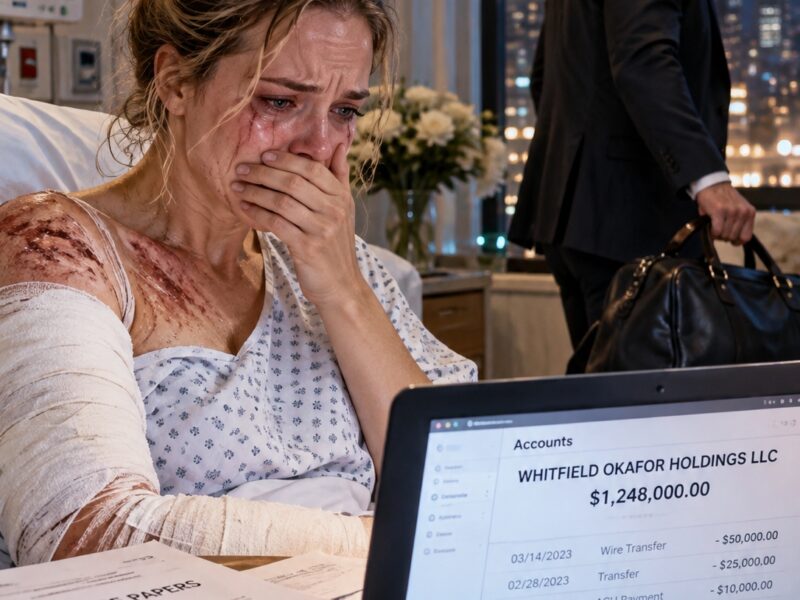
I RAN BACK INTO A BURNING HOUSE TO SAVE MY HUSBAND—THREE WEEKS LATER, HE LEFT ME IN THE HOSPITAL… THEN I FOUND THE ACCOUNT HE THOUGHT THE FIRE HAD ERASED

The first thing my husband did after I saved his life was leave me.
Not immediately.
That would have been easier to understand.
Terrence waited until the doctors had peeled burned skin from my right arm, until the swelling around my collarbone had started to go down, until I could sit upright without the room tilting.
Then he walked into my hospital room carrying his car keys and wearing the expression of a man who had already rehearsed the conversation somewhere else.
“I’m not built for this, Dany.”
I stared at him.
“For what?”
His eyes moved toward my bandaged arm.
He tried not to look directly at it.
That hurt more than I expected.
“All of it,” he said.
Three weeks earlier, I had thrown myself underneath a burning ceiling beam to keep it from crushing him.
Now my husband couldn’t look at the scars it had left behind.
He rubbed his palms against his thighs.
“I think I need to move on.”
“Move on where?”
“I got a place.”
The words landed quietly.
That was the strange thing about the worst moments of your life. Sometimes there was no thunder. No shattered glass. No dramatic music.
Sometimes there was only an IV pump clicking beside your bed and a man you had loved for fourteen years telling you that he had already rented another apartment.
“I’ll send someone for the rest of my things,” he said.
I looked at him for a long time.
Then I asked the question he wasn’t expecting.
“What about Whitfield Okafor Holdings?”
His entire face changed.
Not much.
But enough.
“What did you just say?”
And that was when I knew the fire wasn’t the worst thing Terrence had done to me.
It might only have been the thing that almost kept me from finding out.
Three weeks earlier, at exactly 2:07 in the morning, our smoke alarm started screaming.
I had always been a light sleeper.
My work had trained me that way.
I was a forensic accountant, which meant people generally called me after money disappeared and everyone involved had developed a sudden inability to remember where it went.
Numbers had patterns.
So did lies.
Spend enough years staring at both and some part of your brain never fully shuts down.
That night, I was awake before I understood why.
The bedroom was dark.
For half a second, everything looked normal.
Then I breathed.
Smoke.
Not thick yet.
Just the first bitter trace of it.
The warning before the warning.
“Terrence.”
He didn’t move.
I pushed his shoulder.
“Terrence, wake up.”
He groaned and turned away.
Then I saw it.
A thin gray ribbon of smoke curling underneath our bedroom door.
My stomach dropped.
“Terrence!”
He jerked upright.
“What?”
“The house is on fire.”
That sentence woke him.
I was already out of bed.
I pressed the back of my hand against the bedroom door because somewhere, years earlier, I had read that was what you were supposed to do.
Warm.
Not hot.
I opened it.
Heat rolled through the doorway.
Smoke hung against the ceiling, black and gray, moving downward like a tide.
At the far end of the hallway, orange light pulsed from the direction of the garage.
Terrence’s home office was beside it.
The stairs were the other way.
Maybe twenty feet.
“Stay low,” I told him.
“What happened?”
“I don’t know. Move.”
We crouched.
I grabbed his wrist.
He stumbled behind me, coughing, half awake, turning his head toward the glow as if his brain still hadn’t accepted what was happening.
“Don’t look back.”
“Dany—”
“Move.”
The smoke burned my eyes.
My lungs tightened.
We were almost at the stairs when I heard the sound.
A crack.
Deep.
Heavy.
Then the groan of timber surrendering.
I looked up.
The ceiling beam above us was burning through its center.
There wasn’t time to calculate anything.
I shoved Terrence toward the stairs.
“GO!”
He fell forward.
The beam came down.
Pain exploded through my right arm.
There is no elegant way to describe severe pain.
It doesn’t feel poetic.
It feels white.
It feels enormous.
It feels like your entire body has suddenly become one nerve.
The beam struck from my wrist toward my shoulder and slammed me into the wall.
For one terrible second, I couldn’t breathe.
Then the burning timber rolled away.
Terrence shouted my name.
I looked down.
My arm didn’t look like mine.
But the stairs were still there.
So was my husband.
I grabbed the railing with my left hand.
“Keep moving.”
I don’t remember the last ten feet.
I remember smoke.
I remember Terrence’s back.
I remember falling.
Then suddenly I was outside.
Wet grass pressed against my knees.
Cold night air filled my lungs.
Across the street, porch lights snapped on one after another.
Someone was shouting into a phone.
“Yes, fire. The Okafor house. Please hurry.”
I looked at my arm.
The skin was red and tightening. Blisters were already rising along my forearm, the damage climbing toward my shoulder and collarbone.
I knew enough not to touch it.
“Terrence?”
My voice barely came out.
I turned.
He was six feet away.
Uninjured.
Standing beneath the orange glow of our burning home.
Looking at his phone.
Not at me.
His phone.
His thumb moved across the screen.
Slowly.
Calmly.
As if whatever was happening there required more attention than his wife kneeling in the grass with burned skin hanging from her arm.
“Terrence.”
He looked up.
For a fraction of a second, something crossed his face.
Not fear.
Not relief.
Something closer to irritation at being interrupted.
Then it vanished.
He put the phone into his pocket.
“You okay?”
I stared at him.
Behind us, one of the upstairs windows blew out.
Glass fell through the darkness.
I should have answered.
Instead, I remember thinking something that made no sense at the time.
Who had he been texting?
The ambulance arrived seven minutes later.
Terrence climbed inside with me.
The paramedics cut fabric away from my arm, checked my breathing, started an IV and asked me questions in calm voices.
Name.
Date of birth.
Allergies.
Pain level.
I answered everything.
Across from me, Terrence took out his phone again.
His lips moved.
He was speaking so quietly I couldn’t hear.
I closed my eyes.
At the hospital, I woke beneath white lights.
Terrence was near the window talking to two men from his firm.
He had changed clothes.
I didn’t recognize the shirt.
He was laughing.
Actually laughing.
Then one of the men glanced toward me, and Terrence immediately lowered his voice.
“She’s tough,” he said.
He walked to my bedside.
“Tougher than me. Always has been.”
He kissed my forehead.
His hand rested on my uninjured arm.
Exactly long enough for everyone to see.
“You feeling okay, baby?”
“Thirsty.”
He handed me water.
Then turned back toward his colleagues before I had finished drinking.
That was when I began watching him.
Not because I believed he was cheating.
Not yet.
Because something felt misaligned.
And misalignment was something I understood.
Terrence became the perfect husband whenever there was an audience.
He asked nurses intelligent questions.
He brought coffee.
He told visitors how terrified he’d been.
He told everyone I had saved his life.
But when the room emptied, something changed.
He became restless.
His attention wandered.
His phone never left his hand.
Two or three times every day, he disappeared into the hallway.
He always came back with a reason.
Coffee.
Insurance.
A work call.
Stretching his legs.
Once, while pretending to sleep, I heard his voice outside my door.
Soft.
Low.
Warm.
I had been married to that voice for fourteen years.
I knew exactly when Terrence was speaking to a client.
That wasn’t it.
The call stopped the second he noticed movement inside my room.
Then he waited.
A few seconds later, he came in.
I kept my eyes closed.
His mother, Odessa, visited every day that first week.
She was small, composed and almost aggressively practical.
She brought homemade food because she considered hospital food an insult to human dignity.
She checked my medications.
She interrogated nurses.
She adjusted blankets.
And she watched her son.
On the fifth day, Terrence left to deal with the insurance company.
Odessa sat beside me.
For a while neither of us spoke.
A cart squeaked past in the hallway.
Then she said, “You went back for him.”
I looked at her.
“I got us out.”
“No.”
Her voice was firm.
“You put yourself between him and that beam.”
I didn’t answer.
Odessa reached carefully across the bed and covered my left hand with hers.
“You saved my son’s life.”
Her eyes stayed on mine.
“Don’t ever let him forget it.”
Something about the way she said those words made me uneasy.
As if she wasn’t reminding Terrence.
As if she was warning me.
The following afternoon, nurses changed my dressings.
Terrence stood against the wall.
I tried not to look at my arm.
The burns were healing, but healing wasn’t pretty.
There were raw edges, swollen tissue, skin that would never look exactly the way it had before.
The nurse lifted another section of gauze.
Pain shot through me.
Without thinking, I reached toward my husband with my left hand.
Terrence looked at it.
Then at my arm.
His expression changed.
“I just…”
He cleared his throat.
“I need some air.”
He walked out.
My hand stayed suspended for a moment.
Then I lowered it.
The nurses said nothing.
Ten minutes later, movement outside the window caught my attention.
Terrence was crossing the hospital parking lot.
A dark green duffel bag hung from his shoulder.
I recognized it.
It had been in the back of our closet for years.
He reached his car.
Opened the trunk.
Put the bag inside.
Then he looked up.
Directly toward my hospital window.
He couldn’t possibly have known I was watching.
But for one strange second, it felt like he did.
Then he got into the car.
And drove away.
He didn’t come back that night.
Or the next.
No call.
No text.
Nothing.
For forty-eight hours, I stared at the hospital ceiling and did what I had built an entire career around doing.
I separated what I knew from what I felt.
I felt abandoned.
That wasn’t evidence.
I felt humiliated.
Not evidence.
I believed there was another woman.
Still not evidence.
What did I know?
Terrence had been making private calls.
He had packed a bag before telling me he was leaving.
He had been unusually involved with the insurance claim.
The fire had begun near his home office.
And for months before the fire, he had spent more and more nights locked inside that office.
Facts.
Start with facts.
Terrence returned on Tuesday at eleven in the morning.
He sat beside my bed.
“I’ve been doing a lot of thinking.”
“Okay.”
“This whole thing…”
His hand moved vaguely toward my bandages.
“I’m not equipped for this, Dany.”
“For what?”
He looked away.
“All of it.”
I waited.
“I think we need space.”
“Space?”
“To process.”
“You rented an apartment.”
His eyes flicked back to mine.
“How did you know?”
“I watched you leave with a duffel bag.”
Silence.
Then I asked, “Why are you really leaving?”
“I just told you.”
“No. You described what you’re doing. You haven’t told me why.”
His jaw tightened.
I watched him carefully.
Then another thought surfaced.
Something from our finances.
A series of transfers I’d noticed months earlier but had assumed were related to one of his development projects.
“What happened to the money?”
That did it.
A tiny contraction around his eyes.
“What money?”
“Our joint savings.”
“Dany, this isn’t the time.”
I almost laughed.
Instead I looked around the hospital room.
“I have nothing but time.”
He stood.
“I’ll have my attorney contact you.”
Then he made his mistake.
“The Whitfield account is business property anyway.”
I went completely still.
“The what?”
He stopped.
Terrence was an intelligent man.
Intelligent enough to hear his own mistake.
“Whitfield Okafor Holdings,” he said quickly. “Gerald and I created it for the Meridian project. It’s separate property.”
I stared at him.
Fourteen years.
I had never heard the name.
Not once.
Terrence picked up his keys.
“I’ll call you.”
“No.”
He paused.
“You don’t need to call me.”
His face hardened slightly.
Then he left.
I waited until the door closed.
Then I reached for my phone.
My oldest friend, Renee, answered on the second ring.
“How are you feeling?”
“I need my laptop.”
There was a pause.
“What happened?”
“Terrence left.”
Another pause.
“And?”
“He said the name of an account I’ve never heard before.”
Renee knew me too well.
“What time do you need the laptop?”
“Tonight.”
“I’ll be there at seven.”
She arrived at seven exactly.
Laptop.
Charger.
Soup.
No speech.
No pity.
She had known me since we were eleven and understood that there were moments when love meant not asking someone to talk.
“Call me if you need me,” she said.
Then she left.
I opened the laptop.
The hospital room was dark.
Machines beeped somewhere down the corridor.
I started with our checking account.
Then savings.
Then investment transfers.
I followed every movement backward.
Forty minutes later, I found it.
WHITFIELD OKAFOR HOLDINGS LLC.
The first transfer was fourteen months old.
Then another.
Then another.
Four thousand.
Five thousand.
Six thousand.
Small enough to disappear inside the normal movement of a two-income household with investments, property expenses and a husband working in commercial development.
But not to me.
Once I knew what I was looking for, the pattern became obvious.
Terrence hadn’t moved money once.
He had been moving it systematically.
Month after month.
Quietly.
Patiently.
And he’d been doing it long before our house burned.
I sat in the blue light of the laptop and felt something inside me become very calm.
Not peaceful.
Calm.
There is a difference.
I closed the computer.
My right arm throbbed beneath the dressings.
Terrence thought he had left a broken woman in a hospital bed.
What he had actually left was a forensic accountant with fourteen years of access to his financial life.
And now I had a name.
Whitfield Okafor Holdings.
I intended to find out exactly what it was.
When I was discharged, I moved into Renee’s guest room.
Our house was uninhabitable.
My marriage apparently was too.
Renee’s house smelled like coffee and dryer sheets. The guest room had a firm mattress, a good reading lamp and a window overlooking a dogwood tree.
For three days, I did almost nothing.
I watched birds land on the feeder outside.
I slept badly.
I learned how many ordinary movements required two functional arms.
Buttoning jeans.
Opening jars.
Washing my hair.
Pulling a shirt over my head.
Sometimes grief came through the obvious door.
Sometimes it arrived because you couldn’t fasten your own bra.
On the fourth morning, I set up my laptop.
Renee appeared in the doorway.
“You sure?”
“No.”
She nodded.
“Coffee?”
“Yes.”
That was the entire conversation.
I created a timeline.
The money.
Terrence’s late nights.
The LLC.
The fire.
The apartment.
The woman I still couldn’t name.
Then I called Isaiah Vance.
Isaiah and I had known each other since college.
He had become an investigator with the county fire marshal’s office.
I had become the woman banks hired when numbers stopped making sense.
We hadn’t spoken in months.
He answered immediately.
“Dany.”
“I need a favor.”
“I heard about the fire.”
His voice softened.
“How bad?”
“I’ll heal.”
“That wasn’t what I asked.”
“It’s the answer I have.”
He let that sit.
“What do you need?”
“The fire report.”
He brought it himself two days later.
He sat across from me at Renee’s kitchen table and opened a folder.
“The insurance company gets the official version,” he said. “I’ll tell you what I told them.”
He turned a floor plan toward me.
A red mark showed the northwest corner of the garage.
“Point of origin.”
“Near Terrence’s office.”
“Yes.”
“He told investigators it was the breaker panel.”
“I know.”
“Isn’t the breaker panel on the east wall?”
Isaiah looked at me.
“Yes.”
The kitchen became very quiet.
“So they don’t match.”
“Not cleanly.”
“Arson?”
“I’m not saying that.”
He leaned back.
“Fire behaves unpredictably. Secondary ignition, debris patterns, structural changes—there are legitimate explanations.”
“But?”
He hated that word.
I knew he did.
Still, after a moment, he answered.
“But the origin pattern is inconsistent with the explanation your husband gave.”
I looked at the floor plan.
“What was in that section?”
“Home office wall. Storage. Some shelving.”
I remembered Terrence locking his office.
The filing cabinet.
His laptop.
Late nights.
“Isaiah.”
“Yeah?”
“If somebody had documents they wanted destroyed…”
His face changed.
“Dany.”
“I’m asking technically.”
He waited.
“If somebody wanted paper files and a computer destroyed and wanted the damage to look accidental, would starting a fire there accomplish it?”
He didn’t answer immediately.
Finally:
“Yes.”
I told him about Whitfield Okafor Holdings.
Not my suspicions.
The transactions.
The dates.
The facts.
When I finished, Isaiah closed the folder.
“Don’t confront Terrence.”
“I already asked him about the account.”
“Don’t ask again.”
His tone sharpened.
“If he knows exactly what you’ve found, records disappear. People coordinate stories. Devices get replaced.”
He pushed his card across the table.
“Build the whole picture first.”
After he left, I wrote one word across the top of my legal pad.
TIMELINE.
Then I began.
Whitfield Okafor Holdings had been registered sixteen months earlier.
Two members.
Terrence Dominic Okafor.
Gerald Aaron Whitfield.
I knew Gerald.
Commercial development.
Expensive suits.
Loud laugh.
A handshake designed to make you aware he owned a watch worth more than your first car.
The registered address was a mailbox service six blocks from Terrence’s office.
That was interesting.
But the money was more interesting.
I followed the routing numbers.
Then the originating accounts.
Then I stopped breathing.
The money entering Whitfield Okafor Holdings wasn’t coming from Terrence.
It wasn’t Gerald’s money either.
It came from client escrow accounts.
Real clients.
Real property closings.
Deposits that were supposed to remain protected until transactions closed.
Someone had skimmed them in increments small enough to avoid automatic compliance alerts.
Four thousand here.
Six thousand there.
Amounts designed by someone who understood exactly where the alarm thresholds were.
I checked again.
Then again.
Eleven client accounts.
More than a year of activity.
By the time I finished tracing the full pattern, the exposure was well into six figures.
I wrote one word.
ESCROW.
Underlined it twice.
This wasn’t a husband hiding money before a divorce.
This wasn’t an affair fund.
This was fraud.
Potentially felony fraud.
Renee came into the kitchen.
She looked at my screen.
Then at me.
“Dany.”
“I know.”
“No, I don’t think you do.”
She planted both palms on the table.
“You need a lawyer.”
“I know.”
“Today.”
“I know.”
“You’re sitting on evidence that could become part of a criminal investigation.”
“I know.”
“Then stop saying ‘I know’ like you’re going to keep digging anyway.”
I looked at her.
She exhaled.
“You’re going to keep digging anyway.”
“One more thing.”
She closed her eyes.
“Of course.”
I turned the laptop toward her.
“There are expenses attached to the LLC.”
“And?”
“One name keeps appearing.”
Simone Laurent.
Junior associate.
Terrence’s firm.
Late twenties.
Five months of calendar entries.
Restaurant charges.
Hotel expenses.
A furniture purchase.
Renee stared at the name.
“You think she’s the woman.”
“I think she knows something.”
“Those aren’t the same thing.”
“No.”
I closed the laptop.
“But I’m going to find out which one she is.”
Three days later, I sat inside Birch & Brew half a block from Terrence’s office.
Simone entered at 12:17.
I recognized her from her professional profile.
Camel blazer.
Dark jeans.
Hair pulled neatly back.
She ordered without checking the menu.
A regular.
When she turned with her coffee, I stood.
“Simone?”
“Yes?”
“My name is Danielle.”
Nothing.
Then:
“I know Terrence.”
Her expression recalibrated.
“Okay.”
“Could I ask you a couple questions?”
Her eyes dropped briefly toward the scars visible above my collar.
“Sure.”
We sat.
I didn’t accuse her.
I asked about the fire.
“When Terrence told you about it, had he already filed the insurance claim?”
Her fingers stopped around her coffee cup.
“I don’t know anything about an insurance claim.”
“Did he tell you how the fire started?”
“Electrical.”
“Did he tell you I was inside?”
That changed everything.
Simone went still.
“He said…”
She stopped.
“What?”
“He said you weren’t together.”
I said nothing.
“He told me you’d separated months ago.”
There are moments when pain arrives so cleanly that it almost feels cold.
I had suspected an affair.
Hearing it was different.
“How long have you been seeing him?”
Simone’s face lost color.
“About five months.”
Five months.
Before the fire.
Before my scars.
Before Terrence stood in my hospital room telling visitors how grateful he was that I had saved him.
“He said you ended the marriage,” Simone whispered. “He said you had emotionally checked out. That you asked him to leave.”
“I pulled him out of a burning house three weeks ago.”
Her eyes moved to my arm.
“I was hospitalized afterward.”
She stared at me.
“He never told me that.”
“I know.”
“He told me you weren’t living together.”
“We were sleeping in the same bed when the smoke alarm went off.”
Simone leaned back.
For the first time, she looked less like the other woman and more like another person who had just realized Terrence had built an entire reality around her.
“Who are you?” she whispered.
“His wife.”
She swallowed.
“We haven’t even filed for divorce.”
Outside, traffic moved normally.
Someone laughed near the counter.
A blender started.
The ordinary world continued while Simone Laurent discovered that the man she thought loved her had invented a dying marriage to justify an affair.
Finally she said, “Can I have your number?”
“Why?”
“I need time.”
I wrote it on a napkin.
She folded it twice.
I stood.
“Simone?”
She looked up.
“If he contacts you today, don’t tell him you met me.”
Her face tightened.
“Why?”
“Because the affair isn’t the reason I came.”
I walked away before she could ask what that meant.
Terrence appeared at Renee’s house two days later carrying yellow flowers.
Yellow.
Not roses.
Not lilies.
Flowers selected by someone who wanted credit for thoughtfulness without the inconvenience of actual intimacy.
He wore a navy blazer.
Fresh haircut.
Polished shoes.
And carried a manila envelope.
“I thought we should talk.”
Renee wanted to stay.
I asked her not to.
Terrence sat on the couch.
The flowers went onto the coffee table.
The envelope followed.
“How are you feeling?”
“Better.”
“You look good.”
“Considering?”
He ignored that.
“My attorney put something together.”
He pushed the envelope toward me.
“I want this to be easy.”
I opened it.
The settlement looked reasonable.
That was the point.
Shared accounts divided.
Medical expenses addressed.
Property distributed.
Then page four.
Whitfield Okafor Holdings LLC was classified as Terrence’s separate business property.
Excluded from marital division.
Excluded from discovery if I signed quickly enough.
There it was.
The reason for the flowers.
The reason for his urgency.
Not love.
Containment.
“It’s fair,” he said.
I continued reading.
“You’ll be taken care of.”
Still reading.
“I know I haven’t handled everything perfectly.”
That almost made me smile.
“But dragging this through lawyers won’t help either of us.”
I closed the document.
“I’ll have my attorney review it.”
A beat.
“Of course.”
His smile returned too quickly.
“I was just hoping we could move fast.”
“Why?”
“Business reasons.”
“What business reasons?”
“The longer a divorce remains open, the more complicated things become.”
“For Whitfield Okafor Holdings?”
Silence.
There.
Just for a second.
Fear.
Then it disappeared.
“Among other things.”
I nodded.
“Then I’m sure your attorney can explain them to mine.”
Terrence studied me.
He was looking for the woman he knew.
The woman who cried when we fought.
The woman who wanted reconciliation.
The woman he could reassure, exhaust or confuse until she accepted whatever version of reality he needed.
She wasn’t there.
Eventually he stood.
At the door, his gaze dropped toward my scars.
“Take care of yourself.”
“I am.”
I closed the door.
My attorney’s name was Patricia Olay.
She read everything without interrupting.
The LLC.
Escrow transactions.
Fire report.
Simone.
Settlement agreement.
When she finished, she placed both hands on the folder.
“You assembled this?”
“It’s what I do.”
She studied me.
“Danielle, this stopped being primarily a divorce case somewhere around page twelve.”
“I know.”
“Good.”
She closed the file.
“Then we’re going to treat it accordingly.”
There was one more person I needed to tell.
Odessa.
Terrence’s mother opened her door before I knocked twice.
“You didn’t come to ask how I’m doing.”
“No.”
“Tea?”
“Yes.”
That was Odessa.
Even disaster required tea.
I told her everything.
She interrupted only once.
“When did he create the company?”
“Sixteen months ago.”
Her eyes changed.
I continued.
The client money.
Simone.
The fire discrepancy.
The settlement.
When I finished, Odessa said nothing.
She stood.
Walked into the hallway.
I heard a closet open.
Then another door.
She returned holding a gray flash drive.
The label was old and partially peeled away.
She placed it on the table.
“Terrence gave me this fourteen months ago.”
My pulse changed.
“What did he say was on it?”
“Old office files.”
“Did you ever open it?”
“No.”
“Why did he give it to you?”
“He said he was clearing things out and wanted a copy somewhere safe.”
Fourteen months.
Almost exactly when the transfers began.
Odessa looked at the drive.
Then at me.
“I always knew my son could be selfish.”
Her voice trembled once.
She controlled it.
“Selfishness I understand. Cowardice, even.”
She pushed the drive toward me.
“But this?”
Her eyes filled.
She refused to let the tears fall.
“That’s my son, Dany.”
I didn’t move.
“I know.”
She looked at me.
“But you are my daughter.”
I had survived fire without crying.
I had watched my husband leave me from a hospital window without crying.
I had discovered his affair without crying.
That nearly did it.
I closed my fingers around the flash drive.
Patricia had it examined properly.
No casual opening.
No contaminating metadata.
No mistakes.
The drive contained draft formation documents for Whitfield Okafor Holdings.
Routing instructions.
Early operating agreements.
Account structures.
Blank signature pages.
The metadata predated the financial transfers.
It also predated the fire.
Terrence hadn’t improvised the company after our marriage collapsed.
He had been building it while I still thought we were building a life together.
Patricia contacted the appropriate compliance people.
Isaiah received the financial motive information.
The fire investigation was reopened.
Then we waited.
Three weeks later, Terrence walked into divorce mediation believing he was there to negotiate property.
He wore his best charcoal suit.
I wore a dark green blouse.
For the first time since the fire, I didn’t cover my right arm.
The scars were visible from wrist to elbow.
Terrence noticed immediately.
“Dany.”
“Terrence.”
“You look well.”
“Thank you.”
His lawyer arranged papers.
Patricia closed the conference-room door.
“Before we discuss settlement terms, two additional parties will be joining us.”
Terrence’s lawyer frowned.
“That wasn’t agreed upon.”
“This is preliminary mediation. You can note your objection.”
The door opened.
Gerald Whitfield entered first.
Behind him came Carol Moangi, the firm’s compliance officer.
Terrence stopped moving.
It lasted less than a second.
But I saw it.
Forensic accounting teaches you that people rarely confess with words first.
Their bodies confess.
A hand freezes.
A blink comes late.
A jaw tightens.
Terrence’s body had just confessed that he knew exactly why Carol was there.
“Gerald.”
Gerald didn’t answer.
Patricia looked at me.
“Danielle?”
I opened my folder.
And I did what I had done hundreds of times professionally.
I followed the money.
No accusations.
No speeches.
Dates.
Account numbers.
Transfers.
Eleven client escrow accounts.
Whitfield Okafor Holdings.
Fourteen months of movement.
Then the fire report.
The origin point near Terrence’s office.
The electrical explanation that didn’t align cleanly with it.
Then the flash drive.
Creation dates.
Routing instructions.
Draft documents.
Terrence finally interrupted.
“These documents are being misinterpreted.”
I looked at him.
“Which documents?”
“The LLC materials.”
“How?”
“Draft documents get created all the time.”
“The escrow transfers aren’t drafts.”
“There are accounting explanations.”
“Which ones?”
He stared at me.
Gerald’s chair scraped backward.
Everyone looked at him.
His face had gone gray.
“Carol.”
The compliance officer turned.
Gerald pointed toward the transaction records.
“Those transfers went through on my authorization.”
Terrence snapped his head toward him.
“Gerald—”
“You told me they were reclassified internal funds.”
“Don’t do this.”
Gerald looked directly at him.
“They weren’t internal funds, were they?”
“Gerald.”
“I have the emails.”
Terrence’s face hardened.
“I have every email you sent me about those accounts.”
Gerald’s breathing had become shallow.
“I kept everything.”
“Gerald, shut up.”
The room froze.
Terrence realized what he’d said.
Too late.
Gerald leaned back.
“No.”
His voice was quieter now.
“I’m not going down for you.”
Terrence turned toward me.
And finally, the man I had married disappeared.
No charm.
No wounded husband.
No thoughtful businessman.
Only calculation.
“You have no idea what you’re doing.”
I looked at him.
“I know exactly what I’m doing.”
“You think because you can read bank statements—”
“I don’t think anything.”
I placed the timeline between us.
“You created the LLC sixteen months ago.”
I touched the next line.
“You started moving client money afterward.”
Another line.
“The fire came later.”
Another.
“You had already built an exit.”
His jaw clenched.
“And I still ran back into that house for you.”
Silence.
That was the first time something like shame appeared in his face.
Maybe it wasn’t shame.
Maybe it was only the knowledge that everyone in the room had heard the sentence.
Either way, I continued.
“You knew you were leaving me.”
“That’s not—”
“You were seeing Simone.”
His eyes flashed.
“You told her we’d separated.”
“Dany—”
“You told investigators the fire was electrical.”
“Careful.”
The word came out low.
Threatening.
Familiar.
I almost smiled.
Patricia spoke before I could.
“Mr. Okafor, if you believe any of the records presented today are factually incorrect, identify the error.”
Terrence said nothing.
“Account number?”
Nothing.
“Transaction date?”
Nothing.
“Metadata?”
Nothing.
“Fire report?”
Nothing.
Patricia folded her hands.
“Then I suggest we avoid vague threats.”
Terrence looked around the room.
Gerald wouldn’t meet his eyes.
Carol was taking notes.
His attorney looked like a man reconsidering every conversation he’d had with his client.
Then Terrence saw Odessa.
His mother sat against the far wall.
She had arrived quietly before the meeting.
“Mom.”
His voice changed.
For the first time that afternoon, he sounded like someone’s son.
“You know me.”
Odessa looked at him.
“Tell them.”
She remained silent.
“Mom.”
Nothing.
“Tell them you know me.”
Odessa’s face didn’t harden.
That would have been easier.
She simply looked at her son with unbearable clarity.
The silence lasted perhaps five seconds.
It felt longer.
Terrence understood.
His mother wasn’t going to rescue him.
Not this time.
He looked away.
And that was the moment I knew the marriage was truly over.
Not when he left the hospital.
Not when I found Simone.
Not when I traced the stolen money.
It ended when the last person in the room who loved Terrence enough to lie for him chose not to.
After that, events moved without needing me to push them.
Compliance reported its findings to the board.
The board referred the financial evidence to law enforcement.
Gerald cooperated.
Aggressively.
He produced emails.
Routing authorizations.
Messages.
Every piece of documentation that could separate his responsibility from Terrence’s.
I didn’t admire him for it.
I didn’t hate him either.
Gerald was doing what Gerald did best.
Saving Gerald.
This time, it happened to be useful.
The reopened fire investigation incorporated the financial evidence.
Investigators now had a motive they hadn’t had before.
The insurance carrier reevaluated the claim.
Terrence’s version of events stopped being the only version in the file.
The fraud case expanded.
His firm suspended him.
The divorce settlement he had wanted me to sign disappeared immediately.
So did the fiction that Whitfield Okafor Holdings was simply his private business property.
Simone called me one Thursday evening.
“I went to his office.”
I sat on Renee’s back porch.
“How did that go?”
“I did it in front of people.”
“Why?”
“Because I didn’t want a private conversation he could rewrite later.”
I understood that completely.
“What did he say?”
“He tried to explain.”
“And?”
A dry laugh.
“He’s not very good at explaining when he can’t control who’s listening.”
“No.”
I watched a sparrow land on the dogwood tree.
“He isn’t.”
There was a pause.
“I’m sorry,” Simone said.
“For what?”
“I should have known.”
“No.”
I surprised myself by meaning it.
“You should have been told the truth.”
“So should you.”
“Yes.”
That was enough.
We never became friends.
We didn’t need to.
Some people enter your life because you belong together.
Others enter because the same liar placed you inside different versions of the same story.
Sometimes recognizing that is enough.
Terrence was served with restitution-related papers outside the apartment he had rented after leaving me.
I wasn’t there.
Patricia told me.
Apparently the process server caught him in the parking lot.
Alone.
Months earlier, I might have imagined the scene a hundred different ways.
His embarrassment.
His anger.
The moment he realized how far he’d fallen.
When it actually happened, I felt almost nothing.
That surprised me.
For a long time, I thought healing would feel like justice.
It didn’t.
Justice was paperwork.
Deadlines.
Depositions.
Account statements.
Healing was different.
Healing was the first morning I showered without thinking about how my scars looked.
It was the first night I slept eight hours.
It was realizing I hadn’t checked whether Terrence had called.
It was hearing his name and noticing my heart rate didn’t change.
It was ordinary.
That was the beautiful part.
Almost a year after the fire, I stood in an empty office with fresh paint on the walls.
Three rooms.
Fourth floor.
Large windows.
Nothing extravagant.
Everything mine.
On the frosted glass door were gold letters:
D. OKAFOR CONSULTING
FORENSIC FRAUD SERVICES
Renee stood behind me holding champagne.
“You know you’re supposed to pretend to be surprised.”
“I watched you bring the bottle upstairs.”
“You could still participate.”
“I am participating.”
“You’re impossible.”
She opened it anyway.
The cork hit the ceiling.
Renee jumped.
I laughed so hard my arm hurt.
Not the burn.
The muscles.
A normal hurt.
I liked that.
I had left the bank months earlier.
No dramatic resignation.
No speech.
I worked my final day, packed a box and walked out.
By the time I opened the consultancy, three clients were waiting.
Six months later, I had a waiting list.
People came to me when money disappeared.
When partnerships collapsed.
When spouses hid assets.
When executives thought a complicated enough spreadsheet could bury the truth.
I knew something about buried truth now.
It rarely stayed buried because lies had one fatal weakness.
They required maintenance.
The truth didn’t.
The truth only needed someone patient enough to keep looking.
Sunday dinners became a tradition at Odessa’s house.
The first one happened by accident.
She called.
“Have you eaten?”
“Not really.”
“Come over.”
So I did.
Then I went the following Sunday.
And the next.
Eventually nobody discussed it.
It was simply Sunday.
One afternoon, a woman from Odessa’s church asked if she had children.
Odessa didn’t hesitate.
“I have a daughter.”
The woman smiled at me.
I had to look away for a second.
Isaiah began coming to those dinners too.
At first, because Odessa invited him.
Then because he seemed to find reasons.
Eventually he stopped needing reasons.
Four months after the mediation, he asked me to dinner.
“Just dinner,” he said.
“Why do you keep emphasizing that?”
“Because I’m trying very hard not to make this complicated.”
I looked at him.
“Is it complicated?”
His mouth twitched.
“Not from where I’m standing.”
So we went.
There was no lightning.
No sweeping declaration.
No moment where the universe announced that my life had finally corrected itself.
There was dinner.
Then another.
There were walks.
Coffee.
Sunday afternoons.
There was a man who didn’t disappear when my arm hurt.
A man who didn’t look away from the scars.
A man who had known me before Terrence and somehow never tried to use that history as leverage.
Isaiah was simply there.
Steady.
Unhurried.
True.
One evening, nearly two years after the fire, I was alone in my office finishing a report.
My sleeves were rolled to my elbows.
I had stopped covering the scars months earlier.
I couldn’t remember the exact day.
That was how I knew it mattered.
The biggest changes in your life don’t always announce themselves.
Sometimes you reach for the cardigan you normally use to hide your arm.
Then you decide you’re warm enough without it.
And never reach for it again.
At 5:50, my phone buzzed.
Isaiah.
Downstairs when you’re ready. No rush.
I smiled.
I was closing my laptop when a browser tab refreshed.
A regional business journal.
Four sentences near the bottom of the page.
There was Terrence.
I recognized him from the photograph before I read his name.
Terrence Okafor, formerly associated with Whitfield Okafor Development, had finalized a civil fraud settlement connected to the embezzlement investigation.
He was no longer working in commercial real estate development.
The article said he had taken a job in residential property management.
He declined to comment.
I read the paragraph twice.
Then waited.
For satisfaction.
For anger.
For grief.
For something.
Nothing came.
And suddenly I understood that nothing was the gift.
Terrence had once occupied so much space inside my life that I could tell what mood he was in by the way he placed his keys on the counter.
I knew the sound of his footsteps.
The rhythm of his breathing.
The shirts he wore when he wanted people to trust him.
The expression he used when he was lying but wanted to believe he wasn’t.
Now I could read four sentences about him and feel the same distant neutrality I felt reading the weather forecast for a city I’d never visited.
He had become information.
Nothing more.
I closed the browser.
Then the laptop.
I stood and slipped my bag over my shoulder.
In the dark window, I caught my reflection.
White shirt.
Hair loose.
Scars visible.
For years, I had thought scars were proof of what had been done to you.
I knew better now.
They were also proof of what had failed to finish you.
I turned off the desk lamp.
The office fell dark behind me.
In the hallway, the gold letters on the glass caught the light.
My name.
My business.
My life.
I locked the door and walked toward the stairs.
Isaiah was waiting downstairs.
Odessa expected us for dinner on Sunday.
Renee had already texted me twice about plans for the weekend.
Tomorrow morning, three clients would arrive carrying boxes full of numbers somebody hoped I wouldn’t understand.
I would understand them.
That was what I did.
I descended the stairs slowly.
Not because my arm hurt.
It didn’t.
Not tonight.
Outside, Isaiah leaned against his car.
When he saw me, he straightened.
“You ready?”
I looked back once at the building.
Not at the office.
Not really.
At the woman reflected faintly in the glass door behind me.
For years, I had believed the defining moment of my marriage was the night I ran into smoke for Terrence.
It wasn’t.
It wasn’t even the moment the beam fell.
Or the moment he abandoned me.
Or the moment I found the stolen money.
The defining moment came much later, when I finally understood something I wished I had known while lying beneath those hospital lights.
Saving someone’s life does not make them worthy of yours.
Loving someone does not obligate you to disappear with them.
And surviving betrayal isn’t about making the person who hurt you regret losing you.
It is reaching a day when their regret no longer matters.
I turned toward Isaiah.
“Yeah,” I said.
“I’m ready.”
He opened the passenger door.
I laughed.
“I can open my own door.”
“I know.”
“Then why are you doing it?”
“Because I want to.”
There was no performance in his voice.
No audience.
No hidden transaction.
Just an ordinary sentence.
Maybe that was why it moved me.
I got in.
Isaiah walked around to the driver’s side.
Behind us, the building lights reflected against the windshield.
For one brief second, I could see the pale lines along my right arm in the glass.
Once, I had looked at those scars and seen the night my husband almost destroyed me.
Now they reminded me of something else.
The fire had taken my house.
Terrence had taken years.
The betrayal had taken whatever illusion remained.
But none of them had taken the one thing Terrence had misunderstood from the beginning.
Me.
Isaiah started the car.
I looked forward.
And this time, when we drove away, I didn’t look back.









