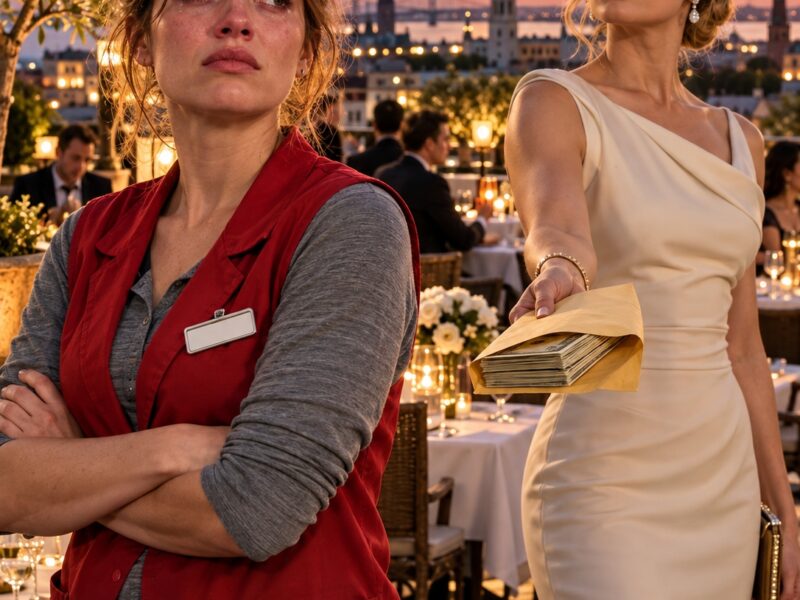
I SHOWED UP TO A MILLIONAIRE’S BLIND DATE IN MY GROCERY STORE UNIFORM—8 DAYS LATER, HIS FUTURE BRIDE OFFERED ME A FORTUNE TO DISAPPEAR… BUT ONE QUESTION AT THE FAMILY DINNER DESTROYED EVERYTHING.

The first time Megan Archer realized Nathan Alden might actually choose her, his family’s multimillion-dollar business deal was already collapsing.
She was standing at the edge of a rooftop terrace in downtown Charleston, still wearing the red vest from Archer Street Market, when thirty conversations died at once.
A champagne glass stopped halfway to someone’s mouth.
A photographer lowered his camera.
Across the terrace, Brooke Reynolds—the polished woman everyone had spent months quietly treating as Nathan’s inevitable future wife—had gone completely white.
And Arthur Alden, Nathan’s father, was staring at Brooke as though he had just discovered a crack running through the foundation of everything he had built.
“Did you offer her money?” he asked.
Brooke’s jaw tightened.
No one moved.
Arthur asked again.
“Did you offer Megan Archer money to leave Charleston?”
Megan felt every eye on her.
Investors.
Restaurant owners.
Members of two wealthy families.
People wearing dresses that probably cost more than she made in a month.
Eight days earlier, most of them wouldn’t have known her name.
Now they were staring at the woman in the grocery-store uniform as if she were holding a match beside a room full of gasoline.
Brooke finally spoke.
“You don’t understand what was at stake.”
Megan almost laughed.
Because that was exactly what Brooke had said when she’d appeared outside Megan’s apartment carrying a thick sealed envelope.
Nathan stood several feet away.
His face had gone still.
Megan looked at him.
And then she asked the question that would hurt far more than anything Brooke had done.
“When did you know?”
Nathan didn’t answer immediately.
That pause changed everything.
But the story hadn’t begun with money.
It hadn’t begun with Brooke.
It hadn’t even begun with the Alden family’s desperate attempt to save three struggling restaurants.
It had begun eight days earlier, with a woman arriving late for a blind date wearing a red market vest and wishing she could disappear.
Charleston was gold in the evening light.
From the rooftop terrace of Lynden House, church steeples rose beyond rows of old brick buildings, while the breeze coming in from the harbor moved the leaves of olive trees planted in oversized clay pots.
Nathan Alden had been waiting nineteen minutes.
He checked his phone once, then deliberately turned it facedown.
He had spent enough of his life looking at clocks.
Then he saw her.
Megan Archer was moving between the tables with the expression of someone walking into the wrong wedding.
Her red work vest was still on.
Her name badge sat crooked against her chest.
A canvas shopping bag hung from one shoulder, and loose strands of brown hair had escaped the hurried knot behind her head.
She stopped beside his table.
“I’m sorry.”
Nathan stood.
“A coworker needed me to cover the end of her shift. I thought I’d have time to go home first, but the closing delivery was late and—”
She stopped.
Her fingers touched the edge of her vest.
“I can leave.”
Nathan frowned.
“We can try another night,” Megan continued. “When I don’t look like I just spent nine hours arguing with produce.”
He looked at the vest.
Then at her.
Megan braced herself.
She knew that look.
Or thought she did.
Years earlier, another man had taught her how quickly someone’s expression could change when they decided her life wasn’t polished enough for theirs.
But Nathan pulled out the chair opposite him.
“Stay.”
She blinked.
“You’re sure?”
“I spent my afternoon in a conference room listening to four people argue about restaurant supply margins.”
He leaned slightly closer.
“You smell like coffee, cardboard and floor cleaner.”
Megan’s cheeks warmed.
Nathan loosened his tie.
“I probably smell like a board meeting.”
A laugh escaped her before she could stop it.
“I think we’re even,” he said.
Something shifted.
Not dramatically.
There was no cinematic music, no instant certainty, no moment when either of them understood that the next eight days would rearrange their lives.
Megan simply sat down.
And Nathan never mentioned the vest again.
That mattered more than he knew.
They talked about terrible customers.
Impossible schedules.
Restaurant menus that used twelve words to describe mashed potatoes.
Megan told him about a customer who had shopped at Archer Street Market every Thursday for six years and still asked where they kept the rice.
Nathan admitted that owning upscale restaurants had not cured him of preferring cheeseburgers eaten over a kitchen sink.
“You own Lynden House,” Megan said.
“My family owns it.”
“That’s a very rich-person correction.”
He smiled.
“Fair.”
The evening became easy.
That frightened Megan more than awkwardness would have.
Because easy things had a way of making people careless.
Across the terrace, another woman had noticed them.
Brooke Reynolds sat with two executives near the railing, a glass of white wine between her fingers.
Her family controlled one of the largest regional food-distribution companies in the Carolinas.
For months, Reynolds Distribution and the Alden Restaurant Group had been negotiating a partnership that could stabilize several of the Aldens’ struggling locations.
Business gossip had transformed that partnership into something else.
Brooke and Nathan had grown up around the same circles.
They attended the same fundraisers.
Their fathers played golf together.
They photographed well beside each other.
Somewhere along the way, people stopped asking whether they were romantically involved and began behaving as though an engagement was merely waiting for the appropriate announcement.
Brooke had never corrected them very enthusiastically.
Neither had Arthur Alden.
Nathan had.
Repeatedly.
Nobody seemed interested in hearing him.
Now Brooke watched him laugh with a woman in a grocery-store uniform.
And for the first time, something theoretical became threateningly real.
After dessert, Nathan walked Megan toward the elevator.
“Give me one more dinner.”
She looked at him.
“That sounded almost like an order.”
“Please give me one more dinner.”
“Better.”
“Before my calendar belongs to everyone else.”
Megan hesitated.
Frank’s voice returned from years earlier.
You’ll never be comfortable around my family.
He had said it after she received a small promotion at another store.
She had expected him to be proud.
Instead, he’d looked almost embarrassed.
Megan had spent years pretending those words no longer mattered.
They did.
Nathan noticed her hesitation.
“You can say no.”
“I know.”
That was partly why she said yes.
She gave him her number.
The next morning, Carol Collins noticed the smile before Megan had even finished tying her apron.
Carol was recovering from surgery and wasn’t supposed to lift anything heavier than ten pounds, a medical instruction she interpreted as a personal insult.
Megan had been covering her heavier work for weeks.
Carol watched her stacking coffee bags.
“So.”
Megan kept working.
“So what?”
“Who is he?”
Megan nearly dropped a bag.
“I don’t know what you’re talking about.”
Carol pointed at her face.
“That.”
“My face?”
“That stupid little smile you’ve been wearing since you walked in.”
Megan rolled her eyes.
Carol grinned.
“I may be recovering from surgery. I am not blind.”
Twenty minutes later, Megan finally surrendered.
“His name is Nathan.”
“Nathan what?”
“Alden.”
Carol stopped counting the register.
“The Nathan Alden?”
“Please don’t say it like that.”
“Like what?”
“Like I accidentally had dinner with the governor.”
Carol stared.
“His family owns half the restaurants people take pictures of their food in.”
“Not half.”
“How many?”
“I don’t know.”
“Then half.”
Megan began opening another box.
“A man like that can date anyone.”
Carol shrugged.
“And apparently he wanted to date you.”
Megan looked down.
Before she could answer, the delivery entrance opened.
A driver carried in a large order sheet.
Imported olives.
Specialty oils.
Preserves.
Wine.
Products for a private event at Lynden House.
Megan checked the authorization.
Nathan Alden.
Carol leaned over her shoulder.
“Charleston isn’t finished with him.”
“It’s business.”
“Of course.”
Megan tried not to smile.
She failed.
Across town, Nathan was having a much less pleasant morning.
Arthur Alden sat opposite him in the conference room overlooking Charleston Harbor.
Financial reports covered the table.
Three restaurants were bleeding money.
One had an expensive lease.
Another had suffered through years of bad management.
A third had expanded its menu until the kitchen wasted thousands of dollars in ingredients every month.
“The announcement is in eight days,” Arthur said.
Nathan looked at the numbers.
“I remember.”
“The Reynolds investment gives us breathing room. Their distribution network cuts costs immediately.”
“I understand the business.”
Arthur removed his glasses.
“Then understand the rest.”
Nathan knew what was coming.
“Brooke will stand beside you during the announcement.”
“No.”
“Nathan.”
“A business partnership is one thing. Letting everyone pretend Brooke and I are planning a marriage is another.”
Arthur’s expression hardened.
“Nobody is announcing an engagement.”
“You don’t have to. Put us beside each other, invite photographers and start talking about two families sharing a future. People will do the rest.”
Arthur closed the folder.
“Sometimes perception has value.”
“So does truth.”
Arthur stared at his son.
Years earlier, the Alden company had nearly collapsed during an aggressive expansion.
Nathan had been engaged then.
His fiancée disappeared as soon as the family’s money became uncertain.
Arthur never forgot it.
He had converted humiliation into philosophy.
Stability mattered.
Predictability mattered.
People from the same world understood what was required of one another.
Love, in Arthur’s experience, became far less romantic when bills arrived.
“Comfort and compatibility aren’t small things,” he said.
Nathan leaned back.
“Comfort isn’t choice.”
“Choice becomes less romantic when payroll is due.”
Before Nathan could answer, the conference-room door opened.
Brooke entered carrying a guest list.
She discussed photographers.
Seating.
Investors.
Then she placed the papers on the table.
“Someone told me you were having dinner with a woman from a grocery market last night.”
Nathan’s eyes sharpened.
“It was a date.”
Arthur looked up.
Brooke smiled.
There was no warmth in it.
“Exactly.”
Nathan stood.
“There is no engagement between us.”
“Not formally.”
“Not privately either.”
Something flashed across Brooke’s face.
“My family believes this partnership means something.”
“Your family believes something I never promised.”
Brooke gathered her papers.
“Rumors travel faster than official announcements, Nathan.”
She left.
Arthur waited several seconds.
“Please don’t make this harder than necessary.”
Nathan looked at the financial reports.
Behind every number were employees.
Cooks.
Servers.
Dishwashers.
Managers.
People with mortgages, children and health insurance tied to those restaurants.
The merger wasn’t merely about Arthur’s pride.
That was what made the trap effective.
Nathan couldn’t simply walk away without consequences.
Later that afternoon, his assistant reminded him that someone needed to collect the special market order.
Any employee could have done it.
Nathan picked up his keys.
Megan was standing on a short ladder when he entered Archer Street Market.
She looked down.
“You own restaurants.”
“I’ve been told.”
“You don’t personally pick up olives.”
“I wanted to make sure the order was correct.”
She stared at him.
“You’re terrible at lying.”
Nathan smiled.
He steadied the ladder while she passed boxes down.
Minutes later, the heir to the Alden Restaurant Group was carrying canned vegetables through a neighborhood market.
He didn’t make a joke about it.
Didn’t roll up his sleeves theatrically.
Didn’t behave as though manual work deserved applause when rich people occasionally performed it.
Megan noticed.
Most people revealed their ideas about class in tiny moments.
Nathan kept surprising her.
Eventually she told him about Mitchell.
Her younger brother had wanted to attend trade school, but equipment and books were expensive.
Their mother was gone.
Money was tight.
So Megan worked.
Then worked more.
She postponed things.
Shoes.
Dental appointments.
Vacations.
Anything that could wait.
Mitchell graduated.
“This vest paid for more than groceries,” Megan said.
“So I’m not ashamed of it.”
Nathan looked at her.
“I never thought you should be.”
She studied his face.
“And coming here?”
“What about it?”
“Business?”
He glanced toward the crates.
“I could’ve sent someone.”
Megan’s mouth curved slightly.
“So this part was your choice.”
Outside, traffic moved slowly past the windows.
A black sedan passed the market.
Brooke Reynolds sat in the back.
She saw Nathan laughing.
Saw Megan beside him.
Saw him carrying boxes.
Her expression changed.
Nathan didn’t notice.
He was asking Megan where she wanted to eat next.
“Anywhere you actually like,” he said.
“One condition.”
“What?”
“No tie.”
“Deal.”
The restaurant Megan chose was six blocks from her apartment.
Small.
Old wooden chairs.
Framed photographs on the walls.
A kitchen door that squeaked loudly enough for everyone to hear whenever someone entered.
Evan, the owner, knew Megan by name.
He gave Nathan the suspicious inspection of a man deciding whether a stranger deserved admission into a familiar world.
Nathan arrived without a tie.
Megan ordered for both of them.
Halfway through dinner, Nathan looked around.
“This is better than Lynden House.”
She laughed.
“You don’t need to insult your own restaurant to impress me.”
“I’m not insulting it.”
“Sounded like it.”
“The food at Lynden House is excellent. But whenever I’m there, I feel like I’m performing.”
Nathan looked around the tiny room.
“Here I feel like I’m having dinner.”
Megan wrapped both hands around her coffee cup.
She told him about growing up nearby.
Her mother used to pick her up from elementary school on an old bicycle that squeaked so loudly Megan could hear her coming before she saw her.
Nathan smiled.
“I had a driver.”
“You say that like you’re confessing a crime.”
“I hated it.”
“Having a driver?”
“Watching other kids walk home with their parents.”
That silenced her.
Their differences were becoming clearer.
Oddly, they were becoming less frightening.
After dinner, Megan reached into her bag.
She removed a small silver brooch shaped like an olive branch.
Its edges had been worn smooth.
“My mother gave me this before she died.”
Nathan accepted it carefully.
“You carry it around?”
“Usually.”
“But you don’t wear it.”
“I’m afraid I’ll lose it.”
“Then why carry it?”
Megan smiled faintly.
“I like knowing it’s close.”
Nathan turned the tiny silver branch between his fingers.
“Why show me?”
That question made her nervous.
She looked at him.
“Because tonight I wanted to show you something real before I found a reason to protect it from you.”
Nathan slowly returned it.
Their fingers remained touching.
Then he told her something real too.
Most of his life had been arranged.
Education led toward the company.
Friendships overlapped with business.
Relationships came wrapped in expectations.
“What would you choose,” Megan asked, “if nobody expected anything from you?”
Nathan didn’t answer immediately.
Then he looked at her.
“This.”
“What is this?”
“A quiet dinner.”
He smiled.
“No photographers. No negotiations. Nobody asking whether I’m making the correct move.”
Megan felt something inside her give way.
And that frightened her.
Because people could only break the things you allowed them to touch.
After dinner, Nathan walked her partway home.
Their goodbye lasted too long.
Neither mentioned it.
Megan continued toward her apartment feeling lighter than she had in years.
Then Carol called.
Her voice was shaking.
Insurance wasn’t covering enough of a prescription she needed that night.
The remaining cost was far higher than expected.
Megan checked her bank balance.
Not enough.
She stopped beneath a streetlight.
Then reached into her bag.
The silver olive branch rested in her palm.
Three blocks away, a pawnshop was still open.
She started walking.
“Megan.”
She turned.
Nathan was standing at the corner.
“How did you know?”
“Carol called the number from the market order.”
“I can handle it.”
“I know.”
“Then why are you here?”
His answer was quiet.
“Because being capable of solving something alone doesn’t mean you should always have to be alone while you solve it.”
Megan opened her hand.
The brooch caught the streetlight.
“This will cover the medicine.”
Nathan shook his head.
“No.”
“You don’t decide that.”
“You’re right.”
He stepped closer.
“But I can offer another choice.”
Megan waited.
“Let me pay the pharmacy directly. Call it a loan. Pay me back whenever you want.”
She hated how quickly relief came.
“I don’t need rescuing.”
“I’m not trying to rescue you.”
Nathan looked at the brooch.
“I’m trying to stop a temporary emergency from taking something you can’t replace.”
That was different.
At the pharmacy, he paid quietly.
No performance.
No speech.
Outside, Megan put the brooch into his palm.
“Collateral.”
Nathan looked at it.
“Seriously?”
“Keep it until I repay you.”
He closed his fingers around the silver branch.
“I’ll keep it safe.”
Neither saw the sedan approaching Megan’s building later.
Nathan had barely disappeared around the corner when Brooke Reynolds stepped out.
She carried a sealed envelope.
“I need a few minutes.”
Megan stared at her.
She was exhausted.
But something about Brooke’s expression told her refusing would only postpone the confrontation.
“What do you want?”
Brooke opened her purse.
She removed the envelope.
“I know who you are.”
Megan looked at it.
“Apparently you know more than I do.”
“There is enough money here for you to leave Charleston before the family dinner.”
For several seconds Megan thought she had misunderstood.
Brooke continued.
“You could start somewhere else. Rent wouldn’t be an issue. Work wouldn’t be an issue for quite a while.”
Megan stared at her.
“You’re paying me to disappear.”
“I’m offering you a comfortable exit.”
“From what?”
“A situation that is going to humiliate you.”
The insult wasn’t in Brooke’s volume.
It was in her calmness.
“You don’t understand Nathan’s world,” Brooke said. “His family’s company affects hundreds of people. This merger has been planned for months.”
“And?”
“You appeared unexpectedly.”
Megan almost smiled.
“And now I’m destabilizing civilization?”
“You’re temporary.”
That landed harder.
Not because Megan believed her.
Because Frank had once used different words to say the same thing.
You don’t belong.
Brooke extended the envelope.
“Take it.”
Megan didn’t move.
“My mother worked until she got sick. My brother finished trade school because I worked extra shifts. My friend is recovering because people helped her when she needed it.”
She looked directly at Brooke.
“I know exactly what money can do.”
“Then you understand why you should take it.”
“No.”
Megan’s voice became quieter.
“I understand why money matters. That’s different from believing it can buy everything.”
Brooke lowered the envelope.
“People like you don’t enter families like mine without somebody getting hurt.”
Megan’s tired eyes hardened.
“Maybe the problem isn’t people like me.”
For the first time, Brooke’s composure cracked.
“If you tell anyone about this, who do you think they’ll believe?”
Megan smiled.
Not because it was funny.
Because Brooke had accidentally reminded her of something.
“I’ve spent enough of my life being underestimated that this doesn’t scare me.”
She stepped toward the apartment entrance.
“If Nathan chooses me, your money won’t change it.”
Another step.
“If he doesn’t choose me, your money still won’t change where I work, where I live or who I am.”
Brooke put the envelope away.
Megan went inside.
But she didn’t tell Nathan.
Not immediately.
Part of her worried she would sound jealous.
Part of her was ashamed that Brooke’s words had reopened an old wound.
And another part—the part she didn’t want to admit existed—wanted to know what Nathan would do without being told what the correct answer was.
For several days, his messages became warmer.
Hers became shorter.
Nathan noticed.
But the family dinner was approaching, and the company was drowning him in meetings.
Then Brooke made one mistake.
On the afternoon of the event, Nathan refused to pose for a series of photographs she had arranged.
Brooke snapped.
“I’ve already tried to handle the Megan problem. You could at least stop creating another one.”
Nathan froze.
“What did you say?”
Brooke realized too late.
Nathan stepped toward her.
“What did you do?”
Perhaps Brooke still believed he would eventually understand.
So she told him.
The envelope.
The apartment.
The money.
She described it like a business decision.
Nathan went cold.
“You went to her home?”
“Someone had to protect what our families have spent months building.”
“You offered Megan money to leave Charleston?”
“I gave her an option.”
“You tried to buy her out of my life.”
Brooke folded her arms.
“Don’t make this melodramatic.”
Nathan turned toward the door.
“Where are you going?”
“To my father.”
Arthur was already with investors.
The announcement was less than two hours away.
Nathan stopped.
He made a decision that seemed reasonable at the time.
He would wait.
Speak privately with Arthur immediately before the announcement.
End the romantic implication surrounding Brooke.
Then tell Megan everything.
Nathan believed he was preventing her from being dragged into a public spectacle.
He didn’t understand that Megan had already been dragged into it.
He was simply deciding, like everyone else, when she was allowed to know the truth.
That evening, Lynden House glowed above Charleston.
Investors filled the terrace.
Wine moved between tables.
Photographers waited near the central platform.
Megan arrived through the service entrance beside Carol with the final market delivery.
“We unload,” Megan whispered, “and leave.”
Carol looked toward the party.
“I’d like to see whether anyone in this family has a conscience first.”
“Carol.”
“I’m recovering. Not dead.”
They unloaded the crates.
Then Arthur Alden stepped onto the platform.
He raised his glass.
He spoke about history.
Survival.
Partnership.
Then came the sentence Nathan had feared.
“Tonight represents more than a business alliance. It represents the joining of two families, professionally and personally.”
Brooke moved beside Nathan.
Cameras lifted.
Megan watched from near the bar.
Nathan wasn’t smiling.
It didn’t matter.
From where Megan stood, the picture said everything.
Brooke had warned her.
Perhaps she had been right.
Perhaps Megan had confused Nathan’s private kindness with public courage.
Then Carol touched her arm.
Near the entrance stood the Reynolds family’s driver.
Carol looked at Megan.
Megan understood instantly.
“No.”
Carol stepped forward.
“Carol, don’t.”
Too late.
“Mr. Alden.”
Arthur stopped speaking.
Thirty conversations faded.
Carol didn’t shout.
She didn’t need to.
“Before you celebrate this union, there’s something you should know about what Miss Reynolds offered my coworker.”
Brooke’s smile disappeared.
“This is ridiculous.”
Carol continued.
She explained the visit.
The envelope.
The money.
The demand that Megan leave Charleston before the dinner.
Megan stood frozen.
She had never asked Carol to defend her publicly.
Yet beneath the embarrassment was another realization.
Carol was doing what Nathan had planned to do privately.
She was choosing the uncomfortable moment.
Arthur looked at Brooke.
“Is this true?”
“Not in the way she’s describing it.”
Arthur’s eyes moved across the terrace.
Then stopped on the Reynolds driver.
“Did you take Brooke to Megan Archer’s apartment?”
The driver hesitated.
Brooke stared at him.
Arthur repeated himself.
“Did you?”
The man swallowed.
“Yes, sir.”
Silence.
“I waited outside while she spoke with someone.”
Arthur lowered his champagne glass.
Something changed in his face.
For months, he had spoken about stability.
Reputation.
Compatibility.
Good families.
Now he was staring at the consequence of his own philosophy.
“Our families have done business together for years,” he said.
Brooke stepped forward.
“Arthur—”
“But I will not save my company by accepting this.”
Brooke’s father rose.
“Let’s discuss this privately.”
Arthur shook his head.
“No.”
He looked toward Nathan.
Then toward Megan.
“I spent months convincing myself that a convenient partnership could substitute for trust.”
His voice tightened.
“That was my mistake.”
He faced the guests.
“The merger is cancelled.”
The terrace erupted in whispers.
Brooke stared at Nathan.
Perhaps she expected him to intervene.
He didn’t.
She left alone.
Nathan immediately crossed the terrace toward Megan.
“I’m sorry.”
Megan looked at him.
“When did you know?”
Nathan stopped.
That tiny hesitation told her everything.
“This afternoon.”
Her face changed.
“You knew.”
“Yes.”
“And you didn’t tell me.”
“I was going to speak with my father privately before the announcement.”
Megan stared.
“I thought I could handle it without putting you in the middle of a scene.”
She almost couldn’t believe the words.
“I was already in the middle of it when she came to my home.”
“I know.”
“No, Nathan.”
Her voice cracked.
“You knew about the envelope, and you still waited for a convenient moment.”
“Megan—”
“The person being humiliated was me.”
He stopped.
“The person being threatened was me. But somehow everybody else got to decide when the truth became appropriate.”
Nathan opened his mouth.
She shook her head.
“The right moment was before Carol had to speak for me.”
Megan removed the market apron she had worn for the delivery.
She placed it on the bar.
Then walked away.
Nathan remained still for three seconds.
Then followed.
He found her several blocks away near a bus stop.
“Megan.”
She didn’t turn.
“Give me two minutes.”
“I don’t want another explanation.”
“Then don’t call it an explanation.”
She finally faced him.
“Two minutes.”
Nathan was breathing hard.
His tie hung loose.
“I hesitated because I was afraid anything I did tonight would look like a reaction to Brooke.”
Megan crossed her arms.
“I didn’t want you thinking I chose you because the merger failed.”
Her expression didn’t soften.
Nathan continued.
“But I chose to know you before tonight.”
He stepped closer.
“I chose that first dinner when you walked into Lynden House wearing your work vest and apologized for something that never needed an apology.”
Megan looked away.
“I chose to go to the market when I could’ve sent someone else.”
He swallowed.
“I chose that little restaurant because sitting across from you felt more real than almost anything on my calendar.”
Megan looked back at him.
“I rejected Brooke’s money without needing time to think.”
Her voice was quiet.
“Watching you hesitate hurt more than the envelope.”
Nathan nodded.
“I know.”
He reached inside his jacket.
Megan stiffened.
Then he removed a small box.
Inside lay the silver olive-branch brooch.
The clasp had been repaired.
Megan stared.
“I had it restored the night you gave it to me.”
Her fingers touched the silver.
Nathan lifted it carefully.
“I wanted to return it stronger than I received it.”
He pinned it to her red vest.
Megan looked at him for a long time.
Then she said, “If I stay with you, I don’t change jobs to make your family comfortable.”
“I don’t want you to.”
“I don’t change how I dress.”
“Okay.”
“I don’t become quieter whenever the truth makes someone uncomfortable.”
Nathan answered without hesitation.
“I don’t want another version of you.”
Megan’s eyes filled.
“Then learn to stand beside this one.”
“I will.”
She touched the brooch.
“I’m staying in Charleston.”
Nathan almost smiled.
“And with me?”
Megan allowed the silence to stretch.
“Yes.”
Then she added, “But next time, don’t wait for the perfect moment.”
“I won’t.”
Cancelling the Reynolds merger didn’t magically rescue the Alden Restaurant Group.
If anything, it exposed how desperately Arthur had wanted one enormous solution.
For weeks, father and son renegotiated leases.
Reviewed contracts.
Cut waste.
Simplified menus.
Visited struggling locations.
For the first time, they stopped discussing salvation and started discussing repair.
Megan stayed away from those decisions.
Deliberately.
She didn’t want dating Nathan to become another transaction.
Then Archer Street Market received an invitation to submit a proposal as a local supplier.
Megan confronted him immediately.
“Did you arrange this?”
“No.”
“Nathan.”
“I suggested we consider more local vendors. Your market is one of several invited.”
“If we get it because I’m dating you, I don’t want it.”
Nathan smiled.
“Then make sure your proposal is better than everyone else’s.”
The challenge awakened something in Megan.
She had spent years calling herself a market employee because that was what her badge said.
But she knew supply chains.
She knew which products failed seasonally.
Which vendors delivered late.
How weather disrupted shipments.
Which local substitutes could replace expensive imports.
How restaurants actually used ingredients rather than how spreadsheets predicted they would.
Carol organized inventory records.
Mitchell repaired the market’s aging delivery van.
Evan reviewed Megan’s pricing plan.
“Stop undercharging,” he told her.
“Bigger companies will look more professional.”
“So?”
“They’ll have prettier presentations.”
Evan shrugged.
“You know what restaurants need. Use that.”
On presentation day, Megan sat across from Arthur and two managers.
Nathan wasn’t in the room.
Arthur asked difficult questions.
Volume.
Emergency replacements.
Late deliveries.
Seasonal pricing.
Megan answered every one.
Finally Arthur closed the folder.
“I owe you an apology.”
Megan waited.
“I judged you before I knew you.”
“You knew my job.”
Arthur nodded.
“I knew your uniform.”
His eyes met hers.
“That isn’t the same thing.”
The market won a trial contract.
Not because Megan was dating Nathan.
Because the proposal was good.
Megan became responsible for the account.
For the first time in years, she wasn’t merely working harder.
She was recognizing the value of what experience had already taught her.
Nathan changed too.
He spent less time entertaining investors and more time inside kitchens.
He spoke to cooks.
Servers.
Drivers.
Managers.
One restaurant reduced an oversized menu.
Another switched several products to local suppliers.
No single decision saved the company.
Dozens of small ones did.
Months later, Nathan stood beside Megan in Archer Street Market after closing.
Boxes waited for the next morning’s deliveries.
“My father spent six months looking for one enormous answer,” Nathan said.
“And?”
“We’re surviving because dozens of people started fixing small things properly.”
Megan smiled.
“That’s usually how real life works.”
Her old red vest hung from a chair.
Nathan nodded toward it.
“Do you ever wish you’d changed before our first date?”
Megan considered the question.
“If I’d had time to change, I probably would’ve spent the entire evening trying to impress you.”
Nathan laughed.
“I would’ve done the same.”
“So maybe showing up exhausted saved us.”
The trial contract became permanent.
Megan’s new badge eventually read ACCOUNT MANAGER.
The salary didn’t make her rich.
It gave her something she’d almost forgotten existed.
Margin.
She could replace a broken appliance without panic.
Save money.
Take a weekend off without calculating every lost hour.
Carol stopped working brutal double shifts.
Mitchell had a stable job.
One afternoon, he arrived carrying an envelope.
Megan opened it.
Money.
“No.”
She pushed it back.
“You don’t owe me.”
Mitchell didn’t take it.
“You spent years saying you didn’t have a choice.”
“I didn’t.”
“Yes, you did.”
Megan looked at him.
Mitchell’s voice softened.
“You chose me.”
The words stayed with her.
She had always believed love meant giving without keeping score.
She hadn’t understood that sometimes love also meant allowing another person to acknowledge what had been given.
Arthur changed more slowly.
At the opening of a renovated restaurant, he invited Megan to stand beside him during a supplier toast.
Months earlier, she would’ve felt examined.
Now she simply felt respected.
“I trusted the Reynolds reputation more than my son’s instincts,” Arthur admitted privately.
Megan lifted her glass.
“Nathan’s instincts aren’t always perfect.”
Arthur laughed.
“So I’ve discovered.”
Brooke eventually moved to another state and joined another branch of her family’s company.
Lawyers and accountants dealt with the remains of the failed merger.
Nathan never turned her into the villain of every conversation.
What she’d done was wrong.
But resentment didn’t need permanent residence in their lives.
Megan understood that.
Because eventually she learned the same thing about Frank.
For years, a man who had disappeared from her life had continued living inside her head.
Whenever she entered an expensive room, she heard him.
Whenever someone wealthier showed interest in her, she heard him.
Whenever she wondered whether her job made her less impressive, she heard him.
You won’t fit.
Then one day Megan understood something embarrassingly simple.
Frank had already taken enough.
She didn’t need to keep giving his old words new years of her life.
On the anniversary of the market contract, Mitchell noticed the silver olive branch pinned above Megan’s badge.
“Mom would’ve been proud of you.”
Megan touched it.
“I hope so.”
Mitchell shook his head.
“No.”
She looked at him.
“She would.”
For once, Megan didn’t argue.
That evening, Nathan walked her home through streets shining after a brief coastal rain.
“What are you thinking about?” he asked.
Megan looked at the storefronts.
“That I spent a long time waiting for other people to decide whether I was enough.”
Nathan squeezed her hand.
“And now?”
She looked at him.
“Now I think being enough was never their decision.”
One cool autumn evening, they returned to the rooftop terrace where everything had begun.
Charleston looked almost unchanged.
Church towers.
Old brick.
Harbor air.
Olive trees moving gently in the breeze.
But Megan had changed.
Or perhaps she hadn’t.
Perhaps she had simply stopped apologizing for the woman she’d always been.
She wore a simple dark dress.
Nathan’s phone remained inside his coat.
They sat near the same table where she’d once arrived breathless in a red vest.
Nathan noticed her looking toward it.
“Thinking about that night?”
“A little.”
“You almost left.”
“I thought you’d be embarrassed.”
“I was mostly worried you’d think I was boring.”
Megan smiled.
“You were a little boring.”
Nathan placed a hand over his heart.
“That’s cruel to say on an anniversary.”
They ordered slowly.
Nobody was waiting for them.
No announcement.
No investor dinner.
No emergency shift.
No envelope.
Later, Nathan asked where she wanted to eat the following week.
Megan looked across the city.
“I don’t know.”
Nathan raised an eyebrow.
“You always know.”
“For once, I don’t have a clock running.”
The realization struck her harder than expected.
For most of her adult life, Megan had measured existence through urgency.
Which bill came first?
How many shifts could she cover?
How quickly could she help Mitchell?
How long could Carol manage?
What could be postponed?
What could be sacrificed?
Urgency had made her capable.
It had also taught her that rest needed to be earned.
That accepting help was more dangerous than giving it.
That usefulness was safer than vulnerability.
Nathan hadn’t created her value.
Arthur’s approval hadn’t increased it.
Brooke’s contempt hadn’t reduced it.
A promotion hadn’t suddenly made her more worthy than she’d been while stocking shelves in a red vest.
That might have been the hardest lesson of all.
Worth did not begin when someone wealthy recognized it.
Belonging could not be purchased.
And love without respect cost too much.
Megan touched the silver olive branch beneath the edge of her coat.
Her mother had left her a small piece of silver.
But the greater inheritance had taken Megan years to understand.
Honest work carried dignity.
Kindness did not stand above another person.
It stood beside them.
Nathan helping with Carol’s medicine mattered because he hadn’t used the moment to make Megan feel weak.
Carol speaking at the dinner mattered because loyalty sometimes demanded courage.
Mitchell’s gratitude mattered because sacrifices didn’t become meaningless simply because nobody applauded them.
And forgiveness didn’t mean pretending pain had never happened.
Megan could forgive Nathan for hesitating and still remember why it hurt.
Arthur could admit fear had distorted his judgment without pretending those choices were harmless.
Nathan could move forward without turning Brooke into a monster.
Growing older, Megan realized, wasn’t about avoiding disappointment.
It was about deciding which disappointments deserved to teach you—and which ones no longer deserved to keep you.
Nathan reached across the table.
“Ready to go?”
Megan looked toward the place where, a year earlier, she’d stood in a crooked name badge apologizing for her uniform.
She remembered the sealed envelope.
The bus stop.
The pharmacy.
The market shelves.
Carol’s laughter.
Mitchell’s graduation.
Arthur’s apology.
And strangely, the dramatic nights no longer seemed like the most important memories.
The ordinary mornings did.
Because a good life was rarely created by one heroic decision.
It was built through hundreds of smaller ones.
Telling the truth when silence was easier.
Accepting help without surrendering dignity.
Admitting when you were wrong.
Leaving people who required you to become smaller.
Staying beside people who allowed you to remain completely yourself.
Nathan was still waiting for her answer.
Megan tightened her fingers around his hand.
“Not yet.”
He leaned back.
“We don’t have anywhere else to be.”
Below them, Charleston glowed.
For the first time in years, Megan felt no need to hurry toward another responsibility, another explanation or another opportunity to prove she deserved her place in the world.
She simply sat beneath the olive trees beside the man she loved.
An entire evening remained ahead of them.
Megan smiled.
“We have all night.”









