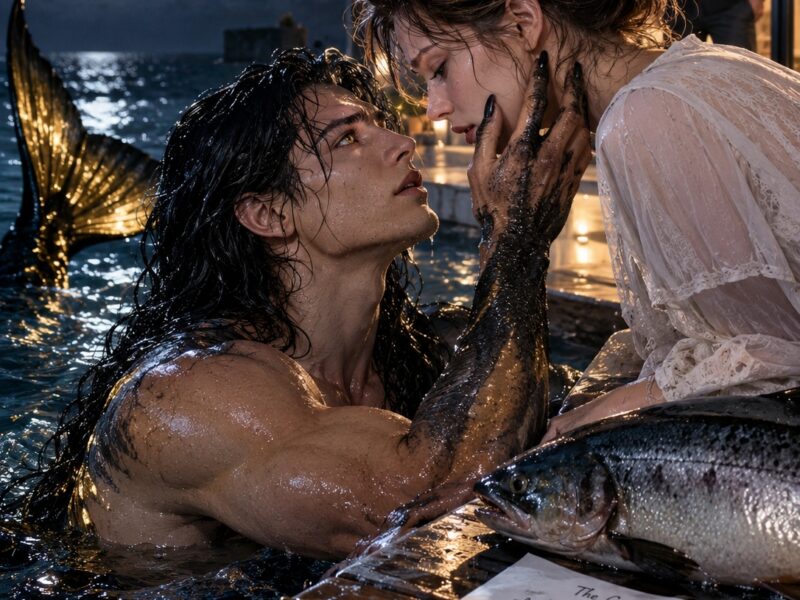
I TAUGHT A LONELY MERMAN HOW TO FIND A MATE—THEN I LEARNED THE COURTSHIP SONG WAS MEANT FOR ME
The first time Professor Wallace told me the creature I had been swimming with for three months could tear me apart in seconds, I laughed.
Not because it was funny.
Because the alternative was admitting that every assumption I had built my thesis around was wrong.
“He brought me salmon yesterday,” I said, gripping the satellite phone tighter. “Monsters don’t usually bring people dinner.”
There was a long silence on the other end.
Then Wallace said quietly, “Mara, listen to me very carefully. Did you see his teeth?”
I looked through the reinforced glass of the research station.
Beyond it, the Pacific was black.
Nothing moved beneath the moonlit surface.
“Yes.”
“Fangs?”
I swallowed.
“Yes.”
“The claws?”
“Yes.”
“And the tail?”
I closed my eyes.
Almost eight feet long.
Black along the spine, fading into bands of burnished gold, powerful enough to launch him clear out of the water when he wanted to reach the station platform.
Professor Wallace exhaled.
“That is not a deep-water merman.”
My stomach tightened.
“What are you saying?”
“I’m saying you need to get off Emerald Island tonight.”
“Professor—”
“Now, Mara.”
His voice changed.
I had known Adrian Wallace for four years. He had supervised my undergraduate work, rejected three versions of my graduate proposal, once made me rewrite a seventy-page field report because I had used the word probably seventeen times.
He did not scare easily.
Now he sounded terrified.
“You didn’t discover an undocumented merman subspecies,” he said. “If your descriptions are accurate, you found something people stopped believing existed two hundred years ago.”
I stared at the dark water.
“What?”
“A siren.”
I almost laughed again.
Then something struck the glass beneath me.
Once.
Softly.
My blood went cold.
A dark hand appeared on the other side of the observation window.
Long fingers.
Black claws.
Then two green eyes emerged from the darkness.
Watching me.
Wallace whispered through the phone.
“Mara?”
I couldn’t answer.
Because the creature outside tilted his head.
And smiled.
Showing me every one of his teeth.
Three months earlier, I had thought he was going to save my career.
That should have been my first warning.
Nothing that looks like salvation from a distance ever stays simple when it gets close.
I was twenty-seven, six months from losing my graduate funding, and spectacularly behind everyone else in my doctoral cohort at Pacific Northwest University.
My classmates were publishing.
I was cataloging algae consumption patterns in shallow-water merfolk.
Not exactly the scientific breakthrough I had imagined when I signed up for xenobiology.
Twenty-six years earlier, when the first permanent human settlements were established on Theia’s oceanic territories, the discovery of aquatic humanoids had electrified the scientific world.
For about five years.
Then researchers realized most shallow-water merfolk possessed cognitive abilities comparable to highly intelligent marine mammals. Fascinating, yes. Revolutionary, no.
Funding moved elsewhere.
So did researchers.
By the time I arrived at Emerald Atoll Research Station, the place had become a lonely collection of white buildings clinging to a volcanic island three hundred miles from the nearest human port.
There were usually twelve researchers stationed there.
That summer, there were three.
Then Professor Wallace left for a conference.
Then the other two researchers rotated home.
For one week, I was alone.
That was when I saw him.
I was collecting water samples near the western reef when something enormous moved beneath my kayak.
At first I thought it was a shark.
Then a hand closed around the side of the boat.
I froze.
Slowly, a face rose from the water.
Black hair clung to his forehead. His skin was pale beneath the seawater, his shoulders broader than any merfolk specimen I had ever documented.
And his eyes—
Emerald green.
Not animal eyes.
Not confused eyes.
They were watching me with deliberate, unsettling concentration.
I whispered, “Hello.”
He blinked.
Then disappeared.
I didn’t sleep that night.
The next morning, a fish was lying on the station dock.
Fresh.
Cleanly killed.
The best portion untouched.
I stared at it for almost a minute.
Then something splashed twenty yards offshore.
Two green eyes appeared.
“You brought this?”
He stared.
I pointed at the fish.
“For me?”
His head tilted.
I touched my chest.
“Mara.”
His gaze dropped to my hand.
“Mara.”
Then I pointed toward him.
“You?”
Silence.
That was how it began.
Not with terror.
Not with a chase.
With a fish.
I named him Orion because the gold markings along his black tail looked like stars scattered across a winter sky.
He never told me whether he liked it.
But after three days, he responded whenever I called.
“Orion.”
His head would appear above the water.
“Orion.”
A splash from somewhere beneath the pier.
“Orion, stop stealing my equipment.”
A waterproof sensor would mysteriously reappear on the dock ten minutes later.
He was intelligent.
Far too intelligent.
Standard Emerald merfolk could recognize symbols and learn simple commands.
Orion understood sentences.
He understood humor.
He understood when I was irritated.
Worst of all, he learned frighteningly fast.
One afternoon, I dropped a wrench between the dock planks.
Before I could reach for the retrieval hook, Orion disappeared underwater.
He returned holding the wrench.
“Thank you.”
He offered it.
I reached for it.
He pulled it away.
I frowned.
He repeated, imperfectly, “Thank… you.”
My heart nearly stopped.
I stared at him.
“Did you just speak?”
He smiled.
Then dropped the wrench back into the ocean.
“You jerk.”
His laugh sounded like a low vibrating trill.
That evening I called Professor Wallace.
He didn’t share my excitement.
“You need distance, Mara.”
“Professor, he imitated human speech.”
“So do several avian species.”
“He understood context.”
“You don’t know that.”
“He brought my wrench back and demanded gratitude.”
Wallace sighed.
“You need a dissertation, not a pet.”
“He isn’t a pet.”
“Then stop treating him like one.”
The words irritated me because they contained just enough truth to hurt.
I was lonely.
Maybe Orion knew it.
Maybe that was why he kept coming back.
Or maybe I kept pretending the visits were research because admitting I looked forward to them felt professionally embarrassing.
Within weeks, I knew his habits.
He preferred deep water during daylight.
He disliked mechanical noises.
He became agitated whenever unfamiliar boats approached the island.
And every morning, he brought food.
Salmon.
Snapper.
Shellfish.
Once, an enormous tuna that took both of us almost twenty minutes to drag onto the dock.
I laughed until my stomach hurt.
“Orion, I cannot eat this much.”
He leaned against the platform, water running from his shoulders.
“You eat.”
“Yes, humans eat. Humans do not eat twenty pounds of tuna before lunch.”
He stared.
Then pushed the fish closer.
“Eat.”
I laughed again.
“You are impossible.”
He smiled.
I didn’t understand then that among his species, food was not generosity.
It was courtship.
The mystery that eventually changed everything began with something much smaller.
Loneliness.
Other young male merfolk around Emerald Atoll traveled in pairs or groups.
Orion never did.
He lived beyond the western reef by himself.
I started researching social separation among merfolk populations.
Young males usually left their birth colonies with brothers or cousins before joining another community. Solitary males were rare.
Most had been separated young.
Some had been abandoned.
Those individuals often failed to develop normal social behaviors.
Including courtship.
I remember staring at the data on my tablet and feeling absurdly sad.
Maybe Orion had not chosen solitude.
Maybe solitude was all he knew.
And then the selfish part of my brain whispered:
This could be your dissertation.
If Orion joined the Emerald colony and reproduced with one of the local females, I could study genetic differences between deep-water and shallow-water populations.
It could be groundbreaking.
It could save my degree.
So I made one of the worst decisions of my life.
I decided to teach a siren how to flirt.
“Watch carefully,” I told him.
Orion floated beside the submerged observation platform.
I had spent two days reconstructing an Emerald courtship song from archival recordings.
The melody was simple.
Four rising notes.
Two descending.
Then a repeating trill.
I played the recording through an underwater speaker.
Orion reacted instantly.
His pupils widened.
His shoulders stiffened.
Then he launched himself toward the speaker and tore it from the mounting bracket.
“Orion!”
He crushed it.
Plastic cracked between his fingers.
“What the hell?”
He looked furious.
Not frightened.
Furious.
I should have stopped.
Instead, I assumed the electronic frequency had hurt him.
So the following evening I tried again.
Without the speaker.
“Easy,” I said. “No claws.”
He watched me.
I inhaled.
Then I sang.
The melody carried strangely across the water.
Orion went completely still.
His expression changed.
The playful curiosity disappeared.
Something deeper replaced it.
Something I could not read.
I finished.
For several seconds, nothing happened.
Then Orion repeated the melody perfectly.
Every note.
I laughed in disbelief.
“You’re incredible.”
He moved closer.
“Okay. Next time you meet a female you like, sing that to her.”
His expression hardened.
I pointed toward the distant reef.
“Female.”
Nothing.
“You understand? Find someone you like.”
His eyes remained on me.
I should have understood.
Instead, I tossed him a fish.
“Tuition.”
He caught it.
Then he threw it back at me.
Two nights later, he climbed onto my balcony.
I woke at 1:13 a.m. to claws scraping metal.
Orion was sitting outside my bedroom.
I stared at him through the glass.
“You have an entire ocean.”
He tapped the door.
“No.”
Another tap.
“Absolutely not.”
Tap.
“Orion.”
Tap.
I opened the door.
He smiled.
“You are spoiled.”
He entered as if he owned the station.
That became another mistake.
I let him into my world.
He learned where I slept.
What music I played while working.
How coffee smelled.
Which drawer contained chocolate.
He hated coffee.
Loved chocolate.
Despised the vacuum robot.
And somehow learned how to repair the underwater speaker he had destroyed.
One morning I found it sitting neatly beside my desk.
“You fixed this?”
Orion watched me proudly.
“You broke it.”
He nodded.
“And then fixed it.”
Another nod.
“You are emotionally exhausting.”
He smiled.
I laughed.
That was the problem.
Around Orion, I forgot to be afraid.
The courtship dance came next.
It should never have happened.
But breeding season was approaching and Orion still showed no interest in the local females.
“If you don’t find somebody soon,” I told him one afternoon, “you’re going to disappear when the season ends and destroy my dissertation.”
He floated on his back.
“Thesis,” he said.
“Yes. My thesis.”
“Bad.”
“My thesis is bad?”
“You… bad.”
I splashed him.
He laughed.
I showed him archival footage of male Emerald merfolk performing the traditional courtship dance.
He watched once.
Then looked at me.
“You try.”
“No.”
“You.”
“I am not a mermaid.”
He waited.
I sighed.
“Fine. Strictly for science.”
I entered the water.
The dance involved circular movements, mirrored turns and a synchronized crossing of arms.
Orion copied me immediately.
Too immediately.
Every time I moved backward, he moved closer.
“Distance.”
He ignored me.
“Orion.”
His hands settled around my waist.
I stopped breathing.
We floated face-to-face.
Water moved gently between us.
“That’s not part of the dance.”
“Like you.”
I blinked.
“What?”
“Like you.”
For the first time, the joke disappeared from his face.
I felt something strange move through my chest.
Then I pushed away.
“You’re supposed to perform this for the female you choose.”
He stared after me.
I laughed nervously.
“Not your teacher.”
His expression became unreadable.
That night, he sang outside my window until dawn.
Three days later Professor Wallace returned my call.
I described Orion’s physical characteristics in greater detail.
There was silence.
Then he asked me to repeat everything.
Black-and-gold tail.
Nearly eight feet.
Emerald eyes.
Fangs.
Retractable claws.
Exceptional strength.
Complex vocalization.
Human speech.
Wallace interrupted me.
“Mara.”
“What?”
“Get away from him.”
I smiled.
“Professor—”
“I mean it.”
“He’s harmless.”
“No, he isn’t.”
“He’s never hurt me.”
“That doesn’t mean he can’t.”
Then Wallace told me about the old expedition records.
Sailors disappearing.
Ships found damaged.
Human survivors describing humanoid predators whose voices could affect the nervous system.
Scientists had dismissed most accounts as folklore.
But one detail appeared again and again.
A siren did not court the way ordinary merfolk did.
It chose.
And once it chose, separation could trigger violent territorial behavior.
My skin went cold.
“You’re saying Orion thinks—”
“I’m saying you taught an apex marine predator a courtship ritual and then personally performed it with him.”
I stopped breathing.
The ocean outside suddenly felt enormous.
“Leave the island.”
“But—”
“Tonight.”
“What about Orion?”
“Mara.”
“He trusts me.”
“And if I’m right, he doesn’t think you’re his researcher.”
The line went silent for half a second.
“He thinks you’re his mate.”
I left without saying goodbye.
That decision would haunt me more than anything else.
The station evacuation boat cleared Emerald Atoll at 12:40 a.m.
I sat in the cabin, staring backward.
Nothing followed us.
Maybe Wallace had been wrong.
Maybe I had been wrong about everything.
Then the sonar alarm screamed.
The captain turned.
“What the hell is that?”
Something enormous was moving beneath us.
Fast.
“Mara,” Wallace said through my headset. “Do not go outside.”
I already knew.
“Orion.”
The boat lurched.
Metal groaned.
Then he surfaced beside us.
His face was nothing like the creature who stole chocolate from my desk.
His eyes were wild.
“Keep moving!” Wallace shouted.
Orion grabbed the hull.
The captain accelerated.
He held on.
I ran onto the rear deck.
“Mara!”
“Orion!”
His head snapped toward me.
I had never seen grief look like rage before.
“Why?”
One word.
Perfectly human.
I froze.
“You could talk?”
“Why leave?”
“I didn’t know what you were.”
He climbed higher.
Crew members raised tranquilizer rifles.
“No!” I screamed. “Nobody shoots.”
Orion’s claws sliced through the railing.
I stepped backward.
“I never meant to hurt you.”
“Stay.”
“I can’t.”
“Stay with me.”
“Orion—”
His voice dropped.
“You chose.”
“No. I taught you.”
His expression changed.
“You sang.”
“It was a lesson.”
“You danced.”
“For your mate.”
“Yes.”
He pointed at me.
“My mate.”
The horror of the misunderstanding hit me all at once.
“Orion, no.”
He reached for me.
I stepped back.
Something flashed between his fingers.
A pearl.
Black at its center.
Gold around the edges.
Before I understood what was happening, he pressed it against my lips.
I fought him.
Then the world tilted.
Cold rushed through my veins.
I remember falling.
I remember Wallace shouting through my headset.
And I remember Orion catching me before I struck the deck.
Then darkness.
I woke underwater.
And I could breathe.
That was the first impossible thing.
The second was the cave.
Blue light glowed from microscopic organisms along the walls. Strange plants moved in the current. Thousands of shells had been arranged into patterns.
And Orion sat ten feet away.
Watching me.
I tried to stand.
There was no floor.
Panic hit.
I inhaled water.
Nothing happened.
My lungs did not burn.
“What did you do to me?”
Orion looked away.
I touched my neck.
Thin openings fluttered beneath my jaw.
Gills.
“No.”
My hands began shaking.
“What was that pearl?”
He said nothing.
“Am I becoming like you?”
“Yes.”
My stomach dropped.
“You changed me?”
“So you stay.”
“You had no right.”
His jaw tightened.
“You leave.”
“That doesn’t give you the right to change my body.”
“You promised.”
“What promise?”
He stared at me.
And for the first time since I had known him, Orion looked genuinely wounded.
“You forgot.”
I hated him.
At least I tried to.
For days, I refused food.
Orion brought salmon.
I turned away.
He brought snapper.
I threw it at him.
He returned with shellfish.
“I said no.”
“Eat.”
“Let me go.”
“No.”
“I hate you.”
His face changed every time I said it.
But he never opened the cave.
Then one evening he returned injured.
Deep scratches crossed his chest.
Blood drifted into the water.
I reacted before I could stop myself.
“What happened?”
“Orcas.”
“How many?”
“Thirty.”
I stared.
“Thirty?”
He nodded.
“You fought thirty orcas?”
“My territory.”
“And you won?”
“Of course.”
I almost laughed.
Instead, I cleaned his wounds.
He watched my hands the entire time.
“Don’t misunderstand,” I muttered. “I can be furious at you and still not want you to die.”
He leaned closer.
“Salmon tomorrow?”
I stared at him.
Then laughed despite myself.
“You are unbelievable.”
Something in his expression softened.
And that frightened me more than his claws ever had.
Because hatred was simple.
Affection was dangerous.
The memory returned in pieces.
A storm.
A boat.
A little girl screaming.
Cold water.
I was seven years old.
My parents had brought me to Theia during one of the first civilian settlement projects.
There had been an accident near Emerald Island.
I fell into the sea.
Everyone believed a merfolk child had saved me.
Afterward, I developed a fever so severe I lost almost every memory of the incident.
My parents put me in swimming lessons.
Then diving lessons.
They hoped the water might trigger something.
It never did.
Until Orion was injured.
Until I touched the scar beneath his ribs.
And suddenly I remembered.
A smaller black-and-gold tail.
Green eyes.
A frightened creature barely larger than me.
He had dragged me to shore.
I had stayed beside him while he recovered.
We played along the lagoon for days before the rescue vessel arrived.
I remembered sitting beside him beneath the rocks.
“Do you have a family?”
He shook his head.
“Friends?”
No.
“Don’t you get lonely?”
He did not understand.
So I explained.
“Lonely means there’s nobody to talk to. Nobody to play with. Nobody who misses you when you’re gone.”
He stared at me.
Then whispered one of the first human words he ever learned.
“Lonely.”
My seven-year-old heart broke.
So I hugged him.
“I’ll come back every summer.”
His hands tightened around mine.
“Promise?”
“Promise.”
I left.
Then the fever erased him.
Orion waited.
For ten years.
When the memory finished returning, I found him watching me from across the cave.
“Orion.”
He didn’t answer.
I swam toward him.
“I remember.”
His body went rigid.
“The island.”
Silence.
“You saved me.”
His eyes lifted.
“I promised I would come back.”
He looked away.
“I forgot.”
“You left.”
“I was seven.”
“You promised.”
“I know.”
“You came back.”
My throat tightened.
“Yes.”
“Then left again.”
That was the wound.
Not the thesis.
Not the song.
Not even the fear.
To Orion, I had abandoned him twice.
“I’m sorry.”
He stared at me.
“I waited.”
I reached for his hand.
He pulled away.
“You don’t trust me.”
“No.”
“Then why keep me here?”
His answer was almost too quiet to hear.
“Because losing you hurts more.”
For the first time, I understood that his captivity of me had never been power to him.
It was terror.
That did not make it right.
But it made it human enough to hurt.
“Take off the restraints,” I said.
“No.”
“If I stay because you force me, you will never know whether I chose you.”
He looked at me.
I held his gaze.
“Is that what you want?”
Silence.
Then, slowly, he broke the restraints.
I didn’t leave.
Not that day.
Or the next.
We started again.
Badly.
Painfully.
Honestly.
I explained consent.
He explained siren bonding.
I explained dating.
He looked offended by the concept.
“You mean I find mate… and then wait?”
“Yes.”
“Why?”
“Because humans are complicated.”
“Stupid.”
“Sometimes.”
I explained that bringing thirty pounds of dead fish to someone’s bedroom was not universally romantic.
He disagreed.
We compromised.
Five pounds.
I explained personal space.
He hated that lesson.
And gradually, something shifted.
I stopped seeing him as the monster Wallace had described.
But I also stopped pretending he was harmless.
Orion was dangerous.
He was territorial.
Jealous.
Possessive.
Powerful enough to break steel.
And capable of tenderness so awkward it sometimes hurt to witness.
One night he brought me a knife.
I stared at it.
“What is this?”
“Exit.”
My heart stopped.
“You’re letting me go?”
He looked away.
“You want human world.”
I waited.
“You can leave.”
“Why?”
His throat moved.
“Because you hate cage.”
I took the knife.
The passage behind the cave opened toward the surface.
Freedom was less than a hundred yards away.
I swam halfway there.
Then stopped.
I looked back.
Orion had not followed.
He sat alone beneath the blue light.
Exactly where I had left him ten years before.
I closed my eyes.
Then turned around.
When I returned, he stared at me.
“Why?”
“Because this time I’m making the choice.”
He didn’t move.
I touched his face.
“I’m staying tonight.”
His eyes closed.
“Tomorrow?”
“We’ll negotiate tomorrow.”
For once, he smiled.
Months later, the scientific world discovered sirens.
Not because I captured Orion.
Because Orion allowed himself to be seen.
The Interstellar Biological Alliance classified sirens as a previously undocumented sentient species.
That distinction changed everything.
Orion was no longer legally wildlife.
He was a person.
Which meant researchers couldn’t own him.
Couldn’t dissect him.
Couldn’t claim biological samples without consent.
Professor Wallace called it the most important sentience ruling in marine biology history.
I called it overdue.
There was only one problem.
Orion remained convinced I would eventually leave.
That fear nearly destroyed us.
Because when we returned to the research station, he misunderstood every closed door.
Every private conversation.
Every blood test.
Every scientist who looked at him too long.
One evening I found him staring through the laboratory window.
“What?”
“Research.”
“Yes.”
“On me.”
“No.”
“Liar.”
The word cut deeper than it should have.
“We drew your blood once.”
He looked away.
“To determine what medications were safe for you.”
Silence.
“No one experimented on you.”
He didn’t believe me.
Not completely.
And I realized something painful.
I had spent months learning to trust a predator.
He had spent his entire life learning that anything he loved eventually disappeared.
Trust wasn’t going to arrive because I demanded it.
It would have to be built.
One ordinary day at a time.
Then Dr. Rhea Collins arrived.
And everything became complicated again.
Rhea was thirty-two, brilliant, sarcastic, and one of the only researchers alive who had spent more than two weeks below the Southern Trench.
Orion disliked her immediately.
Not because she was human.
Because she smelled wrong.
He cornered me outside the lab.
“Siren.”
“What?”
“On her.”
I laughed.
“Rhea is not a siren.”
“No.”
He pointed toward her quarters.
“Siren smell.”
“How would that even be possible?”
“Old.”
“How old?”
Orion’s expression changed.
“Very.”
That night, Rhea disappeared.
At 2:47 a.m., security footage showed her standing alone at the docks.
Singing.
Not an Emerald song.
Not anything in our database.
Something older.
Deeper.
The hydrophones recorded an answer from thirty miles offshore.
A sound so low it shook glass inside the station.
Orion heard it.
His face went pale.
“He found her.”
Rhea finally told us the truth.
Two years earlier, her submarine had failed during an expedition in the Southern Trench.
She had less than two hours of oxygen.
Then something found her.
A siren.
Older than Orion.
Larger.
Red-and-black instead of black-and-gold.
Rhea called him Raiden because she had never learned his real name.
He kept her alive for three weeks.
Brought her food.
Protected her.
Learned fragments of human speech.
Then a rescue team arrived.
Rhea promised she would return.
She tried.
Seventeen expedition applications.
Seventeen rejections.
She never made it back.
Until now.
Orion listened silently.
Then asked one question.
“Pearl?”
Rhea frowned.
“What?”
“Did he give you pearl?”
She hesitated.
Then touched her chest.
“He gave me something when my oxygen failed.”
Orion closed his eyes.
“Oh, no.”
“What?”
“You accepted him.”
“I didn’t know what it meant.”
“He didn’t know you didn’t know.”
The room went silent.
Professor Wallace asked, “What happens when a bonded siren loses its mate?”
Orion stared toward the ocean.
“The bond hurts.”
“How badly?”
“Every second.”
Rhea went pale.
“For two years?”
Orion nodded.
“And eventually?”
“He stops thinking.”
My stomach turned.
“Goes feral?”
“Yes.”
A warning alarm sounded.
The southern sonar array had detected something massive.
Moving directly toward us.
Raiden arrived before sunrise.
He was enormous.
Even Orion looked young beside him.
His scars covered half his torso.
His tail was nearly twelve feet long.
And when he surfaced beyond the docks, the entire station seemed to shrink.
Security raised weapons.
“Lower them,” I said.
“Mara—”
“Lower them.”
Rhea walked onto the dock.
Raiden saw her.
Everything stopped.
Two years of searching.
Two years of pain.
Two years of believing he had been abandoned.
“Raiden,” she whispered.
He moved.
Orion intercepted him.
The collision sounded like a car crash.
Orion flew thirty feet through the water.
“Orion!”
He surfaced.
“I’m fine.”
“You just got thrown thirty feet.”
“He held back.”
I stared.
“What?”
“If he wanted me dead, I would be dead.”
Rhea stepped closer to the edge.
“Raiden.”
The ancient siren froze.
She swallowed.
“It’s me.”
His expression twisted.
Recognition fighting instinct.
Anger fighting relief.
“I’m back.”
His voice came out rough.
“Liar.”
Rhea started crying.
And then she laughed.
Because one word meant his mind was still there.
He remembered her.
It took weeks to explain two years of human bureaucracy to a creature who measured time by migrations and storms.
It took longer to explain that Rhea had not rejected him.
She simply had not understood.
I watched them struggle through the same mistakes Orion and I had made.
Possession versus partnership.
Instinct versus consent.
Promises versus circumstances.
Love versus fear.
One evening, Raiden told Rhea to follow him into the deep.
“Forever,” he said.
Rhea shook her head.
“No.”
His face collapsed.
“You leave again.”
“No.”
“Not coming.”
“Those are different things.”
He didn’t understand.
So Orion explained.
“Humans have jobs.”
Raiden frowned.
“Bad.”
“Families.”
“Bad.”
“Friends.”
“Worse.”
I covered my face.
“Please stop helping.”
Orion shrugged.
Rhea laughed.
Then she held out her hand.
“You can learn to live partly in my world.”
Raiden stared.
“And I can learn to live partly in yours.”
“Why?”
“Because that’s what partnership means.”
He looked at Orion.
Orion nodded solemnly.
“Complicated.”
“Exactly.”
The final mystery was the pearl.
Mine.
Rhea’s.
And what it was doing to us.
I had developed scales along my ribs.
My lungs could function underwater for hours.
Cold no longer bothered me.
Pressure that should have crushed a human body barely registered.
Rhea’s changes had faded during the two years she spent separated from Raiden.
Mine were accelerating.
Professor Wallace finally asked the obvious question.
“Orion, exactly what does a siren pearl do?”
Orion stared.
“Change mate.”
“We know that. How?”
He shrugged.
Wallace closed his eyes.
“You don’t know?”
“No one teach me.”
“You’re a siren.”
“So?”
I laughed so hard I nearly fell out of my chair.
Then Raiden entered.
He knew more.
Not scientifically.
Instinctively.
The pearl was part of a siren’s life force.
Given willingly, it created a biological bond allowing a chosen partner to survive in the siren’s environment.
Water.
Pressure.
Temperature.
Diet.
Even aging.
I stopped writing.
“What was that last one?”
Raiden looked at me.
“Time.”
Wallace leaned forward.
“Explain.”
“Mate changes until mate can stay.”
“For how long?”
Raiden shrugged.
“As long as siren.”
The room went silent.
Orion looked at me.
I looked at him.
“How long do sirens live?”
Raiden considered the question.
“Don’t know.”
“Two hundred years?”
He shrugged.
“More.”
“Five hundred?”
Another shrug.
“No one counts.”
I stared at Orion.
“You told me the pearl would only help me breathe underwater.”
“I thought.”
“You didn’t know?”
“No.”
I threw a towel at him.
He caught it.
“You genetically modified me with something you didn’t understand?”
He considered that.
“Yes.”
“Orion!”
He smiled.
“You look good.”
“That is not the point.”
Rhea laughed from across the room.
And somewhere inside my anger, fear and disbelief, another emotion appeared.
Wonder.
My life had divided into two halves.
Before Orion.
After Orion.
Before him, I believed science existed to classify the unknown.
Name it.
Measure it.
Put it inside a paper.
After him, I understood something far more humbling.
Sometimes the unknown looks back.
Sometimes it has memories.
Sometimes it has wounds.
Sometimes it waits ten years beside an island because a seven-year-old girl promised she would return.
Our son was born eleven months later.
Orion stared at him for almost an hour.
Then lifted him carefully.
The baby had my eyes.
Orion’s black-and-gold markings.
And tiny claws.
“Definitely yours,” I said.
Orion inspected him suspiciously.
“You’re sure?”
“Orion.”
“No switch?”
“What hospital do you imagine secretly keeps spare siren babies?”
He sniffed the child.
I slapped his shoulder.
“What kind of father does that?”
He looked offended.
Then carried our son toward the water.
My heart stopped.
“What are you doing?”
“Sea.”
“No.”
“Babies learn.”
“Put him down.”
“Sirens survive alone.”
“ORION.”
He froze.
I took our son from him.
“Our child is not growing up the way you did.”
He stared.
“He will have parents.”
Silence.
“Grandparents.”
His expression changed.
“Friends.”
He looked toward the baby.
“He’ll go to school. He’ll be annoying. He’ll break things. He’ll probably inherit your habit of bringing dead fish into places they don’t belong.”
Orion looked down.
“But he will never wonder whether anyone is coming back for him.”
His eyes lifted slowly.
I understood too late why he had wanted to put the baby into the sea.
Not cruelty.
Tradition.
The only childhood he knew.
“I had no parents,” he said.
“I know.”
“No grandparents.”
“I know.”
“No friends.”
My throat tightened.
“You had one.”
His eyes met mine.
“She left.”
There it was.
The wound beneath everything.
I stepped closer.
“She came back.”
“Ten years.”
“I know.”
“I waited.”
I touched his face.
“And I’m here now.”
He looked at our son.
Then at me.
“All love?”
I smiled through tears.
“All of it.”
“For me?”
“For both of you.”
He frowned.
“Half?”
I laughed.
“Love doesn’t work like fish portions.”
“It should.”
“Of course you think that.”
He pulled me against him.
Our son made a tiny irritated sound between us.
For once, Orion released me immediately.
He looked horrified.
“Baby angry.”
“He’s hungry.”
Orion vanished beneath the water.
“Where are you going?”
“Fish.”
I started laughing.
Some things, apparently, science could never change.
Years later, people would call our work the beginning of human-siren relations.
Textbooks would describe the Emerald Atoll Accord.
They would mention legal personhood.
Marine territorial rights.
Medical cooperation.
The first mixed human-siren family.
They would write about Raiden, whose territory markers proved sirens had watched human civilization arrive on Theia more than two centuries earlier.
They would write about Rhea.
About Wallace.
About me.
And, inevitably, about Orion.
But textbooks are terrible at telling the truth about people.
They make everything look inevitable.
Nothing about us was inevitable.
We hurt each other.
We misunderstood each other.
We were afraid.
We confused love with ownership and promises with certainty.
We learned that saving someone’s life does not make them yours.
That loving someone does not give you permission to cage them.
That forgiveness is not the same thing as pretending harm never happened.
And that trust is rarely one heroic moment.
It is a thousand ordinary choices.
Orion learned to ask before taking my hand.
I learned not to disappear when I was angry.
He learned that a locked laboratory door did not mean betrayal.
I learned that sometimes when he brought me a fish, the correct response was not a lecture about refrigeration.
Raiden learned not to threaten male researchers who spoke to Rhea.
Mostly.
Rhea learned that telling a two-hundred-year-old siren, “I’ll be right back,” required specifying whether she meant five minutes or five months.
Professor Wallace learned to keep emergency sedatives near every marine conference.
And our son grew up believing all of this was normal.
Maybe that was the strangest miracle.
On our tenth anniversary, Orion took me back to the western side of Emerald Island.
The station lights glowed in the distance.
Our son was staying with my parents.
For the first time in months, we were alone.
Orion floated beside me.
“You remember?”
“Of course.”
The rocks.
The lagoon.
The place where a frightened seven-year-old girl had promised a lonely creature she would return.
I touched the stone where we had once sat together.
“I wish I hadn’t forgotten.”
Orion was silent.
“I wish you hadn’t waited so long.”
Still nothing.
“Orion?”
He looked at me.
“Would change?”
“What?”
“If you remember. Would change everything?”
I thought about it.
If I had remembered him, maybe I would have returned every summer.
Maybe he would never have learned what abandonment felt like.
Maybe I would never have mistaken him for an ordinary merman.
Maybe I would never have taught him the wrong courtship ritual.
Maybe he would never have chased my evacuation boat.
Maybe there would have been no cave.
No pearl.
No pain.
But perhaps there would have been no us, either.
I rested my forehead against his.
“I would change the ways we hurt each other.”
He waited.
“But not the fact that I found you again.”
The water moved softly around us.
Then Orion began singing.
Four rising notes.
Two descending.
A familiar trill.
I laughed.
“You still remember that ridiculous song?”
“Yes.”
“I taught it to you so you could attract another mermaid.”
“No.”
“Yes, I did.”
He shook his head.
“You taught me.”
“To use on someone else.”
“No.”
I narrowed my eyes.
“What do you mean, no?”
He smiled.
And suddenly I understood.
“You knew?”
His smile widened.
“Orion.”
He started laughing.
“You understood what I meant the entire time?”
“Mostly.”
“You let me spend weeks trying to find you a girlfriend.”
“Yes.”
“You manipulative fish.”
“Siren.”
“You let me teach you a whole courtship dance!”
“I liked dance.”
“You kept grabbing me.”
“Liked that too.”
I splashed him.
He caught my wrist.
This time, gently.
This time, waiting.
I intertwined my fingers with his.
His expression softened.
Then he repeated the words he had struggled to say the first time we met as children.
“Stay?”
Ten years earlier, that word had frightened me.
Once, it had sounded like a cage.
Now it sounded different.
Because the choice belonged to me.
I looked toward the lights of the station, then toward the endless dark ocean beyond him.
The human world behind me.
His world beneath me.
Our world somewhere between.
“I’m staying.”
His fingers tightened around mine.
“Forever?”
I smiled.
“We’ve discussed this. Humans don’t make promises about forever.”
He frowned.
I leaned closer.
“But I’ll promise you tomorrow.”
He considered that.
“Tomorrow.”
“And when tomorrow comes, you can ask me again.”
His forehead touched mine.
“Stay?”
I laughed softly.
“Yes.”
Far beneath us, our son’s tracking beacon blinked from the station nursery.
Beyond the reef, Raiden’s ancient song rolled through the deep, answered moments later by Rhea’s imperfect human imitation.
Orion listened.
Then he sang back.
Once, sailors had heard voices like his and invented monsters.
Maybe they had needed monsters because monsters were easier to understand than loneliness.
Easier than devotion.
Easier than a creature powerful enough to destroy a ship but frightened enough to wait beside an empty island for ten years because a child had said she would return.
I had spent half my life trying to discover something no scientist had ever seen.
In the end, my greatest discovery was not a new species.
It was the simple truth that had been waiting beneath every song, every fish left on the dock, every jealous glance, every terrible misunderstanding.
Orion had never been searching for a colony.
He had never been searching for a female.
He had never needed me to teach him how to choose a mate.
He had chosen one long before I remembered his name.
And all those years while I was growing up, going to school, learning to dive, becoming a scientist and forgetting the frightened little creature who once saved my life—
somewhere beyond Emerald Island, beneath an ocean vast enough to swallow every promise ever made—
he had remembered mine.









