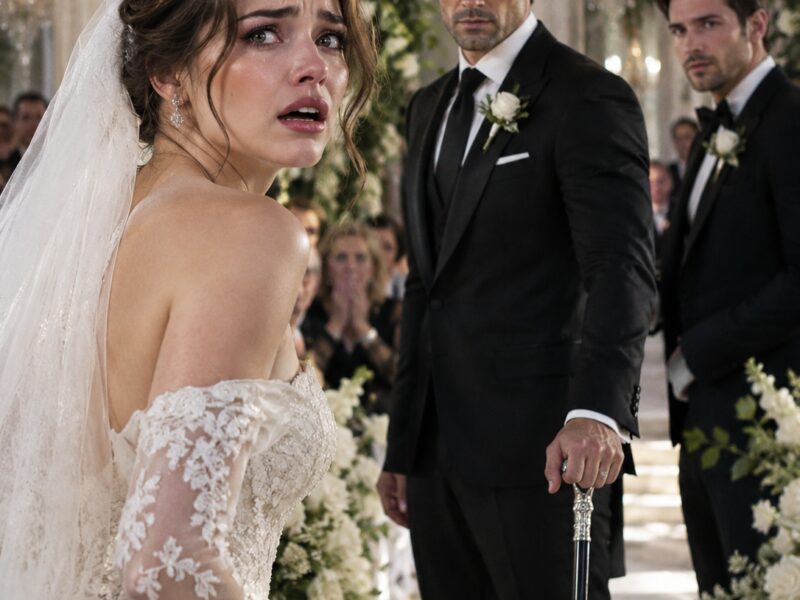
I WALKED DOWN THE AISLE TO MARRY THE MAN I LOVED—THEN I LIFTED MY VEIL AND SAW HIS OLDER BROTHER WAITING
The first thing I noticed was the cane.
Black. Polished. Silver at the handle.
It rested against the right leg of the man waiting for me at the altar, and for one impossible second, my mind refused to understand what my eyes were seeing.
Because Luke Moretti didn’t use a cane.
His older brother did.
I stopped walking.
Nearly two hundred guests filled the glass-walled ballroom of the Moretti estate outside Chicago, but the room became so quiet that I could hear the string quartet hesitate behind me. Somewhere near the back, a champagne flute touched a tray with a tiny crystal click.
My father’s arm tightened beneath mine.
“Clare,” he whispered.
I looked at him.
He wouldn’t meet my eyes.
That was when fear entered my body.
Not nervousness.
Not wedding-day panic.
Fear.
I turned back toward the altar.
Gabriel Moretti stood beneath an arch of white roses and winter greenery wearing a black tuxedo that made him look even taller than I remembered. His dark hair was combed neatly back. His expression was unreadable.
There was a pale scar disappearing beneath his collar.
And there was that cane.
Luke had told me about the shooting.
Years earlier, Gabriel had been hit three times protecting him during an ambush. One bullet had done permanent damage to Gabriel’s leg.
I knew that story.
What I didn’t know was why Gabriel was standing where Luke should have been.
“Where is Luke?”
Nobody answered.
My voice shook harder the second time.
“Where is Luke?”
Gabriel’s jaw tightened.
That was all.
I looked toward the front row.
Luke’s mother, Eleanor, sat perfectly still.
His father stared at the floor.
My mother was already crying.
And suddenly I understood the worst part.
Everyone knew something.
Everyone except me.
I ripped the veil away from my face.
“Clare,” my father said again.
I stepped away from him.
“No.”
Then I turned and ran.
My heels struck marble hard enough to hurt. Guests shifted aside as I passed, politicians and judges and developers and men whose names appeared on hospital wings moving out of my way as if humiliation were contagious.
I shoved through the ballroom doors.
And there he was.
Luke Moretti stood at the bar.
Still in a tuxedo.
Still devastatingly familiar.
The man I had loved for almost a year.
The man who remembered that I hated olives and picked them off my pizza without asking.
The man who had driven across Chicago at two in the morning when I called him after someone tried to follow me through a parking garage.
The man who had kissed me beneath an awning in the rain and told me, “Someday we’re going to have a home where you never have to be afraid.”
The man I thought I had just married.
Except I hadn’t.
I crossed the room so quickly he barely had time to set down his glass.
“Why did I just marry your brother?”
Every conversation stopped.
Luke stared at me.
His face changed.
Not confusion.
Not shock.
Guilt.
“You weren’t told?”
The floor seemed to tilt beneath me.
“Told what?”
He swallowed.
“Clare—”
“Told what?”
His eyes flicked past me toward the ballroom doors.
Then he said it.
“That I was meeting you on Gabriel’s behalf.”
I laughed.
It came out ugly and broken because screaming would have been worse.
“You were what?”
“At first.”
“At first?”
“Gabriel isn’t exactly comfortable with—”
“You gave me your coat in the rain.”
Luke went silent.
“You held my hand when my brother was in surgery. You brought coffee to my mother. You kissed me.”
His face tightened.
“You told me we had a future.”
“I know.”
“Was all of that for Gabriel too?”
For the first time since I had known him, Luke Moretti looked ashamed.
But shame wasn’t enough.
Not anymore.
Behind me came the measured sound of a cane against marble.
Tap.
Step.
Tap.
Step.
Gabriel appeared in the doorway.
Nobody blocked him.
Nobody spoke over him.
And despite the damaged leg, despite the cane, despite the fact that Luke had always been the brother who smiled first and filled rooms easily, I suddenly noticed something I should have noticed long ago.
People were afraid of Gabriel.
Not theatrically.
Instinctively.
Luke rubbed a hand over his mouth.
“Gabriel saved my life.”
I stared at him.
“What?”
“The shooting. Those bullets were meant for me.”
I looked from Luke to Gabriel.
Then back again.
“And I’m his reward?”
Nobody answered.
That silence told me enough.
I reached for my wedding ring.
My fingers shook so badly I couldn’t pull it over my knuckle.
“This marriage is over.”
“Clare,” Luke said.
“Don’t.”
“You need to calm down.”
I froze.
“What did you just say?”
He lowered his voice. “Don’t make a scene.”
For several seconds I simply stared at him.
A scene.
He had let me walk down an aisle toward the wrong man in front of two hundred people, and he was worried I might embarrass him.
Something inside me went cold.
“You chose me for Gabriel because he saved you.”
Luke didn’t answer.
“You decided he deserved someone good.”
“That’s not how—”
“And I’m payment.”
“No.”
“Then tell me what I am.”
Silence again.
I turned toward my parents.
My mother broke before I reached her.
“Clare, sweetheart—”
“Did you know?”
Her face collapsed.
My father looked ten years older than he had that morning.
“Did you know?”
My mother started crying harder.
And I knew.
“Oh my God.”
“Your brother’s surgery,” she whispered.
I stopped breathing.
Six months earlier, my twenty-one-year-old brother, Evan, had nearly died when a drunk driver crossed the center line outside Rockford.
Three surgeries.
Eleven days in intensive care.
Months of rehabilitation.
Insurance had covered a fraction.
My parents had mortgaged their house.
I had emptied my savings.
We still hadn’t come close.
Then, somehow, the bills disappeared.
My father told me a hospital foundation had intervened.
I had been so grateful that I hadn’t asked enough questions.
Now I did.
“How much?”
“Clare—”
“How much did they pay?”
My father told me.
I pulled my hand away from my mother’s.
“So you sold me.”
“No!” she cried. “No, sweetheart. Gabriel is a good man.”
“I don’t care if he’s a saint.”
I finally got the ring loose.
It struck the marble floor between us.
“I was supposed to know who I was marrying.”
Nobody argued.
Because nobody could.
I spent the next hour in the bridal suite with the door locked, sitting on the floor in a wedding dress that suddenly felt like evidence from a crime scene.
Downstairs, the reception continued in fragments.
People whispered.
Cars departed.
Somewhere, silverware was being collected from tables that had been set for a celebration.
Then I heard Luke’s voice in the hallway below.
He was talking to someone about Washington.
About a fundraiser.
About Senator Callahan.
And about Isabella Callahan.
Twenty-eight. Georgetown Law. Daughter of a senator with national ambitions.
Beautiful, connected, appropriate.
The kind of woman who belonged beside Luke Moretti if Luke wanted to become something bigger than the charming younger son of a powerful Chicago family.
I pressed my forehead against the bedroom door.
Suddenly everything made sense.
Luke hadn’t merely handed me to his brother because Gabriel had once saved his life.
I had become inconvenient.
He could give Gabriel the woman who loved him, satisfy his debt to his brother, strengthen the Moretti family’s connection to my grateful parents, and walk away clean enough to pursue a senator’s daughter.
He had turned betrayal into efficiency.
A knock sounded behind me.
I stiffened.
“Clare?”
Gabriel.
I didn’t answer.
“I brought food.”
“I’m not hungry.”
“I assumed you wouldn’t be.”
I almost laughed.
“Then why bring it?”
“Because people who are furious still need to eat.”
Against my better judgment, I opened the door.
He stood there carrying a tray.
His jacket was off.
The sleeves of his white shirt were rolled slightly, revealing a scar along his forearm.
I must have tensed.
He noticed.
Without saying anything, he put the jacket back on.
That tiny movement hurt me more than I expected.
He stepped inside only after I moved away from the doorway.
Then he placed the tray on a table.
Beside it, he set down a brass key.
I stared at it.
“What’s that?”
“The bedroom key.”
“I know what a key looks like.”
“It locks the door from the inside.”
I looked at him.
He met my eyes.
“Nobody enters unless you let them.”
For the first time that day, I didn’t know what to say.
Gabriel moved toward the couch.
“If you want me gone, I’ll leave.”
“Where would you sleep?”
“Somewhere else.”
“This is your house.”
“Tonight that doesn’t matter.”
I studied him.
“Did you know?”
He didn’t pretend not to understand.
“I knew the marriage had been arranged.”
My stomach tightened.
“Did you know I thought I was marrying Luke?”
A long silence.
“No.”
“Would you have stopped it if you had?”
Another silence.
That one was worse.
“I should have asked more questions before agreeing.”
“That’s not an answer.”
“No,” he said quietly. “It’s an admission.”
I looked away before he could see tears gathering again.
Then Gabriel said something I had not expected.
“If you still want out tomorrow, I’ll help you.”
I turned.
“What?”
“I’ll cover your family’s debt myself.”
“And the marriage?”
“We’ll annul it.”
My throat closed.
“You’d really do that?”
“Yes.”
“Why?”
His gaze didn’t move from mine.
“Because you’re not payment for my leg, Clare.”
Something inside me cracked.
Not healed.
Cracked.
There was a difference.
That night Gabriel slept on the couch.
He never touched me.
Never called me his wife as though the word gave him ownership.
Sometime after midnight, I woke and found his cane on the floor beside him.
I stared at it for a long moment.
Then I got out of bed, picked it up, and placed it carefully within reach.
His blanket had slipped halfway to the floor.
I pulled it over his shoulder.
Gabriel didn’t wake.
For the first time, I looked at the man I had been forced to marry and wondered if perhaps he had been used too.
Morning changed everything again.
I came downstairs expecting silence.
Instead, six men in dark suits stood around Gabriel in the library.
Maps covered a table.
Phones buzzed.
One man was speaking about property access, another about airport security.
Gabriel sat at the head of the table with his cane beside him.
Nobody interrupted.
Nobody checked a phone while he spoke.
Nobody needed him to raise his voice.
Then the front doors opened.
Luke entered carrying a travel bag.
He looked at me first.
Then Gabriel.
“Take care of her.”
Gabriel’s expression turned cold.
“I don’t need you to tell me how to treat my wife.”
The room went silent.
Something passed between the brothers that had nothing to do with me and everything to do with years I didn’t understand.
Luke looked at me one last time.
“Take care, Clare.”
Yesterday, I would have followed him with my eyes.
I didn’t.
I looked at Gabriel instead.
The husband I had never chosen.
The man who had given me a locked door, an escape route, and the first real choice anyone had offered me on my wedding day.
Then Gabriel glanced toward the kitchen.
“You don’t have to stay for breakfast.”
I raised an eyebrow.
“Are you always this eager to get rid of your wife?”
He blinked.
Then, very slowly, Gabriel Moretti smiled.
And to my own surprise, I smiled back.
I still hadn’t decided whether I would stay.
But for the first time, leaving wasn’t the only possibility.
I found Gabriel in the kitchen twenty minutes later pouring coffee like a man who had lived alone even while surrounded by employees.
“I asked you a question,” he said.
“What question?”
“Breakfast.”
“I haven’t decided if I’m staying at all.”
That got his attention.
He set down the pot.
“The offer still stands. The debt. The annulment. Nothing about last night changes that.”
“I know.”
I sat at the island.
“I just don’t know what I want yet.”
Gabriel poured a second cup and slid it toward me.
“Then take the time you need.”
I wrapped my hands around it.
“Your brother might disagree.”
Something flickered across his face.
“Luke isn’t here.”
“Where did he go?”
“Washington.”
“Of course.”
Gabriel watched me carefully.
“Apparently Senator Callahan’s daughter needs an escort to a fundraiser.”
Yesterday that information would have gutted me.
That morning it felt strangely distant, as if Luke belonged to a life I had stopped living only twelve hours earlier.
“Doesn’t that bother you?”
“What?”
“That he used both of us and walked away.”
Gabriel looked into his coffee.
“It bothers me more than I’m allowing myself to demonstrate.”
“You make that sound practiced.”
“It is.”
“Luke does this often?”
“Not this.”
He paused.
“But he’s spent most of his life assuming the family will absorb whatever consequences he creates.”
I looked at him.
“And you usually absorb them.”
Gabriel didn’t answer.
That was answer enough.
“Why did you agree to marry me?”
He went still.
“Your family could have paid my parents’ debt without attaching me to it.”
“Luke asked me.”
“That’s it?”
“I’ve spent most of my life being the reason things go right for him. I didn’t examine the request closely enough.”
“That’s a terrible reason to marry someone.”
“Yes.”
The simplicity of his answer disarmed me.
Then heels clicked down the hallway.
A silver-haired woman appeared in the doorway wearing a charcoal suit at eight in the morning as if she were on her way to negotiate a merger.
Eleanor Moretti.
Gabriel sighed.
“Mother.”
“I heard my son got married yesterday to a woman who spent her wedding night behind a locked door. Obviously I came.”
Her eyes moved to me.
“You’re prettier than the photograph Luke showed us.”
“Thank you?”
“And apparently smarter than to stay quiet when you’re deceived.”
She pulled out a chair.
“Good.”
I stared at her.
“Did you know?”
Her expression shifted.
“I knew there was confusion surrounding the arrangement.”
“Did you know I thought I was marrying Luke until I reached the altar?”
“No.”
I watched her carefully.
Eleanor’s mouth tightened.
“I assumed that had been clarified before the ceremony. I discovered otherwise when you tore your veil off in front of half of Chicago.”
“It hadn’t been clarified.”
“Then I owe you an apology.”
She looked at Gabriel.
“And apparently I raised one son to be careless and another to remain silent when he should speak.”
Gabriel’s jaw tightened.
But he didn’t disagree.
Eleanor turned back to me.
“However, before you decide whether you’re leaving, there is something else you need to know.”
Gabriel’s expression changed.
“Mother.”
“Did you tell her about Reyes?”
The kitchen went still.
“Not yet.”
Eleanor stood.
“Then tell her now.”
I looked between them.
“Who is Reyes?”
Gabriel slowly put down his cup.
“Victor Reyes was once my father’s business partner.”
“Was?”
“They separated fifteen years ago after money disappeared and accusations started flying. Fraud. Hidden accounts. Deals nobody wanted attached to their names.”
“And?”
“Reyes blamed my father for destroying him.”
“What does that have to do with me?”
Gabriel’s eyes hardened.
“Yesterday’s wedding was very public.”
I waited.
“Everyone saw what happened. Everyone knows you’re my wife now.”
A cold sensation crawled over my skin.
“So?”
“So Reyes now knows exactly who to look at if he wants to hurt me.”
The coffee cup suddenly felt too hot.
“Are you saying I’m in danger?”
“Not immediately.”
“That isn’t reassuring.”
“Reyes is patient. He doesn’t act without calculating the value first.”
“Value of what?”
“Leverage.”
Eleanor folded her arms.
“A new bride publicly humiliated by the Moretti family is exactly the sort of weakness Victor likes.”
I looked at Gabriel.
“Does Luke know?”
Neither answered quickly enough.
“Does Luke know?”
Gabriel exhaled.
“Luke has his own history with Reyes.”
“What history?”
“That’s his story to tell.”
I laughed once.
“No.”
Gabriel looked at me.
“No more of that.”
“Clare—”
“I walked down an aisle yesterday without knowing who I was marrying. I discovered my parents had accepted money from your family. I discovered Luke used me as repayment for something I didn’t know existed. Now you’re telling me a dangerous man may target me because of a marriage I didn’t choose.”
My voice shook, but I didn’t lower it.
“I have earned a straight answer.”
Eleanor looked at her son.
“She’s right.”
Gabriel stared at the table.
Then he said, “Luke owes Reyes money.”
I felt the room contract.
“How much?”
“Enough.”
“From what?”
“Gambling.”
I closed my eyes.
Of course.
“How long?”
“Two years.”
“And he’s been using family resources to make payments without authorization.”
I opened my eyes again.
“My family’s medical bills.”
“No,” Gabriel said immediately. “Those were paid from legitimate accounts. That part wasn’t a lie.”
“But the wedding was.”
He didn’t answer.
I understood anyway.
“Oh my God.”
I stood.
“Luke used the wedding as cover.”
Eleanor’s face was grim.
“A scandal large enough to pull attention away from his financial problems.”
I looked at Gabriel.
“You didn’t know?”
“No.”
Real anger finally entered his voice.
“If I had, this wedding would never have happened.”
Before I could respond, Eleanor’s phone buzzed.
She glanced at the screen.
Her face lost color.
Gabriel noticed immediately.
“What?”
She turned the phone toward him.
It was a photograph.
Of me.
Standing in the estate garden that morning.
Alone.
Taken from far enough away that I hadn’t noticed the photographer.
A timestamp showed it had been captured less than an hour earlier.
Beneath the image was a message.
Congratulations on the wedding. I’ll be in touch about the guest list soon.
Gabriel changed in front of me.
The quiet man who had slept on a couch disappeared.
In his place was someone colder.
Precise.
Dangerous.
He pulled out his phone.
“Marcus. Full perimeter sweep. Now.”
He listened.
“I want everyone who has been within sight of the gates for the last twelve hours identified. Vehicles, cameras, delivery drivers, everyone.”
He ended the call.
Then he looked at me.
“You’re not leaving this estate alone.”
My fear turned instantly into anger.
“You don’t get to imprison me.”
“I’m not.”
“You just told me I can’t leave.”
“I’m telling you somebody photographed you without your knowledge less than an hour after sunrise.”
He stepped closer.
“This isn’t about control.”
“Everyone keeps saying that while controlling my life.”
That hit him.
I saw it.
Gabriel lowered his voice.
“Then tell me what you need.”
I looked at the photograph again.
“I need to understand what’s happening.”
“Then you will.”
“Everything?”
He hesitated.
“Everything.”
That afternoon, we learned why the old feud terrified Eleanor.
Years earlier, Victor Reyes had engineered the business dispute that lured Luke into an ambush.
Gabriel had found out too late.
He arrived in time to push his brother out of the line of fire.
Three bullets entered Gabriel instead.
One shattered bone.
Another damaged muscle and nerves permanently.
Luke walked away.
Gabriel never walked normally again.
“And Luke turned that into another debt,” I whispered.
Gabriel sat opposite me in his study.
“He didn’t ask me to take the bullets.”
“No. He just decided you deserved a wife because of them.”
Gabriel looked away.
“Luke has always been generous with debts he doesn’t understand.”
I studied him.
A man who had spent years cleaning up disasters other people created.
His brother’s.
His father’s.
Now mine.
“I’m not going to be bait,” I said.
“You’re not.”
“And I’m not going to be protected into silence.”
His gaze returned to me.
“If Reyes wants to use me, I want to understand how before he does it.”
Gabriel watched me for a long time.
Then nodded.
“Fine.”
“Fine?”
“We prepare together.”
For some reason, that single word mattered.
Together.
Not for you.
Not around you.
Together.
That night, Gabriel came to check the guest room before security began its rounds.
His sleeves were rolled up.
He looked exhausted.
“For what it’s worth,” he said, “I’m glad you didn’t leave this morning.”
I leaned against the doorframe.
“Why?”
“Because I’d rather face this with someone who asks difficult questions than someone who simply obeys.”
His phone buzzed.
He looked down.
Every trace of exhaustion vanished.
“What?”
He turned the screen toward me.
A message from Marcus.
Two words.
PERIMETER BREACHED.
Gabriel grabbed my arm and pulled me away from the doorway.
“Stay behind me.”
“Gabriel—”
“Now, Clare.”
Marcus appeared at the end of the hall.
“Southeast fence. Cut, not climbed.”
Gabriel’s face hardened.
“Camera?”
“Blind spot.”
“How long?”
“Maybe ten minutes.”
I felt sick.
Someone knew the property.
Someone had studied it.
Marcus led me to a reinforced room hidden behind a paneled wall in Gabriel’s study.
The door closed with a mechanical lock that sounded nothing like the small brass key Gabriel had given me on our wedding night.
Forty minutes later, Gabriel returned.
His tie was gone.
His hair had fallen loose over his forehead.
“They’re gone.”
“Who?”
“We don’t know. Security saw movement near the outer garden. Whoever it was ran.”
“So Reyes got inside.”
“Not inside the house.”
“Inside the fence.”
Gabriel looked furious with himself.
“I should have anticipated this.”
“You couldn’t know.”
“I should have assumed escalation.”
I studied him.
“You’ve been doing this your entire life, haven’t you?”
“What?”
“Taking responsibility for everyone.”
He leaned back.
“It’s what I’m good at.”
“That doesn’t mean you have to.”
A humorless smile touched his mouth.
“My mother said almost the same thing.”
“Maybe two women telling you something in twenty-four hours is a sign.”
“Or a conspiracy.”
Despite everything, I laughed.
He looked surprised.
So was I.
Two days later, the family’s attorney, Diane Cho, arrived with evidence tying the vehicle seen near the cut fence to a shell rental company associated with Reyes.
Not enough for criminal charges.
Enough to confirm we weren’t imagining the threat.
“He wants a meeting,” Gabriel said.
Diane frowned.
“Then perhaps we give him one.”
I looked between them.
“I’m coming.”
“No.”
Gabriel answered so quickly I almost smiled.
“You’re becoming predictable.”
“Good.”
“Gabriel.”
“No.”
“Reyes is already using me whether I’m present or not.”
His jaw tightened.
“If I’m in the room, he loses the advantage of turning me into some mysterious weak point.”
“He gains access to you.”
“With your security. With Diane. With recording equipment.”
He stared at me.
“If anything happens—”
“Make sure it doesn’t.”
His expression changed.
“I trust you.”
Those three words stopped him.
For a man accustomed to being obeyed, trust seemed to frighten Gabriel more than defiance.
Finally he nodded.
“Every detail gets planned.”
Diane’s phone buzzed an hour later.
Reyes had agreed.
But he had one condition.
Luke had to attend.
Luke returned from Washington the next evening.
For the first time since I’d known him, he looked ordinary.
Tired.
Ashamed.
Smaller somehow.
He dropped his travel bag in the foyer.
His eyes found mine.
“How are you?”
“Better than I expected.”
“Clare—”
“I would have appreciated honesty before people started cutting fences.”
He looked down.
“I know.”
“No. I don’t think you do.”
“I had a lot of time on the plane.”
“Regret isn’t restitution.”
“No.”
He accepted that without argument.
Maybe that was the first honest thing he’d done.
Later, while Diane reviewed the meeting terms, Luke finally said what should have been said before the wedding.
“I should have told both of you.”
Gabriel didn’t look up.
“Yes.”
“The debt. Reyes. Why I pushed the marriage.”
“Yes.”
“I thought I could fix everything.”
Gabriel’s laugh held no humor.
“By making everyone else responsible.”
Luke flinched.
The brothers stared at each other across the room.
For the first time, I saw their relationship clearly.
Luke made mistakes.
Gabriel absorbed them.
Luke apologized.
Gabriel repaired them.
And somewhere along the way, everyone had begun calling that love.
That night, I found Gabriel alone in his study.
Files about Reyes covered his desk.
“You should sleep.”
“So should you.”
I sat opposite him.
“What does Reyes actually want?”
“Money.”
“No.”
Gabriel looked up.
“I mean really.”
I touched one of the files.
“What does a man get from waiting fifteen years to hurt a family?”
Gabriel leaned back.
“When my father pushed him out, Reyes lost more than money. He lost his reputation. Influence. People stopped taking his calls.”
“So he wants your family to lose something publicly.”
“Yes.”
“Painfully.”
“Yes.”
“And he thinks I’m that thing.”
Gabriel’s expression darkened.
“He thinks you’re an opportunity.”
“Is there a difference?”
“To me there is.”
Something about the way he said it made the room feel smaller.
I looked at him.
“Can I ask you something?”
“Always.”
“If none of this existed—Luke, the debt, Reyes, the wedding—would you ever have looked at me twice?”
Gabriel was quiet.
Then he said, “I noticed you when you stopped crying long enough to start asking questions everyone else wanted you too frightened to ask.”
I swallowed.
“That’s a strange compliment.”
“It’s the best one I have.”
“Work on your technique.”
His mouth almost smiled.
“But yes,” he said.
My heartbeat changed.
“Yes what?”
“I would have looked twice.”
Neither of us moved.
For several seconds, there was no Luke.
No Reyes.
No debt.
No wedding.
Only two people who had been placed in the same disaster and were beginning to wonder whether something real could grow inside it.
The next afternoon, Victor Reyes walked into the private dining room of a neutral restaurant at exactly two o’clock.
Silver hair.
Gray suit.
No visible hurry.
He looked like someone’s elegant grandfather.
That made him worse.
“Clare,” he said. “Congratulations.”
Gabriel didn’t sit until I did.
“Skip the pleasantries.”
Reyes smiled.
“Direct. You’ve always been direct, Gabriel.”
His attention shifted toward Luke.
“You look tired.”
Luke said nothing.
“Debt does that.”
Diane activated the recorder.
Reyes noticed.
His smile remained.
“I want the debt settled in full within thirty days.”
Luke’s face tightened.
“That’s not possible.”
“Of course it is. Your family has money.”
“My family doesn’t owe you.”
“You do.”
Reyes turned toward me.
“And apparently your family has discovered creative methods for moving obligations around.”
I leaned forward.
“The marriage isn’t your business.”
“Everything becomes my business when people owe me enough money.”
“No,” I said. “Luke’s mistakes are your business. I’m not.”
Something like approval appeared in his eyes.
“I understand why Gabriel kept you.”
Gabriel’s chair shifted.
“He didn’t keep me.”
Reyes looked at him.
I continued.
“I stayed.”
That wiped the smile from Reyes’s face for half a second.
Then it returned.
“Thirty days.”
Gabriel’s voice was flat.
“And if Luke doesn’t pay?”
Reyes looked directly at me.
“Then I continue demonstrating how exposed a new bride can be.”
Diane’s hand stopped beside the recorder.
“Clarify that.”
Reyes smiled.
“The photographs were gentle.”
The room went cold.
“I have less gentle options.”
Diane spoke immediately.
“That statement is being recorded as an explicit threat against a private citizen in the presence of legal counsel.”
For the first time, Reyes’s composure cracked.
Only slightly.
But I saw it.
“You think a recording frightens me?”
“No,” Diane said. “I think it changes your risk.”
Gabriel leaned forward.
“You’ve spent fifteen years relying on people being too scared to document what you do.”
Reyes stared at him.
“That era is over.”
Something recalculated behind the older man’s eyes.
He stood.
“Thirty days.”
At the door, he looked back at me.
“The next photograph may be taken somewhere less comfortable than a garden.”
Then he left.
The click of the closing door sounded louder than a gunshot.
Luke remained silent for a long time.
Finally he said, “I’ll pay it.”
Gabriel looked at him.
“With what?”
“Whatever I have.”
“You don’t have enough.”
“Then I’ll sell things.”
“Luke—”
“No.”
He looked at me.
“This is mine.”
For once, there was no charm in his face.
No strategy.
Only guilt.
“I created this. I’ll fix it without making anyone else pay.”
I held his gaze.
“That’s a good instinct.”
He nodded.
“A little late.”
“I know.”
The next twenty-eight days passed like a clock counting down inside the walls.
Luke sold his car.
Liquidated investments.
Negotiated loans.
For the first time in his life, apparently, he let consequences attach themselves to the person who had created them.
Diane followed the shell companies.
Marcus tracked vehicles.
Gabriel increased security.
And I stayed.
At first because leaving felt dangerous.
Then because I wasn’t ready.
Then because one evening I realized those reasons were no longer true.
I was in the library pretending to read when Gabriel walked in.
“You’re smiling.”
I looked up.
“Am I prohibited?”
“No.”
He sat opposite me.
“It’s simply unusual considering someone threatened to abduct you three weeks ago.”
“I’ve discovered worrying every minute doesn’t make thirty days move faster.”
“A profound philosophical development.”
“I contain multitudes.”
His eyes warmed.
“Any particular reason you’re smiling tonight?”
I closed my book.
“Maybe I like your company more than I expected.”
Gabriel became very still.
“That’s dangerous information.”
“Why?”
“Because I spent years assuming most people couldn’t see past the cane or the Moretti name.”
I looked at the black cane resting beside his chair.
By then I barely noticed it.
“Good thing I’m not most people.”
Before he could answer, Marcus entered.
“We found it.”
He opened a laptop.
The rental company linked to the vehicle outside the estate had been buried beneath two corporate layers.
But the money ultimately led to an account Reyes had personally used.
Diane filed immediately.
The recorded threat.
The photograph.
The fence breach.
The financial connection.
Two days before Reyes’s deadline expired, a judge granted an emergency restraining order.
It wasn’t a conviction.
It didn’t erase fifteen years of history.
But it changed the calculation.
Any further approach toward me or the estate could now produce immediate legal consequences.
Victor Reyes had built his power on distance and deniability.
The order threatened both.
His response arrived through Diane’s office.
Formal.
Cold.
Legal.
He would cease direct contact.
Luke’s remaining debt would be restructured through attorneys.
No more private threats.
No more mysterious photographs.
No more men at fences.
When Diane finished reading the notice, I stared at her.
“That’s it?”
“For now.”
“He just stops because paperwork made it inconvenient?”
Gabriel stood near the window.
“Men like Reyes don’t fight fair fights.”
He looked at me.
“The moment fighting dirty becomes expensive and visible, they find another calculation.”
Luke exhaled.
“The payment plan will take most of what I have left.”
Gabriel turned toward him.
“Good.”
Luke almost laughed.
“Still angry?”
“Yes.”
“Fair.”
“But you’re handling it yourself.”
Luke nodded.
“No more family accounts.”
“No more hiding?”
“No.”
Gabriel extended his hand.
After a moment, Luke took it.
It wasn’t forgiveness.
Not yet.
But it was the first time I had seen the brothers meet each other as adults instead of rescuer and rescued.
That evening I returned to the garden.
The same place where someone had photographed me without my knowledge.
The roses had started opening.
Chicago’s evening air carried the smell of wet grass.
For the first time, I didn’t search the tree line for a camera.
Gabriel approached behind me.
“Marcus cleared the grounds.”
“I know.”
“You still look worried.”
“I’m not.”
“What are you?”
I turned.
“Thinking.”
“About?”
“Us.”
He stopped.
There it was.
The question we had postponed because danger had been easier to discuss than intimacy.
“Reyes has backed off,” I said. “Luke is finally dealing with his debt. My family’s medical bills are covered.”
Gabriel waited.
“So what happens now?”
His grip tightened slightly around his cane.
“That depends on what you want.”
“Your annulment offer still stands?”
“Yes.”
The answer came without hesitation.
My chest tightened anyway.
“Is that what you want?”
This time he hesitated.
“No.”
One word.
Direct.
Unprotected.
“No?”
“No.”
He looked at me.
“But I won’t ask you to stay because you feel indebted to me. Not after the way this began.”
I stepped closer.
“I’m not staying because I’m indebted.”
“Then why?”
I looked toward the windows of the house.
At the room where I had hidden during the breach.
At the upstairs window behind which a frightened bride had once sat on the floor believing her entire future had been stolen.
Then I looked at Gabriel.
“Somewhere between the locked bedroom door and the cut fence, I started wanting to stay.”
His face changed.
The careful control disappeared.
For a moment I saw the man beneath everything.
Hopeful.
Terrified of hope.
“You mean that?”
“Yes.”
“Clare.”
“You gave me a way out before you ever asked me to stay.”
His eyes lowered briefly.
“That mattered.”
He looked at me again.
“Then stay.”
I smiled.
“I intend to.”
Six months later, the Moretti estate no longer felt like the place where my life had been arranged without me.
The walls hadn’t changed.
The chandeliers were the same.
The marble floors still reflected afternoon light.
But houses remember what happens inside them, and sometimes they can learn new memories.
Luke visited occasionally.
Our relationship never returned to what it had been.
It couldn’t.
I didn’t want it to.
He became something stranger and perhaps healthier: a man I had once loved whom I eventually learned to understand without excusing.
He paid the final portion of his debt himself.
Gabriel made sure of that.
Reyes kept his distance.
Diane continued watching him.
There was no dramatic arrest.
No spectacular destruction.
Just an old enemy discovering that intimidation worked less effectively once everyone stopped protecting his secrets.
One September evening, I stood in the garden again.
Gabriel approached across the lawn.
His cane touched the stone path with that familiar rhythm.
Tap.
Step.
Tap.
Step.
Once, that sound had been the first warning that something was terribly wrong.
Now I could recognize him by it before I turned around.
“You’re thinking too hard,” he said.
“I was remembering.”
“The photograph?”
“The wedding.”
He stopped beside me.
“Better memory or worse?”
“Better.”
“That’s suspicious.”
I smiled.
“Eleanor asked me something today.”
His eyes narrowed.
“That sentence has never ended well for anyone.”
“She wants to know whether we’re planning an actual wedding.”
Gabriel stared at me.
“Her words?”
“Her exact words. Apparently the first ceremony doesn’t count because the bride spent most of the reception threatening to annul the marriage.”
“You also threw your veil.”
“I did.”
“And your ring.”
“Technically I dropped it with dramatic force.”
“You nearly hit a state senator.”
“He moved.”
Gabriel laughed.
I loved his laugh because it was rare enough to still surprise me.
Then he became serious.
“If you want another ceremony…”
I waited.
“The version where you know who is standing at the end of the aisle.”
My throat tightened.
“The version where nobody owes anyone anything.”
“Yes.”
“The version where my parents don’t know before I do.”
“Strongly preferred.”
I looked at him.
“I think I’d like that.”
Three weeks later, we married again.
There were thirty-two guests instead of two hundred.
No politicians.
No photographers.
No alliances hidden behind flower arrangements.
My parents sat in the first row, and when my father offered me his arm, he didn’t guide me forward until I nodded.
Evan stood beside him, healthy enough now to complain about his tie.
Luke attended alone.
When I passed him, our eyes met.
He gave me a small smile.
Not the smile of the man I once thought I would marry.
The smile of someone who finally understood that loving people did not mean deciding their lives for them.
Then I looked toward the altar.
Gabriel was waiting.
The same man.
The same scar.
The same black cane beside his right leg.
But nothing else was the same.
Six months earlier, I had walked toward that spot believing love meant knowing exactly what my future looked like.
I had been wrong.
Love wasn’t certainty.
It wasn’t debt.
It wasn’t sacrifice made on someone else’s behalf and presented as devotion.
It wasn’t a family deciding what was best for you.
It wasn’t a man saying he had protected you while quietly taking away your choices.
Sometimes love was simply a key placed on a nightstand.
A door that locked from your side.
An offer to leave.
A promise that no debt could purchase you.
And someone standing still long enough for you to decide whether you wanted to walk toward him.
When I reached Gabriel, he leaned slightly closer.
“No surprises this time.”
I smiled through tears.
“None.”
The officiant began speaking.
But for a moment I barely heard him.
I was looking at Gabriel’s hand.
Open between us.
Waiting.
Not taking.
Waiting.
And I thought about the first wedding, when nearly two hundred people had watched me discover that everyone seemed to know my future except me.
This time, there were only thirty-two.
This time, I knew everything that mattered.
I knew Gabriel’s silences.
His temper.
His scars.
His habit of drinking coffee too late at night.
The way pain made his right hand tighten around his cane even when he refused to mention it.
The way he carried responsibilities that had never belonged to him.
The way he was slowly learning to put them down.
And he knew me.
Not as Luke’s girlfriend.
Not as the daughter of indebted parents.
Not as compensation.
Not as leverage.
Not as someone who needed to be protected from every hard truth.
Just Clare.
The woman who asked difficult questions.
The woman who had once torn off a veil and run from him.
The woman who had eventually chosen to walk back.
When it was time, I put my hand in his.
And that was the strange, beautiful truth nobody in that ballroom six months earlier could have understood.
The worst moment of my life had not been discovering the wrong man at the altar.
It had been discovering how many people believed I shouldn’t have been allowed to choose.
Gabriel had been part of that mistake.
He never pretended otherwise.
Maybe that was why I could forgive him.
Because he hadn’t asked forgiveness by rewriting the past.
He had earned it by behaving differently afterward.
The first time I married Gabriel Moretti, everyone else had made the decision.
The second time, nobody did.
And when I lifted my eyes at the altar, there was no confusion.
No betrayal waiting behind me.
No secret agreement beneath the flowers.
There was only the man with the black cane, watching me with quiet certainty.
Waiting for my answer.
So I gave it freely.
“I do.”
And for the first time since the day I met a Moretti brother, those two words belonged entirely to me.









