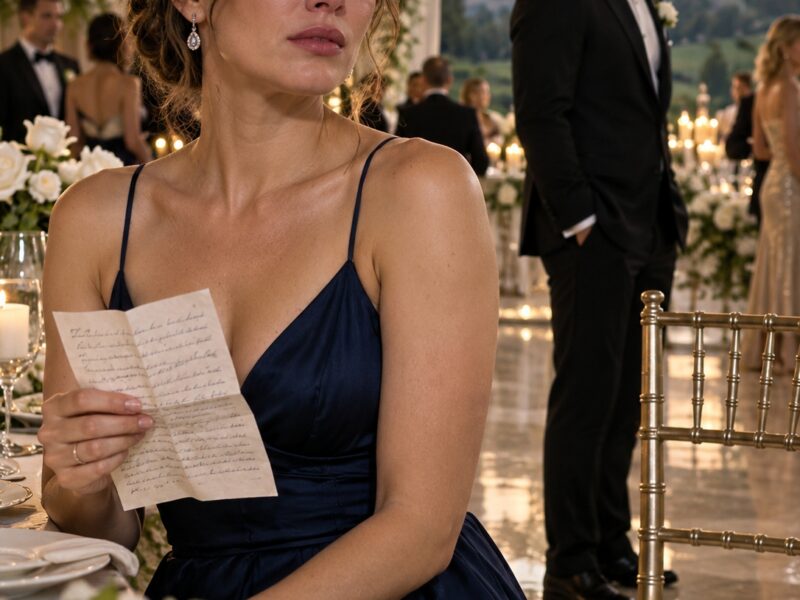
I Went Alone to My Ex-Husband’s Wedding—Then a Stranger Took the Empty Seat Beside Me

The chair beside me was empty.
That should have made me feel safer.
Instead, sitting in the back row of my ex-husband’s wedding with a champagne flute untouched in my hand, I kept looking at that empty chair as if it knew something I didn’t.
Six months earlier, Daniel had signed our divorce papers without looking at me.
Now he was standing beneath an arch of white roses at a private estate outside Hudson Valley, wearing a black tuxedo that probably cost more than the rent on my first apartment, waiting to marry the woman he had once told me was “just someone from work.”
And somehow, I had accepted the invitation.
I could see the back of his head from where I sat.
I could see Clare’s mother dabbing at her eyes in the front row. I could see champagne catching the late-afternoon light on silver trays. I could hear a string quartet playing something soft enough to make heartbreak look elegant.
What I could not understand was why my hands were perfectly still.
For months after the divorce, they had shaken every time Daniel’s name appeared on my phone.
Now I was watching him marry the woman who had entered our marriage before I had realized there was an open door, and all I could think was that the chair beside me looked strangely deliberate.
As if someone was missing.
As if someone was coming.
I placed my small blue purse on it.
“This one,” I whispered under my breath, “is for someone who actually chooses to stay.”
The words were bitter enough to embarrass me.
So I almost laughed.
Then the music changed.
Everyone stood.
Clare appeared at the far end of the aisle.
She was beautiful.
There was no point pretending otherwise.
Her gown was ivory silk, fitted through the waist, with tiny pearls sewn along the neckline. Her blond hair was pinned into a low twist beneath a long veil, and she walked slowly with one hand resting on her father’s arm.
She looked exactly like the kind of woman Daniel had started noticing once success taught him to measure everything by appearances.
Polished.
Expensive.
Certain.
For a fraction of a second, I hated her.
Then I realized the feeling wasn’t hatred.
It was memory.
Because five years earlier, Daniel had looked at me the way he was looking at her now.
Like the future had just entered the room.
I lowered my eyes.
That was when a man stopped beside my row.
He was tall, perhaps early forties, dressed in a charcoal suit without a tie. His dark hair was touched with gray near the temples, and unlike almost every other guest in the room, he didn’t appear interested in being noticed.
He looked at me.
Then at the empty chair.
“Is this seat taken?”
For some reason, the question hit harder than it should have.
I stared at him.
His face wasn’t familiar, but there was something in his expression that made me feel as though he already knew why I was sitting alone.
I moved my purse to the floor.
“No,” I said.
Then, because nerves make people say ridiculous things, I added, “I saved it for you.”
His eyebrows lifted.
A quiet smile touched one corner of his mouth.
“That’s unusually generous.”
“You’re late.”
“Then I’m lucky you’re forgiving.”
He sat down.
And while my ex-husband promised another woman forever, a stranger settled into the empty seat beside me as if he had been expected all along.
I did not know his name.
I did not know why he had arrived after the ceremony began.
And I certainly did not know why, when Daniel glanced toward the back of the room and saw him sitting beside me, every trace of happiness vanished from my ex-husband’s face.
Six months earlier, I had signed away a marriage I once thought would last until one of us died.
The divorce had been quiet.
That was almost worse.
There were no screaming matches in court, no plates thrown against walls, no dramatic accusations exchanged in front of lawyers.
There was only paperwork.
Numbers.
Signatures.
The efficient dismantling of a life.
Daniel sat across from me at the conference table wearing a navy suit and the silver watch I had given him for our third anniversary.
He kept checking it.
That detail stayed with me longer than almost anything else.
Five years of marriage were ending, and he was worried about being late for his next appointment.
My attorney, Rachel, slid a document toward me.
“Page fourteen.”
I signed.
“Initial page fifteen.”
I initialed.
Daniel’s attorney whispered something to him.
He nodded.
Not once did he ask whether I was all right.
Not once did he look toward me and say, We really did try.
Maybe we hadn’t.
Maybe I had tried enough for both of us.
When I finished the last signature, my pen slipped between my fingers and rolled across the polished table.
Daniel caught it.
For one second, our hands almost touched.
He looked at me then.
Really looked at me.
I waited for something.
Regret.
Tenderness.
Shame.
Anything.
Instead, he placed the pen beside my folder and said quietly, “I hope eventually you understand.”
I stared at him.
“Understand what?”
“That people change.”
I nearly smiled.
Because that was the sentence Daniel had used to explain almost everything he had done.
People change.
People outgrow each other.
People want different lives.
People meet other people.
It sounded mature when he said it.
Almost philosophical.
But I had discovered that elegant language could still hide an ugly truth.
Sometimes “people change” simply meant one person had stopped caring how much the change would hurt the other.
I stood.
My knees felt weak.
Daniel rose too.
“Emily.”
I picked up my folder.
“What?”
His face tightened slightly.
“I never wanted to hurt you.”
That sentence finally made me angry.
I looked at him across the conference table.
“No,” I said. “You just wanted everything you wanted, and hurting me was an acceptable price.”
For once, Daniel had no answer.
I left with two suitcases, my grandmother’s necklace, half of what remained in our joint savings account, and a small rented apartment thirty minutes from the home I had spent four years decorating.
Daniel kept the penthouse because his company technically owned it.
He kept the Mercedes because it was registered through the business.
He kept the company because legally I had never been an employee, shareholder, partner, officer, or anything else that mattered on paper.
That last part hurt more than losing the apartment.
Because before Daniel Warren had employees, investors, expensive suits and interviews in business magazines, he had me.
When we met, he was twenty-nine and broke.
Not temporarily short on cash.
Broke.
He lived in a one-bedroom apartment over a laundromat in Queens with a radiator that clanged like someone hitting it with a wrench at three in the morning.
I was twenty-seven, working for a nonprofit and earning just enough to split groceries, subway fare, student-loan payments and the occasional Friday-night takeout.
Our first date cost twenty-three dollars.
He apologized three times because the restaurant didn’t serve wine.
I told him I liked beer.
He believed me.
That was the version of Daniel I loved first.
The man who carried my shoes when my feet hurt.
The man who wrote business ideas on napkins.
The man who once stood in a grocery aisle for ten minutes comparing pasta prices because we were trying to save twelve cents.
He had ideas but no confidence.
I had confidence in him before he knew how to have it himself.
At night, we sat at our tiny kitchen table while I edited his presentations.
“Too many numbers,” I would tell him.
“Investors like numbers.”
“Investors like understanding numbers.”
He would glare.
I would delete half the slide.
He would complain.
Then the next morning he would come home from a meeting and kiss me so hard I nearly dropped my coffee.
“They loved the presentation.”
“I’m shocked.”
“You’re impossible.”
“And yet very useful.”
He would pull me against him.
“More than useful.”
For years, I believed those words.
The company grew slowly at first.
Then all at once.
Daniel found the right investors, made the right acquisitions, hired people smarter than both of us and became frighteningly good at walking into rooms where powerful men expected him to be intimidated.
Success fit him.
Maybe too well.
The first thing to disappear was dinner.
Then weekends.
Then the habit of telling me where he was going.
His suits became more expensive.
His phone gained a second passcode.
When we walked into a restaurant, he started checking whether anyone important was there before looking at me.
And whenever I tried to talk about it, he smiled as though I were being sentimental.
“We worked for this,” he would say.
I always noticed the pronoun.
We worked for this.
But somehow, whenever decisions were made about the life that success purchased, there was only him.
Clare Bennett entered our lives at a company fundraiser in Manhattan.
She was thirty-two, sophisticated, sharp, and so effortlessly comfortable around wealth that I felt provincial standing beside her.
Daniel introduced us near the bar.
“Emily, this is Clare. She’s advising us on the West Coast expansion.”
Clare extended one manicured hand.
“I’ve heard so much about you.”
I smiled.
“Hopefully nothing legally actionable.”
She laughed.
Daniel laughed harder.
Something inside me noticed that.
Not suspicion.
Not yet.
Just a tiny discomfort I couldn’t name.
Later that evening, I watched Clare touch Daniel’s sleeve while speaking to him.
It was nothing.
People touched each other when they talked.
People laughed.
People stood close in crowded rooms.
Marriage could not survive if every harmless interaction became evidence.
So I ignored it.
Then came the late meetings.
San Francisco.
Chicago.
Boston.
Drinks after strategy sessions.
A conference in Miami that somehow required an extra night.
One evening, I woke at 1:17 a.m. and found Daniel on our balcony speaking quietly into his phone.
The glass door was closed.
I couldn’t hear everything.
Only fragments.
“…not tonight.”
Silence.
Then, softer:
“I know.”
He turned and saw me standing in the bedroom.
The call ended immediately.
“Who was that?”
“Marcus.”
“At one in the morning?”
“West Coast issue.”
I looked toward his phone.
“You told him ‘not tonight.’”
Daniel’s jaw tightened.
“Emily, please.”
Two words.
But I heard the warning inside them.
Do not become difficult.
Do not make me explain myself.
Do not force me to say out loud what you already know.
Three weeks later, I found a hotel receipt in the pocket of his coat.
Two guests.
One room.
San Francisco.
Daniel had told me he spent that trip in Los Angeles.
I waited until dinner.
I placed the receipt beside his plate.
He stared at it for a long time.
Then at me.
“Say something,” I whispered.
Daniel sat back.
He didn’t ask how I found it.
He didn’t pretend it was a misunderstanding.
He rubbed one hand over his face.
And somehow his honesty hurt worse than a lie would have.
“How long?”
“Emily—”
“How long?”
“A few months.”
I stared at him.
“With Clare?”
He closed his eyes.
That was the answer.
I stood so quickly my chair struck the wall.
Daniel reached toward me.
“Please don’t.”
“Don’t what? React?”
“That’s not what I meant.”
“Then tell me what you meant.”
He stood.
For twenty minutes, he explained the destruction of our marriage like a businessman explaining a failed merger.
We had become different people.
He had changed.
His world had changed.
He felt I resented his success.
He felt I didn’t understand his responsibilities.
Clare understood the pressure.
Clare understood ambition.
Clare understood who he was now.
Finally, I asked the one question I should never have asked.
“What happened to us?”
Daniel looked at me for a long time.
Then he said the sentence that lived inside me for months afterward.
“I changed, Emily. You didn’t change with me.”
There are words that make you angry immediately.
Then there are words that enter your body quietly and begin poisoning your memories from the inside.
For weeks, I wondered if he was right.
Had I failed to evolve?
Was loving simple dinners and ordinary Sundays evidence that I lacked ambition?
Had I become boring?
Had I been so busy believing in Daniel’s dreams that I forgot to create a new version of myself worthy of standing beside the man he became?
It took therapy, distance, and several lonely months before I understood the cruelty hidden inside his sentence.
I had changed.
I had simply changed in ways he had stopped looking closely enough to notice.
And now, six months after our divorce, I was sitting at his wedding.
The invitation had arrived on a rainy Tuesday.
Cream envelope.
Embossed lettering.
Daniel Warren and Clare Bennett request the pleasure of your company.
I read it three times.
Then laughed.
Not because it was funny.
Because some experiences are so absurd your body refuses to select the correct emotion.
I called my best friend, Nora.
“He invited you?”
“Yes.”
“To his wedding?”
“That’s generally what wedding invitations are for.”
“Emily.”
“I know.”
“Burn it.”
“I thought about that.”
“Then burn it twice.”
I set the card on my kitchen counter.
“What if I go?”
There was a silence so long I checked whether the call had dropped.
Finally Nora said, “Why?”
I didn’t know.
For closure, maybe.
To prove something.
To punish myself.
Some small, shameful part of me probably wanted Daniel to see me walk into that wedding looking composed and realize that losing me had cost him something.
But on the afternoon of the ceremony, standing in front of my bathroom mirror in a dark blue dress I had bought on sale, I finally understood.
I wasn’t going to make Daniel regret leaving.
I was going to find out whether I could stand in the same room with the life he chose instead of me and still remember who I was.
The estate was more beautiful than anything Daniel and I could have afforded when we were married.
White stone.
Tall windows.
Ancient oak trees.
A terrace overlooking green hills.
Luxury cars lined the circular drive while attendants in black jackets opened doors.
For several seconds, I remained behind the steering wheel of my ten-year-old Honda.
A Bentley pulled in beside me.
A woman stepped out wearing earrings that probably cost more than my car.
I almost drove away.
Then I looked at myself in the rearview mirror.
“You didn’t come here to belong to them,” I said.
“You came here to belong to yourself.”
It sounded like something printed on an inspirational mug.
But it got me out of the car.
Inside, several guests recognized me.
Their reactions were fascinating.
Surprise first.
Then pity.
Then frantic politeness.
“Emily! Wow. You look… wonderful.”
Translation: We did not expect the discarded wife to appear.
One woman hugged me too tightly and whispered, “You’re so brave.”
I wanted to ask whether I was attending a wedding or undergoing chemotherapy.
Instead, I smiled.
Then I saw Daniel.
He stood near the entrance to the ballroom speaking with two investors.
Black tuxedo.
Perfect posture.
Confident smile.
Exactly the man he had spent years becoming.
His eyes found mine.
Everything stopped.
Not literally, of course.
The quartet continued.
People continued talking.
A waiter nearly collided with a woman carrying a gift.
But something changed in Daniel’s face.
His smile disappeared.
For the first time that day, I knew coming had been the correct decision.
Not because he looked regretful.
Because I realized his reaction no longer controlled mine.
Clare appeared beside him.
Her hand slipped around his arm.
Daniel looked away.
I found my assigned seat near the back.
One chair beside me remained empty.
Then the ceremony began.
Then the stranger arrived.
For the first several minutes after sitting down, he said nothing.
I appreciated that.
People are often uncomfortable with another person’s pain, so they attack it with questions.
Are you okay?
Do you want to talk?
Everything happens for a reason.
The stranger did none of that.
He simply sat.
When the officiant began speaking about love being a choice renewed every day, I felt the man beside me shift slightly.
“Interesting line,” he whispered.
I glanced at him.
“Which part?”
“The part about choice.”
“You disagree?”
“No.”
He looked toward Daniel.
“I think people underestimate what it costs.”
There was something in his voice.
Not cynicism.
Experience.
“Are you married?” I asked quietly.
“Not anymore.”
“Divorced?”
“Widowed.”
The answer stopped me.
“I’m sorry.”
“So am I.”
He said it gently, without inviting sympathy.
The ceremony continued.
Daniel and Clare exchanged vows.
Clare’s voice trembled.
Daniel’s did not.
When he promised honesty, my throat tightened.
The stranger noticed.
He did not ask why.
He simply handed me the folded ceremony program he had been holding.
I frowned.
“For what?”
“You’re crushing yours.”
I looked down.
He was right.
My own program had been twisted into a tight tube between my fingers.
I released it immediately.
“Occupational hazard,” I murmured.
“What occupation involves destroying wedding stationery?”
“Ex-wife.”
The word escaped before I could stop it.
He turned.
For the first time since sitting down, genuine surprise crossed his face.
“You’re Emily.”
My pulse changed.
I looked directly at him.
“How do you know my name?”
The bride and groom were kissing.
The room erupted in applause.
Everyone stood.
The stranger remained seated for half a second longer.
Then he rose beside me.
“I think,” he said quietly, “that conversation needs more than thirty seconds.”
Before I could answer, people flooded the aisle.
And suddenly I knew two things.
The stranger had known exactly who I was before he sat down.
And Daniel had known exactly who the stranger was.
At the cocktail reception, I deliberately tried to lose him.
It was childish.
I knew that.
But after spending years discovering things after everyone else already knew them, I had developed a violent dislike of mysteries involving my own life.
I crossed the ballroom, took a glass of sparkling water from a tray, and moved toward the terrace.
Three minutes later, he appeared beside me carrying two small plates.
I stared at him.
“Are you following me?”
“You haven’t eaten.”
“That didn’t answer my question.”
“No.”
“You’re holding food.”
“You still haven’t eaten.”
I looked at the plates.
Salmon crostini, vegetables, some tiny pastry I couldn’t identify.
“You’re strange.”
“I’ve been called worse.”
“By your wife?”
A shadow passed through his expression.
I regretted the joke immediately.
“I’m sorry.”
He shook his head.
“She called me worse too.”
That made me laugh before I could stop myself.
The sound felt unfamiliar.
I had not laughed at anything connected to Daniel in a very long time.
The stranger offered me a plate.
I accepted.
“Thank you.”
“You’re welcome.”
I ate one of the crostini.
He looked satisfied.
“That was disturbingly paternal.”
“I have sisters.”
“That explains nothing.”
“It explains everything.”
I studied him.
“What’s your name?”
“Thomas.”
“Thomas what?”
“Reed.”
I nearly dropped the plate.
Thomas Reed.
I knew the name.
Anyone who had spent five years beside Daniel knew the name.
Reed Capital had been one of the earliest investment firms to take Daniel’s company seriously. Thomas Reed had built and sold two technology companies before becoming an investor, and several years earlier his name had appeared constantly in our apartment.
Daniel once called him “the smartest man in any room who makes sure nobody notices.”
I had never met him.
But Daniel had wanted his approval desperately.
“Thomas Reed?”
He gave me a resigned expression.
“Unfortunately.”
“Daniel talked about you.”
“That feels threatening.”
“He admired you.”
“That feels more threatening.”
I stared at him.
“Why are you here?”
“Daniel invited me.”
“That isn’t what I asked.”
Thomas looked toward the ballroom.
“No.”
“It wasn’t.”
He seemed to consider how much to say.
Then a familiar voice came from behind us.
“Emily.”
My entire body recognized Daniel before I turned.
He was standing several feet away.
Up close, he looked different than he had from the back of the ceremony.
Tired.
Not unhappy.
Just strained.
His eyes moved from me to Thomas.
Then back.
“You came.”
I took another bite of crostini because I suddenly enjoyed making him wait.
“I was invited.”
Daniel almost smiled.
“Right.”
Thomas stepped forward.
“Congratulations.”
Daniel looked at him.
The transformation was immediate.
His shoulders stiffened.
“Thomas.”
“Daniel.”
“I didn’t know you were coming.”
“I wasn’t.”
Daniel glanced at me.
“Then what changed?”
Thomas’s expression remained pleasant.
“My mind.”
Silence.
Daniel lowered his voice.
“Can we talk privately?”
“Later.”
“Thomas.”
“Today is your wedding.”
That sounded courteous.
It did not feel courteous.
Daniel’s jaw tightened.
“I’d prefer now.”
Thomas looked at me.
Then back at Daniel.
“I wouldn’t.”
There was no aggression in his voice.
That made the tension worse.
Daniel’s gaze shifted toward me again.
For several seconds, something unspoken moved between the two men.
I felt it.
I hated it.
“You both know something I don’t.”
Neither answered.
I looked at Thomas.
“You knew who I was before you sat down.”
“Yes.”
Daniel’s face changed.
“Thomas.”
I turned toward him.
“What?”
“Emily, this isn’t—”
“What?”
He stopped.
For years, Daniel had been skilled at ending conversations by deciding they were inappropriate.
I no longer had to obey.
“What isn’t what, Daniel?”
Guests passed behind us laughing.
Somebody called Daniel’s name from across the room.
He barely seemed to hear it.
Thomas placed his untouched plate on a nearby table.
“I was going to tell her.”
Daniel looked at him sharply.
“Tell me what?”
Thomas remained quiet for one second too long.
Then the photographer approached.
“Mr. Warren! We need the wedding party by the rose wall.”
Daniel did not move.
The photographer smiled uncertainly.
“Sir?”
Clare appeared behind him.
“There you are.”
Her eyes found me.
The smile remained, but her fingers tightened around Daniel’s arm.
“Emily.”
“Clare.”
“I’m glad you came.”
I believed she had practiced that sentence.
“Congratulations.”
“Thank you.”
Her attention moved toward Thomas.
Recognition lit her face.
“Mr. Reed. I didn’t realize you were here.”
“I arrived late.”
“So I heard.”
Something in her tone told me gossip traveled at remarkable speed among expensive people.
Clare looked at Daniel.
“The photographer is waiting.”
Daniel nodded.
Before leaving, he looked at Thomas.
“Later.”
Thomas said nothing.
Daniel walked away.
Clare followed.
But after several steps, she glanced back at me.
Not with triumph.
Not even dislike.
With fear.
That unsettled me more than anything Daniel had done.
I turned toward Thomas.
“You have exactly thirty seconds before I leave.”
“Emily—”
“Twenty-nine.”
He almost smiled.
I didn’t.
“Twenty-eight.”
“All right.”
He reached inside his jacket.
What he removed was not a business card.
It was a folded envelope.
Old.
Cream-colored.
The edges were soft from having been handled many times.
My stomach dropped before I understood why.
Thomas extended it toward me.
I didn’t take it.
“Where did you get that?”
“You recognize it?”
I recognized my own handwriting.
EMILY, written across the front.
Except I had never written an envelope to myself.
Then memory arrived.
Not gradually.
Violently.
Three years earlier.
A winter night.
Daniel sleeping in the guest room after our fourth argument that week.
Me at the kitchen table at two in the morning, writing things I had become too frightened to say aloud.
I reached for the envelope.
My hands began shaking.
The first line inside confirmed everything.
Daniel,
I miss the man who used to be embarrassed when a dinner cost more than forty dollars.
My throat closed.
I had forgotten the letter.
Or convinced myself I had.
I remembered leaving it on Daniel’s desk before he flew to Boston for an investor meeting.
He never mentioned it.
When I asked if he had read it, he said, “Yes.”
Nothing more.
I assumed he threw it away.
Instead, three years later, it was in the hands of a stranger sitting beside me at Daniel’s wedding.
I looked up.
“Why do you have this?”
Thomas did not answer immediately.
Across the ballroom, guests cheered as Daniel and Clare posed beneath the rose wall.
Flashbulbs exploded.
Thomas watched my face.
“Because Daniel left it in a proposal folder three years ago.”
I stared at him.
“What?”
“He came to my office for a meeting. Your letter was folded between two sets of documents. I opened it because I thought it was part of the proposal.”
My chest tightened.
“You read it?”
“The first page.”
Heat rose into my face.
Those words had been private.
Desperate.
Humiliating.
Thomas must have seen my expression because he continued quickly.
“I realized almost immediately it wasn’t meant for me. I stopped.”
“Then why didn’t Daniel take it home?”
“He did.”
I looked down at the paper in my hands.
“Then how is it here?”
“Because two days later he sent it back.”
That made no sense.
Thomas continued.
“He called me first. He was embarrassed I had seen it. We talked.”
“About me?”
“About himself.”
I swallowed.
“What did he say?”
Thomas looked toward Daniel.
“He asked why your letter bothered him so much.”
A strange laugh escaped me.
“Bothered him?”
“I told him I thought it bothered him because you had described him accurately.”
I looked down at the page.
I could barely make out the words through the blur forming in my eyes.
Thomas spoke quietly.
“He sent the letter back with a note.”
“There was a note?”
Thomas reached into the envelope.
A smaller sheet was folded behind mine.
I had never seen it.
He handed it to me.
Daniel’s handwriting covered only four lines.
You were right.
She remembers who I was better than I do.
Keep this until I’m ready to read it without being angry.
If I ask for it back, make me explain why.
I read it twice.
Then a third time.
My breathing became shallow.
“He never asked for it?”
Thomas shook his head.
“Not until two weeks ago.”
I looked up.
“What happened two weeks ago?”
Thomas glanced toward the wedding photographs.
“He told me he was getting married.”
The room suddenly felt too warm.
“So?”
“So I asked whether he wanted the letter back.”
“And?”
“He said no.”
I stared at him.
Thomas continued.
“He said, ‘Give it to Emily if you ever see her again.’”
Every sound in the ballroom seemed to recede.
The music.
The laughter.
The clinking glasses.
All of it.
I looked across the room at Daniel.
He was smiling for the camera with Clare beside him.
His hand rested at her waist.
A perfect wedding photograph.
Yet two weeks before marrying her, he had told another man to give me the letter I had written while our marriage was dying.
“Why?”
I whispered it.
Thomas heard.
“I asked him.”
“What did he say?”
“That you should know he eventually understood it.”
The sentence pierced somewhere I thought had healed.
I folded the paper.
Very carefully.
“So you came to a wedding just to hand me a letter?”
“No.”
“Then why?”
Thomas looked directly at me.
“That’s the second conversation.”
I almost laughed.
“Of course it is.”
“It’s a little more complicated.”
“Everything involving Daniel apparently requires multiple acts.”
Thomas smiled briefly.
Then his expression changed.
“I’ve been trying to find you for four months.”
I stopped breathing.
“Excuse me?”
“Professionally.”
“That word did not make the sentence less alarming.”
“I realize that.”
“Why were you looking for me?”
Thomas glanced at the paper in my hands.
“Because of what was in your letter.”
“That is an even worse answer.”
He nodded.
“Fair.”
He led me toward a quieter corridor beside the terrace, where the noise of the reception softened.
I should have left.
Every rational instinct said I had already received more emotional information than any person should process at an ex-husband’s wedding.
But curiosity is powerful when it concerns the person you used to be.
Thomas leaned against the stone railing outside.
“I started a foundation last year.”
“I know.”
“You do?”
“I googled you once after Daniel said you terrified him.”
That made him laugh.
“I’m putting that on my résumé.”
“The foundation helps women rebuilding after major financial disruption.”
I nodded.
I had seen an article.
Job training.
Small-business grants.
Legal referrals.
Financial education.
Programs for women leaving marriages, caring for relatives, recovering from bankruptcy or reentering the workforce.
Thomas continued.
“We’ve made mistakes.”
“That’s reassuring.”
“I hired people who were good at philanthropy.”
“That seems logical.”
“It was. Except most of them had never needed what they were designing for other people.”
I looked at him.
He paused.
“We were building rescue boats with people who had never been in the water.”
That line stayed with me.
“So you thought of me?”
“Not because you were divorced.”
“Good.”
“Because of the letter.”
I frowned.
“What exactly in that letter made you think I could run anything?”
“Everything.”
I shook my head.
“You read one page.”
“Enough to know you understood how to believe in someone without worshipping them. Enough to know you could see what success was doing to a person before he could see it himself. Enough to know you were capable of telling someone the truth even when you were terrified of losing him.”
My eyes burned.
I looked away.
Thomas continued.
“And then I learned more.”
“How?”
“Mutual contacts. Public records. People who worked with the nonprofit where you spent seven years.”
A small pulse of alarm moved through me.
“You investigated me?”
“I did due diligence.”
“You rich people have nicer words for everything.”
He accepted that.
“One of your former directors told me you rebuilt their employment program after they lost a federal grant.”
I blinked.
“That was years ago.”
“She remembered.”
Another tiny crack opened inside me.
Thomas continued.
“A former colleague said you created the budgeting workshops they still use.”
I said nothing.
“Another said you trained volunteers, negotiated with landlords, helped women create return-to-work plans, and spent six months getting a pilot program funded after everyone else gave up.”
My throat tightened.
Those things had happened.
But they belonged to a version of my life Daniel had slowly convinced me was small.
Thomas watched me.
“You keep looking surprised.”
“I haven’t thought about most of that in years.”
“That’s why I wanted to meet you.”
“Why?”
“Because somewhere along the way, you started describing yourself as Daniel Warren’s ex-wife.”
The words landed brutally.
He wasn’t wrong.
Since the divorce, every introduction in my head had begun with Daniel.
I was the woman he left.
The woman he cheated on.
The woman who helped build someone else’s life and had no ownership stake when it succeeded.
Thomas reached inside his jacket again and removed a business card.
“I need a director for the foundation’s rebuilding initiative.”
I stared at him.
“You’re offering me a job?”
“I’m offering you an interview.”
Despite everything, I laughed.
“Much less romantic.”
“I’m an investor. We fear promises.”
“You found me at my ex-husband’s wedding to offer me an interview?”
“No.”
“Thomas.”
“I came because Daniel told me you might attend, and I had the letter.”
“That sounds exactly like what I just said.”
“The interview was why I had been looking for you. The letter was why I finally came today.”
I studied him.
“What did Daniel say about you trying to hire me?”
Thomas’s face became unreadable.
“He didn’t know.”
That answer surprised me.
“You didn’t tell him?”
“No.”
“Why?”
“Because he doesn’t own your future.”
For several seconds, I could not speak.
It was such a simple sentence.
So obvious.
Yet nobody had said anything like that to me since the divorce.
Maybe not even before it.
I looked down at the card in my hand.
Thomas Reed.
Founder.
Reed Renewal Foundation.
Beneath it was a handwritten number.
“What if I say no?”
“Then you say no.”
“What if I’m not qualified?”
“Then the interview panel will tell you.”
“You’re not on the panel?”
“I am.”
“That seems biased.”
“I said panel. I didn’t say democracy.”
I laughed again.
And for the second time that evening, I nearly cried immediately afterward.
Thomas noticed.
He looked away.
It was one of the kindest things anyone had done for me all night.
He let me recover without witnessing it.
Then Daniel found us.
He walked onto the terrace alone.
No Clare.
No smile.
No groom’s composure.
His face was pale.
Thomas looked at me.
“Do you want me to stay?”
Daniel flinched slightly at the question.
I noticed.
Six months earlier, Daniel would have assumed privacy with me was his right.
Thomas asked.
“I’m fine,” I said.
Thomas nodded.
“I’ll be inside.”
He passed Daniel without speaking.
When the door closed behind him, my ex-husband and I stood beneath strings of warm garden lights while his wedding reception continued twenty feet away.
Daniel saw the envelope in my hand.
His eyes closed briefly.
“So he gave it to you.”
“Yes.”
“I wasn’t sure he would.”
“You told him to.”
“I know.”
“Why?”
Daniel looked toward the dark lawn.
For several seconds, he said nothing.
Then he whispered, “Because you deserved to know I read it.”
I stared at him.
“You told me you read it three years ago.”
“I mean I actually read it.”
A cold feeling moved through me.
“What are you talking about?”
“The night you gave it to me, I read two paragraphs.”
I remembered.
“You said you read the whole thing.”
“I lied.”
The admission felt almost absurd compared with everything else he had done.
“Why?”
“Because I knew what it said.”
“No. You knew what you assumed it said.”
Daniel rubbed one hand across his mouth.
“I thought it was another argument.”
“It was a letter.”
“I know.”
“You couldn’t even read my letter?”
“No.”
His voice cracked slightly.
I waited.
Daniel looked at me.
“I read it after I asked Thomas for it back.”
I frowned.
“He said you never asked for it.”
“I did. Once.”
“When?”
“After the divorce.”
Something inside me went still.
“How long after?”
“Three weeks.”
I remembered those three weeks.
The empty apartment.
The mornings when I woke convinced for one second that Daniel was in bed beside me.
The afternoons I sat in my car outside the grocery store because buying food for one person made the divorce suddenly real.
Daniel continued.
“Thomas made me explain why.”
“Because of your note.”
He nodded.
“I told him I wanted to know whether I had been unfair.”
“And?”
“He told me if I still needed a letter to answer that question, I wasn’t ready to read it.”
I looked toward the ballroom.
“Apparently Thomas has always enjoyed being dramatic.”
A faint smile touched Daniel’s face.
Then disappeared.
“He sent me a scan.”
“So the original stayed with him.”
“Yes.”
That fixed one mystery.
It created another.
“What did you feel when you finally read it?”
Daniel stared at the lawn.
“Ashamed.”
I waited.
He swallowed.
“Angry at first.”
“At me?”
“At everything.”
He gave a tired laugh.
“I hated the version of me in that letter.”
“You created him.”
“I know.”
“Do you?”
He nodded.
That surprised me more than defensiveness would have.
“I spent years telling myself you couldn’t understand who I had become because you didn’t want more.”
I crossed my arms.
“And Clare did.”
“That’s what I told myself.”
“What are you telling yourself now?”
Daniel looked toward the ballroom doors.
For the first time, I saw fear.
Not fear of losing me.
That would have been easier.
Fear of understanding himself too late.
“Clare and I had a fight before the reception.”
I almost smiled.
“On your wedding day?”
“She found something.”
My stomach tightened despite myself.
“What?”
“A message.”
“From whom?”
“You.”
I stared at him.
“I haven’t messaged you in months.”
“Not a new one.”
Daniel reached into his pocket.
He unlocked his phone and turned the screen toward me.
It was an old text.
From me.
Nearly four years earlier.
Before Clare.
Before the affair.
Before the divorce.
I remembered sending it after Daniel’s first major investment closed.
I am proud of what you’re building. Just promise me there will still be room for the person you were before everyone started applauding.
I looked at him.
“You kept that?”
“Yes.”
“Why?”
“I don’t know.”
“That’s a lie.”
He looked away.
I understood before he spoke.
Clare had understood too.
“You kept it because some part of you knew.”
Daniel’s eyes shone.
“Knew what?”
“That the person you blamed for not growing with you had been warning you not to disappear.”
He closed his eyes.
Neither of us spoke.
Music floated from inside.
A slow song.
Couples were probably moving toward the dance floor while the groom stood outside with his former wife discussing the ruins of his first marriage.
It would have been satisfying if I hated him.
Instead, I felt tired.
Deeply, impossibly tired.
Daniel spoke first.
“Clare asked why I still had the message.”
“What did you tell her?”
“The truth.”
“Which truth?”
“That I don’t want you back.”
That stung less than I expected.
He continued.
“But I still carry guilt about what I did to you.”
I looked at him.
“Those are different things.”
“I know that now.”
“And Clare?”
“She said she didn’t want to spend her marriage competing with a ghost.”
I almost laughed.
“I’m standing twenty feet away. That’s a very visible ghost.”
Daniel smiled weakly.
“It wasn’t about you.”
“No?”
“It was about who I was with you.”
That silenced me.
He took one step closer, then stopped.
“I’m sorry.”
I had imagined those words for years.
During the affair.
During negotiations.
During the divorce.
During nights when anger kept me awake until dawn.
I had constructed entire versions of the moment.
Daniel crying.
Daniel begging.
Daniel realizing Clare had never loved him.
Daniel losing everything.
Daniel coming to my door while I stood there stronger, prettier, happier, completely unaffected.
Reality was quieter.
My ex-husband stood before me on his wedding day looking exhausted.
“I’m sorry,” he repeated. “Not because my life is terrible. It isn’t. Not because I think we should have stayed married. Maybe we shouldn’t have.”
A small pain moved through me.
Truth often hurts even when it frees you.
“But I betrayed you before I left you,” Daniel continued. “Then I made you responsible for why I wanted to leave. I told you that you hadn’t changed because admitting what I had done would have meant admitting I was the one who lost sight of myself.”
My eyes filled.
He kept speaking.
“You deserved honesty. You deserved respect. You deserved some recognition that you were there before any of this.”
He gestured toward the estate.
The lights.
The guests.
The life.
“I acted like success erased the years before it.”
His voice broke.
“It didn’t.”
I looked at him for a long time.
Then I asked the question that surprised both of us.
“Are you happy?”
Daniel exhaled.
“I don’t know.”
“That’s a terrible thing to say at your wedding.”
“I know.”
“Do you love her?”
“Yes.”
No hesitation.
I appreciated that.
“Then why are you out here?”
“Because I needed to say this before I lost the courage.”
I nodded.
Daniel’s eyes searched mine.
“I made a mistake.”
For one second, the old wound in me opened.
Then I realized what he meant.
Not marrying Clare.
Not divorcing me.
The way he had ended us.
“I know,” I said.
“I’m sorry.”
“I know.”
“Can you forgive me?”
That question once would have given me power.
I had imagined withholding forgiveness the way he withheld affection.
Letting him feel uncertainty.
Making him wait.
Instead, I felt something I never expected.
Relief.
“I forgive you.”
Daniel’s face crumpled slightly.
I held up one hand.
“But listen carefully.”
He did.
“Forgiveness is not reconciliation.”
He nodded.
“It is not me saying what happened was acceptable.”
“I know.”
“And it does not mean I was secretly waiting for you to realize you loved me more.”
His eyes filled.
“I know.”
“It means I am finished carrying what you did as evidence of what I’m worth.”
Daniel looked down.
For several seconds, neither of us moved.
Then he whispered, “Are you happy?”
I thought about my rented apartment.
My old Honda.
The nights I ate cereal for dinner.
The panic attack I had in a supermarket because our favorite coffee was on sale.
The way I still sometimes woke with my jaw clenched.
Then I looked through the glass doors.
Thomas stood across the ballroom speaking with an elderly woman.
He glanced toward the terrace.
When he saw me looking, he did not approach.
He simply waited.
Something about that made my answer easy.
“I think I’m finally learning how.”
Daniel followed my gaze.
He noticed Thomas.
His expression shifted.
“Is something happening between you two?”
I nearly laughed.
“I met him ninety minutes ago.”
“That didn’t answer my question.”
“You really haven’t changed enough.”
He laughed.
A genuine laugh.
For one strange second, we sounded like the people we had once been.
Then the moment passed.
Daniel looked back toward the ballroom.
“I should go find my wife.”
“Yes.”
He turned.
“Emily?”
“What?”
“I’m glad you came.”
I considered that.
Then smiled faintly.
“So am I.”
I watched him walk inside.
For the first time since meeting him, I did not wonder whether he would turn around.
That was how I knew it was over.
Not the signatures.
Not Clare.
Not the wedding.
That moment.
When Daniel disappeared through the ballroom doors and I felt no urge to follow.
I stayed outside another minute.
Then Thomas joined me.
“How bad?”
“On a scale?”
“Preferably one with snacks.”
I smiled.
“He apologized.”
Thomas nodded.
“That’s good.”
“You sound disappointed by the lack of bloodshed.”
“I was told this would be an American wedding.”
I laughed.
He offered me a glass of water.
I took it.
“He said he asked you for the letter after our divorce.”
Thomas leaned against the railing.
“He did.”
“You told me he never asked.”
“I said he never asked for the original back.”
I stared at him.
“That is an irritatingly lawyer-like distinction.”
“I fund lawyers. It’s contagious.”
“You sent him a scan.”
“Yes.”
“Why keep the original?”
“Because his note asked me to.”
I looked down at the envelope.
“If he asked for it?”
“I was supposed to make him explain why.”
“Did he?”
“Eventually.”
“What did he say?”
Thomas looked at me.
“That he wanted proof he hadn’t invented the woman who loved him before he had anything.”
I felt the sentence in my chest.
“Did you believe him?”
“I believed he finally understood what he lost.”
“That sounds dangerously close to taking my side.”
Thomas shrugged.
“I have excellent judgment.”
“Except you came to this wedding.”
“Everyone has weaknesses.”
Inside, someone announced the first dance.
Thomas and I watched through the windows as Daniel found Clare.
She looked as though she had been crying.
He said something.
She listened.
After several seconds, she allowed him to take her hand.
They walked toward the dance floor.
I expected jealousy.
It never came.
I expected triumph after Daniel’s apology.
That didn’t come either.
Instead, something far quieter settled over me.
Compassion.
Not only for Daniel.
For Clare too.
She was beginning a marriage with a man who had finally started examining the damage he had done in his previous one.
That would not be simple.
But it was no longer my problem.
Thomas interrupted my thoughts.
“Monday.”
I looked at him.
“What about it?”
“Interview.”
“You’re assuming I’m interested.”
“You kept the card.”
I looked down.
I was still holding it.
“That proves nothing.”
“You also haven’t left.”
“This is a very good wedding.”
“The bride looks like she wants to murder half the guests.”
“Entertainment.”
Thomas smiled.
“Ten a.m.?”
“I have work.”
“Eleven?”
“You’re remarkably persistent.”
“Only about things I think matter.”
The sentence was simple.
But after years of begging a man to notice what mattered to me, simplicity felt dangerous.
I slipped the card into my purse.
“Email me.”
“That sounds like a yes.”
“It sounds like an email address.”
“I can work with that.”
Three days later, Thomas emailed.
No pressure.
No emotional reference to the wedding.
No mention of Daniel.
Just a job description, salary range, program overview and an invitation to interview with a five-person hiring committee.
The position paid more than I was earning.
Substantially more.
For twenty-four hours, I did nothing.
Then I called Nora.
“You’re interviewing.”
“I didn’t ask.”
“You called me because you wanted someone to order you to interview.”
“What if Thomas is doing this because he feels sorry for me?”
“He gave you a five-person panel.”
“What if all five feel sorry for me?”
“Then congratulations on being the most pitiful woman in New York.”
“Nora.”
“Emily. You spent five years helping Daniel believe he could build an empire. Maybe spend one afternoon pretending you deserve a job interview.”
I hated when she made sense.
So I went.
The foundation’s offices occupied two floors of a renovated building in Brooklyn.
There were no marble statues.
No receptionist who looked like a fashion model.
No giant portrait of Thomas.
I considered these good signs.
The interview lasted ninety minutes.
Thomas asked fewer questions than anyone else.
The program director, Maya Chen, asked what I would change about their current employment curriculum.
I told her half of it was useless.
Thomas coughed into his coffee.
Maya leaned forward.
“Why?”
“Because you’re teaching financial literacy like poverty is caused by not understanding spreadsheets.”
The room became very quiet.
I continued.
“A woman who leaves a marriage with eighty dollars in checking doesn’t need a lecture about compound interest first. She needs to know whether she can cover a security deposit, whether she has access to her credit history, whether her name is on the car title, whether she can afford childcare long enough to attend your training.”
Nobody interrupted.
I pointed toward the packet they had given me.
“You have four sessions on budgeting and one page on emergency housing.”
Maya looked at Thomas.
Thomas looked at me.
I immediately regretted speaking.
Then Maya smiled.
“Keep going.”
So I did.
I told them their language was too clinical.
That “participants” should be treated like adults, not broken objects.
That women emerging from financially controlling marriages might not know their own Social Security numbers because someone else had handled every document for years.
That rebuilding did not start with inspiration.
It started with practical choices made while terrified.
When I finished, Thomas asked one question.
“If you had one million dollars for a pilot program, what would you build?”
The answer came before fear could stop it.
“Not a program.”
He raised an eyebrow.
“A bridge.”
“Explain.”
“Legal help, employment placement, emergency cash, financial coaching and mental-health referrals in one place. Not five phone numbers. Not five intake forms. One coordinator who stays with a client for six months.”
Maya sat back.
“That would be expensive.”
“Yes.”
“Hard to scale.”
“Yes.”
“Operationally messy.”
“Yes.”
Thomas smiled.
“Anything good about it?”
I looked at him.
“It might actually work.”
Two weeks later, they offered me the job.
I sat alone in my kitchen staring at the email.
Director of Rebuilding Initiatives.
For five minutes, I was convinced there had been a mistake.
Then I saw the salary again.
I called Nora.
She screamed so loudly I held the phone away from my ear.
“You’re taking it.”
“I think so.”
“You think so?”
“I’m scared.”
“Good.”
“That’s your advice?”
“Yes. Bad decisions can feel comfortable. Good ones can scare the hell out of you.”
I accepted.
My first month was brutal.
I worked longer hours than I had in years.
I argued with Maya twice.
I told Thomas his grant timeline was unrealistic.
He told me my intake process required too many staff hours.
I told him human beings required staff hours.
He told me budgets existed.
I told him rich men invented budgets to annoy women.
He laughed.
I did not.
Then we redesigned the process together.
That surprised me.
Daniel had always treated disagreement as disloyalty.
Thomas treated it as work.
He could say, “I think you’re wrong,” at ten in the morning and bring me coffee at ten fifteen without carrying the argument inside the cup.
It took me months to stop expecting hidden punishment.
One evening, after everyone else left, Thomas found me staring at a spreadsheet.
“You’re frowning.”
“It’s a spreadsheet.”
“Fair.”
“I hate that you were right.”
He pulled up a chair.
“About?”
“Staffing.”
His smile widened.
“Would you like me to record this moment?”
“I’ll deny it.”
“Witnesses?”
“Gone.”
“Security cameras?”
“I’ll burn the building.”
“That seems excessive.”
I laughed.
He studied me for a second.
“You do that more now.”
“What?”
“Laugh.”
I immediately stopped.
Thomas raised both hands.
“Not criticism.”
“I know.”
But my chest had tightened.
He noticed.
“Emily.”
“What?”
“You don’t owe me progress.”
The sentence startled me.
He stood.
“Finish the spreadsheet tomorrow.”
“I’m almost done.”
“Your laptop is at four percent.”
“I have a charger.”
“I hid it.”
I stared at him.
“You did not.”
“No. But I considered it.”
I closed the laptop.
We walked downstairs together.
Outside, rain had started.
Thomas opened an umbrella.
I stepped beneath it.
Our shoulders touched.
Nothing happened.
No cinematic music.
No sudden kiss.
No electric confession.
Just two people walking toward the subway in the rain.
Somehow that felt more intimate than anything dramatic could have.
The foundation’s pilot program launched three months later.
Our first participant was a woman named Denise Carter.
Forty-seven.
Two grown children.
Married twenty-three years.
Her husband had controlled every bank account.
When he left, she discovered their savings were almost gone and three credit cards had been opened in her name.
Denise arrived wearing an old red coat and clutching a folder of papers so tightly her fingers had turned white.
“I feel stupid,” she told me.
We were sitting in a small conference room.
“Why?”
“Because I should have known.”
I looked at her.
“Known what?”
“Everything.”
I understood that word.
Everything.
Women often use it after betrayal because individual facts feel too small to explain the humiliation.
I should have known about the money.
The other woman.
The lies.
The passwords.
The hotel receipt.
Everything.
“You trusted someone,” I told her. “That can become a mistake. It doesn’t mean trusting was stupid.”
Denise cried.
So did I.
Not in front of her.
Later.
In my office with the door closed.
Thomas found me there.
He stood in the doorway.
“Bad day?”
“Good day.”
“That looks suspiciously like crying.”
“She reminded me of me.”
He entered but didn’t sit.
“Do you want company?”
I nodded.
He sat.
For ten minutes, neither of us spoke.
That became the pattern.
Thomas never tried to rescue me from feelings.
He simply stopped treating them like emergencies.
Over time, I learned things about him too.
His wife’s name had been Anna.
She died from ovarian cancer four years earlier.
They had been married eleven years.
There were photographs of her in his office, but he rarely spoke about her unless I asked.
One night, after a fundraising event, we walked to a diner because neither of us had eaten.
Thomas ordered pancakes at eleven thirty.
I judged him openly.
“You’re staring.”
“You had steak available twenty minutes ago.”
“I hate event food.”
“You donated enough money to control the menu.”
“That feels corrupt.”
“And pancakes at midnight don’t?”
“Pancakes are morally neutral.”
I smiled.
Then noticed his wedding ring.
He wore it on a chain beneath his shirt.
The chain had slipped above his collar.
My expression must have changed.
Thomas touched it.
“Habit.”
“You don’t have to explain.”
“I know.”
He looked down at the ring.
“That’s why I want to.”
I waited.
“The first year after Anna died, people kept telling me she would want me to be happy.”
“I hate that sentence.”
“So did I.”
“People use dead people as motivational speakers.”
Thomas laughed softly.
“Exactly.”
His fingers closed around the ring.
“I wasn’t ready to be happy. I was barely ready to be awake.”
The diner became quiet around us.
I understood something then.
Thomas had not sat beside me at Daniel’s wedding because he was a perfect man arriving to repair my broken life.
He was not a reward.
He was wounded too.
He simply carried his wound differently.
“What changed?” I asked.
“Time.”
“That’s disappointingly ordinary.”
“Most true things are.”
He looked at me.
“And people.”
I felt warmth climb into my face.
I stared at my coffee.
Thomas changed the subject.
That kindness made it impossible not to notice what had started happening between us.
Still, neither of us rushed it.
Months passed.
We had coffee.
Then dinner.
Then an argument about whether a documentary counted as a date if neither person admitted it was a date.
Thomas insisted it did.
I insisted he needed better legal representation.
One Friday, after the foundation secured funding to expand into three counties, the staff went out to celebrate.
Near midnight, Thomas walked me to my apartment.
We stood under the light outside my building.
Neither of us moved.
“This feels awkward,” I said.
“Very.”
“Good.”
“I was worried I was imagining it.”
I smiled.
Thomas put his hands in his coat pockets.
“Emily.”
“Yes?”
“I’d like to take you to dinner.”
“We’ve had dinner approximately fourteen times.”
“A dinner where neither of us brings grant documents.”
“That dramatically reduces our conversational options.”
“I’m willing to risk it.”
I studied him.
The old version of me would have answered quickly.
She would have worried hesitation looked ungrateful.
She would have noticed what the other person wanted and adjusted herself to make the moment easier.
I was learning not to do that.
“I’m scared,” I said.
Thomas nodded.
“I know.”
“I don’t want someone to save me.”
“I don’t want to.”
“I mean it.”
“So do I.”
“I spent years disappearing inside another person’s ambition.”
Thomas’s expression became serious.
“I would never ask you to disappear inside mine.”
“No one asks at first.”
That hit him.
He was quiet.
Then he nodded.
“You’re right.”
No argument.
No promise that he was different.
No speech.
Just acknowledgment.
He took one step backward.
“Then don’t answer tonight.”
That was the moment I knew I wanted to.
Not because he pushed.
Because he didn’t.
“Saturday,” I said.
Thomas stopped.
“Seven?”
“Seven thirty.”
“Negotiating already.”
“I’m establishing dominance.”
He smiled.
“Seven thirty.”
Our first official date was terrible.
The restaurant lost our reservation.
Thomas spilled wine on his shirt.
A fire alarm forced everyone onto the sidewalk before dessert.
I laughed so hard my stomach hurt.
“That went well,” he said as we stood outside in the cold.
“Exceptional planning.”
“I’m usually better at this.”
“I’ve seen your budgets. No, you’re not.”
He looked at me.
I looked at him.
This time, when silence arrived, it was not painful.
Thomas touched my cheek.
Slowly.
Giving me time to move away.
I didn’t.
When he kissed me, it was gentle.
No fireworks.
No feeling that the universe had opened.
Just warmth.
Safety.
Choice.
I went home alone that night.
And I was glad.
Because loving someone new was no longer about escaping what someone old had done.
It was about discovering whether another person could stand beside the life I had rebuilt without needing to become its center.
A year after Daniel’s wedding, Reed Renewal Foundation held its annual fundraising event at the same Hudson Valley estate.
When Maya told me the venue, I stared at her.
“You’re kidding.”
“What?”
“Nothing.”
“You hate the place?”
“No.”
I thought about the blue dress.
The empty chair.
The envelope.
“I think I owe it something.”
The ballroom looked almost exactly as I remembered.
Crystal chandeliers.
White flowers.
Golden lights.
Only this time, my name appeared on the program.
Emily Carter, Director of Rebuilding Initiatives.
We had helped one hundred eighty-seven women during the pilot year.
Sixty-three had secured new employment.
Twenty-one had started small businesses.
Dozens had received emergency legal assistance, housing support or financial counseling.
Denise Carter was attending the gala.
She wore a red dress.
Not the old coat.
A red dress.
When she saw me, she hugged me.
“I got the apartment.”
I pulled back.
“You did?”
“Signed yesterday.”
Her smile was enormous.
“My name. My lease. My keys.”
She held them up.
The tiny silver keys glittered beneath the chandelier.
I nearly cried.
“Congratulations.”
She hugged me again.
Across the room, Thomas watched.
Later, after the speeches, I wandered toward the back of the ballroom.
The same rows of chairs had been arranged for a short presentation.
Most were occupied.
One seat beside me was empty.
I stopped.
A strange ache moved through my chest.
Not sadness.
Recognition.
Thomas approached carrying two glasses of water.
He looked at the chair.
Then at me.
His expression became mischievous.
“Is this seat taken?”
I laughed.
He remembered.
Of course he remembered.
For a moment, I was back at Daniel’s wedding.
Six months divorced.
Terrified.
Trying desperately to look like a woman who had healed.
I remembered placing my purse on the chair.
I remembered whispering that it was for someone who would choose to stay.
I had thought the empty chair represented abandonment.
I had been wrong.
Sometimes empty space is not evidence that someone left.
Sometimes it is simply room.
Room for something different.
Someone different.
A life you could not imagine while you were still grieving the one you lost.
Thomas waited.
He never assumed.
Even now.
I reached for his hand.
“No,” I said. “It isn’t taken.”
He sat.
Our fingers remained intertwined between the chairs.
Across the ballroom, people laughed.
Glasses clinked.
Someone adjusted a microphone.
Life continued in all its ordinary noise.
I thought about Daniel.
We had exchanged only a handful of messages over the past year.
Polite.
Brief.
He and Clare were still married.
From what little I knew, they were trying.
Part of me hoped they succeeded.
That surprised me.
But forgiveness had changed shape over time.
At first, I believed forgiving Daniel meant deciding not to hate him.
Later, I understood it meant something larger.
I no longer needed his life to become a punishment for what he had done to mine.
He did not have to fail for me to heal.
Clare did not have to be miserable for my marriage to have mattered.
And Thomas did not have to become perfect for me to trust love again.
People are not endings.
They are chapters.
Some beautiful.
Some brutal.
Some far longer than they should be because we are afraid to turn the page.
Daniel had been a chapter I once mistook for the entire book.
The divorce became a scar.
Not invisible.
Not painless.
But mine.
And scars, I learned, are not proof that you remain wounded forever.
They are proof that something once hurt badly enough to change you—and that your body still found a way to close the wound.
Thomas squeezed my hand.
“You disappeared.”
“I’m right here.”
“You were somewhere else.”
“For a minute.”
“Good place?”
I looked around the ballroom.
The chandeliers.
The flowers.
The empty chair that was no longer empty.
“Eventually.”
He smiled.
The program began.
A woman stepped onto the stage to speak about starting over after twenty-eight years of marriage.
Her voice trembled during the first sentence.
Then steadied.
I listened.
Beside me, Thomas listened too.
And I understood something I wish I had known when I signed those divorce papers with shaking hands.
Losing the person you built your future around can feel like losing the future itself.
It isn’t.
The plans can die.
The marriage can end.
The home can disappear.
Someone can choose another person, another life, another version of themselves.
And for a while, you may confuse being left with being worthless because rejection is loud and worth is often quiet.
But worth does not disappear because one person stops recognizing it.
Sometimes it survives in old work you forgot mattered.
In friends who remember who you were before heartbreak.
In strangers who notice you haven’t eaten.
In women who hold up the keys to an apartment and tell you they finally have something in their own name.
Sometimes it survives in a letter written at two in the morning to a man who was too lost to understand it.
And sometimes, years later, that letter returns to you in the hands of someone who has no intention of giving your old life back.
He simply wants you to see that the woman who wrote it was never as small as she had been made to feel.
After the event, Thomas and I walked outside.
The evening air smelled like grass and rain.
Cars moved slowly along the circular drive.
Somewhere inside, staff were clearing glasses from the tables.
Thomas took off his jacket and placed it around my shoulders.
“I’m capable of experiencing temperature,” I told him.
“I know.”
“I’m not cold.”
“I’m cold.”
I looked at him.
“Then why am I wearing your jacket?”
“You look better in it.”
“That was almost smooth.”
“I’ve had a year to practice.”
We reached my car.
The same old Honda.
I could afford something newer now.
I had simply never bothered.
Thomas leaned against the passenger door.
“One year.”
“Since?”
“The wedding.”
I nodded.
He looked back toward the estate.
“Do you regret coming?”
I thought about the question.
If I had stayed home that day, I might still have found a different path.
Thomas might eventually have contacted me.
The foundation might have hired someone else.
Daniel might have apologized years later or never.
Life rarely depends on one cinematic moment as neatly as stories suggest.
But that wedding had forced me to walk directly into the place I feared most.
To look at the man who had broken my heart and discover he was no longer powerful enough to keep it broken.
“No,” I said.
“I don’t regret it.”
Thomas nodded.
Then I smiled.
“But I still think inviting your ex-wife to your wedding is psychotic.”
He laughed.
“Finally, an evidence-based conclusion.”
I opened the driver’s door.
Thomas caught my hand.
“Emily.”
I turned.
His expression had changed.
Serious now.
“What?”
He hesitated.
For one terrifying second, I thought he was about to propose.
My entire nervous system prepared to flee the state.
Then he said, “I love you.”
I stared at him.
Thomas immediately looked worried.
“That expression is concerning.”
“No.”
“No?”
“I mean—no, it isn’t concerning.”
“That was not better.”
I laughed.
Then the laughter disappeared.
The words settled between us.
I love you.
Once, those words had been a promise.
Then a weapon.
Then a memory.
Now they were simply words offered without demand.
I stepped closer.
“I love you too.”
Thomas exhaled.
“That went much worse in my head.”
“You should see your face.”
“You waited an aggressive amount of time.”
“It was seven seconds.”
“Seven extraordinary seconds.”
I touched his cheek.
“Thomas?”
“Yes?”
“Loving you doesn’t mean I need you to complete my life.”
“I know.”
“It means I want you in it.”
His eyes softened.
“That’s considerably better.”
Then he kissed me beneath the same lights where a year earlier I had stood beside Daniel and told him forgiveness did not mean going backward.
And maybe that was the final lesson.
Healing was never about replacing Daniel.
Thomas was not the answer to Daniel.
My career was not revenge.
The foundation was not proof.
I had spent too many years measuring myself against someone else’s choices.
First Daniel’s.
Then Clare’s.
Then the imagined judgments of people who knew my marriage had failed.
Freedom began when the measuring stopped.
The woman who arrived at that wedding had believed she needed to prove she could survive seeing her ex-husband happy without her.
The woman leaving the estate one year later finally understood something better.
His happiness had never been the question.
Neither was his regret.
The question was whether I could build a life that felt like mine after spending years standing beside someone else’s ambition.
The answer was yes.
Not quickly.
Not beautifully.
Not without nights when loneliness returned.
Not without fear.
But yes.
I started the car.
Thomas tapped on the window.
I lowered it.
“What?”
“My jacket.”
I looked down at it.
“No.”
“That jacket was expensive.”
“You’re successful. Buy another.”
“Emily.”
“You left it in my life. Legally it’s mine now.”
He stared at me.
“That is absolutely not how property law works.”
I smiled.
“People change, Thomas.”
He groaned.
I drove away laughing.
At the end of the driveway, I glanced once in the mirror.
The estate glowed behind me.
For years, I had believed endings were doors closing.
The marriage.
The apartment.
The future I had imagined.
But sometimes an ending does something else.
Sometimes it leaves an empty chair.
And for a while, you stare at that space believing it proves someone abandoned you.
Then one day, someone asks whether the seat is taken.
And you realize the emptiness was never asking you to mourn who left.
It was asking whether you were finally ready to make room for what came next.









