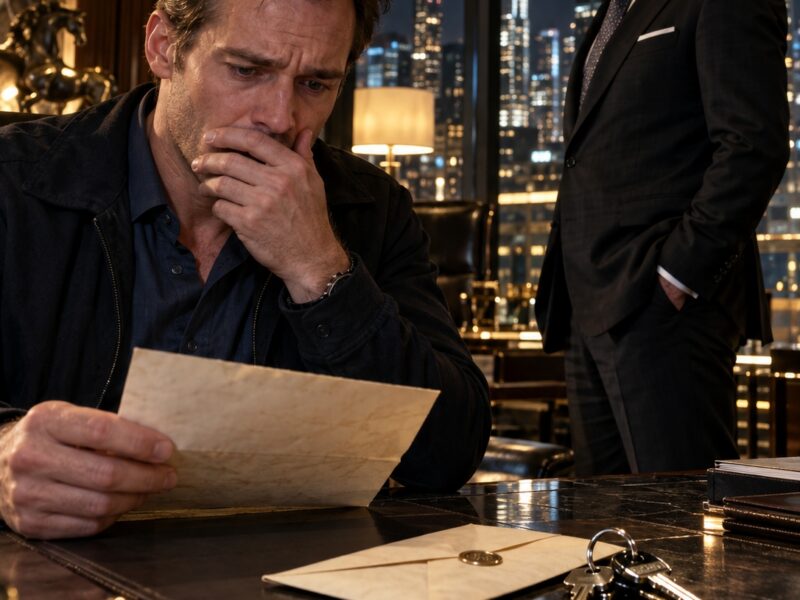
I WENT BACK TO THE OFFICE FOR MY KEYS AT 11 P.M.—AND FOUND THE CEO CRYING AT MY DESK
At 10:57 on a Thursday night, I turned my car around for a set of forgotten keys.
By 9:15 the next morning, I had been fired.
By three that afternoon, eleven people sitting around a walnut table were deciding whether to strip the CEO of her authority.
And before sunset, the man who had quietly controlled our company for twenty years was staring at me as if a ghost had just walked into the boardroom.
But none of that was what frightened me most.
What frightened me most was realizing how close none of it had come to happening.
If I had remembered my keys, I would have driven home.
If my daughter hadn’t asked for cinnamon bread, I might have noticed the keys earlier.
If I had taken the spare jacket instead of the one my wife gave me before she died, I might have had the backup key in the other pocket.
Tiny things.
Meaningless things.
The kind of things we usually call coincidence because the alternative is admitting that sometimes an entire life can turn on an object small enough to fit in your hand.
My name is Evan Ror.
For nine years, I worked at Blackthorn Meridian as a senior systems analyst.
And for most of those nine years, almost nobody important knew my name.
That was fine with me.
Or at least, I had spent a long time convincing myself it was.
Blackthorn Meridian occupied thirty-one floors of glass and limestone overlooking the river, the kind of building where the lobby smelled faintly of polished stone and expensive coffee even at six in the morning.
The company moved freight, logistics data, settlement information, and contracts across half the country.
Billions of dollars passed through systems people like me maintained.
Nobody applauded us when they worked.
People only learned our names when they didn’t.
I was forty-one then, a widower, a father, and the owner of exactly two dark blue work shirts that Molly claimed were technically different colors and I insisted were not.
Molly was twelve.
Her mother, Rachel, had died four years earlier.
Cancer has a way of dividing your life into before and after without asking permission.
Before Rachel got sick, I had wanted things.
Promotions.
A larger house.
Maybe management someday.
Afterward, ambition started to feel like a luxury item displayed behind glass.
What I wanted was to be home.
Home for dinner.
Home when Molly needed help with algebra.
Home when she pretended she didn’t need help with algebra.
Home when she left a glass of water beside my place at the table because Rachel used to do it.
Home before she learned not to wait for me.
I had been offered promotions twice.
Both required travel.
I declined both.
My manager called me cautious.
One executive called me unmotivated.
Neither knew that a twelve-year-old girl had already learned how suddenly a parent could disappear.
I wasn’t going to teach her the lesson twice.
So I stayed on the seventeenth floor.
Same desk.
Same chair with the bad left wheel.
Same coffee mug Molly had painted when she was nine.
Same view of the parking garage instead of the river.
Nine years is long enough for a building to recognize your badge while forgetting the person carrying it.
And until that Thursday night, I thought invisibility was the price I had chosen to pay for stability.
I didn’t know someone else had begun depending on it.
For eleven weeks, I had been chasing a problem in our reporting pipeline.
It was the kind of problem most people would never notice because nothing actually broke.
No server crashed.
No alarm sounded.
No red warning appeared on a dashboard.
The numbers simply didn’t agree.
Raw operational records coming from our regional centers would show one set of costs.
By the time those figures reached executive reporting, they had changed.
Not much.
Seven-tenths of one percent here.
One-point-one percent there.
Four-tenths somewhere else.
Tiny movements.
Individually, they looked like rounding.
Together, they bothered me.
I’ve never trusted errors that behave too consistently.
Random problems are ugly.
Human problems are often neat.
So I started documenting them.
I sent the first warning in March.
Then another.
Then another.
Nine messages over eleven weeks, each routed through the proper chain for executive escalation.
No response.
Meanwhile, three senior engineers abruptly lost access to parts of the audit layer.
Large blocks of financial data began appearing on an old storage cluster that was supposed to have been retired.
Reports were being altered minutes after leaving operations.
Nobody announced anything.
Nobody explained anything.
And then came the restructuring rumors.
In corporate life, rumors usually arrive before facts because facts require signatures.
The name attached to most of those whispers was Sterling Ashford.
Chief operating officer.
Sixty-one.
Gray at the temples.
Perfect posture.
Perfect suits.
Perfect memory.
Sterling had worked beside Conrad Blackthornne, the founder of the company, for almost twenty years.
When Conrad died, Sterling remained.
When Conrad’s daughter Adrienne took over, Sterling remained.
Presidents changed.
Board members rotated.
Markets rose and fell.
Sterling remained.
People didn’t argue with him.
They adjusted around him.
Like weather.
I remember one meeting in particular.
Sterling stood in front of a screen displaying something called Workforce Efficiency: Next-Generation Operating Model.
Whenever an executive needs five words to say “fewer people,” you should pay attention.
He clicked through several slides.
Then he smiled.
“Some roles,” he said, “were designed for an architecture the organization has outgrown.”
Nobody moved.
He continued.
“We have to be disciplined about legacy cost.”
Legacy cost.
I was sitting against the wall.
I knew immediately what he meant.
People like me.
People who remembered why certain systems had been built the way they were.
People whose salaries had accumulated annual raises.
People who could look at a new proposal and remember the three disasters that had caused the old restrictions.
People expensive enough to notice.
I looked toward Adrienne Blackthornne.
She was sitting at the head of the table.
Thirty-six years old.
Eighteen months into the most difficult job in the building.
She had inherited the company after her father’s death and a board split almost evenly between people who thought she deserved the job and people who thought her last name had given it to her.
I had seen men twice her age challenge her in meetings.
She never raised her voice.
Never visibly flinched.
Never let irritation reach her face.
That day, I waited for her to object to Sterling’s phrase.
She didn’t.
She wrote something on her tablet.
Then she said, “Next slide.”
Something in me quietly shut off.
Not anger.
Expectation.
That afternoon I finished another technical report about the synchronization fault.
At 6:40, I shut down my workstation and left.
What I didn’t know was that my name was already on Sterling’s restructuring list.
Forty-one positions.
Four departments.
Mine among them.
What I didn’t know was that Adrienne had reviewed the list eleven days earlier.
And what I definitely didn’t know was that the final signature authorizing my termination belonged to her.
At 10:31 that night, Molly called while I was driving home.
“Did you remember?”
“Remember what?”
The silence on the other end was judgmental enough to be inherited from her mother.
“Dad.”
“I’m kidding.”
“The cinnamon bread?”
I glanced at the paper bag on the passenger seat.
“Right beside me.”
“I have the test tomorrow.”
“I’m aware.”
“I can’t take a test without cinnamon bread.”
“Scientifically established?”
“Absolutely.”
“Peer reviewed?”
“Multiple studies.”
I smiled.
“Go to bed.”
“You too.”
“I’m driving.”
“You know what I mean.”
“I do.”
“Love you.”
“Love you too.”
The call ended.
The car became quiet again.
There is a particular silence after your child says good night when you’re a widowed parent.
It isn’t loneliness exactly.
It’s gratitude with fear mixed into it.
I drove another few miles.
Then, almost automatically, I reached inside my jacket for the spare house key.
Nothing.
I checked the other pocket.
Cup holder.
Door compartment.
Passenger seat.
Then I remembered.
That afternoon, while looking for a cable, I had dropped my entire key ring into the top drawer of my desk.
House.
Car spare.
Storage unit.
Everything.
I could have called Molly.
I could have woken her.
But she had a test the next morning, and there are small promises you make to a child after something terrible happens.
One of mine was that she would not have to take care of me.
So at mile marker nineteen, I sighed, took the next exit, and turned around.
Forty minutes later, I entered the Blackthorn Meridian garage.
I remember thinking the whole trip was ridiculous.
I remember thinking I would be upstairs for two minutes.
I remember thinking about cinnamon bread.
Then the elevator opened on seventeen.
Most of the lights were off.
My section was nearly black except for one pool of light.
At my workstation.
I stopped.
Someone was sitting in my chair.
My first assumption was maintenance.
Then I noticed the jacket.
Nobody doing overnight maintenance wore a jacket like that.
I walked closer.
I heard someone inhale sharply.
Not surprise.
Something closer to the broken breath of a person trying very hard not to make noise.
Then I saw her face.
Adrienne Blackthornne.
The CEO of the company.
Sitting at my desk.
At eleven o’clock at night.
Crying.
I froze.
There are situations for which corporate training provides no useful procedure.
Fire.
Data breach.
Workplace violence.
We had protocols for those.
There was no protocol for finding the chief executive sobbing quietly into her hands in your damaged office chair.
My instinct was to leave.
Immediately.
I took one step backward.
My shoe clipped the leg of an empty chair.
The sound cracked through the dark office.
Adrienne’s head came up.
For three seconds, neither of us spoke.
She wiped her face quickly with the side of her wrist.
Then she seemed to realize there was no point pretending.
Her eyes were still wet.
But when she spoke, her voice was steady.
“Why didn’t you tell me?”
I stared at her.
“I’m sorry?”
“Why didn’t you tell me?”
“I don’t know what you’re talking about.”
She looked at me for another second.
Then she turned my monitor toward me.
An old archived email filled the screen.
The date was almost six years earlier.
The sender was Conrad Blackthornne.
Her father.
I stepped closer.
Then I saw my name.
And the room suddenly felt colder.
Six years earlier, Blackthorn Meridian had almost died.
Internally, we called it the Incident.
A cascading failure inside the routing layer had begun mismatching settlement records across three regions.
By the time the problem reached the executive level, almost four hundred million dollars in transactions were sitting in a state where our systems could no longer reliably prove who owed what to whom.
At that scale, a technical failure becomes something else.
Banks call.
Customers freeze transfers.
Lawyers appear.
Confidence disappears faster than money.
I was a mid-level engineer then.
I wasn’t part of the official response team.
Nobody invited me into the war room.
So while executives upstairs argued about responsibility, I sat downstairs with cold coffee and started reading raw transaction logs.
Five hours later, I saw it.
The data wasn’t being destroyed.
It was being reordered.
More importantly, it was being reordered according to a pattern.
Which meant the process could be reversed.
I spent fourteen hours building a reconciliation routine.
At four in the morning, I gave it to an operations lead.
He took it upstairs.
By eight, settlements were clearing.
By noon, the company’s statement credited “decisive coordinated action by the executive response team.”
My name wasn’t mentioned.
I didn’t care.
Rachel had been alive then.
Molly had been six.
I went home and slept.
Except Conrad Blackthornne had cared.
A week later, according to the email on my screen, he had asked who had actually written the reconciliation routine.
Someone gave him my name.
He sent instructions to his executive office.
Arrange a meeting with Evan Ror.
Personally.
He wanted to know what I had seen that everyone else had missed.
I never got the invitation.
Instead, four days later, my manager told me Conrad was too busy and the meeting would be rescheduled.
It never was.
Adrienne watched me reading.
“I never saw this,” she said.
I looked at her.
“Neither did I.”
“My father kept copies of everything important.”
Apparently not everything.
She pointed to another line.
I read it.
Then read it again.
Conrad had written:
He didn’t save a server. He saved thousands of jobs.
My throat tightened.
Adrienne looked away.
“After my father died, I went through his files myself. Every executive memo. Every succession document. Every unfinished transaction. Sterling told me there was nothing outstanding.”
The name changed the temperature of the conversation.
Sterling.
She looked toward a cream-colored envelope beside my keyboard.
I recognized it.
Three days earlier, while clearing an old storage array scheduled for disposal, I had found a mislabeled box containing physical records from the executive floor.
I had flagged the box for legal.
One envelope had fallen loose.
I opened it just enough to see handwriting, realized it was personal, closed it, and put it on my desk to route properly the next morning.
I hadn’t read it.
Adrienne had.
“That’s my father’s handwriting,” she said.
She pushed the page toward me.
About two-thirds of the way down was a list of names.
Mine was there.
Underneath it, Conrad had written:
If the day ever comes when Adrienne runs this place, someone needs to make certain she knows there are still people like Evan Ror inside the building.
I didn’t know what to say.
Adrienne pressed her palm against the paper.
And then I understood why she had been crying.
It wasn’t because her father had praised some forgotten employee.
It was because a dead man had left her an instruction.
And she had unknowingly done the opposite.
She looked at me.
“There is something else.”
Her voice changed.
Eleven days earlier, she said, she had authorized the workforce reduction.
Forty-one positions.
Including mine.
My termination meeting was scheduled for 9:15 the next morning.
I stared at her.
Oddly, I wasn’t angry.
Maybe shock is simply anger before it finds oxygen.
“You’re firing me tomorrow?”
“I signed the authorization.”
“Why?”
“Redundancy.”
I almost laughed.
“Legacy cost.”
Her eyes shifted.
She remembered the meeting.
“Yes.”
I pulled out the chair beside her and sat down.
For several seconds, the only sound was the ventilation system.
Then I asked the question that mattered.
“If I’m being terminated tomorrow, why are you at my desk tonight?”
She didn’t answer immediately.
That told me everything.
“You didn’t come down here because of your father.”
“No.”
“Then why?”
Adrienne reached into a leather folder.
She placed a second file on the desk.
“Sterling came to me two days ago.”
I said nothing.
“He told me there was an additional problem with your employment.”
“What problem?”
“He said you had been copying protected company data.”
For the first time that night, fear arrived.
Not fear of unemployment.
Something colder.
She continued.
“He said you’d been accessing environments outside your authorization, downloading large data sets and entering the building after hours.”
“And you believed him?”
“I believed the evidence deserved examination.”
“That’s not what I asked.”
Her jaw tightened.
“No. I didn’t know what to believe.”
“Why come yourself?”
“Because tomorrow morning you were going to lose your job. If the accusation went forward, you might lose your career. I wanted to see the evidence before I allowed that to happen.”
She paused.
“Instead, I found my father’s letter.”
She opened the file.
The evidence against me was excellent.
Access logs.
Download histories.
Badge records.
Camera stills.
Nineteen after-hours visits.
Large data transfers.
Cross-system credentials.
Pictures of me leaving late with my laptop bag.
If I hadn’t known the man in those pictures was me, I might have believed he was stealing something too.
I looked through the documents.
Then I noticed something.
“Open the ticket system.”
Adrienne did.
I gave her the first access timestamp.
“Search that.”
A ticket appeared.
Synchronization fault.
Opened by me.
I gave her another.
Another ticket.
Then another.
Every suspicious access event corresponded to authorized diagnostic work.
She became very still.
“The downloads?”
“Raw operational extracts.”
“For what?”
I looked at her.
“Comparison.”
“Against what?”
I didn’t answer.
Instead, I opened my archived correspondence.
Sorted by recipient.
Nine messages appeared.
I turned the monitor toward her.
She read the first.
Then the second.
By the fifth, her face had changed.
By the ninth, she no longer looked like the woman I had found crying.
She looked like the CEO people were afraid of.
Every message documented discrepancies between raw operational records and the summaries being delivered upward.
Every one had been routed according to policy.
Every one had passed through the office of the chief operating officer for executive escalation.
None had reached Adrienne.
“Show me,” she said.
I pulled up the data.
There was a reconciliation service sitting between regional operations and executive reporting.
Officially, it normalized currencies, units, timestamps, and accounting classifications.
Boring infrastructure.
Exactly the sort of system senior people assume someone competent has already checked.
But for years, it had also been applying tiny adjustments to operational cost figures.
Less than one percent here.
A little over one percent there.
Insignificant on individual lines.
Blackthorn Meridian processed billions of dollars in activity.
Tiny percentages become enormous when you give them enough volume and enough time.
I overlaid the raw numbers with the executive figures.
Two lines appeared.
For the first few months, they nearly touched.
Then they separated.
Slowly.
Year by year.
Like scissors opening.
Adrienne stared at the screen.
“How much?”
“I don’t know.”
“Evan.”
“I know the reporting difference. I don’t know where value moved afterward. I’m a systems analyst, not a forensic accountant.”
“How long?”
“At least five years from what I’ve reconstructed.”
She leaned back.
“Who can do this?”
“Administrative accounts.”
“Whose?”
I hesitated.
“One of them is provisioned to Sterling’s office.”
Adrienne reached for her phone.
I put my hand on the desk.
“Don’t.”
Her eyes snapped toward me.
“Excuse me?”
“Don’t call anyone.”
“My board has been receiving falsified financial information.”
“Exactly.”
“I need general counsel.”
“No. You need evidence.”
“I have evidence.”
“You have enough evidence to scare whoever did this.”
She stared at me.
I continued.
“If this has been running for five years inside a company with our compliance requirements, whoever built it planned for discovery.”
“You think legal is compromised?”
“I don’t know.”
“Then what are you saying?”
“I’m saying Sterling’s staff can see executive-floor call activity. The second somebody knows you’re asking questions, we lose whatever is still alive in those systems.”
She looked at the graphs again.
I could almost see her thinking through the consequences.
“And tomorrow morning,” I said, “you fire me for data theft.”
Her eyes returned to mine.
“If I’m the person who’s been documenting the discrepancies, that’s convenient.”
The silence lasted several seconds.
Then Adrienne asked, “What would you do?”
I had no business answering that question.
I was a systems analyst sitting beside the CEO at eleven-thirty at night.
My daughter was asleep across town.
My cinnamon bread was getting stale in the car.
And the next morning, according to company policy, I was supposed to lose my job.
But systems teach you something about failures.
Sometimes the only way to understand a bad process is to let it continue long enough to reveal what it was designed to do.
“Fire me.”
Adrienne stared.
“What?”
“Tomorrow morning. Exactly as planned.”
“No.”
“If you stop the termination, whoever set this up knows something changed.”
“Evan—”
“Let them think it worked.”
She stood.
“You are asking me to terminate you.”
“I’m asking you not to interrupt the process.”
“And then?”
“We watch.”
“For what?”
“What they do after I’m gone.”
Adrienne looked toward the dark windows.
For the first time, I realized how alone she must have felt in that building.
Her father was dead.
Her board was divided.
Her most trusted senior executive had served her family for two decades.
And now a man she’d never spoken to until tonight was telling her the numbers reaching her desk might have been manipulated for years.
Finally, she nodded.
“Nine fifteen?”
“That’s what you said.”
“You won’t argue?”
“No.”
“You won’t contact anyone?”
“No.”
“Neither will I.”
She closed the file.
Before leaving, she cleared her session history from my workstation with surprising competence.
I looked at her.
She noticed.
“I worked infrastructure for two years before my father brought me into the company.”
I couldn’t help it.
“Nobody knows that.”
A tired expression crossed her face.
“Nobody ever asked.”
At the elevator, she stopped.
“Evan.”
“Yes?”
“Are you angry with me?”
I looked down at the keys in my hand.
House key.
Car key.
Small brass storage key.
Rachel’s storage unit.
The objects that had turned me around on a highway.
“I have a daughter waiting for me to come home,” I said. “I haven’t had time to be angry yet.”
Adrienne said nothing.
The elevator doors closed between us.
I got home at 12:40.
Molly had left the hallway light on.
The kitchen was quiet.
I put the cinnamon bread on the counter and stood there for a long time.
Nine hours from then, I would be unemployed.
And somehow that was no longer the most dangerous thing happening.
I slept three hours.
At 6:30, I made Molly eggs.
She came downstairs with one sock on, hair still damp, backpack half open.
“You look terrible.”
“Good morning to you too.”
“You were late.”
“I know.”
“Work?”
“Work.”
She studied me.
Children who lose a parent early become experts in adult faces.
I hated that.
“Everything okay?”
I forced a smile.
“Everything’s fine.”
It was a lie.
But there are lies parents tell because children deserve another ordinary morning.
She ate her cinnamon bread.
I drove her to school.
When she got out, she leaned back through the door.
“Dinner tonight?”
“Six.”
“Promise?”
I hesitated for perhaps half a second.
She noticed.
“Six,” I repeated.
Then she closed the door.
I arrived at Blackthorn Meridian at 8:51.
Everything looked normal.
That was almost unbearable.
People laughed near the elevators.
Coffee machines hissed.
Someone complained about traffic.
A printer jammed.
The world has no obligation to look different on the morning your life changes.
At 9:03, Sterling Ashford walked onto the seventeenth floor.
He almost never came down there.
He stopped beside a director near the windows and spoke for perhaps ninety seconds.
Then he walked past my desk.
Our eyes met.
He smiled politely.
Nodded once.
Kept walking.
A chill went through me.
He hadn’t come to check on operations.
He had come to confirm I was sitting where I was supposed to be.
At 9:15, Human Resources called.
“Hi, Evan. Do you have a few minutes?”
Everyone knows that voice.
The meeting was on fourteen.
Glass walls.
Closed blinds.
A box of tissues centered on the table.
Sterling was already sitting there.
That was when I knew.
A COO responsible for thousands of employees does not personally attend the termination of one systems analyst unless that systems analyst matters for reasons nobody intends to put in the separation paperwork.
Sterling smiled.
“Evan.”
“Sterling.”
“Please.”
He gestured toward the chair.
The HR representative began reading.
Organizational restructuring.
Role elimination.
Operating model modernization.
Severance.
Benefits.
Then Sterling took over.
“This isn’t a reflection on your personal capability.”
Of course it wasn’t.
“The organization is entering a different generation.”
Of course it was.
“Some roles built around an earlier architecture simply don’t carry forward.”
Legacy cost.
He used the word unfortunate three times.
Then he looked directly at me.
“Nine years of steady contribution is nothing to be ashamed of, Evan.”
Nothing to be ashamed of.
As if I had asked.
“I hope you find an organization where your particular temperament is a better fit.”
There it was.
The tiny blade hidden inside the compliment.
I signed the papers.
I didn’t argue.
That seemed to disappoint him slightly.
At 9:47, I returned to seventeen with an empty cardboard box.
It took eleven minutes to pack nine years.
Coffee mug.
Two technical books.
A framed picture of Molly.
A photograph of Rachel.
Three cables.
A small screwdriver set.
Eleven minutes.
There’s a kind of humiliation in discovering how little physical evidence a decade of your life produces.
A woman from analytics hugged me.
One engineer shook my hand.
Two people avoided looking up because layoffs make survivors superstitious.
Adrienne never appeared.
Never called.
Never sent a message.
That was part of the plan.
But nobody else knew that.
So when I carried my box toward the elevator, I could see what they believed.
The CEO had signed off.
The company had moved on.
Evan Ror had become history before lunch.
At 11:22, my credentials were disabled.
At 11:31, nine minutes later, somebody started deleting records.
Not archiving them.
Deleting them.
Modification history inside the reconciliation service began disappearing in bulk.
Four and a half years of records.
Whoever was doing it was moving quickly.
And hurry leaves patterns.
There was something Sterling hadn’t known.
Three years earlier, maintaining a structural integrity monitor had been formally added to my responsibilities.
The monitor wasn’t secret.
It wasn’t a backdoor.
It was a compliance tool.
It watched structural changes across the reporting environment and wrote a mirrored record to a location legal already had standing access to.
When I was fired, I didn’t activate it.
I didn’t modify it.
I didn’t steal anything.
I simply didn’t turn it off.
The person deleting the live history believed the past was disappearing.
It wasn’t.
Adrienne watched the deletion from her office.
At 11:50, my phone rang while I sat in my car in the parking structure with nine years of my life in a cardboard box.
Unknown number.
I answered.
“It happened,” Adrienne said.
No hello.
“Which account?”
“Administrative.”
“Provisioning?”
“COO office.”
I closed my eyes.
It was something.
Not enough.
A shared administrative credential could be blamed on an assistant.
A compromised password.
A rogue employee.
Or me.
Especially me.
Then Adrienne said, “There’s more.”
Her voice sounded different.
“Sterling called an emergency board meeting.”
“When?”
“Three o’clock.”
“Why?”
“He filed a governance concern.”
I sat straighter.
“What concern?”
“Me.”
Sterling was proposing an executive oversight committee.
Officially, it would stabilize confidence.
In practice, it would place operational and financial decisions under a board committee chaired by him.
Adrienne would remain CEO.
Her title would stay on the door.
Her authority would disappear.
And suddenly I understood everything.
The restructuring.
The accusation.
My termination.
The timing.
I hadn’t accidentally been included among forty-one redundant employees.
The forty-one employees were camouflage for me.
Sterling didn’t need me gone because I was expensive.
He needed me outside the security perimeter before three o’clock.
Discredited.
Locked out.
Unable to authenticate.
Unable to interrupt the story he was about to tell the board.
I looked at the cardboard box beside me.
“Adrienne.”
“Yes?”
“He didn’t fire me because I was a legacy cost.”
“I know.”
“He fired me because I could prove his numbers weren’t real.”
Silence.
Then she said, “Can you prove it by three?”
I looked at the dashboard clock.
11:53.
“No.”
Another silence.
“Can you prove enough?”
I stared through the windshield.
“Maybe.”
I spent the next several hours in a coffee shop two miles from headquarters.
Laptop open.
Bad coffee cooling beside me.
Phone face down.
I reconstructed everything I legally could from records already available through compliance exports and independent regional sources.
The trick wasn’t proving the numbers were different.
Sterling could explain differences.
Accounting normalization.
Currency conversion.
Timing.
Corrections.
What I needed was pattern.
Because individual events can be explained.
Patterns are harder.
At 2:37, I found it.
I stared at the screen.
Then I checked again.
And once more.
Every adjustment event had occurred between one and two in the morning.
Every one.
I cross-referenced those windows against executive-floor badge records maintained separately by facilities for fire safety.
Two badge IDs appeared repeatedly.
One belonged to Sterling’s executive assistant.
The other belonged to Sterling.
Then I filtered the dates when his assistant had been on approved leave.
Nineteen matches.
Nineteen nights when the assistant was documented out of state.
Nineteen nights when only Sterling’s badge had entered the executive floor before the financial adjustments were made.
It wasn’t proof of a crime.
But it was a pattern no stolen password could explain.
At 2:51, Adrienne texted me two words.
Come now.
The board meeting started at three.
Eleven members.
Nine physically present.
Two remote.
Sterling stood at the head of the room beside a screen.
He didn’t attack Adrienne.
That would have been crude.
He expressed concern.
Concern is what powerful people use when aggression needs good manners.
He talked about five consecutive quarters of declining operating margins.
Rising fleet costs.
Warehousing overruns.
Technology instability.
A tired organization.
A young CEO carrying an impossible burden after the death of her father.
He said young without saying inexperienced.
He said daughter when he wanted them to remember she had inherited the chair.
Then he displayed the numbers.
The manipulated numbers.
They looked devastating.
Preston Harrington, one of the longest-serving board members, leaned forward.
“I’ve had concerns for some time.”
Of course he had.
Concern becomes fashionable when someone powerful gives it permission.
Sterling finished.
The proposed resolution waited on the table.
Adrienne raised one finger.
“One question.”
Sterling smiled.
“Of course.”
“Where did those numbers come from?”
“Finance and operations.”
“Specifically.”
“The standard reporting pipeline.”
“The same pipeline used for our board reporting?”
“For the last decade.”
“And you’re certain?”
Sterling smiled.
“Absolutely.”
A few people around the table shifted.
Adrienne nodded.
“Thank you. I want that reflected in the minutes.”
Then the boardroom door opened.
I walked in.
Same dark blue shirt.
Same jacket.
Same man they had fired five and a half hours earlier.
Laptop under my arm.
Cable in my hand.
Every face turned toward me.
Most didn’t recognize me.
Sterling did.
And for the first time since I had known him, his face reacted before he could stop it.
Half a second.
That was all.
But sometimes half a second is enough to see the truth before somebody dresses it.
Then the mask returned.
Sterling stood.
“I’m sorry, but this individual was separated from the company this morning and is currently associated with an internal matter involving unauthorized removal of protected data.”
Excellent.
Calm.
Credible.
He turned toward the board secretary.
“Please contact security.”
Nobody moved yet.
Sterling looked at Adrienne.
That was the moment.
If she hesitated, he won.
She didn’t.
“Evan Ror is here at my direct request as chief executive.”
Sterling’s expression hardened.
“Adrienne—”
“Anyone who wants him removed can make a motion and put it to a vote.”
Silence.
Nobody made the motion.
I walked to the display.
My hands were shaking.
So I did what I had done my entire career.
I ignored the room and looked at the data.
I connected the cable.
Two columns appeared.
“On the left,” I said, “are operational cost totals generated by regional systems whose independent records are also used for customs and fuel-tax reporting.”
I pointed to the right.
“These are the corresponding figures delivered through Blackthorn Meridian’s executive reporting pipeline.”
Same periods.
Same categories.
Same company.
Different numbers.
I moved through the discrepancies.
Then I showed the reconciliation layer.
The nightly adjustments.
The administrative credentials.
Five years.
The room became quieter with every slide.
Finally, I showed the accumulated difference.
Just over two hundred thirty million dollars.
Harrington leaned forward.
“Are you saying two hundred thirty million dollars was stolen?”
“No.”
Sterling seized on it.
“Then perhaps we should be careful about what is being implied.”
I nodded.
“He’s right.”
That surprised everyone.
Including Sterling.
“I have no evidence that two hundred thirty million dollars was stolen. What I can demonstrate is that operational costs were systematically altered before reaching this board.”
I changed the slide.
“The effect was to make several underperforming regional contracts appear financially healthier than the underlying operational records indicate.”
Sterling didn’t deny it.
That was why he was dangerous.
He adjusted.
“Administrative credentials are shared.”
“Correct.”
“My office has more than a dozen people with provisioning authority.”
“Correct.”
“Then I assume you agree this proves nothing about who used the account.”
“Correct.”
Harrington visibly relaxed.
Sterling almost smiled.
It was a very good defense.
Which was unfortunate for him because it was the defense I had expected.
I changed the slide again.
A calendar appeared.
Then badge records.
Sterling stopped smiling.
“The executive reporting adjustments occurred during overnight windows,” I said. “I cross-referenced each event against physical badge entry records for the executive floor.”
I explained that the badge system belonged to facilities.
Fire safety.
Separate retention.
Separate administration.
Not controlled by Sterling’s office.
“Across the adjustment windows, two executive-floor badges appear consistently.”
I displayed the names.
Sterling Ashford.
His assistant.
Nobody moved.
“On nineteen of those dates, Mr. Ashford’s assistant was on approved leave outside the state.”
I put the records beside the timestamps.
“On those nineteen nights, only one of the two associated badges entered the executive floor.”
Sterling’s.
The room went completely silent.
I looked at the board.
“This is not proof of a crime. I’m not a lawyer, and I won’t pretend to be one.”
I unplugged the cable.
“But it is a pattern that cannot be explained by a compromised password.”
Then I sat against the wall.
Six seconds passed.
Maybe seven.
Sterling turned toward Adrienne.
When he spoke, the polished warmth was gone.
“You are seriously going to take the word of a terminated technician over mine?”
Adrienne didn’t answer.
Sterling leaned forward.
“I stood beside your father for twenty years.”
Still nothing.
“I carried this company through recessions while you were still in school.”
His voice softened.
“I was there when he died.”
That landed.
Everyone felt it.
“I was the man holding your arm at the funeral.”
Adrienne looked at him for a long time.
Not angrily.
That would have been easier.
She looked at him the way someone looks at a wall in their home after discovering termites inside it.
Then she said quietly:
“I’m not taking his word.”
Sterling stared.
Adrienne glanced toward the screen.
“I’m taking the data.”
The oversight resolution never reached a vote.
By 4:20, Sterling’s systems access had been suspended.
By five, the board had authorized an independent external review.
Outside counsel was retained before anyone left the floor.
Sterling didn’t shout.
Men like Sterling rarely do.
He collected his papers.
Buttoned his jacket.
And walked out of the room with almost exactly the same expression he had worn walking in.
Almost.
I should have felt victorious.
I didn’t.
I felt exhausted.
I sat in the corridor afterward watching the river darken through the glass.
My phone buzzed.
Molly.
Dinner?
I checked the time.
5:42.
I typed:
On my way.
Before I could stand, Adrienne appeared.
“Can you come upstairs?”
I looked at my phone.
“For ten minutes.”
Her office occupied a corner of the thirty-first floor.
Nine years in that building, and I had never been there.
From her windows, the city looked orderly.
That’s the lie height tells you.
Problems become small when viewed from far enough away.
On her desk was the old cream-colored envelope.
Adrienne touched it.
“There’s another page.”
I looked at her.
“I thought that was yours.”
She shook her head.
“Your name is on it.”
She handed it to me.
Conrad had written about the Incident.
He described standing on a mezzanine above the technical bay at two in the morning.
Upstairs, executives were arguing in a glass conference room.
Assigning responsibility.
Protecting departments.
Preparing explanations.
Two floors below them, a young engineer sat alone under fluorescent lights fixing the actual problem.
Me.
Conrad had gone downstairs.
I never knew.
He had stood at the end of the aisle.
Watched.
And decided not to interrupt.
Then came the sentence that stayed with me.
He wrote that companies like Blackthorn Meridian did not truly exist because of the names carved into stone above their entrances.
They existed because ordinary people kept doing the right thing when nobody was looking.
Adrienne read the line again.
“My father wasn’t writing this about you.”
I looked at her.
She gave a sad little smile.
“Not really.”
“That’s flattering.”
“He was writing it to me.”
I understood.
“He knew.”
“Knew what?”
“What the building would do to you.”
She looked toward the windows.
“He knew I’d inherit thirty-one floors and eventually start believing the important things happened on the top three.”
Neither of us spoke.
Then she said, “I signed your termination.”
“You told me.”
“I read forty-one names.”
“Forty-one is a lot.”
“Not if you’re one of them.”
That landed harder than anything Sterling had said.
She continued.
“I looked at positions. Salaries. reporting lines. Redundancies. I didn’t look far enough down to see people.”
I thought about my cardboard box.
Eleven minutes.
Nine years.
Then Adrienne asked me a question I hadn’t expected.
“Why did you stay?”
“What?”
“Nine years. Why?”
I could have given her the professional answer.
Stability.
Institutional knowledge.
Interesting systems.
Instead, maybe because the night before had destroyed whatever hierarchy had existed between us, I told her the truth.
“I was afraid.”
She waited.
“After Rachel died, I got offers. Four that I seriously considered. Two paid better.”
“Why didn’t you take them?”
“Molly.”
“Because of travel?”
“That was what I told myself.”
I looked down at Conrad’s letter.
“At first, stability mattered. She’d lost her mother. I wanted her to know I’d be at the kitchen table at six.”
“And later?”
“Later I kept calling it stability because that sounded better than fear.”
Adrienne didn’t offer sympathy.
I appreciated that.
She simply asked, “Fear of what?”
“Changing anything.”
The answer surprised me with how true it sounded.
“When you’ve had one part of your life disappear without warning, you start treating everything that stays the same as if it’s sacred.”
I looked around her enormous office.
“Eventually I wasn’t choosing this job anymore. I was hiding inside it.”
Adrienne leaned against the desk.
“Come back.”
I almost laughed.
“You fired me this morning.”
“I am aware.”
“That has to be some kind of company record.”
“I’m serious.”
“So am I.”
She waited.
I thought of Molly’s text.
Dinner.
Six.
“I need to think about it.”
For once, the CEO of Blackthorn Meridian didn’t try to close the deal.
She nodded.
“Think.”
I left at 5:49.
I was nine minutes late for dinner.
Molly complained.
I had never been happier to hear her do it.
The independent review lasted five weeks.
What it found was worse than what Adrienne and I had reconstructed that first night.
The reporting adjustments had run for roughly six years across two subsidiaries.
The purpose wasn’t direct theft.
It was reputation.
Several regional contracts associated with Sterling’s operating strategy had been performing badly for years.
If their real cost structures had reached the board, questions would have been asked.
Contracts might have been terminated.
Sterling’s judgment would have been challenged.
His position as the indispensable man who had kept the company stable after Conrad’s death might have collapsed.
So the numbers were nudged.
Never enough to look absurd.
Just enough to survive another quarter.
Then another.
Then another.
A fraction became millions.
Millions became hundreds of millions in distorted reporting.
And every year Sterling appeared more essential because the contracts tied to his leadership seemed healthier than they were.
That was the part I found hardest to understand.
He hadn’t needed to steal the company.
He had needed the company to believe it couldn’t survive without him.
Sterling was removed from the executive team while the legal process continued.
His departure wasn’t dramatic.
No handcuffs in the lobby.
No shouting.
No security guards dragging him past employees.
Real corporate endings are often quieter.
An access card stops working.
A biography disappears from a website.
An office door opens for someone else.
Preston Harrington developed an impressive passion for accountability about nine days after accountability became safe.
Adrienne listened politely.
She never gave him another committee chair.
As for me, I received an offer.
Vice President of Systems Integrity.
A team of eleven.
Compensation roughly two and a half times what I’d been making.
I stared at the letter for a long time.
Old Evan would have accepted immediately.
Not because of the money.
Because being chosen after years of invisibility is intoxicating.
But I had learned something dangerous about myself.
Recognition can become another hiding place if you’re not careful.
So I asked for two changes.
The first concerned my schedule.
I wanted it written into the role that routine travel would be limited and that, absent an actual emergency, my working day ended early enough for me to be home.
Adrienne looked at me across the conference table.
“Six?”
“Six.”
“Your daughter?”
“Yes.”
She signed the change.
That signature mattered to me more than the salary.
The second request took longer.
I wanted a formal integrity escalation channel.
Any technical employee who identified a material risk could submit it into a system no single executive controlled.
The report would create an immutable record.
Unanswered escalations would automatically become visible to the audit committee.
Nobody could intercept nine warnings and quietly bury them.
Adrienne read the proposal.
“This will annoy people.”
“Yes.”
“It will generate false alarms.”
“Definitely.”
“It will be abused occasionally.”
“Probably.”
She looked at me.
“You still want it?”
“Especially then.”
“Why?”
“Because a warning system that only works when powerful people are comfortable isn’t a warning system.”
She approved it.
That became the part of the story I cared about most.
Not the title.
Not the money.
Not Sterling losing his office.
The victory was structural.
For six years, Blackthorn Meridian had accidentally created a system where honest people could be made invisible.
We replaced it with one where invisibility became harder.
Nobody applauded when the new process went live.
There was no ceremony.
No plaque.
No photograph.
That’s how most meaningful improvements enter the world.
Quietly.
A few months later, I was leaving my office at six.
That had become normal.
My phone buzzed.
Molly.
Do not forget dinner.
I smiled.
Then I walked past the old workstation cluster on seventeen.
Adrienne happened to be coming from the opposite direction.
She stopped beside my old desk.
Someone new sat there now.
Three weeks into the job.
Young engineer.
Headphones.
Completely unaware that the chair had once held a crying CEO at eleven o’clock at night.
Adrienne looked at the top drawer.
“Do you ever think about it?”
“The chair?”
“The keys.”
I smiled.
“Sometimes.”
“What would have happened if you’d remembered them?”
I considered the question.
“I would’ve gone home.”
“And the next morning?”
“I would’ve been fired.”
She nodded.
“And the company?”
“You would’ve figured it out eventually.”
Adrienne shook her head.
“Maybe.”
“You would have.”
“Later.”
“Later isn’t never.”
“No.”
She looked toward the windows.
“But some things can’t be repaired once they’re discovered too late.”
I couldn’t argue.
She was right.
I reached into my jacket and pulled out my keys.
Same ring.
House key.
Car key.
The little brass key to Rachel’s storage unit was gone.
I had finally emptied it that spring.
That had taken me four years.
I held the keys for a moment.
Such a stupid little object.
Metal.
Plastic.
A worn leather tag Molly had given me.
Nothing more.
Except one Thursday night, I had forgotten them in a drawer.
So I had turned around.
Because I turned around, I walked into a dark office.
Because I walked into that office, I saw a woman nobody thought could break sitting in my chair with tears on her face.
Because she was there, she found a letter from a dead father.
Because of that letter, she looked twice at a man she had already agreed to discard.
Because she looked twice, she found an accusation.
Because we examined the accusation, we found the reports.
Because we found the reports, somebody panicked.
Because somebody panicked, records started disappearing.
And because those records disappeared exactly when they did, a pattern finally became visible.
People like to tell stories afterward as though the ending had been waiting from the beginning.
It wasn’t.
There was no destiny in that desk drawer.
No grand plan.
There was only a tired father who didn’t want to wake his daughter.
There was a CEO discovering that inherited power had made her blind in ways she hadn’t understood.
There was an old man who had died before delivering a warning.
There was another man who had spent twenty years becoming so trusted that nobody thought to look behind him.
And there were numbers.
Quiet, stubborn numbers.
Truth doesn’t always arrive dramatically.
Sometimes it sits in a log nobody reads.
Sometimes it waits in an email nobody receives.
Sometimes it survives inside an old storage cluster because somebody forgot to delete the duplicate.
Sometimes it is written on paper and misplaced for six years.
And sometimes the only thing separating truth from disappearance is one ordinary person deciding that something small doesn’t look right.
I put my keys back into my pocket.
“Good night, Adrienne.”
“Good night, Evan.”
The elevator took me down through thirty-one floors.
Through executive offices.
Conference rooms.
Legal.
Finance.
Operations.
Engineering.
The floors where decisions were announced.
And the floors where consequences were actually lived.
When the doors opened, evening light was pouring through the lobby windows, turning the marble gold.
For years, I had walked through that lobby believing the important names were the ones carved into the wall.
Conrad Blackthornne.
Adrienne Blackthornne.
Founders.
Presidents.
Board chairs.
People whose portraits hung upstairs.
I don’t believe that anymore.
Companies are held together by people whose names rarely make it onto anything.
The engineer who stays twenty minutes longer because a number looks wrong.
The accountant who asks why two totals don’t match.
The assistant who keeps a copy of a document because the instruction to destroy it feels strange.
The technician who checks the alarm one more time.
The employee someone in a beautiful suit calls inefficient because nobody has calculated the cost of losing what that employee remembers.
Most of them will never walk into a boardroom.
Most shouldn’t have to.
They aren’t heroes.
They’re simply people doing the work correctly when nobody important is watching.
My father never taught me that.
Conrad Blackthornne never taught me that either.
Life did.
Mostly through loss.
Rachel’s death taught me how desperately a person can cling to whatever remains.
Molly taught me that being present is not the same thing as standing still.
Sterling taught me that institutions become dangerous when trust replaces verification.
Adrienne taught me that power means very little if you’re unwilling to look below the floor where you sit.
And somewhere along the way, I learned something about myself.
For years, I believed I had sacrificed ambition for my daughter.
There was truth in that.
But not all the truth.
Part of me had also been afraid to become visible.
Invisible men don’t get blamed first.
They don’t make decisions everyone can criticize.
They don’t risk failing publicly.
They go home.
They lock the door.
They keep life small enough to protect.
Except small lives aren’t automatically safe.
Nothing is.
That was the lesson I had spent four years refusing to learn.
You can’t guarantee that the people you love will never lose anything.
You can’t make the future harmless.
All you can do is decide where you stand while it happens.
That evening, I drove home before the sky went dark.
Molly was in the kitchen when I opened the door.
She looked at the clock.
Then at me.
“Six-oh-three.”
“Traffic.”
“Excuses.”
“I’m vice president now. I have people who can verify my statement.”
She rolled her eyes.
“Did you get dinner?”
I lifted the takeout bag.
Her expression softened.
“Okay. You’re forgiven.”
I hung my jacket beside the door.
The keys went into the ceramic bowl on the counter.
For years afterward, I never left them in my desk again.
Not because I believed they were lucky.
They weren’t.
I just liked seeing them there when I came home.
A small reminder that I had made it back.
There are people who spend entire careers doing essential things in complete silence.
Their names aren’t engraved above entrances.
They aren’t standing in the center when photographs are taken.
They don’t control the meeting.
Sometimes nobody remembers they were even in the room.
Until something breaks.
Then suddenly everyone discovers how much weight the invisible person had been carrying.
I used to resent that.
Now I think resentment is less useful than attention.
Look around before something breaks.
Notice the person who always catches the mistake.
Notice the one who stays quiet in meetings but sends the email nobody wants to answer.
Notice the employee whose work has become so reliable that everyone has mistaken reliability for simplicity.
Notice the person holding together some small corner of your life without asking for applause.
Tell them you see them while telling them still matters.
Because sometimes the difference between losing something and saving it is not a brilliant executive decision.
Sometimes it is nine unanswered emails.
Sometimes it is an old handwritten letter.
Sometimes it is a daughter waiting for dinner.
And every once in a while, it is a tired man halfway home at eleven o’clock at night who reaches into his jacket, finds an empty pocket, turns his car around—
and walks back into the exact room where the truth has been waiting for someone to see it.









