My Billionaire Boss Paid Me to Be Her Husband for One Year—Then I Found the Contract She Never Wanted Me to See
Eleven months after I married my billionaire boss for money, I found the document that proved she had been lying to me.
It was sitting on the desk in her private study.
No envelope.
No password.
No attempt to hide it.
Just six pages of cream-colored legal paper beneath the warm glow of a brass lamp, with my full name printed beside hers.
DANIEL CARTER.
VICTORIA HAIL.
At first, I assumed it was another copy of the agreement that had turned my life upside down nearly a year earlier.
Then I reached page six.
My hands stopped moving.
The original contract had contained a date.
A very specific date.
Twelve months after our wedding, Victoria and I would file for divorce.
No arguments.
No financial claims.
No emotional obligations.
No second thoughts.
That date was gone.
In its place was a sentence I read three times because my brain refused to understand it.
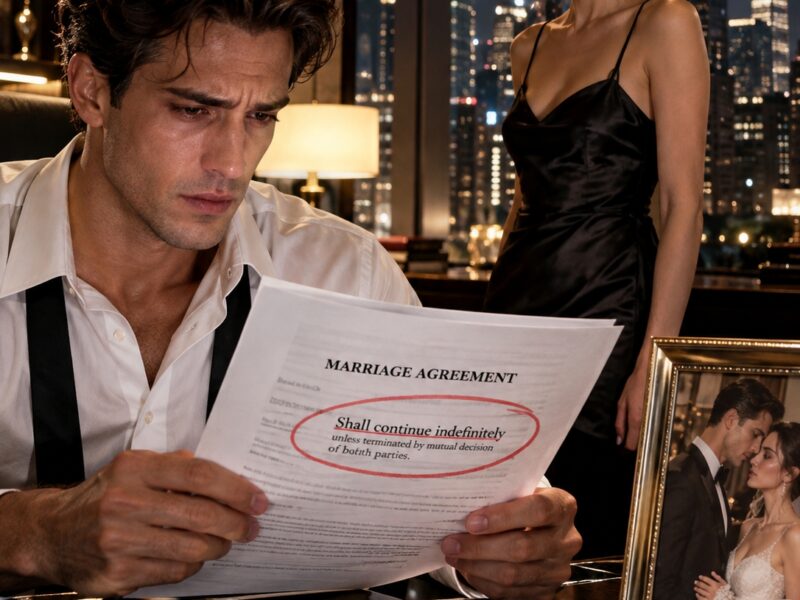
The marriage shall continue indefinitely unless terminated by mutual decision of both parties.
I stared at those words until the letters blurred.
Behind me, a floorboard creaked.
I turned.
Victoria was standing in the doorway.
Barefoot.
Still wearing the black silk dress from the charity dinner we had attended less than an hour earlier.
The woman who could silence a boardroom of twenty executives by simply lifting her eyes suddenly looked terrified.
“Daniel.”
I held up the document.
“What is this?”
Her face changed.
Not dramatically.
Victoria Hail rarely did anything dramatically.
But I had been living with her long enough to recognize the smallest fractures in her armor.
The slight tightening of her jaw.
The way her fingers curled against the doorframe.
The tiny breath she took before answering.
“Where did you find that?”
I almost laughed.
“That’s your question?”
She said nothing.
I looked down at the papers again.
Then back at the woman I had spent eleven months pretending to be married to.
Except somewhere along the way, I had stopped pretending.
And apparently, so had she.
“You removed the divorce date.”
Victoria swallowed.
“Yes.”
“When?”
Silence.
“Victoria.”
“Four months ago.”
The answer landed harder than I expected.
Four months.
For four months, she had known.
For four months, she had been sitting across from me at breakfast, asking whether I wanted more coffee.
Sleeping twenty feet from me.
Laughing beside my mother.
Buying groceries I liked.
Leaving the hallway light on when I worked late.
And every single morning, she had known she was trying to rewrite the ending of our marriage.
Without telling me.
“Why?”
Her eyes finally met mine.
And when she answered, her voice was almost a whisper.
“Because I didn’t want you to leave.”
That should have been the beginning.
But to understand why those seven words nearly destroyed me, you have to understand how our marriage began.
Not with love.
Not with attraction.
Not even with friendship.
It began with a leaking ceiling.
My mother lived in a two-bedroom apartment in Queens where the radiator worked whenever it felt charitable and the ceiling above the kitchen had developed a brown water stain shaped like Florida.
Every time it rained, she placed a blue plastic bucket beneath it.
Every time I visited, the bucket seemed fuller.
“Landlord says he’s sending someone Tuesday,” she told me one night.
“He said that last Tuesday.”
“He’s a busy man.”
“He owns three buildings, Mom.”
“Then he’s very busy.”
That was my mother.
Give her a collapsing roof and she would apologize for inconveniencing gravity.
Her name was Linda Carter.
She was sixty-three, diabetic, stubborn, funny, and determined to pretend her health was better than it was.
My father had died when I was nineteen.
A heart attack in the parking lot of a hardware store.
No warning.
No dramatic goodbye.
One minute he was buying screws for a cabinet.
The next, my mother was identifying his body at St. Joseph’s Hospital.
After that, life became a long exercise in arithmetic.
Rent.
Food.
Insurance.
Medication.
College.
Debt.
Something was always being subtracted.
By thirty-two, I had become very good at surviving.
Not living.
Surviving.
I worked as an executive assistant at Hail Technologies, one of the fastest-growing cybersecurity companies in the country.
The company occupied thirty-eight floors of a glass tower in Manhattan.
The lobby smelled like polished marble and expensive ambition.
People wore watches that cost more than my mother’s apartment.
Deals worth hundreds of millions were discussed over twelve-dollar bottles of sparkling water.
And at the top of all of it sat Victoria Hail.
Founder.
CEO.
Majority shareholder.
Thirty-six years old.
Estimated net worth somewhere north of two billion dollars.
Depending on which financial magazine you believed.
The office had a hundred stories about her.
Victoria fired a vice president for arriving seven minutes late.
Victoria once rejected a seventy-million-dollar acquisition because the founder interrupted her twice.
Victoria slept four hours a night.
Victoria never dated.
Victoria never cried.
Victoria never forgave mistakes.
Half of those stories were probably nonsense.
The other half underestimated her.
I had worked directly for her for fourteen months when everything changed.
Until then, our relationship had been painfully professional.
“Daniel, move the Halpern meeting to Thursday.”
“Yes, Ms. Hail.”
“Daniel, legal needs the revised Singapore documents.”
“I’ll send them.”
“Daniel.”
“Yes?”
She would point at some tiny error in a forty-page report.
I would fix it.
That was us.
I didn’t think she disliked me.
I wasn’t important enough for that.
I was simply useful.
And being useful was something I understood.
Then came the rain.
It was nearly nine at night.
Most of the building had emptied hours earlier.
I was preparing to leave when the light on my desk phone blinked.
Victoria.
I answered.
“Yes?”
“Are you still here?”
I glanced around the empty executive floor.
“Yes.”
“Come into my office.”
No explanation.
That was normal.
What wasn’t normal was what I saw when I entered.
Victoria wasn’t behind her desk.
She was standing near the floor-to-ceiling windows, looking down at Manhattan through sheets of rain.
Her jacket was draped over a chair.
Her hair, normally pinned with military precision, had loosened slightly around her face.
On the table sat two glasses of water.
Two.
“Close the door,” she said.
I did.
Then she said something I was certain I had misheard.
“I need you to marry me.”
I stared at her.
She stared back.
There are moments when your brain rejects reality as a form of self-defense.
This was one of them.
“I’m sorry?”
“I need a husband.”
I waited for the joke.
Victoria did not joke.
“You need…”
“A husband.”
“And you’re asking me?”
“Yes.”
“Why?”
“Sit down.”
“I think I’d rather stand.”
Something almost resembling amusement crossed her face.
It vanished immediately.
She walked to the conference table and pushed a folder toward me.
Inside was a contract.
Forty-two pages.
I didn’t touch it.
“My father is stepping down as chairman at the end of the year,” she said. “There are provisions in the family trust governing the transfer of his remaining voting shares.”
I frowned.
“What does that have to do with marriage?”
“A great deal, unfortunately.”
Her grandfather had created the trust decades earlier.
The language was archaic.
Almost absurd.
Control of a significant block of family shares could pass to Victoria only if she met several conditions before the annual shareholder meeting.
One involved marriage.
I actually laughed.
Not because it was funny.
Because it sounded insane.
“You’re telling me a multibillion-dollar technology company is partially controlled by your grandfather’s opinion about your marital status?”
“My grandfather believed unmarried women became reckless after thirty-five.”
“That’s…”
“Misogynistic?”
“I was going to say medieval.”
“That too.”
“Can’t you challenge it?”
“I have.”
“And?”
“My lawyers believe litigation would take years. The shareholder vote is in twelve weeks.”
She sat across from me.
“So marry someone else.”
“I considered it.”
“That’s comforting.”
“Daniel.”
“What?”
“I trust you.”
That stopped me.
Victoria leaned forward.
“I need a legal marriage lasting twelve months. Public appearances when necessary. Separate rooms. No interference in each other’s private lives. At the end of one year, we divorce.”
“You’ve thought this through.”
“Yes.”
“Why me?”
Her expression became unreadable.
“You’re discreet.”
“That’s it?”
“You’re dependable.”
“Still not enough to marry somebody.”
“You don’t want my company.”
“I definitely don’t.”
“You don’t want access to my social circle.”
“No.”
“You have never used my name to get anything.”
“Is that unusual?”
“In my life?”
She gave me a sad little smile.
“Extremely.”
Then she named the amount.
I stopped breathing.
It was enough to eliminate every debt I had.
Enough to pay my mother’s medical bills.
Enough to move her out of the apartment with the leaking ceiling.
Enough to create a financial cushion I had never possessed in my adult life.
Enough to buy freedom.
Victoria must have seen something change in my face.
“There are no hidden conditions,” she said quietly.
I hated that she could read me.
I hated the contract.
I hated myself for calculating how quickly I could pay the hospital.
“I need time.”
“Of course.”
“How long?”
“The board meets Friday.”
It was Tuesday.
I laughed again.
“Generous.”
“I can ask someone else.”
For some reason, that sentence bothered me.
I closed the folder.
“Give me until tomorrow.”
I spent that night at my mother’s apartment.
Rain dripped into the blue bucket.
Plink.
Plink.
Plink.
There were three envelopes beside her microwave.
One was a final notice.
Another was from the hospital.
The third was from her landlord.
She caught me reading them.
“Those aren’t your problem.”
“You’re my mother.”
“Exactly. Which means I’m supposed to worry about you.”
“You’re sixty-three.”
“And still your mother.”
She took the letters from my hands.
Then she smiled.
“Eat. I made soup.”
I looked at her.
At the cheap kitchen table my father had bought twenty years earlier.
At the insulin pens in the refrigerator.
At the bucket beneath the ceiling.
At the woman who had spent half her life sacrificing things without ever calling them sacrifices.
And I understood something ugly about poverty.
People like to imagine desperation looks dramatic.
It usually doesn’t.
Sometimes it looks like signing your name.
The next morning, I walked into Victoria’s office.
She looked up.
I placed the contract on her desk.
“I have conditions.”
One eyebrow rose.
“I’m listening.”
“My mother never finds out this is fake.”
“Agreed.”
“You don’t interfere with my relationship with her.”
“Agreed.”
“No humiliating me in public.”
Her expression hardened.
“I would never.”
“And when the year ends, it ends cleanly.”
A pause.
So small I almost missed it.
Then she said:
“Yes.”
I signed.
Three weeks later, I married my boss.
The wedding took place at the Hail family’s estate in Westchester.
Small by billionaire standards apparently meant eighty guests, a string quartet, imported flowers, two security teams, and enough champagne to finance my childhood neighborhood.
My mother cried.
That was the worst part.
She sat in the front row wearing a blue dress I had bought her and looked at me as though every difficult year had finally led somewhere beautiful.
I nearly stopped the ceremony.
Then Victoria appeared.
And for several seconds, I forgot the marriage was fake.
Her dress was ivory.
Simple.
No enormous train.
No diamonds hanging from every surface.
Just clean silk, bare shoulders, and a small pearl necklace.
She walked toward me.
The closer she came, the more nervous she looked.
Nobody else would have noticed.
I did.
When she reached me, she slipped her hand into mine.
Her fingers were trembling.
“You okay?” I whispered.
“Yes.”
“You’re shaking.”
“I’m wearing four-inch heels on grass.”
I looked down.
She was not.
I almost smiled.
Then the officiant began.
We exchanged vows written by lawyers.
Beautiful lies polished until they sounded like promises.
When the officiant said, “You may kiss the bride,” Victoria looked at me.
Our contract required public affection when reasonably necessary.
Apparently, this qualified.
I leaned toward her.
She whispered:
“Cheek.”
I turned at the last second.
My lips brushed her cheek.
The photographers loved it.
They called it tender.
Only Victoria and I knew it was negotiated.
That night, we drove to her townhouse on the Upper East Side.
My suitcase was already waiting.
She showed me my bedroom.
It was larger than my mother’s entire apartment.
“There’s a private bathroom,” she said.
“I noticed.”
“The closet is through there.”
“I own six shirts.”
“You may have to spread them out.”
I laughed.
Victoria blinked.
Then, unexpectedly, she laughed too.
It was the first time I had ever heard it.
Not the polite sound she made at corporate dinners.
A real laugh.
Soft.
Warm.
Human.
It changed her whole face.
And that should have worried me.
Instead, I wanted to hear it again.
The first month went exactly according to plan.
At work, she remained Ms. Hail.
At home, she became Victoria.
We ate breakfast across from each other like diplomats from hostile countries.
“Your car leaves at seven-thirty,” I would say.
“I know.”
“You have a call with London at eight.”
“I know.”
“Then why are you still reading the newspaper?”
She would lower it.
“Are you managing me at breakfast?”
“Habit.”
In public, we became convincing.
Her hand on my arm.
My palm against her lower back.
Smiles for photographers.
Occasional staged laughter.
At home, the performance stopped.
Separate bedrooms.
Separate routines.
Separate lives.
Then the small things began.
One morning, I came downstairs and found my coffee waiting.
Black.
One sugar.
Exactly right.
I looked at Victoria.
She was reading emails.
“Did you make this?”
“No.”
“Then we have a ghost with excellent memory.”
“Mrs. Alvarez made it.”
Our housekeeper wasn’t there on Tuesdays.
Victoria’s eyes stayed on her phone.
I drank the coffee.
I didn’t mention it again.
A week later, I worked through lunch.
At three, a sandwich appeared beside my laptop.
“Eat,” Victoria said.
“I’m busy.”
“That wasn’t a suggestion.”
“You’re very controlling for a fake wife.”
She stopped walking.
I regretted the words instantly.
But then she turned.
“Then consider it an order from your real boss.”
She walked away.
I smiled for the next ten minutes.
That was how it happened.
Not with fireworks.
Not with forbidden kisses.
With coffee.
Sandwiches.
A light left on in the hallway.
A text asking whether I needed anything from the grocery store.
Tiny acts so ordinary I didn’t recognize them as intimacy.
Then my mother collapsed.
I was in a meeting when my phone vibrated.
Three missed calls from her neighbor.
One voicemail.
I listened to six seconds before standing.
Victoria stopped mid-sentence.
“Daniel?”
“My mother.”
That was all I managed.
Twenty minutes later, Victoria was driving.
Not her chauffeur.
Victoria.
Her hands gripped the wheel as we raced toward Queens.
“You didn’t have to come.”
“Yes, I did.”
“She’ll be fine.”
“You don’t know that.”
“Thank you, Victoria.”
She didn’t answer.
At the hospital, my mother was diagnosed with complications related to her diabetes.
Treatable.
But frightening.
I spent the next four hours completing paperwork, talking to nurses, calling insurance, and pretending I wasn’t terrified.
When I returned to her room, I heard laughter.
My mother’s laughter.
I stopped outside the door.
Victoria was sitting beside her bed.
Her thousand-dollar coat hung over a plastic chair.
My mother was holding her hand.
“You know what Daniel was like at nine?” Mom asked.
Victoria looked delighted.
“I desperately want to know.”
“He tried to run away because I wouldn’t buy him a motorcycle.”
“I was nine,” I said from the doorway.
Both women turned.
Mom smiled.
“He packed peanut butter crackers and two pairs of underwear.”
Victoria covered her mouth.
“You promised never to tell anyone.”
“I promised no such thing.”
Victoria laughed.
And suddenly I saw a version of my life that had never existed before.
My mother.
My wife.
A hospital room.
Fear.
Laughter.
Family.
The image hit me so hard I had to look away.
That night, after Mom fell asleep, Victoria and I walked through the fluorescent hospital corridor.
“You can go home,” I told her.
“So can you.”
“I’m staying.”
“So am I.”
“Why?”
She looked at me as though the answer should have been obvious.
“Because you’re my husband.”
The word landed between us.
Neither of us mentioned the contract.
My mother recovered.
But something in our marriage did not.
Something had shifted.
We started eating dinner together even when nobody was watching.
Then we started lingering afterward.
Victoria discovered I liked terrible eighties action movies.
I discovered she secretly loved old black-and-white romances.
She claimed Casablanca was perfect.
I told her everyone in Casablanca needed therapy.
She threw popcorn at me.
I stared at her.
“What?”
“You threw food.”
“You insulted Casablanca.”
“You’re a CEO.”
“Not after nine.”
That became a joke between us.
Not after nine.
After nine, she wasn’t Victoria Hail, billionaire founder.
She was a woman who stole the blankets during movies.
A woman who hated mushrooms.
A woman who sang badly when she thought I couldn’t hear.
A woman who sometimes stood in the doorway of my bedroom as though she wanted to say something, then changed her mind.
One evening, I found her sitting alone in the dark living room.
It was the anniversary of her mother’s death.
I knew because I managed her calendar.
I sat beside her.
Neither of us spoke for several minutes.
“She died when I was twelve,” Victoria finally said.
“I know.”
“My father returned to work three days later.”
I looked at her.
“He told me grief was private.”
“That sounds healthy.”
She smiled faintly.
“He thought he was making me strong.”
“Did he?”
“Yes.”
Then she looked at the dark window.
“And no.”
That night, she told me things no magazine profile had ever printed.
Her father believed affection made people vulnerable.
Mistakes were corrected, not comforted.
Achievements were expected.
Pain was hidden.
After her mother died, Victoria learned to cry in bathrooms because locked doors were the only places nobody could see weakness.
“People think money makes you safe,” she said.
“Doesn’t it?”
“It makes certain problems disappear.”
“And the others?”
“It gives them nicer rooms.”
I understood that sentence.
Maybe too well.
So I told her something I had never admitted aloud.
“I’m afraid people only stay while I’m useful.”
She turned toward me.
“Why?”
“My father died. After that, Mom needed me. Employers needed me. Girlfriends…”
I stopped.
“What?”
“They liked me when I could fix things. When I couldn’t…”
I shrugged.
“My last girlfriend said being with me felt like living with someone permanently preparing for an emergency.”
Victoria was quiet.
“She was probably right.”
“No.”
“You didn’t know me.”
“I know enough.”
Her certainty startled me.
“Daniel, being dependable isn’t a defect.”
“Sometimes it becomes one.”
“Only when people exploit it.”
I looked at her.
“And you?”
Her face changed.
“Am I exploiting it?”
I should have said yes.
We had a contract proving exactly that.
Instead I said:
“I don’t know anymore.”
The silence afterward frightened both of us.
Winter arrived.
Our six-month anniversary passed without comment.
Except Victoria brought home a chocolate cake.
“What’s this?”
“Dessert.”
“It says ‘Six Months’ on it.”
“The bakery made an assumption.”
“You told them to write that.”
“Can you prove it?”
I couldn’t.
We ate half the cake.
At seven months, she started coming to Queens for Sunday dinner.
At eight, my mother gave her a key to her apartment.
At nine, Victoria bought me a watch.
Not an absurdly expensive one.
That mattered.
It was a simple vintage Omega I had once paused to look at in a shop window.
I had forgotten about it.
She hadn’t.
“I can’t accept this.”
“Why?”
“Because it’s too much.”
“You bought me socks.”
“You complained your feet were cold.”
“And you complained you were tired of checking your phone for the time.”
I stared at the watch.
“You remember everything.”
“No.”
“Yes, you do.”
Her eyes lifted to mine.
“Only the things that matter.”
Neither of us moved.
There were perhaps eighteen inches between us.
For the first time, I wondered what would happen if I crossed them.
Then her phone rang.
She stepped back.
The moment vanished.
But I remembered it.
That was the problem.
I remembered all of them.
The almost-moments.
The pauses.
The looks that lasted one second too long.
The nights when we stood outside separate bedroom doors.
The mornings when I wanted to touch her hair.
The evenings when she fell asleep beside me on the sofa and I stayed perfectly still because waking her felt cruel.
We were married.
And somehow touching her felt forbidden.
Then came the thunderstorm.
The power went out shortly after midnight.
The backup generator failed to activate immediately, leaving half the townhouse dark.
I found Victoria downstairs near the fireplace.
She was wrapped in a blanket.
“Afraid of thunder?” I asked.
“No.”
Thunder cracked overhead.
She flinched.
“Clearly.”
“Don’t become smug.”
I sat beside her.
Rain hammered the windows.
For a while, we listened.
Then Victoria said:
“What happens in three months?”
I knew exactly what she meant.
I pretended not to.
“Spring?”
“Our contract.”
My chest tightened.
“We get divorced.”
She stared into the fire.
“Right.”
“That’s the agreement.”
“I know.”
Another crack of thunder.
She pulled the blanket tighter.
“What will you do?”
“After?”
“Yes.”
“I don’t know.”
“Will you stay at Hail?”
The question surprised me.
“Do you want me to?”
“I asked first.”
“I probably should leave.”
Her head turned.
“Why?”
“Because working for your ex-wife sounds complicated.”
“Oh.”
Just that.
Oh.
Then she asked:
“Will you move?”
“Maybe.”
“Queens?”
“Maybe somewhere near Mom.”
Another pause.
“And will you date?”
I looked at her.
She kept her eyes on the fire.
“Victoria.”
“What?”
“That isn’t in the contract.”
“I know.”
“So why are you asking?”
Finally, she looked at me.
There was something in her face I had never seen before.
Fear.
Not boardroom fear.
Not financial fear.
Something much smaller and more dangerous.
Personal fear.
“I was curious.”
I could have ended everything right there.
I could have told her I had been thinking about her constantly.
I could have told her the idea of another man sitting beside her at breakfast made something primitive and irrational twist inside me.
Instead, I smiled.
“Well, maybe I’ll finally have time.”
Her face closed.
It happened instantly.
The wall came back.
“Yes,” she said.
“Of course.”
I hated myself the moment the words left my mouth.
But pride is a strange thing.
It can keep two lonely people silent even when both are begging to be understood.
After that night, Victoria changed.
Not colder.
That would have been easier.
She became kinder.
She scheduled a weekend trip to Vermont.
“Our contract doesn’t require vacations,” I reminded her.
“I know.”
She booked two tickets to San Francisco for a conference she could easily have attended alone.
She started leaving small things on my desk.
A novel I had mentioned.
A photograph of Mom laughing at Christmas.
A pair of ridiculous cuff links shaped like coffee cups.
“Why coffee?”
“Because you become useless without it.”
“Romantic.”
Her face went still.
I wished I could pull the word back.
Three months before our anniversary, her attorney began calling more often.
Whenever I entered the room, Victoria ended the conversation.
That bothered me.
Then I noticed a folder on her desk.
MARITAL AGREEMENT — REVISED.
I didn’t open it.
Not then.
I waited.
Two days later, she handed me a document after breakfast.
“I need you to review this.”
“What is it?”
“An amendment.”
“To what?”
“Our agreement.”
The warmth drained from the room.
I took it.
“What changed?”
“Read it.”
I did.
Or tried to.
The language was dense.
Property.
Confidentiality.
Financial waivers.
Residency.
Then I reached the termination clause.
No date.
I looked up.
Victoria was watching me.
“Where is it?”
“What?”
“The divorce date.”
She became very still.
“It has been removed.”
“Why?”
“I thought we should discuss alternatives.”
“Alternatives?”
“Yes.”
“To our divorce?”
“Yes.”
My pulse accelerated.
“What kind of alternatives?”
She hesitated.
That hesitation ruined everything.
Because hope entered the room before she could stop it.
Then fear followed.
I put the papers down.
“Is this about the company?”
“No.”
“Your shares?”
“No.”
“The trust?”
“No.”
“Then what?”
She couldn’t answer.
I stood.
“Daniel—”
“I need to go.”
“Where?”
“Work.”
“We work in the same building.”
“Then I’ll take the subway slowly.”
I left before she could see what was happening to me.
For the next several weeks, we became careful again.
Painfully careful.
Like strangers who knew too much about each other.
I told myself the marriage was ending.
I told myself that was good.
I had the money.
Mom had moved into a safe apartment.
Her medical bills were paid.
I had savings.
I had choices.
Everything I had wanted eleven months earlier was now mine.
So why did freedom feel like grief?
Then came the Hail Foundation gala.
Seven hundred guests.
Manhattan ballroom.
Politicians.
Investors.
Celebrities.
Cameras everywhere.
Victoria wore black.
I had seen her in gowns before.
That night was different.
Maybe because I knew our marriage had twenty-six days left.
Maybe because every beautiful thing becomes sharper when you believe you’re about to lose it.
During dinner, one of the board members raised his glass.
“To Victoria and Daniel,” he said. “The marriage nobody saw coming.”
Everyone laughed.
Victoria smiled.
I smiled.
Under the table, her hand found mine.
That was expected.
Cameras were nearby.
But when the photographers turned away, she didn’t release me.
Her thumb moved once across my knuckles.
Slowly.
Almost unconsciously.
I looked at her.
She kept smiling toward the room.
But her eyes were wet.
Something inside me broke.
We returned home after midnight.
Victoria went upstairs.
I poured myself a drink.
I didn’t drink it.
Instead, I wandered into her study.
That was when I saw the contract.
Not the version she had shown me.
Another version.
Older.
Dated four months earlier.
I read it.
Then I read the emails clipped behind it.
Her attorney had written:
Victoria, I need to ask again whether Daniel is aware you intend to eliminate the automatic dissolution clause.
Her reply:
Not yet.
Another email.
If he refuses?
Victoria’s response was only one sentence.
Then he leaves with everything I promised him, and I will not stop him.
I stared at those words.
Then I heard her behind me.
“Daniel.”
I turned.
“What is this?”
Her eyes went to the documents.
All the color left her face.
“You weren’t supposed to see those.”
“Clearly.”
“I can explain.”
“Please do.”
She stepped into the room.
I held up the email.
“Four months?”
“Yes.”
“You decided four months ago that you didn’t want the divorce?”
“Yes.”
“And you said nothing.”
“I was afraid.”
“You?”
The word came out harsher than I intended.
She flinched.
“Yes, Daniel. Me.”
“Afraid of what?”
Her eyes filled.
“Of finding out why you stayed.”
The anger disappeared so quickly it left me dizzy.
“What does that mean?”
Victoria took a breath.
“The contract was never really about needing a husband.”
I stared at her.
“What?”
“The trust issue was real.”
“Then what are you saying?”
“I could have solved it differently.”
“How?”
“There were people willing to marry me.”
Something ugly twisted in my stomach.
“People?”
“Men my father knew. Business associates. People who would have considered it an advantageous arrangement.”
“Then why me?”
She looked at me.
And suddenly the billionaire disappeared.
The CEO disappeared.
The woman standing in front of me looked younger than thirty-six.
Almost frightened.
“Because I had been watching you.”
I frowned.
“That sounds creepy.”
A broken laugh escaped her.
“I know.”
“How long?”
“Months.”
“Why?”
“Because you were the only person in that building who never seemed to want anything from me.”
“That isn’t true. I wanted my paycheck.”
“You know what I mean.”
She moved closer.
“I saw you stay late to help Melissa finish the Henderson presentation even though it wasn’t your job.”
I remembered.
“I saw you pay for Evan’s laptop when he dropped it.”
“He was an intern.”
“You told everyone accounting reimbursed him.”
“They didn’t need to know.”
“I knew.”
I said nothing.
“You brought coffee to the overnight security guard every Friday.”
“He worked twelve-hour shifts.”
“You remembered the receptionist’s daughter’s name.”
“So?”
“So nobody around me did things without calculating what they might get back.”
Her voice cracked.
“You did.”
I couldn’t move.
“The night I offered you the contract, I already knew you were the person I trusted most in that building.”
“You barely knew me.”
“I knew enough.”
“No. You knew what I did.”
Her face fell.
“There’s a difference.”
“I know.”
“Do you?”
“Yes.”
She stepped closer.
“And that’s why I didn’t tell you when things changed.”
“When what changed?”
Her eyes met mine.
“When I fell in love with you.”
There it was.
No music.
No cameras.
No shareholders.
Just seven words in a quiet room.
I had imagined hearing them.
I had feared hearing them.
I had wanted them so badly that now, with Victoria actually saying them, I couldn’t speak.
She wiped a tear angrily from her cheek.
“I don’t know when it happened.”
“Victoria…”
“Maybe the hospital.”
I stayed silent.
“Maybe the stupid movies.”
Another tear.
“Maybe the night you told me people only stayed while you were useful.”
Her voice became smaller.
“Maybe before that.”
“Why didn’t you tell me?”
“Because I paid you to be here.”
That silenced me.
Victoria looked toward the contract in my hands.
“How could I ask whether you loved me when every month of our marriage was built on a financial agreement?”
“You could have asked.”
“And if you said yes because you felt guilty?”
“I wouldn’t.”
“How was I supposed to know?”
Her voice rose for the first time.
“How was I supposed to know whether you stayed at dinner because you wanted to be there or because you thought you had to? Whether you went to Vermont because you wanted to come or because I was your boss? Whether you held my hand tonight because you wanted me or because there were cameras?”
I stared at her.
She pressed a hand against her mouth.
Then she whispered:
“I couldn’t survive being loved out of obligation.”
That was the truth.
Not the contract.
Not the trust.
Not the shares.
That.
Victoria Hail could lose millions without blinking.
But she could not risk asking someone to love her and discovering he had only been obeying.
I placed the papers on the desk.
“So what happens now?”
Her expression changed.
Something resigned entered her eyes.
“Nothing.”
“What?”
“You don’t sign the new agreement.”
“Victoria—”
“The original contract ends in twenty-six days.”
She walked toward the desk.
“The money is yours.”
She opened a drawer and removed another folder.
“The apartment I purchased for your mother is in her name. Completely. There are no conditions.”
I stared at her.
“Your compensation has already been transferred.”
“Stop.”
“If you want to leave Hail Technologies, I arranged a severance package and references.”
“Victoria.”
“If you want to stay, you’ll report to another executive. You won’t have to see me.”
“Stop.”
She did.
Tears were running down her face now.
She didn’t hide them.
That frightened me more than anything.
“I am not asking you to stay,” she said.
“Why not?”
“Because that’s the only way I’ll ever know.”
“Know what?”
“If you choose me.”
Silence.
Twenty-six days.
That was how long remained on our contract.
Twenty-six days until I was free.
For the first time since I signed my name, nobody needed anything from me.
My mother’s home was secure.
My debt was gone.
My job was optional.
Victoria had removed every chain between us.
Even herself.
And suddenly I understood what she had done.
She hadn’t rewritten the contract to trap me.
She had rewritten it because she wanted a future she was too afraid to ask for.
But when forced to choose between keeping me and setting me free, she had chosen my freedom.
Even though it might destroy her.
I walked toward her.
She stepped back.
“Daniel, don’t.”
“Why?”
“Because if you’re feeling sorry for me—”
“I’m not.”
“If you think you owe me—”
“I don’t.”
“You don’t have to fix this.”
That sentence stopped me.
My whole life, I had fixed things.
Bills.
Broken appliances.
My mother’s problems.
Other people’s emergencies.
Maybe my ex-girlfriend had been right.
I had spent my life believing love was another word for being needed.
Victoria had spent hers believing love was another contract waiting to be broken.
We had found each other carrying opposite versions of the same wound.
I reached into my jacket.
The original contract was there.
I had carried a copy for weeks.
A reminder.
A countdown.
I placed it on the table between us.
“Do you know what I was thinking when I signed this?”
She shook her head.
“Money.”
Her face tightened.
“Debt. Mom. Survival.”
“I know.”
“No. Listen.”
She did.
“I counted everything back then. Every bill. Every dollar. Every month.”
I looked at the contract.
“And after we got married, I started counting something else.”
Her voice trembled.
“What?”
“The hours until I could leave work.”
She stared at me.
“Because?”
“Because I wanted to come home.”
She stopped breathing.
“To the house?”
I shook my head.
“To you.”
Her eyes closed.
I stepped closer.
“I stopped counting the days until the contract ended months ago.”
“Daniel…”
“I just didn’t know what that meant.”
She opened her eyes.
“I do now.”
“Don’t say something because I’m crying.”
I almost laughed.
“You really think highly of my decision-making.”
“I’m serious.”
“So am I.”
I took her hand.
She looked down at our fingers.
“You asked me what happens when the contract ends.”
“Yes.”
“I don’t know.”
Her face fell.
I squeezed her hand.
“But I know where I want to be the morning after.”
She looked at me again.
“Here.”
Her lips parted.
“With you.”
She started crying harder.
“That’s incredibly unfair.”
“What is?”
“You waited until I looked terrible.”
“You’re a billionaire. You’ll recover.”
She laughed through her tears.
There it was.
That laugh.
The one I had heard on our wedding night.
The sound that had started all of this without either of us knowing.
I touched her face.
She froze.
For eleven months, we had touched each other hundreds of times.
For cameras.
For appearances.
For obligation.
This was different.
There was no audience.
No contractual requirement.
No strategic reason.
“Can I kiss you?” I asked.
Victoria’s eyes filled again.
“You’re my husband.”
“That’s not an answer.”
A tiny smile appeared.
“Yes.”
Our first real kiss happened eleven months after our wedding.
It was nothing like the photographs.
Nothing polished.
Nothing perfect.
Victoria’s hands shook when they touched my shoulders.
I nearly bumped into the desk.
She laughed against my mouth.
Then I kissed her again.
And for the first time in my life, staying didn’t feel like an obligation.
It felt like a choice.
The next morning, I woke on the sofa.
Victoria was asleep against me.
We had talked until nearly four.
No dramatic bedroom scene.
No sudden transformation into different people.
Just two exhausted adults admitting how frightened they had been.
When she woke, she looked confused for three seconds.
Then she remembered.
“Good morning,” I said.
She stared at me.
“What?”
“I’m checking whether you regret last night.”
“Do you?”
“No.”
“Then stop checking.”
“That sounded very CEO.”
“It’s after nine in the morning.”
I smiled.
She rested her head against my shoulder again.
Then something occurred to me.
“What happens to the contract?”
Victoria lifted her head.
“Which one?”
“All of them.”
“We can terminate the original.”
“And the revised one?”
“You never signed it.”
I thought for a moment.
“Good.”
“Good?”
“I don’t want another contract.”
Her expression softened.
“Neither do I.”
Twenty-six days later, the original agreement expired.
Nothing happened.
There were no lawyers at breakfast.
No papers waiting on the table.
No moving trucks.
No press release.
I came downstairs at seven-fifteen.
Victoria was making coffee.
Badly.
“You own a machine that does that automatically,” I said.
“I wanted to make yours.”
“You’re failing.”
“Be quiet.”
I came up behind her.
This time, I didn’t have to wonder whether touching her was allowed.
I wrapped my arms around her waist.
She leaned back against me.
“You’re still here,” she said.
The words were light.
But I heard what lived underneath them.
I always would.
I kissed her temple.
“Yeah.”
“You don’t have to be.”
“I know.”
She turned in my arms.
That was the answer she had needed.
Not forever.
Not some enormous promise written by lawyers.
Just that.
I know.
And I’m here anyway.
Our relationship didn’t become perfect after that.
Real love rarely rewards people with perfection.
Victoria still worked too much.
I still tried to solve problems nobody asked me to solve.
She still shut down when she felt vulnerable.
I still mistook usefulness for affection sometimes.
We fought.
Once, spectacularly, over whether I should have told her my mother needed another procedure.
“You hid it from me,” she said.
“I handled it.”
“That isn’t the point.”
“Then what is?”
“You don’t have to handle everything alone anymore!”
The room went silent.
Because both of us understood the argument wasn’t about my mother.
It was about old habits.
Old fears.
Old survival mechanisms that had kept us alive but didn’t know how to let us be loved.
I apologized.
So did she.
We got better.
Slowly.
A year after the day our fake marriage began, Victoria planned a dinner.
No ballroom.
No photographers.
No board members.
Just four places at a table.
Victoria.
Me.
Mom.
And an empty chair for my father.
That had been my mother’s idea.
She brought his old photograph and placed it beside the chair.
“He would’ve liked you,” Mom told Victoria.
Victoria smiled.
“Daniel says he was difficult.”
“He was.”
“Mom.”
“What? Dead people don’t become saints.”
Victoria laughed.
I looked around the table.
My mother was healthy.
The ceiling above her head no longer leaked.
Victoria was arguing with her about whether dessert counted as dinner.
My father’s photograph caught the warm light.
And for one strange, quiet moment, I thought about the man I had been when this began.
The man sitting at a kitchen table listening to rain fall into a plastic bucket.
He had believed money would save him.
In some ways, it did.
Money paid bills.
Money bought medicine.
Money gave my mother security.
Anyone who tells you money doesn’t matter has probably never watched someone they love choose between rent and health care.
But money wasn’t what changed my life.
Choice did.
Victoria had spent her life surrounded by people who wanted access to her wealth, influence, name, or company.
I had spent mine surrounded by people who needed something fixed.
Neither of us knew what it felt like to be chosen when there was nothing left to earn.
That was what our marriage eventually became.
Not a fairy tale.
Not destiny.
A choice repeated in ordinary moments.
Coffee in the morning.
A hand beneath a dinner table.
Waiting at the hospital.
Turning off a laptop.
Apologizing after an argument.
Coming home.
Years later, I found the original contract again.
We were moving boxes into a new house outside the city when an old folder fell from a cabinet.
Victoria picked it up.
She recognized it immediately.
“Oh God.”
“What?”
“Burn it.”
I laughed.
“Why?”
“Because it represents the worst decision-making process of my adult life.”
“You married me.”
“Exactly.”
I clutched my chest.
“Cruel.”
She reached for the contract.
I pulled it away.
“Daniel.”
“I’m keeping it.”
“Absolutely not.”
“Historical document.”
“Evidence of insanity.”
“Our children might want to see it someday.”
Victoria froze.
So did I.
We had talked about children.
Someday.
Abstractly.
But I had never said our children like that before.
Something softened in her face.
“You think we’ll have children?”
I looked at the woman who once believed love required forty-two pages of legal protection.
Then I looked at the contract in my hand.
“I think we should probably negotiate terms.”
She stared at me.
Then she shoved me.
I laughed so hard I nearly dropped the box.
She eventually let me keep the contract.
I framed one page.
Not the page with the money.
Not the termination clause.
The signature page.
Daniel Carter.
Victoria Hail.
Two names.
Two signatures.
A date.
People sometimes ask when I knew I loved my wife.
They expect a dramatic answer.
The hospital, perhaps.
The thunderstorm.
The night I discovered the revised contract.
The first real kiss.
But I don’t think love happened to us in one moment.
I think it accumulated.
A cup of coffee.
A sandwich beside a laptop.
A blue dress in a hospital room.
A terrible movie.
A vintage watch.
A hand that didn’t let go when the cameras turned away.
Love arrived disguised as ordinary things until there were too many of them to call ordinary anymore.
I once believed Victoria had paid me to become her husband.
For a while, that was technically true.
But the contract only bought twelve months of my time.
It never bought the mornings when I wanted to see her.
It didn’t buy the nights I sat beside her after she fell asleep.
It didn’t buy the fear I felt when I imagined another man taking my place.
It didn’t buy the way my mother began calling her daughter.
And it certainly didn’t buy what happened after the contract expired.
That part was free.
Years after our wedding, I asked Victoria one question I had somehow never asked before.
We were sitting on the back porch.
It had started raining.
She was reading.
I said:
“If the trust hadn’t required you to get married, would you ever have asked me out?”
She lowered the book.
“No.”
I stared at her.
“That was fast.”
“You asked.”
“Why not?”
“You worked for me.”
“So?”
“It would have been inappropriate.”
“You married me.”
“Yes.”
“For money.”
“Yes.”
“But dinner would have crossed a professional boundary?”
“Correct.”
I laughed.
She returned to her book.
Then, after a moment, she said:
“But I probably would have found another reason to keep you around.”
I looked at her.
She kept pretending to read.
“What reason?”
“I don’t know.”
“Victoria.”
“Perhaps a promotion.”
“A promotion?”
“With unusual scheduling requirements.”
“Such as?”
“Dinner.”
I smiled.
She finally looked at me.
And even after all those years, there were moments when I could still see the woman standing barefoot in the doorway of that study.
Terrified that the person she loved might leave.
So I reached across the space between us and took her hand.
She looked down at our fingers.
Then at me.
No cameras.
No shareholders.
No lawyers.
No contract.
Just rain against the windows and two people who had once believed love was something you had to earn, negotiate, or survive.
Victoria squeezed my hand.
“You’re staring.”
“I know.”
“Why?”
I thought about giving her some clever answer.
Instead, I told her the truth.
“Because I still can’t believe you picked me.”
Her expression changed.
Softly.
Almost sadly.
Then she moved closer.
“Daniel.”
“What?”
“I didn’t pick you because you were useful.”
I smiled.
“I know.”
“I didn’t pick you because you were convenient.”
“I know.”
“And I didn’t pick you because I needed a husband.”
I looked at her.
“Then why?”
She rested her head against my shoulder.
Outside, the rain grew heavier.
For a few seconds, neither of us spoke.
Then she said:
“Because before you ever loved me, you were the first person who made me feel like I didn’t have to earn the right to be human.”
I couldn’t answer.
Some truths are too large for immediate words.
So I kissed the top of her head.
And we stayed there.
The rain kept falling.
Somewhere in the house, a clock continued counting seconds.
But neither of us was counting anymore.
Not money.
Not months.
Not days until someone left.
There was no expiration date waiting for us.
No signature required.
No clause guaranteeing tomorrow.
Only the terrifying freedom to leave—
and the quiet miracle of waking up, again and again, and choosing not to.
That was the part no lawyer could ever have written for us.
And maybe that was why it lasted.









