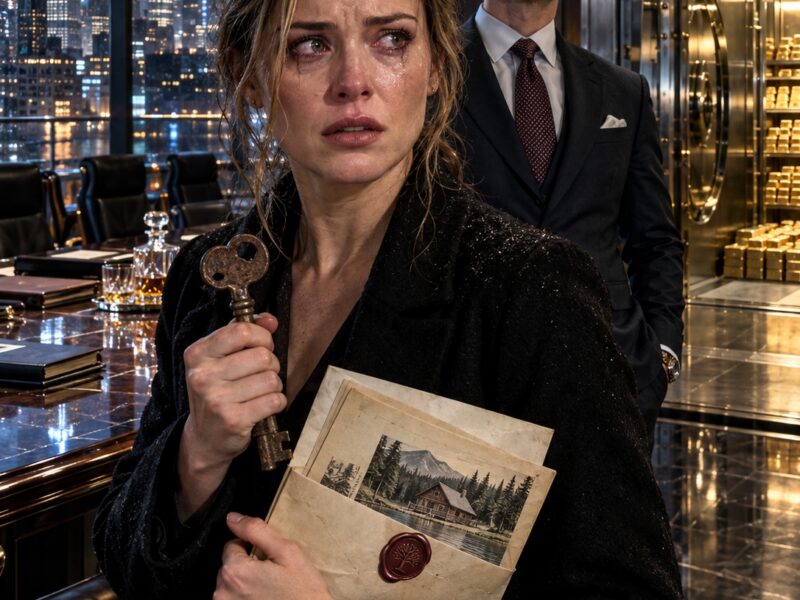
My Billionaire Father Left Me a Worthless $35,000 Cabin While My Brother Inherited Millions—But What I Found 315 Feet Underground Changed Everything
The first thing my brother did after our father’s will was read was laugh.
Not smile.
Not smirk.
Laugh.
It was the kind of laugh that made everyone in the room suddenly interested in their hands.
Outside the floor-to-ceiling windows, November rain blurred lower Manhattan into streaks of silver and gray. Forty stories above the Financial District, inside a mahogany-paneled conference room at Sullivan & Cromwell, my father’s fortune was being divided among the people he had spent his life teaching to confuse money with love.
My stepmother, Cynthia Nelson, received the Tribeca residence, the Southampton estate, and approximately forty-two million dollars in liquid assets.
She accepted the news with a solemn nod so perfectly measured it might have been rehearsed.
My half brother Patrick received controlling shares in Nelson Holdings, commercial properties in Chicago, and an offshore trust large enough to ensure that his children—if he ever had any—would never know what an overdue bill looked like.
Then Arthur Pendleton, my father’s attorney, turned the page.
“And to my daughter, Brittany Nelson…”
The room changed.
Patrick leaned back.
Cynthia lowered her eyes.
Arthur hesitated.
That hesitation told me more than his words did.
I was thirty-two years old, but for one humiliating second I became a little girl again, waiting at the front window for a father who had promised to pick me up and never came.
I told myself not to hope.
Hope had always been expensive in my family.
Still, I had debts.
David’s debts.
Three years after leukemia took my fiancé, I was still receiving envelopes from hospitals, laboratories, specialists and collection agencies. I had sold almost everything worth selling during his treatment.
I drove a rusted 2012 Subaru Forester.
I rented a small apartment.
I worked as a freelance archivist, preserving the histories of wealthy families who somehow always found it easier to protect old letters than living people.
Fifty thousand dollars would have changed my life.
I hated myself for thinking it.
Arthur adjusted his glasses.
“I leave the deed to Lot Forty-Four, commonly known as the Osprey Tract, located within Adirondack Park, New York, including the residential structure upon it.”
He stopped.
I waited.
Everyone waited.
“The remainder of the estate is hereby settled.”
Silence.
I stared at him.
“That’s it?”
Arthur’s face tightened.
“I’m afraid so.”
Patrick laughed.
The sound bounced off the polished wood.
“Oh, my God.”
“Patrick,” Cynthia murmured.
But she was hiding a smile.
I looked from one of them to the other.
“What is the Osprey Tract?”
Patrick leaned forward, expensive cuff links flashing beneath the sleeves of a Brioni suit that probably cost more than I earned in six months.
“It’s a shack, Bee.”
I hated when he called me that.
He knew it.
“Dad bought the land decades ago. Middle of nowhere. Rocks, trees, snow, environmental restrictions. You can’t develop it. You can barely get to it.”
He chuckled.
“No cell service. No running water. Cabin’s practically condemned.”
Arthur looked uncomfortable.
I asked the only question that mattered.
“What’s it worth?”
“The most recent appraisal was approximately thirty-five thousand dollars.”
Patrick laughed again.
Thirty-five thousand.
My father had been worth hundreds of millions on paper.
And he had left me a condemned hunting cabin.
Patrick leaned toward me.
“Dad always said you belonged out in the wilderness with the rest of the strays.”
“Patrick.”
This time Arthur said his name.
Patrick ignored him.
“I guess he wanted to make it official.”
I looked at Cynthia.
For years she had perfected a particular expression around me—gentle enough to appear kind, distant enough to remind me I was never really part of her family.
Now she wore it like mourning jewelry.
“Your father was complicated,” she said.
“No,” I replied quietly. “He was specific.”
Her eyes lifted.
I signed the transfer documents.
I did not cry.
That was the only victory available to me that afternoon.
When I reached the glass doors, Patrick called after me.
“Enjoy the woods, Bee.”
I stopped.
“Try not to freeze.”
I almost turned around.
Instead, I walked out.
Because I thought my father had humiliated me for the last time.
I had no idea he had just handed me the only thing Patrick would eventually be willing to kill for.
Two days later, my Subaru was climbing Route 73 into the Adirondacks.
The rain had become sleet.
Gray mountains rose around me, their peaks disappearing into low clouds. My heater rattled. A warning light glowed on the dashboard. Somewhere in the back seat were trash bags, work gloves, bottled water, two winter sleeping bags and a crowbar.
I had already called a local real estate agency.
The agent had not tried to soften the truth.
“Ms. Nelson, nobody wants a condemned cabin in November.”
“I don’t need a fortune.”
“You may not get anything.”
“What if I clean it?”
A pause.
“Go inspect it. Photograph everything. Make sure the foundation is safe. Then call me.”
So I drove north.
Not because I wanted my father’s cabin.
Because I wanted to sell his final insult.
The GPS stopped working shortly after I turned onto an old logging road.
For six miles the Subaru bounced through muddy ruts and washed-out trenches until I reached a rusted chain-link gate.
PRIVATE PROPERTY.
OSPREY TRACT.
Beyond it, the road climbed through pine forest.
I parked.
The cold hit me the moment I opened the door.
The hike was less than a mile, but the mud made it feel longer. By the time the trees finally opened, my jeans were wet to the knees.
Then I saw my inheritance.
Patrick had not exaggerated.
The cabin looked dead.
Two stories of blackened timber sagged against a gray sky. Missing shingles exposed sections of roof. The porch leaned toward the earth. Moss crawled along the foundation.
For a moment I simply stood there.
Then I laughed.
One short, bitter sound.
“Thanks, Dad.”
My voice disappeared into the trees.
The key Arthur had given me barely turned in the lock.
When the door finally opened, dust rolled through the flashlight beam.
Inside smelled of mildew, wet pine and abandonment.
A moth-eaten sofa sat opposite a stone fireplace.
The kitchen cabinets hung crooked.
Dead leaves had blown across the floor.
I should have turned around.
Instead, habit took over.
Archivists notice things.
We notice when paper stock does not match a date. When a signature uses ink manufactured twenty years later. When one photograph has been placed in a box where it does not belong.
And ten minutes after entering the cabin, I noticed something that did not belong.
An electrical breaker panel.
Not an old fuse box.
Not some rusted residential panel installed in the seventies.
This thing was enormous.
Industrial.
Modern.
Clean.
I wiped dust from the metal door and opened it.
Rows of heavy switches stared back at me.
Each had a printed label.
SUBLEVEL A.
CORE VENTILATION.
HYDRAULIC LIFT.
PRIMARY GEN.
I read the words twice.
“Hydraulic lift?”
I flipped a switch.
Nothing happened.
Another.
Nothing.
The cabin remained silent.
I told myself there was probably an explanation. Maybe my father had once planned renovations. Maybe some eccentric previous owner had installed equipment and abandoned it.
The alternative was ridiculous.
So I cleaned.
For hours.
I filled bags with trash. Swept leaves. Opened drawers. Checked cabinets.
Nothing.
By dusk, the temperature had dropped sharply.
The wood outside was too damp to burn properly, and driving back down the logging road in darkness seemed worse than spending one night inside.
I ate crackers for dinner.
Put on two sweaters.
Climbed into both sleeping bags.
And listened to the wind.
At some point, I slept.
At 2:14 a.m., something woke me.
I opened my eyes into complete darkness.
At first I thought it was the wind.
Then I felt it.
A vibration.
Soft.
Rhythmic.
Deep enough that I felt it in my ribs before I understood it was coming through the floor.
Thrum.
Thrum.
Thrum.
I sat up.
The floorboards were vibrating beneath me.
Not shaking.
Vibrating.
Like a subway platform seconds before a train enters the station.
Except there were no trains here.
There was barely a road.
I grabbed my flashlight and crowbar.
“Hello?”
Stupid word.
There should not have been anyone to answer.
I stepped into the hallway.
The vibration grew stronger toward the kitchen.
Thrum.
Thrum.
Thrum.
A narrow door stood at the rear of the room.
I had noticed it earlier but assumed it was a pantry.
Now I saw the iron deadbolt.
I slid it open.
Wooden stairs descended into darkness.
Cold air should have risen from a cellar.
Instead, the air touching my face was strangely dry.
Filtered.
And underneath the smell of earth was something else.
Oil.
Metal.
Ozone.
I descended.
The cellar looked ordinary at first: stone walls, packed earth, cobwebs.
Then my flashlight crossed an enormous oak wine rack covering almost the entire far wall.
It was empty.
I stepped closer.
The vibration traveled through the wood.
I aimed the flashlight at the floor.
No scrape marks.
No disturbed dirt.
Then I saw steel.
Tracks.
The wine rack was mounted on them.
My mouth went dry.
“What did you build?”
I was no longer speaking to myself.
I was speaking to a dead man.
I searched the wall.
Near waist level, one stone looked slightly different.
I pulled.
It slid outward with mechanical smoothness.
Behind it was a digital keypad glowing blue.
I stared at that light for a long time.
Someone was supplying electricity to this property.
Someone was maintaining whatever existed beneath it.
My father had supposedly left me a worthless cabin.
But worthless cabins do not have biometric-grade infrastructure hidden behind wine racks.
I tried his birthday.
ERROR.
Patrick’s birthday.
ERROR.
One attempt remained.
My hand hovered over the keypad.
Then I remembered the summer I spent cataloguing my father’s early business records.
Richard Nelson did not care about birthdays.
He cared about victories.
October 14, 1998.
The date of the deal that turned Nelson Holdings from a successful regional company into an empire.
I entered the numbers.
10-14-98.
For half a second, nothing happened.
Then the keypad turned green.
A pressurized hiss came from inside the wall.
I stepped backward.
The wine rack moved.
Not awkwardly.
Not slowly like old machinery.
Smoothly.
Silently.
It slid sideways into the stone.
Behind it was a polished concrete corridor illuminated by white LED strips.
At the end stood stainless-steel elevator doors.
I forgot the cold.
Forgot the debt.
Forgot Patrick.
I could only stare.
My father had not left me a cabin.
He had left me a disguise.
A green button pulsed beside the elevator.
I pressed it.
The doors opened immediately.
Inside was a mirrored commercial elevator with no floor buttons.
Only a brass keyhole.
A red emergency stop.
And a large industrial lever.
I stepped inside.
Every instinct told me to go back.
I pulled the lever.
The doors closed.
The elevator dropped.
My stomach seemed to remain somewhere above me.
A digital gauge began counting.
50 FEET.
“What the hell…”
The elevator finally slowed.
315 FEET.
The doors opened.
Lights ignited in sequence beyond them.
One.
Two.
Ten.
Twenty.
Until darkness became an underground space so enormous my mind struggled to process it.
Polished black granite.
Glass climate-controlled rooms.
Reinforced vaults.
Server towers.
Steel corridors.
This was not a bunker.
It was an underground empire.
And sitting behind a glass desk in the center of it was a man drinking tea.
He looked up.
“You took your time, Brittany.”
I raised the crowbar.
He smiled faintly.
“Your father predicted you would solve the entrance within twenty-four hours.”
“Who are you?”
The man carefully placed his cup down.
“Winston Carter.”
He stood.
“I managed certain private assets for Richard Nelson.”
“What are you doing underneath my cabin?”
“Your cabin?”
Something almost amused passed through his eyes.
“No, Ms. Nelson.”
He gestured toward the impossible facility around us.
“The cabin is simply the front door.”
He stepped toward me.
“For fourteen years, I have been sole custodian of the Osprey Protocol.”
I said nothing.
Winston spread his hands.
“Welcome to your actual inheritance.”
I nearly laughed.
“Patrick got Nelson Holdings.”
“Yes.”
“Cynthia got forty-two million dollars and two homes.”
“Yes.”
“My father gave me thirty-five thousand dollars of rotting lumber.”
“Your father gave them what they expected.”
Winston looked toward the elevator.
“He gave you what he wanted hidden.”
A scanner beside one glass room illuminated.
Winston placed his thumb against it.
The door opened.
“Come.”
I did not move.
“What’s inside?”
“The reason Richard Nelson was willing to let his family hate him after death.”
That got me moving.
The lights inside were deliberately dim.
Then my eyes adjusted.
Gold.
Rows of bars filled reinforced shelving from floor to ceiling.
Beyond them were climate-controlled storage tubes containing rolled canvases.
I recognized one artist almost immediately.
My work as an archivist had put me around enough collections to know the difference between decoration and history.
“That can’t be…”
“It is.”
“Those paintings disappeared decades ago.”
“From public records.”
I turned toward him.
“How much?”
Winston’s expression barely changed.
“Enough that the forty-two million dollars mentioned during the will reading would be considered incidental.”
My legs felt weak.
I touched the glass.
My reflection looked like a stranger.
A woman in muddy boots and a thrift-store sweater staring at more wealth than she could understand.
“Why?”
Winston was silent.
I turned.
“Why me?”
He took a slow breath.
“Ten years ago, your father discovered Patrick had begun diverting money from the Chicago commercial accounts.”
I stared at him.
“What?”
“Initially, relatively small amounts. Then larger transfers. Offshore investments. Highly leveraged positions. Richard confronted him indirectly.”
“And?”
“Patrick became better at hiding it.”
I thought of Patrick in the conference room.
The suit.
The smile.
Rightful heir.
“Cynthia knew?”
“Yes.”
The answer landed harder than I expected.
“They protected each other. Richard believed exposing them publicly would damage Nelson Holdings beyond repair. So he began moving portions of his personal wealth outside the conventional estate.”
“Into this?”
“Into assets Patrick could not manipulate electronically.”
I looked at the gold.
The paintings.
Then back at Winston.
“My father ignored me for ten years.”
“I know.”
“When David got sick, I asked him for help.”
Winston’s face changed.
Just slightly.
But I saw it.
“I know.”
“He told me experimental treatment was a bad investment.”
“I know.”
My voice cracked.
“I begged him.”
Winston said nothing.
I hated him for that silence because it left room for memory.
David in the hospital.
David apologizing for the cost of staying alive.
David squeezing my hand while I lied that everything would be okay.
David dying while Richard Nelson sat in a building with his name on it and decided his daughter’s desperation did not meet his standards for acceptable risk.
“So don’t tell me this is love.”
“I wasn’t going to.”
That stopped me.
Winston stepped closer.
“Richard was not a good father.”
I swallowed.
“He was not a particularly good man.”
I looked at him sharply.
“But he understood character,” Winston continued. “Sometimes too late.”
“So this is guilt?”
“No.”
That hurt even more.
“He didn’t leave this to you as an apology.”
“Then why?”
“Because Patrick wanted money. Cynthia wanted status. You wanted neither.”
“I wanted David alive.”
“Yes.”
The words echoed between us.
Winston lowered his voice.
“And when you couldn’t save him, you did not steal, manipulate, blackmail or exploit anyone to survive. You worked. You sold your possessions. You paid what you could. You kept going.”
He glanced toward the vault.
“Richard respected integrity more than affection because integrity was something he understood.”
“That doesn’t make him noble.”
“No.”
“Then stop making him sound noble.”
“I am not.”
For the first time, Winston looked tired.
“He left you the Osprey Protocol because you were the only person carrying his blood whom he trusted not to become him.”
I stared at the gold.
I should have felt vindicated.
Instead, I felt furious.
My father had possessed enough wealth to save David ten thousand times over.
And only after David was dead had Richard decided I was worthy of inheriting it.
“What am I supposed to do with all this?”
“That decision is yours.”
A metallic tone interrupted him.
Winston’s head snapped toward the elevator.
A display above it flashed red.
Then 290.
His face drained.
“What?”
He rushed to the desk.
“Did you close the cellar entrance?”
“I—”
“Brittany.”
“I left the wine rack open.”
“Damn it.”
Winston’s fingers flew over a keyboard.
“The perimeter sensor registered movement twenty minutes ago.”
“You knew?”
“I assumed wildlife.”
My stomach tightened.
“Who else knows about this place?”
“No one who should be coming down that elevator.”
The doors opened.
Patrick stepped out holding a gun.
Mud covered his expensive shoes.
His jacket was torn at one shoulder.
He was breathing hard.
But the moment he saw the vault, exhaustion vanished from his face.
Wonder replaced it.
Then greed.
Pure, naked greed.
“Well,” he whispered.
His eyes moved from the glass rooms to the gold.
“I knew it.”
The gun rose.
It pointed at my chest.
“I knew the bastard was hiding something.”
“Patrick…”
“Don’t.”
His voice cracked through the cavern.
“Don’t you say my name like I’m the crazy one.”
Winston moved slightly.
Patrick swung the gun toward him.
“You stay exactly where you are.”
Winston froze.
Patrick looked at me.
“You really thought I wouldn’t notice?”
“Notice what?”
“The Osprey expenses.”
He laughed.
“One hundred grand a year routed through an anonymous maintenance company for a worthless mountain property? Dad thought I was stupid.”
He took another step.
“I had someone follow you from Manhattan.”
A private investigator.
Of course.
Patrick had never believed I deserved anything.
So when our father gave me something he considered worthless, his first instinct had been to make sure it really was.
He looked at the gold again.
“How much?”
I said nothing.
“How much, Brittany?”
“Enough.”
His face hardened.
“He stole this from me.”
“No.”
“I’m his son.”
“So?”
“I run Nelson Holdings.”
“You’ve been stealing from Nelson Holdings.”
Silence.
Winston looked at me.
Patrick’s eyes narrowed.
“What did you say?”
“Dad knew.”
I had never seen fear appear on Patrick’s face before.
Not real fear.
It lasted perhaps one second.
Then anger buried it.
“You don’t know what you’re talking about.”
“He knew about Chicago.”
“Shut up.”
“He knew about the offshore transfers.”
“Shut up!”
“He knew Cynthia helped you.”
Patrick pointed the gun at my face.
“SHUT UP!”
The cavern swallowed the echo.
I did not move.
For most of my life, Patrick’s anger had worked on me.
When we were children, he would hide my belongings and convince adults I had lost them.
As teenagers, he mocked my clothes, my friends, my mother.
As adults, he perfected the cruelty.
He never needed to hit me.
He simply needed me to believe he had the power.
But standing three hundred fifteen feet beneath a mountain, I finally saw him clearly.
Patrick wasn’t powerful.
He was terrified of losing access to things he had never earned.
He turned toward Winston.
“Transfer it.”
Winston’s expression remained calm.
“I beg your pardon?”
“Everything.”
Patrick pressed the barrel against Winston’s temple.
“Biometric control. Accounts. Access. Whatever Dad built down here. Transfer it to me.”
“That is not possible.”
“Make it possible.”
“A forced transfer would trigger security contingencies.”
Patrick shoved the gun harder against his head.
“I will shoot you, old man.”
“Then you will have even less chance of accessing anything.”
Patrick’s hand trembled.
I looked beyond him.
At the servers.
At the control station.
At the vault doors.
At the elevator.
My father built systems.
That was what Richard Nelson did.
Companies.
Trusts.
Shell corporations.
Layers inside layers.
He trusted no one.
Not even himself.
And men like him always built contingencies.
Then I remembered something.
Years earlier, while archiving architectural plans from several Nelson corporate properties, I had seen references to emergency lockdown commands.
The exact language came back slowly.
Protocol.
Isolation.
Quarantine.
Patrick was still shouting.
I stopped listening.
Then an idea formed.
It was reckless.
It depended on Winston understanding me.
And if I was wrong, Patrick might shoot both of us.
“Patrick.”
He looked at me.
“You don’t want the gold.”
He almost laughed.
“What?”
“You can’t move it.”
His eyes narrowed.
“You can’t sell those paintings either. Half of them are too recognizable.”
“Don’t tell me what I want.”
“You want the servers.”
Silence.
Winston looked at me.
Patrick followed my gaze toward the black server towers.
“What servers?”
I forced myself not to look at Winston.
“Dad archived everything.”
I was guessing.
At least partly.
Patrick’s face changed.
“Everything what?”
“The accounts.”
“What accounts?”
“The money you moved.”
His gun lowered slightly.
I continued.
“Chicago. Offshore transfers. Cynthia’s authorizations. Wire records. Everything.”
“You’re lying.”
“Am I?”
He stared at the servers.
I saw the calculation happening.
If the evidence existed, his inheritance did not matter.
Neither did the gold.
He could lose everything.
“Delete it.”
Winston remained still.
“Excuse me?”
Patrick pointed the gun at him again.
“Delete the servers.”
“I cannot authorize a deletion.”
“Who can?”
Winston looked at me.
The answer was obvious.
Patrick turned.
“Sit down.”
I walked toward the control desk.
Slowly.
“Patrick—”
“Sit.”
I obeyed.
A screen woke.
AUTHORIZATION REQUIRED.
Winston spoke quietly.
“Enter the passcode you used upstairs.”
Patrick glanced between us.
I typed:
10-14-98.
ACCESS GRANTED.
Green light washed across my hands.
“Find the files,” Patrick said.
“There are thousands of directories.”
“Then wipe everything.”
I looked at him.
“What?”
“You heard me.”
“You’d destroy the security system.”
“I don’t care.”
“The records for the vault—”
“I DON’T CARE!”
His voice broke.
That was when I knew I had him.
“There is a master wipe.”
Patrick stepped closer.
“Do it.”
“It’ll erase every drive.”
“Do it.”
I looked into his eyes.
For thirty-two years, I had believed Patrick was the child our father chose because Patrick was better.
Stronger.
Smarter.
More worthy.
Now he stood in front of me with a shaking gun, willing to destroy billions to hide evidence of his own greed.
And suddenly I understood something my father had never bothered teaching either of us.
Inheritance and worth were not the same thing.
I turned toward the keyboard.
My fingers hovered.
Then I typed:
PROTOCOL OSPREY LOCKDOWN.
I pressed Enter.
Darkness.
Patrick screamed.
Red emergency lights exploded to life.
A siren tore through the facility.
WARNING.
QUARANTINE PROTOCOL ENGAGED.
ATMOSPHERIC VENTILATION SUSPENDED.
MAIN ELEVATOR DISABLED.
“What did you do?”
Patrick fired.
The gunshot was deafening.
I ducked.
Steel shutters crashed over the vault windows.
Another shot.
Then something enormous dropped between us.
A reinforced iron barrier slammed into the granite floor.
Patrick was trapped on the opposite side.
The bullet struck the bars and ricocheted away.
“You bitch!”
He grabbed the barrier.
“You’re trapped, Patrick.”
“LET ME OUT!”
He shook the bars.
Winston stepped beside me.
Patrick aimed through the gaps.
But he had no clean shot.
“The elevator has been disabled,” Winston said.
Patrick froze.
“The ventilation system on your side will remain suspended.”
Fear returned.
This time it stayed.
“What?”
“Put the weapon on the floor.”
“You can’t do this.”
Winston’s expression turned cold.
“Mr. Nelson, you are three hundred fifteen feet underground.”
Patrick looked toward the elevator.
Then the sealed vaults.
Then at me.
“You wouldn’t.”
For the first time in my life, I heard him asking rather than commanding.
I stepped closer to the bars.
“Put down the gun.”
His mouth twisted.
“I’ll kill you.”
“No.”
“I swear to God, Brittany—”
“No, Patrick.”
My voice surprised me.
“You won’t.”
His breathing became ragged.
“You need me.”
“No.”
“You don’t know how to run the company.”
“I don’t want the company.”
“You don’t know these people.”
“I don’t want your people.”
“You need me!”
There it was.
Not rage.
Panic.
The terror of a man discovering that the person he had spent his life diminishing could survive perfectly well without him.
I looked at my brother.
“I never needed you.”
Something in him collapsed.
The gun lowered.
“Slide it through the bars.”
He stared at me.
Then at Winston.
“How long?”
Winston checked a display.
“Nine minutes.”
Patrick went pale.
“You’d suffocate me?”
“You are holding a firearm after threatening two people. The solution is extremely simple.”
Patrick’s shoulders sagged.
The gun fell to the floor.
He kicked it through the bars.
I picked it up.
And for the first time since Arthur Pendleton read my name from my father’s will, I breathed.
Two days later, federal agents descended into the Osprey facility.
Not because of the gold.
Not initially.
Because the servers were real.
My lie had only been half a lie.
Richard Nelson had archived everything.
Patrick’s transfers.
Shell companies.
Wire instructions.
Internal emails.
Cynthia’s approvals.
Records documenting years of corporate fraud.
My father had collected evidence against his own family with the same obsessive discipline he used to collect paintings.
I forwarded it to the Department of Justice.
Patrick was led out of the Adirondack woods in handcuffs.
He screamed at me as agents put him into a vehicle.
“You think Dad chose you?”
I said nothing.
“He used you!”
That stopped me.
Because he was right.
At least partly.
Our father had used everyone.
Patrick for ambition.
Cynthia for appearances.
Me for something he called integrity only after spending decades punishing me for having a life outside his control.
Patrick leaned toward the window.
“You’re just his last move, Brittany!”
The door closed.
I watched the vehicle disappear through the trees.
And I wondered whether revenge was supposed to feel better than that.
Cynthia’s assets were frozen the following morning.
Attorneys began calling.
Reporters started digging.
Nelson Holdings went into crisis management.
People who had ignored me for years suddenly wanted statements, meetings, signatures and favors.
I declined most of them.
The gold was another problem.
So were the paintings.
So was the scale of what Richard had buried.
Winston spent weeks explaining ownership structures, tax liabilities, private sales and legal exposure.
One afternoon, deep beneath the mountain, he placed a folder in front of me.
Inside was an estimated valuation.
I read the number.
Then closed the folder.
“Does it matter?”
Winston considered that.
“To most people?”
“Yes.”
“To you?”
I looked through the glass at rows of gold.
“No.”
And I meant it.
I kept enough to pay every remaining bill connected to David’s treatment.
The day I made the final payment, I sat in my Subaru outside the hospital where he had died.
The receipt was on my phone.
BALANCE: $0.00.
I stared at it for nearly ten minutes.
Three years.
Three years of envelopes.
Calls.
Interest.
Payment plans.
Three years of paying for the privilege of remembering the worst months of our lives.
And suddenly the number was zero.
I should have felt free.
Instead I put my forehead against the steering wheel and cried harder than I had at the will reading.
Because David was still dead.
Money could erase debt.
It could not reverse time.
That realization decided what I did next.
I established a fifty-million-dollar foundation in David’s name to fund experimental leukemia research and assist families drowning beneath treatment costs.
Winston read the documents twice.
“You understand this is a considerable amount.”
“I do.”
“Richard would probably consider this emotionally motivated.”
I signed my name.
“Richard is dead.”
Winston smiled.
Only slightly.
“Yes.”
The rest of the Osprey assets were handled carefully over time.
Some pieces were sold through legitimate private channels.
Others required provenance investigations.
The financial structures were untangled.
The underground facility slowly became less of a treasure vault and more of an archive—a record of the strange, paranoid mind of Richard Nelson.
I never moved into the Tribeca penthouse.
Never bought a yacht.
Never learned to enjoy rooms where everyone knew the price of the wine.
I did replace the Subaru eventually.
Not immediately.
It felt important to keep it for a while.
Patrick once told me it embarrassed the family.
After everything happened, that became one of my favorite things about it.
Months later, I returned alone to the Osprey Tract.
Snow covered the mountain.
The cabin looked worse than ever.
One shutter had fallen.
Part of the porch railing had collapsed.
I stood outside with a contractor who had driven up from Albany.
He studied the building.
“You could tear it down.”
“I know.”
“Build something incredible here.”
“I know.”
“With what this property is sitting on?”
He laughed.
“You could build anything.”
I looked at the cabin.
At the warped porch.
The blackened wood.
The roof my brother had mocked.
I thought about my father.
About Patrick laughing in the conference room.
About Cynthia’s sympathetic smile.
About Arthur’s embarrassment.
About myself signing papers for what everyone believed was a thirty-five-thousand-dollar insult.
“No,” I said.
The contractor glanced at me.
“No?”
“Leave it.”
“Like this?”
“Exactly like this.”
He looked confused.
I didn’t explain.
Some monuments are built from marble.
Others deserve rot.
I walked onto the porch.
Snow had begun falling softly through the trees.
Inside, the cabin remained cold and nearly empty.
Nothing about it suggested what existed three hundred fifteen feet beneath my boots.
That was what I loved most.
For most of my life, the Nelson family had judged people the same way they judged property.
By appearances.
By status.
By what could be displayed.
Patrick looked expensive, so he was considered valuable.
Cynthia looked graceful, so she was considered good.
I looked ordinary, so I was considered disposable.
And the cabin looked worthless.
Maybe that was my father’s final joke.
Or maybe it was his only honest confession.
The most valuable thing he owned had been hidden beneath the ugliest thing he could find.
I stood beside the old fireplace and took David’s photograph from my coat pocket.
It was one of my favorites.
He was thirty.
Healthy then.
Squinting into summer sunlight, one arm around my waist.
He had never met the version of me who owned a secret fortress beneath a mountain.
He would have thought the whole thing was absurd.
I could almost hear him.
So your terrible father became Batman?
I laughed.
The sound caught in my throat.
Then I placed the photograph on the mantel.
Not permanently.
Just for a moment.
“I paid the last bill,” I whispered.
Snow tapped the windows.
“I wish you were here to see how stupid all of this is.”
Nothing answered.
That was grief.
People talked about closure as though loss were a door you could eventually shut.
It wasn’t.
It was a room you learned to carry.
I put the photograph back into my coat.
Before leaving, I walked to the kitchen.
The industrial breaker panel remained there.
Clean.
Modern.
Impossible.
I opened it.
SUBLEVEL A.
CORE VENTILATION.
HYDRAULIC LIFT.
PRIMARY GEN.
My fingers rested against the switches.
I thought about going downstairs.
Instead, I closed the panel.
Not every inheritance needs to be visited every day.
Outside, evening had turned the mountain blue.
I locked the front door.
The rusty key felt strangely light in my hand.
Then I walked toward the Subaru through fresh snow.
Halfway to the gate, I stopped and looked back.
The cabin stood crooked against the winter sky.
Thirty-five thousand dollars, according to the appraisal.
Worthless, according to Patrick.
Cruel, according to me.
Maybe we had all been wrong.
Because the real thing my father left me wasn’t the gold beneath the mountain.
It wasn’t the paintings.
It wasn’t even the evidence that destroyed Patrick.
It was a choice.
Richard Nelson spent his life believing money revealed who people were.
In the end, all his money really did was give us enough power to reveal ourselves.
Patrick used it to take.
Cynthia used it to protect what she had taken.
My father used it to control people even after his death.
And I finally had enough of it to decide that I didn’t have to become any of them.
I climbed into the car.
The engine coughed twice before starting.
I smiled.
Then I drove down the mountain.
Behind me, the old cabin disappeared between the pines until there was nothing left to see but falling snow.
Three hundred fifteen feet below it, machines continued humming in the dark.
Gold remained behind steel.
Secrets remained inside servers.
And somewhere beneath all that wealth lay the final truth about Richard Nelson:
He had spent a lifetime building an empire because he was terrified of losing control.
In the end, the only person he trusted with it was the daughter he could never control.
I didn’t forgive him.
Maybe I never would.
But as the mountain vanished in my rearview mirror, I realized I no longer needed to.
For the first time in my life, Richard Nelson’s judgment of me meant nothing.
And somehow, that was worth more than everything he had buried underground.









