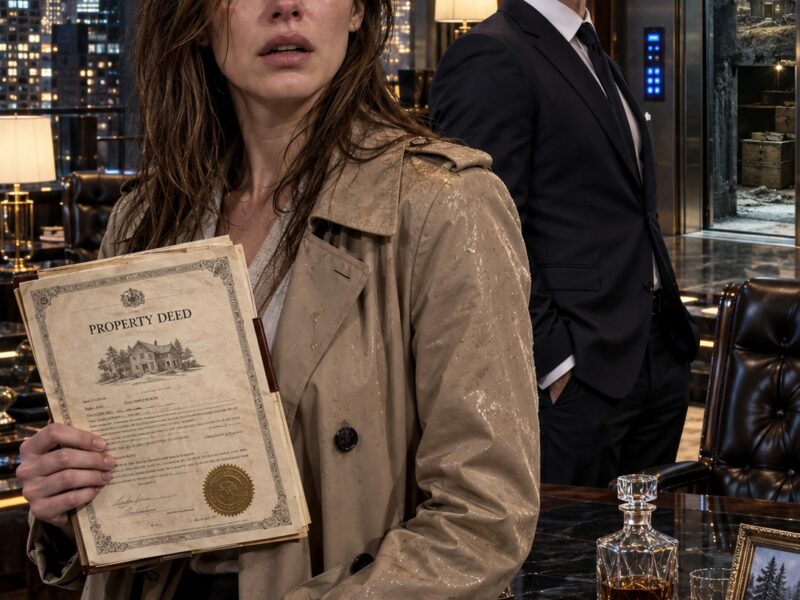
MY BILLIONAIRE FATHER LEFT ME A WORTHLESS CABIN—THEN I FOUND THE ELEVATOR HIDDEN 315 FEET BENEATH IT
The first time my father humiliated me after his death, my brother laughed.
The second time, he pointed a gun at my chest.
Between those two moments, I learned that the rotting cabin everyone thought was my final punishment was sitting on top of an inheritance worth more than everything my family had fought over in Manhattan.
But the money was not the worst secret buried beneath that mountain.
My father had buried proof.
And somehow, even from the grave, Richard Nelson had known exactly which of his children would come looking for it.
Rain hammered the floor-to-ceiling windows of Sullivan & Cromwell hard enough to blur lower Manhattan into gray streaks of glass and steel.
Thirty-two floors above the wet streets, I sat at the far end of a mahogany conference table and listened to a lawyer divide my father’s life into properties, trusts, accounts, percentages, and names.
Mostly names that weren’t mine.
Arthur Pendleton sat at the head of the table.
He was one of those attorneys who seemed born old—silver hair, tortoiseshell glasses, charcoal suit, a voice so dry it could make a funeral sound like a quarterly earnings call.
Across from me sat my half brother, Patrick Nelson.
Patrick was forty, handsome in the expensive way that came from never having to wonder what anything cost, and dressed in a navy Brioni suit that probably cost more than I had earned during some entire years of freelance archival work.
Beside him sat his mother.
Cynthia Nelson.
My father’s second wife.
She wore cream cashmere and pearls small enough to look tasteful but expensive enough to pay off several months of the debt notices sitting unopened on my kitchen counter.
Neither of them looked devastated.
They looked patient.
There is a particular kind of silence wealthy people learn around inheritance.
It resembles grief until you notice everyone is waiting for a number.
Arthur adjusted his glasses.
“To my wife, Cynthia Nelson…”
Cynthia lowered her eyes.
“I leave the primary residence in Tribeca, the Southampton estate, and all liquid assets currently held through Chase Private Client, totaling approximately forty-two million dollars.”
Cynthia gave one solemn nod.
Not surprise.
Not gratitude.
Recognition.
She already knew.
Arthur turned the page.
“To my son, Patrick Nelson, I leave my controlling interest in Nelson Holdings, including the commercial properties in the Chicago Loop, together with the offshore trust administered on my behalf…”
Patrick leaned back.
And looked at me.
Just for a second.
It wasn’t even a smile.
That would have been too obvious.
It was something smaller.
Satisfaction.
Patrick had spent most of our childhood reminding me that I was the accidental first draft of the Nelson family.
I was Richard’s daughter from his first marriage.
My mother, Elaine, had been with him before the private planes, before the magazine covers, before Nelson Holdings owned enough commercial real estate to make reporters call my father a “property visionary.”
By the time my mother was dying in hospice, Richard was acquiring buildings up and down the Eastern Seaboard.
He visited her twice.
He visited me even less after she died.
Then he married Cynthia.
Then Patrick became the son who appeared beside him in photographs.
Golf tournaments.
Galas.
Board meetings.
Charity dinners.
I became the daughter who learned not to check the society pages.
Arthur turned another page.
“And finally…”
Something tightened inside me.
“To my daughter, Brittany Nelson.”
Patrick’s gaze shifted toward me.
I looked at Arthur.
I wasn’t expecting millions.
I want that understood.
I hadn’t walked into that room dreaming about penthouses or yachts.
I had one humiliatingly ordinary hope.
Fifty thousand dollars.
Maybe even thirty.
Enough to stop the calls.
Enough to settle some of the medical bills David had left behind.
David Mercer had been my fiancé.
Three years earlier, at thirty-four, he had developed an aggressive form of leukemia.
We tried everything.
Standard treatment.
Clinical consultations.
Experimental protocols insurance wouldn’t touch.
Travel.
Specialists.
Drugs with names I learned to pronounce while sitting beside a hospital bed at three in the morning.
When money ran out, I borrowed.
When credit ran out, I begged.
Including my father.
I still remembered that conversation.
David was asleep behind a glass partition at Mount Sinai while I stood in a stairwell with my phone pressed against my ear.
“Dad, I’m not asking you to give it to me.”
Silence.
“I’ll repay you.”
“Brittany.”
“Please.”
Another silence.
Then Richard said, “The treatment has a low probability of success.”
I stared at the concrete wall.
“He’s not a probability.”
“Everything is.”
“He’s the man I’m going to marry.”
“And you’re asking me to put capital into an outcome with almost no return.”
I had stopped breathing.
“You mean his life.”
“I mean the facts.”
David died eleven weeks later.
My father sent flowers.
White lilies.
No card.
So no, I wasn’t expecting love from his will.
I was hoping for enough money to stop paying for the consequences of having loved someone he considered a bad investment.
Arthur read.
“I leave the deed to Lot Forty-Four, commonly known as the Osprey Tract, located within Adirondack Park, New York, including the residential structure situated upon it.”
He stopped.
I waited.
Arthur lowered the paper.
“The remainder of the estate is hereby settled.”
The rain ticked against the windows.
I frowned.
“I’m sorry. What?”
Patrick laughed.
It was quick and sharp.
I looked at him.
“The Osprey Tract,” he said.
I turned back to Arthur.
“I don’t know what that is.”
Patrick’s smile widened.
“It’s a shack, Bee.”
He was the only person who still called me Bee.
Mostly because he knew I hated it.
“Dad bought some useless rock near Saranac Lake decades ago. There’s an old hunting cabin on it.”
“Patrick,” Cynthia murmured.
But she didn’t look offended.
Patrick leaned forward.
“No plumbing worth mentioning. No reliable power. Terrible road access. Environmental restrictions everywhere.”
He spread his hands.
“Basically, he left you a pile of wet lumber.”
“Patrick.”
This time Cynthia’s voice carried a little more warning.
He ignored her.
“Dad always said you liked strays and lost causes. I guess he wanted you to have one more.”
I looked at Arthur.
“What is it worth?”
The attorney hesitated.
That hesitation told me more than the answer.
“Approximately thirty-five thousand dollars according to the most recent assessment.”
Patrick snorted.
Arthur continued carefully.
“Although that assumes a buyer can be found. The cabin is significantly deteriorated, and Adirondack Park regulations severely limit development.”
Thirty-five thousand dollars.
Cynthia had received forty-two million in liquid assets alone.
Patrick had received the company.
I had received a condemned cabin no one wanted.
For several seconds, I felt seventeen again.
Standing outside my father’s study.
Listening to him tell someone on the phone that Cynthia and Patrick were “his real family now.”
Maybe he hadn’t known I was outside the door.
Maybe he had.
With Richard, you could never tell.
“Where do I sign?” I asked.
Patrick blinked.
Arthur pushed several documents toward me.
“Brittany, you don’t have to—”
“Where?”
He showed me.
I signed.
No tears.
That mattered to me.
I refused to cry in front of Patrick.
I refused to let Cynthia tilt her head and perform sympathy.
I signed every transfer document, put on my trench coat, and walked toward the glass doors.
Patrick called after me.
“Enjoy the woods, Bee.”
I stopped.
“Maybe you’ll finally find something you’re good at owning.”
I looked over my shoulder.
He was smiling.
Cynthia was staring at the table.
Arthur looked embarrassed for all of them.
I smiled back.
“Maybe.”
Then I left.
At the time, I thought that was the last humiliation my father had planned for me.
I was wrong.
It was the first instruction.
Two days later, my Subaru was crawling north through the Adirondacks beneath a sky the color of dirty wool.
I had already called a real estate agency near Saranac Lake.
The agent had been painfully honest.
“Ms. Nelson, nobody is rushing to buy a condemned off-grid cabin in November.”
“I don’t need a great price.”
“You may not get any price.”
“What do I need to do?”
“Clean it out. Photograph it. Make sure the floor isn’t falling into the foundation. Then call me.”
So I drove north.
Because desperation makes reasonable people do unreasonable things.
And because debt doesn’t care that you’re grieving.
The GPS disappeared twenty minutes after I left the highway.
My phone lost service soon after.
The gravel road became mud.
Mud became ruts.
The Subaru bounced so violently that an old coffee cup launched out of the holder and hit the passenger door.
“Perfect,” I muttered.
Six miles later, the road ended at a rusted chain-link gate.
A faded sign hung crookedly from it.
PRIVATE PROPERTY.
OSPREY TRACT.
I parked.
The air smelled of wet pine and coming snow.
I pulled on gloves, grabbed a flashlight and crowbar, then ducked under the chain.
The hike wasn’t long.
Maybe a quarter mile.
But it was steep enough that by the time I reached the clearing, my lungs were burning.
Then I saw my inheritance.
Patrick hadn’t exaggerated.
If anything, he’d been generous.
The cabin looked dead.
Two stories of blackened timber sagged against the side of the mountain.
Several roof shingles were missing.
The porch had warped into a crooked smile.
Moss climbed the foundation.
One upstairs window was cracked.
Another had been boarded over.
I stood there in the freezing drizzle and started laughing.
Not because it was funny.
Because sometimes disappointment becomes so complete your body doesn’t know what emotion to choose.
“Thanks, Dad.”
My voice vanished into the trees.
I climbed the porch carefully.
The key Arthur had given me resisted at first.
Then the lock turned.
The door groaned open.
Cold, damp air rolled over me.
Mildew.
Old pine.
Wet earth.
Dust.
I stepped inside.
The living room contained a moth-eaten sofa, a stone fireplace and enough dead insects to establish their own municipality.
The kitchen wasn’t better.
Cabinets hung crookedly.
Mouse droppings dotted the counters.
A rusted sink sat beneath a dirty window.
I should have turned around.
Instead, I started cataloguing.
It’s what archivists do.
We notice.
We classify.
We ask why something is where it is.
And that was why, less than ten minutes after entering the cabin, I noticed the electrical panel.
It was mounted beside the kitchen.
At first I walked past it.
Then stopped.
I turned around.
The cabin appeared to have been built sometime in the 1970s.
The breaker box had not.
It was enormous.
Industrial.
Modern.
Too modern.
I wiped dust from the steel cover.
There was almost none.
That was stranger.
I opened it.
Inside were rows of heavy-duty switches.
Each had a printed label.
SUBLEVEL A.
CORE VENTILATION.
PRIMARY GEN.
HYDRAULIC LIFT.
I read the last one again.
Hydraulic lift.
I looked around the kitchen.
“What lift?”
I flipped the switch.
Nothing.
I tried another.
Dead.
Maybe the box had been installed for some abandoned renovation.
Maybe my father had once planned to rebuild.
But why industrial ventilation?
Why a sublevel?
I photographed everything.
Then I spent the next several hours cleaning.
By dusk, the temperature had fallen below freezing.
There was no dry firewood.
No working electricity.
No cell signal.
So I retreated to a downstairs bedroom with two winter sleeping bags, wearing nearly every layer I’d brought.
I remember lying there thinking Patrick had won.
Not financially.
He had won something more embarrassing.
He had been right about what Dad thought of me.
The mountain felt like proof.
My father’s final message wasn’t complicated.
You weren’t worth anything better.
Eventually, exhaustion pulled me under.
At 2:14 a.m., something woke me.
I opened my eyes.
Blackness.
Absolute blackness.
For several seconds I didn’t know where I was.
Then the cold reminded me.
I reached for my phone.
2:14.
No service.
The wind was howling outside.
One loose pane rattled somewhere down the hall.
But that wasn’t what had awakened me.
I held still.
There.
A vibration.
So faint at first that I thought it was my heartbeat.
Then it came again.
Thrum.
Thrum.
Thrum.
The floor beneath me was vibrating.
I sat upright.
Thrum.
Thrum.
Thrum.
Not an earthquake.
Too regular.
Too mechanical.
It sounded like an engine.
A very large engine.
Running somewhere beneath the house.
I pulled on my boots.
My hands were shaking when I picked up the flashlight and crowbar.
The vibration became stronger in the hallway.
I followed it toward the kitchen.
There was a narrow wooden door at the rear that I had assumed was a pantry.
It had an iron deadbolt.
I slid it open.
Behind the door, stairs disappeared underground.
Cold darkness waited below.
I almost shut it.
Then I smelled something.
Not mildew.
Not soil.
Ozone.
Oil.
Filtered air.
The smell of machinery.
I descended.
The cellar looked ordinary.
Stone walls.
Dirt floor.
Cobwebs.
Old shelves.
Except for the sound.
Down there, the hum was enormous.
My flashlight swept across the cellar until it landed on an oak wine rack covering most of the far wall.
Empty.
Dusty.
Heavy.
I moved closer.
The rack was vibrating.
I crouched.
My light traced the base.
Then I stopped breathing.
Steel.
Tracks.
The wine rack wasn’t attached to the wall.
It was attached to a hidden rail system.
“What the hell did you build, Dad?”
I searched the stonework.
Eventually I found one stone that didn’t sit flush with the others.
I pulled it.
It slid forward.
Behind it, a digital keypad glowed blue.
I stared at it.
Electricity.
The cabin had no power.
Yet this keypad was alive.
Someone was still maintaining something beneath Osprey.
I entered Dad’s birthday.
ERROR.
Patrick’s.
ERROR.
One attempt left.
I closed my eyes.
Richard Nelson didn’t choose numbers sentimentally.
He chose them strategically.
Dates mattered only if money had happened on them.
And suddenly I remembered a box of newspaper clippings I had catalogued for him one summer.
October 14, 1998.
The acquisition that had transformed Nelson Holdings.
The deal that had made Richard Nelson a billionaire.
I typed:
The keypad beeped.
For one terrible second, nothing happened.
Then pressurized air hissed behind the wall.
I jumped back.
Gears engaged.
The massive oak wine rack began sliding sideways.
Stone disappeared behind wood.
Wood disappeared into stone.
And where an old wine rack had stood, a pristine concrete corridor appeared.
Bright LED lights ran along the ceiling.
At the far end stood brushed-steel elevator doors.
I didn’t move.
I couldn’t.
The rotting cabin behind me suddenly felt like scenery.
A costume.
A lie.
Patrick’s voice came back to me.
A pile of wet lumber.
Dad’s final insult.
Thirty-five thousand dollars.
But no one built a commercial elevator beneath a thirty-five-thousand-dollar cabin.
I stepped into the corridor.
Beside the elevator was one illuminated green button.
I pressed it.
The doors opened instantly.
Inside was polished metal.
No floor buttons.
Just a brass keyhole, a red emergency stop and a heavy lever.
I stepped inside.
Every instinct told me not to touch it.
So naturally, I did.
The doors closed.
I pulled the lever.
The elevator dropped.
I screamed.
Not descended.
Dropped.
My stomach seemed to stay somewhere above me.
A depth display lit over the door.
50 FEET.
I grabbed the rail.
My ears popped.
Then the brakes engaged.
315 FEET.
The doors opened.
Lights came alive one after another.
And my understanding of my father died for the second time.
The space beyond the elevator was enormous.
Polished black granite.
Reinforced glass.
Climate-controlled chambers.
Steel vault doors.
Server racks.
Enough underground infrastructure to make the cabin above seem like a joke designed by someone with unlimited money and unlimited paranoia.
Then I noticed the man.
He was sitting behind a glass-topped control desk.
Gray suit.
Silver hair.
Porcelain teacup.
Waiting for me.
He checked his watch.
“You took your time, Brittany.”
I raised the crowbar.
“Who are you?”
He smiled faintly.
“Your father estimated you’d solve the entrance within twenty-four hours.”
My mouth went dry.
“He was wrong.”
The man placed the cup down.
“You beat his estimate by nearly a day.”
“Who are you?”
He stood.
“Winston Carter.”
The name meant nothing to me.
“I managed certain private assets for Richard Nelson.”
“What assets?”
His gaze moved across the underground complex.
“These.”
I tightened my grip on the crowbar.
“How long have you been down here?”
“On and off? Fourteen years.”
“Doing what?”
“Maintaining the Osprey Protocol.”
I stared at him.
“The what?”
Winston studied me for a moment.
Then he said the sentence that changed everything.
“Welcome to your actual inheritance, Ms. Nelson.”
I laughed once.
It sounded frightened.
“My actual inheritance is upstairs decomposing.”
“No.”
He walked toward a reinforced glass door.
“Your inheritance upstairs is camouflage.”
He placed his thumb on a biometric reader.
The door opened.
“Come.”
I didn’t.
“What is this?”
“Your father’s contingency.”
“For what?”
Winston’s expression changed.
“Your brother.”
That got me moving.
Inside the chamber, temperature and humidity were carefully controlled.
At first I didn’t understand what I was looking at.
Then my brain caught up.
Gold.
Rows of bars stacked on reinforced shelving.
Hundreds of them.
Beyond them were cylindrical storage systems containing rolled canvases.
I stepped closer.
Even behind protective glass, I recognized the brushwork.
“Is that…”
“Degas.”
Winston indicated another.
“Rembrandt.”
My mouth opened.
“Those are supposed to be—”
“Missing.”
I turned toward him.
“Stolen?”
“Not by your father. Acquired through intermediaries from private estates that preferred discretion.”
I stared at the gold again.
“How much?”
“That depends on markets, authentication, and which assets you include.”
“Winston.”
He regarded me calmly.
“Far more than Patrick inherited.”
The room seemed to tilt.
I backed into the glass.
“No.”
“I’m afraid so.”
“Why?”
Winston didn’t answer immediately.
So I asked the question I’d been carrying since childhood.
“Why me?”
His face softened.
“My father barely spoke to me.”
“I know.”
“He ignored my mother while she was dying.”
“I know.”
“When David got leukemia, I begged him for help.”
Winston looked down.
“He called David a bad investment.”
“I know.”
My voice broke.
“You keep saying that.”
“Because your father told me.”
Something inside me hardened.
“He told you?”
“Richard told me almost everything.”
“Then explain this.”
I gestured around us.
“Because none of this makes sense.”
Winston walked back toward the control room.
“Ten years ago, your father discovered irregularities in the Chicago portfolio.”
“What kind?”
“Patrick had begun siphoning money.”
I said nothing.
“At first, Richard thought it was minor. Unauthorized leverage. Aggressive investments. Then he discovered shell entities, concealed transfers and offshore accounts.”
“Patrick was stealing from him?”
“From Nelson Holdings.”
“Why didn’t Dad stop him?”
“Because Patrick wasn’t acting entirely alone.”
I knew before Winston said it.
“Cynthia.”
He nodded.
“Your father believed exposing them publicly would damage the company beyond repair. So he began moving his most valuable private assets outside the corporate structure.”
“Here.”
“Here.”
I looked around.
“He knew Patrick was stealing and still gave him Nelson Holdings?”
“Richard believed consequences taught more effectively than warnings.”
A bitter laugh escaped me.
“That sounds like him.”
Winston watched me.
“He knew the company Patrick inherited was also the place where Patrick had created his greatest vulnerabilities.”
That sentence stayed with me.
“And me?”
“Richard studied you too.”
My anger returned.
“From where? Across town?”
Winston didn’t defend him.
“He was a terrible father, Brittany.”
I looked away.
“He was.”
“He was emotionally cowardly, punitive, controlling and incapable of expressing remorse.”
“Then don’t turn this into some secret love story.”
“I’m not.”
That stopped me.
Winston stepped closer.
“This isn’t an apology.”
I looked at him.
“Richard didn’t leave you this because he suddenly became a good man.”
“Then why?”
“Because he trusted you.”
I nearly laughed again.
But Winston continued.
“You lived modestly when you could have traded on the Nelson name. You built a profession. You cared for David until the end. You went into debt trying to save him rather than abandoning him when loving him became expensive.”
My throat tightened.
“Your father respected very few things. Competence. Discipline. Loyalty.”
Winston paused.
“And people who could not be bought.”
I stared at the floor.
“He could have told me.”
“Yes.”
“He could have helped David.”
“Yes.”
“He could have been my father while he was alive.”
“Yes.”
Each answer hurt worse because Winston refused to excuse him.
I wiped my eyes angrily.
“So what happens now?”
Winston opened his mouth.
A metallic chime interrupted him.
His head snapped toward the elevator.
Above it, the depth indicator had turned red.
Someone was descending.
Winston’s entire demeanor changed.
“Did you close the entrance?”
I froze.
“What?”
“The wine rack.”
“I…”
“I left it open.”
Winston swore.
His hands flew across the control desk.
“Perimeter sensors triggered twenty minutes ago. I assumed wildlife.”
“Who else knows I’m here?”
“No one.”
Then I remembered Patrick smiling across the conference table.
My stomach dropped.
“I drove straight here.”
“Did anyone know you were coming?”
“The real estate agent.”
The elevator stopped.
Winston looked at me.
“Get behind the desk.”
The doors opened.
Patrick stepped out.
Mud covered his trousers.
His hair was wet.
His face was flushed from exertion.
And in his right hand was a black handgun.
For perhaps three seconds, nobody spoke.
Then Patrick looked past me.
At the vaults.
At the gold.
At the paintings.
At the servers.
Wonder replaced exhaustion.
Then wonder became rage.
He laughed.
“Of course.”
“Patrick.”
He raised the gun.
The barrel pointed directly at my chest.
“Of course he gave it to you.”
I didn’t move.
“Put the gun down.”
“Shut up.”
“How did you find me?”
His smile returned.
“I had someone follow you.”
“A private investigator?”
“You really thought I believed Dad left you thirty-five thousand dollars?”
He looked around.
“I knew he was hiding something.”
“So you followed me.”
“I followed what belonged to me.”
Winston stepped slightly forward.
Patrick swung the gun toward him.
“Don’t.”
Winston stopped.
Patrick’s eyes moved back to the gold.
“How much?”
No one answered.
“How much?”
“Enough,” Winston said.
Patrick laughed again.
“Enough.”
His breathing grew faster.
“Do you know what he did to me? He spent thirty years telling me I’d run the empire. Then he starts questioning every acquisition. Every investment.”
“Because you were stealing.”
Patrick looked at me.
“Excuse me?”
“Dad knew.”
For the first time, his expression slipped.
“He knew about Chicago.”
Silence.
“He knew about the offshore transfers.”
Patrick’s jaw tightened.
“Who told you?”
“He did.”
“He’s dead.”
“Winston.”
Patrick aimed at Winston again.
“You.”
Winston remained motionless.
“Transfer ownership.”
“That is not possible under coercion.”
Patrick walked toward him.
“Everything is possible.”
He pressed the gun against Winston’s temple.
“Transfer it.”
“Patrick.”
“Stay out of this, Bee.”
“If you kill him, you may never access anything.”
“Then I’ll find someone who can.”
“These systems are encrypted.”
“I’ll hire people.”
“You can’t carry hundreds of gold bars through the Adirondacks without someone noticing.”
His eyes flashed.
“You always thought you were smarter than me.”
“No.”
I looked at him.
“You always needed me to think I wasn’t.”
Something shifted between us.
All those childhood dinners.
All those comments.
All those jokes about my clothes, my career, David, my apartment, my debt.
Patrick had never simply disliked me.
He had needed me beneath him.
Because if I wasn’t beneath him, he had no idea who he was.
I glanced toward the server racks.
And remembered something.
Years earlier, while cataloguing my father’s architectural records, I had seen emergency protocols for corporate vaults.
Richard loved redundancies.
And traps.
Especially traps.
I lowered my crowbar.
It hit the granite.
Patrick flinched.
“What are you doing?”
“Surrendering.”
“Brittany,” Winston said carefully.
“It’s okay.”
I raised my hands.
“Patrick’s right.”
Patrick stared at me suspiciously.
“I don’t care about the gold.”
“You expect me to believe that?”
“I care about those.”
I pointed toward the servers.
His gaze followed.
“What about them?”
I had no idea what was on those machines.
But Patrick didn’t know that.
So I lied.
“The ledger.”
His face changed.
“What ledger?”
“The real inheritance.”
I walked slowly toward the control desk.
“Dad archived everything.”
“Everything what?”
“Your accounts. Cynthia’s transfers. Chicago. The offshore entities.”
Patrick stared at the server racks.
I watched fear replace greed.
It happened almost beautifully.
“The wire transfers,” I continued. “Tax records. Fraud. All of it.”
“You’re lying.”
“Am I?”
His eyes moved to Winston.
Winston said nothing.
Which was exactly what I needed.
Patrick’s face drained.
“Delete it.”
Winston remained silent.
“Delete it!”
“I cannot.”
Patrick shoved the gun harder against his temple.
“Then who can?”
Winston looked at me.
“Only the primary account holder.”
Patrick turned.
“Sit down.”
I obeyed.
My legs felt weak.
I sat at the control terminal.
A screen activated.
AUTHORIZATION REQUIRED.
“Enter your code,” Winston said.
I understood.
The screen turned green.
ACCESS GRANTED.
Patrick leaned over the desk.
“Delete the financial files.”
“There are thousands of directories.”
“Then wipe everything.”
I looked at him.
“What?”
“Everything. Destroy the servers.”
I let silence stretch.
“There is a master fail-safe.”
“Do it.”
“It erases every drive.”
“Do it!”
I looked down at the keyboard.
I had seen the phrase once.
Years ago.
Buried in architectural security documents my father probably assumed nobody would ever read closely.
But archivists read closely.
That was the one thing Richard had understood about me.
I typed:
PROTOCOL OSPREY LOCKDOWN.
My finger hovered above Enter.
Patrick saw my hesitation.
“Press it.”
I looked up at him.
For the first time in my life, I didn’t see my powerful older brother.
I saw a frightened man with a gun.
A man who had inherited everything he believed he deserved and still couldn’t stand the possibility that I possessed something he didn’t.
“Do it!”
I pressed Enter.
The facility went black.
Patrick shouted.
Then red emergency lights exploded across the room.
A siren screamed.
A computerized voice filled the underground chamber.
“WARNING. QUARANTINE PROTOCOL ENGAGED.”
Patrick spun toward me.
“What did you do?”
“MAIN ELEVATOR DISABLED.”
Blast doors slammed over the glass vaults.
Patrick fired.
The gunshot was deafening.
I ducked.
A massive steel grate dropped from the ceiling.
Patrick jumped backward.
It struck the granite between us with a thunderous crash.
The bullet sparked harmlessly against reinforced steel.
Suddenly Patrick was on one side.
Winston and I were on the other.
Patrick grabbed the bars.
“OPEN IT!”
I stood slowly.
His face appeared between the steel slats.
“Open this goddamn thing!”
“Drop the gun.”
“I’ll kill you.”
“You can’t reach me.”
“I swear to God, Brittany—”
“Drop it.”
He rattled the grate.
The computerized voice spoke again.
“ATMOSPHERIC VENTILATION SUSPENDED.”
Patrick stopped.
“What?”
Winston stepped beside me.
“Your side of the chamber is isolated.”
Patrick looked toward the ceiling.
“Reopen it.”
Winston folded his hands.
“No.”
“You’ll kill me?”
“No.”
Winston’s voice was calm again.
“You will choose.”
Patrick stared at him.
“Put the weapon on the floor and slide it beneath the grate. Once you are disarmed, ventilation can be restored.”
Patrick looked at me.
“You think you’ve won?”
I said nothing.
“You were nothing to him.”
That landed.
He knew it would.
“Dad didn’t love you.”
“I know.”
Patrick blinked.
I stepped closer.
“He didn’t love you properly either.”
His face twisted.
“Shut up.”
“He made you spend your entire life trying to become him.”
“Shut up.”
“And now you’re standing three hundred feet underground holding a gun because you’re terrified that the daughter he ignored understood him better than the son he trained.”
“SHUT UP!”
His scream echoed through the facility.
Then something strange happened.
I stopped being afraid of him.
Not because he wasn’t dangerous.
Because I finally saw the size of the emptiness beneath all his cruelty.
Patrick had spent his entire life winning a competition our father invented.
And Richard had died without telling either of us the rules.
The gun remained in Patrick’s hand.
His breathing became heavier.
The red lights flashed.
Once.
Twice.
Again.
Finally, his shoulders dropped.
The gun slipped from his fingers.
It struck the granite.
He kicked it beneath the grate.
I picked it up.
For several seconds, Patrick and I looked at each other through the bars.
He looked older.
Smaller.
Almost like the boy I remembered from childhood before our father taught him that inheritance was the same thing as worth.
“Turn the air back on,” I told Winston.
He did.
Patrick sank onto the floor.
And for the first time in thirty-two years, my brother had nothing I wanted.
Two days later, federal agents came down the Osprey elevator.
By then, I had learned that my lie hadn’t actually been a lie.
The servers really did contain records.
Years of them.
Richard had archived Patrick’s transfers.
Shell corporations.
Offshore accounts.
Unauthorized borrowing.
Internal correspondence.
And records connecting Cynthia to several of the concealed transactions.
My father had not merely hidden his fortune from them.
He had built a case.
I authorized Winston to duplicate the relevant material and send it to federal authorities.
Patrick was arrested.
I watched from the cabin porch as agents escorted him toward the logging road in handcuffs.
Snow had begun to fall.
He twisted around once.
“Brittany!”
I didn’t answer.
“You think you’re better than me?”
The agents kept moving him.
“Brittany!”
I stayed on the porch.
Because the answer no longer mattered.
Cynthia’s accounts were frozen the next morning.
Lawyers descended.
Investigators followed.
Nelson Holdings became a maze of audits, litigation and restructuring.
Reporters called.
I ignored most of them.
Everyone wanted the same story.
The rejected daughter.
The hidden billionaire fortune.
The criminal brother.
The underground vault.
They wanted revenge.
People like revenge because it makes pain look organized.
Real pain isn’t.
For weeks after Patrick’s arrest, I kept thinking about David.
Not the hospital.
Not the leukemia.
The ordinary things.
The way he burned toast because he always forgot to change the setting.
The way he sang badly while washing dishes.
The way he once spent twenty minutes trying to rescue a moth from our bathroom because he didn’t want to kill it.
One afternoon, Winston found me sitting alone inside the gold chamber.
“You could buy almost anything,” he said.
I looked at the bars stacked behind the glass.
“Not anything.”
He understood.
The medical debt was the first thing I paid.
Every bill.
Every collection account.
Every ugly envelope I’d avoided opening.
Then I established a fifty-million-dollar foundation in David’s name dedicated to experimental leukemia research and support for families trying to access treatments insurance considered too uncertain.
Winston read the documents.
“This is substantial.”
“So was he.”
He nodded.
I kept enough of the inheritance to never worry about money again.
The rest was handled carefully, legally, quietly, with teams Winston had trusted for years.
Some assets were sold.
Others were transferred.
The paintings required provenance reviews and specialists.
The gold became something more useful than metal sitting under a mountain.
By the following year, I had more wealth than I knew how to think about.
Yet the object I kept returning to wasn’t a gold bar.
It was the deed.
Lot Forty-Four.
Osprey Tract.
Thirty-five thousand dollars.
The worthless inheritance.
I framed it.
Not because I was sentimental about my father.
I never forgave Richard.
That surprised people.
They wanted the discovery beneath the cabin to rewrite him.
They wanted the secret inheritance to prove that underneath everything, he had loved me.
Maybe he had.
In whatever narrow, damaged way a man like Richard Nelson knew how.
But money could not turn neglect into parenting.
A hidden vault could not change what he said about David.
Gold couldn’t visit my mother in hospice.
A billion dollars could not give me back the years I spent believing I was the disposable child.
Richard’s final act was extraordinary.
It was also too late.
Both things could be true.
That was perhaps the most valuable thing he left me.
Not the gold.
Not the art.
Not Osprey.
The ability to stop forcing complicated people into simple categories.
My father had been cruel.
My father had trusted me.
Patrick had been privileged.
Patrick had also been shaped by the same cold man who shaped me.
Cynthia had protected her son until protecting him became participating in his destruction.
And I had spent years believing poverty meant failure because I had been raised around people who measured human beings by what they owned.
I thought the cabin proved my father believed I was worthless.
In fact, the cabin proved he knew everyone else would believe it.
That difference changed everything.
A year after the arrest, I returned to Osprey alone.
The first snow of the season covered the mountain.
The Subaru was gone by then.
I could have arrived in almost any car I wanted.
I bought another used Subaru.
Winston laughed when he saw it.
“What?”
“You have access to several hundred million dollars.”
“It has heated seats.”
“So does a Bentley.”
“Can a Bentley survive this road?”
He considered it.
“Probably not.”
“Exactly.”
The cabin still stood.
I had repaired only what was necessary to keep it structurally safe.
No luxury renovation.
No glass mansion.
No architectural monument.
The warped porch remained.
The timber remained dark.
The old stone fireplace remained.
Even the kitchen looked almost exactly as it had the night I found the breaker box.
People suggested tearing the place down.
I refused.
That cabin had spent decades being judged by people who never bothered to ask what was beneath it.
I knew something about that.
Near sunset, I walked outside.
Snow drifted through the pines.
The mountain was silent.
I sat on the porch steps with two cups of coffee.
One for me.
One I placed beside me.
An old habit.
David and I used to do that whenever one of us was away.
Set out two cups anyway.
Ridiculous.
Tender.
Ours.
I watched steam rise from the untouched cup.
“I paid the hospital,” I said aloud.
Snow landed on my sleeve.
“All of it.”
The woods didn’t answer.
“The foundation approved its first research grants.”
Still nothing.
I smiled.
“You would’ve hated the name.”
The David Mercer Foundation sounded too serious for a man who once tried to name our future dog Congressman Waffles.
My smile faded.
“I wish you’d seen this.”
Wind moved softly through the pines.
For a moment, I imagined telling him everything.
Patrick.
Winston.
The elevator.
The gold.
My father.
David would have listened.
Then he probably would have looked at the cabin and said something simple enough to ruin me.
Something like, You know you were worth more before you found it, right?
My eyes burned.
That was the tragedy of inheriting everything after losing the person who would have been least impressed by it.
Behind me, inside the cabin, the modern breaker panel remained hidden behind an old wooden cupboard door I’d installed.
Downstairs, the wine rack was closed.
The elevator slept.
Three hundred and fifteen feet below my boots sat the remnants of Richard Nelson’s secret empire.
But up there, on the porch, there was only snow.
A woman.
And two cups of coffee.
I had spent most of my life wanting my father to tell me I mattered.
In the end, he left me a mountain and forced me to discover his answer myself.
Maybe that was love to him.
Maybe it was guilt.
Maybe it was simply the last strategic decision of a man who understood assets better than daughters.
I would never know.
And I finally understood that I didn’t need to.
I stood as darkness settled over the Adirondacks.
Before going inside, I looked once toward the narrow road winding through the trees.
A year earlier, Patrick had stood in a Manhattan conference room and laughed because our father had left me thirty-five thousand dollars of frozen, worthless land.
He had inherited the company.
Cynthia had inherited the houses.
I had inherited the thing nobody wanted.
And because nobody wanted it, nobody looked closely.
That was Richard’s final trick.
But it became my lesson.
The world will often tell you what something is worth before anyone has bothered to discover what it contains.
Sometimes they’re right.
Sometimes the cabin really is just a cabin.
Sometimes the rejection really is rejection.
Sometimes the person who hurt you never had a beautiful reason.
But sometimes…
beneath the rot,
beneath the humiliation,
beneath everything other people dismissed because it didn’t glitter brightly enough for them to notice—
there is a door.
And behind that door is the truth.
I picked up David’s untouched coffee and mine and walked back into the cabin.
The old floorboards creaked beneath my feet.
Far below them, hidden under three hundred and fifteen feet of Adirondack bedrock, a machine continued its steady mechanical rhythm.
Thrum.
Thrum.
Thrum.
The same sound that had awakened me that first night.
Only now it didn’t sound like something buried.
It sounded like something still alive.









