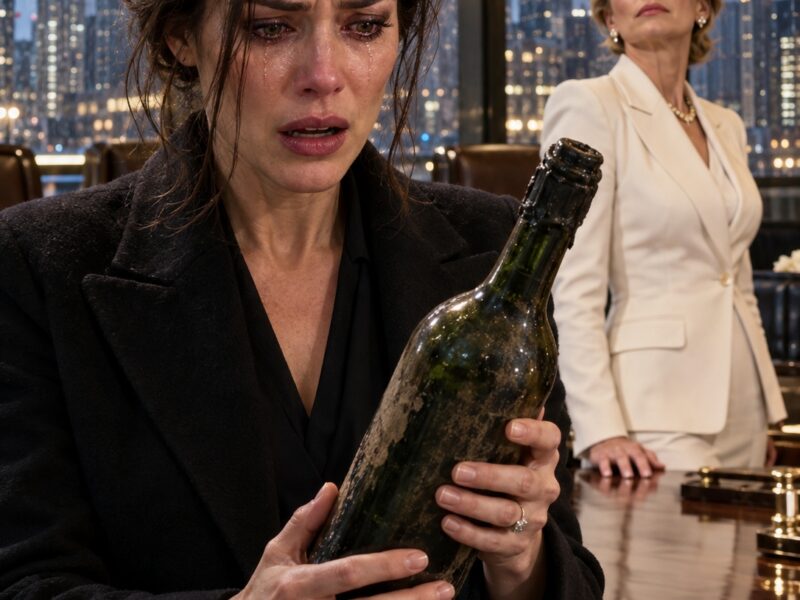
MY BILLIONAIRE FATHER LEFT ME ONE PENNY AND A FILTHY BOTTLE—THEN MY STEPMOTHER FOLLOWED ME TO ZURICH AND LEARNED WHAT HE REALLY LEFT BEHIND

The first time Abigail Caldwell realized her father might have loved her, she was standing three floors beneath a Zurich street with a silver key shaking between her fingers.
Behind a steel door was something Winston Caldwell had hidden from his wife, his son, his attorneys, and apparently most of the United States government.
Behind Abigail, somewhere beyond the private bank’s security corridors, were the two people who had laughed when she inherited a penny.
And back in Chicago, federal agents were preparing to tear apart the empire those same people believed had made them untouchable.
Abigail did not know any of that yet.
She only knew that the key fit.
She turned it.
A deep mechanical clunk traveled through the vault.
Then the steel door opened.
Three days earlier, she had been worth less than the plane ticket that brought her there.
And five years earlier, Winston Caldwell had called her a traitor.
It happened on a Thursday afternoon in Chicago, with rain streaking the windows of Preston Reed & Associates and turning the skyline into a watercolor of steel and gray.
The conference room smelled like polished mahogany, expensive leather, and old money.
Abigail sat at one end of the long table in a charcoal coat that still carried droplets of rain on the shoulders. She had deliberately chosen the simplest clothes she owned.
No jewelry.
No designer handbag.
No attempt to look as if she belonged.
Across from her, Beatrice Caldwell had done the opposite.
Her stepmother wore a white Chanel suit so immaculate it seemed almost hostile in a room full of mourners. A pearl rested at each ear. Her blond hair had been arranged with the kind of effortless precision that required an hour and several hundred dollars.
Beside her sat Gregory.
Abigail’s half brother was thirty-three, handsome in the polished, expensive way that had allowed him to mistake admiration for respect most of his life. His platinum watch caught the light every time he checked it.
He had checked it eleven times.
Abigail knew because counting was easier than looking at him.
“Are we almost finished?” Gregory finally asked.
Mitchell Preston looked over the top of his glasses.
The senior attorney had served Winston Caldwell for nearly twenty-seven years. He had the grave expression of a man who had witnessed too many rich families discover that grief and greed often arrived wearing the same suit.
“We are finished when the will is finished, Mr. Caldwell.”
Gregory leaned back.
“Right.”
Beatrice touched his wrist.
“Patience.”
She said it gently.
But her eyes were on Abigail.
That was the part Abigail hated.
Not the money.
Not even the inheritance.
The watching.
Beatrice had always watched her as though Abigail were an unexpected stain on an otherwise beautiful tablecloth.
Winston Caldwell had built Caldwell Holdings from three distressed warehouses and a borrowed office into one of the Midwest’s most aggressive commercial real-estate empires.
By the time he died, Forbes had estimated his holdings at more than $2 billion.
People described him as brilliant.
People who worked for him used other words when he wasn’t listening.
Merciless.
Controlling.
Impossible.
Abigail simply called him Dad until she was thirty-two.
Then she stopped calling him anything.
Five years earlier, while serving as vice president of acquisitions, Abigail had discovered irregularities buried inside the approval documents for a redevelopment project on Chicago’s West Side.
At first they looked like clerical mistakes.
Then she found the altered zoning maps.
Then the shell consultants.
Then the internal emails.
Caldwell Holdings had been manipulating environmental assessments and zoning classifications to accelerate a development that would displace hundreds of low-income families.
Abigail had walked into her father’s office with a folder under her arm.
Winston had not even looked surprised.
“You’re going to stop this,” she told him.
He sat behind a desk large enough to land an aircraft on.
“No.”
“People are going to lose their homes.”
“People sell homes every day.”
“They aren’t selling. You’re cornering them.”
Winston folded his hands.
“Choose your next sentence carefully.”
She remembered the sunlight behind him.
She remembered the tiny specks of dust floating through it.
She remembered realizing that she was frightened of her own father.
And then realizing she was more frightened of becoming him.
“I copied everything.”
That changed his expression.
“Excuse me?”
“The zoning reports. The emails. The consultant payments.”
“You wouldn’t.”
“I already did.”
For the first time in Abigail’s life, Winston Caldwell had looked at his daughter and seemed genuinely uncertain what she might do next.
It lasted perhaps two seconds.
Then the rage came.
“You self-righteous little fool.”
“Maybe.”
“You have no idea what you’ve done.”
“I know exactly what I’ve done.”
“You’ve destroyed your career.”
“If that’s the price.”
“You’ve destroyed this family.”
Abigail had stared at him.
“No, Dad. I’m just the first person in this family who stopped pretending it wasn’t already broken.”
She gave the evidence to a state investigator that afternoon.
The resulting investigation cost Caldwell Holdings almost $80 million in fines, settlements, and abandoned development expenses.
Winston publicly blamed his daughter.
Privately, he never spoke to her again.
She resigned.
He removed her from company boards.
Her corporate friends disappeared.
Her Christmas invitations stopped.
Her phone became very quiet.
Abigail moved into a small apartment in Wicker Park and began teaching urban planning at a local university.
Her salary was a fraction of what she had once earned.
Her kitchen had cabinets that didn’t quite close.
The radiator clanged every winter.
She took the Blue Line instead of a chauffeured car.
And, unexpectedly, she slept better.
Until Winston died.
A heart attack, according to Beatrice.
Quick.
Private.
Efficient.
Almost appropriate.
Abigail had attended the funeral and stood near the back.
She hadn’t cried.
That disturbed her more than grief would have.
Now, seven days later, she sat inside his attorney’s conference room listening as his kingdom was divided.
Gregory received the flagship real estate.
Gold Coast towers.
Retail properties along the Magnificent Mile.
Industrial and logistics sites outside Chicago.
Properties Abigail knew well enough to understand their potential value.
Beatrice received the Hamptons estate, the jet, several holding accounts, artwork, vehicles, and liquid assets.
The numbers became almost abstract.
Hundreds of millions.
Then more.
Abigail listened without envy.
At least that was what she told herself.
The truth was uglier.
She didn’t want Winston’s money.
She wanted proof that somewhere beneath the anger, he had remembered she was his daughter.
Mitchell Preston reached the final page.
He stopped.
Something changed in his face.
Gregory noticed.
“So that’s it?”
“Not quite.”
Beatrice straightened.
Preston adjusted his glasses.
“There is a final codicil.”
The room became quiet.
Preston read.
“Regarding my eldest daughter, Abigail Frances Caldwell—”
Gregory’s mouth curved.
Abigail looked at the table.
“—who so self-righteously rejected the empire I spent my life building, I leave my unvarnished opinion.”
Abigail’s stomach tightened.
Of course.
Even dead, Winston needed the final word.
Preston continued.
“You were always a fool who mistook stubbornness for morality.”
Gregory laughed.
Not loudly.
That somehow made it worse.
Preston’s jaw tightened almost imperceptibly.
“To ensure there can be no legal misunderstanding that you were accidentally omitted from my estate, I leave you one copper penny minted in the year of your birth.”
This time Gregory didn’t bother hiding his laughter.
Beatrice lowered her eyes, pressing two fingers delicately against her lips.
Abigail could see the smile anyway.
The humiliation was not in the penny.
It was in the preparation.
Winston had planned this.
Drafted it.
Reviewed it with lawyers.
Imagined this room.
Imagined Abigail sitting in this chair.
Imagined Gregory laughing.
He had wanted this moment to survive him.
Preston kept reading.
“And I leave Abigail the unmarked bottle stored in bin forty-two of the primary cellar at my Lake Forest residence. May it remind her that some things, regardless of how carefully preserved or deeply buried, eventually turn to vinegar.”
Silence.
Then Gregory whispered, “Jesus.”
A paralegal stepped forward carrying a silver tray.
The penny was exactly what Abigail expected.
Dull.
Brown.
Ordinary.
The bottle was worse.
It was made from thick green glass and covered in decades of gray-brown cellar grime. There was no label. No vineyard mark. No vintage.
Black wax—or something resembling wax—had been crudely melted around the neck.
It looked less like wine than evidence recovered from a shipwreck.
Gregory stared at it.
Then at Abigail.
“Dad really committed to the bit.”
“Gregory,” Beatrice murmured.
“What? He did.”
Preston ignored them.
“Miss Caldwell, acceptance is required to complete the disposition. You may refuse both items, in which case they will be discarded.”
Gregory leaned forward.
“Take them, Abby.”
She finally looked at him.
His smile widened.
“The penny might cover part of your train fare.”
Beatrice gave a soft sigh.
“You don’t have to be cruel.”
Gregory glanced at her.
“Mom, Dad left her garbage.”
Then Beatrice looked directly at Abigail.
For one second, something almost sympathetic appeared in her expression.
Almost.
“You always wanted principles instead of money,” she said. “Perhaps Winston simply gave you what you asked for.”
That landed harder than Gregory’s joke.
Abigail stood.
Her legs felt strangely numb.
She picked up the penny.
It was warm from the room.
She slipped it into her coat pocket.
Then she reached for the bottle.
The instant she lifted it, something felt wrong.
It was heavy.
Far heavier than she expected.
Her eyes flicked toward Preston.
He gave nothing away.
“Do you accept?” he asked.
Abigail tightened her fingers around the bottle’s neck.
“I accept.”
Gregory chuckled.
“Enjoy dinner.”
She turned toward the door.
“Abigail.”
Beatrice’s voice stopped her.
Abigail looked back.
Her stepmother smiled.
Small.
Elegant.
Victorious.
“Your father always knew people eventually revealed what they really valued.”
Abigail considered that.
Then looked at the hundreds of millions of dollars in documents spread across the table.
“I suppose we’re about to find out.”
The smile disappeared from Beatrice’s face.
Abigail walked out.
She did not cry in the elevator.
She did not cry crossing the lobby.
She did not cry when the cold Chicago rain struck her face.
She made it almost all the way home.
Then she placed Winston Caldwell’s penny beside his filthy bottle on her cheap dining table and finally whispered the question she had refused to ask for five years.
“Why did you hate me this much?”
The apartment gave no answer.
Rain tapped against the windows.
A bus groaned somewhere on Milwaukee Avenue.
The bottle sat beneath the pendant light like a dark joke.
Abigail poured herself water.
She couldn’t afford good wine.
That thought made her laugh once.
It came out sounding dangerously close to a sob.
She sat again.
The penny read 1982.
Her birth year.
Of course.
Winston would have selected it deliberately.
Everything about him had been deliberate.
That thought made her look at the bottle again.
Why bin forty-two?
Why an unlabeled bottle?
Why put garbage in a legal codicil?
Humiliation alone explained some of it.
But not all.
Winston despised disorder.
His Lake Forest cellar had been cataloged digitally. Every vintage had its place, temperature, provenance, acquisition record, and valuation.
He once fired a household manager because six bottles of Bordeaux had been shelved in the wrong sequence.
Yet he had preserved this?
Abigail leaned closer.
The black seal bothered her.
It was ugly.
Winston hated ugly things.
By midnight, curiosity had become stronger than grief.
The next morning, Abigail carried the bottle downtown.
Provenance Vintages occupied a discreet River North storefront without prices in the window.
Its owner, Sebastian Croft, had spent years authenticating rare bottles for auction houses before opening his own private consultancy.
He looked at Winston’s bottle and visibly recoiled.
“Please tell me you didn’t buy this.”
“It was inherited.”
“That doesn’t improve matters.”
“My father owned it.”
Sebastian paused.
“Winston Caldwell?”
“Yes.”
Now he looked at the bottle differently.
Not with admiration.
With suspicion.
He pulled on nitrile gloves.
“May I?”
“Please.”
He cleaned a small section of glass.
Examined the seam.
Turned the bottle upside down.
Used a magnifying loupe.
Five minutes passed.
Then ten.
Abigail became impatient.
“Well?”
Sebastian removed his glasses.
“I can tell you what it isn’t.”
“Which is?”
“Valuable wine.”
Her shoulders fell.
He pointed at the glass.
“Machine molded. Cheap commercial production. Mid-seventies, approximately. Possibly later. Minimal punt. Ordinary glass composition. There is nothing collectible about the vessel.”
“What about the wine?”
“If that’s what is inside.”
Abigail looked at him.
Sebastian tapped the black material around the cork.
“This is strange.”
“How?”
“This isn’t proper bottle wax.”
He scraped the surface gently with a tool.
“Some kind of industrial resin or polymer. Applied by hand.”
“Why?”
“I have no idea.”
“To preserve it?”
“No.”
Sebastian shook his head.
“If anything, this is absurd for wine storage. Whoever did this wasn’t concerned about opening the bottle elegantly.”
He looked at her.
“They were concerned about making sure it stayed closed.”
A small chill moved through Abigail.
“Can you open it?”
“I can.”
Sebastian hesitated.
“But if this belonged to your father and was specifically mentioned in his will, I wouldn’t.”
“Why not?”
“Because I’ve spent twenty years around wealthy collectors, Miss Caldwell.”
He pushed the bottle gently toward her.
“Rich men rarely go to this much trouble over worthless objects unless the object isn’t the point.”
That sentence followed her home.
For two hours, Abigail left the bottle untouched.
Then anger returned.
Maybe she was doing exactly what Winston wanted.
Obsessing.
Searching for meaning in cruelty.
Turning a final insult into another puzzle he could force her to solve from the grave.
She grabbed the bottle.
Raised it.
The exposed brick wall of her kitchen was six feet away.
One throw.
That was all it would take.
She imagined green glass exploding.
Vinegar running down the brick.
Winston’s last joke finally dead.
Then she saw the penny.
Specific.
The bottle.
Bin forty-two.
Specific.
The legal codicil.
Specific.
Winston Caldwell did not do random.
Abigail slowly lowered her arm.
“Damn you.”
She went to the toolbox beneath the sink.
The resin fought her for twenty-three minutes.
She used a utility knife first.
Then a flat screwdriver.
Then a small hammer.
Hard black fragments snapped loose and scattered across the counter.
Beneath them was an old cork.
Abigail inserted a corkscrew.
Twisted once.
Twice.
Three times.
Then—
Scrape.
She stopped.
Metal.
The corkscrew had struck metal.
Abigail’s pulse accelerated.
She tried again.
Scrape.
“What the hell?”
She abandoned the corkscrew and began carefully breaking the cork apart.
The upper section crumbled.
Something silver appeared beneath it.
Abigail stopped breathing.
Embedded inside the hollowed center of the cork was a narrow cylinder wrapped in waterproof foil.
She pulled it free.
Her fingers shook so badly she nearly dropped it.
Inside the foil were two objects.
A tiny rolled strip of waterproof parchment bearing a ten-character alphanumeric code.
And a silver key.
Abigail recognized the insignia immediately.
Interlocking letters.
H.
V.
Haas & Vesper.
Zurich.
She sat down hard.
Winston hadn’t left her wine.
He had left her a bank key.
And suddenly the penny no longer felt like an insult.
It felt like an instruction.
Three days later, Abigail spent nearly everything she had left getting to Switzerland.
The decision was financially insane.
Her checking account held a little over four thousand dollars.
The flight, hotel, transportation, and last-minute expenses consumed most of it.
If the key opened nothing, she would return to Chicago with less than one month’s rent.
But uncertainty had become unbearable.
Zurich greeted her with cold air and immaculate streets.
Haas & Vesper stood behind an unmarked limestone facade near Paradeplatz.
No advertisement.
No luxury cars displayed outside.
No giant logo.
Just two brass letters beside an oak door.
H & V.
Abigail entered.
The lobby was quieter than a church.
A concierge looked up.
“Abigail Caldwell.”
She had prepared identification.
He did not ask for it.
Instead, he stood.
“Of course.”
Her heart skipped.
“Of course?”
“Director Voss will receive you.”
She stared at him.
“You were expecting me?”
The concierge offered only a professional smile.
“Please follow me.”
Henrik Voss was tall, silver-haired, and difficult to read.
When Abigail entered his private office, he stood and extended his hand.
“Miss Caldwell.”
“You know who I am.”
“Yes.”
“How?”
“Your father ensured that we would.”
That answer did nothing to calm her.
Voss gestured toward a chair.
“May I see what you brought?”
Abigail placed the key and parchment on his desk.
He examined both.
Then something astonishing happened.
He smiled.
“Perfectly intact.”
“What is this?”
“Your father described it as a test.”
Abigail almost laughed.
“Of course he did.”
Voss’s expression softened slightly.
“He instructed us never to contact you.”
“So I could have gone my entire life without knowing?”
“Yes.”
“And then?”
“On the first anniversary of his death, the arrangement would terminate.”
“What would happen to whatever is inside?”
Voss glanced at a document.
“A charitable transfer.”
“To what?”
He paused.
“A sanctuary for abandoned cats outside Bern.”
Abigail stared at him.
Voss remained perfectly serious.
She began laughing.
She covered her mouth, but it only made it worse.
For the first time since Winston’s funeral, she laughed until tears came.
“That bastard.”
“I never met him personally,” Voss said carefully.
“You didn’t need to.”
She wiped her eyes.
“That is absolutely him.”
Voss stood.
“You found the key. Therefore, under his instructions, you have satisfied the condition.”
“What condition?”
“That you would look beyond the apparent value of what he gave you.”
The laughter vanished.
Abigail stared at the silver key.
Winston’s voice seemed to return from five years earlier.
You mistake stubbornness for morality.
But another memory followed.
A much older one.
Abigail at eleven years old, struggling with a wooden mechanical puzzle Winston had brought home from Tokyo.
Gregory had thrown his against the wall after three minutes.
Abigail worked on hers for six hours.
When it finally opened, Winston had said something she had forgotten until that moment.
Never trust the surface of a thing merely because someone wants you to.
Her throat tightened.
Voss led her downstairs.
Security became progressively more severe.
Biometric scanners.
Steel doors.
Cameras.
A private elevator descending far below street level.
At last they entered a silent corridor lined with vault doors.
Voss stopped at 4242.
Forty-two.
Again.
“The code is yours,” he said.
“And the key.”
“What’s inside?”
“I genuinely do not know.”
“You expect me to believe that?”
“Discretion is our product, Miss Caldwell.”
He stepped back.
“Your father paid handsomely for it.”
She entered the code.
Green light.
Inserted the key.
Voss turned to leave.
“One more thing.”
Abigail looked at him.
“The entity attached to this vault was legally transferred into your name three years ago.”
She frowned.
“Three years?”
“Yes.”
“My father and I hadn’t spoken in five.”
“I am aware.”
Then Voss walked away.
Abigail stood alone.
Three years.
Two years after she betrayed him, in his version of events.
Two years after he disowned her.
Two years after he publicly called her a traitor.
Winston had transferred something to her.
Secretly.
She turned the key.
The vault opened.
Inside was a brushed aluminum case.
Nothing more.
She carried it to the viewing table.
Two clasps.
Click.
Click.
Inside were three objects.
A sealed manila envelope.
A velvet jewelry box.
And a white envelope bearing one handwritten word.
Abigail.
Her father’s handwriting.
She touched it.
Suddenly the billion-dollar question wasn’t what the vault contained.
It was why Winston had written to her.
She opened the letter.
Abigail,
If you are reading this, you did not smash the bottle.
A broken laugh escaped her.
She kept reading.
The letter was dated nearly four years earlier.
Winston wrote that the humiliation at the will reading had been intentional.
Necessary theater.
He knew Beatrice and Gregory would watch Abigail closely.
If he left Abigail anything that appeared valuable, they would investigate.
If he left her something humiliating, they would celebrate.
So he had given them exactly the story they wanted.
The righteous daughter had lost.
The loyal wife and son had won.
Except they hadn’t.
Abigail’s hands began to tremble.
Winston described what had happened inside Caldwell Holdings during the final years of his life.
Beatrice and Gregory had been quietly leveraging corporate assets to cover reckless investments, shell-company losses, offshore gambling debts, and financial schemes they believed Winston was too sick to discover.
He discovered all of it.
And did nothing.
At least not immediately.
Instead, Winston allowed them to continue.
He documented everything.
Restructured debt.
Shifted collateral.
Separated clean assets from contaminated ones.
Then constructed his final will like a trap.
The properties Gregory inherited were burdened by hidden liabilities and cross-collateralized debt.
The liquid holdings Beatrice believed were safe were connected to entities already under federal scrutiny.
Before dying, Winston quietly triggered audits that would eventually bring investigators to their doors.
Abigail lowered the letter.
“No.”
The word echoed around the steel room.
She read the passage again.
Then continued.
Winston’s public empire, he explained, was not his entire fortune.
Decades earlier, he had established an insulated international holding company called Vanguard Trust.
Through layered but legal entities, Vanguard owned prime commercial real estate in several European capitals, along with a substantial portfolio of blue-chip securities.
Estimated value:
$1.2 billion.
Clean.
Unencumbered.
Transferred to Abigail.
She stared at the figure.
Then counted the zeros again.
The room seemed to tilt.
There was more.
You were the only one who ever told me no when yes would have made you rich.
Abigail stopped.
Her eyes blurred.
You were the only person in my family willing to lose me rather than become me.
I hated you for that.
For longer than I am proud to admit.
She pressed her knuckles against her mouth.
Winston Caldwell had never apologized in his life.
Not when he missed birthdays.
Not when he destroyed competitors.
Not when he reduced employees to tears.
Not even after Abigail’s mother died and he buried himself in work because grief made him uncomfortable.
The letter wasn’t an apology.
Not exactly.
Winston would probably have considered an apology a form of surrender.
But it was as close as he had ever come.
You were right about the West Side project.
Abigail closed her eyes.
Five years.
Five years she had waited to hear those six words.
Now the man saying them was dead.
She kept reading.
Build what I refused to build.
Use the money without worshiping it.
Prove that power does not require cruelty.
And when Beatrice and Gregory fall, do not save them from consequences they purchased themselves.
The final line was simpler.
Make the Caldwell name mean something better than I did.
—Dad
Not Winston.
Dad.
That was what broke her.
Abigail lowered her head over the letter and cried.
Not because she had inherited $1.2 billion.
Not because Gregory had lost.
Not because Beatrice had been fooled.
She cried because reconciliation had arrived too late to become a conversation.
There would be no phone call.
No awkward dinner.
No chance to say, I hated you too.
No chance to ask whether he had been proud of her.
No chance to tell him that being right had not made losing him hurt less.
Money could reverse almost anything.
Except time.
Eventually Abigail opened the velvet box.
Inside lay an enormous emerald-cut pink diamond accompanied by an Antwerp appraisal.
$6.5 million.
Winston’s version of emergency cash.
Abigail laughed through her tears.
“Still insane.”
Then she opened the manila envelope.
Corporate documents.
Ownership records.
Banking instructions.
Legal instruments.
Vanguard Trust.
Sole beneficial owner:
Abigail Frances Caldwell.
For several minutes, she simply sat there.
Yesterday she had been calculating whether she could afford an unexpected dental bill.
Now she controlled more money than she could emotionally comprehend.
But beneath the shock was something stranger.
Fear.
Because Winston had not simply given her wealth.
He had given her the opportunity to discover whether she had been telling the truth all those years.
It was easy to condemn billionaires when you weren’t one.
What would Abigail Caldwell become now that she possessed the same weapon she had once accused her father of abusing?
When she returned to the upper floor, Henrik Voss was waiting.
“Was everything satisfactory?”
Abigail looked at him.
“No.”
Voss blinked.
Then she smiled faintly.
“But I think that’s the point.”
Her phone vibrated.
An American number.
Gregory.
She almost ignored it.
Then answered.
“Hello?”
“Where are you?”
His voice was different.
No amusement.
No lazy superiority.
“Why?”
“Just answer me.”
Abigail looked through the tall bank window toward the gray Zurich afternoon.
“Switzerland.”
Silence.
Then:
“Why?”
There it was.
Fear.
Small but unmistakable.
Abigail felt her body become still.
“How did you know I wasn’t in Chicago?”
Another silence.
“Mom called your department.”
“Why?”
“We were worried.”
Abigail almost smiled.
“You’ve never been worried about me in your life.”
“Don’t make this dramatic.”
“You called my employer to find out where I was.”
“You disappeared after Dad’s will.”
“And?”
“And you took that bottle.”
The world narrowed.
Abigail said nothing.
Gregory continued too quickly.
“Look, I was thinking about it. Dad was weird about that cellar. Maybe the bottle was worth something.”
Yesterday he had called it garbage.
“It’s vinegar,” Abigail said.
“You had it appraised?”
“Yes.”
“What did they say?”
“Worthless.”
Another pause.
Abigail could hear him breathing.
“Then why Switzerland?”
She looked down at the envelope in her hand.
“Vacation.”
“With what money?”
That question almost made her laugh.
“Goodbye, Gregory.”
“Abby—”
She hung up.
Henrik Voss had watched without appearing to watch.
“Problem?”
“My family.”
“Those terms are not always mutually exclusive.”
Abigail smiled despite herself.
Then the elevator doors opened.
A security officer stepped out.
He walked directly to Voss and whispered something in German.
Voss’s face changed.
“What is it?” Abigail asked.
He looked at her.
“Two individuals arrived downstairs asking whether you are a client.”
Her blood went cold.
“Names?”
“They declined to provide them.”
Abigail walked toward the security monitor.
Voss hesitated.
Then turned the screen.
The camera showed the bank’s entrance.
Beatrice Caldwell stood in the lobby.
Beside her was Gregory.
Abigail stared.
Her brother had called her from downstairs.
They had followed her across the Atlantic.
Beatrice looked directly toward the security camera.
And smiled.
The same smile from the will reading.
Only now Abigail understood something her stepmother did not.
Beatrice believed she had followed a poor woman carrying a worthless bottle.
She had no idea she was standing beneath a billion-dollar secret.
“Do they know what’s here?” Voss asked.
“No.”
“Would you like them removed?”
Abigail looked at the documents in her hand.
Then at her father’s letter.
“No.”
Voss raised an eyebrow.
“I want to speak to them.”
Ten minutes later, Abigail entered a private meeting room.
Gregory stood immediately.
“What the hell is going on?”
Beatrice remained seated.
Her eyes traveled across Abigail’s face, coat, handbag.
Looking for evidence.
“What are you doing here?” Abigail asked.
Gregory scoffed.
“Don’t pretend this is normal.”
“You followed me to another country.”
“Because Dad clearly hid something.”
Beatrice spoke calmly.
“Your father had many secrets.”
“So you’ve suddenly become curious about a bottle you laughed at?”
Beatrice’s gaze hardened.
“Winston did nothing without purpose.”
Abigail almost admired the irony.
“You knew him that well?”
“I was married to him for twenty-two years.”
“And yet he surprised you.”
That struck.
Gregory stepped closer.
“What’s in the vault?”
Abigail looked at him.
She didn’t answer.
His face changed.
There.
That was the moment.
The moment he understood there actually was a vault.
“You found something.”
Beatrice stood.
“Gregory.”
But it was too late.
“What did he leave you?”
Abigail remembered Gregory laughing about her rent.
The penny.
The generic pasta.
She reached into her pocket.
The 1982 penny was still there.
She placed it on the table.
Gregory stared.
“He left me this.”
“Stop screwing around.”
“He did.”
“And the bottle?”
“Worthless.”
“Then why are you here?”
Abigail looked at Beatrice.
Her stepmother was studying her with terrifying concentration.
Abigail finally understood why Winston had feared her more than Gregory.
Gregory was greedy.
Beatrice was patient.
“Ask your mother,” Abigail said.
Gregory turned.
“What?”
Abigail continued watching Beatrice.
“You knew something existed, didn’t you?”
Beatrice’s expression barely moved.
But it moved.
That was enough.
Gregory saw it.
“Mom?”
“Don’t be ridiculous.”
“You knew?”
“I suspected Winston maintained assets outside the United States.”
“And you never told me?”
“This is hardly the place.”
Gregory stared at her.
For the first time, the alliance Abigail had watched for decades showed a crack.
A small one.
But deep.
Abigail almost heard Winston laughing.
Beatrice turned back to her.
“What did you find?”
“Something Dad wanted me to find.”
“He was ill.”
“No. He was dying. There’s a difference.”
“People make irrational decisions when they’re dying.”
“Did he?”
Beatrice’s jaw tightened.
“You walked away from him.”
“Yes.”
“You humiliated him publicly.”
“Yes.”
“You cost his company millions.”
“Yes.”
“And you truly believe that man secretly decided you deserved his fortune?”
Abigail thought about the letter.
You were the only person willing to lose me rather than become me.
She met Beatrice’s eyes.
“I think you never understood what he valued.”
Beatrice’s face went white.
Gregory stepped forward.
“How much?”
“Gregory.”
“How much, Abby?”
She picked up the penny.
“One cent.”
“Bullshit!”
His palm struck the table.
Security moved outside the glass wall.
Abigail didn’t flinch.
Gregory’s phone began ringing.
He ignored it.
Then Beatrice’s rang.
Then Gregory’s again.
“Jesus Christ.”
He pulled it out.
His expression changed as he read the screen.
“What?”
Beatrice demanded.
Gregory didn’t answer.
“What?”
“My attorney.”
“Why?”
“He says federal agents are at the Chicago office.”
Silence.
Abigail felt the hairs rise along her arms.
Gregory answered.
“What do you mean, warrant?”
Beatrice grabbed her own phone.
Notifications were arriving now.
Several.
Then more.
Gregory walked away from the table.
“No, slow down.”
His face drained of color.
“Seized what?”
Abigail stood completely still.
Winston’s timing.
Even dead, he had timed it.
Gregory stared at his mother.
“They froze the corporate accounts.”
Beatrice’s hand went to the back of a chair.
“No.”
“SEC and FBI.”
“No.”
“They’re saying fraud.”
Beatrice looked at Abigail.
Not confusion.
Recognition.
“You knew.”
Abigail shook her head.
“Not until today.”
“You knew.”
“Dad knew.”
Beatrice’s composure finally cracked.
“What did he do?”
Abigail thought of answering.
Then she remembered the letter.
Do not save them from consequences they purchased themselves.
“I think,” she said quietly, “he let you inherit exactly what you spent years stealing.”
Gregory stared at his mother.
“What does that mean?”
“Nothing,” Beatrice snapped.
“Mom.”
“Nothing!”
But panic had entered her voice.
Abigail had never heard it before.
Gregory’s phone slipped slightly in his hand.
“You told me the leverage was contained.”
Beatrice’s eyes flashed.
“Shut up.”
“You said those entities couldn’t be traced back.”
“Gregory.”
“You said Dad didn’t know.”
Abigail felt something inside her go cold.
So Winston’s letter was true.
Not accusation.
Not paranoia.
Admission was unfolding in front of her.
Gregory turned toward Abigail.
“You can’t tell anyone what you just heard.”
She stared at him.
“Why would I need to?”
His expression collapsed.
Because he understood.
The federal government already knew.
The fight had ended before he realized it had begun.
Beatrice grabbed her handbag.
“We’re leaving.”
“Where?” Gregory demanded.
“Now.”
She headed for the door.
Then stopped beside Abigail.
For years, Beatrice had spoken to her with polished condescension.
This time her voice trembled.
“Whatever Winston gave you, he did it to punish us.”
Abigail looked at her.
“Maybe.”
“He used you.”
“Probably.”
“He was incapable of love.”
That one hurt.
Because Abigail wasn’t certain Beatrice was wrong.
She glanced at the penny in her palm.
“No,” she said. “I think he was incapable of loving anyone without turning it into a test.”
Beatrice said nothing.
Abigail continued.
“And that’s why I’m not going to build my life the way he built his.”
For the first time, Beatrice looked afraid of Abigail rather than contemptuous of her.
Then she left.
Gregory followed.
He paused at the door.
“Abby.”
She looked at him.
“What did he leave you?”
The old Abigail might have answered.
The daughter still desperate for her family’s recognition might have opened the documents and forced him to see.
Forced him to understand that she had won.
Instead, Abigail closed her fingers around the penny.
“Something you wouldn’t have kept.”
Gregory frowned.
“What does that mean?”
“You would have thrown the bottle away.”
She walked past him.
Three months later, federal agents carried cardboard evidence boxes out of Caldwell Holdings’ Chicago headquarters.
Abigail watched the coverage from the office of a company that did not bear her father’s name.
That had been deliberate.
The television showed Gregory being escorted toward a black government vehicle.
He looked smaller.
Not poor.
Not yet.
Just frightened.
The ticker reported a widening investigation involving fraudulent transfers, shell entities, undisclosed liabilities, and asset seizures.
Beatrice had reportedly been stopped while attempting to leave the country.
Abigail muted the television.
She felt no triumph.
That surprised her.
For years, she had imagined vindication would feel warm.
It didn’t.
It felt quiet.
Almost sad.
Her desk was covered with blueprints.
Not luxury towers.
Not private resorts.
Not another monument to people who already had everything.
The plans showed a mixed-income development on the same West Side blocks where Abigail had discovered Caldwell Holdings’ fraud five years earlier.
Affordable housing.
A grocery store.
Public green space.
Childcare.
Transit access.
Small-business storefronts with protected rents.
A project Winston once called financially sentimental.
Abigail had funded it anyway.
Her chief architect stood across the desk.
“We can increase the luxury units on the east side and improve the return.”
“No.”
“It would give us more flexibility.”
“No.”
He hesitated.
“Investors may push back.”
Abigail smiled.
“We don’t have investors.”
The architect remembered who owned the company.
“Right.”
“Keep the affordable units.”
“Yes, ma’am.”
“And Daniel?”
He stopped at the door.
“If I ever start talking about people as though they’re obstacles on a spreadsheet…”
He waited.
Abigail looked at the old penny resting beside her hand.
“…remind me where this company came from.”
After he left, she walked to the window.
Chicago spread below her.
Beautiful.
Unequal.
Complicated.
Alive.
For most of her childhood, Winston had taught her to look at cities and see assets.
Corners.
Lots.
Air rights.
Zoning.
Yield.
He had taught her to calculate what land could become if money were applied ruthlessly enough.
It had taken Abigail years to understand the question he never asked.
What happens to the people already standing there?
Her phone buzzed.
A message from Mitchell Preston.
One more personal item had been discovered among Winston’s effects.
Would she like it delivered?
Abigail almost said no.
Then asked what it was.
A photograph.
Twenty minutes later, Mitchell emailed a scanned copy.
Abigail opened it.
She stopped breathing.
She was twelve years old in the photograph.
Standing beside Winston at a construction site.
Hard hat too large.
Mud on her shoes.
A missing front tooth.
She remembered the day.
Winston had brought her to inspect a redevelopment project.
She had spent most of the afternoon asking why there were no trees in the architectural renderings.
Winston had become irritated.
Then she had stolen his red pen and drawn them herself.
On the back of the photograph, in Winston’s handwriting, were four words.
She made me reconsider.
Abigail sat down.
For several minutes she simply held the phone.
All that money.
All those buildings.
All those schemes.
All those years spent believing her father had remembered only the day she betrayed him.
And he had kept this.
She looked at the penny.
Then the blueprints.
There would never be a clean ending between Abigail and Winston Caldwell.
Death had made certain of that.
He had been cruel.
He had manipulated her.
He had humiliated her deliberately.
He had used his will to destroy two people he despised and turned his daughter’s grief into one final examination.
A billion dollars did not erase any of it.
But neither did his cruelty erase the possibility that, somewhere beneath his pride, Winston had understood why Abigail walked away.
Perhaps that was the tragedy of men like him.
They learned how to own almost everything before learning how to say the simplest things.
I’m sorry.
You were right.
I’m proud of you.
I love you.
Winston had needed a penny, a bottle, a hidden key, a Swiss vault, a billion-dollar trust, and his own death to come close.
Abigail picked up the copper penny.
She rolled it between her thumb and forefinger.
One cent.
The smallest possible inheritance.
The cruelest joke in the room.
And, strangely, the only piece of Winston’s fortune she kept on her desk.
Years later, visitors would sometimes notice it beneath the glass beside the first completed photograph of the West Side development.
They would ask why a billionaire kept an old penny displayed like a museum piece.
Abigail never told them about the boardroom.
Or Gregory’s laughter.
Or Beatrice’s smile.
Or the filthy green bottle.
Or the night she almost smashed it against a brick wall.
She would simply look through the window at the city her father had taught her to conquer and she had chosen, instead, to repair.
Then she would smile and say:
“It reminds me to look twice before deciding what something is worth.”
And that was the inheritance Winston Caldwell had never understood he was leaving her.
Not the diamond.
Not the European buildings.
Not the $1.2 billion.
A choice.
The choice to inherit a man’s power without inheriting the man he had become.
On quiet evenings, when the office emptied and Chicago turned gold beneath the setting sun, Abigail sometimes placed the penny in the center of the blueprints and imagined Winston sitting across from her.
He would criticize the margins.
Question the returns.
Call the subsidized units sentimental.
She would argue.
He would become furious.
She would refuse to move.
Just like before.
Except in Abigail’s imagination, the conversation never ended with a slammed door.
Winston would eventually look down at the plans.
He would notice the trees.
The playground.
The apartments ordinary families could actually afford.
And perhaps—only perhaps—he would nod.
Abigail never needed to know whether that imagined nod was real.
Some answers arrived too late.
Others never arrived at all.
Outside, lights began appearing one by one across Chicago.
Abigail closed the blueprint folder, slipped the old penny into her pocket, and walked out of the office.
Behind her lay an empire inherited from a dead man.
Ahead of her waited a city full of people who would never know his name.
For the first time in her life, Abigail knew which one mattered more.
And somewhere in the dark drawer of her desk, wrapped carefully in cloth, she kept the empty green bottle that everyone else had mistaken for garbage.
She never cleaned the remaining dust from the glass.









