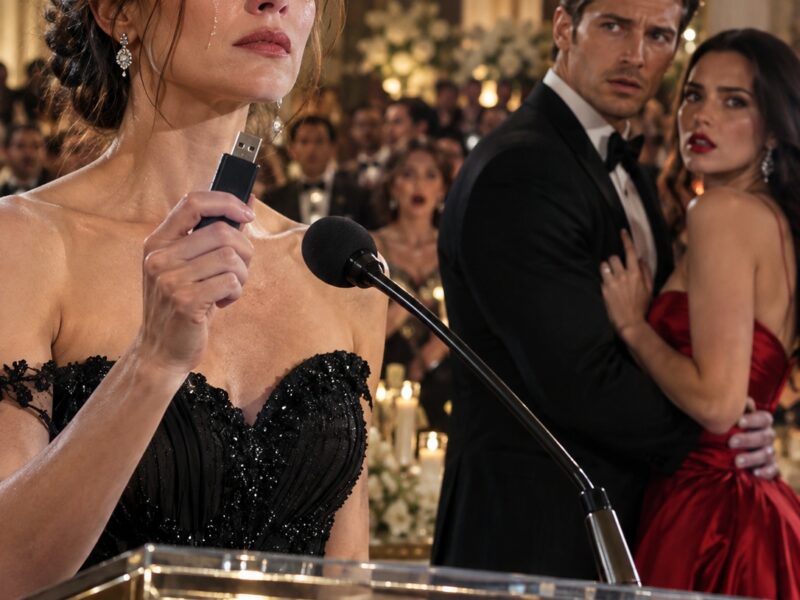
MY BILLIONAIRE HUSBAND DANCED WITH HIS MISTRESS IN FRONT OF 1,000 GUESTS—THEN I TOOK HIS MICROPHONE

The moment my husband chose his mistress for the first dance, I stopped being afraid of destroying him.
There were nearly a thousand people inside the Astoria Grand Ballroom that night—investors, senators, hedge-fund managers, journalists, philanthropists, people whose watches cost more than the house where I grew up.
Every one of them saw Arthur Penington walk past me.
Every one of them saw him extend his hand to Amelia Vance.
And every one of them knew exactly what it meant.
My husband of twenty years was not merely cheating on me.
He was announcing my replacement.
Under twelve crystal chandeliers, with an orchestra waiting and cameras recording, Arthur put his hand around the waist of a woman fifteen years younger than me and began to dance.
People looked at me.
Some with pity.
Some with embarrassment.
Some with the terrible fascination people have when they realize they’re witnessing a car crash but haven’t yet heard the impact.
I sat perfectly still.
Because inside my silver evening bag was a USB drive.
And what Arthur didn’t know was that his affair was the least devastating secret on it.
By midnight, our marriage would be over.
By sunrise, his company might not exist.
And before I walked out of that ballroom, my husband would finally remember something he’d spent fifteen years trying to make the world forget.
I had built his empire too.
And architects know exactly where the load-bearing walls are.
Three hours earlier, Arthur had kissed my cheek for the cameras.
“Smile, darling.”
That was what he said.
Not You look beautiful.
Not Are you all right?
Not even Thank you for coming.
Smile.
His hand rested lightly against my back while photographers shouted our names outside the Starlight Children’s Foundation gala.
“Arthur! Juliana! This way!”
“Mr. Penington, one more!”
“Juliana, look left!”
Flashes exploded against the December night.
I smiled.
Twenty years of marriage teaches you strange skills.
You learn which silence means exhaustion and which means resentment. You learn how your husband’s footsteps change when he’s angry. You learn how long to wait before asking about the unfamiliar perfume on his shirt.
And eventually, if you’re unlucky, you learn how to smile while standing beside a man you no longer recognize.
Arthur leaned closer.
“Could you look happier?”
I kept smiling for the cameras.
“Could you?”
His jaw tightened.
The photographers didn’t notice.
They saw exactly what Arthur wanted them to see: America’s favorite technology billionaire and his elegant wife arriving together for another evening of charitable generosity.
Arthur Penington, founder and CEO of Penington & Neverson Cybersecurity.
The visionary.
The philanthropist.
The genius who had supposedly changed the way corporate America protected its data.
And me?
I had become the decorative proof that successful men could also have successful marriages.
We stepped inside.
The ballroom glittered like something built specifically to make ordinary human problems look vulgar.
Crystal chandeliers floated over tables dressed in ivory linen. White orchids rose from silver centerpieces. Champagne moved through the room on trays held by waiters wearing white gloves.
The smell was a mixture of perfume, flowers, expensive liquor, and money.
Arthur immediately came alive.
He shook hands.
He laughed.
He remembered names.
He placed one hand on shoulders and another around elbows, making powerful people feel as though they were the only person in the room.
I had once loved watching him do that.
In the early years, Arthur’s charisma had felt like sunlight.
Now I understood it differently.
Sunlight illuminates.
Arthur’s charm concealed.
“Juliana.”
I turned.
Beatrice Evans stood beside me holding a champagne flute.
She was in her sixties, silver-haired and magnificently unimpressed by almost everyone. Her husband managed one of Manhattan’s largest private investment funds, which meant Beatrice had spent thirty years surrounded by powerful men and had developed a talent for detecting nonsense before it opened its mouth.
She kissed my cheek.
“You look stunning.”
“Thank you.”
Her eyes shifted past me.
“Your husband seems particularly energetic tonight.”
I didn’t need to turn around.
I knew what she was looking at.
Amelia Vance.
Red dress.
Dark hair.
Twenty-nine years old.
Senior strategic analyst at Penington & Neverson.
Officially.
Unofficially, she had become the reason my husband suddenly needed to attend conferences in cities where no conference appeared on the corporate calendar.
She stood near the silent-auction display laughing at something Arthur had said.
His hand rested on the small of her back.
Not long.
Perhaps two seconds.
But marriage makes you fluent in touch.
I knew Arthur’s professional touches.
I knew his social touches.
That was neither.
Beatrice took a sip of champagne.
“That’s Amelia?”
“Yes.”
“Pretty.”
“Very.”
“Ambitious.”
“Extremely.”
Beatrice glanced at me.
“Do you want me to stop talking?”
“No.”
“Good. Because I’m too old to become tactful now.”
Despite myself, I almost smiled.
She lowered her voice.
“People have noticed.”
There it was.
Not suspicion.
Confirmation.
Something tightened beneath my ribs.
“How many people?”
“Enough.”
Across the room, Amelia touched Arthur’s sleeve as she laughed.
Arthur looked at her the way he hadn’t looked at me in years.
Beatrice’s voice softened.
“I’m sorry.”
I hated those two words more than I expected.
Sorry meant people knew.
Sorry meant strangers had been whispering about my marriage while I was still trying to convince myself there might be an innocent explanation.
Sorry meant I was the last person invited to my own humiliation.
“I don’t need pity,” I said.
“I wasn’t offering pity.”
“What were you offering?”
“A witness.”
That made me look at her.
Beatrice held my gaze.
“Sometimes that’s more useful.”
Before I could answer, Arthur appeared.
“Beatrice.”
His smile was instant.
“Still terrifying Wall Street?”
“Only before lunch.”
Arthur laughed.
Then he turned to me.
“Juliana, darling. You look tense.”
“I’m fine.”
“Have champagne.”
“I don’t want champagne.”
He glanced toward the room.
“You should enjoy yourself. We worked very hard on tonight.”
We.
Arthur had attended three planning meetings.
I had chaired eleven.
But that was another habit of his—turning other people’s labor into plural pronouns.
“We’re raising money for children,” he continued. “Try not to look like you’re attending a funeral.”
I studied him.
“Maybe I am.”
His smile stopped.
Only for a second.
“What does that mean?”
“Nothing.”
Arthur searched my face.
Years ago, he would have asked again.
That night, he merely checked whether anyone important was watching.
Then his expression softened artificially.
“My speech is after the auction.”
“I know.”
“I’d like you at the head table.”
“I know.”
“And smile when they introduce me.”
There it was again.
The instruction.
I looked at him.
“Anything else?”
He frowned.
“What’s gotten into you?”
Before I could answer, someone called his name.
Arthur immediately transformed.
The irritation vanished.
The dazzling smile returned.
He touched my elbow.
“We’ll talk later.”
“No,” I said quietly.
He didn’t hear me.
Or perhaps he did and didn’t care.
I watched him disappear into the crowd.
Beatrice remained beside me.
“What was that?”
I picked up a glass of sparkling water.
“Twenty years of marriage compressed into thirty seconds.”
But even Beatrice didn’t know the whole truth.
No one did.
Not yet.
Because Arthur’s affair wasn’t the reason I’d barely slept for the previous nine nights.
The reason was sitting inside my evening bag.
A black USB drive no larger than my thumb.
I had found the first file eleven days earlier.
I hadn’t been searching for evidence of an affair.
That was the irony.
I’d been looking for old tax documents.
Arthur and I maintained a private server at our townhouse. Most of it contained family photographs, property records, investment documents and backups neither of us had opened in years.
I found a folder buried beneath archived corporate files.
CHIMERA.
Password protected.
I almost ignored it.
Then I noticed the creation date.
Three years earlier.
That mattered because three years earlier Penington & Neverson had experienced an unexplained surge in revenue.
Arthur had called it the result of aggressive expansion.
The board had celebrated him.
Financial magazines put him on covers.
Our net worth doubled.
Then doubled again.
I entered several passwords.
Nothing.
Finally, on a bitter impulse, I typed my birthday.
The folder opened.
For several seconds I simply stared at the screen.
Arthur had protected his greatest secret with the birthday of the woman he believed would never discover it.
There were shell companies.
Encrypted transfers.
Internal communications.
Client lists.
Technical diagrams.
And source code.
My source code.
I recognized it instantly.
Sentinel.
I had written the foundation of it twenty-three years earlier at a kitchen table in a one-bedroom apartment while Arthur slept beside a stack of investor rejection letters.
Back then, we had nothing.
No penthouse.
No chauffeurs.
No private aircraft.
Arthur owned two suits. I owned one laptop with a cracked corner and enough stubbornness for both of us.
He was the salesman.
I was the engineer.
It worked because neither of us pretended otherwise.
“I can get us into the room,” Arthur used to tell me.
“And I can give you something worth selling,” I would answer.
We were partners.
Then success arrived.
At first, slowly.
Then all at once.
The company grew.
Arthur became CEO.
I became pregnant with Alexander.
I stepped away from daily operations for what I thought would be a year.
One year became three.
My name moved lower on presentations.
Then disappeared from them.
Journalists began calling Arthur the sole creator of Sentinel.
He never corrected them.
The first time it happened in front of me, I waited until we got home.
“You didn’t say anything.”
Arthur loosened his tie.
“About what?”
“The reporter said you designed Sentinel.”
“So?”
“I designed Sentinel.”
He sighed.
“Juliana, nobody wants a complicated origin story.”
“Truth isn’t complicated.”
“Branding is.”
That argument should have changed everything.
Instead, I stayed.
I told myself our marriage mattered more than public credit.
I told myself Alexander needed stability.
I told myself Arthur knew the truth even if the world didn’t.
Those are the lies intelligent people tell themselves when intelligence becomes inconvenient.
Now, staring at Project Chimera two decades later, I discovered how completely Arthur had corrupted what we’d built.
Sentinel had been designed as a fortress.
Arthur had secretly inserted doors.
Backdoors.
Hidden vulnerabilities inside the security systems sold to some of America’s largest corporations.
Access points clients didn’t know existed.
And Project Chimera tracked them all.
At first I thought it might be legitimate penetration testing.
Then I found the transfers.
Cayman Islands.
Panama.
Moldova.
Money moving through shell companies with meaningless names.
I kept reading.
By dawn, my hands were shaking.
Arthur hadn’t merely compromised his own customers.
Someone was paying for access to their data.
Trade information.
Logistics.
Energy research.
Corporate strategy.
Confidential communications.
I copied everything.
Then I found Amelia’s name.
Not in love letters.
In authorization logs.
Amelia Vance.
Project lead.
Suddenly the affair looked different.
She wasn’t simply sleeping with my husband.
She was helping him run Chimera.
And Arthur wasn’t simply betraying his wife.
He was betraying everyone who had ever trusted our company.
I spent the next ten days preparing.
Quietly.
I hired Benjamin Carter, an attorney I’d known for fifteen years but whom Arthur believed I contacted only for estate planning.
I created encrypted backups.
I documented dates.
I saved emails.
I reconstructed the moment I’d first gained knowledge of Chimera.
I made sure no one could credibly accuse me of participating in it.
And that afternoon, hours before the gala, I sent an encrypted package to federal regulators with delayed credentials.
I wasn’t planning to expose Arthur publicly.
Not originally.
I intended to confront him privately after the gala.
Give him one opportunity to surrender, cooperate, and tell the truth.
Then I watched him put his hand on Amelia’s waist.
And something inside me changed.
The charity auction began at nine.
Arthur sat beside me as though nothing was wrong.
A vacation villa sold for $400,000.
A painting sold for nearly twice that.
Someone bid an obscene amount for dinner with a former president.
People applauded.
Arthur occasionally leaned toward me and whispered observations about donors.
I barely heard him.
My fingers touched the USB drive through the fabric of my bag.
“You’re very quiet,” Arthur said.
“Am I?”
“People notice.”
“People have noticed quite a lot tonight.”
His eyes narrowed.
“What is that supposed to mean?”
I turned toward him.
For perhaps the first time in years, I saw uncertainty in my husband’s face.
It lasted only a moment.
Then arrogance returned.
“Whatever mood you’re in, save it for home.”
I smiled.
“Of course.”
The auction ended.
The host walked onto the stage.
“And now, ladies and gentlemen, it is my honor to introduce the man whose extraordinary generosity has helped make tonight possible…”
Applause began.
Arthur stood.
He buttoned his tuxedo.
Then he bent toward me.
“Here we go.”
The confidence in his voice almost impressed me.
I looked up at him.
“Enjoy it.”
Arthur smiled.
“I always do.”
He walked toward the stage.
The applause grew.
For the next eleven minutes, my husband delivered the best performance of his life.
He spoke about responsibility.
Integrity.
Children.
Legacy.
“The true measure of success,” Arthur said, “isn’t what we accumulate. It’s what we protect.”
I nearly laughed.
Instead, I looked around the ballroom.
Men and women listened reverently.
Several were Chimera victims.
They simply didn’t know it yet.
Arthur continued.
“Technology must be built on trust. Without trust, innovation becomes exploitation.”
That time I did laugh.
Quietly.
Beatrice looked at me.
“Something funny?”
“You have no idea.”
Arthur reached the emotional peak of his speech.
“And none of us succeeds alone. Every great achievement begins with inspiration.”
Then he looked away from the teleprompter.
His eyes moved across the ballroom.
Past me.
Toward Amelia.
“Sometimes,” he said, smiling, “we’re fortunate enough to find someone who challenges us to become better than we thought possible.”
Silence.
People understood.
Amelia lowered her eyes.
She tried to look modest.
She failed.
The room began looking at me.
I could feel it before I saw it.
Hundreds of glances.
Arthur had done something breathtakingly cruel.
He hadn’t named Amelia.
He didn’t need to.
He’d given her a public love letter while his wife sat fifteen yards away.
For a few seconds, I thought I might break.
My throat tightened.
My vision blurred.
Twenty years.
I remembered Alexander’s birth.
Arthur sleeping beside me in a hospital chair.
Our first apartment.
Chinese takeout at two in the morning.
The day our first patent was approved and Arthur lifted me off the kitchen floor because we couldn’t stop laughing.
Somewhere along the way, that man had disappeared.
Or maybe he had never existed.
Maybe love had simply made me generous with interpretation.
Arthur finished.
The ballroom rose in applause.
He accepted it like a king receiving tribute.
Then the orchestra began.
Tradition called for the foundation chairman and his spouse to open the dance floor.
I knew the routine.
Everyone did.
Arthur descended from the stage.
He walked toward our table.
For one ridiculous second, some part of me expected him to stop in front of me.
Instead, he passed me.
The room went strangely quiet.
Arthur continued another twenty feet.
He stopped before Amelia.
Then he extended his hand.
A woman at the table behind me whispered, “Oh my God.”
Amelia glanced toward me.
That was the moment.
Not Arthur’s hand.
Not the dance.
Her look.
There was victory in it.
She believed she had won.
I felt something inside me go completely still.
Amelia placed her hand in my husband’s.
Arthur led her onto the dance floor.
The orchestra hesitated.
Then began playing.
They danced beautifully.
That hurt more than I expected.
Because people don’t move together like that by accident.
They had practiced.
Somewhere, on some evening Arthur told me he was working, my husband had been learning the steps of this dance with another woman.
His hand rested against her waist.
She leaned toward him.
He whispered something.
She laughed.
Beatrice touched my arm.
“Juliana.”
I stood.
“Don’t.”
“Where are you going?”
I picked up my evening bag.
“To stop being his wife.”
Then I walked toward the stage.
No one tried to stop me.
Maybe it was the expression on my face.
Maybe people sensed what was coming.
Arthur didn’t notice at first.
He was too busy spinning Amelia beneath the chandeliers.
I passed investors.
Board members.
Politicians.
Journalists.
People moved aside.
The event host, Michael Shaw, saw me approaching the stage.
“Mrs. Penington?”
I climbed the first step.
“Is everything okay?”
“No.”
Second step.
“Do you need something?”
“Your microphone.”
His face changed.
“Mrs. Penington, I don’t think—”
I looked at him.
“Michael.”
He stopped.
The song ended.
Scattered applause filled the ballroom.
Arthur turned.
He saw me.
And the smile disappeared from his face.
I walked to the lectern.
The microphone was still live.
Arthur’s expression changed again.
Confusion.
Then recognition.
Then fear.
That last one almost made the previous twenty years worth surviving.
I leaned toward the microphone.
“Good evening.”
My voice filled the ballroom.
The applause died.
Amelia stepped away from Arthur.
I looked directly at my husband.
“Pardon the interruption.”
Arthur began walking toward me.
“Juliana.”
I continued.
“My husband spoke beautifully tonight about inspiration, integrity and legacy.”
A few nervous laughs.
“So beautifully, in fact, that I realized something.”
Arthur stopped.
I reached into my bag.
His face went pale.
“I realized his story deserves a more complete ending.”
I placed the USB drive on the lectern.
The room became absolutely silent.
“Many of you know Arthur Penington as the founder of Penington & Neverson.”
Arthur’s voice cut across the ballroom.
“Juliana, that’s enough.”
I looked at him.
“No, Arthur.”
For the first time in twenty years, saying no to him felt effortless.
“It isn’t.”
I turned back to the audience.
“Some of you invested in his company. Some entrusted your companies’ security to it. And some of you believe Arthur personally created the Sentinel architecture that made him famous.”
I paused.
“He didn’t.”
Whispers erupted.
Arthur moved faster.
I kept speaking.
“I did.”
The room changed.
Not dramatically.
But perceptibly.
People leaned forward.
“The original Sentinel architecture was mine. Arthur sold it. I designed it. For years, I allowed history to be rewritten because I thought protecting my family mattered more than protecting my name.”
I looked toward Amelia.
“I was wrong.”
Arthur reached the foot of the stage.
“Turn off the microphone.”
Nobody moved.
He shouted toward the technicians.
“Turn it off!”
I lifted the USB drive.
“This contains an internal audit of a project called Chimera.”
Arthur froze.
That was all the confirmation the room needed.
Several people immediately took out phones.
I saw a journalist in the front row begin recording.
“Project Chimera,” I continued, “is a hidden system of backdoors installed inside Sentinel-class security products.”
A man stood.
“What?”
Another voice followed.
“Backdoors?”
“Yes.”
Arthur climbed onto the stage.
“She’s lying.”
His voice was too loud.
Too desperate.
“My wife is emotionally unstable. This is a marital issue and she is—”
“This isn’t hysteria.”
I held the drive higher.
“This is data.”
More phones appeared.
Arthur stopped.
I could see calculation racing behind his eyes.
He wanted the drive.
But now there were hundreds of cameras.
I continued.
“Chimera allowed unauthorized access to client systems. That access was monetized through shell companies and offshore accounts.”
The ballroom erupted.
Arthur lunged toward the microphone.
I stepped back.
Security moved uncertainly near the stage.
“Juliana!” he hissed. “Do you understand what you’re doing?”
“Perfectly.”
“You’ll destroy the company.”
“No.”
I stared into his eyes.
“You did that.”
Amelia had stopped moving.
Her red dress suddenly looked absurdly bright against her white face.
I turned toward her.
“And Project Chimera had a lead analyst.”
Amelia shook her head.
Very slightly.
“Don’t,” she whispered.
I heard her.
So did Arthur.
I said her name anyway.
“Amelia Vance.”
The ballroom exploded.
Someone shouted.
Another investor stood.
Reporters surged toward the stage.
Amelia stepped backward.
“No.”
Arthur turned toward her.
“Don’t say anything.”
Her eyes widened.
That command destroyed whatever loyalty remained between them.
“He told me it was testing,” Amelia said.
Arthur stared at her.
“What?”
“He told me—”
“Shut up.”
That was when everyone understood.
Not because I had convinced them.
Because Arthur had forgotten he was still surrounded by microphones.
Amelia began crying.
“He said it was contingency access.”
“Shut your mouth!”
“Arthur.”
I spoke softly.
He turned toward me.
I held up the drive.
“Would you like me to tell them about Cayman account 7345B?”
He stopped breathing.
At least it looked that way.
“Or would you prefer Panama?”
An executive near the front stood abruptly.
“Arthur, my company uses Sentinel.”
Another followed.
“So does mine.”
“What the hell did you do?”
Arthur’s face twisted.
“This is corporate sabotage!”
I stepped toward him.
“He’ll say I’m angry because he cheated.”
I gestured toward Amelia.
“And he’s right.”
The room quieted slightly.
“I am angry.”
I looked at the woman my husband had chosen to humiliate me with.
Then back at Arthur.
“But adultery doesn’t create offshore accounts.”
Silence.
“Heartbreak doesn’t create source code.”
I raised the drive.
“And jealousy doesn’t fabricate bank transfers.”
Arthur grabbed my arm.
Hard.
For the first time that evening, I saw the man beneath the billionaire.
No polish.
No charisma.
No benevolent visionary.
Just fear.
“You are destroying us,” he whispered.
The microphone caught every word.
I looked down at his hand.
Then into his eyes.
“No, Arthur.”
I pulled my arm free.
“You destroyed us a long time ago.”
Security arrived.
Real hotel security this time.
Four men approached the stage.
Arthur backed away.
I watched him look across the ballroom.
Nobody was applauding anymore.
Nobody was smiling.
The people who had spent years competing for proximity to Arthur Penington were now physically stepping away from him.
Power has strange physics.
Everyone wants to stand near it while it rises.
No one wants to be underneath it when it falls.
Amelia suddenly ran.
Her heels struck the marble floor.
People turned as she pushed through the crowd toward the ballroom doors.
Security intercepted her near the lobby.
She began sobbing.
Arthur watched.
Then looked at me.
There was hatred in his eyes.
But underneath it was something much more satisfying.
Recognition.
He finally understood who I was.
I removed the USB drive from the lectern.
A reporter named Marcus Thorne had pushed toward the stage.
I recognized him from the Times.
“Mrs. Penington!”
I stepped toward him.
“Mr. Thorne?”
“Yes.”
I handed him the drive.
His eyes widened.
“What is this?”
“A copy.”
Arthur made a strangled sound behind me.
I continued.
“The encrypted originals were sent to federal regulators and my attorney before tonight.”
Arthur stared at me.
“You planned this.”
I met his eyes.
“Not this.”
I looked toward the abandoned dance floor.
“You planned this.”
For once, he had nothing to say.
Marcus closed his fingers around the USB.
“Why give this to me?”
I thought about that.
About the apartment.
The company.
Alexander.
The patents.
The years of silence.
The woman I’d been.
The woman Arthur thought he’d successfully erased.
Then I looked at the ballroom.
“Because a fortress should protect the people inside it.”
I looked at Arthur one final time.
“Not just the king.”
The microphone went dead.
And so did Arthur Penington’s empire.
Two hours later, I stood barefoot in a hotel suite overlooking Manhattan.
My shoes were beside the sofa.
My silver gown felt like it weighed fifty pounds.
Below me, police lights flashed against wet pavement.
Benjamin Carter entered carrying his briefcase.
He removed his coat.
“The SEC has your files.”
I nodded.
“They’re moving for emergency asset freezes.”
“Good.”
“Arthur and Amelia are being questioned separately.”
I said nothing.
Ben watched me.
“Marcus Thorne published.”
I closed my eyes.
“Already?”
“Forty-three minutes ago.”
Of course.
Ben glanced at his phone.
“It’s everywhere.”
I walked toward the window.
“Alexander?”
“Still at school.”
“Has anyone contacted him?”
“The administration knows. I’ve arranged additional security.”
I swallowed.
That was the first moment the cost became real.
Not the company.
Not the houses.
Not Arthur.
My son.
“He’ll hate me.”
Ben didn’t answer immediately.
“He may hate the situation.”
“That’s not the same thing.”
“No.”
“But when you’re seventeen, it feels the same.”
I pressed my fingertips against the cold glass.
Behind me, Ben opened his briefcase.
“There’s something else.”
I turned.
“Federal prosecutors will want you as their primary witness.”
“I expected that.”
“They may also examine your role.”
“I expected that too.”
“You’re a co-founder and former board member. Arthur’s attorneys will argue you knew.”
“I didn’t.”
“Can you prove it?”
I walked toward the desk.
Opened my laptop.
Inserted another drive.
Folders appeared.
Dates.
Emails.
Internal objections.
Archived messages.
A timeline beginning with the exact day I’d discovered Chimera.
Ben stared.
“You documented everything.”
“Everything.”
“For how long?”
“Eleven days.”
He looked at me differently.
“You prepared for your own investigation before exposing his.”
“I prepared for Arthur.”
Ben almost smiled.
“There’s a difference?”
“Not much.”
For the first time that night, I sat down.
My hands began trembling.
I stared at them.
All evening they had been steady.
Now, alone in a quiet room, my body finally understood what had happened.
Twenty years were gone.
My marriage.
My home.
My identity.
Perhaps much of my fortune.
Arthur had betrayed me.
But I had pulled the pin.
That distinction mattered.
And it hurt.
Ben crouched slightly in front of me.
“Juliana.”
“I know.”
“No, I don’t think you do.”
I looked at him.
“You didn’t destroy a company tonight.”
“That’s exactly what I did.”
“You exposed one.”
“Tell that to the employees tomorrow.”
He went quiet.
Thousands of people would wake up afraid.
People who had done nothing wrong.
Secretaries.
Engineers.
Janitors.
Young programmers with mortgages and newborn babies.
Truth has collateral damage.
Anyone who says otherwise has never told a large enough truth.
“I wish there had been another way,” I whispered.
Ben nodded.
“So do I.”
“But there wasn’t.”
“No.”
I looked toward the lights of Manhattan.
“Then I can live with it.”
I wasn’t sure that was true.
But sometimes courage is merely choosing which pain you are willing to carry.
By morning, Penington & Neverson shares had lost almost eighty percent of their value.
By the next afternoon, trading was suspended.
Within forty-eight hours, the company that had taken twenty-three years to build effectively ceased to exist.
Federal investigators entered headquarters carrying boxes.
Employees left carrying their belongings.
Television crews camped outside.
The board removed Arthur as CEO in an emergency vote, though by then the gesture was almost comical.
You cannot fire a captain after the ship has already split in half.
Arthur was indicted.
So was Amelia.
The charges multiplied as investigators followed the money.
Fraud.
Conspiracy.
Unauthorized access.
Financial crimes.
Obstruction allegations.
The details filled newspapers for weeks.
Arthur responded exactly as I expected.
He blamed me.
According to his attorneys, I was unstable.
Vindictive.
Jealous.
A rejected wife who had manipulated documents to destroy a brilliant man.
Then he sued me for defamation.
Ben laughed for almost a full minute when he read the complaint.
I didn’t.
Because Arthur’s strategy was obvious.
If he couldn’t disprove the evidence, he would discredit the woman carrying it.
It was the oldest trick he’d ever used.
He had done the same thing when he erased me from the history of Sentinel.
Make the woman smaller.
Make the man larger.
Repeat until the world mistakes proportion for truth.
This time, it didn’t work.
Digital evidence has very little interest in charisma.
Amelia’s defense was different.
She claimed manipulation.
She said Arthur seduced her, controlled her and convinced her Chimera was legitimate.
Some of that may even have been true.
But her signatures were everywhere.
Investigators found messages in which she proposed new ways to monetize stolen information.
She hadn’t merely followed Arthur.
She had helped him run faster.
I felt surprisingly little hatred toward her.
That disturbed me at first.
Then I understood why.
Amelia had broken my marriage.
Arthur had broken my understanding of my life.
There was no comparison.
Six weeks after the gala, I was living in a rented house in the Hamptons.
Not because I wanted luxury.
Because Ben’s security people wanted distance.
The ocean was gray most mornings.
I liked that.
Gray didn’t pretend to be cheerful.
I spent long hours walking along the beach, listening to waves erase footprints almost as quickly as I made them.
My phone remained mostly silent.
Old friends didn’t know what to say.
Society acquaintances suddenly remembered they had never liked Arthur.
People sent flowers.
Others sent death threats.
The internet turned me into whatever it needed me to be.
Hero.
Monster.
Whistleblower.
Scorned wife.
Feminist icon.
Family destroyer.
None of those women felt like me.
I was simply tired.
The hardest calls were with Alexander.
At first, he barely spoke.
“How are you?”
“Fine.”
“School?”
“Fine.”
“Do you need anything?”
“No.”
Silence.
Then one evening he asked, “Did you know Dad would be arrested?”
“I knew it was possible.”
“And you did it anyway.”
“I told the truth anyway.”
“Same thing.”
“No.”
“It feels like the same thing.”
I didn’t argue.
“I know.”
Then he hung up.
I cried after that call.
Not elegantly.
Not silently.
I sat on the kitchen floor wearing sweatpants and cried until my throat hurt.
That was the humiliation no ballroom had seen.
Not the mistress.
Not the dance.
My son’s silence.
Three weeks later, on a cold Saturday morning, a black SUV appeared at the end of the driveway.
Alexander stepped out.
I froze.
He had grown taller.
Or perhaps scandal had made him older.
I opened the door before he reached it.
“Hi, Mom.”
“Hi.”
We stood there awkwardly.
“Can I come in?”
“Of course.”
I made tea because mothers need something to do with their hands when their children are hurting.
We sat across from each other.
Alexander stared into his cup.
“I read the indictment.”
My stomach tightened.
“All of it?”
“Most.”
“I’m sorry.”
“For what?”
“For you having to read any of it.”
He nodded.
Then he said something I wasn’t prepared for.
“Dad used my birthday.”
I stared at him.
“What?”
“The offshore account.”
His voice cracked.
“The password was my birthday.”
I closed my eyes.
Arthur had used my birthday to protect Chimera’s files.
Our son’s birthday to protect the money.
Even his crimes needed ownership marks.
“He called me,” Alexander said.
“When?”
“Last week.”
“What did he say?”
“That you did this because you were jealous.”
I remained silent.
“He said Amelia didn’t mean anything.”
A bitter laugh escaped him.
“As if that makes it better.”
“What did you tell him?”
“Nothing.”
He looked at me.
“He said you were crazy.”
My hands tightened around the mug.
“What do you believe?”
Alexander looked down.
For several seconds, he didn’t answer.
Then his eyes filled.
“I think he’s a liar.”
My heart broke.
Not because my son believed me.
Because he no longer believed his father.
“I think he used everyone,” Alexander continued. “You. Me. Everyone.”
One tear slid down his cheek.
He wiped it away angrily.
“He used to tell me I’d run the company someday.”
I moved beside him.
Alexander laughed once.
A terrible sound.
“Some legacy.”
I wrapped my arms around him.
For a second he stayed rigid.
Then he collapsed against me.
My seventeen-year-old son cried like the little boy who once climbed into my bed during thunderstorms.
I held him.
And suddenly I understood something.
I had destroyed the kingdom Arthur wanted to leave him.
Maybe that was the greatest inheritance I could give my son.
The freedom never to rule it.
Ben arrived four days later carrying another briefcase.
That usually meant trouble.
“Please tell me nobody else has committed an international felony.”
“Not that I know of.”
“Comforting.”
He sat across from me.
“The liquidation is progressing.”
“I’ve stopped reading those reports.”
“I know.”
“Then why are you here?”
“Because several former clients and executives are forming a new cybersecurity company.”
I shrugged.
“The market hates a vacuum.”
“They want you.”
I laughed.
Ben didn’t.
My smile disappeared.
“What?”
“As chief technology officer.”
“No.”
“You haven’t heard the offer.”
“I don’t need to.”
“They don’t want the Penington name.”
“Good.”
“They want yours.”
He opened his briefcase.
One document.
He placed it on the table.
At the top was a name.
JULIANA SYSTEMS.
I stared.
“No.”
“That’s their proposed name.”
“They can’t do that.”
“They’re asking permission.”
I didn’t touch the document.
Ben continued.
“They want the original architect of Sentinel. Full authority over product security. Independent ethics oversight. Public audits. Significant equity.”
“Why?”
“Because you were right.”
I looked at him sharply.
“About what?”
“Fortresses.”
For a long time, neither of us spoke.
The ocean moved beyond the windows.
Part of me wanted it.
That frightened me.
I had spent weeks telling myself I was finished with technology.
Finished with boardrooms.
Finished with companies.
But technology had never betrayed me.
Arthur had.
Building had never hurt me.
Being erased had.
Maybe abandoning the work would mean allowing him to steal one final thing.
I reached for the offer.
Then Ben said, “There’s more.”
I stopped.
His expression had changed.
“What?”
“Federal investigators found another pattern in Chimera.”
“What kind?”
“One buyer.”
I frowned.
“Arthur had dozens.”
“This one was different.”
Ben removed several pages.
“Encrypted identity. Payments routed through Moldova. Consistently above market value.”
“For what?”
“Shipping data. Energy research. Infrastructure information.”
Cold moved through me.
“Who?”
“They don’t know.”
“Arthur does.”
“Maybe.”
“What does he say?”
“Nothing useful.”
I leaned back.
Ben hesitated.
“There’s another reason I’m telling you.”
He reached inside his jacket.
Pulled out a plain envelope.
No return address.
“This came to my office.”
I opened it.
Inside was a photograph.
For a second my mind refused to understand what I was seeing.
Then it did.
Alexander and me.
Sitting on the sofa.
In this house.
The photograph had been taken through the window.
My fingers went numb.
“When?”
“Probably Saturday.”
The day Alexander came.
I turned the photograph over.
Three words had been typed on the back.
WE’RE WATCHING YOU.
The room suddenly felt exposed.
Every window.
Every shadow.
Every passing car.
“Alexander.”
“He’s safe.”
“Are you sure?”
“My people are with him.”
“That’s not what I asked.”
Ben went silent.
I stood.
Fear hit differently when it involved my son.
Arthur had frightened me.
This terrified me.
“Who are they?”
“We don’t know.”
“Are they connected to the buyer?”
“We think so.”
“They lost access because of Chimera.”
“Yes.”
“And they blame me.”
“Possibly.”
I stared at the photograph.
Six weeks earlier, I had believed Arthur was the monster at the center of the maze.
Now I understood he might only have been the greedy man who opened the door.
Something worse had been waiting behind it.
Ben pointed toward the offer.
“You don’t have to decide today.”
I looked at JULIANA SYSTEMS.
Then at the photograph.
One represented everything I had lost.
The other represented what I might still build.
Fear told me to disappear.
To change my name.
Take Alexander somewhere no one knew us.
Never write another line of security code.
Never enter another boardroom.
Never become visible again.
For years, fear had disguised itself as compromise.
I knew its voice now.
I picked up the photograph.
Folded it once.
Placed it inside the envelope.
Then I picked up the contract.
“Call them.”
Ben stared at me.
“What?”
“Tell them I’m interested.”
“Juliana—”
“I have conditions.”
A faint smile appeared on his face.
“Naturally.”
“The company doesn’t carry my name.”
“Why?”
“Because we’re building security, not a monument.”
He nodded.
“What else?”
“Independent audits. No founder override. No hidden administrative access. Nobody—not even me—gets a master key.”
Ben took notes.
“And?”
I looked at the photograph again.
“Our first priority is tracing every vulnerability Chimera created.”
“That’s going to take time.”
“I have time.”
“And the people behind this?”
“We give everything we find to federal investigators.”
Ben studied me.
“You’re not thinking of going after them yourself?”
“No.”
I looked toward the ocean.
“I’m an engineer, Ben. Not an action hero.”
He laughed softly.
It was the first uncomplicated sound I’d heard in weeks.
“But I can build systems that make hiding much harder.”
He closed the briefcase.
“So you’re coming back.”
I considered the phrase.
Coming back.
No.
The woman who had entered the Astoria ballroom wasn’t coming back.
She had spent too many years protecting the appearance of a marriage while disappearing inside it.
She had let someone else tell the story of her work.
She had mistaken endurance for loyalty.
I looked at my reflection in the window.
No diamonds.
No couture.
No billionaire husband beside me.
Just a forty-eight-year-old woman in jeans and a sweater, holding a contract she hadn’t expected to want.
For the first time, I recognized her.
“I’m not coming back,” I said.
Ben waited.
“I’m starting again.”
Months later, I drove past the old Penington & Neverson headquarters.
I hadn’t planned to.
Traffic rerouted me.
The logo had been removed.
Only pale marks remained on the glass where the letters had once been.
I remembered the first time Arthur and I saw that building.
We had stood on the sidewalk holding coffee.
He pointed toward the top floors.
“Someday.”
I laughed.
“You don’t even know what you’re pointing at.”
“Our future.”
Back then, his ambition had thrilled me.
I didn’t know ambition could become hunger.
Didn’t know hunger could become entitlement.
Didn’t know a man could spend years building a throne and eventually forget the person who poured the foundation beneath it.
The light changed.
Cars moved.
I stayed still for one extra second.
Then someone behind me honked.
I drove on.
Arthur’s criminal case would take years.
Amelia eventually began cooperating with prosecutors.
The company was gone.
Our divorce was moving quietly through court.
Alexander transferred schools.
He started seeing a therapist, something Arthur would once have mocked and I now considered one of the bravest things my son had ever done.
My new company opened in a modest office downtown.
No marble lobby.
No private elevator.
No founder portraits.
The first day, I arrived before everyone else.
The office smelled like new carpet and coffee.
I walked into the engineering room.
Rows of empty desks.
Whiteboards.
Monitors waiting to wake.
For a while I simply stood there.
Then I sat at one of the computers.
The screen illuminated my face.
A blank development environment opened.
A cursor blinked.
Twenty-three years earlier, another cursor had blinked in a tiny apartment while Arthur slept beside investor rejection letters.
Back then, I had believed we were building something together.
Perhaps we had been.
For a while.
Not every beautiful beginning is a lie simply because the ending becomes ugly.
That was the hardest lesson.
I didn’t need to erase the woman who loved Arthur in order to survive the man he became.
She wasn’t stupid.
She wasn’t weak.
She had simply believed someone she loved.
And when belief finally became impossible, she chose truth.
I placed my hands on the keyboard.
Outside, Manhattan was waking.
Thousands of windows caught the morning light.
Somewhere behind one of them, Arthur was probably meeting lawyers.
Somewhere else, investigators were still tracing Chimera.
Somewhere at school, Alexander was trying to learn how to carry a surname that had become a headline.
None of it was clean.
Justice rarely is.
There was no triumphant ending in which betrayal stopped hurting because the guilty people suffered.
I still woke some nights remembering Arthur dancing with Amelia.
Sometimes I remembered his face when I said Chimera.
Sometimes I remembered something worse:
Arthur at twenty-seven, standing in our kitchen, holding a bottle of cheap champagne because we’d received our first investment.
He had looked at me then as if I were the only person in the world.
Maybe he had loved me.
Maybe power changed him.
Maybe it simply gave him permission to become more completely himself.
I would probably spend the rest of my life wondering.
But I no longer needed the answer.
The cursor kept blinking.
Waiting.
I began typing.
Line after line appeared.
No secret doors.
No hidden keys.
No lies disguised as protection.
Just architecture.
Mine.
An hour later, sunlight filled the office.
I stopped and looked at the code.
For years, Arthur had made me believe losing him would mean losing the life we’d built.
He had been wrong.
The houses were never the life.
The company wasn’t the life.
The galas, the headlines, the private planes, the photographs, the diamonds—none of them were the life.
They were scenery.
My life had been inside me the entire time.
The intelligence I had quieted.
The instincts I had doubted.
The work I had surrendered.
The voice I had lowered so someone else’s could sound larger.
That was what I reclaimed the night I walked onto Arthur’s stage.
Not his company.
Not revenge.
Myself.
I sometimes think about that ballroom.
About the thousand people watching Arthur dance with Amelia.
About the pity in their faces when they looked at me.
They believed they were watching a wife being publicly discarded.
They had no idea what was actually happening.
Neither did Arthur.
He thought he was choosing another woman.
He thought he was demonstrating power.
He thought the woman sitting silently at the head table had finally become irrelevant.
But while he danced beneath those chandeliers, I had already made the most important decision of my life.
I would rather lose an empire than spend another day living inside someone else’s lie.
Arthur believed that night ended our marriage.
It didn’t.
Our marriage had ended quietly years before, one erased credit, one whispered phone call, one locked door, one lie at a time.
What ended that night was my silence.
And sometimes, late in the office when everyone else has gone home, I look through the windows at Manhattan and remember the sound the ballroom made when I said the words Project Chimera.
It wasn’t screaming.
Not at first.
It was silence.
One enormous breath held by a thousand people as a carefully constructed world began to crack.
Arthur spent twenty years building himself a throne.
He surrounded it with glass, money, admiration and lies.
And he believed those things made him untouchable.
What he forgot was very simple.
Before there was a king—
there was an architect.









