
MY BILLIONAIRE MOTHER-IN-LAW ASKED WHAT I COULD POSSIBLY BRING TO HER FAMILY—THEN HER HUSBAND PUT MY NUMBERS ON THE BOARDROOM SCREEN
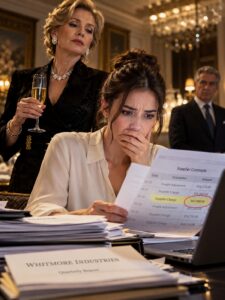
The first time Diane Whitmore asked what I brought to her family besides her son’s affection, she did it over a twelve-thousand-dollar dining table with fourteen people listening.
Nobody defended me quickly enough to stop the silence.
Not even my husband.
And that silence told me something I would remember long after the champagne glasses were cleared away.
The Whitmores didn’t think I belonged in their world.
They thought Julian had married beneath him.
What they didn’t know was that less than a year later, Richard Whitmore would stand in front of the company’s board of directors, put my work on a forty-foot screen, and tell a room full of executives that I had found nearly two million dollars they had somehow failed to notice was disappearing.
But that night, I was still just Mia.
The outsider.
The mistake their son had married.
And Diane Whitmore was raising her champagne glass.
“To my son Julian,” she said, smiling beneath the chandelier, “and his surprising choice.”
A few people laughed softly.
Not enough for anyone to call it laughter.
Just enough for me to know they understood exactly what she meant.
I looked down at the champagne in my glass.
Across the table, Julian’s shoulders tightened.
“Mom.”
“Let me finish.”
Diane didn’t look at him.
Her eyes stayed on me.
She was beautiful in the polished, expensive way some women become when money has spent decades protecting them from inconvenience. Her silver-blond hair sat perfectly above a diamond necklace that probably cost more than the house where I grew up.
“We always imagined Julian marrying someone from our world,” she continued. “Instead, he found someone from a much smaller one.”
Another silence.
This one hurt more.
Because nobody laughed.
They didn’t need to.
I could feel the agreement moving around the table.
I had been married to Julian Whitmore for six weeks.
Six weeks of learning which fork belonged to which course.
Six weeks of pretending not to notice when his sister Paige introduced me as “Julian’s wife” instead of using my name.
Six weeks of conversations that stopped when I walked into rooms.
Six weeks of smiling through questions that weren’t really questions.
Where did you grow up?
Did your parents attend college?
Had you traveled much before meeting Julian?
Wasn’t it overwhelming suddenly being around “all this”?
Every question carried the same hidden sentence.
You aren’t one of us.
That evening, I decided I wasn’t going to flinch.
Diane finally turned her smile toward me.
“Mia, dear, I do hope you’ll learn to keep up with us.”
I set my glass down.
“Thank you for the warm welcome, Diane.”
Her eyebrow lifted slightly.
“I intend to.”
Julian nearly smiled.
His father’s reaction was different.
Richard Whitmore had barely spoken all evening, but his eyes moved toward me.
Not amused.
Not offended.
Interested.
I didn’t understand why yet.
Later, I would.
At that moment, however, Diane simply moved on to another conversation as if she hadn’t just cut me open in front of her family.
That was something I would learn about wealthy people.
Cruelty sounded different when spoken softly.
Sometimes it came wrapped in manners.
Sometimes it arrived with champagne.
And sometimes everyone around you pretended it wasn’t cruelty because acknowledging it would ruin dinner.
I survived the rest of the evening.
That became my private victory.
Not because I wasn’t hurt.
I was.
But I had spent too much of my life learning how not to let embarrassment decide who I became.
My mother had raised me above a diner in a town where everybody knew everybody else’s business before breakfast.
We didn’t have much money.
We had something better.
Expectations.
My mother expected me to work.
Expected me to study.
Expected me to look people in the eye.
Expected me never to confuse wealth with intelligence or poverty with failure.
By seventeen, I could carry six plates at once while calculating tips in my head.
By eighteen, I knew which regulars were going to order before they sat down.
By nineteen, I understood something I would later use in finance without realizing where I’d learned it.
Patterns mattered.
People repeated themselves.
So did numbers.
The only difference was that numbers couldn’t smile while lying to you.
After dinner, Julian found me standing alone on the rear terrace of his parents’ estate.
The autumn air was cold enough to sting.
He closed the French doors behind him.
“I’m sorry.”
I kept looking across the lawn.
“For what?”
“You know what.”
“Do I?”
“Mia.”
I turned.
Julian looked miserable.
I loved him enough that part of me wanted to make his discomfort disappear.
But marriage had already taught me that rescuing someone from an uncomfortable truth only guarantees you’ll have to face that truth again later.
“Your mother insulted me in front of everyone.”
“I know.”
“And you said her name.”
He looked confused.
“What?”
“You said, ‘Mom.'”
“I was trying to stop her.”
“No. You were warning her.”
“What’s the difference?”
“The difference is whether you were protecting me or trying to prevent her from embarrassing herself.”
His expression changed.
I hadn’t planned that sentence.
Maybe that was why it landed so hard.
“Mia, I chose you.”
“I know.”
“I married you.”
“I know that too.”
“Then what are we talking about?”
I looked through the glass doors.
Inside, Diane was laughing with Paige.
Richard stood near the fireplace speaking to two men from Whitmore Industries.
“This isn’t about whether you chose me,” I said. “It’s about whether I’m expected to spend the rest of my life being grateful you did.”
Julian said nothing.
I softened.
“I don’t need them to love me.”
“They will.”
“Maybe.”
“They just need time.”
I nodded.
“Then give them time.”
He reached for my hand.
“They’re not used to anyone who isn’t like them.”
That sentence bothered me more than he intended.
I pulled my coat tighter.
“I’m not asking them to change who they are.”
“I know.”
“I just wish they’d give me the same chance.”
Julian squeezed my fingers.
“You’ll have mine every day.”
I wanted to believe that would be enough.
For a while, it was.
But belonging is strange.
You can be loved by one person in a room and still feel rejected by everyone else in it.
The Whitmore family had traditions.
Sunday brunch.
Quarterly charity dinners.
Christmas in Aspen.
Summer weekends in Nantucket.
Foundation galas where everyone seemed to know where to stand, whom to greet and exactly how long to maintain eye contact before moving on.
I learned.
Quietly.
Not because Diane told me to “keep up.”
Because observing was something I’d always been good at.
I learned that Richard hated small talk but loved baseball.
I learned that Paige checked her phone whenever she felt insecure.
I learned that Julian’s uncle Robert drank sparkling water at dinner because he’d quietly stopped drinking alcohol years earlier and didn’t want anyone making a ceremony of it.
And I learned that Diane remembered every social slight anyone had ever given her but often forgot kindness within minutes.
Two months after the dinner, I asked Paige to lunch.
We were standing in the Whitmore kitchen while she waited for an espresso.
“I was hoping we could get to know each other,” I said.
She looked at me as if I’d suggested a weekend camping trip.
“Sure. Whenever.”
“Maybe lunch this week?”
“I’m very busy, actually.”
The espresso machine hissed between us.
“Another time, then.”
“Definitely.”
We both knew there wouldn’t be another time.
She picked up her cup.
I stepped aside.
“Have a good day, Paige.”
“You too.”
She made it three steps before turning.
“Mia?”
“Yeah?”
“For what it’s worth, don’t try so hard.”
I stared at her.
“I’m not.”
She smiled sympathetically.
That was somehow worse.
Then she left.
That afternoon, I cried in the shower.
Not dramatically.
No collapsing against the tiles.
No screaming.
I simply stood beneath the water and let myself admit something I hadn’t wanted to admit.
They were getting to me.
Not because I believed them.
Because I was starting to wonder how long I could keep proving I didn’t care.
When I came downstairs, Julian was sitting on the edge of our bed.
He took one look at me.
“Paige?”
I laughed despite myself.
“How did you know?”
“Because my sister has the emotional subtlety of a tax audit.”
I sat beside him.
“You don’t have to prove anything to her.”
“I’m not.”
“Then who?”
That question stayed with me.
Because I knew the answer.
“For me.”
Julian frowned.
“I spent four years studying something I was good at. I worked for that scholarship. I worked nights. I graduated near the top of my program. And since marrying you, I’ve somehow allowed everyone to reduce my entire identity to your wife.”
“I don’t see you that way.”
“I know.”
I looked toward the hallway.
“But I’m beginning to see myself through their eyes.”
That scared me.
So I changed something.
I stopped trying to make Diane like me.
I stopped chasing Paige.
I stopped measuring my success by whether anyone invited me into conversations.
And instead, I went back to something I understood.
Work.
It happened almost accidentally.
Richard kept business reports in the study at the family estate.
I noticed them one afternoon while waiting for Julian.
The first report sat open beside a yellow legal pad.
I didn’t touch it.
Not then.
But numbers have always pulled at my attention the way music attracts musicians.
Something on the page looked strange.
Three days later, I saw another report.
Then another.
Eventually I asked Richard directly.
“Would you mind if I looked at these?”
He glanced up from his newspaper.
“Why?”
“Because something in the supply expenses looks inconsistent.”
That got his attention.
“You noticed that from walking past the desk?”
“Mostly.”
“Mostly?”
“I might have stared at it for thirty seconds.”
Richard smiled.
“Knock yourself out.”
I thought he was joking.
He wasn’t.
For the next several evenings, I sat in that study with a calculator, notebook and eighteen months of reports.
I didn’t know what I was searching for.
That was important.
People often miss problems because they begin by deciding what the problem should look like.
I wasn’t looking for fraud.
I wasn’t looking for incompetence.
I was looking for patterns.
Small ones.
The kind people ignore.
A freight surcharge that had risen by 0.8 percent.
A materials handling fee that appeared under two slightly different names.
A warehouse adjustment that repeated every third invoice.
Individually, nothing looked alarming.
Together, they formed a rhythm.
I pulled older invoices.
Compared vendor numbers.
Cross-referenced contracts.
Then I found it.
I checked again.
And again.
My stomach tightened.
Julian walked into the study at nearly eleven that night carrying two mugs.
“You’ve been in here for four hours.”
“I know.”
“Should I be worried?”
“Maybe.”
He put a mug beside me.
“About our marriage or my father’s company?”
“Your father’s company.”
“That’s slightly better.”
I turned the laptop toward him.
“Look.”
He stared at the spreadsheet.
“You know I work in development, right?”
“Column G.”
He leaned closer.
“Okay.”
“Now compare it with the contracted supply rate.”
He did.
His smile disappeared.
“What am I looking at?”
“Overbilling.”
“How much?”
“I don’t know yet.”
“Mia.”
“I need the full contract history.”
“How bad?”
I looked at him.
“Bad enough that I don’t think your father knows.”
The next morning, Richard joined us in the study.
He closed the door.
“Mia asked to check the supply contracts,” Julian explained. “I let her access the older reports.”
Richard looked at me.
“And?”
I pushed a folder toward him.
“The main supplier has been charging Whitmore Industries above the contracted rate for approximately eighteen months.”
His face remained expressionless.
“How?”
“Not one large charge. Small ones.”
I showed him.
“Freight adjustments. Handling costs. Storage fees. Several charges have been renamed periodically, probably because repeated identical entries are easier for automated systems to flag.”
Richard stopped turning pages.
“Probably?”
“I can’t tell you intent without more information.”
That answer seemed to please him.
I wasn’t accusing anyone.
I was telling him what the numbers showed.
He pointed to the total.
“How much?”
I swallowed.
“Based on the records I’ve reviewed?”
“Yes.”
“Just under two million dollars.”
Richard leaned back.
Julian stared at me.
For several seconds, the only sound in the room was the antique clock above the fireplace.
Then Richard asked a question I hadn’t expected.
“Can you prove it?”
I looked directly at him.
“Give me forty-eight hours.”
He smiled.
“Take twenty-four.”
I didn’t sleep much.
By the following afternoon, I had invoice comparisons, contract language, payment records and a clean timeline.
Richard studied everything.
He called two senior finance employees.
They checked my work.
Then three.
Nobody found a mistake.
That evening, Richard asked me to stay after everyone else had left.
“I’d like to bring you on formally.”
I thought I’d misheard him.
“To do what?”
“Review our contracts.”
“Richard—”
“Paid.”
I smiled nervously.
“I assumed that.”
“Good.”
He leaned back.
“You don’t look happy.”
“I am.”
“But?”
I looked through the study windows.
Diane’s roses lined the garden outside.
“I don’t want charity.”
His expression hardened slightly.
“This isn’t charity.”
“I’m your son’s wife.”
“And?”
“If you hire me, everyone will assume that’s why.”
“Let them.”
“I won’t.”
Richard watched me carefully.
Then I said the thing I had been thinking since that first dinner.
“If I work for Whitmore Industries, I want the same standards everyone else gets.”
“You might get higher standards.”
“Fine.”
“No protection from Julian.”
“Good.”
“No family exceptions.”
“Exactly.”
Richard folded his hands.
“You just identified almost two million dollars in losses.”
He paused.
“That’s not charity, Mia.”
I said nothing.
“That’s talent.”
For the first time since marrying Julian, someone in his family wasn’t asking what I brought to their world.
He was asking how much responsibility I could handle inside it.
I accepted.
Quietly.
That decision changed everything.
And almost immediately, it made things worse.
Because proving someone underestimated you doesn’t always make them respect you.
Sometimes it makes them resent you.
Paige found me in the kitchen several days later.
“Well, look who’s here.”
I glanced up.
“I live here sometimes.”
She smiled.
“I heard Dad gave you a job.”
“He hired me for a contract review.”
“Of course.”
Something in her tone made me close the folder.
“Meaning?”
“Nothing.”
“Paige.”
She opened the refrigerator.
“I just think it’s impressive.”
“What is?”
“How quickly some people manage to find their way into the most exclusive circles.”
There it was.
Again.
Only this time, something inside me had changed.
Maybe it was because I finally had work that reminded me who I was.
Maybe I was simply tired.
I stood.
“You’re right.”
Paige looked surprised.
“I am?”
“Your family is incredibly exclusive.”
I picked up my folder.
“But numbers aren’t.”
Her smile faded.
“They don’t care where I grew up. They don’t care where I went to school. They don’t care who I married.”
I walked toward the door.
“They’re either right or they’re wrong.”
Paige folded her arms.
“You’re always so earnest, Mia.”
“I try to be.”
I left her standing there.
What Paige didn’t know was that her father had already given me access to several additional contracts.
And the first problem wasn’t the last.
I found another discrepancy four days later.
Then a third.
Then a fourth.
None was as large as the original supplier issue, but together they exposed something more dangerous than one dishonest vendor.
Whitmore Industries had grown faster than its internal controls.
Departments assumed other departments were checking things.
Managers approved systems they’d inherited.
Software flagged obvious abnormalities while tiny inconsistencies slipped through.
Everyone trusted the process.
Nobody was questioning it.
I did.
Not because I was smarter than everyone.
Because I had no emotional attachment to how things had always been done.
One Friday evening, Richard walked into the conference room where I’d been working.
“You found three more problems this week.”
I looked up.
“Two problems and one inefficient renewal clause.”
“Collins calls it a problem.”
“Mr. Collins is dramatic.”
Richard laughed.
That was the first time I’d heard him laugh at work.
“You really know what to look for.”
“I take my time.”
“That’s all?”
“Mostly.”
He glanced at the spreadsheets.
“Numbers tell the truth when people check them carefully.”
Richard nodded.
Then he dropped an envelope on the table.
“Board meeting. Next month.”
I stared at it.
“What about it?”
“You’re presenting.”
I laughed.
He didn’t.
“The full board?”
“And several investors.”
My stomach dropped.
“Richard.”
“You found the problems.”
“Your financial officers should present them.”
“They didn’t find them.”
I looked at the envelope again.
“I’ve never presented to a corporate board.”
“You’d never found two million dollars for one either.”
“That’s different.”
“Not to me.”
I opened the envelope.
My name was printed on the agenda.
MIA WHITMORE — CONTRACT COMPLIANCE REVIEW.
Seeing the surname made me uncomfortable.
Richard noticed.
“What’s wrong?”
“I don’t want them thinking—”
“I know.”
He interrupted me gently.
“You’ve spent months worrying about people believing you got opportunities because you’re Julian’s wife.”
“Because they will.”
“Some will.”
He leaned toward me.
“So give them a reason to stop.”
The board meeting arrived faster than I wanted.
That morning, I changed outfits three times.
Not because the clothes were wrong.
Because I felt wrong inside them.
Julian leaned against the bedroom door.
“The navy suit.”
“You said the gray one five minutes ago.”
“I was young and foolish.”
I almost smiled.
“What if I freeze?”
“You won’t.”
“What if someone asks something I don’t know?”
“Say you don’t know.”
“What if they think I’m only there because of your father?”
He walked toward me.
“Some of them probably will.”
I stared at him.
“Fantastic pep talk.”
“I’m serious.”
He adjusted my collar.
“You can’t control what they think when you walk in.”
His hands rested on my shoulders.
“You can control what they think when you walk out.”
That stayed with me.
The boardroom occupied the forty-second floor of Whitmore Industries’ headquarters.
Glass walls.
Walnut table.
City skyline.
Twenty-two people who collectively controlled more money than everyone in my hometown would probably earn in generations.
I entered carrying my laptop.
A few people smiled politely.
Others looked confused.
One man whispered something to another.
I knew that expression.
Julian’s wife.
Richard entered last.
Everyone settled.
He didn’t begin with quarterly performance.
He didn’t begin with projections.
Instead, he stood at the head of the table.
“Before we start, I want everyone to meet the person who identified nearly two million dollars in unnecessary supplier charges that our existing review process missed.”
Every face turned toward me.
My pulse hammered.
Richard continued.
“My daughter-in-law, Mia Whitmore.”
There it was.
The label I’d spent months fearing.
Daughter-in-law.
Then Richard added:
“She’s here today because of the first part of that sentence, not the second.”
The room went silent.
Something inside me steadied.
I stood.
“Thank you, Richard.”
The first slide appeared.
“I’ll keep this simple and focus on the numbers.”
Twenty minutes later, nobody cared who I’d married.
They cared about column G.
They cared about freight charges.
They cared about renewal clauses.
They cared about why an automated review system had failed to identify repeated discrepancies.
A board member named Charles Bennett interrupted me.
“How did you find what our team missed?”
Months earlier, that question might have intimidated me.
Now I knew the answer.
“I checked every line.”
He frowned.
“Surely our team did that.”
“No.”
The room changed.
I clicked to another slide.
“They checked exceptions.”
I pointed toward the data.
“I checked assumptions.”
Silence.
“There’s a difference.”
Charles leaned forward.
“Explain.”
“Most financial controls are designed to identify unusual activity. Large deviations. Sudden spikes. Duplicate payments. Things that look wrong.”
I clicked again.
“This didn’t look wrong.”
Rows of numbers appeared.
“It looked normal.”
Another click.
Then the pattern appeared.
“The supplier didn’t create one obvious discrepancy. The overcharges were distributed across routine categories.”
Someone near the far end murmured, “Jesus.”
I continued.
“This is where they started.”
Another slide.
“This is how they evolved.”
Another.
“And this is the system I recommend implementing so they can’t disappear inside normal reporting again.”
Nobody interrupted.
When I finished, Charles Bennett closed his folder.
“This is excellent work.”
“Thank you.”
“What do you want?”
The question surprised me.
“Excuse me?”
“Budget? Team? Authority?”
I looked at Richard.
He didn’t help me.
He wanted me to answer.
“I want the new checking system implemented permanently.”
Charles waited.
“That’s it?”
“That’s why I’m here.”
He smiled.
“Agreed.”
The motion passed.
Unanimously.
Afterward, people came to shake my hand.
Not Julian’s wife’s hand.
Mine.
One of the senior analysts stopped me near the elevator.
“Mia.”
I turned.
He looked uncomfortable.
“I owe you an apology.”
“You don’t.”
“I do.”
He glanced toward the boardroom.
“When Richard said his daughter-in-law had reviewed the contracts, I assumed…”
He didn’t finish.
“You assumed exactly what everyone else assumed.”
He nodded.
“I shouldn’t have.”
“You don’t need to make it up to me.”
He looked relieved.
“Just treat me with the same respect you’d give anyone else doing the work.”
He held out his hand.
“Deal.”
I shook it.
When the elevator doors closed, I finally exhaled.
I thought that was the moment everything would change.
I was wrong.
Because the person whose opinion had hurt me most still hadn’t changed hers.
Diane knew about the board meeting.
She knew about the recovered money.
She knew Richard had hired me.
Yet she said nothing.
Not for days.
Then one Sunday evening, I walked into the library and heard my name.
I stopped outside.
Richard was speaking.
“Mia found a serious problem in our supply contracts.”
Diane answered.
“Yes, you’ve mentioned it.”
“No. You haven’t listened.”
A pause.
“Richard—”
“She found it.”
“I understand.”
“Do you?”
His voice sharpened.
“Our finance team missed it. She didn’t.”
I should have walked away.
Instead, I stood perfectly still.
Diane sighed.
“I didn’t expect that.”
“You should have.”
Another silence.
“She studied finance.”
“At a community college.”
“And then earned a full scholarship to a state university.”
Diane didn’t respond.
Richard continued.
“You never took the time to know her.”
“That’s unfair.”
“Is it?”
“She came into this family very quickly.”
“She married our son.”
“Exactly.”
“What does that mean?”
Diane lowered her voice.
I couldn’t hear the answer.
Then Richard said something that made my throat tighten.
“You’ve judged her for months, Diane.”
Silence.
“She’s proven herself every time.”
I walked away before they knew I’d been listening.
That night, Diane didn’t mention the conversation.
Neither did I.
Three days later, she called me.
Not texted.
Called.
“Mia?”
“Hi, Diane.”
“Are you busy?”
I nearly laughed.
For months, I had been the one asking that question.
“Not particularly.”
“I wondered if you’d like to have lunch.”
I stared at my phone.
“When?”
“Thursday.”
“Sure.”
She hesitated.
“There’s a little place near the museum.”
“I know it.”
Another pause.
“Good.”
Lunch was awkward.
Not cruel.
Not warm.
Awkward.
Which, strangely, felt like progress.
Diane spent several minutes discussing the restaurant.
Then flowers.
Then traffic.
Finally, she put down her fork.
“I’d like to know more about your hometown.”
I looked at her.
“Genuinely this time.”
That mattered.
So I answered.
“It’s small.”
“How small?”
“Small enough that if you get pulled over for speeding, your mother knows before you get home.”
Diane laughed.
A real laugh.
“My mother still runs the diner where I worked.”
“The one where you learned to read people?”
I stared at her.
“You remembered?”
Her expression shifted.
“I do listen sometimes.”
“Could’ve fooled me.”
The words escaped before I could stop them.
For one terrible second, neither of us moved.
Then Diane laughed again.
I did too.
The tension broke.
“I should have asked these questions a year ago,” she said.
I waited.
“Instead of assuming I already knew the answers.”
There are apologies people make because they’ve been caught.
There are apologies people make because they want forgiveness.
And then there are rare apologies that contain no defense.
Diane’s finally did.
“I was wrong about you.”
I looked down at my coffee.
“I’m not asking you to say it’s okay.”
“It wasn’t.”
“I know.”
She absorbed that.
Then nodded.
“I don’t know why I behaved that way.”
“I do.”
Her eyes lifted.
“You thought where I came from told you where I belonged.”
That hurt her.
I could see it.
Good.
Truth should occasionally hurt.
Diane touched the stem of her water glass.
“Perhaps I did.”
I leaned back.
“It’s never too late to ask better questions.”
“No.”
She gave me a small smile.
“I suppose it isn’t.”
Our relationship didn’t transform over lunch.
That would’ve been too easy.
Diane didn’t suddenly become another person.
Neither did I.
Trust arrived in smaller pieces.
She started asking about my work.
I stopped assuming every question contained an insult.
At family dinners, she occasionally asked my opinion and actually waited for the answer.
Then something happened I never expected.
Paige approached me.
We were at another family event, nearly one year after the dinner where Diane had toasted Julian’s “surprising choice.”
I was sitting alone for a moment when Paige appeared beside me.
“Can I sit?”
I looked at the empty chair.
“Of course.”
She sat.
Her hands folded tightly in her lap.
That wasn’t like Paige.
“I know I haven’t exactly earned this conversation.”
I waited.
She stared toward the lawn.
“I said some things.”
“Several.”
She winced.
“Fair.”
I almost smiled.
“That first lunch invitation…”
“The one you rejected?”
“Yes.”
“I remember.”
“I’m not proud of how I treated you.”
She finally looked at me.
“I thought you wanted something from us.”
“I did.”
Her expression tightened.
“What?”
“A chance.”
She looked away.
I continued.
“That’s all I ever wanted.”
“I’m sorry.”
This time, I believed her.
Not because her apology was eloquent.
Because it wasn’t.
It was uncomfortable.
Imperfect.
Human.
“Apology accepted.”
Paige exhaled.
I picked up my water.
“That lunch offer still stands.”
She blinked.
“Seriously?”
“Sure.”
“I’d like that.”
“Thursday?”
She smiled.
“Thursday.”
For almost a year, I’d imagined acceptance would feel like winning.
It didn’t.
It felt quieter.
Like finally setting down something heavy you hadn’t realized you were still carrying.
But my professional life was moving much faster.
The compliance system I proposed became permanent.
Then Richard asked me to oversee a small review team.
I resisted.
He insisted.
Six months later, the department expanded.
I learned management the same way I’d learned everything else.
Slowly.
Carefully.
By paying attention.
I made mistakes.
Real ones.
Once I delayed a vendor transition because I underestimated how badly one warehouse depended on the old ordering system.
It cost the company nine days.
I expected Richard to rescue me.
He didn’t.
He made me explain it to the operations committee myself.
I hated him for approximately forty-eight hours.
Then I understood.
He was giving me exactly what I’d asked for.
No special treatment.
So I stood in front of the committee.
“This was my mistake.”
Nobody expected those words.
Maybe that was why the room became so quiet.
“I prioritized financial efficiency over operational transition time. I was wrong.”
I presented the correction.
Then stayed until nearly midnight helping implement it.
Months later, Charles Bennett reminded me of that meeting.
“Do you know when I decided you were management material?”
“The board presentation?”
“No.”
“The compliance rollout?”
“No.”
“When?”
“When you walked into a room full of executives and said, ‘This was my mistake.'”
I remembered that.
Because it taught me something else.
Belonging wasn’t being perfect.
It was being trusted enough to fail honestly.
Two years after I first opened Richard’s supply reports, he called me into his office.
Mr. Collins was there.
So was the head of human resources.
I stopped at the door.
“Am I being fired?”
Collins laughed.
“That’s one way to begin.”
“Nobody schedules HR for good news.”
Richard pointed toward a chair.
“Sit.”
I did.
Collins slid a folder toward me.
“The board made a decision.”
I opened it.
My eyes stopped at the title.
DIRECTOR OF FINANCIAL OVERSIGHT.
I looked up.
“But that’s your position.”
“Was.”
“What?”
“I’m moving into strategic operations.”
I looked at Richard.
He was smiling.
“Collins recommended you.”
I turned back.
“Why?”
Collins seemed offended.
“Because you’re qualified.”
“I know, but—”
He laughed.
“Mia, someday you’re going to have to stop being surprised when people recognize you’re good at this.”
My eyes burned.
I hated that.
Crying in corporate offices felt deeply inconvenient.
“I don’t know what to say.”
Richard answered.
“Say yes.”
I stared at the folder.
I thought about my mother pouring coffee in that little diner.
I thought about textbooks spread across a table after midnight.
I thought about scholarship applications.
The jobs I’d worked.
The first Whitmore dinner.
Diane’s champagne glass.
Someone from a much smaller world.
I looked at Richard.
“You really think I’m ready?”
“No.”
My heart dropped.
He smiled.
“I know you are.”
I laughed through the tears.
“Then yes.”
Collins stood and offered his hand.
“Congratulations, Director Whitmore.”
I shook it.
Then paused.
“Actually…”
All three men looked at me.
“I’d like my professional records to use Mia Bennett.”
Bennett was my maiden name.
Richard’s eyebrows rose.
“Any particular reason?”
I smiled.
“Whitmore is my family.”
I touched the folder.
“But Bennett earned this.”
Richard smiled slowly.
“Fair enough.”
That evening, I called my mother.
She answered from the diner.
I could hear dishes clattering behind her.
“Baby?”
“Are you busy?”
“Honey, I’ve been busy since 1987. What’s wrong?”
I laughed.
“Nothing.”
I told her.
For several seconds, she didn’t speak.
“Mom?”
“I’m here.”
“Say something.”
“Director?”
“Yes.”
“Like a boss?”
“Basically.”
She shouted so loudly I had to pull the phone away.
Someone in the diner cheered.
Then someone else.
Within thirty seconds, apparently half my hometown knew.
Exactly as expected.
My mother came back on the phone.
“I knew it.”
“No, you didn’t.”
“I absolutely did.”
“Mom.”
“Fine. I hoped it.”
I smiled.
Her voice softened.
“You earned it.”
Those three words meant more than the title.
More than the salary.
More than the office.
You earned it.
That was all I’d wanted.
A few weeks later, the Whitmore family gathered for a photograph at the annual foundation dinner.
Same ballroom.
Same chandeliers.
Almost the same people who had been there the night Diane raised her glass and introduced me as Julian’s surprising choice.
The photographer arranged everyone.
“Mr. Whitmore, center.”
Richard stepped forward.
“Diane beside him.”
She moved into place.
“Julian over here.”
I instinctively stepped toward the edge.
Years of habit are strange.
Sometimes your body remembers rejection after your mind has forgiven it.
Then Diane noticed.
“Mia.”
I looked up.
She pointed beside her.
“Stand in the middle.”
“I’m fine here.”
“No.”
The room seemed to become quieter.
Diane held out her hand.
“You belong there.”
For a second, I couldn’t move.
Then I crossed the space between us.
She adjusted the sleeve of my dress.
A small gesture.
Almost maternal.
“Feels right, doesn’t it?” she whispered.
I looked around.
At Richard.
At Paige.
At Julian.
At people who had once looked through me and now simply looked at me.
“It does.”
Diane swallowed.
“We’re lucky to have you.”
Her voice lowered.
“I should have told you that long ago.”
I looked at her.
“Thank you.”
And I meant it.
“That means a lot.”
The photographer lifted his camera.
“Everyone ready?”
Julian reached for my hand.
Paige leaned closer.
Richard complained that nobody had warned him his tie was crooked.
Diane laughed.
“Three.”
The room settled.
“Two.”
For a moment, I remembered another version of myself.
The young woman sitting at a polished dining table while someone publicly wondered what she could possibly contribute.
I wished I could reach backward through time and tell her not to fight so hard to prove she deserved the chair.
Not because she didn’t need courage.
Because she was asking the wrong question.
She had been measuring herself against a room that hadn’t bothered to measure her fairly.
“One.”
The camera flashed.
And somewhere between that first cruel toast and this photograph, I had learned the difference between being invited into a powerful family and actually belonging to one.
It wasn’t the house.
It wasn’t the name.
It wasn’t Julian’s money.
It wasn’t even Diane’s acceptance.
Those things could be given.
They could also be taken away.
What mattered was everything nobody could give me because I’d already built it myself.
The education my mother had sacrificed to help me reach.
The scholarship I’d earned.
The nights I’d studied after exhausting shifts.
The discipline to check one more line when everyone else assumed the numbers were correct.
The courage to walk into a boardroom knowing some people believed I was there because of the man I’d married.
The humility to admit when I was wrong.
The patience to accept an apology without pretending the wound had never existed.
And the confidence, finally, to stop asking people who had underestimated me for permission to know my own value.
After the photograph, everyone drifted toward dinner.
I stayed behind for a moment.
Diane noticed.
“You coming?”
“In a second.”
She nodded and walked toward the ballroom.
Julian waited.
He always did.
I looked once more at the enormous room.
The first time I’d stood there, I’d felt small.
Now I understood something.
The room had never been big.
I’d simply been surrounded by people who wanted me to believe I was smaller than they were.
I slipped my hand into Julian’s.
“Ready?”
He smiled.
“Always.”
We walked toward his family.
No.
Our family.
And for the first time since entering their world, I didn’t wonder whether I belonged there.
Because somewhere along the way, I’d stopped needing them to answer that question for me.
The answer had been mine all along.









