MY DAUGHTER POINTED AT THE BILLIONAIRE CEO AND SAID, “YOU’RE MY MOM”—THEN SHE ASKED WHERE SHE WAS BORN
The first time my daughter called a woman “Mom,” I was sitting across from that woman on a blind date.
Marabel was seven years old.
In seven years, she had never made that mistake.
Not with teachers. Not with my sister Claire. Not with the mothers of her friends who hugged her after birthday parties or fixed her ponytail before school plays. Not even during those quiet nights when she crawled into my bed and asked why every other kid seemed to have a mother waiting somewhere.
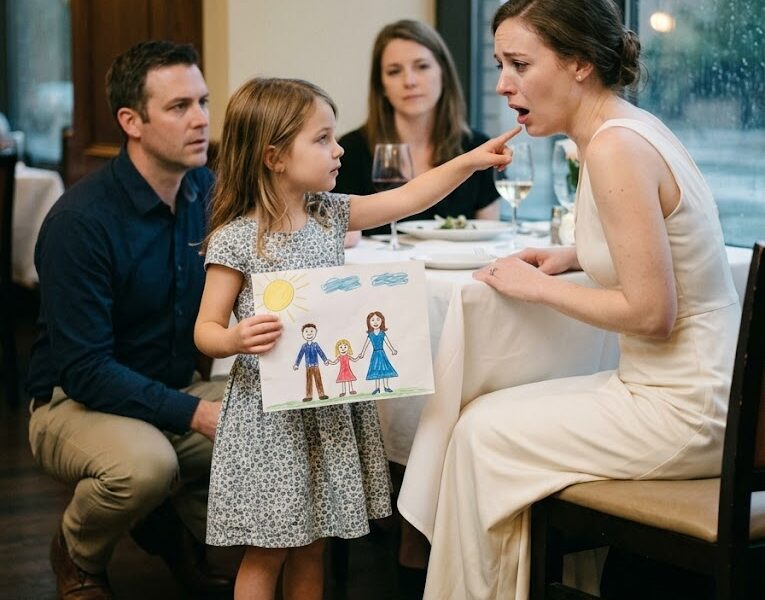
So when she walked into Bellamy House that Friday night, stopped beside our table, and stared at Saraphina Vale as if she had been searching for her all her life, I knew something was wrong.
Then Marabel lifted one trembling finger.
“You’re my mom.”
My water glass slipped against my palm.
Across the table, Saraphina went white.
Not embarrassed.
Not amused.
Terrified.
The restaurant kept moving around us—silverware touching porcelain, a pianist working through an old jazz standard, waiters carrying plates beneath warm amber lights—but the four feet between my daughter and Saraphina suddenly felt like the only space left in the world.
“Marabel,” I said carefully.
She didn’t look at me.
Saraphina Vale was forty years old, the CEO of Vale Meridian Group, and a woman whose face appeared often enough in business magazines that even people who knew nothing about finance recognized her.
Ten minutes earlier, she had been smiling.
Now her fingers were gripping the edge of the table.
Marabel stepped closer.
“You are.”
Saraphina swallowed.
“What did you say?”
Claire came rushing behind Marabel, breathless and apologetic. “Elias, I’m so sorry. The sitter canceled and I tried calling you—”
I barely heard her.
I pushed my chair back and crouched beside my daughter.
“Hey, Bug.”
That was my name for her whenever the world got too big.
She finally looked at me.
“Remember what I told you? I was having dinner with someone.”
“I know.”
“This is Saraphina.”
“I know.”
Something cold traveled through me.
“You know?”
Marabel looked at Saraphina again.
“She’s the lady.”
Saraphina’s voice was barely audible.
“What lady?”
Marabel pulled a folded sheet of construction paper from beneath her arm.
I recognized it immediately.
She had drawn versions of that picture for years.
Three people beneath a yellow sun.
A tall man.
A little girl.
And a woman in a blue dress.
The woman never had a name.
Marabel called her simply the lady who’s supposed to be there.
She unfolded the drawing and placed it on the white tablecloth.
Saraphina stared down at it.
Her breathing changed.
“Marabel,” I whispered, “why do you think Saraphina is your mother?”
My daughter frowned as if the answer should have been obvious.
“Because she has her eyes.”
Saraphina looked up sharply.
“What?”
“The lady in my dreams.”
That was when Saraphina dropped her wineglass.
It shattered against the floor.
Every head near us turned.
But Saraphina didn’t seem to notice.
She was staring at Marabel’s eyes.
Gray-green.
Unusual enough that strangers had commented on them since she was a baby.
I had always assumed she inherited them from her mother.
The mother I believed had abandoned her.
Saraphina whispered, “Where was she born?”
I stood.
Something in her voice made every instinct in me tighten.
“Why?”
“Please.”
“What does that have to do with anything?”
“Where was she born?”
Her composure was gone now.
This wasn’t the billionaire CEO whose photograph appeared beside headlines about acquisitions and billion-dollar valuations.
This was a frightened woman asking a question she was afraid to hear answered.
“St. Aurelia Medical Center.”
Saraphina stepped backward.
Her chair scraped violently across the floor.
Claire looked from her to me.
“Elias?”
I couldn’t answer.
Saraphina pressed one hand against her mouth.
Then she asked, “What date?”
I gave it to her.
November 14.
For several seconds, she made no sound.
Then she whispered something I almost didn’t hear.
“No.”
She grabbed her coat.
“Saraphina.”
“I need air.”
She turned toward the exit.
I caught up with her beneath the restaurant awning.
Rain had begun falling over downtown Chicago, thin silver lines illuminated by headlights.
“Saraphina.”
She kept walking.
I caught her arm.
She spun around.
“Don’t.”
“Then tell me what the hell just happened.”
Her eyes were wet.
“Let me go.”
“My daughter just called you her mother. You asked where she was born, and when I told you, you looked like you’d seen someone rise from the dead.”
That stopped her.
Rain collected in her hair.
For several seconds she stared at me.
Then she said four words that changed my life.
“I had a daughter there.”
I released her arm.
“What?”
“Seven years ago.”
The city seemed to tilt beneath my feet.
Saraphina looked through the glass doors toward the restaurant, where Marabel was standing beside Claire.
“My daughter died.”
Then she looked directly at me.
“Or that’s what I was told.”
Until that night, my life had been painfully ordinary.
I repaired commercial kitchen equipment for hotels, restaurants, hospitals, and cafeterias around Chicago. Refrigeration units. Industrial ovens. Dishwashers that cost more than my truck.
Machines made sense to me.
Something broke.
You found the damaged part.
You replaced it.
People were harder.
People could leave you with no explanation and make you spend years wondering which part of yourself had failed.
Marabel was the exception.
She was the one thing in my life I had never questioned.
Our apartment in Lincoln Square had two bedrooms, uneven floors, a radiator that sounded like someone throwing wrenches down a staircase, and a refrigerator covered with so many of her drawings that you could barely find the handle.
We weren’t poor.
But we were always one expensive disaster away from becoming poor.
I worked.
I paid the bills.
I learned how to braid hair badly and eventually learned how to braid it well.
I packed lunches.
I memorized the names of teachers.
I sat through dance recitals where Marabel spent more time waving at me than dancing.
I learned which cough meant nothing and which cough meant we weren’t sleeping that night.
And for seven years, I answered the question I hated most.
“Where’s my mom?”
The answer changed as Marabel grew.
When she was three, I told her some families looked different.
At five, I told her her mother wasn’t able to stay.
At seven, she wanted more.
“Did she love me?”
That question came one Tuesday night while I was washing spaghetti sauce from a plate.
I turned off the faucet.
“I think she did.”
“You think?”
“I didn’t know her very well.”
“Did she know me?”
I looked at my daughter.
There are lies parents tell because they are cowards.
And there are lies parents tell because the truth would only hand a child pain they aren’t old enough to carry.
I had spent years telling myself mine belonged to the second category.
“She knew you existed.”
Marabel considered that.
“Then why didn’t she come back?”
I had no answer.
Because I had never received one myself.
Seven years earlier, I had been twenty-nine and working nights maintaining kitchen systems at St. Aurelia.
I had known Marabel’s mother briefly before the accident.
Very briefly.
We had met months earlier after I repaired equipment at a private event venue where she had attended a charity dinner. She had slipped away from the ballroom because she hated crowds.
I had been eating vending-machine pretzels behind the loading dock.
She had laughed at me.
We talked.
One conversation became coffee.
Coffee became several weeks neither of us quite knew how to define.
She told me her first name was Sarah.
I never knew her real last name.
She said her family complicated everything.
Then she disappeared.
Months later, a nurse called me.
“There’s a baby.”
I thought it was a scam.
Then she said my name had been listed privately in the mother’s intake history.
I drove to St. Aurelia.
The nurse met me in a service corridor instead of the maternity ward.
Her name was Ruth Brennan.
I remembered that because she kept repeating mine as though making sure she would never forget it.
“Mr. Mercer, you need to listen carefully.”
“Where’s Sarah?”
“I can’t discuss the mother.”
“You called me.”
“I called you about your daughter.”
“My daughter?”
Then she placed a newborn in my arms.
Seven pounds.
Dark hair.
Gray-green eyes.
Marabel.
I asked where her mother was.
Ruth looked toward the corridor.
“Her family is handling her medical care.”
“What does that mean?”
“It means you need to decide whether you’re taking this baby.”
“Taking her where?”
“Home.”
Nothing made sense.
I demanded explanations.
I threatened lawyers I couldn’t afford.
I asked to see Sarah.
Ruth only told me the mother was badly injured and the family had rejected any involvement with the baby.
Two days later, temporary paperwork became custody documents.
Weeks became months.
No one came.
I eventually stopped waiting.
I told myself Sarah had made her choice.
What else was I supposed to believe?
But standing beneath that restaurant awning seven years later, looking at Saraphina Vale, I suddenly remembered something I hadn’t thought about in years.
Sarah had gray-green eyes.
Exactly like Marabel.
Exactly like Saraphina.
And suddenly I couldn’t breathe.
“What was your name before Vale became the company name?”
Saraphina stared at me.
“My name has always been Vale.”
“No. When we met.”
Confusion crossed her face.
Then fear.
“Elias…”
“What name did you give me?”
She whispered, “Sarah.”
The rain kept falling.
Neither of us moved.
We sat in my truck for nearly an hour.
Neither of us wanted to go back inside until we understood enough to keep from frightening Marabel.
Saraphina told me about the accident.
November 13.
Rain.
Lake Shore Drive.
A black SUV.
A memory of headlights crossing the median.
Then nothing.
She woke three days later with a skull fracture, broken ribs, internal bleeding and missing pieces of memory.
Her father, Conrad Vale, was beside her bed.
He told her she had lost the baby.
“What baby?” she had asked.
That was how badly injured she had been.
Fragments returned gradually.
A man.
Coffee.
A loading dock.
Hands stained with machine grease.
A laugh she couldn’t place.
But no name.
No address.
No telephone number.
Nothing complete enough to find me.
“And your father?”
“He handled everything.”
“You never checked?”
Her face hardened.
“You think I didn’t?”
“I’m asking.”
“I was recovering from a traumatic brain injury, Elias.”
“I understand.”
“No, you don’t.”
She turned toward me.
“I woke up unable to remember the previous three months clearly. My father told me my child was dead. A physician confirmed it. There was paperwork.”
“Did you see the body?”
Silence.
I immediately regretted asking.
Saraphina looked through the windshield.
“No.”
“Why?”
“They said the injuries…”
Her voice broke.
She stopped.
I waited.
“My father said seeing her would destroy me.”
That sentence sat between us.
Eventually I asked, “Why would he lie?”
Saraphina laughed once.
There was no humor in it.
“Because Conrad Vale believed love was a weakness people exploited.”
I remembered seeing her father on television.
Old money.
Old power.
A man who had transformed a regional logistics company into an international conglomerate.
“He knew about me?”
“I don’t know.”
“He knew about the baby.”
“Yes.”
“And if he knew about the baby…”
Saraphina finished the thought.
“He probably knew about you.”
My hands tightened around the steering wheel.
Seven years.
Seven birthdays.
Seven Christmas mornings.
Seven years believing a woman had abandoned her daughter.
And somewhere beside me sat a woman who had spent those same years grieving a grave that apparently didn’t exist.
But there was one fact neither of us could avoid.
We didn’t know anything yet.
A resemblance was not proof.
A date was not proof.
A hospital was not proof.
Even memories weren’t proof.
Saraphina looked toward the restaurant.
“I need a DNA test.”
My first instinct was immediate.
“No.”
She stared at me.
“Elias—”
“She’s not evidence.”
“I know that.”
“She’s my daughter.”
“She may be mine too.”
The words hit harder than I expected.
I opened the truck door.
“I need time.”
“How much?”
“I don’t know.”
“You’ve had seven years.”
I turned around.
“And you’ve had forty minutes.”
She flinched.
I hated myself for saying it.
But fear had already taken over.
Because until that moment, I had been thinking about what Saraphina had lost.
Then another thought arrived.
What if finding Marabel meant I could lose her?
That night, I barely slept.
At 2:13 a.m., I stood outside Marabel’s bedroom.
Moonlight spilled across her blanket.
One foot stuck out beneath the covers.
Her stuffed rabbit lay upside down beside her pillow.
I remembered holding her at three months while she screamed with colic.
Her first steps.
The kindergarten morning when she refused to release my hand.
The emergency room visit after she fell from a swing.
Her first lost tooth.
Her asking whether the Tooth Fairy accepted Venmo because she had overheard Claire talking about it.
Every memory whispered the same thing.
Mine.
Then shame followed.
Because love was not ownership.
If Saraphina truly was her mother, Marabel deserved the truth.
Even if the truth terrified me.
At 7:06 the next morning, my phone rang.
Saraphina.
“I found something.”
I sat up.
“What?”
“Hospital records.”
“That quickly?”
“My attorneys obtained an emergency preservation order overnight.”
Of course they had.
Billionaires apparently had lawyers who didn’t sleep.
“What did you find?”
She hesitated.
“A discrepancy.”
My stomach tightened.
“What kind?”
“There’s a neonatal death entry associated with my medical file.”
I closed my eyes.
“That sounds like what your father told you.”
“Yes.”
“But?”
“The infant identification number doesn’t match.”
I said nothing.
Saraphina continued.
“The baby listed as deceased and the baby delivered from my pregnancy have different neonatal tracking numbers.”
My throat went dry.
“What does that mean?”
“It means someone changed something.”
Then she said, “And Elias?”
“What?”
“There’s a second file.”
Silence.
“Your name is in it.”
By noon, we were sitting inside a conference room on the thirty-eighth floor of Vale Meridian Tower.
I had never felt poorer in my life.
Not because anyone treated me badly.
Because everything around me seemed designed to remind ordinary people what power looked like.
Glass walls.
Lake views.
Original art.
A table probably worth more than my truck.
Saraphina sat opposite me wearing the same clothes from the previous night.
No makeup.
No jewelry except a watch.
Three attorneys occupied the far side of the room.
A private investigator named Nathan Cole placed copies of hospital records in front of us.
“We found irregularities beginning at 3:42 a.m. on November 14.”
I looked at Saraphina.
Marabel had been born at 3:31.
Eleven minutes.
Nathan pointed to a document.
“Infant Vale was recorded alive at birth.”
Saraphina stopped breathing.
Alive.
The word seemed to physically strike her.
Nathan continued carefully.
“A second notation entered forty-seven minutes later classified the infant as deceased due to complications.”
“But she wasn’t,” I said.
“No.”
“How do you know?”
“Because her neonatal wristband number appears again six hours later.”
He slid another page toward me.
Under a different case file.
My name appeared near the bottom.
ELIAS MERCER.
BIOLOGICAL PATERNAL CONTACT.
Saraphina covered her mouth.
I kept reading.
A nurse’s signature appeared beside mine.
Ruth Brennan.
I remembered her face.
Her trembling hands.
Her insistence that I leave through a service elevator.
“Find her.”
Nathan nodded.
“We already did.”
I looked up.
“Where?”
“Wisconsin.”
Saraphina asked, “Can she come here?”
Nathan’s expression changed.
“She says she will only speak to Mr. Mercer.”
“Why?”
“She wouldn’t say.”
Then he looked directly at me.
“But she said something else.”
“What?”
“She said she’s been waiting seven years for you to find her.”
Ruth Brennan arrived the following morning.
She was sixty-eight now.
Smaller than I remembered.
Silver hair.
Blue cardigan.
Hands clasped tightly around a leather purse.
When she saw me, she cried.
Not politely.
Not quietly.
She covered her face and cried like someone whose guilt had finally found the room where it belonged.
“I’m sorry.”
I stood frozen.
Saraphina remained near the window.
Ruth looked at her.
Then whatever color remained in her face disappeared.
“Oh, God.”
Saraphina stepped forward.
“Did you know me?”
Ruth nodded.
“Did my daughter die?”
Ruth shook her head.
Saraphina closed her eyes.
That should have been the happiest answer of her life.
Instead, it destroyed her.
She lowered herself into a chair.
“Tell me everything.”
Ruth looked at the attorneys.
Saraphina said, “They stay.”
So Ruth told us.
Conrad Vale arrived at the hospital less than an hour after Saraphina.
He knew she was pregnant.
He knew I was the father.
He also knew Vale Meridian was weeks away from a major financing agreement that depended heavily on Saraphina being presented publicly as the disciplined successor to the family empire.
An unmarried daughter.
A mechanic.
An unexpected child.
To Conrad, those weren’t human beings.
They were risks.
“He said the baby would be placed privately,” Ruth whispered.
“Placed where?” I asked.
“Adoption. Another state. Possibly overseas.”
Saraphina stared at her.
“And he told me she died.”
“Yes.”
“Who helped him?”
Ruth hesitated.
“A hospital administrator. One physician. Someone from your father’s legal office.”
Saraphina’s jaw tightened.
“Names.”
Ruth gave them.
Two were dead.
One was retired in Arizona.
The attorney still worked for the Vale family.
Then Ruth looked at me.
“I found your name in Ms. Vale’s personal intake history.”
I remembered Sarah asking me for my full name weeks before she disappeared.
I had joked that she sounded like a cop.
She had smiled.
“Just in case.”
I hadn’t understood.
Ruth continued.
“I called you because I couldn’t let them erase that child.”
“You told me the family didn’t want her.”
“I couldn’t tell you more.”
“Why?”
“They threatened my license.”
I stood.
“You let me believe her mother abandoned her.”
Ruth started crying again.
“I know.”
“You let her believe her baby was dead.”
“I know.”
“Seven years.”
“I know.”
My voice rose.
“You don’t get to keep saying you know!”
Saraphina touched my arm.
That stopped me.
Not because she was defending Ruth.
Because her hand was shaking harder than mine.
Ruth reached into her purse.
“There’s something else.”
She removed an envelope.
Old.
Yellowed slightly at the edges.
Saraphina stared at it.
“What is that?”
“A letter.”
“From whom?”
“Your father.”
Saraphina didn’t move.
Ruth placed it on the table.
“He gave it to the hospital administrator the morning your daughter was born.”
Saraphina looked at the envelope for a long time.
Then she opened it.
I watched her eyes move across the page.
Halfway down, her face changed.
She handed it to me.
One sentence had been underlined years earlier.
The child must never become a complication in Saraphina’s future.
Not granddaughter.
Not baby.
Not child even, really.
Complication.
I looked at Saraphina.
She was staring at nothing.
“My father died three years ago.”
No one answered.
“I stood beside his hospital bed.”
Her voice became smaller.
“He held my hand and told me he was proud of everything I had become.”
A tear rolled down her cheek.
“And all that time, he knew.”
The DNA results came forty-eight hours later.
99.9987%.
Saraphina Vale was Marabel’s biological mother.
I read the page three times.
Then I sat at my kitchen table and stared at the refrigerator.
One of Marabel’s drawings showed the two of us standing beside a purple cat larger than our apartment.
Another showed Saturn wearing sunglasses.
Another showed three people beneath a yellow sun.
I heard the key turn.
Marabel came inside with Claire.
“Dad!”
I folded the DNA report.
Too late.
She saw it.
“What’s that?”
“Nothing.”
“That means it’s something.”
Claire looked at me.
I gave her a small nod.
She understood.
“I’ll make cocoa.”
It was eighty degrees outside.
Nobody corrected her.
Marabel climbed into the chair opposite me.
“Am I in trouble?”
“No.”
“Are you?”
I almost laughed.
“Maybe.”
She studied me.
Then she asked, “Is Saraphina my mom?”
Children have a cruel way of walking directly through doors adults spend days circling.
I reached across the table.
“Yeah, Bug.”
Her eyes widened.
“Really?”
“Really.”
She became quiet.
That frightened me more than anything.
“How?”
I told her the simplest version.
There had been an accident.
Saraphina had been hurt.
People made terrible decisions.
Saraphina had been told Marabel was gone.
I had been told Saraphina didn’t want us.
Neither had been true.
Marabel listened.
Then she asked the question I hadn’t prepared for.
“Did she look for me?”
I swallowed.
“She didn’t know you were alive.”
“But if she did?”
I looked toward the window.
“She would have.”
“How do you know?”
Because I had seen Saraphina receive the DNA results.
Because I had watched a woman who negotiated billion-dollar contracts collapse against a conference-room wall while clutching one sheet of paper.
Because grief like that couldn’t be performed.
“I just do.”
Marabel thought for several seconds.
“Can I see her?”
Saraphina arrived twenty-three minutes later.
No driver.
No assistant.
No security.
She parked her Mercedes crookedly in front of our building and apparently forgot to lock it.
When I opened the apartment door, she stood there holding nothing.
That surprised me.
I had expected gifts.
Flowers.
Something expensive.
Instead she looked terrified.
“Hi.”
“Hi.”
“Is she—”
Marabel appeared behind me.
Saraphina stopped.
Neither moved.
Then Marabel asked, “Are you really my mom?”
Saraphina’s eyes filled.
“Yes.”
“Did you know?”
“No.”
“Did you leave me?”
“No.”
“Did you want me?”
Saraphina broke.
She dropped to her knees.
“No.”
Marabel’s face changed.
Saraphina realized what she had said.
“No—I mean, yes. God, yes. Marabel, I wanted you. I didn’t know you were alive.”
My daughter stood perfectly still.
Saraphina wiped her face.
“If I had known…”
She couldn’t finish.
Marabel looked at me.
I nodded.
Then she stepped forward.
Saraphina didn’t grab her.
That mattered.
She waited.
Marabel touched Saraphina’s cheek.
“Your eyes.”
Saraphina laughed through her tears.
“Your eyes.”
Then Marabel hugged her.
Saraphina folded around our daughter and made a sound I will remember until I die.
It wasn’t crying exactly.
It was grief leaving a body after seven years.
I turned away.
Because some reunions are too private even when you are standing three feet from them.
Then Marabel asked, muffled against Saraphina’s shoulder, “Can you stay for dinner?”
Saraphina looked at me.
I saw hope there.
And fear.
I also saw something else.
A question neither of us had asked yet.
What happens now?
The answer was not simple.
People like happy endings because they happen quickly.
Real healing does not.
Saraphina wanted to make up seven years in seven days.
That became our first real fight.
Three mornings after the DNA results, a truck arrived outside our apartment.
Then another.
Furniture.
Toys.
Clothes.
Books.
A telescope that probably cost more than six months of my rent.
I called Saraphina.
“What is this?”
“I thought Marabel would like—”
“Send it back.”
Silence.
“Elias.”
“All of it.”
“The telescope is educational.”
“She already has a telescope.”
“You mean that plastic one?”
I looked at Marabel’s twenty-nine-dollar telescope beside the window.
“Yes.”
“That barely qualifies as—”
“Saraphina.”
Silence.
Then she said, “I’m trying.”
“I know.”
“Do you?”
“Yes. But you’re trying to purchase seven years.”
“That’s not fair.”
“No. None of this is fair.”
She arrived twenty minutes later.
Angry.
Beautiful.
Terrifying.
She marched into my kitchen wearing a charcoal suit and heels that probably cost more than my dishwasher.
“I am not trying to buy my daughter.”
“Then stop sending things she didn’t ask for.”
“I missed seven birthdays.”
“I know.”
“Seven Christmases.”
“I know.”
“I never bought her a first bicycle.”
“Saraphina—”
“I never bought her anything!”
There it was.
Not arrogance.
Grief.
I lowered my voice.
“She doesn’t need seven birthdays today.”
Saraphina looked away.
“What does she need?”
“You.”
“I’m here.”
“No. You’re arranging things.”
Her jaw tightened.
“That’s how I solve problems.”
“She isn’t a problem.”
“I know that.”
“Then sit on the floor.”
She stared at me.
“What?”
“Sit on the floor and color with her.”
“I have a board meeting in forty minutes.”
“Then you have thirty-five minutes.”
She almost laughed.
Then Marabel entered carrying markers.
“Do you know how to draw Saturn?”
Saraphina looked at me.
I shrugged.
She slowly removed her jacket.
Then her heels.
Then the CEO of Vale Meridian Group sat cross-legged on our living-room carpet and spent thirty-five minutes drawing the worst Saturn I had ever seen.
Marabel loved it.
That was Saraphina’s first lesson.
Money could create access.
It could not create intimacy.
Intimacy was built from minutes.
There were setbacks.
The first time Marabel called Saraphina “Mom” intentionally, Saraphina cried so hard she had to go into my bathroom and close the door.
The first time Saraphina attempted to braid Marabel’s hair, she somehow created something resembling a fishing knot.
Marabel stared into the mirror.
“Mom.”
“Yes?”
“I love you.”
Saraphina smiled.
“But Dad needs to fix this.”
I laughed until Saraphina threw a hairbrush at me.
She missed.
Mostly.
There were harder moments too.
A school form arrived asking for “Mother” and “Father.”
Marabel filled in both names.
Then she stared at the paper.
“Does this mean you’re married?”
I nearly inhaled my coffee.
Saraphina became intensely interested in the toaster.
“No,” I said.
“Why?”
“Because people don’t automatically get married because they have a child.”
“Why not?”
Saraphina finally spoke.
“Your father and I are complicated.”
Marabel nodded solemnly.
“Claire says Dad makes everything complicated.”
I looked toward the ceiling.
“Your aunt talks too much.”
But the question stayed.
Because somewhere between DNA tests, lawyers, school pickups, burnt pancakes and badly braided hair, Saraphina and I had begun rediscovering something we had lost before we ever understood what it was.
She remembered pieces of me.
The loading dock.
Coffee.
My terrible jokes.
A Saturday by Lake Michigan.
I remembered pieces of Sarah.
The woman before the empire reclaimed her.
The woman who hated champagne.
The woman who removed expensive shoes beneath restaurant tables.
The woman who once told me she wanted one thing in her life that her father couldn’t control.
Neither of us knew she had been talking about us.
Then the past came back one final time.
Nathan Cole located the former Vale attorney who had helped Conrad alter the hospital records.
His name was Malcolm Pierce.
Seventy-four.
Retired.
Dying of pancreatic cancer.
He agreed to speak.
Saraphina wanted me there.
Malcolm lived in a large house outside Scottsdale.
We flew to Arizona.
He looked smaller than the man I had imagined hating.
That bothered me.
Monsters should look like monsters.
Usually they don’t.
He sat beneath a blanket near a window.
Saraphina placed the old letter on the table.
“My father ordered this.”
Malcolm nodded.
“And you helped him.”
Another nod.
“Why?”
“Because I worked for him.”
Saraphina stared at him.
“That’s your answer?”
“No.”
He looked toward the desert outside.
“That’s my excuse.”
I said nothing.
Saraphina leaned forward.
“Did my father ever regret it?”
Malcolm took a long breath.
“He asked about the child.”
“When?”
“Every year.”
Saraphina froze.
“What?”
“He knew Mr. Mercer had her.”
I stood so fast the chair struck the wall.
“He knew?”
Malcolm closed his eyes.
“Yes.”
Seven years of anger condensed into one second.
“He knew where we were?”
“Yes.”
“Did he watch us?”
“Occasionally.”
I felt sick.
Saraphina whispered, “Why didn’t he tell me?”
Malcolm looked at her.
“Because by then, telling you would have meant admitting what he had done.”
That was the final cruelty.
Conrad Vale hadn’t kept the secret to protect Saraphina.
Not eventually.
He kept it to protect himself.
Saraphina stood.
Malcolm said her name.
She stopped at the doorway.
“Your father loved you.”
Saraphina turned.
“No.”
Her voice was calm.
“He loved the version of me he could control.”
Then she walked out.
I followed.
Outside, beneath the Arizona sun, Saraphina stood beside our rental car.
For a long time she said nothing.
Then she asked, “Do you think I’m like him?”
I looked at her.
“No.”
“How can you know?”
“Because he spent seven years hiding from what he did.”
I opened the passenger door.
“You spent seven months showing up.”
Nearly a year after the blind date, I came home on a Thursday evening carrying groceries.
The apartment was quiet.
Too quiet.
“Marabel?”
No answer.
“Saraphina?”
Nothing.
Then I saw the balcony door open.
They were sitting outside.
Marabel had her head against Saraphina’s shoulder.
Saraphina’s phone rested facedown on the table.
It had been ringing.
She ignored it.
That alone would have been impossible a year earlier.
Marabel held a piece of paper.
I stepped outside.
“What are you two doing?”
“Nothing,” Marabel said suspiciously.
Which meant something.
Saraphina smiled.
“Apparently I’m not allowed to tell you.”
Marabel turned the paper around.
I recognized it.
The drawing from Bellamy House.
The yellow sun.
The little girl.
The tall man.
The woman in blue.
But Marabel had changed something.
The three figures were holding hands now.
Above the woman she had written MOM.
Above me she had written DAD.
Above herself she had written ME.
I sat beside them.
For a while, none of us spoke.
The Chicago sky burned orange beyond the rooftops.
Traffic moved below.
Somewhere a dog barked.
Someone played music through an open window.
Ordinary sounds.
Ordinary evening.
That was what made it beautiful.
Saraphina touched the corner of the drawing.
“I used to think about everything I missed.”
Marabel looked up.
“What did you miss?”
Saraphina smiled sadly.
“Lots of things.”
“My first word?”
“Yes.”
“It was ‘light.’ Dad told me.”
“I know.”
“My first tooth?”
“Yes.”
“My first day of school?”
“Yes.”
Marabel considered this.
Then she reached for Saraphina’s hand.
“You didn’t miss today.”
Saraphina’s eyes filled.
“No.”
“You won’t miss tomorrow.”
“No.”
“And Saturday we’re making pancakes.”
Saraphina glanced at me.
I shook my head.
“She burns them.”
“I do not.”
“You absolutely do.”
Marabel giggled.
Saraphina leaned toward her.
“Your father thinks being able to repair an industrial convection oven makes him Gordon Ramsay.”
“Who’s Gordon Ramsay?”
“See?” I said. “Bad parenting.”
Saraphina laughed.
And something inside me became still.
For years I had imagined that families were created at the beginning.
Birth certificates.
Hospital rooms.
Wedding photographs.
Shared last names.
I was wrong.
Sometimes families begin after everything has already gone wrong.
Sometimes they begin after lies.
After grief.
After years that cannot be returned.
Sometimes there is no way to repair what was taken.
Saraphina would never hear Marabel’s first word for the first time.
She would never hold her on the night she was born.
She would never see her first step.
Those moments belonged to history now.
Nothing could buy them back.
Nothing could recreate them.
And maybe healing was not about pretending otherwise.
Maybe healing was learning that grief and gratitude could occupy the same heart.
That losing yesterday did not require surrendering tomorrow.
Marabel climbed into Saraphina’s lap.
“Mom?”
Saraphina still reacted to the word.
Only slightly now.
But I always noticed.
“Yes, sweetheart?”
“Do you remember the restaurant?”
Saraphina smiled.
“I think about it every day.”
“How did I know?”
That question silenced both of us.
There was no medical explanation.
No legal document.
No DNA test that could explain why a seven-year-old girl had walked into a restaurant and recognized a woman she had never consciously met.
Maybe Marabel had noticed the eyes.
Maybe she had seen photographs without remembering them.
Maybe children simply build stories from details adults overlook.
Or maybe some questions are allowed to remain unanswered.
Saraphina kissed the top of her head.
“I don’t know.”
Marabel seemed satisfied.
Then she looked at the drawing.
“I think I knew because you looked lonely.”
Saraphina’s smile disappeared.
Marabel continued coloring.
“You looked like someone was missing.”
I watched Saraphina close her eyes.
For seven years, she had lived inside penthouses, hotels and offices overlooking cities.
She had employed thousands of people.
Her name had appeared on buildings.
She had sat across tables from senators, investors and CEOs.
People called her powerful.
Successful.
Untouchable.
But my daughter had seen what none of them had.
Someone was missing.
Saraphina opened her eyes.
She looked at Marabel.
Then at me.
“No one’s missing now.”
The sun slipped lower.
Marabel returned to her drawing.
I sat beside them until the groceries in the kitchen were probably warmer than they should have been.
I didn’t care.
Because six years earlier, powerful people had decided what our family was allowed to become.
They erased a birth record.
They changed a file.
They separated a mother from her child and convinced two people that the other had chosen to disappear.
They believed paperwork could become truth if enough important people signed it.
For years, it almost did.
But truth has a strange way of surviving.
Sometimes inside a forgotten hospital record.
Sometimes inside the conscience of an old nurse.
Sometimes in gray-green eyes inherited from a mother a little girl had never known.
And sometimes truth walks into an elegant restaurant holding a crayon drawing beneath one arm.
It looks across a crowded room.
It recognizes something everyone else has forgotten.
And in the smallest voice imaginable, it says the five words powerful people spent seven years trying to make impossible.
“You’re my mom.”









