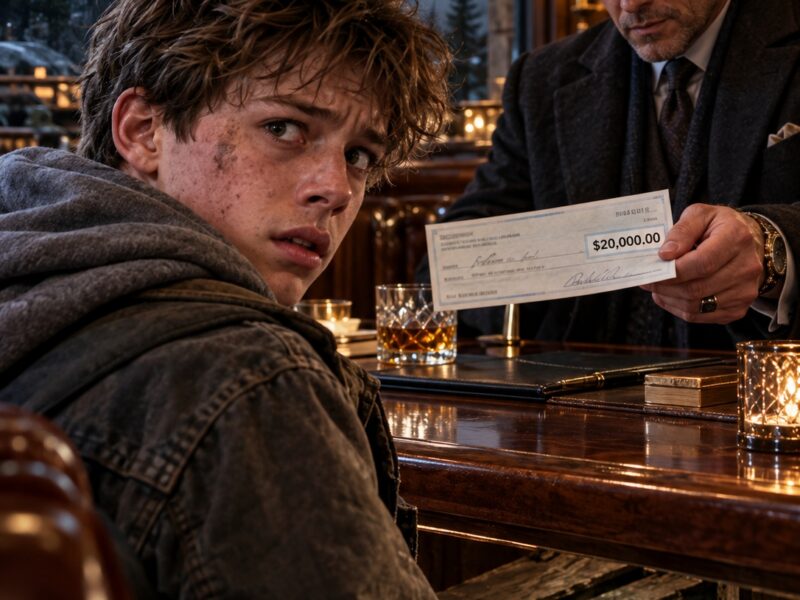
MY DEAD GRANDMOTHER LEFT US A ROTTING CABIN—THEN A MILLIONAIRE OFFERED ME $20,000 BEFORE I COULD SEE WHAT WAS UNDER THE FLOOR
The first man who tried to buy Liam Carmichael’s inheritance offered him twenty thousand dollars before Liam had even seen it.
The second men came after midnight with crowbars.
By sunrise, Liam understood why.
There was something beneath his grandmother’s house worth far more than twenty thousand dollars.
And somebody was willing to bury two children alive to keep it.
Seven months earlier, Liam would have laughed if anyone had told him he was an heir to anything.
He was fourteen years old, homeless, and sleeping in the back seat of a rusted 2004 Chevrolet Cavalier parked behind a closed tire shop outside Asheville, North Carolina.
His nine-year-old sister, Maisie, slept curled beside him beneath two thrift-store blankets and their mother’s old winter coat.
The temperature outside was twenty-three degrees.
Inside the car, it wasn’t much warmer.
Liam woke before dawn because his left foot had gone numb.
He shifted carefully, trying not to wake Maisie, and stared at the frost blooming along the inside edges of the windows.
For a moment, he didn’t know where he was.
That happened sometimes.
He would wake expecting the apartment.
The radiator knocking.
His mother’s slippers moving across the kitchen floor.
Coffee.
The smell of cinnamon toast.
Then the cold would remind him.
His mother had been dead seven months.
The apartment was gone.
School was gone.
Everything was gone except Maisie.
So Liam had made himself one promise.
Nobody was taking her too.
Their mother, Rachel Carmichael, had died after pneumonia became something worse, then something the hospital couldn’t stop. Afterward came social workers, forms, temporary placements, separate bedrooms in separate houses.
Liam heard one caseworker say there was almost no chance anyone would foster a fourteen-year-old boy and his nine-year-old sister together.
He didn’t wait to discover whether she was right.
On their second night in temporary care, he found the keys to their mother’s old Chevrolet in a plastic property bag.
At 2:17 in the morning, he climbed through a laundry-room window.
Maisie followed him.
They had been running ever since.
They learned where supermarkets threw away bread.
Which gas stations had bathrooms that could be entered without buying anything.
Which church parking lots were safe enough to sleep in.
Which cops checked parked cars.
Which ones didn’t.
Liam learned that hunger became easier after the third hour.
Cold didn’t.
Cold was patient.
Cold waited until you were exhausted and then crawled inside your clothes.
That Tuesday morning, Liam was calculating whether the quarter tank of gas in the Cavalier could last until Friday when somebody knocked on the window.
Three sharp taps.
Liam’s hand shot beneath the passenger seat.
His fingers closed around the tire iron.
Maisie woke instantly.
“Liam?”
“Stay down.”
Another knock.
Through the fogged glass, Liam saw the outline of a man.
Not a cop.
The man wore a charcoal overcoat over a tailored suit. Silver hair. Leather gloves. Behind him stood a woman Liam recognized from the county child-services office.
His stomach dropped.
“Don’t open it,” Maisie whispered.
The man bent slightly.
“Liam Carmichael?”
Liam said nothing.
“My name is Arthur Pendleton. I’m an attorney.”
That was almost worse.
Liam tightened his grip on the tire iron.
Pendleton glanced toward the woman beside him.
“We aren’t here to separate you from your sister.”
Liam finally cracked the window two inches.
“Then why are you here?”
Pendleton studied him.
There was something about his expression Liam disliked immediately.
Not cruelty.
Not exactly.
Distance.
The man looked at Liam the way adults looked at damaged paperwork.
“Because your grandmother died.”
An hour later, Liam and Maisie were sitting in a diner booth.
Pendleton had ordered breakfast.
Maisie ate like she was afraid someone might take the plate away.
Eggs first.
Then bacon.
Then half a pancake folded over with her fingers because she was eating too quickly to bother with a fork.
Liam barely touched his food.
Pendleton placed a thick manila folder on the table.
“Your grandmother’s name was Abigail Carmichael.”
“I know her name.”
“Did you know her?”
Liam looked at the folder.
“Not really.”
That was an understatement.
Abigail Carmichael had been less a grandmother than a family ghost.
Their mother almost never spoke about her.
When she did, the stories were strange.
Abigail lived alone somewhere in the mountains.
She hated visitors.
She collected junk.
She trusted nobody.
Once, when Liam was six, he had asked why they never visited Grandma Abigail.
His mother had been washing dishes.
She stopped with both hands submerged in the sink.
“Because some people build walls around themselves,” she’d said.
“Why?”
“Sometimes because they’re afraid.”
“Of what?”
His mother had stared through the kitchen window for a long time.
“Sometimes they’re afraid of being found.”
Liam hadn’t understood.
Now Pendleton opened the folder.
“Abigail died three weeks ago.”
Maisie stopped chewing.
Pendleton continued.
“She left her estate to your mother. Because Rachel predeceased her, the estate passes to her surviving children.”
He rotated the folder toward Liam.
“Primarily to you, as the eldest beneficiary, under trust supervision until your eighteenth birthday.”
Liam stared at him.
“Estate?”
Pendleton slid out a photograph.
The word estate became funny.
The photograph showed a cabin.
If it could still be called one.
The wooden structure sagged sideways beneath enormous pine trees. Part of the porch had collapsed. Vines climbed the walls. Several windows were boarded over.
It looked like something the forest was slowly digesting.
Maisie leaned closer.
“That’s Grandma’s?”
“Yes,” Pendleton said.
“Ours?”
Pendleton hesitated.
“Legally, yes.”
Maisie’s face changed.
It was the first time Liam had seen hope there in months.
Not happiness.
Hope.
There was a difference.
Happiness was pancakes.
Hope was believing tomorrow might contain pancakes too.
“Where?” Liam asked.
“Oak Haven. Ridgeback Mountain.”
“Can we live there?”
Pendleton removed his glasses.
“I’m afraid the property presents certain complications.”
Of course it did.
“It has been neglected for decades. The county considers the structure unsafe. There are delinquent taxes. No reliable utilities. The access road is barely maintained.”
Maisie’s shoulders fell.
Liam almost smiled.
There it was.
The universe correcting itself.
For thirty seconds, he had accidentally believed something good might happen.
Pendleton wasn’t finished.
“Fortunately, there’s another option.”
He looked across the diner.
A large man rose from a booth near the window.
He was perhaps fifty, broad through the shoulders, dressed in an expensive navy wool coat. His pale blue eyes were bright and oddly emotionless.
He walked over already smiling.
“Thomas Dempsey,” he said, extending his hand.
Liam didn’t take it.
Dempsey lowered his hand without appearing offended.
Pendleton said, “Mr. Dempsey is developing property near Ridgeback Mountain.”
“A small eco-resort,” Dempsey said. “Cabins, hiking trails. Bringing jobs into Oak Haven.”
Liam looked between them.
“What does that have to do with us?”
Dempsey pulled a checkbook from his coat.
“Your grandmother’s parcel sits near a route I need for an access road.”
Near.
Liam noticed the word.
Not on.
Near.
“The land isn’t worth much,” Dempsey continued. “Especially with the tax issues and the condemned structure. Frankly, it’s going to become a headache for you.”
His pen clicked.
“But I’m willing to help.”
He wrote something.
Tore out the check.
Placed it on the table.
$20,000.
Liam forgot to breathe.
Dempsey leaned back.
“Twenty thousand dollars. Today.”
Liam looked at the check again.
Twenty thousand dollars was not money.
Not to him.
It was heat.
A motel room.
Food that hadn’t expired.
A toothbrush Maisie didn’t have to keep in a sandwich bag.
A car that started every morning.
A bedroom door.
A shower.
School.
Twenty thousand dollars was the possibility of becoming invisible in a different way.
Not invisible because nobody cared whether you existed.
Invisible because you looked normal enough that nobody asked.
“You sign the transfer documents,” Dempsey said, “and I’ll handle the taxes, demolition, everything.”
Liam looked at Pendleton.
“Can I do that?”
“With appropriate approval, yes.”
Liam picked up the pen.
His fingers trembled.
He hated that Dempsey could see it.
He brought the pen toward the signature line.
“No.”
Maisie’s voice was barely audible.
Liam turned.
She was staring at him.
“Maisie.”
“No.”
She put down her fork.
“It’s our house.”
“It’s barely a house.”
“Mom told me about it.”
Liam frowned.
“When?”
“Before she got sick.”
Dempsey shifted.
Maisie continued.
“She said Grandma had a house on a mountain.”
“Maisie—”
“She said someday maybe we’d go there.”
Liam felt something tighten inside his chest.
Their mother had never said that to him.
Maybe because she’d known what he would say.
That they had school.
That they had an apartment.
That nobody wanted to live with some crazy old woman in the mountains.
Maisie’s eyes filled.
“I don’t want to live in the car anymore.”
The sentence nearly broke him.
He looked down at the check.
Then Dempsey laughed softly.
“Sweetheart, believe me, you don’t want that cabin.”
Something about the way he said it made Liam look up.
The smile was still there.
The warmth wasn’t.
“It’s dangerous,” Dempsey continued. “No running water. Part of the roof is compromised. Coyotes come through that ridge. Black bears too.”
His finger tapped the check.
“Your brother takes this, he can get you someplace safe.”
Liam watched the finger.
Tap.
Tap.
Tap.
Too fast.
Too impatient.
He looked at Pendleton.
The attorney was watching the pen.
Not Liam.
The pen.
And suddenly Liam had a question.
Why?
Why was Thomas Dempsey here?
A wealthy developer had personally driven into Asheville to sit in a diner at eight in the morning because he desperately needed a condemned parcel owned by two homeless children?
If the property was worthless, why not wait for the county to seize it?
Why twenty thousand?
Why today?
Why before Liam had seen it?
Liam set down the pen.
“We’ll go look at it.”
Silence.
Dempsey’s finger stopped tapping.
“You don’t need to.”
“I want to.”
“Son, I’m trying to save you trouble.”
“Then the offer will still be good tomorrow.”
Something moved behind Dempsey’s eyes.
Tiny.
Cold.
“Not necessarily.”
Maisie edged closer to Liam.
Dempsey lowered his voice.
“My project has deadlines. If I reroute the access road, I don’t need your property. Then you’ve got an uninhabitable cabin and a pile of back taxes.”
Pendleton cleared his throat.
“Mr. Dempsey is correct. Time is a factor.”
Liam looked at both men.
Two adults.
Two expensive coats.
Two people insisting a homeless fourteen-year-old needed to make a real-estate decision before breakfast was cold.
His fear became suspicion.
“We’ll look at it.”
Dempsey stared at him.
For one second, Liam saw the man without the smile.
Then it returned.
“Of course.”
Liam wrapped the remaining pancakes in napkins and put them in his jacket.
He took Maisie’s hand.
At the diner door, he glanced back.
Dempsey and Pendleton were no longer pretending to smile.
They were watching him.
And Dempsey said something Liam couldn’t hear.
Pendleton’s face went pale.
The Cavalier barely made it up Ridgeback Mountain.
Asheville disappeared behind them, replaced by narrow roads curling into the Blue Ridge.
The higher they climbed, the quieter Maisie became.
Eventually pavement became gravel.
Gravel became mud.
Ancient hemlocks crowded both sides of the road, their branches knitting overhead until afternoon looked like evening.
The car’s temperature gauge climbed.
“Come on,” Liam whispered.
The engine coughed.
Maisie looked at him.
“Is that bad?”
“No.”
Smoke slipped from beneath the hood.
“Liam.”
“It’s fine.”
The engine died.
They rolled another twenty feet before stopping.
Liam rested his forehead against the steering wheel.
“Still fine?” Maisie asked.
He laughed despite himself.
“No.”
They climbed out.
The mountain was unnaturally quiet.
Then Maisie pointed.
“Is that it?”
Through the trees stood Abigail Carmichael’s cabin.
The photograph had been generous.
The real structure leaned toward the earth like an old woman losing her balance.
Moss coated the cedar siding.
The porch sagged.
One shutter hung from a single hinge.
The chimney tilted.
Briers had swallowed what might once have been a garden.
Maisie stared.
“It looks like a witch lives there.”
“Used to.”
“That’s not funny.”
“A little funny.”
They approached carefully.
The porch groaned beneath Liam’s weight.
He tried the door.
Unlocked.
It opened with a long metallic shriek.
The smell hit first.
Mildew.
Old wood.
Dirt.
And lavender.
So much lavender.
Maisie pressed her sleeve against her nose.
Then Liam raised his flashlight.
And froze.
The house wasn’t empty.
It was full.
Not with furniture.
With things.
Hundreds of things.
Newspapers bundled with twine stood in towers almost to the ceiling.
Mason jars covered shelves along every wall.
Inside them were nails.
Colored glass.
Feathers.
Bird bones.
Buttons.
Locks of hair.
And in one jar—
Maisie grabbed Liam’s sleeve.
“Are those teeth?”
“Don’t touch anything.”
“Are they human?”
“I said don’t touch anything.”
The cabin became stranger the farther they entered.
Symbols had been carved into doorframes.
Words cut into walls.
Some deep enough that the wood had splintered.
Liam brushed dust from the fireplace mantel.
There, carved in furious block letters:
THEY DIG TOO DEEP.
Another line.
THE FOUNDATION BLEEDS.
Then:
HIDE THE VEIN.
HIDE THE BLOOD.
HE WILL COME FOR THE STONE.
Maisie whispered, “Grandma really was crazy.”
Liam didn’t answer.
He wanted to agree.
That would have made everything easier.
A crazy old woman.
A ruined cabin.
Twenty thousand dollars.
Sign tomorrow.
Leave.
Instead he noticed something.
The jars were dusty.
The newspapers were old.
But the carvings weren’t random.
Some repeated.
VEIN.
SHAFT.
STONE.
DEMPSEY.
Liam stepped closer.
“What?” Maisie asked.
“Nothing.”
He found the name again on a ceiling beam.
DEMPSEY DIGS.
He stared at it.
The same surname could mean nothing.
But suddenly Thomas Dempsey’s eagerness in the diner felt less like coincidence.
Outside, thunder rolled across the ridge.
Liam checked his phone.
No service.
The Cavalier wasn’t going anywhere.
“We stay tonight,” he said.
Maisie’s eyes widened.
“Here?”
“We don’t have a choice.”
“What if there are ghosts?”
“Ghosts don’t carry crowbars.”
She stared at him.
“What?”
“Nothing.”
He forced a smile.
“Tomorrow we’ll hike down until we get signal. We’ll call Pendleton. Maybe take Dempsey’s money.”
Maisie looked around the cabin.
This time she didn’t argue.
They found a small bedroom at the rear.
The mattress smelled like dust but was dry.
Liam spread their sleeping bags over it and shoved a heavy dresser against the door.
Maisie watched him.
“Why are you doing that?”
“Old houses.”
“Old houses open doors?”
“Wind does.”
She knew he was lying.
She climbed beneath the sleeping bag anyway.
The storm arrived after dark.
Rain hammered the roof.
Wind pushed through cracks in the walls, making the entire cabin breathe and groan.
Maisie fell asleep with her head against Liam’s shoulder.
He didn’t.
At 1:57 a.m., Liam heard something beneath the storm.
Thud.
He opened his eyes.
Thud.
Then another.
Not thunder.
Footsteps.
Heavy boots crossed the porch.
Liam slowly reached beneath the bed and wrapped his fingers around the tire iron he’d brought from the car.
The front door exploded inward.
Maisie jerked awake.
Liam clamped one hand over her mouth.
“Don’t make a sound.”
Light swept beneath the bedroom door.
Men.
At least two.
Maybe three.
One voice said, “Where are the little rats?”
Liam’s blood turned cold.
Another voice answered.
“Forget the kids. Dempsey wants the map.”
Maisie’s eyes widened.
Liam held a finger to his lips.
A crowbar struck wood.
CRACK.
Then again.
CRACK.
“Old woman hid the survey somewhere.”
“Floor?”
“Has to be. Pendleton said the original documents mention a shaft.”
Liam stopped breathing.
The first man cursed.
“We’ve got until morning. Rip it all up.”
For the next two hours, Liam and Maisie hid beneath the iron bed.
The men destroyed the cabin ten feet away.
Glass shattered.
Boards cracked.
Furniture overturned.
At one point, footsteps entered the hallway.
Maisie started shaking so violently Liam could feel the bed frame trembling against his shoulder.
He pulled her against him.
The doorknob moved.
Once.
Twice.
The dresser held.
A man shoved the door.
“Blocked.”
“Forget it. Kids probably ran.”
The footsteps receded.
Liam waited.
The men continued tearing apart the living room.
Eventually one shouted, “Nothing.”
Another answered, “Check the shed.”
The front door slammed.
Then only rain.
Liam remained beneath the bed for another hour.
When dawn finally turned the window gray, he moved the dresser.
The living room looked as if a tornado had passed through it.
Mason jars lay shattered.
Newspapers soaked in rainwater.
Floorboards had been ripped out, exposing the black crawlspace beneath the cabin.
Maisie appeared behind him.
“They did this?”
“Stay in the bedroom.”
“Liam—”
“Please.”
Something in his voice stopped her.
He stepped carefully between the exposed joists.
Why?
Why destroy a condemned house looking for a map?
A shaft?
He remembered the carvings.
HIDE THE VEIN.
He turned slowly.
Most of the floor had been destroyed.
Except one corner.
The cast-iron woodstove.
It must have weighed several hundred pounds.
The intruders had ripped boards right up to its legs but hadn’t moved it.
One damaged plank beside the stove had shifted enough to reveal something underneath.
A straight line.
Too straight.
Liam crouched.
He swept away soot.
There was an iron frame beneath the stove.
Inside it sat a square panel of reinforced oak.
And attached to the edge—
a brass ring.
Liam’s heartbeat changed.
“Maisie.”
She appeared.
“What?”
“Help me.”
Together they shoved against the stove.
It barely moved.
Liam wedged the tire iron beneath one leg and levered.
Metal screamed across wood.
Inch by inch, they exposed the panel.
Maisie stared at the ring.
“What is that?”
Liam remembered Dempsey’s check.
Twenty thousand dollars.
For a road.
He remembered the men.
Find the shaft.
He grabbed the ring.
“I think this is what they came for.”
He pulled.
Nothing.
Again.
The panel groaned.
On the third attempt, it tore upward.
Cold air rushed from beneath the house.
Not crawlspace air.
Deeper.
Older.
Liam pointed his flashlight down.
Stone stairs disappeared into darkness.
Maisie immediately stepped back.
“No.”
“Maisie—”
“No. Absolutely not.”
He almost laughed.
Their mother used to say Maisie had been born forty years old.
“We have to know.”
“We really don’t.”
“Dempsey does.”
That silenced her.
Liam picked up his mother’s old Maglite.
“If whatever is down there matters enough for those men to come here at two in the morning, it matters enough for us to see it.”
Maisie looked into the darkness.
“There could be something down there.”
“There is.”
“What?”
“The reason they want our house.”
He started down.
After three steps, Maisie grabbed the back of his jacket.
“Don’t leave me.”
“I won’t.”
They descended together.
Ten steps.
Twenty.
Thirty.
The storm faded overhead.
The air smelled of wet stone and metal.
Then the stairwell opened.
Liam’s flashlight swept across a cavern.
He stopped.
It wasn’t a basement.
Wooden beams supported a stone ceiling.
An old generator sat against one wall.
Tables held rock hammers, chisels, scales, magnifying lenses and geological equipment.
Shelves contained carefully labeled samples.
Nothing here was chaotic.
Nothing was crazy.
Everything was precise.
Scientific.
Intentional.
Liam walked toward a wooden workbench.
“Grandma did this?”
Maisie whispered.
He didn’t answer.
Because his flashlight had reached the far wall.
White quartz ran through the mountain.
And inside it were green crystals.
Hundreds.
Some tiny.
Others as thick as Liam’s wrist.
They caught the flashlight and seemed to ignite from within.
Maisie stepped beside him.
“Glass?”
Liam approached.
He had once spent three weeks in a shelter whose lobby contained old National Geographic magazines.
He remembered photographs.
Gem mines.
Appalachian geology.
He touched the cold green crystal.
“No.”
“What is it?”
His mouth went dry.
“Emerald.”
Maisie laughed nervously.
“Like jewelry emerald?”
Liam didn’t move.
“Yeah.”
“How much?”
“I don’t know.”
But that wasn’t true.
Not exactly.
He knew enough.
Enough to understand twenty thousand dollars had just become an insult.
Then he saw the ledger.
Thick.
Leather-bound.
Placed in the center of the workbench.
He opened it.
The handwriting was Abigail’s.
But it didn’t resemble the frantic carvings upstairs.
This writing was neat.
Measured.
Dates.
Coordinates.
Assay results.
Diagrams.
Liam read aloud.
“May fourteenth, 1998. Carmichael vein verified.”
He stopped.
Maisie leaned over.
“Keep reading.”
He did.
“Gem-quality beryl deposit extends beyond preliminary estimate. Dempsey’s father approached again. Refused offer.”
Liam turned the page.
More entries.
Measurements.
Mineral composition.
Maps.
Then:
THEY BELIEVE I AM SENILE.
GOOD.
LET THEM.
MADNESS IS CHEAPER THAN SECURITY.
Liam stared at the words.
Suddenly the cabin above them changed in his mind.
The teeth.
Bones.
Carvings.
Newspapers.
The rotting porch.
The stories.
Crazy Abigail.
Not madness.
Camouflage.
His grandmother had turned herself into a legend nobody wanted to approach.
Maisie whispered, “She was pretending.”
Liam kept reading.
Abigail had been a geologist.
She had discovered the deposit decades earlier.
She had spent years quietly documenting it and extracting only tiny quantities by hand.
The vein was enormous.
But she had refused industrial development.
Mining companies would destroy the ridge.
Strip vegetation.
Cut roads.
Blast rock.
Drain groundwater.
Thomas Dempsey’s father had tried to buy her out.
Then pressure her out.
Then starve her out.
Thomas had continued the campaign.
Liam flipped pages faster.
Property disputes.
Bribes.
County inspections.
Tax manipulation.
Names.
Dates.
Payments.
Then he found Arthur Pendleton.
A payment.
Another.
Another.
His stomach dropped.
“Maisie.”
“What?”
“Pendleton works for Dempsey.”
She stared at him.
“The lawyer?”
“Yeah.”
“Then why did he tell us about the house?”
Liam looked toward the stairs.
“Because he thought we’d sell it.”
A stack of documents lay beside the ledger, sealed in plastic.
Liam tore it open.
Deeds.
Survey maps.
Federal filings.
Mineral rights.
The documents transferred the subsurface claim to Abigail Carmichael and her direct descendants.
His mother.
Then him and Maisie.
Pinned to the front was an envelope.
Rachel.
His mother’s name.
Liam stopped breathing.
His hands shook as he opened it.
The letter had been written the year before Abigail died.
Rachel,
If you’re reading this, I failed to repair what I broke between us.
I don’t ask forgiveness.
I ask only that you believe me about one thing.
They will come for the stone when I’m gone.
Do not trust Arthur Pendleton.
Thomas Dempsey owns more people in Oak Haven than land.
The sheriff is one of them.
Take the ledger.
Take the deeds.
Take the stones I’ve prepared.
Go to the federal courthouse in Charlotte.
Do not go through local authorities.
Protect the children.
Protect the mountain.
Liam had to stop.
The words blurred.
For seven months he had been angry with his mother.
Not because she died.
He knew that wasn’t fair.
But grief wasn’t fair.
Some nights, when Maisie slept, Liam hated Rachel for leaving him with decisions no fourteen-year-old should have to make.
Food or gasoline.
Shelter or invisibility.
Hospital or arrest.
Sleep or guard duty.
Now his dead grandmother was speaking to his dead mother through a letter neither woman had lived long enough to read together.
Maisie touched his arm.
“Liam?”
He wiped his face quickly.
“I’m fine.”
“You always say that when you’re not.”
He folded the letter.
Then Maisie noticed the burlap sack.
“What is that?”
Liam untied it.
He poured four stones into his palm.
Even in the weak flashlight beam, they burned green.
Not raw crystals.
Cut emeralds.
Polished.
Nearly flawless.
Each roughly the size of a quail egg.
Maisie stared.
“Grandma made those?”
“Probably.”
“Are we rich?”
Liam looked at the cavern.
At the green vein disappearing into darkness.
At the ledger.
At the deeds.
At four stones in his dirty fourteen-year-old hand.
Then he remembered the men upstairs.
“No.”
Maisie’s face fell.
“We’re in danger.”
A crash thundered above them.
Dust fell from the cavern ceiling.
Liam switched off the flashlight.
Darkness swallowed everything.
Maisie grabbed him.
“They’re back.”
Footsteps crossed the cabin.
More than before.
Then a voice came through the open shaft.
A voice Liam knew.
Thomas Dempsey.
“I don’t pay you idiots to destroy random floorboards.”
Liam’s heart hammered.
Another voice.
Pendleton.
“The deed references a subterranean claim. Look at the joist distribution.”
Liam felt sick.
Pendleton was there too.
Dempsey said, “Move the stove.”
Metal scraped overhead.
Maisie’s fingernails dug into Liam’s arm.
He covered the flashlight lens with his palm and switched it on, allowing only a thin glow between his fingers.
He grabbed the ledger.
Documents.
Letter.
Stuffed everything into his backpack.
“Take the bag.”
He pushed the emeralds toward Maisie.
She shook her head.
“Liam—”
“Take it.”
Above them, the trapdoor opened.
A tactical flashlight stabbed down the stairs.
A man laughed.
“Found it.”
Dempsey’s voice followed.
“Get down there.”
Then, colder:
“If the children are inside, handle it.”
Maisie’s face went white.
Liam understood the sentence immediately.
There would be no foster care.
No police.
No court.
No tomorrow.
He remembered something from Abigail’s ledger.
A diagram.
Airflow.
Ventilation.
He opened the book again with shaking hands.
There.
SECONDARY SHAFT.
EXIT AT WEEPING SPRING.
He grabbed Maisie.
“Run.”
They crossed the cavern.
Behind a quartz pillar was a tunnel barely three feet high.
Liam pushed Maisie inside.
“Crawl.”
“What about you?”
“Right behind you.”
Men reached the cavern.
One shouted.
“Holy God.”
They’d seen the emerald wall.
Dempsey descended.
For several seconds, nobody chased the children.
Greed had stopped them.
Then Dempsey shouted.
“Where are they?”
A flashlight swept across the tunnel entrance.
“There!”
Maisie crawled.
Mud soaked through her jeans.
The sack of emeralds was clutched against her chest.
Liam followed.
Behind them came voices.
Then crawling.
Fast.
The tunnel narrowed.
Rotting supports held fractured shale overhead.
Liam’s shoulder scraped stone.
Maisie sobbed but kept moving.
“Don’t stop.”
“I can’t breathe.”
“You can.”
“I can’t.”
“Listen to me. You can.”
Flashlight beams appeared behind Liam.
Closer.
A man shouted, “Stop!”
Liam looked ahead.
A faint current of cold air touched his face.
They were close.
Then he saw the support beam.
One old pine timber braced a fractured shelf of rock.
Abigail’s notes had warned about instability in the secondary shaft.
The man behind them was gaining.
“Liam!” Maisie screamed.
“Keep going.”
He stopped.
Turned around.
“What are you doing?”
“Go until you feel rain.”
“I’m not leaving you!”
“MAISIE, GO!”
She crawled.
Liam pulled the tire iron from his belt.
The pursuer’s flashlight filled the tunnel.
Twenty feet.
Fifteen.
The man smiled.
“Nowhere left, kid.”
Liam looked up.
Not at him.
At the pine beam.
Ten feet.
The man reached for something attached to his belt.
A wrench.
“End of the line.”
Liam raised the tire iron.
The man finally understood.
His smile vanished.
“Don’t.”
Liam swung.
The tire iron struck wood.
CRACK.
Nothing happened.
The man lunged.
Liam swung again.
CRACK.
A deep groan traveled through the mountain.
The man’s eyes widened.
“You crazy little—”
Liam hit the beam a third time.
It split.
He threw the tire iron at the man’s face and turned.
Then the mountain came down.
The sound was enormous.
Rock.
Clay.
Shale.
Wood.
The shockwave slammed into Liam’s back.
He flew forward.
Earth buried his legs.
For several seconds he couldn’t hear anything except ringing.
Then Maisie was screaming his name.
“Liam!”
He clawed at the dirt.
“I’m here!”
She crawled back.
Together they freed his legs.
Behind him, the tunnel was gone.
Ten feet of earth separated them from Dempsey’s men.
Maybe more.
Liam stared at it.
He had no idea whether the man chasing them was alive.
He didn’t let himself think about it.
“Move.”
They crawled toward the cold air.
Minutes later, gray morning appeared ahead.
Water rushed somewhere outside.
Maisie reached it first.
She crawled through a curtain of muddy runoff and disappeared.
Liam followed.
He fell out of the mountain onto wet moss.
Rain struck his face.
Real rain.
Sky.
Trees.
Air.
He rolled onto his back and laughed.
Not because anything was funny.
Because he was alive.
Maisie collapsed beside him.
For a while neither spoke.
Then she held up the burlap sack.
“I didn’t drop it.”
Liam started crying.
He pulled her against him.
“I know.”
“You told me not to.”
“I know.”
“I didn’t.”
“I know, Maisie.”
She buried her face against his chest.
“What do we do now?”
Liam looked through the rain at Ridgeback Mountain.
For seven months, every adult system he’d encountered had treated him as a problem to be processed.
Foster care.
County offices.
Police.
Now an attorney had tried to steal from him.
A developer had tried to kill him.
And Abigail’s letter said the sheriff couldn’t be trusted.
But she had given him one instruction.
Charlotte.
Federal courthouse.
So Liam stood.
“We do exactly what Grandma told Mom to do.”
It took them most of the day to reach a road.
A delivery driver found them walking through freezing rain.
At first he thought they’d been in a hiking accident.
Then he saw their faces.
Liam refused the local sheriff.
He refused the Oak Haven police.
He asked for federal authorities.
The driver thought he was delirious.
Until Liam opened the backpack.
Two days later, Arthur Pendleton was drinking espresso in his downtown Asheville office.
He had changed his tie twice that morning.
Appearances mattered.
The television mounted in the corner played local news at low volume.
There had been reports of a landslide on Ridgeback Mountain.
Pendleton wasn’t worried.
Dempsey knew how to manage problems.
He always had.
The children were probably gone.
Runaways disappeared every day.
The cabin could be demolished.
The tax claim accelerated.
The estate challenged.
Without Abigail’s original mineral-rights documentation, the Carmichael descendants would have nothing but a condemned structure and a story nobody would believe.
Pendleton took another sip.
His office door opened.
He frowned.
“I said no interruptions.”
Two men entered.
Dark jackets.
Yellow letters.
FBI.
Pendleton’s cup stopped halfway to his mouth.
A woman followed them.
Forties.
Tailored black suit.
Reporter.
One Pendleton recognized from the largest newspaper in the state.
She carried a leather-bound ledger.
His face emptied.
Then Liam stepped into the room.
Bruised.
A cut across one cheek.
Borrowed clothes.
Fourteen years old.
Pendleton slowly set down the espresso.
“Liam.”
The boy said nothing.
He didn’t need to.
Pendleton looked at the ledger.
Then the agents.
Then Liam.
The cup slipped from his fingers.
It shattered on the hardwood.
At almost the same moment, federal agents entered Thomas Dempsey’s corporate offices.
Emergency crews needed three days to reach the trapped men inside Carmichael Cavern.
Dempsey survived.
So did most of his crew.
When rescue workers finally brought him out on a stretcher, television cameras were waiting.
So were federal agents.
His wrists were cuffed before the ambulance doors closed.
The charges expanded quickly.
Attempted murder.
Extortion.
Conspiracy.
Fraud.
Bribery.
Federal land and mineral-rights violations.
Pendleton’s files connected payments to county officials and local law enforcement.
Abigail’s ledger connected everything else.
For thirty years, the woman Oak Haven had called crazy had recorded dates, offers, threats, geological assessments, shell companies and land transfers.
She had kept copies.
Then copies of copies.
She had hidden them where greed couldn’t reach them.
The story exploded nationally.
Reporters called it the Carmichael Mountain Secret.
Some called it the billion-dollar vein.
Liam hated that name.
Because money wasn’t what he remembered when he thought about the mountain.
He remembered Maisie under the iron bed.
He remembered boots outside the bedroom.
He remembered his grandmother’s letter.
He remembered the sound of a man saying, If the kids are there, deal with them.
The state tried to claim the property over unpaid taxes.
It failed.
A Charlotte law firm saw Liam’s interview and offered representation pro bono.
Abigail’s federal mineral-rights filings were valid.
Meticulous.
Nearly impossible to challenge.
Independent geologists later confirmed what Abigail had known for decades.
The deposit beneath Ridgeback Mountain was extraordinary.
Its exact value depended on how much could legally and responsibly be extracted.
Potentially tens of millions.
Possibly much more.
Companies arrived with offers.
Liam rejected most of them.
People thought that was strange.
A homeless kid turning down money.
They didn’t understand.
Seven months in a Chevrolet had taught Liam something wealthy people often learned too late.
Having nothing made you vulnerable.
Wanting everything did too.
So the arrangement ultimately created for the Carmichael property wasn’t designed simply to extract as much wealth as possible.
Large sections of the ridge were protected.
Environmental restrictions were written into the trust.
Limited mineral recovery could occur only under strict conditions.
The mountain would not be gutted.
Abigail had spent thirty years protecting it.
Liam decided she shouldn’t have done that for nothing.
Seven months after the morning Arthur Pendleton knocked on the Cavalier’s window, Liam stood on Ridgeback Mountain again.
Winter was returning.
But this time he wasn’t afraid of it.
The old cabin had been carefully dismantled.
Not bulldozed.
Liam insisted on that.
Some of Abigail’s original cedar beams had been saved.
So had the mantel.
The strange carvings remained visible.
HIDE THE VEIN.
HIDE THE BLOOD.
HE WILL COME FOR THE STONE.
They would eventually hang inside the new house.
A foundation was being poured where the cabin once stood.
The architect had designed a timber-frame home overlooking the valley.
Nothing enormous.
Nothing resembling Thomas Dempsey’s resorts.
Just warm.
Strong.
Permanent.
Maisie sat on the open tailgate of their truck, drawing in a notebook.
She wore a bright yellow winter coat.
Liam had bought it for her himself.
The first day she wore it, she refused to take it off indoors.
He hadn’t told her to.
He understood.
Some things weren’t clothes.
They were proof.
Proof that you were warm now.
Proof that winter couldn’t reach you the same way anymore.
Liam walked toward the ridge.
Below him, clouds moved between the mountains.
He reached into his pocket.
His fingers closed around one polished emerald.
He had kept it.
Not the largest.
Not the most valuable.
One of the four Maisie carried through the escape tunnel.
He held it toward the afternoon light.
Deep green fire moved inside the stone.
For years, everyone had thought Abigail Carmichael was insane.
Maybe part of her eventually had become strange.
Thirty years alone could do that.
Fear could do that.
Being hunted could do that.
But the madness hadn’t been the truth.
It had been armor.
She had made herself frightening so greedy people would stay away.
She had made her home ugly so nobody would wonder what lay beneath it.
She had accepted being mocked in order to protect something she believed mattered.
And somewhere along the way, the disguise became the only version of her that her own family knew.
Liam sometimes wondered whether his mother had understood.
Whether Rachel had spent years believing Abigail had chosen a mountain over her daughter.
Maybe she had.
Maybe Abigail had.
Love didn’t erase damage.
Good intentions didn’t repair every wound.
Some families carried both.
Maisie closed her notebook.
“What are you thinking about?”
Liam slipped the emerald back into his pocket.
“Grandma.”
“You think she’d like the new house?”
He looked at the concrete foundation.
Then at the preserved cedar beams stacked beneath a tarp.
“I think she’d complain about it.”
Maisie smiled.
“Definitely.”
“She’d probably say the windows were too big.”
“And someone could spy on us.”
“Exactly.”
Maisie hopped from the tailgate.
She came to stand beside him.
For a while they watched the valley.
Then she asked quietly, “Do you ever miss the car?”
Liam looked at her.
“No.”
She laughed.
“I mean it.”
“So do I.”
“But sometimes…”
She struggled to explain.
He understood before she finished.
Sometimes safety felt strange after danger became familiar.
Sometimes a real bed felt too soft.
Sometimes Liam still woke at two in the morning and reached beneath a bed that no longer contained a tire iron.
Sometimes Maisie hid crackers in her bedroom even though the pantry downstairs was full.
Sometimes neither of them could throw food away.
Sometimes a knock at the door made both of them stop talking.
Money had changed their circumstances.
It had not erased seven months.
Nor one night beneath the mountain.
“I know,” Liam said.
Maisie slipped her hand into his.
Below them, construction workers packed up for the evening.
A truck engine started.
The sound echoed across Ridgeback Mountain.
Liam watched the sun lower behind the trees.
For most of his life, he’d thought inheritance meant money.
Land.
Houses.
Things somebody left behind.
Abigail had left those.
But she had also left fear.
Enemies.
Unfinished arguments.
A mountain full of secrets.
And one more thing.
A choice.
Thomas Dempsey had looked at the mountain and seen something to consume.
Abigail had looked at it and seen something to protect.
Liam finally understood the difference.
Maisie tugged his sleeve.
“Come on.”
“Where?”
“Home.”
The word still caught him sometimes.
Home.
Not the Chevrolet.
Not a shelter.
Not somebody else’s spare bedroom.
Home.
Liam took one last look toward the place where Abigail’s cabin had stood.
For a moment, with evening moving through the trees, he could almost imagine the old house still there.
Crooked porch.
Boarded windows.
Lavender behind the door.
Warnings carved into the walls.
A house designed to look worthless.
A woman willing to look mad.
A fortune hidden beneath both.
Then the light shifted.
The illusion disappeared.
Liam followed his sister toward the truck.
Halfway there, Maisie stopped.
“Liam?”
“Yeah?”
“You know when Mr. Dempsey offered us twenty thousand dollars?”
“Yeah.”
“You almost signed.”
He smiled faintly.
“I know.”
“If I hadn’t said no…”
She left the sentence unfinished.
They both looked toward the mountain.
If she hadn’t said no, Thomas Dempsey would have owned the land.
The cabin would have been demolished.
The trapdoor opened.
The ledger destroyed.
The emerald vein taken.
Abigail’s truth buried forever.
Their lives would have changed for twenty thousand dollars.
At the time, twenty thousand had looked like salvation.
Now Liam understood something that frightened him more than being poor ever had.
Sometimes the worst offer of your life arrives looking exactly like rescue.
He squeezed Maisie’s hand.
“But you did say no.”
She smiled.
“Because Mom said it was our home.”
Liam looked toward the unfinished house.
“No.”
Maisie frowned.
“What?”
He opened the truck door for her.
“The house isn’t what made it ours.”
She waited.
Liam looked once more at Ridgeback Mountain.
At the trees Abigail had refused to let Dempsey cut down.
At the earth that had almost become their grave.
At the place that had finally given them something neither money nor emeralds could guarantee.
A future.
Then he said quietly:
“We stayed when somebody wanted us gone.”
Maisie climbed into the truck.
Liam shut the door.
Night was beginning to settle across the ridge, but lights from the construction site still glowed against the foundation of their new home.
He touched the emerald in his pocket one last time.
Then he got behind the wheel.
For the first time in seven months, when Liam turned the key, he wasn’t wondering where he and his sister would sleep that night.
He already knew.
And beneath the dark Appalachian earth behind them, the Carmichael vein remained exactly where Abigail had fought to keep it—
hidden beneath the mountain,
protected by the children everyone had once believed had nothing left to lose.









