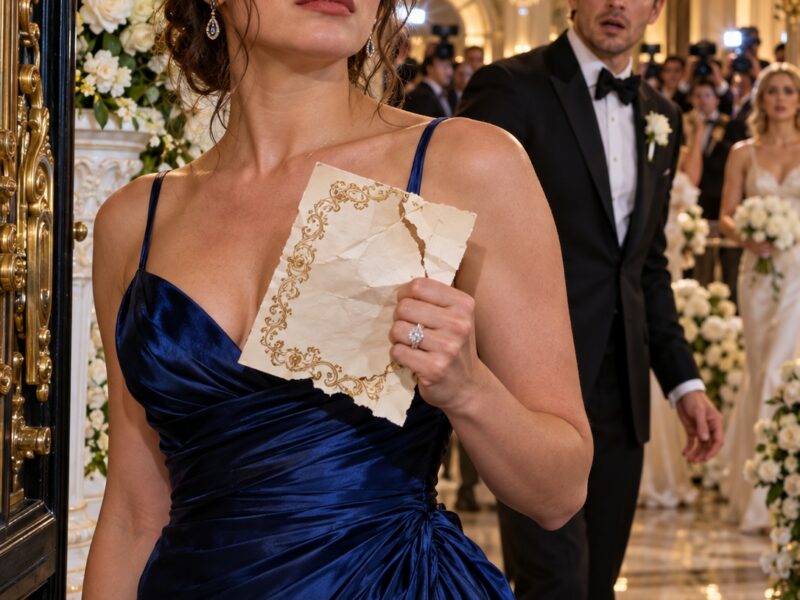
MY EX-HUSBAND INVITED ME TO HIS LUXURY WEDDING TO HUMILIATE ME—BUT THE MOMENT I WALKED IN, HIS BRIDE SAW THE ONE THING HE NEVER WANTED HER TO FIND OUT

The first thing Ryan Mitchell did when he saw me at his wedding was stop smiling.
The second thing he did was look at the three children holding my hands.
And the third was look at the man standing beside me.
That was when the champagne flute began to tremble between his fingers.
For almost a year, Ryan had told anyone willing to listen that I was finished.
Poor.
Abandoned.
Desperate.
The pathetic ex-wife who had made the mistake of believing marriage vows meant something to a man who measured human beings by what they could do for him.
So when he mailed me an invitation to his wedding at the Beverly Hills Grand Hotel, he wasn’t asking for my blessing.
He was asking for an audience.
He wanted me to watch him marry Vanessa Brooks, the glamorous twenty-six-year-old model who had replaced me before the ink on our divorce papers was dry.
More than that, he wanted other people to watch me watching him.
He wanted the comparison.
Vanessa in diamonds.
Me in whatever cheap dress he imagined I could afford.
Vanessa glowing beneath chandeliers.
Me standing somewhere near the back, exhausted from raising three babies alone.
Ryan wanted one photograph that could tell the story he had been telling for months:
He had won.
I had lost.
There was even a chair waiting for me near the back of the ballroom.
One chair.
For the abandoned woman.
Apparently, Ryan had forgotten that he had abandoned four people.
The doors opened.
Conversation died.
My heels touched polished marble.
On my left, my daughter squeezed my fingers.
On my right, one of my sons stared up at the enormous chandeliers while his brother clutched the side of my sapphire gown.
Behind us, camera shutters began exploding.
Beside me walked Alexander Harrington.
Ryan knew that name.
Everyone in that room did.
And judging by the way the color disappeared from his face, Ryan understood before anyone else that the evening he had designed to bury me had just changed direction.
Vanessa leaned toward him.
Even from twenty feet away, I saw her lips move.
“Why is she with him?”
Ryan didn’t answer.
He was staring at our children.
At his children.
And for the first time since he had thrown me out of our house while I was pregnant, Ryan Mitchell looked afraid.
I wish I could tell you I enjoyed it.
I didn’t.
Not yet.
Because beneath the makeup, beneath the sapphire silk, beneath Alexander’s reassuring hand at my back, I was still the woman who remembered standing barefoot in Ryan’s kitchen with one hand beneath a pregnant belly while my husband told me I had ruined his life.
Some wounds don’t disappear because you put diamonds over them.
Sometimes they simply become harder for other people to see.
And as I walked deeper into that ballroom, I could hear Ryan’s voice from a year earlier as clearly as if he were whispering into my ear.
Three babies?
Do you have any idea what you’ve done to me?
That had been the moment everything changed.
Years before that, Ryan had seemed like rescue.
I grew up outside Phoenix with a mother who worked two jobs and still apologized whenever the refrigerator looked empty.
We weren’t miserable.
That’s important.
We were poor, but our home had warmth.
My mother could turn canned tomatoes, rice, and whatever vegetables were left into dinner and somehow make the kitchen smell like safety.
She wore the same winter coat for eleven years.
When I was seventeen, I found a receipt in her purse and realized she’d returned the shoes she’d bought herself so she could pay for my school trip.
That was how I learned love.
You gave.
You sacrificed.
You didn’t keep score.
So when I met Ryan Mitchell at twenty-two, I mistook his confidence for security.
He was older than me, ambitious, handsome in a polished way I wasn’t used to.
He knew which wine to order.
He remembered people’s names.
He could walk into a restaurant and behave as if the best table had been waiting for him.
I was working reception then.
Ryan used to appear near closing time carrying coffee and flowers.
“You shouldn’t have to work this hard forever,” he once told me.
I laughed. “Everybody has to work.”
“Not like this.”
He touched my hand.
“One day I’m going to give you a life where you don’t have to worry about money.”
Nobody had ever promised me that before.
My mother didn’t trust him.
“He likes being admired,” she told me quietly after meeting him.
“What’s wrong with that?”
“Nothing. Until admiration becomes something he needs more than love.”
I thought she was being protective.
Ryan proposed seven months later.
I said yes.
For the first few years, I thought I had proved my mother wrong.
There were flowers.
Weekend trips.
Long conversations about the company Ryan wanted to build.
When his work became demanding, I left my receptionist job.
It made sense at the time.
I handled our home, his schedules, dinners with potential clients, the tiny details that made his increasingly complicated life easier.
When he came home after midnight, his shirts were pressed.
When he forgot his mother’s birthday, I bought the gift.
When he needed a dinner reservation for an investor he’d failed to impress, I found one.
I believed I was building something with my husband.
Ryan slowly began believing I was simply maintaining something that belonged to him.
The money came first.
Then the new friends.
Then the expensive watches and invitations to rooms where everyone seemed to be evaluating everyone else.
Ryan started criticizing my clothes.
“You could try harder.”
I looked down at the dress he’d once told me he loved.
“What’s wrong with this?”
“Nothing. That’s the problem.”
Another time, before a company dinner, he stared at me in the mirror and said, “Some of these wives actually understand how important appearances are.”
I should have asked him what had happened to the man who used to tell me I looked beautiful in sweatpants.
Instead, I changed dresses.
That became our marriage.
Ryan moved the line.
I moved myself to reach it.
Then I got pregnant.
For forty-eight hours, I thought the pregnancy might save us.
Ryan had always talked about having a son someday.
I bought a tiny pair of white socks and left them beside his plate at dinner.
He stared at them.
Then at me.
“Are you serious?”
I smiled through tears.
“Yes.”
He sat back.
He didn’t smile.
Later, the ultrasound showed three heartbeats.
I cried when I heard them.
Ryan didn’t.
The doctor spoke carefully about the pregnancy, about monitoring, about additional risks and expenses.
On the drive home, Ryan said almost nothing.
At a red light, I reached for his hand.
He pulled it away.
“What?”
“Three?”
“Yes.”
He stared through the windshield.
“How are we supposed to do this?”
“We’ll figure it out.”
“You’ll figure it out?”
I turned toward him.
“We will.”
He laughed once.
There was no humor in it.
“You don’t even earn money anymore, Emily.”
Something inside me went cold.
“We agreed I’d stop working.”
“I agreed when I thought you could manage a home without turning it into a daycare center.”
I stared at him.
“These are your children.”
“I know exactly what they are.”
That sentence stayed with me.
Not who.
What.
By my seventh month, Ryan barely came home.
There were meetings.
Business dinners.
Overnight trips.
Eventually there was perfume on one of his shirts that wasn’t mine.
When I asked about it, he looked at me as though my suspicion embarrassed him.
“You’re becoming exhausting.”
“Are you seeing someone?”
“Look at yourself, Emily. Do you really think this is what I want to come home to?”
I remember the silence afterward more than the insult.
I remember placing one hand on my stomach.
One of the babies kicked.
Ryan walked away.
Two weeks later, he told me he wanted a divorce.
“You can’t be serious.”
“I’ve never been more serious.”
“I’m pregnant.”
“I noticed.”
“With your children.”
“And that’s supposed to trap me forever?”
I couldn’t speak.
He walked past me toward the bedroom.
I followed.
“Ryan, please.”
He turned so suddenly I nearly walked into him.
“Stop begging.”
“I’m asking you not to abandon your family.”
“You ruined my life.”
The words landed quietly.
That made them worse.
He didn’t shout.
He said them like a conclusion.
“You ruined it the second you decided three children were somehow my responsibility to celebrate.”
I stared at the man I had married and realized I no longer knew him.
Maybe I never had.
Within weeks, lawyers were involved.
Ryan had money.
Ryan had accounts I barely understood.
Ryan had spent years making sure the business, the house, and almost every meaningful asset was positioned where his attorneys could fight for it.
I had swollen ankles, a suitcase, and three unborn children.
The afternoon I left our house, it was raining.
Ryan didn’t help with my suitcase.
He stood beneath the covered entrance while I dragged it toward my friend’s car.
I turned once.
I don’t know why.
Maybe some stupid part of me still expected him to come running.
He didn’t.
He closed the door.
That sound followed me for months.
My friend let me sleep on her couch until I found a small apartment.
I cleaned offices at night.
I folded clothes at a laundromat.
I babysat when my body allowed it.
People say poverty teaches gratitude.
Sometimes it does.
Sometimes it teaches arithmetic.
Formula or electricity.
Diapers or gas.
Your dinner or theirs.
After the triplets were born—two boys and a girl—I learned to make those calculations without crying.
Most days.
I learned how to hold one baby against my shoulder while rocking another bassinet with my foot.
I learned which floorboards creaked.
I learned how long I could function on three hours of sleep.
I learned that hunger becomes easier to ignore if you’re busy feeding somebody else.
And every night, no matter how exhausted I was, I whispered the same promise over three small beds.
“You were wanted.”
Sometimes I added, “All of you.”
Because I needed them to hear it.
And maybe I needed to hear it too.
Ryan never saw those nights.
He saw magazine photographs.
He saw investors.
He saw Vanessa Brooks.
By the time their engagement appeared online, I no longer had enough anger left to be surprised.
Vanessa was everything Ryan had begun demanding I become.
Polished.
Photographed.
Expensive.
She smiled at cameras as naturally as I smiled at my children.
I didn’t hate her.
Not at first.
I thought she was simply another person who had believed Ryan.
Then the invitation arrived.
Heavy cream paper.
Gold trim.
My name written in elegant script.
Emily Carter.
Not “and family.”
Just Emily.
I stood in my kitchen for a long time holding it.
One of the babies was crying behind me.
A bottle warmer clicked off.
My phone showed a negative balance alert.
And Ryan had sent me an invitation to a wedding that probably cost more than I would earn in years.
I nearly threw it away.
Then I saw the handwritten line at the bottom.
Hope you can make it. It would mean a lot for everyone to see you’re doing well.
I read it twice.
Then I laughed.
It came out sounding almost like a sob.
He didn’t want to see that I was doing well.
He wanted everyone else to see that I wasn’t.
What I didn’t know was that Ryan and Vanessa had discussed that exact possibility.
They had planned it.
Vanessa wanted photographers watching the entrance.
Ryan had arranged one empty chair near the back.
He had even joked to friends that I might arrive begging.
“She’ll come,” he’d told Vanessa.
“Why?”
“Because she’ll want to see what she lost.”
Vanessa had smiled.
“Then let’s make sure she sees it clearly.”
That was their mistake.
They still believed losing Ryan was the worst thing that had happened to me.
The night before the wedding, I sat on my couch staring at the invitation.
The apartment was finally quiet.
Three bottles stood drying beside the sink.
A plastic toy lay beneath the table.
Rain tapped the window.
I imagined the ballroom.
The clothes.
The whispers.
Ryan looking at me with that old expression that could reduce me to the insecure twenty-two-year-old who once thought being chosen by him made me valuable.
I tore the invitation in half.
Then stopped.
My hands shook.
I placed the two pieces on the table.
For almost a year, I had survived by becoming smaller.
Don’t draw attention.
Don’t explain.
Don’t answer gossip.
Don’t look at photographs of Ryan.
Don’t ask why people believed him.
Just survive until tomorrow.
But survival can become another kind of hiding.
I looked toward the bedroom where my children slept.
“I can’t do it,” I whispered.
A knock came the following morning.
I almost ignored it.
Nobody visited without calling.
When I opened the door, Alexander Harrington was standing in the hallway.
For several seconds, I genuinely believed he had the wrong apartment.
Everyone in Los Angeles knew Alexander Harrington.
His investments appeared in business pages.
His charitable donations had helped fund hospitals.
He was famously private and rarely appeared at social events unless there was a reason.
Tall, controlled, dressed simply but impeccably, he looked absurd standing beneath the flickering hallway light outside my apartment.
“Emily Carter?”
“Yes.”
“May I speak with you?”
My hand tightened around the door.
“About what?”
“Ryan Mitchell.”
I started closing it.
Alexander stopped me with words, not his hand.
“He didn’t send me.”
I hesitated.
“I know what he intends to do tonight.”
My stomach tightened.
“Then you know I won’t be there.”
“I know you’re considering not being there.”
“That sounds like the same thing.”
“It isn’t.”
I should have told him to leave.
Instead, something in his expression made me wait.
There was no pity there.
I’d learned to recognize pity.
This was different.
Recognition, perhaps.
He glanced past me at the toys, the bottles, the evidence of a life held together through exhaustion.
“My father left my mother for another woman,” he said.
I said nothing.
“She became ill afterward. Cancer.”
His jaw tightened.
“He wasn’t there when she needed him. Years later, my wife got sick too. I stayed. I spent every dollar and called every specialist I could find.”
His voice lowered.
“I still lost her.”
“I’m sorry.”
“So am I.”
The hallway became quiet.
“Why are you telling me this?”
“Because there are things money cannot fix. I learned that. Ryan hasn’t.”
I folded my arms.
“I don’t need charity.”
“Good.”
His answer surprised me.
“Because I’m not offering charity.”
“What are you offering?”
“Choice.”
He looked directly at me.
“You can stay home tonight, and there’s no shame in that. Or you can walk into that room knowing Ryan doesn’t get to decide what your presence means.”
My throat tightened.
“You make that sound easy.”
“No.”
Alexander’s expression softened.
“I think it will be very difficult.”
That was the first thing he said that I trusted.
Then he added, “But you won’t have to walk in alone.”
I studied him.
“Why do you care?”
His eyes changed.
Only slightly.
“Because I know what it costs when decent people are left alone with someone else’s cruelty.”
He paused.
“And because Ryan Mitchell has other problems.”
“What problems?”
Alexander didn’t answer immediately.
That silence would matter later.
For the moment, he simply said, “Problems he believes no one has discovered.”
I should have asked more.
Instead, one of the babies began crying.
Alexander glanced toward the sound.
Then back at me.
“Go take care of your child.”
I started to close the door.
“Emily?”
I looked up.
“If you decide to come tonight, don’t come to prove anything to Ryan.”
“Then why come?”
“To prove to yourself that you no longer need his permission to exist in the same room.”
Hours later, a black limousine stopped outside my building.
I almost didn’t get in.
The sapphire gown Alexander’s stylist brought felt too beautiful for my life.
“I can’t wear this.”
The stylist smiled.
“Why?”
“Because it isn’t me.”
Alexander, standing near the window, looked over.
“Maybe you haven’t seen yourself clearly in a while.”
I didn’t answer.
When I finally stepped in front of the mirror, I stopped breathing.
Not because the dress transformed me.
That would be too simple.
My face still belonged to a woman who had cried over overdue bills.
My body still remembered carrying three children.
My hands still bore faint damage from cleaning chemicals.
But my shoulders were back.
My eyes were up.
For once, I wasn’t trying to disappear.
My daughter stared at me.
“Mommy pretty.”
I laughed.
Then cried.
One of my sons hugged my leg.
Alexander turned away for a moment, giving me privacy.
That small gesture meant more than the gown.
On the ride to Beverly Hills, my fear returned.
“What if I can’t do this?”
Alexander looked out at the city lights.
“Then we leave.”
“What?”
“You’re not being delivered to a battlefield, Emily. The door remains available in both directions.”
I stared at him.
Ryan had spent years making every choice feel irreversible.
Alexander had just reminded me I could walk away.
Something loosened in my chest.
The limousine slowed.
Camera flashes illuminated the windows.
Alexander offered his hand.
“Ready?”
“No.”
A faint smile touched his face.
“Good answer.”
Then the door opened.
And Ryan Mitchell’s wedding stopped being about Ryan Mitchell.
The whispers reached me before I reached him.
“Is that Emily?”
“I thought she was broke.”
“That’s Harrington.”
“Alexander Harrington?”
“And those children…”
Ryan recovered first.
Or tried to.
He raised his glass.
“Well.”
His voice carried across the room.
“Look who decided to come.”
Vanessa stood beside him in a gown covered with enough crystals to catch every camera flash.
Beautiful.
Perfect.
Furious.
Ryan walked toward me.
“My ex-wife.”
His smile was broad enough for photographs.
“How touching.”
I felt one of the children grip my hand.
Ryan looked at my dress.
“Borrowed?”
A few guests laughed.
Not many.
He noticed.
So he pushed harder.
“Or did Harrington buy it?”
“Ryan,” I said.
He ignored me.
“I suppose places like this must feel strange after…” He pretended to search for the words. “Where is it you’re living now?”
Alexander’s hand touched my back.
Not controlling.
Steadying.
Ryan glanced at the children.
“And bringing them?”
His smile changed.
“That seems a little desperate, Emily. Were you hoping someone here might take pity on you?”
The room went still.
My daughter moved closer to my skirt.
That was when the fear disappeared.
He could insult me.
He had done it before.
But I watched my children react to his voice, and something old inside me finally snapped cleanly instead of painfully.
Alexander stepped forward.
“You keep using that word.”
Ryan looked at him.
“What word?”
“Pity.”
Alexander’s voice wasn’t loud.
It didn’t need to be.
“I don’t see anyone here who should pity Emily Carter.”
Ryan laughed.
“Then perhaps you’re not as intelligent as people say.”
“I see a woman who raised three children after their father abandoned them.”
The room shifted.
Ryan’s smile tightened.
Alexander continued.
“I see someone who worked while exhausted, fed them while struggling to feed herself, and walked into a room deliberately arranged to shame her.”
He looked around the ballroom.
“If anyone deserves pity tonight, Ryan, it isn’t her.”
Ryan’s face reddened.
“This is my wedding.”
“Yes.”
Alexander’s gaze moved toward the extravagant flowers, the champagne, the marble, the cameras.
“That’s another subject we should discuss.”
Ryan froze.
I noticed it.
So did Vanessa.
“What does that mean?” she asked.
Alexander reached inside his jacket.
Ryan’s expression changed.
Not anger.
Recognition.
Alexander removed a slim black folder.
“I suggest you let your guests stay,” he said. “They may find this relevant.”
Ryan’s voice became sharp.
“Security.”
Nobody moved yet.
Alexander opened the folder.
“These records document transfers from Mitchell Holdings over the last two years.”
Ryan laughed too quickly.
“You came to my wedding with accounting records?”
“Offshore transfers. Shell entities. Misclassified expenses. Corporate money converted into personal assets.”
The laughter vanished.
Alexander turned one page.
“Vehicles.”
Another.
“Travel.”
Another.
“Property.”
Then he looked toward the ballroom.
“And portions of tonight’s celebration.”
Vanessa slowly turned toward Ryan.
“What is he talking about?”
“Nothing.”
Ryan pointed at Alexander.
“He’s lying.”
Alexander placed several copies on the table.
“I expected you to say that.”
Guests moved closer.
Ryan’s investors moved fastest.
“Those are fake.”
“They’ve been verified.”
“You can’t prove anything.”
“Bank records.”
Alexander’s voice remained calm.
“Signed correspondence.”
Ryan’s breathing changed.
“And recorded authorization.”
That was when I understood why Alexander had really come to my apartment.
This had never been only about a dress.
He had already been investigating Ryan.
My humiliation was simply the cruelty that made Alexander decide Ryan no longer deserved the luxury of a quiet reckoning.
Ryan reached for the folder.
Alexander closed it.
“Don’t.”
One word.
Ryan stopped.
Vanessa stepped backward.
“Ryan.”
He turned.
“Don’t start.”
“Tell me he’s lying.”
“I said he is.”
“No.”
Her eyes moved over his face.
“Tell me.”
Ryan didn’t.
Vanessa had spent enough time around wealthy men to recognize panic.
She slipped her hand from his arm.
Ryan noticed.
“What are you doing?”
“I asked you a question.”
“And I answered it.”
“You shouted at me.”
“Because we’re being attacked.”
“Is the money real?”
“Vanessa—”
“Is. The. Money. Real?”
Ryan’s silence answered for him.
The woman who had wanted me seated at the back of her wedding now looked around the room and realized the cameras were pointed at her for a completely different reason.
Her face hardened.
“I am not going down with you.”
Ryan stared.
“What?”
“I didn’t agree to marry a criminal.”
Someone gasped.
Ryan’s humiliation became rage.
“You knew exactly what you were marrying.”
“I thought I was marrying money.”
The words escaped before Vanessa could stop them.
The ballroom reacted instantly.
She closed her eyes for half a second.
Too late.
Ryan laughed bitterly.
“There she is.”
Vanessa pulled the ring from her finger.
“You know what? You’re right.”
She looked at the diamond.
Then at him.
“I did marry you for what I thought you could give me.”
Ryan’s face twisted.
“And now?”
“Now your name is worth nothing.”
She dropped the ring.
It struck the marble with a small metallic click.
Of all the sounds that night, I remember that one.
Ryan lunged forward.
Security moved between them.
Vanessa gathered her dress and walked out while photographers followed.
Ryan screamed after her.
“You’re nothing without me!”
The sentence crossed the ballroom and reached me.
Nothing without me.
How many times had he said that to me?
How many nights had I believed him?
I stepped forward.
“No.”
Ryan turned.
Every eye followed him back to me.
“No, Ryan.”
My voice shook.
I let it.
“You don’t get to say that anymore.”
He laughed.
“Please. This entire performance exists because you’re still obsessed with me.”
“Obsessed?”
I looked at my children.
Then back at him.
“When you threw me out, I was carrying three babies.”
A murmur spread.
“You knew that.”
Ryan’s jaw tightened.
“You knew I had no income because I had left my job to support your career.”
“Emily—”
“You knew.”
My voice strengthened.
“You knew when I slept on someone else’s couch. You knew when I went to medical appointments alone. You knew when those children were born.”
I pointed gently toward them.
“And you never came.”
People were staring at Ryan differently now.
Not as a businessman.
Not as a groom.
As a father.
A failed one.
“You want to tell these people I was nothing without you?”
I swallowed.
“I became a mother without you.”
Ryan opened his mouth.
“I worked without you.”
Another breath.
“I survived without you.”
My eyes burned.
“I held three crying babies at two in the morning without you. I skipped meals without you. I learned how to make ten dollars last three days without you. I learned how to stop waiting for the sound of your key in the door without you.”
Tears slid down my face.
I didn’t wipe them away.
“And the worst part?”
Ryan stared at me.
“I still spent months believing you.”
Silence.
“I believed I was the failure because you left.”
I looked at the triplets.
“But these children never ruined my life.”
My daughter looked up at me.
“They saved it.”
Something broke in the room.
A woman near the front began crying.
Ryan shook his head.
“Those kids could belong to anyone.”
The cruelty was so effortless that even I was stunned.
Gasps rose around us.
I saw Alexander’s jaw tighten.
But I didn’t need him.
Not for this.
I walked closer to Ryan.
“Look at them.”
He wouldn’t.
“Look at them, Ryan.”
His eyes flicked toward the children.
Same dark eyes.
Same jaw.
Same unmistakable resemblance.
For one brief second, something appeared on his face.
Not love.
Not remorse.
Fear.
Because they were evidence no accountant could hide.
“You tried to erase me,” I said quietly. “But every time you look at them, you’ll know exactly who you abandoned.”
Ryan’s composure shattered.
“Enough!”
He grabbed a champagne flute and slammed it onto a table.
Glass burst across the white cloth.
Several guests jumped back.
“This is my wedding!”
Nobody answered.
“My company!”
His voice cracked.
“My money! My life!”
Alexander watched him.
Ryan pointed at the folder.
“You want to call me a criminal? Prove it. Where are the police?”
The ballroom doors opened.
Timing can feel like cruelty when truth has been delayed long enough.
Two uniformed officers entered first.
A detective followed.
Ryan stopped breathing.
The detective approached.
“Ryan Mitchell?”
Ryan looked around as if someone else might answer.
“Yes?”
The detective produced a document.
“We have a warrant for your arrest in connection with an investigation involving embezzlement, tax fraud, and money laundering.”
“No.”
Ryan backed away.
“This is ridiculous.”
“Turn around, sir.”
“No.”
He pointed at Alexander.
“He did this.”
Alexander said nothing.
Ryan turned to the investors.
Nobody stepped forward.
To his friends.
They looked away.
To the doorway where Vanessa had disappeared.
“Vanessa!”
Nothing.
“Vanessa!”
His voice sounded smaller the second time.
The officers took his arms.
Ryan resisted.
“Get off me!”
“Sir.”
“You can’t arrest me here!”
The detective looked at him.
“Why not?”
That question destroyed something in Ryan.
Maybe because for years he had genuinely believed certain rooms belonged to people like him.
Certain consequences happened elsewhere.
To poorer people.
Less connected people.
People without custom tuxedos.
The handcuffs closed around his wrists.
Ryan looked at me.
The ballroom blurred around us.
“This isn’t over.”
I didn’t answer.
“You’ll regret this, Emily.”
I looked at the man I had once begged not to leave.
Then at the steel around his wrists.
“No,” I said.
“I think I’m finished regretting things for both of us.”
They led him away.
The doors closed.
For several seconds, nobody moved.
Then my son tugged my hand.
“Mommy?”
I crouched.
His eyes were frightened.
“Are we safe now?”
That question nearly broke me in a way Ryan never had.
I pulled all three children against me.
“Yes.”
My voice failed.
I tried again.
“Yes, babies.”
I kissed their hair.
“We’re safe.”
Behind us, applause started.
I hated it for half a second.
Then I understood.
They weren’t applauding Ryan’s arrest.
At least I didn’t want to believe they were.
They were applauding survival.
Still, I didn’t need strangers to tell me I’d won.
I had three small arms around my neck.
That was enough.
When I stood, Alexander was waiting.
“Why?” I asked.
He knew what I meant.
“Why all of this?”
He looked toward the doors.
“Ryan had been on my radar professionally. The financial discrepancies were already being examined.”
“So you didn’t come because of me.”
“I came to your apartment because of you.”
There was a difference.
I understood it.
“My mother never got to stand in the room where the people who hurt her finally saw her as human,” he said.
His voice softened.
“My wife never got enough tomorrows.”
He looked at my children.
“I couldn’t change those things.”
Then at me.
“But I could refuse to watch someone repeat the same cruelty when I had the power to intervene.”
“You barely knew me.”
“I knew enough.”
“What?”
“That you were still standing.”
The ballroom had begun to empty.
Some guests approached to apologize.
Others offered congratulations that felt inappropriate after a night like this.
I accepted neither judgment nor worship.
I was too tired.
Outside, red and blue lights flashed against the hotel facade as Ryan was placed in a police car.
Vanessa was already gone.
By morning, photographs were everywhere.
Ryan Mitchell arrested at his own wedding.
The story spread faster than anything Ryan had ever paid a publicist to promote.
The financial investigation widened.
Investors withdrew.
Business partners distanced themselves.
Accounts were examined.
The empire Ryan had used as proof of his superiority began collapsing under scrutiny.
From jail, he blamed everyone.
Alexander.
Vanessa.
His accountant.
Me.
Anyone except the man whose signature appeared on the documents.
Vanessa discovered that the world she loved was even less loyal than she was.
The investor she’d kept quietly in reserve stopped taking her calls.
Brands canceled contracts.
Friends disappeared.
Creditors didn’t.
The gowns were sold.
Then jewelry.
Then the car.
The same social circles that had once welcomed her because she looked beautiful beside wealth now treated her like contamination.
I didn’t celebrate that.
There was a time when I would have.
But after Ryan’s arrest, revenge became strangely boring.
I had lunches to pack.
Children to bathe.
A life to rebuild.
Alexander remained.
That surprised me more than anything.
Grand gestures are easy for rich men.
Consistency is harder.
He didn’t arrive every day with limousines.
Sometimes he arrived with groceries.
He learned which child hated peas.
He learned that my daughter needed the hallway light left on.
He learned that one of my sons became quiet when frightened while the other talked nonstop.
He didn’t ask them to call him anything.
He simply kept showing up.
Weeks after the wedding, he encouraged me to pursue an idea I’d once mentioned almost apologetically.
A foundation.
Not a glamorous one.
A practical one.
Temporary housing.
Employment assistance.
Childcare resources.
Help navigating paperwork.
A place where a woman standing outside a locked door with a suitcase and nowhere to go would hear something other than, “You should have planned better.”
I knew that woman.
I had been her.
We built it slowly.
Alexander offered funding.
I insisted on involvement.
“This cannot become something wealthy people attend once a year for photographs.”
“Agreed.”
“I want women leaving with jobs.”
“Agreed.”
“And housing contacts.”
“Agreed.”
“And emergency childcare.”
He smiled.
“Anything you don’t want?”
“Pity.”
His smile faded into something gentler.
“Agreed.”
Months passed.
Ryan went to trial.
The evidence held.
The man who had once told me he could make people believe anything discovered that juries were less impressed by confidence when it came with bank records.
He was convicted.
Vanessa disappeared almost completely from the circles she’d fought so hard to enter.
I heard things occasionally.
I never went looking.
There are victories that become smaller if you keep turning around to watch the people behind you lose.
My life was moving forward.
Then, one evening, Alexander asked me to attend a charity event.
“No surprises?”
He looked offended.
“Would I do that?”
“Yes.”
“Fair.”
The event was smaller than Ryan’s wedding.
Warm lighting.
No reporters at the doors.
No spectacle.
After dinner, Alexander walked me outside to a quiet terrace.
“You’re nervous,” I said.
“I’m not nervous.”
“You’ve adjusted your cuff three times.”
He looked at his sleeve.
“That’s inconvenient evidence.”
I laughed.
It still startled me sometimes how easily laughter came now.
He became serious.
“Emily.”
I knew.
Before the box appeared.
Before he lowered himself to one knee.
I knew.
And suddenly I was terrified.
Not because I didn’t love him.
Because I did.
Love had once made me surrender so much of myself that I confused disappearance with devotion.
Alexander seemed to read the fear.
He didn’t open the box.
“Before I ask anything,” he said, “I need you to understand something.”
I waited.
“I don’t want to rescue you.”
My eyes filled.
“You don’t need rescuing.”
He took my hand.
“I don’t want ownership of your second life. I want a place in it, if you’ll give me one.”
That mattered more than the ring.
“Your children don’t need a rich father. They need someone who stays. I can promise to try to be that man every day.”
His voice roughened.
“And you don’t owe me yes because I helped you. You don’t owe me anything.”
The tears came then.
Not the desperate tears I’d cried for Ryan.
Different tears.
The kind that arrive when somebody finally gives you room to choose.
Alexander opened the box.
“Emily Carter, will you marry me?”
I laughed through my tears.
“Yes.”
Then I added, because I needed to hear myself say it:
“Because I choose you.”
His eyes closed briefly.
When he stood, I kissed him.
No ballroom erupted.
No cameras flashed.
There was only evening air, his arms around me, and the quiet certainty that this beginning belonged to us.
Later, when we told the children, chaos replaced romance.
“Does that mean Alexander lives here?”
“Eventually.”
“Can he make pancakes?”
Alexander frowned.
“I can learn.”
My daughter looked deeply concerned.
“Mommy makes bad pancakes.”
“I do not.”
All three children shouted at once.
Alexander laughed so hard he had to sit down.
That sound became one of my favorite memories.
Not because life became perfect.
It didn’t.
Healing wasn’t a straight line.
Sometimes a slammed door still made my body tense.
Sometimes I woke from dreams in which I was back in Ryan’s house, pregnant, begging someone who no longer loved me to recognize my humanity.
Sometimes I worried that security could disappear overnight.
Alexander had his ghosts too.
There were evenings when grief for his wife entered the room without warning.
He never pretended she hadn’t existed.
I never asked him to.
Love wasn’t a competition with the dead.
Some nights we sat beside the fireplace after the children were asleep and talked about people we’d once been.
“I thought money could prevent loss,” he told me once.
“I thought sacrifice could guarantee love.”
He looked at me.
“We were both wrong.”
“Yes.”
“That’s depressing.”
I smiled.
“Or useful.”
Years earlier, Ryan had promised me a life where I would never have to worry about money.
Alexander never promised that.
He promised breakfast.
School pickups.
Arguments handled without cruelty.
Space.
Truth.
The ordinary things turned out to be more luxurious than chandeliers.
The foundation grew.
The first time I stood in front of a room filled with women and told my story, my hands shook.
I didn’t tell them Ryan was arrested and say justice always arrives dramatically.
It doesn’t.
I didn’t tell them a billionaire would knock on their doors.
Usually, he won’t.
I told them the part that mattered.
There had been nights when nobody came.
I still survived those nights.
There had been mornings when I had seventeen dollars and three babies.
I still got out of bed.
There had been people who believed Ryan because his suit was expensive and his voice was confident.
Their belief had not changed the truth.
Afterward, a woman waited until everyone else had left.
She was holding a sleeping toddler.
“My husband says I can’t make it without him.”
For a moment, the room disappeared.
I saw myself.
Not in her face.
In the way she held her shoulders.
Small.
Apologetic.
As though taking up space required permission.
I wanted to tell her she was strong.
Instead, I asked, “What do you need tonight?”
She started crying.
That was the moment I understood what the foundation was really for.
Not speeches.
Not inspiration.
The next safe night.
Then the next.
Then enough nights for someone to build a life.
One evening, long after the scandal had stopped being daily news, I stood on the porch of our home watching the triplets chase each other through the yard.
The sunset had turned the sky orange and pink.
My daughter pointed upward.
“Look, Mommy. Castles.”
The boys argued about which cloud was the biggest.
Alexander stepped behind me and wrapped an arm around my shoulders.
For a while, neither of us spoke.
Then he asked, “Do you ever think about that wedding?”
“Yes.”
“Do you wish you hadn’t gone?”
I watched my children.
“No.”
“Because Ryan was arrested?”
“No.”
“Because everyone finally believed you?”
I thought about it.
“No.”
Alexander waited.
I rested my head against him.
“For a long time, I thought the best thing that could happen would be watching Ryan lose everything.”
“And?”
“It wasn’t.”
“What was?”
I looked toward the yard.
My children were laughing.
Nobody was afraid.
Nobody was waiting for footsteps in a hallway.
Nobody was being told their existence was a burden.
“I stopped needing him to lose.”
Alexander said nothing.
“That was the victory.”
A breeze moved through the trees.
“I spent so much of my life measuring myself against whatever Ryan thought I was. First I wanted his love. Then I wanted his apology. Then I wanted his punishment.”
I watched the last sunlight catch my daughter’s hair.
“But eventually I realized all three things still made him the center of my life.”
Alexander’s arm tightened gently around me.
“So I stopped.”
“Was it difficult?”
“Yes.”
I smiled.
“Most worthwhile things were.”
The children ran toward us.
My daughter reached me first.
I bent down and caught her.
The boys collided into us seconds later.
Alexander pretended to fall beneath the attack.
Their laughter filled the porch.
And suddenly I remembered the single chair Ryan had placed at the back of his ballroom.
One chair for the poor ex-wife he expected to arrive alone.
I thought about the woman who had once stared at that gold-trimmed invitation in a dark apartment and believed entering that hotel might destroy her.
She hadn’t known yet that humiliation only works when the person humiliating you still gets to define your worth.
Ryan had lost that power long before the police put cuffs on him.
I simply hadn’t realized it.
The greatest thing Alexander gave me wasn’t the sapphire gown.
It wasn’t the diamond pendant.
It wasn’t money.
It wasn’t even the black folder that helped expose Ryan.
It was the moment outside my apartment when he reminded me the door worked both ways.
I could enter.
I could leave.
I could choose.
That became the foundation of everything afterward.
Choice.
Years earlier, I had confused love with sacrifice.
Then I confused survival with strength.
Now I understood both differently.
Love wasn’t disappearing so someone else could shine.
Strength wasn’t pretending nothing hurt.
Love was staying without controlling.
Strength was hurting and still refusing to surrender your future.
And revenge?
Revenge was overrated.
Peace was better.
One night Ryan Mitchell invited me to his wedding because he wanted hundreds of people to watch me discover how little I mattered.
Instead, they watched him discover something he had never understood.
A person doesn’t become worthless because you abandon them.
A mother doesn’t become weak because she cries.
A woman doesn’t become powerful because a billionaire walks beside her.
And a life doesn’t become meaningful because the people who hurt you finally suffer.
Sometimes the deepest victory is much quieter.
It’s a child sleeping safely down the hall.
It’s groceries in the refrigerator.
It’s work that means something.
It’s laughing without checking whether someone approves.
It’s standing beside someone who loves you without asking you to become smaller.
It’s waking up one morning and realizing the voice in your head that used to say you’re nothing sounds distant now.
Almost unfamiliar.
The triplets eventually tired themselves out.
Alexander carried one boy inside.
I carried my daughter.
Our other son walked between us, holding one of my fingers and one of Alexander’s.
At the doorway, I looked back once.
The sunset was almost gone.
For a heartbeat, I saw every version of myself standing somewhere behind me.
The twenty-two-year-old who thought she’d been rescued.
The wife who kept changing herself.
The pregnant woman dragging a suitcase through the rain.
The mother counting dollars beside three sleeping babies.
The woman in sapphire walking through golden doors.
The woman who finally said, I survived without you.
I didn’t hate any of them.
Not anymore.
They had all brought me here.
“Mommy?”
I looked down.
My son was waiting.
“You coming?”
I smiled.
“Yes.”
Then I stepped inside.
And this time, when the door closed behind me, it didn’t sound like abandonment.
It sounded like home.









