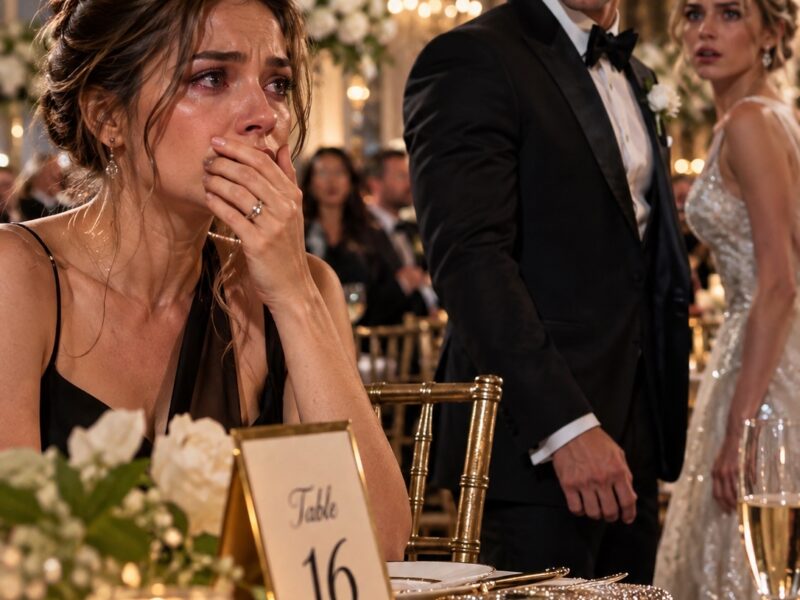
MY EX-HUSBAND SEATED ME BY THE COAT CHECK AT HIS WEDDING—THEN THE MAN BESIDE ME MADE THE ENTIRE ROOM REACH FOR THEIR PHONES

The cruelest part of Seth Crawford’s wedding invitation wasn’t that he sent it to his ex-wife.
It wasn’t even that he invited Senna after six years of almost complete silence.
It was the tiny line printed beneath her name.
TABLE 16.
Senna stared at it for several seconds before she understood why it bothered her.
Then Yinka walked into her office, saw the cream card stock between Senna’s fingers, and stopped dead.
“Oh, no.”
Senna looked up.
Yinka crossed the room, took one look at the gold lettering, and closed her eyes.
“He actually did it.”
“Apparently.”
“Tell me that isn’t Seth’s wedding invitation.”
Senna turned the card over once.
Then back again.
“Seth Crawford and Courtney Ashcroft request the pleasure of my company.”
Yinka leaned closer.
Her expression changed when she saw the table number.
“Table sixteen?”
“Yes.”
“Oh, that son of a—”
“Yinka.”
“I was going to say strategist.”
“No, you weren’t.”
“No.” Yinka pulled out the chair opposite Senna’s desk. “I absolutely was not.”
Outside the forty-second-floor windows, November had swallowed Toronto in gray. Low clouds erased the lake. Buildings disappeared halfway into mist. It was barely three-thirty, yet the afternoon already looked exhausted.
Senna placed the invitation beside her quarterly report.
Yinka was still staring at it.
“Table sixteen is beside the coat check.”
Senna lifted an eyebrow.
“How do you know?”
“My cousin’s firm uses that venue. I’ve been there twice. Tables one through eight are in the main hall. Nine through twelve are along the windows. Thirteen through fifteen are near the terrace.”
“And sixteen?”
“Architectural Siberia.”
That almost made Senna smile.
Almost.
Yinka leaned forward.
“You’re not going.”
“I haven’t decided.”
“He sent this to hurt you.”
Senna said nothing.
“You know he did.”
Still nothing.
“Senna.”
She finally looked at her friend.
Yinka had worked beside her for nine years, long enough to know the difference between Senna being calm and Senna becoming dangerous.
This was neither.
That worried her more.
“He wants you sitting alone in the back,” Yinka continued. “He wants everyone from his firm to see you there. Everyone from the old days. He wants Courtney’s family to see you. He wants you to look like the woman he left behind.”
Senna looked again at the invitation.
Cream card.
Gold letters.
No plus-one.
Table 16.
It was so unmistakably Seth that for one strange second she was thirty-four again, standing barefoot in their old kitchen while he explained why a dinner with investors mattered more than the anniversary reservation she’d made three months earlier.
Everything with Seth had always been placement.
Where you sat.
Who saw you.
Who called first.
Whose name appeared above whose on an invitation.
Who entered a room beside whom.
He had possessed an extraordinary talent for turning ordinary life into a scoreboard.
Their marriage had not begun that way.
That was perhaps what had taken Senna the longest to forgive.
Not him.
Herself.
Because once, she had loved him.
Once, Seth Crawford had been a twenty-eight-year-old junior development analyst with cheap shoes, impossible ambition, and a laugh that filled the tiny apartment they rented above a pharmacy.
Once, he had eaten Chinese takeout with her on the floor because they couldn’t afford a dining table.
Once, when Senna had been terrified to leave her corporate job and start consulting independently, Seth had taken her face between his hands and said, “Do it. If it fails, we’ll survive.”
She had believed that man would exist forever.
Success had not changed Seth.
That was the lie Senna told herself for years.
Success had simply given him enough rooms in which to reveal himself.
The promotions came.
Then the suits.
Then private clubs.
Then dinners Senna was expected to attend because the senior partners liked spouses who understood the choreography.
She became good at it.
Too good, perhaps.
She remembered names.
Children.
Universities.
Who drank bourbon.
Who hated golf but pretended otherwise.
She could rescue an awkward conversation without making anyone realize it had needed rescuing.
For years, Seth praised that ability.
Until Senna’s own company began succeeding.
Then something changed.
Her first major contract came from a manufacturing company whose CEO had heard her speak at a small leadership conference.
The second came through a referral.
The third was large enough that she hired an assistant.
Then two analysts.
Then five consultants.
One evening she came home at eleven after closing the largest account of her career and found Seth drinking scotch in the dark.
She expected champagne.
He asked why she had missed dinner.
That had been the beginning.
Not of their problems.
Of her understanding them.
By the time the marriage ended, Seth had rewritten their history so completely that Senna sometimes wondered whether he believed his own version.
According to him, she was cautious.
Small-thinking.
Emotionally distant.
Uninterested in “building something significant.”
The irony had been almost elegant.
Senna had built something.
She simply hadn’t built it for him.
During their final argument, Seth had stood in their living room beneath a photograph they’d bought together in Montreal and told her she lacked vision.
“You don’t understand ambition,” he’d said.
She remembered becoming very still.
“What do you think I’ve been doing for the last six years?”
“Consulting isn’t the same thing.”
“As what?”
“As building something real.”
She had stared at him.
Then she understood.
Real meant visible.
Real meant photographed.
Real meant having your name announced into rooms full of people.
Seth needed witnesses for everything.
Senna did not.
Three months later, they filed for divorce.
Six years later, he sent her an invitation to his wedding.
And placed her beside the coats.
Yinka tapped the card.
“Throw it away.”
Senna looked toward the windows.
A plane blinked through the clouds above the lake and vanished.
“No.”
Yinka stared.
“No?”
“I think I’m going.”
“Why?”
Senna picked up her pen.
“Because I want to know if it still hurts.”
That silenced the room.
Yinka’s face softened.
“Senna…”
“If it does, I need to know.”
“And if it doesn’t?”
Senna looked down at Seth’s name.
“Then I need to know that too.”
She went.
But she didn’t go alone.
She told Raphael the following evening.
They were eating dinner at the kitchen island in the condominium they had shared for nearly two years.
No candles.
No elaborate meal.
Roasted salmon, potatoes, salad.
Raphael Sinclair had spent most of the afternoon negotiating something involving pension funds, infrastructure assets, and three countries, yet he’d come home carrying groceries because Senna had texted that they were out of lemons.
That was Raphael.
He could move nine figures before lunch and still notice they needed lemons.
Senna slid the invitation across the island.
He read it.
His expression didn’t change.
Then his eyes stopped at the bottom.
“Table sixteen.”
Senna took a sip of water.
“So I’ve been informed.”
“Where is table sixteen?”
“Near the coat check.”
Raphael considered this.
“That seems inconvenient.”
She laughed.
“It wasn’t designed for convenience.”
“I gathered.”
At fifty-two, Raphael had silver at his temples and the kind of face photographers always wanted to make sterner than it actually was.
He disliked publicity.
He disliked industry awards.
He disliked having his photograph taken while pretending to laugh at charity dinners.
What he did not dislike was business.
And he was extraordinarily good at it.
For most people outside Canadian finance and real estate, Raphael Sinclair’s name meant very little.
For people inside those worlds, it meant quite a lot.
Three months earlier, Sinclair Holdings had quietly completed the acquisition of Northstar Urban Group, one of Ontario’s largest commercial development companies.
The transaction had appeared in the financial press for several days.
Raphael gave no interviews.
He didn’t need to.
Northstar’s projects touched dozens of developers, contractors, lenders, architectural firms, consultants, and municipal partnerships.
Including companies connected to Seth Crawford.
Including several businesses controlled by Courtney Ashcroft’s father.
Raphael placed the invitation down.
“I’d like to come.”
Senna stared at him.
“You hate weddings.”
“I hate unnecessary weddings.”
“This one is necessary?”
“I suspect it might be.”
She studied him.
“No theatrics.”
“Senna.”
“I mean it.”
He looked mildly offended.
“When have you ever known me to make a theatrical entrance?”
She remembered a shareholders’ meeting eighteen months earlier in which Raphael had ended a forty-minute argument by saying seven words.
Everyone had stopped talking.
“You don’t need to.”
“Exactly.”
“No calls ahead. No reserved table. No staff suddenly discovering who you are.”
“Agreed.”
“We arrive like everyone else.”
“Fine.”
“And if Seth says something stupid, you don’t buy his company.”
Raphael cut another piece of salmon.
“I hadn’t considered it.”
“You’re considering it now.”
“Briefly.”
“Raphael.”
“All right.”
She narrowed her eyes.
He sighed.
“I will not purchase your ex-husband’s employer during the wedding.”
“Thank you.”
“During.”
She pointed her fork at him.
His mouth moved almost imperceptibly.
That was Raphael’s version of laughing.
The wedding was Saturday.
Senna arrived alone.
That part was deliberate.
Raphael had a conference call that was running late, so they agreed he would meet her at the reception.
She wore charcoal gray.
No sequins.
No dramatic neckline.
No diamonds except the small earrings her mother had given her when Senna turned forty.
She had learned something in the six years since leaving Seth.
People who desperately wanted to prove they had won tended to dress for witnesses.
Senna no longer did.
The venue occupied a restored bank building in Toronto’s financial district.
Limestone walls.
Vaulted ceilings.
Massive arched windows.
White roses climbed brass frames along the aisle, and candles flickered inside glass cylinders.
It was beautiful.
Expensively beautiful.
The kind of beautiful designed to appear effortless after several hundred thousand dollars’ worth of effort.
Senna gave her name at reception.
The woman checked the list.
Something flickered across her face.
“Of course. Ms. Aday.”
There it was.
Recognition.
Not of who Senna was now.
Of who she had once been.
Mrs. Crawford.
The ex-wife.
“Table sixteen.”
“I know.”
The woman smiled professionally.
“Right through there.”
Senna entered the main hall.
Three people noticed her immediately.
Then six.
Then more.
She recognized the phenomenon.
Not gossip exactly.
Recognition moving through a room.
A former colleague of Seth’s looked directly at her, then pretended he hadn’t.
Another woman smiled too brightly.
Someone whispered.
Senna kept walking.
She found table sixteen.
Yinka had not exaggerated.
It was wedged beside an architectural column near the corridor leading to the coat check and service area. A large potted olive tree obscured part of the view.
The guests seated there appeared to have been selected according to one shared characteristic:
None of them mattered to the seating planner.
A distant cousin.
A plus-one who knew nobody.
An elderly accountant.
A man who had already begun drinking enthusiastically.
Senna found her place card.
Her name was positioned with surgical precision.
Back to the wall.
Partial view of the dance floor.
Full view of the coat-check entrance.
She ran one finger over the card.
For one second, she felt it.
Not humiliation.
Something older.
The memory of humiliation.
There was a difference.
It came from another lifetime.
From dinners where Seth corrected her stories.
From parties where he’d introduced her as “my wife” instead of using her name.
From the final year when every success of hers somehow became evidence of selfishness.
She sat down.
The man beside her glanced over.
“Bride’s side or groom’s?”
“Groom’s.”
“Family?”
Senna looked toward the altar.
“Something like that.”
The ceremony began twenty minutes later.
Courtney Ashcroft walked down the aisle in ivory silk.
Senna had expected to dislike her.
She didn’t.
That surprised her.
Courtney was perhaps thirty-seven, elegant without seeming fragile, and visibly nervous beneath the polished surface.
When she reached Seth, he whispered something.
Courtney laughed.
Not politely.
Really laughed.
And for a moment Senna saw something she hadn’t prepared herself to see.
Tenderness.
Seth looked happy.
Not triumphant.
Not strategic.
Happy.
A strange ache moved through her.
Then disappeared.
Maybe people could love badly once and better later.
Maybe the person who hurt you did not have to remain a monster for your pain to have been real.
That was an uncomfortable thought.
Senna let herself have it anyway.
Then Seth saw her.
His eyes traveled past Courtney’s shoulder during the opening remarks and landed on table sixteen.
On Senna.
His expression changed by perhaps one percent.
Nobody else would have noticed.
Senna did.
Satisfaction.
There you are.
Exactly where I put you.
She met his eyes.
One second.
Two.
Three.
Then she looked away first.
Not because she couldn’t hold his gaze.
Because Courtney deserved to have her husband looking at her during their wedding.
Seth’s satisfaction vanished.
For the first time that evening, Senna almost smiled.
After the ceremony, guests moved onto the heated terrace for cocktails.
Senna took sparkling water.
She had barely reached the edge of the crowd when Phil Mercer appeared beside her.
Phil had worked with Seth for nearly fifteen years.
“Senna.”
“Phil.”
“I didn’t expect to see you.”
“I’ve noticed.”
His smile tightened.
“How have you been?”
“Very well.”
“Still consulting?”
She looked at him.
“Still consulting.”
Phil waited for elaboration.
Senna didn’t provide any.
The silence became expensive.
“Still based in Toronto?”
“Yes.”
“Right. Good. Good to see you.”
“You too.”
He escaped.
Senna watched him cross toward three men near the bar.
Phil said something.
One man turned.
Then another.
Six years ago, that would have bothered her.
Tonight it was almost educational.
She wondered what Seth had told them.
That her company failed?
That she’d moved?
That she’d never recovered?
Or perhaps he simply hadn’t spoken about her at all.
Erasure was sometimes more flattering to insecure people than lying.
“Sparkling water?”
A server appeared.
“Thank you.”
Senna reached for another glass.
Then she noticed the event coordinator moving quickly toward the entrance.
The venue manager followed.
Two servers looked at each other.
A man near the bar stopped speaking mid-sentence.
Something had changed.
Senna turned.
Raphael had arrived.
He wore a dark suit without a tie.
No entourage.
No assistant.
No dramatic entrance.
He simply crossed the terrace.
Yet people began moving.
Not intentionally.
Instinctively.
Space opened around him.
The event coordinator intercepted him.
“Mr. Sinclair?”
Raphael said something Senna couldn’t hear.
The coordinator looked across the terrace.
At table sixteen.
Her face changed.
She offered to lead him.
Raphael shook his head politely.
Then he walked directly toward Senna.
She waited.
He stopped beside her.
“You survived.”
“Barely. There was sparkling water.”
“Barbaric.”
“Table sixteen is worse than advertised.”
“I saw the olive tree.”
“It’s load-bearing emotionally.”
Raphael looked toward the table.
The drunk man was now asleep.
“Strong guest list.”
“He’s been our most consistent participant.”
Raphael pulled out the chair beside Senna’s.
And sat down.
That was when the phones appeared.
Quietly at first.
A woman near the bar looked at Raphael, frowned, then opened something on her phone.
She showed her husband.
His head snapped around.
Across the room, a developer Senna recognized stopped speaking.
A city councillor stared.
Someone else typed rapidly.
Senna looked at Raphael.
“They’re looking.”
“They’re Googling.”
“That’s worse.”
“More efficient.”
A woman passed behind them.
“That’s him.”
She whispered it too loudly.
Raphael ignored her.
Senna tried not to laugh.
“You couldn’t have worn a baseball cap?”
“I considered a false mustache.”
“You’d look terrible.”
“I know. That’s why I abandoned the plan.”
Then Senna saw Seth.
He was speaking with Michael Ashcroft, Courtney’s father.
A man approached them.
Leaned toward Seth.
Whispered.
Seth frowned.
The man said something else.
Seth turned.
His eyes found Raphael.
Then Senna.
Then Raphael again.
Senna watched recognition happen.
Confusion.
Calculation.
Disbelief.
Then fear.
Not emotional fear.
Professional fear.
The expression of a man suddenly realizing that the woman he’d placed beside the coat check was sitting next to someone whose company controlled billions of dollars in assets connected to his professional world.
Michael Ashcroft turned too.
His reaction was worse.
“Interesting,” Raphael murmured.
“What?”
“Courtney’s father recognized me.”
“He should.”
“He owes one of our subsidiaries approximately forty-eight million dollars.”
Senna turned slowly.
“You neglected to mention that.”
“You didn’t ask.”
“Raphael.”
“The loan is performing.”
“That is not the point.”
“What is the point?”
Before she could answer, Seth started toward them.
Raphael saw him.
“He’s coming.”
“I know.”
“Would you like me to—”
“No.”
Raphael looked at her.
Senna set down her glass.
“This part is mine.”
Raphael leaned back.
And Seth arrived.
“Senna.”
His smile was flawless.
Twenty years of client dinners lived inside that smile.
“Seth.”
“I’m really glad you came.”
“Congratulations.”
“Thank you.”
His eyes shifted.
Raphael stood.
Seth extended his hand.
“Seth Crawford.”
“Raphael Sinclair.”
They shook.
Seth froze.
Only for a second.
But Senna saw it.
“Mr. Sinclair.”
Raphael smiled politely.
“Raphael is fine.”
“I didn’t realize you’d be joining us tonight.”
“Last-minute addition.”
Seth glanced at Senna.
Then at the table.
Then at the olive tree.
Then, disastrously, toward the coat check.
“We would have arranged better seating if we’d known.”
There it was.
Senna almost admired the speed.
Six minutes earlier, table sixteen had been precisely where Seth wanted her.
Now it was an unfortunate administrative oversight.
“We could move you,” Seth continued. “There’s room closer to the front.”
“The seating is fine,” Senna said.
Seth looked at her.
“We’re comfortable.”
Something passed between them.
Six years of marriage.
Two years of bitterness.
A divorce decree.
Thousands of unsaid things.
And one cheap little table beside a coat check.
“Right,” Seth said.
His voice had changed.
“Well. Enjoy yourselves.”
“We will.”
Seth walked away.
Raphael watched him go.
“That seemed painful.”
“Behave.”
“I am behaving.”
“You’re enjoying yourself.”
“Those are not mutually exclusive.”
Within ten minutes, Michael Ashcroft arrived.
“Raphael!”
Raphael stood.
“Michael.”
The handshake lasted longer than Seth’s had.
Michael laughed too loudly.
“Had I known you were attending—”
“So I’ve heard.”
“We absolutely need to get you moved.”
“We’re comfortable.”
Michael looked at the olive tree.
It had never appeared more incriminating.
“At least let me send over a better bottle.”
“I don’t drink.”
Michael blinked.
“Right.”
“But Senna may.”
“I don’t.”
Another pause.
“Sparkling water, then.”
Senna smiled.
“That would be lovely.”
The sparkling water arrived four minutes later in a silver bucket.
Yinka found Senna near the terrace doors.
“You brought Raphael Sinclair.”
“He brought himself.”
“Michael Ashcroft looks like he’s trying to renegotiate his mortgage using facial expressions.”
Senna laughed.
Yinka lowered her voice.
“Did you know?”
“Know what?”
“That Raphael’s company has business with Ashcroft?”
“Apparently Michael owes one of his subsidiaries forty-eight million dollars.”
Yinka nearly dropped her wine.
“You knew this and still let me spend three days worrying about table sixteen?”
“I learned it seven minutes ago.”
Yinka stared at her.
Then toward Raphael.
Then toward Seth.
“Was this planned?”
“No.”
“Are you sure?”
“Completely.”
Yinka studied her.
“Is it terrible that I’m enjoying it?”
“Probably.”
“Are you?”
Senna looked across the room.
Seth was speaking with Courtney.
Courtney touched his arm.
He smiled at her.
It looked real.
Senna considered Yinka’s question.
“A little.”
Yinka grinned.
“Good.”
“But not for the reason you think.”
“What reason, then?”
Senna looked at table sixteen.
“I thought coming here might show me whether he could still make me feel small.”
“And?”
“He can’t.”
Dinner began.
Raphael received more visitors than the bride.
He disliked this.
Senna could tell because his answers became progressively shorter.
The managing partner at Seth’s firm came over.
Then an investment banker.
Then a municipal planning official.
Then someone from Courtney’s family office.
Raphael remained courteous.
Warm, even.
But he made no promises.
Watching him reminded Senna why she’d fallen in love with him.
Raphael never confused attention with affection.
Or importance with noise.
They had met four years after her divorce at a conference neither wanted to attend.
Senna had been presenting research on organizational restructuring.
Raphael had sat in the back row.
Afterward, he approached her.
She expected the usual.
Compliment.
Business card.
Invitation to lunch.
Instead he said, “Your third slide was wrong.”
Senna stared at him.
“Excuse me?”
“The third slide. Your cost assumption doesn’t account for regional financing variance.”
She disliked him instantly.
For approximately eleven minutes.
Then they argued for an hour.
He was right about the financing variance.
She was right about everything else.
Three weeks later he hired her firm.
Eight months later he asked her to dinner.
She said no.
He asked again four months after that.
She said yes.
Raphael never tried to rescue her.
That mattered.
He never needed to.
He liked that she had her own company.
Her own money.
Her own opinions.
Her own silences.
When they eventually moved in together, he brought books, three terrible paintings, twelve identical white shirts, and absolutely no interest in reorganizing her life.
The difference between him and Seth wasn’t wealth.
It was appetite.
Seth had always needed Senna to become smaller so his own size could be measured.
Raphael seemed happiest when she occupied exactly as much space as she wanted.
The speeches began after dinner.
Courtney’s sister cried.
Her father told a story about Courtney learning to ride a bicycle.
Seth’s best man made several jokes involving golf and a bachelor trip everyone politely pretended had been tasteful.
Then Seth stood.
He took the microphone.
The room quieted.
Senna felt something tighten inside her.
Old reflex.
Seth had always been good with microphones.
He told the story of meeting Courtney at a charity gala eighteen months earlier.
She had spilled champagne on him.
He’d made a joke.
They’d talked until midnight.
It was charming.
People laughed.
Courtney watched him with shining eyes.
Then Seth began talking about certainty.
About recognizing the right person.
About finally understanding what kind of life you wanted.
Senna felt Raphael’s hand rest lightly beside hers.
Not touching.
Available.
Seth looked toward the back.
Toward table sixteen.
And said:
“Sometimes you only understand what you were truly looking for when you finally understand what you had to outgrow.”
The applause began immediately.
Not everyone understood.
But enough did.
Senna heard a woman near the next table stop clapping after two seconds.
Phil Mercer looked at his plate.
Yinka’s face hardened.
Raphael did not move.
Senna felt the sentence land.
Six years of marriage.
Reduced to something Seth had outgrown.
For one second, anger opened inside her with astonishing clarity.
She remembered their first apartment.
His cheap shoes by the door.
The nights she edited his presentations.
The year his father died and Seth slept with his head in her lap because grief had made him feel nine years old.
She remembered loaning him twelve thousand dollars from her savings when he wanted to complete an executive program his company wouldn’t fund.
She remembered hospital waiting rooms.
Christmas mornings.
Burned dinners.
Sunday walks.
The miscarriage neither of them had known how to discuss.
Six years.
Outgrown.
Her fingers tightened around the stem of her water glass.
Raphael leaned closer.
“If you’d like,” he said quietly, “I can purchase this building.”
Senna turned.
His expression was perfectly serious.
“What?”
“I’ll convert it into office space.”
She stared at him.
Then a laugh escaped.
Small.
Real.
Impossible to stop.
Raphael’s eyes softened.
“No,” she whispered.
“A parking garage?”
“No.”
“Storage?”
“Stop.”
“You’re more forgiving than the situation requires.”
Senna looked toward Seth.
He was accepting congratulations.
“No.”
She straightened the glass.
“I’m not forgiving him.”
Raphael waited.
“I’m just not carrying him anymore.”
Something in Raphael’s face changed.
Not pride.
Not pity.
Recognition.
The music started soon after.
Seth and Courtney took the dance floor.
Senna watched them.
Courtney laughed when Seth misstepped.
He whispered something.
She rested her forehead against his.
And once again, Senna saw that uncomfortable thing.
Something genuine.
She could have hated Courtney.
It would have been easy.
But Courtney hadn’t broken her marriage.
Courtney hadn’t been there.
She hadn’t made promises to Senna.
She hadn’t reduced six years to one line.
Seth had.
And Senna suddenly understood something else.
Courtney wasn’t Senna’s replacement.
Nobody could replace a life that had already ended.
The realization was so simple that it felt almost embarrassing.
She stood.
Raphael looked up.
“Where are you going?”
“To congratulate the bride.”
He didn’t ask why.
Senna crossed the ballroom.
People noticed.
Of course they noticed.
But this time she wasn’t walking for them.
The first dance ended.
Applause rose.
Courtney stepped away from Seth.
Senna approached.
“Courtney.”
The bride turned.
For a moment, surprise crossed her face.
Then caution.
Senna smiled.
“You looked beautiful today.”
Courtney blinked.
“Thank you.”
“I mean it.”
The caution softened.
“That’s very kind.”
A pause.
“You’re Senna.”
“I am.”
“I was hoping I’d get a chance to meet you.”
That surprised Senna.
“I’m glad you did.”
Seth stepped closer.
His jaw was tight.
Senna turned to him.
“Thank you for inviting me.”
Seth seemed unsure whether she was mocking him.
She wasn’t.
“I mean that.”
His eyes searched hers.
“For what?”
Senna thought about it.
Then smiled.
“For clarity.”
Seth said nothing.
She looked at Courtney.
Then back at him.
“I hope you find exactly what you’ve been looking for.”
It was not revenge.
That was what made it hurt.
Seth knew it.
Senna could see it in his face.
She held his gaze for one final moment.
Then turned away.
Raphael was already standing when she returned.
“Ready?”
“Yes.”
They collected their coats.
Michael Ashcroft intercepted them near the entrance.
“Raphael, before you go—could we schedule breakfast next week?”
“Call my office.”
“Monday?”
“My office will know.”
Michael smiled.
“Of course.”
Outside, the November air was sharp.
The valet brought Raphael’s old Land Rover instead of the black sedan he used for formal business.
Senna climbed inside.
Raphael drove.
For several blocks, neither spoke.
Toronto slid past the windows in glass, headlights and reflected rain.
Finally Raphael said, “He reduced six years of your life to a sentence.”
Senna watched a streetcar pass.
“Yes.”
“In front of two hundred people.”
“Yes.”
“And you thanked him.”
“Yes.”
Raphael stopped at a red light.
“I’m trying to determine whether you’re exceptionally wise or simply impossible to argue with.”
She smiled.
“Both.”
“That’s unfortunate.”
The light remained red.
Senna looked at her hands.
“When we divorced, he told everyone I lacked vision.”
Raphael waited.
“He said I didn’t understand ambition.”
“I’ve heard this.”
“But I didn’t understand what he meant until later.”
The light turned green.
Raphael drove.
“He meant his kind of ambition,” she continued. “The kind that needs witnesses. He wanted the table everybody could see. The office everybody envied. The wife everybody admired.”
“And you?”
“I wanted the work.”
Raphael nodded.
“The result.”
“Yes.”
Another silence.
“He invited me tonight because he thought I would walk into that room and see everything I’d lost.”
Raphael glanced at her.
“What did you see?”
Senna looked through the windshield.
A thin rain had started.
“I saw that I was never competing for what he had.”
Her phone buzzed.
Yinka.
Senna opened the message.
Three business journalists are already connecting dots. Seth’s name is circulating with Raphael’s. Yours too. Want me to have communications prepare something?
Senna typed:
No. Leave it alone.
She put the phone down.
It buzzed again.
Unknown number.
She opened the message.
Hi, Senna. This is Courtney. Seth’s assistant gave me your number. I hope that’s okay.
Senna sat straighter.
Another message arrived.
I wanted to thank you for what you said tonight.
Then another.
And apologize for your seating. I didn’t oversee that part of the guest list. I found out after you left where you had been placed. I’m embarrassed.
Senna read it twice.
Raphael noticed.
“Problem?”
“Courtney.”
“What does she want?”
“To apologize.”
Senna typed slowly.
Please don’t apologize. You were a beautiful bride, and you seemed genuinely happy. That’s what matters tonight. I wish you both well. I mean that sincerely.
She sent it.
Raphael said nothing.
Three minutes later, Courtney responded.
Senna read the message.
Then read it again.
Her stomach tightened.
I looked you up after you left.
A second bubble appeared.
I didn’t know about your company. I didn’t know what you’d built.
Then:
I’m sorry. Seth never spoke about you that way.
Senna stared at the screen.
The final message came.
I think I understand why now.
She turned the phone facedown.
Raphael drove another block.
“You’re quiet.”
“She looked me up.”
“Courtney?”
“Yes.”
“And?”
Senna watched the city.
“She discovered I exist.”
Raphael glanced at her.
“You’ve always existed.”
“Not in Seth’s version.”
They entered the underground garage beneath their building.
Raphael parked.
The engine went silent.
Neither moved.
The fluorescent light overhead made everything look ordinary.
Senna appreciated that.
No chandeliers.
No cameras.
No people calculating seating arrangements.
Just concrete.
A parked bicycle.
A stain near the elevator.
Raphael unfastened his seat belt.
“What did you tell her?”
“That she didn’t need to apologize.”
“Did you mean it?”
Senna thought about Courtney laughing at the altar.
About the nervous way she’d looked at Senna.
About a woman spending part of her wedding night apologizing for something her husband had done.
“Yes.”
Raphael waited.
“I think she sees more than Seth realizes.”
“Is that good?”
“For her?”
“Yes.”
Senna looked toward the elevator.
“I hope so.”
They went upstairs.
Senna kicked off her heels inside the door.
Raphael hung up their coats.
He went to the kitchen and returned with two glasses of water.
He placed hers on the island without asking.
“I have Singapore at seven.”
“You told me.”
“Which means I should sleep.”
“Yes.”
He remained there.
Senna looked at him.
“What?”
“Nothing.”
“Raphael.”
He leaned against the counter.
“You’re sure you’re all right?”
She considered the question.
Not automatically.
Not politely.
Really considered it.
Then she realized the answer.
“Yes.”
Raphael nodded.
He believed her.
That was another difference.
Seth had always demanded explanations until her feelings became convenient enough for him to accept.
Raphael asked once.
Then trusted the answer.
He started toward the bedroom.
“Raphael.”
He stopped.
“Thank you for coming.”
“I wanted to.”
“I know.”
He disappeared down the hallway.
Senna remained by the windows.
Toronto stretched beneath her.
Nearly midnight.
The CN Tower glowed red through the low clouds.
Beyond it, the lake was invisible.
She thought about the woman who had received that invitation three weeks earlier.
About the way her stomach had tightened when she saw Seth’s name.
She had told Yinka she wanted to know whether it still hurt.
Now she had her answer.
Yes.
A little.
But pain wasn’t power.
That was the mistake she’d made for years.
Something could hurt without owning you.
Someone could insult you without diminishing you.
A room could misunderstand you without changing who you were.
And sometimes the person who desperately needed you to witness his success was still asking for something from you.
Attention.
Comparison.
Regret.
Proof.
Seth had invited her because somewhere beneath all the polished confidence, he still needed Senna Aday to see him win.
That was the saddest thing she had learned all evening.
Not that he’d placed her at table sixteen.
Not that he’d turned their marriage into a line in his wedding speech.
Not even that he’d apparently told Courtney so little about the woman he’d spent six years married to.
The saddest thing was that he still believed winning required someone else to lose.
Senna no longer did.
She heard Raphael behind her.
She didn’t turn.
“I thought you were going to bed.”
“I am.”
“Eventually?”
“Apparently.”
He stopped beside the doorway.
“He thought inviting you was a power move.”
Senna looked at the city.
“It was.”
Raphael waited.
She smiled faintly.
“Just not for him.”
Silence settled between them.
Comfortable.
Then Raphael said, “Table sixteen was unacceptable.”
Senna laughed.
“Let it go.”
“Beside the coat check.”
“I noticed.”
“Behind an olive tree.”
“It was a very nice olive tree.”
“Next time we need to make a point, we’re requesting better seating.”
Senna finally turned.
“There won’t be a next time.”
Raphael looked at her.
Something in his expression became quiet.
“No,” he said.
“There won’t need to be.”
He went to bed.
Senna stayed by the window a little longer.
Her phone lit up once on the kitchen island.
She didn’t check it.
For years after the divorce, she had imagined there would be some final moment when Seth understood what he had lost.
Some perfectly timed encounter.
Some visible success.
Some expression on his face that would return to her everything his words had taken.
Tonight, for a few seconds, she had seen that expression.
When Raphael said his name.
When Michael Ashcroft rushed toward table sixteen.
When the room began Googling.
When Seth realized his ex-wife had built a life he knew nothing about.
And strangely, it hadn’t healed anything.
Because there was nothing left for Seth to heal.
That work had happened elsewhere.
In borrowed offices.
In lonely Sunday mornings.
In contracts signed when nobody was watching.
In therapy sessions she had initially resented paying for.
In friendships she had neglected during her marriage and carefully rebuilt afterward.
In the first apartment she bought alone.
In the first Christmas she realized solitude was not the same thing as abandonment.
In meeting Raphael and discovering love did not always announce itself like a fire.
Sometimes it was a glass of water placed on your side of the kitchen island.
Sometimes it was someone who knew when not to speak.
Sometimes it was a man with enough power to rearrange an entire room who understood that the greatest kindness he could offer was to let you fight your own battle.
Senna looked down at the streets.
Somewhere across the city, Seth Crawford’s wedding was still going.
Champagne glasses were being refilled.
Music was playing.
Courtney was probably dancing.
Seth was probably smiling for photographs.
And Senna genuinely hoped they would be happy.
That surprised her most.
She didn’t forgive everything.
She didn’t need to.
Forgiveness was not the price of freedom.
Indifference wasn’t either.
You could remember exactly what someone had done.
You could acknowledge the scar.
You could even feel it ache occasionally.
And still choose not to build your life around the wound.
Senna picked up her phone.
There were twelve notifications.
She turned it facedown again.
Tomorrow there would be questions.
Someone might publish photographs.
Business circles would gossip about why Raphael Sinclair had spent an evening at table sixteen beside Seth Crawford’s ex-wife.
People would create stories because people always did.
Let them.
Senna knew the real story.
Six years ago, she had walked out of a marriage believing she had failed.
Tonight she had walked out of her ex-husband’s wedding understanding something completely different.
She had not lost the life Seth built.
She had escaped the requirement to want it.
And somewhere between those two truths, she had quietly built something better.
Not bigger.
Not richer.
Not more impressive.
Better.
Because it was hers.
Senna switched off the living-room lamp.
The windows turned black, reflecting her own silhouette back at her.
No crowd.
No microphone.
No table number.
No ex-husband watching.
Just Senna.
For once, that was enough.
She started toward the bedroom, then stopped when she noticed Seth’s wedding invitation sticking halfway out of her evening bag.
She pulled it free.
Cream card stock.
Gold letters.
Perfect typography.
Her name.
And beneath it:
TABLE 16.
For several seconds she held the card between her fingers.
Three weeks earlier, those two words had felt like an insult.
Tonight they looked almost funny.
Senna opened the drawer beneath the kitchen island.
She could have torn the invitation.
Burned it.
Photographed it.
Saved it as evidence of Seth’s pettiness.
Instead, she dropped it into the recycling bin.
The card landed faceup.
Table 16 still visible.
She looked at it once.
Then turned off the final light.
And walked away without looking back.
Because the most powerful thing Senna Aday did that night wasn’t arriving beside a man wealthier and more influential than her ex-husband.
It wasn’t watching two hundred people reach for their phones.
It wasn’t making Seth Crawford realize the woman he’d tried to embarrass had built a life far beyond the version of her he’d preserved in his head.
It was much quieter than that.
She went home.
To a man who didn’t need an audience to love her.
To a company she had built without Seth’s permission.
To a life that no longer required her former husband to regret losing her in order for it to have value.
And while the wedding continued beneath chandeliers across the city, while strangers whispered about Raphael Sinclair and journalists connected names and Seth undoubtedly wondered when exactly his understanding of Senna had become six years out of date, she climbed into bed beside the man who had already fallen asleep.
Raphael’s phone was charging on the nightstand.
Alarm set for 6:45.
Singapore at seven.
Ordinary.
Reliable.
Real.
Senna lay beside him in the dark.
She thought she might replay Seth’s face when Raphael introduced himself.
She didn’t.
She thought she might replay the speech.
She didn’t do that either.
Instead, she listened to the quiet breathing beside her and realized the wedding had given her exactly what she’d gone there looking for.
Not revenge.
Not validation.
Not victory.
Proof.
Proof that the door she’d spent years wondering about was finally closed.
Not because Seth had closed it.
Because she had.
And this time, she didn’t need anyone watching.









