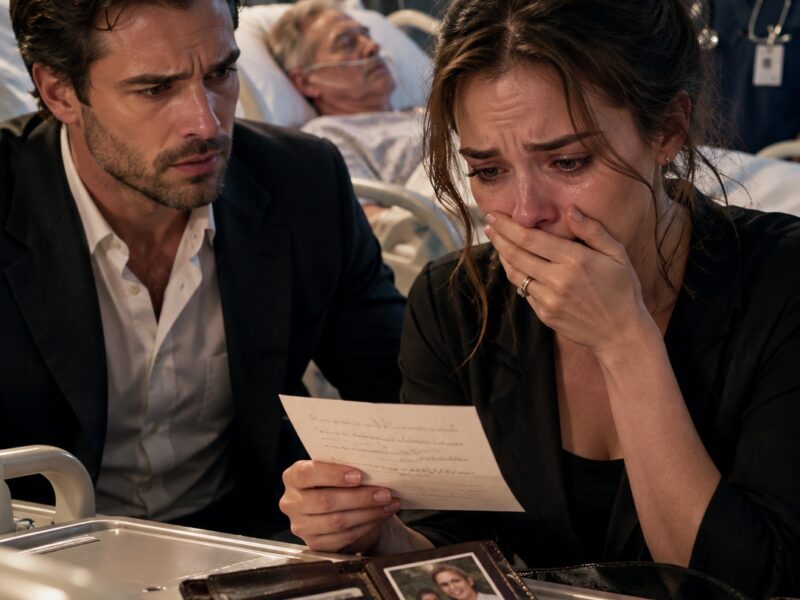
My Ex-Wife Asked Why I Was at Her Father’s Hospital Bed—Then the Nurse Handed Her What He’d Hidden in His Wallet
The hospital called me at 2:17 on a Tuesday morning, three years after my divorce.
I remember the exact time because I stared at the glowing numbers on my nightstand while a stranger said a name I had spent three years teaching myself not to miss.
“Mr. Daniel Carter?”
“Yes.”
“This is St. Matthew’s Medical Center. We have a Richard Bennett here.”
I sat upright.
For one strange second, the rain beating against my apartment windows seemed to disappear.
“What happened?”
“He was brought into the emergency department unconscious. You’re listed as one of his emergency contacts.”
I didn’t understand.
Or maybe I understood too well, and that was worse.
Richard Bennett was my former father-in-law.
Former.
That word was supposed to matter.
Three years earlier, I had signed divorce papers beside his daughter, Emily. I had packed twelve years of marriage into cardboard boxes, surrendered the key to a house where I had once believed I would grow old, and driven away while Emily stood behind a living-room curtain pretending not to watch me leave.
Her father was supposed to belong to the life I had lost.
Yet at 2:17 in the morning, when Richard was unconscious beneath hospital lights, my phone was ringing.
“Is Emily there?” I asked.
“We’ve contacted his daughter. She’s on her way.”
I was already out of bed.
The nurse was still speaking when I pulled on yesterday’s jeans.
“Mr. Carter, are you able to come in?”
“Yes.”
I didn’t think about whether I should.
I didn’t think about whether Emily would want me there.
I didn’t think about the fact that she and I had not stood in the same room for nearly two years.
I only heard Richard’s name.
And I went.
Twenty-three minutes later, I walked through the emergency entrance soaked from the shoulders down, my shoes squeaking against polished tile.
The hospital smelled like antiseptic, burned coffee, and the kind of fear nobody ever talks about because everyone recognizes it.
I saw Emily before she saw me.
She was standing beside the nurses’ station in a gray sweater and jeans, her hair twisted into a loose knot as though she had tied it with shaking hands.
For a moment, I forgot three years had passed.
Then she turned.
Her eyes found mine.
And she froze.
The paper cup in her hands stopped halfway to her mouth.
“Daniel?”
There are names you stop hearing but never stop recognizing.
The way she said mine did something painful inside my chest.
Not because it sounded loving.
It didn’t.
It sounded shocked.
Almost frightened.
Like she had opened a door in the middle of the night and found a ghost standing on the other side.
“What are you doing here?”
I stopped several feet away.
“The hospital called me.”
Her eyebrows drew together.
“What?”
“They said your dad was brought in unconscious.”
“I know that. I mean why did they call you?”
I had asked myself the same question all the way there.
“I’m still listed as his emergency contact.”
Emily stared at me.
Then she looked toward the nurses’ station as if someone there might tell her I had misunderstood.
“You’re still on his file?”
“Apparently.”
“No.”
She shook her head.
“I told him to update everything after the divorce.”
Something in the way she said it hurt more than it should have.
After the divorce.
As if there had been a formal process for erasing me.
Change the locks.
Separate the bank accounts.
Cancel the insurance.
Remove the photographs.
Delete Daniel Carter from emergency contacts.
She looked back at me.
“He told me he took care of it.”
“Well, I guess he didn’t.”
“Why wouldn’t he?”
I had no answer.
Before either of us could say another word, a doctor approached.
“Emily Bennett?”
She turned so quickly coffee spilled over the rim of her cup.
“Yes.”
“I’m Dr. Patel. I’m treating your father.”
I watched all the anger and confusion leave Emily’s face at once.
She became somebody’s terrified daughter.
“What happened?”
“Your father experienced a significant cardiac event. He was found quickly, which helped us enormously. He’s stable at the moment, but his condition is serious.”
Emily’s hand rose to her mouth.
“How serious?”
“The next several hours are going to tell us a lot.”
“Can I see him?”
“Not yet.”
“Is he awake?”
“No.”
Her shoulders folded inward.
I knew that movement.
I had seen it fourteen years earlier when her mother died.
I took one step toward her before remembering I no longer had the right to touch her.
My hand stopped uselessly at my side.
Emily noticed.
For a second, our eyes met.
Then she whispered, “I’m scared.”
It was the first completely honest sentence we had said to each other in years.
And suddenly I understood why Richard had never felt like my former father-in-law.
Because some people enter your life through paperwork.
Then they stay for reasons paperwork cannot undo.
I looked at the empty chair beside Emily.
“You don’t have to wait alone.”
She didn’t answer.
She simply sat down.
After a few seconds, I sat beside her.
Neither of us knew it yet, but Richard Bennett had left something inside his wallet that would force both of us to confront the question we had avoided for three years.
What exactly survives when a marriage dies?
And why had he chosen me to be there when the answer finally came?
I met Emily Bennett when we were twenty-two.
It happened in a cramped independent bookstore near the university, the kind of place with uneven wooden floors and handwritten recommendation cards taped beneath the shelves.
I was carrying three used economics textbooks I couldn’t afford.
Emily was sitting cross-legged on the floor in the fiction aisle.
She had a paperback open in her lap.
I noticed something strange.
She was reading the last page.
“You know that’s illegal, right?”
She looked up.
She had green eyes and a tiny crease between her eyebrows that appeared whenever she was confused.
“What is?”
“Reading the ending first.”
She glanced at the book.
“Who made that law?”
“People who respect stories.”
She smiled.
It was the first thing about her I fell in love with.
Not immediately, of course.
People say that afterward because it makes the story cleaner.
Real love is rarely clean.
It happens in fragments.
A laugh you remember longer than you should.
A phone call that lasts until two in the morning.
A cup of coffee somebody brings you without asking how you take it because they already know.
Emily closed the book.
“I always read the ending first.”
“That ruins everything.”
“No. It makes the difficult parts easier.”
“How?”
“If I know where something ends, I’m not afraid of getting lost in the middle.”
I laughed.
“You sound exhausting.”
“So do you.”
She bought the book.
I bought her coffee.
Seven years later, I married her.
For a long time, I believed I knew how our story ended too.
Emily and me, old together.
Maybe a porch.
Maybe grandchildren.
Maybe the same stupid arguments about whether the thermostat should be set at sixty-eight or seventy.
I never imagined there would be a courthouse parking lot.
I never imagined cardboard boxes.
And I certainly never imagined that three years after signing our divorce papers, I would be sitting beside her beneath fluorescent hospital lights because her father had refused to delete my phone number.
Richard Bennett had liked me before Emily was willing to admit she did.
He was a retired mechanic by the time we became serious, though “retired” was mostly a technical description.
His garage looked like a small-town repair shop.
Tools hung in careful rows above the workbench. Coffee cans were filled with screws and bolts. Old license plates covered one wall. A faded calendar from a parts supplier was permanently stuck on a year nearly a decade old because Richard liked the photograph of a 1967 Mustang on it.
His hands were permanently rough.
His jokes were terrible.
His coffee could strip paint.
The first time Emily brought me home, Richard opened the front door, looked me up and down, and said, “You the bookstore guy?”
I looked at Emily.
She turned red.
Apparently I had been discussed.
“Yes, sir.”
“Don’t call me sir. Makes me feel like I should own land.”
Then he shook my hand.
He squeezed hard enough to test me.
I squeezed back.
He grinned.
“Come in.”
That was Richard.
He pretended not to be sentimental because sentiment embarrassed him.
But he remembered birthdays.
He saved ticket stubs.
He kept every card Emily had ever given him.
And when I proposed to her four years later, he pulled me into the garage before dinner.
I thought I was about to receive the father-of-the-bride threat.
Instead he handed me a beer.
“You love her?”
“Yes.”
“You sure?”
“Yes.”
“You know she gets mean when she’s hungry?”
“I know.”
“And she’ll tell you she doesn’t need help carrying something even while actively dropping it?”
“I know that too.”
Richard stared at me for several seconds.
Then he nodded.
“Okay.”
“Okay?”
“You’re not just marrying my daughter, Daniel.”
His voice changed.
“You’re becoming my son.”
I laughed because I didn’t know what else to do.
Richard didn’t.
He meant it.
And over the years, he proved it in a hundred ordinary ways.
He taught me to change brake pads.
He showed me how to repair drywall after I confidently punched through a pipe while trying to install a bathroom shelf.
He taught me to make eggs the way he liked them on Sunday mornings.
Whenever Emily and I visited, there were three coffee cups waiting.
Never two.
Never “one for my daughter and one for her husband.”
Three.
Family.
That was what I became.
Which was why losing Emily eventually felt like losing an entire country.
I didn’t just lose my wife.
I lost Sunday breakfasts.
Christmas mornings at Richard’s house.
The garden Emily’s mother had planted.
The old truck in the driveway.
The photographs in the hallway.
The familiar squeak in the third stair.
I lost a language of ordinary things.
The worst part was that nobody had betrayed anybody.
Sometimes I wished they had.
People understand betrayal.
A mistress.
A secret account.
A hidden phone.
A devastating lie.
Those things give pain a villain.
Our marriage had no villain.
It had exhaustion.
And silence.
And two people who loved each other while slowly becoming incapable of giving each other what they needed.
I took a management position at thirty-three.
The salary was nearly twice what I had been making.
I thought Emily would be thrilled.
We had student loans.
A mortgage.
Her nursing schedule was unpredictable.
We had spent years talking about traveling, fixing the kitchen, building savings, maybe having children once life felt stable.
The promotion looked like stability.
At least to me.
For the first six months, I worked fifty-five hours a week.
Then sixty.
Then more.
I started leaving before Emily woke up.
I started coming home after she had eaten.
I answered emails in bed.
I took calls during dinner.
Whenever she complained, I heard accusation instead of loneliness.
“We need the money,” I would say.
“We need you.”
“I’m doing this for us.”
“You keep saying that.”
“Because it’s true.”
“No, Daniel. You’re doing this for some future version of us you’ve invented.”
“What does that even mean?”
“It means I’m married to a man who keeps sacrificing our life so we can afford to have a better one someday.”
I thought she was being unfair.
That was my favorite word back then.
Unfair.
Her expectations were unfair.
Her frustration was unfair.
Her anger when I missed dinner was unfair.
Her disappointment when I canceled a weekend trip because of work was unfair.
It took losing her to understand she had not been asking for vacations or gifts.
She had been asking me to notice that she was lonely.
Once, on our ninth anniversary, I came home nearly three hours late.
There were two plates on the table.
One was untouched.
The candles had burned down until wax covered the holders.
Emily was sitting on the couch in sweatpants.
I walked in carrying flowers from a grocery store that stayed open late.
“Em, I’m sorry.”
She looked at the bouquet.
“What are those?”
“Peace offering.”
“For what?”
I almost laughed.
“For being late.”
“No.”
She shook her head.
“What are they for?”
I set my briefcase down.
“I just told you.”
“No, Daniel. You think flowers are a receipt. You buy them and the debt disappears.”
“That’s not fair.”
There it was.
She looked at me for a long time.
Then she said quietly, “Do you know what scares me?”
I said nothing.
“I think one day you’re going to finally have enough money, enough promotions, enough security… and you’re going to come home and discover there’s nobody here to share it with.”
I should have listened.
Instead I got defensive.
I told her she didn’t appreciate how hard I worked.
She told me I didn’t understand what marriage meant anymore.
We slept facing opposite walls.
Neither of us apologized the next morning.
That became another pattern.
Not explosions.
Sediment.
Tiny resentments settling over everything until eventually we could no longer see the bottom.
Richard noticed.
Of course he did.
One Sunday afternoon, he found me alone in his garage pretending to inspect the engine of his pickup.
“You hiding?”
“No.”
“Then you’re doing a convincing impression.”
I wiped my hands on a rag.
“Emily’s mad.”
“She’s been mad for six months.”
“Thanks.”
“You want me to lie?”
“No.”
Richard leaned against the workbench.
“You love her?”
I stared at him.
“What kind of question is that?”
“The kind men get offended by when they’re scared of the answer.”
“Yes. I love her.”
“Then go home.”
“We are home.”
“You know what I mean.”
I shook my head.
“You don’t understand.”
“Probably not.”
He picked up a wrench and examined it.
“But I know my daughter.”
“So do I.”
“Maybe that’s the problem.”
I looked at him.
Richard set the wrench down.
“You both know the version of each other you’ve already decided is true. She thinks you care more about work. You think she doesn’t appreciate what you’re doing. Every argument starts with the verdict already written.”
I wanted to dismiss him.
Instead I asked, “What am I supposed to do?”
“Listen before you defend yourself.”
“That simple?”
“No.”
He smiled sadly.
“Simple things are usually the hardest.”
I wish I could tell you I went home that night and saved my marriage.
I didn’t.
People rarely change because someone gives them one good piece of advice.
Usually we change after consequences make the old version of ourselves too painful to keep being.
Mine came eighteen months later.
Emily was sitting at the kitchen table.
No candles.
No shouting.
No tears.
Just an envelope.
When I saw it, I knew.
She didn’t even have to speak.
“I talked to an attorney.”
I remained standing.
“Why?”
Her eyes closed.
“Please don’t make me explain everything again.”
“We can fix this.”
“We’ve been fixing it for three years.”
“I’ll quit.”
She gave me the saddest smile I had ever seen.
“You said that last year.”
“I mean it now.”
“And what happens six months from now when you’re scared about money again?”
“I’ll change.”
“I believe you believe that.”
“Emily—”
“I’m tired, Daniel.”
That sentence defeated me.
Not “I hate you.”
Not “I don’t love you.”
Tired.
She looked thirty-five and eighty years old at the same time.
“I don’t want to hate you,” she whispered. “And I think if we keep doing this, eventually I will.”
I sat across from her.
For the first time in years, I had nothing to defend.
“Do you still love me?”
She began crying.
That was my answer.
“Yes.”
I looked down.
“Then why are we doing this?”
“Because sometimes love isn’t the thing that’s missing.”
The divorce took four months.
We signed the final papers on a cold Thursday morning.
Outside the courthouse, Emily cried beside her car.
I watched from across the parking lot.
Every instinct told me to go to her.
But I had spent years learning too late when she needed me.
Now I didn’t know whether I was the person she needed comfort from or the person she needed comfort because of.
So I got into my car.
I sat there until almost everyone had left.
Then I drove away.
Two days later, Richard called.
I stared at his name for almost a minute before answering.
“Hey.”
“You eat yet?”
That was all he said.
I nearly broke.
“Richard—”
“I made too much chili.”
“You don’t have to do this.”
“Do what?”
“Pretend nothing changed.”
He went quiet.
Then he said, “Everything changed.”
I swallowed.
“Then maybe you shouldn’t call me anymore.”
“Why?”
“Because she’s your daughter.”
“She is.”
“And I’m her ex-husband.”
“You are.”
I waited.
Richard sighed.
“Daniel, a marriage ending doesn’t turn every good thing that happened before it into garbage.”
“I don’t want to make this harder for Emily.”
“Then don’t.”
“That might mean staying away.”
“From her, maybe.”
His voice hardened slightly.
“But don’t tell me who I’m allowed to care about.”
I closed my eyes.
“Richard—”
“I meant what I told you before the wedding.”
I couldn’t answer.
“You became my son.”
“The marriage is over.”
“I noticed.”
Despite myself, I laughed.
He continued.
“I’m not asking you to come over every Sunday. I’m not asking you to chase Emily. I’m telling you that if you think I’m going to pretend twelve years didn’t happen because a judge stamped a piece of paper, you’re giving that judge way too much power.”
That was Richard.
After the divorce, I stopped visiting the house.
Emily needed space, and I respected that.
But Richard called every few months.
Usually about nothing.
His truck.
Football.
A faucet.
Some politician he was angry at.
Whether I was eating properly.
Whether I was working too much.
I always said I was fine.
He always said, “Bull.”
Then we would change the subject.
Three years passed like that.
I built a new life.
Technically.
I moved into a downtown apartment with floor-to-ceiling windows.
I bought furniture Emily had never chosen.
I changed jobs.
I stopped working weekends.
I learned to cook for one.
Or at least I learned to prepare food for one.
Eating was different.
For almost a year, I ate dinner standing beside the kitchen counter because sitting alone at a table felt too much like admitting nobody else was coming.
I dated twice.
Neither relationship lasted.
Not because I was secretly waiting for Emily.
At least that was what I told myself.
I simply didn’t know how to explain to another woman that I had once loved someone enough to marry her and had still managed to lose her without either of us doing anything unforgivable.
Then came 2:17 on a rainy Tuesday morning.
And suddenly I was sitting beside Emily again.
For the first hour in the hospital, we barely spoke.
Emily stared at the double doors leading into the cardiac unit.
I stared at the vending machines across the hallway.
Every few minutes, somebody in scrubs passed us.
Each time, Emily straightened.
Each time, they continued walking.
Eventually I noticed she was shivering.
“Are you cold?”
“No.”
“You’re shaking.”
“I’m fine.”
It sounded exactly like Richard.
I stood.
“Where are you going?”
“To get you a blanket.”
“I said I’m fine.”
“And I’ve heard that particular lie from your father enough times to recognize it.”
For the first time that night, something changed in her expression.
Almost a smile.
Almost.
I returned with a thin hospital blanket.
She let me place it beside her but didn’t use it.
Ten minutes later, she pulled it over her knees.
I pretended not to notice.
Around four, I bought two coffees.
She accepted hers.
“You remembered.”
“Two sugars. No cream.”
She stared at the cup.
“Three years.”
“Some things stick.”
She looked away.
That silence had a different weight.
Eventually she asked, “Did Dad call you?”
“Sometimes.”
“How often?”
“Every few months.”
Her eyes moved back to mine.
“What did you talk about?”
“Mostly things he could complain about.”
“That doesn’t narrow it down.”
I laughed softly.
Neither of us expected it.
Emily almost laughed too.
Then her face changed.
“Why didn’t you tell me?”
“That your dad called?”
“Yes.”
“How exactly was that conversation supposed to happen?”
She looked down.
I continued.
“You asked for space, Em. I gave it to you.”
“I didn’t ask you to keep a relationship with my father secret.”
“It wasn’t secret.”
“It feels like it.”
“Would you have wanted to know?”
She opened her mouth.
Nothing came out.
I didn’t push.
A minute later, she said, “I asked him more than once to change the emergency contact.”
I nodded.
“He always said he would.”
“He apparently lied.”
“He didn’t lie.”
I looked at her.
Emily rubbed her thumb against the coffee cup.
“He’d say, ‘Yeah, yeah, I’ll take care of it.’ Then he’d change the subject.”
“That sounds like lying with extra steps.”
This time she did laugh.
It lasted less than a second.
Then tears filled her eyes.
“I was so angry at him.”
“For keeping my number?”
“Yes.”
The honesty surprised me.
She looked ashamed of it.
“I thought he was refusing to accept the divorce.”
“Maybe he was.”
“No.”
She shook her head.
“I think I wanted that to be the reason.”
“Why?”
“Because then I could be angry.”
Her voice became quieter.
“Anger was easier.”
I understood that more than she knew.
Before I could answer, the doors opened.
Both of us stood.
It was only a nurse.
She walked toward us carrying a clear plastic belongings bag.
“Ms. Bennett?”
“Yes.”
“These are your father’s personal effects.”
Emily took the bag.
Inside were Richard’s keys, his watch, his wallet, loose change, and the pocketknife he had carried for as long as I had known him.
Seeing those ordinary objects inside hospital plastic made my stomach twist.
Human beings spend decades gathering things.
Then one terrible morning, everything they had in their pockets gets sealed inside a transparent bag.
Emily touched his watch through the plastic.
“He never takes this off.”
“I know.”
“It was Mom’s last Christmas present to him.”
“I remember.”
Her eyes flicked toward me.
Of course I remembered.
I had been there.
The nurse hesitated.
“There was also a folded card inside his wallet. The physician thought you might need it. It has some medical information.”
Emily opened the bag.
Her fingers trembled as she pulled out Richard’s worn brown wallet.
She knew exactly where he kept things.
Cash on the right.
Driver’s license behind the clear plastic.
Insurance card in the center.
Photographs tucked behind everything else.
Then she found the folded piece of paper.
She opened it.
I watched her eyes move across Richard’s handwriting.
Her face changed.
“What?”
She didn’t answer.
“Emily?”
She looked at me.
Then back at the card.
At the top was Richard’s name.
Blood type.
Medication.
Allergies.
His doctor.
Emily’s number was listed first.
Mine was second.
But that wasn’t what had made her stop breathing.
Under our names, Richard had written one sentence.
If anything happens to me, call Daniel too. He knows when I’m pretending to be fine.
Emily read it again.
Then again.
Her mouth trembled.
“Oh, Dad.”
She pressed the card against her chest and began to cry.
Not the restrained tears from earlier.
These were the kind that came from somewhere old.
I stared at Richard’s handwriting.
He knows when I’m pretending to be fine.
Suddenly I was standing in his garage years earlier.
Richard telling me to listen before defending myself.
Richard asking if I was hiding.
Richard calling every few months and refusing to believe me when I said I was fine.
He had seen me.
That was his gift.
And sometimes his curse.
He noticed the things people worked hardest to hide.
Emily wiped her face.
“Did you know?”
“No.”
“He still calls you his son.”
My throat tightened.
“What?”
“When he talks to people.”
She looked down at the card.
“Mr. Peterson next door asked me about you last Christmas. He said Dad told him his son Daniel had changed jobs.”
I couldn’t speak.
“I corrected him.”
Emily gave a broken laugh.
“I said, ‘Daniel isn’t his son. He’s my ex-husband.’”
She looked at me.
“Dad got so angry.”
I could picture it.
“What did he say?”
“He told me those things weren’t mutually exclusive.”
Despite everything, I smiled.
“Sounds like him.”
“I hated it.”
The smile disappeared.
Emily’s voice dropped.
“I hated hearing your name in that house.”
I let that sentence land.
She looked terrified that I would misunderstand.
“Not because I hated you.”
“I know.”
“No, you don’t.”
She wiped at her eyes.
“I hated that everything kept reminding me there had been a time when we were happy. Your coffee mug was still in the cabinet. Dad kept that stupid socket wrench you gave him for Father’s Day. Mrs. Peterson would ask how you were. There were pictures I couldn’t throw away because Dad wanted them.”
She looked down at the card.
“And every time I saw one, I felt like the divorce hadn’t finished.”
I said quietly, “Maybe divorces don’t finish the way we think they do.”
Her eyes lifted.
“What does that mean?”
“I don’t know.”
That was the truth.
She looked at Richard’s handwriting again.
“I thought Dad kept you on this because he wanted us back together.”
“Did he?”
“I don’t think so.”
“Why not?”
“Because he never once told me to call you.”
That surprised me.
“Never?”
“Not once.”
She shook her head.
“He never told me I made a mistake. Never told me to reconsider. Never told me you had changed. Nothing.”
Emily swallowed.
“He just refused to act like you had died.”
There was something devastating about the sentence.
Because in a way, that was exactly what divorce had felt like.
A death with no funeral.
No obituary.
No permission to grieve publicly because the person was still alive somewhere, drinking coffee, buying groceries, laughing at jokes you would never hear.
I sat back down.
Emily sat beside me.
For several minutes, neither of us spoke.
Then she whispered, “I was angry at you for so long.”
“I know.”
“No. I mean after.”
I waited.
“I blamed you because it was easier than admitting I had failed too.”
I looked at her.
“You didn’t fail alone.”
“I know that now.”
Her eyes remained fixed on the floor.
“I wanted you to fight harder when I asked for the divorce.”
That sentence hit me harder than anything else she had said.
“You looked exhausted.”
“I was.”
“You wanted out.”
“I did.”
“Then what was I supposed to do?”
“I don’t know.”
She finally looked at me.
“That’s the terrible part. I wanted you to respect me and fight for me at the same time.”
“Emily—”
“I know it isn’t fair.”
There was that word again.
Except now neither of us was using it as a weapon.
“I sat in my car after the courthouse,” I said.
Her expression changed.
“For how long?”
“Until the parking lot was almost empty.”
“Why?”
“Because you were crying.”
“You saw me?”
“Yes.”
“Why didn’t you come over?”
I laughed once, without humor.
“Because I thought you’d spent years telling me I didn’t know what you needed. I was afraid comforting you would just be one more thing I got wrong.”
Emily stared at me.
“I waited.”
My heart stopped.
“What?”
“For maybe ten minutes.”
She blinked rapidly.
“I kept thinking you’d come over.”
Neither of us moved.
Three years.
Three years separated us from two people sitting in different cars less than a hundred feet apart, each waiting for the other to cross the distance.
Eventually Emily whispered, “God, we were terrible at this.”
A laugh escaped me.
Then another.
She started laughing too.
We were both crying by the time it stopped.
And that was when the doctor returned.
His expression told us immediately this wasn’t a casual update.
Emily stood.
I followed.
Dr. Patel looked from her to me.
“Your father’s rhythm has become unstable again.”
The world narrowed.
“What does that mean?” Emily asked.
“We’re treating it aggressively, but there’s a possibility we’ll need to move faster than we anticipated.”
“Surgery?”
“Potentially.”
“Is he dying?”
The doctor paused.
Doctors have a way of answering terrible questions carefully.
“We are doing everything we can.”
Emily’s hand found mine.
Neither of us noticed until we were already holding on.
Dawn arrived without anyone inviting it.
A gray line appeared beyond the waiting-room windows.
The rain slowed.
The hospital gradually changed shifts.
Fresh nurses replaced exhausted ones.
The coffee got worse.
For three hours, we knew almost nothing.
Emily slept for eleven minutes with her head against my shoulder.
When she woke, she pulled away immediately.
“Sorry.”
“You don’t have to apologize.”
“I wasn’t—”
“I know.”
She stared at me.
Then, deliberately, she leaned back against my shoulder.
I didn’t move.
It wasn’t romance.
That mattered.
We weren’t two divorced people rediscovering love beneath cinematic hospital lights.
We were two frightened people who had once known the exact shape of each other’s bodies in sleep.
There was comfort in that familiarity.
And danger.
I knew both.
At 7:43, Dr. Patel returned.
This time he was smiling.
Not much.
Enough.
“Your father is responding.”
Emily stood so fast the blanket fell to the floor.
“What happened?”
“We’ve stabilized his rhythm. He still has a difficult road ahead, and I don’t want to minimize the seriousness of what happened, but I’m more optimistic than I was a few hours ago.”
Emily covered her face.
I exhaled for what felt like the first time since 2:17.
“Can we see him?”
“Briefly.”
We followed the doctor down the hallway.
The room was dim.
Machines surrounded Richard.
He looked smaller than I had ever seen him.
That frightened me more than the monitors.
Richard had always seemed physically permanent.
Even at seventy, he moved like a man who expected his body to obey.
Now tubes ran beneath his nose.
Electrodes covered his chest.
His skin looked gray.
Emily went immediately to his right side.
“Dad?”
His eyelids moved.
“Dad, it’s me.”
His eyes slowly opened.
Emily began crying.
“Hi.”
Richard looked at her.
Then his eyes moved past her.
Toward me.
I was standing near the foot of the bed.
I suddenly felt like an intruder.
Maybe the emergency was over.
Maybe this was where I was supposed to leave.
I took half a step backward.
Richard lifted his left hand.
Barely.
His fingers moved.
I stared at him.
“Me?”
His eyebrows tightened in irritation.
Even half-conscious after nearly dying, Richard Bennett apparently had no patience for stupid questions.
I walked closer.
He reached for my hand.
His grip was weak.
But unmistakable.
I swallowed hard.
“You scared the hell out of us.”
His mouth moved.
No sound came out.
Emily leaned closer.
“What?”
Richard tried again.
“Truck.”
I stared at him.
“Your truck?”
A tiny nod.
“You almost die and you’re worried about that piece of junk?”
Richard’s eyes narrowed.
Emily laughed through her tears.
I squeezed his hand.
“You’re not allowed to go anywhere until you teach me why the engine keeps knocking.”
A faint smile appeared.
Emily looked at us.
And for several seconds, something impossible happened.
There was no divorce.
Not because it had been erased.
Not because we had gone backward.
It simply wasn’t the most important thing in the room.
We were three people who had once been a family.
And for those few seconds, perhaps we still were.
Richard underwent surgery two days later.
It was successful.
Recovery was not.
He hated the hospital.
He hated the food.
He hated being told when to sleep.
He hated the physical therapist, which meant he secretly respected her.
By the fourth day, he was complaining enough that everyone agreed he was improving.
I visited after work.
The first time I walked into his room alone, he looked at me and said, “Took you long enough.”
“You’ve been unconscious for half the week.”
“Excuses.”
I pulled up a chair.
“You know you caused a lot of trouble.”
“So I’ve heard.”
“Why was I still your emergency contact?”
He looked at me.
I waited.
Richard turned his attention toward the window.
“Didn’t get around to changing it.”
“Bull.”
His mouth twitched.
“Learned that from me?”
“Yes.”
“Good.”
“Richard.”
He sighed.
“What?”
“You knew Emily wanted you to remove me.”
“Yep.”
“And you didn’t.”
“Nope.”
“Why?”
He stared at his hands.
For once, Richard Bennett seemed unsure what to say.
Finally he asked, “You want the truth?”
“I’d prefer it.”
“You answer your phone.”
I laughed.
“That’s it?”
“No.”
He looked at me.
“You show up.”
Something in his tone made me stop smiling.
“When?”
“When it matters.”
“Richard—”
“Don’t make it complicated.”
“It is complicated.”
“No. You and Emily made everything complicated.”
“That seems unfair.”
“There’s that word.”
I stared at him.
He smiled.
He remembered.
Of course he did.
Richard leaned back.
“You know why I liked you for her?”
“Because of my charming personality?”
“No. Never understood what she saw there.”
I rolled my eyes.
He continued.
“Because when something mattered, you showed up.”
I almost argued.
Hadn’t the entire failure of my marriage been about not showing up?
Richard seemed to read the thought.
“You stopped doing it for a while.”
There it was.
“But you weren’t always that man.”
He looked toward the door.
“And she wasn’t always the woman who stopped asking.”
I lowered my eyes.
“I hurt her.”
“Yep.”
“She hurt me too.”
“Yep.”
“You have anything more helpful?”
“Nope.”
I laughed.
Then he said quietly, “You two spent years deciding somebody had to be guilty.”
I looked at him.
“Maybe nobody was.”
“That doesn’t make it hurt less.”
“No.”
Richard shook his head.
“But it might make forgiveness easier.”
I didn’t answer.
A moment later the door opened.
Emily walked in carrying a paper bag.
She stopped when she saw me.
Then she smiled.
Not the careful smile from the hospital corridor.
Something warmer.
“Hey.”
“Hey.”
Richard looked between us.
Then he closed his eyes.
“What?” Emily asked.
“Nothing.”
“Dad.”
“I’m recovering.”
“From what?”
“Your interrogation.”
She handed him the bag.
“I brought your glasses.”
“Thank God.”
“And clean pajamas.”
“Less important.”
“And the emergency card from your wallet.”
Richard opened one eye.
Emily placed it on his blanket.
“You and I are going to discuss this.”
He closed his eye again.
“Cardiac patient.”
“You’re exploiting this.”
“Absolutely.”
I stood.
“I should let you two talk.”
Richard opened both eyes.
“Sit down.”
Emily and I exchanged a look.
I sat.
She crossed her arms.
“Why did you keep Daniel listed?”
Richard looked at the card.
Then at his daughter.
“Because he’s Daniel.”
“That is not an answer.”
“It is if you stop demanding a different one.”
Emily’s jaw tightened.
“Dad, we’re divorced.”
“I know.”
“Then why keep doing things like this?”
“Like what?”
“Keeping his number. Talking about him. Keeping pictures.”
Richard studied her.
“You want me to throw away every photograph he’s in?”
“No.”
“Pretend he wasn’t at your mother’s funeral?”
Emily flinched.
“That’s not what I’m saying.”
“Pretend he didn’t spend twelve Christmases here?”
“No.”
“Pretend I didn’t love him?”
Silence.
Richard’s voice softened.
“You divorced him, Em.”
“I know.”
“I didn’t.”
The words sat between us.
Emily looked down.
Richard continued.
“That doesn’t mean I wanted you back together.”
She looked up.
“I thought you did.”
“No.”
“You never said that.”
“You never asked.”
Her expression tightened.
“You knew I was angry.”
“Yep.”
“And you let me think—”
“I let you think whatever you needed to think.”
“Why?”
“Because you were hurting.”
Emily’s eyes filled.
“So was he.”
Richard nodded toward me.
“So was I.”
Nobody spoke.
Then Richard said something I would remember for the rest of my life.
“Ending a marriage changes what people are to each other. It doesn’t give you the right to rewrite what they were.”
Emily wiped her cheek.
Richard tapped the emergency card.
“I kept Daniel’s number because if I called him at two in the morning, he’d come.”
He looked at me.
“And he did.”
Emily turned toward me.
I couldn’t hold her gaze.
Richard leaned back, exhausted.
“Now both of you get out. I need sleep.”
“Dad—”
“Doctor’s orders.”
“The doctor did not tell us to leave.”
“My orders.”
I stood.
Emily kissed his forehead.
At the door, Richard called my name.
I turned.
“Truck.”
I shook my head.
“You are unbelievable.”
His grin followed me into the hallway.
Richard’s recovery took months.
During those months, Emily and I became part of each other’s lives again in the least romantic way imaginable.
Medication schedules.
Cardiology appointments.
Grocery lists.
Physical therapy.
Insurance forms.
Richard’s front steps needed repair because he refused to use the side entrance with the safer railing.
I replaced three boards one Saturday.
Emily arrived carrying sandwiches.
“You’re doing it wrong.”
I looked up.
“You’ve been here thirty seconds.”
“I’ve seen enough.”
“Would you like the hammer?”
“No.”
“Then your supervisory position has been terminated.”
She sat on the porch.
“You always hated being corrected.”
“I hated being incorrectly corrected.”
“You see? That’s exactly the problem.”
I laughed.
She smiled.
For a while, we were quiet.
Then she said, “You really did change jobs.”
I drove another screw into the wood.
“About eighteen months after the divorce.”
“Why?”
“Because you were right.”
She didn’t respond.
I looked at her.
“Don’t look so shocked.”
“I’ve waited fourteen years to hear that sentence.”
“I was working too much.”
Emily’s smile faded.
“Did you change because of me?”
“Partly.”
“Daniel…”
“Not to get you back.”
She relaxed slightly.
“I realized I had built my whole identity around being useful.”
“What do you mean?”
“If I made enough money, solved enough problems, fixed enough things, then nobody could accuse me of failing.”
Emily stared at me.
“But the more afraid I became of failing you, the more I worked.”
“And the more you worked…”
“The more I failed you.”
She looked down.
“I wish you’d told me.”
“I didn’t know.”
That was one of the cruelest truths about growing older.
Sometimes the explanation arrives after it can no longer save anything.
Emily picked at the edge of the sandwich wrapper.
“I wasn’t innocent either.”
“I never said you were.”
She gave me a look.
“Still annoying.”
“Some things stick.”
She smiled again.
Then she said, “I stopped telling you what I needed.”
“You tried.”
“At first.”
Her voice softened.
“Eventually I started testing you instead.”
I frowned.
“How?”
“I’d tell myself, ‘If he really loves me, he’ll notice I’m upset.’ Or ‘If he really wants to spend time with me, he’ll cancel the meeting without me asking.’”
I sat beside her.
“And when I didn’t…”
“It proved whatever terrible thing I already believed.”
I thought about Richard’s garage.
Every argument starts with the verdict already written.
“He saw it,” I said.
“Dad?”
I nodded.
“Years before we did.”
Emily sighed.
“He usually does.”
That afternoon, we ate sandwiches on Richard’s porch.
Nothing happened.
No kiss.
No declaration.
No music swelling somewhere in the background.
And because nothing happened, it meant more.
For the first time since our divorce, we could occupy the same silence without using it to punish each other.
A few weeks later, Richard asked me to help him sort through boxes in the living room.
“Why?”
“Because apparently nearly dying means my daughter thinks I should organize my life.”
“She has a point.”
“You’re supposed to be on my side.”
“I was specifically informed that the divorce means I don’t have to be anymore.”
He laughed.
We spent most of the afternoon going through old photographs.
Emily as a baby.
Emily missing her front teeth.
Richard and his late wife, Susan, standing beside Niagara Falls.
A Christmas morning.
A fishing trip.
Then I found our wedding photograph.
Emily was laughing.
Her head was tilted toward mine.
I was looking at her instead of the camera.
Richard stood behind us with one hand on each of our shoulders.
I stopped.
“You kept this out?”
“Why wouldn’t I?”
“You know why.”
He studied the photograph.
“That was a good day.”
“It didn’t exactly work out.”
Richard looked at me.
“So?”
I almost smiled.
“You make everything sound simple.”
“No. You make everything sound like it needs a verdict.”
He took the photograph from me.
“You think because your marriage ended, you weren’t happy here?”
“We were.”
“You think Emily was faking that laugh?”
“No.”
“You think I was pretending to love having you as family?”
My throat tightened.
“No.”
“Then why would I throw this away?”
“Because you know how it ended.”
Richard ran his thumb along the edge of the frame.
“Son, an ending doesn’t travel backward in time.”
I stared at him.
He continued.
“This happened.”
He tapped the photograph.
“You were happy. She was happy. I was happy. Your marriage ending badly doesn’t make that day a lie.”
I couldn’t speak.
Richard put the photograph back on the shelf.
“You young people are always trying to make life neat. Good relationship. Bad relationship. Success. Failure. Married. Divorced.”
He shook his head.
“Life doesn’t care about your categories.”
“What category am I?”
Richard looked at me as though the answer were obvious.
“Daniel.”
I laughed.
But my eyes burned.
He returned to the box.
Conversation over.
That evening, driving home, I thought about the wedding photograph.
For years, I had avoided looking at pictures of Emily because every happy memory felt like evidence against me.
Evidence of what I had lost.
Evidence of what I had failed to protect.
Richard saw it differently.
A good memory wasn’t an accusation.
It was simply proof that something good had existed.
Maybe healing wasn’t learning to forget.
Maybe it was learning to remember without putting yourself on trial.
By early fall, Richard was home for good.
His cardiologist approved short walks.
Richard interpreted “short walks” as permission to resume every activity he had been forbidden to do.
Emily caught him carrying a bag of soil across the backyard.
She nearly exploded.
“What are you doing?”
“Gardening.”
“You had heart surgery.”
“Months ago.”
“You are not carrying forty-pound bags.”
“It’s thirty-two.”
“That is not the point!”
I was standing beside the porch trying not to laugh.
Emily pointed at me.
“Don’t encourage him.”
“I haven’t said anything.”
“Your face is encouraging him.”
Richard looked at me.
“She’s always been bossy.”
“Dad!”
“Heart patient.”
“You don’t get to use that forever.”
“Watch me.”
I took the bag from him.
“Go sit down.”
Richard glared.
“You too?”
“Especially me.”
He muttered something about betrayal and lowered himself into a chair.
Emily handed him water.
The garden looked almost exactly as I remembered.
Susan’s roses still grew along the fence.
Richard had refused to replace them even after maintaining them became difficult.
He said some things deserved extra work.
Emily and I stood beside the flower bed while he pretended not to be tired.
The afternoon sun moved through the leaves.
For a moment, I felt something I hadn’t experienced in years.
Peace.
Not happiness exactly.
Happiness can be loud.
Peace is quieter.
It asks less.
Emily looked at me.
“Thank you.”
“For confiscating the dirt?”
“For coming that night.”
I knew immediately which night.
“You don’t have to thank me.”
“Yes, I do.”
“Emily—”
“You could have ignored the call.”
“No.”
“You could have decided he wasn’t your responsibility anymore.”
“He wasn’t.”
She looked surprised.
I continued.
“That’s why I came.”
“I don’t understand.”
“Responsibility wasn’t the reason.”
She waited.
“I came because it was Richard.”
Her eyes softened.
“That was enough.”
She looked toward her father.
He was pretending to inspect a rose while obviously listening to us.
Emily noticed too.
“Stop eavesdropping.”
“I can’t hear anything.”
“You’re fifteen feet away.”
“Heart surgery damaged my hearing.”
“No, it didn’t.”
Richard shrugged.
Emily laughed.
Then she looked back at me.
“For a long time, I thought divorce meant I had to erase everything.”
“I know.”
“I deleted pictures.”
“So did I.”
“I put your things in boxes.”
“I threw away that blue chair you hated.”
She gasped.
“You loved that chair.”
“It was hideous.”
“I told you.”
“Don’t ruin the moment.”
She smiled.
Then the smile faded into something gentler.
“I thought moving forward meant proving none of it mattered anymore.”
I understood.
“I did too.”
“But it did matter.”
“Yes.”
Her eyes held mine.
“We mattered.”
Past tense.
For once, it didn’t hurt.
“Yes,” I said. “We did.”
Emily looked down.
“And maybe we still do.”
I said nothing.
She glanced toward Richard.
“Just differently.”
There it was.
Not reconciliation.
Not a promise.
Something more honest.
We had spent years believing there were only two possible endings.
Stay married.
Or become strangers.
Richard had understood a third possibility before either of us did.
Love could change shape.
A family could break without every bond inside it disappearing.
Forgiveness didn’t require reunion.
Moving forward didn’t require pretending the past had meant nothing.
Emily looked at me.
“Do you ever wonder?”
“About us?”
She nodded.
“Sometimes.”
“What do you think?”
I considered lying.
Then I remembered how much lying by omission had cost us.
“I think I don’t want to turn this into another expectation.”
She exhaled.
“Me neither.”
“If something happens someday…”
“We’ll let it happen.”
“And if it doesn’t?”
She looked toward her father.
“Then maybe this is enough.”
Richard called from across the garden.
“Daniel.”
“What?”
“Tell her I’m allowed to water the roses.”
“You’re allowed to water the roses.”
Emily stared at me.
I added, “While sitting down.”
Richard cursed.
Emily laughed.
And I realized I hadn’t heard that particular laugh in years.
The same laugh from the bookstore.
The same laugh in our wedding photograph.
I didn’t need to own it anymore.
I didn’t need to know what it meant.
I was simply grateful it still existed.
Winter came.
Richard got stronger.
Emily and I developed a strange, comfortable rhythm.
Sometimes we had coffee after his appointments.
Sometimes we didn’t.
Sometimes we texted about him.
Eventually we texted about other things.
A book she thought I would like.
A photograph of Richard asleep in his recliner while insisting he had not been sleeping.
A joke about the old truck.
Nothing dramatic.
Nothing that demanded a name.
One evening, Emily called.
For half a second, seeing her name on my screen pulled me back to 2:17 that rainy morning.
I answered.
“Everything okay?”
She laughed.
“Yes.”
“Sorry. Reflex.”
“I know.”
“What happened?”
“Dad wants to know if you’re coming Sunday.”
“For what?”
“Breakfast.”
I leaned against my kitchen counter.
Sunday breakfast.
Three words capable of opening an entire room inside my memory.
“Why?”
“Apparently he needs someone who knows how not to burn his eggs.”
“He taught me.”
“I know.”
“Are you going to be there?”
A pause.
“Yes.”
I looked at the empty dining table across my apartment.
For years, I had avoided sitting there alone.
Some habits survive long after their reasons disappear.
“Then I’ll come.”
“Okay.”
Another pause.
“Daniel?”
“Yeah?”
“I’m glad he never changed the number.”
I closed my eyes.
“Me too.”
We hung up.
Sunday morning, I drove to Richard’s house.
The old truck was still in the driveway.
The roses were dormant.
A thin layer of frost covered the lawn.
Before I reached the porch, the door opened.
Richard stood there wearing an old flannel shirt.
“You’re late.”
I checked my watch.
“I’m four minutes early.”
“Should’ve been six.”
Behind him, Emily appeared.
“Don’t listen to him.”
“I never do.”
Richard stepped aside.
For one second, I stood at the threshold.
I had crossed that doorway thousands of times during my marriage.
As a boyfriend.
A fiancé.
A husband.
A son-in-law.
A divorced man who believed he no longer belonged.
Now I wasn’t sure what I was.
Maybe Richard had been right.
Maybe not everything needed a category.
I walked inside.
Three coffee cups were waiting on the kitchen table.
I stopped.
Richard noticed.
He said nothing.
Neither did Emily.
She simply picked up the cup that had always been mine and held it toward me.
I took it.
“Two sugars,” she said.
“No cream.”
“Some things stick.”
I smiled.
Outside, morning light spread slowly across the frozen garden.
Inside, Richard complained about my eggs.
Emily laughed.
And for once, I didn’t wonder whether this was the beginning of something new or the return of something old.
I didn’t need to read the last page first.
That had been Emily’s habit, not mine.
Maybe neither of us needed it anymore.
Three years earlier, I had believed our divorce was an ending so complete that everything before it had become painful evidence of failure.
Richard had known better.
That was why my number remained folded inside his wallet.
Not because he expected me to marry his daughter again.
Not because he refused to accept reality.
Not because he was secretly trying to put a broken marriage back together.
He kept my number because once, years earlier, he had told me I was his son.
And unlike the rest of us, Richard did not believe love became meaningless simply because its circumstances changed.
I still don’t know what happened next for Emily and me.
Maybe that’s the wrong question.
Maybe some relationships deserve to exist without being forced toward an ending.
What I know is this:
At 2:17 on a rainy Tuesday morning, a hospital called a man who technically no longer belonged to a family.
And he went.
He went because an old mechanic with rough hands had once put an extra coffee cup on the table for him.
He went because twelve Christmases don’t disappear inside a courthouse.
He went because grief doesn’t understand legal definitions.
He went because there are people we stop living with without ever completely stopping loving.
And somewhere between the hospital corridor, Richard’s worn wallet, and three coffee cups waiting on a Sunday morning, Emily and I finally understood what her father had been trying to teach us.
Not every love that survives is asking to be restored.
Not every broken family needs to be rebuilt exactly as it was.
Not every ending means the story before it was a mistake.
Sometimes forgiveness is quieter than reconciliation.
Sometimes love doesn’t come back.
It simply stops hurting.
And sometimes the people who leave our lives never truly leave our hearts.
They just learn to live there differently.









