MY EX-WIFE TOLD ME TO USE THE BACK DOOR BECAUSE “PEOPLE LIKE YOU DON’T BELONG HERE”—THEN THE MAN ON STAGE SAID MY NAME
“Use the back entrance.”
Lauren Morgan didn’t lower her voice.
She didn’t need to.
The string quartet was still playing somewhere behind her, waiters were still moving between white-clothed tables with champagne balanced on silver trays, and more than two hundred people filled the glass ballroom overlooking downtown Charlotte.
But somehow, after she said those four words, the entire room seemed to hear them.
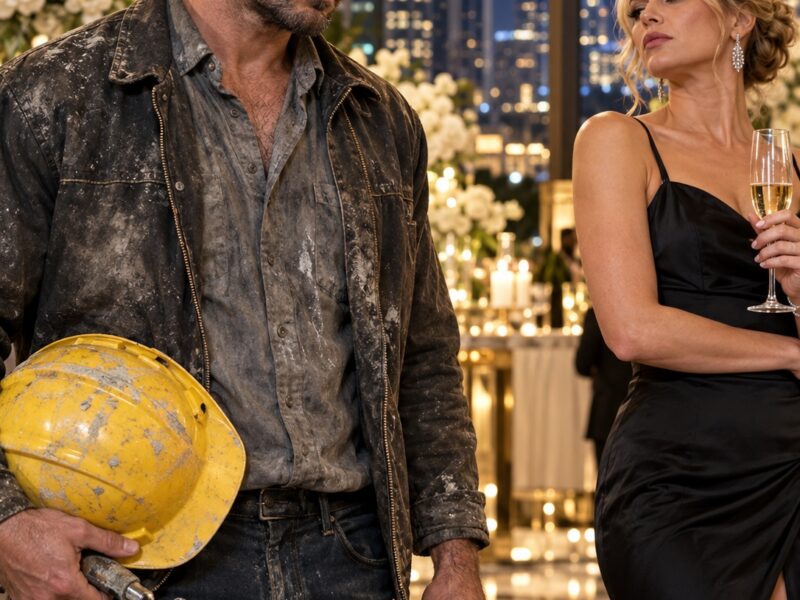
Caleb Morgan stood just inside the entrance with rain on his shoulders and pale cement dust dried into the seams of his work shirt.
A hard hat rested beneath one arm.
Mud darkened one boot.
Lauren looked him up and down as though he had tracked something unpleasant into the building.
Then she added the sentence Caleb would remember long after the humiliation itself stopped hurting.
“People like you don’t belong at the front.”
Someone laughed.
Caleb recognized the laugh before he recognized the man.
Mason Price.
Lauren’s fiancé.
Mason wore a charcoal suit that probably cost more than some of Caleb’s crew members made in a week. His hair was perfect. His cuff links caught the ballroom lights whenever he moved his hands, which he did often because Mason had mastered the art of making every conversation look important.
He slipped an arm around Lauren’s waist.
“I thought construction crews usually knew where the service entrance was.”
More laughter.
Not much.
Just enough.
Lauren’s oldest friend, Rachel, lifted her phone.
Caleb couldn’t tell whether she was recording.
That somehow made it worse.
He looked past them.
Near the stage stood Robert Hayes, the public-facing director of Ankerstone Builders.
Robert had already started walking toward him.
Caleb caught his eye.
Then gave the smallest shake of his head.
Not yet.
Robert stopped.
Nobody noticed.
That was the strange thing about people who believed they already understood a man.
They rarely looked closely enough to notice what contradicted them.
Caleb could have ended the humiliation in ten seconds.
One sentence would have done it.
Instead, he looked at Lauren.
There had been a time when she had washed cement from those same hands in a chipped kitchen sink.
There had been a time when they had shared canned soup because payday was two days away.
There had been a time when she had rested her head against his shoulder and whispered that she didn’t care if they never became rich as long as they became old together.
Apparently, poverty sounded romantic only before you had lived inside it long enough.
“Mom!”
A little girl slipped between two tables.
Everything inside Caleb softened.
Avery.
Seven years old.
Her dark hair had been tied with a cream ribbon, and she wore the pale blue dress Caleb had seen hanging behind her bedroom door the previous weekend.
She ran toward him.
“Daddy!”
Caleb opened his arms.
Lauren caught Avery by the shoulders before she reached him.
“Careful.”
Avery struggled.
“But that’s Dad.”
“Your dress is new,” Lauren said quietly. “Look at him. You’ll get dust all over it.”
Avery stopped moving.
The excitement disappeared from her face so quickly that Caleb felt something inside him tear.
He crouched.
He could have challenged Lauren.
He could have demanded that she let his daughter go.
He could have reminded everyone in that ballroom that concrete dust washed out of fabric more easily than contempt washed out of a child’s memory.
Instead, he smiled.
“I’ll come around the other way, sweetheart.”
Avery’s lower lip trembled.
“You promise?”
“I promise.”
She wiped beneath one eye.
Caleb stood.
Then he turned toward the service corridor.
Behind him, Mason chuckled.
The back hallway smelled of coffee, detergent and roasted vegetables instead of expensive perfume.
Caleb preferred it immediately.
He stopped beside a stainless-steel counter and put down his hard hat.
Only then did he allow his hands to shake.
Not because Mason had embarrassed him.
Not even because Lauren had.
Because Avery had watched it happen.
He reached into his jacket and closed his fingers around an old masonry trowel.
The wooden handle was worn smooth.
His father’s initials—A.M.—were barely visible near the base.
Arthur Morgan had spent forty years laying brick.
He had never owned a tailored suit.
Never driven a luxury car.
Never attended a launch party.
But when Caleb was twelve, Arthur had once held up his filthy hands after a fourteen-hour shift and said, “Never be ashamed of honest dust, son. Somebody has to build the walls everyone else hangs their paintings on.”
Caleb had forgotten many things his father said.
He had never forgotten that.
“You okay?”
A woman in a catering uniform stood a few feet away.
Her name tag read NANCY.
Caleb straightened.
“I’m fine.”
“No, you’re not.”
A younger waiter appeared beside her and handed Caleb a clean towel.
“Here,” he said. “For the rain.”
His name was Wyatt.
Caleb accepted it.
“Thank you.”
Nancy glanced toward the ballroom.
“You didn’t deserve that.”
Caleb wiped his face.
“You don’t even know me.”
Nancy shrugged.
“I knew enough.”
That answer stayed with him.
Because less than thirty feet away were people who had known Caleb for years and apparently understood less about him than a catering worker who had known him for thirty seconds.
His phone vibrated.
Sarah.
Ankerstone’s attorney.
Caleb answered.
“Tell me.”
Her voice came quickly.
“Do not sign anything tonight.”
Caleb’s expression changed.
“What happened?”
“We finished the preliminary review on Prism Development.”
Mason’s company.
Caleb looked toward the ballroom doors.
“And?”
A pause.
“Come backstage before the partnership announcement. There’s something wrong.”
“How wrong?”
Another pause.
“Wrong enough that I don’t want to discuss it over the phone.”
The call ended.
Before Caleb could move, the phone rang again.
Jack Turner.
His oldest foreman.
Caleb answered immediately.
“How’s the wall?”
Jack didn’t bother with a greeting.
“It held.”
Caleb closed his eyes.
For the first time that evening, his shoulders dropped.
Three hours earlier, he had been standing knee-deep in rainwater with Jack and fourteen workers, reinforcing a retaining wall in a neighborhood where six houses sat downhill.
If the wall failed, families could lose their homes.
That was why Caleb had arrived late.
That was why he had cement on his shirt.
That was why his hands were scraped.
“The drainage?”
“Working.”
“The Harris place?”
“Dry.”
Caleb breathed out.
Jack was silent for a moment.
Then he said, “Arthur would be proud.”
Caleb stared at his father’s trowel.
Jack continued.
“And he’d tell you something else.”
“What?”
“That this is probably the night you stop hiding.”
The line went dead.
Caleb stood very still.
Then he heard small footsteps.
Avery appeared around the corner.
Before he could speak, she ran into him.
Dust went straight onto the front of her new dress.
Neither of them cared.
“I found you.”
Caleb held her tightly.
“I told you I’d come around.”
“You took too long.”
“Sorry.”
She pulled something from behind her back.
A folded piece of paper.
“I made it at Grandma Carol’s.”
Caleb opened it.
A house had been drawn in colored pencil.
The roof was crooked.
The windows were different sizes.
Beside it stood a tall stick figure wearing a yellow hard hat.
Across the bottom, Avery had written carefully:
MY DADDY BUILDS HOMES FOR PEOPLE.
Caleb read it twice.
Then folded it and placed it inside his jacket.
Right over his heart.
“Best thing anyone’s given me tonight.”
“Even better than champagne?”
Caleb smiled.
“Way better.”
Avery grinned.
Then her smile disappeared.
Lauren stood at the end of the corridor.
Mason and Rachel were behind her.
Lauren stared at the gray dust now smeared across Avery’s dress.
“For God’s sake, Caleb.”
Avery stepped closer to her father.
Lauren came forward.
“You always make everything harder.”
Caleb’s jaw tightened.
Something about that sentence reached deeper than the insult at the entrance.
Maybe because Lauren had been saying versions of it for years.
The bills were harder because Caleb refused to chase flashy opportunities.
Marriage was harder because he worked too much.
Her life was harder because his boots smelled like concrete.
Leaving had apparently been easier.
Caleb knelt and straightened Avery’s ribbon.
Then he looked at Lauren.
“I’ve never spoken badly about you to our daughter.”
Lauren folded her arms.
“What is that supposed to mean?”
“It means I’m asking you for the same courtesy.”
Mason laughed.
“Come on. Nobody insulted you. Lauren just didn’t want you wandering into a formal event looking like you came straight off a job site.”
“I did come straight off a job site.”
“Exactly.”
Caleb looked down at the polished floor beneath Mason’s shoes.
Then back up.
“You know something strange about floors like this?”
Mason smirked.
“I’m sure you’re about to tell me.”
“Somebody had to get dirty building them.”
The smirk weakened.
Caleb turned to Lauren.
“The floor you’re standing on exists because somebody was willing to get their hands dirty.”
For once, Lauren had no answer.
Mason did.
“In about ten minutes, I’ll be shaking hands with the owner of Ankerstone Builders.”
He stepped closer.
“And you’ll still be standing in a service hallway.”
Caleb studied him.
“Maybe.”
The ballroom lights dimmed.
Applause began.
Robert Hayes stepped onto the stage.
Mason straightened his jacket.
“That’s my cue.”
He took Lauren’s hand.
Rachel followed.
Lauren looked back once.
Caleb couldn’t read the expression.
Embarrassment?
Regret?
Annoyance?
Then she disappeared into the ballroom.
Avery squeezed his fingers.
“Are you coming?”
Caleb looked toward the stage.
Then at the trowel in his hand.
“Yes.”
This time, he said, “I think I am.”
Robert’s voice carried through the ballroom.
“Tonight is supposed to be about buildings.”
Guests settled into their chairs.
Mason and Lauren stood near the front.
“But buildings are really about people.”
Robert paused.
“Ankerstone began with a man who believed you should never ask someone to do work you wouldn’t do yourself.”
Caleb entered through the side door.
Nobody noticed him yet.
“Our founder carried bricks beside his father before he ever signed a contract. Even after the company grew, he kept visiting sites. He kept working beside crews.”
Mason’s smile slowly disappeared.
Lauren turned toward the stage.
“And this afternoon,” Robert continued, “while many of us were preparing for this party, he was standing in freezing rain helping stabilize a retaining wall because several families were waiting downhill.”
Lauren stopped breathing.
Robert looked toward the side of the room.
“Ladies and gentlemen, the founder and owner of Ankerstone Builders…”
Caleb stepped into the light.
“…Caleb Morgan.”
Lauren’s champagne glass slipped from her hand.
It struck the floor.
The crack sounded impossibly loud.
Mason didn’t move.
Rachel lowered her phone.
Avery jumped from her chair.
“That’s my daddy!”
The room laughed warmly.
Then applauded.
Caleb walked onto the stage wearing the same dusty shirt Lauren had wanted hidden behind the building.
He carried his hard hat in one hand.
Arthur’s trowel in the other.
He reached the microphone.
For several seconds, he said nothing.
Two hundred people waited for him to humiliate the people who had humiliated him.
Caleb looked at Lauren.
Then at Mason.
Then beyond them.
At Nancy standing near the service doors.
At Wyatt beside her.
At Avery staring at him as though nothing in the world could possibly be more impressive than her father.
Caleb leaned toward the microphone.
“First, I should apologize for the clothes.”
A few people laughed.
“I came directly from a job site. A retaining wall was failing after the rain. Six families live below it.”
Silence.
“The wall is stable now.”
Applause started.
Caleb lifted a hand.
“But that isn’t why I mention it.”
He looked toward the entrance.
“When I arrived tonight, I was told to use the back door.”
Lauren lowered her eyes.
“I did.”
The room tightened.
Caleb continued.
“People who look like I do tonight are often expected to use back doors. Laborers. Caterers. Cleaners. Delivery drivers. People whose names nobody asks because everyone assumes their job tells you everything worth knowing about them.”
Mason shifted in his chair.
Caleb turned toward Nancy.
“Would Nancy and Wyatt come up here?”
Nancy froze.
Wyatt whispered something to her.
Eventually they walked onto the stage.
Caleb faced the audience.
“These two people showed me kindness before they knew my name.”
Nancy’s eyes filled.
“They didn’t know what company I owned. They didn’t know whether I could help their careers. They didn’t know whether I mattered to anyone in this room.”
Caleb paused.
“They decided I mattered anyway.”
The applause began quietly.
Then grew.
Nancy covered her mouth.
Wyatt stared at the crowd in disbelief.
Avery climbed the stairs.
Caleb lifted her.
She immediately leaned toward the microphone.
“My daddy builds homes for people.”
Laughter broke through the tension.
Then the applause became thunderous.
Lauren stood motionless.
Because suddenly she understood something that frightened her more than Caleb being wealthy.
She had not misunderstood his bank account.
She had misunderstood him.
And money could not explain that away.
Backstage twenty minutes later, Mason had already transformed.
The arrogance was gone.
He smiled too much.
“Caleb, listen, the entrance thing got out of hand.”
Caleb said nothing.
“Lauren was stressed. Rachel was joking. I was joking. Obviously.”
Sarah stood near the desk holding a thick folder.
Mason produced a pen.
“Anyway, the partnership is the important thing.”
Caleb looked at the pen.
Then at Mason.
“You were comfortable insulting a bricklayer.”
Mason’s smile froze.
“You’re only uncomfortable now because you know the bricklayer owns the company.”
“Come on.”
“No.”
One word.
Mason blinked.
Caleb turned toward Sarah.
“Show me.”
Sarah opened the folder.
“Prism Development has been collecting deposits for Meadowlark Gardens for almost eighteen months.”
Mason’s face changed.
Lauren entered the room just in time to hear Sarah continue.
“The land was never properly secured.”
Lauren stopped.
“What?”
“No permits. No viable construction financing. No meaningful site work.”
Mason stepped forward.
“That’s not accurate.”
Sarah ignored him.
“Prism is insolvent or very close to it. The proposed Ankerstone partnership appears designed to bring new capital into the company.”
Caleb understood.
“New money paying old obligations.”
Sarah nodded.
“Possibly worse.”
Lauren stared at Mason.
“You told me Meadowlark was delayed because of zoning.”
“It is.”
Sarah slid several documents across the table.
“No.”
Lauren picked them up.
Her face slowly lost color.
Her name appeared near the top.
LAUREN MORGAN.
MANAGING PARTNER.
Then again.
And again.
Her signature appeared beneath customer contracts.
Lauren looked up.
“I didn’t sign these.”
Sarah pointed.
“That’s your signature.”
“I mean—I signed things. Mason gave me papers.”
Mason stepped toward her.
“Lauren, don’t start panicking.”
She pulled away.
“What are these?”
“Routine restructuring.”
Sarah opened another folder.
“One of these contracts belongs to someone in this building tonight.”
Caleb frowned.
“Who?”
Sarah looked toward the doorway.
“Nancy.”
The humiliation from earlier suddenly became very small.
Caleb found Nancy near the kitchen.
When he asked about Meadowlark Gardens, she lowered her eyes.
“I didn’t know you knew about that.”
“How much?”
She hesitated.
Then told him.
It was almost everything she had saved.
Years of catering weddings.
Years of holiday shifts.
Years of saying yes when someone called because another server hadn’t shown up.
“I wanted a little apartment,” she said. “Nothing fancy.”
Her voice grew quieter.
“My grandson stays with me during school breaks. The brochure had a bedroom beside the window. I told him that would be his.”
Caleb swallowed.
“Who handled your paperwork?”
Nancy looked toward the ballroom.
“The woman was very nice.”
Caleb already knew.
“Her name?”
“Lauren.”
The night changed.
Again.
Lauren was brought into the backstage office.
She read the contracts until the words blurred.
“Mason said these were accounting changes.”
Nobody answered.
“He said putting my name on things would make paperwork easier after we married.”
Mason stood by the door.
“You knew you were joining the company.”
“I knew I was helping you.”
“You signed.”
Lauren looked at him.
For the first time, Caleb saw fear replacing admiration.
Real fear.
Then she turned on Caleb.
“And you?”
He frowned.
“You hid an entire company from me.”
Mason almost smiled at the distraction.
Caleb didn’t.
“I never told you I was rich.”
“That’s exactly my point.”
“But I never lied about who I was.”
Lauren stared at him.
Caleb’s voice remained quiet.
“I was always the man who came home with dust on his clothes.”
That landed harder than shouting would have.
“After you left, I started taking small contracts. Then bigger ones. Dad helped until he got sick. After he died, I built Ankerstone through a holding company.”
“Why hide it?”
“I wasn’t hiding it from you.”
“Then why didn’t I know?”
“Because you stopped asking anything about my life that didn’t involve Avery.”
Lauren recoiled.
Caleb immediately regretted the cruelty in it.
But he couldn’t take it back.
“I wanted Avery to know me as her father,” he said. “Not as a bank account.”
Mason reached for Lauren.
“We’re leaving.”
Caleb looked at him.
“There will be no partnership.”
Mason stopped.
“Think carefully.”
“I have.”
“You could destroy Prism.”
Caleb looked at Nancy through the glass partition.
“No.”
His eyes returned to Mason.
“You already did.”
Three days later, Prism Development’s office closed.
The party video spread online first.
Someone had captured Lauren telling Caleb to use the back entrance.
Someone else had captured Robert introducing him.
The internet loved the reversal.
For twenty-four hours, Lauren became a punch line.
Then Meadowlark families recognized her.
Screenshots appeared.
Contracts.
Receipts.
Deposit records.
Her signature.
Suddenly nobody was laughing.
Mason stopped answering his phone.
Then Lauren returned to the apartment he had arranged for them and discovered the lease was being terminated.
She called her mother.
Valerie listened in silence.
Then said, “You can’t bring this here.”
Lauren thought she had misheard.
“What?”
“The reporters. The scandal. Owen has business contacts.”
“Mom, I have Avery.”
“I’m sorry.”
The call ended.
That evening rain covered Charlotte.
Lauren stood outside Carol Morgan’s small house holding one suitcase.
Avery slept against her shoulder.
The door opened.
Carol looked at Lauren.
Years of hurt existed between those two women.
Lauren expected judgment.
Carol said nothing.
She simply took Avery.
“Give her to me before you drop her.”
Lauren surrendered her daughter.
Carol carried Avery inside, removed her wet shoes, wrapped her in a towel and heated milk.
Only after Avery was asleep did Carol return to the kitchen.
Lauren sat at the table.
“I can leave in the morning.”
Carol didn’t answer.
Instead, she opened a drawer.
Then placed an old cream envelope on the table.
Lauren stared at it.
Her handwriting was on the front.
CALEB.
She stopped breathing.
“Where did you get that?”
Carol sat down.
“I found it years ago.”
Lauren looked up.
“How many years?”
Carol’s eyes filled.
“The night you left.”
Lauren stood so quickly the chair scraped backward.
“No.”
“Lauren—”
“No.”
Carol began crying.
“Arthur was dying. Everything was chaos. Your mother came here the next morning. She said you were done. She said giving Caleb the letter would only humiliate him.”
Lauren stared at the envelope.
“I waited.”
Carol stopped.
Lauren’s voice cracked.
“I waited at Mom’s window all day.”
She tore open the envelope.
The paper inside had yellowed.
Her own younger handwriting covered both sides.
She remembered every word before reading them.
She had written that she was angry.
Afraid.
Tired of being poor.
Tired of fighting.
But she had also written:
I don’t want this to be over.
If you come for me tomorrow, I’ll come home.
Lauren covered her mouth.
Carol whispered, “I’m sorry.”
Lauren looked at her.
“My mother told me he refused to come.”
Carol closed her eyes.
“Oh, God.”
The front door opened.
Caleb entered carrying coffee.
He stopped.
Lauren sat at his mother’s kitchen table holding a letter he had never seen.
Carol looked at her son.
“I need to tell you something.”
Caleb read the letter once.
Then again.
His face became completely still.
Finally he looked at Lauren.
“Were you really there?”
She nodded.
“At the window?”
“Yes.”
“How long?”
“Until dark.”
Caleb turned toward the sink.
His hands gripped the edge.
Lauren watched his shoulders begin to shake.
“I would have come.”
She started crying.
He turned.
“I would have crossed the whole damn city on foot.”
Neither moved toward the other.
That was what made it unbearable.
Because love had once existed.
Maybe some piece still did.
But years had grown around the lie.
Lauren had left.
Caleb had built a company.
Lauren had built resentment.
Caleb had built silence.
Other people had entered their lives.
Their daughter had grown old enough to understand humiliation.
A letter could explain the beginning.
It could not erase everything that followed.
Caleb folded it carefully.
“I need time.”
Lauren nodded.
For once, she didn’t ask him to make the pain easier.
The next morning Caleb stood at a construction site beside Jack.
He told him everything.
Jack listened.
Then picked up a handful of wet concrete.
“Your father used to say resentment was like this stuff.”
Caleb looked at him.
“Leave it sitting long enough, it hardens.”
Jack dropped it.
“If you want to shape it, do it before it sets.”
Caleb touched Arthur’s trowel inside his jacket.
For the first time, forgiveness stopped sounding like pretending nothing had happened.
Maybe forgiveness was deciding what happened next.
Lauren reached the same conclusion somewhere else.
Her first attempt at repair was not with Caleb.
It was with Nancy.
Nancy lived in a small rented house outside Charlotte.
Lauren arrived carrying a jewelry box.
She placed her engagement ring inside it.
Along with every valuable piece Mason had given her.
“This is what I have.”
Nancy stared at the box.
“It won’t replace your deposit,” Lauren continued. “I know that. But I have to start somewhere.”
Nancy pushed it back.
“Jewelry from a dishonest man isn’t going to rebuild my future.”
Lauren’s eyes dropped.
“Then tell me what will.”
Nancy studied her.
Behind her, pinned to the wall, was the old Meadowlark brochure.
One bedroom had been circled.
MY GRANDSON’S ROOM was written beside it.
Lauren stared.
For the first time, the missing deposit stopped being a number.
It became late shifts.
Missed holidays.
Sore feet.
Washed dishes.
A grandmother imagining a child sleeping safely beside a window.
Nancy poured two cups of coffee.
“I don’t know what you understood when you signed those papers.”
Lauren looked at her.
“But now you understand what they cost.”
Nancy pushed one cup toward her.
“What you do next is the part that matters.”
Lauren carried those words home.
Then Mason released a video.
He appeared in a dark suit against a neutral wall.
Calm.
Polished.
Injured.
He claimed Lauren had controlled Prism.
He suggested Caleb must have known something because Lauren was his former wife.
Within hours, Ankerstone’s lenders froze payments pending review.
Robert entered Caleb’s office with the expression of a man delivering bad news.
“There’s an easy solution.”
Caleb already knew.
“Publicly cut Lauren loose.”
Robert nodded.
“State that she has no relationship to Ankerstone. Let investigators deal with her.”
Caleb looked through the window.
Outside the construction gate, people were gathering.
Meadowlark families.
Nancy stood among them holding cardboard.
WE WANT THE TRUTH.
A taxi stopped.
Lauren stepped out.
She looked terrified.
Then she walked directly toward the crowd.
Some recognized her immediately.
She stopped beside Caleb.
“My name is Lauren Morgan.”
Nobody spoke.
“My signature is on your contracts.”
A woman shouted, “Where’s our money?”
Lauren flinched.
“I don’t know. But I’m going to help find it.”
“You signed!”
“Yes.”
Lauren swallowed.
“I did not understand what I was signing. But I signed it. That part is my responsibility.”
The crowd quieted.
“And Caleb had nothing to do with Prism.”
Caleb looked at her.
“He didn’t know I was involved.”
Nobody applauded.
This wasn’t a ballroom.
Nobody needed applause.
Caleb stepped forward.
“I’m not abandoning anyone to protect my reputation.”
Robert stared at him.
“We’ll trace the money. And if there’s a way to build the homes you were promised, we’ll find it.”
A little boy holding his father’s hand looked up.
“Are you the man who’s going to build our house?”
Caleb crouched.
“I’m going to do everything I can.”
Later, Lauren asked him quietly, “Why didn’t you let me take the blame?”
Caleb looked at her.
“Because telling the truth isn’t the same as carrying everything alone.”
That evening Rachel called.
“I know where Mason moved the money.”
Lauren gripped the phone.
Rachel’s voice trembled.
“And I know because I helped him.”
They met at a roadside diner.
Rachel sat in the last booth clutching a black notebook.
“I knew Mason before you did.”
Lauren stared.
“Prism was already failing. He needed someone clean. Someone whose name wasn’t connected to the old debts.”
Lauren understood before Rachel finished.
“You suggested me.”
Rachel nodded.
“Why?”
Tears appeared in her eyes.
“Because I was jealous.”
Lauren laughed once, without humor.
“Of what?”
“You.”
Rachel looked down.
“You always had something people loved. Even when you complained about Caleb, you had someone who would have walked through a storm for you. Then you had Avery. I kept thinking… why does Lauren always get chosen?”
“So you gave me to Mason?”
“He promised we’d leave together after the money was moved.”
Rachel pushed the notebook across the table.
Transfer dates.
Accounts.
Amounts.
Names.
Everything.
“Why tell me now?”
Rachel cried.
“I watched the party video.”
Lauren said nothing.
“Avery ran toward Caleb like he was the greatest man alive.”
Rachel wiped her face.
“I’m her godmother.”
Her voice broke.
“I promised to protect that little girl, and instead I helped destroy her mother.”
Lauren picked up the notebook.
“I don’t know if I can forgive you.”
Rachel nodded.
“I don’t expect you to.”
Lauren stood.
“Tell the truth anyway.”
When she returned to Carol’s house, Caleb was waiting on the porch.
He saw the notebook.
“Where were you?”
“With Rachel.”
“Alone?”
“Yes.”
Anger flashed across his face.
“Lauren.”
“I’m fine.”
“That’s not the point.”
“Then what is?”
Caleb stepped closer.
“Next time, call me.”
She stared at him.
“You don’t have to cross this kind of road alone.”
For the first time in years, Lauren heard concern in his voice without ownership attached to it.
It almost hurt more than anger.
Rachel’s records helped investigators trace the missing funds.
They also showed Lauren had received none of the money.
Rachel agreed to cooperate knowing she could still face consequences.
Meanwhile, the scandal reached Avery’s school.
One afternoon Lauren found her sitting on the bedroom floor beside a broken piggy bank.
Coins covered the carpet.
“What happened?”
Avery looked up.
“I want Nancy to have these.”
Lauren knelt.
“Why?”
“For the window.”
Lauren’s throat tightened.
“What window?”
“Her grandson’s room.”
Avery gathered quarters in both hands.
“Maybe this is enough for part of it.”
Lauren pulled her daughter into her arms.
The next day, Avery carried the coins to Nancy in a cloth pouch Carol had sewn.
Nancy knelt on the sidewalk.
Avery held out the bag.
Nancy began crying.
“This is worth more than money.”
Avery frowned.
“It’s not that much.”
Nancy hugged her.
“It is when someone gives everything they have.”
Caleb later visited Avery’s class.
He brought Arthur’s trowel.
He drew a house on the board.
Then a line underneath it.
“This is the foundation.”
A boy raised his hand.
“You can’t see it.”
“Exactly.”
Caleb smiled.
“But it carries the whole house.”
He looked toward Avery.
“People can be like foundations too. Sometimes someone makes a mistake, and then they quietly do the work required to repair it.”
After class, a boy who had called Lauren a thief approached Avery.
He didn’t apologize properly.
Children rarely do.
He simply handed her his favorite colored pencil.
Avery accepted it.
Caleb watched.
Some repairs began with courtrooms.
Others began with a pencil.
Then Ankerstone’s crisis deepened.
The lender freeze threatened payroll.
Caleb gathered the crews.
“I won’t promise what I can’t guarantee.”
Hundreds of workers watched.
“I’ll fight for every paycheck. But I won’t lie to you about where we stand.”
Jack stepped forward.
“I’m staying.”
Caleb stared.
Jack looked around.
“This man has worked beside us when he could’ve stayed in an office. He’s shared lunch with us. Worked storms with us. Learned our kids’ names.”
Jack lifted one hand.
“I’m staying.”
Another hand rose.
Then another.
Then dozens.
Caleb looked away before anyone saw his eyes.
That night, he ate dinner at Carol’s table with Lauren and Avery.
It was not reconciliation.
Not yet.
Too many wounds still had edges.
But for the first time in years, nobody used pride as armor.
Three days later Sarah called.
“They found Mason.”
“Where?”
“Charlotte Douglas.”
He had been preparing to leave the country.
Caleb drove Lauren to the airport.
Mason was already surrounded by officers when they arrived.
He saw Lauren.
His polished expression cracked.
“You did this.”
Lauren stopped.
Mason leaned closer as officers moved him past.
“You would have nothing without me.”
Lauren looked at the man whose expensive suit had once represented everything she thought Caleb lacked.
“I have almost nothing.”
She glanced toward Caleb.
Then back at Mason.
“But what I have now is real.”
Investigators searched Mason’s luggage.
They found records leading to another account.
A large portion of the missing deposits had been transferred there.
The account holder was Valerie.
Lauren’s mother.
Before sunrise, Caleb drove Lauren to Valerie’s house.
Valerie called the money an investment.
“Mason asked me to hold it temporarily.”
Lauren didn’t argue.
She asked something else.
“Why did you tell Carol I wasn’t coming back?”
Valerie froze.
“Lauren—”
“Why did you tell me Caleb refused to come?”
Silence.
Then the truth finally arrived.
Valerie had spent her entire life terrified of poverty.
When Lauren married Caleb, Valerie saw work boots, bills and uncertainty.
She believed her daughter deserved more.
So when Lauren left after that terrible argument, Valerie saw an opportunity.
She told Carol that Lauren was finished.
Then told Lauren Caleb had chosen not to come.
Years later Mason appeared.
Suit.
Car.
Money.
Status.
Everything Valerie thought Caleb wasn’t.
“I thought I was protecting you,” she whispered.
Lauren looked at her mother for a long time.
“You taught me to admire people at the top.”
Valerie cried.
Lauren’s voice remained quiet.
“You never taught me to notice who built the stairs.”
Valerie eventually agreed to return the money and cooperate.
Recovered funds, Rachel’s notebook and Mason’s records established that Lauren had been used as a legal front.
But Lauren refused to call herself completely innocent.
“I signed.”
She said it every time someone tried to excuse her.
“I should have read what I signed.”
Families began receiving deposits back.
Ankerstone’s financing resumed.
On the first payday after the freeze, Caleb went to the site personally.
He shook every worker’s hand.
Every paycheck included what was owed.
Inside each envelope was a handwritten thank-you.
Later, Jack joined him on the highest completed floor.
Charlotte glowed below them.
Jack smiled.
“So?”
“So what?”
“Did the resentment harden?”
Caleb looked at Arthur’s trowel.
“Almost.”
Jack waited.
Caleb smiled faintly.
“But I think I worked it before it set.”
For a builder, Jack decided, that was enough.
Returning the Meadowlark deposits should have ended everything.
Caleb couldn’t let it.
“They didn’t save for refunds,” he told Sarah and Robert.
“They saved for homes.”
Ankerstone purchased land outside Charlotte.
Caleb announced that Meadowlark Gardens would be built for real.
At the affordable terms originally promised.
Nancy covered her face and cried.
A little boy asked, “Are the walls really going up?”
Caleb handed him Arthur’s trowel for a moment.
“You can watch them rise.”
Lauren asked for a job in the temporary site office.
Not an executive position.
Not public relations.
Paperwork.
Families.
Questions.
She learned every household by name.
She read contracts aloud.
She explained fees.
She returned to Carol’s house every evening with dust on her shoes.
Strangely, she stopped brushing it off.
Nancy’s new contract was the first one Lauren prepared.
She placed it on the desk.
But she didn’t offer Nancy a pen.
“We’re reading every line first.”
Nancy smiled.
“Every line?”
“Every one.”
Lauren looked down.
“Last time I signed something I didn’t understand, you paid for it.”
They read together.
When they finished, Nancy signed.
Then reached across the desk and held Lauren’s hand.
Wyatt eventually joined Ankerstone in an administrative role.
At night, he began studying engineering.
Valerie came to Carol’s house months later carrying oranges and an apology.
The two mothers stood at the gate.
One had lied because she feared poverty.
The other had hidden a letter because she feared her son would be hurt again.
Neither could undo the years that followed.
Carol opened the door.
“Come inside.”
Valerie hesitated.
Carol sighed.
“Coffee is better for difficult conversations.”
The hardest repair remained Caleb and Lauren.
One evening, while the first Meadowlark walls were rising, Lauren tucked Avery into Caleb’s old childhood bed.
Avery whispered, “Mom?”
“Yes?”
“Does a letter still count if it arrives really late?”
Lauren stopped.
“I don’t know.”
Someone knocked at the gate.
Lauren walked outside barefoot.
Caleb stood beneath the porch light.
Clean shirt.
Hands in his pockets.
Arthur’s trowel visible beneath one arm.
Lauren descended one step.
“What are you doing here?”
Caleb looked at her.
“You wrote that if I came for you, you’d come home.”
Her eyes filled immediately.
“You’re a little late.”
“I know.”
“How late?”
Caleb smiled sadly.
“Years.”
Lauren came down another step.
“I don’t know if it still counts.”
“Neither do I.”
The porch light hummed above them.
Caleb looked toward the house where their daughter slept.
“We can’t rebuild by pretending the cracks never happened.”
Lauren wiped her cheek.
“No.”
“We can’t pretend your mother didn’t lie. Or my mother didn’t hide the letter. Or Rachel didn’t betray you.”
He paused.
“And we can’t pretend you didn’t hurt me.”
Lauren nodded.
“Or that I didn’t hurt you back.”
Another nod.
Caleb stepped closer.
“All we can do is see the cracks.”
Lauren looked at him.
“And?”
“Decide whether we’re willing to work on them.”
He didn’t ask her to remarry him.
She didn’t promise forever.
That would have been easier.
Instead, they agreed to something smaller.
Truth before pride.
Conversation before resentment.
Time.
And Avery before everything.
The next morning Carol placed four cups on the kitchen table.
Four.
For the first time in years.
Avery sat between her parents eating cake for breakfast and swinging her feet beneath the chair.
On the wall hung two framed pages.
Her drawing:
MY DADDY BUILDS HOMES FOR PEOPLE.
And Lauren’s old letter.
One had been written by a child who saw something adults had forgotten.
The other had arrived years too late.
Somehow both had helped bring them back to the same table.
Months later, Meadowlark Gardens opened.
There was no ballroom.
No velvet rope.
No private guest list.
Workers brought wives and husbands and children.
Carol brought cake.
Sarah distributed keys from a cardboard box.
Nancy stood outside her apartment holding her grandson’s hand.
At the main entrance, one floor tile had intentionally been left unset.
Avery arrived carrying the cloth pouch.
Her saved coins were still inside.
Caleb knelt beside her.
He handed her Arthur’s trowel.
Together they spread mortar.
Lauren knelt on the other side.
Avery poured the coins into the wet cement.
Quarters.
Dimes.
Nickels.
A few pennies.
The savings of a little girl who had once believed she could buy a stranger a window.
Then they lowered the tile.
Caleb stood.
Families gathered around.
He looked toward the entrance.
Years earlier, he had arrived at a beautiful building and been told that people like him belonged at the back.
He remembered Lauren’s voice.
Mason’s laughter.
Avery being stopped before she could hug him.
Then he looked at Nancy.
At Wyatt.
At Jack.
At Lauren, now wearing dusty work shoes.
At Avery.
“There will be no back door for anyone here,” Caleb said.
The crowd became silent.
“Everyone enters through the front.”
Nancy unlocked her apartment.
Her grandson ran inside.
Straight toward the small bedroom beside the window.
Later, Avery sat with Caleb on a low brick wall.
“Dad?”
“Yeah?”
“Is a foundation the part nobody sees but everybody stands on?”
Caleb looked at his daughter.
Then at the homes rising behind her.
“Yes.”
She thought about that.
“Do people have foundations?”
Caleb smiled.
“They better.”
Over time, he understood something Arthur had probably known all along.
The strongest parts of a life were rarely the parts strangers admired.
Money had not made Caleb a better father.
Owning Ankerstone had not made his work more honorable than it had been when he carried bricks.
Lauren’s expensive clothes had not made her secure.
Mason’s suit had not made him trustworthy.
Rachel’s friendship had not made her loyal.
Valerie’s desire for status had not protected her daughter.
Appearances had only made certain truths easier to overlook.
Forgiveness didn’t erase those truths.
Carol had hidden a letter.
Valerie had deliberately separated two young people because she feared poverty.
Rachel’s jealousy had helped destroy a family.
Lauren had humiliated the father of her child and signed papers she had never bothered to understand.
Caleb had allowed hurt to become silence.
Apologies did not make those things disappear.
Consequences mattered.
Boundaries mattered.
Truth mattered.
But Caleb eventually understood that regret became useful only when it changed the next decision.
Carol admitted what she had done.
Valerie returned money that did not belong to her.
Rachel accepted the consequences of helping Mason.
Lauren stood before the families whose contracts carried her signature.
Then she worked beside them.
And Caleb chose not to turn success into a weapon against everyone who had once underestimated him.
For Lauren, the strangest transformation was the dust.
She had spent years hating it.
Dust on Caleb’s boots.
Dust on his shirts.
Dust in the old car.
Dust near the doorway.
She had mistaken it for failure.
Now she saw it on the sleeves of men pouring foundations.
On women measuring walls.
On Caleb’s hands.
Eventually, on her own shoes.
It no longer looked like failure.
It looked like evidence that somebody had shown up.
Somebody had done difficult work so another person could feel safe.
Maybe love was like that too.
Not a beautiful promise made in perfect clothes before witnesses.
Not expensive rings.
Not photographs.
Not status.
Love was showing up at a gate years late and telling the truth anyway.
It was a child breaking her piggy bank because a stranger had lost a bedroom.
It was an older woman opening her door to someone who had once walked away.
It was workers raising their hands when no paycheck was guaranteed.
It was two people looking directly at the cracks in something they had once broken and deciding not to cover them with paint.
Some chances disappear.
Some words cannot be taken back.
Some years cannot be restored.
And forgiveness does not require anyone to pretend otherwise.
But a life does not have to be perfect to be rebuilt.
It needs people willing to stop hiding the damage.
To clear away what failed.
To accept the cost of repair.
And then, carefully, to begin again on something honest.
That afternoon, the families of Meadowlark Gardens carried boxes through the front entrance of homes that finally belonged to them.
Nobody noticed the tile near the doorway.
Nobody could see what rested beneath it.
A handful of Avery’s coins remained sealed inside the hardened mortar.
They would probably stay there for decades.
Hidden.
Holding nothing up by themselves.
Worth almost nothing to anyone who didn’t know the story.
And perhaps that was exactly why Caleb loved knowing they were there.
Because his father had been right.
The things that hold a life together are often not the things people notice.
Sometimes they are buried beneath the surface.
A promise.
An apology.
A child’s faith.
A second chance nobody was owed.
An old letter that arrived years too late.
And the quiet decision, made after everything beautiful has cracked, to pick up the trowel…
and build anyway.









