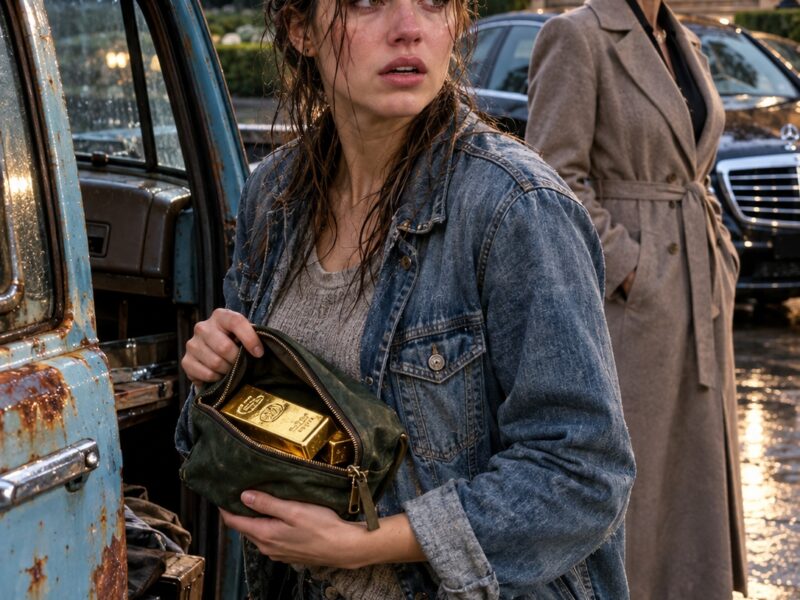
MY FAMILY LAUGHED WHEN GRANDPA LEFT ME A RUSTED 1968 FORD—THEN MY AUNT OFFERED ME $5,000 FOR IT, AND I REALIZED SHE KNEW WHAT WAS HIDDEN INSIDE
“Open the door, Meline.”
Victor Harrington’s voice came through the thin wood of my apartment door with terrifying calm.
Not shouting.
Not pleading.
Calm.
That was worse.
I stood barefoot in my tiny kitchen with rainwater dripping from my hair, a canvas backpack hanging from one shoulder and nearly twenty pounds of secrets pressing against my spine.
On my coffee table sat an overturned cup of tea.
On the floor lay three glittering stones I hadn’t had time to put away.
And somewhere behind the man outside my door stood another man large enough to make the hallway light disappear through the peephole.
Victor knocked again.
Three measured blows.
“Meline, I know you found it.”
My heart stopped.
Less than a week earlier, this man had barely looked at me.
His wife—my aunt Caroline—had laughed while I sat in a lawyer’s office being handed what everyone believed was the most worthless object in my grandfather’s estate.
A rusted 1968 Ford F-100.
Seventy acres had gone to Caroline.
Hundreds of thousands of dollars had gone to her son, Jasper.
I got a truck that hadn’t moved in twenty years.
They laughed.
Now Victor Harrington had brought a man to break down my door for it.
The backpack on my shoulder contained three Swiss gold bars, a box of uncut gemstones, several passports bearing my dead grandfather’s photograph under names I had never heard before—and a handwritten ledger that could destroy Victor’s entire life.
Another impact shook the door.
The frame cracked.
“Last chance,” Victor said.
I looked toward the kitchen window.
Then at the backpack.
Then back toward the door.
And for the first time since Grandpa Henry died, I understood exactly what he had meant when he wrote one strange sentence into his will.
Treat her well, kiddo. She’ll take you where you need to go.
Three days earlier, I had thought he meant the truck.
I was beginning to understand that he meant something much bigger.
The mahogany-paneled conference room at Abernathy & Associates smelled like lemon furniture polish, stale coffee, and money.
Not new money.
Old money.
The kind that seemed to have seeped into the leather chairs and brass lamps over decades.
I sat near the end of the glass table with both hands clasped between my knees.
Across from me, Aunt Caroline checked the time on a gold watch.
Again.
And again.
Her son Jasper was scrolling through his phone.
Neither of them looked particularly devastated that Henry Caldwell was dead.
Maybe that was unfair.
People grieved differently.
That was what I kept telling myself.
But Caroline had spent the previous morning walking through Grandpa’s farmhouse with a contractor, pointing at walls and asking which ones were load-bearing.
The funeral flowers hadn’t even wilted yet.
Mr. Abernathy shuffled a stack of documents.
“Are we ready?”
Caroline sighed.
“We’ve been ready for fifteen minutes.”
He looked over his half-moon glasses.
“Your father waited eighty-one years to die, Mrs. Caldwell. I imagine we can spare him fifteen minutes.”
Jasper’s mouth twitched.
Caroline didn’t appreciate the joke.
I almost smiled.
Grandpa would have.
Henry Caldwell had raised me from the time I was eleven years old.
My parents died on a wet highway outside Salem when a delivery truck crossed the center line.
One phone call.
One sheriff standing on a porch.
One night in which childhood simply ended.
Caroline had suggested I be placed temporarily with another relative because, as she put it, she and Victor “weren’t equipped for a traumatized child.”
Grandpa had been sixty-six.
He lived alone.
He ran a struggling repair shop.
His farmhouse roof leaked in two rooms.
He drove vehicles older than most of the people who brought cars into his garage.
And he hadn’t hesitated for even one second.
“She comes home with me.”
That was all he said.
So I did.
Grandpa never became rich.
At least, that was what I believed.
He smelled like peppermint, motor oil, coffee, and the orange hand cleaner mechanics used to scrub grease from their knuckles.
He hated television news.
Loved baseball on the radio.
Kept cash in old coffee tins.
And believed almost anything could be repaired if you were patient enough to figure out what had actually broken.
Including people.
Especially people.
Mr. Abernathy cleared his throat.
“To my daughter, Caroline Caldwell Harrington, I leave the Oak Haven estate, consisting of the farmhouse and approximately seventy acres, subject to the conditions specified herein.”
Caroline finally stopped checking her watch.
Her spine straightened.
I watched something almost indecent pass over her face.
Relief.
Victory.
Grandpa’s farm sat outside Oak Haven, Oregon, where development had been creeping outward for years. Victor had once mentioned that the property could be worth several million dollars if rezoned and divided.
Caroline had pretended not to hear him.
Grandpa had definitely heard him.
Mr. Abernathy continued.
“The beneficiary shall assume responsibility for all outstanding property taxes, assessments, and obligations attached to the property.”
“Yes, yes,” Caroline said. “Naturally.”
The lawyer paused.
Something about that pause bothered me.
Then he moved on.
“To my grandson Jasper Harrington, I leave the contents of my Charles Schwab investment portfolio.”
Jasper looked up.
Caroline frowned.
“What investment portfolio?”
Mr. Abernathy checked the page.
“Your father began making investments in the late 1980s.”
“My father fixed transmissions.”
“Apparently he also bought securities.”
“How much?”
Mr. Abernathy hesitated.
“Approximately four hundred fifty thousand dollars at the most recent valuation.”
Jasper dropped his phone.
Actually dropped it.
It bounced off the carpet.
“Four hundred and fifty grand?”
Caroline stared at the attorney.
Then she laughed softly.
“Well.”
She leaned back.
“The old man had surprises.”
Something tightened inside my chest.
The old man.
Not Dad.
Not Father.
Not Henry.
The old man.
Mr. Abernathy turned one page.
His expression changed when he looked at me.
That was when I knew something strange was coming.
“And finally, to my granddaughter, Meline Hayes.”
Caroline looked toward me.
Jasper recovered his phone.
Mr. Abernathy read more slowly now.
“You were the light of my twilight years, kiddo.”
My throat closed.
That sounded like Grandpa.
Not the legal language.
Not the estate.
Just him.
“I leave you my 1968 Ford F-100, presently stored in the north barn.”
Silence.
For perhaps two seconds, nobody moved.
Then Caroline laughed.
A sharp, startled bark.
“The truck?”
Jasper looked between us.
“No way.”
Mr. Abernathy continued reading.
“Treat her well, and she’ll take you where you need to go.”
Jasper leaned back and covered his mouth.
“Sorry. Sorry.”
He wasn’t sorry.
“Grandpa left you the raccoon truck?”
I stared at the lawyer.
“That’s it?”
Mr. Abernathy’s gaze stayed on mine.
“That is the specific bequest, yes.”
Caroline laughed harder.
“Oh, Meline.”
I looked down.
I hated that my face was getting hot.
Not because I wanted money.
That was the part they would never understand.
I didn’t care about Jasper’s investment account.
I didn’t want seventy acres.
I wanted one more Tuesday night sitting on Grandpa’s porch.
I wanted to hear him complain that the Mariners had no bullpen.
I wanted to see his dirty boots beside the kitchen door.
I wanted to call him and ask why he had left me a truck that hadn’t started since I was a child.
But dead people don’t explain themselves.
So all I had was a sentence.
Treat her well.
Jasper whistled.
“You might get two hundred bucks for scrap.”
“After paying three hundred to tow it,” Caroline said.
They laughed again.
Mr. Abernathy didn’t.
I lifted my eyes.
“That truck mattered to him.”
Caroline’s smile vanished.
“It’s an eyesore, Meline.”
“It was Grandpa’s.”
“And now it’s yours. Which means I want it removed from my property.”
She stood.
“Friday.”
Mr. Abernathy frowned.
“There is a reasonable grace period for—”
“Friday.”
Caroline buttoned her blazer.
“I already have people evaluating the structures. I don’t want some rusted piece of junk interfering with the work.”
I looked at her.
“You’re tearing down the farmhouse?”
“Eventually.”
“He’s been dead nine days.”
Something cold entered her expression.
“And the house has been dying for thirty years.”
Jasper stood beside her.
“Don’t worry, cuz. Maybe the truck will start and you can live in it.”
That one hurt.
Probably because I was twenty-six years old, working double shifts at a diner and barely making rent.
Probably because Jasper knew it.
Probably because cruelty is most efficient when it contains just enough truth.
They left.
Expensive perfume lingered behind Caroline.
Mr. Abernathy waited until the door closed.
Then he removed his glasses.
“Your grandfather was not a careless man, Meline.”
I looked at him.
“What does that mean?”
“It means I wouldn’t assume the value of a gift merely by looking at it.”
My pulse changed.
“Did he tell you something?”
“No.”
“Then why say that?”
The lawyer glanced toward the closed door.
“Because Henry Caldwell spent considerable time making sure the language concerning that truck was exact.”
I waited.
He said nothing else.
“That’s all?”
“That’s all I can tell you.”
I walked out more confused than when I entered.
And two days later, I spent three hundred dollars I couldn’t afford to have a dead truck delivered to my apartment.
The tow-truck driver stared at the Ford and then at me.
“This yours?”
“Unfortunately.”
He grinned.
“I’ve seen worse.”
“Really?”
“No.”
At least he was honest.
The F-100 looked like tetanus with headlights.
What remained of the original sky-blue paint had disappeared beneath layers of orange-brown rust. The tires were flat. One headlight was cracked. Damp leaves filled the bed.
When the driver lowered it into my parking space, two neighbors opened their curtains.
Mrs. Alvarez from 3B came outside carrying a trash bag.
She stared.
“Meline?”
“Yeah?”
“Are we starting a junkyard?”
“Family inheritance.”
She considered that.
“Your family hates you?”
I laughed despite myself.
“Possibly.”
My phone buzzed.
Jasper.
He had apparently seen the tow truck near the diner.
Nice ride. Get a tetanus shot before touching the steering wheel.
I deleted the message.
Then I climbed into the cab.
The smell hit first.
Old gasoline.
Mildew.
Wet fabric.
Dust.
Something animal.
Maybe Caroline had been right about the raccoons.
The bench seat was split open, exposing rusted springs. Receipts, bolts, spark plugs and brittle paper filled the floor.
I touched the steering wheel.
For one second I was seven again.
Grandpa sat beside me in the north barn.
My legs were too short to reach the pedals.
“Ten and two,” he told me.
“We aren’t moving.”
“Doesn’t matter.”
“I can’t drive.”
“Everybody can’t drive until they can.”
I had turned the wheel and made engine sounds.
Grandpa laughed.
That memory nearly broke me.
So I cleaned.
For hours.
Because grief needs somewhere to go.
If you don’t give it a task, it starts dismantling you from the inside.
Saturday brought cold rain.
I wore old overalls and scrubbed the dashboard until my fingers went numb.
Receipts from 1982.
A tire gauge.
Three dead pens.
A matchbook from Nevada.
A quarter.
A corroded socket.
Nothing that explained why Grandpa had given me this particular wreck while Caroline received the farm and Jasper received nearly half a million dollars.
By noon, frustration had replaced sadness.
I collapsed onto the driver’s seat.
Rain hammered the roof.
“Treat her well,” I muttered.
I looked at the dead dashboard.
“And she’ll take me where I need to go.”
I laughed bitterly.
“Where, Grandpa?”
Silence.
“The scrapyard?”
I slammed my palm against the dashboard.
Something clicked.
Not loudly.
Just enough.
I froze.
The glove compartment had opened half an inch.
I stared at it.
I’d tried opening it earlier.
It had been rusted shut.
I pulled.
Nothing.
Pulled harder.
Metal shrieked.
Then the compartment dropped open.
Empty.
I almost laughed.
Of course.
One final joke from the universe.
I reached inside to wipe the dust away.
My knuckles struck the rear wall.
I stopped.
Tapped it.
The sound was wrong.
Plastic.
Not metal.
I leaned closer.
There was a seam.
My heart began beating faster.
I grabbed a flashlight and found a tiny sliding latch near the upper corner.
“Grandpa…”
I pushed it.
Nothing.
Again.
It snapped.
The entire rear panel shifted forward.
Behind it was darkness.
A hidden compartment.
And inside that compartment was a dark green canvas pouch secured with a leather strap.
I pulled it out.
It was shockingly heavy.
Ten pounds.
Maybe fifteen.
I set it on the passenger seat.
Rain beat harder against the windshield.
For some reason, I locked both doors.
Then I opened the pouch.
The first thing I saw was a passport.
Henry Caldwell’s photograph stared back at me.
Except the name beneath it wasn’t Henry Caldwell.
Arthur Pendleton.
I stopped breathing.
There were more.
Thomas Croft.
Michael Dane.
Different names.
Same face.
Different countries.
Switzerland.
Austria.
Argentina.
Germany.
Dates from the 1970s.
I had seen photographs of Grandpa from those years.
But never like these.
In my memories he had always been an aging mechanic in flannel.
The man in those passport photographs was lean, hard-eyed, unsmiling.
Dangerous.
Under the passports was a leather-bound book.
A ledger.
Names.
Dates.
Dollar amounts.
Cities.
Short handwritten notes.
Asset recovered.
Transfer completed.
Bribe delivered.
And one phrase that made my stomach turn.
Target neutralized.
I closed the book.
“No.”
I suddenly didn’t want to know.
But there was one more object inside the bag.
A flat jewelry case.
I opened it.
Even under the gray Oregon sky, light exploded across the truck’s filthy interior.
Diamonds.
Not polished jewelry-store diamonds.
Rough stones.
Some nearly the size of marbles.
Sapphires.
Rubies.
And beside them—
gold.
Three compact bars of it.
I lifted one.
The weight nearly pulled it from my hand.
A Swiss bank insignia was stamped into the surface.
I stared at it.
Then at the truck.
Then at the passports.
My grandfather had not left me junk.
He had left me a fortune.
And apparently an entirely different version of himself.
A tap hit the driver’s window.
I screamed.
The gold bar slipped from my hand.
I shoved everything toward the floor and threw a rag over the canvas bag.
Then I turned.
Aunt Caroline stood outside holding a black umbrella.
Watching me.
I lowered the window three inches.
“What are you doing here?”
Caroline smiled.
Too warmly.
“I was nearby.”
She lived forty minutes away.
She had no reason to be nearby.
Rain rolled from the edges of her umbrella.
Her eyes moved past my face.
Into the cab.
Across the dashboard.
Down toward my boots.
“What happened?” she asked.
“What?”
“You look pale.”
“It’s cold.”
“I suppose.”
She tilted her head.
“I wanted to apologize.”
That frightened me more than anger would have.
“For what?”
“The attorney’s office.”
Her voice became soft.
“I was unkind.”
“You laughed at me.”
“Grief makes people behave badly.”
“You were laughing before Grandpa was buried.”
Something flashed behind her eyes.
Then vanished.
“I’ve been thinking about the truck.”
My fingers tightened around the steering wheel.
“What about it?”
“You can’t restore this thing.”
“I know.”
“It’ll cost thousands.”
“Probably.”
“And your apartment complex may fine you for keeping an inoperable vehicle.”
“Probably.”
“So let me solve the problem.”
She reached into her purse.
“I’ll give you five thousand dollars.”
For several seconds, I thought I’d misheard.
“What?”
“Five thousand. Cash if you want it.”
I stared at her.
Two days earlier, this truck had been garbage.
Now she was offering twenty-five times Jasper’s joke valuation.
“Why?”
“Sentimental reasons.”
“You hated it.”
“I hated seeing it deteriorate.”
“You threatened to call a scrapyard.”
Caroline’s jaw tightened.
“I’ve changed my mind.”
“Why?”
“I thought it could be incorporated into the farm development. Decorative landscaping. Something rustic.”
“A planter?”
“Yes.”
I almost smiled.
The lie was that bad.
Then I noticed something.
Her gaze wasn’t on the truck.
It was on the glove compartment.
And suddenly the rain seemed very loud.
I remembered Mr. Abernathy saying Grandpa had been careful.
I remembered the hidden latch.
I remembered the passports.
I remembered the ledger.
And I understood.
“You know.”
Caroline stopped breathing for half a second.
That was enough.
“Know what?”
I looked at her.
“You tell me.”
The softness disappeared.
She moved closer to the window.
“Meline.”
Her voice dropped.
“Take the money.”
“No.”
“Don’t be stupid.”
“No.”
“You don’t understand what you have.”
My pulse hammered.
“So there is something.”
Caroline closed her eyes.
A tiny mistake.
When she opened them again, the aunt was gone.
In her place stood Victor Harrington’s wife.
“Your grandfather stole something.”
“From who?”
She hesitated.
“From Victor.”
I felt cold spread through my body.
“What?”
“Years ago.”
“What did he steal?”
“Something that doesn’t belong to you.”
I thought about the ledger.
“Then tell me what it is.”
She didn’t.
“Exactly,” I whispered.
Her hand shot forward and gripped the edge of the partially lowered window.
“Listen to me carefully. Sell me the truck. Forget whatever you think you’ve seen.”
“Let go.”
“You have no idea what kind of people—”
“Let go of my window.”
“You stupid little girl.”
That did it.
Fear transformed into something else.
Maybe anger.
Maybe twenty-six years of swallowing humiliation.
I pressed the electric-window switch.
The old motor groaned.
The glass rose.
Caroline yanked her fingers away.
Her face twisted.
“You’re making a serious mistake.”
I stared at her through the wet glass.
“No.”
For once, my voice didn’t shake.
“I think Grandpa made sure you did.”
She stepped backward.
I saw real fear in her eyes.
Not fear of me.
Fear of whatever Henry had hidden.
Caroline marched toward her Mercedes.
I waited until she drove away.
Then I looked down at the canvas pouch.
Grandpa hadn’t left me an inheritance.
He had left me a war.
I carried everything upstairs.
Three locks suddenly didn’t feel like enough.
My apartment had always embarrassed me.
Secondhand sofa.
Laminate table.
A refrigerator that hummed like farm equipment.
Now three gold bars sat on that cheap table.
Diamonds glittered beneath a twelve-dollar floor lamp.
The absurdity almost made me laugh.
But the ledger kept pulling my attention back.
I made tea.
Then I started reading.
The earliest entries belonged to another world.
Zurich.
Vienna.
Buenos Aires.
Berlin.
Names accompanied by codes.
Assets.
Payments.
Retrievals.
Grandpa had apparently spent part of his younger life working as some kind of private recovery specialist.
Not quite law enforcement.
Not quite intelligence.
Something between.
He recovered stolen assets for people powerful enough to hire men who did not ask ordinary questions.
Eventually the international entries stopped.
The dates jumped forward.
The locations moved closer.
Seattle.
Portland.
Oak Haven.
Then I saw a name I recognized.
Victor Harrington.
I read the first entry.
Then the second.
Then all of them.
Victor wasn’t simply a real estate developer.
Grandpa believed he was running an organized land-fraud operation.
Shell companies purchased distressed debt.
Elderly property owners were pressured.
Taxes were manipulated.
Foreclosures accelerated.
Land was acquired cheaply, moved through layered companies, then sold to developers—including entities Victor secretly controlled.
There were judges.
County officials.
Contractors.
Bank employees.
Names everywhere.
And Grandpa had documented them.
I found the Caldwell farm several pages later.
Victor had tried to take it too.
That explained everything.
The hostility.
Caroline’s visits.
Grandpa refusing to sell.
The arguments behind closed doors.
I remembered being seventeen and hearing Victor shout from the kitchen.
“You can’t sit on seventy acres forever!”
Grandpa had replied quietly.
“Watch me.”
At the time I thought it was about property.
It hadn’t been.
Grandpa had discovered what Victor was doing.
And instead of confronting him openly, he had gone back to the skills he’d abandoned decades earlier.
He followed the money.
Documented the companies.
Tracked a payoff.
And intercepted assets Victor intended to move beyond investigators’ reach.
The gold.
The stones.
Not a treasure.
Leverage.
Insurance.
I reached the final handwritten page.
The ink was faded.
The writing less steady.
But it was Grandpa.
Victor knows I took it.
My hands began shaking.
He cannot prove it without proving where it came from.
I read faster.
The assets are insurance. The ledger is the weapon.
Then:
I hid both in the one place their arrogance would protect.
I looked toward the rain-streaked window.
Down in the parking lot, beneath a yellow security light, sat the Ford.
The truck Caroline despised.
The truck Jasper mocked.
The truck nobody thought worth searching.
I continued.
Meline, if this reaches you, don’t trust Caroline.
My eyes burned.
He had known.
He had known exactly what would happen after his death.
There was one final instruction.
A name.
William Dempsey.
Carlsbad, California.
Gemological Institute connection.
Grandpa wrote that Dempsey owed him his life.
He would authenticate the stones.
He would know what to do.
I had just reached for my phone when someone pounded on the door.
I froze.
“Meline.”
Victor.
I looked toward the peephole.
My entire body seemed to understand the danger before my mind did.
I approached quietly.
Victor stood outside.
Behind him was a man I didn’t know.
Large.
Expressionless.
“Open the door.”
I didn’t move.
Victor leaned closer.
“Caroline told me you found something.”
My hand went to my mouth.
“Don’t make this difficult.”
I backed away.
His fist struck the door.
“You’re a waitress, Meline. You don’t understand any of this.”
Maybe that was what changed me.
Not the threat.
The contempt.
The assumption that because I carried coffee and pancakes for a living, I was stupid.
Because I was broke, I was weak.
Because I had spent my life avoiding conflict, I couldn’t fight.
Grandpa had spent fifteen years teaching me something Victor had never bothered to notice.
Patience isn’t weakness.
Quiet isn’t surrender.
And people who fix things learn where the pressure points are.
“Open the door,” Victor said again, “or my associate will.”
I swept the ledger, gold and stones into my backpack.
Another blow struck the door.
Wood cracked.
I ran for the kitchen.
Opened the window.
Cold rain hit my face.
Three stories below, the alley shone black beneath the streetlights.
The fire escape trembled as I climbed onto it.
Behind me—
CRACK.
The front door frame began giving way.
I climbed down.
Second floor.
First.
My shoe slipped.
I caught the railing.
The backpack slammed against my ribs.
Above me, someone entered the apartment.
Victor shouted my name.
I hit the alley and ran.
I didn’t know where I was going.
Then I remembered Grandpa’s sentence.
She’ll take you where you need to go.
For the first time, I smiled.
Because I finally knew.
Not where.
Who.
William Dempsey.
Forty-eight hours later, I sat in a private office in Carlsbad, California, watching a seventy-year-old man examine one of Grandpa’s diamonds beneath magnification.
William Dempsey had silver hair, surgeon-steady hands and the unnerving habit of remaining silent for long stretches.
He had read Grandpa’s note twice.
He inspected the passports.
Then the ledger.
Then the gold.
Finally, he sat back.
“How did Henry die?”
“Heart failure.”
William studied me.
“Are you sure?”
The question made my stomach tighten.
“The doctor said—”
“I asked whether you’re sure.”
“No.”
He nodded once.
“Good answer.”
“Was Grandpa a criminal?”
William removed his glasses.
“That’s a very simple word for a complicated man.”
“That’s not an answer.”
“No.”
He looked toward the old passport photograph.
“Henry worked in asset recovery during a period when governments, corporations and wealthy private interests often needed things returned without attracting attention.”
“So he was a spy?”
“Sometimes.”
“A mercenary?”
“Sometimes.”
“A thief?”
William looked at me.
“Sometimes.”
I swallowed.
“And these?”
I pointed toward the stones.
“Are they stolen?”
“They were intercepted.”
“That’s a nicer word for stolen.”
“Yes.”
I almost laughed.
Grandpa would have liked him.
William continued.
“The more important question is where they came from.”
“Victor.”
“Partly.”
He opened the ledger.
“These assets appear tied to transactions your grandfather believed were connected to Harrington’s laundering structure.”
“Can they be traced?”
“Some can.”
“What are they worth?”
William studied me.
“Enough to change your life.”
“How much?”
“Enough that you shouldn’t say the number aloud until lawyers have established exactly what you can legally claim.”
That answer scared me more than a number would have.
I stared at the gold.
“I don’t want dirty money.”
William’s expression softened.
“Then perhaps Henry chose correctly.”
“What does that mean?”
“Most people find gold and immediately ask how much belongs to them.”
“I just asked that.”
“No. You asked whether it was dirty first.”
He closed the ledger.
“This is more valuable than the stones.”
“The notebook?”
“The names.”
He tapped one page.
“Victor Harrington has spent years constructing layers between himself and his operations. Henry documented those layers.”
“Can we go to the FBI?”
“We can.”
“Then why don’t we?”
“Because the moment we do, you lose control of the timing.”
I thought of Victor outside my apartment.
“What would Grandpa do?”
William smiled faintly.
“Henry would make sure his opponent understood the cost of moving before he decided whether to pull the trigger.”
I stared at him.
“You knew him well.”
“He saved my life in 1976.”
“How?”
“That’s a story for another day.”
“There may not be another day.”
“There will be.”
He pushed the ledger toward me.
“Because Henry also taught me how to build insurance.”
For the next six hours, we copied documents.
Authenticated signatures.
Photographed pages.
Created sworn statements.
The original ledger went into secure custody.
Instructions were drafted.
If I disappeared, if I was injured under suspicious circumstances, if Victor contacted me again, copies would go to federal investigators, tax authorities and the Oregon state prosecutor.
By midnight, Victor couldn’t silence me without destroying himself.
But William found something else.
Something Grandpa had hidden not inside the truck—
but inside the inheritance itself.
When he explained it to me, I sat completely still.
Then I started laughing.
Not because it was funny.
Because I finally understood why Grandpa had allowed Caroline to believe she’d won.
“He planned all of this?”
William shook his head.
“No.”
Then he smiled.
“Henry planned more.”
Three days after Victor tried to break into my apartment, I returned to Abernathy & Associates.
Same conference room.
Same leather chair.
Different woman.
Caroline sat across from me.
Victor beside her.
Neither looked as polished as before.
Victor had dark circles beneath his eyes.
Caroline’s hair was imperfect.
For her, that was practically a public emergency.
Jasper wasn’t there.
Mr. Abernathy looked uncomfortable.
“Meline, you requested this meeting.”
“Yes.”
Victor leaned forward.
“You little thief.”
Mr. Abernathy stiffened.
“Mr. Harrington—”
“Stay out of this.”
I looked at Victor.
“Give what back?”
His mouth tightened.
“You know.”
“The truck?”
Caroline slammed her palm on the table.
“Stop playing games.”
Interesting.
The woman who had laughed about a two-hundred-dollar scrap vehicle now couldn’t even pretend.
“That money belongs to us.”
Mr. Abernathy turned slowly toward her.
“What money?”
Silence.
Victor closed his eyes.
I almost admired how efficiently Caroline had damaged him with five words.
I opened my bag.
“Grandpa kept records.”
Victor’s face changed.
I placed one photocopied ledger page on the table.
Nothing more.
He looked down.
All color left his face.
“What is this?”
“You know what it is.”
Caroline reached for the page.
Victor grabbed her wrist.
“Don’t.”
That frightened her.
“What?”
“Don’t touch it.”
I leaned back.
“It’s a copy.”
Victor looked at me.
“Where is the original?”
“Somewhere you can’t reach.”
His jaw tightened.
“You think this makes you powerful?”
“No.”
I kept my voice quiet.
“I think it makes me expensive to hurt.”
That silenced him.
I explained the arrangement.
Original ledger secured.
Copies prepared.
Affidavit executed.
Automatic delivery to federal and state authorities if anything happened to me.
“If I so much as trip over a curb under suspicious circumstances,” I said, “your financial history becomes government reading material.”
Victor stared at me.
The grandfather clock ticked.
Once.
Twice.
Three times.
Finally, he said, “What do you want?”
There it was.
Not you’re lying.
Not this is fake.
Not I did nothing.
Just:
What do you want?
“I keep the truck.”
He said nothing.
“I keep everything Grandpa legally left with it pending counsel’s handling of the assets.”
Nothing.
“You stay away from me.”
His eyes narrowed.
“You never come to my home again. You never call. Caroline doesn’t contact me. Neither does anyone working for you.”
“You’re blackmailing me.”
“No.”
I smiled slightly.
“I’m explaining the consequences of your choices.”
Caroline stared at her husband.
“Victor, what did you do?”
He ignored her.
I almost felt sorry for her.
Almost.
Then she turned toward me.
“You think you’ve won because you found some dirty little secret?”
“I didn’t say I won.”
“You’re still the same pathetic girl who carries plates for tips.”
There she was.
The real Caroline.
“You have a bag of rocks and an old truck. I have the Caldwell estate. Seventy acres. Jasper has nearly half a million dollars. You still got scraps.”
I looked at Mr. Abernathy.
“Could you repeat the condition attached to Aunt Caroline’s inheritance?”
His brows drew together.
“The estate passes to Mrs. Harrington subject to responsibility for outstanding property taxes, assessments and attached obligations.”
Caroline rolled her eyes.
“We know.”
I removed a second document.
William’s attorney had obtained it that morning.
I slid it across the glass.
Caroline picked it up.
Read the first page.
Her expression changed.
“What is this?”
Victor looked.
And for the first time since I had known him, I saw terror.
Not anger.
Terror.
“Victor?”
He didn’t answer.
“Victor, what is this?”
Mr. Abernathy took the document.
His eyes moved rapidly.
Then stopped.
“Oh.”
Caroline turned toward him.
“Oh what?”
The lawyer looked genuinely uncomfortable.
“Mrs. Harrington, it appears that years ago certain financial obligations involving the property were linked through an entity formerly controlled by your husband.”
“What obligations?”
Mr. Abernathy turned another page.
“Tax liabilities.”
“How much?”
Nobody answered immediately.
Caroline’s voice rose.
“How much?”
“Just over six million dollars including penalties, according to this filing.”
Silence.
Caroline laughed.
Not because anything was funny.
Because sometimes the mind rejects a number before it understands it.
“That’s impossible.”
Victor stared at the table.
“Victor.”
Nothing.
“You told me the company was dissolved.”
“It was.”
“Then why is this attached to Dad’s property?”
Victor rubbed both hands across his face.
And suddenly I saw Grandpa.
Not the old man dying in a farmhouse.
The younger man from those passports.
Patient.
Dangerous.
Waiting decades for the right pressure point.
Caroline pushed back from the table.
“No. I won’t accept it.”
Mr. Abernathy cleared his throat.
“You already signed the acceptance documents.”
Her face went white.
“When?”
“Following the reading.”
“I thought I was accepting the farm.”
“You were.”
“No. No, you don’t understand. I didn’t know about this.”
Mr. Abernathy’s expression became almost sympathetic.
“The stipulation concerning outstanding obligations was read aloud.”
I remembered her impatient voice.
Yes, yes. Naturally.
Grandpa had known exactly who his daughter was.
That realization hurt more than I expected.
Because underneath the satisfaction, there was tragedy.
He hadn’t built this trap for strangers.
He built it for family.
His own daughter.
His own son-in-law.
People he should have been able to trust.
Caroline looked at me.
“You knew.”
“Not when you signed.”
“You knew today.”
“Yes.”
“You came here to humiliate me.”
“No.”
I stood.
“I came here to make sure you never humiliate me again.”
Her face twisted.
“For God’s sake, Meline, we’re family.”
The sentence was so absurd that I almost couldn’t respond.
“Family?”
My voice remained quiet.
“You wanted me gone when my parents died.”
She flinched.
“You visited Grandpa when you needed money.”
“That isn’t—”
“You mocked the only thing he left me.”
“Meline—”
“And when you thought there might be something valuable inside it, you came to take that too.”
She looked away.
I picked up my bag.
“Grandpa spent his entire life repairing things.”
My eyes moved from Caroline to Victor.
“But I think eventually he learned some things shouldn’t be repaired.”
I turned toward the door.
Victor finally spoke.
“Meline.”
I stopped.
His voice sounded smaller.
“What are you going to do with the ledger?”
I looked back.
For a moment, I considered telling him.
Maybe investigators would receive it tomorrow.
Maybe lawyers would spend months determining which victims could still be identified and compensated.
Maybe some crimes were too old.
Maybe others weren’t.
Maybe the fortune in the truck would become evidence before it ever became mine.
The future was suddenly enormous and complicated.
But Grandpa had given me something more valuable than certainty.
He had given me a choice.
“I haven’t decided.”
Victor stared at me.
I opened the door.
“And that’s why you should sleep badly.”
Then I left.
Six months later, the Ford came back from restoration.
I almost didn’t recognize it.
The rust was gone.
The body had been repaired.
Chrome reflected the morning sun.
The paint was the exact shade of sky blue I remembered from the tiny photographs Grandpa kept in an old cigar box.
The mechanic handed me the keys.
“She isn’t perfect.”
I ran my fingers along the hood.
“Good.”
He looked surprised.
“I don’t want perfect.”
I opened the driver’s door.
The bench seat had been restored, but I had asked them to preserve one thing.
A small worn spot near the passenger side.
That was where Grandpa’s hand used to rest when he rode with me.
Some things shouldn’t be erased just because you can make them look new.
Victor’s business empire didn’t collapse overnight.
Real life rarely gives you that kind of clean ending.
Investigations began.
Companies were examined.
Former partners started talking.
Attorneys called.
People who had once ignored Grandpa’s warnings suddenly remembered conversations.
Caroline sold jewelry.
Jasper hired his own lawyer.
The Caldwell property became entangled in litigation so complicated that nobody was building luxury homes on it anytime soon.
William helped establish a legal structure for the recoverable assets.
Some money would likely go toward restitution.
Some remained disputed.
Some, after taxes and legal review, became mine.
Enough that I no longer worried about rent.
Enough that I could have stopped working immediately.
I didn’t.
Not at first.
I still took a few shifts at the diner.
Maybe because I needed something normal.
Maybe because after learning your grandfather had once traveled under false identities and hidden gold inside a truck, pouring coffee for regulars feels wonderfully uncomplicated.
Mrs. Alvarez asked why I kept working.
I told her I liked the pie.
She didn’t believe me.
One Sunday morning, I drove the Ford back toward Oak Haven.
The road narrowed.
Pines rose on both sides.
For years I had traveled that road in Grandpa’s passenger seat.
Now my hands rested at ten and two.
Just like he taught me.
The farmhouse appeared beyond the trees.
Empty.
Weathered.
Caught between lawsuits, debt and memory.
I parked near the north barn.
For a long time, I didn’t get out.
Then I noticed something on the dashboard.
A tiny scratch the restoration shop had preserved at my request.
H.C.
Grandpa’s initials.
I touched them.
“I figured it out,” I whispered.
The truck ticked softly as the engine cooled.
No answer.
Of course.
But grief changes shape.
At first, it is an empty chair.
Then an unanswered phone.
Then a shirt you can’t bring yourself to throw away.
Eventually, if you’re lucky, it becomes something quieter.
A road.
A habit.
A voice inside you saying what the person would have said if they were still there.
I walked to the barn.
The place where the truck had spent twenty years hidden beneath dust.
The place Caroline saw only as square footage.
The place Grandpa had chosen because arrogance was the best lock he could buy.
Inside, sunlight came through gaps in the boards.
I remembered the will.
Seventy acres for Caroline.
Money for Jasper.
A worthless truck for me.
For months, I had wondered why he hadn’t simply left me the fortune openly.
Now I knew.
Because if he had given me gold, they would have fought me for gold.
If he had given me land, they would have fought me for land.
If he had given me the ledger, Victor would have known immediately.
So Grandpa gave me something nobody wanted.
Something ugly.
Something old.
Something everyone else had already decided was worthless.
Maybe he knew I would understand that.
Because in some ways, that was exactly how Caroline and Jasper had always treated me.
The poor granddaughter.
The waitress.
The orphan Grandpa took in.
The girl who sat quietly while everyone else claimed the important things.
They looked at me and saw scrap metal.
Grandpa looked at me and saw what could survive underneath the rust.
I stood there until the afternoon light turned gold.
Then I returned to the truck.
On the passenger seat lay Grandpa’s old red flannel shirt.
William had found it folded in a box of Henry’s belongings and mailed it to me.
It still carried the faintest trace of motor oil.
Maybe I imagined the peppermint.
I pressed the sleeve between my fingers.
“You could have just told me,” I said.
Then I laughed.
“No. You couldn’t.”
Because secrets had been the architecture of Henry Caldwell’s entire life.
Maybe he had wanted to tell me.
Maybe he had sat across from me on those porch evenings and almost confessed a hundred times.
Maybe every story he told about “an old friend” had actually been about himself.
There were things I would never know.
That was the part nobody tells you about inheritance.
You don’t inherit answers.
You inherit unfinished questions.
I started the Ford.
The engine turned over with a deep, steady rumble.
For a second, I closed my eyes.
I was seven.
Grandpa was beside me.
My feet couldn’t reach the pedals.
“Ten and two, kiddo.”
“We aren’t moving.”
“Doesn’t matter.”
“I can’t drive.”
“Everybody can’t until they can.”
I opened my eyes.
The passenger seat was empty.
That hurt.
It always would.
But empty didn’t mean meaningless anymore.
I put the truck in gear.
Rolled down the window.
And drove away from the farmhouse.
At the end of the gravel road, I stopped.
Left would take me back toward Portland.
Toward attorneys, investigations, paperwork and a life I still hadn’t figured out.
Right led deeper into Oregon, toward highways Grandpa once traveled when he was young enough to carry passports with other men’s names.
For the first time in my life, nobody else was deciding what happened next.
Not Caroline.
Not Victor.
Not poverty.
Not fear.
Not even Grandpa.
I looked at the open road.
Then at the worn red flannel shirt beside me.
“You said she’d take me where I needed to go.”
The engine idled.
I smiled through tears.
“Let’s see if you were right.”
I turned the wheel.
And somewhere behind me sat seventy acres of poisoned inheritance, a collapsing empire, and a family that had spent years mistaking kindness for weakness.
Ahead of me was nothing but road.
Grandpa had left Caroline the property she coveted.
He had left Jasper the money that made him look up from his phone.
But he had left me the one thing none of them understood.
A way out.
And as the restored sky-blue Ford carried me beneath the Oregon sun, I finally understood why Henry Caldwell had hidden his greatest secret inside the ugliest thing he owned.
He wasn’t testing whether I could find the treasure.
He was testing whether I had learned what he had spent my whole childhood trying to teach me.
Never decide what something is worth by the way other people treat it.
Not a truck.
Not a life.
And especially—
not yourself.









