MY FAMILY LAUGHED WHEN I INHERITED 80 ACRES OF DEAD LAND—THEN WE FOUND A STEEL DOOR BURIED UNDER THE BARN
The first time my cousin Marcus came to Dunmore Hill Farm, he was wearing twelve-hundred-dollar shoes.
By the time he left, both of them were covered in Vermont mud.
He stood in my driveway with a lawyer beside him, a certified letter in his hand, and an expression I had seen on his face only once before—three weeks earlier, when he had laughed across a polished conference table because our great-uncle had left me eighty acres of poisoned dirt and a collapsing farmhouse.
Except Marcus wasn’t laughing now.
He kept looking past my shoulder toward the old stone barn.
Toward the section I had fenced off.
Toward the security cameras that hadn’t been there the last time anyone in my family bothered to care about Dunmore Hill.
“You knew,” he said.
I almost smiled.
“Knew what?”
“That there was something here.”
The wind came hard across the ridge, lifting the edge of the expensive wool coat he clearly hadn’t expected to wear on a farm. Behind him, his attorney shifted carefully on the gravel, trying not to sink another inch into the mud.
Marcus stepped closer.
“You took advantage of us.”
That was the moment I understood something I should have learned years earlier.
Some people can watch you drown without moving a finger.
But the second you climb onto shore carrying something valuable, they’ll accuse you of stealing the beach.
I looked at the certified letter in Marcus’s hand.
Then at his face.
Then at the barn.
Three weeks earlier, I had stood in that same barn with rain dripping through a collapsed roof while a contractor named Daniel Foss uncovered a five-foot steel hatch buried beneath nearly a century of dirt.
Forty-eight concrete steps below that hatch, we had found something no one in my family knew existed.
Something my great-uncle Edmund had protected for most of his life.
Something worth somewhere between forty and sixty million dollars.
And Marcus had arrived to tell me it belonged to him.
But to understand why I didn’t slam the door in his face, you have to understand what he had done when he thought Dunmore Hill was worthless.
And what Edmund Callaway had done decades before any of us were born.
Three weeks earlier, I had exactly $380.17 in my checking account.
I know the seventeen cents because I stared at the number for almost ten minutes in the parking garage beneath Gerald Whitmore’s law office in downtown Boston.
My jewelry business was dead.
Not struggling.
Not “going through a difficult quarter.”
Dead.
Three years of work had disappeared in less than six weeks after a supplier I’d trusted took a large advance payment, failed to deliver the materials I’d ordered, and vanished behind a maze of disconnected phone numbers and shell companies.
I had refunded customers with money I didn’t have.
Put shipping costs on credit cards.
Borrowed against equipment.
Then borrowed again because the first loan hadn’t been enough.
By the time the smoke cleared, I owed just over $47,000.
At twenty-six, I had become very good at pretending numbers weren’t terrifying.
You learn tricks.
You don’t check your bank account before bed.
You let unknown numbers go to voicemail.
You stack unopened envelopes according to how urgently they frighten you.
And when someone asks how business is going, you smile and say, “Slow month.”
That morning, sitting in my Subaru beneath a Boston office tower, I wasn’t smiling.
My great-uncle Edmund Callaway had died three weeks earlier at eighty-nine.
And for the first time in my life, I was attending the reading of a will while secretly hoping a dead man had remembered me.
I hated myself for it.
But desperation makes room for thoughts pride normally keeps outside.
Edmund had money.
Everyone knew that much.
No one knew exactly how much.
He had inherited pieces of old family investments, commercial property, securities, and whatever remained of wealth accumulated by Callaways who had been better at acquiring things than loving one another.
Yet Edmund himself lived like a man who distrusted comfort.
For more than fifty years, he had stayed on an isolated property in Vermont called Dunmore Hill Farm.
He rarely traveled.
Rarely answered the telephone.
Never married.
He communicated mostly by handwritten letters in a sloping script that looked as though it belonged to another century.
My mother used to call him strange.
Aunt Patricia called him selfish.
Marcus called him “the family crypt keeper.”
I called him Uncle Edmund.
Technically, he was my great-uncle.
But when I was nine, ten, and eleven, I spent three summers at Dunmore Hill while my mother worked double shifts.
Those summers were among the few memories from childhood that still felt completely quiet.
Edmund taught me how to identify maple trees by their bark.
How to sharpen a knife without destroying the edge.
How to repair a hinge instead of replacing a door.
How to tell whether rain would last by watching the swallows.
Once, when I found a rusted brass button near the stone barn and asked if it was valuable, he turned it over in his palm and said, “Value is a dangerous word, Clara.”
“What does that mean?”
“It means people usually notice it too late.”
I had forgotten that conversation.
Until the day of his will.
Gerald Whitmore’s office occupied most of the fourteenth floor of a glass tower overlooking downtown Boston.
The carpets were thick enough to swallow footsteps.
The lights were low.
Everything smelled faintly of leather, coffee, and money that had survived several generations.
I sat in a chair that probably cost more than my monthly rent and folded my hands tightly in my lap so no one would see them shaking.
Across the table sat Aunt Patricia.
Cream blazer.
Pearl earrings.
Perfect nails.
The controlled expression of a woman who had already rehearsed receiving good news without appearing greedy.
Marcus sat beside her scrolling through his phone.
He was thirty-two, six years older than me, and had spent most of his adult life moving between vague executive positions created by people who knew his mother.
He looked up when I entered.
“Clara.”
“Marcus.”
His eyes moved over my coat.
“Still doing the jewelry thing?”
There are questions that are not questions.
“Still doing it.”
“Good for you.”
He returned to his phone.
Patricia gave me a sympathetic smile.
“I heard you’ve had some difficulties.”
Of course she had.
Bad news travels fastest through families that pretend not to gossip.
“I’m handling it.”
“I’m sure.”
She said it softly enough to sound kind.
That somehow made it worse.
Gerald Whitmore entered carrying a leather folder.
He was somewhere in his sixties, silver-haired, narrow-faced, with the careful movements of a man accustomed to being paid for precision.
After introductions and formalities, he opened Edmund’s will.
Patricia received the financial holdings.
Brokerage accounts.
A trust established in 1981.
Commercial property interests in Connecticut.
I watched her shoulders relax by half an inch.
Marcus received Edmund’s vehicle collection, artwork in storage, and his shares in the Callaway family LLC.
For the first time that morning, Marcus put his phone facedown.
Then Whitmore looked at me.
“And to my grandniece, Clara Merritt…”
He paused.
It was a tiny pause.
But everyone noticed.
“I leave Dunmore Hill Farm in its entirety, including all structures, all acreage, and everything contained within the property lines, from the uppermost point of the land to the deepest point of the bedrock below.”
Silence.
Then Marcus laughed.
Not loudly.
That would have been less cruel.
It was a short breath through his nose followed by a shake of his head.
“Dunmore Hill?”
Whitmore continued reading.
Marcus interrupted him.
“I’m sorry. He gave her the farm?”
Patricia touched her son’s sleeve.
“Marcus.”
“No, I’m just surprised.”
He looked at me.
“Edmund hasn’t maintained that place since what—the Carter administration?”
“Something like that,” Whitmore said.
“I heard the house failed inspection.”
Whitmore closed his mouth.
Marcus smiled.
“Twice?”
“Marcus,” Patricia repeated, though this time I heard amusement beneath the warning.
He leaned back.
“Clara, I genuinely feel bad for you.”
I stared at him.
He seemed almost disappointed that I didn’t react.
Patricia reached across the table and patted my hand with three fingers.
The smallest amount of human contact required to imitate sympathy.
“The land may still have some value,” she said. “If demolition becomes too expensive, we can help you find someone looking for acreage.”
Marcus gave a little shrug.
“Assuming anyone wants contaminated acreage.”
I turned toward Whitmore.
“Contaminated?”
His expression changed.
Not much.
Enough.
“The property has had environmental issues.”
Of course it had.
Because apparently inheriting a collapsing farm wasn’t enough.
“How serious?”
“There was a soil assessment several years ago. I can provide the records.”
Marcus picked up his phone again.
“You might get fifteen grand for salvage.”
Patricia frowned at him.
“What?”
“I’m trying to be realistic.”
He looked at me.
“Don’t dump money into it because you’re sentimental. That’s how people go broke.”
Something hot moved behind my ribs.
People go broke.
He didn’t know.
Or maybe he did.
I couldn’t tell which possibility humiliated me more.
Whitmore slid a document toward me.
At the bottom was a line waiting for my signature.
I stared at Edmund’s words.
Everything contained within the property lines.
Uppermost point.
Deepest point of bedrock.
It seemed unnecessarily specific.
But Edmund had always been specific.
When I was ten, I once watched him spend forty minutes adjusting a cabinet door until the gap was equal on both sides.
“Close enough” irritated him.
I signed.
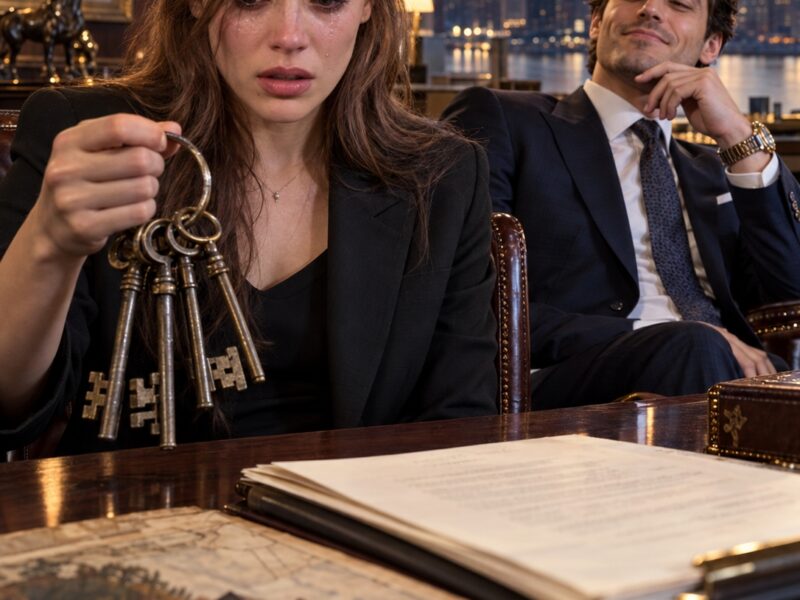
Whitmore gave me a heavy iron key ring.
Five keys.
One was almost black with age.
Patricia collected her documents.
Marcus was already standing.
As they headed for the door, he stopped beside me.
“If you decide to sell fast, call Mom. Seriously. Before taxes eat you alive.”
Then he smiled.
“Congratulations.”
I drove out of Boston alone.
Six hours later, I understood why Marcus had laughed.
The access road to Dunmore Hill was barely a road anymore.
Branches scraped both sides of my Subaru.
Mud filled deep tire ruts.
Twice the undercarriage struck hard enough to make me wince.
Then I rounded the last bend and saw the farmhouse.
I stopped.
The building leaned slightly to the right.
Not enough to look dramatic.
Enough to look doomed.
The wraparound porch had collapsed along one side. Several second-story windows were broken. The east corner of the foundation had separated badly enough for daylight to show through.
The fields I remembered from childhood were gone beneath bramble, weeds, saplings, and pale skeletal birches.
The barn on the northeast hillside had partially caved in.
Everything looked tired.
Not abandoned.
Tired.
As if the entire property had spent decades holding itself upright and was finally losing the argument.
I stayed inside the car for a full minute.
Then I laughed.
I couldn’t help it.
It was either laugh or cry.
I did both.
“Congratulations, Clara,” I whispered.
The front door resisted until I put my shoulder against it.
The smell hit first.
Damp wood.
Mildew.
Dust.
Mouse droppings.
Cold ashes.
Old paper.
Edmund had apparently confined himself to two rooms during his final years.
The rest of the house had been surrendered to time.
Yellow notebooks were stacked in crooked towers along the hall.
Water stains spread across the ceilings.
The kitchen floor moved under my boots.
In the parlor, a faded armchair faced a stone fireplace.
Beside it sat Edmund’s reading lamp.
I remembered sitting on the rug there while he read newspapers.
For one stupid second, I expected him to be in the chair.
The grief arrived so quickly I had to turn away.
I set my bag down.
Found an overturned wooden crate.
Sat.
And cried until my chest hurt.
Not only because Edmund was dead.
I cried because my business was gone.
Because I was $47,000 in debt.
Because my relatives had walked away with liquid assets while I had inherited a building that might collapse before winter.
Because I was exhausted from telling everyone I was fine.
My phone buzzed.
An email.
COUNTY PROPERTY TAX NOTICE.
I opened it.
$11,084.62.
Due within ninety days.
I stared at the number.
Then I started laughing again.
It sounded terrible in the empty house.
That night, I slept in my coat inside a sleeping bag beside Edmund’s fireplace.
At 2:13 a.m., rain began tapping through a leak into a metal cooking pot I’d placed beneath the ceiling.
Ping.
Ping.
Ping.
I watched shadows move across the walls.
Somewhere inside the house, wood groaned.
I thought about leaving.
Not tomorrow.
Immediately.
Get in the Subaru.
Drive back to Maine.
Let the county take the farm.
File bankruptcy if I had to.
Start over.
Then I remembered something Edmund had said during my last summer there.
We had been pulling weeds beside the barn.
I complained that they kept coming back.
He had leaned on his hoe and looked across the hill.
“Most people stop digging when the ground disappoints them.”
I had rolled my eyes.
I was eleven.
“What does that even mean?”
“It means the ground gets the final vote.”
At sunrise, I got up.
I gave myself one day to feel sorry for myself.
Then I started working.
For the first week, I survived mostly through anger.
Anger is underrated fuel.
I filled contractor bags.
Dragged ruined furniture outside.
Pulled wet insulation.
Scrubbed mold.
Sorted metal.
Made lists.
I heated canned soup on a camping stove and drank coffee strong enough to qualify as punishment.
I called real estate agents.
The first didn’t call back.
The second told me over the phone that Dunmore Hill had “complications.”
The third agreed to come.
Her name was Sandra Bell.
She arrived in a dented Ford pickup wearing work boots and carrying a clipboard.
She spent fifteen minutes walking the property.
When she returned, she didn’t bother pretending.
“You want the polite version?”
“No.”
“Good.”
She pointed toward the fields.
“Soil was tested in 2019. Contamination from an old tannery operation farther up the valley. Agricultural use is basically off the table unless somebody spends a fortune remediating.”
I swallowed.
“The house?”
“Tear-down.”
“The barn?”
“Maybe salvage stone and timber.”
“What would you list the property for?”
Sandra looked at me.
“You don’t want me to answer that.”
“I really do.”
She sighed.
“If you strip salvage first, maybe you clear fifteen thousand. Maybe.”
“Fifteen?”
“If you’re lucky.”
My tax bill was eleven.
My business debt was forty-seven.
I folded my arms because suddenly I was cold.
Sandra watched me.
“You inherited this?”
“Yes.”
“I’m sorry.”
I laughed once.
“So is everyone else.”
She studied the farmhouse.
“Sometimes families leave people things because they love them.”
“And sometimes?”
“Sometimes they leave people problems because they don’t want to solve them themselves.”
After she drove away, I stood in the driveway staring at Dunmore Hill.
For the first time, I wondered which one Edmund had done.
I decided to salvage everything I could.
Copper.
Hardware.
Slate.
Old-growth beams.
Fixtures.
Anything someone would buy.
The largest potential source was the stone bank barn built into the northeast hillside.
It was older than the farmhouse.
Late nineteenth century, according to county records.
The east roof had collapsed.
Half the interior was buried beneath timber, stone, dirt, and decades of accumulated debris.
I couldn’t clear it alone.
Sandra gave me the number of a local contractor.
Daniel Foss arrived the following morning.
He was in his early forties, broad-shouldered, quiet, with a beard beginning to gray around the chin.
His truck had rust around the wheel wells.
His excavator looked old but meticulously maintained.
He walked through the barn without saying much.
Then he looked at me.
“You living in the house?”
“For now.”
He glanced toward the sagging roofline.
“You shouldn’t sleep upstairs.”
“Wasn’t planning to.”
“You got heat?”
“Fireplace.”
“That isn’t heat.”
“It is when you’re broke.”
He looked at me for a second longer.
Then down at his clipboard.
His estimate was lower than I expected.
I knew immediately he’d reduced it.
“You don’t have to do that.”
“Do what?”
“Give me the charity rate.”
“I’m not.”
“You are.”
Daniel shrugged.
“Then don’t tell anybody. Ruins my reputation.”
That was the beginning of our friendship.
We worked six days.
He ran the excavator.
I sorted debris.
We found chestnut beams worth several hundred dollars each.
Hand-forged hinges.
Slate.
Old copper.
Not enough to save me.
Enough to keep me moving.
On the seventh day, rain started shortly after lunch.
Daniel was working at the far interior corner where the barn disappeared into the hillside.
I was thirty feet away stacking usable stone.
Then the excavator bucket struck something.
CLANG.
The sound was wrong.
Not stone.
Not wood.
Not buried farm machinery.
It was deep.
Metallic.
Resonant.
Daniel stopped immediately.
The excavator engine idled for two seconds.
Then died.
He climbed down.
I was already walking toward him.
“What happened?”
He crouched beside the bucket.
One tooth had been damaged.
Daniel wiped mud from it.
“That isn’t ledge.”
“What is it?”
“No idea.”
He looked toward the hole.
“But it’s engineered.”
We dug by hand.
Rain fell through the broken roof.
Mud stuck to my gloves.
Twenty-five minutes later, my shovel struck something hard.
The vibration ran up the handle into my arms.
Daniel froze.
I scraped again.
Metal.
We cleared more dirt.
A curved edge appeared.
Then another.
Concrete surrounded it.
Neither of us spoke.
By the time we’d exposed the entire thing, the rain was coming down hard.
Embedded horizontally in the ground was a circular steel hatch almost five feet across.
The surface was dark reddish-brown with oxidation.
At its center sat a wheel mechanism secured by a massive padlock.
Daniel crouched beside it.
Ran his fingers over the metal.
“This is not farm equipment.”
“What is it?”
“Commercial-grade steel.”
“How old?”
“Mid-century. Maybe older.”
He tapped the concrete collar.
“Someone poured this to last.”
My heartbeat had changed.
“Why?”
Daniel looked at me.
“You build something like this for one of two reasons.”
“Which are?”
“You expect something catastrophic to happen.”
He paused.
“Or you’re hiding something you absolutely cannot afford to lose.”
Rain hammered the barn roof.
I stared at the hatch.
Edmund had let his kitchen rot.
He’d heated two rooms.
He patched his own clothes.
Yet somewhere beneath his barn was a steel door designed to survive decades underground.
“Can we open it?”
Daniel looked at the lock.
“Not with what we’ve got here.”
“Your truck?”
“I’ve got a grinder.”
“Then let’s do it.”
He didn’t move.
“Clara.”
“What?”
“If that’s a fuel storage tank, chemical chamber, old industrial containment—anything sealed—we could have a serious problem.”
“So?”
“So the responsible move is call the county.”
“No.”
The word came out instantly.
Daniel stared at me.
I thought about Marcus laughing.
Patricia’s fingertips on my hand.
Fifteen thousand dollars.
Eleven thousand in taxes.
Forty-seven thousand in debt.
Then I remembered Edmund’s will.
Everything contained within the property lines.
To the deepest point of bedrock below.
“No county,” I said.
“That’s not what I recommended.”
“Noted.”
“Clara—”
“Double your rate.”
His eyebrows rose.
“I can’t afford it, but I’ll figure that out later. Please.”
Daniel looked at the hatch.
Then at me.
“You are either very determined or catastrophically bad at financial decisions.”
“Both.”
He exhaled.
“Stay back when I cut.”
The grinder screamed.
Orange sparks scattered across wet stone.
One disc broke.
Then another wore down.
Finally the padlock shackle separated.
It hit the hatch with a heavy metallic crack.
Daniel rigged a winch cable to the wheel.
We pulled.
Nothing.
Again.
Nothing.
“Together,” he said.
I wrapped both hands around the wheel.
“One.”
My boots slipped.
“Two.”
Rainwater ran down my neck.
“Three.”
We pushed.
For several seconds, the wheel refused.
Then something moved deep inside the mechanism.
An ugly shriek came from beneath us.
The wheel turned one inch.
Then two.
Then suddenly spun.
A hiss exploded around the hatch seam.
I stumbled backward.
Daniel grabbed my arm.
“Don’t breathe.”
We waited.
A column of trapped air escaped.
Daniel sniffed cautiously.
His expression changed.
“What?”
He looked confused.
“That isn’t chemical.”
I smelled it.
Charred wood.
Vanilla.
Dark sugar.
Something sharp beneath it.
Alcohol.
Old alcohol.
Daniel stared at me.
“You smell that?”
“Yes.”
We lifted the hatch with the winch.
Beneath it was darkness.
A concrete stairway descended underground.
Not a crude cellar.
A staircase.
Reinforced walls.
Smooth surfaces.
Perfectly preserved.
Daniel aimed his flashlight downward.
The beam vanished before reaching the bottom.
“Still want to do this?”
I looked outside.
At the ruined barn.
At the dead fields.
At the farmhouse everyone had told me was worthless.
Then I put one foot on the first stair.
“Yes.”
We counted forty-eight steps.
At the bottom stood another iron door.
Partially open.
Beyond it was blackness.
Daniel found an old electrical panel.
After twenty minutes of checking cables and running power from his generator, he looked at me.
“Ready?”
I nodded.
He threw the switch.
One light came on.
Then another.
Then another.
Amber industrial bulbs awakened one by one down the length of the underground chamber.
I stopped breathing.
The room was enormous.
Brick columns.
Steel crossbeams.
A vaulted ceiling.
Cool, stable air.
And shelves.
Thousands of feet of shelves.
On them sat enormous glass vessels sealed with dark wax.
Hundreds.
Then thousands.
Every vessel contained amber liquid.
The lights caught it until the entire chamber seemed filled with trapped sunset.
Daniel whispered something I couldn’t hear.
I walked toward the nearest rack.
There was a stamp in the wax.
Daniel wiped dust from it.
CALLAWAY RESERVE.
DISTILLED 1921.
BOTTLED 1929.
I stared at the words.
“No.”
Daniel looked at me.
“What?”
“Prohibition.”
He stared at the vessel.
Then at the endless rows behind it.
“Oh, hell.”
At the far end of the chamber stood a glass-walled office raised on a steel platform.
Inside was a mahogany desk.
A ledger.
And an envelope.
My name wasn’t written on it.
Instead, in Edmund’s unmistakable handwriting, were seven words.
FOR THE ONE WHO WAS WILLING TO LOOK.
My hands began shaking.
I opened it.
Clara,
If you are reading this, then I am gone.
And you have inherited the only thing I was never able to leave behind.
I sat down.
Daniel stayed by the doorway.
I kept reading.
Edmund told me about his grandfather, Silas Callaway.
In 1921, during Prohibition, Silas had built the underground chamber.
He produced rye whiskey using a family recipe and stored it in secret while working through distributors who operated beyond the law.
But eventually those men wanted more than distribution.
They wanted the recipe.
The stock.
Control.
Silas refused.
One winter night outside Burlington, men stopped his vehicle on an isolated road.
He never came home alive.
Edmund had been nineteen.
After the funeral, Edmund sealed the vault.
The stock remained underground.
Years passed.
The men involved disappeared, died, or were swallowed by other organizations.
But Edmund never trusted the danger had truly ended.
So he did something extraordinary.
He made Dunmore Hill look worthless.
He allowed fields to disappear.
Allowed buildings to decay.
Refused development.
Refused buyers.
Refused questions.
He lived above a fortune while people called him a miser.
A madman.
A recluse.
Then I reached the final paragraph.
I read it twice.
This liquid is the only honest thing my family ever made.
Money changes people, Clara, but expectation reveals them first.
I knew what Patricia expected.
I knew what Marcus expected.
I knew what you would expect too.
Nothing.
That is why I chose you.
Not because you needed it.
Because you were the only one who ever came here when there was nothing to take.
If you found this, you did what I hoped you would do.
You looked deeper.
It belongs to you.
I lowered the letter.
Daniel had turned away to give me privacy.
“Daniel.”
He looked back.
“I think he knew.”
“Knew what?”
“That everyone would laugh.”
I looked around at the amber bottles.
“I think that was part of the test.”
That night, I didn’t sleep.
I photographed seals.
Catalogued shelves.
Read Edmund’s ledgers.
The records were obsessive.
Dates.
Batch numbers.
Barrel origins.
Grain sources.
Bottling records.
Storage positions.
Every detail.
At 8:12 the next morning, Dr. Adrienne Voss arrived from New York.
She specialized in rare spirits and historical collections.
I expected excitement.
Instead, she became quieter with every hour.
She took samples.
Photographed seals.
Cross-referenced distillation records.
Examined glass composition.
Read ledgers.
Called two historians.
Then three.
At one point she sat down without saying anything.
That frightened me more than if she’d screamed.
Finally, after nearly four hours, she removed her glasses.
“Ms. Merritt.”
“Clara.”
“Clara.”
She glanced toward the shelves.
“Do you understand what you have?”
“No.”
“That may be preferable for another thirty seconds.”
Daniel coughed to hide a laugh.
Dr. Voss ignored him.
“This is authenticated pre-Prohibition American rye. The storage conditions are extraordinary. The vessels prevented the type of oxidation or evaporation we’d normally expect from a collection this old.”
“How much is it worth?”
She hesitated.
My stomach dropped.
“Is that bad?”
“No.”
“Then why are you looking at me like that?”
“Because I don’t like giving valuations before a full inventory.”
“Give me the ugly estimate.”
She folded her hands.
“Conservatively?”
“Yes.”
“Forty million.”
I thought I had misheard.
“What?”
“Potentially sixty.”
The room became very quiet.
“Dollars?”
Daniel turned away again.
Dr. Voss almost smiled.
“Yes, dollars.”
I sat down.
Forty million.
My mind refused to hold the number.
So it replaced it with smaller ones.
$47,000.
My debt.
$11,084.62.
Property tax.
$380.17.
My bank account.
Numbers I understood.
Forty million belonged to another language.
I looked at the nearest vessel.
“How quickly can I legally sell some?”
Dr. Voss raised an eyebrow.
“Most people ask how to maximize the collection.”
“I don’t need maximum anything. I need enough money to stop losing the property.”
“How much?”
“Eleven thousand by Friday.”
She looked around.
“Clara, one properly authenticated vessel could cover that many times over.”
“I know.”
“No, I don’t think you do.”
She was right.
By midnight, three vessels had been transferred through verified private buyers under controlled conditions.
At 11:48 p.m., I opened my banking app.
$420,000.
I refreshed it.
Same number.
Again.
Same number.
I sat on the farmhouse kitchen floor.
Not because there wasn’t a chair.
Because my legs stopped working.
For three years, money had meant fear.
Every number had been a countdown.
Rent.
Debt.
Interest.
Invoices.
Refunds.
Now I stared at $420,000 and felt almost nothing.
Then my phone buzzed.
A text from Marcus.
Mom says you still haven’t sold that dump.
Let me know if you want the name of a demolition guy.
I stared at it.
Then started laughing.
The next morning, I paid the property tax.
In full.
Then I paid off the most aggressive business creditor.
Then I hired an environmental attorney, a structural engineer, a security company, and a preservation consultant.
In that order.
I told no one in my family.
I didn’t need to.
News has its own transportation.
Especially when money is involved.
Two days later, Marcus called.
I watched his name flash across my phone.
I let it ring.
He called again.
Then Patricia.
Then Marcus again.
Finally I answered.
“Hello?”
Silence.
Then Marcus said, “What did you find?”
No greeting.
No pretending.
I leaned against Edmund’s kitchen counter.
“What are you talking about?”
“Don’t.”
“Don’t what?”
“Play stupid.”
“You’ve always seemed to think I didn’t need to play.”
His breathing changed.
“There’s a New York valuation firm registered at the property.”
So he’d been checking.
Interesting.
“You researching my worthless farm now?”
“Clara.”
“What?”
“What did you find?”
I looked through the kitchen window toward the barn.
Daniel was helping two security technicians install a camera above the entrance.
“Something Edmund left me.”
“You don’t know that.”
I smiled.
“Actually, that’s exactly what the will says.”
He hung up.
Marcus arrived the next afternoon.
With a lawyer.
Which brings us back to his shoes.
He stood in the driveway holding a certified notice.
His attorney introduced himself as Nathan Keller.
I invited neither of them inside.
Keller cleared his throat.
“Ms. Merritt, my client has reason to believe a previously undisclosed subterranean structure exists beneath the property.”
“Your client?”
I looked at Marcus.
“He told me the property was worthless.”
Marcus’s jaw tightened.
Keller continued.
“There may be legal questions regarding whether assets concealed within such a structure were properly included in probate.”
“Really?”
“Yes.”
I held out my hand.
“Can I see the letter?”
He gave it to me.
I read three paragraphs.
It cited an obscure Vermont statute regarding undisclosed improvements, questions of estate inventory, and potentially separate ownership of movable assets contained within a structure.
It was impressive.
It was also irrelevant.
I had spent the previous forty-eight hours paying very expensive attorneys to make sure of that.
“Wait here.”
I went inside.
When I returned, I was carrying a copy of Edmund’s will.
I handed it to Keller.
One paragraph was highlighted.
He read it.
Then read it again.
Everything contained within the property lines, from the uppermost point of the land to the deepest point of the bedrock below.
Keller’s face changed.
Marcus noticed.
“What?”
His lawyer didn’t answer.
“What?”
Keller lowered the document.
“This language is unusually comprehensive.”
“So?”
“It complicates your claim.”
“Complicates?”
“It may defeat it.”
Marcus stared at him.
“You said—”
“I said I needed to review the testamentary language.”
“You reviewed it.”
“Not this provision.”
Marcus snatched the document.
He read.
For the first time since I’d known him, I watched confidence leave his face in stages.
Disbelief.
Calculation.
Anger.
Then something almost childlike.
Injustice.
“This is insane.”
I said nothing.
“He gave Mom the financial accounts because those were hers. He gave me the cars and shares. He couldn’t have known what this was worth.”
“Maybe he did.”
Marcus looked up.
“What?”
“Maybe Edmund knew exactly what he was doing.”
“No.”
The answer came too fast.
“He was senile.”
“No, he wasn’t.”
“He lived like a homeless man in a collapsing house.”
“By choice.”
Marcus stared toward the barn.
“How much?”
I didn’t answer.
“How much is down there?”
“Enough.”
“I heard fifty million.”
His lawyer looked at him sharply.
So that was the rumor.
Marcus stepped closer.
“You think you deserve fifty million because you got lucky with a shovel?”
I felt something inside me become very still.
“Do you remember the probate meeting?”
“What does that have to do with anything?”
“You laughed.”
“Oh, come on.”
“You laughed when Whitmore said Dunmore Hill.”
“Because everybody thought it was worthless.”
“Exactly.”
He opened his mouth.
I continued.
“You told me not to waste money on it. Your mother offered to help me find someone to take it off my hands.”
“We didn’t know.”
“No.”
I looked him directly in the eyes.
“You didn’t.”
He shook his head.
“So this is revenge?”
“No.”
“Sounds like it.”
“If it were revenge, I’d be enjoying this more.”
Keller shifted beside him.
Marcus ignored him.
“We’re family.”
There it was.
Two words that had apparently been waiting for the valuation report.
I laughed softly.
“Were we family when I had $380?”
“That isn’t fair.”
“Were we family when I owed forty-seven thousand dollars?”
“I didn’t know about that.”
“Patricia did.”
His face changed.
Just slightly.
Enough.
“Were we family when you thought this place would bankrupt me?”
“You signed the will.”
“Yes.”
“So did you.”
He looked down at the paper.
Then toward the barn again.
“Granddad built the family wealth.”
“Great-Granddad.”
“Whatever.”
“No. Not whatever.”
My voice surprised even me.
“That’s the difference, Marcus. You don’t know who built what. You don’t know what happened here. You don’t know Silas. You don’t know why Edmund stayed. You don’t know why the house rotted. You didn’t even know how long he’d lived here.”
“And you did?”
“I listened.”
He stared at me.
I thought about Edmund’s letter.
Expectation reveals them first.
Marcus folded the will.
“You’ll regret doing this alone.”
“I’m not alone.”
“You know what I mean.”
He handed the document back.
Then he and Keller left.
Neither said goodbye.
The next six months changed Dunmore Hill.
But not in the way Marcus predicted.
I didn’t bulldoze the farmhouse.
I restored it.
Slowly.
The east foundation was rebuilt stone by stone.
The porch was reconstructed using photographs from Edmund’s journals.
We saved the original windows where possible.
Repaired the plaster.
Reused chestnut beams from sections of the barn that couldn’t be preserved.
The kitchen got heat.
Actual heat.
Daniel insisted.
“You’ve got forty million dollars underground and you’re still making coffee on a camp stove.”
“It works.”
“You’re a menace.”
He installed a proper stove the next week.
I paid him full rate.
He complained.
I ignored him.
The environmental contamination took longer.
Some sections of the property couldn’t be restored for agriculture without enormous expense.
So we stopped trying to make the land become what it had been.
We planted native species where appropriate.
Stabilized the watershed.
Worked with specialists.
The land wasn’t dead.
That had been another convenient description.
Damaged wasn’t the same thing as dead.
I understood that better than most.
The barn was rebuilt around the original stone.
The vault entrance received climate controls, fire suppression, security, and monitoring.
Dr. Voss helped establish provenance for the collection.
Historical records confirmed pieces of Edmund’s story.
Old newspaper archives mentioned Silas Callaway’s death.
Shipping records connected the family to grain suppliers.
The ledgers matched known bottle and glass manufacturing dates.
Every verification made the impossible more real.
Callaway Reserve became a name collectors whispered before most of the public ever heard it.
I sold carefully.
Never enough to destroy the collection.
Never enough to turn it into a circus.
Within sixty days, every dollar of my old business debt was gone.
The morning I made the final payment, I expected something dramatic.
Relief.
Triumph.
Maybe tears.
Instead, I sat at Edmund’s restored kitchen table and stared at the confirmation email.
PAID IN FULL.
I whispered it aloud.
“Paid in full.”
Then I cried harder than I had on the first night.
Not because I was rich.
Because for the first time in years, no one was coming for something I couldn’t give them.
There is a kind of exhaustion that doesn’t leave when the danger ends.
Your body keeps waiting for the next bill.
The next call.
The next disaster.
For months, I still checked my account before buying groceries.
Still hesitated before turning up the heat.
Still saved cardboard shipping boxes because they might be useful.
Money can change your circumstances in one day.
It takes longer to convince your nervous system.
One afternoon in April, I found myself standing in Edmund’s old room.
We had restored almost everything except one wall of shelves.
His notebooks remained there.
Hundreds of them.
Most were ordinary records.
Weather.
Repairs.
Expenses.
Planting dates.
But some contained thoughts.
One entry from 1998 stopped me.
Patricia visited today.
Asked again whether I intend to sell.
She says the place is wasted on me.
Perhaps.
But people confuse unused with wasted.
A locked door is not wasted merely because someone does not possess the key.
Another entry came from 2007.
Marcus came with Patricia.
He was thirteen.
Complained about the smell, the mud, and no television.
He asked what the farm would be worth if sold to developers.
I told him less than he hoped.
He never asked another question.
Then I found my name.
June 18, 2011.
Clara repaired the east gate hinge without being asked.
Used the wrong screw first.
Removed it.
Tried again.
Did not complain.
I laughed through tears.
Below it Edmund had written:
She notices broken things without assuming they should be thrown away.
I sat on the floor.
That sentence hurt more than his will.
Because suddenly I understood.
The inheritance wasn’t a reward for being his favorite.
It wasn’t charity.
It wasn’t luck.
Edmund had spent decades watching people.
Watching what they did when they thought nothing valuable was present.
Patricia saw an inconvenient old man.
Marcus saw decaying property.
I had seen a gate with a broken hinge.
And maybe that was all Edmund had needed.
Six months after the discovery, a letter arrived.
Heavy cream paper.
Marcus’s name on the return address.
I nearly threw it away.
Instead, I opened it.
He proposed a partnership.
His language was polished.
“Reunifying family assets.”
“Leveraging existing Callaway business infrastructure.”
“Preserving the legacy collectively.”
He offered contacts.
Capital.
Management.
Distribution.
Near the bottom, he wrote:
Whatever happened during probate, I hope we can agree that Edmund would not have wanted this discovery to divide the family.
I read that sentence three times.
Then carried the letter outside.
Daniel was repairing drainage near the barn.
He saw the envelope.
“Trouble?”
“Marcus.”
“Ah.”
“He wants to preserve the family.”
Daniel leaned on his shovel.
“Generous.”
“Apparently.”
“What are you going to say?”
I looked across the hill.
Spring had begun returning green to places that had been gray when I arrived.
The farmhouse stood straight again.
The porch Edmund had let collapse was new but looked old.
The barn roof was whole.
Beneath it, forty-eight concrete steps still descended into the earth.
“What do you think?”
Daniel considered.
“I think you already know.”
I did.
I never answered Marcus.
Not because I hated him.
Hatred requires maintenance.
I had enough property to maintain.
I didn’t answer because Edmund had taught me something wealth couldn’t.
Some people arrive when there is something to divide.
Others stay when there is only work to do.
You should remember the difference.
A year after Edmund died, I stood outside Dunmore Hill at dusk.
The valley below was filling with fog.
Lights glowed behind the farmhouse windows.
Somewhere inside, the heating system clicked on.
That still made me smile.
I carried one of Edmund’s notebooks beneath my arm and walked toward the barn.
The restored doors opened smoothly.
Inside, the original stone walls remained visible beneath the new structure.
I stopped above the steel hatch.
We had cleaned it but deliberately hadn’t replaced it.
The rust was gone.
The scars remained.
I liked that.
There are things you restore.
There are things you preserve.
And wisdom is knowing which is which.
I descended the forty-eight steps alone.
The vault lights came on gradually.
Amber glass appeared row after row.
For months, visitors had called the sight extraordinary.
Priceless.
Historic.
A fortune.
But I no longer saw dollar signs first.
I saw Edmund.
Nineteen years old.
His grandfather dead.
A frightened young man sealing an iron door because he believed dangerous people might return.
I saw him years later repairing fences above millions of dollars he refused to touch.
Eating alone.
Growing old.
Listening as his family mocked the property he had sacrificed his life to protect.
I used to wonder why he hadn’t sold the collection once the danger disappeared.
Why not enjoy it?
Why live in a leaking house above a fortune?
Then I understood.
At some point, Edmund stopped protecting whiskey.
He was protecting a choice.
Who would receive it.
And perhaps he knew that if he revealed the secret too soon, he’d never know whether someone loved him or the thing beneath his feet.
There is loneliness in that kind of knowledge.
A terrible loneliness.
I entered the glass office.
Edmund’s original letter was now stored safely elsewhere, but I’d made a copy.
I kept it in the desk.
That evening, I read the final lines again.
It belongs to someone willing to dig for it.
That person was always going to be you.
I sat there until the vault lights dimmed automatically.
For years, I had thought inheritance meant receiving what someone had accumulated.
Money.
Property.
Objects.
I was wrong.
Sometimes inheritance is receiving the weight someone else carried.
Sometimes it is learning why they carried it.
And sometimes the greatest thing someone leaves you isn’t the fortune.
It’s the proof that they saw who you were long before you had enough evidence to see it yourself.
When I finally climbed back upstairs, night had settled over Dunmore Hill.
Daniel’s truck was gone.
The farmhouse lights glowed through the trees.
The fields moved softly in the wind.
My phone vibrated.
For half a second, I expected Marcus.
It wasn’t him.
It was a notification from my bank.
I cleared it without opening the app.
That might have been the strangest change of all.
A year earlier, numbers controlled my breathing.
Now the richest thing I owned was silence.
I locked the barn.
Crossed the yard.
Then stopped halfway to the house.
From there, I could see the entire ridge.
The place Marcus had called worthless.
The property Sandra had valued mostly for salvage.
The house where I’d sat on a wooden crate and cried because I had $380 left.
The ground everyone told me was dead.
I thought of the probate room again.
Marcus laughing.
Patricia touching my hand with three fingers.
Whitmore pausing before reading Edmund’s unusually precise sentence.
Everything contained within the property lines.
From the uppermost point of the land to the deepest point of the bedrock below.
For months, I had assumed Edmund wrote it that way because he wanted to make certain the vault legally belonged to me.
Now I wondered if there was another reason.
Maybe the old man had left one final lesson inside the language itself.
People are always eager to judge what they can see.
A ruined house.
Dead soil.
A failed business.
A broke twenty-six-year-old woman.
A strange old man living alone.
They look at the surface and decide they understand the value underneath.
Marcus had done it to the farm.
My family had done it to Edmund.
And, if I was being truthful, I had done it to myself.
I had believed failure meant I was finished.
I had believed debt meant I was foolish.
I had believed inheriting Dunmore Hill was proof that even in death, luck had somehow passed me by.
But the ground had gotten the final vote.
Just like Edmund said it would.
I walked toward the farmhouse.
Behind me, beneath stone and steel and eighty acres everyone had dismissed, the Callaway Reserve rested in darkness.
Not waiting to make anyone rich.
It had already done that.
Waiting, perhaps, to remind the next person who heard the story of something much harder to measure.
Some fortunes are handed to people who expect them.
Some are fought over by people who believe their name gives them ownership.
And some remain buried for nearly a century until the person nobody bothered to envy becomes desperate enough to keep digging.
Marcus inherited the cars.
Patricia inherited the accounts.
I inherited the thing they laughed at.
And in the end, that was exactly how Edmund had planned it.
Because some things are not divided.
Some things are not claimed simply because you discover their price.
Some things are earned long before anyone realizes they have value.
And sometimes the person who appears to have been left with nothing is standing on top of everything.









