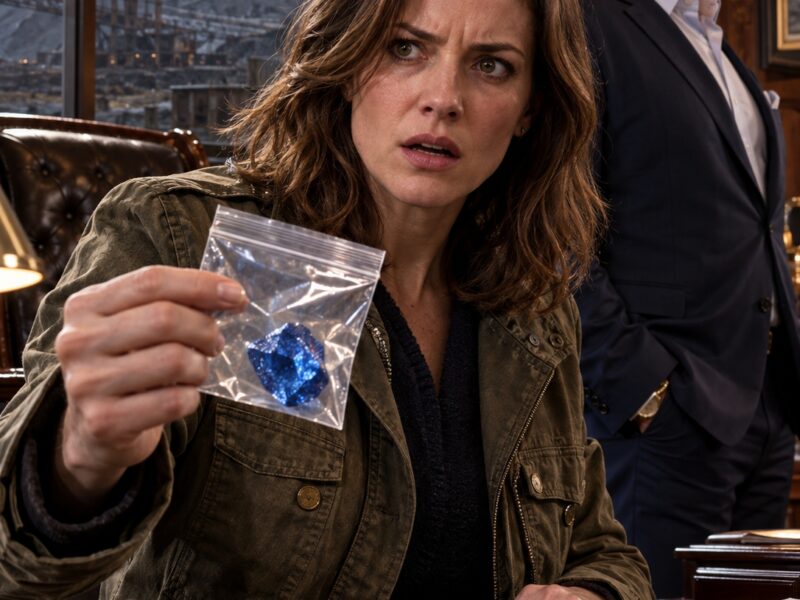
MY FAMILY LEFT ME A $1 TOXIC WASTELAND—THEN A STRANGER SHOWED UP AND SAID, “DON’T TOUCH ANOTHER ROCK. THIS LAND IS WORTH $72 MILLION.”

The first bulldozer arrived at 5:47 in the morning.
By 5:51, Bridget Nolan was standing in front of it.
She wore muddy work boots, yesterday’s jeans, and a state-issued field jacket she had pulled over her T-shirt without bothering to zip it. Her hair was twisted into a loose knot. She had slept perhaps forty minutes.
Behind her, beyond a rusted chain-link fence, rose the ugliest inheritance in Ironvale County.
A black ridge of nineteenth-century industrial waste.
A dead smelter foundation.
Contaminated soil.
And somewhere inside all of it, according to a geological consultant, approximately seventy-two million dollars in rough diamonds.
The diesel engine growled behind the gate.
Warrick Doyle stepped away from the flatbed truck and stared at Bridget.
He looked different without his polished office calm.
Less like a man delivering paperwork.
More like a man watching a very expensive morning go wrong.
“Ms. Nolan,” he called over the machinery. “You need to move.”
Bridget held up a document.
“No.”
Doyle’s expression tightened.
His crew had driven in before sunrise because Highline Reclamation Group intended to begin preliminary extraction that morning. Eleven days earlier, Doyle had stood at the same gate and explained—politely, confidently, almost sympathetically—that companies like his often received rights to materials recovered during environmental cleanup.
He had spoken as if the outcome had already been decided.
As if Bridget should be grateful.
As if the mountain had already changed owners.
Now she walked toward him and extended the document.
“This is a state-issued emergency stay.”
The loader operator killed the engine.
Suddenly the morning became very quiet.
“No equipment crosses that boundary,” Bridget said, “until the mineral-rights review is complete.”
Doyle took the paper.
His eyes moved down the first page.
Then the second.
Then back to the first.
The foreman climbed down from the loader.
Doyle stopped at a paragraph near the bottom.
For the first time since Bridget had met him, he looked genuinely uncertain.
“Where did this severance language come from?”
“1891.”
He looked up.
Bridget pointed toward the black ridge behind her.
“You searched the property,” she said. “You searched the environmental notices. You searched the modern title history.”
She paused.
“You forgot to search the dead.”
Something changed in Doyle’s face.
Because now he understood.
This was no longer a dispute about contaminated dirt.
It was about a document that had been waiting underground, figuratively speaking, almost as long as the stones themselves.
And Bridget Nolan had found it ten days before his bulldozers arrived.
But three months earlier, she had believed that land was worth exactly one dollar.
That was what the appraisal said.
One dollar.
Not one dollar per acre.
Not one dollar after liabilities.
One dollar total.
The number had been printed neatly on official estate letterhead and placed in front of her in Franklin Odet’s law office on a hot Wednesday morning.
Bridget remembered staring at it while the window air conditioner rattled behind her.
Six chairs had been squeezed into a room designed for four. The carpet smelled faintly of dust and old coffee. Outside, Ironvale’s downtown sat beneath the tired afternoon sun, half the storefronts empty since the highway bypass had redirected traffic years earlier.
Her grandfather, Desmond Nolan, had died six weeks before.
He had not been wealthy in the way magazines described wealth.
But he had owned land.
A gravel quarry.
A townhouse.
Equipment.
Savings.
And the remnants of an old industrial property that everyone in the family had spent decades pretending did not exist.
Franklin Odet adjusted his glasses and began reading the will.
“Emmett Nolan receives full ownership of Nolan Quarry and associated equipment.”
Bridget’s uncle leaned back.
Tap.
Tap.
His wedding ring touched the conference table twice.
Bridget noticed.
She always noticed.
Emmett had been doing that since she was a child. Whenever he believed an argument was over, whenever he thought he had won, his wedding ring struck the nearest hard surface twice.
Tap.
Tap.
A tiny victory bell.
Odet continued.
“Additionally, Mr. Nolan leaves Emmett the investment account currently valued at approximately one hundred seventy-five thousand dollars.”
Colleen, Emmett’s wife, squeezed his arm.
Then came the townhouse.
Paid off.
Downtown.
Colleen received it.
She immediately unlocked her phone and whispered something about replacing the kitchen cabinets.
Then Franklin looked at Bridget.
“And to Bridget Nolan…”
For one foolish second, she thought her grandfather might have left her something personal.
His old Ford.
His field notebooks.
The brass compass he carried when she was little.
Something that said he remembered the girl who used to sit beside him on the quarry overlook eating peanut butter sandwiches from wax paper.
Instead Franklin slid a property description toward her.
“…the former Iron Veil smelting parcel located off Ironvale Road, including the mill footprint and associated slag field.”
Silence.
Then Emmett’s ring touched the table.
Tap.
Tap.
Bridget looked at the appraisal.
Estimated value: $1.00.
She almost laughed.
Not because it was funny.
Because sometimes humiliation was so precise that the body mistook it for absurdity.
Emmett leaned toward her.
“The slag heap.”
He said it gently.
That made it worse.
“Look, Bridget, that ground’s been fenced off since before either of us were born. County’s had a testing order sitting on it forever. Nobody wants it.”
Colleen glanced up from a photograph of white marble countertops.
“Honestly, honey, you could probably deed it back to the county.”
Bridget said nothing.
“Wash your hands of it,” Colleen added.
Emmett nodded.
“You got the one piece of this estate that costs money to own.”
There it was.
Not cruelty exactly.
Something colder.
Certainty.
The certainty that Bridget had once again made the wrong choices and everyone else could see it.
She had been the Nolan who left Ironvale.
The one who went to college.
Then graduate school.
Then Denver.
The one who took a state environmental science job that her relatives described vaguely as “lab stuff.”
Emmett had stayed.
He had worked beside Desmond.
He understood gravel crushers, diesel engines, contract bids and the language of men who measured a good year by tonnage.
Bridget understood spectrographs, contamination profiles and environmental records.
In the Nolan family, only one of those things had ever looked like real work.
Franklin cleared his throat.
“There’s also an environmental file.”
He pushed a thick folder toward Bridget.
“The state requires testing before any sale or development. No updated testing has been filed in years.”
“How expensive?” Bridget asked.
“Depends what they find.”
Emmett smiled without quite smiling.
“That’s lawyer language for expensive.”
Tap.
Tap.
Franklin continued.
“The title search is otherwise clean. No liens. No competing ownership claims. Nothing unusual in the county index.”
Bridget placed one hand on the folder.
Something in that sentence bothered her.
Not because Franklin was wrong.
Because she knew what “clean” meant in old industrial files.
It meant no one had found anything.
That was not the same as nothing being there.
She had spent eleven years reading reports about abandoned mines, chemical yards and forgotten processing plants. Records did not preserve truth.
Records preserved whatever somebody had bothered to write down.
Emmett stood.
“Don’t take it personally, Bridge.”
She looked at him.
“Why would I?”
“Granddad had to leave that parcel to somebody.”
His voice softened.
“At least the state probably can’t make you pay for the entire cleanup unless you try selling it.”
He walked out.
Colleen followed him, already discussing backsplash colors.
Bridget remained seated.
On the table lay a one-dollar appraisal.
Beside it sat an environmental folder thick enough to ruin several weekends.
She picked up both.
Franklin gave her an apologetic smile.
“For what it’s worth, your grandfather never talked about that property with me.”
“That’s supposed to make me feel better?”
“I don’t know.”
She stood.
“Neither do I.”
Outside, she put the folder in the passenger seat.
Then she sat behind the wheel without starting the engine.
Across the parking lot, Emmett and Colleen were laughing beside their SUV.
A cousin stopped to congratulate them.
Bridget could not hear every word, but she heard enough.
Quarry contract.
Renewal.
Big year.
She looked down at the appraisal again.
$1.
Her grandfather had left Emmett the business that kept the family solvent.
He had left Colleen a home.
He had left Bridget a warning sign.
For three weeks, she did almost nothing about it.
Almost.
The folder traveled back to Denver with her.
At the state environmental laboratory, Bridget mentioned the parcel to her supervisor, Fay Renwick, during a slow Thursday afternoon.
Fay had spent twenty years studying places everyone else wanted forgotten.
She flipped through the smelter history.
“1891 to 1909.”
“Then nothing,” Bridget said.
Fay frowned.
“Nothing?”
“Operation stops. No bankruptcy explanation. No fire report. No labor action I can find. No recorded depletion notice.”
“Old smelters disappeared all the time.”
“I know.”
“They ran out of ore. Ran out of money. Owner died. Railroad changed routes.”
“I know.”
Fay closed the folder.
“You want me to tell you your grandfather secretly left you a gold mine?”
Bridget smiled.
“I’d settle for telling me why a functioning smelter apparently woke up one morning in 1909 and decided it was tired.”
Fay pushed the folder back.
“Go home, Bridget.”
She did.
But the folder went into her desk drawer instead of the recycling bin.
Three weeks later, Bridget loaded a portable spectrograph into her state vehicle on a Saturday morning.
Technically, she was not required to personally perform the contamination survey.
Technically, using state equipment on inherited property was something she would eventually have to document.
Practically, hiring a contractor would cost more than the parcel was supposedly worth.
So she drove two hours to Ironvale.
The town looked smaller than she remembered.
The hardware store remained.
So did the diner.
Everything else seemed to be slowly fading.
At the end of Ironvale Road, she stopped beside the old fence.
A faded sign read:
CONTAMINATED SITE — TESTING REQUIRED PRIOR TO DISTURBANCE
Beyond it rose the slag ridge.
Black.
Low.
Ugly.
The remains of the mill foundations were half buried beneath scrub grass.
Bridget climbed through a section of chain link that had rusted loose.
Heat pressed against her shoulders.
Then she smelled something.
Metallic.
But faintly sweet.
She stopped.
That was wrong.
She had sampled dozens of industrial waste sites.
Old lead contamination had a profile.
Sulfur residue had one.
Arsenic-bearing waste had one.
This smelled like none of them.
She set up the analyzer.
First sample.
Normal industrial contamination.
Second.
Normal.
Third.
Then the screen changed.
Bridget frowned.
She recalibrated.
Ran it again.
Same result.
Carbon.
Too much.
Not contamination-too-much.
Geologically wrong.
She crouched beside the pile.
“What are you?”
The machine obviously did not answer.
She moved twenty feet.
Another sample.
The spike appeared again.
Steady.
She ran calibration twice.
No equipment error.
By late afternoon, Bridget’s knees hurt and sweat had soaked through the back of her shirt.
She should have packed up.
Instead she kept digging.
Her fingers brushed something embedded inside a fused piece of slag.
Hard.
She worked around it carefully.
A stone came loose.
Gray-blue.
Dull.
Heavy.
Far too heavy.
She rolled it across her palm.
For several seconds she simply stared.
Then she whispered, “No.”
Because her brain had produced an explanation she did not want to entertain.
Years earlier, in graduate mineralogy, she had seen a reference sample with a carbon signature like this.
Kimberlite.
But there was no recorded kimberlite deposit in Ironvale County.
None.
Bridget sealed the stone in a sample bag.
Then found another.
And another.
Darkness began spreading across the ridge.
She should have left.
Instead she reached into her equipment case.
At the bottom was a handheld thermal-conductivity probe.
Most technicians could work an entire career without needing one.
Bridget pressed it against the first stone.
The needle swung hard right.
She froze.
“No.”
She tested again.
Same result.
Glass would not do that.
Quartz would not do that.
Ordinary smelting waste absolutely would not do that.
Her hands began trembling.
She lifted the stone toward the dying sunlight.
Along one broken edge, something flashed.
Not bright.
Not beautiful.
Just enough.
Bridget sat down in the dirt.
For several seconds, the only sound was wind moving through dry grass.
Then she laughed.
Once.
A short, frightened sound.
She turned toward the slag ridge.
All her life, her family had called it waste.
Her grandfather had fenced it off.
The county had marked it contaminated.
An appraiser had valued it at one dollar.
Now Bridget looked at the black hill and felt the terrifying sensation that the hill was looking back.
She stayed until after dark.
Her headlamp moved slowly across the slag.
One stone became three.
Three became six.
At the motel that night, she lined the sealed bags across the desk.
She did not call Emmett.
She did not call Franklin.
She did not call anybody.
Nine days later, Dr. Adzo Okonquo from the university gemology laboratory called her.
“Ms. Nolan?”
“Yes.”
“I have your samples.”
Bridget stood from her desk.
“And?”
There was a pause.
Not long.
Long enough.
“They’re diamonds.”
The laboratory around Bridget seemed to recede.
“Natural?”
“Yes.”
“Industrial grade?”
Another pause.
“No.”
Bridget gripped the edge of her desk.
Okonquo continued.
“Type IIb. Trace boron is responsible for the coloration.”
“Blue.”
“Yes.”
Bridget closed her eyes.
“How unusual?”
“Very.”
“How valuable?”
“I’m not going to give you a valuation from four rough samples.”
“Doctor.”
“Very valuable.”
Bridget said nothing.
Okonquo’s voice changed.
Professional curiosity gave way to something sharper.
“Where did you say these came from?”
“A nineteenth-century slag heap.”
“That’s the problem.”
“What problem?”
“There is no recorded kimberlite pipe anywhere in that county.”
Bridget stared at the folder on her desk.
“So?”
“So if those stones really came out of smelting waste, the men operating that furnace may have processed diamond-bearing rock without knowing what they had.”
Bridget felt cold.
“How much could be left?”
“I have absolutely no way to answer that.”
Then Okonquo added:
“But if you found four without excavation…”
She stopped.
Bridget finished the thought herself.
There could be more.
The following weekend, she returned.
This time she worked systematically.
Grid sections.
Photographs.
Sample numbers.
Locations.
Eleven additional stones.
Every one drove the probe needle right.
By Sunday evening, Bridget no longer wondered whether the discovery was real.
She wondered where the rock had originally come from.
That question took her to the county archive.
Marlene Cutter, the records clerk, disappeared into storage and returned carrying boxes coated in dust.
“Nobody asks for the old smelter records,” she said.
“How nobody?”
“I’ve worked here eleven years.”
“And?”
“You’re the first.”
Inside a 1908 operations ledger, Bridget found handwriting she recognized from old family papers.
Cormac Nolan.
Her great-grandfather.
Foreman.
Most entries were boring.
Furnace loads.
Weights.
Deliveries.
Repairs.
Then Bridget found an entry six weeks before the operation closed.
She read it twice.
Then a third time.
Vein seven again today. Rocks heavier than they have any right to be. Ruined two crucibles this month. Something in it doesn’t melt clean the way ordinary ore does. Told the men to leave that section be until someone smarter than any of us figures out what it actually is.
Bridget stopped breathing.
“Marlene?”
“Yeah?”
“When did the smelter close?”
Marlene checked another ledger.
“About a month after that.”
The final entry contained only a vague explanation.
Conditions beyond continuing.
That afternoon Bridget walked to Ironvale’s historical society.
An eighty-something volunteer named Otis Farrow listened to her question, then slowly removed an old photograph from a display case.
“My grandfather worked the furnace.”
He pointed toward a row of soot-covered men.
“He used to talk about the last year.”
“What did he say?”
“That the foreman started separating certain rock.”
“Cormac Nolan?”
Otis nodded.
“Said Cormac wouldn’t let anyone throw it back into the furnace.”
“Did he know what it was?”
“Hell, no.”
Otis smiled faintly.
“Nobody did.”
Then he pointed toward a handwritten line reproduced beneath the photograph.
Bridget leaned closer.
The mountain doesn’t waste anything. It only hides what men weren’t equipped yet to see.
She read it twice.
Eight days later, a man was waiting at her property gate.
His hard hat was spotless.
That was the first thing Bridget noticed.
The second was his folder.
“Warrick Doyle. Highline Reclamation Group.”
He offered the folder instead of his hand.
“How did you find me?”
“Your contamination filing.”
Bridget’s stomach tightened.
“It’s public?”
“Environmental database.”
Of course.
She had followed procedure.
And procedure had announced her discovery.
Doyle explained that Highline tracked remediation opportunities.
He spoke calmly.
Reasonably.
Almost kindly.
That made Bridget distrust him immediately.
“We’ve already applied for contractor designation.”
“Already?”
“Standard process.”
“I didn’t hire you.”
“You don’t necessarily have to.”
She stared at him.
Doyle opened the folder.
“Sites under standing remediation orders can qualify for state-directed cleanup. Contractors sometimes offset costs through recovered material.”
Bridget felt something shift inside her.
“Recovered material.”
“Yes.”
“You mean my diamonds.”
Doyle did not smile.
But he did not pretend ignorance either.
“Our consultant estimates potential recoverable value at approximately seventy-two million dollars.”
Bridget heard the number.
She did not react.
Not visibly.
Inside her, something fell through the floor.
Seventy-two million.
Her uncle had tapped his wedding ring against a table over a one-dollar appraisal.
Colleen had suggested giving the property away.
Her grandfather had left her a poisoned hill.
Seventy-two million dollars.
Doyle watched her carefully.
“Most owners in your position are relieved to have the liability handled.”
“My position?”
“You inherited a contaminated industrial site.”
“I also inherited what’s inside it.”
“That’s legally more complicated.”
“How complicated?”
“Enough that you should get counsel.”
She almost admired the answer.
Almost.
Doyle looked toward the ridge.
“Our preliminary extraction begins in eleven days.”
Bridget turned back.
“Excuse me?”
“While designation review proceeds.”
“You intend to move equipment onto my property before the paperwork is complete?”
“We don’t generally wait to mobilize.”
“Why?”
“Time.”
“No.”
His eyes returned to her.
“What?”
“I asked why.”
Doyle considered her.
Then said quietly:
“Because people who wait usually lose something.”
That night Bridget barely slept.
At 2:13 a.m., she spread copies of every document she possessed across her motel bed.
Modern title search.
Environmental notice.
Probate records.
Smelter history.
Nothing.
At 3:40 she found herself staring at one phrase from Franklin Odet.
The title search is otherwise clean.
Clean.
Bridget suddenly sat upright.
A routine title search.
Modern indexes.
Recorded encumbrances.
Current ownership.
But the land had been purchased in 1891.
What if the thing she needed was older than the indexing system looking for it?
At eight the next morning, she called Marlene.
“I need the original deed.”
“Which deed?”
“The first one.”
“How first?”
“1891.”
There was silence.
Then Marlene said:
“That may take a while.”
“I have ten days.”
Two days later, Bridget was sitting beneath fluorescent archive lights with a brittle document spread carefully across a table.
The ink had faded brown.
The legal language was dense.
She read the first paragraph.
Nothing.
Second.
Nothing.
Third—
Bridget stopped.
Read it again.
Then she stood so quickly her chair scraped backward.
“Marlene.”
The clerk came over.
“What?”
Bridget pointed.
“Tell me you see that.”
Marlene adjusted her glasses.
Her lips moved as she read.
Then she looked up.
“Oh.”
Buried inside the 1891 purchase deed was a mineral-rights severance clause.
Surface ownership and subsurface mineral rights had been legally separated.
The mineral rights belonged to the original purchasing company and its successors.
That ownership chain had eventually passed, uninterrupted, into the Nolan family.
Generation after generation.
Nobody had noticed.
Because nobody had needed to.
Until now.
Bridget copied everything.
That afternoon she filed an emergency brief with the state mining board.
She included Okonquo’s gemological report.
The deed.
The historical ownership chain.
And Doyle’s eleven-day extraction timeline.
Then she waited.
Day three.
Nothing.
Day five.
Nothing.
Day seven.
Highline trucks appeared in Ironvale.
Day eight.
Bridget called the board twice.
Day nine.
No ruling.
On day ten, at 4:03 p.m., an email appeared.
EMERGENCY ADMINISTRATIVE STAY GRANTED.
Bridget printed six copies.
Then drove through the night.
Which was how she came to be standing before a bulldozer at 5:51 the next morning.
Doyle read the order.
“Where did this severance language come from?”
“1891.”
He looked toward his crew.
Bridget stepped closer.
“You told me people who wait usually lose something.”
Doyle’s jaw flexed.
“I remember.”
“So do I.”
The crew foreman walked over.
“You want us moving?”
Doyle stared at the order.
The answer took several seconds.
“No.”
The foreman waved the trucks back.
One by one, engines shut down.
For Bridget, the silence that followed was louder than machinery.
Eleven days later, the state mining board issued its final ruling.
The 1891 severance clause was valid.
Highline could perform environmental remediation.
It could not claim the recovered minerals.
The diamonds belonged to Bridget.
The written decision included one sentence she read five times.
Highline’s legal team had apparently relied on a routine title search without requesting the original 1891 deed.
They had made the same mistake everyone had made.
They saw waste.
They saw liability.
They saw a woman who had inherited something nobody wanted.
And they stopped looking.
Bridget called Emmett that evening.
He answered on the fourth ring.
“Bridge.”
She had not heard him sound cautious with her in years.
“You heard?”
“About the ruling?”
“Yes.”
A long silence.
“How much is it really worth?”
She looked through the motel window toward the distant ridge.
“Highline’s estimate is seventy-two million.”
Emmett breathed out.
“Jesus.”
Neither spoke for several seconds.
Then Bridget said:
“You remember the will reading?”
“Bridget—”
“You said I got the one thing that costs money to own.”
“I shouldn’t have said it like that.”
“You were right.”
He went quiet.
“It did cost money.”
She looked at Cormac Nolan’s copied ledger on the desk.
“It just cost the mountain a century to figure out how to pay me back.”
Emmett had no answer.
Weeks later, Highline formally accepted the ruling.
Doyle returned to the gate one final time before remediation began.
No polished folder this time.
No spotless hard hat.
Just a man standing beside a fence.
“For what it’s worth,” he said, “I raised the mineral-rights issue with legal.”
Bridget looked at him.
“And?”
“They were confident it wouldn’t matter.”
“You weren’t?”
Doyle gave a tired half-smile.
“I’ve been doing reclamation permitting twelve years.”
“That didn’t answer my question.”
“No.”
He looked toward the slag.
“I wasn’t.”
“Then why push?”
“Because companies don’t pay people to be nervous.”
Bridget almost smiled.
Doyle shoved his hands into his pockets.
“I keep a private list.”
“Of what?”
“Claims we pushed harder than I thought we should.”
Bridget waited.
“This one was near the top.”
It was not an apology.
But it was perhaps the closest thing a man in Doyle’s position knew how to give.
Bridget accepted it without forgiving what did not require her forgiveness.
Then she did something nobody expected.
She did not simply sell the diamonds and abandon Ironvale.
Working with Dr. Okonquo’s recommended licensed gem dealer, she arranged controlled extraction.
The confirmed appraised recovery value reached approximately seventy-two million dollars.
She placed the proceeds into a remediation trust.
Then she funded the cleanup herself.
Fay Renwick came out to consult.
Highline crews performed much of the physical remediation under corrected terms.
Doyle occasionally appeared at the site.
This time he asked before crossing the gate.
Months passed.
Contaminated soil was removed.
Old waste was stabilized.
Water monitoring stations were installed.
Records were updated.
For the first time in more than a century, somebody was not trying to extract everything the mountain could give.
They were trying to repair what people had done to it.
Then Emmett called.
His voice was different.
No confidence.
No ring tapping.
No invisible scoreboard.
“I was wondering something.”
“What?”
“If there’s a way the family can still be part of whatever you do out there.”
Bridget sat quietly.
A younger version of herself would have answered immediately.
Yes, because she wanted approval.
Or no, because she wanted revenge.
At forty, Bridget finally understood that both impulses gave other people too much power.
“I’ll think about it.”
Emmett waited.
“That’s it?”
“That’s it.”
And for once, she meant exactly those words.
Colleen never called.
Bridget heard through relatives that the townhouse kitchen renovation was completed that spring.
White cabinets.
Stone counters.
Everything precisely as planned.
Life had an almost cruel talent for continuing normally beside extraordinary events.
Bridget eventually used part of the trust proceeds to establish a program through her state office teaching rural landowners how to investigate historical deeds, dormant mineral clauses and industrial ownership records before signing away property they had been told was worthless.
Twelve families attended the first workshop.
The following year, two other state offices adopted the curriculum.
Marlene Cutter framed a copy of the 1891 severance clause and kept it on her archive desk.
“It’s my favorite document in the building,” she told Bridget.
Otis Farrow added Cormac Nolan’s ledger entry to the historical society exhibit beneath the old photograph of the furnace crew.
For the first time, visitors could read why certain stones had been pulled aside in 1908.
Bridget preserved part of the original slag ridge.
The dangerous sections were stabilized.
The fence was replaced.
But she refused to erase everything.
Near the ridge she installed a small marker.
Nothing elaborate.
No mention of seventy-two million dollars.
No diamonds.
No celebration of wealth.
Only:
CORMAC NOLAN
1908
Fay stood beside her the afternoon the marker went in.
“You could build something here.”
“I know.”
“A visitor center.”
“I know.”
“Sell the land.”
“I know.”
Fay studied her.
“So why keep this?”
Bridget looked at the black ridge.
Because she remembered a conference room.
A one-dollar appraisal.
Tap.
Tap.
She remembered Colleen scrolling through kitchen photographs while Bridget inherited contamination.
She remembered Emmett saying somebody had to hold the liability.
She remembered Doyle standing at the gate with paperwork that treated ownership like an inconvenience.
And she remembered kneeling alone in the dirt as a thermal probe swung hard to the right.
All those people had looked at the same land.
None had seen the same thing.
“My grandfather could’ve sold this parcel,” Bridget finally said.
“Why didn’t he?”
“I don’t know.”
“You think he knew?”
“About the diamonds?”
“Yes.”
Bridget shook her head.
“No.”
That answer had taken her months to accept.
Desmond had probably never known.
There had been no secret fortune deliberately handed to his granddaughter.
No grand plan.
No final test.
Sometimes people left you burdens because they genuinely believed those things were burdens.
Sometimes the universe did not arrange justice elegantly.
Sometimes there was only an overlooked deed, a stubborn woman and enough time for old mistakes to become visible.
Fay touched the top of the marker.
“Then why you?”
Bridget smiled faintly.
“Because everybody else stopped looking.”
Years later, when Bridget returned to Ironvale, she occasionally saw families standing beside that marker.
Most had heard some version of the story.
The seventy-two-million-dollar slag heap.
The blue diamonds.
The one-dollar inheritance.
Those were the details people remembered.
Money made stories easy to repeat.
But Bridget had come to believe the money was the least important part.
The diamonds had been there when Cormac Nolan stood beside the furnace in 1908.
They had been there when the smelter closed.
They had been there through the Depression, two world wars, recessions, births, funerals, marriages and divorces.
They had been there while Ironvale grew.
They had been there while Ironvale shrank.
They had been there when Desmond bought equipment for the quarry.
When Emmett learned to drive a loader.
When Bridget left town.
When everyone decided the old ridge was useless.
Value had not suddenly appeared when Bridget found it.
Only recognition had.
One autumn afternoon, she visited the historical society alone.
Otis had died the previous winter.
A younger volunteer now sat behind the desk.
She did not recognize Bridget.
That amused her.
Bridget wandered toward the smelter display.
Cormac’s photograph remained.
So did the ledger entry.
Beneath it, Otis had added another line before his death.
Bridget had never seen it.
She leaned closer.
The mountain doesn’t waste anything. It only hides what men weren’t equipped yet to see.
She stood there for a long time.
Then her phone vibrated.
Emmett.
Their relationship had never become simple.
There had been no dramatic reconciliation.
No tearful family dinner where decades of resentment vanished over dessert.
They spoke occasionally.
Sometimes about the quarry.
Sometimes about Desmond.
Sometimes about nothing important.
That was enough.
Bridget answered.
“Hey.”
“You in town?”
“How’d you know?”
“Marlene saw your car.”
Bridget laughed.
“Ironvale hasn’t changed.”
“Nope.”
A pause.
Then Emmett said, “I’m out at the quarry. Found something of Granddad’s you might want.”
“What?”
“Come see.”
She looked once more at Cormac’s photograph.
“I’ll be there.”
Outside, late-afternoon light fell across Main Street.
The town was still imperfect.
Still smaller than it had once been.
Still carrying abandoned buildings and old arguments.
But Bridget no longer felt the need to escape it.
She drove toward Ironvale Road.
Near the restored property, she pulled over.
The new fence caught the sunlight.
Behind it stood the ridge.
Not beautiful.
Not exactly.
But no longer ugly either.
She walked to the marker.
Wind moved through the grass.
For a moment she imagined Cormac there more than a century earlier, holding one of those strange heavy rocks and knowing only that it did not behave the way stone was supposed to behave.
He had lacked the instruments.
The geology.
The laboratory.
The language.
But he had possessed something else.
Doubt.
Enough doubt to stop.
Enough curiosity not to destroy what he did not understand.
Bridget placed her hand against the marker.
For most of her life, she had thought being underestimated meant someone else had measured her and found her lacking.
Now she understood something different.
Sometimes being underestimated simply meant the person doing the measuring had brought the wrong instrument.
Her family had measured worth in businesses, property and staying close to home.
The appraiser had measured land by liability.
Highline had measured it by recoverable profit.
Cormac had measured those stones by how strangely they behaved inside a furnace.
Bridget had measured them by questions.
And questions had changed everything.
She turned toward her car.
Then stopped.
Something small glinted near the edge of the stabilized ridge.
Her old instincts stirred.
For one ridiculous second, she considered climbing the fence.
Then she laughed.
“No.”
She had learned when to keep looking.
She had also learned when enough was enough.
Bridget got into her car and drove toward the quarry, leaving the mountain behind her.
The sun dropped lower.
The ridge disappeared in her rearview mirror.
And somewhere beneath the cleaned soil and preserved black stone, perhaps there were still diamonds nobody had found.
Perhaps there weren’t.
It no longer mattered.
Because the greatest thing Bridget Nolan recovered from Iron Veil had never been buried inside the slag.
It was the part of herself she had spent years allowing other people to appraise.
The niece who left.
The scientist whose work nobody understood.
The woman given the unwanted inheritance.
The family member expected to smile while everybody else walked away with something better.
For years, she had mistaken other people’s certainty for evidence.
She would never make that mistake again.
At the next bend in the road, the mountain vanished completely.
Bridget kept driving.
Behind her stood a marker bearing the name of a man who had recognized a mystery he could not solve.
Ahead of her waited an uncle who had finally learned that being wrong did not always mean being unforgivable.
And between them lay more than a century of people deciding what was valuable before they understood what they were looking at.
The land had waited through all of them.
Patiently.
Silently.
Holding its secret beneath a pile of waste worth one dollar on paper.
Until someone finally looked twice.









