MY FAMILY SAVED 13 CHAIRS FOR 14 PEOPLE—THEN TOLD ME TO EAT IN THE KITCHEN. I WALKED OUT… AND EVERYTHING CHANGED

There were fourteen people in my sister’s house on Christmas Eve.
There were thirteen chairs.
And after I had spent eight hours cooking dinner for every person in that room, my mother looked straight at me and said, with the calm practicality of someone solving a minor household problem, “Clare, sweetheart, why don’t you eat in the kitchen?”
For one second, nobody moved.
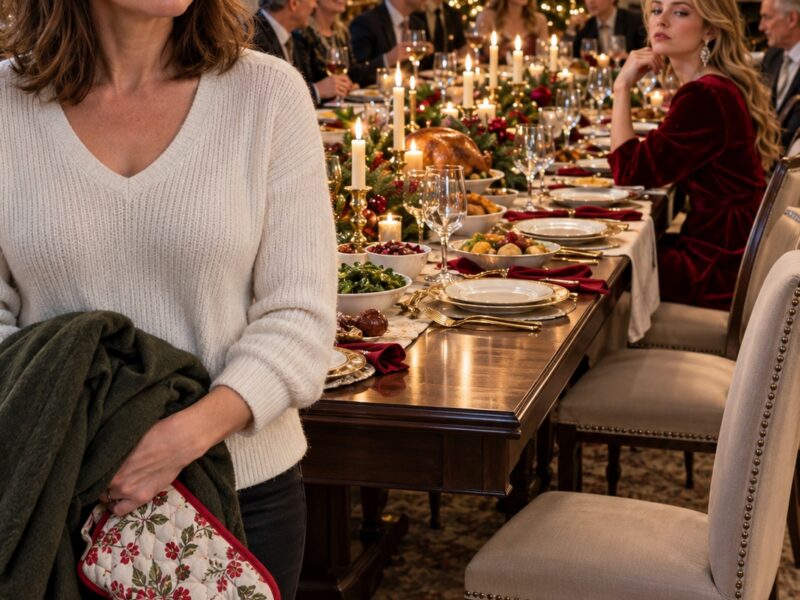
Steam curled from the platter of glazed ham between us. Candles flickered in crystal holders my sister had received as a wedding gift. Somewhere near the far end of the table, Derek’s teenage nephew laughed at something on his phone because he hadn’t heard what my mother said.
Or maybe he had.
Maybe everyone had.
My sister, Mallerie, stared at her plate.
My father reached for his wine.
And I stood there holding an oven mitt, suddenly aware that I had spent forty-one years becoming very good at disappearing.
I had been useful for so long that my family had mistaken usefulness for personality.
I remembered birthdays.
I drove people to appointments.
I covered shifts.
I brought casseroles after surgeries, wrapped presents for children who were not mine, stayed late after parties, washed glasses while everyone else laughed in the living room.
And that morning, I had arrived at Mallerie’s house before seven.
I had driven forty minutes through Connecticut snow.
I had brined the ham the night before.
I had made two pies, dinner rolls from scratch, mashed potatoes, gravy, roasted vegetables and the homemade cranberry sauce my mother insisted tasted “more festive.”
I had done all of it while Mallerie wore a cashmere robe and occasionally wandered through the kitchen to tell me where she kept the good serving spoons.
Now everyone was seated except me.
And apparently nobody found that strange.
“Clare?” my mother prompted.
I looked at her.
Judith Witcom had a particular expression she used whenever one of her daughters became inconvenient.
Soft eyes.
Patient mouth.
A slight tilt of the head that made the other person look unreasonable before they had said anything at all.
“You’ll be more comfortable in there,” she added. “It’s crowded.”
Something inside me went very still.
Not angry.
Not yet.
Just still.
I looked at the thirteen chairs.
Then at the fourteen plates.
Then at Mallerie.
She would not meet my eyes.
“No,” I said.
My father finally looked up.
“What?”
“I said no.”
The word wasn’t loud.
That was what made everyone hear it.
Howard Witcom put down his wine.
“Clare, this isn’t the time.”
A laugh almost escaped me.
Not because anything was funny.
Because that sentence had followed me my entire life.
When I was twelve and Mallerie had taken the birthday money our grandmother gave me because she wanted a new jacket more than I wanted anything.
Not the time.
When I was seventeen and my parents paid for Mallerie’s summer program but told me the household budget was tight.
Not the time.
When I was twenty-six and I postponed culinary school because my father’s business was struggling and my mother needed help.
Not the time.
When I was thirty-three and Mallerie and Derek needed a temporary loan for the down payment on their first house, and somehow I became selfish for asking when they planned to return it.
Never the time.
There was always a perfect time for me to help.
There was never a good time for me to hurt.
“I think that’s been the problem,” I said.
My mother’s face tightened.
“What has?”
“There’s never a time.”
Mallerie finally looked at me. “What are you doing?”
I stared at my younger sister.
She was thirty-eight, beautiful in the polished, effortless way people assumed came naturally even when it required an entire architecture of money, support and attention.
“This dinner,” I said. “Who cooked it?”
She blinked.
“What?”
“Who cooked dinner?”
“Clare—”
“Who came here last night to brine the ham?”
Nobody answered.
“Who got here at seven this morning?”
My father sighed. “We all appreciate what you did.”
“No, Dad. You appreciate that it got done.”
Silence.
That landed.
I could feel it.
My heartbeat thudded against my ribs, but my voice remained strangely calm.
“I made the ham. I made the potatoes. I made the gravy, the rolls, both pies, the vegetables and the cranberry sauce Mom requested. I set most of this table while everyone else was in the living room.”
Mallerie folded her arms.
“You volunteered.”
“I always volunteer.”
“That isn’t our fault.”
There it was.
The little trapdoor beneath every favor I had ever done.
Nobody asked you.
Therefore nobody owed you gratitude.
I looked at her and suddenly saw the whole system with painful clarity.
“You’re right.”
Mallerie’s expression changed.
She hadn’t expected agreement.
“You’re absolutely right,” I continued. “It isn’t your fault that I kept saying yes.”
My mother leaned forward.
“Clare, you’re making this much larger than it is. We’re short one chair.”
“There are fourteen people.”
“Yes.”
“And thirteen chairs.”
Nobody spoke.
I looked around the table.
“All day, not one person noticed there wasn’t a place for me.”
My father’s jaw tightened.
“Enough.”
“No.”
His eyebrows rose.
It might have been the first time in my adult life I had ever said that word directly to him.
“No,” I repeated. “It isn’t enough. That’s actually the entire point.”
Mallerie gave a humorless little laugh.
“It’s my house, Clare.”
That sentence hurt more than my mother’s.
Maybe because it was so simple.
So honest.
I looked at the table I had filled with food.
At the candles I had lit.
At the napkins I had folded.
At the people waiting for me to stop being difficult so they could begin eating.
“You’re right again.”
I took off the oven mitt.
“It is your house.”
“Then can we please—”
“And that means none of this is mine.”
Mallerie stopped.
I swallowed.
The grief arrived before the anger.
It had been waiting much longer.
“I spent most of my life thinking if I made myself useful enough, eventually I’d become important.”
My mother’s face changed slightly.
I kept going.
“I thought if I remembered enough birthdays, made enough dinners, answered enough calls and made things easy enough for everybody, eventually somebody would notice me before they needed something.”
“Clare,” my father warned.
I shook my head.
“But you didn’t.”
The room was silent now.
Completely silent.
Even the teenagers had stopped talking.
I looked at my mother.
“Fourteen people.”
Then at the chairs.
“Thirteen seats.”
Then at my sister.
“And somehow I’m still the one expected to solve it.”
Mallerie’s eyes flashed.
“What do you want me to do? Build another dining room?”
“No.”
I picked up my coat from the back of a chair near the hallway.
“I want you to enjoy dinner.”
“Clare.”
“Merry Christmas.”
My mother stood.
“Oh, for heaven’s sake. Don’t leave over a chair.”
I stopped at the doorway.
That was the moment everything changed.
Because for the first time, I understood that it was never about the chair.
And maybe she understood it too.
“It isn’t the chair, Mom.”
I looked back at her.
“It’s that none of you knew it was missing.”
Then I walked out.
Nobody followed me.
That part stayed with me.
Not the argument.
Not Mallerie’s face.
Not my father’s anger.
The fact that nobody followed.
The front door closed behind me, and Connecticut winter hit my face like a slap.
Snow had thickened since morning.
The driveway was already white.
My car looked small under the streetlamp, half-buried beneath a soft layer of snow.
I got inside.
Closed the door.
And sat there.
For ninety seconds, maybe two minutes, I could not breathe correctly.
My body had apparently decided that telling the truth at Christmas dinner qualified as a medical emergency.
I gripped the steering wheel.
“Okay,” I whispered.
Nothing was okay.
I started the engine anyway.
I had nowhere to go.
That realization should have destroyed me.
Instead, it felt strangely clean.
My apartment was forty minutes away.
I could have driven there.
I didn’t.
I drove through Brier Glenn’s decorated downtown, past the white church with the nativity scene, the hardware store with colored lights around its windows, the diner where I sometimes ate breakfast on Sundays.
Then I kept driving.
Out past the neighborhoods.
Past the streetlights.
Onto the narrow country roads where snow collected faster than county crews could clear it.
I cried somewhere around mile six.
Not elegantly.
Not the single tear of women in movies who somehow remain beautiful while devastated.
My nose ran.
My chest hurt.
I cursed my family.
Then myself.
Then my family again.
And because pain has a talent for opening old filing cabinets, I remembered things I hadn’t thought about in years.
The acceptance letter from a culinary program in New York I never answered.
The bakery notebook I started at nineteen.
The second notebook at twenty-seven.
The third at thirty-five.
Recipes written between insurance claims and family emergencies.
Dreams developed in secret because secret dreams could not embarrass me.
I was still crying when my car made the sound.
A hard metallic shudder.
Then another.
I knew that sound.
My mechanic had warned me about the alternator two months earlier.
I had said I would handle it after Christmas.
Christmas, apparently, had other plans.
The dashboard flickered.
The engine died.
I managed to pull onto the shoulder before everything went dark.
For a while, I just sat there.
Snow gathered on the windshield.
I reached for my phone.
Dead.
Of course.
The charging cable I kept in the car had been failing for weeks, and because my entire personality could apparently be summarized as I’ll deal with it later, I had not replaced it.
I laughed.
Actually laughed.
Alone.
On a dark road.
During a snowstorm.
After walking out on my family.
It was so complete that it crossed the line from tragedy into insult.
“Perfect,” I whispered.
I pulled my coat tighter.
Town was maybe three miles behind me.
Maybe more.
Walking in that weather would be stupid.
Staying in the car indefinitely might be worse.
I was still calculating when headlights appeared in my rearview mirror.
They slowed.
My relief lasted half a second.
Then came fear.
Every woman knows that switch.
Rescue and danger sometimes wear the same headlights.
The vehicle stopped behind me.
Not a pickup.
A black sedan.
Large.
Expensive.
The driver’s door opened.
A man stepped out.
Even through snow and darkness, he was imposing.
Tall.
Broad-shouldered.
A dark wool coat.
The controlled movements of someone who did not waste energy wondering what other people thought of him.
He approached my window.
I cracked it two inches.
He looked at me.
Not glanced.
Looked.
His face was older than mine, probably early fifties. Strong nose. Dark hair touched with gray. The kind of eyes that made you suspect he noticed exits automatically.
“Car dead?” he asked.
His voice was low.
“Apparently.”
“Phone?”
“Also dead.”
His gaze shifted briefly toward the dashboard.
“You’ll freeze if you stay here.”
“I had reached a similar conclusion.”
One corner of his mouth moved.
Almost a smile.
“There’s a house about a mile ahead.”
“Your house?”
“Yes.”
That did not necessarily improve things.
He seemed to read the thought.
“My name is Gideon Ashborne.”
I waited.
The name meant nothing to me then.
It would mean a great deal later.
“I live outside Brier Glenn,” he continued. “You can use the phone. Get warm. Someone can look at your car when the roads clear.”
“I don’t know you.”
“No.”
Snow landed in his hair.
He didn’t seem bothered by it.
“I’m also not leaving you here.”
I almost laughed again.
“That sounds slightly threatening.”
This time the almost-smile became real.
Brief.
“Fair.”
He stepped back from the window, giving me space.
“Let me try again. You’re welcome to stay in your car. I can call someone from mine and wait until they arrive. Or you can come to the house. Your choice.”
Choice.
Such a simple word.
Something about the way he said it settled me.
Not safe.
I did not know enough to call him safe.
But he had corrected himself.
That mattered.
“It’s Christmas Eve,” he added.
As though that explained why a man who looked like he belonged in a boardroom or a courtroom—or possibly somewhere far less legal—was standing in snow offering assistance to a stranger.
I looked at the road.
At my dead phone.
At him.
Then I opened the door.
The wind nearly knocked me backward.
Gideon offered his arm as I stepped over the icy shoulder.
He let go the second I was stable.
His car was warmer than any place had a right to be.
Leather seats.
Quiet engine.
That deep expensive warmth that feels less like heat and more like the complete absence of problems.
I sat with my purse on my lap.
He drove.
He did not ask why I had been crying.
That may have been the first kind thing he did for me.
The iron gates opened before his car stopped.
That was when I began to understand Gideon Ashborne was not merely wealthy.
The gates were set into a stone wall disappearing into the trees.
No visible security booth.
No obvious cameras.
Which meant there were probably many.
The drive curved through snowy woods toward a house large enough to deserve a name.
Ashborne Manor.
Stone, brick and tall windows glowing amber against the storm.
I stared.
“This is your house?”
“It is.”
“That was not the kind of house I imagined when you said a house.”
“What kind did you imagine?”
“One where I wouldn’t immediately regret having worn old boots.”
That nearly earned another smile.
The front door opened before we reached it.
The woman standing there looked to be in her late sixties, with silver hair pinned back and the expression of someone who had survived enough foolishness to no longer be impressed by it.
“You’re late,” she told Gideon.
“Road was bad.”
“I noticed the blizzard.”
Then she saw me.
Her attention moved over my coat, wet hair and probably wrecked face.
Concern replaced irritation.
“Who is this?”
“Clare Witcom. Her car broke down.”
The woman looked at me.
“Come inside before you become a medical event.”
“This is Margaret,” Gideon said.
“I run the house.”
Margaret removed her eyes from me long enough to look at him.
“I run you.”
Gideon sighed.
I nearly smiled.
Margaret wrapped a warm blanket around my shoulders before I could object.
Not offered.
Wrapped.
Competence with hands.
“Sit.”
“I’m fine.”
“You are the color of printer paper.”
I sat.
Gideon leaned against the wall several feet away.
“You can use the phone in the study.”
I opened my mouth.
Then stopped.
Who would I call?
Mallerie?
My parents?
Tell them I had broken down after storming out so somebody could come rescue me and restore the family hierarchy?
No.
My friends were scattered across other states.
My coworker Paula had grandchildren visiting.
There was no one.
Gideon watched the realization happen.
“Or not,” he said.
I looked at him.
For some reason, that nearly made me cry again.
“I’m sorry.”
His brows drew together.
“For what?”
“This.”
He looked genuinely confused.
“You apologize often.”
Heat climbed my face.
“I’ve known you fifteen minutes.”
“And you’ve apologized twice.”
Margaret made a small approving sound.
Gideon looked toward her.
“Don’t encourage her.”
“I’m encouraging you.”
I laughed.
It slipped out before I could stop it.
The sound startled me.
An hour earlier, I had been standing without a chair at my sister’s Christmas table.
Now I was laughing under a blanket in a mansion with two strangers.
Life had apparently lost interest in subtle transitions.
Margaret fed me.
Roasted chicken.
Potatoes.
Carrots.
Fresh bread.
Nothing elaborate.
It may have been the best Christmas dinner I ever ate because it was the first one in years I had not cooked myself.
Gideon sat across from me.
He ate quietly.
Margaret moved around the kitchen.
At one point I asked, “Did you make this?”
“Yes.”
“I can cook,” Gideon said.
Margaret didn’t turn around.
“You can heat.”
“There is a distinction?”
“A very large one.”
I watched them.
There was affection beneath the irritation.
History.
The kind of shorthand people develop after years of actually knowing one another.
My chest tightened.
I looked down at my plate.
“You okay?” Gideon asked.
“Yes.”
He waited.
I corrected myself.
“No. But I will be.”
His gaze held mine.
“Better answer.”
The roads closed before ten.
By eleven, leaving was impossible.
Margaret showed me a guest bedroom.
I stood under a hot shower for twenty minutes and stared at tile.
Then I climbed into a bed softer than any mattress I had ever owned.
My family had called.
Seven times.
Four from my mother.
Two from Mallerie.
One from my father.
My phone had charged enough to show the notifications after Margaret found a cable.
I did not listen to the voicemails.
I turned the phone facedown.
And for the first time in years, I chose not to fix what somebody else was feeling.
I slept.
Christmas morning, I woke at six-thirty from habit.
The house was silent.
I lay there for ten minutes before restlessness won.
Then I found the kitchen.
Cooking had always been how I translated emotion into something I could hold.
So I made breakfast.
Eggs.
Toast.
Coffee.
When Margaret appeared, she stopped in the doorway.
“You didn’t have to do that.”
“I know.”
That answer surprised both of us.
“I wanted to.”
Her eyes softened.
“Better.”
“Gideon told you?”
“He didn’t need to.”
At seven forty-five, the side door opened.
Gideon came in wearing running clothes, snow dusting his shoulders.
He stopped when he saw me.
Then the eggs.
Then Margaret.
“Apparently we’ve been replaced,” Margaret told him.
Gideon sat.
He ate everything.
Halfway through breakfast, something in his posture changed.
Less controlled.
Less like the man from the dark road.
More like somebody sitting in his own kitchen.
I studied him when he wasn’t looking.
And suddenly I recognized something.
Loneliness.
Not the theatrical kind.
Not sadness.
Infrastructure.
The loneliness of a person who had lived without intimacy so long that solitude had become part of the architecture.
I recognized it because I had built the same house inside myself.
The storm kept me at Ashborne Manor for three days.
At least, that was the official explanation.
By the second afternoon, roads were technically passable.
My car needed an alternator.
A man named Titus who worked for Gideon retrieved it and arranged the repair.
I should have left.
Instead, Margaret needed help chopping vegetables.
Then I found an old book in the library.
Then snow started again.
Then it was dark.
Reasons multiplied when desire was too frightening to name.
On the third day, Gideon found me in the library reading a book about bakeries in New England.
“You cook professionally?” he asked.
I laughed.
“No.”
“Why is that funny?”
“I process insurance claims.”
He looked at the book.
Then at me.
“That wasn’t my question.”
I lowered it.
“I wanted to.”
“To cook professionally?”
“To own a bakery.”
He said nothing.
For some reason, the silence made me continue.
“I used to have plans.”
“Used to?”
“I was nineteen. Then twenty-two. Then twenty-seven. At some point you stop saying someday because someday starts sounding embarrassing.”
“What happened?”
I looked at the snow beyond the windows.
“Life.”
“That’s vague.”
“My family needed things. Money. Time. Help. There was always something more urgent.”
“And you?”
I smiled without humor.
“I became the person who handled urgent things.”
“How long ago did you stop?”
The question hit somewhere unexpected.
“I’m not sure I ever officially stopped.”
He waited.
“I just kept putting it off until twenty years disappeared.”
His face changed.
Not pity.
Recognition.
“I know something about losing years.”
I wanted to ask how.
I did not.
He did not offer.
That was the strange thing about Gideon.
He could be direct without being invasive.
He looked at you completely and still left doors closed if they belonged to you.
At least, that was what I believed then.
Later, I would learn even kindness can hide control when a person is accustomed to deciding what others need to know.
But that came later.
On the third evening, I put on my coat.
Gideon found me in the entry hall.
“Leaving?”
“I’ve stayed too long.”
“You apologized twice today for existing inside a house with fourteen bedrooms.”
“Twelve.”
“Fourteen.”
I looked at him.
“There are two you haven’t seen.”
Despite myself, I smiled.
“I have a job.”
“I know.”
“An apartment.”
“I know.”
“A life.”
He crossed his arms.
“That’s a description.”
“It’s also where I live.”
He nodded.
He didn’t stop me.
That mattered.
“Thank you,” I said. “For everything.”
“You would have survived without me.”
“Maybe.”
“No.”
The certainty in his voice irritated me.
And comforted me.
“You would have.”
He opened the door.
Cold air moved between us.
“Come back when you’re ready.”
I looked at him.
“To the manor?”
“The library.”
A pause.
“If that makes it easier.”
It did.
That frightened me more than it should have.
I returned to work.
Claims.
Fluorescent lights.
Tuesday meetings.
The same desk where I had sat for nine years doing a job I could perform almost perfectly while thinking about something else.
I had always been praised for reliability.
Nobody had ever noticed reliability and invisibility were almost the same skill.
My mother called January third.
“I’ve been worried sick.”
No hello.
No apology.
No Are you okay?
I leaned back on my couch.
“I’m fine.”
“You disappeared.”
“I left.”
“On Christmas.”
“Yes.”
“Without telling anyone where you were going.”
“I didn’t know where I was going.”
A pause.
“That is not reassuring.”
I almost smiled.
“No. I suppose not.”
She exhaled.
“Mallerie has been devastated.”
There it was.
My sister’s pain.
Center stage.
Right on schedule.
“Why?”
“Because of what happened.”
“What happened?”
“Clare.”
“I’m asking.”
“You humiliated her in her own house.”
“I said there wasn’t a chair for me.”
“You made a scene.”
“I named a fact.”
Silence.
Then the voice.
Patient.
Wounded.
The voice from my childhood.
“Your father and I worked very hard to give both of you girls everything.”
I looked at the wall.
“No.”
“What?”
“You gave Mallerie everything.”
“That is ridiculous.”
“You paid her college tuition.”
“We helped both of you.”
“I went to community college at night because you said money was tight.”
“That was your choice.”
“You helped with Mallerie’s down payment.”
“She had children.”
“She didn’t have children yet.”
Another silence.
I kept going.
“When Derek’s first business failed, Dad loaned them thirty thousand dollars.”
“That’s private.”
“I gave you eight thousand of it.”
My mother said nothing.
“You told me Dad’s business needed help.”
“That was years ago.”
“Yes.”
My throat tightened.
“That’s why it matters.”
She changed tactics.
“You’ve always been jealous of your sister.”
Something old inside me flinched.
Something newer stayed still.
“I was at Mallerie’s house before seven in the morning on Christmas.”
“Clare—”
“I cooked every dish.”
“I know.”
“She didn’t notice there wasn’t a chair for me.”
My voice stayed level.
“Either she didn’t notice or she didn’t care. I honestly don’t know which one hurts more.”
This silence was different.
Less strategic.
“I’d like to see you,” my mother said eventually.
“Not yet.”
“Why?”
“Because I’m not ready to pretend this is fixed.”
“I’m not asking you to pretend.”
“You are.”
I stood.
“You always are.”
I ended the call.
Four minutes later, Mallerie texted.
Mom says you’re still angry. Can we please move past this? This isn’t healthy for the family.
I stared at the screen.
The family.
For forty-one years, I had been the unpaid infrastructure of that phrase.
Now my anger was apparently the structural weakness.
I put the phone facedown.
Three Saturdays later, I drove back to Ashborne Manor.
At the gate, I pressed the intercom.
For several seconds, nothing happened.
I nearly left.
Then Gideon’s voice came through.
“Library?”
I smiled despite myself.
“If the offer still stands.”
The gates opened.
“It stands.”
That became our rhythm.
Saturday afternoons.
Books.
Coffee.
Margaret’s tea.
Sometimes Gideon worked while I read.
Sometimes we talked for hours.
He never asked why I came back.
I never asked why he always made sure the chair opposite him was empty before I arrived.
One Saturday in February, he looked up from a file.
“Your mother called.”
My entire body tensed.
“What?”
“She called here.”
“How did she get this number?”
“I’m finding out.”
There was something in the way he said it that reminded me Gideon’s definition of finding out probably differed from mine.
“What did she want?”
“To know whether you were here.”
My stomach sank.
“What did you say?”
“That your whereabouts were your business.”
I exhaled.
He continued.
“She said your family is concerned that you’ve been acting unlike yourself.”
“That means I stopped cooperating.”
His eyes sharpened slightly.
“She also said you might be vulnerable.”
“Vulnerable?”
“And that you had become attached to inappropriate people.”
I looked at him.
“Inappropriate people.”
“Yes.”
“Meaning you.”
“I assume.”
“Oh my God.”
I covered my eyes.
“I’m sorry.”
“Stop.”
I lowered my hands.
“What?”
“Stop apologizing for things you did not do.”
“I’m apologizing because she called your house.”
“You didn’t call.”
“That’s not—”
“It is.”
His voice remained quiet.
“You do this constantly.”
I stared at him.
“You manage other people’s reactions before they happen. You apologize in advance so maybe the blame will hurt less when it arrives.”
The accuracy of it felt almost rude.
“How long have you been psychoanalyzing me?”
“Since Christmas.”
“That’s unsettling.”
“It should be.”
I looked away.
“It’s a habit,” he said. “Not a character defect.”
“That’s generous.”
“It’s expensive.”
I looked back.
“What?”
“The habit. It costs you.”
Before I could answer, Margaret entered with coffee and ended the conversation by setting a cup in front of me.
But the sentence stayed.
It costs you.
The following week, Derek emailed Gideon.
Gideon showed me the message at the kitchen table.
I read it twice.
Derek had apparently learned who Gideon Ashborne was.
Not everything.
But enough.
The Ashborne name carried weight in three counties.
Shipping companies.
Commercial real estate.
Construction.
Restaurants.
Warehouses.
Businesses whose names I recognized and others I did not.
And rumors.
Plenty of rumors.
Derek’s email was dressed as a professional introduction.
Underneath, it was a request for money.
He had a development project.
He had projections.
He had an opportunity a man of Gideon’s “resources and strategic vision” might appreciate.
I put the phone down.
“He’s using me.”
Gideon said nothing.
“My mother called here.”
“Yes.”
“Then Derek emails you.”
“Yes.”
“They spent a month telling everyone they’re worried about me getting involved with you.”
“Yes.”
“And the second they think I might give them access to you, they want an investment.”
Gideon leaned back.
“You wanted honesty.”
“I did.”
“They are not primarily worried about you.”
Cold spread through my chest.
“Right.”
“They’re worried about proximity.”
I closed my eyes.
I wanted him to be wrong.
That was the worst part.
“I need to see them.”
“Why?”
“Because I need to know.”
“You already know.”
“No.”
I shook my head.
“I need to sit across from them and give them one opportunity to prove me wrong.”
He studied me.
“You think that’s foolish?”
“I think it’s yours to do.”
That answer was becoming one of the reasons I trusted him.
Which made what happened later hurt much more.
I arranged lunch with my parents and Mallerie.
Neutral restaurant.
My choice.
My time.
They arrived together.
That told me almost everything.
Judith hugged me.
Howard kissed my cheek.
Mallerie said I looked thin.
They had clearly rehearsed concern.
For twenty minutes, we talked about nothing.
My apartment.
My job.
The weather.
My mother announced she had made my favorite soup.
It was Mallerie’s favorite.
It had always been Mallerie’s favorite.
Then Dad cleared his throat.
“I understand you’ve been spending time with Gideon Ashborne.”
There it was.
I picked up my water.
“Yes.”
“He’s… significant in this county.”
“Interesting adjective.”
My father frowned.
“We’ve heard things.”
“What things?”
He looked at my mother.
My mother looked at Mallerie.
Mallerie looked at her hands.
A little triangle of cowardice.
“We just want what’s best for you,” my sister said.
I almost laughed.
Instead, I placed my glass down.
“Derek emailed him.”
Mallerie froze.
My parents looked at her.
“What?” my mother asked.
“Derek emailed Gideon asking for money.”
“It wasn’t asking for money,” Mallerie said quickly. “It was a business opportunity.”
“Did you know?”
“He mentioned reaching out.”
I nodded.
There it was.
Complete.
Clean.
Undeniable.
“So while Mom was calling Gideon’s home because she was worried I had attached myself to inappropriate people, your husband was trying to get those inappropriate people to finance his project.”
“That’s not fair.”
“No?”
“Business is separate.”
“Only when it benefits you.”
“Clare.”
I looked at my father.
“When was the last time you called me because you wanted to know how I was?”
He stared.
“Not because you needed paperwork explained. Not because Mom needed a ride. Not because Mallerie needed help. When did you call me because you wondered how your daughter was doing?”
His face hardened.
He had no answer.
I turned to my mother.
“Mallerie got college paid for. Help with her house. Money after Derek’s business failed.”
“You cannot reduce a family to accounting.”
“I’m not.”
I leaned forward.
“I’m reducing this lunch to honesty.”
Mallerie looked angry now.
“You have always kept score.”
“No.”
My voice surprised me.
Calm.
“I started keeping score when I realized everybody else had been spending from my account.”
She stared at me.
I stood.
“I know what this lunch is.”
My mother’s expression flickered.
“It’s not reconciliation.”
I placed money beneath my water glass.
“It’s reconnaissance.”
“Clare—”
“You wanted to know whether I could still be managed.”
Nobody moved.
I picked up my purse.
“Now you know.”
I walked outside.
My hands did not shake until I reached the sidewalk.
I drove to Ashborne Manor without deciding to.
Margaret let me in.
Gideon was in the small sitting room off the library, the one with the crooked lampshade.
He looked up.
One look at my face, and he closed the book.
“It was what you thought.”
“I’m sorry.”
I gave him a tired smile.
“Don’t apologize.”
Something almost amused moved through his eyes.
“I’m learning.”
I sat.
For several minutes, neither of us spoke.
Then I said, “I have notebooks.”
He waited.
“Three.”
“What kind?”
“Recipes.”
Something in his face sharpened.
“I started the first one when I was nineteen. There are business ideas too. Menus. Bakery names. Floor plans I drew before I understood anything about commercial kitchens.”
He leaned forward.
“Where are they?”
“My closet.”
“Why?”
“Because apparently I enjoy storing my life behind tax documents.”
That earned a real smile.
“I think I need to get them.”
“Yes.”
“You haven’t seen them.”
“No.”
“You don’t know if they’re any good.”
“No.”
“Then why yes?”
“Because you said need.”
That stopped me.
I went home.
Pulled the notebooks from the closet.
And sat on the floor until midnight reading the life I had hidden from everybody, including myself.
Twenty-two years.
Brown-butter almond cake.
Salted caramel.
Orange-cardamom rolls.
Lemon cake with cardamom glaze.
A whole creative life preserved in ink.
The last recipe was two months old.
That realization broke something open.
I had never actually stopped.
I had only stopped admitting I wanted it.
Tuesday morning, I drove to Ashborne Manor with all three notebooks under my arm.
Gideon looked at them.
“Tuesday.”
“I know.”
“You’re allowed to come on Tuesday.”
I placed the notebooks on the kitchen table.
“I want you to read something.”
He sat.
Opened the first one.
And read.
Not skimmed.
Read.
Every page.
Every note.
Every crossed-out measurement.
I made coffee because watching someone examine the most private thing I had ever created made standing still impossible.
When he closed the third notebook, nearly an hour had passed.
I immediately said, “They’re just recipes.”
“Stop.”
The word was soft.
I stared.
“Stop doing that.”
“Doing what?”
“Reducing something before anybody else has the opportunity to value it.”
My mouth closed.
He touched the top notebook.
“These are extraordinary.”
Emotion climbed my throat so fast I hated him slightly for causing it.
“You don’t know that.”
“I know enough.”
“I’m an insurance claims processor.”
“That has nothing to do with what’s on this table.”
“I don’t know how to run a bakery.”
“You can learn.”
“What if I fail?”
His gaze held mine.
“What if you don’t?”
I looked away.
He waited.
Then he said, “I own a commercial property on Hawthorne Avenue.”
I looked back.
“Corner location. Empty fourteen months. Professional kitchen. Large front windows.”
My heart began beating faster.
“No.”
“You haven’t heard the offer.”
“I know the offer.”
“Do you?”
“Yes. And no.”
“Why?”
“Because I can’t accept a building from you.”
“Why?”
“Because normal people don’t give other people commercial properties.”
“That’s a social convention, not an answer.”
“It creates debt.”
“No.”
“It creates obligation.”
“No.”
“You can say no, Gideon. That doesn’t make the power imbalance disappear.”
For the first time, he seemed impressed rather than frustrated.
“Good.”
“What does that mean?”
“It means that was the actual answer.”
He leaned back.
“So we solve that answer.”
“There is no debt. No romantic obligation. No business obligation. Legal documents. Independent counsel if you want it. Whatever structure makes the boundary clear.”
I shook my head.
“Why?”
He looked toward the notebooks.
“Because I know what happens if you walk out without doing this.”
“You think you know me that well?”
“Yes.”
The answer irritated me.
He continued.
“You’ll return to your desk. Put these notebooks on the shelf. Tell yourself this isn’t the right time.”
My chest tightened.
“And twenty years from now you’ll still be waiting.”
Silence filled the kitchen.
He pushed the notebooks gently toward me.
“The right time is rarely delivered.”
I stared at my handwriting.
“What if I’m terrible at it?”
“What if you’re excellent?”
“That is an infuriating response.”
“I’ve been told.”
I said yes.
Not because I felt brave.
Because I was tired of being afraid in the same direction.
I named the bakery The Empty Chair.
Gideon did not laugh.
He looked at me for a long moment.
“That’s exactly right.”
Six weeks later, I unlocked the front door.
My bakery.
My name on the permits.
My recipes in the kitchen.
My hands shaking so badly I nearly dropped the keys.
The first week was slow.
The second improved.
By the third, people were asking for the lemon cake by name.
Then a food columnist from Hartford came in without identifying herself.
She ate one slice.
Drank black coffee.
Left.
A week later, her review called the cake “the most honest thing I’ve tasted this year.”
By seven the next morning, my phone would not stop ringing.
People lined up outside.
I hired Dara, a young baker with quick hands and no fear of butter.
Then Luis, quiet, efficient, impossible to rattle.
The business grew.
And so did I.
One afternoon Gideon came through the kitchen doorway and stood watching me.
“What?”
“You’re different.”
I wiped flour on my apron.
“That sounds dangerous.”
“Good different.”
“Specifics.”
“You don’t apologize when you enter rooms anymore.”
I stopped.
“I didn’t realize I used to.”
“I did.”
Something changed between us.
Not suddenly.
It had been changing for months.
This was simply the moment we both stopped pretending we hadn’t noticed.
Three weeks later, a woman named Genevieve Lockwood walked into the bakery.
Beautiful.
Expensive coat.
Old-money posture.
She ordered black coffee and studied me.
“You’re Clare Witcom.”
“I am.”
“You’re the woman Gideon has been seeing.”
I kept wiping the counter.
“That depends on what seeing means.”
Her mouth moved slightly.
“I’m Genevieve Lockwood.”
The name meant nothing to me.
“Our families have known each other a long time.”
“Okay.”
“There was a time people expected Gideon and me to marry.”
I stopped wiping.
Not threatened.
Alert.
“That didn’t happen,” she continued. “For complicated reasons.”
“I assume so.”
“He isn’t a simple man.”
“I’ve noticed.”
“Women who enter his world sometimes misunderstand what that world costs.”
There it was.
Not advice.
Territory disguised as concern.
I met her eyes.
“Then I’ll give you the same honesty you gave me.”
She waited.
“I am not a woman passing through Gideon’s life.”
A small change in her expression.
“I own this bakery. I have employees. Suppliers. Bills. A commercial loan application on my desk and six cakes in an oven that will burn if this conversation gets too long.”
Her mouth twitched.
“Whatever Gideon and I are is between Gideon and me.”
I lifted the coffee pot.
“More?”
She looked at me for several seconds.
“No.”
“Have a good afternoon.”
When she left, I realized something extraordinary.
I wasn’t shaking.
That evening, Gideon came near closing.
I told him.
His face hardened.
“I’ll speak to her.”
“I already did.”
He looked at me.
Then something almost proud passed over his face.
“I know.”
“So don’t fight battles I’ve already won.”
“I wasn’t going to fight it for you.”
“You were absolutely going to fight it for me.”
A beat.
“Yes.”
I laughed.
He didn’t.
Then he said, “I’m in love with you.”
I was holding a plate.
I remember that because I stared at it as though the plate could provide legal counsel.
Gideon stood on the other side of the counter with his coat still on.
No grand gesture.
No prepared speech.
Just complete attention.
“I know,” I said.
His eyebrow lifted.
“That is a terrible response.”
“I’m working on it.”
I placed the plate down.
“I need something understood before I answer.”
“All right.”
“The bakery. The building. Everything you gave me. None of that buys this.”
“I know.”
“No ledger.”
“No ledger.”
“No debt.”
“None.”
“And if this ends someday, it doesn’t mean what you did was wasted.”
Something softened in his face.
“Clare.”
“I need to say it.”
“Then say it.”
I breathed.
“I love you too.”
It felt enormous.
And strangely simple.
Then my phone rang.
Mallerie.
I almost ignored it.
Then it rang again.
I answered.
Her voice was raw.
“Clare.”
Every muscle in my body tightened.
“What happened?”
“Dad had a heart attack.”
The room changed.
“He’s stable,” she rushed. “They think. Mom is at Brier Glenn General. They’re taking him in for a procedure.”
“I’m coming.”
I hung up.
Gideon already had my coat.
“Go.”
“The bakery—”
“I’ll close it.”
“You don’t know how.”
“Margaret does.”
That almost made me smile.
At the hospital, my mother looked ten years older.
Mallerie arrived with Derek.
For hours, old tensions became irrelevant in the way they sometimes do when mortality walks into a room.
My father survived.
Later that night, I was allowed to see him alone.
Howard Witcom looked smaller in a hospital bed.
“You came,” he said.
“Of course.”
“Mallerie said you might not.”
“Mallerie was wrong.”
He stared at the ceiling.
Then he said, “I’ve been wrong about a lot.”
I went still.
He swallowed.
“I thought I might die today.”
“Dad—”
“I’m not saying that for sympathy.”
His eyes moved to mine.
“I’ve been thinking.”
I waited.
“I don’t know how to fix what we did.”
The word we mattered.
“I don’t know if you can.”
He nodded slightly.
“I know.”
“But knowing is a beginning.”
His eyes closed briefly.
“I’m sorry, Clare.”
There it was.
Not enough.
Not close.
But real.
I touched his hand.
“We can talk when you’re stronger.”
Three weeks later, a journalist walked into my bakery and nearly took everything from me.
Her name was Sandra Reeve.
Hartford Monitor.
She asked me to step outside.
Then she turned on a recorder.
“I’ve been investigating Gideon Ashborne’s business operations for eight months.”
My stomach went cold.
“What does that have to do with me?”
“A great deal.”
She told me there was a federal investigation.
Financial crimes.
Racketeering.
Companies used to move money between legitimate and allegedly criminal operations.
I looked through the bakery window at Luis serving coffee.
At Dara carrying pastries.
Sandra continued.
“The building you’re operating in was acquired through Aldrich Holdings.”
“Yes.”
“A company federal investigators believe was used to launder proceeds.”
The sidewalk seemed to shift beneath me.
“What are you saying?”
“The property may be subject to forfeiture.”
I stared.
“They could take the building.”
“Yes.”
“Could?”
“Possibly within weeks.”
The words stopped being sound.
I saw the bakery sign.
The windows.
The table near the front where an older couple sat every Sunday.
The stainless-steel counters I had measured personally.
The ovens.
My notebooks in the back office.
Everything.
I turned to Sandra.
“Does Gideon know?”
She hesitated.
That hesitation told me more than the answer.
“Based on what we’ve learned,” she said, “he knew there were legal risks when the property was transferred.”
I stared at her recorder.
“Turn that off.”
“Ms. Witcom—”
“Turn it off.”
She did.
I went back inside.
Put both hands on my prep table.
And called Gideon.
We met at a coffee shop on Meridian.
Neutral ground.
He arrived exactly at two-thirty.
“Sandra Reeve came to the bakery.”
His face changed almost imperceptibly.
He knew the name.
“She told me about Aldrich Holdings.”
Silence.
“She told me the building may be seized.”
He said nothing.
“Tell me you didn’t know.”
That was the moment our relationship became real.
Not when he rescued me.
Not when I opened the bakery.
Not when we said I love you.
Here.
At a scratched coffee-shop table.
When the thing I needed from him was no longer kindness.
It was truth.
“I knew the property had exposure,” he said.
My chest hollowed.
“When you gave it to me?”
“Yes.”
I stared.
“You knew I might lose it.”
“I believed I could resolve the issue before that happened.”
“But you didn’t tell me.”
“No.”
I almost stood.
Instead, I forced myself to stay.
“You let me quit my job.”
“Yes.”
“Hire people.”
“Yes.”
“Build my entire future inside a property you knew might become evidence in a federal case.”
His jaw tightened.
“Yes.”
“Why?”
“I thought I could protect you from the problem.”
Something snapped cleanly inside me.
“That isn’t protection.”
“I know.”
“No, you don’t.”
My voice remained low.
“You made the decision for me.”
“Yes.”
“You decided what information I could handle.”
“Yes.”
“You decided what risk I was allowed to understand.”
“Yes.”
I hated that he would not defend himself.
Part of me wanted an argument.
Excuses would have been easier to fight.
Instead, he said, “I was wrong.”
I looked away.
The coffee shop was full of ordinary people living ordinary afternoons.
“I need time.”
“Take it.”
“I’m not saying we’re finished.”
His eyes stayed on me.
“I know.”
“But I can’t think with you here.”
He nodded.
So I left.
Then I called Beth Corwin.
Beth had worked with me at the insurance company before becoming an attorney.
She listened.
Asked questions.
Requested documents.
Two hours later she called back.
“The fact that the property was gifted makes this harder.”
“How much harder?”
“Enough that you should prepare yourself.”
I closed my eyes.
“But,” she added, “your business may have independent value we can protect.”
“Meaning?”
“Your equipment. Revenue. Employees. Brand. Intellectual property. Recipes. Goodwill.”
“My recipes?”
“Yes, Clare. Your recipes.”
For twenty-two years, those notebooks had been the only thing nobody could take.
Now, somehow, they might help save the rest.
The next evening, I went to Ashborne Manor.
Gideon was in his formal study.
I had rarely seen that version of him.
Cold.
Controlled.
Speaking quietly into a phone while somebody on the other end apparently received very bad news.
He hung up when he saw me.
“I spoke to a lawyer.”
“Good.”
“She needs access to your legal team.”
His expression hardened.
“All documents related to Aldrich Holdings and Hawthorne Avenue.”
“Clare—”
“No managed version.”
He stopped.
“My lawyer gets everything relevant to my property.”
A long pause.
Then he nodded.
“Okay.”
“There’s more?”
His eyes shifted.
That was enough.
“What?”
“One of the cooperating witnesses is a man named Roland Vess.”
I waited.
“I’ve known him twenty years.”
My stomach tightened.
“He knows the structure of my companies. Finances. Operations.”
“Okay.”
“He knows about you.”
I stared.
“How?”
“You were at the manor regularly.”
“And?”
“He understood you were important to me.”
“Am I in federal documents?”
“Yes.”
My anger came back so quickly I almost laughed.
“Since when?”
“January.”
I stood.
“January?”
“Yes.”
“So while I was building the bakery, federal investigators already knew my name?”
“Yes.”
“Did you know that?”
“I learned Roland was cooperating six weeks after I transferred the property.”
“So before the bakery opened.”
“Yes.”
“And you still didn’t tell me.”
“I thought—”
“You thought you could resolve it.”
He stopped.
Because we both heard it.
The pattern.
I walked to the window.
“You know what my family did?”
He remained silent.
“They spent my entire life deciding what was best for me.”
I turned.
“They hid things because I would worry. Used my time because I was better at coping. Made decisions because Clare won’t mind.”
His face changed.
“You are doing the same thing with more money.”
That landed.
Hard.
“You call it protection.”
I pointed between us.
“But control dressed as protection is still control.”
He did not look away.
“Yes.”
The word stunned me.
I lowered my hand.
“Yes?”
“Yes.”
He came around the desk but stayed several feet away.
“I don’t know how to be close to someone without managing risk for them.”
It was the most vulnerable thing I had ever heard him say.
“My entire adult life has been built on the principle that information is leverage. The fewer people who know something, the safer they are.”
“That may work in your business.”
“I know.”
“It cannot work with me.”
“I know.”
“No.”
I stepped closer.
“You’re going to have to learn.”
He held my eyes.
“I will.”
“I’m furious with you.”
“You should be.”
“I may remain furious for a while.”
“I understand.”
“But I’m not leaving.”
Something in his face broke open.
Barely.
Enough.
I pointed at him.
“Do not make me regret saying that.”
“I’ll try not to.”
“And from now on, if information affects my life, I get it before you solve it.”
“Yes.”
“Even if knowing creates legal risk.”
He hesitated.
I raised my eyebrows.
“Yes.”
“Good.”
Margaret entered twenty minutes later carrying food.
She looked at our faces.
“I assume nobody has died.”
“No,” Gideon said.
“Then eat.”
She left the tray.
I looked at him.
“Does she know everything?”
“Usually before I do.”
That made me laugh despite myself.
Beth found a strategy.
The government wanted the property.
We argued that The Empty Chair was a legitimate independent enterprise, not an asset-hiding mechanism.
Real customers.
Real employees.
Real revenue.
Real suppliers.
Real labor.
My labor.
Federal agents came to the bakery.
Two men in suits, credentials visible.
The shop went silent.
“Clare Witcom?”
“That’s me.”
“We have questions regarding Gideon Ashborne and this property.”
Every old instinct in me screamed to be cooperative.
Helpful.
Easy.
Instead, I said, “I’m calling my lawyer.”
Beth arrived twenty-two minutes later.
She moved the conversation out of my bakery.
Before leaving, one agent looked at the coffee.
I said, “Would you like some while you wait?”
He blinked.
“Sure.”
I poured it myself.
My hands did not shake.
That was the first moment I knew I had truly changed.
Not because I wasn’t afraid.
I was terrified.
But fear no longer automatically turned me obedient.
The negotiations lasted days.
Beth built the case from invoices, payroll records, supplier contracts, tax filings, sales logs and the impossible success of six weeks of lemon cake.
Finally, the government offered terms.
A financial settlement instead of physical seizure.
A brutal amount.
Enough to require commercial financing.
And one condition that mattered more than everything else.
The bakery had to remain financially independent from Gideon.
No additional funding.
No concealed support.
No intertwined operations.
I sat across from Agent Garrett in the empty commercial unit next door to my shop.
“I understand.”
Beth touched my arm.
I nodded.
“I understand completely.”
Later, I sat across from Gideon in the bakery.
“You heard?”
“Enough.”
“The building is the last financial thing I can accept from you.”
“I know.”
“After the settlement, I carry this.”
“Yes.”
I studied him.
“Does that bother you?”
A faint smile touched his mouth.
“Deeply.”
I laughed.
“But?”
“But that’s my problem.”
I reached across the table.
“Look at you learning.”
He turned his hand and held mine.
The settlement was approved at 4:57 on a Friday afternoon.
Sixty days to secure financing.
Twenty-four months of financial transparency.
No guarantees beyond that.
When Beth finished explaining everything, I stood alone in the bakery after closing.
The sign above the front window read THE EMPTY CHAIR.
Backwards from where I stood.
I could still read it perfectly.
This place had begun with humiliation.
One missing chair.
One sentence.
You can eat in the kitchen.
But standing there, I finally understood something.
My mother had not created the empty chair.
Neither had Mallerie.
They had only shown me that I had been leaving it empty myself.
Waiting.
Always waiting.
Waiting for permission.
Waiting for appreciation.
Waiting for somebody to notice.
Waiting for someone else to say, Clare, sit down. You belong here.
The first Friday of December, Brier Glenn County held its annual business gala.
The Empty Chair had been nominated for New Business of the Year.
I wore blue.
Not because blue was slimming.
Not because it was modest.
Not because my mother liked blue.
Because I tried on the dress and liked myself in it.
That alone felt revolutionary.
Gideon picked me up.
He looked at me.
“You look like yourself.”
I smiled.
“Good answer.”
The gala filled the old county hall with two hundred people, warm light and expensive wine.
I saw my family across the room almost immediately.
They had seen me first.
Mom.
Dad.
Mallerie.
They approached together.
My mother looked older.
My father looked thinner since the heart attack.
Mallerie wore red.
“You look beautiful,” Mom said.
“Thank you.”
Dad shook my hand.
“Congratulations.”
His eyes moved around the room.
“This is something, Clare.”
“Yes.”
“It is.”
Mom hesitated.
“We heard you had some trouble with the building.”
“I did.”
“With Gideon’s help?”
“No.”
The answer came gently.
“With my lawyer. My records. My business.”
I looked at her.
“I handled it.”
Something like embarrassment moved through her face.
Dad said, “Good for you.”
And for the first time, the words did not sound like dismissal.
Mallerie smiled.
“I always told people you were going to do something incredible. You just needed the right push.”
There was an older version of me who would have allowed that sentence to stand.
Because correcting it would create discomfort.
Because this was a gala.
Because Mom was fragile.
Because Dad was recovering.
Because Mallerie meant well.
There was always a reason to postpone the truth.
Not anymore.
“You didn’t know about the bakery.”
Her smile faltered.
“What?”
“None of you did.”
I kept my voice calm.
“I had three notebooks for twenty-two years. Nobody knew because nobody asked what I wanted.”
Mom’s eyes dropped.
“I’m not saying that to punish you.”
I looked at all three of them.
“I’m saying it because I’m not rewriting my life so everybody can feel better about how we got here.”
Mallerie had gone pale.
“I built something.”
My throat tightened.
“I’m proud of it. If you want to be proud too, I’d like that. Genuinely.”
I paused.
“But we need to be accurate about whose work it was.”
Dad looked toward the floor.
Then back at me.
Mom’s hands tightened around her clutch.
“We owe you better than we gave you.”
The room seemed to go quiet, although around us hundreds of people continued talking.
I stared at her.
Judith Witcom did not apologize directly.
She circled apology.
She implied regret.
She performed concern.
This was different.
“Yes,” I said.
Her eyes filled.
“You do.”
Mallerie’s face cracked.
“I’m sorry.”
I looked at my sister.
Not forgiveness.
Not yet.
But something.
A first honest brick.
“I know.”
“I mean it.”
“I hope you do.”
She flinched.
I didn’t rescue her from it.
That was new too.
“I’m not ready to pretend everything is fixed,” I said. “But I’m not trying to punish anyone.”
Dad nodded.
“What do you want?”
There was the question.
Forty-one years late.
Still worth hearing.
“I want you to know me.”
My voice nearly broke.
“Not the useful version. Not the version who fixes things. Me.”
Mom nodded.
“We can try.”
“Slowly.”
“Yes.”
“Slowly.”
Then Gideon appeared beside me.
I felt him before I saw him.
He did not intervene.
Did not glare at my family.
Did not rescue me.
He simply stood there.
“They’re announcing the award,” he said.
I looked toward the stage.
Then back at my family.
“We’ll talk.”
Dad nodded.
“Whenever you’re ready.”
I took Gideon’s hand.
And walked away from them.
Not fleeing.
Not punishing.
Moving forward.
When the chamber president said, “The Empty Chair,” and then said my name, I walked onto the stage.
The award was bronze.
Small.
Heavier than it looked.
I stood behind the microphone.
Two hundred faces waited.
I had prepared no speech.
So I told the truth.
“My bakery is called The Empty Chair because of a Christmas dinner.”
A few people smiled.
“There were fourteen people in the house and thirteen chairs.”
The room quieted.
“I had cooked dinner all day. And when everybody sat down, there wasn’t a place for me.”
I glanced toward my family.
Then away.
“I was told to eat in the kitchen.”
Someone near the back made a soft sound.
“I walked out.”
I held the edge of the podium.
“For most of my life, I believed some people naturally got chairs and some people belonged in kitchens.”
A few people laughed gently.
“I was very good in kitchens, so I accepted the arrangement longer than I should have.”
More laughter.
Then silence.
“I had three notebooks full of recipes hidden in a closet for twenty-two years.”
My eyes found Gideon.
He was watching me.
“I kept them hidden because when something stays in a notebook, nobody can tell you it’s foolish.”
I breathed.
“Nobody can reject it.”
My voice softened.
“But nobody can taste it either.”
The room disappeared for a moment.
There was only the memory of my younger self at a kitchen table, writing recipes after midnight.
“I lost twenty-two years waiting to feel entitled to want what I wanted.”
I looked at the award.
“I don’t say that because I want anyone to feel sorry for me.”
Then I looked out at the crowd.
“I say it because somebody in this room has something on a shelf.”
Very still now.
“A business plan.”
“A book.”
“A painting.”
“A degree application.”
“A recipe.”
“A life they keep telling themselves they’ll start when everybody else stops needing them.”
I swallowed.
“The people who taught you to make yourself smaller may never be the people who give you permission to become larger.”
My voice almost cracked.
“So maybe stop waiting for them.”
No one moved.
“The chair isn’t empty anymore.”
A pause.
“And neither are you.”
Applause began somewhere in the middle.
Then spread.
I stood there and let myself feel it.
For one moment, I did not search the crowd for Gideon.
I did not search for my parents.
I did not search for Mallerie.
I stood alone.
Not lonely.
Alone.
There is a difference.
Then I looked toward the back.
Gideon was watching me.
He moved his lips.
I could not hear him.
I understood anyway.
I see you.
And for the first time, I did not need those words in order to exist.
That was the strangest, most beautiful part.
Afterward, people stopped me.
Business owners.
Customers.
The columnist who had written the review.
Then a young woman, maybe twenty-five, waited until the others moved away.
“I have notebooks too,” she said.
Her voice was quiet.
Almost ashamed.
I looked at her.
“Show someone.”
She nodded.
I touched her arm.
“And if the first person doesn’t understand them, show somebody else.”
Her eyes filled.
“Okay.”
Later, Gideon handed me water.
“You were good up there.”
“I was terrified.”
“I know.”
“Could you tell?”
“No.”
“That feels unfair.”
“It usually does.”
I leaned against him lightly.
“My family apologized.”
“I saw.”
“Sort of.”
“Beginnings usually look inadequate.”
I looked up.
“That’s annoyingly wise.”
“I’m fifty-three.”
“That is not the same thing.”
He laughed.
We left at ten.
Brier Glenn had begun putting up Christmas lights again.
Almost one year.
That was all.
One year since the dinner.
One year since the road.
One year since my dead car and a stranger knocking on the glass.
The hardware store had the same lights.
The church had the same nativity scene.
The diner windows glowed yellow.
Nothing looked different.
Everything looked different.
Gideon walked me to my apartment door.
“Come to the bakery Sunday,” I said.
“For?”
“Winter menu testing.”
“Margaret?”
“Especially Margaret.”
“She’ll criticize everything.”
“That’s why she’s invited.”
“I’ll tell her.”
“No.”
I smiled.
“Ask her.”
He caught the correction.
So did I.
“Right.”
He nodded.
“I’ll ask her.”
I kissed him.
Then went inside.
I changed out of the blue dress and hung it in my closet.
Not behind anything.
Where I could see it.
Then I made tea.
The bronze award went on the shelf above my kitchen table.
The notebooks were there too.
Open to the lemon cake.
The handwriting belonged to a twenty-two-year-old woman who still believed in something even when she had already started losing belief in herself.
I touched the page.
The next two years would not be easy.
I had debt.
Federal reporting requirements.
A business growing faster than I understood.
A family relationship that could not be repaired with one apology at a gala.
A man I loved who was learning, imperfectly, to share truth instead of managing it.
And myself.
Still learning.
Still catching the old habits.
Still occasionally saying sorry when I meant nothing of the kind.
Still sometimes looking around a room for permission before remembering nobody was going to issue it.
Outside, snow had begun.
Small flakes.
Quiet.
The first real snow of December.
I stood at the kitchen window watching it fall.
For a moment, I remembered Christmas Eve.
The road.
The broken alternator.
The black sedan.
The two-inch crack in my window.
Gideon’s voice.
You’ll freeze out here.
I smiled.
Because he had been right.
Just not in the way either of us understood then.
I had been freezing for years.
Living in rooms where affection was conditional on usefulness.
Surviving on whatever warmth remained after everyone else had taken their share.
I used to think the great turning point of my life was Gideon stopping that night.
It wasn’t.
He mattered.
He mattered enormously.
But the turning point happened before him.
At a dining table.
Fourteen people.
Thirteen chairs.
A woman holding an oven mitt finally saying one word.
No.
That was the door.
Everything else came after.
The next morning, I woke at five.
At five forty-five, I unlocked the bakery.
By six, the lemon cakes were in the oven.
At six-thirty, Dara came through the back door carrying coffee.
At six forty-five, Luis arrived and complained that whoever had stacked the pastry boxes the night before had no understanding of structural stability.
At six fifty-seven, I looked through the front windows.
A line had already formed.
Regulars.
Commuters.
A mother with two children.
An elderly man who came every Tuesday and Friday and always bought one roll to eat there and one for his wife.
The bakery smelled like butter.
Coffee.
Lemon.
Warm sugar.
The ordinary perfume of the life I had once been too frightened to ask for.
I turned the sign.
CLOSED became OPEN.
The bell above the door rang.
People came in.
“Morning, Clare.”
“Morning.”
“Any lemon cake?”
“Give me ten minutes.”
Someone laughed.
Luis started pouring coffee.
Dara pulled rolls from the oven.
And I stood behind my counter in a place that was mine.
Not because nobody had helped me.
People had.
Gideon had.
Margaret had.
Beth had.
Dara and Luis had.
Even strangers had.
Independence, I had learned, did not mean building a life untouched by other people.
It meant knowing the difference between receiving help and surrendering authorship.
It meant accepting love without turning love into debt.
Accepting opportunity without giving away consent.
Accepting apology without pretending history disappeared.
Accepting fear without letting it vote.
At seven-fifteen, my phone buzzed.
A message from Dad.
He had started sending one every Sunday.
At first they were awkward.
Weather.
Bakery hours.
Questions that clearly took him ten minutes to compose.
This one said:
Your mother wants to know if you have time for lunch next week. No pressure. Your schedule.
I stared at the words.
Your schedule.
Such a small thing.
Such an enormous thing.
I typed back.
Thursday. 1 p.m. I have forty-five minutes.
His response came a minute later.
We’ll be there.
I put my phone away.
No rush of forgiveness.
No miraculous healing.
Just a boundary.
Respected.
For today.
That was enough.
At eleven, Gideon came in with Margaret.
Margaret walked directly behind the counter.
“You have changed the cinnamon rolls.”
“Good morning to you too.”
“You changed them.”
“I reduced the sugar.”
“Why?”
“Because you said they were too sweet.”
Margaret looked offended.
“I did not say remove the joy.”
Gideon leaned toward me.
“You invited this.”
“I did.”
Margaret tasted the roll.
Chewed.
Considered.
“Better.”
I smiled.
“You’re welcome.”
“I said better. I did not say good.”
She took another bite.
Gideon and I looked at each other.
He was different too.
Not transformed.
Real people rarely transform completely.
But changing.
The most difficult movements are often almost invisible from outside.
He told me things now.
Not everything.
Some things legally could not be shared.
But when something touched my life, he told me early.
Sometimes I hated what I heard.
Sometimes I wished for the old illusion of safety.
But illusion had become too expensive.
We chose truth.
Repeatedly.
Imperfectly.
That was love now.
Not rescue.
Not protection.
Not grand gestures.
Information.
Consent.
Space.
Choice.
And someone still standing there after you said no.
Near closing, after Margaret left and Dara and Luis finished the afternoon shift, Gideon helped me put chairs onto tables.
He picked up the last one.
Then stopped.
“What?”
He looked at the chair.
“Do you ever think about it?”
“Christmas?”
“Yes.”
“All the time.”
He set the chair down instead of placing it on the table.
“You know what I think about?”
“What?”
“That nobody followed me.”
His face hardened.
I shook my head.
“Not like that.”
I ran my fingers along the wooden back.
“For a long time, I thought that was the cruelest part.”
“And now?”
“Now I think maybe nobody following was necessary.”
He watched me.
“If somebody had come outside immediately…”
I smiled faintly.
“My mother. Dad. Mallerie.”
“If somebody had apologized fast enough, I probably would’ve gone back inside.”
“You would have.”
“I absolutely would have.”
He almost smiled.
“I would’ve sat on a folding chair somebody found in the garage.”
“Probably.”
“I would’ve served dessert.”
“Yes.”
“Done the dishes.”
“Certainly.”
I laughed.
Then looked at him.
“And none of this would exist.”
The bakery was dark except for the lights over the counter.
Outside, Hawthorne Avenue shone beneath streetlamps.
Snow had begun again.
“So maybe,” I said, “sometimes nobody coming after you is the thing that finally forces you to go somewhere new.”
Gideon nodded.
“Maybe.”
He carried the chair toward the table.
“Leave that one.”
He stopped.
“What?”
I pointed toward the front window.
“Leave one down.”
He looked at me for a moment.
Then understood.
Every night after that, we left one chair on the floor.
Not as decoration.
Not for marketing.
Most customers never knew why.
But I knew.
One chair.
Ready.
Waiting.
Not empty because nobody belonged there.
Empty because somebody always would.
Some exhausted woman who had spent years saying yes.
Some man who had postponed the thing he loved because practical people told him dreams were irresponsible.
Some young woman carrying notebooks she had never shown anyone.
Some stranger who needed coffee.
Some person who had spent a lifetime believing belonging had to be earned through usefulness.
There would always be a place.
And on the anniversary of that Christmas Eve, I closed the bakery early.
At four-thirty, I drove to my parents’ house.
Not Mallerie’s.
Mom and Dad’s.
Small dinner.
Six people.
My parents.
Mallerie and Derek.
Gideon.
Me.
Nothing dramatic.
No perfect healing.
Mallerie and I still had moments when old patterns surfaced between us like cracks beneath paint.
Dad still occasionally tried to end difficult conversations by becoming authoritative.
Mom still sometimes mistook concern for entitlement.
And I still noticed every single thing.
The difference was that now I spoke.
Sometimes badly.
Sometimes late.
But I spoke.
Dinner was roast chicken.
Mom cooked.
I brought dessert.
Lemon cake.
Of course.
When we walked into the dining room, I stopped.
Six people.
Six chairs.
My mother saw me counting.
Her face tightened.
Then softened.
“I checked three times,” she said.
The joke could have been terrible.
Instead, something inside me loosened.
“Good.”
Mallerie looked at the table.
Then at me.
“I checked twice.”
Dad cleared his throat.
“I added an extra chair.”
I looked.
There it was.
Against the wall.
A seventh chair.
Nobody needed it.
Dad shrugged awkwardly.
“Just in case.”
My throat closed.
I turned away for a second because forgiveness, I discovered, did not arrive like a door opening.
It arrived like this.
Small evidence.
Repeated.
Uncomfortable.
A chair nobody needed.
Placed there because somebody finally remembered what forgetting had cost.
Gideon’s hand touched my back.
Not guiding.
Just there.
Mom took her seat.
Mallerie sat.
Dad waited.
Nobody began eating.
I realized they were all looking at me.
“What?”
My mother smiled.
“Sit down, Clare.”
For forty-two years, I had imagined that sentence would heal something.
It didn’t.
Not completely.
Nothing could return the years.
Nothing could make the nineteen-year-old version of me choose culinary school.
Nothing could erase all the nights I sat alone with recipes because my dreams felt safer when hidden.
But healing, I had learned, was not getting the past rewritten.
It was refusing to let the past write the ending.
I pulled out my chair.
And sat.
Not because they had finally invited me.
Because I already knew I belonged.
That was the difference.
That was everything.
Outside, snow began falling over Connecticut again.
Inside, six people passed plates around a table with seven chairs.
And for once, the empty chair did not mean someone had been forgotten.
It meant there was room.
There would always be room.
I looked at my family.
At Gideon.
At the lemon cake waiting in the kitchen.
At my own hands resting quietly beside my plate.
And I thought about the woman I had been a year earlier, standing in another dining room with an oven mitt in her hand, waiting for somebody to notice she had nowhere to sit.
I wished I could tell her something.
Not that everything would be fine.
It wouldn’t.
Not that a powerful man would rescue her.
He wouldn’t.
Not really.
Not that her family would change overnight.
They wouldn’t.
I would tell her something smaller.
Something harder.
Something true.
Walk out.
Let them be angry.
Let them call you dramatic.
Let the road be cold.
Let the car break down.
Let yourself have nowhere to go.
Because sometimes the life you keep begging to be included in has to collapse before you realize you were allowed to build another one.
And when you build it, put enough chairs at the table.
Especially one for yourself.









