MY FATHER CALLED ME A DISGRACE IN FRONT OF THE WHOLE TOWN—THEN HE SMASHED THE $10 MILLION GIFT MY SON SENT HIM

The first bottle shattered three feet from Margaret Cole’s shoes.
For one impossible second, nobody in the Sterling Civic Hall moved.
Dark red wine spread across the polished marble like blood. The scent rose almost immediately—cedar, dried cherry, tobacco, something old and strangely sweet—and several guests instinctively stepped closer.
Margaret did not.
She simply stared at the broken glass.
Twenty years earlier, she had left this town with three frightened boys, two suitcases, and seventy-three dollars in cash.
Now she had returned for her father’s seventieth birthday.
And her own sister had just smashed a bottle worth more than most homes in Sterling.
Crystal Sterling lifted another dusty bottle from the battered brown paper bag.
“Stop,” Margaret said.
Crystal smiled.
It was the same smile Margaret remembered from childhood—the one Crystal wore whenever she knew their father was watching and believed she could do anything without consequence.
“Oh, come on, Maggie. Look at this thing.”
Laughter rippled through the crowd.
Margaret’s mother, Rebecca, pushed forward. “Crystal, put it down.”
But Walter Sterling’s voice cut across hers.
“Let her.”
Margaret slowly looked at her father.
He stood beneath the chandeliers in a dark navy suit, surrounded by donors, business owners, reporters, county officials, and nearly every person in Sterling whose opinion he had spent seventy years trying to control.
His white hair had been carefully combed. His Sterling Family Foundation pin gleamed on his lapel.
He looked older than Margaret remembered.
But his eyes had not changed.
They still carried the same message.
You embarrassed me once.
You will not embarrass me again.
Crystal raised the second bottle.
Margaret’s voice dropped.
“Dad. Tell her to put it down.”
Walter glanced at the torn paper bag on the registration table.
Then at Margaret’s simple charcoal coat.
Then at the people watching.
“Why?” he asked. “So we can pretend that garbage belongs at my charity auction?”
Margaret felt something inside her go very still.
The second bottle hit the floor.
Glass exploded.
Someone gasped.
Someone else laughed nervously.
Margaret closed her eyes.
Two bottles.
Gone.
Crystal reached for a third.
And somewhere in New York, Margaret’s oldest son had no idea that the birthday gift he had arranged for his grandfather was being destroyed one bottle at a time.
Three hours earlier, Margaret had been sitting in the back of a black sedan watching the sign for Sterling County appear through the windshield.
POPULATION 18,412.
The number made her smile.
Barely.
“Mrs. Cole,” Terra Wells had said from the front passenger seat, “I can come inside with you.”
“No.”
“At least let the driver take you to the entrance.”
“No.”
Terra turned around.
She was thirty-eight, immaculate, frighteningly efficient, and one of the few people in Margaret’s life who had learned that when Margaret spoke quietly, she usually meant something absolutely.
“Your family doesn’t know you’re coming alone.”
“That’s the point.”
“They also don’t know about the foundation.”
“I know.”
“Or Ethan.”
“I know.”
“Or Liam.”
Margaret looked out the window.
“Terra.”
Terra stopped.
Margaret’s fingers rested on the battered paper bag beside her.
“No announcements. No security. No photographers. No foundation representatives. I’m going home for my father’s birthday.”
After a moment, Terra nodded.
“Yes, ma’am.”
Home.
Margaret almost laughed at the word.
Twenty years had passed since Sterling had been home.
She had been twenty-nine when she fled.
Marcus Cole had been charming when they married. His family had money, a large house, and enough influence that Walter Sterling had considered the marriage the greatest accomplishment of Margaret’s life.
Then Marcus began gambling.
Then drinking.
Then borrowing.
Then apologizing.
Then hitting.
The first time he struck Margaret, she told herself it had been an accident.
The second time, she told herself the boys hadn’t seen.
The third time, Ethan had been standing in the hallway.
He was nine years old.
Margaret never forgot his face.
Not fear.
Worse.
Understanding.
That night, she called Walter.
“Dad,” she whispered from the bathroom floor, “I need to come home.”
There had been silence.
Then Walter asked the question that changed everything.
“Did anyone see?”
Margaret stared at the bruise forming beneath her cheekbone.
“What?”
“Did anyone outside the house see what happened?”
“Dad, Marcus hit me.”
“And I’m asking whether anyone saw.”
Margaret stopped crying.
Walter exhaled impatiently.
“The Sterling women do not divorce their husbands, Margaret.”
“If I stay, something terrible is going to happen.”
“Marcus comes from one of the wealthiest families in the county.”
“He hurts the boys.”
That should have changed everything.
It changed nothing.
Walter said, “Marriage is difficult. You don’t destroy two families because a man loses his temper.”
Margaret remembered staring at the bathroom door.
Marcus was pounding on it.
Ethan was crying somewhere down the hall.
And Margaret asked her father one final question.
“What if I can’t survive this marriage?”
Walter answered quietly.
“Then don’t bring the scandal to my doorstep.”
Margaret left three nights later.
She never asked again.
Now, twenty years later, her mother had called.
“Your father turns seventy tomorrow.”
Margaret had said nothing.
Rebecca’s voice trembled.
“There’s a charity auction. The whole town will be there.”
Still Margaret said nothing.
Then Rebecca whispered, “Maggie, I don’t know how many birthdays we have left.”
That did it.
Not Walter.
Her mother.
So Margaret came home.
She expected discomfort.
She expected old gossip.
She even expected her father’s disappointment.
She had not expected hatred to have aged so well.
The Sterling estate looked smaller.
That surprised her.
As a child, the brick house had seemed enormous, almost royal, with white columns, boxwood hedges, and a circular driveway Walter polished socially as carefully as he polished his shoes.
Now Margaret saw cracks in the stone.
Paint peeling beneath one upstairs window.
A gutter sagging slightly over the east wing.
Time had touched the Sterling house even if Walter Sterling refused to admit it.
Margaret stepped from the sedan before the driver could open her door.
“I’ll call when I’m ready,” she said.
Terra frowned.
“Mrs. Cole—”
“I need to do this alone.”
She carried the paper bag herself.
Inside were five bottles from a collection Ethan had acquired through a private European sale.
When Margaret saw the original black leather case that morning, she had laughed.
“It weighs more than my suitcase.”
“Mom,” Ethan had said over the phone, “please take the case.”
“It’s ridiculous.”
“It contains the provenance documents.”
“Terra can bring those later.”
“Mom.”
“I’m going to Sterling, not Buckingham Palace.”
Ethan had sighed.
“You’re putting two-million-dollar bottles in a grocery bag.”
“It’s a strong grocery bag.”
“Mom.”
She had smiled.
“Your grandfather hates grand displays.”
“From everything you’ve told me, Grandpa seems to love grand displays.”
Margaret laughed then.
She wished she could hear that laugh now.
Because the moment she reached the Sterling Civic Hall, she realized nothing about her return was going to be simple.
Her sisters arrived before her.
Vanessa stepped from a white Mercedes wearing a cream designer suit, carrying a velvet jewelry case.
Crystal arrived moments later with her husband, Rich, and a vintage pocket watch supposedly acquired from a private collector.
Their father embraced them both.
Margaret saw it from twenty yards away.
“Happy birthday, Dad!” Vanessa called.
Walter opened the jewelry case.
His face brightened.
“A one-of-a-kind necklace?”
“Found it in Paris.”
“That’s my girl.”
Crystal showed him the watch.
Walter clapped Rich on the shoulder.
“Now this is what a Sterling brings to a charity auction.”
Then Walter looked up.
Saw Margaret.
His smile disappeared.
Conversation around the entrance weakened.
Margaret walked toward him.
Rebecca saw her first.
“Maggie.”
Her mother’s eyes filled instantly.
Margaret barely had time to smile before Walter spoke.
“Who told you to come back?”
Not hello.
Not twenty years.
Not you look well.
Just that.
Margaret stopped.
“Happy birthday, Dad.”
“Who told you?”
“Mom.”
Walter looked at Rebecca.
She lowered her eyes.
People were watching.
Margaret could feel it.
Sterling had always been a town where information traveled faster than weather.
Someone whispered behind her.
“That’s Margaret.”
“The divorced one?”
“I heard she’s been barely surviving in New York.”
Margaret tightened her grip on the paper bag.
Walter noticed it.
“What is that?”
“An auction donation Ethan arranged.”
Walter stared at the bag.
Then he laughed.
Not loudly.
That made it worse.
“Ethan.”
“Yes.”
“The boy you dragged to New York.”
“My son.”
“What does he do now?”
Margaret considered answering.
Then decided against it.
“He works.”
Walter looked around as if sharing the joke with everyone.
“Apparently.”
Vanessa covered a smile.
Crystal didn’t bother.
Walter pointed toward the velvet case Vanessa carried.
“Your sister brought a unique diamond necklace from Paris.”
Then the watch.
“Crystal and Rich brought a private collector’s piece.”
Finally, the paper bag.
“And you bring dirty bottles in a grocery sack.”
“The bag isn’t the donation.”
“People see the bag first.”
There it was.
The entire philosophy of Walter Sterling compressed into six words.
People see the bag first.
Margaret looked at him for a long moment.
Then she said, “That explains a lot.”
Walter’s jaw hardened.
Twenty years disappeared.
Margaret was twenty-nine again.
He was deciding whether she was allowed to exist inside his definition of family.
Rebecca quickly took Margaret’s arm.
“Come inside.”
Walter stopped them.
“The VIP section is reserved for family members who contributed to tonight’s auction.”
Rebecca stared at him.
“Walter.”
“What?”
“She is your daughter.”
Walter’s eyes remained on Margaret.
“She can help at the service counter.”
A few people looked away.
Even Vanessa seemed briefly uncomfortable.
Margaret felt the humiliation.
She simply refused to carry it.
“All right.”
Rebecca turned sharply.
“Maggie, no.”
“It’s coffee, Mom.”
“But—”
Margaret kissed her cheek.
“I’ve survived worse things than serving coffee.”
She walked inside.
Behind her, Crystal laughed.
“Poor people get good at swallowing pride.”
Margaret heard every word.
She kept walking.
What Crystal did not know was that, at that exact moment, three men hundreds of miles away were discovering how their mother had been welcomed home.
And none of them found it funny.
Ethan Cole was in Manhattan when Terra’s message arrived.
YOUR MOTHER WENT INSIDE ALONE.
He stopped reading the acquisition report on his desk.
Across from him, six executives waited.
Cole Capital controlled investments across healthcare, logistics, technology, and infrastructure.
Most people in Sterling had heard the name.
Almost none knew the chairman of its largest private subsidiary was the same Ethan whom Walter Sterling still imagined drifting unemployed around Brooklyn.
Ethan picked up his phone.
“How bad?”
Terra hesitated.
“That depends on your definition.”
“Terra.”
“They sent her to serve coffee.”
Ethan stood.
The room went silent.
“Prepare the jet.”
His chief operating officer blinked.
“We have the board vote in forty minutes.”
“Move it.”
“Ethan—”
“My mother is in Sterling.”
That ended the discussion.
In Chicago, Dr. Liam Cole walked out of an operating room, removed his surgical cap, and found eleven messages waiting.
His expression changed after the third.
“Cancel my afternoon conference.”
His fellow surgeon stared.
“You’re keynote.”
“Find another keynote.”
In California, Noah Cole sat inside a glass conference room at the research campus bearing his name.
He read Terra’s message twice.
Then he looked at the prototype provenance scanner displayed on the screen behind him.
The same technology, by coincidence, was being delivered to Sterling’s charity auction that afternoon.
Noah closed his laptop.
“Get me a flight.”
His assistant blinked.
“To where?”
“Home.”
He paused.
“No. Not home.”
A strange smile touched his face.
“To Sterling.”
Margaret worked the coffee station for twenty-three minutes.
It was almost peaceful.
She poured coffee.
Refilled cream.
Helped an elderly teacher carry a tray.
A retired bus driver recognized her.
“Maggie Sterling?”
“Cole now.”
He smiled.
“You used to tutor my daughter in algebra.”
Margaret remembered.
“Jenny.”
“She teaches middle school now.”
“That’s wonderful.”
“You look good.”
“So do you.”
He laughed.
“I look eighty.”
“You look experienced.”
For a moment, Margaret remembered why she had loved Sterling.
Not the name.
Not the house.
People.
Ordinary people.
Children who needed books.
Families who needed buses.
Schools where teachers bought pencils with their own money.
That was why, years after escaping, when Margaret finally had enough money to give something back, she chose Sterling.
Quietly.
No plaque.
No photograph.
No Sterling name.
For twenty years, the Cole Education Foundation had funded scholarships, meal programs, transportation, library renovations, and grants across the county.
Walter had praised the anonymous foundation many times.
He simply never knew the woman signing the checks was the daughter he considered his greatest failure.
“Maggie.”
Rebecca appeared beside the coffee station carrying a bottle.
“I need you to do something.”
Margaret saw the label.
“Mom.”
“Crystal gave this to your father last Christmas. It’s worth a few thousand dollars.”
“I already brought something.”
“I know.”
“Then why—”
“Because your father won’t listen.”
Rebecca’s hands shook.
“Just register this one under your name. Please. Once the auction starts, things will calm down.”
Margaret looked at her mother.
Twenty years of trying to survive Walter had trained Rebecca to confuse peace with surrender.
Margaret gently pushed the bottle back.
“No.”
“Maggie.”
“I spent too much of my life pretending things were fine so Dad wouldn’t get angry.”
Rebecca’s eyes filled.
“I just don’t want to lose you again.”
Margaret softened.
“You didn’t lose me.”
“I did.”
“No. I left him.”
Margaret glanced toward the ballroom.
“And you were trapped here with the consequences.”
Rebecca swallowed.
“I should have gone with you that night.”
Margaret took her hand.
“You weren’t ready.”
“I was your mother.”
“You were scared.”
Rebecca began crying.
Margaret hugged her.
Neither noticed Crystal standing around the corner.
But Crystal had heard enough.
And when she saw Margaret’s paper bag on the registration table, jealousy did what jealousy always does.
It invented permission.
Ten minutes later, Crystal had called a friend on the auction technology committee.
“Bring the provenance scanner.”
“Why?”
Crystal smiled.
“Because my sister brought something she claims is valuable.”
“How valuable?”
“She won’t say.”
Crystal looked toward Margaret.
“And I want the whole town watching when we find out she’s lying.”
By seven o’clock, nearly four hundred guests filled the civic hall.
Local reporters lined the back wall.
Walter Sterling moved through the crowd like a man campaigning for sainthood.
Then Crystal raised her voice.
“Wait.”
The auction registrar froze.
Crystal pointed at a bottle.
“Isn’t that mine?”
Rebecca went pale.
Vanessa approached.
“What’s going on?”
Crystal lifted the bottle Rebecca had tried to give Margaret.
“This is the wine I gave Dad last Christmas.”
Murmurs spread.
Margaret immediately understood.
“Mom.”
Rebecca stepped forward.
“I gave it to her.”
Crystal’s eyes widened theatrically.
“So Margaret comes home after twenty years with nothing, and Mom gives her my wine so she can pretend she donated something?”
“I refused it,” Margaret said.
“But it’s registered under your name.”
“I told Mom I already had my own donation.”
Crystal laughed.
“The grocery bag?”
Walter arrived.
“What is happening?”
Within seconds, the story had been twisted into the version he was most prepared to believe.
Margaret had returned poor.
Margaret was ashamed.
Margaret had borrowed Crystal’s gift.
Margaret was lying.
Walter’s face darkened.
“You never change.”
Margaret stared at him.
“You haven’t asked me one question.”
“I don’t need to.”
“You never did.”
Silence.
That struck somewhere deeper.
Walter stepped closer.
“You ruined this family once.”
“No. I ended a marriage.”
“You humiliated us.”
“I survived it.”
“Marcus came here afterward. Debt collectors came here. People talked for years.”
“Marcus’s debts weren’t mine.”
“You brought the trouble.”
Margaret’s voice lowered.
“He beat me.”
Several nearby conversations stopped.
Walter looked around.
His face tightened.
“Not here.”
“Why? Because people might hear?”
“Maggie.”
“You told me twenty years ago that Sterling women don’t divorce.”
Walter said nothing.
Margaret continued.
“I told you I thought I might die.”
Rebecca covered her mouth.
“And do you remember what you said?”
Walter’s eyes flickered.
Margaret did.
Every word.
“You told me not to die on your doorstep.”
No one laughed now.
Crystal broke the silence.
“This has nothing to do with the auction.”
Margaret turned toward her.
“You’re right.”
She picked up the paper bag.
“So let’s auction the wine.”
Crystal laughed again.
And then the provenance scanner arrived.
The first items were scanned publicly.
Crystal’s Christmas bottle: $2,999.
Applause.
Rich’s pocket watch: $19,999.
More applause.
Vanessa’s diamond necklace: $58,800.
Walter beamed.
“This,” he announced, “is what generosity looks like.”
Margaret stood beside Rebecca.
Crystal turned.
“Your turn.”
Margaret placed the paper bag on the table.
She removed the first bottle.
The room erupted in laughter.
The label was faded.
The wax looked ancient.
Dust had collected around the neck.
Crystal leaned toward a reporter.
“Maybe Brooklyn has very expensive garbage.”
Margaret ignored her.
“This is one of five bottles Ethan prepared.”
“Five?”
She removed the others.
An older man in the audience stopped smiling.
He leaned forward.
“What is it?” someone asked.
He shook his head.
“Nothing. I thought I recognized the seal.”
Crystal grabbed one bottle.
Margaret’s expression changed instantly.
“Put it down.”
“Oh, now she’s nervous.”
“Crystal.”
“Let the scanner tell us.”
“It will.”
Crystal studied the bottle.
“This wax is broken.”
“Put it down.”
“What if it’s contaminated?”
“It isn’t.”
“How would you know?”
“Because I know where it came from.”
Crystal smirked.
“And where is that?”
“A private collection.”
The laughter grew louder.
Crystal lifted the bottle.
“Private collection.”
Then she dropped it.
The bottle shattered.
Margaret froze.
The fragrance filled the hall.
The older man stood.
“My God.”
Crystal reached for another.
“Don’t.”
Second bottle.
Gone.
Vanessa joined her.
“Maybe we should protect the foundation from contaminated alcohol.”
Third bottle.
Rebecca screamed.
“Stop!”
Walter did nothing.
Margaret stepped forward.
“Dad.”
Crystal lifted the fourth.
“Tell her to stop.”
Walter stared at Margaret.
“You should have learned twenty years ago that lies have consequences.”
The fourth bottle shattered.
Margaret looked down at the wine running across the marble.
Something changed in her face.
Not rage.
Something colder.
The last fragile hope that coming home might repair anything finally died.
She picked up the fifth bottle herself.
“Scan it.”
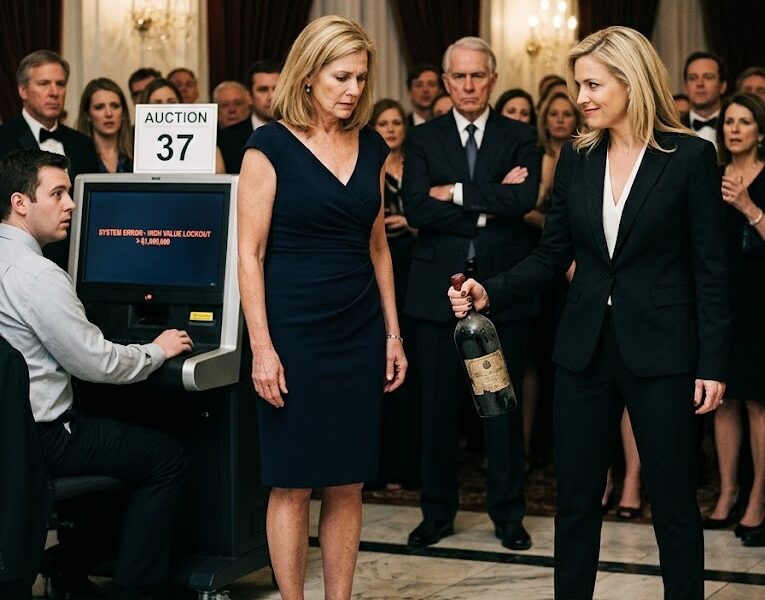
The machine processed the label.
Then the wax.
Then the serial number.
The screen froze.
Crystal laughed.
“There. It doesn’t even recognize it.”
The technician frowned.
“No.”
“What?”
“The system locked.”
Crystal folded her arms.
“Because it’s fake.”
The technician looked uncomfortable.
“Not necessarily.”
“What else?”
He swallowed.
“The public valuation software has a one-million-dollar ceiling.”
The room became quiet.
“If an item exceeds the ceiling, the system automatically locks and requires manual expert authentication.”
Nobody moved.
Vanessa looked at the broken glass.
“One million?”
The technician nodded.
“Potentially more.”
Rebecca whispered, “Four bottles.”
Crystal’s face drained.
Then Rich stepped forward.
“You said potentially. Could there be another reason?”
The technician hesitated.
“Yes.”
Everyone turned.
“A database conflict. Counterfeit labels can sometimes trigger a lock.”
Crystal exhaled.
Then smiled.
“There.”
Margaret looked at her.
Crystal pointed at the bottle.
“Fake.”
Walter’s relief was immediate.
Almost desperate.
“I knew it.”
That hurt Margaret more than the accusation.
He wanted it to be fake.
Because the alternative would mean he had been wrong about her.
And Walter Sterling would rather destroy ten million dollars than reconsider a twenty-year-old judgment.
Then a voice came from the crowd.
“May I see the bottle?”
An elderly collector approached.
He had once worked in wine storage for a Chicago auction house.
He held the bottle beneath the light.
Turned it.
Examined the wax.
The punt.
The discoloration.
The tiny hand-stamped serial marking.
His hands began to tremble.
“I’ve seen this seal before.”
Crystal rolled her eyes.
“Where?”
“A Valmont catalog.”
The room shifted.
The man searched his phone.
Then his face went white.
“Château de Valmont. The Emperor’s Last Cask.”
Someone laughed uncertainly.
He didn’t.
“A private reserve. Five bottles from one final barrel. Almost never publicly traded.”
He turned the phone around.
A comparable bottle had sold years earlier for $1.5 million.
Vanessa whispered, “No.”
Crystal stared at the four pools staining the marble.
“No.”
Margaret said nothing.
The collector looked at her.
“If this is authentic, your family just destroyed at least six million dollars.”
Then a woman near the stage corrected him.
“Probably more.”
Everyone turned.
“Current private-market valuation could be closer to two million per bottle.”
Eight million dollars.
Destroyed.
Because four people had needed Margaret to be poor more than they needed to know the truth.
But Crystal wasn’t finished.
“Where’s the case?”
Margaret looked at her.
“What?”
“Wine like this doesn’t come in a grocery bag. Where’s the original case? Insurance? Provenance?”
Vanessa seized the argument.
“Exactly.”
Margaret answered calmly.
“In the car.”
Crystal laughed.
“Of course it is.”
Walter’s face hardened again.
“Enough.”
A professional appraiser named Beaumont was summoned from a nearby hotel.
He arrived forty minutes later.
He examined the remaining bottle.
Then the broken glass.
Then the wax fragments on the floor.
His knees seemed to weaken.
Someone brought him a chair.
Crystal smiled.
“I knew it.”
Beaumont looked up.
“I’m not sick.”
He pointed toward the ruined bottles.
“I’m heartbroken.”
Nobody spoke.
“These were genuine.”
Walter’s mouth opened.
Beaumont looked almost furious.
“Château de Valmont. Emperor’s Last Cask.”
Crystal shook her head.
“No.”
“Five bottles.”
He looked at Margaret.
“You had all five?”
“Yes.”
“And they destroyed four?”
“Yes.”
Beaumont closed his eyes.
“At current private valuation, the surviving bottle alone could exceed two million dollars.”
The room exploded into whispers.
Crystal backed away.
Walter suddenly reached toward Margaret.
“Maggie, give me the bottle.”
Margaret moved it away.
He blinked.
“This is our auction item.”
“No.”
“You brought it for the Sterling auction.”
“I brought it to support the children.”
“That’s what I mean.”
“No, Dad.”
Margaret’s voice remained calm.
“You mean something very different.”
Before Walter could answer, headlights swept across the tall windows.
A black sedan stopped outside.
Terra Wells entered carrying a black leather case.
Conversation died around her.
Several executives in the room recognized her.
One actually stood.
“Terra Wells?”
Terra walked directly toward Margaret.
“Mrs. Cole.”
She placed the case on the table.
“The original insurance certificate, European auction record, transfer documentation, and serial verification.”
Beaumont opened the case.
Silver crest.
Matching number.
Original paperwork.
He compared everything.
Then nodded.
“Authentic.”
Crystal whispered, “Documents can be forged.”
Beaumont looked at her as if she had insulted oxygen.
Then a local developer approached Terra.
“I saw you at a Cole Capital reception.”
Terra nodded.
Another businessman stepped closer.
“You worked for the chairman.”
“I did.”
Walter’s expression changed.
Suddenly Terra mattered.
Suddenly Margaret mattered because Terra mattered.
“Miss Wells,” he said warmly, “we should have been told you were coming.”
Terra’s face remained unreadable.
“I wasn’t invited.”
Walter glanced at Margaret.
“What is your relationship with my daughter?”
Terra answered without hesitation.
“I’m Mrs. Margaret Cole’s personal assistant.”
The room went silent again.
Crystal laughed.
It sounded strained.
“Personal assistant?”
Vanessa shook her head.
“Maggie can’t afford someone like you.”
Terra looked at her.
Margaret almost pitied Vanessa.
Almost.
Then announcements began arriving from the foundation office.
A ten-million-dollar donation to the Sterling Children’s Education Fund.
A mobile cardiac screening unit for the county.
A fully equipped AI education laboratory for Sterling High School.
The three gifts carried short dedications.
For Walter Sterling’s seventieth birthday.
From his grandsons.
The same grandsons he had called unemployed.
The same boys Margaret had supposedly ruined by leaving Marcus.
Walter sank into a chair.
“My grandsons?”
Margaret nodded.
“Ethan arranged the financial donation.”
Someone in the crowd whispered.
“Cole Capital?”
“Liam arranged the medical unit.”
Another voice.
“Cole Heart Center?”
“And Noah arranged the AI lab.”
The technician beside the provenance scanner stared at Margaret.
“Noah?”
Before Margaret could answer, three younger members of Vanessa and Crystal’s families rushed inside.
Brandon.
Tyler.
Chloe.
They were flushed with excitement.
Brandon held a contract.
“I just closed a deal with a Cole Capital company.”
Tyler announced that he had received a residency recommendation at Cole Heart Center.
Chloe had been offered a position at Noah Labs.
Their mothers immediately recovered.
Crystal smiled triumphantly.
“There. You see?”
Margaret frowned.
Crystal raised her voice.
“Those donations weren’t from Maggie’s children. They were recognition for ours.”
Brandon nodded.
“The Cole Capital deal is real.”
Tyler lifted his letter.
“So is my recommendation.”
Chloe held up her phone.
“And Noah Labs sent me the offer.”
Walter stood straighter.
Hope returned to him.
Not hope that Margaret had succeeded.
Hope that he had not been wrong.
He placed a hand on Brandon’s shoulder.
“This is what I’ve always said. The children who respect their family become something.”
Margaret watched him.
Walter addressed the room.
“People call me old-fashioned. But family values matter. Reputation matters. Marriage matters.”
Margaret felt Rebecca’s fingers tighten around hers.
Walter continued.
“You don’t abandon your family when life becomes difficult.”
Margaret almost laughed.
Twenty years.
And he still thought she had abandoned him.
Crystal smiled at Margaret.
“Your little performance is over.”
Terra stepped forward.
“Those three documents prove only that they received opportunities.”
Crystal frowned.
“What?”
“They do not prove why those opportunities were given.”
Brandon scoffed.
“Then why were they?”
Terra looked at Margaret.
Margaret shook her head slightly.
Not yet.
Crystal noticed.
“Oh, I understand.”
She stepped closer.
“You can’t explain because you don’t know.”
Margaret said nothing.
“Who is your boss, Terra?”
Again, silence.
“Who is the mysterious chairman?”
Terra’s jaw tightened.
“I’m not authorized to discuss private identities.”
Crystal laughed.
“There it is.”
Walter’s face changed again.
“Margaret.”
“Dad.”
“Tell the truth.”
“I have.”
“No. You arrived with fake grandeur. An assistant. Documents. Expensive wine.”
“The wine was authenticated.”
“Maybe.”
Even Beaumont stared at him.
“Mr. Sterling—”
Walter raised his hand.
“My family has been respected here for three generations.”
Margaret felt exhausted suddenly.
Not angry.
Tired.
Twenty years of building.
Twenty years of raising boys who once slept in coats because their first New York apartment had no reliable heat.
Twenty years of night classes.
Two jobs.
Medical bills.
Court papers.
Marcus’s threats.
Ethan studying at the kitchen table until two in the morning.
Liam memorizing anatomy flashcards on subway rides.
Noah dismantling broken radios because they couldn’t afford computers.
Twenty years of refusing to teach her sons that money made them valuable.
And still she was standing in front of Walter Sterling being asked to prove she deserved dignity.
Walter pointed toward the door.
“You changed your name.”
Margaret stared at him.
“You’re Margaret Cole.”
“Yes.”
“Then maybe you should remember that you chose not to be a Sterling.”
Rebecca stepped between them.
“Walter.”
He moved her aside.
“Twenty years ago, she chose herself over this family.”
Margaret’s eyes burned.
“No.”
Her voice shook for the first time.
“I chose my children.”
Walter scoffed.
“You broke your home.”
“I stopped Marcus from breaking my sons.”
“You could have handled it privately.”
“I tried.”
“You could have stayed.”
“He hit Ethan.”
Walter stopped.
Margaret stepped closer.
“He was nine.”
The room disappeared for her.
There was only her father.
“Marcus shoved him into a wall because Ethan stood between us.”
Rebecca began crying.
Margaret continued.
“That was the night I called you.”
Walter’s face changed slightly.
“You knew he hit me. You didn’t know he had started hitting them because I was too ashamed to tell you.”
“Maggie—”
“I left because my nine-year-old son looked at me and asked whether being married meant letting someone hurt you forever.”
Walter said nothing.
“I had no answer for him.”
Margaret wiped one tear from her cheek.
“So I packed two suitcases.”
Another breath.
“And I gave him one.”
No one moved.
“I gave Liam the other.”
Her voice cracked.
“And Noah was four, so I carried him.”
Rebecca covered her face.
“We walked out.”
Margaret looked at Walter.
“That was the greatest thing I ever did.”
Walter’s pride could not survive the room hearing that.
So he attacked.
“My greatest regret,” he said, “is that I ever had you.”
Rebecca gasped.
Margaret became completely still.
The words landed.
They hurt.
Of course they hurt.
Some part of every daughter remains young enough to want her father to choose her.
But pain was no longer authority.
Margaret nodded.
“All right.”
Walter pointed toward the door.
“From this moment forward, you are no daughter of mine.”
Rebecca grabbed his arm.
“Walter, no.”
Margaret gently removed her mother’s hand.
“No, Mom.”
She looked at Walter.
“He finally said what he has spent twenty years proving.”
Then Walter reached for the last Valmont bottle.
Beaumont shouted.
“Don’t!”
Walter raised it.
Margaret’s eyes widened.
“Dad.”
“Fake wine. Fake documents. Fake assistant. All of it ends now.”
Terra stepped forward.
“If you damage that bottle, our attorneys—”
Walter laughed.
“Your attorneys?”
He lifted the bottle higher.
And smashed it.
The sound was quieter than the others.
Maybe because no one laughed this time.
Beaumont looked physically ill.
Ten million dollars.
Five bottles.
Gone.
Walter breathed hard.
“There.”
Wine ran between his shoes.
“No evidence.”
Margaret stared at the floor.
Then she began laughing.
Softly.
Crystal looked unsettled.
“What’s funny?”
Margaret looked up.
“You still think the wine was the evidence.”
Terra’s phone buzzed.
Then Margaret’s.
Then three more phones around the room.
Terra read her screen.
“They’re here.”
Walter frowned.
“Who?”
Margaret slipped her phone into her purse.
“My sons.”
The ballroom doors opened.
Three men entered.
Ethan first.
Dark suit.
No tie.
The controlled expression of a man accustomed to rooms becoming quiet when he entered them.
Liam followed, still wearing his hospital ID beneath his overcoat.
Noah came last, jeans beneath an expensive jacket, his face younger than his brothers but his anger less disguised.
Several guests recognized them before Walter did.
A banker whispered Ethan’s name.
A physician stared at Liam.
The provenance technician nearly dropped his tablet when he saw Noah.
Chloe turned white.
“No.”
Noah looked at her.
Then at the scanner bearing his company logo.
Then at his mother.
“Mom.”
That one word changed Margaret.
For the first time all evening, her shoulders dropped.
Ethan crossed the room.
He saw the wine on the floor.
Then he saw Walter.
His jaw tightened.
“Who did this?”
Nobody answered.
Liam reached Margaret first.
“Are you hurt?”
“No.”
“Did anyone touch you?”
“No.”
Noah looked around the room.
His voice was dangerously calm.
“Who called my mother a fraud?”
Crystal stepped backward.
Brandon stared at Ethan.
“You’re—”
“Yes,” Ethan said.
Brandon’s face drained.
Ethan turned toward Walter.
“You’re my grandfather.”
Walter stared at him.
“Ethan?”
“You remember.”
“You were nine.”
“Yes.”
Walter looked between the three brothers.
“You’re with Cole Capital?”
Ethan nodded.
“I chair Cole Capital’s North American investment group.”
A collective breath moved through the room.
Walter looked at Liam.
“And you?”
“Medical director and co-founder of Cole Heart Center.”
Tyler slowly lowered his recommendation letter.
Walter turned to Noah.
Noah gave a humorless smile.
“Noah Cole.”
The technician whispered, “Founder of Noah Labs.”
Chloe’s phone slipped slightly in her hand.
Crystal shook her head.
“This is impossible.”
Noah looked at her.
“You applied to my research institute.”
Chloe swallowed.
“I—”
“I know.”
Then he looked at Tyler.
“My brother approved the physician expansion program that created your residency slot.”
Liam said nothing.
Ethan looked at Brandon.
“And the contract you’re celebrating?”
Brandon’s face had gone gray.
“My office authorized it.”
Walter stared at the three documents.
Then at Margaret.
“But they said those opportunities were because of their talent.”
Margaret answered softly.
“They earned consideration.”
Ethan nodded.
“We didn’t hand them careers.”
Liam added, “Mom would never allow that.”
Noah looked toward his cousins.
“We gave them doors.”
Then his eyes shifted toward Crystal.
“What they did after walking through them was supposed to be their responsibility.”
Crystal forced a laugh.
“So the donations really came from you?”
“Yes,” Ethan said.
“For Grandpa?”
“No.”
Walter stiffened.
Ethan looked at Margaret.
“For our mother.”
Silence.
“We knew she was coming back after twenty years.”
Liam continued.
“We wanted the town she came from to benefit from the life she built.”
Noah looked at Walter.
“And because she still cared about this place even after this place gave her every reason not to.”
Walter’s face crumpled slightly.
Then Terra spoke.
“There is one more thing.”
Margaret closed her eyes.
“Terra.”
But Ethan shook his head.
“No, Mom.”
He turned toward the crowd.
“For twenty years, the Cole Education Foundation has funded schools across this county.”
Someone whispered, “The anonymous donor.”
Terra nodded.
“Scholarships. Transportation. Meal programs. Teacher grants.”
Rebecca stared at Margaret.
“Maggie?”
Margaret looked at her mother.
“I remembered what it was like when Mrs. Parker bought my notebooks because Dad said scholarship students should learn to make do.”
Rebecca began crying again.
Walter looked confused.
“You?”
Margaret nodded.
“You funded Sterling?”
“Yes.”
“Why didn’t you tell anyone?”
Margaret almost smiled.
“Because children don’t learn better when the donor gets applause.”
A reporter lowered her camera.
That answer seemed to embarrass the entire room.
Walter sat down.
All evening, he had spoken about reputation.
Margaret had spent twenty years building something without attaching her name to it.
He had called her poor.
She had funded his town.
He had called her sons useless.
One ran an investment empire.
One built a nationally respected cardiac center.
One founded the technology company whose machine Walter had trusted more than his own daughter.
He had accused Margaret of returning to steal the Sterling family’s credit.
She had spent two decades giving without taking any.
Walter looked suddenly very old.
“Maggie.”
She didn’t answer.
“I didn’t know.”
“No.”
“How could I?”
That finally made her look at him.
“You could have asked.”
Four words.
Nothing Walter said afterward could survive them.
He stood.
“I was angry.”
“You were ashamed.”
“I thought—”
“You always thought.”
Margaret stepped closer.
“You thought Marcus’s money made him a good husband.”
Walter lowered his eyes.
“You thought divorce made me a bad daughter.”
“Maggie—”
“You thought a paper bag made me poor.”
Crystal looked away.
“You thought my children were failures because they didn’t come here and perform success for you.”
Walter swallowed.
“And tonight, when experts, documents, technology, and your own eyes told you that you might be wrong, you destroyed the evidence.”
She looked at the red stains on the marble.
“Not because you believed it was fake.”
Walter said nothing.
“You destroyed it because you needed it to be fake.”
Rebecca quietly began to sob.
Walter whispered, “I’m sorry.”
Margaret had imagined those words for years.
She had imagined hearing them at thirty.
At thirty-five.
At forty.
When Ethan graduated.
When Liam entered medical school.
When Noah sold his first company.
She imagined her father calling one night and saying he understood.
Now the apology had finally arrived.
And Margaret discovered something strange.
She no longer needed it.
“I believe you’re sorry,” she said.
Walter looked up hopefully.
“But being sorry because you discovered I’m successful is not the same as being sorry for how you treated me when you believed I was nothing.”
The room went silent.
Walter’s face collapsed.
That was the truth he could not escape.
If Margaret had truly been poor…
If Ethan had truly been unemployed…
If Liam had truly been struggling…
If Noah had truly been nobody…
Walter would still have believed she deserved humiliation.
His remorse had arrived only after her value became measurable.
Margaret picked up her purse.
Crystal stepped forward.
“Maggie.”
Margaret looked at her.
Crystal’s confidence was gone.
“The bottles…”
“Yes?”
“I didn’t know.”
“You weren’t supposed to know.”
Crystal blinked.
“What?”
“You were supposed to respect something because it belonged to another person.”
Crystal looked at the floor.
Margaret continued.
“It shouldn’t need to cost two million dollars before you understand that.”
Vanessa began crying.
“We’re sisters.”
Margaret’s expression softened, but only slightly.
“We were.”
The words hit harder than shouting could have.
Rebecca reached for Margaret.
“Please don’t leave again.”
Margaret immediately took her mother’s hands.
“I’m not leaving you.”
Walter looked up.
Margaret glanced toward the Sterling house beyond the windows.
“But I’m done trying to come home to a place that only wants me when I make it look important.”
Rebecca nodded through tears.
“I understand.”
Margaret kissed her forehead.
“You can come to New York whenever you want.”
Ethan stepped beside his mother.
“So can you, Grandma.”
Liam smiled gently.
“We have room.”
Noah added, “Too much room, actually.”
Rebecca laughed through her tears.
It was the first genuine laughter anyone had heard all evening.
Then Brandon spoke.
“Mr. Cole.”
Ethan turned.
“My contract…”
Crystal looked horrified.
“Brandon, not now.”
But the young man was panicking.
“Is it still valid?”
Ethan studied him.
“The contract was awarded legitimately.”
Brandon exhaled.
“It won’t be canceled because of tonight.”
Relief flooded his face.
“No.”
Then Ethan added, “Unless your work gives us a reason.”
Brandon nodded rapidly.
“Thank you.”
Liam looked at Tyler.
“Same.”
Tyler lowered his eyes.
“You’re not withdrawing the residency recommendation?”
“No.”
“Why?”
Liam glanced at Margaret.
“Because my mother didn’t raise us to destroy someone’s future because their family humiliated ours.”
Tyler looked ashamed.
Noah faced Chloe.
She couldn’t meet his eyes.
“My offer?”
“You earned your interview.”
“And the position?”
“You’ll be evaluated like everyone else.”
She nodded.
Noah started to walk away.
Then Chloe whispered, “I’m sorry.”
He stopped.
“Tell her.”
Chloe looked at Margaret.
“I’m sorry, Aunt Margaret.”
Margaret nodded once.
It wasn’t forgiveness.
But it was a beginning.
Walter watched everything.
Perhaps that was the cruelest lesson of the night.
The grandchildren he had dismissed showed more grace in five minutes than he had shown his daughter in twenty years.
The auction never resumed normally.
How could it?
Reporters had come expecting photographs of Walter Sterling celebrating seventy years.
Instead, they had witnessed the collapse of the mythology he had spent a lifetime building.
But Margaret refused interviews.
When one reporter approached, she said only, “Tonight was supposed to raise money for children. Please write about that.”
By midnight, the education fund had received more than twelve million dollars in additional pledges.
The mobile cardiac unit was fully funded.
Noah Labs expanded the planned education facility to include robotics equipment and teacher training.
And the shattered wine?
Ethan’s insurance company could have pursued damages.
He chose not to.
Walter eventually offered to repay it.
Ethan declined.
Not because ten million dollars meant nothing.
Because some debts could not be settled with money.
Margaret stayed in Sterling for one night.
Not at her father’s house.
At the small hotel beside the river.
Rebecca came over the next morning carrying two coffees.
No makeup.
No pearls.
No Walter.
She sat beside Margaret near the window.
For several minutes, neither spoke.
Then Rebecca said, “I kept the suitcase.”
Margaret looked at her.
“What suitcase?”
“The blue one.”
Margaret remembered.
The cheap suitcase Liam had dragged down the Sterling driveway twenty years earlier.
One wheel had been broken.
Rebecca smiled sadly.
“You left it at the bus station because the zipper tore.”
“I thought we threw it away.”
“I went back.”
“Why?”
Rebecca looked down at her coffee.
“Because it was the last thing of yours I knew how to save.”
Margaret began crying.
Quietly.
Not for the wine.
Not for Walter.
For the twenty-nine-year-old woman who had stood at that bus station with three children and no idea whether courage would be enough.
Rebecca reached across the table.
“I should have chosen you.”
Margaret squeezed her hand.
“You can choose me now.”
And sometimes, that is the closest life gives us to repairing the past.
Walter did not call for six weeks.
When he finally did, Margaret watched his name glow on her phone.
She almost let it ring out.
Then answered.
“Hello?”
His voice sounded smaller.
“Maggie.”
“Yes.”
“I found something.”
She waited.
“A box in the attic.”
“What box?”
“Your things.”
Margaret sat down.
“School certificates. Photographs. That blue ribbon from the science fair.”
She smiled despite herself.
“You hated that science fair.”
“I didn’t understand why you cared about it.”
“No.”
Walter breathed.
“I didn’t understand a lot.”
Margaret said nothing.
He continued.
“I found a picture of you with Ethan.”
Her throat tightened.
“He was maybe eight.”
“Probably.”
“You were holding him.”
“Yes.”
“And you had a bruise.”
Margaret closed her eyes.
Walter’s voice broke.
“I could see it.”
For the first time in twenty years, Margaret had no idea what to say.
“I could see it in the photograph,” he repeated. “And I remember that day.”
Margaret looked out across Manhattan.
Traffic moved far below.
“I remember asking why you were wearing makeup in July.”
“Yes.”
“You said you were experimenting.”
“Yes.”
Walter began crying.
“I knew.”
Margaret’s eyes filled.
“You suspected.”
“No.”
His voice cracked.
“I knew.”
There it was.
The final truth.
Not ignorance.
Cowardice.
Walter had known enough to ask.
He simply hadn’t wanted the answer.
“I’m sorry,” he whispered.
Margaret pressed her fingers against her lips.
For a moment she was twenty-nine again.
Then she looked around her apartment.
At Ethan’s framed graduation photograph.
At Liam holding his first medical award.
At Noah asleep on a couch after his first startup launch.
At the family she had built from the wreckage.
“Dad.”
“Yes?”
“I forgive you enough that I don’t want to hate you.”
Walter cried harder.
“But I can’t go back and become the daughter you wanted.”
“I know.”
“And you don’t get to become the father I needed just because you’re sorry now.”
A long silence.
“I know.”
Margaret wiped her cheek.
“But if you want to become someone different for whatever time we have left…”
She paused.
“…that’s your choice.”
Walter breathed unevenly.
“Could I try?”
Margaret looked at the city.
“Yes.”
Not come home.
Not everything is forgiven.
Not we can forget.
Just yes.
Sometimes yes is enormous.
The following spring, Margaret returned to Sterling.
No gala.
No reporters.
No chauffeur waiting at the curb.
She drove herself.
The town looked almost exactly the same.
The diner still had its crooked red sign.
The church bell still rang nine minutes late.
The old pharmacy had become a coffee shop.
And outside Sterling High School stood a new building.
THE COLE EDUCATION AND TECHNOLOGY CENTER.
Margaret had fought against the name.
The school board won.
Children streamed through the doors carrying laptops and backpacks.
Across the parking lot, a mobile cardiac clinic was screening elderly residents free of charge.
Rebecca stood beside Margaret.
Walter stood several feet behind them.
He had changed.
Not dramatically.
Real change rarely looks dramatic.
He listened more.
Spoke less.
He had stopped introducing Margaret as “my daughter from New York.”
Now he simply said, “My daughter, Maggie.”
Crystal and Vanessa were there too.
Their relationship with Margaret remained cautious.
Scar tissue is not hostility.
But it isn’t skin either.
Some wounds heal differently.
Ethan couldn’t attend.
Liam was operating.
Noah was somewhere in Singapore arguing with engineers.
They sent flowers.
Margaret laughed when she saw them.
Her sons had finally learned.
No expensive wine.
The principal invited Margaret to cut the ribbon.
She refused.
“Let a student do it.”
A twelve-year-old girl named Sophie was chosen.
She wore secondhand sneakers and held the ceremonial scissors with trembling hands.
Margaret crouched beside her.
“Nervous?”
Sophie nodded.
“Good.”
The girl looked confused.
Margaret smiled.
“It means you care.”
Sophie cut the ribbon.
Applause erupted.
Walter stood beside Margaret.
Afterward, he handed her something.
A brown paper bag.
Margaret stared at it.
“What is this?”
“Open it.”
Inside was an inexpensive bottle of wine.
Probably twenty dollars.
Margaret laughed.
Walter looked embarrassed.
“I asked the clerk for something decent.”
“Dad.”
“I know nothing about wine.”
“That has become historically clear.”
Rebecca burst out laughing.
Even Walter smiled.
Then he grew serious.
“I thought maybe we could have dinner tonight.”
Margaret studied him.
“At the house?”
“If you want.”
She looked toward the old Sterling home in the distance.
For years, she had believed returning there would mean surrender.
Then she understood something.
A house had never rejected her.
People had.
And people, occasionally, could change.
“I’ll come for dinner.”
Walter nodded.
No triumph.
No assumption.
Just gratitude.
Margaret slipped the cheap bottle back into its paper bag.
As they walked toward the parking lot, Walter glanced at it.
“You aren’t going to have that appraised, are you?”
Margaret smiled.
“No.”
“How do you know it isn’t secretly worth millions?”
She looked at her father.
“Because sometimes a cheap bottle is just a cheap bottle.”
Walter laughed.
Then Margaret added quietly:
“But sometimes a woman carrying one is still priceless.”
Walter stopped walking.
His eyes filled.
Margaret didn’t wait for an apology.
She continued toward the car with her mother beside her and the brown paper bag tucked beneath her arm.
Twenty years earlier, she had left Sterling carrying everything she owned.
She had believed she was walking away as a failure.
She knew better now.
She had not lost her family that night.
She had saved one.
And in the end, that was the only inheritance worth keeping.









