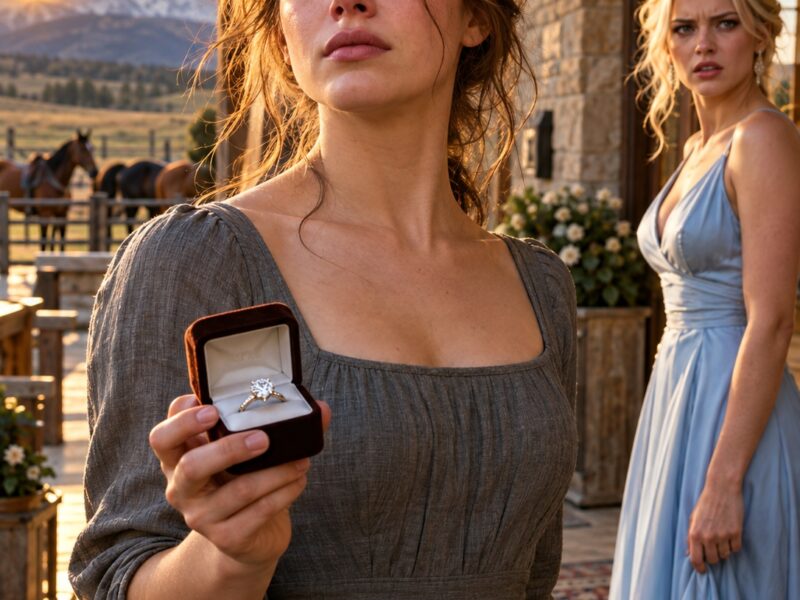
MY FATHER CALLED ME THE WRONG DAUGHTER—THEN THE MILLIONAIRE RANCHER CHOSE ME INSTEAD OF MY PERFECT SISTER

“You think you can just steal what belongs to your sister?”
My father’s voice cracked across the Montana yard like a rifle shot.
I stood in the dust with one hand wrapped around the reins of a saddled horse.
Vivien was crying on the porch.
Margaret—my stepmother—stood behind her with one hand pressed dramatically against her chest, as if I had just murdered someone instead of made a choice they had never imagined I was capable of making.
And behind me sat Colton Mercer.
The wealthiest young rancher in the valley.
The man who had arrived at our dying ranch that afternoon because my father expected him to marry my sister.
The man who had looked at Vivien for less than an hour…
then chosen me.
“Answer me, Clara!”
My father came down the porch steps.
Edmund Hail still knew how to look powerful when he was angry. That was one of his great talents.
The Hail ranch was collapsing.
His bank accounts were nearly empty.
Half our cattle were gone.
Three employees had quit because he could no longer reliably pay them.
But Edmund could straighten his shoulders, put on an old tailored jacket, and make you believe for thirty seconds that the Hail name still meant something.
I had spent twenty-one years believing it.
That afternoon, I finally stopped.
“You want an answer?” I asked.
His face hardened.
“Yes.”
I looked at Vivien.
My beautiful sister.
The daughter who had been taught French while I repaired fences.
The daughter who received piano lessons while I cleaned stalls.
The daughter who had been raised to marry money while I had been raised—without anyone ever admitting it—to keep the ranch alive long enough for her to do it.
Then I looked at my father.
“No.”
One word.
That was all.
But sometimes one word is enough to destroy an entire family.
My father stared at me.
“What did you say?”
“I said no.”
Margaret gasped.
Vivien stopped crying.
For perhaps the first time in her life, my sister looked at me not with irritation or superiority but with genuine disbelief.
My father stepped closer.
“You will get off that horse.”
“No.”
“You will apologize to your sister.”
“No.”
“And you will tell Mr. Mercer that whatever misunderstanding occurred this afternoon is over.”
I heard leather creak behind me as Colton shifted in his saddle.
“Mr. Hail,” he said calmly, “there was no misunderstanding.”
My father ignored him.
That frightened me more than the shouting.
He looked only at me.
“You are going to destroy this family.”
The strange thing was, I had heard those words in one form or another my entire life.
Clara, don’t embarrass us.
Clara, don’t make trouble.
Clara, don’t upset Vivien.
Clara, somebody has to be practical.
Clara, your sister has opportunities you don’t.
Clara, understand your place.
Different words.
Same command.
Disappear.
I tightened my fingers around the reins.
“This family was already destroyed,” I said.
Then I climbed into the saddle.
My father’s face changed.
For one terrible second, I thought he might grab the bridle.
Instead he said the cruelest thing he could think of.
“If you leave with him, you are no daughter of mine.”
The old Clara would have broken.
The old Clara would have climbed down.
The old Clara would have apologized for wanting anything that belonged only to herself.
But Colton Mercer had said something to me in the stable less than an hour earlier.
Nobody is coming to save you.
And for once, I believed him.
I looked at my father.
“Then I guess you finally have the daughter you always wanted.”
I glanced at Vivien.
“Just one.”
Then I rode away.
I did not know yet that my freedom would cost my sister hers.
I did not know that Colton’s father would despise me, that men would try to burn us off our land, that someone would eventually put a bullet through a window meant for the Mercer family.
I certainly did not know that beneath the wealth of the Mercer empire was a ledger filled with stolen land, ruined families, blackmail, fraud, and enough buried evidence to destroy everything I was riding toward.
And I did not know that months later, I would walk into my sister’s mansion carrying papers that could set her free from the man our father had sold her to.
That afternoon, I knew only one thing.
For the first time in twenty-one years, I was riding away from the people who had taught me I was worthless.
And I was terrified they might have been right.
The Hail ranch had been dying for years.
Not dramatically.
There was no single fire, drought, lawsuit, or foreclosure that destroyed us.
It died by inches.
Paint peeled from the house.
Fence posts rotted.
Equipment went unrepaired.
Cattle disappeared from the pastures one sale at a time.
Employees left.
Bills accumulated unopened in my father’s desk.
Yet every Sunday Edmund Hail wore a jacket that had once been expensive and insisted we use silverware we could no longer afford to replace.
Poverty did not frighten my father nearly as much as admitting poverty.
So we lived inside a performance.
And Vivien was supposed to be the final act.
She was twenty-two, blonde, elegant, polished, and beautiful in the effortless way that made strangers turn their heads.
She could play Chopin.
She spoke conversational French.
She knew which fork belonged to which course and how long a young woman was supposed to hold a man’s gaze before looking away.
I knew how to pull a calf during a difficult birth.
I knew which section of the south fence collapsed every spring.
I knew the tractor needed a new hydraulic line.
I knew exactly how much feed remained in the west barn.
And I knew my father owed more money than he would ever admit.
That made Vivien an investment.
It made me labor.
Margaret once summarized the difference perfectly.
“Vivien is this family’s future.”
I had been seventeen.
I remember looking at my cracked hands and thinking:
Then what am I?
I eventually understood.
I was the person keeping that future alive.
Which was why the arrival of Colton Mercer mattered so much.
The Mercers owned one of the largest ranching operations in the region. Land, timber, water rights, livestock, transport contracts—if money could grow from Montana soil, Victor Mercer had found a way to own part of it.
Colton was his only son.
And according to every rumor my father had collected, Victor wanted him married.
Preferably to a woman from an old family.
Preferably beautiful.
Preferably obedient.
My father heard those requirements and saw Vivien.
He never considered me.
Neither did I.
The morning Colton was scheduled to arrive, Margaret dragged a brush through my hair while criticizing everything about me.
“Stand still.”
“I am standing still.”
“You move like a ranch hand.”
“I am a ranch hand.”
Her mouth tightened.
“That is precisely the problem.”
She pulled harder.
I met her eyes in the mirror.
Behind us hung the gray dress she had chosen for me.
Vivien would wear blue silk.
I would serve tea.
The message was obvious.
“Why am I even going downstairs?”
“Because appearances matter.”
“To whom?”
“Everyone.”
She shoved another pin into my hair.
I flinched.
“Your sister has one chance to secure this family’s future. You will not ruin it because you’re jealous.”
I almost laughed.
“Jealous?”
“Don’t.”
“I repaired the south fence this morning because Jacob quit.”
“That is not your concern.”
“He quit because Father hasn’t paid him.”
Margaret froze.
Only for a second.
Then she slapped me.
It was not a dramatic blow.
Margaret was smarter than that.
She knew exactly how hard she could hit without leaving evidence.
“You will not speak that way today.”
I touched my cheek.
Something inside me had been getting quieter around her for years.
That morning, strangely, it woke up.
“Father knows we’re broke.”
Her eyes narrowed.
“He knows the fences are falling down. He knows people aren’t getting paid. He just doesn’t care as long as Vivien gets another dress.”
“Enough.”
“I’m not insulting her.”
“You always resent her.”
“No. I resent being told the house will collapse if I stop holding up the walls while everyone pretends she’s the one saving it.”
For a moment Margaret looked almost ashamed.
Then the familiar coldness returned.
“Wear the gray dress.”
She walked toward the door.
“And remember something, Clara. Mr. Mercer is coming to meet your sister. If he speaks to you, be polite. Briefly.”
She looked back.
“You are not part of the conversation.”
Colton arrived at three.
Exactly three.
I watched him from the kitchen window as three riders crossed the ridge.
Even before I knew him, his punctuality interested me.
Men like my father were always late because they believed other people should wait.
Colton Mercer apparently did not.
He rode a dark sorrel gelding and sat the saddle like someone who actually worked from horseback rather than posed on one.
When he entered the parlor, my father transformed.
“Mr. Mercer!”
The voice became warmer.
The shoulders straighter.
The smile wider.
“Welcome to the Hail ranch.”
Vivien stepped forward.
She looked extraordinary.
I can admit that now.
Back then, admitting my sister was beautiful always felt like agreeing that I was not.
She smiled.
“Mr. Mercer.”
“Miss Hail.”
I lowered my eyes and carried in the tea.
Then I felt someone looking at me.
I glanced up.
Colton.
Gray eyes.
Dark hair.
A narrow scar near his jaw.
He was not looking at me the way wealthy guests usually looked at servants.
He was studying me.
I looked away first.
Conversation followed the script.
My father praised Mercer land.
Margaret praised Mercer business.
Vivien asked carefully prepared questions.
Colton gave short answers.
Then Margaret mentioned marriage.
I nearly dropped a cup.
“My understanding,” she said, “is that you’re considering establishing a family.”
Colton set his cup down.
“My father believes I should.”
“And what do you believe?” Vivien asked.
He smiled.
It wasn’t warm.
“I’ve spent most of my life doing what my father believes I should do.”
The room changed.
Only slightly.
But I felt it.
“Maybe,” Colton continued, “it’s time I chose something myself.”
My father laughed too loudly.
“Of course. Every man should forge his own path.”
I poured more tea.
Colton watched my hands.
Later I learned he had noticed the calluses.
At the time, I thought he had noticed how badly they shook.
My father suggested Vivien show him the garden.
Colton declined.
“I’d rather see your horses.”
Margaret blinked.
“The stables?”
“Yes.”
Before I could stop myself, I said, “I can show you.”
Silence.
Absolute silence.
My father stared at me as though a chair had started speaking.
Vivien’s smile vanished.
Margaret looked ready to kill me.
Colton stood.
“Perfect.”
Outside, I walked quickly.
“This isn’t necessary.”
“What isn’t?”
“Pretending to care about our horses.”
“I care about horses.”
“You’re supposed to be getting to know my sister.”
He stopped.
“I’m not here for your sister.”
My stomach tightened.
“Then why are you here?”
He looked directly at me.
“How old are you?”
“Twenty-one.”
“Married?”
“No.”
“Why?”
I laughed despite myself.
“Look at me.”
“I am.”
That answer silenced me.
He stepped inside the stable.
“You repaired that fence this morning.”
I stared.
“How did you know?”
“Fresh cuts on the posts. Mud on your boots. Splinters in your hand.”
He nodded toward the house.
“Your father can’t afford to maintain this place, but your sister is wearing a dress that probably cost more than three months of feed.”
My face burned.
“You shouldn’t say that.”
“Why? Because it’s true?”
“You don’t know us.”
“No. But I know desperation.”
That was when he told me about Victor.
About the Mercer expansion.
About neighboring ranchers who hated them.
Cut fences.
Poisoned cattle.
A burned barn.
Threats.
A gunshot fired at their foreman.
“My father thinks I need a socially useful wife,” he said. “Someone pretty enough for dinners and connected enough for politics.”
“That sounds like Vivien.”
“It does.”
“Then marry her.”
“No.”
“Why?”
He looked toward the house.
“Your sister has been trained to survive a ballroom.”
Then he looked at me.
“You’ve been trained to survive everything else.”
I should have been offended.
Instead, I felt seen.
And that was more dangerous.
“You don’t know anything about me.”
“I know your family eats because you work.”
“You can’t know that.”
“I know your father speaks to you like an employee. I know your stepmother dressed you so no one would notice you. I know your sister has probably never opened a feed invoice in her life.”
“Stop.”
“And I know you hate me right now because I’m saying aloud everything you’ve spent years pretending doesn’t hurt.”
My eyes burned.
I hated him for being right.
Then he offered me something no one had ever offered before.
A choice.
“I have two horses saddled.”
I stared at him.
“In ten minutes, I’m leaving.”
“What are you saying?”
“If you come with me, I’ll court you publicly. If you still want this after you’ve seen my world, we’ll marry.”
I actually laughed.
“You’re insane.”
“Probably.”
“My family would hate me.”
“They already treat you like they do.”
That landed harder than it should have.
“What do you get out of this?”
“A partner.”
“You don’t know if I’m capable of that.”
“No.”
His expression softened.
“But I’d rather gamble on someone who knows how to fight than marry someone who’s been trained never to.”
I could hear my heart.
“You’re asking me to abandon my family.”
“No.”
He stepped closer.
“I’m asking you to stop abandoning yourself.”
That sentence followed me back into the house.
Vivien cornered me first.
“What did you do?”
“Nothing.”
“He asked for you.”
“I didn’t ask him to.”
“You stole this.”
Her face twisted.
“I spent my entire life preparing for this.”
“Vivien—”
“French. Piano. Etiquette. Everything Father asked. Everything Mother asked. I did it perfectly.”
Her voice broke.
“And you walk into a stable with dirt on your boots and somehow he chooses you?”
I had never understood until that moment that Vivien had a cage too.
Hers was simply prettier.
Then my father summoned us.
He announced that Colton intended to court me.
Vivien demanded to know why.
Colton gave an answer nobody forgot.
“Calluses.”
Margaret looked disgusted.
My father exploded.
“She is worthless.”
The word entered the room and seemed to remain there.
Worthless.
My father had implied it thousands of times.
He had never said it so clearly.
Colton stepped forward.
I stopped him.
Because suddenly I didn’t want anyone defending me.
Not even him.
I looked at my father.
“You really believe that?”
He was breathing hard.
“You have no education. No refinement. No useful connections. Everything we’ve invested in this family has been for Vivien because she has a future.”
“And me?”
“You work.”
There it was.
Twenty-one years reduced to two words.
You work.
I nodded.
Then I walked outside.
And when Colton followed, I climbed onto that second horse.
My father chased us into the yard.
“You leave and you’re finished here.”
I looked back once.
Vivien was standing behind him.
I expected hatred.
What I saw instead was fear.
I should have understood it.
I didn’t.
Not yet.
The Mercer ranch was everything the Hail ranch pretended to be.
Thousands of acres.
Working barns.
Paid employees.
Modern equipment.
Money.
Power.
But power had its own smell.
And Victor Mercer carried it into every room.
He met me the first evening.
Colton had warned him.
It didn’t help.
Victor looked me up and down.
“Edmund Hail’s daughter?”
“Yes, sir.”
“The bankrupt one.”
I lifted my chin.
“Yes, sir.”
“And my son intends to marry you.”
“So he says.”
Victor almost smiled.
Then he dismantled me.
No education.
No connections.
No social influence.
No money.
Nothing to offer.
“You’re dead weight in a dress.”
Colton moved toward him.
I touched Colton’s arm.
“No.”
Victor raised an eyebrow.
“Let him finish.”
So Victor did.
He told me Colton would eventually regret choosing me.
He told me I had mistaken escape for opportunity.
He told me I had simply traded one powerful man for another.
That accusation frightened me because part of me wondered whether it was true.
Then Victor asked:
“What can you give my son?”
I swallowed.
“The truth.”
Victor laughed.
“Truth doesn’t protect land.”
“No. But lies destroy families.”
His smile disappeared.
“Careful.”
“I’ve spent my entire life watching a man pretend he still had power after he’d lost it. I’m not impressed by pretending anymore.”
Colton went completely still.
Victor stared at me.
I thought I had destroyed everything.
Instead he said:
“Interesting.”
That was the beginning of my education.
Victor tested me constantly.
He put me on difficult horses.
Made me learn contracts.
Water rights.
Payroll.
Land maps.
Politics.
He sent me into meetings where men deliberately ignored me.
Then criticized me when I allowed them to.
He wanted me to quit.
I refused.
One afternoon, after I completed a ride he clearly expected to frighten me, Victor said:
“You have a spine.”
“Thank you.”
“It wasn’t a compliment.”
“I’ll take it anyway.”
Something changed in his face.
Not affection.
Respect had not arrived yet.
But curiosity had.
Then the ranch war escalated.
Thomas Quinn and neighboring ranchers accused the Mercers of manipulating water access and expanding beyond agreements.
Victor refused to yield.
Quinn refused to back down.
Threats became sabotage.
Sabotage became fire.
One night flames rose from a Mercer structure and men reached for guns before the smoke had even cleared.
By sunrise, armed riders from both sides faced each other.
I remember horses stamping.
Rifles.
Men shouting.
Colton beside me.
Victor ten yards ahead.
Thomas Quinn across the open ground.
Everybody was waiting for somebody else to make the first stupid decision.
So I rode between them.
Colton shouted my name.
I ignored him.
Thomas Quinn stared.
“Get out of the way.”
“No.”
“This isn’t your fight.”
“It becomes everyone’s fight when the shooting starts.”
Victor swore.
I turned toward him.
“You want to win?”
“Clara—”
“Then don’t give them martyrs.”
I turned to Quinn.
“And you want justice?”
His jaw tightened.
“Yes.”
“Then get it with witnesses and contracts instead of dead ranch hands.”
Nobody moved.
I could hear my own breathing.
Finally Quinn lowered his rifle.
“We talk tomorrow.”
Victor’s men slowly followed.
A war ended before it began.
Not permanently.
But long enough.
When Quinn rode away, he called back:
“Mercer, you owe your future daughter-in-law a debt. She just saved both our lives.”
Victor looked at me.
“That was either extremely brave or extremely stupid.”
“Probably both.”
His mouth twitched.
“You stopped a war.”
“Temporarily.”
“Don’t ruin the compliment.”
For the first time, Victor Mercer looked at me as though I belonged there.
That feeling lasted less than six hours.
Because my father arrived that evening.
With Vivien.
Edmund stood in the Mercer parlor and ordered me home.
“I am home,” I said.
His face reddened.
Then he raised his hand.
Colton moved between us.
“Touch her,” he said quietly, “and we’ll have a problem.”
My father stopped.
Then he smiled.
It was an ugly smile.
“You think you’ve won, Clara?”
“I don’t think this is about winning.”
“Oh, it is.”
He turned to Vivien.
“Tell her.”
Vivien’s eyes were swollen.
“Father arranged my marriage.”
Something cold moved through me.
“To whom?”
She hesitated.
“Harold Westbrook.”
I knew the name.
Everyone did.
Sixty years old.
Extremely wealthy.
Twice widowed.
Both wives dead under circumstances polite society preferred not to discuss too closely.
I stared at my father.
“No.”
He shrugged.
“Someone has to save what remains of our family.”
“You can’t give her to him.”
“I can.”
Vivien flinched.
Then my father told me the price.
If I abandoned Colton publicly…
if Colton agreed to court Vivien instead…
if I admitted I had misunderstood his intentions…
Edmund would cancel the Westbrook marriage.
Blackmail.
Not with money.
With my sister.
“Save her,” my father said.
I looked at Vivien.
Her terror was real.
And suddenly freedom felt selfish.
Colton reached for my hand.
I pulled away.
Because for one horrible moment, I considered it.
Then Victor spoke.
“No.”
My father turned.
Victor’s face had become stone.
“You are a bankrupt coward trying to sell your daughters to cover your failures.”
“Stay out of this.”
“They’re standing in my house. That makes it my business.”
He moved beside me.
“My son chose Clara. That stands.”
“Then Vivien’s fate is on your head.”
Victor’s eyes narrowed.
“No. It’s on yours.”
Edmund dragged Vivien toward the door.
I called her name.
She looked back.
And I will remember that look until I die.
Fear.
Anger.
Betrayal.
And beneath all three, a question.
Why did you get to escape?
Two weeks later, Vivien married Harold Westbrook.
I attended.
I almost wish I hadn’t.
She looked perfect.
Of course she did.
She had been trained her entire life to look perfect while disappearing.
Before the ceremony I found her alone.
“You can still leave.”
“And become what?”
“Free.”
She laughed bitterly.
“Like you?”
“Yes.”
“No, Clara. You didn’t become free. You became rich.”
“That isn’t fair.”
“Neither is any of this.”
Her voice cracked.
“You could have stayed. You could have married Colton and still convinced him to help Father.”
“Father would never have stopped.”
“You don’t know that.”
“Yes, I do.”
“At least you had a choice!”
That silenced me.
Vivien wiped her tears.
“I’m going to be exactly what I was raised to be.”
“Vivien—”
“A perfect wife. A perfect ornament.”
Then she said something that haunted me.
“And if Harold eventually kills me, at least I’ll die as somebody instead of living as nobody.”
I wanted to shake her.
Instead I whispered:
“If you ever need me, come to me.”
“I won’t.”
She walked down the aisle.
I watched my father give her away.
And I finally understood the phrase literally.
He gave her away.
The months that followed changed everything.
My relationship with Colton deepened not because he rescued me, but because he stopped trying to.
When I failed, he let me fail.
When I argued, he argued back.
When I was right, he admitted it.
Usually eventually.
“You know,” I told him once, “most women would find you extremely difficult.”
“Most women wouldn’t have ridden away with me after knowing me for three hours.”
“Evidence that I was temporarily insane.”
“You’re still here.”
“The insanity may be permanent.”
He kissed me.
But the Mercer ranch was hiding something far darker than our romance.
I discovered the first clue after someone broke into Victor’s study.
Nothing obvious was stolen.
That bothered me.
Burglars take valuables.
People searching for secrets leave valuables behind.
Then came the letters.
Names.
Old disputes.
Properties absorbed into Mercer holdings under suspicious circumstances.
Families destroyed.
Water rights manipulated.
Judges pressured.
Debts weaponized.
Victor had not built his empire simply through intelligence and work.
He had cheated.
Threatened.
Bought.
Stolen.
And sometimes worse.
Colton looked physically ill when the truth became impossible to deny.
“You knew?” he asked his father.
Victor stared at him.
“I did it.”
“That’s not what I asked.”
“Yes.”
“You let me defend this place my whole life knowing what it was built on?”
“I built something you could inherit.”
“You built it on people.”
Victor slammed his hand on the desk.
“That is how power works!”
“No,” I said.
Both men looked at me.
“That is how fear works.”
Victor’s eyes hardened.
“You think morality keeps a ranch alive?”
“No.”
I looked at the records.
“But neither do ghosts.”
Then Victor revealed another truth.
He was dying.
Cancer.
Advanced.
Months, perhaps.
Suddenly the old tyrant looked smaller.
Not innocent.
Never innocent.
Just mortal.
“What do you want from us?” Colton asked.
Victor stared at the ledger.
“To fix what can be fixed.”
We began with Samuel Brennan’s family.
Land had been taken.
Rights manipulated.
Lives reshaped by a decision Victor made decades earlier.
Michael Brennan listened to our offer and said:
“You think returning stolen property makes us even?”
“No,” I answered.
“Then why are you here?”
“Because keeping it makes us worse.”
He took the documents.
He did not forgive us.
That mattered.
Restitution was not a machine where you inserted land and received forgiveness.
Some families accepted.
Some cursed us.
One widow looked at me and said:
“You can’t return my husband.”
She was right.
We kept going.
For six weeks we opened the Mercer empire wound by wound.
Victor signed away land.
Returned water rights.
Paid compensation.
Admitted things powerful men almost never admit.
I did this.
I was wrong.
I cannot undo it.
But I can stop benefiting from it.
Then something unexpected happened.
James Caldwell arrived carrying the letters that had been stolen from Victor’s study.
His father had wanted revenge against the Mercers.
Until we returned his family’s land.
“My father told me to bring these back,” James said.
Victor stared at the bundle.
“Why?”
“He said a man trying to make things right deserves the chance to finish.”
Victor looked away.
I saw his jaw tighten.
For the first time, I understood that remorse can hurt even when it arrives too late.
That night I found Colton in the barn.
“There is someone missing from the ledger.”
He looked up.
“Who?”
“Vivien.”
“My father didn’t hurt Vivien.”
“No.”
I swallowed.
“We did.”
“Clara—”
“She paid for my freedom.”
“She made her choice.”
“She made it with a gun nobody could see pressed against her back.”
Colton went quiet.
“What are you proposing?”
“We buy her freedom.”
Harold Westbrook had a price.
Men like him usually do.
Money.
Timberland.
Settlement of debts.
Within an hour, he agreed to dissolve the marriage.
“She was getting tiresome anyway.”
I wanted to hit him.
Instead I took the signed papers.
We drove to the Westbrook estate that afternoon.
Vivien met us in the parlor.
I almost didn’t recognize her.
She had lost weight.
Her face was pale.
Her eyes had the distant look of someone who had learned to leave her own body without moving.
Then I noticed the bruise around her wrist.
I handed her the papers.
“What is this?”
“Your freedom.”
She stared.
“Harold agreed. It’s over.”
Her hands began shaking.
“Why?”
“Because you’re my sister.”
She looked at me.
Then the truth came out.
“He hits me.”
My heart stopped.
“When dinner isn’t right. When I don’t smile. When I embarrass him.”
She covered her mouth.
“I tried to leave.”
“Why didn’t you come to me?”
“Father said I’d made my choice.”
Of course he did.
I crossed the room and held her.
For the first few seconds she remained rigid.
Then my sister collapsed against me.
Twenty-two years of competition dissolved in my arms.
All those years we thought we were fighting each other.
We had never been enemies.
We were two girls trapped in different rooms of the same house.
“You’re safe,” I whispered.
She sobbed harder.
“You’re safe now.”
We brought her home.
Not to the Hail ranch.
To ours.
Weeks later, Vivien sat beside me on the porch watching a Montana sunset.
“Thank you.”
“You would’ve done the same.”
She shook her head.
“No.”
I looked at her.
“I wouldn’t have.”
Her honesty hurt.
“I was too angry at you. I thought your happiness caused my suffering.”
She squeezed my hand.
“I was wrong.”
“So was I.”
“You escaped.”
“I should’ve looked back sooner.”
She rested her head against my shoulder.
“We were both trapped.”
“Different cages.”
She smiled faintly.
“Different cages.”
Three weeks later, I married Colton.
That morning Victor asked to see me.
Cancer had reduced him, but not softened his eyes.
He handed me a wooden box.
Inside was a silver bracelet.
“It belonged to Colton’s mother.”
I touched the engraved vines.
“Victor…”
“She used to say strength and beauty could exist in the same place.”
His voice caught.
“She would’ve liked you.”
I had spent months fighting that man.
Arguing with him.
Forcing him to confront things he wanted buried.
Yet standing there, I realized I loved him in the complicated way you sometimes love people who have done terrible things but finally choose to stop lying about them.
I hugged him.
He froze.
Then hugged me back.
“Keep this place honest,” he whispered.
“I will.”
“And keep my son from becoming me.”
“I definitely will.”
He laughed.
“Good.”
The wedding was held beneath golden aspens.
Thomas Quinn came.
Michael Brennan came.
Families Victor had harmed came.
Ranch hands came.
Vivien stood beside me.
Victor sat in the front row.
And when I reached Colton, he whispered:
“You look terrified.”
“I am.”
“Want to run?”
I looked behind me.
Once, running had saved my life.
This time I didn’t need to.
“No.”
He smiled.
“Good.”
After the ceremony, Victor danced with me.
Slowly.
Painfully.
Halfway through, he leaned close.
“One more secret.”
I sighed.
“Of course there is.”
“The stolen letters weren’t the only copies.”
I stopped smiling.
“What?”
He had hidden duplicates.
A bank vault.
A buried cache.
A lawyer in Helena.
Evidence of his crimes.
Evidence of the restitution.
Insurance.
Then he gave me access.
“Why me?”
“Because Colton believes people are better than they are.”
“And me?”
“You know exactly how bad people can be.”
I stared at him.
“That’s not flattering.”
“It isn’t supposed to be.”
He tightened his grip on my hand.
“If anyone comes for this ranch after I’m gone, those records are your nuclear option.”
“You’re trusting me with enough evidence to destroy the Mercer name.”
“Yes.”
“Why?”
Victor looked toward his son.
“Because you’re ruthless enough to use it if necessary.”
Then he looked back at me.
“And honest enough not to unless it is.”
Two weeks after our wedding, Victor collapsed at breakfast.
He died three days later.
Colton held one hand.
I held the other.
His last clear words to me were simple.
“Keep him human.”
“I will.”
He smiled.
“I know.”
Victor Mercer died without erasing what he had done.
That mattered to me.
I don’t believe death transforms guilty people into saints.
He had destroyed lives.
He had stolen land.
He had hurt people whose forgiveness he had no right to demand.
But in the final months of his life, he had stopped running from the truth.
Sometimes redemption isn’t becoming innocent again.
Sometimes it is refusing to die while still pretending you were.
After the funeral, everyone expected Colton to inherit Victor’s throne.
Instead, we dismantled it.
We invited neighboring landowners and families into Victor’s old study.
Thomas Quinn.
Michael Brennan.
Others who had every reason to distrust us.
Colton stood at the head of the table.
“My father accumulated power by taking it from other people.”
Nobody spoke.
“We’re not going to continue that.”
I explained the plan.
A cooperative structure.
Shared decisions on expansion.
Water rights.
Resource allocation.
Profit participation.
Accountability.
Thomas stared at us.
“You’re giving away control?”
“Sharing it,” I said.
“What’s the difference?”
“If we fail, people can stop us.”
He laughed once.
“Victor Mercer would rise from his grave just to kill you both.”
“Probably,” Colton said.
Michael Brennan smiled.
“I’m in.”
Thomas looked around the room.
Then he stood.
“So am I.”
Not everyone agreed.
But enough did.
The Mercer Ranch gradually stopped being a kingdom.
It became a community.
Vivien left for Helena.
She found a teaching position.
French and music.
The two things our father had taught her only to make her more valuable to a husband became the tools she used to become independent.
That felt like justice.
She eventually fell in love with a bookstore owner.
A quiet man.
No empire.
No mansion.
No famous name.
He loved her mind.
She married him.
My father died the following February.
Drunk.
Alone.
The Hail property finally collapsed beneath its debts.
People expected me to cry.
I didn’t.
I buried him.
Then I went home.
For years I wondered whether that made me cruel.
Eventually I understood grief does not appear simply because biology demands it.
Sometimes you mourn a parent while they’re still alive.
You mourn every apology that never comes.
Every moment of tenderness you needed and did not receive.
Every version of them you kept hoping might someday exist.
By the time Edmund Hail died, I had already buried my father many times.
Margaret tried to destroy my reputation afterward.
The rumors failed.
By then people knew me.
That was the difference.
A lie is powerful when nobody knows who you are.
Once you’ve built a life in public, character becomes its own evidence.
Then spring came.
And I discovered I was pregnant.
I told Colton on the porch.
He stared at me.
“We’re having a baby?”
“Yes.”
“A human one?”
I laughed.
“What other kind were you expecting?”
“I don’t know. With you, possibly something that comes out already angry and demanding voting rights.”
Our daughter arrived during the first snow.
Gray eyes.
My chin.
A grip strong enough to hurt my finger.
We named her Victoria.
Not because Victor deserved to have his sins forgotten.
He didn’t.
We named her for what he had finally learned.
Victory is not possessing everything.
Sometimes victory is having the courage to give back what should never have belonged to you.
Years passed.
We had two sons after Victoria.
The cooperative survived.
Then flourished.
Other ranching communities studied it.
Vivien opened a school for girls.
Thomas Quinn became one of our closest advisers.
Michael Brennan asked me to become godmother to his youngest daughter.
And Victoria grew into exactly the kind of child I should have expected.
At seven, she announced during dinner:
“I’m going to be governor of Montana.”
Colton looked at me.
I looked at him.
“Why governor?” he asked.
Victoria shrugged.
“President seems like too much travel.”
Neither of us laughed.
We knew better.
Twenty years after I rode away from the Hail ranch, I stood on our porch at sunset.
Colton’s hair had begun turning gray.
So had mine.
The valley below us looked different now.
Not because the mountains had changed.
Because we had.
“What are you thinking?” he asked.
“How impossible this would’ve seemed.”
“What?”
“All of it.”
I watched riders moving cattle in the distance.
“Us.”
“The ranch.”
“Vivien.”
“Our children.”
He leaned against the railing.
“Do you regret choosing this life?”
I thought about the question.
Really thought about it.
I remembered my father’s voice.
Worthless.
I remembered Margaret’s hand against my cheek.
I remembered Vivien in blue silk, trained to be perfect.
I remembered Victor calling me dead weight.
I remembered standing between armed men.
The fire.
The stolen letters.
The ledger.
Harold Westbrook.
My sister’s bruised wrist.
Victor dying.
Our daughter sleeping against my chest during the first snowfall.
“No,” I said.
“Not even the hard parts?”
“Especially not those.”
Colton smiled.
“That’s a strange answer.”
“Easy things don’t usually change people.”
I took his hand.
“Sometimes they just let us stay exactly who we were.”
For a while, neither of us spoke.
Then Colton said:
“My father once told me you’d either save me or destroy me.”
I laughed softly.
“He always did enjoy being dramatic.”
“He was right.”
I looked at him.
“You destroyed everything I thought I had to become.”
His fingers closed around mine.
“And saved everything I actually wanted to be.”
I shook my head.
“We saved each other.”
“Fair enough.”
The sun slipped behind the mountains.
Windows across the ranch began glowing one by one.
Somewhere inside, our children were arguing.
Somewhere in Helena, my sister was probably closing her school for the evening.
Somewhere beneath Montana soil still sat one set of Victor Mercer’s letters—the evidence he had trusted me to use if his old world ever tried to return.
I had never needed them.
I hoped I never would.
But I kept them.
Not because I wanted power.
Because I had learned what power became when nobody remembered where it came from.
For most of my childhood, I thought Vivien was the lucky daughter.
She had the large bedroom.
The dresses.
The lessons.
The attention.
I got the work.
Years later, I realized neither of us had been lucky.
She had been polished into something valuable enough to sell.
I had been neglected into someone strong enough to leave.
The miracle wasn’t that a wealthy man chose the “wrong daughter.”
That was the story people liked telling.
It was romantic.
Simple.
Easy to understand.
But it wasn’t the truth.
Colton choosing me did not make me valuable.
Victor eventually respecting me did not make me valuable.
My father dying without apologizing did not make me less valuable.
The ranch did not make me valuable.
The Mercer name did not make me valuable.
I had been valuable in that gray dress.
I had been valuable while repairing fences nobody thanked me for repairing.
I had been valuable when my father called me worthless.
I simply hadn’t known it yet.
That was the only difference.
I looked across the valley one final time as darkness settled over Montana.
Twenty years earlier, I had ridden away from one house believing I was escaping with a man.
I know better now.
I wasn’t riding toward Colton Mercer.
I wasn’t riding toward money.
I wasn’t even riding toward freedom.
I was riding toward the woman I might become once nobody else was allowed to decide what I was worth.
And maybe that was why my father’s final insult had eventually become the strangest gift he ever gave me.
He had called me the wrong daughter.
For years, I believed him.
But standing there beside my husband, looking at the family we had built and the land we had changed, I finally understood.
There had never been anything wrong with me.
I had simply been born into a house that needed me small.
A house where obedience was called love.
Where sacrifice was demanded only from the powerless.
Where daughters were measured by what they could provide to men.
Vivien escaped one version of that house.
I escaped another.
And our daughters would never have to escape at all.
That was the legacy I cared about.
Not the acres.
Not the Mercer name.
Not the money.
Choice.
I squeezed Colton’s hand.
Inside the house, Victoria called for us.
“Mom! Dad!”
“We’re coming,” Colton shouted.
He started toward the door.
I stayed behind for one more second.
The last edge of sunlight disappeared behind the mountains.
For a moment, the valley was completely still.
Then I thought about the twenty-one-year-old girl sitting on a horse outside the Hail house while her father told her that leaving meant she was no longer his daughter.
If I could speak to her now, I wouldn’t tell her that everything would work out.
Because it didn’t.
Not everything.
People got hurt.
Some wounds never fully closed.
Some wrongs could only be acknowledged, never repaired.
Victor died.
My father never changed.
My sister carried scars nobody else could see.
And there were still nights when I woke from dreams in which I was back in that tiny bedroom while Margaret brushed my hair and told me not to be noticed.
I wouldn’t promise that frightened girl a perfect ending.
I would tell her something better.
Keep riding.
There will be days when freedom feels like guilt.
Keep riding.
There will be people who punish you for becoming someone they can no longer control.
Keep riding.
You will discover that some powerful men are weaker than they appear, some enemies can become allies, and some people you love will disappoint you beyond anything you thought survivable.
Keep riding.
You will learn that saving yourself does not mean abandoning everyone else.
Sometimes it is the first thing that makes you strong enough to go back for them.
Keep riding.
One day your sister will sit beside you without resentment.
One day a dying man who once called you worthless will trust you with everything he built.
One day your daughter will grow up in a house where nobody tells her she must become smaller so someone else can feel important.
And one evening, decades from now, you will stand beneath a Montana sky and finally understand the truth.
You were never the wrong daughter.
You were simply the first one brave enough to leave.
I turned toward the light spilling from our doorway.
Colton was waiting.
Not ahead of me.
Not behind me.
Beside me.
Exactly where he had learned to stand.
I walked inside.
And behind us, beyond the porch and the fields and the mountains disappearing into darkness, the old empire remained buried beneath everything we had chosen to build in its place.
Not perfect.
Not innocent.
But better.
And after everything it had cost us to get there, better was enough.









