MY FATHER-IN-LAW MADE ME SIGN A POSTNUP TO KEEP ME AWAY FROM HIS $40 MILLION WINERY—HE DIDN’T KNOW I ALREADY OWNED THE DEBT BENEATH IT

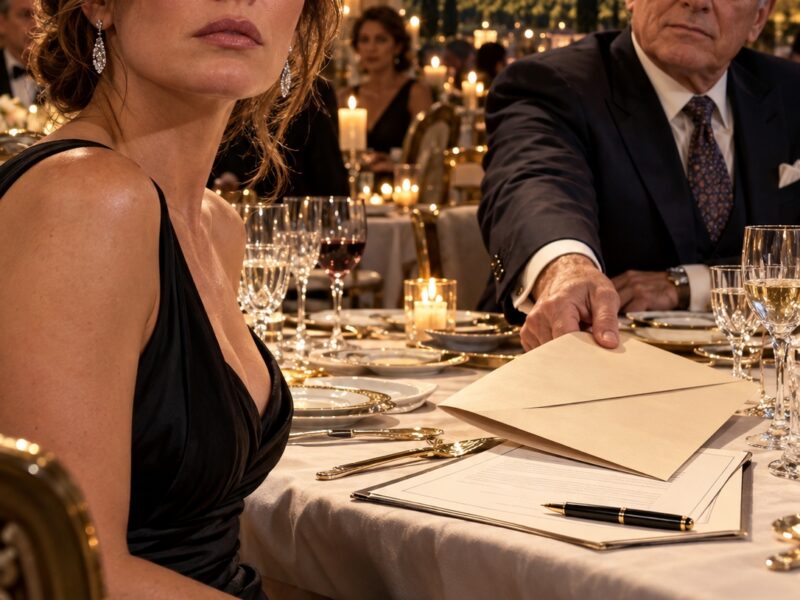
The envelope arrived between the salad and the filet mignon.
Richard Cairn slid it across twelve feet of white linen toward his daughter-in-law with two fingers and the faintest smile on his face.
“Standard family protection,” he said.
Naomi Brooks-Cairn looked down at the cream-colored envelope.
Her husband, Sterling, stopped turning his wineglass.
His mother, Margaret, suddenly became fascinated by the arrangement of roasted beets on her plate.
Nobody looked surprised.
That told Naomi everything she needed to know.
She lifted her eyes toward Sterling.
He looked away.
And in that small movement—barely a second, perhaps less—something inside their marriage finally stopped asking to be saved.
Naomi picked up the envelope.
Richard leaned back.
He had spent most of his sixty-seven years perfecting the art of humiliating people without ever raising his voice. He knew how to make cruelty sound like tradition and suspicion sound like prudence. He knew how to insult someone while leaving them unsure whether objecting would make them appear unreasonable.
Tonight, however, he had made one mistake.
He believed Naomi was the least powerful person at the table.
She opened the envelope.
Fourteen pages.
A postnuptial agreement.
The Cairn Family Trust.
Cairn Ridge Vineyards.
The tasting estate.
The private lodge.
Two hundred and six acres of vines stretching over the hills outside St. Helena, California.
Distribution rights.
Intellectual property.
Family residences.
Investment accounts.
Equipment.
Wine inventory.
Every meaningful asset connected to the Cairn name had been cataloged, described, and legally fenced away from Naomi.
The message beneath the legal language was simple.
You married our son.
You did not become one of us.
Naomi turned another page.
Then another.
Richard watched her carefully.
Sterling drank his wine.
“Dad,” he finally murmured.
Richard didn’t look at him.
“What?”
Sterling rubbed his thumb against the stem of his glass.
“Maybe we could have discussed this privately first.”
“We are discussing it privately.”
There were eight people at the table.
Richard’s attorney was one of them.
So was his accountant.
Naomi almost smiled.
Instead, she continued reading.
Richard mistook her silence for discomfort.
That was understandable.
Most people did.
“It’s nothing personal, Naomi.”
She looked up.
“No?”
“Of course not.”
He gave her the reassuring expression of a man explaining an unpleasant necessity to someone he considered emotionally inferior.
“The vineyard has been in this family for three generations. Sterling will eventually inherit significant responsibilities. Margaret and I simply believe clarity prevents misunderstanding.”
Naomi glanced at her husband again.
“Do you?”
Sterling’s jaw tightened.
“Naomi—”
“I’m asking your father.”
Richard folded his hands.
“I believe people who enter a marriage for the right reasons should never be troubled by documents protecting assets that aren’t theirs.”
There it was.
Margaret’s fork stopped for half a second.
Sterling closed his eyes.
Naomi felt something cold settle beneath her ribs.
Not because the insult surprised her.
Because Sterling had known it was coming.
She could see that now.
He had known.
Maybe for a week.
Maybe for a month.
Maybe since the lawyer had drafted the first page.
And he had sat beside her that morning drinking coffee while she read the news on her tablet.
He had kissed her before work.
He had texted her at 3:14 p.m.
Don’t forget dinner at my parents’. Love you.
Not one word.
Naomi returned to the agreement.
She read every clause.
Slowly.
Carefully.
Richard’s impatience began to show around page nine.
He had expected resistance.
A demand for independent counsel.
An argument.
Maybe tears.
He would never have admitted wanting tears, but men like Richard valued emotional reactions because reactions proved they still controlled the temperature of the room.
Naomi gave him nothing.
She reached page fourteen.
There was a signature line.
She closed the document.
“May I borrow a pen?”
Sterling’s head snapped toward her.
“Naomi.”
Richard’s attorney produced a black Montblanc.
Naomi took it.
Sterling pushed his chair back slightly.
“Wait.”
For the first time all evening, she looked directly at him.
His face held something close to panic.
“You should have your own attorney review that.”
Richard frowned.
“She’s perfectly capable of understanding a contract.”
“I know she’s capable.”
Sterling turned toward her.
“I’m saying you don’t have to sign tonight.”
Naomi studied him.
Two years earlier, she would have heard concern.
Tonight she heard cowardice arriving late enough to call itself kindness.
She signed.
Naomi Brooks-Cairn.
She added the date.
October 18.
Then she slid the agreement back across the table.
Richard stared at the signature.
That faint smile returned.
“Thank you.”
“You’re welcome.”
Naomi picked up her fork.
Nobody moved.
She cut a small piece of steak.
Richard had expected the moment to wound her.
What unsettled him was that she looked relieved.
He didn’t understand why.
He would.
Soon.
Because while Richard Cairn had spent months making certain Naomi could never claim his family’s vineyard through her marriage…
he had never bothered to ask who owned the mortgage on the land beneath it.
And Naomi had owned that for eighteen months.
Naomi’s father had taught her the difference between wealth and the appearance of wealth when she was twelve years old.
Emmanuel Brooks had spent thirty-five years restructuring distressed companies from a modest office in downtown Chicago.
He wasn’t famous.
He didn’t appear on television.
His office furniture looked like it had survived three recessions because most of it had.
But bankers called Emmanuel when companies with beautiful headquarters and impressive histories stopped being able to pay their bills.
When Naomi was young, she sometimes sat in his office after school.
She remembered one winter evening especially.
Snow pressed against the windows.
Her father had two annual reports spread across his desk.
One belonged to a company Naomi recognized from television commercials.
“They’re rich,” she said.
Emmanuel looked at her over his reading glasses.
“No.”
“They have buildings everywhere.”
“They have buildings.”
“They have millions of customers.”
“They have customers.”
“They’re famous.”
“That they are.”
Naomi frowned.
“So they’re rich.”
Her father smiled.
“Those are four different statements.”
He turned the report around.
“What matters?”
Naomi shrugged.
“The money?”
“The obligations.”
He tapped a line with his pen.
“Anybody can show you what they own. Learn to ask what owns them.”
She never forgot it.
Other children inherited recipes, sports allegiances, family sayings.
Naomi inherited an instinct for leverage.
By thirty-one, she was working in structured finance in San Francisco.
By thirty-six, she could read a balance sheet and sense the pressure hidden between two ordinary-looking lines.
By thirty-eight, she was a managing director overseeing complicated debt transactions that made most people’s eyes glaze over within five minutes.
That was the year she met Sterling Cairn.
They were attending an investment conference in Napa.
Sterling had been standing near a hotel bar listening to three men debate interest rates with tremendous confidence and very little understanding.
Naomi had walked past just as Sterling said, “I’m pretty sure none of us actually knows what we’re talking about.”
She laughed.
He heard her.
“See?” he said to the others. “Independent confirmation.”
She should have kept walking.
Instead, she stopped.
Sterling bought her a drink.
He was handsome without seeming aware of how much it had helped him. Dark blond hair, easy smile, expensive watch inherited from his grandfather.
But there was gentleness in him too.
That surprised her.
He asked questions.
He listened to the answers.
He remembered things.
Three weeks after meeting her, he sent her a photograph of a used bookstore because she had mentioned once that she loved the smell of old paper.
Four months later, he took her to Cairn Ridge.
The property was spectacular.
Rows of vines curved across the Napa hillside beneath a September sun. The main house stood above them in pale stone and cedar, with glass walls overlooking the valley.
Sterling stopped the car near the ridge.
“My grandfather planted the first twenty acres.”
Naomi looked across the vineyard.
“And your father?”
“Expanded everything.”
There was pride in his voice.
Not arrogance.
Not yet.
Then she met Richard.
He shook her hand.
“Sterling tells us you’re in finance.”
“I am.”
“What kind?”
“Structured credit.”
Richard nodded as if she had told him she sold insurance.
“Sounds complicated.”
“It can be.”
“Well, Sterling was never interested in that sort of thing.”
Sterling laughed.
“Dad thinks anything involving a spreadsheet is witchcraft.”
Richard didn’t laugh.
Naomi noticed.
She noticed other things too.
Richard asked where she had gone to school before asking where she had grown up.
He asked what her father did before asking whether her mother was still alive.
He asked how long she’d been with her firm.
He never asked whether she liked Sterling.
By dessert, Naomi understood she was being evaluated.
By coffee, she understood she had failed an examination whose rules nobody intended to explain.
Sterling squeezed her knee beneath the table.
“Don’t mind him,” he whispered later.
Naomi looked back toward the dining room.
“I don’t.”
That wasn’t entirely true.
But love makes optimists of intelligent people.
Naomi believed Sterling would eventually learn how to stand somewhere other than the space his father had prepared for him.
She married him eighteen months later.
For a while, she thought she had been right.
Their marriage was not unhappy.
That was what made everything harder.
Sterling made Sunday breakfast.
He knew exactly how she took her coffee.
He left notes in her suitcase when she traveled.
He could make her laugh when she was furious.
When her mother underwent surgery, Sterling slept three nights in an uncomfortable hospital chair without being asked.
There were dozens of reasons to love him.
There was only one reason she eventually couldn’t remain married to him.
When loving Naomi cost him something, Sterling disappeared.
Not physically.
That would have been easier.
He simply became neutral.
And neutrality, Naomi learned, could be a sophisticated form of abandonment.
The first time Richard referred to her career as “a useful little specialty,” Sterling laughed awkwardly and changed the subject.
The second time Richard told a dinner guest that Naomi was “very ambitious,” in a tone that turned the word into an accusation, Sterling squeezed her hand beneath the table.
The third time Margaret excluded Naomi from a family photograph and said, “Just the Cairns for this one,” Sterling stood with his parents.
He apologized later.
Always later.
“Mom didn’t mean anything.”
“Dad’s from another generation.”
“You know how they are.”
“Why let him get to you?”
Each apology asked Naomi to carry the cost of his silence.
And for a while, she did.
Then she began noticing something else.
The vineyard.
Or, more specifically, the numbers around it.
Cairn Ridge had reduced production for two consecutive seasons.
Their newsletter described it as a deliberate move toward “smaller-batch exclusivity.”
Naomi recognized the phrase immediately.
It was the kind of sentence companies wrote when necessity needed to dress like strategy.
Two longtime managers disappeared from the website.
Neither was replaced.
The proposed expansion of the luxury lodge—something Richard had bragged about at dinners for years—was postponed.
Then delayed again.
Then removed from the website entirely.
A tasting-room renovation stopped halfway through.
An equipment supplier filed a routine lien that disappeared six weeks later.
None of these things alone meant anything.
Together, they formed a rhythm.
Naomi knew that rhythm.
Something was bleeding.
Six months before her wedding, she hired a corporate research firm.
She told herself she was protecting Sterling.
Perhaps that was even true then.
The report arrived three weeks later.
She read it twice.
There was no scandal.
No stolen money.
No secret mistress being paid through a shell company.
No spectacular fraud.
The truth was less dramatic.
And far more dangerous.
Debt.
Four years earlier, Richard had borrowed aggressively against Cairn Ridge’s land and operating assets to finance a major hospitality expansion.
Then came two weak harvests.
Construction costs rose.
A key distributor pulled out.
Tourism projections missed.
Interest rates moved against them.
The loan remained technically current, but only because Richard had begun selling assets.
First a commercial building in Santa Rosa.
Then several company vehicles.
Then a collection of vintage agricultural equipment the family had displayed as part of the vineyard’s “heritage.”
The website still called Cairn Ridge debt-conscious and independently owned.
The balance sheet told another story.
The family wasn’t protecting a fortune.
They were defending a beautiful structure with termites inside the walls.
The lender wanted out.
That was the most interesting part.
A regional commercial finance company had originated the loan, then been acquired by a national institution that had no interest in babysitting a distressed winery with complicated collateral and a family wealthy enough to litigate.
The bank’s workout division had been trying to sell the position.
Naomi stared at that sentence for a long time.
Then she called someone.
His name was Daniel Reeves.
They had worked together on two distressed-debt acquisitions.
“I need you to look at something,” she said.
“How ugly?”
“Not ugly.”
“That’s disappointing.”
“Just inconvenient.”
“For whom?”
Naomi looked through the window of her office toward downtown San Francisco.
“I haven’t decided yet.”
Daniel went quiet.
Then he laughed softly.
“Send it.”
Negotiations took six weeks.
Naomi never appeared directly.
The debt was acquired through an LLC she had created years earlier for an unrelated investment, then transferred through two additional entities before landing in a holding company.
Nothing illegal.
Nothing exotic.
Just intentionally boring.
Boring was useful.
Boring discouraged curiosity.
The institutional lender accepted a discount because certainty today was worth more than litigation tomorrow.
Naomi signed the final documents on a Tuesday afternoon.
At 6:40 that evening, she walked into the house she shared with Sterling.
He was making tomato soup.
Music played quietly from a speaker.
“You’re late,” he said.
“Deal ran long.”
“Good deal?”
She set her purse down.
“Yes.”
He tasted the soup.
“Too much basil?”
She kissed his cheek.
“There’s no such thing.”
He smiled.
“How was your day?”
She waited.
But he had already turned toward the stove.
She nearly told him.
The words rose all the way to her throat.
Sterling, your family’s lender wanted out. I bought the loan.
She could have said it.
Instead she watched him stir the soup.
He never asked what the deal had been.
So she didn’t tell him.
Years later, Naomi would understand that this was the first secret in their marriage that had not been created by deception.
It had been created by absence.
There was space between them.
Sterling simply never noticed when something moved into it.
For eighteen months, Naomi did nothing with the debt.
That mattered.
She wasn’t waiting for revenge.
She wasn’t plotting to steal the vineyard.
The payments continued.
She accepted them.
When they arrived late but within contractual cure periods, she let them arrive late.
When Richard sold assets to keep the loan current, she watched.
Once, Daniel called.
“You could tighten the covenants.”
“No.”
“You’re being generous.”
“I’m being contractual.”
“That’s not the same thing.”
“It is to me.”
Naomi still loved Sterling.
More importantly, some stubborn part of her still believed he might become the man she saw when they were alone.
Then came the harvest gala.
Cairn Ridge hosted one every September.
Nearly two hundred guests arrived in black cars and rented SUVs.
String lights glowed above the terrace.
A jazz quartet played near the barrel room.
Servers moved between guests carrying champagne and tiny portions of food arranged on slate.
The valley below looked painted in gold.
It was the sort of event designed to make photographs feel like evidence.
Evidence that the Cairns were prosperous.
Evidence that the vineyard was permanent.
Evidence that certain families simply belonged to places more than other people did.
Naomi wore a black dress and small diamond earrings her father had given her when she made managing director.
Sterling kissed her shoulder before they left their bedroom.
“You look incredible.”
“Thank you.”
He adjusted his cuff links.
“Dad’s stressed tonight.”
Naomi watched him in the mirror.
“About?”
“Harvest numbers. Something with distribution.”
“Hmm.”
“Just don’t engage if he gets…”
He searched for the word.
Naomi supplied it.
“Rude?”
Sterling sighed.
“You know what I mean.”
“Yes.”
“I’m serious.”
“So am I.”
He turned.
“Naomi.”
She met his eyes in the mirror.
“What exactly are you asking me to do?”
“Nothing.”
“No. You’re asking something.”
“I’m asking you not to take the bait.”
Naomi turned around.
“Interesting.”
“What?”
“Your father hasn’t insulted me yet, but you’ve already assigned me responsibility for keeping the evening pleasant when he does.”
Sterling stared at her.
“That’s not fair.”
“No?”
“I’m trying to prevent a fight.”
“By telling the person who hasn’t started one to remain quiet.”
His expression changed.
He knew she was right.
For one hopeful second, Naomi waited.
This was one of those moments.
One of the little moments she had spent two years watching.
Sterling stepped closer.
“Can we please just have a good night?”
And there it was.
Not a choice.
An escape.
Naomi picked up her clutch.
“Of course.”
Three hours later, Richard gathered several guests near the tasting bar.
Naomi was close enough to hear him.
Helen Whitmore, one of Margaret’s oldest friends, was praising the estate.
“Your family has done something remarkable here.”
Richard smiled.
“We’ve simply protected what was entrusted to us.”
“That’s rare these days.”
“Very.”
He took a sip of Cabernet.
“People don’t understand roots anymore.”
Naomi felt the shift before he looked at her.
“You can’t manufacture belonging,” Richard continued. “People think education or money or ambition can substitute for history.”
Helen’s smile faded slightly.
Richard kept going.
“They arrive somewhere with credentials and think achievement gives them the same standing as generations of sacrifice.”
Then he looked at Naomi.
Only for a second.
Perfectly timed.
Helen looked down.
Another guest cleared his throat.
Naomi searched for Sterling.
He was thirty feet away.
Laughing with a vineyard owner.
He hadn’t heard.
Or perhaps he had mastered the art of not hearing things that required courage.
Naomi looked back at Richard.
He expected anger.
She smiled instead.
“You have built something beautiful here, Richard.”
His eyes narrowed.
“Thank you.”
“I mean that.”
She set her champagne glass down.
Then she walked away.
Outside the reach of the string lights, the vineyard descended into darkness.
Naomi stood alone near the upper terrace.
She could smell crushed grapes, pine, damp earth.
Behind her, people laughed.
A photographer’s flash lit the windows.
She looked across two hundred acres of land.
Beautiful land.
Richard was right about that.
He was wrong about almost everything else.
Naomi removed her wedding ring.
She held it between two fingers.
For several seconds, she considered putting it into her purse.
Then she heard Sterling behind her.
“There you are.”
She slipped the ring back on.
He approached carrying two glasses.
“You disappeared.”
“I noticed.”
He offered her one.
She didn’t take it.
His smile faded.
“What happened?”
Naomi looked at him.
There were moments when a marriage ended loudly.
A slammed door.
A confession.
A suitcase dragged across hardwood.
This wasn’t one of them.
This marriage ended with Naomi realizing her husband genuinely did not know what had happened twenty minutes earlier.
“Nothing,” she said.
Sterling studied her.
“You sure?”
“Yes.”
He kissed her temple.
“Come back inside.”
“In a minute.”
He left.
Naomi remained under the dark sky.
Then she took out her phone.
She opened Daniel’s contact.
She typed four words.
Prepare the enforcement file.
Her thumb hovered over the screen.
She thought about the postnup she hadn’t yet been asked to sign.
She thought about Richard’s glances.
Margaret’s polite exclusions.
Sterling’s endless later apologies.
She thought about every room in which she had waited for the man she loved to choose where he stood.
Then she pressed Send.
Three weeks later, Richard put the postnuptial agreement in front of her.
And Naomi signed it without changing a word.
For the first few days after the dinner, Sterling behaved as though nothing had happened.
That was his talent.
He could smooth over discomfort by acting as if enough normal mornings would eventually erase it.
He made coffee.
He sent Naomi a funny article.
He asked whether she wanted Thai food Thursday.
She answered normally.
On Saturday morning, he finally mentioned the agreement.
“You’re really okay?”
Naomi looked up from her laptop.
“With?”
He frowned.
“The postnup.”
“Oh.”
That tiny word bothered him.
“I thought you’d be angry.”
“Would that help?”
“No.”
“Then why?”
“I don’t know.”
Sterling sat across from her.
“You signed it very fast.”
“I read it.”
“You should have had counsel.”
“I understand contracts.”
“I know that.”
“Then what’s the problem?”
He stared at her.
Naomi could almost see him searching for the conversation he thought they were having.
Finally he said, “I don’t want you thinking I don’t trust you.”
She closed her laptop.
“Did you know?”
His silence answered before his mouth did.
“For how long?”
“Dad mentioned it.”
“When?”
“A couple weeks ago.”
Naomi nodded.
Sterling leaned forward.
“I told him I thought it was unnecessary.”
“But you didn’t tell me.”
“I didn’t know he was going to bring it out at dinner.”
“You knew the document existed.”
“Yes.”
“You knew it was being drafted.”
“I knew they were discussing it.”
“And every morning you sat across from me.”
“Naomi—”
“Every night you came home.”
“I didn’t want to create drama before there was something concrete.”
She looked at him.
Something concrete.
Fourteen pages had apparently been necessary before his wife’s dignity qualified as a fact.
Sterling reached for her hand.
She moved it to her coffee mug.
He noticed.
“I handled it badly.”
“Yes.”
“I’m sorry.”
“I believe you.”
Relief crossed his face.
That hurt more than the apology.
Because he thought believing his regret meant absolving his pattern.
Naomi opened her laptop again.
Sterling stayed seated.
“That’s it?”
“What else would you like me to say?”
“I don’t know.”
“Neither do I.”
He went upstairs ten minutes later.
Naomi remained at the kitchen table.
At 9:17 a.m., an email arrived from Daniel.
SUBJECT: Cairn Ridge — Payment Status.
She opened it.
The scheduled principal payment had not arrived.
Naomi read the message once.
Then she looked toward the staircase where Sterling had disappeared.
The cure provisions were explicit.
She had no need to improvise.
No need for anger.
No need for revenge.
Only dates.
Contracts.
Obligations.
The things Richard respected when they protected him.
Now they would work in the opposite direction.
Forty-eight hours after the cure period expired, Cairn Ridge received a formal notice of default.
Richard called three law firms before lunch.
By evening, he had assembled accountants, counsel, and two old friends with banking connections.
None could identify the beneficial owner behind the note.
The debt had been transferred cleanly.
The holding company was legitimate.
The paperwork was immaculate.
Richard became obsessed.
Sterling came home six days later looking ten years older.
He loosened his tie in the kitchen.
Naomi was drinking tea.
“We have a problem.”
She looked up.
“What kind?”
“The vineyard.”
He paced toward the refrigerator, then back.
“Some lender—or entity, I don’t even know what to call it—owns the commercial note.”
Naomi waited.
“They sent an enforcement notice.”
“How far behind?”
Sterling looked at her.
“What?”
“The payment.”
“Dad says it’s complicated.”
“Debt usually becomes less complicated when a payment is missed.”
He rubbed his forehead.
“Can you not do that?”
“Do what?”
“Talk like you’re in a board meeting.”
Naomi lowered her mug.
“What would you prefer?”
“I don’t know. Be worried?”
There was genuine frustration in his voice.
Perhaps even fear.
Naomi studied the man she had married.
“Are you worried?”
“Of course I’m worried. This is my family’s entire life.”
“No. It’s an asset.”
“It’s not just an asset.”
“To you.”
Sterling stared.
She softened slightly.
“What happened?”
“The lawyers can’t identify who controls the lender. Dad thinks someone deliberately bought the debt to force a sale.”
“Does he have evidence?”
“No.”
“Then that’s speculation.”
“The notice came almost immediately.”
“That usually happens when lenders stop believing delay will improve the outcome.”
Sterling stopped pacing.
Something had changed in his face.
He was finally hearing her.
Not her words.
Her lack of surprise.
“Naomi.”
“Yes?”
“How much do you know about this?”
She held his gaze.
Enough time passed for the refrigerator motor to shut off.
The kitchen became strangely quiet.
Naomi placed her mug on the counter.
“Sterling, have I ever given you a reason to believe I don’t know exactly where I stand?”
His mouth opened.
Nothing came out.
Upstairs, his phone began ringing.
He looked toward the sound.
Then back at her.
“That’s Dad.”
“Then you should answer.”
He didn’t move for several seconds.
Eventually he went upstairs.
Naomi turned toward the window.
Outside, evening had begun settling over the neighborhood in strips of orange and gray.
She felt no thrill.
No triumph.
Only the strange calm that comes when something you’ve carried for too long finally begins moving under its own weight.
Richard called a family meeting the following Monday.
He insisted Naomi attend.
That made her smile.
He still believed he was summoning her.
The boardroom at Cairn Ridge smelled of polished oak, old paper, and expensive coffee.
Richard sat at the head of the table.
Margaret sat to his right.
Sterling sat across from Naomi.
There were two attorneys, the family accountant, Richard’s longtime business partner, and a restructuring consultant from Los Angeles.
Naomi arrived last.
Not late.
Last.
There was a difference.
She wore a charcoal suit and carried a slim leather portfolio.
Richard barely acknowledged her.
“Now that everyone is here.”
Naomi took her seat.
Richard’s lead attorney, Charles Benton, distributed documents.
“We’ve spent the past seventeen days tracing the current holder of the Cairn Ridge commercial mortgage.”
Naomi opened the packet.
She already knew every page.
Charles continued.
“The original lender sold the instrument approximately eighteen months ago.”
Richard’s jaw tightened.
“It was transferred through multiple entities before being consolidated under Redwood Crest Capital Holdings.”
“Who owns it?” Margaret asked.
“We don’t know.”
Richard slammed his palm against the table.
“What do you mean, you don’t know?”
Charles remained calm.
“I mean the beneficial ownership isn’t disclosed in any publicly searchable record we’ve identified.”
“Someone owns the damn company.”
“Obviously.”
“Then find them.”
“We are trying.”
Richard stood and walked toward the window.
Outside, vineyard workers moved between rows that had belonged to his family longer than anyone in the room had been alive.
“They’re trying to steal this property.”
Naomi looked at the document.
Charles chose his next words carefully.
“They’re enforcing contractual remedies after default.”
Richard turned.
“Don’t correct my language.”
“I’m explaining the legal position.”
“I know the legal position.”
The restructuring consultant cleared his throat.
“There may still be an opportunity to negotiate.”
“With whom?”
“Redwood Crest.”
“Whoever they are.”
“Yes.”
Richard laughed bitterly.
“Cowards hiding behind shell companies.”
Naomi lifted her eyes.
Richard caught the movement.
“What?”
“Nothing.”
“No. You have an opinion?”
Sterling shifted in his chair.
“Dad.”
Richard ignored him.
“You work in this world, Naomi. Tell us. What kind of person structures an acquisition like this?”
The room became still.
Naomi looked at him.
Richard had finally asked the correct question.
He just didn’t know it.
“Usually?”
“Yes.”
“Someone who doesn’t want the identity of the creditor to distract from the enforceability of the instrument.”
Richard scoffed.
“That sounds rehearsed.”
“It isn’t.”
“You think this is legitimate?”
“I think your lawyer has already answered that.”
Richard looked at Charles.
The attorney didn’t rescue him.
Richard sat down again.
“We have assets.”
Naomi said nothing.
“We have options.”
Still nothing.
Richard leaned toward her.
“You’ve been very quiet.”
Naomi closed the packet Charles had provided.
Then she reached down beside her chair.
She lifted her leather portfolio onto the table.
Sterling’s eyes followed it.
Naomi opened the clasp.
Inside was a second document package.
Twenty-three pages.
Tabbed.
Indexed.
She placed it on the table.
Then she pushed it toward the center.
Charles looked at it first.
“What is that?”
Naomi leaned back.
“The answer to Richard’s question.”
Nobody moved.
Richard reached for the packet.
He opened the first page.
His expression didn’t change immediately.
He turned to the second tab.
Then the third.
The color began leaving his face.
Not dramatically.
Slowly.
His body understood before his pride did.
Charles stood and moved beside him.
He read over Richard’s shoulder.
Margaret looked between them.
“What?”
Neither man answered.
“Richard?”
Sterling stared at Naomi.
She met his eyes.
He knew.
Not the details.
But enough.
“Oh my God,” he whispered.
Richard finally looked up.
His voice had changed.
“What is this?”
Naomi folded her hands.
“The commercial mortgage secured against Cairn Ridge was acquired eighteen months ago.”
“I can read.”
“Then keep reading.”
Richard’s eyes flashed.
Charles put a hand on his shoulder.
“Richard.”
It was a warning.
Richard looked down again.
Naomi continued.
“The acquisition was initially completed through Westbridge Four LLC. The instrument was subsequently transferred through two domestic entities before being consolidated under Redwood Crest Capital Holdings.”
Margaret’s hand flattened against the table.
Sterling didn’t move.
Richard stared at Naomi.
“No.”
She waited.
“No.”
His voice was louder this time.
“You?”
Naomi’s expression remained calm.
“I control Redwood Crest.”
Margaret inhaled sharply.
Richard looked at Charles.
The lawyer was still reading.
“Charles.”
Charles didn’t answer.
“Charles.”
Finally the attorney straightened.
“The documentation appears consistent.”
“Consistent with what?”
Charles looked at him.
“With what she’s saying.”
The room disappeared into silence.
Richard’s business partner slowly removed his glasses.
The accountant looked down at his hands.
Sterling kept staring at his wife.
Richard looked back at the documents.
Then at Naomi.
“You bought our debt.”
“I purchased a commercial credit instrument from a lender that wanted to exit the position.”
“Don’t play games with language.”
“I’m being precise.”
“You bought my vineyard.”
“No.”
Naomi leaned forward slightly.
“You mortgaged your vineyard.”
The words landed harder than if she had shouted.
“I bought the debt.”
Richard stood.
“You manipulative little—”
“Dad.”
Sterling’s voice cracked across the room.
Everyone looked at him.
Sterling had gone pale.
“Sit down.”
Richard stared at his son.
For perhaps the first time in his life, Sterling didn’t look away.
“Sit down,” he repeated.
Richard remained standing.
But he stopped speaking.
Naomi watched Sterling.
Two years.
Hundreds of dinners.
A thousand small moments.
And finally he had confronted his father.
Too late.
That was the tragedy.
People imagine courage becomes meaningless if it arrives late.
That isn’t true.
Late courage still matters.
It simply cannot always repair what earlier cowardice destroyed.
Richard slowly lowered himself into his chair.
His eyes found Naomi again.
“The postnup.”
There was desperation in his voice now.
It was almost painful to hear.
“You signed it.”
“Yes.”
“You acknowledged the assets belonged exclusively to the Cairn Family Trust.”
“Yes.”
“You waived claims.”
“As Sterling’s spouse.”
Richard looked at Charles.
The attorney closed his eyes briefly.
He understood.
Richard did not.
Not yet.
Naomi explained.
“The agreement prevents me from making a marital claim against assets held by the Cairn Family Trust.”
She paused.
“It does not extinguish the rights of an unrelated commercial creditor.”
Richard’s lips parted.
Naomi continued.
“I didn’t acquire the note as Sterling’s wife.”
Her voice remained quiet.
“I acquired it through an investment entity eighteen months before you put that agreement in front of me.”
She looked at the cream-colored copy of the postnup sitting among Richard’s papers.
“When I signed your agreement, I wasn’t surrendering my position.”
Another beat of silence.
“I was protecting it.”
Margaret whispered, “My God.”
Richard stared at Naomi as though seeing her for the first time.
Perhaps he was.
“You planned this.”
“No.”
“Don’t lie to me.”
“I haven’t.”
“You infiltrated this family knowing you could take the property.”
Sterling flinched.
Naomi did not.
“I discovered the debt six months before our wedding.”
Richard pointed at her.
“There.”
“I also did nothing with it for eighteen months.”
“You hid it.”
“Yes.”
“From my son.”
Naomi turned toward Sterling.
The anger in Richard’s voice could not hurt her.
Sterling’s face could.
“Why?” Sterling asked.
The question was barely audible.
Not why did you buy it.
Not why did you enforce it.
Something more painful.
“Why didn’t you tell me?”
Naomi looked at him for a long time.
She had imagined this conversation.
In some versions she had been furious.
In others she had cried.
In one, Sterling finally understood soon enough to matter.
Reality was quieter.
“Because I stayed.”
Sterling frowned.
“What?”
“When I learned how much your family owed, I could have walked away.”
She swallowed.
“I didn’t.”
Richard shifted, but Naomi never looked at him.
“I married you.”
Sterling’s eyes glistened.
“I built a life with you. I sat at your family’s table. I came to every holiday. Every fundraiser. Every ridiculous wine dinner where your father introduced me by mentioning my job before mentioning that I was your wife.”
“Naomi—”
“I waited.”
Her voice almost broke.
Almost.
“For what?”
She smiled sadly.
“For you.”
Sterling looked devastated.
“I was there.”
“No.”
That single word silenced him.
“You were nearby.”
He lowered his eyes.
Naomi continued.
“There’s a difference.”
Nobody else in the room existed anymore.
“I watched you every time your father made me smaller so he could feel larger. I watched you when your mother excluded me. I watched you when somebody made a joke and you knew exactly what it meant.”
Sterling’s breathing had become shallow.
“I didn’t agree with them.”
“I know.”
“I never agreed with him.”
“I know.”
“Then how can you say—”
“Because disagreement that never costs you anything is private morality, Sterling.”
He stopped.
Naomi’s eyes filled now.
She hated that.
Not because she was ashamed of tears.
Because she had wanted this moment to be clean.
But love leaves fingerprints even on endings.
“I never needed you to fight your father for me,” she said. “I needed you to let him know there was a line he couldn’t cross without finding you standing on the other side.”
Sterling wiped his mouth with his hand.
“I thought I was keeping the peace.”
“You were.”
He looked up.
“With everyone except me.”
His face collapsed.
Naomi looked away.
Richard broke the silence.
“This is absurd.”
She turned toward him.
He was angry again because anger was the only position left in which he recognized himself.
“You’re destroying something three generations built because you felt insulted at dinner?”
Naomi stared at him.
“No.”
“Then what do you call this?”
“A default.”
Richard laughed.
“You expect anyone to believe this isn’t personal?”
“I don’t care what anyone believes.”
“You’re taking my family’s land.”
Naomi’s expression changed.
For the first time, there was steel in it.
“Your family borrowed against the land.”
Richard froze.
“You borrowed millions to build a hospitality expansion the business couldn’t support. You missed projections. You lost distribution. You sold assets to make debt service while telling everyone the company was choosing exclusivity.”
The accountant looked uncomfortable.
Naomi continued.
“You mortgaged your history, Richard.”
He said nothing.
“You did that. Not me.”
Margaret whispered his name.
Richard ignored her.
Naomi reached for her portfolio.
“You spent years telling everyone this land proved your family was permanent.”
She gathered her papers.
“But permanence isn’t a financial category.”
She stood.
Sterling stood too.
“Naomi.”
She looked at him.
He seemed suddenly younger.
Not the charming forty-year-old heir to Cairn Ridge.
Just a frightened man realizing that the person he loved had been leaving in inches while he kept assuming she would always remain within reach.
“Are you leaving me?”
Naomi’s fingers tightened around the portfolio.
The question hurt because part of her still wanted the answer to be no.
“Yes.”
Sterling closed his eyes.
Richard stared between them.
“So that’s it?”
Naomi looked at her father-in-law.
“You put a postnuptial agreement in front of me to remind me that I had no claim to anything your family built.”
Richard’s jaw tightened.
“And you signed it.”
“I did.”
“Why?”
Naomi walked toward the door.
Then she stopped.
She looked back.
Not at Sterling.
At Richard.
“Because it had nothing to do with the only position that mattered.”
Richard’s face hardened.
Naomi opened the door.
Behind her, Sterling said her name once.
She almost turned around.
That was the closest she came to changing everything.
Her hand remained on the brass handle.
She remembered Sunday breakfasts.
Hospital chairs.
Notes hidden in luggage.
Sterling laughing in bed.
Sterling holding her mother’s hand.
Sterling looking away at dinner.
Sterling standing thirty feet away beneath string lights.
Love was still there.
That was the cruelest part.
Love had simply stopped being enough.
Naomi walked out.
Sterling came home three nights later.
Naomi was packing.
Not dramatically.
No clothes thrown onto the floor.
No shattered photographs.
Two suitcases sat open on the bed.
He stopped in the doorway.
“So you meant it.”
She folded a sweater.
“Yes.”
“Where are you going?”
“I rented an apartment in San Francisco.”
“For how long?”
Naomi looked at him.
He laughed once.
A broken sound.
“Right.”
He sat on the edge of the bed.
She continued packing.
After a minute, he said, “Dad thinks we can challenge the transfer.”
“You can challenge anything.”
“Will he win?”
“No.”
Sterling nodded.
He believed her.
That was almost funny.
After two years of failing to understand what she knew, he trusted her expertise completely when it was too late to help him.
“Are you going to sell it?”
“I don’t know yet.”
“Cairn Ridge.”
“I know what you meant.”
He watched her fold another sweater.
“You could keep it.”
“I could.”
“Live there.”
“I won’t.”
“Why?”
Naomi stopped.
“Because I never wanted your vineyard.”
Sterling stared at the floor.
“I know.”
“Do you?”
“Yes.”
He rubbed both hands over his face.
“I know now.”
Naomi sat across from him.
For several seconds neither spoke.
Then Sterling reached into his pocket.
He placed something on the bed between them.
Her wedding ring.
Naomi touched her left hand instinctively.
She had removed it the night before and left it beside the bathroom sink.
“I thought you’d forgotten it,” he said.
“No.”
He nodded.
“Right.”
Neither touched the ring.
Sterling looked toward the window.
“Was there ever a moment I could’ve fixed this?”
Naomi considered lying.
Kindness sometimes resembles dishonesty when two people are saying goodbye.
But Sterling had spent his life protected from consequences by softened language.
She wouldn’t do that to him now.
“Yes.”
His eyes lifted.
“When?”
“Lots of them.”
He swallowed.
“At the gala?”
“Before that.”
“The postnup?”
“Before that too.”
“Then when?”
Naomi’s eyes filled.
“Every time.”
He didn’t understand.
She explained.
“Every time your father insulted me and you heard it. Every time your mother excluded me and you noticed. Every time we drove home afterward and you apologized for people who weren’t sorry.”
Sterling looked down.
“You could’ve told me.”
“I did.”
“When?”
“Every time I went quiet.”
His face tightened.
“That’s not fair. I can’t read your mind.”
“No. You can’t.”
Naomi nodded.
“And I should have said more. That’s mine.”
He looked surprised.
She continued.
“I should have told you sooner how much it was costing me.”
“Then maybe—”
“But Sterling.”
She waited until he looked at her.
“You didn’t need to read my mind to hear your father.”
He had no answer.
That was the final truth between them.
Naomi zipped the suitcase.
Sterling stood.
He picked up her second bag and carried it downstairs.
Even then, he was kind.
That was what made leaving hurt.
At the front door, Naomi reached for the handle.
Sterling said, “I love you.”
She closed her eyes.
“I know.”
“Do you still love me?”
Naomi turned.
His eyes were red.
She wished he had been cruel.
Cruel men are easier to leave.
“Yes.”
The answer destroyed him.
“Then why?”
“Because loving someone isn’t the same as being safe with them.”
“I never hurt you.”
Naomi looked at him.
Sterling understood his mistake before she answered.
“No,” she said quietly. “You just kept standing beside the people who did.”
She stepped outside.
He didn’t follow.
The foreclosure process lasted forty-one days.
Richard’s lawyers challenged notice procedures.
They lost.
They challenged the assignment chain.
They lost.
They alleged bad faith.
The documents told a different story.
Payments had been accepted according to the contract.
Cure periods had been honored.
Default remedies had been exercised only after the applicable deadlines.
There was no dramatic courtroom speech.
No judge slamming a gavel.
No moment when Richard screamed Naomi’s name from courthouse steps.
Real financial endings are usually quieter.
Signatures.
Notices.
Wire transfers.
Recorded documents.
Then one morning, for the first time in three generations, Cairn Ridge Vineyard no longer belonged to the Cairn family.
Naomi didn’t celebrate.
Daniel called.
“Congratulations.”
“For what?”
“You now own one of the prettiest distressed assets in California.”
Naomi looked out her office window.
“I don’t want it.”
“I know.”
“You sound disappointed.”
“I was hoping you’d become an eccentric wine baron.”
“Wine baroness.”
“Apologies.”
She laughed.
It was the first genuine laugh she’d had in weeks.
Then Daniel became serious.
“What are you going to do?”
“Sell it.”
“To whom?”
“The right buyer.”
Richard made three attempts to contact her directly.
Naomi declined all three.
Margaret sent one handwritten letter.
Naomi read it.
There was no apology in it.
Only grief disguised as nostalgia.
She didn’t answer.
Sterling sent nothing.
That hurt.
It also helped.
The divorce proceeded quietly.
They had no children.
Their personal assets were straightforward.
Ironically, Richard’s postnuptial agreement made the separation easier.
Naomi’s attorney pointed this out during one meeting.
She laughed so suddenly that she had to cover her face.
“You okay?” he asked.
“Yes.”
She wiped her eyes.
“That’s just very funny.”
Seven months after the foreclosure, Naomi had three serious offers for Cairn Ridge.
The highest came from a luxury hospitality group.
They wanted to turn the property into an ultra-exclusive resort.
Private villas.
Helipad access.
Membership-only tasting rooms.
Naomi read the proposal.
Then set it aside.
The second offer came from a private-equity-backed wine company.
They planned to preserve the Cairn Ridge name.
That surprised her.
“The brand has value,” Daniel explained.
“Even without the family?”
“Especially without the debt.”
Naomi stared at him.
He smiled.
“Too soon?”
“A little.”
She rejected that offer too.
The third wasn’t the highest.
It came from a regional agricultural and cultural development organization partnering with several local growers and hospitality operators.
They wanted to continue producing wine.
The main lodge would become a culinary and cultural center.
Parts of the property would be opened for educational programs.
Several longtime Cairn Ridge employees would keep their jobs.
The Cairn name would disappear from the bottles.
Naomi read the proposal twice.
Then she called Daniel.
“This one.”
“They’re eleven percent below the hospitality group.”
“I know.”
“You asked me to maximize value.”
“I changed the instruction.”
Daniel paused.
“Why them?”
Naomi looked at the photograph attached to the proposal.
A group of people standing between rows of vines.
“This place has spent too long being used as proof that only one family belongs here.”
Daniel was quiet.
“Okay.”
The deal closed on a rainy Wednesday in April.
Naomi was in her office when the final confirmation arrived.
TRANSFER COMPLETE.
She stared at the email.
For almost three years, Cairn Ridge had occupied some portion of her mind.
First as a warning.
Then a secret.
Then leverage.
Then a battlefield.
Now it was simply somewhere else.
Naomi closed her laptop.
Her phone rang.
Dad.
She answered.
“Hi.”
Emmanuel Brooks didn’t ask whether the deal had closed.
He already knew.
“Well,” he said.
Naomi smiled.
“Well.”
A pause.
Rain moved across the windows.
“Are you all right?”
It was such a simple question.
Nobody in the Cairn family had ever asked it without also needing the answer to reassure them.
Naomi considered it carefully.
“Yes.”
“You sure?”
She looked around her office.
There were no vineyard photographs.
No legal documents.
No wedding ring.
Just a half-finished coffee and a stack of work she would complain about tomorrow.
“Yes,” she said. “I think I actually am.”
Her father exhaled.
Not quite a laugh.
Something softer.
“What now?”
Naomi leaned back.
“Work.”
“Terrible idea.”
“Sleep.”
“Better.”
“Maybe take a vacation.”
“Now I’m suspicious. Who is this?”
She laughed.
Then her father asked, “And after that?”
Naomi looked through the rain.
“Find something new worth building.”
Emmanuel was silent for a moment.
“That sounds about right.”
“Dad?”
“Yes?”
“Do you remember that company you showed me when I was twelve?”
He didn’t hesitate.
“The department-store chain?”
“Yes.”
“You argued with me for twenty minutes.”
“I was twelve.”
“You were exhausting.”
Naomi smiled.
“You told me a famous name wasn’t collateral.”
“I told you many brilliant things.”
“That one stayed.”
Her father became quiet.
Naomi looked down at her hands.
“Richard thought his name protected him.”
“Most people confuse reputation with structure until structure stops cooperating.”
“He thought I wanted what he had.”
“And did you?”
Naomi thought about the vineyard at sunset.
The rows of vines.
The stone lodge.
The dinners.
The photographs.
Sterling.
“No.”
“Good.”
She frowned.
“Why good?”
“Because if you wanted it, you’d still be carrying it.”
Naomi didn’t answer.
She didn’t need to.
Three months later, she saw Sterling again.
Not at a courthouse.
Not at a lawyer’s office.
At a coffee shop.
Naomi was waiting for an order when she heard someone say her name.
She turned.
Sterling stood ten feet away.
He looked different.
Not dramatically.
His hair was slightly longer.
He had lost weight.
No expensive watch.
For a second, neither moved.
Then he smiled.
“Hi.”
“Hi.”
He approached.
“I wasn’t sure whether to say something.”
“I’m glad you did.”
That seemed to surprise him.
They sat near the window.
For several minutes they talked about ordinary things.
Work.
Mutual friends.
Margaret’s health.
Sterling had moved to Sacramento.
“What are you doing there?”
“Consulting.”
Naomi raised an eyebrow.
He laughed.
“I know.”
“You hated consulting.”
“I hated the idea of having a job my father couldn’t explain at dinner.”
The humor disappeared from his face.
“Turns out that was a bad reason.”
Naomi nodded.
Sterling stirred his coffee.
“Dad still blames you.”
“I assumed.”
“I don’t.”
She looked at him.
“He says you took everything.”
“What do you say?”
Sterling looked through the window.
“I tell him he borrowed everything.”
Naomi felt something shift in her chest.
Not hope.
Something gentler.
Recognition, perhaps.
Sterling looked back at her.
“I should’ve said things like that when we were married.”
“Yes.”
“I know.”
No excuses.
That was new.
He smiled sadly.
“I’m getting better at knowing things on time.”
Naomi laughed softly.
“I hope so.”
He hesitated.
“Are you happy?”
The question caught her off guard.
“I think I’m becoming good at being myself again.”
“That wasn’t what I asked.”
“It might be my answer.”
Sterling nodded.
“Fair.”
A barista called Naomi’s name.
She stood.
Sterling stood too.
For a moment they faced each other with all the strange intimacy of two people who once knew exactly how the other slept and now didn’t know whether a hug was appropriate.
Sterling solved it.
He offered his hand.
Naomi looked at it.
Then she hugged him.
He froze for half a second before wrapping his arms around her.
It lasted perhaps three seconds.
When they separated, Sterling’s eyes were wet.
“I’m sorry,” he said.
Naomi believed him.
That mattered.
It simply didn’t change anything.
“I know.”
He nodded.
She picked up her coffee.
“Take care of yourself.”
“You too.”
Naomi walked toward the door.
“Naomi?”
She turned.
Sterling stood beside the table.
“There was something I always wondered.”
“What?”
“When Dad gave you the postnup.”
Naomi waited.
“You signed it immediately.”
“Yes.”
“When did you know it couldn’t hurt you?”
She smiled.
“The moment I read the first page.”
His expression changed.
“Because you already owned the debt.”
“No.”
Sterling frowned.
Naomi held his gaze.
“Because by then I had finally understood that the thing I needed protection from wasn’t losing your family’s money.”
She opened the door.
“It was losing myself trying to earn your family’s permission to belong.”
Sterling didn’t answer.
There was nothing left to say.
Naomi stepped outside.
The afternoon was bright after several days of rain.
She walked two blocks before realizing she was smiling.
Not because she had beaten Richard.
Not because she had taken Cairn Ridge.
Not because the documents had worked exactly as she knew they would.
Those things belonged to another life now.
She smiled because she no longer needed any of them to mean something.
For three generations, the Cairns had told anyone willing to listen that their name was permanent.
The vineyard was their proof.
Richard believed history could become ownership simply by being repeated long enough.
He believed the family name was a wall.
Naomi’s father had taught her something different when she was twelve.
A name was a story.
A reputation was a story.
Prestige was a story.
Sometimes even wealth was only a story.
But debt was arithmetic.
Collateral was real.
Obligations were real.
And beneath every beautiful story, there was eventually a number that refused to care who your grandfather had been.
Richard Cairn had spent his entire adult life protecting the family name.
He protected it from outsiders.
From scandal.
From change.
Eventually, he tried to protect it from his own daughter-in-law.
So he put fourteen pages in front of her at dinner and asked her to sign away her right to everything he believed made his family powerful.
Naomi signed every page.
She didn’t argue.
She didn’t cry.
She didn’t ask for anything.
Because Richard had been guarding the wrong thing.
The mansion wasn’t the foundation.
The vineyard wasn’t the foundation.
The family trust wasn’t even the foundation.
The debt beneath all of it was.
And while Richard Cairn had spent sixty years making certain nobody could take what carried his name…
he had never thought to ask who owned the line underneath it.









