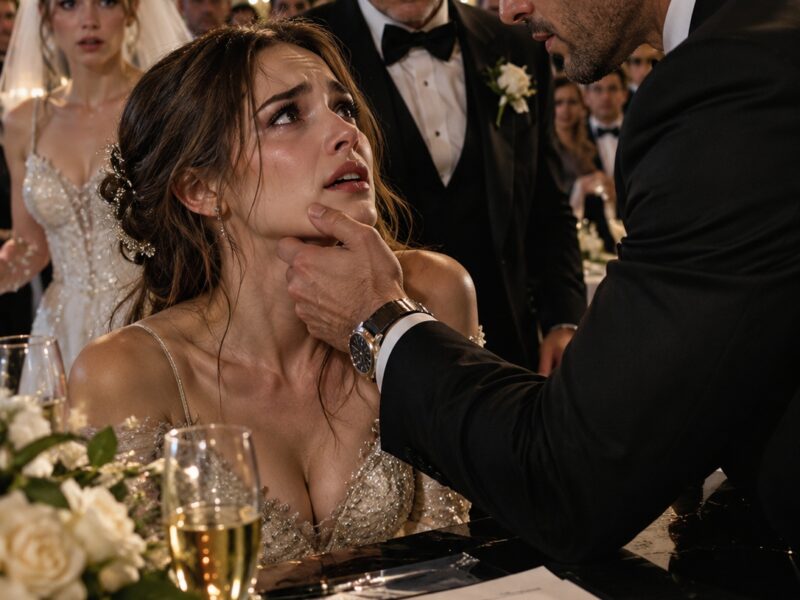
MY FATHER OFFERED ME TO CHICAGO’S MOST FEARED MAFIA BOSS TO ERASE HIS $11 MILLION DEBT—BUT THE BOSS LOOKED AT ME AND SAID, “SHE’S NOT YOURS TO BARGAIN WITH.”

Smiling was the only thing keeping four hundred wedding guests from realizing my father had just tried to sell my future.
I was twenty-seven years old, standing beneath a ceiling of crystal chandeliers at the Holston Grand Hotel, when Garrick Voss dug his fingers into my wrist and whispered through a photographer-ready smile, “Stand up straight.”
Lake Michigan was black beyond the ballroom windows. White roses spilled from six-foot arrangements. A string quartet was playing something expensive and forgettable while waiters carried champagne between tables filled with judges, developers, donors, politicians, and the kind of people my father had spent thirty years collecting.
Across the room, my older sister Meredith was dancing with her new husband.
She looked beautiful.
She also looked terrified.
“You’re hurting me,” I said without moving my smile.
“Then stop trying to walk away.”
“I was going to get some air.”
“You can breathe tomorrow.”
His grip tightened.
“The photographers are still working.”
That sentence told you almost everything you needed to know about Garrick Voss.
Appearance first.
Reality later.
If reality became inconvenient, bury it beneath enough money that nobody asked questions.
I looked toward Meredith again. Her wedding gown probably cost more than I earned in a year at the Chicago Municipal Archives, a detail my father had mentioned three separate times that week as though the price of her dress were somehow evidence of her worth.
“You’re supposed to look happy for your sister,” he murmured.
“I am happy for her.”
“You look miserable.”
“I’m smiling.”
“Try meaning it.”
So I widened my smile.
“There.”
His jaw twitched.
For one small, satisfying second, I knew he understood I was mocking him.
Then he released my wrist.
“Go speak to the Hales again. Richard Hale’s company has two developments coming up next year.”
“I work for the city, Dad. I’m not looking for investors.”
“You work in a basement with old paperwork.”
“I work with municipal records.”
“Same thing.”
It wasn’t.
My father had never understood what I did because understanding it would have required admitting that work could matter without making someone rich.
For four years, I had handled property transfers, permits, corporate filings, historical deeds, zoning records, and documents old enough to crumble if you touched them carelessly. Most people saw paper.
I saw patterns.
A date entered two days too early.
A signature shaped differently from the previous six.
A corporation created three weeks before receiving a property supposedly owned by it for ten years.
A missing page.
A replaced page.
A lie disguised as bureaucracy.
My father called it filing.
The job had taught me to notice inconsistencies.
Growing up with Garrick Voss had taught me to notice everything else.
Which questions made his jaw tighten.
Which names made him lower his voice.
Which phone calls caused him to close his office door.
Which compliments were really warnings.
Which silences meant someone in the family was about to pay for something he had done.
That night, however, I was tired of noticing.
I wanted five minutes where nobody needed anything from me.
I slipped toward the windows and pressed two fingers against the cold glass.
“You look like you’re planning an escape.”
I turned.
Meredith stood behind me in satin and diamonds, her blond hair pinned beneath a veil that had taken two stylists almost an hour to arrange.
“You should be dancing,” I said.
“I wanted to check on you.”
“Why?”
The word came out sharper than I intended.
Her expression changed.
“You’re my sister.”
“That hasn’t usually been enough reason.”
“Elena.”
The hurt in her voice made me regret it immediately.
I looked down.
“Sorry.”
Meredith stepped closer.
“Dad’s been impossible tonight.”
“Dad’s been Dad.”
“He just wants everything perfect.”
“No. He wants everything controlled.”
She didn’t answer.
Instead, she looked over my shoulder.
At him.
It lasted less than a second.
But I knew fear when I saw it.
I turned slightly.
Dad was speaking with two men near the bar.
“What’s wrong?”
“Nothing.”
“You just looked at him like you were afraid of him.”
“I didn’t.”
“You did.”
“Elena, please.”
My stomach tightened.
“Please what?”
She glanced toward the ballroom entrance, then back toward our father.
Finally she grabbed my hand.
Hard.
“Whatever Dad asks you to do tonight,” she whispered, “don’t agree to anything.”
The cold from the window seemed to enter my body all at once.
“What?”
“Just promise me.”
“Meredith, what are you talking about?”
“Promise me.”
“What did he do?”
The music stopped.
Not dramatically.
One violin simply fell silent.
Then another.
Then conversations began dying table by table.
A strange quiet moved across the ballroom like a shadow.
Meredith turned toward the entrance.
The color disappeared from her face.
Four men in dark suits entered first.
Then he walked in behind them.
Dominic Russo.
I knew the name before I recognized the face.
Everyone in Chicago did.
Russo Holdings owned hotels, logistics companies, restaurants, commercial real estate, and enough legitimate businesses that financial magazines occasionally wrote flattering profiles about its young chief executive.
Other stories were told more quietly.
Stories involving the Russo family.
Stories involving men who disappeared from businesses overnight.
Stories involving old Chicago loyalties that had survived longer than prosecutors, politicians, and entire police administrations.
Dominic had inherited control after his father’s death.
He was thirty-two.
He had become, depending on which version of Chicago you believed, either one of the city’s most disciplined young businessmen or its most dangerous mafia boss.
Possibly both.
He wore a black suit without a tie.
No smile.
No visible hurry.
That was what frightened people.
Powerful men usually entered rooms expecting to be noticed.
Dominic entered as though noticing him were inevitable.
My father saw him.
And Garrick Voss went pale.
Not nervous.
Not uncomfortable.
Pale.
“Dad?” I said.
He didn’t answer.
Dominic crossed the ballroom.
Four hundred people watched him.
He ignored all of them.
He walked directly toward us.
Toward me.
My father stepped forward.
“Dominic, this isn’t the place.”
Dominic stopped.
His eyes went to my father’s hand, which had somehow found my wrist again.
Then he looked at me.
Dark eyes.
Controlled expression.
Something strangely familiar in the way he studied my face.
When he spoke, his voice was quiet enough that everyone had to become silent to hear him.
“She’s not yours to bargain with, Garrick.”
My father’s fingers froze around my wrist.
Dominic’s gaze never left mine.
Then he added two words that detonated across the ballroom.
“She’s mine.”
Nobody moved.
Champagne glasses remained suspended halfway to mouths.
A woman near the dance floor actually lowered her phone as though even recording the moment felt dangerous.
I stared at Dominic.
“What did you just say?”
“Elena,” Dad snapped. “Don’t.”
I looked down at his hand.
He was still holding me.
Dominic noticed too.
“Let go of her.”
He didn’t raise his voice.
My father released me instantly.
That frightened me more than anything else.
I had spent twenty-seven years watching Garrick Voss bully bankers, lawyers, contractors, employees, and his own family.
I had never seen anyone make him obey with four words.
“Someone,” I said, “is going to explain what’s happening.”
Neither man answered quickly enough.
“Now.”
Dominic’s expression changed when he looked at me.
Not softer exactly.
More careful.
“Your father owes my family eleven million dollars.”
For a moment, I genuinely thought I had misheard him.
“Eleven million?”
“Accumulated over six years.”
I laughed once.
It was the wrong reaction, but shock does strange things to the body.
“That’s impossible.”
“No,” Dominic said. “Unfortunately, it isn’t.”
I turned toward my father.
His eyes avoided mine.
“Dad?”
Nothing.
“Tell me he’s lying.”
“It’s complicated.”
My stomach dropped.
Dominic’s jaw tightened.
“It’s actually remarkably simple.”
“Stay out of this,” my father said.
Dominic almost smiled.
“You invited me into it when you offered me your daughter.”
The room seemed to tilt.
Meredith made a sound behind me.
Small.
Broken.
I looked at her.
She wasn’t shocked.
That was when I knew.
She already knew.
I turned back to my father.
“What did he just say?”
“Elena—”
“What did he just say?”
My voice cracked across the ballroom.
Dad stepped closer.
“Not here.”
“Then you should have chosen somewhere else to sell me.”
Gasps rippled through the guests.
His face hardened.
“It was not like that.”
“What was it like?”
Dominic answered.
“Your father’s real estate business began collapsing years ago. Banks stopped extending credit. My father financed him privately. Garrick defaulted, borrowed again, refinanced, borrowed against assets already carrying debt, and continued pretending publicly that Voss Development was healthy.”
My father’s humiliation was visible now.
Good.
Let him feel it.
“For six years?” I asked.
“Yes.”
“And tonight?”
Dominic’s eyes stayed on me.
“Tonight he proposed eliminating the debt through a family alliance.”
The language was elegant.
The meaning wasn’t.
I swallowed.
“A marriage.”
“Yes.”
“To you.”
“Yes.”
I looked at my father.
“You offered me to him.”
“I proposed something that could have protected this family.”
“You offered me.”
“You’re deliberately making it sound crude.”
“How should I make it sound?”
“Elena—”
“Was there a ring in the loan documents?”
His expression changed.
I kept going.
“Did you put me under collateral? Did you write ‘second daughter’ beside the house and the commercial properties?”
“That’s enough.”
“No. I want to understand the accounting.”
His face reddened.
Dominic stepped between us.
Not dramatically.
Half a step.
But it was enough.
“I refused,” he said.
I looked at him.
“What?”
“I refused the arrangement.”
The ballroom disappeared around me.
“Then why did you say I’m yours?”
For the first time, uncertainty crossed Dominic Russo’s face.
It was brief.
Almost invisible.
But I caught it.
Because catching small things was what I did.
“I said it badly.”
“That might be the understatement of the evening.”
A few people actually inhaled.
Dominic’s mouth almost moved.
Almost.
Then he looked toward my father.
“I came here because I wanted Garrick to hear my answer publicly. No private renegotiation tomorrow. No revised proposal. No attempt to approach me through someone else.”
He turned toward the room.
“I do not accept people as payment.”
Then back to my father.
“Not even for eleven million dollars.”
My father’s shoulders dropped.
Relief.
It lasted perhaps two seconds.
“The debt, however,” Dominic continued, “remains.”
Dad stiffened.
“You have thirty days.”
“Dominic—”
“Thirty.”
“You know I can’t raise that.”
“Then I’ll take the assets securing the loans.”
“The company?”
“Yes.”
“The house?”
“If necessary.”
“You’d destroy us.”
Dominic looked at him with an expression colder than anger.
“You should have considered that before deciding your daughter was easier to lose than your property.”
My father had no answer.
Neither did I.
I stood in the middle of my sister’s wedding reception while my entire understanding of my family cracked open beneath crystal chandeliers.
But one question remained.
I turned toward Dominic.
“You still haven’t answered me.”
His eyes met mine.
“Why did you say I was yours?”
The ballroom seemed to hold its breath again.
Dominic looked almost irritated with himself.
Then he said quietly, “Because I’ve known who you are for longer than tonight.”
My heartbeat changed.
“We’ve never met.”
“That isn’t entirely true.”
Before I could ask what that meant, my father grabbed my arm.
“We’re talking privately.”
I yanked myself free.
“You don’t get to drag me anywhere anymore.”
“Elena.”
“I’ll come because I want answers.”
I looked back at Dominic.
“This conversation isn’t over.”
“No,” he said.
“It isn’t.”
Then he left.
Just walked out.
Four men following behind him.
And somehow his departure made the room feel even more dangerous.
Because now I was standing beside the man who had tried to trade me away.
And the sister who had known.
My father pulled us into a private sitting room adjoining the ballroom.
The door had barely closed before I turned on him.
“Eleven million dollars.”
“Elena—”
“Six years.”
“I can explain.”
“You’ve had six years to explain.”
He lowered himself into a velvet chair.
For the first time that night, he looked sixty-one.
Not powerful.
Not polished.
Old.
“The business started failing eight years ago.”
“So you borrowed from the Russos?”
“I did what I had to do.”
“No. You did what you wanted to do and called it necessity afterward.”
His eyes flashed.
“You have no idea what it takes to keep a company alive.”
“I know what forged confidence looks like.”
That hit him.
I saw it.
“My entire job is reading records people hope nobody reads carefully, Dad. How much of your company is real?”
Silence.
“How much?”
“The assets are real.”
“That isn’t what I asked.”
His face tightened.
“The company is overleveraged.”
“How badly?”
He looked away.
I laughed without humor.
“Of course.”
“I was protecting what I built.”
“You were protecting your reputation.”
“I built that reputation for this family.”
“No. You built this family around that reputation.”
The door opened.
Meredith entered.
She had removed her veil.
Without it, she looked younger.
More frightened.
“You knew,” I said.
Her eyes filled immediately.
“Elena—”
“You knew.”
“I found out three weeks ago.”
My chest hurt.
“Three weeks.”
“Dad made me promise—”
I stared at her.
“Finish that sentence very carefully.”
Her lower lip trembled.
“He made me promise not to tell you until after the wedding.”
I looked toward the door.
Through it, muffled music had begun again.
Her wedding.
Her perfect day.
“You let me walk into that ballroom blind.”
“I tried to warn you.”
“Thirty seconds before Dominic Russo walked through the door.”
“I told you not to agree to anything.”
“That was your warning?”
“I didn’t know what else to do.”
“You could have told me the truth.”
“Dad said—”
“Stop saying Dad.”
She flinched.
I hated that I had made her flinch.
I hated more that she still looked toward him before answering me.
“I was afraid,” she whispered.
That stopped me.
“Of what?”
Meredith wiped beneath one eye.
“You don’t know what he’s like when he’s cornered.”
I slowly looked at our father.
“I think I do.”
“No.”
Something in her voice made me still.
“No, Elena. You don’t.”
Dad stood.
“Enough.”
Meredith’s eyes immediately dropped.
There.
That reaction.
That was the thing I had been noticing all night without understanding.
“What has he done?” I asked.
“Nothing,” Meredith said too quickly.
“Meredith.”
“Please.”
“What has he done?”
“Not tonight.”
Dad cleared his throat.
The sound was deliberate.
A reset.
He had done it throughout our childhood whenever a conversation began moving somewhere he didn’t want it to go.
“Regardless of everyone’s feelings about my methods,” he said, “the debt exists.”
I stared at him.
“My feelings about your methods?”
“Thirty days is not enough time to raise eleven million through conventional financing.”
“That sounds like your problem.”
“If I lose everything, you lose everything too.”
“I have an apartment and a city salary.”
“Your inheritance.”
“Don’t care.”
“Your mother’s house.”
That got me.
He saw it.
Of course he did.
Our mother had died six years earlier.
The lake house in Wisconsin was the last place that still felt like her.
“You mortgaged Mom’s house?”
He said nothing.
I felt something inside me go quiet.
Not anger.
Something beyond anger.
A door closing.
“There may still be another option,” he said.
“I am not marrying Dominic Russo.”
“That’s not what I meant.”
“Then what?”
“Russo said he already knew you.”
My father watched my face carefully.
“He clearly has an interest in you independent of the debt.”
I stared at him.
He continued.
“If you approached him yourself—”
I laughed.
He stopped.
“You are unbelievable.”
“Elena, listen.”
“You’re still doing it.”
“Doing what?”
“Calculating my value.”
“That is not what I’m doing.”
“You just changed the wording.”
“I’m trying to save this family.”
“No.”
I stepped closer.
“You’re trying to save yourself.”
His face hardened.
“And I think you stopped knowing the difference years ago.”
My phone buzzed.
Unknown number.
I looked down.
Meet me outside in ten minutes. Alone.
D.R.
I should have ignored it.
Instead, ten minutes later, I was walking through the hotel’s side entrance into freezing November air.
Snow had started falling.
Dominic stood beside a black sedan at the edge of the private drive.
No bodyguards visible.
No audience.
Just him.
“You came.”
“You said alone.”
“I did.”
“Which means either this is important or you have a flair for dramatic entrances.”
“I’ve been accused of worse.”
“I’m sure.”
Snow collected in his dark hair.
I crossed my arms.
“You said you’ve known me longer than tonight.”
“Yes.”
“Explain.”
He studied me.
Then he said, “Four years ago, I audited a series of property transfers connected to Russo Holdings.”
“You personally audit property records?”
“I personally audit anything involving enough money.”
Fair.
“The transfers contained altered dates, forged signatures and ownership structures that didn’t make sense.”
My body went still.
Those words belonged to my world.
Not his.
“I hired an outside team to trace them,” he continued. “They found the person who originally flagged the discrepancies through municipal channels.”
I already knew what he was going to say.
Still, hearing my name felt strange.
“Elena Voss.”
Three years earlier.
I remembered the file.
Not because it had seemed important.
Because it hadn’t.
Routine property records.
A chain of transfers.
One deed referenced a corporation that technically hadn’t existed on the date of acquisition.
I had checked twice.
Then five times.
My supervisor had told me it was probably clerical.
I filed the discrepancy anyway.
“That was you,” Dominic said.
“I never knew who owned the properties.”
“I know.”
“I wasn’t helping your family.”
“I know.”
“I was doing my job.”
“Exactly.”
Something about the way he said it unsettled me more than praise should have.
He continued.
“One of my father’s former associates had been moving properties out of Russo Holdings through falsified transfers for years. Your report gave investigators the thread they needed.”
“So what?”
“So I remembered your name.”
“For three years?”
“Yes.”
“That’s strange.”
“Yes.”
The immediate answer almost made me smile.
Almost.
“Did you investigate me?”
“I made sure you weren’t involved in the fraud.”
“That sounds like investigating me.”
“It was.”
“At least you admit it.”
“I learned enough to know you lived alone, worked for the city, had no unexplained money and apparently refused two promotions because you preferred records work.”
“How do you know about the promotions?”
Dominic looked mildly guilty.
I pointed at him.
“That is exactly the face of a man who investigated me too much.”
A laugh escaped him.
It surprised both of us.
For one second he wasn’t Dominic Russo, the man who had silenced a ballroom.
He was simply a thirty-two-year-old man standing in the snow because a woman had caught him doing something embarrassing.
Then the expression disappeared.
“When your father came to me with his proposal,” he said, “I recognized your name immediately.”
“And that’s why you came personally.”
“Yes.”
“Why?”
“I told myself I wanted witnesses.”
“To your refusal.”
“Yes.”
“But?”
His gaze held mine.
“But I wanted to see you.”
Snow landed on my eyelashes.
I blinked it away.
“You could have introduced yourself like a normal person.”
“I’m beginning to understand that.”
“Instead you walked into my sister’s wedding and announced that I belonged to you.”
“That was poorly phrased.”
“It was insane.”
“It achieved the immediate objective.”
“What objective?”
“Your father let go of your wrist.”
I stopped.
He had noticed.
Of all the things happening in that ballroom, he had noticed my father’s hand.
Dominic looked away for the first time.
“I don’t like watching people use force against someone who can’t respond without creating a scene.”
“I could have responded.”
“I know.”
“Then why interfere?”
“Because you shouldn’t have had to.”
That answer lodged somewhere inconvenient inside me.
I looked toward the hotel.
“My father wants me to negotiate with you.”
Dominic’s face cooled.
“Of course he does.”
“On my terms, supposedly.”
“And what are your terms?”
“I don’t have any.”
“What do you want?”
The question irritated me.
“What?”
“Not Garrick. Not Voss Development. Not your inheritance.”
He stepped closer, though still leaving several feet between us.
“What do you want, Elena?”
I opened my mouth.
Nothing came out.
That disturbed me more than it should have.
My whole life had been organized around other people’s expectations.
My father wanted obedience.
Meredith wanted peace.
My supervisors wanted competence.
My mother had wanted us to remain a family even after she was gone.
What did I want?
“The truth,” I said finally.
“About?”
“Everything.”
I looked at him.
“My father’s debts. Whatever Meredith is afraid to tell me. Why you really came tonight. Why you’ve remembered me for three years.”
Dominic’s expression became unreadable.
Then something changed.
A crack in the armor.
“I came because of you.”
My breath caught.
“That’s not an explanation.”
“No.”
“Try again.”
“I remembered the woman who found something everyone else missed.”
“That sounds like professional admiration.”
“It was.”
“Was?”
His eyes remained on mine.
“Then I saw you tonight.”
The hotel doors opened behind us.
Someone stepped outside, saw Dominic, and immediately went back in.
He didn’t notice.
Or pretended not to.
“You were standing beside your father,” he said. “You were frightened, but you kept asking questions. Everyone else in that room was afraid of what I might do. You were trying to understand what had already been done.”
My throat tightened.
“And?”
“And I realized I had spent three years remembering a file.”
His voice dropped.
“But the woman standing in front of me was considerably more difficult to forget.”
My phone rang.
Meredith.
I almost rejected it.
Then I saw she had called three times.
I answered.
“Meredith?”
“Elena.”
Her voice was breathless.
Terrified.
“You need to come inside.”
“What happened?”
“Dad collapsed.”
I turned toward the hotel.
“There are two men here asking about him,” she said.
“What men?”
“I’ve never seen them before.”
Dominic was already watching my face.
Meredith whispered the next words.
“And Elena?”
“Yes?”
“They said you were part of the payment.”
I ran.
Dominic was beside me before we reached the doors.
The ballroom had transformed.
The music was gone.
Guests stood in a wide circle near the head table.
My father lay on the floor.
Meredith knelt beside him, her wedding gown spread around her like spilled cream.
A doctor from among the guests had two fingers against Dad’s neck.
“What happened?”
Meredith looked up.
“He was talking to two men. They said something. Then he grabbed his chest.”
“What men?” Dominic asked.
She looked at him.
“They left.”
“When?”
“Right after he collapsed.”
My father’s eyes opened.
Unfocused.
Then they found Dominic.
Panic sharpened them immediately.
“You.”
Dominic’s face became stone.
“I’ve been outside with Elena.”
“You did this.”
“I did nothing.”
“Dad,” I said. “Who were those men?”
His hand found mine.
Weak this time.
“Costa.”
Dominic went still.
Not surprised.
Worse.
Recognizing.
“Victor Costa?” he asked.
Dad closed his eyes.
“Yes.”
The name meant nothing to me.
But Dominic’s reaction did.
“Why would Victor Costa send men here?”
My father looked at me.
Shame entered his face.
“I borrowed from him too.”
For several seconds, I heard nothing.
Not the doctor.
Not Meredith.
Not the whispering guests.
Nothing.
“How much?” Dominic asked.
Dad didn’t answer.
Dominic crouched beside him.
“How much, Garrick?”
“Six.”
“Six hundred thousand?”
Dad looked away.
Dominic’s expression changed.
“Six million?”
“Yes.”
I stood.
The room tilted again.
Eleven million to Russo.
Six million to Costa.
Seventeen million dollars.
Two families.
Two secrets.
One father.
“You borrowed six million from another criminal organization while already owing Dominic eleven?”
“I thought I could restructure.”
“Stop saying that word like it makes this intelligent.”
“Elena—”
“What did Costa’s men say?”
Dad closed his eyes.
“If I don’t settle within seven days, they take the business.”
“And?”
“The house.”
“And?”
Silence.
I knew.
Somehow I knew.
“And?”
His eyes opened.
“You.”
Meredith began crying.
Quietly.
I looked at my father.
He had offered me once.
Then somehow allowed me to become collateral twice.
I didn’t slap him.
I didn’t scream.
I think part of him would have preferred that.
Instead, I said, “I don’t have a father anymore.”
His face collapsed.
“Elena.”
“You’re a debtor who knows my name.”
Then I walked away.
Dominic followed.
He caught up with me in the corridor.
“Elena.”
“Don’t.”
I kept walking.
“Elena.”
I turned.
“What?”
He stopped.
There was anger in his face.
Not at me.
“What Costa is doing has nothing to do with a legitimate debt.”
I laughed bitterly.
“Legitimate?”
“You know what I mean.”
“No, Dominic. I really don’t. I work in a building where people argue over whether a seventy-year-old easement was recorded in the right book. My father apparently lives in a world where daughters are financing instruments.”
“Costa won’t touch you.”
“You can’t promise that.”
“I can.”
“That’s exactly the kind of thing men like my father say before deciding women like me don’t need to know the details.”
That landed.
Dominic became quiet.
I stepped closer.
“If you want me to trust you, don’t protect me by making decisions behind my back.”
His jaw tightened.
Then he nodded.
“Fair.”
“Tell me what you know about Costa.”
He hesitated.
I almost walked away.
“Victor Costa and my father were partners fifteen years ago,” he said.
I stopped.
“The relationship ended badly.”
“How badly?”
“Two dead businesses. Several criminal investigations. People choosing sides.”
“And now?”
“Now Costa controls enough operations on the west side to be inconvenient.”
“Inconvenient.”
“It’s a word.”
“It’s not the right one.”
“No.”
I waited.
Dominic finally said, “He has wanted leverage against my organization for years.”
“And my father handed it to him.”
“Yes.”
“Why me?”
“Because Garrick demonstrated that you mattered enough to use.”
That sentence made me cold.
Dominic looked toward the ballroom.
“Your father didn’t merely expose his own weakness tonight. He exposed yours.”
“My weakness?”
“You care about people who don’t deserve the leverage that gives them.”
I stared at him.
“You barely know me.”
“I know enough.”
“No.”
I shook my head.
“You know a filing.”
His eyes narrowed.
“You’re right.”
That surprised me.
He stepped back.
“I know a filing. I know what I observed tonight. Anything beyond that would be assumption.”
“Good.”
“Then let me earn the rest.”
Before I could answer, Meredith appeared in the corridor.
“Elena.”
She looked behind her.
Then lowered her voice.
“There’s something else.”
“What?”
“Three weeks ago, when I found out about Dad’s debt, I overheard him on the phone.”
“With Costa?”
“I don’t know.”
She looked at Dominic.
“But they mentioned someone inside the Russo organization.”
Dominic’s expression went blank.
“Who?”
“I only heard a first name.”
“What name?”
Meredith swallowed.
“Anthony.”
For the first time since he had entered the wedding, Dominic Russo looked genuinely dangerous.
Not angry.
Dangerous.
“Anthony Reyes?”
“I don’t know.”
His eyes shifted toward the ballroom doors.
“Where did you hear it?”
“Dad’s office.”
“What exactly did they say?”
Meredith closed her eyes, trying to remember.
“Something about Anthony giving Costa the schedule.”
“What schedule?”
“The wedding.”
Dominic went completely still.
And suddenly my sister’s wedding no longer looked like the night my father’s secrets happened to collapse.
It looked planned.
My father survived.
Doctors called it a stress-induced cardiac episode rather than a full heart attack, though Meredith privately said owing seventeen million dollars to two rival criminal families seemed like a reasonable way to stress a heart.
I didn’t laugh.
Three days later, I sat inside a private conference room in a Russo Holdings building overlooking the Chicago River.
Dominic placed a folder in front of me.
Meredith sat on my left.
A lawyer I had never met sat near the door.
“Anthony Reyes,” Dominic said.
I opened the folder.
Photographs.
Financial transfers.
Phone records.
Security logs.
A man in his late forties with silver beginning at his temples.
“He worked for my father for eighteen years,” Dominic said. “Then for me.”
“Past tense?”
“Yes.”
Meredith shifted uncomfortably.
“What did he do?”
Dominic looked toward her.
“You were right. Anthony has been providing information to Costa for almost a year.”
I flipped through the documents.
“How did you find this in three days?”
“I didn’t.”
I looked up.
Dominic leaned back.
“I suspected a leak for months.”
“And said nothing?”
“I didn’t know who.”
I looked at another page.
Payments routed through shell companies.
Properties.
Dates.
My brain automatically began sorting them.
One company name caught my attention.
I stopped.
“Wait.”
Dominic looked at me.
“This corporation.”
“What about it?”
“Lakecrest Property Services.”
“Yes.”
“It doesn’t fit.”
The lawyer leaned forward.
“How?”
“The formation date.”
I turned the page around.
“It supposedly paid Anthony eleven months ago.”
“Yes.”
“But the state record says it was incorporated eight months ago.”
Dominic stared at the page.
The lawyer reached for it.
“Could be an amended filing.”
“No.”
I tapped the corporate number.
“That prefix wasn’t being assigned during the period listed on this payment record.”
The lawyer looked at Dominic.
Dominic looked at me.
“What does that mean?”
“It means somebody backdated the transaction.”
Silence.
I checked another page.
Then another.
My pulse quickened.
“These aren’t merely payments.”
“What are they?”
“A constructed paper trail.”
I stood and moved the documents across the table.
“Someone wanted you to discover Anthony.”
Meredith whispered, “Why?”
“Because Anthony might not be the only person involved.”
Dominic’s face hardened.
That was the moment everything changed.
Until then, I had been the woman being protected.
The daughter being leveraged.
The archivist everyone underestimated.
Now Dominic moved his chair toward mine.
Not in front of me.
Beside me.
“What do you need?” he asked.
I looked at him.
“Original documents.”
“You’ll have them.”
“Not scans.”
“Fine.”
“Corporate filings for every company connected to these transfers.”
“Done.”
“Property records.”
“Yes.”
“Anything Anthony had access to.”
“All of it.”
The lawyer interrupted.
“That could expose sensitive internal information.”
Dominic didn’t look away from me.
“Then she’ll see sensitive internal information.”
The lawyer went silent.
For the next six hours, I did what my father had spent years dismissing as filing papers.
And by midnight, we found the lie.
Anthony had been feeding information to Costa.
That part was true.
But he had also been preparing a secondary structure designed to make it appear that Dominic himself had authorized several questionable transfers.
If the operation collapsed publicly, Costa wouldn’t simply gain leverage.
Dominic could be implicated.
Russo Holdings could fracture.
Investigators could descend.
People loyal to Dominic’s father might turn on him.
And Garrick Voss?
My father was never the target.
He was bait.
A desperate businessman with too much pride and too little liquidity.
A man Anthony knew would make increasingly reckless choices as pressure rose.
The wedding had been chosen deliberately because four hundred witnesses guaranteed maximum humiliation.
Dominic’s public appearance guaranteed escalation.
My father’s offer of me guaranteed emotional chaos.
Someone had built the entire evening like a row of dominoes.
And I had been standing in the middle.
“There’s one problem,” I said.
Dominic rubbed his eyes.
It was nearly one in the morning.
“What?”
“If Anthony wanted this discovered eventually, why make the backdating mistake?”
“He got careless.”
“No.”
I shook my head.
“People who construct schemes this elaborate don’t accidentally use impossible incorporation dates.”
“What are you saying?”
“I’m saying he wanted someone to find it.”
“Who?”
I looked at the documents.
Then at Dominic.
“Maybe you.”
He frowned.
“Or maybe me.”
Silence filled the room.
Meredith had gone home hours earlier.
Only Dominic and I remained.
He stared at me.
“You think Anthony knew about you.”
“I think anyone investigating you deeply enough would eventually find the old fraud case.”
“The one you discovered.”
“Yes.”
“And if he knew I remembered your involvement…”
“He could predict you’d investigate me again after my father’s proposal.”
Dominic stood.
“Which means—”
A phone rang.
Not mine.
His.
He looked at the screen.
No number.
He answered.
“Russo.”
He listened.
His face changed.
“Where?”
Silence.
Then he looked at me.
“Send it.”
The call ended.
“What happened?”
He turned his phone toward me.
A photograph had arrived.
My apartment building.
Taken less than an hour earlier.
A message underneath.
THE ARCHIVIST SHOULD HAVE STAYED IN THE BASEMENT.
My skin went cold.
Dominic’s voice became quiet.
“You’re not going home.”
I looked at him.
“Careful.”
His jaw tightened.
I pointed at the phone.
“You promised not to make decisions for me.”
Someone had threatened me.
Every instinct in him clearly wanted to issue orders.
I watched him fight it.
Finally he said, “What do you want to do?”
That was the moment I began trusting him.
Not because he could protect me.
Because he stopped himself from deciding that protection gave him ownership.
“I want to know who sent it.”
“Good.”
“And I’m not hiding.”
“Less good.”
“Still my decision.”
“Yes.”
I studied him.
“Does that hurt to say?”
“More than you can imagine.”
I almost smiled.
Almost.
By sunrise, security footage showed a gray sedan circling my building twice.
The plates were stolen.
But one camera caught the driver.
Not Anthony.
Victor Costa.
Or, more accurately, a man who worked directly for him.
Dominic wanted to confront Costa.
I wanted something else.
“Records.”
He stared at me across his office.
“You’ve been threatened and your response is paperwork.”
“Paperwork is how powerful men get caught after spending years assuming nobody reads it.”
So we read.
Two days later, we found what my father had missed for six years.
Costa’s second loan to him had never been properly secured.
The contracts referenced Voss Development assets already pledged elsewhere. Several guarantees had been altered after signing. One signature was copied digitally from an older document.
My father owed Costa money.
But Costa did not possess the legal leverage he claimed.
His leverage had been fear.
Fear and Anthony’s information.
Once Anthony was removed from the equation, the entire structure weakened.
Dominic arranged a meeting.
I insisted on attending.
“No.”
I stared at him.
He sighed.
“Sorry. Reflex.”
“Try again.”
“I strongly prefer that you not attend.”
“Better.”
“It’s dangerous.”
“It concerns contracts bearing my family’s name and threats involving me.”
“I know.”
“Then I’m going.”
He stared at me for several seconds.
“Fine.”
“Was that painful?”
“Excruciating.”
The meeting took place in a private dining room at an old Italian restaurant before opening hours.
Victor Costa was older than Dominic.
Mid-fifties.
Gray suit.
Silver watch.
The smile of a man who believed politeness could disguise cruelty.
He looked at me first.
“So this is Elena.”
Dominic’s entire body changed.
Costa noticed.
So did I.
I pulled out my own chair.
“Yes.”
Costa smiled.
“Garrick described you as difficult.”
“My father thinks reading contracts before signing them is difficult.”
The smile faded slightly.
Good.
He slid a folder onto the table.
“Your father owes me six million dollars.”
“I know.”
“Then you understand why we’re here.”
“Yes.”
I placed another folder beside his.
“To discuss why three of your guarantees contain alterations made after my father signed them.”
Costa didn’t move.
Dominic looked at me.
I continued.
“And why a company named West Mercer Holdings supposedly witnessed one agreement five months before that company legally existed.”
Costa’s gaze sharpened.
“Careful.”
“No.”
The word came easily.
For the first time in my life, I understood how powerful it felt not to need a controlling man’s approval.
“You were counting on my father being too frightened to read his own documents.”
“He borrowed the money.”
“I’m not disputing the principal.”
Costa looked toward Dominic.
“You brought a records clerk to negotiate?”
Dominic’s answer came without hesitation.
“No.”
He leaned back.
“I brought the person who found your mistake.”
Costa looked at me again.
The smile was gone.
That meeting lasted ninety-three minutes.
Nobody shouted.
Nobody drew a weapon.
Nobody needed to.
By the end, Costa’s seven-day ultimatum was gone.
So were the threats against Meredith and me.
The debt would be restructured under attorneys on both sides, secured only against legitimate assets.
No daughters.
No implied violence.
No imaginary leverage.
When we walked outside, Chicago wind cut between the buildings.
Dominic stopped beside me.
“You realize Costa hates you now.”
“I assumed I wasn’t getting invited to Christmas.”
He laughed.
A real laugh.
Then he became serious.
“You were extraordinary in there.”
I shook my head.
“Don’t.”
“What?”
“Don’t turn basic competence into something romantic because you’re attracted to me.”
His eyebrows lifted.
“So you know I’m attracted to you.”
“You announced I belonged to you in front of four hundred people.”
“I have apologized for the wording.”
“You’ve mentioned regretting it.”
“That’s practically an apology.”
“It absolutely is not.”
He smiled.
And despite myself, I smiled too.
That frightened me.
Not because Dominic was dangerous.
Because wanting him felt dangerous.
There was a difference.
Over the next month, my father began selling pieces of the life he had spent decades pretending was permanent.
A vacation property.
Two cars.
A development parcel.
Part of his company.
He complained.
He negotiated.
He blamed interest rates, partners, banks, Costa, Dominic, the market, timing.
He blamed everyone except himself.
Until one afternoon I visited him at the house.
He looked smaller behind his enormous desk.
“You came.”
“Meredith said you wanted to see me.”
He nodded toward a chair.
I remained standing.
“I’m sorry.”
I waited.
He looked confused.
“That’s it?”
“No.”
I shook my head.
“That’s not an apology.”
His face tightened.
“I said I’m sorry.”
“For what?”
He looked at me.
“For everything.”
“That means nothing.”
“Elena.”
“Name it.”
His eyes dropped.
I waited.
For once, I would not rescue him from his own discomfort.
Finally he said, “I’m sorry I borrowed money I couldn’t repay.”
“That hurt you.”
He swallowed.
“I’m sorry I mortgaged your mother’s house.”
“That hurt all of us.”
Another silence.
Then his voice changed.
“I’m sorry I offered your future because I was too afraid to lose mine.”
There it was.
The truth.
Ugly.
Small.
Human.
I felt tears come to my eyes.
Not because the apology fixed anything.
It didn’t.
Some things cannot be repaired by naming them correctly.
But sometimes naming the wound is the first honest thing a person has done in years.
“I don’t forgive you yet,” I said.
His face crumpled slightly.
“I understand.”
“No, you don’t.”
I wiped my cheek.
“But maybe someday you will.”
I left.
Meredith found me outside.
She had been waiting in her car.
“How did it go?”
“He apologized.”
Her eyes widened.
“Actually apologized?”
“Eventually.”
She smiled sadly.
Then I asked the question I had been carrying since her wedding.
“What were you afraid he would do?”
Her smile disappeared.
She looked toward the house.
“When Mom was sick, Dad was losing the first major project.”
I waited.
“He wanted to refinance the lake house.”
My chest tightened.
“Mom refused.”
Meredith stared at her hands.
“They fought. Badly. He punched a hole through the study door beside her head.”
I stopped breathing.
“He never hit her,” Meredith said quickly. “But I saw her face afterward.”
“You were there?”
“I was nineteen.”
“Why didn’t you tell me?”
“You were fifteen.”
“So?”
“She made me promise.”
There it was again.
Promises.
Secrets disguised as protection.
I reached across the console and took my sister’s hand.
“No more.”
She looked at me.
“No more what?”
“No more promises that require one sister to abandon the other.”
Her eyes filled.
“Okay.”
“Even if the truth ruins a wedding.”
A laugh broke through her tears.
“Especially then.”
That was how Meredith and I began becoming sisters again.
Not the decorative version our father liked.
Something messier.
More honest.
Something real.
Dominic and I moved more slowly.
Much more slowly than either of our families expected.
He invited me to dinner.
I said no.
He waited a week.
He asked again.
I said yes.
Our first date was at a tiny restaurant in Lincoln Park where nobody cared who he was.
He arrived without bodyguards inside the dining room.
I noticed two outside.
“You said alone.”
“I am alone.”
“There are two men across the street.”
“They’re enjoying Chicago architecture.”
“One has been staring at the entrance for twenty minutes.”
“He’s passionate about doors.”
I laughed into my wine.
It became easier after that.
Not simple.
Never simple.
I learned Dominic hated olives, slept four hours on a good night, and kept an old fountain pen that had belonged to his mother.
He learned I alphabetized spices but left books stacked everywhere.
I learned he remembered every employee’s name.
He learned I hated being given expensive gifts because my father had spent my childhood using money as an apology.
So Dominic stopped buying jewelry.
Instead, one Saturday morning, he brought me a cardboard box.
“What is this?”
“Open it.”
Inside was a battered municipal ledger from 1894.
I stared at him.
“You stole city property?”
His expression became offended.
“I bought it legally at an archival auction in Milwaukee.”
I opened the cover carefully.
Handwritten property entries.
Old Chicago names.
Ink faded brown with age.
I looked at him.
“You bought me a ledger.”
“Yes.”
“This may be the least romantic gift anyone has ever given a woman.”
“You’ve been smiling for thirty seconds.”
I looked back down.
“I hate you.”
“No, you don’t.”
That was the problem.
I didn’t.
Three months after Meredith’s wedding, Anthony Reyes finally agreed to cooperate with investigators handling the financial fraud surrounding several shell companies.
Dominic never told me what had happened in the first days after Anthony was exposed.
I didn’t ask.
There were parts of his world I refused to romanticize.
That mattered.
Loving someone did not require pretending every part of him was beautiful.
Dominic had inherited violence.
Power.
A family structure built on rules I did not share.
He was trying to move more of the organization into legitimate businesses, but transformation was not the same thing as innocence.
I told him that.
He didn’t argue.
“If we do this,” I said one night on the roof of his building, “I’m not becoming someone who looks away.”
“I wouldn’t respect you if you did.”
“And I’m not becoming your moral excuse.”
His eyes narrowed.
“What does that mean?”
“It means you don’t get to say you’re a good man because I love you.”
He was silent.
Then he nodded.
“Fair.”
“You say that a lot.”
“You make a lot of irritatingly fair arguments.”
“And if I ever discover you’ve lied to me about something that affects my life—”
“You leave.”
“Yes.”
He looked over Chicago.
Then back at me.
“And if I tell you something you don’t like?”
“I decide what to do with the truth.”
He reached for my hand.
Slowly.
Always slowly now.
“And I accept the decision.”
That was the first time I kissed him.
Not at my sister’s wedding.
Not after he rescued me.
Not because he had protected me.
On a cold rooftop months later, after he promised me the only thing my father had never understood I valued more than security.
Choice.
Six months after the wedding, Garrick Voss’s debt was shrinking.
Not magically.
Not because Dominic forgave it for love.
My father sold assets.
Restructured the company.
Accepted oversight.
Paid what he owed.
The lake house survived because Meredith and I bought it from the company ourselves.
Dad hated that.
Then eventually admitted Mom would have loved it.
Meredith’s marriage settled into something wonderfully ordinary.
Sunday groceries.
Arguments over dishwasher loading.
Takeout on Wednesdays.
The sort of life our father had once considered too small to admire.
I began to understand its value.
Ordinary happiness is underestimated by people addicted to spectacle.
Dominic understood that too.
One evening, almost a year after the wedding, he took me back to the Holston Grand.
The ballroom was empty.
No roses.
No orchestra.
No four hundred witnesses.
Just late-afternoon sunlight stretching across polished floors.
I stopped near the place where he had first confronted my father.
“Why are we here?”
He put his hands in his pockets.
A nervous gesture.
I had never seen Dominic Russo nervous.
Then I understood.
“No.”
His face changed.
“I haven’t asked anything yet.”
“You’re about to.”
“Probably.”
“Dominic.”
“Can I at least finish?”
I crossed my arms.
“Fine.”
He stepped toward me.
“A year ago, in this room, I said something I had no right to say.”
I knew immediately.
“She’s mine.”
He nodded.
“I thought I was protecting you.”
“You were.”
“But I used the language of ownership while trying to stop someone else from treating you like property.”
My throat tightened.
“I’ve regretted that since.”
“You did get one thing right.”
“What?”
“It was dramatic.”
He smiled.
Then the smile disappeared.
“Elena Voss, you do not belong to me.”
He took a small box from his pocket.
“You never will.”
My eyes burned.
“You belong to yourself.”
He opened the box.
Inside was a simple ring.
Nothing enormous.
Nothing designed to prove wealth.
Just beautiful.
“And if the life you choose happens to include me, I would consider myself the luckiest man in Chicago.”
I laughed through tears.
“That’s incredibly sentimental for a terrifying mafia boss.”
“I rehearsed.”
“That makes it worse.”
“I can stop.”
“Don’t.”
He looked at me.
And there, in the ballroom where my father had once tried to exchange my future for eleven million dollars, Dominic did not kneel immediately.
He waited.
Because he knew by then that even the posture of a proposal could feel like pressure if choice had once been taken from you.
“May I?”
I nodded.
Then he knelt.
“Will you marry me?”
I looked around the empty ballroom.
For years, I had believed power meant being the person nobody could say no to.
My father believed that.
Costa believed it.
Men like Anthony built entire lives around manipulating it.
Dominic had once believed pieces of it too.
But I had learned something different.
Real power was being able to say no and knowing the people who loved you would still be there afterward.
Real love was not rescue.
It was not debt.
It was not leverage.
It was not a man standing in a ballroom announcing that you belonged to him.
It was a man returning to that same room a year later and admitting that you never had.
“Yes,” I whispered.
Dominic exhaled.
Actually exhaled.
I laughed.
“Were you worried?”
“Terrified.”
“Good.”
He slid the ring onto my finger.
We married four months later.
Quietly.
Meredith stood beside me.
My father attended, but he did not walk me down the aisle.
That decision had caused our last major argument.
“I’m your father,” he had said.
“I know.”
“Then who is giving you away?”
“No one.”
He stared at me.
I smiled.
“That’s the point.”
So I walked alone.
Not because I had nobody.
Meredith was crying in the front row.
My father was there too, older and humbler.
Dominic waited at the other end, looking at me the way he had looked across the ballroom the first night.
Except this time there were no debts between us.
No bargain.
No threat.
No father’s hand around my wrist.
Just a choice.
Mine.
When I reached him, Dominic held out his hand.
He didn’t take mine.
He waited.
I placed my hand in his.
Years later, people would occasionally ask how we met.
Dominic liked saying, “Property records.”
Meredith preferred, “Our father’s catastrophic financial judgment.”
I usually told people the truth.
We met on the worst night of my sister’s life and the first honest night of mine.
Because that was what I remember most.
Not Dominic entering the ballroom.
Not the eleven million dollars.
Not Costa.
Not even my father’s betrayal.
I remember the second after Dominic ordered him to let go of my wrist.
For the first time in years, my father’s hand opened.
And I realized something I should have learned long before.
The cage had never been as strong as I thought.
Part of it had been fear.
Part obligation.
Part the belief that keeping a family together required letting the most powerful person decide what everyone else sacrificed.
Once I stopped believing that, the whole structure began collapsing.
My father lost much of the empire he had nearly destroyed us trying to preserve.
Strangely, losing it made him more human.
Meredith stopped confusing obedience with peace.
Dominic learned that protection without consent could become another kind of cage.
And I stopped apologizing for noticing things people preferred I ignore.
I still work with records.
I could have left after marrying Dominic.
I didn’t.
There is something satisfying about walking into the same municipal building every morning, setting down my coffee, opening a hundred-year-old deed and searching for the tiny inconsistency someone believed nobody would ever see.
Because enormous lies rarely announce themselves as enormous lies.
They arrive as a wrong date.
A missing signature.
A frightened glance across a wedding ballroom.
A father saying, Trust me.
A sister whispering, Don’t agree to anything.
A stranger saying, She’s mine.
And sometimes the difference between losing your life and reclaiming it begins with refusing to accept the sentence everyone else has already written for you.
My father tried to put a price on my future.
Dominic once used the language of ownership to stop him.
In the end, both men had to learn the same truth.
I had never been anyone’s to give away.
And the first person who finally understood that completely—
was me.









