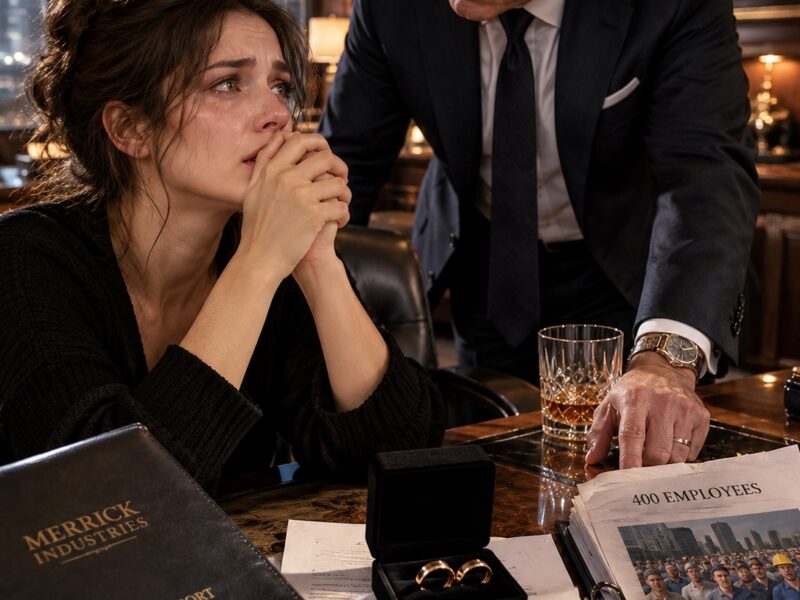
MY FATHER TRIED TO MARRY ME OFF TO SAVE HIS COMPANY—SO I MARRIED A STRANGER. THEN HE TOLD MY DAD HIS LAST NAME.

The first thing Sloan Merrick said to the man she was about to marry was, “Sorry.”
Not I love you.
Not Are we really doing this?
Not even Good morning.
Just—
“Sorry. A black SUV followed me for six blocks.”
Beck Holloway looked past her through the courthouse doors, toward the wet Manhattan street where taxis hissed over yesterday’s rain.
“Definitely your father’s.”
Sloan stared at him.
“You’re four minutes late.”
“You counted?”
“I had time.”
A laugh escaped her before she could stop it.
That was how Sloan Merrick knew she had officially lost her mind.
Twenty-four hours earlier, Beck Holloway had been a stranger sitting near her in a coffee shop.
Now he was standing beside her outside a county clerk’s office in a canvas jacket, dark jeans, and boots that looked as if they had actually touched dirt at some point in their existence.
In Sloan’s world, men wore Italian wool before breakfast.
They had drivers.
They had assistants who had assistants.
They didn’t stand under fluorescent courthouse lights holding two paper coffee cups and looking strangely calm about marrying women they barely knew.
Sloan glanced toward the entrance again.
“You think he’ll come in?”
“Your father?”
“Yes.”
“No.”
She turned to him. “You sound very sure.”
“He sent someone to follow you. If he wanted a confrontation, he’d be here himself.”
There was something about the way Beck said it that bothered her.
Not the words.
The certainty.
But before she could ask, a clerk opened the door and called their names.
“Merrick and Holloway?”
Sloan’s stomach dropped.
Beck offered her one of the coffees.
“You can still leave.”
She looked at the cup.
Then at him.
“Is that your version of romance?”
“It’s my version of informed consent.”
She took the coffee.
“Terrible proposal.”
“You accepted it.”
And ten minutes later, they were standing before a tired civil officiant whose expression suggested he had witnessed stranger decisions before lunch.
The woman adjusted her glasses and looked between them.
“I’m required to ask whether both of you are here of your own free will.”
“Yes,” Sloan said.
“Absolutely,” Beck said at exactly the same time.
The officiant raised one eyebrow.
“Nobody ever sounds that sure at eleven in the morning.”
Sloan almost laughed again.
Then Beck reached into his jacket.
Two rings landed softly on the desk.
Sloan stared at them.
“You bought rings?”
“You can’t get married without them.”
“We’re not really—”
She stopped.
Because apparently they were.
The officiant looked at Sloan as if she had seen this particular kind of panic before too.
“Ready?”
No.
Absolutely not.
Sloan thought of four hundred employees.
She thought of her father sitting behind his enormous walnut desk, looking ten years older than he had the week before.
She thought of the name he had spoken after avoiding it for twenty years.
Her mother.
Then she looked at Beck.
A stranger.
A man who had asked for nothing.
A man who had given her an exit when everyone else had offered her a cage.
“Yes,” she whispered.
The ceremony took less than four minutes.
There were no flowers.
No family.
No white dress.
No music.
No photographers waiting outside.
Just signatures, two inexpensive rings, and the absurd sound of an officiant saying:
“By the power vested in me by the State of New York, I now pronounce you married.”
Sloan stopped breathing for half a second.
Beck looked at her.
Not triumphantly.
Not possessively.
Almost carefully.
As though he understood exactly how terrifying freedom could feel when you had spent your entire life being told what it should look like.
“Sign here, please.”
Sloan signed.
Beck signed beneath her.
The officiant stamped the certificate.
“Congratulations, Mr. and Mrs. Holloway.”
Mrs. Holloway.
Sloan stared at the paper.
Yesterday she had been Sloan Merrick, daughter of Charles Merrick, heiress to Merrick Industries, the woman her father intended to trade into a corporate alliance.
Today she had married a stranger.
And she had no idea that the man beside her had lied about almost everything except his name.
Twenty-four hours earlier, Sloan had been halfway through restoring an 1894 landscape when her father called.
Not texted.
Called.
Charles Merrick never called during work hours unless someone was dead, hospitalized, or threatening litigation.
Sloan worked in a restoration studio in SoHo, where her days smelled of varnish, old canvas, solvents, and coffee that had usually gone cold before she remembered to drink it.
Her father hated the job.
Not because it paid poorly—it didn’t.
Not because Sloan lacked talent—she had spent years studying conservation and had become one of the youngest senior restorers at the firm.
Charles hated it because it had nothing to do with Merrick Industries.
Sloan had spent most of her adult life resisting the gravity of the family name.
That afternoon, gravity called.
“You said it was urgent,” she said when she entered her father’s office forty minutes later. “I left a restoration half done.”
Charles didn’t look up immediately.
That frightened her.
Her father had always believed silence was a tool best used against other people.
“Sit down.”
“I’ll stand.”
“Sloan.”
“Dad.”
Finally he raised his eyes.
And something in her chest tightened.
Charles Merrick was sixty-three years old and normally looked indestructible. Silver hair. Custom suits. A voice that could silence conference rooms without rising above conversational volume.
Today his tie was loose.
There were papers covering his desk.
A glass of bourbon sat near his right hand at three in the afternoon.
“Merrick Industries is in trouble,” he said.
Sloan frowned.
“What kind of trouble?”
“The kind we may not recover from.”
Her irritation disappeared.
Charles leaned back.
“Two banks called portions of our loans after the logistics division missed its projections. Two institutional investors pulled out last month. A restructuring deal collapsed Monday.”
Sloan stared at him.
“How long?”
He didn’t answer.
“How long have you known?”
“I’ve been covering payroll from my personal accounts for six weeks.”
“Six weeks?”
“Sloan—”
“Six weeks, Dad?”
He looked away.
“Why didn’t you tell me?”
“Because I didn’t want you looking at me the way you’re looking at me now.”
That answer hurt more than she expected.
She sat.
“How bad?”
Charles rubbed a hand over his mouth.
“We have four hundred employees.”
“I know.”
“Some have been with us thirty years. Some of their fathers worked for your grandfather.”
“Dad.”
“If we don’t secure capital by the end of the month, there is a very real possibility they lose everything.”
Sloan’s stomach twisted.
“Okay.”
Charles looked at her.
“Okay?”
“Then we find capital.”
“It’s not that simple.”
“I have savings. Not enough, obviously, but I can contribute. We can sell the Hamptons house. You can liquidate—”
“Sloan.”
“I can talk to people.”
“I already have.”
“Who?”
Charles hesitated.
That hesitation was the beginning of everything.
“Sinclair Group.”
Sloan went still.
“Sinclair?”
“Yes.”
“As in Harlan Sinclair?”
Charles nodded.
There were wealthy families in New York.
Then there were families like the Sinclairs.
Old money wrapped around new money, multiplied through shipping, infrastructure, commercial real estate, private equity, energy, and enough political relationships to make journalists careful about adjectives.
“They’ll fund the recovery?” Sloan asked.
“They’ll absorb the immediate debt exposure, refinance the vulnerable divisions, and provide operating capital.”
Her shoulders dropped with relief.
“Then what’s the problem?”
“They want a partnership.”
“Fine.”
“A family partnership.”
The room changed.
Sloan slowly lifted her eyes.
“What does that mean?”
Charles said nothing.
And then she knew.
“No.”
“Sloan.”
“No.”
“You haven’t heard—”
“I don’t need to.”
“They want you to marry Beckett Sinclair.”
For several seconds, Sloan heard nothing except the faint ticking of the antique clock behind her father’s desk.
Then she laughed.
Once.
Sharp and humorless.
“I’m sorry. What year is it?”
“Don’t be childish.”
“Childish?”
“It isn’t medieval.”
“You just told me four hundred jobs depend on me marrying a man I’ve never met.”
“It’s a merger with paperwork.”
“No, Dad. A merger is between companies. This is me.”
“He’s thirty-one. Princeton. Wharton. He’s intelligent.”
“Fantastic. Does the livestock auction include his résumé?”
“Sloan.”
“You want to sell me.”
“I am trying to save this company.”
“And apparently my uterus is part of the restructuring package.”
Charles slammed his palm against the desk.
“Enough.”
She stood.
“No. Not enough.”
“He isn’t some monster.”
“I wouldn’t know. I’ve never met him.”
“You will Friday.”
Sloan blinked.
“What?”
“Dinner.”
“You already arranged it?”
“The Sinclairs are coming here.”
“Without asking me?”
“I am asking you now.”
“No. You’re informing me.”
Charles exhaled slowly.
“This is bigger than your feelings.”
Sloan felt the sentence like a slap.
“My feelings.”
“Four hundred families—”
“Do not do that.”
“Do what?”
“Put them between us so I can’t say no without feeling like I fired them myself.”
Charles’s expression hardened.
“You were born into privilege because of this company.”
“I know.”
“Your education, your opportunities, your apartment—”
“My career is mine.”
“Built on a foundation this family gave you.”
“And that means you own the rest of my life?”
Charles stood too.
For a moment they faced each other across the desk like adversaries instead of father and daughter.
Then Charles said the one thing that changed the argument.
“Your mother understood what was at stake.”
Sloan froze.
“What did you say?”
Charles’s face changed.
Barely.
But Sloan saw it.
“I said your mother understood responsibility.”
“You said Mom.”
“Sloan—”
“You’ve said her name maybe twice in twenty years.”
“That’s an exaggeration.”
“No, it isn’t.”
Her mother, Evelyn Merrick, had died when Sloan was eleven.
Car accident.
That was the official story.
A rain-slick highway north of the city. A truck crossing the center line. Immediate death.
After the funeral, Charles had removed almost every photograph of her from the house.
He never discussed the accident.
Never discussed their marriage.
Never discussed anything that came before the silence.
“What does Mom have to do with Sinclair?” Sloan asked.
“Nothing.”
“You just brought her into this.”
“Figure of speech.”
“My father doesn’t use figures of speech.”
Charles turned toward the windows.
“Friday. Seven-thirty. Just meet them.”
Sloan watched his reflection in the glass.
“You’re not telling me something.”
“Good night, Sloan.”
“Dad.”
“Good night.”
She left with one certainty.
The company was in trouble.
And one question that frightened her far more.
Why had the name Sinclair made her father think of her dead mother?
Her best friend Tess called it what Sloan was still afraid to call it.
“So they want to trade you for a bailout.”
They were sitting in a small wine bar in the West Village three hours later.
Sloan stared into her glass.
“Basically.”
“Like a hockey player.”
“Tess.”
“Sorry.”
Tess leaned forward.
“Is he at least hot?”
“I have no idea what he looks like.”
“You didn’t Google him?”
“Of course I Googled him.”
“And?”
“Nothing useful. No interviews. No recent photographs. A few old business mentions. Apparently Beckett Sinclair avoids publicity like it’s contagious.”
Tess narrowed her eyes.
“That’s creepy.”
“Or smart.”
“Mostly creepy.”
Sloan smiled despite herself.
Then the smile disappeared.
“Four hundred people.”
Tess sighed.
“Sloan.”
“Some of them have worked there longer than I’ve been alive.”
“You didn’t cause the company’s debt.”
“I know.”
“You didn’t pull the investments.”
“I know.”
“You didn’t call the loans.”
“I know.”
“Then stop sentencing yourself for a crime you didn’t commit.”
Sloan looked down.
“If I say no and the company collapses, knowing I could have stopped it—”
“And if you say yes?”
Sloan looked at her.
Tess’s voice softened.
“You lose your life.”
Silence stretched between them.
Finally Sloan whispered, “He mentioned my mom.”
Tess frowned.
“What exactly did he say?”
“That she understood what was at stake.”
“Understood what?”
“He wouldn’t tell me.”
“Maybe he was being dramatic.”
“My father is never dramatic.”
Sloan looked toward the dark window.
“That’s why it scared me.”
The next morning, she was sitting alone in a café on Delancey Street when Charles called for the fifth time.
She answered only because she was tired of watching the screen light up.
“I said I’d think about it.”
“You’re avoiding the issue.”
“No, I am literally thinking.”
“Friday is two days away.”
“Dad.”
“The Sinclairs need confirmation.”
“I’m hanging up.”
“Sloan—”
She ended the call.
Then closed her eyes.
“That sounded productive.”
Sloan opened them.
The man sitting at the neighboring table had a paperback in one hand and coffee in the other.
Early thirties.
Dark hair that needed cutting.
Canvas jacket.
No watch she could see.
No polished Manhattan uniform.
He had the irritatingly relaxed posture of someone who had nowhere urgent to be.
“Sorry,” Sloan said. “Was I loud?”
“Not really. I just have good hearing.”
“Great. A stranger who eavesdrops.”
“You were on speakerphone.”
Sloan looked down.
Her phone was, in fact, still set to speaker.
“Oh my God.”
“It’s fine.”
“No, it’s humiliating.”
“I’ve heard worse.”
She studied him.
“So you heard everything?”
“Enough.”
“And?”
He took a sip of coffee.
“Your father wants you to marry someone you’ve never met.”
“That’s the abbreviated version.”
“You don’t want to.”
“Correct.”
“Then don’t.”
Sloan laughed.
“Wow.”
“What?”
“Nothing. It must be nice living in a universe where problems are that easy.”
“Most decisions are simple. Consequences are complicated.”
She stared at him.
“That sounds like something printed on an expensive motivational poster.”
“It probably is.”
“You don’t have four hundred employees depending on whether you say yes to a man in a suit.”
He looked at her for a moment.
Then at the paperback in his hand.
“You’re right.”
Sloan expected him to stop there.
Instead he said, “Then marry someone else.”
She blinked.
“What?”
“If being unmarried is what allows your father to trade you into the deal, remove that option.”
Sloan stared at him.
Then laughed.
Actually laughed.
“Sure. I’ll go find a husband.”
She glanced theatrically toward the window.
“Hold on. Let me check the sidewalk.”
He didn’t laugh.
Sloan’s smile faded.
“You’re serious.”
“You asked as a joke.”
“I absolutely did.”
“Sometimes the joke is the only honest thing someone says all day.”
She studied him again.
“Who are you?”
“Beck.”
“Beck what?”
“Holloway.”
“What do you do, Beck Holloway?”
“I manage investments.”
Sloan glanced at his canvas jacket.
“Of course you do.”
“What does that mean?”
“You manage investments dressed like you repair boats.”
“It’s comfortable.”
She shook her head.
“You’re weird.”
“I’ve been called worse.”
“You’re suggesting I marry a stranger to avoid marrying another stranger.”
“Yes.”
“That makes no sense.”
“One stranger was selected for you.”
“And the other?”
He met her eyes.
“You’d select yourself.”
Something inside Sloan went quiet.
Because that was the part everyone kept ignoring.
Choice.
Her father talked about duty.
The Sinclairs talked through contracts.
Tess talked about escape.
But this strange man with his cheap coffee and battered paperback had reduced the entire nightmare to the one thing Sloan had almost forgotten she possessed.
A choice.
“You don’t owe your father your life,” Beck said, “just because he built your family’s name.”
“That’s a dangerous thing to say to someone this stressed.”
“It’s still true.”
She studied him.
“Why would you do it?”
“I have my reasons.”
“That isn’t an answer.”
“It’s the only one I have right now.”
Sloan should have stood.
She should have thanked him for the bizarre conversation and returned to her life.
Instead she asked:
“Would you actually do it?”
For the first time, Beck stopped looking casual.
He closed his book.
“If you understand what you’re asking.”
“I don’t.”
“Then understand it before tomorrow.”
“Tomorrow?”
“Courthouse on Delancey. Ten-thirty.”
Her pulse jumped.
“You’re insane.”
“Possibly.”
“You don’t know me.”
“You don’t know Sinclair.”
“That’s your argument?”
“No.”
He stood.
“My argument is that you deserve to decide which mistake belongs to you.”
Then he put a few dollars beneath his coffee cup.
“If you’re not there, I’ll understand.”
He walked toward the door.
Sloan called after him.
“Beck.”
He turned.
“You can still say no,” he said.
Then he disappeared into the Manhattan morning.
Tess reacted exactly as expected.
“You are not getting married to a guy named Beck.”
“Holloway.”
“That makes it worse. Beck Holloway sounds like a country singer who owns a boat.”
“He seemed kind.”
“Serial killers seem kind.”
“That feels statistically unsupported.”
“Sloan.”
“He didn’t ask for money.”
“That’s suspicious.”
“He didn’t try to impress me.”
“More suspicious. Everybody tries to impress you.”
Sloan sat cross-legged on Tess’s sofa.
“If I marry him, I’m out.”
“Out of what?”
“The Sinclair deal.”
“And into a marriage with a stranger.”
“A marriage I chose.”
Tess stared at her.
“Run away to Portugal.”
“With what money?”
“You have money.”
“Not enough to save Merrick.”
“Stop.”
Tess sat beside her.
“You are not responsible for four hundred people.”
“I know.”
“Do you?”
Sloan stared at the simple card Beck had written his number on.
“I’m responsible for what I say yes to.”
Tess closed her eyes.
“Oh God.”
“What?”
“You’ve already decided.”
Sloan didn’t answer.
“I think you decided in the café.”
Still nothing.
Tess pointed at her.
“If he gets weird, you text me one word.”
“What word?”
“Flamingo.”
“Why flamingo?”
“Because nobody says flamingo by accident.”
And so, at 10:34 the next morning, Sloan Merrick ran into the courthouse four minutes late after a black SUV followed her for six blocks.
She married Beck Holloway at eleven.
At 11:23, she walked out wearing a plain silver band.
At 11:31, her father called for the fourteenth time.
She ignored him.
At 11:42, Beck asked, “Where are we going?”
Sloan looked at the marriage certificate in her hand.
“You tell me.”
“It’s your father.”
“He’s going to have a stroke.”
“He’ll survive.”
“You don’t know my father.”
Beck looked through the windshield.
“I know enough.”
Sloan turned toward him.
“What does that mean?”
His jaw tightened almost imperceptibly.
“Nothing.”
It was the first lie she caught.
It would not be the last.
Charles was waiting when they arrived.
He didn’t invite Beck to sit.
He barely acknowledged Sloan.
“I have called you fourteen times.”
“I know.”
“You know?”
“I counted.”
Charles looked past her.
“Who is this?”
Sloan’s heartbeat thundered.
There were moments when a person could feel their old life closing behind them.
This was one.
She lifted her left hand.
The ring caught the light.
“This is Beck.”
Charles looked at the ring.
Then at Sloan.
Then at Beck.
“My husband.”
Silence.
Charles’s face emptied.
“You’re joking.”
“I’m not.”
“You married him?”
“This morning.”
“You met him when?”
“Yesterday.”
Charles actually staggered half a step backward.
Then anger flooded in.
“What do you do, Mr.—?”
“Holloway,” Beck said.
Charles looked him over.
Canvas jacket.
Plain boots.
No visible status.
“I manage investments.”
Charles gave a cold laugh.
“Holloway. I see.”
Sloan’s eyes narrowed.
“What does that mean?”
“Nothing.”
Charles looked at Beck.
“With whose money?”
Beck’s expression didn’t change.
“Mostly other people’s.”
Charles glanced at the jacket.
“Confident profession for a ten-dollar coat.”
“It’s comfortable.”
Sloan nearly smiled.
Charles did not.
“You’ve ruined this family.”
“No, Dad.”
Her voice was quiet.
“You were about to sell it.”
“I was trying to save four hundred jobs.”
“By putting a price on me.”
“How much did she pay you?” Charles demanded.
Beck frowned.
“Nothing.”
“No one marries for nothing.”
“Some people do.”
The answer seemed to disturb Charles more than an insult would have.
His phone rang.
He looked at the screen.
And the color drained from his face.
Sloan saw the caller ID.
SINCLAIR EXECUTIVE OFFICE.
Charles looked at her.
“They’re expecting you Friday.”
“Tell them I’m married.”
“You have no idea what you’ve done.”
“What danger have I put us in?”
Charles’s eyes flashed.
Then he made a mistake.
He said, “You don’t understand the danger.”
Sloan went still.
“What danger?”
“Financial.”
“That isn’t what you meant.”
Charles looked away.
Sloan’s skin prickled.
“Dad.”
Nothing.
She turned toward Beck.
And something even stranger happened.
Her father was staring at him.
Not with contempt anymore.
With concentration.
“Holloway,” Charles said.
Beck said nothing.
“First name Beck.”
“Yes.”
“Short for something?”
“Just Beck.”
Charles’s expression tightened.
“I want him out of my house.”
“He’s my husband.”
“Sloan.”
“He goes where I go.”
Charles looked between them.
Then, for one strange second, Sloan saw something she had never expected to see in her father’s face.
Fear.
Outside, Sloan released a breath.
“Well.”
Beck glanced at her.
“That went badly.”
“Better than expected.”
She turned.
“What exactly did you expect?”
He opened the passenger door.
“A vase.”
Sloan stared at him.
Then she laughed.
A real laugh this time.
“You’re funny.”
He seemed surprised by that.
“I didn’t know.”
“Neither did I.”
For three days, married life consisted mostly of avoidance.
Sloan stayed in her apartment.
Beck stayed somewhere he refused to describe beyond “downtown.”
They texted like two people organizing a mildly inconvenient business trip.
Alive?
Yes.
Father?
Still furious.
Flamingo?
Sloan stared at that one.
How do you know about flamingo?
Three dots appeared.
Disappeared.
Appeared again.
Tess threatened me.
That answer should have reassured her.
It didn’t.
Because Tess had never met Beck.
Sloan called immediately.
“Where are you?”
“Working.”
“Where?”
“Office.”
“Which office?”
Pause.
“Investment office.”
“Beck.”
“Sloan.”
“How do you know Tess’s emergency word?”
Another pause.
“She called.”
“How did she get your number?”
“You put it on the marriage paperwork.”
“No, I didn’t.”
Silence.
Sloan sat up.
“Beck?”
“I’ll explain tonight.”
“Explain now.”
“I can’t.”
“Can’t or won’t?”
“Both.”
The call ended thirty seconds later with Sloan furious enough to throw her phone.
She didn’t.
Instead she opened her laptop.
Beck Holloway.
Nothing.
LinkedIn produced several unrelated men.
Corporate registries produced a consulting company dissolved six years earlier.
Property records produced no Manhattan apartment.
No press.
No board memberships.
No visible career.
It was almost impossible for a thirty-one-year-old investment manager in New York to leave no digital footprint.
Unless he had deliberately erased it.
Her phone rang.
Charles.
She almost ignored it.
Then she remembered the fear on his face.
“Hello?”
“Come to the house.”
“No.”
“Sloan.”
“Tell me why.”
There was a pause.
Then Charles said, “It’s about your mother.”
Sloan was in a cab three minutes later.
Her father was waiting in the library.
On the table sat a wooden box Sloan recognized immediately.
Her mother’s.
She had not seen it since she was eleven.
Sloan stopped in the doorway.
“Where did you get that?”
“It’s been in the safe.”
“For twenty years?”
Charles nodded.
Anger rose so quickly she almost couldn’t speak.
“You told me her things were gone.”
“I told you I couldn’t keep them around.”
“That is not the same thing.”
“No.”
“What’s inside?”
Charles sat.
“Before you open it, I need you to understand something.”
“Stop deciding what I need.”
He flinched.
Sloan opened the box.
Photographs.
Letters.
A pearl hairpin.
A faded theater ticket.
A dried white rose.
And beneath everything else, an envelope.
On the front, in her mother’s handwriting:
For Sloan, when the Sinclairs come back.
Her knees weakened.
She looked at Charles.
“When they come back?”
Charles closed his eyes.
“Your mother knew Harlan Sinclair.”
“How?”
“They grew up together.”
Sloan stared.
“You told me Mom grew up in Connecticut.”
“She did.”
“With grandparents.”
“For part of it.”
“Dad.”
Charles rubbed his hands together.
“Evelyn’s father worked for Sinclair Holdings.”
“Doing what?”
“He was Harlan’s closest adviser.”
Sloan slowly sat.
“And?”
“There was an agreement.”
The word made her stomach turn.
“What agreement?”
Charles looked at the envelope.
“Open it.”
Sloan tore the paper.
Inside was a letter dated three months before her mother died.
My darling Sloan,
If you are reading this, then something I hoped would disappear has found you instead.
Her hands began shaking.
The letter described two families.
A debt.
An investment that had saved Merrick Industries decades earlier.
And a promise made between men who believed family loyalty could be inherited like property.
Sloan stopped reading.
“No.”
Charles said nothing.
“She knew?”
“Yes.”
“She knew someone might try to arrange my marriage?”
“Yes.”
“And you let me believe yesterday was the first time?”
“I hoped it would never happen.”
Sloan stood.
“You hoped?”
“I spent twenty years keeping distance from Sinclair.”
“Why?”
Charles’s face collapsed into something older than exhaustion.
“Because your mother died trying to get out of that agreement.”
The room seemed to tilt.
Sloan stared at him.
“The accident.”
“It was an accident.”
“But?”
Charles looked away.
“But she had been driving to meet Harlan Sinclair.”
Sloan’s throat tightened.
“Why?”
“To end it permanently.”
“And did she?”
“She never arrived.”
Silence.
Sloan folded the letter with trembling fingers.
“Does Harlan know about this?”
“Yes.”
“And Beckett?”
“I don’t know.”
Sloan’s phone buzzed.
BECK.
She stared at the name.
Then at her father.
Charles noticed.
“Where did you meet that man?”
“A café.”
“What café?”
“Why?”
“Answer me.”
“Delancey.”
Charles stood so quickly his chair scraped backward.
“What?”
“What is wrong with Delancey?”
He walked toward the window.
“Sloan, you need to annul the marriage.”
She laughed in disbelief.
“Now you care who I marry?”
“I’m serious.”
“So am I.”
“You don’t know him.”
“Neither did you.”
“I know enough.”
The phrase stopped her.
Beck had said exactly the same thing.
Her father turned.
“What?”
“Nothing.”
But Sloan already knew it wasn’t nothing.
That evening, she followed Beck.
She hated herself for doing it.
She hated him more for making it necessary.
He left a small office building near Canal Street at six-fifteen.
No suit.
Same canvas jacket.
He walked three blocks.
Then a black sedan pulled to the curb.
Not a rideshare.
A Maybach.
The driver got out.
Opened the rear door.
And called him:
“Mr. Sinclair.”
Sloan stopped breathing.
Beck turned.
For one terrible second, their eyes met across the sidewalk.
He knew immediately.
“Sloan.”
She stepped backward.
“No.”
He crossed toward her.
“Let me explain.”
“No.”
“Sloan.”
“You’re him.”
Traffic moved between them.
A horn blared.
Rain began tapping against the pavement.
“Beckett Sinclair.”
He didn’t deny it.
Sloan felt something inside her break.
“You knew.”
“Yes.”
“You knew who I was in that café.”
“Yes.”
“You knew what my father wanted.”
“Yes.”
Every answer was quiet.
Every answer hurt worse.
“You sat there while I told you I didn’t want to marry Beckett Sinclair.”
“I know.”
“You offered to marry me.”
“Yes.”
“And then you married me under another name.”
“Holloway is legally mine.”
“What does that even mean?”
“My mother’s surname.”
Sloan laughed, but there was no humor in it.
“Oh, fantastic. So technically you didn’t lie.”
“I lied.”
That stopped her.
He stepped closer.
“I lied to you.”
“Why?”
“Because if I told you who I was, you would have walked away.”
“You’re damn right I would have.”
“I know.”
“So you took away my choice.”
His face changed.
That landed.
“You stood in that café telling me I deserved to choose.”
“You did.”
“Then you manipulated the choice.”
“Yes.”
She slapped him.
The sound cracked through the rain.
Beck didn’t move.
Sloan’s hand burned.
She hated that she was crying.
“I trusted you because you were the only person who didn’t seem to want something from me.”
“I know.”
“What did you want?”
His answer came almost too softly to hear.
“To stop my father.”
Sloan stared at him.
“What?”
“The arranged marriage wasn’t my idea.”
“You expect me to believe that?”
“No. I expect you to decide after you hear everything.”
“I’m done hearing things from men who decide what information I can handle.”
She turned.
Beck caught her wrist, then released it immediately.
“Sloan.”
She looked back.
“My father didn’t offer to save Merrick Industries because he needs your company.”
“Then why?”
“Because he wanted access.”
“To what?”
Beck looked at her.
“To you.”
A cold sensation crawled down her spine.
“Why?”
“I don’t know the whole answer.”
“You expect me to believe that too?”
“My father has spent twenty years refusing to talk about your mother.”
Sloan froze.
Beck continued.
“Three months ago, he started asking questions about you.”
“What questions?”
“Where you worked. Whether you were seeing anyone. Whether you planned to join Merrick Industries.”
“Why?”
“I asked him.”
“And?”
“He told me our families had unfinished business.”
Rain ran down Sloan’s face.
Beck reached into his coat.
Slowly.
He removed an envelope.
Old.
Yellowed at the edges.
Sloan recognized the handwriting before he handed it over.
Her mother’s.
“How do you have this?”
“My mother gave it to me when I turned twenty-one.”
Sloan stared at the envelope.
On the front were five words.
For Beckett, if Sloan returns.
Her knees nearly buckled.
“What the hell does that mean?”
“I’ve been trying to find out for ten years.”
The story Sloan thought she understood shattered completely.
Beck’s mother, Margaret Holloway Sinclair, had known Evelyn Merrick.
Not casually.
They had been friends.
The two women had spent years quietly trying to sever the financial agreements binding their families together.
Harlan Sinclair and Charles Merrick had inherited more than companies.
They had inherited a structure of debts, voting rights, trusts, and dormant contracts built by their fathers.
The proposed marriage was supposed to consolidate those interests permanently.
But Evelyn had discovered something.
Something important enough that she had planned to meet Harlan the night she died.
“What?” Sloan asked.
Beck shook his head.
“I don’t know.”
“You keep saying that.”
“Because it’s true.”
“You manage Sinclair investments.”
“I manage a private fund independent from my father.”
“You’re his heir.”
“Legally.”
“Meaning?”
“Meaning I haven’t worked for Sinclair Group in four years.”
“Why?”
“Because my father and I don’t agree on what people are allowed to own.”
Sloan stared at him.
“Companies?”
“People.”
That silenced her.
Beck looked toward the street.
“When I heard about the marriage proposal, I refused.”
“When?”
“Three weeks ago.”
Sloan’s anger sharpened.
“Three weeks?”
“Yes.”
“My father told me two days ago.”
“I know.”
“How?”
“Because my father told him to wait until the financial pressure was severe enough.”
The cruelty of it took a moment to register.
“You’re saying Sinclair engineered this?”
“Not the original debt. Merrick was already vulnerable.”
“But?”
“My father bought part of the distressed debt through intermediaries.”
Sloan felt sick.
“He tightened the noose.”
“Yes.”
“To force me into marriage.”
“Yes.”
“And you knew?”
“I found out four days before the café.”
“Why didn’t you tell me?”
“Because I needed proof.”
“And marrying me was part of that proof?”
“No.”
“Then what was it?”
Beck looked directly at her.
“The one thing my father couldn’t control.”
Sloan laughed bitterly.
“You?”
“No.”
He glanced at the ring on her finger.
“Us.”
The following morning, Harlan Sinclair requested a meeting.
Not at his office.
At Merrick Industries.
Charles nearly refused.
Sloan accepted for him.
At 10:00 a.m., three black vehicles stopped outside the building.
Harlan Sinclair entered with two attorneys and a chief financial officer.
He was seventy, silver-haired, elegant, and frighteningly calm.
He looked at Sloan first.
Then Beck.
“My son.”
Beck’s expression hardened.
“Harlan.”
Charles whispered, “Son?”
Sloan looked at her father.
“You didn’t know?”
Charles went pale.
“No.”
For the first time, Sloan believed him.
Harlan smiled faintly.
“I see introductions have become unnecessarily complicated.”
Sloan stood.
“You offered to save this company if I married your son.”
“Yes.”
“I married him.”
Harlan’s smile disappeared.
“Not according to the intended agreement.”
“You wanted Beckett Sinclair.”
“I did.”
She pointed toward Beck.
“There he is.”
Silence.
Charles looked between them as if reality had abandoned him.
“You’re Beckett Sinclair?”
Beck nodded.
Charles sat down.
Harlan’s attorneys whispered to each other.
Sloan felt the balance of power shift.
Not completely.
But enough.
Harlan looked at Beck.
“You thought this was clever.”
“No.”
“Then what?”
“Necessary.”
“You’ve jeopardized billions in structured holdings because you wanted to make a point.”
“No.”
Beck stepped forward.
“I protected my wife from being used as consideration in a financial transaction.”
The word wife hit Sloan differently this time.
Not romantically.
But not falsely either.
Harlan looked at her.
“Your mother was more practical.”
Sloan’s blood went cold.
“Don’t.”
Harlan paused.
“Don’t talk about my mother like you knew what she wanted.”
“I knew her extremely well.”
Charles stood.
“That’s enough.”
Harlan looked at him.
“You’ve spent twenty years hiding from what happened.”
“And you’ve spent twenty years pretending you didn’t cause it.”
The room went silent.
Sloan looked at her father.
“What?”
Charles’s jaw tightened.
Harlan’s calm finally cracked.
“Careful.”
“No,” Sloan said.
Both men looked at her.
“No more careful.”
She took her mother’s letter from her bag and placed it on the table.
“Twenty years of careful is enough.”
Then Beck placed his letter beside hers.
Two envelopes.
Two dead women.
One secret.
And four hundred employees whose futures had somehow become collateral in a war that began before Sloan was old enough to understand the word inheritance.
“Tell us everything,” she said.
Charles looked at Harlan.
Harlan looked at Beck.
Then at Sloan.
Finally, Charles sat.
“Your mother wasn’t driving to meet Harlan the night she died.”
Sloan stopped breathing.
“You told me she was.”
“I lied.”
“Why?”
“Because the truth was worse.”
Charles opened the old wooden box.
From beneath the photographs, he removed a sealed document.
“She was driving to the attorney general’s office.”
Harlan closed his eyes.
Beck went still.
Sloan whispered, “Why?”
Charles slid the document across the table.
It was a photocopy of an internal agreement.
Signatures.
Shell companies.
Transfer schedules.
A decades-old structure designed to conceal ownership stakes between Merrick and Sinclair.
Evelyn had discovered that the previous generation had used family trusts to move liabilities between companies and hide losses from investors.
If exposed at the time, both empires could have collapsed.
“She wanted to disclose it,” Charles said.
“And you stopped her?”
“No.”
“Did Harlan?”
Harlan answered himself.
“I tried.”
Sloan looked at him.
“You threatened her?”
“I argued with her.”
“Did you threaten her?”
Silence.
“Yes.”
Beck’s expression darkened.
Harlan looked at his son.
“I was thirty-nine years old. Thousands of employees depended on us.”
“So you threatened a woman with a child.”
“I told her disclosure would destroy both families.”
Charles laughed bitterly.
“You told her you would take Sloan.”
Sloan turned.
“What?”
Charles’s eyes filled with something she had never seen there before.
Shame.
“Harlan threatened a custody action if Evelyn exposed the structure. He had documents suggesting Merrick money had been used improperly. He said if we were prosecuted, you’d have no parents left to raise you.”
Sloan stared at Harlan.
“You used me.”
Harlan said nothing.
“And now you tried to use me again.”
“I tried to repair what our families damaged.”
“By forcing me to marry your son?”
“By joining what should never have been divided.”
Sloan almost laughed.
“You still don’t understand.”
She removed her wedding ring.
Beck’s face changed.
She held it between two fingers.
“You all think this is about who owns what.”
She looked at Charles.
“A company.”
At Harlan.
“A legacy.”
At Beck.
“A decision.”
Then she slipped the ring back onto her finger.
“But I’m not an asset.”
Harlan’s expression hardened.
“Merrick Industries will collapse without our financing.”
Beck finally spoke.
“No, it won’t.”
Everyone turned.
Harlan stared at his son.
Beck placed a folder on the table.
Sloan looked at him.
“What is that?”
“The reason I’ve been busy.”
Inside were commitments from three institutional investors.
A restructuring plan.
A bridge facility.
Debt purchases.
Charles began reading.
His hands started trembling.
“This is…”
“Enough capital to stabilize payroll, refinance the called loans, and give Merrick twelve months to restructure.”
Harlan’s face went still.
Charles looked up.
“Who funded this?”
Beck met his father’s eyes.
“My fund.”
Harlan whispered, “You wouldn’t.”
“I already did.”
Sloan stared at Beck.
“How much?”
“Enough.”
“Beck.”
“One hundred and eighty million committed. Ninety-two immediately accessible.”
Charles sank into his chair.
Harlan looked at his son with something colder than anger.
“You would put that much capital at risk for her?”
Beck’s answer came without hesitation.
“No.”
Sloan felt a strange sting.
Then Beck continued.
“I put it at risk because Merrick employs four hundred people, owns viable assets, and can recover if it stops being managed around one family’s pride.”
Charles looked offended.
Beck shrugged.
“And because of her.”
Sloan almost smiled.
Almost.
Harlan didn’t.
“You think this makes you independent?”
“No.”
“You think she chose you?”
Beck looked at Sloan.
“No.”
That surprised everyone.
He continued quietly.
“She chose a man she thought was Beck Holloway.”
Sloan’s throat tightened.
“That man existed,” Beck said. “But I didn’t give her the whole truth.”
He removed his wedding ring.
Placed it on the table.
Sloan stared at it.
“If she wants an annulment, I’ll sign today.”
Harlan smiled.
There it was.
Victory.
But Beck wasn’t looking at his father.
He was looking only at Sloan.
“No conditions. No contracts. No financial consequences. Merrick keeps the financing whether she stays married to me or not.”
Sloan blinked.
“You’d still fund it?”
“Yes.”
“Why?”
“Because otherwise it isn’t a choice.”
Those words returned them to the café.
A paperback.
A coffee.
A stranger telling her that most decisions were simple and consequences complicated.
Sloan looked at the ring on the table.
Then at Beck.
“You lied to me.”
“Yes.”
“You manipulated me.”
“Yes.”
“You knew exactly who I was.”
“Yes.”
“And you let me stand in a courthouse believing I had escaped Beckett Sinclair.”
Pain flickered across his face.
“Yes.”
She swallowed.
“I don’t forgive you.”
“I know.”
Harlan stood.
“This is absurd.”
Sloan turned.
“No. What you did was absurd.”
“You don’t understand the world you’re entering.”
“I’m not entering yours.”
“You already belong to it.”
That sentence finally clarified everything.
Sloan looked at Harlan Sinclair and saw a man who had spent his entire life confusing possession with responsibility.
“No,” she said.
“I was born near it.”
She looked at her father.
“I was raised inside it.”
Then at Beck.
“And yesterday I almost repeated it.”
She picked up Beck’s ring.
For one second, he looked hopeful.
Sloan placed it in his palm.
“But I get to decide whether I stay.”
His fingers closed around it.
“Yes.”
She left the room alone.
Merrick Industries survived.
Not cleanly.
There were layoffs, but not four hundred.
Charles stepped down as chief executive six months later after the board approved an independent restructuring committee.
For the first time in decades, Merrick Industries was run by people whose surnames did not appear on the building.
Harlan Sinclair contested Beck’s fund arrangements.
He lost.
Then he tried to remove Beck from several family trusts.
That fight lasted longer.
Beck didn’t seem particularly bothered.
Sloan returned to restoration.
For months, she saw Beck only when lawyers required signatures.
He never asked her to come back.
Never sent flowers.
Never appeared unexpectedly outside her studio.
He respected the distance she demanded.
That, more than anything, made her miss him.
Nine months after their courthouse wedding, Sloan was restoring a nineteenth-century portrait when someone placed a coffee beside her elbow.
She looked up.
Canvas jacket.
Dark hair.
Paperback.
Beck.
“You’re not allowed back here,” she said.
“I checked.”
“With whom?”
“Reception.”
“They betrayed me.”
“Apparently.”
She looked at the coffee.
“What do you want?”
“Nothing.”
“Dangerous answer.”
“I’ve learned.”
She tried not to smile.
Failed slightly.
He noticed.
Said nothing.
“How’s your father?” she asked.
“Still rich.”
“Tragic.”
“How’s yours?”
“Learning hobbies.”
“That sounds more dangerous.”
“He bought a fishing rod.”
“God help the fish.”
Sloan laughed.
Then silence settled.
Not uncomfortable.
Just unfinished.
Beck looked at the painting.
“You fixed her.”
Sloan followed his gaze.
The portrait had arrived almost destroyed.
Smoke damage.
Cracked varnish.
A tear running directly through the woman’s face.
Now the features were visible again.
Not perfect.
Never perfect.
But whole enough to be seen.
“I didn’t fix her,” Sloan said.
“No?”
“I removed what didn’t belong. Stabilized what was still there.”
Beck nodded.
“That sounds harder.”
“It is.”
Another silence.
Then Sloan asked, “Why were you really at that café?”
Beck looked at her.
She had wondered for nine months.
He knew it.
“My father told me where you worked.”
“That isn’t what I asked.”
“No.”
“Were you following me?”
“Yes.”
She appreciated that he didn’t soften it.
“For how long?”
“Three days.”
“That’s creepy.”
“Very.”
“Why?”
“I wanted to see who you were before I decided how to stop the marriage arrangement.”
“And what did you see?”
“A woman who spent twenty minutes repairing the torn cover of a stranger’s book because he looked upset about it.”
Sloan frowned.
“The old man?”
Beck nodded.
“You were there?”
“Across the street.”
“That was you?”
“Yes.”
“You bought coffee three days in a row just to watch me?”
“The coffee was terrible.”
“That makes it worse.”
“I know.”
She looked at him for a long time.
“Why didn’t you just approach me and tell me everything?”
“Because I thought you’d see Sinclair before you saw me.”
“I would have.”
“Yes.”
“And instead you made sure I saw you before Sinclair.”
“Yes.”
“That was selfish.”
“Yes.”
“Manipulative.”
“Yes.”
“Dishonest.”
“Yes.”
She narrowed her eyes.
“You agreeing with everything is annoying.”
“I can disagree if it helps.”
“It doesn’t.”
He smiled.
And suddenly Sloan remembered why she had trusted him in the first place.
Not because he had seemed harmless.
He wasn’t.
Not because he had been honest.
He hadn’t been.
She trusted something quieter.
The version of Beck who wore the canvas jacket because it was comfortable.
Who made jokes when rooms became unbearable.
Who had eventually put a $180 million commitment on a table and then given her permission to walk away from him without taking one dollar back.
That didn’t erase the lie.
Nothing should.
But perhaps people were not paintings.
You couldn’t restore them to some imaginary original state.
Sometimes you simply decided whether what remained was worth preserving.
Sloan removed her gloves.
“Are we still married?”
Beck blinked.
“What?”
“Legally.”
“Yes.”
“The lawyers never finalized the annulment?”
“You asked them to pause.”
“I know.”
“I assumed you had reasons.”
“I did.”
He waited.
She hated that he had become good at waiting.
“Dinner,” Sloan said.
His expression changed.
“Dinner?”
“One dinner.”
“With me?”
“No, Beck, with your father.”
He laughed.
She pointed at him.
“This is not reconciliation.”
“Understood.”
“It’s not forgiveness.”
“Understood.”
“And if you lie to me again—”
“Flamingo?”
Sloan stared at him.
“You still remember that?”
“I remember almost everything you say.”
That was unfairly effective.
She grabbed her coat.
“Come on.”
“Where?”
“You tell me.”
Beck looked at her.
The same words she had spoken outside the courthouse.
This time, however, neither of them was running from anyone.
He picked up his jacket.
They walked out together.
A year later, Sloan finally asked Charles the question she had been afraid to ask since discovering the letters.
“Did Mom know she was going to die?”
They were sitting on the porch of the small house Charles had bought in Connecticut after stepping away from Merrick.
He looked older without the suits.
Softer too.
“No.”
“Was her death really an accident?”
Charles stared at the trees.
Sloan waited.
“Yes.”
She watched him carefully.
“You’re sure?”
“The police reinvestigated after you found the documents. Beck hired independent investigators too.”
“And?”
“Black ice. A truck driver who had been working too long. No Sinclair conspiracy. No Merrick conspiracy.”
Sloan exhaled.
Strangely, the truth hurt.
Because accidents offered no villain.
No one to punish.
No satisfying explanation for why an eleven-year-old girl had lost her mother.
“She died trying to do the right thing,” Sloan said.
“Yes.”
Charles looked at his hands.
“And I spent twenty years doing the wrong thing because I was terrified of losing what she died trying to protect.”
Sloan looked at him.
“Me?”
He shook his head.
“Your freedom.”
That was the closest Charles Merrick ever came to asking forgiveness.
Sloan did not give it immediately.
Some wounds deserved time.
But she reached across the space between them and took his hand.
Months later, she and Beck returned to the courthouse on Delancey.
Same hallway.
Same ugly fluorescent lights.
Different reason.
The officiant from their first wedding was still there.
She recognized them after a few seconds.
“Oh.”
Sloan smiled.
“Oh?”
The woman pointed.
“You two.”
Beck looked concerned.
“Is that good?”
“You’re the investment guy and the runaway heiress.”
Sloan groaned.
“I was hoping we were forgettable.”
“You were married in under four minutes. Nobody that nervous signs that fast.”
Beck laughed.
The officiant adjusted her glasses.
“So what are we doing today? Divorce paperwork?”
“No,” Sloan said.
Beck looked at her.
She reached into her bag.
Two rings.
The first ones had been cheap silver bands purchased from a jeweler two blocks away.
She had kept hers.
So had Beck.
“We’re getting married,” Sloan said.
The officiant stared at their existing marriage certificate.
“You’re already married.”
“Technically.”
“Very technically.”
Sloan looked at Beck.
“The first time, I was running away from something.”
His expression softened.
“And now?”
“Now I know exactly who I’m standing beside.”
She handed him the ring.
“Beckett Holloway Sinclair.”
He winced.
“That’s a lot of name.”
“You deserve every syllable today.”
He slipped the silver band onto her finger.
“And you?”
“Sloan Merrick.”
“Not Holloway?”
She smiled.
“Don’t push it.”
The officiant laughed.
Then she asked the same question she had asked more than a year earlier.
“Are both of you here of your own free will?”
This time Sloan didn’t answer quickly.
She looked at Beck.
At the man who had first entered her life as an escape.
At the man who had lied.
At the man who had eventually handed every choice back to her, even when the choice might destroy him.
She thought about her mother driving through a winter night because she believed her daughter deserved a future that could not be negotiated by men in boardrooms.
She thought about Charles learning too late that protecting someone by controlling them was only another form of fear.
She thought about four hundred employees who had almost become bargaining chips.
About Harlan Sinclair, still surrounded by wealth and increasingly alone.
About an old damaged portrait beneath layers of varnish.
About restoration.
Not returning something to what it had been.
Making it strong enough to survive what had happened to it.
The officiant waited.
Sloan smiled.
“Yes.”
Then she looked at Beck.
He smiled back.
“Absolutely.”
The officiant raised one eyebrow.
“Nobody ever sounds that sure before noon.”
Sloan laughed.
This time, there was no black SUV outside.
No father calling fourteen times.
No corporation waiting to learn whether she had agreed to become part of a deal.
No one was being rescued.
No one was being purchased.
No one was being exchanged.
Two people simply walked out of a courthouse into the noise of New York City, wearing the same cheap rings they had worn when they barely knew each other.
Beck reached for Sloan’s hand.
She let him take it.
“What now?” he asked.
Sloan looked down the crowded street.
For most of her life, someone had always had an answer ready for her.
Her father.
Her family.
A boardroom.
A contract.
A dead agreement between people who believed the future could be signed away before the people living it were old enough to object.
But there was no contract now.
No map.
No arrangement.
Sloan squeezed Beck’s hand.
“I don’t know.”
He smiled.
“Good.”
They started walking.
And for the first time in her life, Sloan Merrick discovered that not knowing what came next didn’t feel like losing control.
It felt like freedom.









