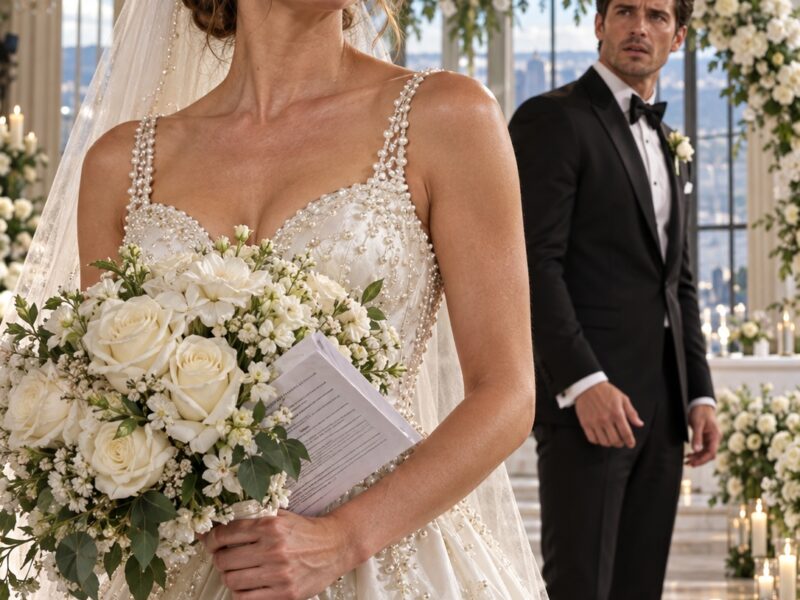
MY FIANCÉ CARRIED HIS EX DOWN MY AISLE—THEN I LEARNED WHAT HE HID UNDER MY BOUQUET
The church doors opened twelve minutes before I was supposed to become Colin Ashford’s wife, and my fiancé walked in carrying another woman.
Not helping her. Not guiding her.
Carrying her.
Serena Voss had one arm wrapped around Colin’s neck, her cheek resting against the shoulder of his black tuxedo as if she belonged there. One ivory satin shoe dangled from her fingers. A pearl-edged veil was pinned into her dark hair, and the dress she wore was pale enough that half the room mistook her for a second bride before the whispers started.
Colin looked directly at me over Serena’s shoulder.
“Grace,” he said, with two hundred guests watching, “don’t make this harder than it already is. She’s hurt.”
That was the first moment I understood that a wedding could become a courtroom before a single vow was spoken.
The string quartet kept playing.
Nobody had told them what humiliation sounded like.
The first violinist’s bow trembled almost imperceptibly as Colin carried Serena down the aisle I had spent six months planning. White roses lined every pew. Glass lanterns glowed beneath the clear windows of Westlake Chapel. My father’s photograph stood beside the guest book, his expression stern and amused, as if death had not prevented him from noticing when somebody entered a room with bad intentions.
My father would have hated what Colin had just done.
Henry Whitlock had chosen Westlake Chapel years earlier for one reason: the windows weren’t stained glass.
“Truth shouldn’t need colored light,” he used to say.
When I was a child, I thought it was something fathers said because they enjoyed sounding wise. Later, after watching him build Whitlock Harbor Development from three leased construction trailers into one of the most powerful privately held development companies on the East Coast, I understood he meant every word.
My father had been dead for three years.
For two of those years, Colin had been patient.
That morning, as my maid of honor fastened the last pearl button down the back of my wedding gown, I had still believed patience was proof of love.
Colin had sat beside me through probate hearings. He had held my hand while lawsuits froze development projects my father had started but never lived to finish. He had spent long nights reassuring my mother when lenders began calling. His family had money, connections, banks, lawyers, old relationships with city officials.
The Ashfords understood pressure.
At least, that was what Colin had always told me.
What he had not told me was that his first love planned to arrive at our wedding wearing ivory.
Colin lowered Serena into the front pew beside the altar with absurd tenderness.
Her ankle was wrapped in clean white gauze. Mascara formed two delicate black trails beneath her eyes. She looked devastated in exactly the way beautiful women in expensive photographs always seemed to look devastated—carefully enough that somebody might still admire them.
“I’m so sorry, Grace,” she whispered.
She whispered loudly enough for the first three rows to hear.
“I only wanted to bless you both.”
My mother went rigid beside me.
My uncle Martin leaned close. “Ignore her. Walk.”
I looked at Colin.
His tuxedo jacket was open from carrying Serena. His hands were still resting on her shoulders.
“She fell outside,” he explained. “I couldn’t just leave her there.”
“No one asked you to leave her there.”
My voice was calm.
That frightened me more than anger would have.
The chapel slowly went quiet until I could hear the air-conditioning humming above us.
I could hear my own heartbeat.
And somewhere near the back, I heard the mechanical shutter of a camera.
The Ashfords had invited society photographers because this wedding was supposed to represent the joining of two important families.
Whitlock money.
Ashford influence.
A waterfront empire.
The only daughter of Henry Whitlock marrying the only son of Richard Ashford.
Apparently, nobody had considered what the photographs would look like if the groom arrived carrying his ex-girlfriend.
Colin’s mouth tightened.
“Then please show some compassion.”
I stared at him.
He continued, as though I had asked for clarification.
“She should sit close. She’s in pain.”
Serena lowered her lashes.
“I can leave.”
She did not move.
Colin looked at me with an expression I knew too well.
It was the expression he used whenever he expected me to prove that I was reasonable.
“Grace,” he said, “just start over.”
“What?”
“Walk in again. We’ll reset the music. Everyone understands this was unexpected. Let’s behave like mature adults.”
Start over.
He had carried another woman through my aisle.
Placed her beside my altar.
Touched her face in front of my mother.
And somehow I was responsible for restoring dignity to the room.
For years, I had thought strength meant surviving embarrassment without giving people the satisfaction of seeing your pain.
My father had taught me differently.
He used to say that sometimes dignity was not staying composed.
Sometimes dignity was refusing the premise.
I looked beyond Colin toward the lectern.
Daniel Cross stood there in a charcoal suit.
He wasn’t smiling.
He wasn’t surprised either.
That mattered.
Daniel was thirty-six, six years older than me and younger than most judges in the county. He had close-cut black hair, steady dark eyes, and the silver watch my father had given him after Daniel won his first major appellate case.
He was not attending the wedding merely as an old family friend.
My father had named him independent monitor of my trust before his death.
Three weeks earlier, Daniel had asked me not to marry Colin.
Not because he disliked him.
Not because he wanted me.
At least, not in any way he had admitted.
He had asked because he had found something.
“There are signatures in your father’s archive that don’t match,” Daniel had told me in his office.
Probate binders had been stacked between us.
Outside, rain had streaked his windows, turning the city into gray glass.
I had been angry before he finished explaining.
“Colin has been helping us for two years.”
“I know.”
“His family stabilized our credit facility.”
“I know.”
“Richard Ashford got three banks back to the table after Dad died.”
“I know that too.”
“Then what exactly are you suggesting?”
Daniel had watched me for several seconds.
“I’m suggesting that grief makes gratitude feel like loyalty.”
I stood.
“Colin loves me.”
Daniel didn’t argue.
That made me angrier.
Instead, he asked one question.
“If I prove otherwise before the ceremony, will you let the truth matter?”
I had been furious enough to say yes.
Now, across the chapel, Daniel was looking at me.
Not at Colin.
Not at Serena.
At me.
Colin touched Serena’s cheek with two fingers.
Something inside me became very still.
“Daniel.”
Every head turned.
Daniel stepped away from the lectern.
“Yes?”
“Has the marriage license been executed?”
Colin frowned. “What are you doing?”
Daniel ignored him.
“No,” he said. “It has not been signed by both parties.”
“Good.”
My mother inhaled.
Serena suddenly sat straighter.
For a woman with an injured ankle, she was remarkably alert.
I walked down the aisle alone.
My train whispered over the white runner.
Colin stepped toward me.
“Grace.”
I passed him.
He reached for my arm.
I moved before he touched me.
“This is not the time,” he said through his teeth.
I stopped beside Daniel.
“It is exactly the time.”
I turned toward the guests.
Two hundred faces stared back at me.
Friends.
Bankers.
Contractors.
Politicians.
People who had watched my father build an empire and watched me inherit the burden of protecting it before I had finished grieving him.
“Thank you for coming,” I said. “Before anyone says vows today, there’s a legal matter that needs to be corrected.”
Colin laughed once.
Low.
Dangerous.
“Don’t embarrass yourself.”
I looked at him.
“You already handled that part for me.”
A murmur moved across the pews.
Serena pressed her bandaged ankle delicately against the floor.
Daniel opened the black leather portfolio resting on the lectern.
He did it without flourish.
That was what made it frightening.
Daniel Cross never needed theater.
He had the quiet authority of a man who trusted documents more than volume.
“Grace Whitlock,” he said, “before your father died, sixty-two percent of voting shares in Whitlock Harbor Development were transferred into a protective trust.”
Richard Ashford stood from the second row.
Colin’s father was sixty-three, silver-haired, immaculately tailored, and accustomed to rooms changing shape when he entered them.
“This is a wedding, Judge Cross.”
Daniel turned toward him.
“It was scheduled to be.”
A few nervous laughs died immediately.
Daniel continued.
“The trust prohibits transfer of voting control during probate without approval of the independent monitor.”
Richard’s face didn’t change.
But Colin’s did.
Only slightly.
I would have missed it two weeks earlier.
Now I knew what fear looked like on the face of a man who had spent years practicing calm.
Daniel reached into the portfolio.
“This became relevant at 8:17 this morning, when counsel representing Ashford Capital delivered a postnuptial voting proxy to Miss Whitlock’s bridal suite.”
My mother turned toward me.
“What proxy?”
I reached into the hidden pocket sewn inside my gown.
My fingers closed around the folded document.
I had been carrying it against my hip for almost four hours.
I pulled it out.
Colin stopped breathing for a fraction of a second.
There.
The groom disappeared.
The strategist looked back at me.
“Grace,” he said quietly. “We discussed that.”
“No.”
“Yes, we did.”
“No, Colin. Your attorney left it beneath my bouquet with a note calling it a routine family governance document.”
Richard smiled the way bankers smiled at young people asking inconvenient questions.
“It is routine.”
Daniel lifted one sheet.
“No.”
The chapel went silent again.
“This document grants Colin Ashford irrevocable voting authority over Grace Whitlock’s shares for ten years.”
The room exploded.
Someone swore.
My uncle Martin stood.
My mother said my name.
Serena whispered, “Colin?”
It would have been a convincing performance if I hadn’t already seen the invoices.
Colin came toward me.
“You’re upset.”
“That’s one word for it.”
“I understand why.”
“I doubt that.”
“Serena shouldn’t have come in like this. I handled it badly.”
He said the words with the careful cadence of somebody negotiating a contract.
“But don’t destroy our future because you’re humiliated.”
I looked at him.
“Which future?”
He frowned.
“The one where you control my company?”
His face tightened.
“Or the one where Serena lives in the Harbor House penthouse under a consulting agreement paid for by my father’s development fund?”
Serena went white.
Not performance-white.
Real white.
That was when everyone understood this had stopped being a romantic disaster.
Daniel pressed a button.
The projection screen behind the altar illuminated.
It had been installed to show photographs of my father walking construction sites with me as a child.
Instead, invoices appeared.
HARBOR HOUSE PENTHOUSE.
SIX-MONTH LUXURY RESIDENCE.
PERSONAL STYLING CONSULTANT.
BRAND PREPARATION.
PRIVATE ORTHOPEDIC CONCIERGE.
The beneficiary was Serena Voss.
The authorizing contact was Colin Ashford.
Colin lunged toward the projector.
Daniel stepped in front of him.
“Don’t.”
One word.
Colin stopped.
Richard moved into the aisle.
“This is privileged material.”
“It came from Whitlock accounts,” I said.
He turned toward me.
“My accounts.”
Nobody moved.
Serena did.
She stood too quickly.
Her supposedly injured ankle took her entire weight.
My mother saw it.
So did the photographers.
For three extraordinary seconds, Serena Voss forgot which foot was supposed to hurt.
Camera shutters began clicking.
Colin stared at her.
“Sit down.”
She froze.
“Colin—”
“Sit down.”
That did more damage than the invoices.
Serena dropped back into the pew.
A laugh nearly escaped me.
Not because anything was funny.
Because sometimes humiliation becomes so complete that the body searches desperately for another reaction.
Daniel turned one page.
“There’s more.”
Colin looked at me.
Truly looked at me.
And for the first time since I had met him, I saw fear.
Three weeks earlier, when Daniel warned me about my father’s signatures, I hadn’t believed him.
But Henry Whitlock raised me with one rule.
Love people.
Verify paperwork.
So after Daniel’s warning, I checked one thing.
Shoes.
Serena had told Colin she could not attend our wedding because a recent accident made travel too difficult.
Colin had shown me her message in bed at midnight.
The blue glow of his phone lit his face.
“I still feel responsible for her,” he said.
“Why?”
“She gave up a lot when we were young.”
“For you?”
He looked toward the dark window.
“For what we could have been.”
I had felt sorry for him.
The next morning, a bridal shoemaker called me.
“Mrs. Whitlock?”
“Miss Whitlock.”
“My apologies. We’re confirming the duplicate ivory pumps.”
“What duplicate pumps?”
A pause.
“For Miss Voss.”
I had sat up slowly.
“She requested the same heel height as the bride.”
There was no Miss Voss in my bridal party.
I called Daniel.
He did not say I told you so.
He sent a forensic accountant.
The accountant found the penthouse.
Then the stylist.
Then the orthopedic concierge.
Then twelve months of reclassified hospitality charges.
Then altered board minutes from two years earlier.
The original minutes recorded my father refusing to sell Harbor House to Ashford Capital.
The altered version changed one sentence.
REFUSED became CONDITIONALLY APPROVED.
My father’s signature appeared at the bottom.
It looked right if you loved the idea of a signature.
It looked wrong if you had watched Henry Whitlock sign field permits on the hood of a pickup truck every summer of your childhood.
Dad crossed the H in Henry hard enough to dent paper.
The forged signature floated.
Daniel projected both signatures side by side.
Richard’s attorney stood.
“This is outrageous.”
Daniel faced the guests.
“The county forensic examiner issued a preliminary opinion yesterday. The signature used to authorize Ashford Capital participation during probate is inconsistent with verified Henry Whitlock signatures.”
“Preliminary opinions are not evidence,” Richard snapped.
“They are sufficient for emergency preservation when supported by additional conduct.”
Daniel looked at the proxy in his hand.
“Such as attempting to obtain irrevocable voting control on the morning of the beneficiary’s wedding.”
Colin’s mother began to cry.
Nobody comforted her.
I hated myself slightly for understanding why.
The room had exhausted its sympathy.
Colin walked toward me until he was close enough that I could smell cedar cologne.
The same cologne he wore when he proposed on my father’s dock.
“Grace,” he whispered. “If you do this, you destroy both families.”
“You used my father’s name after he died.”
“My father handled the corporate side.”
“And you?”
“I was trying to protect you.”
“By hiding a ten-year voting proxy under my bouquet?”
His jaw flexed.
“By carrying Serena through my aisle?”
“She panicked.”
“So did I.”
He stared at me.
The answer came then.
Not in anything he said.
In what he couldn’t.
For two years, I had mistaken his calm for strength.
Now I understood.
It was convenience.
I had been easy to love as long as I remained grateful.
Daniel placed another document beside the proxy.
“The trust contains a contingency clause.”
Richard swore quietly.
I heard him.
So did Daniel.
That told me Richard knew exactly what was coming.
Daniel continued.
“If Grace Whitlock enters marriage or legal partnership with a party financially connected to Ashford Capital while suspected probate fraud is under investigation, her voting rights automatically freeze under independent administration.”
Colin stared at his father.
“What?”
Daniel looked at him.
“You didn’t know?”
Richard said nothing.
The fracture between father and son appeared so quickly I almost missed it.
Daniel continued.
“The clause also provides that if Grace enters an independent protective marriage or partnership approved before any disputed transfer becomes effective, voting authority remains hers.”
The language sounded ugly.
Legal.
Clinical.
It was also my father reaching through three years of death to put one last hand on my shoulder.
I looked at Daniel.
“You said protective marriage.”
“The clause allows it.”
Colin laughed.
This time the sound cracked.
“You cannot be serious.”
Nobody answered.
His gaze moved from Daniel to me.
“You’re going to marry him?”
Daniel’s expression hardened.
“I am not presiding over this matter. I was appointed trust monitor before taking the bench, and the probate court has been informed of every potential conflict. If Grace chooses me, I resign monitor authority immediately.”
“How noble.”
Colin stepped closer.
“How long have you wanted her?”
Three weeks earlier, the accusation would have humiliated me.
Now I felt strangely free.
I looked at Colin.
“Longer than you respected me, apparently.”
Daniel turned sharply.
“Grace.”
“What?”
“You don’t have to do this.”
The room seemed to shift.
Colin stared at him.
So did I.
Daniel continued.
“We can seek an injunction. We can freeze the transfer. We can appoint an emergency receiver. You can delay everything and leave this building unmarried.”
That was why I trusted him.
Not because he had power.
Because he kept giving me exits.
Colin had given me papers beneath flowers.
Richard Ashford stepped forward.
“Miss Whitlock, I suggest you think carefully. If you humiliate my son publicly, no lender in this city will touch your development.”
My mother stood.
Ela Whitlock was five-foot-three, silver-haired, and wearing the pale blue suit she bought because my father once told her blue made her look dangerous.
For three years she had grieved quietly enough that people forgot who she had been before she became a widow.
She had negotiated union contracts with construction crews twice her size.
“Richard.”
He turned.
“My husband built half this waterfront before your son learned to tie a necktie.”
Nobody breathed.
“Do not threaten my daughter in church.”
The sentence landed harder than shouting.
I loved her so sharply in that moment it hurt.
Serena rose again.
More carefully.
“Grace, please.”
I looked at her.
“I never wanted this.”
Her voice trembled.
“Colin told me you knew about the penthouse.”
Colin closed his eyes.
“He said you wanted to help me rebuild my career.”
“Did he tell you to wear ivory?”
Her lips parted.
“No.”
“The veil?”
She reached instinctively toward it.
“No.”
“The duplicate shoes?”
Silence.
“The fake ankle?”
Her face changed.
“Give me your phone.”
“What?”
“If Colin lied to you, give Daniel your phone. Let the messages be preserved.”
Serena looked at Colin.
The truth lived in that glance.
Daniel nodded toward a woman in the back row.
She stood.
“Laura Kim. Court-appointed digital preservation specialist.”
Colin rounded on Daniel.
“You staged this.”
Daniel looked at him.
“No.”
A beat.
“You did.”
Laura held out an evidence pouch.
Serena clutched her purse.
“I need a lawyer.”
I almost smiled.
“You do?”
Her expression hardened.
For the first time all afternoon, I saw the woman beneath the victim.
I turned toward Daniel.
“Can the license be amended today?”
“Yes.”
Colin stared at me.
Daniel continued carefully.
“If both parties consent. The clerk would need to reissue it under emergency authority.”
A gray-haired woman sitting in the third row raised her hand.
“The clerk is present.”
Colin looked at her as if municipal government had personally betrayed him.
I should have felt victorious.
Instead, grief hit me.
Not grief for Colin.
Grief for the woman upstairs an hour earlier while Leah buttoned her dress.
That Grace had still believed a wedding might repair something inside her.
My father died.
My company nearly collapsed.
My mother stopped laughing for almost a year.
And I had let myself believe marrying Colin meant the worst period of my life was finally over.
Daniel came toward me.
Not too close.
“Grace.”
I looked at him.
“If you do this, it has to be because you are choosing a path. Not because he cornered you.”
I looked past him at Colin.
He did corner me.
With paperwork.
With gratitude.
With grief.
With Serena sitting beside my altar in a counterfeit injury and the color of my wedding dress.
But corners have doors.
“I’m choosing the door.”
Daniel’s expression changed.
Not triumph.
Not desire.
Respect.
“Then I consent.”
The clerk took us into a small chamber beside the chapel.
Behind us, voices erupted.
Leah grabbed my train before it caught on the door.
“Are you okay?” she whispered.
“No.”
“Good.”
I blinked.
“I’d be worried if you were.”
That almost made me cry.
Inside the chamber, my mother held my hands.
“You do not owe your father a wedding.”
“I know.”
“You do not owe Daniel one either.”
Daniel stood beside the door.
Close enough to hear.
Far enough not to intrude.
“I know.”
My mother searched my face.
“Then why?”
Through the small glass window, I could see Colin arguing with Richard.
Serena stood surrounded by people who no longer believed her limp.
Reporters typed frantically into their phones.
My father’s photograph watched from the guest table.
“Because Dad wrote the clause for a reason.”
My mother followed my gaze.
“He knew someone might use my grief.”
She nodded slowly.
“He gave me one tool they couldn’t control.”
Daniel spoke from the doorway.
“Ela.”
My mother looked at him.
“I have a separate agreement.”
He opened another folder.
“Grace retains all trust voting rights. All personal property. All company authority. No spousal financial claim. Unilateral dissolution rights after the emergency period.”
My mother stared at him.
“You brought that today?”
“No.”
Daniel swallowed.
“Henry asked me to draft it when he created the contingency clause.”
My mother broke.
Her hand covered her mouth.
For one second, my father was in the room.
I could almost hear his pen scratching across paper.
Almost smell sawdust and coffee on his field jacket.
I signed the amended license.
My hand shook.
Daniel signed after me.
His did not.
When we returned to the chapel, Colin had removed his boutonniere.
His face was red.
His hair had lost its perfect shape.
“Grace.”
I stopped.
“Stop this.”
“No.”
“You’re angry.”
“Yes.”
“I forgive that.”
The room heard him.
So did I.
He forgave me for bleeding on the knife.
I walked past.
Daniel waited near the altar.
Not in Colin’s place.
No one could replace a groom who had never deserved the word.
Daniel simply stood where the clerk told him to stand.
And waited for me to reach him.
The ceremony lasted less than four minutes.
No poetry.
No unity candle.
No speeches about destiny.
The clerk asked whether I entered the marriage freely.
I looked at Daniel.
“Yes.”
She asked him the same question.
“Yes.”
Somewhere behind us, Colin made a sound like somebody had struck him.
When the clerk pronounced us married, nobody reacted.
Then Leah clapped.
Once.
Twice.
My mother joined her.
Uncle Martin stood.
The applause spread unevenly until it filled the chapel.
It didn’t feel like celebration.
It felt like witnesses.
Serena tried to leave during the noise.
Laura Kim stopped her at the door.
By sunset, my wedding reception had become a press conference.
I changed out of my gown.
Not because I was ashamed of it.
Because it belonged to a ceremony Colin had tried to poison.
I put on a cream suit and pulled my father’s navy field jacket over it.
The elbow was patched.
The fabric smelled faintly of cedar from the storage chest.
Daniel noticed.
He said nothing.
That was becoming something I noticed about him.
He let moments exist without trying to own them.
The ballroom had been rearranged.
The floral arch remained.
The Ashford crest had been removed from the ice sculpture.
At the head table, Leah replaced Colin’s place card with a new one.
DANIEL CROSS.
She looked at me.
“Too dramatic?”
“No.”
“You sure?”
“It’s concrete.”
She smiled.
“Your father would approve.”
At seven o’clock, I stood before forty-three cameras.
Daniel stood to my right.
My mother stood to my left.
The forensic accountant stood behind us.
I did not call Colin evil.
I did not call Serena a home-wrecker.
I did not call Richard a criminal.
Names like that would have made them the center.
I wanted the facts to be the center.
“This afternoon, an attempted transfer of voting control over Whitlock Harbor Development was prevented.”
Flashes exploded.
“We have referred suspected forged corporate documents, unauthorized trust expenditures, and related financial transactions to counsel and the appropriate authorities.”
A reporter shouted a question.
I kept going.
“No worker contract will be interrupted. No active housing commitment will be abandoned. Company operations continue under independent oversight.”
Another reporter raised her voice.
“Mrs. Cross!”
The name struck me strangely.
Mrs. Cross.
Daniel glanced at me.
He was ready to answer if I wanted him to.
I took the microphone myself.
“Was today’s marriage arranged to block Ashford Capital?”
“Yes.”
A wave of whispers.
I continued before they could write the wrong version.
“It was also my legal choice.”
The room quieted.
“But the important story is not who stood beside me at the altar.”
I looked directly into the cameras.
“It is who tried to take my signature before I understood the paperwork.”
That line was on every local station by morning.
Colin released a statement claiming Serena’s injury created emotional confusion.
Security footage destroyed it before lunch.
A camera above the chapel entrance showed Serena arriving in heels.
Walking normally.
Stopping near the vestibule.
Removing gauze from her purse.
Wrapping her own ankle.
Then waiting.
For Colin.
The shoemaker gave an affidavit confirming Serena ordered shoes matching my bridal heels.
The orthopedic concierge cooperated.
The stylist cooperated.
The Harbor House property manager cooperated.
By the end of the week, Richard Ashford resigned from two nonprofit boards.
Then the wedding gifts became evidence.
Leah was the first person to laugh when our attorneys told us.
“You have got to be kidding.”
They were not.
Several expensive family gifts had been routed through vendors connected to disputed Harbor House invoices.
A silver punch bowl from Richard’s sister matched a payment code used for a fake community-outreach expense.
A luggage set intended for our honeymoon came from the same boutique that fitted Serena for her ivory dress.
Even the engraved champagne flutes had been charged to a donor hospitality account.
My mother stood in the dining room surrounded by ribbon and tissue paper.
“Henry would make a chart.”
So we made one.
By midnight, the long mahogany table looked less like the aftermath of a wedding and more like a prosecutor’s wall.
Pink sticky notes for wedding vendors.
Blue for trust accounts.
Yellow for Ashford family members.
Green for Serena.
The green notes multiplied.
At two in the morning, I found a small card beneath a crystal serving tray.
Colin’s handwriting.
To Grace, who made the future possible.
Inside was a receipt for antique cuff links.
He had bought them for himself.
With a Whitlock hospitality account.
I stared at the sentence until the words stopped having meaning.
Daniel entered carrying two coffees.
He stopped.
“Bad one?”
I handed him the card.
He read it.
Then placed it carefully on the table.
“You don’t have to turn every betrayal into useful evidence tonight.”
“If I don’t, then it’s just betrayal.”
“It’s allowed to be that first.”
I glared at him.
“Do you know how many people are waiting for me to fall apart?”
“Yes.”
“Then don’t ask me to.”
He set the coffee down.
“I’m asking you to remain a person while you fight.”
I hated the answer.
Because it wasn’t weak.
I sat.
For three minutes, neither of us spoke.
Rain touched the windows.
Leah worked in the room next door.
My mother finally slept upstairs.
“He proposed on Dad’s dock,” I said.
Daniel looked at me.
“He waited until sunset. He said Dad would want me to have joy again.”
My throat tightened.
“I thought that was love.”
Daniel remained quiet.
“Now every memory feels like there’s a receipt behind it.”
“Not every memory.”
I looked at him.
“The dock is still yours.”
I almost laughed.
“That is incredibly sentimental for a judge.”
“It is also legally accurate.”
A broken laugh escaped me.
Daniel smiled into his coffee.
For the first time all week, the room felt warmer than the evidence.
Television loved what happened in the chapel.
A woman in a wedding dress refusing humiliation made excellent footage.
Television cared less about what came afterward.
The real fight did not happen beneath flowers.
It happened beneath fluorescent lights.
On Monday, every lender connected to Whitlock Harbor requested a call.
On Tuesday, three contractors demanded assurances that payroll was secure.
By Wednesday, two city council members who had smiled at my wedding sent almost identical emails about “community confidence.”
In political language, that meant they planned to support whoever survived.
Daniel told me to sleep.
I told him to stop sounding like a husband.
“Fine,” he replied. “In my former capacity as trust monitor, I recommend sleep.”
I wanted to laugh.
I didn’t give him the satisfaction.
We established a temporary command center in my father’s old site office above the hotel garage.
Faded maps of the waterfront remained pinned behind clear plastic.
Coffee came in paper cups.
My wedding manicure chipped against banker boxes.
Leah built spreadsheets.
My mother called union leaders.
Our attorneys reviewed thousands of pages.
On the fourth day, a man named Paul Brennan walked into the office.
He had sunburned ears and scarred hands.
Thirty years pouring concrete had shaped his fingers permanently.
He removed his cap.
“Miss Whitlock.”
“Grace.”
He hesitated.
“Your father told me if an Ashford ever got control of the pier contract, I should bring you this.”
He placed a yellow envelope on the table.
Inside was a side letter dated seven months before my father died.
Richard Ashford had promised to replace the union crew at Harbor House with cheaper labor once the sale closed.
Colin had signed as witness.
I read his signature three times.
“Grace.”
Daniel’s voice.
I ignored him.
“He told me he respected Dad’s workers.”
Paul looked down.
“I know.”
“He came to your retirement dinner.”
“I remember.”
“That was six days after he signed this.”
Paul nodded.
Then he said something my father could have said.
“Men can smile across dinner and still write around you.”
That hurt more than the document.
The yellow envelope became a thread.
Then more people came.
A former hotel accountant brought reclassified expense records.
A project manager produced voicemail messages.
A catering director admitted Serena’s private bridal brunch had been billed as donor hospitality.
A vendor produced emails showing Ashford Capital pressured him to backdate invoices.
None of it alone told the whole story.
Together, it became a map.
Richard had been the architect.
Colin had not.
That did not save him.
He had been the polished hallway that let his father walk into my life.
Two weeks after the wedding, probate court held an emergency preservation hearing.
The courtroom was smaller than the chapel.
Less beautiful.
I preferred it.
There were no flowers.
No music.
No veils.
Just oak benches, microphones, reading glasses and exhibits.
Richard arrived with four lawyers.
Colin came with one.
Serena entered late wearing black.
No ankle bandage.
I wore gray.
My mother’s pearls.
Daniel sat behind my legal team.
Not beside them.
He had resigned as monitor the morning after our marriage and filed every disclosure the court requested.
His presence still irritated Richard.
That alone made me glad he came.
The hearing lasted seven hours.
Richard’s attorneys argued the wedding documents had been misunderstood.
Business families often used marital agreements.
Voting proxies reduced uncertainty.
Public embarrassment had distorted routine governance.
Helen Brooks, our lead litigation attorney, placed the document from my bouquet on the evidence table.
“Routine documents,” she said, “are generally not concealed beneath flowers.”
The judge looked over his glasses.
Richard’s attorney stopped smiling.
Serena testified first.
Her lawyer clearly wanted distance from the Ashfords.
She claimed Colin told her I approved the penthouse.
The dress.
The front pew.
Even the dramatic entrance.
When shown footage of herself wrapping her ankle, she cried.
“I was overwhelmed.”
Helen’s voice remained calm.
“Overwhelmed women do not generally invoice orthopedic concierge services to a development trust.”
Serena looked at Colin.
Colin stared at the table.
Their love story ended without anybody saying goodbye.
Then Colin testified.
For eleven minutes, he became the man I had agreed to marry.
Measured.
Soft-spoken.
Regretful.
He said his father controlled the business documents.
He trusted attorneys.
Serena had reentered his life at a difficult time.
He had been emotionally confused.
Helen let him speak.
Then she lifted Paul Brennan’s side letter.
“Is this your signature?”
Colin swallowed.
“Yes.”
“Did your father force you to sign it?”
“No.”
“Did Grace Whitlock know about the planned replacement of the union workforce?”
“No.”
“Did you attend Paul Brennan’s retirement dinner with Grace six days after signing this letter?”
His attorney objected.
The judge allowed the question.
Colin stared toward me.
“Yes.”
I held his gaze.
For once, nobody rescued him from silence.
At the end of the hearing, the court froze every disputed Whitlock voting transfer.
Ashford Capital devices connected to Harbor House were ordered preserved.
An emergency receiver took control of joint accounts touched by Richard.
The newspapers called it a stunning victory.
It did not feel stunning.
It felt like somebody finally let me breathe halfway.
The other half came from the workers.
That Friday, I stood inside a warehouse near the pier.
Eighty people faced me.
Hard hats.
Hotel uniforms.
Accounting badges.
Kitchen aprons.
These were not the people who gasped when Colin carried Serena into church.
These were the people who would miss rent if my private disaster shut down a project.
“I can’t promise this will be easy.”
Nobody moved.
“I can promise payroll is funded for ninety days.”
A few shoulders relaxed.
“I can promise no union contract will be replaced during litigation.”
Paul stood near the back.
“I can promise nobody in this room will learn whether they still have a job from a newspaper.”
Paul crossed his arms.
“That sounds like Henry.”
My voice nearly failed.
“He taught me the sentence.”
My mother cried quietly behind him.
Daniel waited outside near the loading dock.
Rain had started by the time I finished.
He held an umbrella.
He didn’t open it over me until I stepped beneath it.
“You did well.”
“I shook the entire time.”
“They listened anyway.”
“Because of Dad.”
“Because of you.”
I instinctively prepared to reject the compliment.
Grief had trained me to hand everything good back to the dead.
Daniel saw it happen.
“Both can be true.”
I stared at the rain.
“Maybe both.”
“That is allowed.”
We stood there for a while.
I realized Daniel never rushed silence.
Colin had filled silence with promises.
Daniel let silence tell the truth.
That difference was becoming dangerous.
Not betrayal-dangerous.
Something worse.
Healing-dangerous.
The legal cleanup gave us practical reasons to see each other.
Receiver reports.
Depositions.
Trust amendments.
Public statements.
Daniel was obsessive about boundaries.
Every email copied my attorney.
He left meetings when privilege required it.
He never entered my hotel suite unless my mother or Leah was present.
After Colin, distance felt unexpectedly like tenderness.
One month after the wedding, I found Daniel inside Westlake Chapel.
Alone.
He stood near the pew where Serena had sat.
The clear windows reflected evening light.
“I thought judges avoided crime scenes.”
He glanced back.
“This one is also where I got married.”
“Not your most romantic day.”
“No.”
I sat.
Daniel remained standing.
“At least it was honest.”
I looked toward my father’s favorite window.
“Did Dad really ask you to draft that clause?”
“Yes.”
“When?”
Daniel hesitated.
“After his diagnosis.”
I turned.
“Before he told me?”
“Yes.”
The answer knocked something loose inside me.
“He knew he was dying.”
“Yes.”
“And he was doing paperwork.”
“That was your father.”
A laugh almost escaped me.
“Why the Ashford restriction?”
“He suspected Richard would move aggressively if he died.”
“Did he know about Colin?”
“No. You weren’t engaged.”
“Then what did he know?”
Daniel looked through the clear glass.
“He knew Richard Ashford saw grieving women as negotiable.”
My hands closed together.
“Why you?”
“Because I owed him.”
“That’s not enough.”
“No.”
He sat one pew behind me.
“Because I was independent. Because he trusted me to refuse you if refusing protected you.”
I looked at him.
“Did you want to?”
“What?”
“Refuse me.”
“At the altar?”
“Marrying me.”
His jaw shifted.
“That’s not a fair question.”
I almost smiled.
“Most questions in this chapel aren’t.”
Daniel looked toward the altar.
“I cared about you before that day.”
My heartbeat changed.
He continued.
“But caring about you made me more careful, not less.”
Nobody had ever said anything romantic to me that asked for so little.
I stood.
Not because I was offended.
Because warmth had begun spreading through my chest and I didn’t trust it yet.
Colin came to the hotel the following Thursday.
Daniel was in court.
My mother was upstairs with counsel.
I sat beneath the restored brass chandelier in the old lobby reviewing vendor contracts.
Colin wore a gray suit.
No tie.
He looked smaller than he had in his tuxedo.
“You ruined me.”
I finished signing the page in front of me.
Then I looked up.
“No.”
His mouth tightened.
“I documented you.”
He flinched.
“I loved you.”
“You loved access.”
“That’s not fair.”
“You gave me a voting proxy under my bouquet.”
He looked away.
For one second I saw the man I almost married.
Not the villain on television.
Not Richard Ashford’s son.
Just a weak man who wanted comfort without cost.
It did not soften me.
It clarified him.
“Serena is going to testify against my father,” he said.
“Convenient.”
“Grace, I didn’t forge Henry’s signature.”
“Maybe not.”
“I didn’t.”
“You benefited from it.”
He opened his mouth.
“You saw the proxy.”
Silence.
“You knew about the penthouse.”
His shoulders dropped.
“You carried Serena into my wedding.”
“I panicked.”
“So did I.”
He looked at me.
“Then I chose better.”
That hurt him.
I saw it.
The lobby doors opened.
Daniel entered carrying a file, rain darkening the shoulders of his coat.
He stopped when he saw Colin.
“This is private,” Colin said.
Daniel didn’t approach.
“Grace decides that.”
I closed my folder.
“We’re done.”
Colin looked between us.
“Do you love him?”
The question sounded small.
Ugly.
I could have lied.
I could have said yes just to hurt him.
Instead, I told the truth.
“I trust him.”
Daniel’s face stayed neutral.
Only his hand changed.
His grip tightened slightly around the file.
Colin left.
Six months later, the probate court invalidated the forged board authorization.
Ashford Capital lost every claim to Harbor House.
Richard Ashford was indicted on fraud and evidence-tampering charges.
Colin cooperated.
He avoided prison, but regulators barred him from sitting on several financial boards.
Serena gave one televised interview beneath soft studio lights.
She cried.
She said she had been manipulated by powerful men.
Maybe parts of that were true.
But the footage of her wrapping her own ankle never disappeared.
Neither did the messages.
The final board meeting happened on a freezing January morning.
Same hotel ballroom.
Different world.
No roses.
No champagne.
No society photographers.
Folding tables.
Microphones.
Coffee.
Workers filled the back rows.
Richard appeared by video.
Colin attended in person.
He sat at the far end of the table.
His shoulders rounded.
His left ring finger bare.
I had never worn his ring.
That small mercy mattered.
The receiver read findings for forty-two minutes.
Misclassified expenses.
Altered board records.
Unauthorized hospitality payments.
Related-party transactions.
Attempted procurement interference.
The language was dry enough to make theft sound like weather.
Then the vote came.
Remove every Ashford-affiliated entity from Harbor House governance.
I raised my hand.
It did not shake.
Colin watched me.
Afterward, he approached while two security officers remained nearby.
“My father is going to prison.”
I said nothing.
“Serena sold every message she had.”
“That sounds like Serena.”
He almost smiled.
It disappeared.
Outside the ballroom windows, crews repaired winter damage along the pier.
“I keep thinking about the morning before the wedding.”
I waited.
“You asked if I was nervous.”
“I remember.”
“I said only about dancing.”
“Yes.”
He looked at the floor.
“I was nervous about the proxy.”
For months I had imagined confession would feel like a key turning.
It did not.
It felt like a crumb.
“Colin.”
He looked at me.
“You weren’t nervous enough to stop.”
His eyes filled.
This time, badly.
Without technique.
“I know.”
I nodded.
“Then that’s the part you should remember.”
I walked away before he could ask me to forgive him.
Maybe forgiveness would come one day.
Quietly.
Privately.
Without his permission.
But it was not something he needed in order to face consequences.
Men like Colin had been forgiven in advance their whole lives.
I was done funding that account.
Whitlock Harbor eventually reopened under my father’s original plan.
Mixed-income apartments.
Public pier access.
Union labor.
A community clinic bearing Henry Whitlock’s name.
On opening day, my mother cut the ribbon with Dad’s old pocketknife.
Daniel stood in the crowd.
Not as trust monitor.
Not as my attorney.
Technically, as my husband.
Though for the first three months after the wedding, we lived separately.
That had been my choice.
Daniel never questioned it.
We met once a week to discuss the remaining legal cleanup.
Then we began having dinner afterward.
Then eventually we stopped pretending dinner was about legal cleanup.
He learned I drank coffee after midnight and organized documents by emotional temperature before organizing them by date.
I learned he hated public praise, bought terrible grocery-store pie, and remembered every bad joke my father had ever told him.
Nothing happened quickly.
That was the strange part.
Colin had filled my life with urgency disguised as devotion.
Daniel gave time back to me.
One evening, nearly a year after the first wedding, we walked through the empty chapel.
The aisle runner was gone.
The flowers were gone.
The pew where Serena sat looked ordinary again.
Daniel stopped beneath the clear windows.
“Do you regret it?”
“What?”
“That day.”
“Marrying you?”
He nodded.
Rain moved across the glass in silver lines.
“I regret not believing you sooner.”
“You wanted to believe someone you loved.”
“I wanted to believe grief had earned me something gentle.”
Daniel was quiet for a long time.
Then he said, “It still can.”
I looked at him.
He did not reach for me.
So I reached first.
That was how our real wedding began.
Not with a proposal.
Not with emergency paperwork.
Not with an enemy to defeat.
A year after Colin carried another woman down my aisle, I stood on my father’s pier in a simple ivory dress.
My mother cried openly.
Leah laughed too loudly.
Workers from Whitlock Harbor filled folding chairs along the water.
Daniel waited at the end of the boards wearing a dark blue suit.
No trust clause required this ceremony.
No emergency demanded it.
No company depended on my answer.
No one needed to lose for me to walk forward.
Before the music began, Daniel leaned close.
“Last chance to choose the door.”
I smiled.
“I already did.”
Then I walked toward him.
Not because I needed to protect my father’s company.
Not because Colin had left a wound shaped like an altar.
Not because fear had pushed me there.
I walked because the first wedding taught me what a vow was not.
A vow was not access.
It was not ownership.
It was not gratitude repackaged as obedience.
It was not a signature hidden beneath flowers.
It was not asking someone to become smaller so a room could stay comfortable.
Daniel waited until I stood in front of him.
No one applauded yet.
No cameras flashed.
The harbor moved quietly behind us.
I thought about my father’s clear chapel windows.
Truth should not need colored light.
For the first time in years, I understood exactly what he meant.
Love did not need deception to make it beautiful.
It did not need spectacle to make it real.
It only needed enough light for both people to see the door—
and enough freedom to choose, every day, whether to stay.
This time, I stayed.









