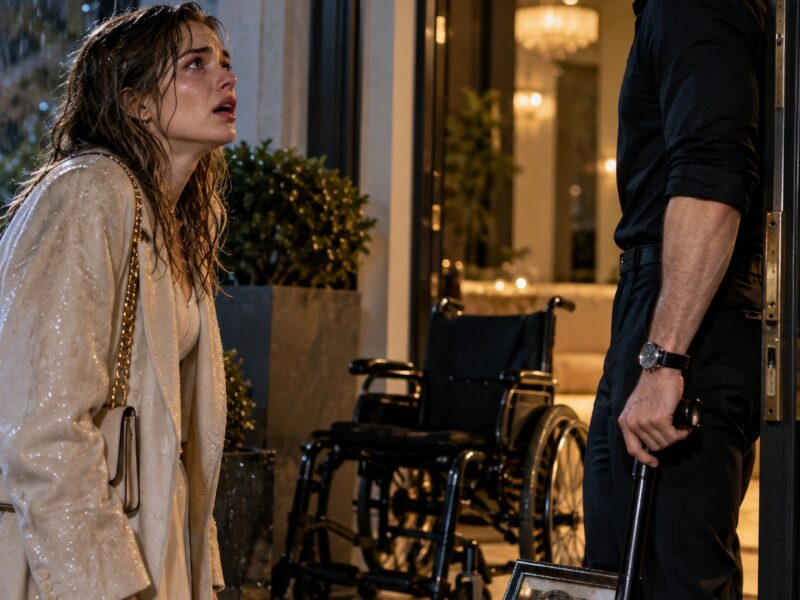
MY FIANCÉE LEFT ME WHEN DOCTORS SAID I MIGHT NEVER WALK AGAIN—THEN SHE CAME BACK THE DAY SHE SAW ME STANDING WITH ANOTHER WOMAN

The first thing Helen noticed when Michael Reed opened the front door was that he was standing.
Not sitting in the wheelchair she had left him in.
Not gripping the arms of a hospital chair with that hollow, frightened look she remembered from the weeks after the accident.
Standing.
His right hand rested lightly against the doorframe. A black walking cane leaned against the wall beside him, close enough to grab if his balance failed, but he wasn’t using it.
For several seconds, Helen said nothing.
Neither did Michael.
Rainwater glistened on the shoulders of her cream-colored coat. Her blond hair, usually perfect, had gone limp around her face. She looked as though she had driven through half of Chicago without noticing the weather.
Then her eyes dropped to his legs.
Michael saw the exact moment disbelief became relief.
And relief became something else.
Hope.
“Michael.”
He hadn’t heard her say his name in almost three months.
Once, that voice could pull him out of a meeting.
Once, it could make him smile across a crowded restaurant.
Once, he’d imagined hearing it beside him when he was seventy years old.
Now it only made his fingers tighten against the doorframe.
“Helen.”
She gave a nervous little laugh.
“Oh my God.”
Her hand rose toward her mouth.
“You’re standing.”
Michael looked down at himself as if he’d somehow forgotten.
“So I am.”
“I heard you were getting better, but I didn’t know—Daniel said you were walking, and I thought maybe he meant with a therapist or with one of those support things, but—”
She stopped.
Her eyes were filling.
Michael remembered another hospital room.
Another version of Helen.
She had been crying then, too.
She had held his hand so tightly his fingers hurt and whispered, We’ll walk through this together.
He had believed her.
That was the cruel thing about promises.
They sounded exactly like truth when you desperately needed them to be true.
Helen stepped closer.
“Can I come in?”
Michael didn’t move.
Something shifted behind him.
A woman’s voice came from the living room.
“Michael, did you leave your medication on the kitchen counter again?”
Helen froze.
Michael closed his eyes for half a second.
Then Faith Carter appeared at the end of the hallway wearing jeans, white sneakers, and a soft gray sweater instead of her nursing scrubs.
She stopped when she saw Helen.
Helen looked at Faith.
Then at Michael.
Then at the two coffee mugs on the table behind them.
One was Michael’s.
The other belonged to Faith.
The silence changed.
“Michael,” Helen whispered. “Who is she?”
He almost laughed.
Not because anything was funny.
Because once upon a time, Helen had known exactly who Faith was.
The nurse.
The woman Helen assumed would take care of all the difficult parts after she decided she no longer could.
Michael looked at the woman he’d once planned to marry.
Then he looked at the woman who had taught him how to stand after that future collapsed.
And he understood something he wished he’d understood months earlier.
Sometimes the person who leaves you doesn’t break your life.
Sometimes they simply leave enough space for you to finally see who stayed.
But six months earlier, Michael Reed had known none of that.
Six months earlier, he had believed he was the luckiest man in Chicago.
He had just closed the largest commercial development contract of his career.
At thirty-six, Michael was a partner in a rapidly growing construction consulting firm headquartered near the Chicago River. He wasn’t born wealthy. His father had repaired elevators. His mother had worked administrative jobs until arthritis forced her into early retirement.
Michael had built everything slowly.
One client.
One sleepless night.
One calculated risk at a time.
That Tuesday afternoon, when the signed contract finally appeared in his inbox, he leaned back in his office chair and stared at the screen.
Six months of negotiations.
Forty-three revisions.
Two competing firms.
One deal worth enough money to change the next five years of his company.
His first instinct wasn’t to call his business partner.
It wasn’t to call his mother.
It was Helen.
She answered on the second ring.
“Hello, Mr. Busy Man.”
Michael smiled.
“You finally remembered you have a fiancé,” she teased.
“Madam, behave yourself.”
“Oh, now I’m ‘Madam’?”
“I have good news.”
Helen gasped dramatically.
“Wait. Don’t tell me.”
He could hear traffic behind her.
“The Riverside contract?”
Michael leaned forward.
“Signed.”
She screamed so loudly he had to pull the phone away from his ear.
“I told you!”
“You did.”
“Didn’t I tell you? You were stressing yourself for nothing.”
“I remember someone calling me at two in the morning because she was worried about whether I was stressing.”
“That doesn’t sound like me.”
“It was absolutely you.”
She laughed.
Michael stared at the framed photograph on his desk.
Helen at Lake Geneva the previous summer, barefoot on a dock, holding her engagement ring toward the camera while Michael stood behind her pretending to look annoyed.
They were supposed to marry in October.
A small ceremony outside the city.
One hundred and twelve guests.
Helen had already chosen flowers.
Michael had already complained about the price of flowers.
She had told him he was welcome to marry himself if he preferred.
He had kissed her in the middle of the florist’s showroom.
That was their life.
Ordinary arguments.
Expensive wedding plans.
Late dinners.
Inside jokes.
A future that seemed almost embarrassingly certain.
“I’m coming over tonight,” Helen said. “We’re celebrating.”
“I thought you had dinner with your friends.”
“They’ll survive.”
“Are you sure?”
“Michael.”
“What?”
“You’re my future husband. Of course I’m sure.”
He smiled.
Those words would haunt him later.
At 5:47 that evening, Michael left his office.
At 6:13, his life split cleanly into before and after.
He remembered the intersection.
He remembered the green light.
He remembered headlights moving too fast from his left.
After that came fragments.
Metal folding.
Glass exploding.
The steering wheel slamming into his body.
A sound he didn’t immediately recognize as his own screaming.
Then nothing.
Helen received the call while sitting at a restaurant with two friends.
A woman named Grace from Michael’s office had somehow gotten her number from his emergency contact file.
“Hello, my name is Grace. I work with Michael Reed. There’s been an accident.”
Helen stopped breathing.
Twenty-eight minutes later, she was running through the emergency department at Northwestern Memorial Hospital with one heel in her hand because the other had broken somewhere between the parking garage and the elevators.
She found Daniel first.
Michael’s closest friend stood outside a trauma room with blood on his shirt.
Not his blood.
Michael’s.
Helen nearly collapsed.
“Oh my God.”
Daniel caught her shoulders.
“He’s alive.”
“What happened?”
“A truck ran the light.”
“Where is he?”
“They’re operating.”
“Operating on what?”
Daniel hesitated.
That hesitation terrified her more than any answer.
“His leg took most of the impact.”
Helen stared at him.
“His leg?”
“And his lower back got hit hard. They don’t know everything yet.”
She pressed both hands over her mouth.
For the next three hours, Helen sat beneath fluorescent hospital lights bargaining with every God she’d ever heard of.
She promised to become kinder.
She promised to stop complaining about Michael working late.
She promised she wouldn’t care about the wedding.
She promised she wouldn’t care about money.
She promised she wouldn’t care about anything if he just survived.
When the surgeon finally appeared, Helen stood so quickly the plastic chair scraped backward.
“Will he be okay?”
“He’s stable.”
Her knees almost gave out.
“But,” the doctor continued, “there are concerns.”
There was always a but.
Michael had sustained significant trauma around his right ankle and lower leg. Surgery had repaired the most immediate damage, but inflammation and neurological complications made his recovery difficult to predict.
Helen listened for less than thirty seconds before interrupting.
“Doctor, I’m sorry. Can you say this without the medical terminology?”
The surgeon nodded.
“What do you need to know?”
“Will Michael walk again?”
A pause.
Not long.
Maybe two seconds.
But Helen would remember it for months.
“It’s too early to give you a definite answer.”
She stared at him.
“What does that mean?”
“We have reason to be optimistic. With rehabilitation and physical therapy, he may recover significant function.”
“May?”
“Yes.”
“So he could stay like this?”
“I’m saying we don’t know yet.”
That uncertainty followed Helen into Michael’s hospital room.
He looked smaller somehow.
Michael had always been physically confident. Six feet two. Broad shoulders. The kind of man who carried suitcases for everyone because waiting for somebody else irritated him.
Now tubes disappeared beneath his hospital gown.
His leg was immobilized.
His face was gray with exhaustion.
When he opened his eyes and saw Helen, he smiled.
And somehow that made her cry harder.
“Hey.”
She leaned over him carefully.
“Don’t ever do that to me again.”
“I’ll try to schedule my accidents more responsibly.”
“Michael.”
“I’m kidding.”
“You’re an idiot.”
“Still handsome?”
Helen laughed through tears.
“Unfortunately.”
He reached for her hand.
She gave it to him.
“Helen?”
“Yeah?”
“Are you scared?”
She wanted to lie.
Instead she whispered, “Of course I’m scared. I almost lost you.”
“Don’t think like that.”
“How am I supposed to think?”
He squeezed her fingers.
“I’m still here.”
She nodded.
“We’ll figure it out.”
“We’ll walk through this together,” he said.
The words came naturally.
Neither of them noticed the irony.
Helen leaned down and kissed his forehead.
“Promise?”
“I promise.”
She swallowed.
“I promise too.”
For the first few days, she meant it.
She came every morning before work.
She brought coffee she knew Michael couldn’t drink because of his medication.
She sat beside him while nurses changed dressings.
She argued with insurance representatives.
She answered his mother’s calls.
She slept in a chair twice.
When Michael became angry, she absorbed it.
When he apologized, she told him he didn’t need to.
When he woke from nightmares convinced he could still hear metal crushing around him, she held his hand until sunrise.
But trauma doesn’t only reveal love.
Sometimes it reveals the limits of it.
After Michael was discharged, the reality became different.
There were no monitors.
No nurses entering every twenty minutes.
No hospital staff assuring Helen that progress could happen.
There was only Michael’s house, temporarily rearranged around a wheelchair.
A shower chair.
Medication schedules.
Appointments.
Exercises.
Pain.
And uncertainty.
The first week, Helen stayed nearly every night.
The second week, she stayed four.
By the third, she had started finding reasons to leave early.
“Your food is in the kitchen,” she said one afternoon, picking up her purse.
Michael looked at the clock.
“You just got here.”
“I’ve been here thirty minutes.”
“Exactly.”
Helen exhaled.
“I have work, Michael.”
“I know.”
“I have responsibilities too.”
“I didn’t say you didn’t.”
“Sometimes it feels like you expect me to sit beside you twenty-four hours a day.”
His face changed.
“That’s not what I meant.”
“Then what did you mean?”
“I miss my fiancée.”
The words landed harder than he intended.
Helen looked away.
Michael immediately regretted them.
“No. Forget it.”
“I didn’t say I don’t care.”
“I know.”
“I can’t lose my whole life because you—”
She stopped.
Michael stared at her.
“Because I what?”
Helen’s face went pale.
“Nothing.”
“Finish the sentence.”
“I said nothing.”
“Helen.”
“I have to go.”
She walked out.
Michael sat alone in the living room for almost an hour without turning on the television.
For the first time since the accident, he wondered whether losing the ability to walk might not be the worst thing that had happened to him.
Two days later, Dr. Steven assigned a home-care nurse.
Her name was Faith Carter.
Michael disliked her immediately.
Not because she was unpleasant.
Because she wasn’t.
Faith arrived at ten o’clock sharp carrying a medical bag and a folder thick enough to frighten him.
She was thirty-one, with dark curly hair pulled into a loose knot, warm brown eyes, and the unnerving confidence of someone who had already decided she wasn’t going to be intimidated by his bad mood.
“Michael Reed?”
“No, I’m his much more attractive brother.”
Faith looked around the room.
“Should I come back when Michael gets home?”
He stared at her.
She smiled.
“Good. We understand each other.”
That was their beginning.
No sparks.
No romantic music.
No miraculous connection.
Just a wounded man in a wheelchair and a nurse who refused to treat him as fragile.
Faith checked his medication.
She reviewed his discharge instructions.
She examined his leg.
She asked about numbness, pain, sleep, appetite, muscle spasms and dizziness.
Then she announced they were going to exercise.
Michael frowned.
“Today?”
“No, next Christmas.”
“I like you less every minute.”
“That’s fine. I bill the hospital, not your approval.”
For the first time in days, Michael laughed.
It surprised both of them.
Faith didn’t mention it.
She simply said, “Nothing too stressful today.”
“Please emphasize the nothing-too-stressful part.”
“I’ll be nice.”
“That sounds like a threat.”
“It probably is.”
Michael expected Helen that evening.
She didn’t come.
She didn’t come Monday either.
On Tuesday she texted that work had become crazy.
Wednesday, she stopped answering his calls.
Thursday afternoon, Faith was helping him through a set of leg exercises when Michael suddenly looked at the calendar.
“What day is it?”
Faith glanced over.
“Thursday.”
Michael went still.
“Helen hasn’t been here since Sunday.”
Faith’s hands paused.
Michael picked up his phone.
He called.
Helen answered on the fifth ring.
“Michael.”
“What’s going on?”
“Nothing.”
“Then why don’t you come anymore?”
Silence.
“Helen?”
“I told you. Work is crazy.”
“For four days?”
“Don’t start this.”
His jaw tightened.
“Start what? Missing my fiancée?”
Faith quietly stepped toward the kitchen.
Michael hated her for trying to give him privacy.
It meant she understood what was happening before he did.
“I’ll come when I’m free,” Helen said.
“When will that be?”
“I don’t know.”
“You don’t know when you’ll see the man you’re supposed to marry?”
“Michael, please.”
“Please what?”
“I have to go.”
The call ended.
Michael stared at the screen.
Faith pretended to organize medication bottles.
“She’s avoiding me.”
Faith didn’t answer.
“Isn’t she?”
“I don’t know what’s happening in Helen’s mind.”
Michael gave a bitter laugh.
“That’s a polite way of saying yes.”
“No.”
Faith turned toward him.
“It’s a polite way of saying don’t torture yourself with assumptions until you know the truth.”
But the truth was already taking shape somewhere else.
That evening, Helen sat across from two friends in a wine bar downtown.
One of them, Lauren, had known her since college.
Lauren stirred her drink slowly.
“I know you love Michael.”
Helen’s eyes dropped.
“But have you actually thought about what you’re getting yourself into?”
Helen stiffened.
“He had an accident. He didn’t choose this.”
“That’s not what I’m saying.”
“It sounds like it.”
“The doctors don’t know if he’ll walk again.”
Helen said nothing.
Lauren leaned forward.
“You’re talking about marriage. Not visiting someone in recovery. Marriage.”
“Stop.”
“This could become your life.”
“Lauren.”
“Pushing a wheelchair. Helping him shower. Rearranging vacations. Making every decision around accessibility. Taking care of him every day.”
“Please don’t say it like that.”
“Why? Because it sounds cruel?”
“Because he’s Michael.”
“And you’re Helen.”
Helen looked away.
“You’re still young,” Lauren continued. “Are you really ready to spend the next forty years caring for someone who may never walk again?”
Helen’s voice became smaller.
“I don’t know.”
That admission frightened her.
Lauren sat back.
“There. That’s the truth.”
“I love him.”
“I know.”
“He’ll have nurses. Therapists.”
“That’s not the same as having a wife.”
Helen’s eyes filled.
“If I leave him now, everybody will think I’m heartless.”
Lauren’s expression hardened.
“People will talk for a week. Then they’ll go back to their own lives. They’re not the ones who have to live yours.”
Helen stared through the window at pedestrians moving along the sidewalk.
Walking.
Laughing.
Hurrying.
Doing all the things she had once imagined doing with Michael without ever considering that the ability to do them might disappear.
For the first time, she let herself imagine the wedding differently.
Michael in a wheelchair.
Their honeymoon rearranged.
Their house remodeled.
Children asking why Daddy couldn’t run.
She hated herself for thinking it.
But once fear had entered the picture, she couldn’t make it leave.
Three days later, Michael received a message.
Not a visit.
Not even a phone call.
A message.
Michael, I’ve tried to convince myself I can handle this, but I don’t think I can. I know this sounds selfish. We promised each other forever, but that was before everything changed. I can’t put my whole life on hold when none of us knows what the future looks like. I’m sorry. Please take care of yourself.
Michael read it twice.
Then a third time.
Faith arrived twenty minutes later.
She found him sitting by the window.
He hadn’t moved.
“Michael?”
Nothing.
She set down her bag.
“What happened?”
He handed her the phone.
Faith read the message.
Her face tightened.
She returned it without comment.
Michael laughed once.
A terrible, empty sound.
“She promised me forever.”
Faith pulled a chair closer.
He stared at the floor.
“I gave that woman everything I knew how to give.”
“Michael—”
“She knew me before I had money. She was there when I started the company. She was there when I signed my first real client. I bought the ring she wanted. I planned the house she wanted. I was going to marry her.”
His voice cracked.
“And the moment I became this—”
“Don’t.”
Michael looked up.
“What?”
“Don’t finish that sentence.”
“Why?”
Faith pointed toward the wheelchair.
“Because that’s where you’re sitting.”
He frowned.
“It isn’t who you are.”
Something inside Michael broke.
Not loudly.
His face simply folded.
He turned away, ashamed of the tears.
Faith didn’t touch him.
She didn’t tell him Helen was terrible.
She didn’t tell him everything happened for a reason.
She didn’t offer cheap optimism.
She just sat there.
Eventually Michael whispered, “I really want to walk again.”
Faith nodded.
“Then that’s what we’re going to work toward.”
“I don’t care what exercises you make me do.”
“You’ll regret saying that.”
“I don’t care how many times I fall.”
Faith studied him.
“There’s one condition.”
“What?”
“Your recovery cannot become revenge.”
Michael frowned.
“I don’t understand.”
“You don’t learn to walk so Helen regrets leaving you.”
“Why not?”
“Because then she still owns your life.”
He stared at her.
“You do it for Michael.”
His throat tightened.
“Fine.”
“Fine what?”
“I’ll do it for Michael.”
Faith stood.
“Good.”
Michael looked suspicious.
“Why do you suddenly look happy?”
“Because you just gave me permission to make you miserable.”
The next two months were brutal.
Progress didn’t arrive like a movie montage.
It came in inches.
Seconds.
Tiny victories no one else would understand.
Michael learned to transfer his weight differently.
He learned to trust muscles that no longer felt like his.
He learned that pain could make a thirty-second exercise feel longer than a board meeting.
He learned that humiliation had levels.
The first time Faith helped him attempt standing with support bars, his arms shook so violently he had to sit again after four seconds.
He slammed his fist against the chair.
“I can’t.”
“You can.”
“You don’t know that.”
“Neither do you.”
He glared at her.
Faith leaned against the rail.
“So stop deciding you’ve failed before your body gets a chance to answer.”
“I hate when you talk like a motivational poster.”
“Stand first. Insult me later.”
He tried again.
Five seconds.
Then seven.
Then twelve.
On the fourth attempt, his knee buckled.
Faith caught him.
Michael cursed.
She laughed.
“Are you laughing at your disabled patient?”
“I’m laughing at a grown man who just called a therapy bar something I can’t repeat in a medical report.”
He started laughing too.
For a few seconds, he forgot to be ashamed.
Those moments became more frequent.
Daniel noticed first.
He came by one Saturday carrying takeout and found Michael arguing with Faith over whether pizza counted as appropriate recovery nutrition.
“It contains tomatoes,” Michael said.
Faith stared at him.
“So does ketchup.”
“Exactly. Vegetables.”
“Tomatoes are fruit.”
Michael looked at Daniel.
“Get this woman out of my house.”
Daniel smiled.
Later, after Faith left, he sat across from Michael.
“I’ve been watching you.”
“That’s creepy.”
“You’re here physically, but half the time your mind is somewhere else.”
Michael’s smile disappeared.
“I’m fine.”
“No, you’re not.”
“What do you want me to say?”
“Anything true.”
Michael looked toward the dark window.
“Helen left.”
“I know.”
“Just like that.”
“What she did hurt you. I’m not defending her.”
“It’s easy for you.”
“Of course it is.”
Michael turned.
Daniel shrugged.
“I wasn’t planning my life with her. You were.”
Michael’s anger softened.
Daniel continued.
“I’m not telling you to forget her overnight. I’m telling you to stop waiting.”
Michael looked down.
“What if she comes back?”
“Then let her come back and meet a man who already found himself again.”
Michael said nothing.
“She was supposed to stay, Daniel.”
“I know.”
“Out of everybody, she was supposed to be the one.”
“That’s why it hurts.”
Michael’s eyes reddened.
“I still love her.”
Daniel nodded.
“You can love somebody and still understand they’re no longer good for you.”
“What if nobody wants this version of me?”
Daniel leaned forward.
“Wrong question.”
“What’s the right one?”
“Do you want this version of you?”
Michael looked at him.
“Because if you do, build him. Fight for him. Everything else comes later.”
Daniel paused.
“And for what it’s worth, that nurse hasn’t given up on you.”
Michael rolled his eyes.
“Faith is doing her job.”
“Sure.”
“What?”
“Nothing.”
“Daniel.”
“I’m just saying that smile on your face is suspicious.”
Michael threw a napkin at him.
But that night, after Daniel left, Michael lay awake thinking about Faith.
Not romantically.
At least that’s what he told himself.
He thought about how she never looked away when he struggled.
How she never praised him for existing.
How she pushed when he needed pushing and stopped when pain became dangerous.
How she somehow knew the difference between the two.
He also thought about Helen.
That hurt remained.
Faith understood.
One morning Michael admitted, “Do you know the stupid part?”
“What?”
“I still miss her.”
Faith adjusted the resistance band around his leg.
“That’s not stupid.”
“She abandoned me.”
“Yes.”
“So why do I miss her?”
Faith looked at him.
“Because somebody hurting you doesn’t erase the years you loved them.”
Michael went quiet.
“Your heart isn’t a light switch.”
“Where did you learn to talk like that?”
“Nursing school.”
“You’re lying.”
“Completely.”
He smiled.
“Sounds like somebody broke your heart.”
Faith looked away.
For the first time, Michael saw something guarded behind her humor.
“Maybe.”
He wanted to ask.
He didn’t.
That restraint changed something between them.
Faith noticed it too.
Two weeks later, Michael stood without assistance.
It happened so unexpectedly neither of them understood at first.
Faith had one hand near his elbow.
Michael gripped the support bar.
“Shift your weight.”
“I’m shifting.”
“You’re thinking about falling.”
“Because falling is historically bad.”
“Think about standing.”
“Faith—”
“Michael.”
He exhaled.
Then slowly loosened his grip.
One finger.
Then another.
His hand lifted from the bar.
Faith froze.
Michael was standing.
No rail.
No hands.
No one holding him.
Three seconds.
Four.
Five.
His eyes widened.
“Faith.”
She was crying.
“Oh my God.”
“Am I—”
“You’re standing.”
A laugh burst out of him.
“I’m standing.”
“You did it.”
“I did it.”
Faith threw her arms around him.
Michael hugged her back instinctively.
For one impossible moment, the world disappeared.
The wheelchair.
Helen.
The accident.
The fear.
Everything.
Then Faith pulled back.
Their faces were inches apart.
Michael kissed her.
It lasted barely a second.
Faith jerked away.
Michael’s joy vanished.
“I’m sorry.”
She stared at him.
“I shouldn’t have done that.”
“You’re my patient.”
“I know.”
“Michael—”
“I know.”
Faith grabbed her bag.
“I need to go.”
“Faith.”
“I’ll see you tomorrow.”
She left.
Michael stood alone beside the therapy rail.
The greatest physical victory of his recovery suddenly felt dangerously complicated.
The next morning, Faith arrived exactly on time.
Professional.
Controlled.
Michael hated the distance immediately.
Before she could open her folder, he spoke.
“I owe you an apology.”
Faith stopped.
“Okay.”
“Yesterday was wrong.”
She looked at him.
“Whatever I’m feeling, I had no right to put you in that position. You came here to help me. I crossed a line.”
Faith’s expression softened.
“I’m okay.”
“That doesn’t make it acceptable.”
She nodded slowly.
“It won’t happen again.”
“Good.”
But when she turned away, Michael saw something in her face.
Not relief.
Disappointment.
And that frightened him more.
Because it meant the kiss might not have been one-sided.
Faith knew it too.
She requested that Michael’s formal home-care supervision begin transitioning to outpatient rehabilitation.
She told herself it was appropriate.
He was improving.
He needed independence.
She needed boundaries.
What she didn’t admit was that every time Michael smiled at her now, she remembered the kiss.
Then Helen heard he was walking.
Lauren told her over brunch.
“I heard Michael’s on his feet again.”
Helen’s fork stopped halfway to her mouth.
“What?”
“Daniel posted something. Apparently rehab is going really well.”
“He didn’t tell me.”
Lauren gave her a long look.
“Why would he?”
Helen looked down at her plate.
That question followed her home.
She opened old photographs.
Michael cooking in her apartment.
Michael asleep on a plane.
Michael proposing beside Lake Geneva.
Michael standing behind her with his arms around her waist.
Standing.
She cried.
Then she told herself the tears meant she still loved him.
She didn’t ask whether she would have cried the same way if Michael were still in the wheelchair.
Three days later, she drove to his house.
And Michael opened the door standing.
Now Helen stood in the foyer staring at Faith.
“Who is she?”
Faith answered first.
“I’m Faith.”
Helen’s eyes narrowed.
“The nurse.”
Faith’s shoulders stiffened.
Michael heard the contempt.
“Her name is Faith.”
Helen looked at him.
“I came to talk to you.”
“We’re talking.”
“Alone.”
Faith reached for her coat.
“I should go.”
“No.”
Both women looked at Michael.
He swallowed.
“Faith, please stay.”
Helen’s face changed.
That was the moment she understood.
Not everything.
But enough.
“Michael, please.”
He stepped carefully toward the living room.
Each step still required concentration.
Helen watched him as though witnessing a miracle.
Michael hated that look.
Because he remembered how she had looked at him when she thought the miracle might never happen.
She followed him.
“Please hear me out before you say anything.”
Michael lowered himself into a chair.
Faith remained near the hallway.
Helen sat across from him.
“I know you’re angry.”
“Angry isn’t the word.”
“I deserve that.”
“Probably.”
She flinched.
“I miss you.”
Michael looked at her.
“You miss me?”
“Every day.”
A bitter smile touched his mouth.
“Interesting.”
“I know what I did was wrong.”
“Do you?”
“I was confused.”
“No. You were scared.”
Helen nodded.
“Yes.”
“There’s a difference.”
“I was terrified, Michael. Everything happened so fast. One minute we were planning our wedding. The next, doctors were telling me you might never walk again.”
Michael’s voice hardened.
“And you left.”
“I’m sorry.”
“For leaving?”
“Yes.”
“Or for coming back too late?”
Helen stared at him.
“Why are you doing this?”
“Doing what?”
“Making this impossible.”
Michael almost couldn’t believe it.
“I’m making this difficult?”
“I came here.”
“So?”
“Doesn’t that matter?”
He stared at her for several seconds.
Then he laughed quietly.
“That’s incredible.”
“What?”
“You think showing up now is courage.”
“Michael—”
“Where was this courage when I couldn’t stand?”
Tears gathered in Helen’s eyes.
“I made a mistake.”
“You made a choice.”
“We loved each other.”
“Yes.”
“We were going to get married.”
Michael nodded.
“Were.”
Helen went still.
“What?”
“You said were going to get married.”
“No, that’s not what I meant.”
“It’s what you said.”
“Michael, stop.”
“You’re right. We were.”
Her face drained.
“What are you saying?”
Michael looked toward Faith.
Faith shook her head almost imperceptibly.
Don’t use me.
Don’t make me a weapon.
He understood.
So he looked back at Helen.
“I’m saying that life is over.”
Helen stood.
“No.”
“Helen.”
“No. You don’t get to erase seven years because I panicked.”
“I didn’t erase them.”
“Then what is this?”
“I survived them.”
She began crying.
“We can start again.”
Michael’s chest hurt.
There had been a time when those words would have been everything he wanted.
He imagined saying yes.
For one second, he could see the old life waiting.
Wedding.
House.
Photos.
Familiarity.
Then another memory replaced it.
A text message.
I can’t put my whole life on hold.
Michael looked at Helen.
“Would you be here if I still couldn’t walk?”
She opened her mouth.
No answer came.
That silence was the answer.
Helen looked toward Faith.
Understanding sharpened into anger.
“Is this because of her?”
Michael didn’t respond.
“Your nurse?”
“Helen.”
“You’re choosing your nurse over me?”
Faith stepped forward.
“Don’t.”
Helen turned.
“Excuse me?”
“Don’t make this about me.”
“It obviously is.”
“No,” Faith said calmly. “It isn’t.”
Helen laughed bitterly.
“You’ve been in his house for months.”
“Because he needed medical care.”
“And now?”
Faith went silent.
Michael stood.
It was slow.
Painful.
But deliberate.
Helen watched him rise.
“This isn’t about choosing Faith instead of you.”
Helen looked at him.
“It’s about finally choosing myself.”
She stared.
Michael’s voice softened.
“You left when loving me stopped looking like the life you’d imagined.”
“That’s not fair.”
“It may not be.”
“I was scared.”
“I know.”
“People make mistakes when they’re scared.”
“Yes.”
“So forgive me.”
Michael swallowed.
“I do.”
Hope flashed across her face.
“But forgiveness isn’t the same thing as going back.”
The hope disappeared.
Helen covered her mouth.
Michael felt no triumph.
Only grief.
Some endings didn’t need villains.
Sometimes a person simply failed you at the exact moment you discovered what their love was made of.
Helen picked up her purse.
At the door, she turned.
“I really did love you.”
Michael believed her.
That was perhaps the saddest part.
“I know.”
She cried harder.
“I hope you’re happy.”
Michael looked toward Faith.
Then back at Helen.
“I hope you are too.”
Helen left.
The door closed.
Silence filled the house.
Faith immediately grabbed her coat.
“Wait.”
She stopped.
“Michael, I can’t do this right now.”
“Do what?”
“This.”
She turned.
Her eyes were wet.
“Ever since that kiss, I’ve been pretending nothing happened.”
Michael’s heart began pounding.
“Faith—”
“Today, in front of Helen, you looked at me like—”
She stopped.
“Like what?”
“Like I’m the reason you could let her go.”
Michael frowned.
“You’re not.”
Faith’s face fell.
“No. That’s not what I meant.”
“Then what did you mean?”
Michael moved closer.
His balance wavered.
Faith instinctively reached for him.
He steadied himself.
They both noticed.
Michael smiled faintly.
“You still do that.”
“Do what?”
“Reach for me.”
Faith lowered her hand.
“It’s habit.”
“No.”
He looked into her eyes.
“It’s who you are.”
Faith’s breath caught.
Michael continued.
“You want the truth?”
“Yes.”
“You weren’t convenient.”
“Then what was I?”
“The person who met me when I had nothing impressive left.”
Faith’s eyes filled.
“You didn’t meet Michael Reed with the company and the cars and the expensive suits.”
“Michael—”
“You met the man who needed help getting out of bed.”
She looked down.
“The man who couldn’t shower without planning it like a military operation. The man who couldn’t get across his own living room without asking someone for help.”
“Stop.”
“Why?”
“Because you don’t have to humiliate yourself to tell me you care about me.”
Michael stared at her.
Then smiled.
“See?”
“What?”
“That’s exactly what I mean.”
Faith shook her head.
“You never made me feel humiliated.”
His voice became quiet.
“You made me feel worth fighting for when I couldn’t find one damn reason to fight for myself.”
Faith cried.
Michael took another step.
“I love you.”
Her eyes closed.
“I don’t expect you to say it back.”
“Michael.”
“And I don’t want you to feel pressured because you cared for me. If this is complicated or inappropriate or too soon, I’ll understand.”
Faith laughed through her tears.
“That’s the problem.”
“What?”
She looked at him.
“I think I fell in love with you too.”
Michael forgot how to breathe.
Faith smiled shakily.
“Apparently nursing school did not prepare me for this.”
He laughed.
This time, when they kissed, Michael didn’t fall.
Not physically.
Not emotionally.
He simply stood there with the woman who had seen him at his weakest and had never once confused weakness with worthlessness.
Recovery continued.
Love didn’t magically repair his nerves.
Faith didn’t become his miracle cure.
Michael still had painful mornings.
He still occasionally needed the cane.
There were stairs he hated.
Days when his ankle swelled.
Nights when memories of the crash returned without permission.
But his world expanded again.
He returned to the office part-time.
Then full-time.
He drove for the first time seven months after the accident and sat in the parking lot afterward with both hands trembling against the steering wheel.
Faith didn’t tell him not to be afraid.
She sat beside him until the fear passed.
Eventually she left home-care nursing and accepted a position in rehabilitation coordination at another medical center, ensuring their relationship no longer carried the professional complications of those first months.
They learned each other outside recovery.
Michael discovered Faith hated fancy restaurants because tiny portions made her angry.
Faith discovered Michael sang terribly in the car.
He learned she called her mother every Sunday.
She learned he became quiet whenever he was worried about money, even though he now had plenty.
They fought.
Their first serious argument happened because Michael tried to hide a bad pain day.
Faith accused him of pretending strength.
Michael accused her of treating him like a patient.
They didn’t speak for three hours.
Then Michael appeared in the kitchen with two cups of coffee.
“I don’t need a nurse,” he said.
Faith crossed her arms.
“I know.”
“I need a partner.”
Her expression softened.
“But partners are allowed to know when you’re hurting.”
Michael nodded.
“I’m learning.”
“So am I.”
That became the shape of their relationship.
Not rescue.
Not gratitude.
Learning.
Almost a year after the accident, Michael took Faith to Lake Geneva.
The same place where he had once proposed to Helen.
He hadn’t planned the symbolism.
At least that was what he told himself.
They walked toward the water just before sunset.
Michael carried his cane but barely used it.
Faith noticed he was unusually quiet.
“Are you okay?”
“Terrified.”
She frowned.
“Pain?”
“No.”
“Then why do you look like you’re about to testify before Congress?”
Michael stopped.
Faith turned.
He reached into his coat.
Her eyes widened.
“Oh.”
“That’s encouraging.”
“Michael.”
“Apparently learning to walk again was easier than this.”
Faith covered her mouth.
He didn’t kneel.
His ankle still didn’t like that position, and Michael had finally stopped believing love needed unnecessary pain to look sincere.
Instead, he stood in front of her.
Exactly as he was.
“I need to tell you something before I ask.”
Faith was already crying.
“When the accident happened, I thought I’d lost my future.”
He took her hand.
“Then Helen left, and I thought that proved it.”
Faith squeezed his fingers.
“But you taught me something I should’ve known long before I met you.”
“What?”
“That losing the future you planned isn’t the same as losing your future.”
Faith’s tears spilled.
Michael opened the ring box.
“I don’t want to marry you because you helped me walk.”
She shook her head, crying harder.
“I don’t want to marry you because you saved me. You didn’t.”
Faith smiled through tears.
“You made me save myself.”
Michael’s voice trembled.
“And when I imagine the good years now—the boring ones, the successful ones, the difficult ones, the years when we’re old and complaining about our backs—I don’t imagine you beside me because I need you there.”
He took a breath.
“I imagine you because you’re the woman I want there.”
Faith stared at him.
“Faith Carter, will you marry me?”
She laughed and cried at the same time.
“Yes.”
Michael blinked.
“That’s it?”
“What do you mean, that’s it?”
“I prepared a whole speech.”
“You just gave the speech.”
“There was another section.”
Faith grabbed his face.
“Michael.”
“What?”
“Yes.”
Then she kissed him.
Months later, on a cool October afternoon, Michael stood at the end of a small outdoor aisle waiting for Faith.
No wheelchair.
No dramatic entrance.
His cane rested against the first row because his ankle had been bothering him that morning, and for once he wasn’t embarrassed by it.
Daniel stood beside him as best man.
“You nervous?”
Michael exhaled.
“Completely.”
“Good.”
“Why is that good?”
“Means you’re paying attention.”
Music began.
Everyone stood.
Michael looked toward the back.
Faith appeared.
For one strange second, Michael remembered the hospital.
Helen crying beside his bed.
We’ll walk through this together.
He no longer hated the memory.
He no longer hated Helen.
There were people we loved who belonged to earlier versions of ourselves.
People who taught us what devotion felt like.
People who taught us what abandonment felt like.
Sometimes they were the same person.
Michael had spent months believing Helen had stolen his future.
She hadn’t.
She had only revealed that the future he’d planned was conditional.
Faith walked toward him.
Her eyes never left his.
Halfway down the aisle, Michael’s ankle gave a sharp pulse of pain.
His body shifted.
Daniel instinctively reached toward him.
Michael steadied himself.
Faith noticed.
She didn’t panic.
She didn’t rush.
She simply smiled.
Michael smiled back.
And suddenly he understood the difference between the two women more clearly than ever.
Helen had once promised she would walk beside him forever because neither of them had imagined a world in which walking could become difficult.
Faith had never promised that.
She had simply stayed when every step hurt.
Faith reached him.
Michael took her hands.
“You okay?” she whispered.
“My ankle’s complaining.”
“Want the cane?”
“In a minute.”
She smiled.
“No heroics.”
“Yes, nurse.”
Faith narrowed her eyes.
“Don’t start.”
Daniel laughed behind them.
So did Michael.
The ceremony began.
Later, after the photographs and dinner and speeches, Michael slipped outside alone.
The reception glowed behind him through tall windows.
Music floated into the cool night.
He looked down at his right leg.
A faint scar disappeared beneath his trousers.
There had been a time when he’d hated that scar.
It reminded him of twisted metal.
Hospitals.
A wheelchair.
A text message ending an engagement.
Now it reminded him of something else.
A therapy rail.
Five seconds standing.
Faith crying.
You did it.
The door opened behind him.
Faith stepped outside.
“There you are.”
Michael smiled.
“Looking for me already?”
“We’ve been married four hours. I’m clingy now.”
She moved beside him.
For a moment they watched the lights across the lake.
“Do you ever think about it?” Faith asked.
“The accident?”
“Everything.”
Michael nodded.
“Sometimes.”
“Do you wish it never happened?”
He didn’t answer immediately.
The easy answer was no.
The romantic answer was that he would endure it all again because it led him to her.
But Michael had learned to distrust beautiful lies.
So he told her the truth.
“Yes.”
Faith looked at him.
“I wish I hadn’t been hit by that truck. I wish I hadn’t spent months in pain. I wish I hadn’t been afraid I’d never walk again.”
She nodded.
“And Helen?”
Michael looked toward the water.
“I wish she’d been honest sooner about the kind of life she was willing to love me in.”
Faith rested her head against his shoulder.
“But I don’t wish any of it happened just so I could find you.”
“Good.”
Michael looked at her.
“Good?”
“I’d be worried if you thought nearly dying was romantic.”
He laughed.
Faith slipped her hand into his.
“What I do believe,” Michael said, “is that terrible things happen, and sometimes something good grows afterward.”
Faith squeezed his fingers.
“That’s less poetic.”
“It’s also true.”
“I’ll take true.”
They stood together in silence.
After a while, Michael’s ankle began aching again.
Faith noticed him shifting his weight.
“Ready?”
He nodded.
She reached for the cane resting beside the door.
Michael took it.
No shame.
No anger.
No need to prove anything.
They started back toward the reception.
Michael took three steps before stopping.
Faith looked at him.
“What?”
He smiled.
“Nothing.”
“You’re being weird.”
“I was just thinking.”
“That’s usually dangerous.”
He laughed.
Then his expression softened.
“After the accident, everybody kept asking whether I’d walk again.”
Faith waited.
“I thought that was the biggest question in my life.”
“And now?”
Michael looked through the glass doors.
At Daniel laughing.
At his mother wiping tears from her cheeks.
At friends gathered beneath warm lights.
At a life he once believed had ended on a Chicago intersection.
Then he looked at Faith.
“Turns out walking wasn’t the hard part.”
“What was?”
“Learning that losing someone doesn’t always mean you’ve lost.”
Faith’s eyes softened.
Michael opened the door for her.
She stepped inside, then turned and held out her hand.
Not because he couldn’t enter without her.
Not because he needed someone to carry him.
Simply because she wanted to walk beside him.
Michael looked at her hand.
Then he took it.
And together they walked back into the light.









