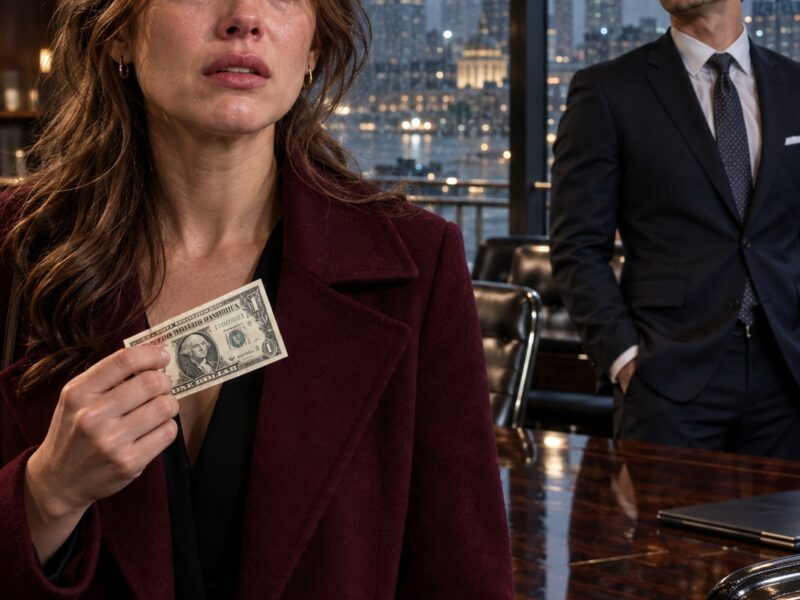
My Grandfather Humiliated Me With a $1 Inheritance—24 Hours Later, I Learned Why My Family Was Terrified of That Dollar
The first person to laugh when my grandfather left me one dollar was my cousin Preston.
Not a nervous laugh.
Not the awkward little sound people make when something cruel happens in public and nobody knows where to look.
He threw his head back and laughed like he had just watched someone fall down a flight of stairs.
“A dollar?”
His voice cracked across the boardroom.
“The old man left you one freaking dollar?”
Rain hammered the forty-second-floor windows behind him, turning Boston into a gray blur of glass and steel.
Nobody told Preston to stop.
My aunt Fiona touched the diamonds at her throat and smiled.
My uncle Richard leaned back in his leather chair.
And at the head of the enormous mahogany table, Harrison Caldwell—the attorney who had known my grandfather for almost forty years—sat perfectly still.
In front of me was a small manila envelope.
Inside it was a single crisp one-dollar bill.
Twenty-four hours later, that same dollar would be in my hand while a man pointed a gun at my head beneath a mountain in Maine.
By then, Preston would no longer be laughing.
But I didn’t know any of that yet.
At that moment, I only knew one thing.
Arthur Gallagher had been dead for three weeks.
And somehow, from beyond the grave, the man I loved most had managed to break my heart.
I was twenty-eight years old when my grandfather died.
I taught history at a public middle school outside Boston, which meant my professional life mostly consisted of explaining the Constitution to twelve-year-olds who were more interested in TikTok and breaking up arguments over stolen lunch money.
I wasn’t rich.
That distinction mattered in my family.
The Gallaghers didn’t measure people by whether they were kind, loyal, funny, intelligent, or decent.
They measured people in square footage.
Cars.
Trusts.
Board seats.
Vacation homes.
The names engraved on buildings.
My apartment in Somerville had one bedroom, a radiator that clanged all winter, and a kitchen drawer I had to lift slightly before it would close.
I had student loans.
I had medical debt left from my mother’s final illness.
I had an electric bill sitting unopened on my desk because sometimes not looking at a number for another twenty-four hours felt almost like having money.
My grandfather, Arthur Gallagher, had been the opposite of poor for so long that newspapers had stopped trying to estimate exactly how rich he was.
He built Gallagher Shipping into one of New England’s most recognizable private companies. His name appeared on warehouses, charitable foundations, maritime buildings, scholarship funds, and brass plaques from Boston to Newport.
He died at eighty-nine after a brutal battle with pulmonary fibrosis.
During his last months, breathing became work.
Talking became work.
Eventually, even sitting upright became work.
His children rarely came.
Fiona was always somewhere warm.
St. Barts.
Palm Beach.
Monaco.
Richard was always closing something.
A property acquisition.
A hotel deal.
A redevelopment project.
A transaction in Dubai that was apparently important enough to keep him away while his father was struggling for every breath.
Preston came twice that I remembered.
Once he spent most of the visit on his phone.
The second time he asked Arthur about a vintage Ferrari before asking how he felt.
I came after school.
Sometimes I brought grading with me.
Sometimes I brought soup Arthur barely touched.
Sometimes I just sat there.
When his hands shook too badly to hold a book, I read Dickens aloud.
When the oxygen machine made conversation difficult, we listened to the rain.
When he couldn’t sleep, he told me about the Boston shipyards when he was young—before the money, before the boardrooms, before everyone around him started treating love like another asset to negotiate.
One night, maybe six weeks before he died, he looked at me for a long time.
“You know what money does badly?” he asked.
I smiled.
“Pays public school teachers?”
He laughed until the laugh became a cough.
I reached for his water.
When he recovered, he shook his head.
“No. Money reveals people badly.”
“What does that mean?”
“It means people think money changes them.”
He looked toward the dark window.
“It doesn’t.”
Then he turned back to me.
“It gives them permission.”
I remembered that conversation during the will reading.
I just didn’t understand it yet.
The offices of Caldwell, Walsh, and Montgomery occupied several floors of a skyscraper overlooking downtown Boston.
Everything about the boardroom seemed designed to make ordinary people feel temporary.
Mahogany walls.
Original art.
Leather chairs.
A conference table so long you could have served Thanksgiving dinner to three generations of Gallaghers without anyone having to sit near someone they disliked.
I arrived in a damp wool coat.
Fiona arrived in Cartier.
Richard wore a charcoal suit that probably cost more than my car.
Preston lounged near the end of the table in a bespoke navy suit, tapping on his phone with the bored concentration of someone who believed the world existed primarily to send him notifications.
Harrison Caldwell sat at the head.
He was in his late sixties, silver-haired and severe, with tortoiseshell glasses and the posture of a man who had spent his entire career watching wealthy people lie.
He opened a thick leather portfolio.
“Let us begin.”
Even Preston stopped tapping for a second.
“Arthur Gallagher was a man of precise intentions,” Caldwell said. “The document I am about to execute represents the final revision of his will, completed approximately two months before his death.”
Fiona crossed one leg over the other.
Richard checked his watch.
I folded my hands in my lap.
I wasn’t expecting millions.
That part is important.
People would later assume I must have gone into that room expecting a reward for being the dutiful granddaughter.
I didn’t.
I wanted something small.
A book.
His watch.
One of the old shipyard photographs from his study.
Maybe the brass compass he kept beside his bed.
Something that smelled faintly of tobacco and cedar and reminded me of the man he had been before his lungs betrayed him.
Caldwell began reading.
“To my daughter, Fiona Gallagher, I leave my estate in Newport, Rhode Island, and the sum of twelve million dollars currently held in the Cayman Offshore Trust.”
Fiona’s shoulders relaxed.
Just slightly.
But I saw it.
She had been afraid.
Now she wasn’t.
“To my son, Richard Gallagher, I leave controlling shares of Gallagher Commercial Properties alongside the sum of fifteen million dollars.”
Richard gave a slow nod.
No smile.
Just confirmation.
As though fifteen million dollars were an invoice finally paid.
Caldwell continued.
“To my grandson, Preston Gallagher, I leave my vintage automotive collection and the sum of eight million dollars, to be placed in an annuity, lest he spend it all on frivolous endeavors before his thirtieth birthday.”
Preston looked up.
“Seriously?”
Fiona gave him a warning glance.
He rolled his eyes and returned to his phone.
Eight million dollars apparently wasn’t enough to hold his attention.
Then Caldwell turned a page.
Something changed.
It was almost nothing.
A pause half a second too long.
A slight adjustment of his glasses.
But I felt it.
Fiona felt it too.
She looked at me.
Richard followed.
Then Preston.
Three faces turned toward the poor relation at the end of the table.
Caldwell lowered his eyes.
“And finally, to my granddaughter, Beatatrice Gallagher, for her dedicated presence during my final days, and to ensure that she is fully recognized and not forgotten in the execution of this estate…”
My throat tightened.
Caldwell stopped.
Then he reached inside his jacket.
He removed a sealed manila envelope.
Instead of handing it to me, he placed it on the polished table and pushed it.
The envelope slid twenty feet.
It stopped directly in front of my hands.
Caldwell looked at me.
“I leave the sum of exactly one dollar.”
Rain struck the windows.
That was all.
No explanation.
No book.
No watch.
No compass.
One dollar.
I stared at the envelope.
For several seconds, nobody moved.
Then Preston laughed.
“A dollar?”
He slapped the table.
“You’ve got to be kidding me.”
I couldn’t look at him.
“The old man actually left you one dollar.”
“Preston,” Caldwell said.
But Fiona was smiling now.
“Well,” she said, adjusting her necklace, “Beatatrice always insisted she wasn’t interested in Father’s money.”
Her eyes found mine.
“I suppose he believed you.”
Richard chuckled.
“You should frame it.”
I finally looked at him.
“What?”
“The dollar. Frame it.”
He smiled.
“Hang it in that little apartment of yours. Great conversation piece.”
Preston laughed harder.
Something inside me went very quiet.
It wasn’t the money.
I need you to understand that.
If Arthur had left me nothing, I could have survived that.
But the wording mattered.
He had specifically remembered me.
Specifically recognized what I had done.
Then specifically reduced it to one dollar.
It felt deliberate.
Not neglect.
Judgment.
For months, I had held his hand while he struggled to breathe.
I had wiped soup from his chin when he was too weak to notice.
I had heard him tell me things he had never told his children.
And now I wondered whether I had misunderstood everything.
Maybe kindness had made me stupid.
Maybe he had tolerated me because I was available.
Maybe those long nights had meant more to me than they had to him.
I opened the envelope.
Inside was a one-dollar bill.
Nothing else.
Fiona looked toward Caldwell.
“Is this some sort of joke, Harrison?”
She sounded delighted by the possibility.
Caldwell’s expression didn’t change.
“I am executing Arthur’s will exactly as written.”
That sentence should have sounded ordinary.
It didn’t.
Exactly as written.
I looked at him.
For the briefest instant, his eyes met mine.
There was something there.
Not pity.
Not embarrassment.
Something harder to identify.
Then it disappeared.
“If there are no further questions,” he said, “this concludes the reading.”
I stood.
“Beatatrice,” Fiona called.
I pulled on my coat.
“You don’t have to rush away.”
I looked at her.
For once, she didn’t bother hiding the satisfaction on her face.
“Yes,” I said. “I do.”
The heavy doors closed behind me.
Preston’s laughter followed me into the hallway.
I heard it all the way to the elevators.
By the time I reached the street, Boston had disappeared beneath October rain.
I walked three blocks before realizing I was crying.
On the subway back to Somerville, I sat beside a teenager wearing headphones and an exhausted woman holding grocery bags between her knees.
Nobody knew I had just been disinherited.
Nobody knew my family was worth hundreds of millions of dollars.
Nobody knew there was a one-dollar bill folded inside my coat pocket that somehow hurt more than every overdue notice waiting at home.
That anonymity should have comforted me.
Instead, I kept hearing Arthur’s voice.
Money doesn’t change people.
It gives them permission.
I wondered what permission he had just given them.
And what he had taken from me.
My apartment was cold when I got home.
I locked the deadbolt, dropped my keys into a ceramic bowl, and stood in the silence.
My mother’s photograph was on the bookshelf.
She had Arthur’s eyes.
That made everything worse.
I threw my coat over the sofa and placed the dollar on my cheap laminate desk.
Then I sat down.
For a long time, I did nothing.
Eventually, anger arrived.
It was easier than grief.
“Why?”
I said it aloud to an empty room.
“Why would you do that?”
No answer.
Of course.
Dead men don’t explain themselves.
That was the cruelty of inheritance.
The living received the consequences.
The dead kept the reasons.
Hours passed.
Outside, headlights moved across my ceiling.
My phone buzzed twice.
I ignored it.
My stomach finally growled around nine.
I stood to find something to eat and turned on the desk lamp.
Yellow light spilled across the dollar.
I almost walked away.
Then something caught my eye.
A mark.
I stopped.
Picked up the bill.
Tilted it toward the lamp.
Across George Washington’s portrait was a faint line that hadn’t been visible in the boardroom.
Numbers.
I moved closer.
45.3219° N.
69.5244° W.
My pulse changed.
Coordinates.
I stared at them.
Then I noticed something else.
Along the green border, written so finely I had mistaken it for printing, was a ten-digit sequence.
My grandfather’s handwriting.
I knew it immediately.
Arthur wrote numbers with an unusually flat seven.
I had watched him make grocery lists from his hospital bed.
This was his hand.
The room suddenly felt smaller.
I reached for my phone.
Before I touched it, the phone buzzed.
BLOCKED CALLER.
I froze.
Then answered.
“Hello?”
A familiar baritone voice came through the speaker.
“Hello, Beatatrice.”
I sat down.
“Mr. Caldwell?”
“I assume you’ve looked closely at your inheritance by now.”
My eyes went back to the dollar.
“I see coordinates.”
A pause.
“And a phone number.”
Another pause.
“What is this?”
Caldwell exhaled.
When he spoke again, the formal attorney from the boardroom was gone.
“That reading was a performance.”
I stood so quickly my chair scraped backward.
“What?”
“For them.”
My heart began pounding.
“Arthur knew exactly who his children were. He knew what would happen if he publicly left you what he actually intended you to have.”
“What he intended—”
“They would have challenged the estate. Frozen assets. Filed injunctions. Questioned his competence. Questioned yours. They would have kept you in litigation until you were fifty.”
I gripped the phone.
“Why?”
“Because they would destroy you before allowing you to keep it.”
Keep what?
The question came out as a whisper.
Caldwell didn’t answer.
Instead he said, “Pack a bag.”
I laughed once because the alternative was screaming.
“What?”
“Enough clothes for a week. Nothing you cannot replace.”
“Mr. Caldwell—”
“Do it now.”
Something in his voice silenced me.
“I’m parked in the alley behind your building.”
I looked toward my window.
“Why the alley?”
“Because Fiona has used private investigators before, and I would prefer not to discover whether she is using them tonight.”
The blood drained from my face.
“Are you serious?”
“Entirely.”
I looked down at the dollar.
“Where are we going?”
“To the coordinates Arthur gave you.”
“What’s there?”
Caldwell was silent for two seconds.
Then he said, “The part of your grandfather’s life his children never found.”
The line went dead.
Twenty minutes later, I slipped through the rear entrance of my apartment building carrying an overnight bag.
Rain had turned the alley black and glossy.
A tinted Lincoln Navigator waited beside the dumpsters with its engine running.
The rear door opened.
Harrison Caldwell sat inside.
On his lap was a leather dossier thick enough to contain somebody’s entire life.
I climbed in.
The door closed.
The locks clicked.
The SUV began moving before I had buckled my seat belt.
“Start talking,” I said.
Caldwell studied me.
“You sound angry.”
“My family just laughed while you handed me one dollar, and now I’m being driven out of Boston in an armored SUV.”
“It is armored.”
“That was not the part of the sentence I needed confirmed.”
For the first time that day, the corner of his mouth moved.
Then it disappeared.
“The dollar was necessary.”
“How?”
“In Massachusetts, omitting an heir can create grounds for litigation. Your grandfather did not omit you. He identified you specifically, acknowledged your relationship specifically, and deliberately left you a precise amount.”
“One dollar.”
“Yes.”
“So they can’t claim he forgot me.”
“Correct.”
I stared through the rain-streaked glass.
“That still doesn’t explain why.”
“No.”
Caldwell lifted the dossier.
“It explains why they can never touch what comes next.”
He handed it to me.
Embossed across the leather were two words.
ETHELGARD TRUST.
“What is this?”
“Open it.”
The first document was dated 1984.
Then came incorporation papers.
Asset schedules.
Land records.
Patent holdings.
Investment structures.
Names of companies I had heard on the news.
Companies I hadn’t.
Property.
Mineral rights.
Technology investments.
Pages of numbers so large my mind stopped assigning meaning to them.
“What am I looking at?”
“Your grandfather’s actual fortune.”
I looked up.
“Gallagher Shipping?”
“Was only one part of Arthur’s wealth.”
Caldwell leaned back.
“In the late seventies, Arthur became convinced global trade would change dramatically. He invested beyond shipping—land connected to rare-earth mineral rights, early technology ventures, patent-holding entities, real estate. He placed those interests into structures separate from the Gallagher name.”
“Why?”
“Because eventually he stopped trusting his children.”
The words hung between us.
“He created Ethelgard as a blind trust. The holdings were controlled through corporate proxies. Gallagher Shipping was visible. Ethelgard wasn’t.”
I turned another page.
Then another.
My hands slowed.
At the bottom of one asset summary was a number.
I read it twice.
“That can’t be right.”
“It is.”
I looked at Caldwell.
“This says—”
“Approximately one point two billion dollars.”
I stopped breathing.
The dossier slipped from my hands and hit the floor.
For a moment, neither of us moved.
Then I laughed.
It sounded wrong.
“No.”
“Beatatrice—”
“No.”
I shook my head.
“I’m a middle school teacher.”
“I am aware.”
“I spent fifteen minutes yesterday deciding whether I could afford new brake pads this month.”
“I know.”
“My electricity is overdue.”
“That can be remedied.”
“My mother’s hospital debt—”
“Can be remedied.”
I stared at him.
“You’re telling me I’m a billionaire?”
“Legally, you are the sole beneficiary of Ethelgard Trust.”
I felt sick.
Not happy.
Not powerful.
Sick.
“Why me?”
Caldwell’s face changed.
Some of the attorney disappeared.
What remained was an old man who had buried his closest friend.
“Arthur spent his life watching money reveal his family.”
My grandfather’s words came back.
Permission.
“He watched Richard become predatory. He watched Fiona turn relationships into transactions. He watched Preston learn that charm could hide appetite.”
Caldwell looked at the dossier on the floor.
“He believed they inherited his ambition without his conscience.”
“And me?”
“He told me you inherited his soul.”
I turned toward the window.
I couldn’t let Caldwell see my face.
“He humiliated me.”
“Yes.”
“Why couldn’t he tell me?”
“Because you cannot betray a secret you do not know.”
That silenced me.
Caldwell continued more gently.
“He knew you would never survive against them if they understood what you possessed before the estate structure became irrevocable.”
I thought of Preston laughing.
Fiona smiling.
Richard telling me to frame the dollar.
“Then the forty million they received…”
“Decoy money.”
I looked at him.
“Forty million dollars is decoy money?”
“To Arthur?”
Caldwell gave a humorless smile.
“Yes.”
Boston disappeared behind us.
The city lights thinned.
Hours passed.
Rain became mist.
The interstate became darker.
I kept opening the dossier as though the numbers might change if I checked often enough.
They didn’t.
Near dawn, we crossed into Maine.
The landscape became forests and empty road.
Eventually Caldwell pointed at the dollar still in my hand.
“The coordinates.”
I checked them.
45.3219° N.
69.5244° W.
We were getting close.
The highway narrowed.
Then became a local road.
Then an unmarked logging road surrounded by enormous pines.
“Where exactly are we?”
“Somerset County.”
“And Ethelgard?”
“Is not merely the trust’s name.”
I turned toward him.
“What does that mean?”
“You’ll see.”
Ten minutes later, the forest opened.
I stopped breathing for the second time that night.
A wall stretched across the wilderness.
Not a fence.
A wall.
Dark stone reinforced with steel, high enough to belong around a military facility.
The Navigator approached enormous gates.
Two armed guards emerged.
I instinctively leaned away from the window.
“They have rifles.”
“Yes.”
“Why does my grandfather’s vacation property require men with rifles?”
Caldwell looked at me.
“Because this was never a vacation property.”
One guard scanned a black card Caldwell handed him.
Then he looked into the back seat.
At me.
His gaze lasted half a second too long.
Then he nodded.
The gates opened.
The road beyond curved through the trees.
And Arthur Gallagher’s secret life appeared.
A vast modern residence had been built directly into the side of a granite mountain.
Glass.
Steel.
Dark stone.
Below it lay a private alpine lake so still it reflected the forest like polished metal.
Beyond the house I saw a helicopter pad.
An airstrip.
Low concrete structures disappearing into the mountain.
Security cameras followed the SUV.
I pressed my palm against the cold window.
“What is this?”
“Thirty thousand acres.”
Caldwell watched my expression.
“Self-sustaining utilities. Secure communications. Private aviation access. Hardened storage facilities.”
The SUV stopped before the entrance.
A small staff waited outside.
Caldwell opened his door.
“Welcome home, Beatatrice.”
I didn’t move.
Yesterday, I had been calculating groceries.
Yesterday, I had been publicly mocked over a dollar.
Now I owned a mountain.
But before I could step fully out of the SUV, Caldwell’s phone rang.
He looked at the screen.
His expression changed immediately.
He answered.
“Yes?”
Silence.
Then:
“How?”
Another silence.
His eyes moved toward the gates behind us.
“How did he find out?”
My skin went cold.
Caldwell ended the call.
The fatherly calm had vanished.
“What happened?” I asked.
He looked at me.
“Preston.”
“What about him?”
“He wasn’t laughing yesterday because he thought you got nothing.”
The mountain air suddenly felt too thin.
Caldwell stepped closer.
“He was laughing because he already knew.”
I stared at him.
“That makes no sense.”
“Inside. Now.”
He grabbed my arm and hurried me toward the mansion.
“What did he know?”
“That Arthur was hiding assets.”
“How?”
“Three months ago, Preston hired a private intelligence firm in London.”
My feet nearly stopped.
“Preston?”
“The spoiled young man tapping on his phone during the will reading?”
“Yes.”
Caldwell pushed open the glass doors.
“That persona is useful to him.”
The foyer was breathtaking—black slate floors, timber beams, windows three stories high.
I barely saw any of it.
“He wasn’t texting yesterday,” Caldwell said. “He was monitoring a tracker attached to my vehicle.”
I stopped.
“A tracker?”
“And cross-referencing movement with offshore transfers associated with Arthur’s corporate proxies.”
“You knew?”
“No.”
That frightened me more.
Harrison Caldwell seemed like a man who knew everything.
A member of the staff approached.
Caldwell turned.
“Lock the property down.”
The employee didn’t ask why.
Alarms sounded.
Steel shutters descended over the enormous windows.
Daylight vanished.
Red emergency lighting flooded the foyer.
I backed away.
“What the hell is happening?”
“Preston knows we came here.”
“Then call the police.”
“It is not that simple.”
“Why?”
Caldwell stared at me.
“Because the trust isn’t the only thing Arthur hid.”
A glass staircase descended beneath the house.
We went down.
One level.
Then another.
Granite replaced architecture.
The temperature dropped.
“He wants Ethelgard,” Caldwell said. “But he cannot obtain it through litigation.”
“Good.”
“So he will attempt another method.”
I stopped walking.
“What method?”
Caldwell didn’t answer immediately.
That was answer enough.
“No.”
“Beatatrice—”
“No. You’re talking like he’s going to force me.”
“He may.”
“He’s my cousin.”
Caldwell turned.
“Stop saying that as though blood guarantees morality.”
The words hit harder than they should have.
We kept descending.
“What happens if I refuse?”
“Legally? Nothing. Ethelgard remains yours.”
“And illegally?”
“That depends on how desperate Preston has become.”
We reached a subterranean corridor.
At its end stood a circular steel vault door built directly into the mountain.
It looked capable of surviving a war.
Caldwell stopped before it.
“This is why Arthur brought you here.”
I stared at the vault.
“The money?”
“No.”
He looked at me.
“The evidence.”
My stomach tightened.
“What evidence?”
“The Genesis Ledger.”
He placed his hand against the steel.
“It is an offline physical server containing records Arthur collected over decades.”
“Records of what?”
“Everything.”
The word echoed.
“Richard’s offshore money laundering.”
I stared at him.
“Fiona’s bribery connected to federal judges and port contracts.”
My mouth went dry.
“Corporate intermediaries. Political payments. Private arrangements. Financial crimes.”
I backed away from the vault.
“You’re telling me my grandfather collected blackmail on his own children?”
“I am telling you Arthur understood that wealth without leverage is merely something stronger people can take from you.”
I thought about the man whose hand I had held.
The oxygen tubes.
Dickens.
Soup.
The quiet old man staring through bedroom windows.
How many versions of Arthur Gallagher had existed?
“And Preston wants this?”
“He wants both.”
Caldwell pointed toward the vault.
“Ethelgard gives him money. Genesis gives him power.”
“What kind of power?”
“If he controls the evidence instead of exposing it, he can control everyone implicated by it.”
Caldwell’s voice dropped.
“Judges. Police. Political figures. His parents. Executives.”
I stared at the steel door.
“He’d become untouchable.”
“Yes.”
The mountain shook.
A deep boom traveled through the floor.
Dust drifted from the ceiling.
I flinched.
Caldwell went pale.
“What was that?”
“The gate.”
Another distant impact.
“They breached it.”
He moved toward a biometric panel beside the vault.
“Arthur gave me the first half of the sequence.”
He looked at me.
“You have the second.”
“I don’t know any sequence.”
“Yes, you do.”
My hand instinctively went toward my coat pocket.
The dollar.
Before I could pull it out, a sound came from behind us.
Click.
Small.
Metallic.
Unmistakable.
Caldwell froze.
A voice came from the stairs.
“Step away from the panel, Harrison.”
I turned.
The security guard who had opened the gate for us was descending the stairs.
Miller.
Only now the rifle was gone.
In his hands was a suppressed pistol.
Pointed at Caldwell’s chest.
“Miller,” Caldwell said quietly.
The guard smiled.
“You swore an oath to Arthur.”
“Arthur’s dead.”
Miller continued downward.
“And Preston offered me ten million dollars.”
His gaze shifted to me.
“Plus a permanent seat on the Gallagher board.”
“You work for this estate,” Caldwell said.
“I work for money.”
Miller stopped ten feet away.
“I’m a mercenary, Harrison. Not a monk.”
My heartbeat was so loud I could hear it.
Miller gestured with the pistol.
“Move.”
Caldwell stepped away from the panel.
I couldn’t stop looking at the gun.
Yesterday, my greatest fear had been debt.
That seemed almost luxurious now.
Miller glanced at his watch.
“Preston’s helicopter is landing.”
My stomach dropped.
“He brought a notary and several people who specialize in making inconvenient legal situations become convenient.”
He smiled at me.
“You’re going to sign over your beneficiary rights.”
“No.”
The answer escaped before fear could stop it.
Miller’s smile disappeared.
He pointed the gun at Caldwell’s knee.
“Then he screams first.”
I looked at Harrison.
His face remained calm.
“Do not sign anything.”
“Harrison—”
“If Preston obtains Genesis, neither of us leaves this mountain alive.”
Miller laughed.
“Dramatic.”
“No,” Caldwell said. “Practical.”
Miller’s finger tightened against the trigger.
“Open the vault.”
I didn’t move.
“Last chance, teacher.”
Teacher.
The word did something strange to me.
He meant it as an insult.
As though standing in front of thirteen-year-olds every day had prepared me for nothing.
But suddenly I remembered classrooms.
Fights.
Threats.
Children testing weakness.
The moments when fear had to remain inside your body while your voice stayed calm.
My hands were trembling inside my coat pockets.
Then my fingers touched paper.
The dollar.
Arthur had left me exactly one dollar.
Coordinates across Washington’s face.
Ten digits along the border.
A man of precise intentions.
I pulled my hand halfway out.
What if the second number wasn’t a phone number?
What if Arthur hadn’t only shown me where to go?
What if he had known Preston would eventually find us?
Arthur knew exactly who his children were.
Caldwell had said it twice.
Maybe the humiliation hadn’t merely protected the trust legally.
Maybe the dollar itself had always been meant to survive because nobody greedy enough to laugh at one dollar would ever think it mattered.
I looked at Miller.
“Okay.”
Caldwell’s eyes snapped toward me.
“Beatatrice.”
“I’ll do it.”
“Don’t.”
Miller lowered the gun slightly.
“Smart girl.”
I pulled out the dollar.
Miller frowned.
“What is that?”
“The override.”
Caldwell stared at me.
I prayed he understood.
“My grandfather didn’t give me a biometric sequence,” I said. “He gave me a manual code.”
Miller stepped closer.
“On a dollar?”
“Yes.”
“Give it to me.”
“No.”
The word came out stronger this time.
His eyes hardened.
I moved toward the keypad.
“I enter it.”
“Why?”
“Because if you kill me and enter it wrong, the system permanently locks.”
I had no idea whether that was true.
Miller didn’t either.
That was what mattered.
“You get the vault,” I continued. “You get your ten million. Preston gets whatever he wants.”
I looked at the gun.
“But I type the code.”
Miller studied me.
Behind him came a faint vibration.
Helicopter rotors.
Preston was here.
Time disappeared.
Finally Miller nodded.
“Do it.”
I stepped toward the keypad.
My hands were still shaking.
I flattened the dollar against my palm.
Coordinates.
45.3219.
69.5244.
Those had brought me here.
Then the ten digits.
The number I had assumed was a phone number.
I stared at them.
Arthur’s handwriting.
Flat seven.
Tiny numbers hidden where only someone looking closely would see them.
“Come on,” Miller snapped.
I entered the ten digits.
One by one.
Caldwell stared.
Miller leaned forward.
I pressed ENTER.
The keypad flashed green.
Nothing happened.
Miller’s eyes narrowed.
“Open it.”
The vault remained shut.
Then a woman’s synthetic voice filled the corridor.
“SCORCHED EARTH PROTOCOL INITIATED.”
Miller froze.
Caldwell dropped toward the floor.
“What did you do?” Miller shouted.
“System lockdown in five seconds.”
The gun swung toward me.
“Uploading Genesis Ledger to Federal Bureau of Investigation.”
Miller’s face changed.
“No.”
“Securities and Exchange Commission.”
“No!”
“Major news syndicates.”
Miller lunged toward the keypad.
Caldwell shouted, “Beatatrice, down!”
“Five.”
I dropped.
“Four.”
Miller slammed his hand against the controls.
“Cancel it!”
“Three.”
The corridor filled with mechanical locks engaging.
“Two.”
Miller turned toward me.
His face was no longer controlled.
It was animal.
“One.”
“UPLOAD COMPLETE.”
Every red emergency light turned white.
The vault mechanisms began grinding.
Steel bolts drove into the surrounding granite.
The Genesis Ledger was no longer leverage.
It was evidence.
Evidence that now belonged to everyone.
Miller raised his pistol.
I saw the barrel.
I remember thinking how small the opening looked.
Then footsteps thundered from the staircase.
“What the hell is going on?”
Preston.
He stood on the landing wearing a designer trench coat over his suit, hair disturbed by helicopter wind.
For one absurd second, he looked exactly like he had in the boardroom.
Rich.
Annoyed.
Certain somebody else would fix the problem.
Then he saw the sealed vault.
Miller.
Caldwell on the floor.
Me beside the keypad.
“What happened?”
“She triggered a lockdown,” Miller shouted.
Preston’s eyes moved to me.
“What?”
“The files uploaded.”
Silence.
“What files?”
Miller didn’t answer.
Preston pulled out his phone.
Notifications appeared before he had even unlocked it.
One.
Then another.
Then five.
His face lost color.
“No.”
He swiped.
“No.”
Another notification.
His hands began shaking.
“No, no, no.”
I slowly stood.
“What happened, Preston?”
He looked at me.
For the first time in my life, my cousin looked afraid of me.
“My accounts.”
His voice broke.
“They froze my accounts.”
Another notification.
“The board…”
He swallowed.
“The board got an emergency disclosure.”
Caldwell rose slowly.
“Arthur’s dead-man protocol.”
Preston stared at him.
“You knew?”
“I knew there was a contingency.”
“You knew!”
“I did not know the trigger.”
Preston looked at the dollar in my hand.
Understanding arrived.
It was almost beautiful.
His gaze moved from the bill to me.
Then back again.
“That?”
His voice became very small.
“That stupid dollar?”
I remembered his laughter.
The boardroom.
His knee slapping beneath the table.
The way Fiona touched her diamonds.
Richard’s suggestion that I frame it.
I folded the dollar once.
“You thought Grandfather gave me nothing.”
Preston stared.
I stepped closer.
“He gave you eight million dollars because he knew that’s what you would see.”
“What?”
“A number.”
My voice sounded different down there.
Calmer.
“He gave me one dollar because he knew I’d look at it.”
Preston’s mouth opened.
No words came.
“You thought you were the smartest person in that room.”
I held his gaze.
“He knew exactly who you were.”
Outside, faint at first, came sirens.
Preston heard them.
So did Miller.
Miller looked toward the service corridor.
Then at his pistol.
Then at Preston.
Ten million dollars had become worthless remarkably quickly.
He dropped the weapon.
Metal struck stone.
Then he ran.
Preston didn’t.
Maybe he knew there was nowhere left to go.
Maybe he was finally calculating correctly.
He sank onto the stairs.
His phone slipped from his hand.
For twenty-four hours, I had carried the image of him laughing at me.
Now he covered his face with both hands.
And cried.
I expected satisfaction.
I had imagined, in the abstract way people imagine revenge, that seeing someone cruel finally collapse would feel like balance.
It didn’t.
He looked young.
Broken.
Pathetic.
Still dangerous.
Still guilty.
But human.
That was somehow worse.
Caldwell came to stand beside me.
“Well done, Miss Gallagher.”
I looked at the sealed vault.
“Did Arthur know this would happen?”
Caldwell was quiet.
“He believed it might.”
“He knew Preston would come?”
“He knew greed.”
That wasn’t the same answer.
Maybe it was the only answer.
Sirens grew louder.
Somewhere above us, men shouted.
Doors opened.
The mountain that had hidden Arthur’s secrets for decades was surrendering them all at once.
I looked down at the dollar.
The paper was wrinkled now.
One corner was bent.
Yesterday it had humiliated me.
Then it had become a map.
Then a key.
Now it was evidence of something I still wasn’t sure I understood.
Love, maybe.
Or guilt.
Or Arthur’s final attempt to correct a family he had helped create.
Because that was the truth nobody in the boardroom had wanted to discuss.
Arthur hadn’t simply been victimized by greedy children.
He had raised them.
His empire had taught them that winning mattered.
His wealth had surrounded them with people willing to say yes.
His influence had protected them from consequences.
Maybe Ethelgard was not only an inheritance.
Maybe it was an apology.
I thought of the last night I had read to him.
His breathing had been especially bad.
I had closed the book when I realized his eyes were no longer following the page.
“Too tired?”
He shook his head.
“Thinking.”
“About what?”
“You.”
I smiled.
“That’s ominous.”
His fingers found mine.
“You still think being powerless and being good are the same thing.”
I frowned.
“I don’t think that.”
“You do.”
He struggled for breath.
Then said something I hadn’t understood.
“Someday, Beatatrice, someone may force you to learn the difference.”
At the time, I thought he was talking about work.
About difficult parents.
School administrators.
Debt.
Life.
Now, beneath thirty thousand acres of Maine wilderness, with police converging on the mountain and my cousin sobbing on a staircase, I finally understood.
Arthur had not left me money so I could become powerful.
He had left me power and trusted me to decide what kind of person I would become once I had it.
That terrified me more than the gun had.
Federal investigators arrived before noon.
The following hours became a blur of badges, questions, attorneys, phones, security teams, and people suddenly very interested in everything the Gallagher family had ever touched.
Fiona called me seventeen times.
I didn’t answer.
Richard called eleven.
I didn’t answer him either.
The eighteenth call from Fiona came while I stood beside a window overlooking the lake.
Caldwell walked up beside me.
“You should probably speak to her eventually.”
“Eventually.”
My phone stopped ringing.
Then a message arrived.
BEATRICE, WHATEVER YOU THINK YOU KNOW, DO NOT TALK TO ANYONE UNTIL WE DISCUSS THIS AS A FAMILY.
I read it twice.
Then showed Caldwell.
His expression didn’t change.
“Interesting.”
“What?”
“Twenty-four hours ago, you were barely family enough to deserve a dollar.”
I looked again at the message.
Now we discuss things as a family.
Money revealed people badly.
Arthur had been right.
But perhaps consequences did too.
I turned off my phone.
For the first time since the boardroom, there was silence.
Real silence.
Not humiliation.
Not fear.
Just the lake outside.
Pines.
Clouds moving over the mountain.
“What happens now?” I asked.
Caldwell stood beside me.
“Investigations.”
“To them?”
“To many people.”
“And Ethelgard?”
“Remains yours.”
I laughed quietly.
That still sounded absurd.
“One point two billion dollars.”
“Approximately.”
“Please stop saying approximately as if the missing amount might be twelve dollars.”
He almost smiled.
Then his expression softened.
“You don’t have to decide anything today.”
That was perhaps the kindest thing anyone had said to me since Arthur died.
I looked around the house.
I owned it.
The lake.
The land.
The investments.
Companies.
Accounts.
Things I couldn’t even name yet.
But the only object I wanted was still in my hand.
I smoothed the dollar against the window ledge.
Carefully.
The wrinkles wouldn’t disappear completely.
I liked that.
I folded it once.
Then again.
And put it into my coat pocket.
Preston was taken away that afternoon.
I watched from inside.
No dramatic final confrontation.
No clever last words.
No applause.
His hands were restrained behind him.
His expensive coat hung awkwardly from his shoulders.
For a moment he turned toward the house.
Our eyes met through the glass.
I wondered whether he hated me.
Probably.
I wondered whether he hated Arthur.
Almost certainly.
But somewhere beneath both, I thought I saw something else.
Confusion.
Because Preston understood transactions.
He understood leverage.
He understood greed.
What he had never understood was why Arthur had trusted the granddaughter who wanted nothing.
And I realized that until that morning, I hadn’t understood either.
Caldwell joined me.
“You’ve lost something today,” he said.
“My family?”
He considered that.
“The version of them you hoped existed.”
That hurt because it was true.
I had always known Fiona was cold.
Richard was ruthless.
Preston was spoiled.
But knowing somebody is selfish is different from learning exactly what they will do when enough money is placed in front of them.
A billion dollars hadn’t created Preston’s betrayal.
It had given him permission.
I touched the dollar through my coat.
“And Grandfather?”
“What about him?”
“I think I lost a version of him too.”
Caldwell looked toward the mountain.
“Yes.”
Arthur had been gentler with me than with the world.
That didn’t mean the rest of him hadn’t existed.
The man who loved Dickens had also built secret corporate structures.
The grandfather whose hands trembled in mine had spent decades collecting evidence capable of destroying judges and politicians.
The man who told me money revealed people had accumulated enough of it to build a fortress inside a mountain.
Love didn’t erase contradiction.
Sometimes it made contradiction harder to survive.
By evening, rain had reached Maine.
It tapped gently against the enormous windows.
Almost the same sound as the rain in Boston the day before.
I stood alone in a house worth more than every home I had ever entered combined.
Yet what I remembered was my apartment.
The broken kitchen drawer.
My mother’s photograph.
The unpaid electric bill.
For the first time, those things didn’t embarrass me.
They anchored me.
I knew what twenty dollars meant.
I knew what a medical bill could do to a family.
I knew what it felt like to stand in a grocery aisle doing arithmetic.
I knew how children acted when they were hungry but too proud to say so.
Arthur could have given Ethelgard to someone trained to run an empire.
He didn’t.
Maybe that was precisely the point.
I wasn’t supposed to become Richard.
Or Fiona.
Or Preston.
Maybe I wasn’t even supposed to become Arthur.
I was supposed to remain the woman who understood what one dollar meant.
Caldwell found me near midnight.
He had removed his tie.
For the first time, he looked his age.
“There are attorneys waiting to brief you in the morning.”
“Of course there are.”
“Financial advisers.”
“Wonderful.”
“Trust administrators.”
“Even better.”
“And federal investigators.”
I sighed.
“Can I go back to teaching seventh-grade history instead?”
“You can do anything you want.”
I turned toward him.
That sentence landed differently now.
Anything.
That was what Arthur had actually left me.
Not luxury.
Choice.
Choice without asking permission.
Choice without calculating whether rent was due.
Choice without worrying that one illness could destroy everything.
Choice to become cruel.
Choice to become generous.
Choice to hide.
Choice to fight.
Money wasn’t morality.
It was amplification.
Arthur had known that too.
“I’m going back to Boston,” I said.
Caldwell raised an eyebrow.
“To the apartment?”
“Yes.”
“You own this estate.”
“I know.”
“You also own several residences considerably closer to Boston.”
“I know.”
He waited.
“I need my mother’s photograph.”
Understanding crossed his face.
“And my grading.”
“Your grading?”
“My students have essays due.”
For the first time since this began, Harrison Caldwell laughed.
Not loudly.
Not cruelly.
Just enough.
“Of course they do.”
The next morning, before we left, I walked outside alone.
Mist floated above the lake.
The mountain stood behind the house, enormous and silent.
Somewhere beneath my feet was a sealed vault that had contained the ugliest truths my family had spent decades hiding.
Those truths weren’t hidden anymore.
Fiona was finished.
Richard was finished.
Preston’s future would now be decided in rooms where the Gallagher name could no longer purchase silence.
And Ethelgard remained mine.
Legitimate.
Protected.
Untouchable.
I reached into my pocket and removed the dollar.
For several seconds, I simply held it.
One dollar.
The amount my family believed measured my worth.
One dollar.
The thing that made them laugh.
One dollar.
Enough to prove Arthur remembered me.
Enough to lead me north.
Enough to open the truth.
Enough to destroy an empire built on the assumption that money could bury consequences forever.
I thought about framing it.
Richard had suggested that.
Maybe someday I would.
Not in gold.
Not behind museum glass.
Nothing expensive.
Maybe in a cheap wooden frame from a drugstore.
Maybe beside my mother’s photograph.
Not because it represented $1.2 billion.
Because it represented the moment I learned how dangerous appearances could be.
Behind me, Caldwell opened the door.
“Ready, Miss Gallagher?”
I folded the bill carefully.
“Yes.”
Then I stopped.
Down by the lake, morning light broke through the clouds.
For one impossible second, the water turned silver.
Arthur would have liked it.
I felt grief rise unexpectedly.
Not clean grief.
Not forgiveness.
Something more complicated.
I missed him.
I was angry with him.
I loved him.
All three things were true.
Maybe that was adulthood too—learning that the people we love can save us and wound us with the same hand.
I placed the dollar back into my pocket.
Then I turned toward Harrison.
“We have a lot of work to do.”
He nodded.
We walked toward the waiting car.
I didn’t look back at Preston.
I didn’t look back at the vault.
I looked once at the mountain.
Then forward.
Because twenty-four hours earlier, I had walked out of a Boston boardroom believing my grandfather had decided I was worth exactly one dollar.
Now I understood.
The dollar had never been the inheritance.
It was the test.
The map.
The shield.
And, when everything else failed, the sword.
Arthur Gallagher had spent a lifetime building an empire.
In the end, he trusted the person who had never wanted it to decide what survived.
The black car door opened.
I climbed inside.
The dollar remained in my pocket, creased now beyond repair.
I never tried to make it perfect again.









