My Grandfather Left My Cousin $40 Million. He Left Me a Condemned Hotel and One Dollar—Then I Found What Was Buried Under It

The first time my cousin Preston laughed at my inheritance, we were sitting beneath a crystal chandelier in a Chicago law office.
The second time he laughed, he told me I would be bankrupt within a month.
Three weeks later, he was standing in the basement of a condemned hotel in Nevada, screaming my name through a steel door while trying to break into a vault worth more than everything he had inherited.
And that was when I finally understood my grandfather’s last lesson.
Some people spend their whole lives looking up.
He had left everything that mattered underground.
My name is Hyacinth Green.
I was twenty-eight years old when my grandfather died, and until the afternoon his will was read, I had spent most of my life being treated like the defective branch of an otherwise impressive family tree.
The Greens did not consider themselves rich.
Rich was a word people used for surgeons, professional athletes, and families with vacation houses.
The Greens preferred words like established.
Legacy.
Institutional.
My grandfather, Harrison Green, had spent more than fifty years building Green Logistics from a regional freight operation into a sprawling transportation company with warehouses, distribution contracts, commercial property, and enough political connections to make people return his phone calls before the second ring.
My cousin Preston had been raised to inherit it.
Everyone knew that.
Especially Preston.
He was thirty-four, handsome in the polished way money can make an average face look important, and had spent his entire adult life moving from expensive school to expensive office without ever having to wonder whether his credit card would clear.
I had chosen a different life.
I restored old buildings.
Not glamorous ones.
Not skyscrapers with champagne openings.
I worked on theaters with water damage, train stations with cracked limestone, forgotten libraries, historic houses nobody wanted until somebody discovered that tearing them down would be more expensive than saving them.
I loved old things because old things told the truth.
A new wall could hide anything.
An old wall eventually confessed.
Grandpa Harrison understood that about me.
Maybe that was why, during the last two years of his life, when his body began failing him and most of the family started visiting less often, I kept going.
Sometimes he remembered every acquisition Green Logistics had made in 1987.
Sometimes he forgot whether he’d eaten breakfast.
But even on his worst days, his eyes changed when we talked about buildings.
Foundations.
Materials.
The difference between something that looked expensive and something built to survive.
Preston called those visits sentimental.
Camila, his wife, once called them strategic.
I heard her.
She hadn’t meant me to.
“Hyacinth isn’t stupid,” she’d whispered at a Christmas dinner. “The old man adores her. She’s positioning herself.”
I remember standing behind the kitchen door with a tray in my hands, wondering what kind of family assumed affection had to be an investment.
After Grandpa died, I found out.
Aldrich Perez had been Harrison Green’s attorney for longer than I’d been alive.
He was a narrow, silver-haired man who wore tortoiseshell glasses and three-piece suits that seemed to belong to another century.
His office occupied the upper floor of a limestone building overlooking the Chicago River.
The conference room smelled of lemon polish, leather, and money.
Preston sat directly across from Aldrich.
Camila sat beside him with a pale Himalayan Birkin on the table.
I sat near the end.
My corduroy blazer had a repaired elbow.
There was dust on one of my boots from a restoration site I’d visited that morning.
Preston noticed.
Of course he did.
He checked his diamond Rolex.
Then he sighed.
“Can we get through this?” he asked. “Some of us have actual responsibilities.”
Aldrich looked at him over his glasses.
“Your grandfather waited eighty-seven years to die, Mr. Green. I imagine you can give him another forty minutes.”
I looked down to hide my smile.
Preston didn’t.
Aldrich began reading.
There were charitable distributions first.
Scholarships.
Several trusts.
Money for longtime employees.
Then came Green Logistics.
Aldrich adjusted his papers.
“To my grandson, Preston Alexander Green, I leave my controlling interest in Green Logistics Incorporated, the Oak Brook estate, and the liquid assets currently held in designated Northern Trust accounts.”
Camila’s hand immediately found Preston’s knee.
He tried to look solemn.
He failed.
Everyone in the room understood the number even before Aldrich finished explaining the distribution.
More than forty million dollars.
Probably considerably more once the company was properly valued.
Preston leaned back.
His shoulders relaxed.
For one second, I saw the little boy he must once have been—the one who had spent his whole childhood being promised a throne and had finally been allowed to sit in it.
Then Aldrich turned toward me.
“And to my granddaughter, Hyacinth Eleanor Green…”
Preston looked over.
Camila did too.
Aldrich reached beneath the papers.
He removed a yellow envelope.
Then a faded velvet box.
He placed both in front of me.
“Your grandfather left specific instructions that these be physically delivered into your hands.”
My fingers suddenly felt cold.
I opened the box first.
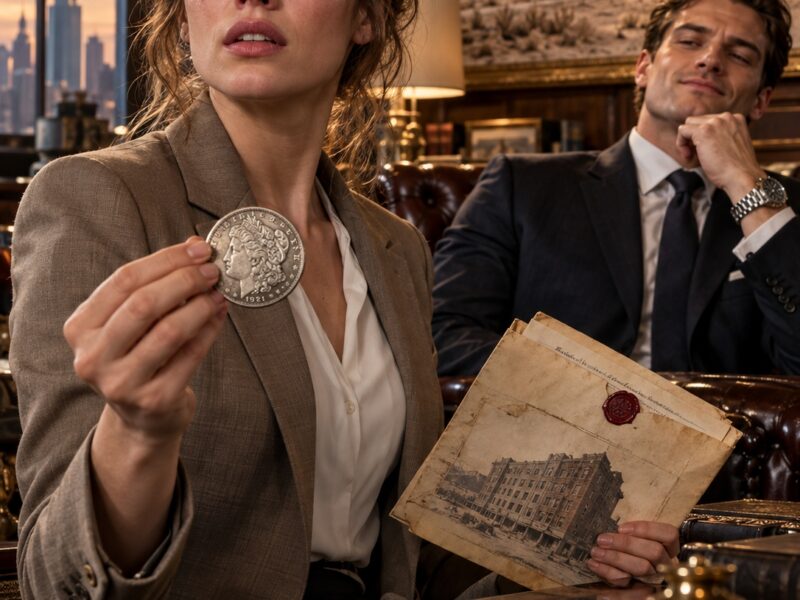
Inside was a coin.
A tarnished 1921 Morgan silver dollar.
For several seconds, nobody spoke.
Then Preston snorted.
“Seriously?”
Camila leaned closer.
“Is it collectible?”
“Maybe thirty bucks,” Preston said. “Don’t spend it all at once, Hy.”
I ignored him.
I opened the envelope.
Inside was a brittle property deed bearing the seal of Esmeralda County, Nevada.
I read the name twice.
ST. CECILIA RESORT AND SPA.
Goldfield, Nevada.
I looked up.
Aldrich’s expression had changed.
Not amusement.
Not quite pity.
Something more complicated.
“Your grandfather has transferred full ownership of the St. Cecilia Resort and Spa to you.”
“What’s that?” I asked.
Preston was already searching on his phone.
Aldrich answered first.
“A hotel.”
Camila smiled.
“How nice.”
“An abandoned hotel,” Aldrich added.
Her smile widened.
Preston found a photograph.
Then he laughed.
Not politely.
Not under his breath.
He actually turned his phone toward Camila and laughed.
The image showed a six-story brick ruin rising from the Nevada desert.
Boarded windows.
Collapsed porch.
Dead landscaping.
A building that looked less inherited than excavated.
Aldrich continued.
“Your cash distribution is one dollar.”
Camila covered her mouth.
It didn’t help.
“A dollar?”
“The dollar has already been applied toward the municipal transfer.”
That did it.
She laughed openly.
Preston stared at me.
“Forty million versus a haunted motel and one dollar.”
“It’s not a motel,” Aldrich said.
Preston shrugged.
“Fine. Haunted luxury accommodations.”
I barely heard him.
I was still staring at the deed.
Because something was wrong.
Not legally.
Emotionally.
Grandpa could be cruel.
He could be manipulative.
He could plan ten moves ahead while everyone else was still deciding whether they wanted to play.
But he was almost never careless.
And leaving me a random building thousands of miles away felt careless.
Until Aldrich opened another file.
“I am required to advise you of the liabilities.”
The laughter faded.
“The St. Cecilia opened in 1912 and has been abandoned since 1982. There are outstanding environmental citations involving asbestos and lead paint, significant structural deterioration, and more than four hundred thousand dollars in unpaid property taxes.”
I stared at him.
“The county intends to initiate final seizure proceedings next month.”
Preston leaned forward.
His smile returned slowly.
“Oh, Grandpa.”
Camila looked delighted.
Preston pointed at the deed.
“He didn’t cut you out.”
He started laughing again.
“He gave you debt.”
I said nothing.
“Do you understand?” he continued. “You can’t sell that thing. You probably can’t insure it. You can’t renovate it. You can’t even demolish it without spending a fortune.”
Aldrich slid a blank document toward me.
“You may renounce the inheritance.”
I looked at him.
“If you do, the property will pass into county seizure and you will avoid assuming its burdens.”
Preston tapped the paper.
“Sign.”
I looked at the blank line.
Then at the Morgan dollar.
And suddenly I wasn’t in Chicago anymore.
I was beside Grandpa’s hospice bed eleven days before he died.
His skin had looked almost translucent.
His hands had trembled.
But when I mentioned a restoration project where contractors had discovered original masonry beneath a cheap 1970s facade, his eyes sharpened.
“They cover good bones with ugly things,” he’d whispered.
I laughed softly.
“Sometimes.”
His hand shot out.
He grabbed my wrist.
Hard.
Much harder than I thought he could.
“Listen to me, Hyacinth.”
I stopped smiling.
“They only look at the shiny things.”
“Who?”
“All of them.”
His eyes had moved toward the closed door.
“Preston sees the penthouse.”
His fingers tightened.
“You know where the strength is.”
“The foundation.”
“Exactly.”
He leaned closer.
“Look below the surface.”
I thought the medication was making him confused.
“Grandpa—”
“Promise me.”
“What?”
“Promise me you’ll look below the surface.”
I promised.
Then he’d released my wrist and closed his eyes.
I’d almost forgotten that conversation.
Until a dead man gave me a ruined hotel.
And a silver dollar.
“Hyacinth.”
Preston’s voice pulled me back.
“Sign it.”
I looked at him.
“Why do you care?”
He blinked.
“What?”
“If it’s worthless, why do you care whether I keep it?”
His expression shifted.
Just for a second.
Then the smirk returned.
“I don’t. I’m trying to stop you from destroying your life.”
“You’ve never been that interested in my life.”
Camila rolled her eyes.
“Oh God.”
I closed the velvet box.
Put it in my pocket.
Folded the deed.
Then pushed the renunciation document back across the table.
“I’m keeping it.”
Silence.
Even Aldrich looked surprised.
Preston stared at me.
“Are you deaf?”
“No.”
“That’s nearly half a million dollars in tax debt attached to radioactive bricks.”
“As you just spent ten minutes explaining.”
“And you’re keeping it?”
“Yes.”
“Why?”
I stood.
Because I didn’t have an answer I could prove.
Because Grandpa had made me promise something in a hospice room.
Because the coin felt too deliberate.
Because Harrison Green had spent fifty years building an empire by understanding what other people overlooked.
But mostly because Preston wanted me to sign too badly.
“It’s my inheritance,” I said.
I picked up my canvas bag.
“And it’s none of your business anymore.”
I walked out before my courage could change its mind.
The elevator doors closed behind me.
Only then did I realize my hands were shaking.
I had just accepted a condemned hotel.
Four hundred thousand dollars in back taxes.
Environmental contamination.
Structural failure.
And exactly zero dollars to solve any of it.
The county would seize the property in three weeks.
I should have been terrified.
Instead, standing alone in that elevator, I reached into my pocket and wrapped my fingers around the Morgan dollar.
Look below the surface.
Two days later, I pointed my Subaru west.
Nevada was not beautiful in the gentle way people meant when they put landscapes on postcards.
It was brutal.
Huge.
The sky seemed too large for the earth beneath it.
Route 95 stretched through sun-bleached sagebrush and rock, my old air conditioner wheezing against afternoon heat.
By the time Goldfield appeared, I had begun wondering whether Preston had been right.
The town looked like a memory nobody had finished erasing.
Goldfield had once exploded with gold money and thousands of people.
Now weathered buildings stood beneath the desert sun like survivors who had forgotten what they were surviving for.
Then I saw the St. Cecilia.
I actually pulled the car over.
The hotel dominated the northern edge of town.
Six stories.
Dark red brick.
Arched windows covered with rotting plywood.
A wraparound porch collapsed at one corner.
Above the entrance, faded gold lettering still spelled out its name.
ST. CECILIA.
It was magnificent.
And ruined.
I understood immediately why Grandpa had left it to me.
Not the secret.
Not yet.
But the building.
Even half-dead, it had presence.
You could see what it had been.
That was the curse of restoration work.
Other people saw rot.
I saw ghosts of craftsmanship.
The proportions of the windows.
The masonry.
The surviving stone lintels.
The curve of the entrance canopy.
I could almost hear orchestras in the ballroom.
Almost see luggage carts rolling across polished tile.
Then a piece of porch railing fell off and hit the dirt.
Reality returned.
“Okay,” I whispered.
“Maybe you’re a little dead.”
I parked in the weed-choked lot.
Respirator.
Flashlight.
Gloves.
Crowbar.
The main entrance was chained, so I circled to an old service door behind the kitchens.
One strike with the crowbar cracked the rotted frame.
The smell inside was immediate.
Dust.
Dry rot.
Old plaster.
Forty years of air that had nowhere to go.
I switched on my flashlight.
The lobby appeared.
And I forgot to breathe.
A double staircase rose toward a mezzanine.
Most of the velvet runners were gone.
The chandelier had shattered across the floor, leaving crystal pieces beneath decades of dust.
Water had damaged the plaster.
Graffiti scarred one wall.
But the bones were there.
Grandpa’s voice returned.
You know where the strength is.
I spent two hours mapping the first floor.
Dining room.
Collapsed casino area.
Kitchen.
Administrative offices.
The manager’s office had been ransacked long ago.
Filing cabinets lay on their sides.
Rain had turned paperwork into gray pulp.
I was preparing to leave when my flashlight caught a line behind the old desk.
A seam.
The wall paneling didn’t quite meet the floor correctly.
Restoration teaches you to notice inconsistencies.
A quarter-inch difference.
Newer mortar.
A nail where no nail should be.
I moved the desk enough to reach the panel.
Then used the crowbar.
The wood cracked.
Something opened behind it.
I froze.
A narrow compartment had been built inside the wall.
There was only one object inside.
A leather folio.
Unlike everything around it, it was remarkably preserved.
I carried it into the lobby and opened it beneath my flashlight.
Blueprints.
Caldwell & Hughes Engineering.
Chicago.
My heartbeat changed.
I spread the sheets across the dusty floor.
First floor.
Second.
Third.
Mechanical systems.
The original plans matched the building almost perfectly.
Then I reached the basement sheet.
Boiler room.
Coal chutes.
Laundry.
Storage.
And beneath them—
I stopped.
A second set of lines had been drawn in different ink.
A large square.
No room designation.
No normal access.
Only two words.
SUB-B RESTRICTED.
“What the hell?”
I traced the route.
There was a service corridor behind the main boiler.
According to the original building around me, that corridor shouldn’t have led anywhere.
According to this blueprint, it went somewhere below the hotel.
I packed the drawings.
Then found the basement stairs.
Every step downward made the air colder.
The basement was a maze of iron pipes and collapsed shelving.
My flashlight moved across rusted boilers the size of trucks.
I counted columns against the blueprint.
One.
Two.
Three.
Main boiler.
There.
I squeezed behind it.
My light hit brick.
Dead end.
I almost laughed.
“Of course.”
I checked the blueprint again.
Same position.
The corridor should have been directly ahead.
I touched the wall.
Old brick.
Old brick.
Old brick.
Then—
Different mortar.
Slightly lighter.
I leaned closer.
Someone had sealed the corridor.
Not in 1916.
Later.
I should have left.
I should have returned with structural equipment and another person.
Instead, I found a loose brick.
And started digging.
Forty minutes later, my palms were blistered beneath my gloves.
Sweat ran into my eyes.
Dust coated my clothes.
Then one brick finally moved.
It fell backward.
I heard it hit something.
Not immediately.
A fraction of a second later.
Hollow space.
My exhaustion vanished.
I widened the opening.
Pulled another brick.
Then another.
Eventually I had a hole large enough to crawl through.
I raised the flashlight.
And every hair on my arms lifted.
The corridor on the other side was not from 1916.
Reinforced concrete.
Modern steel.
Industrial electrical conduit.
At the end stood a door.
Not an ordinary door.
A vault door.
Massive brushed steel.
Perfectly preserved.
The kind of thing you’d expect beneath a bank, not beneath an abandoned desert hotel.
DIEBOLD SAFE & LOCK CO. was embossed on its center wheel.
I approached slowly.
Beside it was a metal box.
No keypad.
No handle.
No keyhole.
Just a vertical slot.
About the width of—
I stopped.
My hand went into my pocket.
The Morgan dollar.
“No.”
I actually laughed.
Not because it was funny.
Because the alternative was admitting a dead man had choreographed this moment.
I held the coin against the slot.
Perfect fit.
Grandpa’s voice whispered through thirty years of dust.
Look below the surface.
I inserted the dollar.
It dropped.
Clack.
Nothing.
I waited.
Still nothing.
“Grandpa, you dramatic bastard.”
Then I noticed cables overhead.
Thick industrial cables led into an alcove.
I followed them.
My flashlight found a Caterpillar diesel generator.
Modern.
Far newer than anything else in the basement.
I checked the gauge.
Full.
Then the battery terminals.
Fresh anti-corrosion gel.
I touched it.
My stomach tightened.
Someone had maintained this machine recently.
In a condemned building nobody supposedly cared about.
There was a breaker panel beside it.
Main power: OFF.
I stared at the switch.
Then flipped it.
Nothing.
The generator had a start control.
I pressed it.
For one second, silence.
Then a mechanical whine.
A cough.
Another.
And the enormous diesel engine exploded to life.
The floor vibrated beneath my boots.
Lights flickered inside the alcove.
Ventilation fans started somewhere overhead.
I ran back toward the vault.
The steel box beside the door now glowed green.
Then—
THUNK.
I jumped.
THUNK.
THUNK.
Massive locking bolts were retracting inside the door.
I grabbed the wheel.
Turned.
Pulled.
Cold air rushed over me.
Not basement air.
Conditioned air.
Clean.
Filtered.
Impossible.
The door opened.
I stepped through.
A sensor clicked.
White LED lights ignited one after another into the distance.
For several seconds, I couldn’t understand what I was seeing.
There was an elevator.
Glass.
Modern.
Its control panel was illuminated.
Waiting.
I looked behind me at the rusted basement.
Then ahead.
The contrast made me dizzy.
I stepped inside.
There was only one button beneath ground level.
I pressed it.
The doors closed.
The elevator descended.
Farther than it should have.
Farther than any hotel basement had reason to go.
Rock disappeared outside the glass.
Then reinforced walls.
Then metal.
Finally the elevator stopped.
The doors opened.
And I understood why Harrison Green had been willing to let the county believe his hotel was worthless.
The underground chamber was enormous.
Climate controlled.
Pristine.
Museum lighting reflected off polished floors.
Glass cases lined one side.
At first I thought the objects inside were reproductions.
Then I saw handwritten provenance tags.
Historical journals.
Engineering drawings.
Rare mechanical documents.
Paintings I recognized from graduate-school books—works believed lost or destroyed decades earlier.
I walked closer.
My reflection stared back from the glass.
Then something on the opposite side of the chamber caught my eye.
Metal pallets.
Rows of them.
Stacked with dull yellow bars.
I approached one.
Gold.
Old gold.
Not glossy modern bars displayed in investment commercials.
Heavy, rough-stamped bullion from another era.
Rows.
And rows.
And rows.
My knees almost gave out.
“No.”
I whispered it again.
“No, no, no…”
A desk stood alone at the center of the chamber.
Mid-century modern.
Perfectly clean.
A laptop sat on it.
Beside it was an envelope.
My name was handwritten across the front.
HYACINTH.
I knew the handwriting.
Suddenly the gold didn’t matter.
The paintings didn’t matter.
Nothing mattered except that envelope.
I tore it open.
Grandpa’s letter began:
My dearest Hyacinth,
If you’re reading this, then you didn’t allow Preston’s arrogance to blind you to the foundation.
I sat down.
The room blurred.
I kept reading.
He wrote that he had spent fifty years building Green Logistics.
He had believed wealth could create security.
Instead, he’d watched wealth change his son, then his grandson.
Preston, he wrote, understood value only when it could be displayed.
Cars.
Watches.
Property.
Status.
Grandpa had spent decades quietly separating his personal wealth from the corporate empire.
Gold bought during market crashes.
Historical acquisitions.
Rare artifacts.
Privately purchased intellectual property.
Assets held outside Green Logistics.
Protected.
Documented.
Placed into the St. Cecilia Trust.
Then came the line that changed everything.
The trust assets were conservatively valued at approximately eight hundred million dollars.
I read the number again.
$800,000,000.
My hands began shaking.
Then Grandpa explained the generator.
A shell corporation financed diesel deliveries and maintenance every six months.
The entire system had been kept alive while the hotel above it was allowed to appear worthless.
And then he wrote about Preston.
Preston inherited Green Logistics.
What he doesn’t know is that the company is leveraged against fifty million dollars in toxic debt.
He wanted the penthouse.
I gave him the penthouse.
But I knew its foundation was failing.
I covered my mouth.
All those years.
All the jokes.
All the family dinners where Preston had spoken about my career as though preserving old buildings were a hobby for people who couldn’t succeed in real business.
Grandpa had been watching.
Judging.
Planning.
His final lines were simpler.
You inherited the foundation.
Restore the hotel.
Revive the town.
Build something that lasts.
With all my love,
Granddad.
I cried.
Not because I was suddenly rich.
That part didn’t even feel real.
I cried because the last conversation in the hospice room finally made sense.
He hadn’t been confused.
He’d been giving me directions.
I pressed the letter against my chest.
And then—
CLANG.
I looked up.
The sound came from somewhere above.
CLANG.
Metal against metal.
My tears stopped.
A voice echoed faintly through the ventilation system.
“HYACINTH!”
My blood turned cold.
I knew that voice.
Preston.
I ran to the laptop.
The screen woke when I touched the trackpad.
Security cameras appeared.
One showed the basement corridor.
Preston stood outside the vault.
Camila was beside him, holding a silk scarf over her mouth.
A third man was there too—large, tattooed, carrying a duffel bag.
Brody Reynolds.
A private investigator Preston occasionally used for corporate work.
My first thought was simple.
How?
Then the answer came through their argument.
Camila had discovered recurring diesel purchases while reviewing Green Logistics accounts.
Thousands of gallons delivered to an address in Goldfield.
They had connected the payments to my inheritance.
Preston had followed.
Of course he had.
He hadn’t cared about my hotel when he thought it was worthless.
The moment it looked secret, it became his.
“Open the door!” Preston shouted.
I searched the laptop.
There was an application.
ST. CECILIA OPERATIONS.
Security.
Intercom.
I pressed the microphone.
“Stop.”
My voice exploded through speakers in the corridor.
All three of them jumped.
Preston stared upward.
Then smiled.
There was something frightening about that smile.
Not because he was angry.
Because he believed he was entitled to be angry.
“You little thief.”
I gripped the desk.
“I didn’t steal anything.”
“You manipulated him.”
“Grandpa?”
“He was dying.”
“He knew exactly what he was doing.”
“Open the door.”
“No.”
His face changed.
“Whatever is down there belongs to Green Logistics.”
“No.”
“You don’t understand how estates work.”
I looked at Grandpa’s letter.
For the first time in my life, Preston’s certainty didn’t make me doubt myself.
“It belongs to the St. Cecilia Trust.”
He went still.
I continued.
“And the trust is tied to the property.”
Camila whispered something.
Preston’s jaw tightened.
“You own a condemned hotel.”
“I own this condemned hotel.”
“I’m executor of the primary estate.”
“And?”
“And I can bury you in litigation until you’re seventy.”
Brody removed a hydraulic jack from his bag.
My confidence evaporated.
“Preston.”
“You should have signed the renunciation.”
Brody wedged the jack into the door seam.
Metal groaned.
“Don’t do this.”
“Open it.”
“No.”
“Then we’ll open it ourselves.”
The jack pumped.
The door shifted.
Barely.
But it moved.
I looked around the chamber.
Eight hundred million dollars.
And suddenly it felt like a cage.
I searched the security controls.
Lockdown.
Elevator disable.
Anything.
But the door bolts were already disengaged because I’d opened it.
Brody pumped again.
The steel groaned louder.
Then another voice came through the camera feed.
Dry.
Calm.
Familiar.
“You might want to reconsider that, Preston.”
Brody stopped.
Preston turned.
A man stepped out of the darkness behind them.
Three-piece suit.
Tortoiseshell glasses.
Dust on his shoes.
Aldrich Perez.
Even through a security camera, I could see Preston’s confusion.
“Aldrich?”
The old lawyer brushed dust from his sleeve.
“What the hell are you doing here?”
“My job.”
Preston pointed at the vault.
“She’s hiding estate assets.”
“No.”
“I am executor—”
“You are the recipient of the corporate distribution.”
“I have Grandpa’s final will.”
Aldrich’s face barely changed.
“No, Preston.”
He reached inside his jacket.
“You have the portion Harrison wanted you to see.”
Silence.
Then Aldrich removed a folded document.
“Harrison left instructions concerning this exact possibility.”
Preston laughed nervously.
“What possibility?”
“You following Hyacinth.”
The smile disappeared.
“Or attempting to seize the St. Cecilia property by force.”
Aldrich handed him the document.
I leaned toward the monitor.
Preston read.
His face slowly drained of color.
“What is this?”
“A severability and non-contest provision.”
“This is bullshit.”
“It is binding.”
Aldrich sounded almost bored.
“At the will reading, you were given an opportunity to challenge Hyacinth’s distribution.”
“I didn’t know what was inside the building.”
“Precisely.”
Aldrich adjusted his glasses.
“You mocked her inheritance. You acknowledged the property as entirely hers and independent from Green Logistics. Your counsel subsequently confirmed acceptance of the distribution.”
Preston looked toward the vault.
“Those assets were bought with company money.”
“No.”
One word.
Quiet.
Fatal.
Aldrich opened another folder.
“I have approximately fifty years of acquisition records.”
Camila lowered the scarf from her mouth.
“What records?”
“Receipts. Tax filings. Dividend statements. Purchase agreements. Provenance documentation.”
Aldrich looked at Preston.
“Your grandfather purchased the assets through personal income and personal investment entities. Taxes were paid. Ownership was transferred into a trust legally tied to St. Cecilia.”
Preston’s hand tightened around the document.
“I’ll sue.”
“You may.”
“I’ll freeze everything.”
“You may attempt to.”
“We have better lawyers than she can afford.”
That came from Camila.
Her designer clothes were covered in Nevada dust and cobwebs now.
For some reason, that detail made everything feel absurdly complete.
Aldrich turned toward her.
“I wouldn’t recommend litigation.”
“Why?”
He looked back at Preston.
“Because you can’t afford it.”
Nobody moved.
Preston laughed.
But it sounded wrong.
“I inherited forty million dollars.”
“No.”
Aldrich’s voice became softer.
“You inherited assets represented to you as having that value.”
Preston stared.
“What are you talking about?”
“Have you reviewed Green Logistics’ third-quarter financial statements?”
His silence answered.
Aldrich continued.
“Three months before Harrison died, Green Logistics secured a fifty-million-dollar balloon facility against its liquid assets.”
Preston’s mouth opened.
“The payment comes due Friday.”
“That’s impossible.”
“Unfortunately, it is extremely possible.”
“My grandfather personally guaranteed our credit.”
“He did.”
“Then the guarantee—”
“Expired upon his death.”
The basement seemed to become silent even through the monitor.
Only the generator continued humming.
Aldrich looked at Preston with something that wasn’t cruelty.
It was worse.
Pity.
“Without Harrison’s personal backing, Green Logistics is insolvent.”
Preston shook his head.
“No.”
“After current liabilities, your personal exposure, and the debt structure you accepted with the corporate distribution are calculated…”
Aldrich paused.
“You are not a multimillionaire.”
Camila stared at her husband.
Aldrich finished.
“As of this morning, you’re approximately twelve million dollars in debt.”
Preston dropped the document.
I watched it flutter onto the dirty concrete.
Nobody spoke.
And in that silence, I understood Grandpa’s final trick.
He hadn’t given Preston nothing.
That would have been obvious.
He had given Preston exactly what Preston had always demanded.
The company.
The estate.
The title.
The visible empire.
The penthouse.
And he had given me what Preston would never have chosen.
A liability.
A ruin.
A mystery.
A foundation.
Brody looked from Preston to Camila.
Then at the hydraulic jack.
Slowly, without saying a word, he removed it from the vault door.
He put it back into his bag.
Preston stared at him.
“Where are you going?”
Brody zipped the bag.
“Mr. Green…”
He hesitated.
“I’ll have my office send the invoice.”
Then he walked away.
I almost laughed.
Almost.
But I looked at Preston on the monitor and couldn’t.
He seemed smaller.
Not humbled.
Not transformed.
Just suddenly stripped of the certainty he’d worn like armor his whole life.
Camila whispered his name.
He didn’t answer.
I pressed the intercom button.
“Aldrich?”
He looked toward the speaker.
“Yes, Miss Green?”
I looked around the chamber.
At the gold.
The paintings.
Grandpa’s desk.
The letter still beneath my hand.
For the first time since the will reading, I smiled.
“Would you like to come down and see the foundation?”
Aldrich smiled too.
“I would be honored.”
Six months later, scaffolding covered the St. Cecilia.
The first thing we restored wasn’t the ballroom.
It wasn’t the suites.
It wasn’t the grand staircase.
It was the foundation.
Grandpa would have appreciated that.
Engineers stabilized the structure.
Environmental teams removed asbestos and lead.
Local contractors rebuilt the wraparound porch using archival photographs.
Stoneworkers repaired the facade.
Carpenters recreated damaged trim.
We hired people from Goldfield.
Then people moved back because there was work.
A diner reopened.
A hardware supplier expanded.
A family bought one of the empty storefronts.
None of it happened magically.
Money solved many problems, but not all of them.
Restoration was slow.
Permits were slower.
People argued.
Budgets changed.
Some sections of the hotel were too damaged to save.
There were mornings when I stood inside St. Cecilia wondering whether Grandpa had left me a gift or a lifelong obligation.
Eventually I realized it was both.
Preston filed for bankruptcy.
The Oak Brook estate was sold.
Green Logistics went through restructuring.
He and Camila moved into a two-bedroom apartment outside Chicago.
I heard about it from Aldrich.
I didn’t celebrate.
That surprised me.
For years I had imagined how satisfying it would feel for someone like Preston to finally be wrong.
But watching a person lose everything is different from imagining it.
Money hadn’t made him cruel.
It had simply protected him from ever needing to examine his cruelty.
Losing it didn’t automatically make him better.
And inheriting eight hundred million dollars didn’t automatically make me wise.
That part was up to me.
One evening, six months into the restoration, I stood on the rebuilt section of the St. Cecilia’s porch.
The Nevada desert stretched beyond town.
The sunset had turned the mountains copper.
Behind me came the sounds of construction.
A saw.
A hammer.
Someone laughing.
A radio playing from inside the lobby.
For the first time in decades, the building sounded alive.
I reached into my pocket.
The Morgan silver dollar was there.
I’d recovered it from the vault mechanism after Aldrich came down.
I carried it almost every day now.
Not because it was valuable.
Compared with what had been hidden beneath the hotel, it was almost worthless.
That was why I loved it.
Grandpa had left Preston the things everyone could recognize as wealth.
Shares.
Accounts.
A mansion.
A company.
He had left me a dollar.
A ruined building.
And a question.
For years, I had thought he respected me because I visited him when the others didn’t.
I was wrong.
Or at least, that wasn’t the whole truth.
He trusted me because of the way I looked at broken things.
Preston saw deterioration and asked what it was worth.
I saw deterioration and asked what could still be saved.
Maybe Grandpa had known the difference long before either of us did.
The wind moved across the porch.
Below me, new lights came on along the street one by one.
Goldfield still wasn’t what it had been during the gold rush.
Maybe it never would be.
That wasn’t the point.
Restoration isn’t about forcing something old to become what it used to be.
It’s about deciding what deserves to survive.
I rolled the tarnished silver dollar between my fingers.
Behind me, beneath six floors of brick and timber and plaster, hundreds of millions of dollars remained protected underground.
But standing there, listening to hammers echo through a hotel everyone else had called dead, I finally understood what my grandfather had really left me.
It wasn’t the vault.
It wasn’t the gold.
It wasn’t even St. Cecilia.
He had left me the one thing Preston had inherited an empire without ever learning.
How to recognize value before someone else puts a price on it.
I closed my hand around the dollar.
Then I heard a contractor inside call my name.
There was another problem with the west staircase.
Something hidden behind the old plaster.
I smiled and turned toward the door.
Because old buildings always have one more secret.
And some inheritances take a lifetime to open.









