MY GRANDMOTHER DIED “POOR”—THEN I OPENED THE CELLAR SHE’D HIDDEN FOR 20 YEARS AND REALIZED SHE KNEW I WOULD COME BACK BROKE
The first thing I saw beneath my grandmother’s garden shed was enough food to survive a year.
The second thing I saw made me sit down on the dirt floor.
The third made me realize I had misunderstood a dead woman for almost twenty years.
My flashlight shook in my hand as its beam moved across shelves built from floor to ceiling beneath the mountain.
Hundreds of glass jars.
Sealed seed packets.
Medical supplies.
Wooden crates marked with dates going back almost two decades.
A blue binder thick with handwritten instructions.
Everything dry.
Everything labeled.
Everything preserved with such obsessive care that it did not look like the forgotten storage room of an elderly woman who had supposedly died poor.
It looked like someone had been preparing for a disaster.
Or for a person.
Then I found the envelope.
My name wasn’t written on it.
It didn’t need to be.
Inside were financial statements, legal documents, correspondence from a county land trust, and numbers I read three times because my brain refused to accept them.
Four days earlier, my nine-year-old daughter and I had been sleeping in a homeless shelter.
I had seventeen dollars in my checking account.
Seventeen.
I had been deciding whether that money needed to become gas, groceries, or the copay for an inhaler Ren would soon need replaced.
And now I was sitting underground beneath the property of the poorest woman I had ever known, staring at proof that she had quietly built the one thing I had spent two years begging life to give my daughter.
A way out.
I pressed one hand over my mouth.
Above me, Ren called through the open trapdoor.
“Mom?”
I couldn’t answer.
“Mom, are you okay?”
No.
I wasn’t.
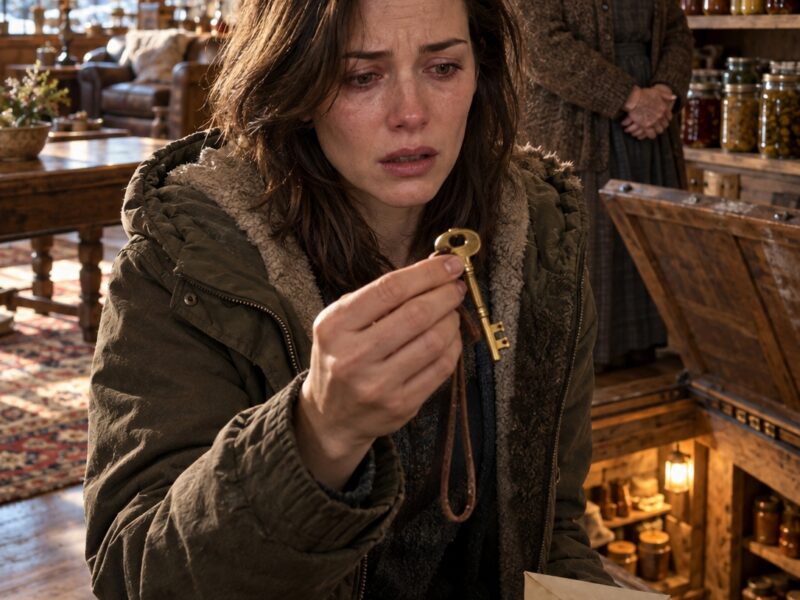
Because suddenly I understood why Grandma Elsa had worn that ugly little brass key around her neck for as long as I could remember.
And I understood something worse.
She had known.
Maybe not exactly what would happen to me.
Maybe not when.
But somehow, years before I lost my apartment, before my job disappeared, before my daughter learned how to sleep through strangers crying behind shelter curtains, my grandmother had begun preparing this place.
For us.
The realization should have felt like salvation.
Instead, sitting on that cold cellar floor, I felt something inside me break.
Because the last thing I had said to Elsa when I was nineteen years old was:
“You don’t care about anybody but yourself.”
And then I had walked away.
I didn’t come back for eighteen years.
She spent those eighteen years building something for me anyway.
Three days before I discovered the cellar, I had thought the brass key was almost worthless.
The lawyer slid it across a laminate desk in an office outside Portland that smelled like old paper, burnt coffee, and recycled air.
“You are the only remaining family,” he said.
I looked at the key.
Then at him.
Then back at the key.
He had used the word estate twice already, which almost made me laugh.
Estate.
Grandma Elsa lived in a weather-beaten cabin up in the Oregon Cascades on a piece of mountain land everybody in the family had always described with the same word.
Worthless.
No paved access.
No commercial timber rights worth fighting over.
No development nearby.
No lakefront.
No ski resort.
No reason for anyone with money to want it.
Elsa made her own soap.
She canned vegetables.
She reused aluminum foil.
She once repaired the same pair of winter boots so many times that the original leather seemed to account for maybe half the shoe.
Nobody called her eccentric.
Nobody called her self-sufficient.
They called her poor.
So when the lawyer said estate, I assumed legal language simply made everything sound more important.
“What exactly did she leave?” I asked.
“The residence. The surrounding acreage. Its contents. There are some additional documents on the property.”
“What kind of documents?”
His expression changed slightly.
“Your grandmother asked that you discover those yourself.”
I stared at him.
“She’s dead.”
“Yes.”
“So we’re still following her instructions?”
A pause.
“She was very specific.”
That sounded like Elsa.
I almost smiled.
Almost.
Instead I picked up the key.
The brass had gone dark around the edges from years of contact with skin.
I remembered it hanging from a thin leather cord around Elsa’s neck when I was a child.
At breakfast.
In the garden.
While splitting kindling.
While kneading bread.
Even while sleeping sometimes, unless my memory had invented that detail.
I had once asked her what it opened.
She’d said, “Something worth keeping.”
I had been seven.
Naturally, I’d imagined treasure.
At thirty-seven, with seventeen dollars in the bank, I knew better than to imagine treasure.
“Is the property sellable?” I asked.
The lawyer leaned back.
“Technically, yes. Though there are restrictions you’ll need to understand.”
Of course there were.
There were always restrictions.
Always conditions.
Always one more problem hiding behind the thing that looked like help.
“How much is it worth?”
“I think you should see it first.”
That answer irritated me.
“I didn’t drive forty minutes to play a scavenger hunt.”
His eyes softened, which irritated me even more because I recognized pity immediately now.
You become very good at recognizing pity when you’re homeless.
“Mara,” he said quietly, “go see the house.”
I took the key.
That was all.
I didn’t tell him that Ren and I had been living at St. Catherine’s Family Shelter since October.
I didn’t tell him that my restaurant job had disappeared when the owner closed with less than two weeks’ notice.
I didn’t tell him about the apartment we’d lost after I fell two months behind.
Or the cousin whose couch lasted six weeks.
Or the friend who said we could stay “as long as necessary” and then started leaving apartment listings open on her laptop.
I didn’t tell him how humiliation changes shape over time.
At first, it’s hot.
Then it’s heavy.
Eventually it becomes practical.
Where can we shower?
Where can Ren do homework?
Which laundromat stays open late?
How long can I make fourteen dollars last?
You stop asking why your life collapsed.
You start asking what closes at nine.
So I put the brass key in my coat pocket and walked out.
Ren was waiting in the lobby with her backpack between her sneakers.
“Did we get the house?” she asked.
Children should not know enough about instability to ask questions like that.
I forced a smile.
“Apparently.”
“Can we live there?”
“I don’t know.”
“Is there heat?”
“I don’t know.”
“Internet?”
That made me laugh.
“Let’s not get greedy.”
She grinned.
For three seconds she looked nine again.
Then she stood, shouldered the backpack containing almost everything she cared about, and followed me outside.
The first week of March still had winter teeth in the mountains.
We borrowed a truck from a shelter volunteer named Denise because my Corolla would never have made the access road.
The pavement ended first.
Then the cell signal.
Then the road narrowed until Douglas firs crowded both sides like dark walls.
Snow lay beneath them in old gray patches.
Ren watched the forest through the passenger window.
“Did you come here when you were little?”
“All the time.”
“Did you like Grandma Elsa?”
The question caught me.
I kept my eyes on the road.
“Yes.”
“You never talked about her.”
“I know.”
“Why?”
Children can ask questions adults spend years arranging their lives to avoid.
“We stopped being close.”
“Why?”
“I was angry.”
“At her?”
“Yes.”
“What did she do?”
I tightened my hands around the steering wheel.
“I don’t remember.”
Ren turned toward me.
“You don’t remember why you were mad for eighteen years?”
There are moments when your child accidentally says something so devastatingly accurate that you have to pretend traffic requires your full attention.
“There was more to it than that.”
“Oh.”
She looked back out the window.
I could tell she didn’t believe me.
Neither did I.
The truck eventually reached a place where the ruts became too deep to risk continuing.
We parked.
I shouldered our duffel.
Ren carried her backpack.
And we walked.
The brass key sat in my coat pocket.
It felt strangely heavy.
The last time I’d traveled that road, I’d been nineteen.
My mother had been dead less than a year.
I had been angry at almost everyone still alive.
Especially Elsa.
She had been incapable of giving me what I believed grief required.
I wanted sentences.
She gave me soup.
I wanted her to tell me she missed my mother.
She repaired the loose button on my coat.
I wanted her to sit beside me and admit that life was cruel and unfair and that I had every right to hate it.
She told me the potatoes needed digging before rain.
At nineteen, I interpreted practical love as emotional absence.
Eventually I exploded.
I remembered Elsa standing near the kitchen sink while I shouted.
I remembered saying she was cold.
I remembered saying my mother had spent her entire childhood trying to escape that mountain because Elsa didn’t know how to love people.
And I remembered the final sentence.
“You don’t care about anybody but yourself.”
Elsa had looked at me for a long time.
She hadn’t defended herself.
That had made me angrier.
“Maybe you’ll understand me someday,” she’d said.
I hated that sentence.
It sounded condescending.
So I left.
I expected her to call.
She didn’t.
Then I waited too long to call her.
Then waiting became pride.
Pride became embarrassment.
Embarrassment became years.
Years became a life.
Until a lawyer called to tell me Elsa had died in November.
The cabin appeared between the trees almost exactly where memory had kept it.
Dark green metal roof.
Small porch.
Gray siding.
Stone chimney.
Nothing grand.
Nothing magical.
Just a house that seemed to have grown from the hillside rather than been constructed on it.
Ren stopped beside me.
“That’s ours?”
The word ours hurt more than I expected.
“For now.”
She looked up at me.
“What does that mean?”
“It means let’s see if the roof leaks before we get sentimental.”
She nodded with the solemn practicality she’d learned from me.
Then I noticed the garden.
And stopped.
It should have been dead.
Not merely dormant.
Abandoned.
Elsa had died months earlier.
But the long raised beds beside the southern wall had been edged recently.
Straw mulch had been laid in neat rows.
The dark soil underneath looked turned and cared for.
Someone had maintained it.
“Mom?”
“I’m fine.”
“You stopped.”
“I know.”
“Why?”
I stared at the garden.
“Because somebody’s been here.”
Ren moved closer to me.
“Like a burglar?”
“No.”
At least, I didn’t think so.
The lawyer had mentioned an elderly neighbor named Carl Bergstrom who checked the property.
Probably Carl.
Still, I felt the first small movement of something I couldn’t name.
Not fear.
Not yet.
Expectation, maybe.
I climbed the porch.
The key turned on the first try.
The door opened.
And the smell hit me.
Wood smoke.
Dried herbs.
Old pine.
Soap.
Something earthy beneath all of it.
For one disorienting second, I was ten years old again.
Elsa was somewhere in the kitchen.
My mother was alive.
Nothing had happened yet.
Then Ren stepped past me.
“Whoa.”
The cabin looked almost untouched.
The black wood stove stood in the corner.
The oak table still bore knife scars and heat marks.
Deep window ledges waited empty for spring seedlings.
And the shelves—
God, the shelves.
Jars covered almost two entire walls.
Tomatoes.
Apple butter.
Pickled beans.
Wild plum jam.
Garlic.
Broth.
Preserved greens.
Each label was written in Elsa’s small, left-leaning handwriting.
Ren touched one carefully.
“2022.”
Another.
“2018.”
She moved farther down.
“Mom. This one’s from 2009.”
“I see it.”
“Can food stay good that long?”
“Depends.”
“Did she make all this?”
“Yes.”
My voice changed on the word.
I walked toward the kitchen.
Cast-iron pans hung in descending order.
Cutting boards had been worn smooth at their centers.
Bundles of rosemary, lavender, and yarrow hung from beams.
Nothing was decorative.
Everything had a use.
And sitting in the center of the kitchen table was a cream-colored envelope.
Four words were written across it.
For when you come.
I didn’t touch it.
Ren came up behind me.
“Is that for you?”
“I don’t know.”
“It says when you come.”
“I can read.”
“So open it.”
“No.”
“Why?”
Because the dead can still frighten you.
Because some envelopes contain explanations you’ve spent years convincing yourself you don’t need.
Because I suddenly had the absurd feeling that Elsa knew I was standing there.
“Later.”
Ren studied my face.
Then, mercifully, she let it go.
We spent the afternoon cleaning dust that barely existed, checking pipes, starting the stove, and inspecting bedrooms.
The electricity worked.
So did the water.
The pantry was stocked.
Not lavishly.
Intelligently.
Rice.
Flour.
Salt.
Coffee.
Oats.
Beans.
Cooking oil.
Soap.
Matches.
Batteries.
Nothing extravagant.
Everything useful.
That was Elsa.
By evening, snow had begun falling lightly.
Ren chose the smaller bedroom.
I found her standing in the doorway staring at the narrow bed.
“What?”
She shook her head.
“Nothing.”
“Ren.”
She rubbed the strap of her backpack.
“Do I get to sleep here by myself?”
The question hollowed me out.
At the shelter, our beds had been separated from another family’s beds by a curtain.
“Yes.”
“Like, every night?”
“As long as we’re here.”
She walked to the mattress and pressed both palms against it.
Then she looked at the door.
“Can I close it?”
“Of course.”
She closed the door halfway.
Opened it.
Closed it again.
Testing privacy like a new appliance.
That night, after she fell asleep, I returned to the kitchen.
The envelope waited.
I sat across from it for almost an hour.
But I still couldn’t open it.
The next morning, somebody knocked.
Three slow knocks.
I opened the door to a tall elderly man wearing a faded canvas coat and a wool cap.
His face looked carved by weather.
“You’re Mara.”
Not a question.
“Yes.”
“Carl Bergstrom.”
I relaxed slightly.
He held out a hand.
“Your grandmother talked about you.”
Something inside me tightened again.
“Recently?”
“All the time.”
I didn’t know what to do with that.
So I invited him in.
Carl sat at Elsa’s table as if his body knew exactly which chair belonged to him.
I made coffee.
Ren emerged in socks and studied him.
Carl studied her back with equal seriousness.
“You must be Ren.”
She nodded.
“Your great-grandmother grew a tomato nearly as big as your head once.”
Ren narrowed her eyes.
“That sounds fake.”
Carl considered.
“Fair criticism. Maybe three-quarters the size of your head.”
Ren smiled.
I liked him immediately for not talking to her like she was five.
He wrapped both hands around his mug.
“I kept the garden going after Elsa couldn’t.”
“She asked you?”
“Ordered me.”
That sounded right.
“She was particular.”
“She was impossible.”
His mouth twitched.
“She was also usually right, which made being impossible much easier for her.”
I laughed before I could stop myself.
It was the first time I’d laughed about Elsa since hearing she died.
Carl looked toward the kitchen.
“You found the letter?”
My laughter disappeared.
“Yes.”
“Read it?”
“No.”
He nodded.
No judgment.
That somehow bothered me more.
“What?”
“Nothing.”
“You looked like you were going to say something.”
“I’ve lived seventy-four years. One of the few useful things I’ve learned is that people open letters when they’re ready to hear what’s in them.”
I folded my arms.
“Did she tell you what it says?”
“No.”
“But you know something.”
“I know Elsa.”
He drank his coffee.
Then said, “She wanted me to show you the cellar.”
The room seemed to change temperature.
“What cellar?”
Carl’s eyes lifted to mine.
“You don’t know?”
“There wasn’t a cellar.”
“There was.”
“I spent summers here.”
“She moved the entrance.”
“Why?”
Carl gave the smallest shrug.
“Probably because she didn’t want people finding it.”
Ren immediately said, “Now we have to see it.”
Carl stood.
“That’s more or less what your grandmother thought.”
The entrance was in the garden shed.
Carl rolled aside a heavy workbench.
It moved too easily.
Casters.
Designed to move.
Underneath was a square wooden trapdoor fitted almost perfectly into the floor.
There was an iron ring at its center.
I looked at Carl.
“How long has this been here?”
“The cellar? Longer than me. This entrance? Twenty-some years.”
“What did she keep down there?”
“Things.”
“What things?”
His expression didn’t change.
“Things she thought somebody might need.”
A cold sensation traveled up my spine.
“Who?”
Carl looked at me.
He didn’t answer.
I pulled the ring.
The trapdoor opened.
Darkness.
A ladder descended below the shed.
Carl handed me a flashlight.
“You coming?” I asked Ren.
“Absolutely.”
“No.”
“Mom.”
“No.”
Her shoulders fell.
“Stay with Carl.”
“I’ll guard her with my life,” Carl said.
“That seems excessive.”
“I’ve got nothing scheduled.”
Ren laughed.
I didn’t.
I descended.
The air changed halfway down.
Cooler.
Drier.
I reached the floor.
Turned.
Raised the flashlight.
And stopped breathing.
Shelves.
Everywhere.
Not clutter.
Not junk.
Inventory.
Rows of glass jars stretched along one wall.
Boxes filled another.
Metal canisters.
Vacuum-sealed packets.
Medical supplies.
Tools.
Seed containers.
Numbered wooden crates.
Labels.
Dates.
Instructions.
It wasn’t a basement.
It was a system.
“Carl?”
“Yeah?”
“How long did she do this?”
Silence above me.
Then:
“She got serious about it around 2005.”
I did the math.
Twenty years.
I moved the flashlight over the nearest shelf.
Beans.
Rice.
Flour.
Preserved vegetables.
Another shelf held seeds.
Another contained sealed medical kits.
Nothing was dusty.
Nothing was neglected.
Everything had been rotated.
Maintained.
Updated.
“What was she preparing for?”
Carl’s answer came quietly from above.
“You.”
I froze.
“What?”
He didn’t repeat himself.
I climbed the ladder too fast.
When I emerged, Carl was standing exactly where I’d left him.
Ren watched both of us.
“What did you mean?”
Carl looked toward the house.
“I think it’s time you opened the letter.”
That evening, after Ren went to sleep, I finally did.
I sat at the oak table.
The stove clicked softly.
Wind pushed against the windows.
I broke no seal because Elsa hadn’t sealed the envelope.
She had simply folded it shut.
Inside were three handwritten pages.
The first line read:
Dear Mara,
I stopped.
For some reason seeing my name hurt more than anything else had.
I continued.
I don’t know what kind of shape things are in for you right now.
I hope they’re fine.
I hope you’re reading this somewhere comfortable and this letter is nothing more than an old woman’s unnecessary preparation.
But life doesn’t always cooperate with hope.
I covered my mouth.
Then kept reading.
Elsa wrote about my grandfather dying when she had forty-three dollars in the bank.
My mother had been five.
The roof leaked.
The land was considered useless because machinery couldn’t easily reach it.
Neighbors pitied her.
She hated being pitied.
So she made a decision.
She would build, as she called it, “the slowest safety net imaginable.”
Not for herself.
For whoever came after.
She learned the soil.
Expanded the garden.
Preserved whatever she couldn’t use.
Saved seeds.
Traded labor for canned goods.
Waterproofed the cellar.
Built shelves.
Learned rotation.
Stored medical supplies.
Made Carl write down everything he knew about the mountain.
Year after year.
Jar after jar.
Seed after seed.
I reached the paragraph about the cellar.
There should be enough stored there to keep a small family fed for close to a year if necessary.
My vision blurred.
I wiped my eyes angrily.
I wasn’t ready to forgive her.
That thought sounds ridiculous now.
But grief is rarely logical.
Some stubborn nineteen-year-old version of me was still alive inside my thirty-seven-year-old body.
Still standing in this kitchen.
Still waiting for Elsa to say the correct words.
Then I reached the next page.
I should tell you about the land.
I sat straighter.
Twelve years earlier, representatives from a conservation organization had approached Elsa.
The property bordered protected forest and contained habitat the county wanted preserved.
She hadn’t sold.
Instead, she negotiated a conservation easement restricting future development.
In exchange, she received compensation.
She invested most of it.
Quietly.
Conservatively.
“I put it somewhere it could grow the way things grow here,” she wrote. “Slowly.”
Then came the sentence that broke whatever defenses I still had.
I know I wasn’t always easy to love.
I put the letter down.
The stove popped.
Outside, wind moved through the fir trees.
I stared at Elsa’s handwriting.
Then picked the letter up again.
I know there were things you needed me to say that I did not know how to say.
That doesn’t mean I didn’t feel them.
My throat closed.
She wrote about our last argument.
Not defensively.
Not accusingly.
She didn’t pretend I had imagined the distance between us.
She admitted it.
Some things don’t get settled, Mara. Sometimes they simply get outlasted.
Then:
I thought about you.
After your mother died, I thought about you even more.
When I heard you had a daughter, I thought about her too, though I never had the privilege of meeting her.
I stopped reading.
My hands were trembling.
How had she known about Ren?
A relative?
A Christmas card?
Carl?
It didn’t matter.
Elsa had known.
And while I was telling myself she had forgotten me, she had been adding shelves beneath the garden.
While I was building an adult life that eventually collapsed, she had been saving seeds.
While I was angry that she never called, she had been preserving food for a great-granddaughter she’d never met.
The final lines were simple.
Whatever you need this place to be, let it be that.
You don’t owe the mountain anything.
You don’t owe me anything.
Just don’t mistake pride for strength. I did that too many times.
I love you.
Elsa.
I read the letter again.
Then again.
I didn’t cry the way movies tell you people cry.
There was no collapse.
No sobbing into my hands.
I just sat there.
Something enormous moved through me too slowly to name.
Anger.
Love.
Shame.
Relief.
Grief.
All of it sharing the same body.
Eventually I whispered into the empty kitchen:
“Why didn’t you just call me?”
The mountain didn’t answer.
Neither did Elsa.
And that mattered.
Because love doesn’t erase failure.
Preparation doesn’t undo eighteen years of silence.
A cellar full of food couldn’t return the birthdays she’d missed.
Money couldn’t give Ren a great-grandmother.
Elsa had loved me.
Elsa had also failed me.
Both things could be true.
Maybe adulthood was learning that most painful truths arrive in pairs.
The next morning, Carl found me drinking coffee on the porch.
“You read it.”
“Yes.”
He sat beside me.
For a while neither of us spoke.
Then I asked, “Why didn’t she call?”
Carl looked across the trees.
“She did.”
I turned sharply.
“What?”
“Not recently.”
“When?”
“Years ago.”
“I never got—”
“She hung up.”
I stared at him.
“She’d dial. Let it ring once or twice. Then she’d lose her nerve.”
“That doesn’t count.”
“No.”
His agreement disarmed me.
“She should’ve tried harder.”
“Yes.”
“She was the adult.”
“Yes.”
“I was nineteen.”
“Yes.”
I looked at him angrily.
“Stop agreeing with me.”
“Would you prefer I lie?”
“No.”
“Then Elsa should’ve tried harder.”
My eyes burned.
Carl continued.
“But she didn’t know how.”
“That isn’t an excuse.”
“No.”
“Then what is it?”
“An explanation.”
We sat quietly.
I hated how much sense that made.
“Did she know we were homeless?”
Carl took longer to answer.
“No.”
Relief came first.
Then pain.
“She knew things weren’t easy. She heard through someone that your restaurant closed. She worried.”
“If she’d known?”
Carl looked at me.
“Mara, if Elsa had known her great-granddaughter was sleeping in a shelter, she’d have driven down that mountain herself at ninety if she had to.”
I stared into my coffee.
“Then why prepare all this instead of finding me?”
Carl’s voice softened.
“Because preparing was something she knew how to do.”
There it was again.
The language I had never learned to read.
Work.
Preparation.
Provision.
Not words.
Never words.
The next four days, we cataloged the cellar.
Ren treated it like an archaeological expedition.
Carl treated it like inventory.
I treated it like evidence in a trial where both defendant and victim were dead versions of people I loved.
There were 243 jars in the cellar alone.
Seeds were organized by variety and year.
Tomatoes.
Squash.
Beans.
Spinach.
Kale.
Herbs.
Several heirloom varieties I had never heard of.
Two crates contained medical supplies.
Bandages.
Antiseptic.
Basic medication.
First-aid manuals.
All current enough to be useful because Elsa had replaced expired items.
That detail got me.
She hadn’t simply stored things.
She had maintained them.
Preparation wasn’t an event.
It was a routine.
A blue binder contained forty-six pages of Carl’s handwriting.
Soil composition.
Planting schedules.
Watering notes.
Frost dates.
Pest control.
Which sections received morning sun.
Which vegetables tolerated the western wind.
Elsa’s handwriting appeared throughout the margins.
Corrections.
Questions.
Arguments.
“Too early.”
“Try again after April 12.”
“More compost.”
“Carl is wrong about beans.”
I showed him that one.
He squinted.
“She was wrong.”
“It’s literally her binder.”
“Dead people don’t become right automatically.”
Ren laughed so hard she nearly fell off a crate.
For a moment the cellar wasn’t tragic.
It was simply a place where three living people were sitting among the work of someone who had gone.
On the fourth day, I reached the final crate.
Under a stack of neatly folded wool blankets was a sealed financial envelope.
Unlike the letter, this one was meant to survive.
Inside were investment statements.
Land-trust correspondence.
Tax records.
Account information.
I read everything twice.
Then called the lawyer.
Then read it again.
It wasn’t a movie fortune.
There were no millions.
No private jet.
No secret mansion.
Elsa had not secretly been rich.
What she’d done was somehow more astonishing.
She had been careful.
The conservation payment had been invested conservatively for years.
There were additional savings.
The house was owned outright.
Taxes were current.
The easement meant much of the land could never become condos or a resort, but that had been Elsa’s intention.
What remained was enough.
Enough to repair the roof.
Enough to replace the ancient heating system.
Enough to cover living expenses while I found work.
Enough to breathe.
Enough that Ren would never have to return to the shelter.
I sat on the cellar floor with the documents in my lap.
For two years, I had lived in numbers.
Rent due.
Days until payday.
Gas remaining.
Hours scheduled.
Account balance.
Late fees.
Calories.
Bus fare.
Every number had represented something disappearing.
This was the first number in years that represented time.
Time to think.
Time to recover.
Time to make a decision before desperation made it for me.
Ren climbed down the ladder.
She saw my face.
“Is it bad?”
“No.”
“Then why do you look weird?”
I laughed through tears.
“Because sometimes good news hurts.”
She considered that.
“That doesn’t make sense.”
“I know.”
She sat beside me.
“Are we selling the house?”
I looked around.
The shelves.
The jars.
The binder.
The preserved evidence of twenty years of stubborn faith.
“I don’t know.”
Her face fell slightly.
She tried to hide it.
“What do you want?” I asked.
“You always say kids don’t make money decisions.”
“This isn’t only money.”
She picked at a thread on her sleeve.
“I like having a door.”
I didn’t understand.
“A door?”
“My bedroom.”
Then I did.
“I like closing it.”
My heart cracked cleanly in two.
“At the shelter, people always walk past. Even if they don’t mean anything.”
She looked embarrassed.
“And here it’s quiet.”
I reached for her hand.
She let me take it.
“I like it too.”
“Do we have to leave?”
I looked toward the ladder.
At the square of daylight above us.
“No,” I said.
And for the first time in two years, I could say that word without lying.
“No. We don’t have to.”
Something changed after that.
Not dramatically.
Real lives rarely transform with music swelling in the background.
There were still problems.
The roof needed work.
One pipe froze.
The truck had to be returned.
The nearest decent job market was far away.
Ren needed to transfer schools.
The cabin’s internet connection behaved like it had a personal grievance against civilization.
I still woke at 3:00 a.m. some nights convinced someone would tell us we’d misunderstood the paperwork and had to leave.
Housing insecurity trains your nervous system to distrust walls.
But morning kept arriving.
And the house was still ours.
One night, Ren found me counting the jars again.
“You already counted those.”
“I know.”
“Then why are you doing it again?”
“I don’t know.”
She leaned against the cellar shelf.
“Because you think they’ll disappear?”
Children notice everything.
“Maybe.”
She nodded.
“I do that with my room.”
I looked at her.
“What?”
“Sometimes I wake up and touch the wall.”
“Why?”
“To make sure it’s still there.”
I couldn’t speak.
Ren shrugged, suddenly uncomfortable with her own honesty.
“It’s stupid.”
“No.”
I pulled her toward me.
She resisted for half a second, then let me hold her.
“It’s not stupid.”
I looked over her shoulder at Elsa’s shelves.
Maybe that was what the cellar really was.
A wall someone had built long before we needed to touch it.
Carl came by most mornings.
In the second week, he arrived carrying a garden trowel and several seed packets.
Ren followed him outside before breakfast was finished.
March was early for most planting, but not everything.
“Spinach,” Carl said.
“Kale.”
“Lettuce.”
He handed Ren a packet.
“And these.”
She read the label.
“Elsa’s Cold Leaf.”
“Your great-grandmother developed that line over years.”
“Like invented it?”
“Plants don’t care much for patents.”
Ren crouched.
Carl showed her how deep to press each seed.
Then they moved to the garlic.
Tiny green points had not yet broken the soil, but Carl showed us where cloves had been planted in November.
“Elsa insisted,” he said.
“She was dying in November.”
“Yes.”
“And she was worried about garlic?”
Carl glanced at me.
“She knew she wouldn’t eat it.”
That silenced me.
“Then why?”
“You know why.”
I did.
I knelt in the soil.
Cold seeped through my jeans.
For the first time, I pictured Elsa not as the old woman I remembered but as a woman my age.
Thirty-seven.
Widowed.
Forty-three dollars in the bank.
A five-year-old daughter.
A leaking roof.
People telling her she was in a sorry situation.
What had she done?
She planted.
Not because planting solved everything.
Because it was something.
Then she preserved.
Then she stored.
Then she learned.
Then she kept going.
There was no dramatic day when Elsa built our salvation.
That was the revelation.
She built it on thousands of ordinary days.
One jar.
One seed.
One repaired shelf.
One investment contribution.
One note in a binder.
One November garlic clove pressed into frozen earth for a spring she might never see.
I had spent eighteen years believing Elsa did not love loudly enough.
I had been right.
She didn’t.
She loved almost silently.
And silence is dangerous because sometimes the people you love cannot hear it.
That was her failure.
But the work was real.
That was her truth.
In April, the garlic emerged.
Ren found it first.
She ran into the kitchen in pajamas.
“Mom.”
I was making coffee.
“What?”
“Come outside.”
“Shoes.”
“No time.”
“For what?”
“It happened.”
The seriousness in her voice made me follow her barefoot.
The ground was cold enough to hurt.
She led me to the garden.
There, in the dark soil, were small green spears.
Straight.
Bright.
Impossible-looking against the remaining patches of snow.
“Garlic,” Ren whispered.
“Yes.”
“Carl said she told him exactly where to plant it.”
“I know.”
“So Grandma Elsa planned this?”
“Yes.”
“Even though she knew she wouldn’t see it?”
I looked at my daughter.
Children sometimes reach the center of a truth without all the detours adults require.
“Yes.”
Ren crouched.
She didn’t touch the shoots.
“That’s kind of sad.”
“It is.”
“And kind of nice.”
“Yes.”
“Both?”
I smiled.
“Both.”
She stood and slipped her hand into mine.
We watched the garden.
More snow had melted from the ridge.
Water dripped from the eaves.
Somewhere farther downhill, a bird called once, then again.
There was nothing cinematic about it.
No revelation waiting behind us.
No lawyer coming up the driveway with another envelope.
Just garlic.
And somehow that was enough.
Because I finally understood what Elsa had spent twenty years trying to say.
The cellar was a sentence.
The garden was a sentence.
The key around her neck was a sentence.
The investment account was a sentence.
Carl’s forty-six-page binder was a sentence.
Two hundred forty-three jars were a sentence.
Every seed she dried and labeled was a sentence.
Every medical supply she replaced before it expired was a sentence.
Every autumn she planted something she might not live to harvest was a sentence.
I had spent my entire adult life waiting for the words.
She had spent hers doing the verbs.
That didn’t mean I had been wrong to need the words.
I wish she’d said them.
I wish she’d called.
I wish she had driven down the mountain while there was still time and knocked on my door.
I wish I’d called her too.
There are no saints in this story.
Only two stubborn women who loved each other badly from a distance.
One of them died before they could fix it.
But before she died, she left the door unlocked for the other.
Maybe that was the closest Elsa could come to an apology.
Maybe my staying was the closest I could come to accepting it.
By May, I found work remotely doing customer support for a regional food distributor.
It wasn’t glamorous.
I didn’t care.
The internet had to be upgraded, which Carl complained about for three straight days despite using it immediately to watch tractor repair videos.
Ren started at the elementary school twenty minutes down the mountain.
On her first day, I packed her lunch in one of Elsa’s old metal lunchboxes.
She stared at it.
“This looks ancient.”
“It probably is.”
“People are going to make fun of me.”
“Then tell them it’s vintage.”
“What’s the difference?”
“Price.”
She rolled her eyes.
Then hugged me before getting out of the truck.
That surprised both of us.
I watched her walk toward school carrying a backpack that no longer contained everything she owned.
That detail destroyed me.
Her backpack was just a backpack now.
Not luggage.
Not emergency storage.
Not a portable life.
Just pencils.
Homework.
A library book.
An apple.
Ordinary things.
I sat behind the steering wheel after she disappeared inside and cried harder than I had when I read Elsa’s letter.
Because survival has a strange cruelty.
You often don’t understand how frightened you were until you become safe enough to stop being frightened.
That afternoon, I went into the cellar.
I didn’t need anything.
I simply sat there.
I thought about Elsa.
Then my mother.
Then myself.
Three generations of women who had mistaken endurance for communication.
My mother had left the mountain because she wanted a different life.
I had left because I wanted a different kind of love.
Ren, I hoped, would never have to leave anything just to prove she could survive without it.
I took Elsa’s letter from my pocket.
I’d started carrying it around.
Maybe I’d inherited that habit from her too.
She carried keys.
I carried explanations.
I read the final lines again.
Whatever you need this place to be, let it be that.
So I decided what it would be.
Not a monument.
Not a shrine.
Not an apology.
A home.
That summer, we ate the first lettuce from the garden.
Then spinach.
Then peas.
The garlic came later.
Ren insisted on harvesting the first bulb herself.
Carl showed her how to loosen the soil without damaging it.
She lifted the plant by its stalk.
A pale bulb emerged from the earth with dark roots dangling beneath it.
Ren held it up triumphantly.
“Look.”
Carl nodded.
“Your great-grandmother would approve.”
Ren looked at me.
“Would she?”
I smiled.
“She’d probably tell you you’re holding it wrong.”
Carl laughed.
“Now you understand Elsa.”
We ate that garlic at dinner.
I don’t remember what else was on the plate.
I remember the smell when it hit the hot cast iron.
I remember Ren talking about a girl from school.
I remember Carl complaining that store-bought tomatoes had become “red water balloons.”
I remember the windows being open.
I remember summer air coming through them.
I remember suddenly looking around the table and realizing I wasn’t waiting for something terrible to happen.
Maybe that sounds small.
It wasn’t.
For almost two years, every good moment had contained a timer.
How long can we stay?
When does the money run out?
When will they ask us to leave?
What happens next?
That night there was no timer.
There was just dinner.
After Ren went to bed, I walked outside.
The mountain was dark.
The garden smelled faintly of soil and tomato vines.
I stood beside the shed.
Then I touched the brass key hanging from my own neck.
I had put it on Elsa’s old leather cord.
Not because I was afraid of losing the cellar.
I knew where the spare was.
I wore it because I finally understood why she had.
A key is a strange object.
Most of its life is spent doing nothing.
It waits.
In a pocket.
On a hook.
Around a neck.
It can wait years without becoming useless.
Its purpose doesn’t diminish because the door remains closed.
It simply remains capable of opening something.
Elsa had lived like that.
Waiting.
Preparing.
Not knowing.
Maybe hoping.
I used to think faith meant believing something good would happen.
Now I think sometimes faith is quieter.
Sometimes faith is stocking a shelf for someone who isn’t coming.
Sometimes faith is planting garlic in November when you’re not sure you’ll see April.
Sometimes faith is maintaining a house for a granddaughter who hasn’t called in eighteen years.
Sometimes faith is writing For when you come instead of If you come.
I looked toward Ren’s bedroom window.
A small lamp glowed behind the curtain.
For years, I had believed I was the last link in a broken family.
But perhaps families aren’t chains.
Maybe they’re gardens.
Some things die.
Some things fail.
Some seasons produce almost nothing.
Some roots survive underground where nobody can see them.
And sometimes something planted by a person who is gone emerges exactly when another person needs proof that winter isn’t permanent.
The next morning, Ren found me in the garden.
She was barefoot.
I pointed at her feet.
“Shoes.”
“You’re barefoot.”
“I’m an adult.”
“That’s not a reason.”
“It’s the only reason adults have for half the things we do.”
She came beside me.
“What are you planting?”
“Beans.”
“Can I help?”
I handed her a seed.
She pressed it into the soil.
Then another.
And another.
Neither of us talked for a while.
Eventually she asked, “Are we staying forever?”
I looked toward the cabin.
The green roof had been repaired.
Smoke curled from the chimney even though the morning wasn’t especially cold.
Carl’s truck was visible farther down the road.
Laundry moved on the line.
The garden stretched beside us.
I thought about giving her the careful adult answer.
We’ll see.
Nothing is forever.
Life changes.
All true.
All useless.
So instead I said:
“This is home.”
Ren looked at me.
“Really?”
“Really.”
She smiled and returned to the beans.
I watched her small fingers push soil over each seed.
And suddenly I could see Elsa’s hands doing the same thing.
My mother’s.
Mine.
Ren’s.
Not ghosts.
Continuity.
I reached beneath my shirt and closed my fingers around the brass key.
For almost twenty years, I’d thought Elsa’s silence meant there was nothing behind it.
I had been wrong.
There had been an entire cellar behind it.
An entire garden.
An entire future.
Love should speak.
I believe that now more strongly than ever.
We should tell people while they’re alive.
We should call.
We should apologize before funerals turn conversations into archaeology.
We should not force the people we love to decode us from the things we leave behind.
But I’ve also learned not to dismiss quiet love just because it doesn’t arrive in the language we expected.
Sometimes somebody has been loving you in verbs while you’ve been waiting for nouns.
Sometimes the apology is a roof that doesn’t leak.
Sometimes the embrace is two hundred forty-three jars on shelves.
Sometimes “I missed you” looks like a garden kept alive through eighteen winters.
Sometimes “I was wrong” is written in the margin of a forty-six-page binder.
And sometimes “I love you” is an old brass key passed across a lawyer’s desk after the woman who wore it is already gone.
That afternoon, Ren and I planted another row.
Then another.
We didn’t know which seeds would take.
That was the point.
You plant anyway.
You prepare anyway.
You love anyway.
Because somewhere between Elsa’s forty-three dollars and my seventeen, between her widowhood and my homelessness, between the words we never said and the garden she refused to let die, one stubborn truth had survived us both:
A life can fall apart much faster than anyone expects.
But sometimes, long before it does, someone who loves you has already begun building the place where you can put it back together.
Quietly.
Patiently.
One shelf.
One seed.
One ordinary day at a time.
And twenty years after I walked away from that mountain believing my grandmother didn’t love me, I stood beside my daughter in the garden Elsa had kept waiting for us.
The garlic was green.
The cellar was full.
The key was warm against my skin.
Ren slipped her dirt-covered hand into mine and asked, “What should we plant next?”
I looked at the dark earth in front of us.
For once, I wasn’t afraid of not knowing what came next.
“Everything we can,” I said.
And for the first time since I was nineteen years old, I wasn’t returning to my grandmother’s house.
I was home.









