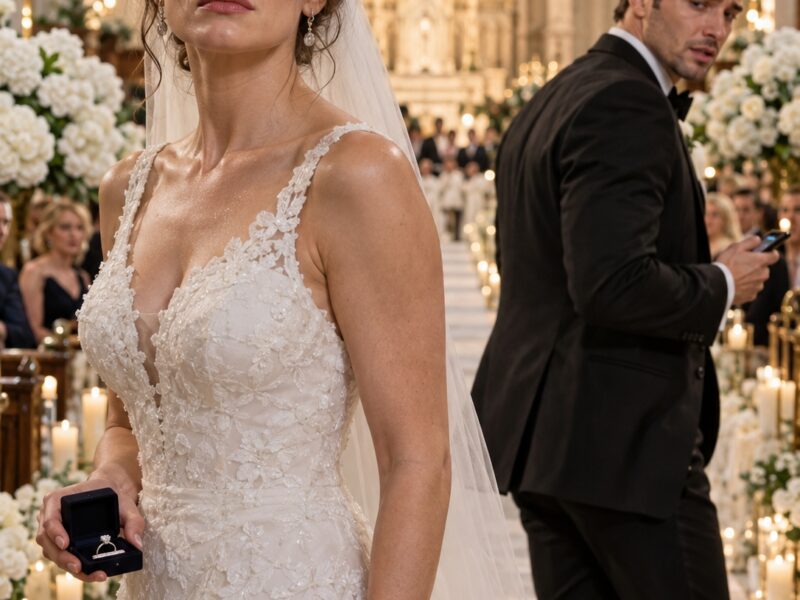
MY GROOM LEFT ME AT THE ALTAR FOR HIS FIRST LOVE—HE HAD NO IDEA I’D ALREADY FOUND OUT WHY

My groom abandoned our wedding before I had even reached the altar.
Not after the vows.
Not after some terrible confession.
Before I had taken ten steps down the aisle.
Three hundred people were sitting beneath white hydrangeas and polished brass chandeliers inside St. Matthew’s in Manhattan when Carter Hayes pressed his phone to his ear, went pale, and ran.
He didn’t ask whether I was all right.
He didn’t take my hands.
He didn’t even keep the ring.
He pulled the small velvet box from his pocket, shoved it into his best man’s palm, and told me to wait.
Because Lena Moore had crashed her car.
Because Lena Moore might be hurt.
Because apparently love, according to the man I had been about to marry, meant understanding why he needed to leave his bride standing beneath the church doors while he rushed to the woman he had loved before me.
The strange thing was that I didn’t cry.
Not then.
The church doors were still open behind me, and rain had begun silvering the stone steps outside. The aisle runner remained perfectly white. The string quartet had stopped halfway through the processional, leaving one violin note hanging in the air like a question nobody wanted to answer.
I stood there in a wedding dress that had taken eight months to make and watched Carter disappear down the side aisle with his tuxedo jacket half unbuttoned.
His mother called after him.
“Carter!”
He stopped.
For one stupid, hopeful second, I thought she was calling him back to me.
Then Evelyn Hayes said, “The cameras.”
Not Sophia.
Not your bride.
The cameras.
That was when something inside me became very quiet.
Carter turned at the church doors.
His blue eyes were wide with panic. Rain blew behind him. He looked like the hero in someone else’s tragedy.
“Sophia,” he said. “Lena hit a guardrail near the FDR. They think she might have internal bleeding.”
A murmur moved through the pews.
Everyone knew Lena.
His childhood neighbor.
His first girlfriend.
His mother’s favorite almost-daughter.
The woman whose name had quietly moved back into our lives six months earlier and somehow found a seat at every dinner, every charity gala, every family weekend, every conversation that should have belonged to Carter and me.
I tightened my fingers around my bouquet.
White lilies.
Evelyn had chosen them.
I had wanted dark red roses.
“Who said she has internal bleeding?” I asked.
Carter blinked.
“What?”
“Did a doctor say that?”
His mouth hardened almost immediately.
“This is not the time to interrogate me.”
“I’m asking who told you.”
“She could be dying, Sophia.”
“That wasn’t my question.”
His face changed.
I recognized that expression. It was the one he used whenever my refusal to become convenient made him feel accused.
“It’s my wedding too,” he snapped, lowering his voice, “and someone I care about might be dying.”
Someone I care about.
Not someone we know.
Not Lena.
Someone I care about.
The language was small, but the meaning wasn’t.
He looked beyond me toward the pews. Near the back of the church, the red light on the livestream camera was still glowing.
Our wedding was being broadcast.
That had been Carter’s idea.
Hayes Development was preparing to close the largest project in its history, a massive redevelopment of the Hudson waterfront involving luxury residences, restored ferry structures, retail space, and historic buildings owned by my family’s company, Grant Restoration.
Our marriage was supposed to make investors feel comfortable.
Two families.
Two businesses.
One future.
My father had called it reassuring.
Carter had called it romantic.
Evelyn Hayes had said wealthy families needed witnesses.
Now the witnesses were watching her son choose another woman before the vows.
Carter came back toward me.
I hated myself for the flicker of relief that passed through my chest.
Maybe he had changed his mind.
Maybe he would take my hand.
Maybe he would finally look at me and understand what he was doing.
Instead, he leaned close.
“Tell everyone we’re moving the ceremony to tomorrow.”
I stared at him.
“What?”
“Just tell them there’s been an emergency. Ask them to go to the reception. We’ll handle this privately.”
“You want me to tell three hundred people to come back tomorrow?”
“We’ll figure it out.”
His eyes searched mine.
Then he said the sentence that ended us before either of us understood it.
“Be graceful, please.”
Graceful.
Women were always being asked to be graceful when men dropped something heavy on their hearts.
I looked over his shoulder.
His best man, Daniel, stood frozen near the front pew with our ring box in his hand.
“If you walk out that door,” I said, “you are leaving me at the altar.”
Pain crossed Carter’s face.
Not enough pain.
“Don’t make this about pride.”
“I’m making it about a choice.”
“There is no choice.”
“There’s always a choice.”
“Sophia, I’ll come back.”
The words hit somewhere old.
He had said them on my thirty-first birthday when Lena called because a pipe burst in her apartment.
He had said them at my mother’s memorial dinner when Lena supposedly had a panic attack in a hotel bar.
He had said them the night we were supposed to sign the venue contract when Lena claimed someone had followed her home.
I’ll come back.
He always did.
Hours later.
Apologetic.
Exhausted.
Certain I would still be where he had left me.
I studied the man in front of me.
Perfect black tuxedo.
Perfectly cut dark hair.
The face I had once thought I would grow old beside.
I loved him.
That was the tragedy.
Not that Carter was leaving.
The tragedy was that I already knew the sound of his footsteps walking away from me.
“No,” I said.
His brow tightened.
“No what?”
“I’m not telling them to wait.”
The church went silent enough that I could hear rain touching the stained-glass windows.
Evelyn Hayes rose from the front row.
She wore silver silk and diamonds that seemed cold even under warm chandelier light.
“Sophia,” she said softly, “this family does not abandon people in crisis.”
I looked directly at her.
“Except brides.”
Someone gasped.
Carter’s jaw tightened.
“I don’t have time for this.”
“Then go.”
He stared at me.
That was the moment I finally understood what he had expected.
Permission wrapped in tears.
He had expected me to beg him to stay, then heroically forgive him for leaving.
He had not expected me to open the door.
“We’ll talk when I get back,” he said.
“No.”
His hand froze around the brass handle.
“We won’t.”
His phone rang.
Lena’s name appeared on the screen.
Carter answered before looking at me.
That was the end.
He ran into the rain.
The church doors closed behind him with a sound so soft it should not have felt like a verdict.
For several seconds, nobody spoke.
Then came the whispers.
Poor Sophia.
Lena must be badly hurt.
Can they postpone the ceremony?
What about the investors?
My father reached me first.
Thomas Grant had always looked younger than his sixty-three years. That afternoon, he suddenly looked seventy.
“Honey,” he said, “maybe we should move everyone to the conservatory.”
“No.”
“Just until we know what’s happening.”
“No, Dad.”
He lowered his voice.
“There are lenders here.”
I looked at him.
That sentence hurt almost as much as Carter leaving.
My father saw it.
“Sophia—”
I handed my bouquet to Harper Bennett, my maid of honor and closest friend since architecture school.
Harper’s hands were shaking with rage.
“Tell me what you need,” she whispered.
“My phone.”
She placed it in my palm.
I stared at the screen for one second.
Then I dialed a number I had saved two nights earlier and prayed I would never need.
The man answered after one ring.
“Sophia Grant.”
His voice was low and controlled.
Not surprised.
Almost as if he had been waiting.
“Mr. Black,” I said. “I need the contingency.”
Silence.
Not confusion.
Confirmation.
“Did he leave?”
“Yes.”
“Are you safe?”
The question almost broke me.
Not Are the investors leaving?
Not Did anyone record it?
Not What did Carter say?
Are you safe?
No one at the altar had asked me that.
“Yes.”
“Then take three minutes. Breathe. I’m five blocks away.”
“You’re in Manhattan?”
“I never left.”
I closed my eyes.
Julian Black was chairman of Black Harbor Capital, one of the most aggressive private lenders in New York real estate.
He was also Carter Hayes’s largest private lender.
Carter called him a shark.
Evelyn called him vulgar money.
My late mother had called him one of the few men in real estate who read contracts before compliments.
Two weeks earlier, Julian had come to my Tribeca restoration studio to review financing protections involving the Hayes Pier redevelopment.
The project was supposed to be the great merger of two legacies.
Hayes Development would build the new residential tower.
Grant Restoration would preserve the nineteenth-century ferry hall, warehouse structures, market buildings, and waterfront facades.
We brought historic tax credits, landmark approvals, and property rights.
The Hayes family brought construction financing, development management, and political connections.
On paper, it looked balanced.
Until I started reading the revisions.
Every new draft Carter’s lawyers sent contained one tiny alteration.
Temporary operating authority.
Temporary asset consolidation.
Temporary family governance.
Temporary post-marital control over restoration grants.
The word temporary appeared seven times.
Temporary.
Five years in one clause.
Three years in another.
Automatic extensions if certain debt covenants were triggered.
My attorney hated it.
So did I.
When I refused to sign before the wedding, Carter accused me of bringing fear into our marriage.
“You trust lawyers more than me,” he had said.
“I trust documents to say what people sometimes won’t.”
He had laughed then.
Not cruelly.
Almost affectionately.
“You’re intense.”
My mother had spent thirty-five years teaching me that details were another word for survival.
Carter called them intensity.
Then the emergencies started.
Lena locked herself out of her apartment.
Lena fractured her wrist.
Lena had a panic attack.
Lena lost her passport before an international trip.
Lena thought someone was following her.
Each crisis happened within hours of some conversation in which I challenged a Hayes Pier document.
Harper noticed first.
She had spread the dates across my office floor two nights before the wedding.
“Look at this.”
I had stared down at the papers.
“What am I looking at?”
“Every time you push back on a governance clause, Lena has a crisis.”
“That sounds insane.”
“Yes.”
“It also sounds paranoid.”
“Yes.”
Harper had looked at me.
“Those two things can be true and we can still check.”
So we checked.
Not illegally.
Not dramatically.
We reviewed calendars, emails, meeting records, public filings.
Enough to find a pattern.
Not proof.
A pattern.
That was when I called Julian Black.
Not because I wanted a billionaire to rescue me.
Because he held the debt.
And debt, unlike love, tended to read the fine print.
Julian sent me three things.
A list of independent counsel.
A copy of the lender’s disclosure obligations.
And one warning.
If Carter married me and activated the temporary governance provisions without signing the final no-transfer amendment, Hayes Development could gain access to assets it had represented to Black Harbor as independently controlled.
If Carter left before signing, the assumptions behind those disclosures became questionable.
“What does that mean?” I had asked.
Julian’s answer came without drama.
“It means the wedding isn’t your trap, Ms. Grant.”
A pause.
“It may be his.”
Now, seventeen minutes after Carter ran from the church, Julian Black walked through the same doors.
Rain darkened the shoulders of his black overcoat.
Every whisper stopped.
He was tall, dark-haired, gray-eyed, and possessed the unnerving stillness of a man who never needed to raise his voice to change a room.
He did not walk toward me like a hero in a movie.
He stopped beside the first pew.
Looked at me.
And said only two words.
“Your choice.”
My choice.
The exact opposite of Carter.
I turned toward three hundred guests.
“The wedding is canceled.”
Evelyn made a strangled sound.
“Sophia.”
I looked at her.
“You cannot make that decision alone.”
My eyes moved to the empty place where her son had been standing.
“I already did.”
My father grabbed my arm.
“What about the reception?”
“We’re still having it.”
He blinked.
“For what?”
I looked toward Julian.
Then at Evelyn.
Then at the camera that had been meant to broadcast a union.
“For the truth.”
The Grant Conservatory stood six blocks away, a vast glass-and-steel landmark my grandfather had saved from demolition in the 1970s.
Rain traced silver lines across the roof.
Old vines climbed black beams.
Thousands of candles had been arranged along long dinner tables beneath hanging greenery.
It should have been beautiful for a wedding.
It was still beautiful.
That mattered.
Beauty did not belong to Carter Hayes.
The guests arrived in a stunned current.
Some came because they cared.
Some came because they wanted gossip.
Some came because dinner had already cost more than most people’s annual salaries.
But they all came.
Good.
Witnesses mattered.
At 6:42 p.m., Carter texted me.
Lena is conscious. I will explain later. Please keep everyone calm.
I read the message twice.
Conscious.
Not in surgery.
Not critical.
Conscious.
I handed the phone to Harper.
She closed her eyes.
“She did it again.”
“No.”
Harper looked at me.
“He did.”
That distinction mattered.
Lena could manipulate.
Evelyn could pressure.
But Carter still chose which voice to obey.
At 7:10, Julian’s legal director arrived.
At 7:18, my attorney came from Brooklyn carrying two document cases and the expression of a woman whose Friday night had just become extremely expensive.
At 7:30, the livestream resumed.
Not as a wedding.
As a statement.
I stood before the same camera wearing my wedding dress.
No veil.
No bouquet.
No groom.
Evelyn hovered near the head table, pale with fury.
“This is reckless,” she whispered.
“No,” I said.
I looked toward the camera.
“This is recorded.”
She stepped backward.
The red light appeared.
I began.
“Earlier today, Carter Hayes left our wedding after receiving a call regarding Lena Moore’s car accident. I sincerely hope Miss Moore receives every medical service she requires.”
I paused.
I meant that.
Lena could be manipulative and still deserve an ambulance.
Cruelty did not become justice merely because I was wounded.
“But today’s ceremony was also connected publicly and financially to a business transaction involving Grant Restoration, Hayes Development, and the Hayes Pier redevelopment. Since Mr. Hayes left before final governance documents were signed, I believe everyone whose money, employment, property, or reputation is connected to that transaction deserves clarity.”
Across the room, Julian remained near the wall.
Not beside me.
Not speaking for me.
That was important.
My attorney projected the first document.
Original agreement.
Grant Restoration assets remained independently controlled.
Second document.
Revised agreement.
Post-marriage temporary management authority would shift to Carter.
Five years.
The room became restless.
Evelyn interrupted.
“This is not the appropriate setting.”
I looked at her.
“It became the appropriate setting when your son asked me to keep investors calm while he ran to another woman.”
Silence.
My attorney continued.
Vendor invoices.
Public-relations retainers.
Influencer contracts.
Wedding photography.
Media production.
Investor hospitality.
Nearly all billed through a Hayes affiliate connected to the Pier project.
My wedding had not merely been a wedding.
It had been investor theater.
My dress.
My face.
My mother’s company.
My family’s buildings.
Carter’s debt.
That was the real aisle I had been walking down.
Then came the accident report.
We did not display Lena’s private medical records.
There was no reason to.
The preliminary police incident record said enough.
Single-vehicle collision.
Low speed.
Minor front-end damage.
Driver transported for observation.
No trapped passenger.
No emergency surgery notation.
No confirmation of internal bleeding.
A ripple moved across the room.
Evelyn looked away.
Harper whispered, “There it is.”
I raised one hand.
“This does not mean Miss Moore wasn’t frightened. It does not mean she should not have received medical attention. It means Carter Hayes left our wedding and delayed returning based on information he did not verify while a major governance agreement awaited my signature.”
My father’s shoulders lowered.
He finally understood.
Not everything.
Enough.
Then my attorney changed the screen.
A preservation request had produced a call log from Carter’s business phone.
Four calls from Lena during the hour before the ceremony.
One to Evelyn Hayes.
One to Carter.
One to Carter’s sister Paige.
Then another to Carter.
A message from Paige to the wedding planner followed.
Hold press package until Carter confirms family emergency angle.
The room erupted.
Evelyn spun toward Paige.
“You said nothing about this.”
Paige sat near the champagne tower, suddenly looking less like a thirty-two-year-old public-relations executive and more like a frightened girl.
“I thought it was just optics.”
Optics.
The word people used when cruelty needed a job title.
I looked straight into the camera.
“I will not participate in a family emergency angle.”
My voice did not shake.
“I will not marry a man who uses my patience as collateral. And I will not transfer one brick, window, tax credit, contract, or piece of my mother’s company through pressure, pity, embarrassment, or public expectation.”
Julian’s legal director stepped forward.
She opened a folder.
Black Harbor Capital was suspending further Hayes Pier disbursements pending review of governance disclosures, project expenses, media representations, and proposed asset-transfer conditions.
No shouting.
No threat.
Just money refusing to continue walking toward a lie.
Evelyn grabbed the back of a chair.
“You are destroying hundreds of jobs.”
I looked at her.
“No. Your family endangered them by tying a construction project to a marriage you didn’t respect.”
For once, Evelyn Hayes had nothing to say.
The first investor left the room before dessert.
The second made a call near the bar.
By nine o’clock, the senior lender requested clarification.
By ten, two architecture partners paused deliverables.
At eleven thirteen, the conservatory doors opened.
Carter walked in.
Still wearing his tuxedo.
Rain in his hair.
A paper visitor bracelet from the hospital clung to his wrist.
For one terrible second, my heart remembered him before my mind remembered the aisle.
Then he saw the screen.
The documents.
The guests.
Julian.
Me.
“What did you do?” he demanded.
I almost laughed.
Not because anything was funny.
Because even then, his first instinct was accusation.
“I told the truth.”
He walked toward me.
“Lena could have been seriously hurt.”
“Was she?”
He stopped.
“She was scared.”
“That isn’t what I asked.”
His jaw flexed.
“No.”
The room heard him.
So did the cameras.
“She wasn’t seriously hurt.”
“When did you know?”
He looked away.
That was answer enough.
“What time, Carter?”
“Sophia—”
“What time did you know?”
“About six thirty.”
The ceremony had been scheduled for five.
My statement began at seven thirty.
He had known for an hour.
He had not called me.
He had not returned.
He had sent one message asking me to keep everyone calm.
Something inside me became completely still.
“Why didn’t you come back?”
His eyes flashed.
“Because Lena was shaken. Because Mom kept calling. Because I knew you’d be angry.”
I stared at him.
“You were afraid I’d be angry.”
“That isn’t what I meant.”
“So you allowed me to remain publicly humiliated because facing my anger was harder than staying with Lena.”
“Sophia—”
The doors opened behind him.
Everyone looked.
Lena Moore walked into my wedding reception.
No wheelchair.
No oxygen.
No dramatic bandages.
Just a narrow strip of gauze at her temple and a beige hospital cardigan over the black dress she had apparently been wearing when she crashed.
Her face was pale.
Her eyes were dry.
She stopped when she saw the room.
Then another man entered through the side door.
Noah Chamberlain.
The private investigator my lawyer had retained forty-eight hours earlier.
He carried a signed witness statement.
Not secret photographs.
Not illegal recordings.
A taxi driver’s contact information.
Insurance documentation.
Public road-camera records.
The taxi driver who had been behind Lena’s car reported that she had slowed significantly before drifting toward the guardrail.
He remembered because her brake lights flashed twice.
He also reported seeing her looking downward immediately beforehand, apparently at a phone.
None of that proved she intentionally crashed.
It proved the event deserved more questions than Carter had bothered to ask.
Lena’s face changed.
Carter saw it.
For the first time that day, he looked at her not with concern but uncertainty.
“Lena?”
She grabbed his sleeve.
“I was terrified. I called you because I didn’t know who else to call.”
I spoke from across the room.
“You called Evelyn first.”
Lena froze.
The call log returned to the screen.
Evelyn.
Carter.
Paige.
Carter again.
Lena’s fingers loosened around his sleeve.
“I was confused.”
Harper spoke from beside me.
“You were organized enough to reach the groom, his mother, and his sister before you followed up with emergency services.”
Lena’s expression hardened.
The fragile woman disappeared.
“You know nothing about what it feels like to be abandoned.”
I looked at Carter.
Then back at her.
“Actually, I learned today.”
Nobody laughed.
Good.
It wasn’t a joke.
Lena turned desperately toward Carter.
“Are you going to let her attack me?”
There it was.
The command that had governed their entire relationship.
Choose me.
Protect me.
Prove I still come first.
Carter hesitated.
Only two seconds.
But for Lena, two seconds was betrayal.
“You promised,” she whispered.
His face changed.
“What?”
“You promised you’d never let them erase me again.”
Evelyn hissed her name.
“Lena.”
Too late.
I turned slowly.
“Again?”
Carter went pale.
Lena covered her mouth.
My lawyer opened another file.
Seven months earlier, one month before Carter proposed to me, Lena Moore had signed a consulting agreement with Hayes Development.
Brand recovery.
Community narrative.
Event alignment.
Ten thousand dollars a month.
Charged through Hayes Pier.
The entire room understood before Carter seemed to.
Lena had not simply returned to New York as the wounded first love.
She had returned on payroll.
Evelyn had approved the contract.
Paige had managed communications.
Carter stared at his mother.
“You hired her?”
Evelyn’s spine straightened.
“She understood the family.”
“You put her on the Pier payroll?”
“It was temporary.”
Temporary.
Again.
The favorite word of people who wanted permanent consequences without permanent accountability.
I turned to Evelyn.
“You paid your son’s former girlfriend with money connected to a project involving my company.”
“She provided legitimate consulting.”
“To do what?”
Evelyn looked at me.
“Protect Carter’s image.”
Lena lifted her chin.
“I helped him.”
Then she looked at me.
“You only judged him.”
“I loved him.”
Carter flinched.
I continued.
“That was my mistake.”
I reached down.
Removed my engagement ring.
The diamond was oval, flawless, old, and heavy with Hayes family history.
For eighteen months I had worn it as evidence that Carter had chosen me.
Now it felt like evidence of how badly I had misunderstood the question.
I placed it beside the unsigned governance documents.
“The wedding is over.”
Carter’s voice broke.
“Sophia.”
“The engagement is over too.”
He stepped toward me.
Julian moved.
Only one step.
Not between us.
Not possessive.
Just close enough that Carter noticed.
Jealousy immediately sharpened Carter’s face.
“So this is about him.”
I almost felt sorry for him.
Men like Carter often needed another man to explain why a woman might finally choose herself.
“No,” I said quietly. “This is about the man who left.”
He had no answer.
I walked out through the side door my mother once used when she managed events at the conservatory.
The rain had stopped.
For one minute, Manhattan smelled washed clean.
It wasn’t.
Neither was I.
But for one minute, it was enough.
The next morning, my abandoned wedding was everywhere.
BRIDE TURNS FIANCÉ’S EMERGENCY INTO BUSINESS WAR.
HAYES WEDDING COLLAPSE EXPOSES WATERFRONT FINANCING FIGHT.
BILLIONAIRE LENDER ENTERS AFTER GROOM FLEES CEREMONY.
The internet divided itself into teams because that was what people did when a woman refused to suffer privately.
I stopped reading after ten minutes.
Then I went to work.
Grant Restoration occupied a brick building in Tribeca where original brass hinges sat in glass drawers and the walls were covered with paint samples dating back one hundred years.
My mother, Margaret Grant, had built the company from city contracts no developer wanted.
Firehouses.
Libraries.
Brownstones.
Forgotten theaters with broken plaster angels.
She believed buildings remembered everyone who touched them.
She also believed daughters should inherit responsibility, not fear.
At ten that morning, our board assembled.
My father arrived first.
He closed the conference-room door.
“I failed you yesterday.”
I did not rescue him from the truth.
“Yes.”
He swallowed.
“I kept thinking about the Pier financing. The lender covenants. The employees.”
“So did I.”
“I know.”
That was new.
Not enough.
But new.
The board voted to terminate all proposed marital governance clauses.
Then to suspend Hayes Development’s management authority pending review.
Then to audit every Pier expenditure connected to Lena Moore.
Every vote passed.
Every vote sounded like a lock opening.
By three that afternoon, Carter had called seventeen times.
I answered none.
At four, white lilies arrived.
I sent them to a hospital waiting room.
Let emergencies have them.
Two days later, Lena gave an interview.
She wore a neck brace.
By noon, a reporter had confirmed that no physician had prescribed one.
The image spread faster than her explanation.
She said she had never intended to interrupt my wedding.
Then she said I had always been jealous of her connection with Carter.
Then she cried.
She was good at crying.
But the network placed the call log beside her face.
Evelyn first.
Carter second.
Paige third.
Carter fourth.
Her tears had less room to work after that.
The insurance inquiry deepened.
The taxi driver gave a formal statement.
Traffic footage showed Lena’s car traveling at low speed before moving toward the barrier.
No investigator publicly called it intentional.
Neither did I.
Evidence mattered.
So did restraint.
But lenders disliked unexplained patterns.
Black Harbor froze the Hayes Pier credit line.
Julian called me that evening.
“You should hear this before the press does.”
I looked out my office window.
“What happened?”
“Hayes Development asked us to reopen financing with Grant Restoration removed from the deal.”
“And?”
“I declined.”
“Why?”
“Because the historic assets are yours.”
No compliment.
No speech.
Just a boundary.
I had forgotten how attractive boundaries could be.
“Thank you.”
“Don’t thank me for basic due diligence.”
I smiled for the first time in two days.
“That was almost warm, Mr. Black.”
“I’ll recover.”
The laugh that escaped me hurt.
But it came.
One week after the wedding, Carter came to my office.
Security called before letting him upstairs.
I met him in the lobby.
Glass walls.
Cameras.
Witnesses.
Lessons learned.
He wore a charcoal suit and looked ten pounds thinner.
His eyes moved across my face as if he expected to find the old Sophia waiting inside it.
She wasn’t.
“Sophia.”
“Carter.”
He took a breath.
“Lena lied.”
“About what?”
“The accident. The severity. The panic. Maybe more.”
“And before that?”
His brow tightened.
“Before what?”
“My birthday.”
He said nothing.
“My mother’s memorial dinner.”
Silence.
“The contract night. The lender call. The rehearsal dinner.”
His face slowly changed.
I stepped closer.
“Did Lena lie every single time, Carter? Or did you enjoy having someone who made you feel heroic?”
That question hurt him more than accusation.
Accusation gave Carter something to fight.
Truth gave him a mirror.
After a long time, he said, “I liked it.”
The honesty surprised both of us.
He rubbed both hands across his face.
“With you, I had to be accountable. You asked questions. You noticed things. You expected me to show up before there was a disaster.”
I said nothing.
“With Lena…” He swallowed. “I only had to arrive.”
There it was.
The shape of the whole catastrophe.
“Arrival is easier than love,” I said.
His eyes filled.
“I’m sorry.”
“I believe you.”
Hope moved across his face.
I stopped it.
“That doesn’t change my answer.”
“Sophia, please.”
“No.”
“I can fix the contracts. I can remove my mother from the project. I can cut Lena off completely.”
“You’re listing repairs because you want to keep something you already lost.”
He stepped forward.
Security moved.
Carter noticed and stopped.
Good.
His voice became quiet.
“Did you love me?”
I hated him a little for asking.
Not because the answer was no.
Because it was yes.
“Yes.”
His face crumpled.
“I loved you enough to keep waiting much longer than I should have.”
“And now?”
“Now I love myself enough to stop.”
He covered his mouth.
The silence stood between us.
Then he asked the question I had known was coming.
“Is it Julian?”
“No.”
“He wants you.”
“Maybe.”
Carter flinched.
“But Julian didn’t make me leave you. You did that before he ever entered the church.”
For once, Carter did not argue.
He simply nodded.
Strangely, that made it harder.
Regret had finally reached him.
It had simply arrived after the bride was gone.
The investigations lasted three months.
Lena’s consulting payments were deemed improperly charged to the Pier project.
Paige admitted coordinating the “family emergency angle” with Evelyn because they wanted to protect Carter’s public image if he left the ceremony.
Evelyn resigned from the Hayes Foundation board after donors threatened to withdraw.
Carter stepped down from leadership of Hayes Pier.
Hayes Development remained involved only under independent oversight.
Grant Restoration retained full control over its landmark properties.
Black Harbor agreed to restructure financing without any marital-transfer provisions.
My father signed the final agreement with me as lead executive.
Not daughter.
Not future Hayes wife.
Lead executive.
That title mattered.
But paperwork did not make the emotional damage disappear.
Lena fought back first.
She hired a reputation-management firm and released a statement claiming my company had bullied an injured woman to protect a commercial transaction.
If she had stopped with her personal pain, I might have stayed silent.
She didn’t.
So my attorneys responded.
Not with medical records.
Not with gossip.
With evidence.
Her consulting contract.
The Pier invoices.
The call sequence.
The insurance inquiry.
The taxi driver’s statement.
Paige’s email containing the words family emergency angle.
Within forty-eight hours, Lena’s reputation firm resigned.
It was one of the quietest humiliations I had ever seen.
No screaming.
No public confrontation.
Just a company deciding its client had become too expensive to believe.
Lena called me afterward.
I did not answer.
She left a voicemail.
Her voice was different.
No trembling.
No dramatic pauses.
Just exhaustion.
“You always had everything, Sophia.”
I listened.
“A father. A company. A family name people respected. Carter was the only thing I had first.”
I listened again.
Not because the message softened me.
Because motive mattered.
Lena had not created crises because she loved Carter more than I did.
She needed Carter choosing her to prove the world had not permanently rejected her.
That was different.
And in some ways, more dangerous.
“Evelyn told me that after he married you, I’d disappear,” Lena continued. “She said you’d make him serious. She said serious men forget old promises.”
Evelyn.
Again.
Not the woman driving the car.
Not the woman calling from the hospital.
But the hand placing matches beside dry wood.
Then Lena said something I believed.
“I didn’t think he would actually leave the church.”
I closed my eyes.
She had manufactured a crisis.
She had trusted Carter to choose her.
And even Lena seemed shocked by how completely he had done it.
I forwarded the voicemail to my attorney.
Then sat alone in my office until the afternoon light changed.
Harper came in without knocking.
She carried soup.
“You listened to her?”
“Yes.”
“Did she apologize?”
“No.”
“Then eat.”
I looked at her.
“That’s your advice?”
“It’s my advice until your blood sugar stops making decisions.”
I laughed.
Harper pointed the spoon at me.
“That. More of that.”
She understood which wounds required analysis and which ones required noodles.
A week later, Evelyn Hayes requested a private meeting.
I refused.
She requested mediation.
My lawyer accepted.
Mediation had rules.
Rules were useful when dealing with people who mistook manners for weakness.
We met in a law office above Bryant Park.
Evelyn arrived wearing navy wool and one diamond bracelet.
Understated for her.
Still worth more than most cars.
Carter came separately with separate counsel.
That told me everything.
The family had cracked.
Julian attended because Black Harbor held a lender claim related to the dispute.
He sat at the far end of the table and said nothing.
His silence had weight.
Evelyn began with sorrow.
Of course she did.
“No mother wants to see her son suffer.”
I looked at her.
“Then you shouldn’t have trained him to avoid discomfort at other people’s expense.”
Her mouth tightened.
Carter looked down.
The mediator cleared his throat.
Evelyn tried again.
“The Hayes family deeply regrets the way the wedding unfolded.”
“The wedding didn’t unfold.”
She stared at me.
“It was handled.”
The mediator wrote something down.
Good.
Handled was accurate.
The Hayes family might not have planned every detail of Lena’s crash.
But they had planned the story that would follow if Carter ran.
They had built a system where my humiliation could be converted into investor reassurance.
That was enough.
Evelyn’s lawyer slid a settlement proposal toward me.
Mutual public statement.
No admission of wrongdoing.
All parties moving forward with respect.
Limited continued use of Grant Restoration imagery in Hayes Pier promotional archives.
I picked up a pen.
“No.”
Evelyn stared.
“You’ve already won.”
“This isn’t a contest.”
“Then what more do you want?”
“Accuracy.”
The word sat between us.
Plain.
Uncomfortable.
I crossed out mutual.
Crossed out moving forward with respect.
Crossed out continued image use.
Crossed out no admission.
Then wrote my terms.
Hayes Development would acknowledge that the wedding livestream had been used in investor communications after material project terms changed without my informed approval.
The “family emergency angle” email would be formally described as improper.
My name and Grant Restoration imagery would be removed from Hayes promotional materials.
Lena’s consulting payments would be repaid to the project account.
And Evelyn Hayes would personally fund a preservation fellowship for women-led restoration firms.
No gala.
No naming rights.
No plaque.
Just the money.
Evelyn stared at me.
“You want me to finance women who could compete with your company?”
“Yes.”
“That is absurd.”
“No. That is repair.”
For the first time, Julian spoke.
“It’s also cheaper than litigation.”
Evelyn looked at him like she wanted to cut glass with her eyes.
Julian looked bored.
Many powerful men feared Evelyn Hayes.
Julian’s indifference reduced her more effectively than an insult.
Carter picked up my marked proposal.
He read every line.
Then said, “We should accept.”
Evelyn turned toward him.
“You don’t understand what she’s doing.”
“Yes, I do.”
His voice was different now.
Quieter.
“She’s making sure we can never call this a misunderstanding.”
Evelyn’s face changed.
That was exactly what she had wanted.
Time.
Fog.
Years later, a softened story.
Sophia was emotional.
Carter was conflicted.
Lena was injured.
Everyone meant well.
The families moved on.
No.
Not this time.
Carter looked at me.
“I spent years letting you be the reasonable one,” he said. “I think I need to be reasonable now.”
It was not enough to rebuild anything between us.
But it was enough to sign.
By the end of mediation, Evelyn agreed.
She never apologized.
That was fine.
Her money would eventually do more good than her words.
The Pier project restarted slowly.
We reduced the luxury footprint.
Added public river access.
The old ferry hall became a market for local vendors.
A warehouse became studios for artists and craftspeople.
The residential tower still rose above everything, but it no longer swallowed the history around it.
That was my mother’s kind of restoration.
Not freezing the past.
Making it useful without erasing its soul.
Julian visited the site one cold morning in December.
He wore a black overcoat.
No scarf.
Rich men often behaved as though weather were an administrative inconvenience.
I handed him one from the site office.
“Put this on.”
He looked down at it.
“Is that an order?”
“Basic due diligence.”
He put it on.
I was absurdly pleased.
We walked through the ferry hall while workers installed repaired iron railings.
I explained the original tile pattern.
Julian asked questions that proved he had read the preservation reports.
Not skimmed.
Read.
Carter used to tell me details made me intense.
Julian described them differently.
“Evidence of care.”
That was how love began to change shape for me.
Not as rescue.
As translation.
Someone finally understood the language I had been speaking all along.
But I did not run into Julian’s arms.
That mattered too.
For months, kindness made me suspicious.
When he sent a revised term sheet, I searched for traps.
When he offered his car after a late zoning hearing, I ordered my own.
When he remembered that I hated white lilies, I wondered who had told him.
He noticed.
Of course he did.
One rainy night outside City Hall, he held an umbrella over us.
I stepped away from it.
He lowered the umbrella.
No complaint.
No wounded pride.
Just space.
“You can say it,” he said.
“Say what?”
“That you’re waiting for me to turn kindness into a contract.”
I stared at him.
He looked back without accusation.
“I am.”
“Good.”
I almost laughed.
“Good?”
“It means you’re paying attention.”
That answer stayed with me.
Carter had treated trust like proof of love.
Julian treated trust like something that should survive inspection.
For the first time, I stopped treating caution as damage.
Maybe I was not broken.
Maybe I had finally learned quality control.
Inside the ferry hall, Julian stopped beside a cracked marble column.
“Your mother saved this?”
“She did.”
“Why?”
“The city wanted to replace it. She said repair teaches more than replacement.”
He looked at me.
“Do you believe that?”
I thought about Carter.
Lena.
Evelyn.
My father.
Myself.
“Sometimes.”
“Only sometimes?”
“Repair requires consent from the damaged thing.”
Julian nodded slowly.
“That’s worth remembering.”
The preservation fellowship held its first workshop in that same building.
Five women.
Two structural engineers.
Three damaged windows.
Enough coffee to remove paint.
I taught them how to identify water damage.
Julian arrived carrying lunch and attempted to leave before anyone made him speak.
Tessa, the youngest fellow, intercepted him near the tool carts.
“Are you the money?”
Julian looked at me.
I raised one eyebrow.
“In some contexts.”
“Great,” Tessa said. “The money can carry boxes.”
Nobody breathed.
Julian removed his coat.
Then carried boxes.
That was the day Harper decided he was acceptable.
Later she told me, “Any billionaire who moves hardware without giving a speech has potential.”
“You’re impossible.”
“That’s why you keep me.”
She was right.
Six months after the wedding, Carter testified during a financing review.
He admitted leaving the ceremony because of panic, guilt, and pressure.
He admitted learning Lena was stable long before returning.
He admitted asking me to keep investors calm without giving me the truth.
He made no excuses.
That mattered.
Accountability was less dramatic than people imagined.
Nobody screamed.
Nobody fainted.
There was no perfect sentence that destroyed the room.
It sounded like regulators asking the same question twice.
It looked like Carter reading his own emails and realizing charm did not qualify as compliance.
He had to explain why our wedding livestream appeared in lender materials.
Why Grant Restoration photographs remained in investor decks after I withheld approval.
Why Lena’s consulting invoices had been charged to a construction project where she performed no construction function.
Sometimes he answered badly.
Sometimes honestly.
But he answered.
Evelyn sat behind him.
For once, she could not interrupt.
Her silence looked expensive.
It also looked powerless.
Afterward, I saw Lena in the hallway.
I had not expected her.
She wore a gray coat.
No neck brace.
No gauze.
No costume.
For the first time, she looked ordinary.
That made her harder to hate.
She stopped six feet away.
“I’m leaving.”
“New York?”
“Everything.”
I said nothing.
She pushed her sunglasses onto her head.
Her eyes were exhausted.
“I used to think that if Carter chose me in front of enough people, it would fix what happened when we were younger.”
“What happened?”
“His family decided I wasn’t good enough.”
She looked away.
“Then they decided you were useful enough.”
That landed differently than I expected.
Lena gave a small bitter laugh.
“That’s the cruelest thing about families like the Hayes family. They can make two women feel opposite kinds of worthless and still call it standards.”
“That doesn’t excuse what you did.”
“I know.”
The words sounded scraped out of her.
“I wanted him to run,” she said. “I wanted everyone to see that he would run for me.”
I stayed silent.
“I told myself that meant he loved me. But when he reached the hospital…”
Her voice broke.
“He looked terrified.”
“For you?”
“No.”
She met my eyes.
“For what he had done.”
I pictured Carter beside that hospital bed, finally seeing the altar behind him.
Late.
Always late.
“I don’t expect forgiveness,” Lena said.
“Good.”
Her mouth moved.
Almost a smile.
“You were always sharper than he deserved.”
“So were you.”
She frowned.
“What?”
“You could have built something with all that strategy.”
Her eyes widened.
“Instead you spent years trying to be chosen by people who enjoyed watching women compete.”
This time, when tears filled her eyes, I believed them.
That did not make them mine to hold.
“Goodbye, Lena.”
She nodded.
Then walked away.
No victory music.
No final humiliation.
Just a woman leaving New York with fewer illusions than she brought.
I hoped she did something better with the rest of her life.
I also hoped she did it very far from mine.
That evening I went back to the Pier.
The workers had left.
Wind pressed against temporary plastic sheeting.
Bare wires hung from the ferry-hall ceiling.
Fresh mortar darkened the brick.
The repaired iron railings waited beneath canvas.
This was the place Carter had nearly taken from me through a wedding.
It did not look romantic.
It looked unfinished.
That was why I loved it.
Unfinished things still had choices.
Julian found me near the river doors.
“Harper said you might be here.”
“Harper talks too much.”
“She also threatened me with a staple gun if I allowed you to skip dinner.”
“That sounds like Harper.”
He lifted a paper bag.
“Soup?”
I stared at him.
“Is soup everyone’s answer to my emotional collapse?”
“Often.”
“Does it work?”
“You keep accepting it.”
I took the bag.
Warmth moved into my hands.
We stood without speaking.
The river struck the pilings beneath us.
Lights trembled across the dark water.
“Lena’s leaving,” I said.
“I heard.”
“Carter testified.”
“I heard that too.”
“Do you hear everything?”
“Only expensive things.”
I laughed.
Then, without warning, the laugh broke into something dangerously close to a sob.
Julian did not touch me.
He waited.
I hated how much that helped.
“I thought I’d feel cleaner once everyone admitted enough.”
“Do you?”
“No.”
I stared into the dark hall.
“I feel tired.”
“That’s often what comes after surviving.”
I looked at him.
“You sound like you know.”
Something in his expression closed slightly.
Not against me.
Against memory.
“My father built companies by making people grateful for less than they deserved,” he said. “It took me years to stop calling that discipline.”
It was the first truly personal thing Julian had given me without being forced by a crisis.
I held it carefully.
“Is that why you read contracts before compliments?”
“Yes.”
“My mother would have liked that answer.”
“I cared very much what your mother thought.”
“Why?”
He looked toward the river.
“Because she was kind without being easy to fool.”
The words stayed in the room.
That was what I wanted.
Not hardness.
Not revenge.
Kindness without surrender.
Maybe I was already becoming it.
Julian placed the soup on a workbench.
“Sophia.”
“Yes?”
“When this place opens, people are going to call it your comeback.”
“Probably.”
“They’ll be wrong.”
I turned toward him.
“What is it then?”
He looked around the unfinished ferry hall.
“Continuation.”
The word went through me.
Not comeback.
Not revenge.
Not recovery.
Continuation.
Carter had interrupted my life.
He had not ended it.
Months later, he found me outside the final review hearing.
His mother had already left.
Lena was gone from New York.
Carter stood alone.
“I’m moving to Boston,” he said.
“For work?”
“Smaller division. No family staff.”
“That sounds healthy.”
“It sounds humiliating.”
“Both can be true.”
He smiled sadly.
“You always made truth efficient.”
“You always made me wait for it.”
He accepted that.
Then said, “I loved being needed more than I loved being honest.”
I looked at him.
That was the closest he had ever come to naming the root of himself.
“Then learn to be honest somewhere no one needs you first.”
His eyes shone.
“Do you forgive me?”
“One day, maybe.”
He inhaled.
“Does that mean—”
“No.”
I said it gently.
“Forgiveness isn’t a return policy.”
A broken laugh escaped him.
“You sound happy.”
I considered the word.
Happy was not quite right.
“Free is closer.”
He nodded.
Then I realized something.
“I sound like myself.”
Carter smiled.
“That’s better.”
Then he walked away.
This time, he did not look back.
One year after the wedding that never happened, Grant Pier opened at sunset.
No white lilies.
No livestream pretending romance was an investment strategy.
Lanterns hung beside the water.
Workers brought their families.
Vendors arranged bread, flowers, coffee, and handmade jewelry inside the old market hall.
Artists hung their first exhibitions against restored brick walls.
My father stood beside me during the ribbon ceremony.
He had become quieter over the past year.
Better, maybe.
Not completely forgiven.
But working.
That counted.
Harper cried openly.
She claimed it was allergies.
It was February.
Nobody believed her.
Julian remained behind the crowd until I waved him forward.
He approached slowly.
Still giving me the choice.
Even after a year in which hundreds of small choices had already answered him.
“This is yours,” he said.
“Ours.”
His eyebrows lifted.
“Everyone who protected it.”
“I meant the victory.”
“I know.”
The sun lowered beyond the Hudson.
Gold filled the restored glass.
For a moment, the conservatory from my failed wedding and the Pier became the same place in my mind.
Glass.
Witnesses.
Light.
Except this time I was not waiting for a groom to return.
I was standing inside a life I had chosen.
Julian held out a small box.
I stared at him.
“Careful.”
“It isn’t a ring.”
“Good.”
I opened it.
Inside lay an old brass key.
Heavy.
Cleaned but not polished smooth.
“What is this?”
“Your mother kept it from the original ferry hall.”
My throat tightened.
“Where did you get it?”
“Your father found it in storage.”
Julian smiled faintly.
“He asked me to give it to you because he thought you might refuse it from him.”
I ran my thumb across the worn brass.
“He was right.”
“He’s learning.”
“So am I.”
We stood quietly for a moment.
Then Julian said, “May I ask you something?”
“Yes.”
“Dinner tomorrow.”
I looked at him.
“No investors?”
“No investors.”
“No project agenda?”
“No project agenda.”
“No emergency phone calls?”
“That last condition may require legal review.”
I smiled.
“I can put it in writing.”
“I would expect nothing less.”
He waited.
No pressure.
No assumption.
Just the question.
“Tomorrow,” I said.
His expression softened.
“Tomorrow.”
For years, that word had meant waiting.
Carter would come back tomorrow.
We would fix the problem tomorrow.
I would ask the hard question tomorrow.
I would protect myself tomorrow.
Now the word felt different.
Tomorrow was not a delay.
Tomorrow was a choice.
Much later that night, after the vendors packed up and the final guests disappeared, I walked through the ferry hall alone.
The restored lights glowed against century-old tile.
Beyond the windows, the Hudson moved through darkness.
I thought about the church.
Carter running.
Lena calling.
Evelyn telling me to be graceful.
For a long time, I had hated that word.
Grace.
But perhaps I had misunderstood it.
Grace was not remaining silent while someone humiliated you.
It was not smiling while people used your patience against you.
It was not standing in a wedding dress and promising everyone you could absorb one more wound without changing the seating chart.
Maybe grace was refusing to become cruel after people had given you every reason.
Maybe grace was protecting the work without begging the people destroying it to understand why it mattered.
Maybe grace was allowing someone to leave without turning yourself into a permanent waiting room for their return.
My wedding taught me something I should have understood years earlier.
Do not measure love by who runs to you during a crisis they secretly enjoy.
Measure it by who tells you the truth when telling the truth costs comfort.
Measure it by who respects your work before they need something from it.
Measure it by who sees your boundaries and does not treat them like negotiations.
Measure it by who asks whether you are safe before asking you to be patient.
Carter left me at the altar because he believed I would wait.
The most painful truth was that I had spent years teaching him that belief.
That part was mine to unlearn.
So I did.
I stopped waiting for a man who always returned after choosing someone else first.
I stopped calling endurance loyalty.
I stopped confusing public grace with private disappearance.
I stopped wearing sacrifice as proof that my love was stronger.
And eventually, when another kind of love stood beside me, it did not ask me to pause my life.
It did not demand blind trust.
It did not need emergencies to feel important.
It simply asked where I wanted to go.
That was how I finally understood what happened at my wedding.
Carter Hayes had not destroyed my future when he ran toward Lena Moore.
He had done something far more permanent.
He had ended my delay.









