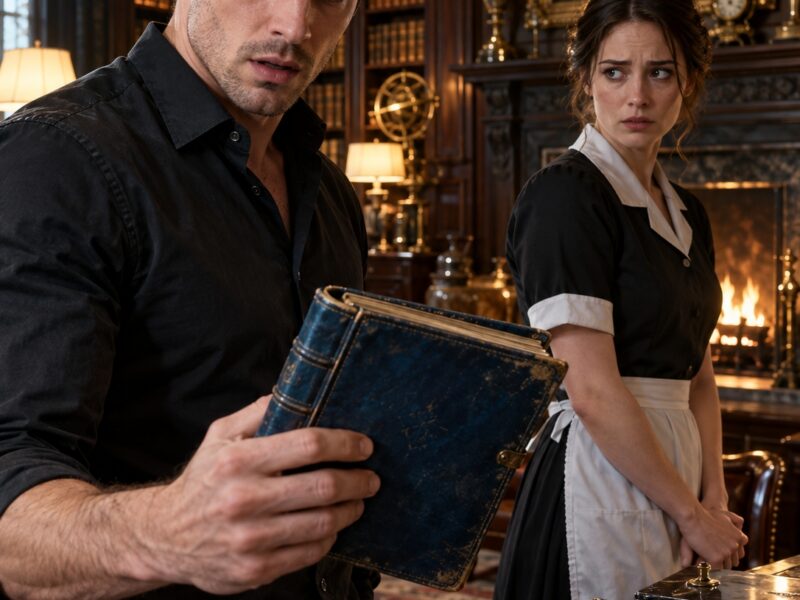
My Housekeeper’s Three-Year-Old Daughter Copied My Missing Girlfriend’s Face — Then She Led Me To The Secret My Family Had Buried For Thirty Years

“Lucas, Rosie isn’t the secret I’ve been keeping from you.”
Clara said it so quietly that, for several seconds, I thought I had misunderstood her.
The antique clock behind me kept ticking.
One second.
Two.
Three.
The sound seemed impossibly loud inside the dressing room.
Clara stood in the doorway with one hand wrapped around her three-year-old daughter’s fingers. Rosie had stopped smiling. A few minutes earlier, she had been wandering through a room she wasn’t supposed to enter, touching things with the fearless curiosity of a child who had never learned that wealthy adults built entire houses around things they didn’t want touched.
Then she had made that face.
Emily’s face.
The slight narrowing of the eyes. The tiny pull at one corner of the mouth. That peculiar expression of amused suspicion that I had seen a thousand times on the woman who disappeared from my life three years earlier.
I had spent three years trying to forget it.
A three-year-old child had brought it back in less than three seconds.
And when I asked Clara why her daughter looked so much like Emily in that moment, my housekeeper had gone pale.
Now she was telling me Rosie wasn’t the secret.
I stared at her.
“Then what is?”
Clara lowered her eyes.
“Not here.”
I almost laughed.
Nothing about her expression was funny.
“Clara, you just admitted you’ve been keeping something from me for nearly two years.”
“I know.”
“Then tell me.”
Rosie tugged gently at her mother’s skirt.
“Mommy?”
Clara looked down.
“Yeah, sweetheart?”
“Are you sad?”
The change in Clara was immediate.
For half a second, the frightened woman standing in my doorway disappeared and Rosie’s mother took her place. Clara crouched until they were eye level.
“No, sweetheart.”
Rosie studied her.
“You have crying eyes.”
“I’m okay.”
Rosie clearly didn’t believe her.
Neither did I.
The little girl reached up and wiped her mother’s cheek with one tiny hand.
And something inside me broke open.
Emily used to do that.
Not wipe tears exactly.
Touch people when words failed her.
If we were sitting in a restaurant and she sensed I was angry about something, her fingers would find my wrist beneath the table.
If she passed behind my chair while I was working, she would brush my shoulder.
If I woke from a nightmare and pretended I hadn’t, she would simply place her palm against my chest and leave it there.
She had always understood that sometimes touching someone was more honest than talking to them.
Rosie had just done the same thing.
I turned away before Clara could see what crossed my face.
“Take Rosie downstairs.”
Clara stood.
“I’ll come back.”
“No.”
She froze.
I heard the sharpness in my own voice and hated it, but I couldn’t soften it.
“Put her with Mrs. Dalton in the kitchen. Then come to my study.”
Clara nodded.
Rosie frowned at me.
“Are you going to yell at Mommy?”
The question stopped me.
I looked down at her.
“No.”
“Promise?”
Those enormous hazel eyes watched me with surprising seriousness.
“I promise.”
Rosie considered this carefully.
Then she pointed two fingers toward her own eyes and turned them toward me.
“I’ll know.”
A breath of laughter escaped me despite everything.
Rosie seemed satisfied.
Clara didn’t.
She led her daughter away.
Their footsteps faded down the corridor.
I stayed where I was.
The clock continued ticking.
Eventually, I looked into the mirror.
A thirty-two-year-old man stared back at me.
Successful, at least according to every definition Theodore Whitmore had spent my childhood teaching me to respect.
Whitmore Development had active projects in five states.
The estate outside Boston had twelve bedrooms, two kitchens, a library larger than the apartment where Emily had lived when I met her, a wine cellar I barely entered, and enough polished marble to make every footstep sound important.
Or lonely.
Depending on who was listening.
I had spent years confusing those two things.
Three years earlier, when Emily disappeared, I had believed grief worked like business.
Identify the loss.
Contain the damage.
Reorganize.
Continue.
I worked later.
Traveled more.
Bought properties.
Closed deals.
Stopped asking questions I knew nobody could answer.
Eventually, people stopped mentioning Emily around me.
My father called that progress.
It wasn’t.
It was silence with an expensive address.
And now a three-year-old girl had walked into a private room, made one familiar expression, and torn open everything I had spent three years sealing shut.
I left the dressing room.
Clara was waiting in my study.
She stood beside the fireplace, hands clasped tightly in front of her. She still wore the plain clothes she worked in. Nothing about her looked threatening.
That somehow made what was happening worse.
For almost two years, this woman had moved quietly through my home.
She knew how I took my coffee.
She knew which rooms I hated having flowers in.
She knew not to touch the stack of architectural journals beside my bed even when they collected dust.
She knew I sometimes stayed in the library until three in the morning.
And apparently, she knew something about Emily.
I closed the door.
“Start talking.”
Clara swallowed.
“Rosie’s father was Daniel Bennett.”
I waited.
“My husband.”
“You told the agency you were widowed.”
“I am.”
Her voice cracked.
“Daniel died before Rosie was born.”
Something inside my chest loosened.
The relief came so quickly that I hated myself for feeling it.
I turned toward the desk and placed both palms against the wood.
“So Rosie isn’t—”
“No.”
Clara understood before I could finish.
“She isn’t your daughter.”
I closed my eyes for a second.
Of course she wasn’t.
The dates didn’t make sense.
The idea had been irrational from the beginning.
But grief wasn’t rational, and neither was resemblance when it arrived wearing the face of a child.
I nodded once.
That should have ended the question.
Instead, another one took its place.
“Then why were you terrified when I noticed she looked like Emily?”
Clara said nothing.
I faced her.
“And don’t tell me there isn’t a resemblance.”
“I wasn’t going to.”
“Rosie looks like her.”
“Yes.”
One word.
Quiet.
Devastating.
“How do you know Emily?”
Clara closed her eyes.
When she opened them, there were tears in them.
“Because Emily is my sister.”
For a moment, the room lost its shape.
I stared at her.
“No.”
“She is.”
“Emily’s last name was Carter.”
“Her professional name.”
“She never mentioned a sister named Clara.”
“My name wasn’t Clara Bennett when you knew her.”
Clara took a breath.
“I was Clara Carter.”
Memory moved slowly at first.
Then all at once.
Emily sitting cross-legged on my sofa.
A rainy Sunday afternoon.
A cup of tea cooling in her hands.
Me asking whether she had any family left.
Her saying there was someone younger.
Someone in Vermont.
Someone she worried about.
“You’re the sister who moved to Vermont.”
Clara’s face changed.
“You remember?”
“Emily said you married a man who restored old houses.”
For the first time since this conversation began, Clara almost smiled.
“Daniel.”
The name softened her.
“He could repair anything except his own terrible coffee.”
The smile lasted barely a second.
“He died in a highway accident six weeks before Rosie was born.”
The room became quieter.
“I’m sorry.”
“Thank you.”
There was nothing else to say to that.
I sat down.
The pieces inside my head were moving, but they weren’t fitting together.
Not yet.
“You applied to work here knowing who I was.”
“Yes.”
“You knew I had been with Emily.”
“Yes.”
“You knew what happened.”
Clara hesitated.
“I knew some of it.”
“And you never said anything.”
“I couldn’t.”
My jaw tightened.
“Why did you come here?”
She looked toward the windows.
Beyond them, the Whitmore grounds stretched beneath a gray Massachusetts sky.
Bare trees.
Stone paths.
Perfect hedges.
Everything orderly.
Everything controlled.
“Because Emily asked me to.”
My chair scraped hard against the floor as I stood.
“When?”
“Two years ago.”
For the first time since Clara entered the room, I forgot how to breathe.
“You spoke to Emily two years ago?”
“Yes.”
The answer hit me harder than I expected.
“Where?”
“I can’t tell you.”
I stared at her.
“You can’t tell me?”
“I promised her.”
“She disappeared from my life.”
“I know.”
“No. I don’t think you understand.”
“I do.”
“One week we were looking at apartments together.”
My voice rose despite myself.
“One week, Clara. She was arguing with me about whether we needed a second bedroom because she wanted somewhere to put her books. Seven days later, her phone was disconnected.”
“I know.”
“I went to her apartment.”
“I know.”
“Her landlord told me she had moved.”
“I know.”
“I called her friends.”
Clara looked down.
“I know.”
“I called hospitals.”
Her mouth trembled.
“I know.”
“I checked accident reports.”
She closed her eyes.
“I know.”
“I thought she was dead.”
That finally broke through whatever control Clara had been holding onto.
Her hand rose to her mouth.
“I know.”
The words came out as a whisper.
I turned away.
I couldn’t look at her.
Three years.
Three years of wondering whether Emily had walked away because she stopped loving me.
Three years of wondering whether I had missed something.
Three years of imagining hospital rooms, accidents, unidentified bodies, another man, another life.
Eventually, the worst question hadn’t been where she went.
It had been whether I had ever really known her at all.
And all this time, a woman who knew she was alive had been walking through my house.
Polishing my furniture.
Changing flowers.
Packing Rosie’s lunch at my kitchen counter.
I laughed once, but there was no humor in it.
“Why would Emily send you here?”
“She didn’t send me to watch you.”
I turned.
“Then why?”
Clara’s answer came quietly.
“To watch the house.”
A coldness moved through me.
“What does that mean?”
“She wanted to know whether someone was still coming here.”
“Who?”
“I don’t know.”
“You don’t know who you were supposed to watch for?”
“No.”
“You expect me to believe that?”
“I know how it sounds.”
“No, Clara. I don’t think you do.”
She stared at me for several seconds.
Then she reached into the pocket of her apron.
Her hand came out closed around something.
She walked toward my desk and placed it between us.
A key.
Small.
Silver.
Old.
I knew it immediately.
My anger vanished.
“Where did you get that?”
“Emily.”
I picked it up.
The metal was cold against my fingers.
Three years earlier, that key had opened a narrow drawer built into the antique writing desk in my library.
Emily loved that desk.
On Sunday mornings, she would sit there barefoot with coffee and spread historical documents around herself until the entire surface disappeared beneath maps, notebooks, photocopies, pencils and whatever pastry she had convinced herself counted as breakfast.
She called it her corner.
After she disappeared, I opened that drawer.
It was empty.
The key was gone.
I assumed she had taken it accidentally.
Apparently, nothing about it had been accidental.
“What did she tell you?”
Clara’s voice dropped.
“She said if you ever recognized Rosie’s expression, it meant you still remembered enough to hear the truth.”
I stared at her.
“That makes no sense.”
“It didn’t make sense to me either.”
“Where is Emily?”
“I genuinely don’t know now.”
The word caught me.
“Now?”
“The last time I saw her was eighteen months ago.”
My heartbeat changed.
“She was alive eighteen months ago.”
“Yes.”
“Was she safe?”
Clara hesitated.
Just half a second.
It frightened me more than anything she had said.
“Clara.”
“She was frightened.”
“Of whom?”
“She wouldn’t tell me.”
“Where was she living?”
“I promised—”
“Stop telling me what you promised her.”
Clara flinched.
I lowered my voice.
“What happened between us?”
Her eyes filled again.
“She thought you betrayed her.”
That hurt in a completely different way.
“Betrayed her how?”
“I don’t know everything.”
“Then tell me what you do know.”
Clara sat in the chair opposite my desk.
For a moment, she simply looked at her hands.
“About three weeks before Emily disappeared, she found documents connected to Whitmore Development.”
“What kind of documents?”
“I never saw them.”
“Financial?”
“I think so.”
“That makes no sense. Emily was an architectural historian. She had nothing to do with company finances.”
“She was researching one of your restoration projects.”
And immediately, I knew which one.
“The Ashford Hotel.”
Clara nodded.
The Ashford was a nineteenth-century property near Beacon Hill. Whitmore Development had purchased it with plans for a full historical restoration.
Emily had loved the project.
For months, she spent more time inside preservation archives than she did at home.
Original blueprints.
Property deeds.
Historic ownership records.
City permits.
Old photographs.
At the time, I had teased her that she cared more about dead architects than living developers.
She had smiled.
“Dead architects lie less.”
I remembered the sentence now.
It didn’t feel funny anymore.
“She found something in the old records,” Clara said. “Something that didn’t match the modern ownership documents.”
“What?”
“She wouldn’t tell me over the phone.”
“Why?”
“Because she believed someone was listening.”
I nearly dismissed it.
Nearly.
Then memories began surfacing.
Emily checking the window before talking.
Emily asking whether my office computers were secure.
Emily lowering her voice when we discussed the Ashford.
And one night after dinner, Emily asking me a question that had seemed ridiculous at the time.
Does your father still have access to your private company accounts?
I laughed.
I told her Theodore Whitmore barely knew how to attach a document to an email.
She didn’t laugh with me.
At the time, I thought she was tired.
Now I wondered whether she had been afraid.
“Why didn’t she tell me?”
“She tried.”
I looked at Clara.
“What?”
“The night before she disappeared.”
“No.”
“She went to see you.”
“She didn’t.”
“She did.”
“I was in New York.”
Clara frowned.
“You weren’t.”
“I was at the Mercer Hotel in Manhattan.”
“No, Lucas. Emily called me from outside this estate.”
Cold spread across my back.
“She said your car was here.”
“That’s impossible.”
“She said she saw you through the library window.”
“I was two hundred miles away.”
“She believed you were here.”
I opened my mouth to argue.
Then stopped.
A memory surfaced.
My car.
Three years ago, I owned two identical black Mercedes sedans.
One usually stayed at the Boston office.
My father sometimes used it.
So did my executive assistant.
I looked at Clara.
“Did Emily actually speak to me?”
“No.”
“Then she didn’t see me.”
“She thought she did.”
“What happened?”
Clara shifted uneasily.
“She saw someone leave your study carrying the Ashford files.”
“Who?”
“She never told me.”
“Why?”
“Because she recognized them.”
The word landed differently.
Them.
Not him.
Not her.
Them.
“Someone she knew.”
“Yes.”
“And then?”
“She received an envelope.”
“What was inside?”
“Photographs.”
My stomach tightened.
“Photographs of what?”
“You.”
“With whom?”
“I don’t know.”
“You don’t know?”
“She destroyed them.”
I stared at her in disbelief.
“So someone sent Emily photographs of me, she decided I was involved in whatever she found, and then she disappeared?”
“It wasn’t that simple.”
“Then make it simple.”
Clara stood.
“She believed the photographs proved you were involved.”
“In what?”
“In whatever she discovered.”
“And you believed her?”
Clara looked directly at me.
“No.”
That stopped me.
“I believed my sister was frightened. I believed she had found something dangerous. But I never believed you wanted to hurt her.”
I hated how much that mattered.
I looked down at the key.
“What does this open now?”
“The same drawer.”
“It’s empty.”
“No.”
I looked up.
Clara shook her head.
“Emily put something back.”
“When?”
“Eighteen months ago.”
I didn’t ask another question.
I left the study.
Clara followed me across the hallway.
The library smelled exactly as it always had—leather, cedar, old paper, faint fireplace ash.
Nothing had changed.
That was the cruelest thing about rooms.
People disappeared.
Rooms remained.
I crossed directly to Emily’s writing desk.
My hand shook slightly as I inserted the key.
It turned.
I pulled open the drawer.
Empty.
I looked at Clara.
“There’s nothing.”
“She said you’d have to look beneath it.”
I removed the drawer completely.
For years, I had owned that desk without noticing that the wooden base beneath the drawer sat slightly higher than it should.
I pressed one corner.
A thin panel lifted.
My pulse stopped.
Underneath lay a folded envelope.
My name was written across the front.
LUCAS.
I knew that handwriting.
I had birthday cards upstairs written in those same slightly slanted letters.
Notes she used to leave beside the coffeemaker.
A grocery list I had once kept because she had drawn an angry face beside the words “actual vegetables.”
Emily.
I opened the envelope.
Inside was a photograph.
Emily stood outside a small coastal house.
Her hair was shorter.
She was thinner.
But she was smiling.
Alive.
I forgot Clara was beside me.
Forgot the room.
Forgot everything except the face I had spent three years trying not to imagine.
I touched the edge of the photograph.
Not her face.
I couldn’t.
“Emily.”
Her name came out barely louder than breath.
I turned the photograph over.
Three lines were written on the back.
If Clara gives you this, then something changed.
Below it:
I’m sorry I believed what they wanted me to believe.
And finally:
But I still can’t come home.
I read the last sentence again.
And again.
Alive.
Sorry.
Unable to come home.
Each answer opened something worse.
“Why?”
Clara stood beside me.
“I don’t know.”
“There has to be a reason.”
“I know.”
“You always know.”
The bitterness in my voice made her look away.
There was another folded sheet inside the envelope.
I opened it.
Four lines.
That was all.
Lucas, the Ashford records were never about the hotel.
They were about your family.
Ask your father why Margaret Whitmore’s name was removed from the original trust.
And whatever he tells you, ask to see the blue ledger.
I read the name twice.
Margaret Whitmore.
My grandmother.
She had died when I was eleven.
“What blue ledger?”
“I don’t know,” Clara said.
Neither did I.
But I knew someone who might.
My father lived in the guest house on the eastern side of the estate.
Calling it a guest house was one of those absurdities wealthy families stopped noticing. It had five bedrooms, a library, a private kitchen and a greenhouse Theodore loved more than most people.
At seventy-one, my father was officially retired.
In practice, retirement meant calling Whitmore executives at inconvenient hours and reminding them that he had built the company they were supposedly running.
I found him in the greenhouse.
He was trimming a rosebush.
“Lucas.”
He didn’t look up immediately.
Then he saw the photograph in my hand.
The shears stopped.
My father was not a man who frightened easily.
I had watched him negotiate during recessions, lawsuits, hostile acquisitions and a federal investigation involving one of our contractors.
I had seen him receive news of deaths without allowing his hands to shake.
But when he saw Emily’s photograph, something changed in his face.
Fear.
For perhaps the first time in my life, I saw Theodore Whitmore afraid.
“Where did you get that?”
I held Emily’s note toward him.
“What is the blue ledger?”
He didn’t answer.
I stepped closer.
“What is it?”
He placed the pruning shears slowly on the bench.
“Close the door.”
“No.”
“Lucas.”
“Three years ago, Emily Carter disappeared. Today I learned she uncovered something involving this family. So you can tell me what it is right now, or I start calling attorneys, auditors, archivists and every board member who has ever worked for Whitmore Development.”
He stared at me.
I waited.
Eventually, his shoulders sank.
“I wondered when this would come back.”
My pulse quickened.
“What would?”
He walked to an old wooden bench and sat.
“The company you inherited isn’t exactly the company I built.”
“That sounds like a riddle.”
“It’s a confession.”
I said nothing.
My father suddenly looked seventy-one.
Not powerful.
Not intimidating.
Old.
“When your grandmother Margaret died, she left controlling interests in several properties to a trust.”
“I know.”
“No.”
He looked at me.
“You know the version we told you.”
Something tightened in my stomach.
“The trust had another beneficiary.”
“Who?”
“A woman named Eleanor Vale.”
The name meant nothing to me.
“Who was she?”
My father hesitated.
“Margaret’s daughter.”
I stared at him.
“My aunt?”
“Your half-aunt.”
“My grandmother had another daughter?”
“Yes.”
“And nobody thought I should know?”
“My father refused to acknowledge Eleanor publicly.”
“Why?”
“Eleanor was born before Margaret married your grandfather.”
For several seconds, the only sound was the soft movement of the greenhouse ventilation system.
My entire childhood had been filled with Whitmore history.
Portraits.
Stories.
Family dinners where dead men were discussed like saints.
My grandfather’s name was engraved on buildings.
My grandmother’s portrait hung over the fireplace in my library.
There had never been an Eleanor.
Not once.
“What does any of this have to do with Emily?”
“The Ashford Hotel was one of the properties originally belonging to Eleanor’s share of the trust.”
“But Whitmore Development owns it.”
“Yes.”
“How?”
My father looked away.
“That’s the problem.”
I felt cold despite the heat of the greenhouse.
“Theodore.”
He hated when I used his first name.
Today, he didn’t correct me.
“The documents were changed after Margaret died.”
“Changed by whom?”
“My father.”
My grandfather.
The man whose portrait hung in our boardroom.
The man whose business principles had been quoted to me before I was old enough to understand what a balance sheet was.
“Did you know?”
“Not at first.”
“But later?”
“Yes.”
“And you did nothing.”
“I was twenty-eight.”
“That doesn’t answer me.”
“The company was collapsing. My father told me that correcting the records would destroy everything. Hundreds of jobs. Properties. Families.”
“That still doesn’t answer me.”
His eyes met mine.
“No.”
His voice became quieter.
“It doesn’t.”
I waited.
“It was simply the answer I accepted.”
That was worse.
Not innocence.
Not ignorance.
A decision.
One made long before I inherited the consequences.
“Where is Eleanor?”
“She died years ago.”
“Did she have children?”
My father looked at me.
“One daughter.”
My chest tightened.
“What was her name?”
He hesitated.
“Marianne.”
“And Marianne?”
“I lost track of her.”
“You lost track of a woman whose inheritance your family stole?”
His face hardened.
“Be careful.”
“No.”
I stepped closer.
“You’ve had thirty years of people being careful around you. Where is Marianne?”
“She changed her name.”
“To what?”
“I don’t know.”
I thought about Emily.
Historical records.
Family trees.
Birth certificates.
Property transfers.
“She found Eleanor.”
My father nodded slowly.
“I think so.”
“And somebody wanted her to stop.”
His expression changed.
“I never wanted Emily harmed.”
I stared at him.
“That wasn’t what I asked.”
“I know.”
“Who else knew?”
Silence.
“Who?”
“Lucas, this isn’t something you solve by confronting people.”
“Apparently ignoring it for thirty years didn’t work either.”
I turned toward the door.
“Wait.”
His voice stopped me.
“The blue ledger.”
I looked back.
“It belonged to Margaret.”
“Where is it?”
“I thought it had been destroyed.”
“Thought?”
“Your grandmother kept handwritten records. Every property. Every trust payment. Every transfer.”
“And if Emily found it?”
“She could prove Eleanor’s inheritance was diverted.”
There it was.
Not suspicion.
Not family gossip.
Proof.
“Where would Margaret have hidden it?”
“I don’t know.”
I studied my father.
For the first time in my life, I couldn’t tell whether he was lying.
That frightened me almost as much as Emily’s disappearance.
I left him among his roses.
For the rest of the afternoon, I thought about nothing except the photograph.
Emily alive.
At least eighteen months earlier.
I took the picture into the library and studied it until every detail felt engraved into my mind.
The small coastal house behind her had gray shingles.
White porch railing.
A blue mailbox.
Beyond one side of the house, a narrow strip of ocean was visible.
Emily’s hair barely touched her shoulders.
She wore a sweater I had never seen.
She looked older.
Not dramatically.
But grief had taught me how much a face could change without anyone else noticing.
Then I saw the window.
A reflection.
Someone had taken the photograph.
Obviously.
But the glass behind Emily had caught the photographer.
Only vaguely.
The outline of a woman holding a camera.
I photographed the photograph with my phone and enlarged the reflection.
Clara leaned over my shoulder.
“Do you recognize her?”
“No.”
I zoomed further.
The image broke into grain.
Then Clara stopped breathing.
“What?”
She pointed.
“Her necklace.”
Around the reflected woman’s neck was a circular pendant.
Clara touched her own throat without seeming to realize she was doing it.
“I’ve seen that before.”
“Where?”
“Emily had one exactly like it.”
I looked at her.
“Then who took the photograph?”
Clara stared at the reflection.
“I don’t know.”
That sentence had begun to terrify me.
Before either of us could say more, tiny footsteps sounded in the hallway.
Rosie appeared in the library doorway.
Mrs. Dalton hurried behind her.
“I’m sorry, Mr. Whitmore. She escaped.”
Rosie ignored her.
She marched directly toward me carrying a plate with both hands.
On the plate sat one crooked cookie.
“I brought you this.”
I crouched.
“For me?”
“You look sad.”
“I’m okay.”
She frowned.
“That’s what Mommy says when she’s not okay.”
Behind her, Clara almost smiled.
I accepted the cookie.
“Thank you.”
Rosie’s attention moved to the photograph in my other hand.
Her entire face brightened.
“Oh!”
Clara stiffened.
“What, sweetheart?”
Rosie pointed.
Then tapped Emily’s face with one finger.
“That’s Aunt Emmy.”
The library went silent.
I slowly looked at Clara.
“You told me Rosie hadn’t seen Emily since she was a baby.”
Clara’s face had gone white.
“She hasn’t.”
Rosie shook her head.
“Yes I did.”
Clara immediately crouched.
“When?”
Rosie thought.
Children have a strange relationship with time. Yesterday can mean last week. Last year can mean before breakfast.
So I watched Clara carefully, waiting for her to explain it away.
Rosie pointed toward the windows.
“When the leaves were orange.”
Clara’s face changed.
So did mine.
Autumn.
Last autumn.
Months ago.
Not eighteen months.
Clara took Rosie’s hands.
“Sweetheart, where did you see Aunt Emmy?”
“At the little house.”
“What little house?”
“The one with the ducks.”
Clara’s voice began to shake.
“Who took you there?”
Rosie smiled as if the answer were obvious.
“Grandma.”
Clara stopped breathing.
I looked between them.
“Your mother?”
Clara slowly stood.
“Our mother died twelve years ago.”
Rosie frowned.
“No, Mommy.”
She pointed at Emily’s photograph.
“Grandma has the same necklace.”
Nobody moved.
I looked again at the reflection.
The circular pendant.
The woman holding the camera.
Clara grabbed the edge of my desk.
“My mother had a pendant like that.”
“You said she died.”
“She did.”
“Did you see her body?”
The question seemed to strike her physically.
Her eyes lifted to mine.
Fear entered them.
“No.”
Barely audible.
“There was a fire.”
I stared at her.
Rosie tugged on her skirt.
“Mommy?”
Clara looked down at her daughter.
Rosie pointed toward Emily again.
“Grandma said Aunt Emmy was waiting for Angry Face to remember.”
My heart stopped.
Angry Face.
Me.
Rosie had called me that once before when she thought I couldn’t hear her.
I crouched in front of her.
“What did Grandma say?”
Rosie’s hazel eyes met mine.
“She said you have something that belongs to Aunt Emmy.”
“What?”
Rosie shrugged.
For a moment, I thought that was all she remembered.
Then her eyes widened.
“The blue book.”
Clara made a small sound behind me.
I forgot how to breathe.
“Rosie.”
I kept my voice as calm as possible.
“Did Grandma show you the blue book?”
She nodded.
“Where?”
Rosie looked around the library.
Her gaze traveled over the shelves.
The windows.
The desk.
The fireplace.
Then she lifted one small hand.
And pointed.
Directly above the fireplace hung an enormous oil portrait of Margaret Whitmore.
My grandmother.
“Behind that lady.”
I stood very slowly.
Margaret stared down at me from the painting.
I knew that portrait.
I had known it all my life.
The dark dress.
The pearl earrings.
The restrained smile.
The hands folded in her lap.
For thirty years, that portrait had hung in this house.
I had walked beneath it thousands of times.
Emily had walked beneath it.
My father had walked beneath it.
And now a three-year-old child was telling me something was hidden behind it.
I crossed the room.
Clara followed.
The frame was heavier than it looked.
Together, we lifted it away from the wall.
Dust moved through the afternoon light.
And there it was.
A narrow brass panel embedded in the wall.
I had never seen it before.
My hands were shaking now.
I pressed the latch.
The panel opened.
Inside sat a book.
Faded blue leather.
Old.
Thick.
The blue ledger.
For several seconds, neither Clara nor I spoke.
Thirty years of family history had apparently been hidden a few inches behind the face of the woman who had written it.
I reached toward the ledger.
Then Clara gasped.
Because the ledger wasn’t alone.
An envelope rested on top of it.
Unlike the faded book beneath it, the envelope was clean.
White.
Recent.
Someone had put it there long after my grandmother died.
My pulse began hammering.
I picked it up.
Six words were written across the front.
I knew the handwriting immediately.
Emily.
My hands went cold.
I read the message once.
Then again.
LUCAS — DO NOT TRUST CLARA YET.
The entire room seemed to change.
Slowly, I turned around.
Clara was staring at the envelope.
All the color had drained from her face.
“Clara?”
She didn’t answer.
The woman who had spent the last hour telling me she had come here because Emily trusted her suddenly looked terrified of six words written by her own sister.
I looked at the key Clara had given me.
At Emily’s photograph.
At the reflection of a woman Clara said might be their dead mother.
At the child who somehow knew where my grandmother had hidden a ledger that could expose thirty years of fraud.
And for the first time, another possibility entered my mind.
Maybe Clara had told me the truth.
But maybe she hadn’t told me all of it.
“Why would Emily write this?”
Clara shook her head.
“I don’t know.”
There it was again.
The answer I had heard all afternoon.
I don’t know.
But this time, I no longer knew whether I believed her.
“Lucas, I swear to you—”
A tiny voice interrupted her.
“Mommy.”
We both looked down.
Rosie was standing beside Clara.
She wasn’t smiling anymore.
Her eyes moved from the envelope to her mother.
Then she whispered something so softly I almost missed it.
“Mommy… that’s what Grandma told Aunt Emmy too.”
Clara went completely still.
I looked at Rosie.
“What did Grandma tell Aunt Emmy?”
The little girl pressed herself against her mother’s leg.
For the first time all day, she seemed frightened.
Clara whispered, “Rosie, sweetheart—”
But Rosie was looking at me.
Not at her mother.
At me.
And in those enormous hazel eyes, I saw the same expression that had started all of this.
Emily’s expression.
The slight narrowing of the eyes.
The tiny pull at the corner of the mouth.
The look she used to give me whenever she knew there was something in the room nobody was willing to say aloud.
Behind me, the hidden compartment remained open.
Inside it sat the blue ledger that could prove my family had stolen an inheritance.
In my hand was a warning from the woman I had spent three years mourning.
Beside me stood her sister, who had entered my home under another name and admitted she had been watching it for nearly two years.
And somewhere—if a three-year-old child could be believed—Emily was still alive.
So was a woman Clara had buried twelve years earlier.
For most of my life, I had believed the Whitmore house was full of history.
Standing beneath my grandmother’s portrait that afternoon, I finally understood the difference.
History was what families remembered.
Secrets were what they built walls around.
And someone had just opened one.
I looked once more at the six words on Emily’s envelope.
DO NOT TRUST CLARA YET.
Then I looked at Clara.
She looked back at me with tears in her eyes.
Neither of us spoke.
Because suddenly the most frightening question was no longer where Emily had been hiding.
It was who she had been hiding from.
And whether that person was already standing inside my house.









