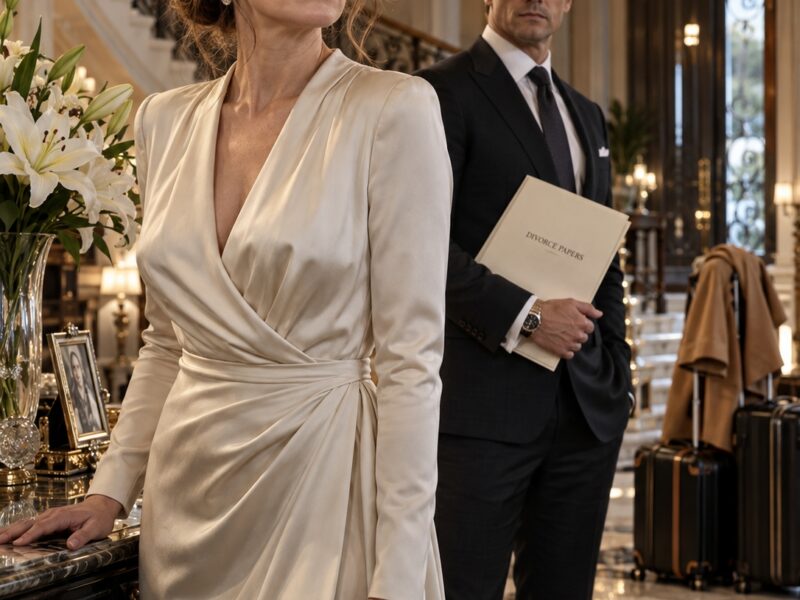
MY HUSBAND BROUGHT HIS MISTRESS HOME AND HANDED ME DIVORCE PAPERS—HE DIDN’T KNOW THE HOUSE, HIS MERGER, AND HALF HIS EMPIRE WERE NEVER HIS

The first thing my husband did after bringing his mistress into my home was ask me not to embarrass him.
Not apologize.
Not explain.
Not even have the decency to look ashamed.
He stood beneath the chandelier my mother had chosen twenty-three years earlier, one leather-gloved hand resting lightly against the lower back of a woman I had never officially met, and looked at me as if I were the uncomfortable guest.
“Eleanor,” Adrian said, his voice carrying the same polished patience he used with junior executives who had disappointed him, “please don’t make this more difficult than it needs to be.”
I was standing beside a twelve-thousand-dollar antique console table arranging white lilies.
One stem remained between my fingers.
I remember that because afterward people kept asking me what I felt in that moment, as though betrayal arrived as one clean emotion.
It didn’t.
First I noticed the lilies.
Then the woman’s camel-colored coat.
Then Adrian’s gloves.
Then the faint scent of perfume that had been appearing on his shirts for three months.
Only after that did I understand that my marriage had just walked through the front door wearing another woman’s face.
Her name was Sienna Roe.
I knew that before Adrian introduced her.
I had seen the name on a restaurant reservation accidentally forwarded to our household email. I had seen the initials S.R. on a receipt for a bracelet Adrian claimed was a retirement gift for an employee. I had heard her laugh once through the half-open door of Adrian’s study, followed by the abrupt silence that happens when two people realize the wrong person has entered the hallway.
For months, I had been collecting small pieces of information without admitting I was building a picture.
Now the picture stood six feet away from me.
Sienna was younger than I was by perhaps twelve years. Beautiful in the expensive, effortless way that actually required enormous effort. Her dark hair fell over one shoulder. Her nails were pale pink. Her makeup was flawless. She held herself with the careful confidence of someone who had already been told what kind of woman I was.
Adrian finally removed his gloves.
“This is Sienna.”
“I know.”
That made him pause.
Only for half a second.
Sienna’s eyes flickered toward him.
Adrian recovered quickly. He always did.
“Sienna is going through a difficult transition,” he said. “She needs somewhere safe to stay for a while.”
I looked at her suitcase.
There were two.
A garment bag hung from the brass handle of one.
This was not a woman stopping by after a bad day.
This was a woman moving in.
“Safe,” I repeated.
“Yes.”
“And the safest place you could think of was your wife’s house?”
Adrian’s jaw tightened.
There it was.
The first warning.
For nine years, I had learned every version of that tightening jaw.
It meant lower your voice.
It meant stop asking questions.
It meant there are staff nearby.
It meant don’t humiliate me.
It meant remember who people think I am.
Sienna glanced toward the staircase.
“I hope this doesn’t have to be unpleasant.”
For one extraordinary second, I almost laughed.
Instead, I placed the final lily into the vase.
“I’m sure you do.”
Her smile weakened.
Adrian stepped forward.
“She’ll be using the west suite.”
That was the moment something inside me went perfectly still.
Not because he had brought another woman home.
Not even because he intended to move her into my house before our marriage had legally ended.
The west suite had been my mother’s room.
After her stroke, when walking became difficult, she would stay there during visits because the morning light reached the bed and she could see the old elm trees from the windows.
She had painted a watercolor of the Maine coast with trembling hands during her final summer.
It still hung above the fireplace.
Adrian knew that.
He knew exactly what that room meant.
And he had chosen it anyway.
“The west suite is closed,” I said.
His expression hardened.
“Eleanor.”
“It’s not available.”
“It has three bedrooms.”
“It is not available.”
Sienna shifted uncomfortably.
Adrian sighed.
He actually sighed.
As if I were being unreasonable about seating arrangements at a dinner party.
“The east guest room is perfectly comfortable,” he said. “You can use that temporarily.”
I stared at him.
“The room beside the laundry stairs?”
“It’s a guest room.”
“You’re asking your wife to move out of her bedroom so your mistress can sleep in her mother’s suite.”
Sienna inhaled sharply.
Adrian’s face changed.
“Don’t use that word.”
“Which one?”
“You know which one.”
“Mistress?”
“Eleanor.”
“Mistress seems more accurate than difficult transition.”
Sienna’s cheeks flushed.
Adrian stepped closer.
“Enough.”
The room went quiet.
That word had worked on me many times before.
Enough.
At dinner parties.
In cars.
During disagreements about money.
When I questioned why he humiliated an assistant in front of twenty people.
When I asked whether Valecrest could really afford the expansion he had announced before the financing was finalized.
Enough meant the discussion was over because Adrian had decided it was over.
But betrayal changes the acoustics of a marriage.
Words that once controlled you begin to sound ridiculous.
I looked at Sienna.
“Did he tell you I knew?”
She blinked.
Adrian answered for her.
“This is not an interrogation.”
“I wasn’t speaking to you.”
His face reddened.
Sienna swallowed.
“He told me you both understood the marriage had become more of a partnership.”
I turned toward Adrian.
“Did I?”
He said nothing.
She continued, more quietly now.
“He said you’d been living separate emotional lives for years.”
“That’s interesting.”
“Eleanor—”
“No. I’d like to hear this.”
Sienna looked suddenly less certain.
“He said the marriage was effectively over.”
I nodded slowly.
“And yet he somehow forgot to tell his wife.”
Adrian’s voice dropped.
“Careful.”
There it was again.
Only this time, it did not frighten me.
It clarified him.
Careful with my reputation.
Careful with my company.
Careful with my investors.
Careful with my anger.
Careful with anything that might interrupt the version of Adrian Vale he had sold to the world.
I had been careful for nine years.
So careful that he had mistaken restraint for weakness.
Adrian reached inside his coat.
When I saw the cream-colored folder, I understood the choreography.
The mistress.
The suitcases.
The room.
The folder.
He had planned the entire evening like a corporate restructuring.
“I wanted to discuss this privately,” he said.
“You brought an audience.”
His eyes flicked toward Sienna.
“That’s unnecessary.”
“What’s in the folder?”
He hesitated.
That was when I knew he wanted the reveal.
Adrian loved reveals.
Announcements.
Statements.
Moments in which everyone else learned what he already knew.
So I took it from him.
“Divorce papers?”
His brows lifted.
“A proposed separation agreement.”
He set it beside the lilies.
“Clean. Civil. Generous.”
“Generous to whom?”
“Considering the circumstances, to you.”
There are sentences that break your heart.
Then there are sentences so arrogant they cauterize the wound.
I opened the folder.
Adrian watched me carefully.
Sienna tried not to.
The first pages were exactly what I expected.
Confidentiality.
Residential arrangements.
Noninterference with Valecrest business.
No direct communication with investors.
No statements to press.
A monthly settlement.
Restricted access to corporate records.
Temporary occupancy rights.
Adrian had anticipated rage.
He had anticipated embarrassment.
He had anticipated that I might expose his affair.
What he had not anticipated was that I understood contracts.
For most of our marriage, I had allowed him to believe otherwise.
That was my mistake.
Maybe the most expensive mistake he had ever encouraged me to make.
I turned another page.
“And Sienna?”
His jaw tightened again.
“She has nothing to do with the financial agreement.”
I glanced toward the staircase.
“She seems to have quite a lot to do with residential arrangements.”
Sienna looked down.
Adrian leaned closer.
“Don’t start.”
I looked at him.
“You brought a woman into my house carrying luggage.”
“Our house.”
“No.”
The word escaped before I intended it to.
He frowned.
I lowered my eyes back to the document.
“You’ve lived very well because of me,” he said.
For the first time that evening, something truly hurt.
Not because it was true.
Because he believed it.
He genuinely believed my life had begun when he selected me.
Before Adrian, there had been Merritt Harbor Logistics.
My grandfather had started with two tugboats and a warehouse near Baltimore.
My father had expanded it into shipping, infrastructure, port development, and maritime financing.
By the time I met Adrian, the Merritt family name had been opening doors for four generations.
But my father despised people who talked about wealth.
He taught me that inherited money made you responsible, not important.
So when I married a brilliant, hungry thirty-one-year-old investment manager who insisted he wanted to build something without depending on my family, I respected him for it.
I respected him so much that I made myself smaller to protect his pride.
I let investors assume the house was his.
I let dinner guests praise him for hosting.
I let journalists call me “the elegant wife behind Valecrest’s rise.”
I let Adrian tell stories about beginning with nothing while omitting the introductions my father had made, the guarantees our trust had quietly provided, the relationships I had maintained.
Every omission felt small at the time.
Marriage was not an accounting ledger, I told myself.
Love did not need credit.
Eventually, Adrian took my refusal to demand credit as proof none was due.
“You’re right,” I said.
He looked surprised.
“I have lived very well.”
I picked up the pen attached to the folder.
Sienna’s lips parted.
Adrian blinked.
“You’re signing?”
“What did you expect?”
His posture changed almost imperceptibly.
Victory softened his shoulders.
“I expected us to be adults.”
“Of course.”
I turned to the acknowledgment page.
Not the settlement.
Not the asset division.
Not the confidentiality agreement.
The acknowledgment confirming only that I had received the proposed terms.
I signed.
Then I initialed the receipt line.
Adrian, who had spent years assuming everyone else read documents for him, did not notice.
Neither did Sienna.
I closed the folder.
“There.”
For one bright second, my husband looked triumphant.
That second told me everything.
He did not mourn our marriage.
He celebrated winning the exit.
I handed the folder back.
“You have your answer.”
“Good.”
Then I took out my phone.
His smile vanished.
“Margo?”
Our house manager answered on the second ring.
“Yes, Mrs. Vale?”
“Please activate the private inventory protocol.”
Silence.
Not confusion.
Recognition.
Margo had worked for my family since I was sixteen.
She understood exactly what those words meant.
“Tonight?” she asked.
“Tonight.”
Adrian stared at me.
“What inventory protocol?”
I continued.
“My clothing from the primary suite. My mother’s paintings. The blue safe. The Merritt archives in the lower study. Personal correspondence from the east library. Nothing belonging to Mr. Vale.”
“Eleanor.”
“Have the trust vehicle brought around.”
Adrian stepped closer.
“Put the phone down.”
“And Margo?”
“Yes?”
“The west suite is closed.”
Sienna straightened.
“Excuse me?”
I finally looked at her.
“You’ll need another place to stay.”
Adrian laughed.
Not because anything was funny.
Because people sometimes laugh when reality arrives too quickly for pride to process it.
“This is my house.”
I ended the call.
“No, Adrian.”
He went still.
“This house belongs to the Merritt Trust.”
The silence afterward felt almost physical.
Sienna turned toward him.
“Adrian?”
He laughed again.
Louder.
“The house belongs to us.”
“No.”
“You’re being ridiculous.”
“The title has never been in your name.”
His face changed.
Only slightly.
But after nine years, I could read Adrian the way sailors read weather.
Disbelief first.
Then calculation.
Then anger.
“You told me when we married—”
“I told you we could live here.”
“You said this was our home.”
“It was.”
“Then what game are you playing?”
“I’m not playing one.”
I moved past him toward the stairs.
“The Merritt Trust owns the residence. You have spousal occupancy rights tied to the marriage. Those rights are subject to annual review.”
Sienna looked between us.
“You said you bought this place.”
Adrian spun toward her.
“Stay out of it.”
She recoiled.
It was small.
Barely visible.
But I saw it.
Because I had once reacted exactly the same way when the charming man vanished and the controlling one appeared.
“Don’t speak to her like that,” I said.
Adrian looked at me as though I had lost my mind.
“Now you’re defending her?”
“No. I’m recognizing you.”
That landed harder.
Footsteps sounded above us.
Margo appeared at the top of the staircase, followed by two household staff members carrying archive boxes.
Adrian pointed.
“Put those down.”
They stopped.
Then looked at me.
Not him.
“Continue,” I said.
They continued.
Something terrible passed through Adrian’s expression.
Not heartbreak.
Humiliation.
He had believed authority lived in volume.
Now three employees had quietly shown him otherwise.
“This is insane,” he said.
The front door opened.
Two private security officers entered first.
Then Celeste Nair.
Celeste was general counsel to the Merritt Trust and one of the few people my father had trusted enough to disagree with him in public.
She removed her gray wool coat.
“Good evening.”
Adrian stared.
“What the hell is this?”
“Trust protocol.”
“Who authorized it?”
“I did,” I said.
His gaze snapped toward me.
Celeste opened a leather portfolio.
“Mr. Vale, Mrs. Vale is entitled to remove separate property belonging to her and to the trust. Please do not interfere.”
“This is my marital residence.”
“It is trust property subject to a marital occupancy license.”
“I’m her husband.”
Celeste’s expression remained perfectly neutral.
“And approximately forty minutes ago, you presented her with proposed divorce terms while attempting to move another woman into a restricted family suite.”
Sienna closed her eyes.
Adrian’s face went pale.
“You planned this.”
I shook my head.
“No. You planned tonight. I prepared for the possibility that one day you would become careless.”
His eyes hardened.
“This isn’t finished.”
“I know.”
“You think throwing me out of a house changes anything? I have Valecrest. I have the merger. I have every investor in this city returning my calls.”
For a moment, I nearly told him.
About the preferred shares.
The debt facility.
The trust-backed expansion.
The governance triggers my father had buried beneath layers of cautious paperwork after our wedding.
I almost told him that the house was the smallest surprise waiting for him.
Instead, I picked up the overnight bag I had packed that morning.
“Then you should answer those calls,” I said.
His eyes narrowed.
“What does that mean?”
I walked toward the door.
Behind me, Sienna called my name.
I stopped.
“You’re just leaving?”
I turned.
The question was strangely sincere.
Maybe she had imagined a fight.
Maybe Adrian had promised her tears.
Maybe she wanted proof she had won something.
“You don’t want to fight for him?” she asked.
I looked at my husband.
At the man I had once loved so deeply I had mistaken accommodation for loyalty.
His face was rigid, his pride wounded not by losing me, but by losing command of the room.
“No,” I said. “I don’t fight for things that invite strangers into my mother’s room.”
Then I left.
I made it all the way to the Harbor House Hotel before my hands began to shake.
That surprised me.
I had expected grief.
Instead, my body rebelled first.
I stood barefoot in front of the windows of a fourth-floor suite overlooking the river while cargo cranes moved against the dawn like patient steel animals, and I shook so hard I had to put my coffee down.
Ten minutes.
That was what I allowed myself.
Ten minutes to be the woman whose husband had brought his mistress home.
Ten minutes to remember the early years.
Adrian running through rain toward my father’s office because his umbrella had turned inside out.
Adrian cooking terrible pasta in our first apartment.
Adrian whispering into my hair that he would spend his whole life making me proud.
Adrian pressing his forehead against mine after my mother’s funeral and promising I would never have to carry everything alone.
There had been a man worth loving once.
That was what made the ending painful.
Monsters are easy to leave.
Memories are not.
At minute eleven, I showered.
At minute twenty-seven, I dressed.
At 7:30, Celeste arrived with tea, toast, and the expression of a woman prepared to explain how much worse things were than I currently understood.
“You signed correctly,” she said.
“Receipt only.”
“He didn’t notice.”
“He rarely notices details when they flatter him.”
She almost smiled.
Then pushed a folder across the table.
“The house is secured. Sienna left shortly after midnight.”
“And Adrian?”
“Loudly.”
I looked down at my tea.
“Did he damage anything?”
“Only his dignity.”
“Insured?”
“Unfortunately not.”
That made me laugh.
It was the first time since the previous evening.
The sound felt wrong in my throat.
Then Celeste touched the folder.
“Now we need to talk about Valecrest.”
The laugh disappeared.
Adrian’s company was his religion.
Valecrest Capital had begun fifteen years earlier in two rented offices and grown into a major infrastructure investment firm with interests in ports, industrial redevelopment, transportation, and commercial real estate.
The upcoming merger with Hawthorne Global was supposed to be Adrian’s coronation.
For eighteen months, he had discussed it at breakfast, during dinners, on vacations, in bed.
The transaction would put him on national business pages.
It would double the combined group’s infrastructure portfolio.
And, more importantly to Adrian, it would prove he belonged among the people who had once made him feel small.
“What about Valecrest?”
“The Hawthorne merger reception is next Friday.”
“I know.”
“Julian Hawthorne wants to meet with you.”
I looked up.
Julian Hawthorne was Adrian’s professional enemy.
Not officially.
Men like them rarely admitted to enemies.
They called them competitors.
Adrian had described Julian as cold, arrogant, bloodless, self-important, humorless, and impossible.
I had met Julian three times.
He had been none of those things.
Reserved, yes.
Direct.
Almost aggressively uninterested in charm.
Which, in Adrian’s world, probably qualified as hostility.
“Why?”
Celeste opened the folder.
The first page contained a diagram of Merritt Trust holdings.
I stared at it.
Then stared again.
“Celeste.”
“Yes.”
“What am I looking at?”
“The reason your father kept me employed.”
I followed the lines.
Preferred interests.
Legacy investor rights.
A debt guarantee.
Voting triggers.
A participation clause in the facility underpinning Valecrest’s infrastructure expansion.
I looked up slowly.
“How much?”
“Enough.”
“That isn’t a number.”
“It is when I’m trying not to ruin your breakfast.”
“Celeste.”
She sighed.
“The trust is not a majority owner of Valecrest. But it controls positions significant enough that material misrepresentation of trust-backed assets can force review of the Hawthorne transaction.”
My mouth went dry.
“Adrian doesn’t know.”
“No.”
“How?”
“Because Adrian believes family offices are decorative until he needs their money.”
I pushed the folder away.
“My father arranged this?”
“After your wedding.”
“Why wouldn’t he tell me?”
Celeste’s face softened.
“Because Richard wanted you to choose your marriage freely.”
A painful pressure formed behind my ribs.
“And?”
“And he wanted you protected if your choice became a cage.”
I turned toward the windows.
For years, I had wondered whether my father had understood what my marriage was becoming.
He never criticized Adrian directly.
He was too careful.
He would ask questions instead.
Are you happy, Nell?
Do you still make decisions together?
Does he listen when no one is watching?
I had answered like a daughter determined to protect the husband she chose.
Yes.
Of course.
He’s under pressure.
You know what building something does to people.
Apparently my father had listened to every excuse and quietly built a door behind me anyway.
“What does Julian want?”
“Accuracy.”
“That sounds like him.”
“Hawthorne Global believes Adrian represented several relationships, residential hosting assets, investor channels, and trust-backed support as though they were under his personal control.”
“They aren’t.”
“I know.”
“He knows that?”
“He knows enough to become nervous.”
I closed my eyes.
Adrian would blame me.
That certainty came immediately.
He would say I had waited for the affair so I could destroy him.
He would tell everyone I was vindictive.
Cold.
A bitter wife weaponizing family money.
The strange thing was that six months earlier, the thought of Adrian telling that story would have terrified me.
That morning, it merely exhausted me.
“Schedule the meeting.”
Julian arrived at exactly two.
No entourage.
No dramatic stack of documents.
No assistant announcing him.
One dark suit.
Silver at his temples.
One folder.
He sat opposite me in the hotel dining room.
“Mrs. Vale.”
“For now.”
Something almost like amusement touched his mouth.
“Eleanor, then.”
I nodded.
He placed one document between us.
“I’ll be direct.”
“I would be disappointed if you weren’t.”
That earned a brief smile.
“Adrian has represented that several strategic relationships and supporting assets used in the Valecrest valuation are directly controlled by Valecrest leadership.”
“They’re not.”
“My team has reached the same conclusion.”
“You could walk away from the merger.”
“Yes.”
“Will you?”
“Not necessarily.”
“Why?”
“Because a company can survive a man’s ego if the company is larger than his ego.”
I studied him.
“And is Valecrest?”
“That is what we are about to discover.”
I leaned back.
“What do you need from me?”
“A statement of the Merritt Trust’s actual position. Nothing emotional. Nothing personal. Ownership, facility rights, investor relationships, property structures.”
“So Adrian can’t call this revenge.”
“He’ll call it revenge anyway.”
That surprised a laugh from me.
Julian continued.
“But the people responsible for approving a transaction won’t be able to confuse his accusation with documentation.”
I looked at him.
“Why help me?”
His expression became still.
“I’m not.”
The answer should have offended me.
Instead, I felt something loosen in my chest.
“I’m protecting Hawthorne Global,” he said. “Your husband seems to confuse possession with control. That is dangerous in marriage. It is expensive in mergers.”
It was perhaps the most reassuring thing anyone could have said.
Because Julian did not need me wounded.
He needed facts.
For the next week, Adrian called thirty-two times.
I answered none.
Every voicemail went to counsel.
The first messages were smooth.
“Eleanor, we both said things we regret.”
We had not.
“Let’s handle this privately.”
He had brought Sienna into the front hall.
“There is no reason to involve the trust.”
He had put restrictions on my contact with investors into the settlement agreement.
By the ninth message, the charm weakened.
“Do you understand what you’re doing?”
By the fifteenth, anger appeared.
“If Hawthorne thinks he can use you to interfere with my company—”
By the twenty-third, he sounded almost afraid.
At 1:13 Wednesday morning, he left a message I listened to twice.
“Eleanor. This is beneath you. Whatever happened between us, you know what I built. Don’t let Julian Hawthorne turn your humiliation into his opportunity. Call me before you do something you can’t undo.”
I saved it.
Not because I intended to use it.
Because for the first time, I heard the structure clearly.
My humiliation.
His company.
His opportunity.
My responsibility.
Even in panic, Adrian remained the center of his own universe.
Sienna contacted me once.
Not directly.
She sent a message through Margo.
I didn’t know the house belonged to your family. He told me you lived off him. I didn’t understand what the room meant. I’m sorry.
I read it twice.
There was a time when I might have replied with fury.
Instead, I dictated five sentences.
Return anything removed from the house.
Consult independent counsel regarding any gifts or funds provided by Adrian.
Do not contact me personally again.
Do not enter Merritt property.
Take care of yourself.
Celeste raised an eyebrow at the final sentence.
“You’re kinder than I am.”
“No.”
I put down my phone.
“I’m just done participating.”
By Thursday, everyone in our social circle knew some version of the story.
The details changed depending on who told it.
Adrian had left me.
I had thrown Adrian out.
Sienna had moved in.
Sienna had never moved in.
I had frozen Adrian’s assets.
Adrian had hidden millions.
Julian Hawthorne and I were secretly involved.
That one impressed me most.
I had known the man for approximately four hours of cumulative conversation.
Apparently a woman could not oppose one powerful man unless another powerful man was sleeping with her.
Some myths were older than financial markets.
Thursday afternoon, I returned to Merritt House with Celeste to collect the remaining items from my private study.
Adrian was waiting in the entrance hall.
The lilies had begun to wilt.
He stood beneath my father’s portrait with his hands in his pockets.
No Sienna.
No jacket.
No audience he had chosen.
“I thought you were at the hotel.”
“I thought you were at the office.”
He ignored that.
“You’re meeting with Hawthorne.”
“Yes.”
“Why?”
“You know why.”
“He wants to destroy me.”
“Julian has a remarkably full schedule for a man supposedly organizing his life around your destruction.”
Adrian stared at me.
“This is funny to you?”
“No.”
I walked toward the study.
He followed.
“I built Valecrest from nothing.”
I stopped.
There were moments when correcting a lie was less about persuading the liar than about refusing to carry it any longer.
“You built the first version of Valecrest yourself,” I said. “Then my father introduced you to maritime clients. The Merritt network opened infrastructure relationships. Our trust supported your first expansion. Our home hosted investors. I spent years smoothing relationships after you insulted people you needed.”
“You’re rewriting history.”
“No. I’m adding the pages you removed.”
His face tightened.
“I loved you.”
The words stopped me more effectively than anger could have.
I turned.
For a moment, I saw him at thirty-one.
Rain in his hair.
A cheap watch on his wrist.
Standing in my father’s study insisting he would earn every introduction Richard Merritt ever made for him.
I remembered why I had married him.
That was the cruelty of it.
Our marriage had not been fake.
It had become something ugly gradually enough that I kept believing I could find the original shape underneath.
“I loved you too,” I said.
His shoulders lowered.
Relief appeared in his face.
He thought the sentence was a door.
“That’s why I know exactly what you wasted.”
The relief vanished.
I walked into the study.
Staff members were packing my father’s annotated ledgers and my mother’s sketches.
Adrian leaned against the bookshelves.
“You won’t win this in public.”
“I’m not trying to win.”
“People know me.”
“They know your speeches.”
“And what do they know about you?”
I lifted a silver-framed photograph of my parents.
His voice sharpened.
“That you smile. That you pour wine. That you send thank-you notes. That you stand beside me at dinners.”
I turned slowly.
For nine years, I had protected him from seeing how much of his world I held together.
Now I understood he genuinely believed invisibility meant absence.
“The reception should be educational, then.”
His eyes narrowed.
“Don’t come.”
There it was.
Not a command this time.
A fear disguised as one.
“Why?”
“Because if you walk in with Hawthorne, everyone will know what you’re doing.”
“And what am I doing?”
“Punishing me.”
“No.”
“You’ll look like a bitter wife hanging off my rival’s arm.”
I almost admired the speed with which he manufactured moral equivalence.
He had brought another woman into my home before I had even received the divorce agreement.
Now he wanted my attendance at a financial event to become betrayal.
“I will look like a Merritt Trust representative attending a transaction involving Merritt Trust assets.”
“You know that isn’t how people will see it.”
“People who require your version of events can keep it.”
He stepped closer.
Celeste shifted near the doorway.
I raised one hand.
Not because I trusted Adrian.
Because I wanted to hear the rest.
His voice lowered.
“If you walk into that reception, I will tell people the truth about our marriage.”
“Please do.”
“You were cold.”
I said nothing.
“You were absent.”
I waited.
“You drove me away.”
Still nothing.
“Sienna gave me what you refused.”
There are moments when someone believes they are hurting you and instead hands you the key to understanding them.
I looked at the man I had loved for nine years.
“Then tell everyone.”
He blinked.
“Tell them whatever helps you sleep. And I’ll tell them you brought another woman into my home before your wife had even read the divorce terms.”
His mouth closed.
“And Adrian?”
“What?”
“If your version of our marriage requires me to stay silent for it to sound convincing, it probably isn’t the truth.”
I left him beneath my father’s portrait.
The reception took place Friday night in the East Wing of the Meridian Club.
Adrian had chosen the venue months earlier because the building made money look inherited.
Gold constellations covered the ceiling.
Tall windows overlooked the river.
A string quartet played near the marble stairs.
There were bankers, investors, infrastructure executives, attorneys, former governors, shipping families, private equity partners, and enough expensive tailoring to fund a small hospital.
For years, rooms like that had made me disappear.
People greeted Adrian first.
They asked about Valecrest.
Then they turned to me.
Eleanor, you look lovely.
Eleanor, what a beautiful house you have.
Eleanor, Adrian tells us you’re renovating the Cape property.
Eleanor, you must be so proud of him.
I had smiled.
Poured wine.
Remembered birthdays.
Introduced people who later signed contracts with my husband.
Friday night, I arrived at 8:10.
Julian stepped from the car first.
He offered his arm.
He did not reach for me.
Did not pull.
Did not perform.
He simply waited.
That tiny courtesy almost undid me.
I placed my hand lightly on his arm.
Cameras flashed near the entrance.
“Mrs. Vale!”
“Mr. Hawthorne!”
“Is the merger proceeding?”
“Are you representing Merritt Trust tonight?”
Julian leaned slightly toward me.
“There is a side entrance.”
I looked through the glass doors.
At the crowd.
At my reflection.
Black satin gown.
My mother’s diamond comb in my hair.
My shoulders straight.
For nine years, I had walked through doors worrying whether Adrian approved of how I entered the room.
“No,” I said.
“The front is fine.”
We walked in.
Conversation changed before it stopped.
People noticed Julian first.
Then me.
Then the fact that we had arrived together.
Then, almost collectively, they looked across the ballroom.
At Adrian.
He stood beside a rendering of the proposed combined company.
His hand tightened around his glass.
For one second, he forgot to rearrange his face.
That second revealed everything.
Then the smile returned.
“Julian.”
“Adrian.”
Adrian looked at me.
“I didn’t realize you were bringing a guest.”
Julian’s expression remained neutral.
“Eleanor is attending as a Merritt Trust representative.”
Adrian looked deliberately at my hand resting on Julian’s arm.
“Is that what we’re calling it?”
The people nearest us became suddenly interested in their drinks.
I removed my hand.
Not because Adrian embarrassed me.
Because I would not allow him to decide the subject.
“Good evening, Adrian.”
His eyes moved over my dress.
“You look well for someone grieving a marriage.”
“You look tense for someone celebrating a merger.”
Julian almost smiled.
Adrian stepped closer.
“May I speak to my wife privately?”
“Your counsel may speak to mine.”
“This is not about lawyers.”
“Then I don’t need to discuss it.”
His smile trembled.
“You arrive here on his arm after accusing me of betrayal, and you expect no one to notice?”
I looked around.
“They noticed when you brought another woman into my home too. They were simply too polite to mention it.”
A man behind Adrian coughed into his fist.
Adrian flushed.
“Lower your voice.”
“I haven’t raised it.”
That was when Julian spoke.
“Adrian.”
Adrian turned.
“This reception concerns transactional clarity. If you require a marital confrontation, I suggest another room and possibly another decade.”
Somewhere behind me, someone inhaled sharply.
Adrian stared at him.
“You think because she handed you a few trust documents she’s on your side?”
Julian’s expression cooled.
“Eleanor is not on my side.”
Adrian smiled.
Then Julian finished.
“She represents her own.”
I cannot explain why those words affected me as deeply as they did.
They should have been ordinary.
A statement of fact.
But for nine years, I had been placed everywhere except inside my own life.
Richard Merritt’s daughter.
Adrian Vale’s wife.
The hostess.
The asset.
The quiet one.
The woman behind the man.
Julian did not rescue me.
He did not claim me.
He simply refused to.
And Adrian noticed.
His anger changed.
“You want to humiliate me?” he asked.
“No.”
I looked directly at him.
“I want the documents corrected.”
“Tonight?”
“You built tonight around incorrect documents.”
The nearest Valecrest partners exchanged glances.
That was when Adrian made his mistake.
He forgot where he was.
“Fine,” he said. “Let’s stop pretending.”
His voice carried farther now.
“My wife is angry because I moved on.”
A terrible calm moved through me.
He wanted the room.
So I gave him the room.
“Your wife signed acknowledgment of receiving divorce papers after you brought your mistress into a trust-owned residence and attempted to install her in her mother’s former suite.”
Silence.
Not dramatic silence.
Worse.
Professional silence.
Investors did not particularly care that Adrian was cruel.
But investors cared enormously when cruelty overlapped with undisclosed governance problems.
Adrian laughed.
No one joined him.
“This is absurd.”
Julian nodded toward a woman near the stage.
“Ms. Rourke.”
Hawthorne Global’s general counsel approached holding three folders.
Adrian looked at them.
“What is this?”
“Governance clarification.”
His face changed.
“You can’t do this.”
Julian took one folder.
“Final execution can be paused if material representations require review.”
“Based on what? My wife having a tantrum?”
I opened my copy.
No accusations.
No emotions.
Just records.
Property titles.
Debt agreements.
Preferred interests.
Investor introduction documentation.
Facility guarantees.
Correspondence.
Facts arranged so neatly that Adrian’s anger looked childish beside them.
Julian’s voice carried across the circle forming around us.
“Hawthorne Global has identified inconsistencies between representations made during transaction discussions and the actual control of certain strategic assets and relationships.”
“I am Valecrest,” Adrian snapped.
One of his senior partners looked down.
Miles Denton.
He had been with Valecrest for eleven years.
Quiet.
Competent.
The sort of man Adrian increasingly treated like furniture because Miles rarely challenged him publicly.
Now Miles lifted his head.
“Adrian.”
“What?”
“The board needs to review this.”
Adrian stared at him.
“You too?”
“This is governance.”
“This is betrayal.”
“No,” I said.
He turned toward me.
“This is what happens when your story stops matching the paperwork.”
And then, in front of everyone, Adrian said the sentence that ended something inside me forever.
“You were nothing before my name.”
Even the quartet seemed distant.
Someone whispered his name.
Maybe a warning.
Maybe disbelief.
The words hurt.
Of course they did.
I will not rewrite myself as a woman so strong that cruelty could no longer touch her.
Strength is not numbness.
But the insult struck a place that had already been wounded too many times to obey him anymore.
I closed the folder.
“My father introduced you to your first institutional maritime client.”
Adrian’s mouth opened.
I continued.
“The Merritt Trust guaranteed your first major expansion facility. My family relationships got you into infrastructure rooms that would not return your calls. My home hosted investors. My staff organized your dinners. I remembered the spouses, the children, the illnesses, the retirements and the funerals of people whose money built your company.”
He stared at me.
“My silence protected your temper. My introductions protected your pride. My family gave you ground to stand on while you told people you taught yourself to fly.”
No one moved.
I stepped closer.
“I was never nothing, Adrian.”
His face had gone white.
“I was the ground you mistook for air.”
Nobody applauded.
I was grateful.
This was not theater.
It was consequence.
Julian addressed the room.
“Hawthorne Global will pause final execution pending independent governance review. Operational discussions may continue through non-conflicted representatives.”
He turned.
“Mr. Denton will coordinate interim materials.”
Adrian looked at Miles.
“You’re agreeing to this?”
Miles took one breath.
“Yes.”
That single word did more damage than shouting ever could.
Adrian had built his identity around the assumption that reality waited for his permission.
Now reality moved without him.
He looked between Julian and me.
“So this is what you wanted.”
“No.”
“You leave my house and run straight to my rival.”
“I left my house.”
A few people looked down.
“And I walked into a room where your rival happened to read the documents.”
Julian added dryly, “A habit I strongly recommend.”
Someone near the back laughed before they could stop themselves.
Adrian heard it.
His face darkened.
He moved one step toward Julian.
Security moved one step away from the wall.
Nobody touched Adrian.
They did not need to.
He stopped.
That was when I saw it.
Not collapse.
Containment.
For a man like Adrian, it was worse.
I stepped onto the balcony ten minutes later because I could not bear one more person asking whether I was all right.
Cold river air hit my skin.
Below, headlights moved along the embankment.
Inside, the reception continued without its original center of gravity.
Investors spoke to counsel.
Valecrest partners formed small circles.
The quartet kept playing.
The world did not end simply because Adrian Vale lost control of a room.
That realization was strangely comforting.
Julian appeared beside the doors.
“You disappeared.”
“I escaped before anyone could ask if I’m all right.”
He stopped a few feet away.
“Then I won’t ask.”
I laughed.
A real laugh this time.
“Thank you.”
He leaned against the stone railing.
“Adrian left.”
“Side entrance?”
“Of course.”
“Did he make loud phone calls first?”
“Several.”
I nodded.
“Then he’s fine.”
Julian glanced at me.
“You handled him with remarkable restraint.”
“I have nine years of practice.”
“What would you prefer to practice next?”
The question surprised me.
I considered it.
“Discernment.”
He waited.
“Rest.”
Another pause.
“Saying no before I require three attorneys and private security.”
“That seems efficient.”
I smiled.
There was something safe about Julian because he did not hurry intimacy.
He did not make my pain an invitation.
A lesser story would have made him my rescue.
The powerful rival.
The better man.
The romantic reward for surviving the bad husband.
But I had not left Adrian to become an object in someone else’s narrative.
Julian seemed to understand that without explanation.
“For clarity,” he said, “I meant what I said inside.”
“Which part?”
“You are not on my side.”
“I know.”
“Good.”
I looked at him.
“You make that sound like a compliment.”
“It is.”
My phone buzzed.
Margo.
MR. VALE ATTEMPTED TO ENTER THE WEST WING. SECURITY REFUSED ACCESS. HE LEFT A BOX AT THE GATE. INVENTORY TOMORROW.
I showed Julian without thinking.
He read it.
“Do you want a car?”
“No.”
“You could leave.”
“I know.”
That was the strange thing.
For years, I had stayed in rooms because leaving felt like failure.
Now I could leave whenever I wanted.
Which meant staying became a choice.
“I want to finish the reception.”
Julian nodded.
We went back inside.
Miles approached first.
“Eleanor.”
His eyes were tired.
“I should have spoken sooner.”
“Yes.”
The answer startled him.
He had probably expected me to make his guilt easier.
I was done doing emotional housekeeping for men.
He nodded slowly.
“I’ll cooperate fully with the review.”
“Good.”
“Your father gave me a chance when I had no connections. I should have remembered that.”
“Then remember it now.”
One by one, people approached.
Some apologized.
Some called me brave, which irritated me more than it helped.
Some offered support that sounded suspiciously like portfolio management.
Several women simply touched my hand.
No speeches.
No pity.
Their eyes told me they understood too much.
For the first time, I realized I did not need anyone in the room to restore my worth.
They had never owned it.
At the far side of the ballroom, the doors opened.
Adrian walked in.
His tie was loose.
His hair no longer perfect.
He moved calmly enough that security hesitated.
But I knew his face.
I saw the rage before anyone else.
Julian stepped forward.
I raised my hand.
“No.”
Adrian stopped in front of me.
“You think you won?”
His voice was low.
I looked at him.
“No.”
He seemed almost surprised.
“I think the reception is over for you.”
“You walked in here on his arm to punish me.”
“I walked in with someone reviewing a transaction you misrepresented.”
“Stop hiding behind documents.”
“Stop hiding from them.”
His eyes burned.
“You loved me yesterday.”
That was the cruelest thing he said all night.
Because unlike the insults, it contained truth.
Love does not disappear on schedule.
Some part of me still remembered Adrian before ambition curdled into entitlement.
Some part of me still grieved a man who no longer existed.
“I loved you for years,” I said.
He stepped closer.
“That is not the same as belonging to you forever.”
His eyes flicked toward Julian.
“And him?”
I already knew what was coming.
“How long has he been waiting?”
I felt suddenly tired.
“Do not reduce my freedom to another man’s appetite just because that is the only language you respect.”
Adrian’s face twisted.
“You are my wife.”
“Pending divorce.”
“Mine.”
One word.
That was all it took.
Mine.
Not love.
Not Eleanor.
Not please.
Inventory.
Something settled inside me.
“No.”
He reached for my wrist.
He never touched it.
Julian caught Adrian’s forearm before his hand reached me.
Not violently.
Just decisively.
Security arrived instantly.
Miles moved with them.
“Adrian,” he said. “Don’t.”
Adrian looked at Julian’s hand on his sleeve.
Then at the room watching him.
I saw the realization travel across his face.
This was the image people would remember.
Not me arriving on Julian Hawthorne’s arm.
Adrian Vale reaching for the wife he had publicly discarded and being stopped before he could touch her.
He pulled free.
“This is what you wanted,” he said. “A spectacle.”
I looked at him.
“No.”
For the first time that night, I was not angry.
Only sad.
“I wanted you to let me leave with the dignity you refused to give me at home.”
His expression changed.
Beneath the anger appeared something frightened.
He had expected retaliation.
He understood retaliation.
He could fight revenge.
What he could not fight was finality.
“Eleanor.”
His voice softened.
I knew that voice.
The apology voice.
Not an apology containing responsibility.
The voice that came after humiliation.
After a cruel joke at dinner.
After ignoring me for an entire event.
After shouting at a driver.
After interrupting me in front of my father.
The voice that said, Come on, you know how stressed I am.
It had opened the door many times.
That night, there was no door left.
“Goodbye, Adrian.”
Security escorted him toward the side corridor.
No one applauded.
No one needed to.
For the first time in years, the absence of Adrian’s voice felt louder than his presence.
The reception ended early.
Hawthorne Global issued a bland statement before midnight.
Governance review.
Transaction evaluation.
Continuing discussions.
Nothing about mistresses.
Nothing about marriage.
Nothing about a husband trying to claim a wife like property beneath a ceiling painted with stars.
Business language was useful that way.
It could take an implosion and convert it into six bloodless lines.
By morning, three financial newsletters had reported that Valecrest leadership was under review.
By noon, Adrian’s attorney requested a settlement conference.
I did not celebrate.
I slept eleven hours.
When I woke, sunlight covered the hotel carpet.
There was a box on the table.
Margo had sent it from the house.
Her inventory sheet sat on top.
One diamond hair comb.
Two signed first editions.
One silver photograph frame.
One pair of my father’s cufflinks mistakenly removed from the study.
Assorted correspondence.
Then, in Margo’s tidy handwriting:
NO APOLOGY ENCLOSED.
I stared at the sentence.
Then I laughed.
I laughed until the laughter cracked.
Then I cried.
Not elegantly.
Not quietly.
I sat on the hotel floor in a robe and cried for the man Adrian had been, the marriage I had defended, the years I had made myself smaller, my father who had understood more than I ever allowed him to say, my mother’s room, the lilies, the girl I had been when I thought patience could save almost anything.
Grief finally arrived after there was no audience left to impress.
And that was how I knew I was going to survive it.
Six months later, Merritt House smelled like lemon oil, old wood, coffee and sea air.
Not Sienna’s perfume.
Not Adrian’s cologne.
The west suite changed most.
I removed the bed.
Not because I hated the room.
Because I wanted it to become something that could not be invaded the same way again.
We replaced it with bookshelves, two long tables and a bank of filing cabinets.
My mother’s watercolor remained above the fireplace.
The Harbor Women’s Legal Fund held its first advisory meetings there.
It had started as an idea during one of the endless calls with Celeste.
Too many women, she told me, discovered the truth of their finances only after someone threatened to leave.
Too many did not know where deeds were kept.
Which accounts existed.
Whose name was on the house.
Whether retirement funds had been borrowed against.
Whether businesses were marital property.
Whether the person saying “you have nothing without me” had ever checked the paperwork.
So we built something practical.
Lawyers.
Financial planners.
Counselors.
Housing advocates.
Secure document storage.
Emergency consultations.
Not charity.
Infrastructure.
Adrian lost sole control of Valecrest.
The board appointed Miles interim managing partner during the review.
The Hawthorne merger survived, but in a narrower form stripped of several claims Adrian had treated as personal assets.
Sienna cooperated through her attorney.
She returned gifts connected to questionable expense accounts and provided a statement confirming that Adrian had planned to move her into Merritt House before I signed any final settlement.
I did not forgive her.
Forgiveness was not required for accuracy.
She had known he was married.
She had walked into my home carrying suitcases.
But accountability and villainy were not the same thing.
Sienna eventually learned something I had taken years to understand.
Adrian’s promises were most beautiful when no one had yet asked who would pay for them.
He sent letters through counsel.
Some were strategic.
Some angry.
One was almost apologetic.
I read none of them.
Celeste summarized anything legally relevant.
There are people who believe closure requires hearing every final explanation.
I no longer believed that.
Sometimes closure was refusing to give someone another opportunity to edit history.
The divorce was still moving through procedure when Julian Hawthorne came to Merritt House in May.
He was there for a legal fund advisory meeting.
Not dinner.
Not a date.
Not rescue.
I liked that distinction.
Margo found me in the library.
“Mr. Hawthorne has arrived.”
I looked up from a grant proposal.
“Early?”
“Seven minutes.”
“That must be devastating for him.”
Margo almost smiled.
When I entered the hall, Julian was standing beside the console table.
White lilies filled the vase.
He looked at them.
“Brave choice.”
“I like lilies.”
“I see.”
“I’m not surrendering an entire flower species to a bad memory.”
“Reasonable.”
He glanced at my father’s portrait.
“Richard Merritt had intimidating eyes.”
“He used them mostly on bankers and teenage boys who brought me home late.”
“Effective?”
“Extremely.”
The meeting lasted two hours.
Twelve people sat around the table in the former west suite.
Attorneys.
Counselors.
Two women who had survived financially controlling marriages.
A housing specialist.
A forensic accountant.
Nobody whispered about Sienna.
Nobody looked at the room like evidence of a scandal.
They treated it as a place where work needed to be done.
After everyone left, Julian remained near the window while I gathered notes.
“This is impressive.”
“It’s necessary.”
“Often the same thing.”
I looked at him.
“The merger closes next month?”
“Yes.”
“Miles stays in control of the Valecrest division?”
“Yes.”
“And Adrian?”
“Reduced equity position. Limited management role. Subject to settlement obligations.”
“That sounds fair.”
Julian considered that.
“It sounds documented.”
I laughed.
“Even better.”
For the first time since I had met him, Julian looked uncertain.
Not nervous exactly.
Just less prepared than usual.
“There’s a reception after closing.”
I lifted one eyebrow.
“I have mixed experiences with merger receptions.”
“Understandable.”
“Will there be security?”
“Excessive amounts.”
“Governance packets?”
“Only upon request.”
“No husbands?”
“That would depend entirely on the guest list.”
I smiled.
He paused.
“I’d like you to attend.”
“As a trust representative?”
“If you prefer.”
“And if I don’t?”
His eyes met mine.
“Then as yourself.”
He did not move closer.
Did not turn the invitation into a test.
Did not fill the silence.
That mattered.
Adrian had always treated hesitation as resistance to overcome.
Julian seemed to understand hesitation could simply be time a person owned.
“I’ll consider it.”
He nodded.
“That’s all I can ask.”
After he left, I remained in the west suite.
Sunlight covered the long table.
Folders from the morning meeting were stacked near my mother’s painting.
Three women had spent the past two hours discussing safe housing.
Another had learned how to request business records her husband claimed she had no right to see.
One had cried when the forensic accountant explained that the retirement account she believed was gone might still be recoverable.
The room Adrian had intended to give his mistress had become a place helping women reclaim the parts of their lives someone else had tried to rename.
My phone buzzed.
Celeste.
ADRIAN HAS ACCEPTED THE REVISED DIVORCE FRAMEWORK.
I read on.
No occupancy claims.
No Merritt Trust claims.
Limited confidentiality.
Financial misconduct excluded from nondisclosure protections.
I read the message twice.
For months, I had imagined this moment.
I expected triumph.
Instead, there was quiet.
I walked downstairs.
The house was almost silent.
Late-afternoon light crossed the marble floor.
The lilies on the console had opened fully.
I touched one white petal.
That was when I understood what Adrian had actually tried to do that first night.
It had never been only about Sienna.
Or the room.
Or even the divorce.
He had expected me to accept his definition of reality.
His house.
His company.
His money.
His success.
His wife.
His decision.
His story.
He thought if he moved another woman into the west suite and moved me beside the laundry stairs, I would adapt because adapting was what I had always done.
He had mistaken endurance for permission.
He had mistaken silence for ignorance.
He had mistaken love for surrender.
And, most dangerously, he had mistaken access for ownership.
For years, I believed leaving Adrian would mean losing the life we built.
The house.
The dinners.
The company.
The social circle.
The marriage.
The future I had defended so fiercely that sometimes I defended it from myself.
But when the marriage finally broke, I discovered something underneath it.
A foundation.
My father’s caution.
My mother’s room.
My own name.
My own judgment.
The relationships I had maintained.
The work I had done quietly.
The woman I had been before Adrian and the woman I became after surviving him.
He brought another woman home believing I would fold myself into the guest room of my own life.
Instead, I walked out.
Months later, I came back.
Not as Adrian Vale’s abandoned wife.
Not as Julian Hawthorne’s new woman.
Not as the scandal whispered about beneath chandeliers.
I came back as Eleanor Merritt.
Trustee.
Founder.
Daughter.
A woman capable of loving someone without disappearing inside him.
And perhaps, someday, a woman capable of loving again without confusing patience with obligation.
Outside, evening settled over the harbor.
Somewhere beyond the windows, ships moved through darkening water carrying thousands of things toward lives I would never see.
The house creaked softly around me.
I picked up one fallen lily petal from the console.
For years, I had thought dignity was something another person could take from you.
Adrian taught me otherwise.
Dignity was not the room he tried to remove me from.
It was not the marriage he discarded.
It was not the money he claimed.
It was not the people who finally believed me.
It was the key I had been carrying the entire time.
I had simply forgotten the house was mine to unlock.









