MY HUSBAND CALLED OUR MARRIAGE “GOOD FOR BUSINESS” AT OUR 10TH ANNIVERSARY—HE DIDN’T KNOW I WAS STANDING BEHIND HIM
The cruelest words are rarely screamed.
Most of the time, they are spoken casually.
With a drink in one hand.
A smile on someone’s face.
And absolutely no idea that the person whose heart they are about to break is standing only a few feet away.
I heard my husband laugh before I heard what he said.
For one stupid, ordinary second, that laugh made me smile.
Graham Callaway had not laughed like that around me in months.
Not really.
At home, his laughter had become something reserved for conference calls, charity dinners, investors, executives, and men who measured their lives by acquisition numbers and quarterly growth. With me, he smiled. He kissed my forehead. He asked whether the museum board meeting went well. He said thank you when I placed coffee beside him.
But laughter?
The kind that lifted his shoulders and made the hard lines around his mouth disappear?
I had almost forgotten the sound.
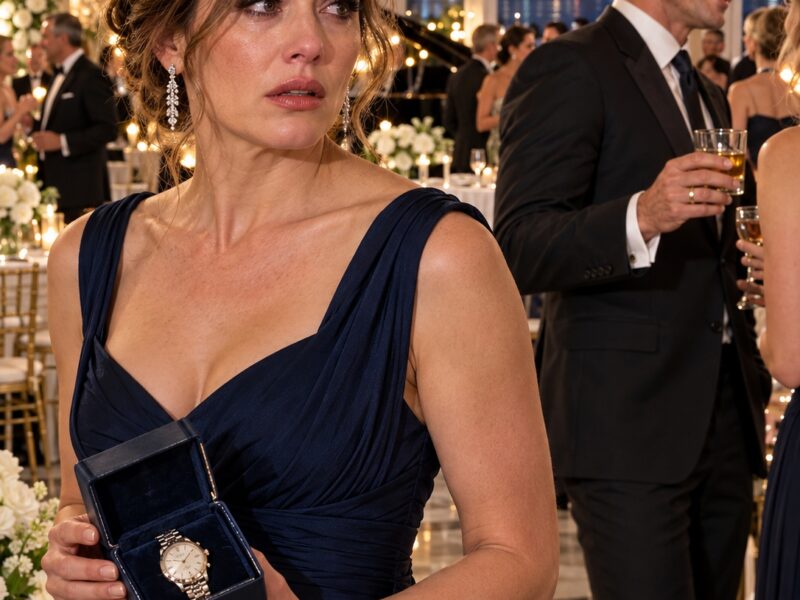
So when I heard it floating out of the private lounge beside the ballroom, I tightened my fingers around the small navy gift box hidden behind my back and thought:
Good.
Maybe tonight had reached him.
Maybe ten years still meant something.
The ballroom of our Charleston waterfront home glowed beneath crystal chandeliers. Through the tall windows, Charleston Harbor looked almost black beneath the night sky, scattered with gold reflections from passing boats. White roses stood in silver vases on every table. A jazz quartet played near the terrace doors. Waiters in black jackets moved quietly between politicians, shipping executives, museum donors, attorneys, and old-money families whose names appeared on buildings all over South Carolina.
It was, everyone kept telling me, a beautiful celebration.
Ten years.
Ten years since I had stood beside Graham in a little church with only eighty guests and watched a man who owned almost nothing promise me he would never allow success to turn him into someone I no longer recognized.
Ten years since he slipped a simple gold band onto my hand.
Ten years since I believed him without hesitation.
I had planned almost every detail of the evening.
Graham had paid for it.
There was a difference.
He had told his assistant to “give Evelyn whatever she needs,” and Daniel had arranged vendors, security, catering, parking, flowers, musicians, and the guest list.
But I had chosen the menu because Graham hated overly complicated food.
I had asked the florist not to use lilies because their scent gave him headaches.
I had made sure an elderly investor named Mr. Hendricks had a chair with extra back support because I remembered his surgery the year before.
I had even moved the anniversary toast fifteen minutes later because Graham had an investor call scheduled at six thirty.
I knew everyone’s needs.
That had always been my talent.
Especially Graham’s.
The navy gift box in my hand contained something money could not buy.
His father’s watch.
Graham had believed it was lost almost twenty years earlier after his father’s death. I had spent seven months tracking it through a cousin, an estate sale, and eventually a collector in Virginia. Then I found an old watchmaker outside Savannah who restored the scratched silver case without replacing the worn details Graham would remember.
Inside the back cover, I had six words engraved.
Every moment still begins with us.
I had imagined giving it to him after the guests left.
I imagined us sitting on the terrace overlooking the harbor, his tie loosened, my shoes kicked off beneath the table.
I imagined him opening the box and going silent.
Maybe touching the watch the way he used to touch his father’s old photographs.
Maybe looking at me with that expression I had not seen in years—the expression that said, for one moment, nothing else in the world had managed to follow him home.
I imagined telling him I missed us.
I imagined him saying he did too.
Then I reached the lounge door.
It stood partially open.
Graham’s voice came through clearly.
“She still believes I wear this ring for her.”
Several men laughed.
I stopped.
Not dramatically.
There was no gasp.
No dropped glass.
No music suddenly cutting off.
I simply stopped walking.
Inside the room, Graham stood near the fireplace with four executives I recognized from Callaway Maritime. His jacket was unbuttoned. A glass of bourbon rested in his right hand.
He lifted his left hand.
His wedding ring caught the light.
One of the men laughed and said, “Come on, Graham. You’re telling me the great Graham Callaway is sentimental?”
Graham smiled.
Not cruelly.
That somehow made it worse.
“No,” he said. “I’m telling you it’s useful.”
Another laugh.
“What is?”
“Marriage.”
Someone whistled.
Graham rolled his glass between his fingers.
“People trust a married man more than they trust a powerful one,” he said. “Especially when they’re negotiating with him. Family man. Stable. Predictable. The ring helps.”
One executive grinned. “So the wife is part of the brand?”
Graham laughed.
Then he said the sentence I would hear in my head for weeks.
“It’s good for business.”
The room erupted again.
Someone muttered, “Cheapest investment you ever made.”
Graham looked down at his wedding band.
“Exactly.”
My fingers loosened around the gift box.
For ten years, I had believed there were moments in a marriage that could not be priced.
The first morning after the wedding, when we burned pancakes because neither of us knew how to use the stove in our rented apartment.
The winter Graham’s first company almost failed and we slept on the office floor for three nights because he was afraid to leave.
The night his mother died and he sat on our bathroom floor at two in the morning because grief had made breathing difficult.
Every cup of coffee.
Every late dinner kept warm.
Every handwritten note slipped into a briefcase.
Every scarf placed in his car because he never remembered Charleston could get cold.
Every time I defended his absence to people who quietly judged him.
Every time I whispered, “He’s building something.”
Every time I told myself he was doing it for us.
Ten years.
Thousands of ordinary choices.
And my husband had just explained our marriage as a useful accessory to four men drinking bourbon twenty feet from our anniversary cake.
None of them saw me.
Graham did not see me.
Why would he?
He was looking at everyone except the woman who could identify his footsteps from the other end of a hallway.
I looked down at my own wedding ring.
It suddenly felt heavier.
Not because it had changed.
Because its meaning had.
One of the executives asked, “Does Evelyn know she’s good for shareholder confidence?”
Another round of laughter.
Graham shook his head.
“Evelyn doesn’t care about any of this.”
Something inside me went completely still.
He was wrong.
I cared.
I had cared so much that somewhere along the way I had stopped asking whether caring was being returned.
Someone called my name from the ballroom.
“Evelyn?”
I stepped backward before anyone inside the lounge could see me.
My heartbeat was strangely calm.
That frightened me more than anger would have.
Anger meant there was something alive enough to fight.
This felt different.
This felt like reaching for a light switch and discovering the electricity had been cut hours ago.
“Mrs. Callaway?”
I turned.
One of the caterers stood near the ballroom entrance. “They’re asking whether you want the cake brought out now.”
I looked at her.
She had no idea my marriage had ended in my head thirty seconds earlier.
I smiled.
“Not yet.”
She nodded and hurried away.
I walked past the ballroom.
Past the flowers.
Past the photographs from our wedding arranged along the corridor.
Past a framed picture of Graham and me standing outside our first apartment, both of us laughing because the front door key had broken in the lock.
I climbed the staircase without rushing.
No one stopped me.
Upstairs, Graham’s private study overlooked the dark harbor.
I closed the door behind me.
The room smelled like cedar, leather, and the faint trace of his cologne.
Everything here reflected him.
Shipping maps.
Awards.
Photographs with governors and foreign investors.
Books he had not opened in years.
On the wall behind his desk hung an oil painting of Charleston Harbor.
Behind it was an antique steel safe.
I entered the code.
My birthday.
Of course it was my birthday.
Graham had chosen it years ago because he said it was one number he would never forget.
The lock clicked.
I placed the navy gift box on the bottom shelf.
For a moment, I stared at it.
Months of searching.
Weeks of restoration.
Six engraved words.
A private hope I had been too afraid to say out loud.
I closed the safe.
The steel door shut with one quiet metallic click.
Downstairs, applause erupted.
Someone had probably begun a toast.
I rested my fingertips against the cold safe door and whispered the first completely honest sentence I had spoken all evening.
“Happy anniversary, Graham.”
Then I went downstairs and smiled for the photographs.
No one knew our anniversary had already ended.
Not even my husband.
The next morning, our house looked exactly the same.
That was the dangerous part.
Sunlight spilled across the marble foyer. The automated shades lifted at six fifteen. At six thirty, the coffee machine began brewing because I had programmed it years earlier.
The newspaper waited beside Graham’s chair.
Breakfast was set on the walnut table overlooking the harbor.
The world had not acknowledged what had happened.
So neither did I.
Graham came downstairs at six forty-three, already reading emails.
Dark suit.
Silver cuff links.
Phone in hand.
His hair still slightly damp from the shower.
“Morning.”
“Morning.”
He sat.
I poured his coffee.
One sugar.
Small amount of cream.
He reached for it without looking.
“Thank you.”
Usually I said, You’re welcome.
That morning, I said nothing.
He did not notice.
At least I thought he didn’t.
He checked a message while eating eggs.
“The Singapore group moved the call to eight tonight.”
I buttered a piece of toast.
“So you’ll be late.”
“Probably.”
“All right.”
He looked up.
Just briefly.
I had said the exact words I always said.
But apparently I had said them differently.
“You okay?”
There it was.
The smallest opening.
I could have told him.
I could have asked what exactly I was worth on a balance sheet.
I could have repeated every word I had heard.
Instead, I looked at him and understood something painful.
I did not want an apology he had been forced to give because I caught him.
I wanted to know who he was when no one demanded he change.
“I’m fine.”
His gaze stayed on me another second.
Then his phone vibrated.
He looked down.
The moment disappeared.
At seven twelve, he stood.
“I’ll try not to wake you when I come in.”
“That’s considerate.”
He leaned down and kissed my forehead.
For years, that kiss had meant familiarity.
Affection.
Home.
That morning it felt like the final step in a routine he had memorized.
Wallet.
Phone.
Keys.
Kiss wife.
Leave.
The front door closed.
I carried our coffee cups to the kitchen.
Mine was empty.
His was still half full.
I poured the cold coffee into the sink and watched it disappear.
And for the first time in my marriage, I asked myself a question that felt almost disloyal.
How many parts of Graham’s life existed because I quietly maintained them?
The answer arrived slowly over the next several days.
More than either of us knew.
Every Tuesday, I replaced the flowers in his home office with white roses because stronger scents gave him headaches.
That Tuesday, I didn’t.
Not to punish him.
I simply forgot to make it my responsibility.
By Thursday, the old flowers had started browning at the edges.
Graham noticed.
He looked at them during a phone call, frowned, and removed one dead petal with his thumb.
He never asked why they had not been replaced.
Every Wednesday morning, I tucked a note into his briefcase.
Sometimes I wrote, Eat lunch today.
Sometimes, You’ve handled harder meetings than this.
Sometimes, Come home before the harbor gets dark.
Once, after a difficult year, I wrote only, Someone still believes in you when you forget how.
The Wednesday after our anniversary, I watched his driver carry the briefcase outside.
No note.
At noon, Graham opened the case during a board meeting.
Daniel later told me what happened, though not until much later.
Graham reached into the inside pocket.
Paused.
Checked another compartment.
Then another.
Daniel asked, “Lose something?”
Graham looked embarrassed.
“No.”
“You sure?”
“Yes.”
He closed the briefcase.
Five minutes later, he opened it again.
The missing note was the first absence he could not explain away.
There were others.
When he texted that he was coming home, I stopped waiting at the front window.
For ten years, I had done it without thinking.
Headlights across the driveway.
Gate opening.
The sound of tires on stone.
My feet automatically carried me toward the foyer because I liked being the first person he saw after a brutal day.
Three nights after our anniversary, Graham came home at 7:45.
I heard the gate.
I heard the car.
I stayed in the library.
The front door opened.
Silence.
“Evelyn?”
“I’m in here.”
He appeared in the doorway, briefcase in hand.
“You didn’t hear me?”
“I did.”
He glanced toward the front windows.
“I was reading.”
“Oh.”
He loosened his tie.
“What are you reading?”
I almost laughed.
In ten years, he had rarely asked.
I turned the cover toward him.
He nodded as if that settled something.
Then he went upstairs.
But before leaving the room, he looked once more toward the empty foyer.
I saw the confusion in his face.
It was the expression of a man noticing machinery only after one quiet part stopped moving.
I was not trying to teach him a lesson.
That mattered to me.
I did not want to become cruel simply because I had been hurt.
I did not cancel his appointments.
I did not embarrass him publicly.
I did not tell friends what I heard.
I did not sleep with someone else, threaten divorce, drain accounts, or throw his clothes onto the lawn.
I kept living.
That was all.
I still made dinner when I was home.
I still asked whether he needed anything from the grocery store.
I still attended events when we had committed to attend together.
I simply stopped filling every empty space before Graham had a chance to realize the space existed.
And the strangest thing happened.
I began breathing easier.
Saturday night, we attended a fundraiser at one of Charleston’s historic hotels.
A jazz trio played beneath warm terrace lights.
Graham circulated among business partners while I spoke with museum donors.
For years, this had been normal.
The Callaways.
Strong marriage.
Successful husband.
Cultured wife.
Charleston loved a polished story.
At dinner, one of Graham’s longtime associates raised a glass.
“Ten years, right?”
Graham smiled. “Ten.”
The man looked at me. “You two always seem so solid. What’s the secret?”
Several people waited for something romantic.
Graham opened his mouth.
I answered first.
“Consistency.”
The table laughed softly.
A woman beside me touched my arm. “That’s the truth.”
I smiled.
“Yes.”
Across the table, Graham watched me.
He knew something in my voice had changed.
He simply did not know what.
That night, standing in front of our bedroom mirror, I removed my earrings.
Then my bracelet.
Then I looked at my wedding ring.
I had worn it every day for ten years.
Through funerals.
Flights.
Illness.
Arguments.
Museum renovations.
Business collapses.
Success.
I had never seriously considered taking it off.
Until then.
I slipped the ring from my finger.
No anger.
No speech.
I placed it inside the velvet jewelry box Graham had given me years ago.
Then I turned off the light.
The next morning, Graham noticed before breakfast ended.
He was passing me coffee when his eyes moved to my bare left hand.
His fingers stopped.
The cup remained suspended between us.
For half a second, I thought he would ask immediately.
He didn’t.
Graham never reacted quickly to emotional problems.
He studied them.
Stored them.
Waited until he believed he had enough information to control the outcome.
He placed the cup in front of me.
“Coffee.”
“Thank you.”
His eyes returned to my hand.
I ate breakfast.
He checked his phone.
Neither of us spoke about the missing ring.
But when he left for work, he forgot his briefcase.
The driver had to bring him back.
That was when I knew the silence had finally reached him.
Two nights later, we attended the Charleston Business Alliance dinner.
An elderly couple named Henry and Lorraine Whitmore approached us near the terrace.
They had been married forty-three years.
Henry shook Graham’s hand, then pointed at his wedding band.
“Never take that thing off.”
Graham smiled politely.
“I’ll remember that.”
Henry laughed. “No, son. You won’t. That’s why you wear it.”
Graham’s expression changed.
Only slightly.
Henry continued, “It’s not jewelry. It’s a reminder that somebody trusted you with their ordinary days.”
Lorraine rolled her eyes. “He gets philosophical after two glasses of wine.”
“I get accurate.”
They walked away holding hands.
Graham rubbed his thumb across his ring.
Later, at home, I stood on the terrace looking across the harbor.
He came outside.
No phone.
No bourbon.
Just Graham.
For several minutes, we said nothing.
Then he asked, “Where’s your ring?”
I kept my hands on the stone railing.
“In my jewelry box.”
“Why?”
“I still have it.”
“That wasn’t my question.”
I turned toward him.
He looked genuinely unsettled.
“Did something happen?”
I almost admired the irony.
“Nothing happened today.”
He stared at me.
“Evelyn.”
“What?”
“You’re different.”
“No.”
“Yes, you are.”
“Maybe you’re noticing me differently.”
His jaw tightened.
“Is this about me?”
I looked toward the water.
“That depends.”
“On what?”
“On whether you think a marriage can change without one person noticing.”
The question landed harder than an accusation.
His voice lowered.
“Have I done something?”
I thought of the lounge.
The bourbon.
The laughter.
She still believes I wear this ring for her.
I could have ended the mystery.
Instead I asked, “Do you know why you wear yours?”
He looked down.
I went inside.
Behind me, I heard a faint metallic sound.
Graham was turning his wedding band around his finger.
Again.
And again.
And again.
A week later, he canceled an evening meeting for the first time in years.
Daniel nearly dropped his tablet.
“You want me to move the quarterly review?”
“Yes.”
“To tomorrow?”
“Yes.”
“You’ve never moved this meeting.”
“There’s a first time for everything.”
Graham left the office at 5:30.
He did not tell me.
I did not know he was coming home early.
At 6:05, he entered a silent house.
Dining room dark.
Kitchen empty.
No music.
No covered dinner plates.
On the island was a handwritten note.
Dinner is in the refrigerator. Museum board meeting tonight. Please don’t wait for me.
Inside the refrigerator, I had left chicken, vegetables, and rice with reheating instructions.
Everything he needed.
Except me.
He ate alone.
At 9:14, I came home.
Graham sat in the living room with a book open on his lap.
I knew immediately he had not read a page.
“How was your meeting?” he asked.
“Productive.”
“Dinner was good.”
“I’m glad.”
I picked up my coat.
He watched me.
“I came home early.”
“I noticed.”
“You weren’t here.”
“No.”
There was a childish edge to the statement he was trying not to make.
I came home for you.
I softened slightly.
“I had plans, Graham.”
He nodded.
“Right.”
I went upstairs.
At the bedroom door, I looked back.
He was still sitting beneath the lamp with the unread book open in his hands.
For the first time, I wondered whether he was beginning to understand.
Then came the Saturday that changed everything.
Months earlier, I had reserved a table at a small waterfront restaurant where Graham and I celebrated our first anniversary.
Back then we could barely afford dinner.
We split an appetizer.
He ordered the cheapest entrée on the menu and pretended it was his favorite.
Afterward, we walked along the harbor because we did not have money for a taxi.
When we became wealthy, Graham once offered to buy the restaurant.
I told him not everything meaningful needed to belong to us.
That Saturday had been marked on our shared calendar for months.
PRIVATE ANNIVERSARY DINNER – 7 PM.
Three days after the party, I canceled the reservation.
I never told him.
Instead, I volunteered at a children’s art workshop sponsored by the museum.
Graham remembered the calendar around noon.
He came downstairs looking for me.
Martha, our housekeeper of eight years, was arranging flowers in the entry hall.
“Where’s Evelyn?”
“She left early, Mr. Callaway.”
“For the restaurant?”
Martha hesitated.
“No, sir.”
“Where?”
“The museum workshop.”
He looked toward the driveway.
“When will she be back?”
“This evening.”
He stood there longer than necessary.
Then he went upstairs.
Later, he would tell me he had entered the study looking for a property file.
Maybe he had.
Maybe some part of him was looking for something else.
He opened the safe.
On the lower shelf sat the navy gift box.
Silver ribbon.
Unopened.
He recognized it.
He carried it to his desk.
For a man who had signed nine-figure contracts without shaking, it took him almost five minutes to untie one ribbon.
Inside was his father’s watch.
The restored silver case reflected the afternoon light.
Graham sat completely still.
Then he saw the engraving.
Every moment still begins with us.
Beneath the watch was a card.
Six words again.
Nothing accusatory.
Nothing dramatic.
No mention of what he said in the lounge.
Just the hope I had carried into our anniversary.
Graham closed his eyes.
And memory, apparently, did what I no longer had the energy to do.
It reminded him.
His first office.
Our broken heater.
The night we ate Chinese food sitting on cardboard boxes because our apartment had no furniture.
The winter his company nearly collapsed.
The promise that money would buy freedom but would never become the thing that owned us.
When I came home that evening, Graham was already in the kitchen.
That alone stopped me.
He had changed out of his suit.
His sleeves were rolled up.
The restored watch was on his wrist.
I looked at it.
He saw me look.
Neither of us mentioned it.
“You’re home,” I said.
“So are you.”
I put my bag down.
“What are you doing?”
“Trying to help.”
“With what?”
“Dinner.”
I almost smiled despite myself.
“Do you know how?”
“No.”
At least the answer was honest.
I handed him tomatoes and a cutting board.
“Start there.”
He cut them badly.
Too thick.
Then too thin.
I stirred soup.
His phone vibrated on the counter.
He reached for it automatically.
Stopped.
Turned it face down.
We cooked in silence.
Not the cold silence of the previous weeks.
Something more uncertain.
Like two people standing near a damaged bridge, testing whether it could still carry weight.
At dinner, his phone rang twice.
He ignored it.
Afterward, I picked up our plates.
He stood.
“I’ll do it.”
I looked at him.
“You’ll do what?”
“The dishes.”
“Graham Callaway washing dishes?”
“Don’t tell the board.”
A laugh escaped me.
Small.
But real.
His face changed when he heard it.
For one second, he looked almost relieved.
That scared me.
Because hope was more dangerous than anger.
Anger required nothing from me.
Hope meant I could be hurt again.
Later, I found him on the terrace.
He was touching his father’s watch.
“Thank you,” he said.
“You weren’t supposed to find it like that.”
“I know.”
Silence.
“I’m sorry.”
I stiffened.
“For what?”
He looked at me.
And there it was.
The problem.
He still didn’t know.
Not completely.
“I don’t know yet,” he admitted.
It was the first useful thing he had said.
“I just know I’ve been missing something happening in my own house.”
I folded my arms.
“You’ve been missing a lot.”
“Then tell me.”
I wanted to.
God, I wanted to unload every sentence.
But part of me was tired of translating myself for a man who could negotiate international port agreements in three time zones yet needed instructions on how to recognize loneliness across a breakfast table.
“You need to see some of it yourself.”
“That feels like a test.”
“It isn’t.”
“What is it?”
“A consequence.”
He went quiet.
I walked inside.
That night, for the first time since our anniversary, Graham did not follow me with another question.
He listened.
The next test arrived on a rainy Thursday.
My museum had spent almost a year preparing a maritime history exhibition.
It was my largest professional project.
Graham knew this.
Or at least I had told him.
The opening was Thursday at six.
At eight that morning, his company began the final stage of negotiations for an international shipping agreement that would expand Callaway Maritime into two additional ports.
Everyone expected Graham to lead the investor presentation that evening.
At breakfast, I placed an envelope beside his briefcase.
He opened it.
Museum invitation.
At the bottom I had written:
No pressure. I simply wanted you to know where I’ll be.
He read the sentence twice.
“You’re opening tonight.”
“Yes.”
“At six?”
“Yes.”
He looked toward his phone.
I knew that look.
Schedule calculations.
Obligations.
Cost.
Consequences.
“I know you have the investor meeting,” I said.
“You remember?”
“I remember most things about your calendar.”
He heard what I did not say.
You don’t remember mine.
“I’ll try.”
There was a time when those words would have satisfied me.
That morning, they didn’t.
“Don’t try for me.”
He frowned.
“What does that mean?”
“It means make whatever choice you actually believe you should make.”
I left.
At 5:58 that evening, I stood near a restored lighthouse lens explaining the preservation process to a group of donors.
The museum was crowded.
Children pressed fingerprints against glass cases.
Local officials shook hands beneath banners.
Volunteers moved between displays.
I had stopped looking toward the doors.
Then I saw Graham.
Dark suit.
Rain still shining on the shoulders.
Father’s watch on his wrist.
Standing alone at the back.
No grand entrance.
No flowers.
No assistant.
No announcement.
He was simply there.
I kept talking.
Our eyes met once.
He did not wave.
He listened.
I told the group, “Objects survive because someone decides their story is worth preserving. But preserving the object isn’t enough. We have to remember why it mattered.”
Across the room, Graham lowered his eyes.
After the presentation, guests surrounded me.
He waited.
Twenty minutes.
Thirty.
When the final donor walked away, Graham approached.
“That was remarkable.”
“Thank you.”
“I almost missed it.”
I looked at him.
“Yes.”
His mouth tightened.
“I canceled the meeting.”
“No. You delegated it.”
“How do you know?”
“Because you wouldn’t build a company that collapsed because you attended your wife’s museum opening.”
He smiled faintly.
“I used almost those exact words.”
For a moment, we were the people we used to be.
Then reality returned.
We walked through the galleries after the crowd thinned.
We stopped in front of nineteenth-century letters sent between sailors and their families.
Ink faded.
Paper yellowed.
Words still visible.
Graham read one silently.
“They waited months for replies.”
“Sometimes longer.”
“And they kept writing.”
“Yes.”
“Why?”
I looked at him.
“Because when people believe something matters, they keep showing up for it.”
He stared through the glass.
“Even when nobody sees.”
“Especially then.”
He looked at me.
I knew the conversation was no longer about sailors.
When we returned home, rain tapped against the windows.
I went upstairs and brought down a leather journal.
I had kept it for ten years.
Graham sat opposite me.
“What is that?”
I placed it on the coffee table.
“Open it.”
The first page held our wedding photograph.
We were not looking at the camera.
We were looking at each other.
The next page contained a photograph from our first anniversary.
Then our first house.
Our first Christmas.
The night his company signed its first major contract.
The funeral of his mother.
The afternoon we bought this house.
Receipts.
Ticket stubs.
Notes.
Photographs.
Ten years of a marriage documented not through expensive milestones but through moments.
Graham turned the pages without speaking.
Near the end was the receipt from the watch restoration.
Beside it, the original engraving sketch.
And underneath, a note I had written weeks before our anniversary.
He unfolded it.
I never wanted another expensive gift. I only hoped one day we would treasure the same promises again.
His hand went still.
He closed the journal.
For several seconds, he stared at the cover.
Then he said, “I thought I was doing everything right.”
I did not answer.
“I thought building the company meant protecting our future.”
“It did. For a while.”
“I wanted you to never worry about money.”
“I never asked you to make sure I never worried.”
His eyes lifted.
“I asked you to come home.”
He flinched.
Not because I raised my voice.
Because I didn’t.
“I came home.”
“Your body did.”
Silence.
“That’s unfair.”
“Is it?”
He stood.
Walked toward the window.
I watched him fight the instinct to defend himself.
“You knew what building this company required.”
“Yes.”
“You encouraged me.”
“Yes.”
“You told me to keep going when I wanted to quit.”
“Yes.”
He turned.
“Then how was I supposed to know I had crossed some invisible line?”
I stood too.
“Because I was on the other side of it.”
His expression hardened.
“That’s not an answer.”
“No, Graham. It is the answer. You just don’t like it.”
He stared at me.
Ten years of marriage sat between us.
Then I finally said the words I had refused to say.
“I heard you.”
He went completely still.
“At the anniversary party.”
His face changed.
I saw the moment memory returned.
The lounge.
The executives.
Bourbon.
Laughter.
His ring.
He whispered, “Evelyn—”
“No.”
“I didn’t—”
“Do not tell me I misunderstood.”
“I wasn’t going to.”
“Good.”
He sat down slowly.
Color drained from his face.
“You heard all of it?”
“I heard enough.”
His eyes dropped to the wedding band on his hand.
I repeated his words.
“People trust a married man more than they trust a powerful one.”
He closed his eyes.
“Family man. Stable. Predictable.”
“Evelyn.”
“The ring helps.”
“Please.”
“Marriage is good for business.”
He looked physically sick.
I kept going because I had swallowed the words for weeks.
“One of those men asked whether I knew I was good for shareholder confidence.”
His jaw tightened.
“And you laughed.”
“I know.”
“You laughed.”
“I know.”
“On our tenth anniversary.”
“I know.”
“No, Graham.”
My voice broke for the first time.
“You know now.”
That silenced him.
I turned away because tears had finally reached my eyes and I hated that they had waited until this moment.
Behind me, Graham said, “There is no excuse for that.”
I wiped my cheek.
“No.”
“I was showing off.”
“I know.”
“I was being an arrogant bastard in a room full of arrogant men.”
“Yes.”
“I didn’t believe what I said.”
I turned.
“That might be worse.”
He stared at me.
“If you believed it, at least I’d know exactly what our marriage meant to you. But if you didn’t believe it, then you traded my dignity for a laugh you didn’t even need.”
His face collapsed.
Not dramatically.
Quietly.
I had never seen Graham Callaway look powerless.
Not when his company nearly failed.
Not at his mother’s funeral.
Not during lawsuits or hostile negotiations.
But he looked powerless then because money could not repair what money had not broken.
He removed his wedding ring.
My stomach tightened.
He placed it on the journal.
“I’ve been wearing this for ten years,” he said.
I said nothing.
“And somehow I turned it into decoration.”
His fingertips rested beside the ring.
“I thought providing was loving you.”
“Sometimes it was.”
“I thought being dependable was enough.”
“It isn’t.”
“I thought because you never complained—”
“That I had nothing to complain about?”
He winced.
“Yes.”
I sat across from him.
For a long time, neither of us spoke.
Then Graham whispered, “I don’t know how to fix this.”
For once, I did not rescue him.
“Neither do I.”
His eyes met mine.
It was the first truly honest conversation we had shared in years.
Not romantic.
Not beautiful.
Honest.
And honesty was messier.
“I don’t want you to put your ring back on because I say the right thing tonight,” he said.
“Good.”
“I don’t want you to forgive me because I found a watch and suddenly remembered I have a wife.”
“Good.”
His mouth tightened.
“You could stop saying ‘good.’”
I almost smiled.
“Then stop saying sensible things.”
He laughed once.
It broke halfway through.
Then his eyes filled.
Graham rarely cried.
I had seen it three times in ten years.
He looked toward the journal.
“What do I do?”
“You live differently.”
“For how long?”
I shook my head.
“That question is exactly the problem.”
He understood.
Love was not a thirty-day turnaround plan.
There would be no single gesture.
No expensive vacation.
No necklace.
No dramatic renewal ceremony where fifty guests applauded while we pretended repair happened because someone rented flowers.
He would either become present in our marriage again.
Or he wouldn’t.
Morning came over Charleston Harbor quietly.
Two coffee cups sat on the table.
Graham came downstairs in a light blue shirt, sleeves rolled to his forearms.
His father’s watch was on his wrist.
He poured coffee before I could.
“Cream?”
I nodded.
He added exactly the amount I liked.
I noticed.
So did he.
Neither of us made the moment larger than it was.
That became our rule.
Small actions.
No applause.
He came home when he said he would.
When he couldn’t, he called.
Not Daniel.
Not his assistant.
Him.
He asked about the museum before discussing shipping contracts.
He stopped carrying his phone from room to room.
He thanked Martha by name.
On Sundays, he tried to cook breakfast.
The first pancakes were burned.
I ate one anyway.
“They’re terrible,” he said.
“Yes.”
“You could lie.”
“We’re trying honesty now.”
He laughed.
So did I.
It was the first time laughter had filled our kitchen in months.
But rebuilding did not mean pretending the damage was gone.
Some nights, I remembered the anniversary lounge and became cold without warning.
The first time it happened, Graham asked what was wrong.
“Nothing.”
Then I saw fear cross his face.
Because he remembered my answer on the terrace.
Nothing happened today.
So I corrected myself.
“I remembered what you said.”
He put his phone down.
“I’m sorry.”
“I know.”
“I can leave you alone.”
“No.”
“What do you need?”
“I don’t know.”
He nodded.
Then he stayed.
No defense.
No demand that I recognize his progress.
He sat in silence until I was ready to speak.
That mattered more than roses would have.
Several weeks later, one of the executives from the anniversary lounge approached me at another event.
Thomas Avery.
He looked uncomfortable.
“Evelyn, may I speak with you?”
Graham was across the room.
I nodded.
Thomas cleared his throat.
“I owe you an apology.”
“For what?”
His face told me he knew I had heard.
“Graham told us.”
I looked toward my husband.
“He did?”
“The four of us.”
Thomas glanced down.
“He said the conversation that night was disrespectful. To you. To our wives. He said if he ever heard that kind of conversation in his company again, he would leave the room rather than join it.”
I said nothing.
Thomas continued, “For what it’s worth, my wife heard about it too.”
“How?”
“I told her.”
I raised an eyebrow.
“That brave?”
“No.” He gave a miserable smile. “Graham told us if we wouldn’t repeat the joke in front of our wives, then we already knew it wasn’t funny.”
Something shifted inside me.
Graham had not told me he confronted them.
He had gained nothing by doing it.
That made it real.
Later, in the car, I asked, “You spoke to Thomas?”
“Yes.”
“Why didn’t you tell me?”
He looked through the windshield.
“Because I didn’t do it for credit.”
I turned toward the window so he would not see my expression.
Another brick returned to the bridge.
Not all at once.
One ordinary piece at a time.
Spring moved toward summer.
On a Saturday afternoon, Graham asked if I wanted to walk along the harbor.
Years earlier, before wealth and calendars and drivers and assistants, we walked there constantly.
I agreed.
Families moved along the promenade.
Children chased gulls.
Sailboats crossed the water.
For once, Graham did not walk as if arriving somewhere mattered more than the walk itself.
Halfway down the marina, he stopped near a bench.
“What?”
He reached into his jacket.
My wedding ring rested in his palm.
I stared at him.
“I didn’t take it from your jewelry box,” he said quickly.
“I was about to ask.”
“You left it on the dresser Wednesday when you were choosing earrings.”
“I remember.”
“I asked if I could take it.”
“You asked Martha?”
“No. I asked you.”
I blinked.
Then remembered.
I had been half asleep.
He smiled slightly.
“You said, ‘Whatever, Graham.’ Very romantic.”
Despite myself, I laughed.
The ring had been cleaned.
Not altered.
Not upgraded.
No diamonds added.
Just polished until the old gold caught the afternoon sun.
“I took it to the jeweler,” he said.
“Why?”
“I almost had something engraved inside.”
My heart tightened.
“What?”
“I don’t know. Something profound and expensive.”
“That sounds like you.”
“That’s why I didn’t.”
He held the ring out.
“I realized the ring wasn’t missing words. I was missing the point.”
Neither of us moved.
Graham swallowed.
“I’m not asking you to put it on.”
I looked at him.
“I’m not asking you to forgive me because enough weeks have passed.”
The wind moved through his hair.
“I’m not even asking you to promise we’re okay.”
His voice softened.
“I just wanted you to have it back when you were ready.”
I took the ring from his palm.
The gold felt warm.
Familiar.
I thought about the woman I had been on our anniversary night.
Standing behind a half-open door.
Holding his father’s watch.
Listening to strangers laugh while my husband reduced something sacred to something useful.
That woman wanted certainty.
She wanted to know whether ten years had been real.
I knew now that they had been.
The mornings were real.
The sacrifices were real.
The love was real.
So was the neglect.
So was the humiliation.
One truth did not erase the other.
Maybe adulthood was learning that people could love you and still fail you terribly.
Maybe marriage was deciding whether failure revealed who someone truly was—or whether what they did after being confronted revealed something too.
I turned the ring between my fingers.
“Do you remember what Henry Whitmore said?”
Graham nodded.
“That it reminds you.”
I looked at him.
“No. The other part.”
He thought.
“Somebody trusted you with their ordinary days.”
“Yes.”
His eyes dropped.
“I forgot.”
“I know.”
“I don’t want to again.”
I believed him.
But belief was no longer enough.
I had learned that lesson.
So I said, “Then don’t.”
And I slipped the ring onto my finger.
Graham exhaled.
He did not hug me immediately.
He did not cheer.
He did not say thank God.
He only looked at the ring.
Then at me.
“Thank you.”
“This isn’t a reset.”
“I know.”
“It doesn’t erase what happened.”
“I know.”
“And if you ever call our marriage a business strategy again—”
“I’ll give you the company.”
I stared at him.
“That isn’t funny.”
“Right.”
A beat passed.
Then I laughed.
He did too.
Graham reached into his other pocket and removed his own wedding band.
He had stopped wearing it after our conversation beside the journal.
Not because he was leaving.
Because, he said, he wanted to earn the meaning back before wearing the symbol.
Now he slid it onto his finger.
We began walking again.
For several yards, our hands moved separately.
Then his fingers brushed mine.
He did not grab.
He waited.
I let my hand turn.
Our fingers intertwined.
No applause followed.
No orchestra.
No dramatic declaration.
Only waves against the harbor wall.
Children laughing somewhere behind us.
The faint bell of a sailboat.
And the warm Charleston sun moving lower across the water.
Months later, I returned the leather journal to the upstairs study.
I placed it in the antique safe.
Beside it was the empty navy watch box.
I almost closed the door.
Then something stopped me.
On the shelf was a new envelope.
My name was written on it.
I opened it.
Inside was one sheet of paper in Graham’s handwriting.
Evelyn,
For years, I thought the biggest promises were the ones made in front of witnesses. I was wrong.
The promises that matter most are usually made when nobody is watching.
Come home when I say I will.
Listen when you speak.
Know what matters to you.
Protect your dignity even when you are not in the room.
Remember that success is something I built. You are someone I chose.
Never confuse the two again.
There was no signature.
There didn’t need to be.
I folded the letter and placed it inside the journal.
Then I noticed something else.
A small photograph had been added to the final page.
Graham and me walking along the harbor.
Our backs toward the camera.
Hands joined.
Martha must have taken it from a distance.
Below it, Graham had written a date.
And underneath the date, one sentence.
The day we stopped trying to return to what we had—and started choosing what came next.
I stood there for a long time.
Ten years earlier, I believed love was a promise.
At our anniversary, I thought maybe love was only a story I had been telling myself.
I know better now.
Love is neither.
Not completely.
Love is the cup of coffee made correctly because someone remembered.
It is a phone placed face down when another person is speaking.
It is coming home.
It is showing up.
It is apologizing without bargaining for forgiveness.
It is protecting someone’s name when they are not there to hear you do it.
It is washing dishes when nobody is impressed.
It is allowing silence without abandoning the room.
It is noticing the flowers.
Remembering the museum opening.
Learning the difference between providing a life and participating in one.
And sometimes, love is taking a wedding ring off because wearing it has become dishonest.
Sometimes it is putting the same ring back on only after the person beside you understands that forgiveness is not something they are owed.
I closed the safe.
Downstairs, I heard Graham calling.
“Evelyn?”
His voice echoed through the house.
Years earlier, I would have hurried down automatically.
That evening, I smiled.
“I’m coming.”
When I reached the kitchen, he was standing beside the stove.
There was flour on his shirt.
A frying pan smoked behind him.
I looked at the disaster.
“What happened?”
“I attempted dinner.”
“Attempted?”
“The distinction matters.”
I opened a window.
He turned off the burner.
“Takeout?”
“Definitely.”
He reached for his phone.
Then paused.
“Chinese?”
I looked at him.
The same food we had eaten on the floor of our first apartment when we could not afford furniture.
“The cheap place?”
“The very cheap place.”
“You hated their noodles.”
“I was in love.”
“You lied to me.”
“I was trying to impress you.”
“You had nineteen dollars in your bank account.”
“Twenty-three.”
I laughed.
He ordered dinner.
Forty minutes later, we sat on the kitchen floor despite owning a table large enough for sixteen people.
The house around us was worth more money than either of us once believed we would see in a lifetime.
Graham’s company operated across oceans.
My museum exhibition had become one of its most successful programs.
Upstairs, the journal held a decade of photographs.
On his wrist ticked the watch his father once wore.
On my left hand was the same gold ring I had once thought I might never wear again.
Graham handed me a carton of noodles.
“Good?”
I tasted them.
“Still terrible.”
He smiled.
Outside, Charleston Harbor glimmered beyond the windows.
Neither of us checked the time.
And I understood something then that I wish I had understood ten years earlier.
A marriage does not survive because two people once stood in a beautiful room and promised forever.
It survives because, long after the room empties and the flowers die and nobody is watching anymore, they keep deciding what those promises are worth.
My husband once told a room full of men that his wedding ring was good for business.
For weeks, I thought those words might become the last true thing about our marriage.
They didn’t.
Because the sentence that almost destroyed us was not the one that ultimately defined us.
The ordinary days afterward did.
And now, whenever Graham absentmindedly touches his wedding band, I know he is no longer checking whether it is still there.
He is remembering why it is.









