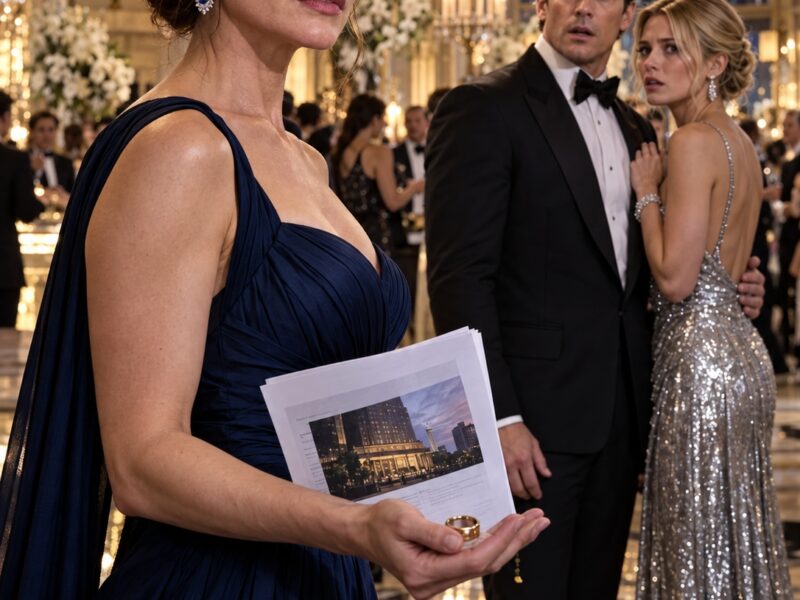
MY HUSBAND DANCED WITH HIS MISTRESS AT THE COMPANY I BUILT—THEN I TOOK THE MICROPHONE AND ENDED THE TITLE HE THOUGHT I’D NEVER DARE TOUCH

“Effective at six o’clock this evening, Nathan Morgan is no longer president of Hail Meridian Group.”
I said it calmly.
That was the part Nathan would remember.
Not the microphone in my hand.
Not the thousand guests beneath the crystal chandeliers.
Not Lauren Pierce standing fifteen feet away in a silver gown, still carrying the expression of a woman who had spent the evening believing she had already won.
He would remember my voice.
Because there was no anger in it.
No trembling.
No satisfaction.
And absolutely no request for permission.
For several seconds, the ballroom simply stopped.
A waiter near the center aisle froze with a tray of champagne balanced against his palm. The orchestra had already lowered its instruments, but one violinist still held his bow in the air as though even he had forgotten what came next.
Investors stared at Nathan.
Senior executives stared at me.
Lauren stared at the floor.
Nathan stared only at his wife.
Five minutes earlier, that same hand had been resting on Lauren’s waist while they danced beneath the chandeliers at the twentieth-anniversary gala of the company I had founded.
Now that hand hung uselessly beside him.
“Victoria.”
He said my name softly.
Almost like a warning.
I continued.
“The board has approved the transition plan. Daniel Foster will assume interim operating responsibility while a formal search is conducted. Employees will receive written communication tomorrow morning.”
Nathan stepped toward the stage.
“You fired me in front of everyone.”
I lowered the microphone.
“No.”
His face hardened.
“What do you call this?”
“An announcement.”
“Of what?”
“A decision that was already final before you walked onto that dance floor.”
Something changed in his eyes.
Not fear.
Not yet.
Nathan looked past me toward the directors seated near the front tables.
Michael Grant did not move.
Rebecca Sloan, our general counsel, stood beside a closed leather folder.
James Whitaker watched Nathan without surprise.
That was when my husband finally understood the most frightening thing happening in the ballroom.
I had not shocked the board.
The board had been waiting for me.
And to understand why, you have to understand that Nathan Morgan did not marry a powerful woman and immediately decide to destroy her.
That would have been easier.
He loved me once.
I believe that.
Maybe that is why betrayal hurts differently when it grows slowly.
You can recognize an enemy when he enters your house carrying a weapon.
It is harder when he enters carrying your coffee exactly the way you like it.
Six months earlier, Nathan and I stood together in the executive conference room on the forty-third floor of Hail Meridian headquarters overlooking Midtown Manhattan.
A business reporter had asked us what it felt like to lead one of the fastest-growing privately held groups in the country.
Nathan smiled before I answered.
“We built something durable,” he said.
I turned toward him.
The reporter smiled as though she had been handed the perfect quote.
I said nothing.
Hail Meridian had existed almost ten years before Nathan joined it.
I started with three employees, one distressed-property portfolio, a rented office with unreliable heat, and enough debt to keep me awake until sunrise.
My father had left me no empire.
There was no trust fund waiting to rescue me.
There were years when I knew the occupancy percentage of every building we owned because a two-point drop could determine whether we made payroll comfortably or spent another month pretending everything was fine.
I had slept on office sofas.
Negotiated with lenders from hospital waiting rooms while my mother was dying.
Sold my apartment once to keep a deal alive.
By the time I met Nathan, Hail Meridian already owned commercial properties, hotels, and logistics assets across several states.
But Nathan brought something I needed.
Discipline.
Speed.
He could walk into a failing operation and understand within an hour which executive was afraid, which one was lying, and which number mattered.
I admired him before I loved him.
Perhaps that was my first mistake.
Or perhaps it was the reason I loved him.
After the interview, we walked toward the elevators.
“You were quiet in there,” he said.
“You seemed comfortable answering for both of us.”
He smiled.
“I was saving you time.”
“You called Hail Meridian something we built.”
“We did.”
The elevator doors opened.
I pressed the button for the private floor.
“We built the current version together,” I said. “I built the company.”
His smile changed.
Only slightly.
“That distinction matters to you?”
“Accuracy matters to me.”
He looked at my reflection in the elevator doors.
“I would never take anything away from what you created.”
I smiled then.
“Good.”
The elevator began descending.
“Because stewardship isn’t ownership.”
His eyes shifted toward me.
For a moment, neither of us spoke.
Then he laughed.
I thought the moment had passed.
It hadn’t.
Over the next several months, Nathan began saying my company more often.
At investor dinners.
During interviews.
On conference calls.
Sometimes people corrected themselves around him.
Sometimes they didn’t.
I corrected him only once.
“Our company,” I said after a hospitality summit in Chicago.
Nathan grinned.
“My company.”
The people around the table laughed.
So did I.
Lauren Pierce was sitting two seats away.
She didn’t laugh very much.
She watched us.
Lauren was thirty-five, polished, intelligent, and exceptionally good at her job.
That matters.
I could make this story easier by telling you she was incompetent.
She wasn’t.
I could say she slept her way into Hail Meridian.
She didn’t.
Lauren had spent years building a reputation in corporate communications. She understood investors, journalists, crisis strategy, and the delicate language powerful companies use when something has gone terribly wrong but no one is ready to admit it publicly.
When the senior vice president of corporate affairs position opened, Nathan recommended her.
I reviewed her record.
Michael supported the promotion.
Rebecca raised no concern.
Lauren earned the job.
That truth would become important later.
At first, nothing looked wrong.
Then she began appearing beside Nathan more often.
Chicago.
Miami.
Boston.
Private investor meetings.
Acquisition dinners.
Late calls.
Nathan always had an explanation.
And every explanation made sense.
That is another thing nobody tells you about betrayal.
The dangerous lies are rarely absurd.
They are reasonable.
One evening, I was reviewing acquisition documents in our study when Nathan walked in wearing his coat.
“I have dinner downtown.”
“With whom?”
“Lauren and two potential institutional partners.”
I nodded.
“How late?”
“Ten, maybe.”
He leaned down and kissed my forehead.
“Don’t wait up.”
I remember the smell of his cologne.
I remember the sound of the apartment door closing.
I remember turning another page.
Nothing about the moment felt dangerous.
That was what haunted me later.
Betrayal rarely kicks the door open.
Sometimes it leaves politely after kissing your forehead.
Three weeks later, Lauren’s promotion became official.
Nathan signed the recommendation memorandum himself.
By summer, her name appeared on his travel schedule often enough that I stopped noticing it.
Until the details stopped matching.
Chicago was supposed to be a two-day investor conference.
Nathan stayed an extra night.
Lauren had supposedly arranged a private dinner with a pension-fund representative.
Miami was a hospitality summit.
An expense report showed a late-night car service from a restaurant almost twenty miles from the convention hotel.
Boston was supposed to involve three executives.
A copied hotel confirmation reached our household office by mistake.
Two names appeared.
Nathan Morgan.
Lauren Pierce.
Separate suites.
Same floor.
I stared at the page.
Then I closed it.
I did not call Nathan.
I did not confront Lauren.
I did not ask security to pull footage.
Suspicion is intoxicating when you are hurt.
It can make every shadow look guilty.
I had spent twenty years building an institution around the principle that facts mattered more than feelings.
I was not going to abandon that principle because my marriage frightened me.
What disturbed me most was not the evidence.
It was Nathan’s explanations.
They began arriving before I asked questions.
“The Boston team changed at the last minute.”
“The Miami dinner became more important than expected.”
“Lauren stayed because communications had to be handled in real time.”
Each sentence sounded reasonable.
Together, they sounded rehearsed.
Then came our twelfth wedding anniversary.
Nathan promised dinner at a quiet restaurant in Tribeca where we had celebrated our fifth.
I arrived at seven-thirty.
He didn’t.
At eight, the waiter quietly removed the second place setting’s untouched bread plate.
At 8:15, my phone rang.
Nathan.
“I’m sorry.”
I looked at the empty chair across from me.
“Where are you?”
“Board preparation turned into a mess.”
“There’s no board meeting tomorrow.”
A pause.
“Not a formal one. Acquisition committee preparation.”
“With whom?”
“Lauren and finance.”
Of course.
I watched rain slide down the restaurant window.
“Victoria,” he said.
“Yes?”
“Don’t do that.”
“Do what?”
“Make it sound like something it isn’t.”
I almost laughed.
Not because anything was funny.
Because I had not accused him of anything.
He had defended himself against a question I hadn’t asked.
“Good night, Nathan.”
“Victoria—”
I ended the call.
The following Monday, my executive assistant forwarded a hotel confirmation.
Luxury property.
Boston.
Friday and Saturday.
The acquisition meetings had ended Thursday afternoon.
Two suites.
Nathan Morgan.
Lauren Pierce.
No other Hail Meridian travelers.
I read it twice.
I expected grief.
Instead, something colder arrived.
Precision.
I opened Hail Meridian’s governance manual.
I knew exactly where to look because I had helped write the policy years earlier.
Senior executives were required to disclose personal relationships that could create an actual or perceived conflict of interest.
Nathan had recommended Lauren’s promotion.
He had signed compensation documents.
He approved travel involving her division.
He had authority over decisions affecting her career.
I picked up my phone.
But I still did not call my husband.
I called Rebecca Sloan.
“Rebecca, I need to ask you something confidential.”
Her voice changed immediately.
“Of course.”
“Does our conflict-disclosure policy apply if a senior executive begins a personal relationship with someone whose compensation or promotion he can influence?”
Silence.
Then:
“Yes.”
“Even if the person is completely qualified?”
“Yes.”
“And if the relationship isn’t disclosed?”
Another pause.
“Then we potentially have a governance problem.”
I looked at Nathan’s name on the hotel confirmation.
Until that moment, I had been trying to understand whether I had a marriage problem.
Now I knew I might have two.
I waited until Nathan returned from Boston.
No lawyers.
No board members.
No assistants.
No conference room.
Just us.
The penthouse was quiet that evening. Manhattan glittered beyond the windows as though nothing ugly could happen that high above the street.
Nathan loosened his tie and poured himself bourbon.
“You’ve been quiet all evening.”
I sat opposite him.
“I want to ask you something as your wife.”
He turned.
“All right.”
“Are you having an affair with Lauren Pierce?”
Nathan didn’t answer.
It was less than three seconds.
Maybe two.
But marriages can end inside two seconds.
“Victoria—”
“Yes or no?”
He placed his glass on the table.
“Lauren and I became close.”
“That wasn’t my question.”
“Things between us have been difficult for a long time.”
“Are you having an affair with her?”
He looked toward the windows.
“Yes.”
No thunder.
No broken glass.
No slap.
Just one syllable.
Yes.
I inhaled.
“How long?”
“A few months.”
“Before or after her promotion?”
He looked at me.
“After.”
“Before or after you signed her compensation recommendation?”
His jaw tightened.
“Victoria, don’t turn this into a board inquiry.”
“I’m still asking as your wife.”
“I never planned for this to happen.”
“Planning isn’t the same as choosing.”
He stood.
“You’ve been married to Hail Meridian longer than you’ve been married to me.”
I studied him.
There are sentences people use because they contain enough truth to hide a lie.
Yes, the company had consumed pieces of me.
Yes, I had missed dinners.
Yes, I had taken calls on vacations.
Yes, there were nights Nathan probably felt married to a woman whose mind was still somewhere inside a boardroom.
But none of that had placed him in Lauren’s bed.
“So this is my fault?” I asked.
“That isn’t what I said.”
“It’s what you need to believe.”
He ran a hand across his face.
“I’m saying we haven’t been happy.”
“Then you could have told me.”
“I tried.”
“No. You became unhappy. Then you became dishonest. Those are separate decisions.”
He looked exhausted.
Maybe he was.
I felt almost sorry for him.
That frightened me more than anger would have.
Because pity is sometimes what remains when love begins dying.
That night, I slept in the guest suite.
At seven the next morning, I sat in the small office beside our kitchen.
My wedding ring felt strangely heavy.
I twisted it once.
Then removed it.
For twelve years, there had been a pale line beneath it.
I placed the ring beside a closed notebook.
At 8:03, I called my family attorney.
At 9:00, I began separating my marriage from my company.
At 10:15, I called Michael Grant.
“I need to disclose a potential conflict involving Nathan and Lauren Pierce.”
Michael was silent.
“Personal or corporate?”
“Potentially both.”
“All right.”
“I’m recusing myself from any investigation, recommendation, or vote concerning either of them.”
This time his silence lasted longer.
“You understand what that means?”
“Yes.”
“You control the company.”
“I control my shares.”
“Victoria—”
“I don’t want anyone to be able to say I used Hail Meridian to punish my husband for humiliating me.”
Michael exhaled.
“Rebecca has the policy?”
“Yes.”
“And you want the independent directors to determine the process?”
“Yes.”
“Then that’s what we’ll do.”
Within forty-eight hours, an independent committee retained outside counsel.
Travel records.
Expense approvals.
Executive disclosures.
Lauren’s promotion.
Compensation decisions.
Reporting structures.
Governance certifications.
Everything would be reviewed.
I received procedural updates.
Nothing else.
I refused interview notes.
I refused private briefings.
When a longtime investor offered to call Michael on my behalf, I stopped him.
“This isn’t my case to argue.”
Nathan interpreted my restraint as strategy.
Three days later, he cornered Michael after an executive meeting.
“Victoria is using the board to punish me.”
Michael closed the conference-room door.
“Your wife hasn’t cast a vote.”
“She controls this company.”
“She controls her shares. She isn’t controlling this review.”
“You actually believe that?”
“I believe the minutes, the engagement letter, and the recusal record.”
Nathan leaned against the conference table.
“This is still because of her.”
“No,” Michael said. “This is because a possible conflict was disclosed.”
“Lauren earned her promotion.”
“The review may confirm that.”
“And then?”
“Then we deal with whatever remains.”
“You’re treating a private relationship like misconduct.”
Michael shook his head.
“The relationship isn’t the only question.”
“What is?”
“Disclosure. Compensation authority. Travel approvals. Governance certification.”
For the first time, Nathan began to understand.
The board was not investigating whether he had been a bad husband.
It was investigating whether he had been a careless president.
And those were very different trials.
Over the next two weeks, outside counsel reviewed eighteen months of records.
Lauren’s performance history was strong.
Her promotion had been supported by several executives.
There was no evidence she had been unqualified.
Nathan seized on that.
“See?” he told his attorney. “This is collapsing.”
It wasn’t.
Because six weeks after their relationship began, Nathan had personally approved a substantial retention package for Lauren.
The package itself was ordinary for someone at her level.
The amount wasn’t the problem.
The signature was.
Nathan had certified that no undisclosed personal conflict affected the decision.
Rebecca read the document twice.
Then she called Michael.
“We have a certification issue.”
“Was their relationship already underway?”
“According to both of their interview timelines, yes.”
That single sheet of paper changed everything.
When Nathan learned about it, he blamed me.
That almost impressed me.
I had not written the certification.
I had not signed it.
I had not hidden the relationship.
I had not approved Lauren’s retention package.
Yet somehow, in his mind, I remained the author of every consequence.
Outside counsel finished its review three weeks before Hail Meridian’s twentieth-anniversary gala.
The findings were painfully uncinematic.
No theft.
No fabricated job.
No stolen millions.
No conspiracy.
Lauren had been qualified.
Her compensation was within market range.
The problem was simpler.
And therefore worse.
Nathan had continued exercising authority over an executive with whom he had an undisclosed intimate relationship.
He had approved compensation.
He had approved travel where business and personal time overlapped.
He had certified that no conflict existed.
Again and again, he had been given an opportunity to disclose.
Again and again, he chose not to.
My name appeared in the report almost nowhere.
Except beside one word.
Recused.
Michael called a special meeting of the independent directors.
Nathan attended with counsel.
I did not.
“This meeting is about governance,” Michael told him, “not your marriage.”
Nathan leaned back.
“I understand the distinction.”
“Do you?”
Nathan’s eyes narrowed.
“My wife disclosed the relationship.”
“She disclosed a potential conflict.”
“And you found no fraud.”
“Correct.”
“No theft.”
“Correct.”
“Lauren was qualified.”
“Yes.”
Nathan spread his hands.
“Then what exactly are we discussing?”
Michael answered immediately.
“Judgment.”
The room went quiet.
“You approved compensation for an executive with whom you had an undisclosed relationship. You signed a conflict certification that was inaccurate. You allowed corporate travel and personal conduct to overlap without independent review. And when your authority over her became obvious, you still did not disclose.”
“Nothing I approved was outside market standards.”
“That reduces one risk,” Michael said. “It doesn’t erase the conflict.”
Nathan looked around the table.
“Investors trust me. Employees trust me. I’ve led this company through acquisitions, restructurings, and two credit cycles.”
“All true,” James Whitaker said.
“Removing me would create instability.”
James leaned forward.
“Keeping a president because he believes the company cannot function without him creates another kind of instability.”
Nathan stared at him.
The directors agreed to reconvene for a formal vote.
The date was set.
The afternoon of Hail Meridian’s anniversary gala.
Nathan thought the timing saved him.
A thousand guests were coming.
Major investors.
Lenders.
Business press.
City leaders.
Clients.
Hail Meridian had spent months preparing the celebration.
No rational board, Nathan believed, would remove its president hours before such an event.
More importantly, he believed I would never allow it.
By then, we were living in separate parts of the penthouse.
Our attorneys had begun discussing divorce.
Two nights before the gala, Nathan found me in the library reviewing event materials.
“You know what happens if they remove me this week.”
I kept reading.
“The company follows its succession plan.”
“The market hears scandal.”
“Hail Meridian is private.”
“Lenders talk.”
“They do.”
“Investors talk.”
“They do too.”
He stepped closer.
“You can stop this.”
I closed the folder.
“No.”
“You control the company.”
“I control my shares.”
“You could tell Michael the damage is greater than the offense.”
“Then my recusal would be meaningless.”
He laughed bitterly.
“You’re really going to stand aside and let them do this?”
I rose.
“You asked me not to make it personal.”
He watched me.
“I listened.”
I walked past him.
Nathan remained in the library.
And even then, he still believed that when the final moment came, I would protect his title to protect my company.
What he did not understand was that I no longer believed those were the same thing.
At 4:30 on the afternoon of the gala, Nathan entered the Hail Meridian boardroom wearing the tuxedo he planned to wear that evening.
I was already at the hotel.
I did not call Michael.
I did not call Rebecca.
I did not ask for a prediction.
The independent directors reviewed the final report.
Nathan made his argument one last time.
“You’re willing to destabilize a multibillion-dollar company over a disclosure failure?”
James answered.
“We’re unwilling to tell every employee that disclosure rules apply only when the president finds them convenient.”
“Lauren’s compensation was within range.”
“Yes.”
“Her promotion was justified.”
“Yes.”
“No money was stolen.”
“Correct.”
Michael leaned forward.
“And none of that changes the certification you signed.”
The vote began.
Nathan could not vote on his own position.
I was absent.
The result was unanimous.
Nathan Morgan would cease to be president of Hail Meridian Group at six o’clock that evening.
Daniel Foster, our COO, would assume interim operating authority.
Nathan sat motionless.
“You’re doing this hours before the twentieth-anniversary gala.”
“The effective time allows an orderly transition before tomorrow’s business day.”
Nathan looked at Michael.
“And Victoria agreed?”
“Victoria did not vote.”
“She knew.”
“She knew the process existed.”
Michael closed the board packet.
“Do not confuse knowledge with control.”
Nathan left furious.
But not defeated.
Not in his own mind.
Because the gala still existed.
A thousand people would still be watching.
He thought public embarrassment gave him leverage.
At seven that evening, the ballroom glowed beneath crystal chandeliers.
Nathan arrived as though nothing had changed.
Most guests didn’t know.
His access badge still worked because HR had scheduled system changes for later.
People still called him “Mr. President.”
He still shook hands like a man who owned the room.
Lauren arrived in silver.
She knew her own employment review remained unresolved.
Nathan found her near the bar.
“They won’t create a scene,” he said.
“How do you know?”
“Victoria will protect Hail Meridian.”
Lauren looked toward the stage.
“Will she protect you?”
Nathan didn’t answer.
When the orchestra began a slow dance, Lauren hesitated.
Nathan held out his hand.
“We’re not hiding anymore.”
They stepped onto the dance floor.
Across the ballroom, I was speaking with two longtime investors.
I saw them.
Nathan’s hand at Lauren’s waist.
Her fingers against his shoulder.
The uncomfortable glances around them.
I felt something.
But it wasn’t jealousy.
Jealousy requires believing something still belongs to you.
At 6:58, Michael approached me.
He handed me a folded note.
I opened it.
The transition documentation was complete.
“Everything final?” I asked.
“Yes.”
“Any objections?”
“None.”
I handed the note back.
“Proceed.”
Michael walked away.
Nathan caught me looking at him.
And he smiled.
He actually smiled.
Perhaps he thought my silence meant surrender.
Perhaps he thought I was too embarrassed to act.
Perhaps he still believed that twelve years of marriage had trained me to absorb humiliation quietly.
The song ended.
Applause rose.
I walked toward the stage.
Emily Carter stepped away from the podium.
Nathan’s smile vanished.
I took the microphone.
And that was how we returned to the sentence that opened this story.
“Effective at six o’clock this evening, Nathan Morgan is no longer president of Hail Meridian Group.”
Silence swallowed the ballroom.
Nathan stepped away from Lauren.
“Victoria.”
I explained the transition.
Then I returned the microphone to its stand.
Nathan came toward me.
“You fired me in front of everyone.”
“No.”
“What do you call this?”
“An announcement of a decision I didn’t vote on.”
“Don’t do that.”
“Do what?”
“Pretend this has nothing to do with you.”
“I disclosed the conflict. Then I recused myself.”
“You control this company.”
“I control my shares.”
“You could have stopped them.”
“That would have made my recusal meaningless.”
Nathan looked toward Michael.
“Was the vote unanimous?”
Michael stood.
“Among the disinterested directors, yes.”
Nathan’s face changed.
“And she didn’t vote?”
“No.”
“She didn’t call any of you?”
“No.”
The silence around us became heavier.
For months, Nathan had needed me to be the villain.
Because if I had destroyed him, then he remained the victim of a powerful woman’s revenge.
But if I had stepped away…
Then he had to face a much uglier possibility.
He had destroyed himself.
Lauren stood several feet away.
Rebecca approached her.
“Lauren, your employment review is separate. We’ll meet tomorrow morning.”
Lauren nodded.
I had insisted on that distinction.
No public humiliation.
No security escort.
No dramatic accusation.
Personnel matters would be handled through process.
Nathan looked at me.
“So this is what you wanted.”
“No.”
“Then what did you want?”
“For the company to survive our personal failures without becoming one of them.”
He laughed once.
“You expect me to believe this wasn’t revenge?”
“Revenge would have required me to use my power against you.”
I held his eyes.
“I stepped away.”
He said nothing.
“Your title ended because of the decisions you made while holding it.”
Nathan looked around the ballroom.
For years, he had entered rooms and watched people become attentive because he was president of Hail Meridian.
That night, the title disappeared.
The room remained.
The company remained.
The people remained.
He finally had to consider whether the power he had mistaken for himself had always belonged to the chair.
Two weeks later, Lauren entered a negotiated separation process and resigned.
The company did not publicly attack her qualifications.
Nathan retained the shares and assets legally belonging to him.
But his executive authority ended.
His corporate approvals disappeared.
His office was transitioned through HR.
His calendar, once crowded with decisions worth hundreds of millions of dollars, became almost empty.
Three days after the gala, I found him in the library.
He looked older.
Not dramatically.
Just enough.
“I thought you destroyed me,” he said.
I closed the document in my lap.
“I didn’t.”
“I know that now.”
It was the first thing he had said in months that sounded less like defense than recognition.
He looked at my left hand.
“Is there anything left to save?”
I knew what he meant.
I also knew what he hoped I would say.
“There is something left.”
Hope crossed his face.
“There are twelve years of history,” I continued. “There are things we built together. There are mornings I was happy to wake beside you. There are places I’ll never visit without remembering you. I won’t rewrite my entire life because the ending hurts.”
Nathan stepped closer.
“Then maybe we can start again.”
I shook my head.
“History isn’t the same as a future.”
His eyes dropped.
“So that’s it?”
“For the marriage?”
“Yes.”
“Even if I change?”
I looked at him for a long time.
“You should change because you understand what you did, Nathan. Not because you think becoming better purchases your way back into my life.”
He had no answer.
Our divorce was finalized four months later.
There was no public war.
No scorched-earth litigation.
I did not try to leave Nathan penniless.
Eventually, he stopped interpreting every fair settlement term as evidence I secretly wanted to punish him.
He moved downtown.
Months later, he opened a small advisory firm specializing in operations and restructuring.
For the first time in years, he walked into meetings without Hail Meridian’s name entering ahead of him.
The rooms were smaller.
The deals were smaller.
The applause was smaller.
Maybe that was good for him.
Because he slowly began learning the difference between being powerful and being entrusted with power.
Lauren accepted a position elsewhere.
She and Nathan did not stay together.
I heard that through other people.
I never asked why.
Perhaps secrecy had made their relationship feel larger than it was.
Perhaps consequence changed the chemistry.
Perhaps once there was nothing left to steal, they discovered they had never actually known what to build.
Hail Meridian moved forward.
Daniel Foster performed well as interim president.
After a formal search, the board appointed him permanently.
We strengthened conflict-disclosure controls.
Changed compensation review procedures.
Improved independent approval requirements.
And then we did the most important thing an institution can do after scandal.
We stopped making the scandal its identity.
A year after the anniversary gala, I returned to the same Manhattan ballroom.
The chandeliers looked identical.
I didn’t.
Before the event began, Emily approached me carrying a small envelope.
“This came to the office this morning.”
There was no return address on the front.
But I recognized the handwriting.
Nathan.
I waited until I was alone to open it.
The letter was short.
He wrote that he had spent years confusing access with ownership.
Influence with entitlement.
My loyalty with permission.
He wrote that losing Hail Meridian had forced him to see how much of his identity had depended on a title attached to something another person had built.
He did not ask me to forgive him.
He did not ask me to come back.
The last line said:
I finally understand that losing the presidency wasn’t the worst thing that happened to me. Losing the woman who trusted me enough to place power in my hands was.
I read it twice.
Then folded the paper along the same crease.
For a moment, I thought about the woman I had been twelve months earlier.
The woman standing at the edge of the ballroom while her husband danced with another woman.
The woman who had spent weeks wondering whether calmness meant weakness.
Whether refusing revenge meant surrender.
Whether loving someone once obligated you to keep protecting them from the consequences of who they had become.
It didn’t.
I placed Nathan’s letter back inside the envelope.
Then I walked onto the stage.
A microphone waited beneath warm light.
One year earlier, I had stood in that exact spot and announced the end of my husband’s authority.
That evening, I announced something different.
“Beginning next year, Hail Meridian Group will fund a national scholarship and mentorship program for women entering leadership roles in real estate, logistics, and hospitality.”
Applause filled the ballroom.
I looked out at young managers, employees, investors, directors, and people who had spent years helping turn a frightened woman’s small Manhattan office into something capable of surviving even the people closest to her.
I thought about Nathan’s letter.
Then about my wedding ring, somewhere inside a locked drawer I rarely opened.
I did not hate him.
That surprised me.
Maybe healing is not reaching the point where the past stops hurting.
Maybe it is reaching the point where pain no longer gets to decide what you build next.
Nathan once believed losing Hail Meridian was his punishment.
Eventually, he understood the company had never been his to lose.
And I eventually understood something too.
My victory had never been taking a microphone and removing my husband’s title in front of a thousand people.
It wasn’t keeping the company.
It wasn’t watching the board choose policy over his ego.
It wasn’t even leaving a marriage that had become too dishonest to survive.
My victory was quieter.
He betrayed me.
And I did not become cruel.
He embarrassed me.
And I did not become small.
He mistook my trust for weakness, my loyalty for permission, and my silence for surrender.
And when everything was over, I still knew how to trust the right people.
I still knew how to build.
I still knew who I was without him.
The applause continued beneath the chandeliers.
For one second, I looked toward the place on the dance floor where Nathan had once stood with Lauren’s hand in his.
It was empty now.
Then a group of young Hail Meridian employees rose from their table.
Others followed.
I smiled.
Not because Nathan had lost.
Because I finally understood that surviving betrayal isn’t about making sure the person who hurt you ends up with nothing.
It is about making sure what they did does not become the most important thing that ever happened to you.
I stepped away from the microphone.
Behind me, the Hail Meridian name glowed against the ballroom wall.
Twenty-one years earlier, that name had existed only on a piece of paper in a rented office.
Twelve years earlier, I had shared my life with a man I believed would help me protect it.
One year earlier, I had watched that man lose the authority he had mistaken for ownership.
And now, walking down from the stage alone, I understood the difference between losing someone and losing yourself.
One can break your heart.
The other can destroy your future.
Nathan had done the first.
I had refused to let him do the second.
And for the first time since I took off my wedding ring, the empty space on my hand did not feel empty at all.









