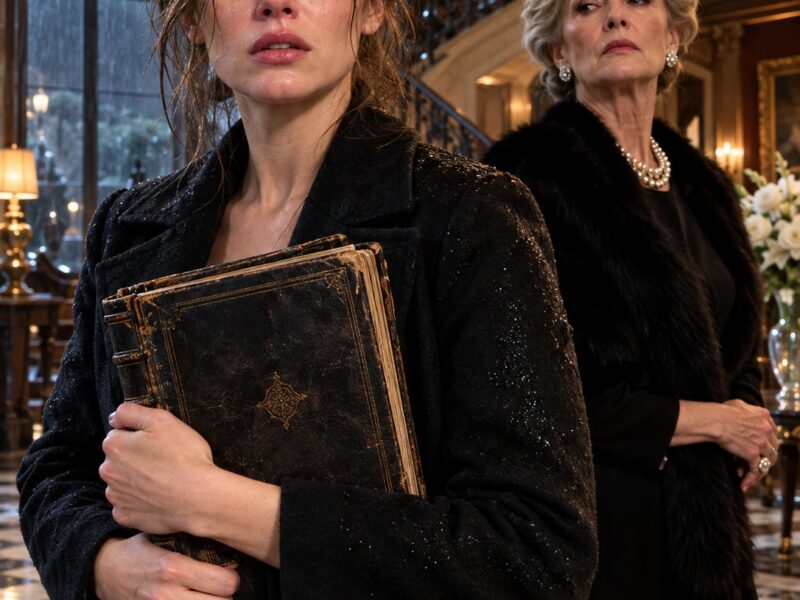
MY HUSBAND DIED—HIS FAMILY THREW ME INTO A ROTTEN BARN. THEY HAD NO IDEA WHAT WAS HIDDEN BENEATH THE FLOOR.

The night my brother-in-law tried to burn me alive, I was lying six feet above his head with a century-old ledger pressed against my chest and enough stolen gold around me to destroy his entire family.
He thought I was working a late shift at a diner.
He thought the barn was empty.
He thought gasoline and a road flare would erase the last embarrassing reminder of his dead brother’s marriage.
Then I heard him say my name.
“Once this place is gone, so is Kayla.”
I stopped breathing.
Below me, rain hammered the roof of the old stone barn while Reginald Neely poured gasoline over the sleeping bag I had been using as a bed.
Beside him stood Thomas Halloway, the Neely family attorney, whispering that this was arson.
Reginald laughed.
“No,” he said. “It’s an act of God.”
Three weeks earlier, I would never have believed a man could say something like that about his own sister-in-law.
Three weeks earlier, I still believed grief was the worst thing that could happen to me.
I had been wrong.
Grief only took my husband.
His family tried to take everything else.
Arthur Neely died on a Tuesday afternoon.
There was no warning dramatic enough to prepare me for it.
No long goodbye.
No final speech.
No moment in which he squeezed my hand and told me what to do after he was gone.
At 2:17 that afternoon, he was alive.
At 2:31, an ambulance was carrying him through the Hudson Valley with a catastrophic cerebral aneurysm.
By sunset, doctors were speaking to me in the careful, measured voices medical professionals use when hope has already left the room.
Arthur was forty-one.
We had been married five years.
And less than forty-eight hours after I buried him, his mother told me I owned nothing.
But that came later.
First came the funeral.
Oak Haven looked beautiful that morning.
That was the cruelest part.
The estate spread across the rolling hills of the Hudson Valley like something designed to convince strangers that tragedy could never enter through its gates.
Ancient maples burned red and gold along the drive. Weeping willows bent toward the pond. The limestone mansion stood beyond them with its black shutters, slate roof, and white columns glowing beneath a pale October sky.
Arthur had hated the house.
Not the gardens.
Never the gardens.
He loved those.
But the house itself represented everything he had spent his adult life trying not to become.
The Neely family had owned Oak Haven for generations.
They also owned investment firms, commercial properties, warehouses, stakes in manufacturing companies, and enough old-money influence to make people lower their voices when they said the family name.
Arthur could have spent his life doing nothing more difficult than signing papers.
Instead, he sketched.
He planted tomatoes.
He volunteered at a community arts program.
He married me.
According to his mother, that last choice was his greatest act of rebellion.
I had been a public-school teacher when we met.
No family trust.
No summer house in Nantucket.
No private-school pedigree.
My father repaired municipal buses. My mother worked at a pharmacy.
The first time Arthur brought me to Oak Haven, his mother looked at my department-store dress and asked which designer had made it.
When I told her, she smiled.
“Oh,” Beatrice Neely said. “How practical.”
Arthur squeezed my hand under the dinner table.
That was Arthur.
He never made a scene when kindness would do.
For five years, I thought his kindness had protected me from his family.
Standing beside his grave, I finally understood that Arthur had merely been standing between us.
And now he was gone.
Beatrice stood beneath a weeping willow in a tailored black coat, pressing a black lace handkerchief against eyes that were completely dry.
Her older son, Reginald, stood beside her checking his Rolex.
Once.
Twice.
Three times.
His brother’s coffin had not even been lowered completely into the earth.
Ten paces away, I watched him glance at the time again.
Something inside me went cold.
Arthur had once told me that Reginald measured everything according to usefulness.
People.
Relationships.
Minutes.
“If he can’t turn something into leverage,” Arthur had said, “he doesn’t know what to do with it.”
I had laughed then.
I didn’t laugh at the funeral.
When the minister finished, guests approached me with soft voices and careful embraces.
Some genuinely loved Arthur.
Others had known his last name.
There was a difference.
I could feel it now.
Then Beatrice finally came to me.
She touched my arm with two gloved fingers.
“You should rest tonight,” she said.
I stared at her.
“My husband was buried ten minutes ago.”
“I’m aware.”
Something in her voice made me look at her more closely.
There was no grief there.
Only calculation.
She glanced toward the mansion.
“Thomas will need to speak with you tomorrow.”
“Thomas Halloway?”
“Our attorney.”
“About what?”
A tiny pause.
Then Beatrice gave me the same smile she had given me the first night Arthur brought me home.
“Practical matters.”
She walked away.
I watched her join Reginald near the cars.
He leaned toward her.
She said something.
They both looked at me.
That should have warned me.
Instead, I went home and slept on Arthur’s side of our bed because his pillow still smelled faintly of cedar soap.
The following afternoon, a housekeeper knocked on the bedroom door.
“Mrs. Neely?”
I opened my eyes.
For half a second, I forgot.
Then I saw Arthur’s empty pillow.
The grief returned so violently that I had to grip the sheets.
“Yes?”
“Mrs. Neely would like you in the library.”
Mrs. Neely.
Not Beatrice.
Not your mother-in-law.
The message was already clear.
There was only one Mrs. Neely who mattered now.
I dressed and walked downstairs.
The library smelled of polished leather, cigar smoke, and old paper.
Beatrice sat behind the antique mahogany desk.
Reginald stood near the fireplace with a glass of Scotch.
Thomas Halloway sat between them.
He was sweating.
That was the first thing I noticed.
The second was the stack of documents in front of him.
“Sit down, Kayla,” Beatrice said.
I remained standing.
“I’d rather not.”
Her eyebrows lifted.
I looked at Thomas.
“Can we make this quick? I still have to go to the hospital. They called about Arthur’s belongings.”
Thomas swallowed.
“Of course.”
His fingers shuffled the papers although they were already perfectly aligned.
“Kayla, we need to discuss the disposition of Arthur’s assets and the Oak Haven estate.”
I looked from him to Beatrice.
“Arthur and I already handled that.”
Silence.
“We made wills three years ago. Arthur left everything to me if something happened to him.”
Reginald laughed.
Not loudly.
That somehow made it worse.
“Oh, Kayla.”
I turned toward him.
“What?”
“You drafted a will.”
“We both did.”
“Yes. A very sweet little document.”
My fingers tightened.
“What does that mean?”
Reginald took a sip of Scotch.
“It means Arthur couldn’t leave you what he never owned.”
I looked at Thomas.
He stared at the documents.
“Thomas?”
He removed his glasses.
“It’s complicated.”
“Make it uncomplicated.”
He exhaled.
“The Neely family holdings are governed by a multigenerational covenant established by Arthur’s grandfather, Elias Neely.”
I knew the name.
Everyone did.
A severe portrait of Elias hung above the ballroom fireplace: silver hair, dark suit, one hand resting on the back of a carved chair.
Family mythology said he had built the Neely fortune through shipping, textiles, and investments before the Great Depression.
Thomas continued.
“The Oak Haven Heritage Trust controls the estate and a significant portion of the family assets.”
“So?”
“Arthur was a beneficiary. He wasn’t the ultimate titleholder.”
I stared at him.
“We paid the property taxes.”
“I know.”
“From our joint account.”
“Yes.”
“We renovated the east wing.”
Thomas said nothing.
“We paid for the new roof four years ago.”
“I know.”
Reginald smiled.
“You paid expenses on property you were permitted to use.”
I turned on him.
“Permitted?”
Beatrice set down her teacup.
“Arthur should have explained this to you.”
“Explained what?”
“That Oak Haven was never his.”
My pulse began pounding in my ears.
Thomas spoke more quietly.
“The covenant contains a bloodline succession provision. If a male descendant dies without a biological child, his interest reverts to the primary bloodline trustee.”
I understood the words individually.
Together, they made no sense.
“Who is the trustee?”
Nobody answered immediately.
Then Beatrice smiled.
“I am.”
The room seemed to tilt.
Arthur and I had talked about children.
We had tried.
Then work became complicated.
Then there was a miscarriage we barely told anyone about.
Then another year disappeared.
Arthur used to tell me we had time.
I had believed him.
Beatrice leaned back.
“The house belongs to the trust. The vehicles belong to the trust. Most of the investment accounts belong to the trust.”
“What about our bank accounts?”
“Frozen pending review.”
“My jewelry?”
“Anything purchased with trust funds is being inventoried.”
“My husband died two days ago.”
No one spoke.
I looked at Thomas.
“Tell me she cannot do this.”
His silence answered first.
“Thomas.”
“I’m sorry.”
I laughed once.
It sounded nothing like laughter.
“Sorry?”
I turned toward Beatrice.
“You’re evicting me?”
She tilted her head.
“Don’t be theatrical.”
“Arthur is barely in the ground.”
“You are an adult woman, Kayla.”
“And this is my home.”
Her expression changed.
Only slightly.
But I saw the pleasure.
“It was never your home.”
There are sentences that hurt when they are spoken.
And there are sentences that rearrange something inside you.
That one did.
Reginald placed his glass on the mantel.
“You have until midnight.”
I stared at him.
“For what?”
“To pack your clothes.”
“Midnight?”
“We don’t want this becoming unpleasant.”
I almost smiled.
“You think it isn’t unpleasant yet?”
His jaw tightened.
“Take personal clothing and toiletries. Nothing from the art collection. Nothing from the silver. Nothing from the jewelry safes. Everything has been inventoried.”
I looked at Beatrice.
“Where exactly do you expect me to go?”
“That is no longer a family matter.”
I had $187 in my personal checking account.
My own savings had been almost entirely exhausted during Arthur’s final week because we had paid for an experimental intervention his insurance refused to cover.
The joint accounts were frozen.
My teaching position had ended when I took leave to care for him.
My husband was dead.
My home was being taken.
And the woman sitting behind the desk knew every one of those things.
Thomas suddenly cleared his throat.
“Actually…”
Beatrice’s eyes moved toward him.
“What?”
“There is one property issue.”
Reginald sighed.
“Thomas.”
“The southern parcel.”
The room became very still.
“What southern parcel?” I asked.
Thomas pulled a survey from beneath the stack.
“Two years ago Arthur subdivided acreage near the southern boundary.”
I remembered.
The community garden.
Arthur had wanted to turn part of Oak Haven into something local families could actually use.
Beatrice had called it “a charitable eyesore.”
Thomas pointed at the map.
“When the acreage was subdivided, the old livestock barn was inadvertently separated from the main Oak Haven deed.”
Beatrice’s face changed.
Thomas kept going.
“It was registered under a separate LLC. Arthur was the sole owner.”
Reginald stared at him.
“And?”
“It falls outside the Heritage Trust.”
My heart beat once.
Hard.
Thomas finally looked at me.
“It passes to Kayla.”
For the first time since entering the room, Beatrice lost control of her expression.
Only for a second.
Then she laughed.
“The barn?”
Reginald began laughing too.
“The stone barn?”
Thomas nodded.
“The structure and approximately a quarter acre.”
“The one beside the swamp?” Beatrice asked.
“Yes.”
“The roof is collapsing.”
“I understand.”
“There hasn’t been plumbing there in fifty years.”
“I understand.”
Reginald looked at me.
“Well.”
He lifted his Scotch in a mock toast.
“Congratulations.”
I said nothing.
“You’re a landowner.”
His smile widened.
“You and the rats should be very happy together.”
I looked at him.
Then at Beatrice.
Then at the lawyer who could no longer meet my eyes.
Something strange happened.
I stopped feeling humiliated.
Not because it hurt less.
Because I finally understood what kind of people I was dealing with.
Arthur had spent years softening their cruelty for me.
Making excuses.
Changing subjects.
Standing between his mother and me at dinners.
Laughing away Reginald’s insults.
He had made monsters look merely difficult because he loved me enough to keep me from seeing their teeth.
Now he was gone.
And they were smiling.
I picked up the survey.
Beatrice frowned.
“What are you doing?”
“Taking what belongs to me.”
“It’s worthless.”
“Then you shouldn’t mind.”
I turned toward the door.
“Kayla.”
I stopped.
Beatrice’s voice followed me.
“You’ll understand eventually that Arthur made many mistakes because he was sentimental.”
I looked back.
She was sitting beneath a portrait of her father, surrounded by a century of money.
“My marriage wasn’t one of them.”
Then I left.
At 11:30 that night, I dragged two suitcases through the rain toward the southern boundary of Oak Haven.
The mansion glowed behind me.
Thirty-seven windows lit against the darkness.
Warm bedrooms.
Fireplaces.
Hot water.
Food.
Everything I had called home forty-eight hours earlier.
Ahead of me stood the barn.
It had been built in 1882 from heavy fieldstone.
In the moonlight it looked less like a building than the remains of a small fortress.
Half the windows were shattered.
The enormous wooden doors had warped away from their hinges.
One section of roof sagged visibly.
I pushed inside.
The smell hit me first.
Wet hay.
Rot.
Rust.
Animal droppings.
There was no electricity.
No plumbing.
Broken farming equipment sat beneath decades of dust.
A rusted tractor leaned near one wall like the skeleton of some extinct animal.
Wind moved through gaps in the stone.
I stood there holding two suitcases.
And for the first time since Arthur died, I understood exactly how alone I was.
I found a relatively dry patch beside an old iron anvil.
I put on three coats.
Then I lay my head on a suitcase.
And I cried.
Not elegantly.
Not silently.
I cried until my throat hurt.
I cried because Arthur was dead.
Because I had not been beside him when the aneurysm ruptured.
Because I had spent our last morning irritated that he had left coffee grounds in the sink.
Because the last text I sent my husband had been:
DON’T FORGET MILK.
He never came home with it.
At some point, I pulled my phone from my pocket.
His last voicemail was still there.
“Hey, Kay. I’m leaving the office early. Thought maybe we could walk the south field before dinner. I have an idea for the garden. Call me.”
I listened to it twice.
Then a third time.
Outside, the rain intensified.
I sat up.
Through a broken window, I could see the distant lights of Oak Haven.
I wiped my face.
“You wanted your garden,” I whispered.
The barn answered with silence.
“I don’t know how yet.”
My voice shook.
“But they don’t get everything.”
That became my promise.
Not revenge.
Not then.
Survival.
I would stay.
If Beatrice wanted me embarrassed, I would let her see me every morning.
If Reginald wanted me gone, he could watch me walk past his gates every afternoon.
If they had given me a ruin because they thought a ruin would break me, I would learn how to live inside it.
Three weeks passed.
October became vicious.
Cold rain stripped the Hudson Valley trees bare.
I bought a battery lantern.
A propane stove.
A secondhand camping cot.
A heavy sleeping bag.
That used nearly everything I had left.
During the day, I walked three miles into town and worked cash shifts at a diner.
The manager, Rosa, knew Arthur.
She never asked too many questions.
“You don’t belong washing dishes back there,” she told me once.
“Right now I belong wherever someone pays me.”
She studied me.
“Fair enough.”
At night I returned to the barn.
Some evenings, I could see parties through Oak Haven’s ballroom windows.
Cars arrived.
Women in dresses stepped beneath umbrellas.
Men in tailored coats laughed on the front steps.
And I ate canned soup beside a propane flame.
I thought humiliation would eventually become unbearable.
Instead, something else happened.
I stopped caring what those people thought.
Beatrice did not.
Apparently, my existence was becoming embarrassing at the country club.
People had begun asking questions.
Why was Arthur Neely’s widow walking into town every morning?
Why was she living in an abandoned barn?
Why had Beatrice evicted her immediately after the funeral?
Old-money families can survive cruelty.
What they cannot tolerate is public discussion of it.
So Reginald cut the agricultural water line.
I discovered it one morning when I turned the outdoor spigot and nothing came out.
Two days later, a county vehicle arrived.
The inspector was named Walter Greene.
He walked through the barn with a clipboard and an expression that told me I was in trouble.
Finally, he looked at the roof.
“Mrs. Neely…”
“Kayla.”
“Kayla, this isn’t safe.”
“I know.”
“I could condemn it today.”
My stomach dropped.
He studied me.
“You Arthur’s wife?”
“Widow.”
His expression softened.
“I knew Arthur.”
I said nothing.
“He helped my grandson get into that summer art program.”
That sounded like him.
Walter looked up again.
“I can give you thirty days.”
“For what?”
“Patch the roof. Secure the windows. Make the main structure weather-tight.”
“Thirty days?”
“After that, I don’t have discretion.”
I nodded.
“Thank you.”
He hesitated before leaving.
“Mrs. Neely called us personally.”
Of course she had.
“Did she?”
Walter looked toward Oak Haven.
“Some people spend so much time protecting what they own they forget to ask whether they deserve it.”
Then he left.
The roof became my obsession.
I watched repair videos at the public library.
I priced lumber I couldn’t afford.
I salvaged tarps.
I borrowed tools from Rosa’s husband.
And every night I stared up at the enormous loft that covered the back half of the barn.
Arthur had always warned me about it.
“Never climb up there.”
“Why?”
“Because I like being married to someone with an intact spine.”
The loft floor was fifteen feet above the ground.
Ancient timber.
Iron-bolted joists.
Decades of damp.
I stayed away from it.
Until October 24.
The nor’easter arrived after dark.
By nine, wind was screaming around the stone walls.
Rain struck the roof like gravel.
I moved buckets beneath the leaks.
Then another leak opened.
Directly above my cot.
Within seconds, freezing water was pouring onto my sleeping bag.
“No.”
I dragged the cot sideways.
Water followed.
“No. No, no, no.”
That sleeping bag was the only reason I could sleep through forty-degree nights.
If it soaked through, I was finished.
I looked at the ladder.
Then the loft.
Arthur’s warning echoed in my head.
Never climb up there.
Another sheet of water struck the cot.
I grabbed a tarp, flashlight, and staple gun.
“Sorry, Arthur.”
The ladder groaned beneath me.
Halfway up, I nearly changed my mind.
Then cold water ran down the back of my neck.
I kept climbing.
The loft smelled worse than the barn below.
Mildew.
Wet wood.
Old hay.
Animal waste.
I crawled rather than walked, testing every board before shifting my weight.
Wind rattled the roof so violently that the entire structure seemed to breathe.
I reached the leak.
Holding a vertical beam, I stood.
I raised the staple gun.
Then I heard a crack.
Not the small crack of wood shifting.
A violent report.
Like a rifle shot.
I looked down.
The joist beneath my boots split.
“God—”
The floor disappeared.
I fell.
There wasn’t time to scream properly.
Just a sound ripped from somewhere inside me as darkness swallowed everything.
I expected to hit the ground fifteen feet below.
Instead, I struck something solid after six.
Pain exploded through my ribs.
Dust filled my mouth.
Boards and rotted hay crashed around me.
For several seconds, I couldn’t breathe.
Then air came back violently.
I coughed.
Tried to move.
Nothing seemed broken.
My flashlight was gone.
I searched blindly.
My palm touched something cold.
Metal.
Not dirt.
Not stone.
Metal.
I found the flashlight and switched it on.
The beam moved across the darkness.
And I stopped breathing again.
I wasn’t on the ground floor.
I was inside a room.
A room that should not have existed.
It had been built between the barn ceiling and the loft floor.
Maybe twenty feet wide.
Ten feet deep.
No windows.
Thick reinforced beams.
Stone walls.
Dry.
Completely dry.
My flashlight passed over wooden crates.
Dozens of them.
Faded serial markings.
Dates from the 1920s.
Then the beam reached the center.
Five enormous leather steamer trunks.
Beside them sat a steel safe.
Its door was slightly open.
I forgot my ribs.
Forgot the storm.
Forgot Beatrice.
I crawled toward the nearest trunk.
Its brass hardware had turned green with age.
Wax seals crumbled beneath my fingers.
I lifted one latch.
Click.
Then another.
I opened the lid.
Inside were rows of oiled canvas bags.
I lifted one.
It nearly pulled my shoulder down.
“What the hell?”
I loosened the drawstring.
Something dull yellow caught the light.
I stared.
Then reached inside.
A gold bar.
Heavy.
Solid.
Stamped with a federal treasury mark.
My hands began shaking.
I opened another bag.
Gold.
Another.
Gold.
The second compartment contained bundles wrapped in brittle wax paper.
I opened one.
Bearer bonds.
Stacks of them.
Thousands.
Tens of thousands.
Possibly millions.
Another trunk held jewelry.
Emeralds.
Diamonds.
Brooches.
Watches.
Pearls.
Then I opened a dark velvet box.
Inside lay an Art Deco diamond necklace.
I knew it.
I had seen it before.
Not physically.
In the portrait hanging over Oak Haven’s ballroom fireplace.
Elias Neely’s wife had been painted wearing it in 1928.
I whispered into the darkness.
“My God.”
Then I remembered the safe.
Inside was one object.
A thick black leather ledger.
Faded gold lettering had been pressed into the cover.
ELIAS NEELY.
I opened it.
The first pages looked like accounting records.
Dates.
Names.
Payments.
Transfers.
Then I began reading more carefully.
Ten minutes later, everything I thought I knew about the Neely family had changed.
Elias Neely had not built his fortune through brilliant investing.
Not entirely.
He had stolen it.
The ledger described bribes.
Extortion.
Embezzlement.
Shell companies.
Money siphoned from business partners.
Funds moved just before the 1929 market crash.
Gold purchased through intermediaries.
Bearer bonds.
Everything hidden outside the formal family books.
Oak Haven wasn’t the foundation of the fortune.
It was camouflage.
The mansion had been mortgaged repeatedly to maintain appearances while Elias hid his real wealth somewhere federal investigators would never search.
The livestock barn.
I turned page after page.
Then reached the final entry.
October 1931.
The handwriting was different.
Jagged.
Hurried.
The authorities were closing in.
Elias wrote that he had told his son about the family trust.
But not the barn.
If investigators searched Oak Haven, they would find nothing.
He would return for the hidden fortune when things cooled down.
He never did.
Elias Neely died of a heart attack a week later.
I sat in silence.
For almost a century, the Neely family had protected Oak Haven as if the mansion itself were sacred.
They had built their identity around Elias.
His intelligence.
His discipline.
His legacy.
Meanwhile, the truth had been sitting inside a rotting livestock barn.
The same barn Beatrice had laughed about giving me.
I looked around at the gold.
The bonds.
The jewels.
Then at the ledger.
And suddenly I understood something.
The money mattered.
Of course it did.
I had $43 left.
I was washing dishes for cash.
Gold mattered.
But the ledger mattered more.
Because money could change my life.
That book could change theirs.
A laugh escaped me.
Small at first.
Almost frightened.
Then I covered my mouth.
For three weeks, Beatrice had believed she had reduced me to nothing.
She had taken my house.
My accounts.
My security.
She had sent me into the rain with two suitcases and a collapsing barn.
And without realizing it, she had handed me the one piece of property containing the secret her family had been searching for since 1931.
Then I heard pounding.
I froze.
It came from below.
The barn doors.
Once.
Twice.
Then they crashed open.
I switched off my flashlight.
Darkness swallowed me.
Footsteps entered the barn.
A flashlight beam cut through gaps in the floor.
Then a voice rose through the boards.
“I told you she wasn’t here, Reginald.”
Thomas Halloway.
My heart stopped.
“The diner manager said she took a double shift,” Thomas continued. “She won’t be back until two.”
Reginald answered.
“Stop talking.”
I pressed myself against the floor.
I had traded shifts that afternoon.
Rosa had sent me home because of the storm.
They didn’t know.
Thomas did.
“We shouldn’t be doing this.”
“Hold the light.”
“What if someone sees us?”
“In this weather?”
Then I smelled it.
Gasoline.
My blood went cold.
“This is arson,” Thomas whispered.
Reginald laughed.
“We’re solving a problem.”
A liquid splashed below me.
I looked through a crack.
Reginald held a red gasoline container.
He poured it over my sleeping bag.
My clothes.
The wooden supports.
Thomas stood nearby looking sick.
“Beatrice is tired of hearing people whisper at the club,” Reginald said. “The inspector gave her thirty days. Fine. If there’s no roof, there’s nothing to repair.”
“You could kill her.”
“She isn’t here.”
“You don’t know that.”
“I know enough.”
More gasoline splashed.
“She’ll come back to ashes. The county will clear the structure. She’ll have nowhere to live and finally crawl back to whatever working-class hole she came from.”
Thomas whispered, “Jesus.”
“No. Lightning.”
Reginald laughed again.
“Old barn. Catastrophic storm. Electrical problem. Act of God.”
I put my hand over my mouth.
Then I remembered my phone.
It was still in my coat pocket.
Battery: seventeen percent.
I opened the recorder.
Pressed start.
Below me, Thomas said, “If this gets traced to us—”
“Then stop saying incriminating things.”
“You’re holding gasoline.”
“And you’re standing beside me.”
Silence.
That shut him up.
I looked around.
If the barn burned, I would die inside the hidden room.
The gold would melt.
The ledger would burn.
And the truth would disappear for another hundred years.
I couldn’t carry the gold.
Some bars weighed forty pounds.
I grabbed the ledger and shoved it beneath my sweater.
Then bearer bonds.
As many as I could fit inside my coat.
My pockets.
My pants.
I took the velvet jewelry box.
The diamond necklace.
Below, Reginald dropped an empty gasoline container.
“Give me the flare.”
My head snapped toward the wall.
There had to be another exit.
Old barns had loading hatches.
Hay doors.
Something.
I moved my hands across the stone.
Nothing.
Nothing.
Nothing.
Then iron.
A latch.
I nearly cried.
I pulled.
It didn’t move.
Below me came a sharp crack.
Then the hiss of a road flare.
Red light flickered through the floorboards.
“Light it,” Reginald said.
I threw my shoulder into the hatch.
Nothing.
Again.
Pain tore through my bruised ribs.
The wood shifted.
Again.
The hinges screamed.
Thomas shouted below.
“What was that?”
I froze.
Reginald waited.
Wind slammed into the roof.
“Shingles,” he said.
I hit the hatch one last time.
It exploded outward.
Freezing rain struck my face.
Ten feet below was mud.
Behind me, Reginald said:
“Goodbye, Kayla.”
Then came the sound.
Whoosh.
Orange light flooded the hidden chamber.
Fire climbed the support beams.
Smoke rolled upward.
I crawled through the hatch.
Hung from the ledge.
For one second, I looked back.
Gold gleamed through smoke.
A fortune nobody had touched in ninety-five years.
Then flames reached the nearest trunk.
I let go.
I hit the ground hard.
Mud swallowed my hands.
Pain shot through my hip.
I rolled into blackberry bushes and stayed there.
Seconds later, Reginald and Thomas ran from the barn.
They never saw me.
They disappeared toward Oak Haven.
I lay beneath the thorns and watched the barn burn.
The roof collapsed at 11:47 p.m.
Sparks rose into the storm.
Stone cracked.
Timber screamed.
Everything I had slept beside for three weeks vanished.
I put my hand beneath my sweater.
The ledger was still there.
My phone was still recording.
And suddenly I realized Reginald had made the same mistake his mother had.
They both believed destroying my home would destroy me.
Instead, they had just given me evidence of attempted murder.
I stood.
Turned away from Oak Haven.
And walked into the woods carrying millions of dollars and ninety-five years of secrets.
I disappeared that night.
At least, that was what the Neely family believed.
For the next two months, Beatrice told people I had fled.
Reginald told investigators the fire was probably electrical.
The official preliminary finding agreed.
Old structure.
Severe storm.
Possible electrical or accidental ignition.
Beatrice relaxed.
Oak Haven returned to normal.
I did not.
Rosa helped me get to a motel without asking questions.
The following morning, I contacted an attorney in Manhattan whose firm specialized in complex estate litigation and financial fraud.
Her name was Eleanor Kensington.
I placed Elias Neely’s ledger on her conference table.
Then I put the diamond necklace beside it.
Then the bearer bonds.
She stared at them.
“Where did you get these?”
“My house.”
“What house?”
“The one my mother-in-law says is worthless.”
For the first time in two days, I smiled.
Eleanor didn’t.
She spent six hours asking questions.
By evening, she had made three calls.
By the next morning, federal investigators were involved.
The ledger was authenticated.
The bonds were examined.
The necklace was matched to historical photographs.
Financial historians reconstructed Elias’s transactions.
Records long buried in archives began matching names and dates in the ledger.
Then we gave investigators my phone.
The audio was damaged by wind, rain, and fire.
But not enough.
Reginald’s voice could be isolated.
So could Thomas’s.
This is arson, Reginald.
If there’s no roof, there’s no grace period.
Give me the flare.
The forensic technician played those lines in a quiet room.
I listened without moving.
Eleanor looked at me.
“You understand what this means?”
“Yes.”
“No, Kayla. I mean really understand.”
I looked at the waveform on the computer screen.
Arthur had spent years telling me not to let his family turn me into someone bitter.
I wondered what he would think now.
“I don’t want revenge,” I said.
Eleanor studied me.
“What do you want?”
I thought about that.
“The truth.”
She waited.
“And I want them to hear it in the room where they lied about everything.”
Two months after the fire, Beatrice Neely held Oak Haven’s annual winter gala.
It was the social event of the season.
White silk draped the ballroom.
Silver-frosted pine branches framed the windows.
A string quartet played beneath crystal chandeliers.
Champagne moved through the room on silver trays.
Politicians came.
Investors came.
Judges.
Bankers.
Donors.
People whose names appeared on hospital wings.
Beatrice wore black velvet.
Reginald stood beside an ice sculpture with the relaxed smile of a man who believed consequences were for other people.
Oak Haven was in trouble.
That was another thing Elias’s ledger revealed.
The mansion had always been more fragile than it appeared.
Mortgages.
Debt.
Leverage.
Refinancing.
The Neely family had spent generations maintaining the illusion of unlimited wealth.
Now Beatrice needed a major loan.
The gala was not simply a party.
It was theater for investors.
At 8:59 p.m., she believed the performance was working.
At 9:00, the ballroom doors opened.
The quartet stopped.
I walked in.
Conversation died around me.
I had imagined this moment many times.
In some versions, I was angry.
In others, triumphant.
But when it finally happened, I felt strangely calm.
I wore an emerald silk gown.
My hair was pinned back.
Eleanor walked beside me.
Special Agent Kinsley stood on my other side.
Federal marshals waited beyond the doors.
But nobody looked at them first.
They looked at my neck.
The necklace caught the chandelier light.
Diamonds.
Art Deco geometry.
Ninety-five years of family mythology resting against my skin.
Across the ballroom, Beatrice dropped her champagne glass.
It shattered.
She stared at the necklace.
Then at the portrait above the fireplace.
Elias’s wife wore the same piece.
For once, Beatrice had nothing to say.
Then panic became rage.
She crossed the ballroom.
“How dare you?”
Her voice cracked.
People turned.
“Security!”
Nobody moved.
“Get her out of my house!”
I looked at her.
She pointed at my throat.
“And take that necklace. She stole it from the family vault.”
“There is no family vault,” I said.
Her face changed.
“What?”
Agent Kinsley stepped forward.
“Actually, Mrs. Neely, she didn’t steal anything.”
She displayed her credentials.
“Special Agent Kinsley. FBI.”
The ballroom became silent.
Reginald pushed through the crowd.
“What the hell is this?”
“A federal warrant.”
“You can’t walk into private property—”
“And a court order.”
Reginald stopped.
I looked at Beatrice.
She looked older than she had two months earlier.
Or perhaps I was finally seeing her without fear.
“You told me I owned nothing,” I said.
“Kayla—”
“You remember?”
Her eyes moved toward the guests.
“Not here.”
I almost laughed.
Of course.
Cruelty had been acceptable in private.
Truth was indecent in public.
“You told me Arthur’s grandfather created the Oak Haven Heritage Trust to protect the family fortune.”
Reginald stepped toward me.
“Shut your mouth.”
A marshal blocked him.
I continued.
“But Elias didn’t build this family fortune through shipping and textiles.”
People were watching now.
The governor.
The investors.
Beatrice’s friends.
Everyone whose opinion she had valued more than mercy.
“He stole it.”
A murmur moved through the ballroom.
Reginald lunged.
“She’s insane.”
The marshal stopped him.
“Elias Neely embezzled millions from his partners before the 1929 crash,” I said. “He converted stolen money into gold, bearer bonds, and jewelry.”
Beatrice whispered, “Stop.”
“He hid it.”
Her face drained of color.
“In the old stone barn.”
Silence.
I stepped closer.
“The barn you gave me.”
Reginald stared at me.
“The barn you burned.”
Something passed across his face.
Not guilt.
Recognition.
He understood.
“You were there,” he whispered.
“Yes.”
Thomas Halloway was standing near the back of the ballroom.
I saw him turn toward the side door.
Agent Kinsley saw him too.
“Mr. Halloway.”
He ran.
He made it perhaps twelve feet.
Two agents intercepted him.
A woman screamed as Thomas was pushed against a marble column and handcuffed.
Reginald’s composure collapsed.
“This is ridiculous. She has no proof.”
Eleanor opened her briefcase.
She removed the ledger.
Beatrice made a sound I had never heard from another human being.
Not quite a gasp.
Not quite a cry.
Recognition.
Eleanor held it up.
“Elias Neely’s personal accounting ledger.”
Reginald shook his head.
“No.”
“Authenticated.”
“No.”
“It identifies the original sources of the concealed assets, the shell entities used to move them, and the funds used to establish and support portions of the Oak Haven Heritage Trust.”
Beatrice stared at me.
“How did you find it?”
I looked at her.
“The roof collapsed.”
For a second, neither of us moved.
Then something almost funny occurred to me.
“You remember the roof?”
Her lips parted.
“The one you tried to have the county condemn?”
Reginald began backing away.
Agent Kinsley turned toward him.
“And we have something else.”
She nodded.
An agent held up an evidence bag containing my old phone.
Reginald went completely still.
“Forensic audio recovered from a recording made on October twenty-fourth.”
Thomas closed his eyes.
Agent Kinsley continued.
“It captures a conversation concerning gasoline, destruction of the structure, concealment of the cause, and Mrs. Kayla Neely’s removal from the property.”
Reginald looked at Thomas.
That one glance told everyone everything.
“You recorded us?” Thomas whispered.
“I was six feet above you.”
He closed his eyes again.
Reginald exploded.
“You lying little—”
The marshal caught his arm.
Reginald twisted.
Another agent moved in.
Within seconds, his wrists were behind his back.
Beatrice stood perfectly still.
“Mother!” Reginald shouted.
She didn’t look at him.
Her eyes were on me.
Agents escorted him across the ballroom where, minutes earlier, he had been shaking hands with investors.
His face was red.
His tie crooked.
His polished shoes slipped slightly on champagne from his mother’s broken glass.
Nobody helped him.
Not one person.
The doors closed behind him.
Beatrice whispered, “This is still my home.”
Eleanor spoke.
“No, Mrs. Neely.”
She explained what would happen next.
Assets connected to the fraudulent trust were being frozen.
Records would be seized.
Property would be reviewed.
Historical claims, penalties, liens, and restitution would be determined.
Oak Haven itself would eventually be subject to court-controlled disposition.
The language was technical.
The meaning wasn’t.
Beatrice was losing everything.
She turned toward the governor.
He looked away.
Toward the investors.
One of them was already speaking quietly into his phone.
“No.”
Her hand found the back of a chair.
“No, you don’t understand.”
Nobody answered.
“My family has lived here for generations.”
I watched her.
She looked at the staircase.
The paintings.
The chandeliers.
The silver.
All the things she had confused with identity.
“This is my home.”
And there it was.
The sentence she had given me.
Returned.
I walked closer.
I could have shouted.
I could have humiliated her.
Instead, I spoke softly.
“It was never your home.”
Her eyes met mine.
For the first time, Beatrice Neely looked afraid of me.
I didn’t enjoy it as much as I once thought I would.
That surprised me.
“You have until midnight to pack your clothes,” I said.
Her mouth trembled.
“Don’t take the silver.”
She sat down.
Not gracefully.
Her knees simply stopped supporting her.
Then she cried.
Real tears this time.
Around her, federal agents began photographing paintings and cataloging assets.
The orchestra musicians packed their instruments.
Guests quietly collected their coats.
The party dissolved.
I stood at the foot of the grand staircase.
Above me was Elias Neely’s portrait.
For years, I had passed beneath it and felt small.
That night I looked at his painted face and saw something different.
Not power.
Fear.
A frightened man had stolen money, hidden it, built a lie, and died before he could return for what he had buried.
Then his descendants had spent generations protecting the lie because it made them feel important.
Arthur had been different.
That was why they never understood him.
He hadn’t cared about owning Oak Haven.
He had wanted to change it.
Weeks later, Reginald was formally facing charges connected to the arson and the attempt on my life.
Thomas began cooperating.
Investigations into the Neely finances continued.
The surviving bearer bonds and other assets I had removed from the barn went through months of legal examination.
Nothing was as simple as opening a trunk and becoming rich.
Lawyers argued.
Experts traced ownership.
Government agencies reviewed claims.
But eventually, through lawful restructuring and the assets that could legitimately pass to me, I had more financial security than Arthur and I had ever possessed together.
The strange part was that by then, money no longer felt like the thing I had won.
Oak Haven was scheduled for court-supervised sale.
Eleanor asked me one afternoon whether I was serious about bidding.
“Yes.”
“You know what maintaining that place costs.”
“I don’t want to maintain it.”
She looked at me.
“What do you want to do?”
I unfolded one of Arthur’s old sketches.
He had drawn it years earlier.
Oak Haven without the iron gates.
The south lawn divided into community garden plots.
A small greenhouse.
An art room for children.
Walking paths.
Benches beneath the willows.
In the corner Arthur had written:
WHAT IF A PLACE LIKE THIS BELONGED TO EVERYONE FOR ONCE?
Eleanor read it.
Then looked at me.
“You kept this?”
“I keep everything he drew.”
Months later, I stood at the southern edge of the property.
Almost nothing remained of the barn.
Fire had destroyed the roof and timber.
The stone walls had partially collapsed.
The secret chamber was open to the sky.
Federal teams had recovered what remained of the hidden fortune.
I walked through the ruins alone.
Snow had melted.
Tiny green shoots were beginning to appear in the mud.
Near the place where my cot had once stood, I found a rusted piece of metal.
Part of the old anvil.
I sat on a fallen stone.
For a while, I said nothing.
Then I played Arthur’s voicemail.
His voice filled the empty space.
“Hey, Kay. I’m leaving the office early. Thought maybe we could walk the south field before dinner. I have an idea for the garden. Call me.”
The recording ended.
Wind moved through the grass.
“I found it,” I whispered.
My eyes burned.
“Your idea.”
There was no answer.
There never would be.
That was the part revenge stories usually leave out.
Justice does not bring dead people home.
Money doesn’t either.
Neither does watching cruel people lose the things they used to hurt you.
Arthur was still gone.
There would never be another coffee cup beside mine.
No more muddy shoes by the back door.
No more unfinished sketches on the kitchen table.
No more ridiculous arguments about whether tomatoes were technically fruit.
I would have traded every gold bar Elias Neely ever stole for one ordinary Tuesday with my husband.
That was the truth.
But there was another truth too.
I had survived.
Not because I found money.
I survived three weeks before I knew the money existed.
I survived cold nights.
Humiliation.
Hunger.
Fear.
I survived people who believed poverty made me powerless.
The treasure had not created that woman.
The barn had.
A year after Arthur died, the gates of Oak Haven opened to the public.
The mahogany library remained, but the desk where Beatrice had told me I owned nothing was removed.
The room became a community reading room.
Several formal gardens were preserved.
Others became vegetable plots.
A greenhouse went up near the southern field.
Local schools began bringing children for weekend art programs.
The ballroom remained too.
I considered tearing it apart.
Instead, I removed Elias’s portrait.
In its place hung one of Arthur’s sketches.
Nothing expensive.
Nothing grand.
Just a charcoal drawing of the south field in summer.
The first community garden harvest happened on a Saturday in September.
Families filled baskets with tomatoes, squash, peppers, and herbs.
Children ran between the rows.
Someone played music near the greenhouse.
An elderly woman asked me if the estate had always been this beautiful.
I looked toward the mansion.
“No.”
She seemed surprised.
“No?”
I smiled.
“It used to be much more expensive.”
She laughed and walked away.
Near sunset, I wandered toward the old barn site.
We had not rebuilt it.
I didn’t want to.
Instead, we stabilized one section of the original stone wall and built a simple wooden bench beside it.
No plaque explained the gold.
No monument explained the Neely scandal.
People didn’t need another shrine to money.
I sat down.
In the distance, children were laughing.
Someone called my name.
I didn’t answer immediately.
I looked at the place where the barn had stood.
For months, I had wondered whether Arthur somehow knew.
Whether separating the barn from the trust had truly been an accident.
Thomas insisted it was.
The paperwork supported him.
Arthur had been creating the garden parcel and the barn simply fell outside an old boundary line.
A clerical accident.
Nothing more.
Probably.
But sometimes I remembered something Arthur had said two summers before he died.
We had been walking along that same southern field.
He stopped near the barn and looked back at Oak Haven.
“My grandfather used to say everything important in this family was inside that house.”
I had laughed.
“Was he right?”
Arthur looked at the barn.
Then at me.
“No.”
“What is important?”
He smiled.
“The things they don’t value.”
At the time, I thought he meant me.
Maybe he did.
Maybe he meant the garden.
Maybe it was nothing more than one of Arthur’s quiet observations about a family obsessed with possessions.
I will never know.
And perhaps I don’t need to.
As darkness settled over Oak Haven, lights came on inside the mansion.
But they looked different now.
Not like thirty-seven glowing windows reminding a freezing widow of everything she had lost.
They belonged to classrooms.
Meeting rooms.
A public kitchen.
An art studio.
Places where ordinary people were welcome.
I touched the diamond necklace at my throat.
I rarely wore it.
That evening was the exception.
Not because it made me feel wealthy.
Because I remembered the night I first held it in my muddy hands beneath a collapsing barn.
The night everything changed.
I had believed Beatrice Neely had given me nothing.
A quarter acre of mud.
A ruined barn.
A place filled with rats, mold, and broken machinery.
In reality, she had given me the truth.
But even that wasn’t the greatest thing hidden there.
The greatest thing I found in that barn wasn’t gold.
It wasn’t bearer bonds.
It wasn’t diamonds.
It wasn’t Elias Neely’s ledger.
It was the moment I finally understood that losing everything people can take from you is not the same thing as having nothing left.
Someone called my name again.
This time I stood.
Before walking back toward the house, I looked once more at the broken stone wall.
The autumn wind moved through the grass.
For half a second, I could almost hear Arthur beside me.
Not speaking.
Just walking.
I slipped my hands into my coat pockets and started toward the garden.
Behind me stood the ruins of the place where the Neely family had tried to bury me.
Ahead of me, children were harvesting the last tomatoes beneath strings of warm lights.
And somewhere between those two places was the life I had never asked for—
but had finally chosen for myself.









