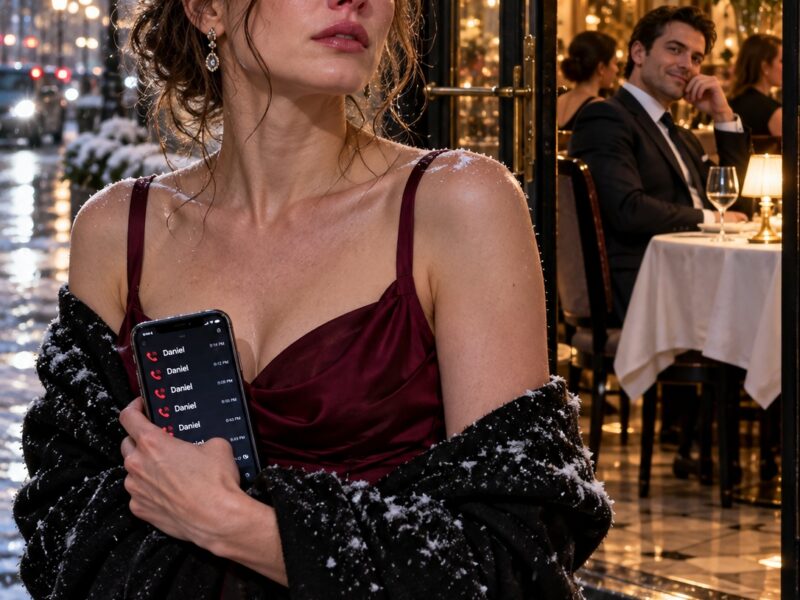
MY HUSBAND HUMILIATED ME IN FRONT OF 14 PEOPLE—SO I WALKED INTO THE SNOW AND SAT BESIDE THE ONE MAN HE SHOULD HAVE FEARED

The moment my husband destroyed our marriage, fourteen people were laughing.
I remember that more clearly than I remember his words.
The laughter.
Fourteen polished, successful people sitting beneath amber chandeliers in one of the most expensive restaurants in the city, lifting wineglasses and laughing at something Daniel Fitzpatrick had said about his wife.
About me.
I sat beside him in a burgundy dress he had chosen three weeks earlier.
“Elegant,” he had said when I tried it on.
That night, I finally understood what he meant.
Elegant enough to decorate his table.
Quiet enough not to disturb it.
Gerald Mercer, one of Daniel’s investors, had been talking about the Westmount development. He was already red-faced from wine when he leaned across the table and asked how Daniel managed the pressure.
“You’re running three projects, negotiating with the city, and somehow you still look rested. What’s your secret?”
Daniel smiled.
I knew that smile.
Everybody else thought it was charming.
I knew it meant someone was about to pay for the room’s attention.
He put one hand over mine.
“Easy,” he said. “Clare handles exactly two things.”
A pause.
Perfectly timed.
“Picking up our dry cleaning and looking grateful.”
The table exploded.
Gerald slapped the linen.
Someone nearly spilled a glass.
Even Sandra from accounting laughed.
Sandra, who had once sat beside me in a hospital waiting room after I lost the baby and held my hand while Daniel took business calls in the hallway.
Daniel squeezed my fingers beneath the table.
Not affectionately.
A warning.
Smile.
So I smiled.
For approximately three seconds.
Then something inside me went very quiet.
Not broken.
Quiet.
There is a difference.
Breaking is loud. Breaking announces itself.
What happened to me that night was more like a machine being switched off after running too long.
I looked around that table and suddenly saw every person clearly.
The investor who had called me “Mrs. Fitzpatrick” for four years because learning my first name apparently required too much effort.
The woman who knew exactly what Daniel could be like and laughed anyway.
The junior partner staring into his wine because he was embarrassed but not embarrassed enough to say anything.
And my husband.
The man who had spent five years teaching me that every wound he caused was somehow evidence of a flaw in me.
Too sensitive.
Too emotional.
Too difficult.
Too dramatic.
Too ungrateful.
He turned toward me, still smiling.
“You okay, sweetheart?”
That was Daniel’s favorite trick.
Injure you publicly.
Ask about your feelings publicly.
Then make your answer the problem.
I picked up my wineglass.
My hand was trembling.
So I put it down again.
“I need the restroom.”
Daniel’s smile tightened.
“Don’t disappear. We haven’t ordered dessert.”
I stood.
For five years, those six words would have been enough.
That night, they weren’t.
I walked through the restaurant.
Past the marble bar.
Past the hostess.
Past the coat check.
I didn’t take my coat.
I pushed open the heavy front door and stepped into the November snow wearing heels and a sleeveless burgundy dress.
And I never went back to the table.
My coat was still bundled against my chest when I reached the next block.
Snow collected in my hair.
The cold bit through my dress, but I kept walking.
My phone buzzed inside my clutch.
Once.
Twice.
Again.
I didn’t look.
Daniel had trained me to answer immediately.
Where are you?
Why aren’t you answering?
Who are you with?
Do you realize how this makes me look?
I could already hear the sequence.
First irritation.
Then concern.
Then anger disguised as concern.
Then punishment disguised as disappointment.
So I walked.
The city seemed almost abandoned beneath the snow. Storefronts glowed against wet pavement. Cars hissed through slush. Somewhere beyond the buildings, a horn sounded low over the river.
I stopped beneath an awning because my legs had begun shaking.
That was when I remembered the money.
Eight hundred forty-seven dollars.
My entire independent fortune.
Daniel didn’t know it existed.
I had started saving in February.
Twenty dollars after groceries.
Thirty-five from returning a sweater.
Forty when I bought generic detergent instead of the brand Daniel insisted smelled “less cheap.”
Once, I hid sixty dollars inside an old nursing textbook because Daniel had decided to review our bank statements that evening.
At the time, saving money had made me feel dishonest.
Standing alone in the snow, I understood something that frightened me.
It had been survival.
I was thirty-one years old.
I had a nursing degree.
I had once been good at my job.
Very good.
I could calm frightened children before blood draws. I could recognize respiratory distress from across a room. I could work twelve hours on my feet and still remember which elderly patient needed somebody to call her daughter.
Then I married Daniel.
At first, he admired my career.
Then he joked about it.
Then he questioned it.
Then one evening at a charity dinner, he told someone that having a wife come home smelling like antiseptic was “less glamorous than advertised.”
Six months later, I stopped working.
Daniel called it my choice.
Most cages don’t arrive with locks.
Sometimes they arrive as reasonable conversations repeated until resistance becomes exhausting.
My mother had multiple sclerosis and lived in a ground-floor apartment Daniel helped pay for.
He reminded me of that every week and a half.
Not directly.
Daniel rarely did anything directly.
“Your mother’s rent went out yesterday.”
Or:
“That medication isn’t cheap.”
Or:
“I don’t mind supporting your family, Clare. I just wish you appreciated what that means.”
I had once been pregnant.
Four months.
Long enough to imagine a bedroom.
Long enough to buy a pair of tiny white socks and hide them in Daniel’s desk because I planned to surprise him.
Long enough to begin talking to someone who never got the chance to hear me.
After the miscarriage, Daniel lasted eleven days before telling me we “couldn’t let tragedy become an identity.”
Three months later, he complained that I wasn’t fun anymore.
My friends disappeared gradually after that.
Daniel found something wrong with every one of them.
Too intrusive.
Too single.
Too jealous.
Too negative.
Eventually, declining invitations became easier than defending them.
Now I had $847.
A dead phone battery waiting to happen.
A mother whose apartment depended on my husband.
No job.
No home I could safely return to.
And, for the first time in five years, clarity.
I could not go back tonight.
Maybe tomorrow.
Maybe I would lose my nerve.
Maybe Daniel would find the right words and convince me that the restaurant had been nothing.
But tonight, if I saw his face, I knew exactly what would happen.
He would explain my humiliation until I apologized for experiencing it.
So I kept walking.
Three blocks later, I saw the brass plaque.
ARCHIPEL.
No neon.
No menu outside.
Just a narrow wooden door set into an old stone building and warm light behind frosted glass.
I pushed it open.
Dark wood.
Low lamps.
Four tables.
A long bar.
Slow jazz.
The room smelled faintly of cedar, bread, and something smoky simmering somewhere behind the kitchen doors.
The bartender looked up.
He was perhaps fifty-five, with tired eyes and the expression of a man who had seen people enter bars for every reason bars exist.
“Bonsoir.”
Then he took in the snow melting in my hair.
“You all right?”
“Fine.”
The lie came automatically.
He didn’t challenge it.
“Can I sit somewhere?”
“Anywhere you like.”
“Water, please.”
“Of course.”
I chose the table farthest from the entrance.
Old habits.
Wall behind me.
Door visible.
I placed my phone face down.
The bartender brought water and, without asking, a small bowl of warm spiced nuts.
That almost made me cry.
Not because of the food.
Because he had given me something without requiring me to deserve it first.
I stared at the bowl until my eyes cleared.
Then a man’s voice came from nearby.
“The nuts are actually good.”
I looked up sharply.
He immediately lifted one hand.
“Sorry. I didn’t mean to startle you.”
He stood several feet from the table.
Tall.
Dark hair silvering at the temples.
Black jacket that probably cost more than my emergency savings but had no visible label.
He held a glass of amber liquor loosely in one hand.
His face wasn’t conventionally gentle.
Too many hard lines.
But his eyes were calm.
He looked at me for another second.
“You know what?” he said. “I’m going to mind my own business.”
He turned.
That stopped me.
Not the joke.
Not his appearance.
The fact that he was leaving.
Daniel never abandoned an opening once he had decided he wanted something.
“Cold,” I said.
The stranger turned back.
“Excuse me?”
“You were going to say I looked like something.”
A faint smile touched his mouth.
“I was.”
“I looked cold.”
“That too.”
“What were you going to say?”
He considered whether to answer.
“I was going to say you look like someone who just made a very difficult decision.”
My fingers tightened around the water glass.
“But,” he added, “that seemed presumptuous.”
“It’s accurate.”
He nodded.
Nothing else.
No questions.
No invitation to explain myself.
That made me curious.
“You can sit,” I said. “If you want.”
He crossed the room and took the chair opposite me.
“Marco.”
“Clare.”
“Just Clare?”
“For now.”
That almost made him smile again.
“Fair enough.”
For a while, neither of us spoke.
The silence wasn’t awkward.
I had forgotten silence could exist without being punishment.
Eventually, I said, “I walked out of dinner.”
Marco waited.
“My husband’s business dinner.”
“Okay.”
That was all.
I looked at him.
“You’re not going to ask why?”
“If you want me to know, you’ll tell me.”
That sentence did something strange to my chest.
So I told him.
Not everything.
Just the joke.
The laughter.
Daniel’s hand squeezing mine.
Sandra laughing.
When I finished, Marco stared at his glass.
“What he did wasn’t honesty,” he said.
“I didn’t say it was.”
“You were about to defend him.”
I opened my mouth.
Closed it.
Marco continued.
“People like to dress cruelty up as honesty because honesty sounds respectable. But honesty doesn’t require an audience. What your husband did was a performance.”
I looked at him.
The word landed precisely.
Performance.
That was Daniel.
Our marriage was a theater production in which I had been cast as evidence of his success.
“Yes,” I whispered.
Marco’s expression changed.
Only slightly.
“I knew someone who used to smile through things she should never have been asked to survive.”
“What happened?”
His eyes moved toward the window.
“I understood too late what I was watching.”
There was a history there.
I didn’t ask.
Perhaps that was why he continued talking to me.
We stayed for almost two hours.
I learned that he owned commercial properties in several cities.
He grew up poor.
His parents were immigrants.
He had a younger brother.
He had never married.
There had been someone once.
When I asked what happened, he said only, “She decided the kind of man I was wasn’t the kind of man she could build a life with.”
“Was she right?”
He looked at me.
“Probably.”
The answer should have frightened me.
Instead, its lack of decoration felt almost comforting.
Near midnight, I finally looked at my phone.
Forty-three missed calls.
Twenty-six messages.
The latest said:
I’m coming to find you. Stop embarrassing yourself.
Marco didn’t ask to see the screen.
But he saw my face.
“You’re not going home.”
It wasn’t a question.
“No.”
“Good.”
I looked up.
“Good?”
“You made one decision tonight. Don’t undo it because you’re tired.”
“I need somewhere to sleep.”
“A hotel?”
“I can afford one.”
“How much money do you have?”
I stiffened.
Marco noticed.
“Forget I asked.”
That surprised me again.
He reached inside his jacket and placed a cream-colored card on the table.
A name.
A telephone number.
Nothing else.
“Call that tomorrow morning.”
“What is it?”
“A number where people answer.”
“That doesn’t explain anything.”
“No.”
“Whose number?”
“Mine, effectively.”
I stared at him.
“If you call, I can put you in contact with a lawyer. I can arrange somewhere safe for you to stay while you decide what you want. And if you want to work again, I know people who can help with that too.”
Every instinct Daniel had trained into me woke up at once.
“What do you want?”
Marco leaned back.
“Nothing.”
“No one does this for nothing.”
His eyes held mine.
“Then perhaps you’ve been around the wrong people.”
“Why me?”
For the first time that evening, he looked tired.
“Because you walked through that door looking like someone who had finally decided to save herself.”
He stood.
“And because once, a long time ago, someone else needed help and I waited too long to give it.”
He buttoned his jacket.
“Get some sleep, Clare.”
Then he walked away.
No request for my number.
No hand on my shoulder.
No dramatic promise.
He simply disappeared into the snow.
I sat there holding his card.
I didn’t know who Marco Caruso really was.
I didn’t know there were people in that city who lowered their voices before saying his name.
I didn’t know that businesses changed hands after conversations with him.
That men who had spent years trying to build cases around his network had mostly accumulated rumors, sealed records, frightened witnesses, and frustration.
I didn’t know that Marco possessed the kind of power Daniel had spent his adult life pretending to possess.
All I knew was that a stranger had listened to me for two hours without once making me feel stupid.
So I switched off my phone.
And found a hotel.
The room cost $189.
It smelled like artificial pine and loneliness.
I slept at four in the morning.
At nine, I called the number.
A woman answered.
“Good morning.”
“I’m trying to reach Marco Caruso.”
“Your name?”
“Clare.”
There was no pause.
The line clicked.
Marco answered immediately.
“You called.”
“You told me to.”
“I did.”
Something in his voice almost sounded relieved.
“How did you sleep?”
“Better than I expected.”
“Good. Now listen carefully. Has Daniel contacted the police?”
My stomach tightened.
“Why would he?”
“Because he has already contacted your building.”
I sat straighter.
“What?”
“I had someone look into the situation after I left.”
“You investigated my husband?”
“Yes.”
There was no apology.
“He told the concierge you may be experiencing a mental health crisis. He said you’re emotionally unstable and he’s worried you might hurt yourself.”
For several seconds, I heard nothing.
Not because Marco stopped speaking.
Because the world inside my head had gone silent.
Daniel had already written the story.
Of course he had.
He had always understood something I didn’t.
Whoever tells the story first often gets to decide who looks insane.
“He’s going to use the miscarriage,” I said.
Marco was quiet.
I hadn’t told him much about it.
“He’ll say I never recovered.”
“Then we’ll make sure he doesn’t get to define the evidence.”
“We?”
“If you’ll let me.”
I walked to the window.
Snow had buried the parked cars.
“He pays my mother’s rent.”
“Not anymore.”
I turned.
“What?”
“Her rent for the next six months has been covered.”
My heart lurched.
“You did what?”
“I removed leverage.”
“You can’t just—”
“I can.”
“That’s not your responsibility.”
“No. It isn’t.”
His voice softened.
“But Daniel believes it is his weapon. Now it isn’t.”
I pressed my fingertips against my forehead.
“Marco, I met you last night.”
“Yes.”
“Why are you doing this?”
Silence.
Then:
“Because nobody should have to negotiate freedom with the person holding the rent money.”
Twenty minutes later, a black Audi stopped outside.
The driver was a woman named Diane.
She drove me north.
Away from downtown.
Away from Daniel.
Away from the version of my life I had spent five years defending.
The house stood beyond iron gates above a narrow lake.
Stone walls.
Tall windows.
Snow-covered gardens.
It wasn’t ostentatious.
That made it feel more expensive.
A man named Felix met me at the entrance.
“Miss Bowmont.”
Nobody had called me that in years.
I almost corrected him.
Mrs. Fitzpatrick.
Then I didn’t.
Inside, the house smelled of cardamom, wood smoke, and bread.
Mrs. Okafor, the housekeeper, informed me that lunch would be ready in forty minutes and my room was upstairs.
No one asked what I had done.
No one looked at me with pity.
Nobody treated me like a scandal.
For three days, I mostly slept.
Then I found Isabelle.
She was sitting cross-legged on the floor of a pale yellow room, surrounded by colored pencils.
Nine years old.
Close-cropped dark hair.
Serious eyes.
A huge sheet of paper stretched across the floor.
She looked up.
“You’re Clare.”
I stopped.
“You know who I am?”
“Felix said someone named Clare was staying here.”
“Right.”
She held up a purple pencil.
“What color are angry clouds?”
I blinked.
“Sorry?”
“Before a storm. When they’re angry.”
I stepped closer.
Her drawing showed the lake beneath a sky filled with grays and blues.
“Maybe purple,” I said.
She frowned.
“Clouds aren’t purple.”
“Not completely. Just at the edges.”
She considered this.
Then tried it.
Her entire face changed.
“Oh.”
I smiled.
“Better?”
“Yes.”
She handed me another pencil.
That was apparently my invitation.
We spent an hour on the floor.
She told me she might become an architect.
Or design video games.
She preferred storms to sunny days because “sunny days are what everybody expects.”
Then I asked the obvious question.
“Do you live here?”
“Mostly.”
“With your parents?”
“My papa.”
Something in her eyes suddenly looked familiar.
“Your father is Marco?”
She nodded.
I stared at her.
Marco had a daughter.
For some reason, that fact rearranged him in my mind.
“Are you his girlfriend?”
I nearly inhaled a pencil.
“No.”
Isabelle shrugged.
“He doesn’t have one.”
“Good to know.”
“He used to have my mom.”
The past tense changed the room.
I set my pencil down.
“Where is she?”
“She died.”
“I’m sorry.”
“It was three years ago.”
Isabelle added violet to the horizon.
“She got sick really fast.”
I didn’t know what to say.
Children can make adults realize how often adults speak merely to escape silence.
So I said the only true thing.
“That must have hurt.”
“It still hurts Papa.”
Then she looked at me.
“He doesn’t say that.”
“How do you know?”
“Because I’m nine, not stupid.”
I laughed.
And that was when Marco appeared in the doorway.
He looked exhausted.
Then Isabelle saw him.
“Papa!”
She launched herself into his arms.
Marco caught her without hesitation.
The man I had met in the bar disappeared.
His face opened.
His daughter wrapped herself around him, and he kissed her temple.
“What have you two done to the weather?”
“Clare fixed my clouds.”
“I suggested purple.”
Isabelle cupped Marco’s face.
“Can Clare stay for dinner?”
Marco looked at me over her shoulder.
Something moved between us.
Not romance.
Not yet.
Recognition, perhaps.
“She can stay as long as she likes.”
I should have been frightened by how much I wanted to believe him.
Instead, I stayed.
The divorce became war.
Daniel contested everything.
He claimed I had abandoned the marriage.
He questioned my competence.
He implied that grief after the miscarriage had caused a prolonged psychiatric decline.
He gave an interview in which he called himself “heartbroken” four times.
Then Marco’s attorneys started digging.
They found accounts I had never seen.
Transfers.
A property hidden behind a shell company.
Payments to consultants who apparently performed no consulting.
Tax discrepancies.
One evening, one of the attorneys placed a folder in front of me.
“Did you know about any of this?”
“No.”
She watched me carefully.
“Daniel may claim you did.”
The old fear returned immediately.
“What happens if he does?”
“We prove he’s lying.”
I looked toward Marco.
He was standing near the window.
He didn’t tell me not to worry.
He didn’t promise everything would magically disappear.
He simply said:
“You tell the truth. We handle the rest.”
It became our pattern.
The lawyers fought.
I rebuilt.
I applied to restore my nursing credentials.
I visited my mother without asking Daniel whether it fit his schedule.
I opened a bank account containing more than $847.
I bought groceries without mentally calculating what amount I could secretly keep.
I read in Marco’s library.
I helped Isabelle build a blanket fort.
I laughed.
At first, every time I laughed loudly, some part of me waited for Daniel to tell me I was being obnoxious.
Nobody did.
That was how healing surprised me.
Not with enormous moments.
With absences.
No one checking my phone.
No one criticizing my clothes.
No one turning my mother into debt.
No one making me rehearse conversations before dinner.
No one punishing me with silence.
And then there was Marco.
He frightened me in ways Daniel never had.
Not because he controlled me.
Because he didn’t.
He gave me choices, and after five years without them, choices felt terrifying.
One December evening, I found him alone in the library.
Isabelle was asleep.
Snow pressed against the windows.
A fire had burned low.
“You didn’t grow up in places like this,” I said.
Marco looked over.
“No.”
“Where?”
“Four rooms above a repair shop.”
He told me about his mother working double shifts.
His father dying young.
His brother.
The years when survival and legality did not always occupy the same side of the street.
“How did you build all this?”
Marco looked at the fire.
“Not always by the most straightforward route.”
“I know.”
His eyes lifted.
“You know?”
“I’ve lived here a month, Marco. I’m not blind.”
He went very still.
I stepped closer.
“I spent five years with a man who wore perfect suits, donated to hospitals, attended charity galas and knew exactly which fork to use at dinner.”
Marco said nothing.
“He was the most dangerous person I’ve ever lived with.”
“And me?”
“The danger around you doesn’t pretend to be virtue.”
His jaw tightened.
“That shouldn’t comfort you.”
“It does.”
“You don’t know everything about me.”
“No.”
“You might not like everything you learn.”
“I don’t need perfection.”
I swallowed.
“I need truth.”
The silence that followed felt nothing like the silence at Archipel.
That had belonged to strangers.
This belonged to two people standing dangerously close to something neither was ready to name.
Marco finally sat.
I sat beside him.
Our shoulders almost touched.
Neither of us moved closer.
That was how it began.
Not with a kiss.
With restraint.
January arrived viciously cold.
Felix brought the news on a Tuesday night.
Daniel had hired two men.
Not lawyers.
Not investigators in the ordinary sense.
They had been watching the house.
There were photographs.
My walks.
The gates.
Delivery schedules.
Isabelle.
When I saw the photograph of her, my blood turned cold.
“I’m leaving.”
Marco looked up.
“No.”
“This is because of me.”
“No.”
“Your daughter is in those pictures.”
“I know.”
“I won’t let Daniel—”
Marco crossed the room.
He didn’t touch me.
“Clare.”
I stopped.
“This is what he has trained you to do.”
“What?”
“Disappear whenever somebody else behaves badly.”
I stared at him.
“He hurts you, and you ask what you did wrong. He threatens people, and you decide your presence is dangerous. He creates chaos, and you volunteer to remove yourself.”
His voice remained calm.
“That ends here.”
I hated that tears immediately filled my eyes.
“I don’t want Isabelle hurt.”
“Neither do I.”
“Then let me leave.”
“No.”
“Marco—”
“Daniel Fitzpatrick doesn’t decide who belongs in this house.”
The sentence hit harder than shouting would have.
Marco stepped closer.
“Can you trust me for forty-eight hours?”
I looked at him.
“Yes.”
“Completely?”
“Yes.”
“Then behave normally.”
Isabelle went to stay with Marco’s sister.
I walked the property at the usual time.
I read beside the same window.
I went to bed at ten-thirty.
And listened.
At 11:17 on the second night, I heard movement downstairs.
A door.
A muffled voice.
Footsteps.
Then silence.
Forty-seven minutes later, Marco knocked.
I opened the door.
“We have them.”
My stomach dropped.
“The men?”
“Yes.”
“What did Daniel want?”
Marco hesitated.
“Tell me.”
“You don’t need—”
“Don’t protect me from information about my own life.”
Something shifted in his face.
Then he nodded.
“You’re right.”
He looked directly at me.
“Daniel told them to bring you back.”
My fingers went cold.
“Back where?”
“To him.”
“How?”
Marco didn’t answer.
“At any cost?”
His silence answered.
I sat on the edge of the bed.
For months, I had been asking myself whether I had exaggerated Daniel.
Whether leaving had been selfish.
Whether maybe a stronger woman could have repaired the marriage.
Now two men had been sent to remove me from a house.
And suddenly the last lie died.
Daniel had never loved me.
He had loved possession.
“What happens now?”
“Tomorrow, statements go to prosecutors. So do recordings from tonight, photographs, financial records, and the material our attorneys found.”
“Will that be enough?”
Marco looked toward the dark window.
“Yes.”
“How do you know?”
His gaze returned to mine.
“Because Daniel made the mistake powerful men eventually make.”
“What mistake?”
“He started believing nobody could tell him no.”
Daniel was arrested Wednesday morning.
Three business partners watched.
So did a reporter who somehow happened to be waiting in the lobby.
He was released that evening under strict conditions.
No contact.
No approaching my residence.
No intermediaries.
His attorneys called the allegations outrageous.
Daniel called them a misunderstanding.
For the first time, nobody asked me to explain him.
The divorce was finalized in February.
I walked down the courthouse steps beneath a painfully blue winter sky.
Marco stood at the bottom.
Hands in his coat pockets.
No flowers.
No limousine at the curb.
No performance.
“It’s done,” he said.
I reached the last step.
“I thought I would feel happier.”
“You probably will.”
“When?”
“After you finish feeling everything else.”
We started walking.
Ice cracked on the river.
The city moved around us.
Then I stopped.
“Marco.”
He turned.
“I know what you are.”
His face revealed nothing.
“I know enough,” I continued. “I’ve watched people come to the house. I’ve watched Felix. I’ve watched men twice your size wait until you’ve finished speaking before they breathe.”
“Clare—”
“I’m not asking for an explanation.”
That surprised him.
“I spent five years loving a performance,” I said. “I don’t want another one.”
Snow had begun falling.
Small flakes catching in his dark hair.
“What do you want?”
“The truth.”
“About?”
“Us.”
For the first time since I had met Marco Caruso, he looked uncertain.
I almost smiled.
“I need to know whether this thing between us is real or whether I invented it because you were there when my life collapsed.”
Marco looked at me for a long time.
“You didn’t invent it.”
My breath caught.
“I have been careful,” he said.
“I noticed.”
“No. You don’t understand.”
He moved closer.
“I have been careful every day since November because you met me when you were vulnerable. You needed safety. You needed choices. You needed somewhere to stand.”
His voice dropped.
“You did not need another man deciding what your gratitude was supposed to become.”
Something inside me cracked open.
“I didn’t want to become another debt,” he said.
“You didn’t.”
“I needed you to know you could leave my house whenever you wanted before I ever asked whether you might choose to stay.”
I looked at him.
At the man who could command rooms and had somehow understood that the most meaningful thing he could offer me was an unlocked door.
“And now?” I asked.
“Now you’re divorced.”
“Yes.”
“You have your own bank account.”
“Yes.”
“Your nursing license is being reinstated.”
“Yes.”
“Your mother’s home is secure regardless of anything between you and me.”
“Yes.”
His mouth almost curved.
“And you have enough money to walk away from me.”
“Yes.”
“Good.”
“Good?”
“Yes.”
“Why?”
“Because now, if you stay, I get to know you chose it.”
The snow fell between us.
I stepped forward.
“Marco.”
“Yes?”
“I’m choosing it.”
He kissed me for the first time beside a half-frozen river.
Not like Daniel used to kiss me at parties when someone was watching.
Not like ownership.
Not like proof.
Like a question.
And because it was a question, I was allowed to answer.
I kissed him back.
Spring came late.
By May, the apple trees behind the stone house were flowering.
I married Marco there.
Twenty people.
No investors.
No reporters.
Nobody whose presence required me to perform happiness.
My mother wore yellow.
Isabelle insisted I get ready in her bedroom.
“You can’t put your hair up like that.”
I looked at her through the mirror.
“Why?”
“You look like you’re interviewing for a job.”
I laughed.
“That’s very specific criticism.”
“I’ve been planning this longer than you.”
“You’re nine.”
“Exactly. I have time.”
She helped me put tiny white flowers into my hair.
When it was time, nobody walked me down the aisle.
I walked alone.
That mattered.
I had spent too many years being treated as something transferred from one person’s authority to another.
I wasn’t being given to Marco.
I was going to him.
There is a difference.
He stood beneath the apple trees with his brother beside him.
When he saw me, something happened to his face that I knew I would remember when I was old.
We wrote our own vows.
“I promise to see you,” I told him. “Not the version other people see. You. The man who drives through snowstorms because his daughter forgot her favorite book. The man who helps people and then pretends it was logistics. The man who has done things I may never fully understand but has never once asked me to misunderstand myself.”
Marco’s eyes lowered for a moment.
Then he took my hands.
“I promise to stand beside you,” he said. “Not in front of you. Not behind you. Beside you.”
My mother began crying.
Marco continued.
“I promise to protect you without limiting you. I promise never to make dependence the price of love.”
My throat closed.
“And I promise you will never again have to hide forty dollars from a grocery budget just to feel that something belongs to you.”
I laughed through tears.
Isabelle was openly sobbing now.
Marco squeezed my hands.
“I cannot promise that our life will always be easy. I can promise it will belong to both of us.”
Then he said the words that mattered most.
“I choose you. But I will never require you to stop choosing yourself.”
Later, after dinner, after music, after Isabelle had announced approximately twelve times that we were “officially a real family,” I slipped away to the lake.
My shoes came off.
The water was freezing around my feet.
Behind me, the stone house glowed through the trees.
My mother was inside.
Isabelle was probably refusing to sleep.
Marco found me near the shoreline.
“Escaping already?”
I smiled.
“Never.”
His arms came around me from behind.
“What are you doing?”
“Memorizing.”
“What?”
I looked at the water.
And suddenly I could see another night.
November.
Snow.
A burgundy dress.
Forty-three missed calls.
Eight hundred forty-seven dollars.
Fourteen people laughing.
A narrow doorway I almost walked past.
I had once believed the worst moment of my life began at that restaurant table.
Maybe it had.
But that wasn’t the whole truth.
Sometimes the worst moment of your life is also the moment the lie becomes too painful to continue.
And once the lie dies, something else finally gets room to breathe.
“Everything,” I said.
Marco rested his chin lightly against my hair.
“I want to remember everything.”
“Even the bad parts?”
“Especially those.”
He was quiet.
I watched light move across the lake.
“I don’t want to forget the woman who walked into that bar.”
Marco’s arms tightened slightly.
“Why?”
“Because for a long time I was ashamed of her.”
I thought of her trembling hands.
Her frozen feet.
Her secret money.
Her dead career.
Her empty marriage.
The child she had lost.
The friends she had surrendered one by one.
The way she had believed leaving a restaurant required courage she didn’t possess.
“But she was brave,” I said.
“She was.”
“No.”
I turned in his arms.
“She was terrified.”
Marco waited.
I smiled.
“That’s what made her brave.”
The house glowed behind him.
For years, Daniel had taught me to believe strength meant enduring whatever someone chose to do to me without making the room uncomfortable.
I knew better now.
Strength had been standing up from that table.
Strength had been refusing to smile.
Strength had been hiding twenty dollars when twenty dollars was all the freedom I could afford.
Strength had been making the call the next morning.
And strength had eventually meant learning that being rescued and being owned were not the same thing.
One gives you another cage.
The other gives you enough ground beneath your feet to walk on your own.
Marco had given me ground.
What I built on it was mine.
I leaned against him again.
Somewhere inside the house, a window opened.
“Clare!” Isabelle shouted into the night.
Marco closed his eyes.
I laughed.
“WHAT?”
“ARE YOU COMING BACK?”
I looked at Marco.
Then at the house.
At the warm windows.
At the place I had once entered believing I was hiding from my life.
And finally understood that I hadn’t been hiding at all.
I had been becoming someone capable of returning to it.
“Yes!” I shouted.
“When?”
“Right now.”
Isabelle disappeared from the window.
Marco held out his hand.
I looked at it.
For one brief second, I remembered another hand over mine beneath a restaurant table.
A hand tightening.
Warning.
Commanding.
Smile.
Behave.
Stay.
This hand waited.
That was all.
It waited.
So I took it.
We walked toward the house together.
Halfway up the hill, I stopped and looked back once.
The lake was black beneath the stars.
The apple blossoms moved gently in the dark.
There was no snow anymore.
But I could still remember exactly how it had felt against my bare shoulders that November night.
Cold enough to hurt.
Cold enough to wake me.
Fourteen people had laughed when my husband humiliated me.
For years, I thought that was the night my marriage ended.
I was wrong.
My marriage had been ending quietly for a very long time.
That was simply the night I finally heard it.
And the stranger I met afterward had not saved me.
That mattered too.
Marco gave me lawyers.
A room.
Protection.
Time.
He gave me a door that locked from the inside and opened whenever I wanted.
But the woman who walked through that first restaurant door?
The woman who kept moving through the snow with $847 to her name and no idea where she would sleep?
She saved me.
I just didn’t know her well enough yet to recognize her.
Marco squeezed my hand.
“You coming?”
I looked toward the warm house.
Toward my mother.
Toward Isabelle.
Toward a life imperfect enough to be real and free enough to be mine.
“Yes.”
And this time, when I walked through the door, nobody had to tell me to look grateful.
I was.
But gratitude was no longer something a man demanded from me.
It was something I chose.
Just like the house.
Just like Marco.
Just like my name.
Just like the life waiting on the other side of that door.
And for the first time in years, I entered it without flinching.









