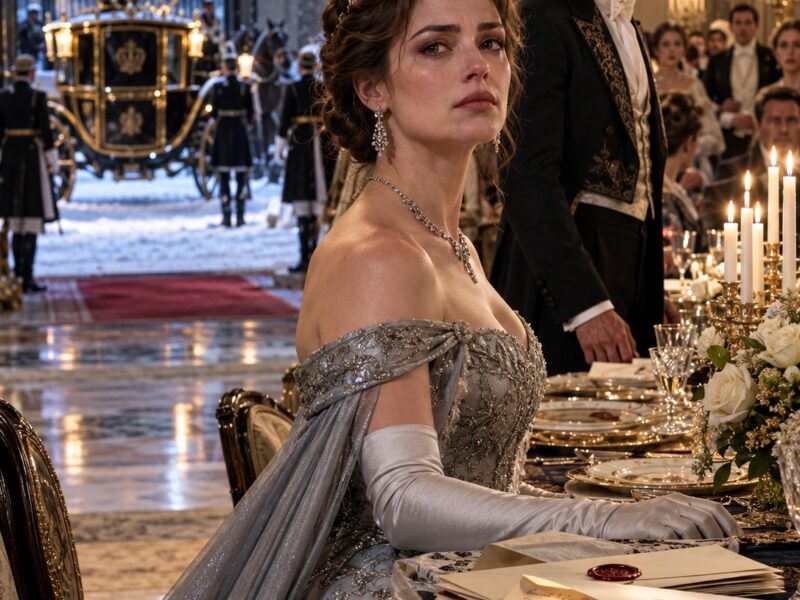
MY HUSBAND HUMILIATED ME IN FRONT OF 37 ROYAL GUESTS, SAYING I HAD NO FAMILY—THEN A ROYAL CARRIAGE ARRIVED WITH MY REAL NAME, AND HIS FACE WENT PALE.
The first time Duke Weston Caldwell realized his wife had never needed his name, he was standing at the head of his own dining table with thirty-seven people watching him lose control of the room.
Only an hour earlier, he had made them laugh at her.
Now no one was laughing.
Outside Blackmir Hall, iron wheels crushed frozen gravel beneath the weight of a black royal carriage. Torchlight flashed across lacquered doors, a crown crest, and a polished brass plate engraved with two words Weston had never heard spoken inside his house.
EVELYN HARTWELL.
Weston stared at the name.
Then at his wife.
Evelyn stood beneath the chandelier in the same silver-gray gown she had worn while he humiliated her. Her hands were folded loosely at her waist. Her expression was calm.
Too calm.
She did not look surprised.
That frightened him more than the carriage.
“What is this?” Weston demanded.
Evelyn looked at him for several seconds.
Then she said quietly, “You should have delivered my letters.”
And in that moment, something inside Blackmir Hall shifted.
Not loudly.
Not yet.
But permanently.
Three days earlier, Weston Caldwell had believed he understood exactly who his wife was.
He was thirty-eight, handsome in the carefully maintained way of men who considered appearance a form of authority. He wore tailored coats even at breakfast. His boots were polished before he entered the stables. He corrected servants who failed to address him properly and remembered insults for years.
Blackmir Hall had belonged to the Caldwell family for generations.
At least, that was what Weston liked to say.
Its stone towers stood above miles of winter fields. Its north gardens had once been famous. Portraits of dead Caldwells filled the long gallery, each ancestor staring down with the confidence of people who had never imagined their descendants might run out of money.
Weston had inherited the title.
He had also inherited debts.
Then he had created more.
Poor harvests had hurt the estate, certainly, but bad weather was only part of the problem. Weston spent as though financial reality were something that happened to lesser families.
He renovated a ballroom no one had asked to renovate.
He bought blooded horses he barely rode.
He hosted hunts large enough to feed rumors throughout the county.
He funded political dinners because powerful men remembered expensive wine.
Every season Blackmir looked richer.
Every season it became poorer.
The winter reception was supposed to fix that.
Dozens of influential families had been invited. County officials would attend. Several men connected to the royal household were expected.
If Weston could make Blackmir appear strong, lenders might remain patient.
Reputation, he believed, could purchase time.
And if there was one person he considered useful to that performance, it was Lady Joselyn Avery.
Joselyn was thirty-four, unmarried, elegant and connected to families Weston desperately wanted on his side.
She was also not his wife.
That distinction seemed to matter less to Weston every month.
Two days before the reception, Evelyn entered the dining hall and found Weston standing over the seating chart.
He barely looked up.
“Your place has changed.”
Evelyn stopped.
Her usual chair—the seat immediately to his right—now bore a card with Joselyn Avery’s name.
Evelyn’s card sat near the opposite end of the table.
Beside a minor magistrate.
And an empty chair.
She looked from the card to her husband.
“Why?”
“Joselyn can help us.”
“Us?”
“Blackmir.”
Evelyn touched the edge of the chair that had belonged to every Duchess of Caldwell before her.
“Then perhaps Blackmir should marry Joselyn.”
Weston sighed.
“Don’t be childish.”
“I asked a question.”
“And I answered it.”
“No. You told me she was useful.”
“She is.”
“And I am not?”
Weston finally looked at her.
There were moments when cruelty entered his face so gradually that another person might have mistaken it for impatience.
Evelyn never did.
“You are my wife,” he said. “That should be enough.”
“Apparently not enough to sit beside you.”
His mouth tightened.
“Must everything become a battle?”
“You moved your wife away from your side at a public dinner.”
“A seating arrangement is not a declaration of war.”
“No. But sometimes it tells you where the war already is.”
For a second, Weston said nothing.
Then he smiled.
Thinly.
“You always forget how fortunate you are.”
Evelyn’s fingers went still.
There it was.
The sentence beneath nearly every argument they had had for three years.
Fortunate.
He had married her when polite society knew almost nothing about her.
She had arrived as Evelyn Mercer.
No parents had attended the wedding.
No brothers stood beside her.
No sisters helped with her gown.
No wealthy uncle sent a gift.
No family estate appeared on marriage documents.
Weston had once found the mystery romantic.
Later, he found it useful.
Whenever Evelyn disagreed with him, he reminded her that she had nowhere else to go.
Whenever she questioned an expense, he reminded her that everything around her belonged to the Caldwells.
Whenever she challenged him in private, he asked the same quiet question.
“Who were you before me?”
Evelyn had stopped answering.
Weston mistook that silence for shame.
He never considered that it might be restraint.
Now he leaned against the table.
“What family?” he asked. “You never had one until I gave you mine.”
Evelyn studied his face.
She had loved that face once.
Perhaps part of her still did, which was the cruelest part.
Because love did not disappear the first time someone diminished you.
Sometimes it stayed long enough to teach you exactly how much pain you could survive.
“You had better pray that’s true,” she said.
Then she walked away.
Weston laughed after she left.
But the sound died quickly.
There had always been things about Evelyn Mercer that did not make sense.
She spoke diplomatic French fluently.
She understood court etiquette better than men who had spent their lives near the palace.
Once, at dinner, she had corrected the placement of a visiting marquess without embarrassing him, using a form of address so obscure that even Weston had needed to look it up afterward.
She recognized ancient family crests.
She knew scandals that had happened before she was born.
And she carried herself in grand rooms not like a woman impressed by them, but like someone who had grown tired of them.
Whenever Weston asked where she had learned these things, she gave him the same answer.
“Long before Blackmir.”
For years, he had told himself that every mystery had an ordinary explanation.
Until the letters began arriving.
The first had come eighteen months earlier.
A heavy envelope.
Royal seal.
Addressed not to Evelyn Caldwell.
Not to Evelyn Mercer.
To Evelyn Hartwell.
Personal and confidential.
Weston had been in his study when the post arrived.
He remembered turning the envelope over.
Hartwell.
The name had bothered him.
So he opened it.
By the time he finished reading, his hands were shaking.
That evening Evelyn had entered the study carrying tea.
“You look pale,” she said.
“Do I?”
“Has something happened?”
He had folded the letter beneath another document.
“No.”
She had watched him.
Then nodded.
“All right.”
He almost told her.
Almost.
But then he remembered the loans.
He remembered Northbridge Holdings.
He remembered a financial review from the previous year that had listed the Hartwell Trust among the entities connected to his creditors.
He remembered seeing the name of an heir.
Evelyn Grace Hartwell.
Daughter of a Mercer mother.
Suddenly his mysterious wife was not mysterious at all.
She was dangerous.
Not because she intended to hurt him.
Because she had the power to stop needing him.
That night, Weston locked the letter inside his desk.
Then another arrived.
Then another.
Seven in all.
He kept every one.
Three he opened.
Four he did not dare.
And during those same eighteen months, he became crueler to Evelyn.
He told himself it was coincidence.
It wasn’t.
The more frightened he became of the woman she might discover herself to be, the more determined he became to convince everyone—including Evelyn—that she was nothing without him.
But Evelyn had noticed the missing correspondence.
For more than a year, she received invitations, household accounts and charitable requests.
Nothing personal.
Not one letter.
Her companion, Tessa Monroe, finally said what Evelyn had been avoiding.
“A woman can lose friends,” Tessa said one afternoon. “She does not lose every person who ever knew her on the same day.”
Evelyn looked toward the window.
“Perhaps they decided silence was easier.”
“All of them?”
Evelyn said nothing.
Tessa lowered her voice.
“Have you checked the post ledger?”
That evening they did.
Several private parcels had been recorded for the Duchess.
Signed for.
Never delivered.
Evelyn confronted Weston the next morning.
He did not even lift his head from his papers.
“Most were from beggars.”
“You opened them?”
“I spared you the trouble.”
“They were addressed to me.”
“You are my wife.”
“That was not my question.”
He finally looked up.
“People use women like you.”
Something in Evelyn’s expression changed.
“Women like me?”
“Women unused to influence.”
Evelyn stared at him for a long time.
Then she smiled.
It was a small, strange smile.
“You really believe that, don’t you?”
Weston frowned.
“Believe what?”
But she had already turned away.
That night, Evelyn copied every missing delivery date into a journal.
Then she wrote a letter.
No family crest.
No title.
No Caldwell stationery.
She sealed it and handed it to Tessa.
“Take this to the village.”
“To whom?”
“Someone who once promised to come if I ever called.”
Tessa looked at the blank outer cover.
“Who?”
Evelyn hesitated.
“My aunt.”
It was the first time Tessa had heard her mention one.
The winter reception opened beneath a gray sky heavy with snow.
Blackmir glittered.
Fresh candles burned in every corridor. Holly climbed the marble staircase. Silver gleamed. Fires roared.
Guests arrived believing they had come to admire the strength of the Caldwell family.
Weston greeted each one personally.
And beside him, whenever the guest mattered enough, stood Joselyn Avery.
Evelyn watched from across the hall.
Weston touched Joselyn’s elbow as he introduced her.
He guided her toward influential men.
He laughed too warmly at her remarks.
When Evelyn approached, conversation somehow shifted away from her.
It was deliberate.
She knew it.
So did Tessa.
“Say the word,” Tessa whispered. “We can leave.”
Evelyn looked toward the tall courtyard windows.
“No.”
“Why?”
“Because I’m waiting.”
“For your aunt?”
Evelyn did not answer.
Dinner was called.
Joselyn took Evelyn’s chair.
A murmur traveled down the table.
No one objected.
Powerful rooms rarely needed everyone to agree with cruelty.
They only needed everyone to remain seated.
Evelyn walked to the far end and took her assigned place.
Halfway through dinner, an elderly baron leaned toward her.
“Mercer,” he said kindly. “Which branch?”
Evelyn opened her mouth.
Weston answered first.
“No branch at all.”
Several people laughed.
The baron looked embarrassed.
Weston lifted his wine.
“Evelyn had no family of consequence before she came here.”
Joselyn lowered her face behind her napkin.
Evelyn saw the smile anyway.
Weston continued.
“She was extraordinarily fortunate.”
The laughter grew.
Not because the joke was funny.
Because Weston was Duke of Caldwell.
Evelyn placed her glass on the table.
Click.
Tessa heard it from halfway across the room.
Weston should have stopped.
Instead, encouraged by his audience, he leaned deeper into the humiliation.
“Everything she wears came from Blackmir. Every jewel. Every introduction. Every title.”
Evelyn looked toward the courtyard.
Nothing.
Weston spread his hands.
“If I took the Caldwell name from her tomorrow, there would be nothing left to prove she ever belonged in this world.”
The room became quieter.
Even Joselyn stopped smiling.
Evelyn turned.
“Are you certain?”
Weston laughed.
Then came the sound.
Iron wheels.
Slow.
Heavy.
Grinding across frozen gravel.
Heads turned.
A footman hurried into the hall, face drained of color.
He whispered into Weston’s ear.
Weston straightened.
“What?”
The footman repeated himself.
A royal carriage had entered the gates.
Weston’s expression transformed.
Royal.
For years he had courted people who knew people who knew the palace.
Now the Crown itself had sent someone to Blackmir.
He stood so quickly his chair scraped backward.
“Ladies and gentlemen.”
He barely concealed his satisfaction.
“It appears we have an unexpected guest.”
Everyone followed him toward the entrance.
Weston descended the front steps first.
The carriage rolled into torchlight.
Black lacquer.
Royal crest.
Four horses steaming in the cold.
Then Weston saw the brass plate.
EVELYN HARTWELL.
His smile disappeared.
Behind him, Evelyn whispered, “You should have delivered my letters.”
The carriage opened.
An older woman stepped down.
Silver hair.
Dark velvet.
Straight-backed despite her years.
She walked past Weston as though he were a servant holding the door.
“I am Delaney Hartwell.”
She looked at Evelyn.
“I have come for my niece.”
Weston moved between them.
“This is absurd.”
Delaney stopped.
“I beg your pardon?”
“I don’t know you. I recognize no claim you have over my wife, and I will not permit strangers to enter my home using forged royal insignia.”
For a moment, Weston almost recovered the room.
Then another man stepped from the carriage.
Lean.
Forty-seven.
Dressed in the restrained black of royal service.
“Corbin Shaw,” he said. “Royal Secretary.”
He produced a commission bearing the Crown’s crimson seal.
No one laughed.
No one moved.
Delaney walked into Blackmir.
Evelyn waited beside the fire.
Aunt and niece looked at each other.
No dramatic embrace followed.
No tears.
Years of separation were too heavy for theatrical gestures.
Finally Delaney spoke.
“Evelyn Grace Hartwell.”
Weston felt the name hit him like a blow.
The story came out slowly.
Evelyn had been born into one of the oldest families connected to the royal household.
The Hartwells had managed Crown properties and served as trusted advisers for generations.
More than a decade earlier, Evelyn’s father had been accused of embezzling royal assets.
The accusation destroyed the family before any court determined whether it was true.
Friends disappeared.
Invitations stopped.
Doors closed.
Evelyn watched people who had eaten at her father’s table cross streets to avoid him.
So she abandoned Hartwell.
She took Mercer, her mother’s maiden name.
After her parents died, she kept it.
Not because she was ashamed of poverty.
Because she was disgusted by status.
Weston stared at her.
“If this is true, why didn’t you tell me?”
“I intended to.”
“When?”
“When the investigation ended.”
Corbin Shaw looked at him.
“It ended eighteen months ago.”
Evelyn turned sharply.
“What?”
For the first time that night, her composure cracked.
“Eighteen months?”
“Yes.”
Corbin’s voice softened.
“Your father was completely exonerated.”
Evelyn gripped the back of a chair.
She had imagined that sentence for years.
Sometimes she had imagined hearing it beside her father.
Sometimes beside her mother.
Eventually she stopped imagining it at all.
Now a stranger was saying it in her husband’s house.
Eighteen months late.
Corbin continued.
“Seven official letters were sent to you.”
Silence.
“Seven?” Evelyn whispered.
“All marked private.”
Weston spoke immediately.
“I never saw them.”
Evelyn looked at him.
He did not blink.
“If correspondence went missing,” he continued, “a servant must have mishandled it.”
Delaney reached into her bag.
She produced the royal courier register.
Corbin read the signatures aloud.
“W. Caldwell.”
Once.
Twice.
Seven times.
Weston’s face hardened.
“A clerk signs documents for me constantly.”
Evelyn walked toward him.
One step.
Then another.
“Where are my letters?”
“I told you—”
“Where are they?”
His voice rose.
“I don’t know.”
Evelyn turned to Randall Pike, Blackmir’s financial steward.
“The key to the Duke’s study.”
Randall froze.
Weston exploded.
“No one enters my study.”
Corbin stepped forward.
“Royal correspondence addressed to Lady Evelyn is not your property.”
Weston looked around.
Too many witnesses.
Too many eyes.
He could not burn anything now.
Randall slowly placed a key in Evelyn’s hand.
Inside the study, the air smelled of leather, tobacco and cold ash.
Evelyn saw the locked drawer immediately.
Weston blocked her.
“Private papers.”
Randall cleared his throat.
“That lock was replaced eighteen months ago.”
Weston turned.
Randall swallowed.
“On your order.”
The brass key was on Weston’s ring.
Evelyn took it.
The lock opened.
Seven envelopes lay inside.
Four sealed.
Three opened.
Each carried the royal mark.
Each bore the same name.
Evelyn Hartwell.
Personal and confidential.
Evelyn did not touch them at first.
She simply stared.
Then she looked at Weston.
“You knew.”
He said nothing.
“You knew my name.”
Still nothing.
“You stood in that dining room and told people I had none.”
Corbin opened the first letter.
The investigation had concluded.
The second cleared Evelyn’s father of every accusation.
The third informed Evelyn that the Hartwell fortune, frozen during the inquiry, was being restored.
And that she was requested to resume administration of the Hartwell Trust.
Weston finally spoke.
“I was protecting our marriage.”
Evelyn’s eyes filled.
Not with tears.
With understanding.
“No.”
She shook her head.
“You were protecting your position in it.”
Tessa lifted one of the remaining envelopes toward the lamp.
Something was written across the corner.
Three words.
In Weston’s handwriting.
DO NOT DELIVER.
The lie died there.
But Delaney was still staring at Weston.
“This isn’t why he hid them.”
Evelyn turned.
“What?”
Delaney’s expression hardened.
“He knows what the Hartwell Trust owns.”
Weston’s face changed.
And Evelyn understood that the letters were only the first door.
Behind them was something worse.
Delaney said one name.
“Fletcher Boon.”
Weston erupted.
“No.”
The violence of his reaction answered the question before anyone asked it.
Boon arrived the next morning.
He represented Northbridge Holdings, the financial firm that had quietly extended credit to Blackmir for years.
Weston had always described Northbridge as a group of private investors.
That was technically true.
But incomplete.
Boon opened his ledger.
“Northbridge manages the capital.”
“Whose capital?” Evelyn asked.
Boon looked at her.
“The Hartwell Trust’s.”
No one moved.
Blackmir had survived because of money belonging to Evelyn’s family.
The farms.
The timber lands.
The mill.
The rental properties.
Much of Blackmir’s income had been pledged against loans ultimately owned by the Hartwell Trust.
Weston had married the woman whose family’s money was keeping his estate alive.
And for years he had called her dependent.
“When did he know?” Evelyn asked.
Boon hesitated.
“Approximately two years ago.”
Weston snapped, “Careful.”
Boon ignored him.
“A trust review identified the heirs. Your full name appeared.”
Evelyn looked at Weston.
So before the first royal letter, he had already begun to suspect.
When the letter arrived, suspicion became certainty.
That was why he hid it.
If Evelyn learned the Hartwell name had been restored, she could regain control of the trust.
And once she controlled the trust, Weston could no longer control her.
Suddenly Evelyn saw her marriage differently.
Every joke.
Every insult.
Every dinner where Weston described her as naive.
Every meeting he excluded her from.
Every document he pushed toward her saying, “Just sign here.”
It had not merely been contempt.
It had been preparation.
If Evelyn ever accused him, Weston wanted society to remember the fragile, ignorant woman he had spent years constructing.
He had been destroying her credibility before she knew she would need it.
“Are there documents with my signature?” she asked.
Boon opened another file.
“Three.”
Evelyn examined them.
The first was hers.
The next two were not.
The imitation was good.
Almost.
Her real signature moved quickly.
These signatures had been drawn slowly by someone afraid of making a mistake.
Weston stepped closer.
“This is becoming ridiculous.”
Evelyn looked up.
“Is it?”
“You suddenly discover a grand family, a fortune and a royal connection, and now everyone expects us to believe you understand finance?”
Evelyn closed the folder.
“No.”
She stood.
“But eighteen months of you hiding my identity gives me every reason to examine how you understood it.”
She ordered all new Blackmir transactions frozen for seventy-two hours.
Weston laughed.
Then Randall Pike entered carrying an old brown ledger.
His hands were shaking.
“The Duke ordered me to burn this last week.”
Weston went pale.
Randall placed it on the table.
“I didn’t.”
Inside were monthly payments.
Small enough to avoid attention.
Regular enough to establish intent.
The recipient was a former clerk in the royal mail office.
Corbin read the entries twice.
Weston had not merely intercepted letters after they reached Blackmir.
He had paid someone to alert him whenever correspondence bearing the Hartwell name or royal seal entered the system.
He had built an entire mechanism to keep Evelyn ignorant.
Corbin closed the ledger.
“Nothing in this house is to be destroyed.”
Weston understood the walls were closing.
So he did what frightened men with social power often do.
He changed the story.
By dinner, he was no longer the husband who stole his wife’s letters.
Evelyn was the deceiver.
“She married me under a false identity,” he told the remaining guests.
Joselyn sat beside him.
“She knew exactly what she was doing.”
Evelyn stood at the opposite side of the room.
Weston continued.
“Now her fortune returns, and suddenly she remembers she is a Hartwell.”
Whispers began before breakfast.
Calculating.
Ambitious.
Dishonest.
Evelyn could have let Corbin defend her.
Instead, she called everyone into the drawing room.
“I did hide my name.”
Weston smiled.
Several guests exchanged glances.
Evelyn continued.
“I was not expelled from the Hartwell family. I left the name myself.”
The room quieted.
“When my father was accused, I watched people who had called him friend disappear before the evidence was even examined. I learned what titles were worth when everyone believed yours had become inconvenient.”
She looked at Weston.
“So I became Mercer.”
“You tested me,” he said.
“No.”
Her answer was immediate.
“I trusted you.”
The words hurt him more than an accusation.
“I wanted to know whether I could build a life in which my name did not decide my value. And when I married you, I believed I had.”
Tessa stepped forward carrying Evelyn’s journal.
She opened an entry written months before the royal carriage appeared.
Corbin read it.
“If the Hartwells are ever cleared, Weston will be the first person I tell.”
The date destroyed his accusation.
Joselyn slowly looked away from him.
But the worst evidence arrived that night.
Fletcher Boon entered carrying a guarantee.
It had secured one of Blackmir’s largest loans.
The guarantor was written clearly.
Evelyn Grace Hartwell.
The document was ten months old.
Evelyn had never used that name at Blackmir.
Not once.
Only one person in the house had known it.
Weston.
For two days he had sworn he had never heard “Hartwell” before the carriage arrived.
Yet he had borrowed money using it.
Randall spoke quietly.
“The Duke once asked me to find an old sample of the Duchess’s signature.”
Weston turned on him.
Randall did not stop.
“I refused.”
“So he found someone else,” Boon said.
The guarantee was forged.
The truth was finally complete.
Weston had not hidden Evelyn’s inheritance because he wanted the money for himself someday.
He had already begun spending the power of her name.
Blackmir’s financial crisis was not one catastrophe.
It was vanity accumulated over years.
Ballrooms.
Horses.
Political dinners.
Lavish hunts.
Decorations.
Borrowing used to disguise previous borrowing.
Weston had not wanted Evelyn to become Hartwell again.
He wanted to use Hartwell before Evelyn discovered it belonged to her.
That night they met alone in the long gallery.
Seven generations of Caldwell portraits watched them.
Weston looked exhausted.
“I gave you Blackmir.”
Evelyn almost laughed.
Instead she said, “You gave me a room in Blackmir.”
“I gave you a title.”
“And reminded me every day that you could take it away.”
“You were nobody when I met you.”
There it was.
Even now.
After everything.
The truth he needed to believe.
Evelyn stepped closer.
“I chose Mercer.”
Her voice was almost a whisper.
“You chose to turn it into a chain.”
“Get out.”
She did not move.
“Get out of my house!”
A door opened.
Fletcher Boon entered.
Delaney and Corbin followed.
Boon held several papers.
“Your Grace, you may not sell, mortgage, transfer or remove any significant Blackmir asset while the audit is underway.”
Weston stared.
“Who ordered an audit?”
Boon looked at Evelyn.
“The head of the Hartwell Trust.”
Silence.
Delaney approached carrying a walnut box.
Inside lay an old silver seal.
Hartwell.
She placed it in Evelyn’s hands.
The woman Weston had just ordered out of Blackmir now controlled the financial institution that held Blackmir’s future.
Weston stared at her.
He expected revenge.
Evelyn asked only one question.
“How much does Blackmir owe?”
Boon told her.
The number was devastating.
Nearly every productive part of the estate had been pledged.
If the Hartwell Trust demanded immediate repayment, Blackmir would collapse.
Workers would lose wages.
Tenant families would lose homes.
The mill could close.
Weston saw the problem immediately.
And smiled.
“You want to destroy me?”
He stepped closer.
“Then destroy them too.”
That smile nearly made Evelyn hate him.
Not because he was threatening her.
Because he was hiding behind people whose names he barely knew.
Evelyn stayed awake until dawn.
She could ruin Weston with one signature.
Part of her wanted to.
She imagined the ballroom empty.
The horses sold.
The Caldwell silver boxed.
The portraits removed.
She imagined Weston standing where she had stood, discovering what it meant to have the world decide you no longer belonged.
Then she thought of the kitchen maid whose husband worked the mill.
The old shepherd.
The tenant children.
The blacksmith.
Randall.
People who had never stolen her letters.
People who had never laughed.
At sunrise she made her decision.
She would not call the debt.
She would restructure it.
Weston would retain his title.
But he would lose unilateral financial control.
Randall would co-approve expenditures.
No Blackmir asset could fund Weston’s private extravagance.
Every contract carrying Evelyn’s signature would be investigated.
The Hartwell Trust would guarantee workers’ wages while the estate recovered.
Weston could remain Duke of Caldwell.
He simply could no longer spend Blackmir into ruin.
It was not the revenge he feared.
It was worse.
Accountability.
Joselyn left that afternoon.
Before she went, she showed Evelyn a letter Weston had sent weeks earlier.
After the winter reception, he had written, Evelyn would “no longer be a problem.”
Joselyn had believed he meant social separation.
Now she was no longer sure.
“I don’t expect forgiveness,” she told Evelyn.
“I wasn’t offering it.”
Joselyn accepted that.
“But I won’t be used by him again.”
She walked past Weston without saying goodbye.
Her carriage disappeared through the gates.
Another alliance gone.
Another piece of his carefully manufactured world falling away.
Before the remaining guests departed, Corbin addressed them.
The Crown would not decide the Caldwell marriage.
Evelyn’s identity was lawful.
The Hartwell family had been exonerated.
The fortune had been restored.
And Weston Caldwell had deliberately withheld royal correspondence.
“What happens now,” Corbin said, “belongs to Evelyn.”
Weston laughed bitterly.
“Then why the royal carriage?”
Delaney looked at him.
“It wasn’t sent to rescue her.”
She turned toward Evelyn.
“My niece has been summoned to the palace.”
Weston’s expression changed.
“For what?”
“To decide who will represent the Hartwell interests on the Royal Council.”
The woman he had mocked for not belonging in his world was being invited into the one room he had spent his adult life trying to enter.
Before Evelyn left, she arranged one final dinner.
No orchestra.
No expensive flowers.
No display.
Only the same people who had witnessed Weston humiliate her.
Weston arrived expecting retaliation.
Evelyn waited until the final plate had been cleared.
Then she stood.
“I want one thing from you.”
Weston stared at her.
“What?”
“Correct the lie.”
His jaw tightened.
“You told everyone at this table that I had no family and no name before you.”
No one moved.
“Introduce me properly.”
“No.”
Evelyn nodded.
She picked up her gloves.
“Then we’re finished.”
She turned toward the door.
Delaney stood.
Then Tessa.
Randall.
Boon.
The elderly baron.
One guest after another pushed back a chair and rose.
Within seconds, everyone at the table was standing.
Everyone except Weston.
No one said a word.
That was what made it unbearable.
For the first time in his life, Weston understood that social power did not live inside a title.
It lived in whether people chose to remain seated when you entered the room.
His voice came out hoarse.
“Lady Evelyn Hartwell.”
She stopped.
Then turned.
“No.”
Weston blinked.
“I said your name.”
“You gave me another title.”
“What do you want?”
Evelyn looked at him.
“My name.”
A long silence.
Then Weston forced himself to say it.
“Evelyn Hartwell.”
Plain.
No Duchess.
No Lady.
No Caldwell.
Just Evelyn Hartwell.
She smiled faintly.
“Thank you.”
At the doorway, Weston caught her arm.
Not hard.
Not this time.
“Will you come back?”
Evelyn looked down at his hand.
He released her.
“After the palace,” he added. “Will you come home?”
Evelyn’s expression softened.
That almost hurt more.
“Blackmir was never home because you never allowed me to belong here without owing you for it.”
“We can change.”
“You can.”
He waited.
“But not because I stay.”
The following morning the royal carriage waited outside.
Evelyn was about to climb inside when Boon hurried down the steps carrying an old document.
Another contract.
Older than either of them.
Signed by their grandfathers.
Weston watched from the doorway.
“What now?”
Boon looked stunned.
The land beneath Blackmir’s north wing, gardens and grand entrance avenue did not legally belong to the Caldwells.
It belonged to the Hartwell estate.
Generations earlier it had been leased to Blackmir under an agreement almost everyone had forgotten.
Weston stared down the avenue.
The road every important guest traveled to reach his famous house.
Not his.
The gardens he boasted about.
Not his.
Even part of the ground beneath Blackmir itself.
Not his.
Evelyn could terminate the arrangement.
One decision could humiliate the Caldwell family for generations.
Boon waited.
“What would you like me to do?”
Evelyn looked toward the workers crossing the frozen grounds.
Then she folded the contract.
“Nothing.”
Weston stared.
Evelyn handed it back.
“Blackmir will not be punished for its duke.”
Then she entered the carriage.
Months passed.
The audit confirmed the deception.
Seven letters deliberately withheld.
Unauthorized transactions.
Forged signatures.
Payments to monitor Evelyn’s correspondence.
Fraudulent contracts were voided.
Debt was restructured.
Blackmir survived.
So did Weston’s title.
And perhaps that was the most fitting consequence.
No revolution stripped him of his position.
No enemy stole his inheritance.
Every morning he woke beneath the Caldwell crest knowing his own choices had made the title smaller.
Randall managed the estate finances under strict oversight.
Workers kept their wages.
Tenant families remained.
The mill stayed open.
And Evelyn?
She did not become a princess.
Life rarely gives people such tidy endings.
She became the Hartwell Trust’s representative on the Royal Council, responsible for properties connected to the Crown.
It was quiet power.
Real power.
The kind Weston had never understood because it did not need to announce itself before entering a room.
In spring, a royal carriage returned to Blackmir.
Weston saw it from the front steps.
For one foolish moment, hope rose inside him.
Evelyn stepped out wearing deep blue.
She looked different.
Not grander.
Lighter.
She had returned only to sign the final restructuring agreement.
They sat in Weston’s study.
The locked drawer had been removed.
He watched her sign the final page.
“Why?” he asked.
Evelyn looked up.
“Why what?”
“Why are you still saving this place?”
She glanced through the window.
Workers moved through the orchard.
Smoke rose from tenant cottages.
She could hear someone laughing in the distance.
“I’m not saving you.”
Weston flinched.
“I’m saving the people you believed you owned because your name was on the gate.”
She capped her pen.
Weston stared at her hands.
“Does Caldwell mean anything to you now?”
Evelyn considered the question.
Then she stood.
“It’s the name I wore when I forgot I never needed a man to confirm where I belonged.”
He followed her outside.
The carriage waited.
Before the footman closed the door, Weston looked at the brass plate.
Months earlier, he had seen it and thought Hartwell was the most frightening thing written there.
Now he noticed what mattered more.
It did not say Duchess of Caldwell.
It did not say Lady Hartwell.
It said only:
EVELYN HARTWELL.
The carriage began moving.
Down the avenue.
Across land the Caldwells had never truly owned.
Past workers whose lives Evelyn had protected when destroying Weston would have been easier.
Through the gates.
Weston remained beneath the Caldwell crest.
He had spent his life believing a name could make people respect him.
Evelyn had spent years trying to live without hers.
In the end, both of them discovered the same truth from opposite sides.
A title could open a door.
Money could buy a chair.
A family crest could persuade people to bow.
But none of those things could force anyone to stand beside you once they understood who you really were.
Weston Caldwell remained a duke.
He kept Blackmir.
He kept the portraits.
He kept the crest above the door.
But the woman he once called nobody left in a royal carriage carrying the name he had hidden from her for eighteen months.
And perhaps the cruelest part was that Evelyn did not leave as his enemy.
She left as something far more final.
A woman who no longer needed him to regret what he had done.
By the time the carriage disappeared beyond the spring trees, Weston understood that he had spent three years threatening to take away the only name he thought she possessed.
He never realized that the name was the least valuable thing she had given him.
She had given him trust.
And unlike Blackmir, unlike the loans, unlike the land beneath the avenue, that was the one thing no contract could ever return.









