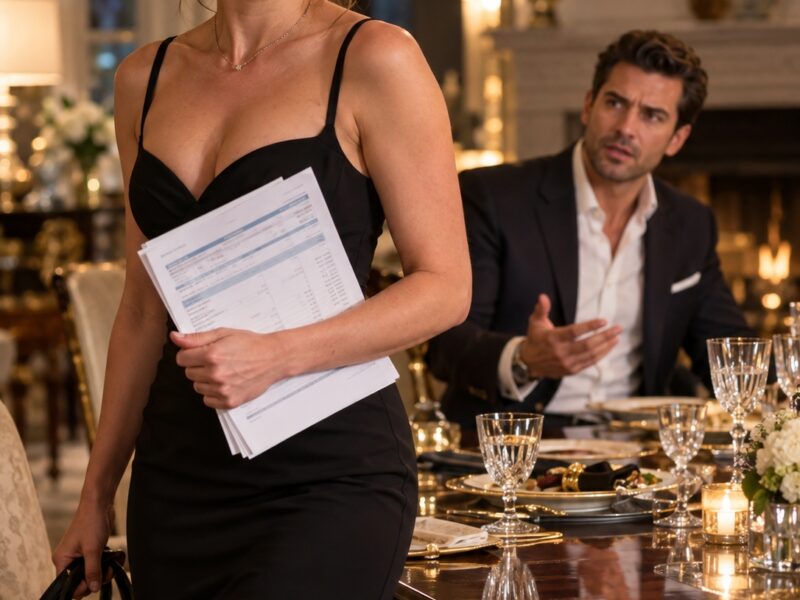
MY HUSBAND LAUGHED AT ME IN FRONT OF HIS FAMILY AND TOLD ME TO “GO FIND BETTER”—HE DIDN’T KNOW MY BAG WAS ALREADY PACKED… OR WHAT I’D FOUND IN HIS JACKET

The whole table laughed when my husband told me to go find better.
What none of them knew was that my suitcase had been packed for four days.
And what Reggie didn’t know was that I had spent those same four days tracing twenty-two months of money he thought I would never notice.
His mother, Priscilla, gave the small uncomfortable laugh she always used when her son crossed a line she preferred to pretend wasn’t there.
His sister Vanessa didn’t laugh.
She looked at me.
Maybe she saw something in my face.
Maybe she noticed that I wasn’t embarrassed.
I wasn’t angry, either.
That was probably what should have frightened Reggie.
He leaned back in his chair at his mother’s dining table, one hand open toward the front door as if he were granting me permission to disappear from the life we had built together.
“If you really think you can do better than what I’ve built,” he said, still smiling, “then go find better.”
He emphasized the word I.
What I’ve built.
Eleven years of marriage disappeared inside that sentence.
Eleven years of recipes I had developed after midnight.
Eleven years of vendor calls, invoices, tasting menus, burned fingertips, ruined batches, emergency deliveries, weddings, funerals, engagement dinners and corporate events.
Eleven years of me standing six feet behind him while he told clients about “our culinary philosophy.”
Except somehow, whenever there was applause, our became his.
I looked at him across the table.
Reggie was still smiling.
He expected me to do what I had always done.
Lower my eyes.
Make a joke.
Save him from the discomfort he had created.
That had been one of my unofficial jobs in our marriage.
Reggie made the mess.
Elaine made the room comfortable again.
Not that night.
I lifted the cloth napkin from my lap, folded it once, and placed it beside my plate.
Then I stood.
His smile changed.
Only slightly.
But I saw it.
“Elaine?”
I walked through Priscilla’s kitchen and out the side door.
The October air hit my face.
My car was parked beneath the maple tree at the curb.
I opened the trunk.
Lifted the panel above the spare tire.
And pulled out the overnight bag I had hidden there four days earlier.
When I walked back into the house carrying it, nobody was laughing anymore.
Reggie stood so quickly his chair scraped against the hardwood.
“Elaine.”
I passed the dining room.
“Elaine, what the hell are you doing?”
I started toward the stairs.
His footsteps came behind me.
Fast.
His hand closed around my shoulder and turned me around.
Not violently.
But not gently.
The smile was gone now.
So was the charming voice he used with clients.
“You’re really doing this?” he asked under his breath. “Here? In front of my family?”
Behind him, Priscilla stood in the dining room doorway.
Vanessa was beside her.
I looked at the man I had married at twenty-two.
At thirty-three, I finally understood something I should have understood years earlier.
Reggie wasn’t upset because I was leaving.
He was upset because I was leaving where people could see it.
“Yes,” I said.
His eyes dropped to the bag.
“When did you pack that?”
I almost smiled.
Instead, I adjusted the strap on my shoulder.
“I found better months ago, Reggie.”
His face hardened.
“I just hadn’t told you yet.”
Then I walked upstairs.
What I didn’t tell him was that “better” wasn’t another man.
It wasn’t another marriage.
It wasn’t even another life.
It was the truth.
And three nights earlier, I had found the first piece of it folded inside his jacket.
The buttercream had been almost perfect that afternoon.
Almost.
I stood beneath the fluorescent lights of our prep kitchen, staring at twelve vanilla brown-butter cake squares lined across black slate tiles.
Each one had a honey-cardamom rosette piped on top, three slices of candied kumquat fanned beside it, a dusting of edible gold and one tiny mint stem tucked beneath the frosting.
Eleven years of catering had taught me that people tasted with their eyes before anything reached their mouths.
The first batch of buttercream was too yellow.
One extra egg yolk.
Most clients would never have noticed.
I did.
I scraped it.
Made another.
When I tasted the second batch from the back of my wrist, the flavors arrived in the order I wanted: honey first, then cardamom, then the deep warmth of butter beneath both.
Quiet sweetness.
The kind that made you reach for another bite before you had finished the first.
“There you are,” I whispered.
The walk-in cooler hummed behind me.
The prep kitchen smelled like brown butter, citrus peel and dish soap.
It was a small commercial space with two stainless-steel tables, a six-burner range, industrial sinks and a cooler door you had to lift slightly before pulling because the lower hinge had never been installed correctly.
Reggie had signed the lease.
I had built everything else.
At two o’clock, our prospective clients arrived.
A couple in their late thirties planning an engagement dinner for the woman’s sister.
Reggie met them at the door.
He was excellent at that part.
I never denied it.
He could shake someone’s hand and make them feel that meeting him had improved their afternoon.
He wore a white shirt with the sleeves rolled to his elbows. No tie. Expensive watch. Relaxed smile.
The look of a man who wanted you to believe success had happened to him naturally.
“What you’re about to taste,” he told them, “is really the result of a culinary philosophy we’ve spent years developing.”
I was six feet away checking the temperature of the lamb.
“We don’t just cater events,” he continued. “We design experiences.”
The woman tasted my cake.
Her eyes closed.
Not theatrically.
Just for a second.
That tiny involuntary reaction was why I still loved cooking.
“Oh my God,” she said. “This is incredible.”
I looked up.
“Who developed this?”
There are moments that seem insignificant until later.
A spoon placed on a plate.
A phone turned facedown.
A pause one second too long.
That question was one of them.
Reggie didn’t even glance toward me.
“That’s the Okafor signature.”
He spread his hands.
“Years in the making.”
I waited.
He could have added six words.
Elaine created it from scratch.
He didn’t.
The woman wrote something in her notebook.
“The cardamom is so subtle.”
“Exactly,” Reggie said. “Restraint is everything.”
I set down the serving spoon.
Quietly.
The cake had begun on our kitchen table three years earlier at 12:43 in the morning because I couldn’t sleep.
Reggie had been upstairs watching television.
I had tested seven versions over four days.
But listening to him talk, you would have thought cardamom had personally whispered the recipe into his ear.
I said nothing.
That had become another skill.
During the tasting, Reggie stepped outside twice.
The first time, he said he had to take a call.
Four minutes.
The second time, he didn’t explain.
He picked up his phone and angled the screen away from me as naturally as breathing.
Then he went through the side door.
I noticed.
I had been noticing a lot lately.
His phone suddenly lived facedown.
His showers were longer after certain events.
He had started taking calls in the driveway.
And when I mentioned our anniversary—two weeks away—he barely lifted his eyes from the screen.
“I was thinking about that Italian place on Drexel,” I said. “Where we had our third date.”
“Which place?”
I stared at him.
“The place where you told the waiter you were allergic to mushrooms because you didn’t know what truffle was.”
That finally made him smile.
“Oh. Right.”
“Friday night?”
His phone buzzed.
He checked it.
“That weekend might be bad.”
“Why?”
“I’ve got something going with an investor.”
“What investor?”
“I’ll tell you when it’s solid.”
Then he slipped the phone into his pocket.
“Don’t make a reservation yet.”
I nodded.
I stored that moment beside all the others.
The turned screen.
The unexplained calls.
My recipes becoming “Okafor signatures.”
The anniversary he couldn’t commit to.
Individually, none of them proved anything.
Together, they were beginning to taste wrong.
That night, Reggie fell asleep at 10:30.
I stayed awake.
I picked up the clothes he had dropped over the chair near our bedroom window.
His undershirt.
His pants.
His jacket.
I lifted the jacket to hang it properly, pressed my hand against the inside pocket to flatten the lining—
And heard paper crinkle.
I stopped.
Reggie breathed steadily behind me.
I reached into the pocket.
A folded bank statement.
Not a receipt.
Not a restaurant proposal.
A bank statement.
I stepped into the hallway and pulled the bedroom door nearly shut.
Under the hallway light, I unfolded it.
The account number meant nothing to me.
That was strange.
I handled our finances.
Business checking.
Personal checking.
Savings.
Payroll.
Taxes.
Vendor accounts.
I knew all of them.
Then I saw the address.
R. Okafor.
An apartment across town.
Not our house.
I read it twice.
Then I looked down at the transactions.
Transfer.
Transfer.
Transfer.
Every month.
Nearly the same amount.
And every transfer originated from a business category I recognized immediately.
Supplies.
My supply budget.
For a few seconds, I heard nothing.
Not the furnace.
Not the television downstairs.
Not even Reggie breathing behind the door.
I walked into the kitchen.
The microwave clock said 2:14 a.m.
I sat at the table.
Smoothed the statement flat.
Twenty-two months.
I should have cried.
I didn’t.
Instead, I felt something colder.
Recognition.
It was the feeling you get halfway through a recipe when you realize you’ve been measuring from the wrong line on the cup.
Nothing in the kitchen has changed.
But suddenly you understand why everything tastes wrong.
I pulled a yellow legal pad from the drawer.
Then I started writing.
Date.
Amount.
Date.
Amount.
Twenty-two months.
Always between the twelfth and fifteenth.
Always close to the same figure.
Not impulsive withdrawals.
Not random spending.
A fixed expense.
Rent.
A car payment.
A second life.
At 7:03 the next morning, I called Odell Carter.
Odell had been helping small businesses untangle financial messes since before Reggie and I were old enough to have one.
More importantly, he was one of the few people in my life who never confused comforting me with helping me.
He answered on the second ring.
“Elaine?”
“I need you to look at something.”
A pause.
“What kind of something?”
“I don’t want you to tell me I’m overreacting.”
“I wouldn’t.”
“I don’t want you to make me feel better.”
“I know.”
I looked toward the bedroom.
“Tell me what it actually is.”
His voice changed.
“Where?”
We met at a coffee shop on the east side.
I brought the statement in a manila folder.
Odell brought his laptop and portable scanner.
He read everything without interrupting.
Then he looked at me over his glasses.
“These are coming from the supply budget?”
“My supply budget.”
“You’re sure?”
“I created the categories.”
He leaned back.
“Give me two days.”
I gave him three.
During those three days, I went home every night.
Cooked dinner.
Asked Reggie about work.
Passed him the salt.
Listened while he told me about corporate clients and restaurant concepts and people he was “talking to.”
He kissed my cheek once while I stood at the sink.
I almost turned around and asked him where the apartment was.
Instead, I rinsed a plate.
Thursday afternoon, I began packing.
Documents first.
Passport.
Tax files.
Grandmother’s ring.
Backup drive.
Recipe notebooks.
My knife roll.
Things Reggie wouldn’t immediately notice.
I hid the bag beneath the spare tire panel in my trunk.
Friday, I rented a one-bedroom apartment under my maiden name.
Saturday, Reggie announced that his mother wanted us for dinner Sunday.
“I’m telling everybody about the restaurant,” he said.
I looked at him.
Restaurant?
He had never told me a lease had been signed.
Never asked whether I wanted to be involved.
Never discussed ownership.
But somehow there was already a restaurant.
“I’ll be there,” I said.
That night, Odell called.
“I traced enough to tell you your instinct was right.”
I sat on the edge of the bed.
Reggie was downstairs.
“What is it?”
“Most likely a fixed recurring expense. The transfer pattern fits rent.”
I closed my eyes.
“Can you prove where it goes?”
“Not yet.”
“Then keep going.”
“Elaine—”
“I need facts.”
“I know.”
“No guesses. No assumptions. No story I can be talked out of later.”
His answer came quietly.
“Understood.”
That was why I trusted him.
Sunday evening, I walked into Priscilla Okafor’s dining room already knowing I might never sit at that table again.
Then Reggie announced his restaurant.
“Table by Okafor.”
Priscilla nearly glowed.
Vanessa finally put down her phone.
Reggie described the location on Meridian, the private dining room, the bar program.
Then he described the menu.
My menu.
“The anchor dessert will be the brown-butter peach cobbler,” he said. “We spent months getting those ratios right.”
We.
I remembered standing alone in our kitchen three years earlier, burning butter four times until I found the temperature I wanted.
“And the jerk-spiced lamb chops,” he continued. “That’s going to be a signature.”
I set down my fork.
“Reggie.”
He looked at me.
“I developed those dishes.”
Silence.
Then he laughed.
“She’s right.”
He looked around the table.
“She’s my secret ingredient.”
Priscilla smiled.
“You know how Elaine gets.”
Something inside me became very still.
“The cobbler is mine,” I said. “So are the lamb chops. The cornbread soufflé. The sweet potato purée. I have the original notes.”
Reggie’s smile remained.
His eyes didn’t.
“Elaine.”
“I want that acknowledged before you put them on a restaurant menu.”
“Sweetheart, everything we built, we built together.”
“That isn’t what I’m saying.”
His jaw tightened.
Then came the performance.
The open hand.
The little laugh.
“If you think you can do better than what I’ve built, go find better.”
So I did exactly what he told me.
I stood up.
And left.
The rental apartment had crooked baseboards and a kitchen window overlooking a dry cleaner.
I loved it immediately.
Not because it was beautiful.
Because nothing in it belonged to Reggie.
No framed photographs selected together.
No wedding china.
No chair carrying the shape of his body.
No sound of his keys entering the lock.
I put my grandmother’s photograph on the windowsill.
Made the bed.
Boiled water in the only saucepan in the cabinet.
Then I sat alone with a cup of tea.
At two the next afternoon, Odell knocked.
He brought sandwiches and a leather portfolio.
We ate before opening it.
That was another thing I liked about him.
He understood that devastating information was easier to absorb when you had eaten lunch.
Finally he wiped his hands, opened the portfolio and spread several documents across the table.
“Here’s where we are.”
The original transfers totaled just over $41,000.
Every dollar had been traced.
Reggie had been paying rent on an apartment in Westwood.
The lease was under one name.
Yolanda Briggs.
I knew her.
Event planner.
Late twenties.
Beautiful without seeming to work at it.
She had coordinated several events with us two years earlier.
At a corporate reception, she had complimented my cornbread soufflé.
Then spent forty minutes talking to my husband near the bar.
I had been carrying trays.
I remembered that now.
“Keep going,” I said.
Odell slid another document toward me.
“The investor Reggie told you about isn’t an investor.”
“What is it?”
“BRT Hospitality Group.”
“Who owns it?”
“On paper, the registered agent is Yolanda Briggs.”
My stomach tightened.
Odell tapped another page.
“The money from your supply account moved into accounts associated with BRT. Then the money was used as capital supporting the restaurant financing.”
I stared at him.
“He stole money from our company, moved it through her company, then used it to finance his restaurant?”
“That’s what the records indicate.”
“And the apartment?”
“Same financial ecosystem.”
I leaned back.
Forty-one thousand dollars.
A mistress.
A shell company.
A restaurant using my recipes.
His name over the door.
“How much more?”
“I don’t know yet.”
“Find out.”
He studied me.
“You don’t want me contacting the bank?”
“Not yet.”
“Elaine, if he realizes—”
“That’s exactly why.”
I looked down at the documents.
“If I move before I know everything, he’ll move whatever I haven’t found.”
Odell nodded.
“Thursday.”
After he left, I began going through the paperwork I had removed from our house.
Vendor contracts.
Old tax summaries.
Insurance forms.
Business statements.
Then I found something I didn’t recognize.
A commercial lease.
Meridian property.
Table by Okafor.
I flipped to the signature page.
And stopped breathing.
My name appeared beside the words:
CO-GUARANTOR.
Loan amount:
$220,000.
Below that was my signature.
Except it wasn’t.
I pulled my notebook closer.
Signed my name once.
Again.
A third time.
Then placed my real signatures beside the one on the loan.
Whoever had copied mine had practiced.
The capital E was close.
The connection between the letters was good.
But the loop on the L curved the wrong direction.
Small.
Almost invisible.
But wrong.
I called Odell.
“I found something.”
“What?”
“A restaurant lease.”
Silence.
“My name is listed as co-guarantor on a $220,000 loan.”
Another silence.
Longer.
“I never signed it.”
His voice sharpened instantly.
“Photograph every page.”
I did.
Ten minutes later he called back.
“The loan is active.”
My fingers tightened around the phone.
“What does that mean?”
“If the restaurant defaults, the lender can pursue you under the guarantee.”
I stared through the kitchen window at the dry cleaner sign blinking outside.
“He stole money to build a restaurant designed to cut me out.”
“Yes.”
“And used my name to absorb the risk.”
“That’s what the paperwork shows.”
I closed my eyes.
Until then, part of me had still thought I was ending a marriage.
That changed.
“This isn’t divorce anymore,” I said.
“No.”
I looked at the false signature.
“No. It isn’t.”
Then Odell found the final connection.
Yolanda’s signature was on the loan paperwork.
She hadn’t simply been sleeping with my husband.
She had helped build the structure.
And suddenly I wanted to look her in the eyes.
I chose a coffee shop where nobody knew us.
Yolanda arrived exactly at two.
Camel blazer.
Dark jeans.
Leather tote.
She smiled when she saw me.
“Elaine. It’s been a while.”
“It has.”
“You said you wanted to talk business.”
She reached toward her bag.
“I’ve actually been thinking there might be an opportunity for us—”
“I didn’t ask you here about catering.”
Her hand stopped.
I took three pages from my folder.
Placed them on the table.
Transfer records.
BRT loan application.
Forged guarantee.
Yolanda looked at them.
The smile disappeared.
“Where did you get these?”
“That isn’t important.”
Her eyes moved toward the window.
Then back.
“Reggie told me your marriage was already over.”
There it was.
Not denial.
Explanation.
I nodded.
“Okay.”
She blinked.
“I’m not saying what happened was right.”
“I didn’t ask about your relationship.”
That caught her off guard.
I tapped the transfer records.
“I’m asking about this.”
Her shoulders stiffened.
“I handled some business matters.”
“You created BRT with him.”
“I helped.”
“You knew money was coming through it.”
“I wasn’t managing his marriage.”
“We’re not talking about his marriage.”
I moved my finger to the forged signature.
“We’re talking about my name.”
Yolanda stared at it.
“You knew I hadn’t signed this.”
“I didn’t write it.”
“I didn’t say you did.”
Silence.
The espresso machine hissed behind the counter.
Somebody laughed near the door.
Yolanda lowered her voice.
“He promised me fifteen percent.”
“Of the restaurant?”
She nodded.
“It was in writing.”
I almost felt sorry for her.
Almost.
“You traded your name on those documents for fifteen percent of something he was financing with money taken from our company.”
Her jaw tightened.
“I was going to help build something.”
“So was I.”
That landed.
I gathered the papers.
“I have documentation showing your role in the LLC and the loan. I intend to use it.”
Fear appeared in her eyes.
Not dramatic fear.
The quieter kind.
The kind that arrives when someone realizes consequences have already entered the building.
“Elaine—”
“I wanted you to hear that from me.”
I stood.
“We’re done.”
That night, Odell came to the apartment.
This time the documents covered almost the entire table.
The LLC registration.
Transfer records.
Loan application.
Forged guarantee.
And one document I hadn’t seen.
Odell slid it toward me.
“Reggie is the beneficial owner of BRT.”
I looked up.
“Yolanda isn’t?”
“She’s the registered agent. He owns it.”
“When did he create it?”
“Fourteen months ago.”
Fourteen months.
Before the restaurant announcement.
Before the lease.
Before the supposed investor.
Odell leaned forward.
“If you had filed for divorce without finding this, the restaurant could have been effectively hidden behind BRT during the initial asset disclosures.”
I looked at the papers.
That was when I finally saw the architecture of it.
This wasn’t a man who had fallen in love with someone else and panicked.
This wasn’t even a husband making selfish decisions.
He had been building an exit.
Quietly.
Month by month.
Using my work to fund it.
My recipes to populate it.
My credit to protect it.
And another woman’s company to hide it.
“Is it airtight?” I asked.
“Yes.”
“Not emotionally.”
“I know what you mean.”
“Legally.”
“The transfers are traceable. The LLC timeline is documented. A document examiner has reviewed the signature copy. Yolanda’s participation is on the loan application.”
I nodded.
“Good.”
Odell watched me.
“What are you going to do?”
I looked at the table.
For eleven years, Reggie had understood something about me correctly.
I didn’t like scenes.
I didn’t scream.
I didn’t threaten.
I didn’t throw plates.
He had mistaken that for weakness.
“I’m going back to his mother’s house.”
I called Priscilla the next morning.
“I’d like to arrange a family meeting.”
Her voice became guarded.
“About what?”
“The restaurant.”
A pause.
“What about it?”
“There are things everyone needs to hear together.”
Another pause.
Then:
“My house?”
“Yes.”
“All right.”
When I arrived, Priscilla had placed crystal water glasses on the table.
The good ones.
A pitcher of ice water sat in the middle.
I almost smiled.
Even now she was trying to make chaos behave by setting the table correctly.
Reggie was already there.
Jacket on.
Hands folded.
Reasonable-man posture.
He looked at me.
“Elaine.”
I didn’t answer.
Vanessa entered from the kitchen and sat across from him.
Priscilla took her usual seat at the head.
“All right,” she said. “We’re here.”
I opened my bag.
Then I began setting out documents.
One at a time.
Transfer records first.
“What is that?” Priscilla asked.
“Two years of withdrawals from our supply account.”
Reggie shifted.
“Elaine—”
“I’m not finished.”
I placed the BRT documents beside them.
“The money didn’t go to vendors. It went into accounts connected to BRT Hospitality.”
Vanessa looked at Reggie.
He stared at me.
Next came the loan application.
Yolanda’s name.
Then the lease.
I placed that one directly in front of his mother.
“This is the restaurant loan guarantee.”
Priscilla picked it up.
“My name is on it,” I said. “I never signed it.”
For the first time, Reggie looked frightened.
Only for half a second.
Then the salesman returned.
“That situation is more complicated than you’re making it sound.”
I looked at him.
“How?”
“There was confusion with the loan officer.”
“About whether I signed my own name?”
“Elaine, come on.”
“A document examiner reviewed it.”
His mouth closed.
Vanessa slowly set down her water glass.
I continued.
“The bank received my fraud complaint four days ago.”
Reggie’s face changed.
“My attorney received the documentation the same day.”
He pushed his chair back slightly.
“And Yolanda Briggs’s employer received formal notice of her involvement in the financial structure.”
“You contacted her employer?”
His voice rose.
There it was.
Not outrage over the marriage.
Not horror that his wife had discovered the fraud.
Fear for the structure collapsing around him.
“You had no right—”
“It’s already done.”
“Elaine, you don’t understand what you’ve—”
“No.”
I looked directly at him.
“You’re still thinking this is a negotiation.”
Nobody moved.
“The bank has it. My attorney has it. Yolanda’s employer has it. The documentation exists outside this room now.”
His eyes moved across the table.
Looking for an argument.
A weakness.
A person he could charm.
There wasn’t one.
Priscilla was still holding the guarantee.
Finally she looked at her son.
“Reginald.”
He didn’t answer.
She rarely called him that.
“You used her name.”
“Mom—”
“She didn’t sign this.”
“It wasn’t like—”
“You attached her credit to a loan she didn’t authorize.”
“Everybody needs to calm down.”
Vanessa laughed once.
Not because anything was funny.
It was the sound people make when disbelief becomes too large to hold quietly.
“Seriously?” she said.
Reggie turned toward her.
“Vanessa, stay out of this.”
“She just showed us forty-one thousand dollars.”
“You don’t understand the business.”
“Neither did Elaine, apparently,” Vanessa said. “And she ran it.”
His face reddened.
Priscilla put the paper down.
“You used her name, Reginald.”
He stared at his hands.
I watched him.
For eleven years, I had watched Reggie win rooms.
I had seen him smooth over angry clients.
Convince vendors to extend terms.
Turn mistakes into jokes.
Turn my work into his story.
But paper didn’t care how charming he was.
Numbers didn’t laugh.
Signatures didn’t forget.
Dates didn’t become confused because he smiled at them.
For once, Reggie had nothing to perform.
I collected my documents.
One by one.
Slid them into the folder.
Closed my bag.
Then stood.
He looked up.
“That’s it?”
“Yes.”
“You bring all this here and you’re just leaving?”
I considered him for a moment.
“You told me to go find better.”
His face tightened.
“I did.”
Then I walked out.
The bank moved eleven days later.
The signature was formally determined not to be mine.
The guarantee was challenged.
The restaurant financing froze.
Without my guarantee, the structure collapsed.
BRT was flagged for review.
The account was frozen.
The diverted funds became a liability Reggie owed back to our business.
His restaurant never opened.
No grand launch.
No glowing sign above Meridian.
No private dining room.
No brown-butter peach cobbler served beneath his name.
Nothing.
His lawyer contacted mine.
Reggie offered to transfer his ownership stake in our catering company as part of the settlement.
I read the letter twice.
Then drank my coffee before it got cold.
There was one more thing he had forgotten.
Eleven years earlier, when we created the company, I had insisted on a partnership agreement.
Reggie had teased me about it.
“You really think we’re going to sue each other someday?”
“No,” I had said.
“I think we should know what belongs to whom.”
I was twenty-two.
Young enough to believe love lasted automatically.
Old enough to know paperwork mattered.
The intellectual-property clause was simple.
Recipes developed by Elaine remained Elaine’s property.
Menu formulas.
Baked goods.
Desserts.
Original dishes.
All mine.
The client list I had developed was protected.
And the business name—Okafor & Table—belonged to the company, not personally to Reggie.
He had signed the agreement.
Apparently without imagining there might someday be a world in which I read it more carefully than he did.
I signed the final transfer documents on a Tuesday.
My attorney slid each page toward me.
Full ownership of the recipe catalog.
I signed.
Full ownership of the client relationships.
I signed.
Full control of the business assets transferred under the settlement.
I signed.
Every time, I watched my pen move.
Elaine.
The loop on the L curved the right direction.
My signature.
My name.
My hand.
It shouldn’t have felt revolutionary.
It did.
Yolanda lost her job after the fraud review became impossible for her employer to ignore.
The fifteen-percent restaurant stake Reggie had promised her became fifteen percent of nothing.
The restaurant was dead.
The financing was dead.
BRT was frozen.
Eventually she left town.
I didn’t celebrate.
That surprised me.
For weeks I had imagined consequences would feel like justice arriving with trumpets.
They didn’t.
Mostly they felt quiet.
Like putting a crooked picture frame straight and realizing how long you had been unconsciously bothered by it.
Vanessa called me two weeks after the family meeting.
“I’m sorry,” she said.
“For what?”
“For taking this long to understand him.”
I leaned against the counter in my rental.
“You didn’t do what he did.”
“I laughed sometimes.”
“So did I.”
She was quiet.
Then she said, “He still doesn’t think he owes you an apology.”
That made me smile.
Of course he didn’t.
“He says the lawyers handled everything.”
“I know.”
“I told him lawyers can handle money. They can’t apologize for you.”
I looked at the signed documents on my counter.
“Thank you.”
“Are you okay?”
That question used to bother me.
People asked it as if there were only two possible answers.
Yes.
No.
Life after betrayal wasn’t that clean.
Some mornings I woke relieved.
Some nights I remembered the way Reggie used to bring me coffee when I was testing recipes and wondered whether those moments had been real.
They had been.
That was the hardest part.
A person could love you once and still betray you later.
A marriage could contain real tenderness and real exploitation.
One truth did not erase the other.
Eventually I said:
“Yeah.”
I looked around my tiny rental kitchen.
“For the first time in a long time, I think I am.”
I changed the name.
Not immediately.
For weeks, I kept writing possibilities on scraps of paper.
Names that sounded expensive.
Names that sounded modern.
Names that sounded like the kind of place food magazines would photograph.
None felt right.
Then one morning I was building a cake.
Almond sponge.
Rosewater cream.
Raspberry preserve.
Another layer.
Another.
Another.
I looked at the cross-section.
And wrote one word on the back of an invoice.
Layered.
That was it.
Because cakes were layered.
Flavor was layered.
Marriage was layered.
Betrayal was layered.
And so was survival.
People thought leaving happened in one dramatic moment.
A slammed door.
A suitcase.
A final sentence.
It didn’t.
I had been leaving Reggie in layers for years without knowing it.
Every time I swallowed an insult.
Every time he accepted credit and I told myself recognition didn’t matter.
Every time I made myself smaller because his confidence needed more room.
Every time I said we when the work had been mine.
Then came the final layers.
The bank statement.
The apartment.
Yolanda.
BRT.
The forged signature.
By the time I carried that suitcase through Priscilla’s dining room, the marriage had already ended inside me.
My body was simply catching up.
Layered opened in a small storefront with white counters and a professional oven I bought myself.
I installed open shelving along the back wall.
My mixing bowls sat in order from smallest to largest.
I hired two women.
Talented.
Disciplined.
Hungry to learn.
The first thing I told them wasn’t about recipes.
It was about credit.
“If you create something,” I said, “your name stays attached to it.”
One of them looked surprised.
“Even if it’s for the shop?”
“Especially then.”
I knew what invisible work cost.
I wasn’t going to build another business on it.
The first dollar Layered earned went into a black frame beside the register.
Behind it, I taped a piece of paper.
The date.
Written in my own handwriting.
Nothing else.
No inspirational quote.
No revenge slogan.
No mention of Reggie.
Just proof.
A year passed.
Reggie ended up working in a hotel catering kitchen.
He rented a one-bedroom apartment in a neighborhood he once would have dismissed.
He clocked in.
Worked under another chef.
Clocked out.
Nobody asked for his culinary philosophy.
Nobody waited for him to make an entrance.
The industry knew enough about what happened that opportunities became smaller.
Not nonexistent.
Just ordinary.
For a man who had built his identity around being exceptional, ordinary was probably the hardest consequence of all.
Priscilla stopped defending him.
Not apologizing.
Not exactly.
Just retreating.
When our paths crossed, she was polite.
Careful.
Her certainty was gone.
Vanessa came to Layered’s soft opening.
She sat at the counter and ordered the honey-cardamom cake.
The same recipe Reggie had once called the Okafor signature.
She took one bite.
Closed her eyes.
Then took another.
“This is ridiculous,” she said.
I smiled.
“Good ridiculous?”
She pointed her fork at me.
“You know exactly what I mean.”
She ordered another slice.
Neither of us mentioned her brother.
We didn’t need to.
Six weeks before Layered’s first anniversary, I received a wedding inquiry.
Two hundred guests.
Outdoor ceremony.
Seated dinner after sunset.
The bride had found me through a local food magazine.
The article headline used my name.
ELAINE CARTER IS BUILDING SOMETHING LAYERED.
I read it three times.
Not because I was vain.
Because I wasn’t accustomed to seeing my name attached to my own work.
The bride called the morning after the article appeared.
“I want the pastry chef from the profile.”
“That would be me.”
“No, I mean you. I don’t want you just designing it and somebody else making it.”
I laughed.
“I understand.”
“Will you do it?”
I looked around my kitchen.
“Yes.”
On the Saturday of the wedding, Layered was alive by four in the afternoon.
Sheet pans moved through the oven.
Ganache cooled over a double boiler.
Timers chimed.
Metal bowls touched stainless steel.
My assistants worked without panic.
Nobody screamed.
Nobody performed.
Nobody needed to be the most important person in the room.
We were simply good at what we did.
At the center island stood the wedding cake.
Almond and rosewater.
Four tiers.
It had taken four test batches to get the sponge exactly where I wanted it.
I piped the final border.
Adjusted the cake plate half an inch.
Stepped back.
Perfect.
One of my assistants leaned over.
“Chef?”
“Yeah?”
“The bride’s coordinator wants to know who developed the cake.”
For a second, the kitchen disappeared.
I was back eleven years earlier.
Standing six feet behind Reggie.
Watching a woman taste honey-cardamom buttercream.
Hearing her ask:
Who developed this?
And hearing my husband answer:
That’s the Okafor signature.
I looked at my assistant.
She was waiting.
This time, nobody else answered for me.
“I did,” I said.
She smiled.
“I’ll tell her.”
Then she disappeared through the swinging door.
I stood there alone for a moment.
Not completely alone.
Around me were the sounds of the life I had built.
Oven fans.
Spatulas.
Footsteps.
The faint rattle of cooling racks.
Late-afternoon sunlight stretched through the front windows and landed on the little black frame beside the register.
My first dollar.
Behind it, the date was still written in my handwriting.
My eyes rested there.
Just for a second.
Then I picked up the piping bag.
There was another cake waiting.
Another order.
Another room somewhere across the city where people would taste something I had made and know who made it.
That was the part Reggie never understood.
When he told me to find better, he thought “better” had to be another man.
He thought my choices existed only in relation to him.
Stay with Reggie.
Or find someone better than Reggie.
Love him.
Or replace him.
He never imagined the third possibility.
That I could choose myself.
He also never understood that I hadn’t suddenly become strong at his mother’s dinner table.
Strength wasn’t the suitcase.
It wasn’t the fraud complaint.
It wasn’t watching his restaurant collapse.
It wasn’t taking back the company.
Those were only the visible moments.
The real work had happened quietly.
It happened every midnight I perfected a recipe nobody credited me for.
Every morning I balanced books he never bothered to understand.
Every client relationship I maintained.
Every document I saved.
Every contract I read.
Every small decision to become competent even when nobody was applauding.
For eleven years, Reggie thought I was standing behind him.
He never realized I was holding up the entire structure.
And when I finally stepped away, I didn’t destroy his world.
I simply stopped carrying it.
The rest happened on its own.
I squeezed another line of rosewater buttercream along the edge of the cake.
Steady pressure.
Clean curve.
Exactly where I wanted it.
Outside, the afternoon light was turning gold.
Inside, someone laughed near the ovens.
Not at me.
With me.
I looked down at my hands.
The same hands that had built everything the first time.
Only now, when people asked whose work it was, nobody had to search the room for the answer.
I was already standing there.









