MY HUSBAND LAUGHED WHEN I CORRECTED SIX EXPERTS AT DINNER—THEN THE FLOODGATE BROKE
The first time my husband laughed at me that night, six men joined him.
The second time, nobody did.
By the third time, one of those men was staring at a broken steel pin lying between the wineglasses and whispering, “Oh my God.”
Outside, rain hammered the glass walls of our house above the Hudson Valley hard enough to make the windows tremble. Inside, my husband, Nathan Mercer, stood at the head of a twelve-seat walnut dining table surrounded by engineers, historians, consultants, and county officials—the kind of men whose résumés Nathan could recite more accurately than he could remember how I took my coffee.
And in less than an hour, one of them would tell him that if I was right, nearly everything they had done to protect the valley from flooding had actually been making the danger worse.
But at 8:17 that evening, Nathan still thought the most embarrassing thing in the room was me.
It had started as a dinner.
At least, that was what Nathan had called it.
“Nothing formal,” he’d said that morning while knotting his tie in front of our bedroom mirror. “Just Warren, Dr. Ellis, Paul, a couple of county people. We’ll eat, look over the restoration plans, figure out why the north basin keeps behaving strangely.”
Nothing formal.
Nathan’s version of nothing formal required the chef to change the menu twice, the house manager to polish silver that had not been used since Christmas, and me to change out of the sweater I had been wearing because he thought the governor’s infrastructure adviser might stop by.
He kissed my forehead before leaving the bedroom.
“Wear the navy dress tonight.”
I looked at him through the mirror.
“Why?”
“You look beautiful in it.”
That should have sounded like a compliment.
After seven years of marriage, I knew when it was an instruction.
So I wore the navy dress.
At thirty-six, Nathan Mercer had become one of those men newspapers liked photographing beside things other people had built. Bridges. Research centers. Restored historic properties. Flood-control projects. He had inherited Mercer Development from his father, expanded it aggressively, and developed a reputation for funding expensive solutions to complicated problems.
People called him decisive.
They called him visionary.
They called him the kind of man who walked into a room already knowing what needed to happen.
For a long time, I had admired that quality.
Eventually, I understood its cost.
A man who believes he sees the answer quickly can stop noticing how many questions he never asks.
That night, the question was buried beneath nearly two centuries of stone.
Mercer Ridge, the estate Nathan had inherited from his grandfather, sat above Bellweather County in upstate New York. Most people knew the property for its restored mansion, vineyard, horse barns, and sweeping views over the valley.
Almost nobody thought about what lay underneath it.
In the 1840s, before paved roads and electric pumps, the original owners had constructed an extraordinary network of gravity-fed channels, retaining basins, culverts, sluice gates, and emergency spillways to control runoff coming down from the northern hills.
The system was primitive by modern standards.
It was also brilliant.
Parts of it had survived for more than 170 years.
Three years earlier, Mercer Development had begun restoring it as part of a larger county flood-control partnership.
Then things started going wrong.
Fields north of Bellweather remained saturated days after storms.
Old wells rose unexpectedly.
Two basements flooded from beneath their foundations.
A creek downstream ran strangely low even during heavy rain.
Sensors showed pressure where engineers did not expect pressure to exist.
Nathan had responded the way Nathan responded to everything.
He assembled experts.
That was why Dr. Warren Ellis sat three chairs from me that evening.
Warren was seventy-one, silver-haired, elegant, and famous enough in historical engineering circles that Nathan had once flown to Boston just to hear him lecture. He had spent forty years studying nineteenth-century infrastructure documents.
Beside him sat Dr. Paul Renner, a historical linguist who had published three books on regional technical terminology.
Across from them sat Michael Edson, the civil engineer responsible for Mercer Ridge’s water-management restoration.
There were county planners, a hydrologist, and Nathan’s longtime friend Grant Holloway, who possessed no useful expertise whatsoever but had an extraordinary ability to look amused whenever Nathan did.
I knew all of that because Nathan had told me.
Repeatedly.
What Nathan had never asked was why I kept looking at the old drainage diagrams spread across the table.
Dinner had been underway for almost an hour when the doors opened.
Everyone turned.
Luis Ortega, one of the estate maintenance supervisors, stepped inside with rainwater streaming from his jacket.
Michael Edson followed him.
Neither man bothered apologizing for the mud.
That was when I knew something was wrong.
Luis carried something wrapped in an oily shop towel.
Nathan pushed back from the table.
“Michael?”
“We lost another gate connection.”
The room went silent.
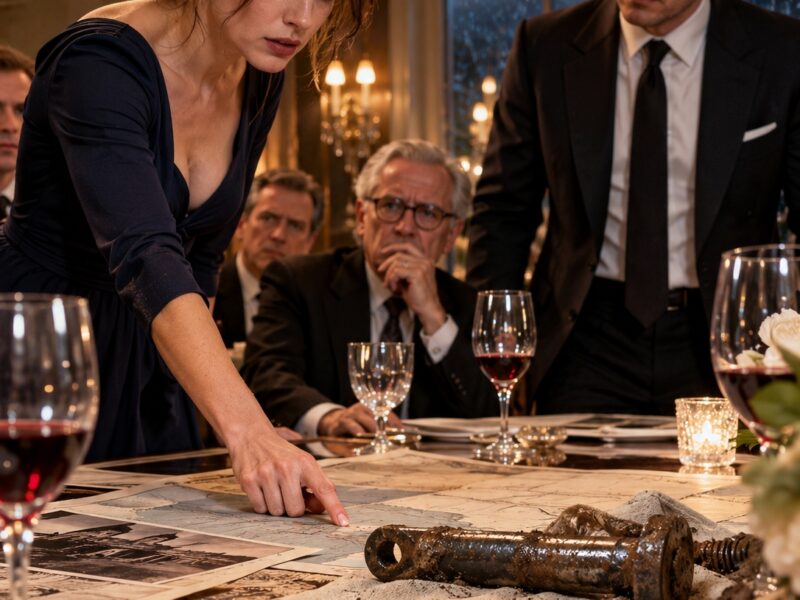
Michael crossed to the table, pulled back the cloth, and dropped a steel pin beside Nathan’s plate.
It landed with a hard metallic crack.
Mud streaked the white tablecloth.
Water ran from the pin and gathered beside a crystal wineglass.
Nathan stared at it.
“Which gate?”
“North feeder.”
Warren Ellis leaned forward.
Instead of looking worried, he looked almost vindicated.
“That supports what we discussed.”
Michael wiped rain from his forehead.
“How?”
Warren pulled one of the enlarged archival photographs closer.
“The original operating instruction is explicit. When northern water rises, the eastern mouth is to remain sealed until the third mark.”
I looked down at the photograph.
I had been looking at that sentence for most of dinner.
Something about it had bothered me from the beginning.
Not because I considered myself a linguist.
I didn’t.
Not because I believed Warren Ellis was incompetent.
He wasn’t.
It bothered me because I knew water.
I knew what it sounded like when it had nowhere to go.
And the instruction Warren had just read made no physical sense.
I looked at the diagram again.
North feeder.
Main retaining basin.
Eastern spillway.
Pressure junction.
I heard my grandfather’s voice from thirty years earlier.
Never argue with water, Claire. Give it somewhere safer to go.
I put down my fork.
“That can’t be right.”
It was not loud.
It did not need to be.
Every conversation at the table stopped.
Nathan looked at me first.
Then Warren did.
“What can’t be right?” Nathan asked.
“The translation.”
There are moments when you can feel a room decide what you are before you finish speaking.
I felt it then.
Grant lowered his wineglass.
One county official looked at his plate.
Paul Renner adjusted his glasses.
Warren gave me the polite expression older accomplished men sometimes use when preparing to correct someone without appearing cruel.
Nathan merely looked surprised.
“Claire.”
“If that instruction means what Dr. Ellis says it means, the system traps additional water in the main basin precisely when pressure is highest.”
Warren smiled.
Not mockingly.
That almost made it worse.
“The language is unusual, Mrs. Mercer, but the verb is quite clear.”
“What verb?”
He pointed.
“Here. In standard nineteenth-century technical usage, it means close, bar, or secure.”
I looked at the word.
Then at the smaller words around it.
“No.”
Grant shifted in his chair.
Nathan’s expression changed.
It was subtle.
I knew it anyway.
The warning.
Claire, don’t make this awkward.
Warren leaned back.
“No?”
“In that context, I don’t think it means close.”
Paul Renner finally spoke.
“Mrs. Mercer, Warren has worked with these documents for four decades.”
Nathan gave a short laugh.
There it was.
The first one.
Grant smiled immediately.
Nathan spread one hand toward the maps.
“Apparently we have another expert at the table.”
A couple of people laughed.
Not because the joke was especially funny.
Because Nathan Mercer had made it.
I felt heat climb my neck.
Seven years earlier, I might have laughed too.
Five years earlier, I might have changed the subject.
Three years earlier, I would have gone silent and spent the rest of the night wondering whether speaking had been worth the embarrassment.
But something strange happens when you are underestimated long enough.
Eventually humiliation stops frightening you as much as silence does.
I looked at Nathan.
“How many years has Dr. Ellis studied these documents?”
His smile remained.
“Forty, apparently.”
“And how many years has he spent operating a floodgate?”
Nobody laughed at that.
Nathan leaned back.
His eyes hardened slightly.
“All right.”
“Nathan—”
“No. You disagree. Explain it.”
The sentence was dressed as an invitation.
It wasn’t.
It was a stage.
He expected me to step onto it, realize how little I knew, and retreat.
I knew because I had watched him do the same thing in boardrooms.
He was very good at giving people enough rope to embarrass themselves.
So I stood.
I placed my napkin beside my plate and walked toward the plans.
Michael Edson moved aside.
Warren watched me carefully now.
I touched the north feeder channel.
“Dr. Ellis, if water enters here, where does it go?”
He frowned.
“Into the principal basin.”
“And if the eastern spillway remains closed?”
“The basin retains it.”
“For how long?”
He hesitated.
Michael answered.
“Until the level falls naturally or pressure exceeds the relief threshold.”
I moved my finger south.
“Where does the pressure concentrate first?”
Michael bent over the map.
His finger followed mine.
Then stopped.
His face changed.
“Here.”
A junction beneath the north fields.
I picked up the broken steel pin.
It was heavier than I expected.
I placed it directly on that point.
Nobody moved.
“The gate that failed tonight,” I said. “That’s where it is, isn’t it?”
Michael stared at the map.
“Yes.”
Rain rattled the windows.
Nathan’s smile was gone.
I turned to Paul.
“Read the entire inscription.”
He pulled the photograph closer.
“I have.”
“Read the words around the verb.”
His expression tightened, but he did it.
“North water. Third measure. Eastern mouth. The disputed verb. Then a pressure notation.”
“What kind of vocabulary is that?”
“Hydraulic.”
“Look at these two words.”
I pointed.
He bent closer.
“Those are… probably milling terms.”
“Probably?”
“Yes.”
“Not ceremonial language?”
“No.”
“Not legal?”
“No.”
“Not architectural?”
Paul looked at me differently.
“No.”
“Milling.”
“Yes.”
I nodded.
“My grandfather owned a mill.”
Nathan turned toward me.
That sentence surprised him more than it should have.
The fact hurt.
“My mother grew up outside Millbrook,” I continued. “Her family managed irrigation channels, mill races, drainage ditches, and two old mechanical sluices. I spent every summer there until I was sixteen.”
Paul looked again at the inscription.
“The verb is still normally translated as close.”
“For a door.”
Warren leaned forward.
I pointed to the diagram.
“But whoever carved this wasn’t talking about a door.”
Silence.
“He was talking about trapped water.”
Paul’s eyes narrowed.
I could see him doing something different now.
Not defending the translation.
Testing it.
“When my grandfather’s workers used that verb about a shed,” I said, “it meant secure it. When they used the same old expression about backed-up water, it meant break confinement. Let it out.”
Warren pulled the photograph toward him.
“That would be highly regional.”
“Yes.”
“And nonstandard.”
“Yes.”
“You’re suggesting the original builders used a colloquial mill-worker meaning in an operational inscription?”
“I’m suggesting the inscription wasn’t written for professors.”
That landed harder than I intended.
Warren stared at me.
I softened my voice.
“It was written for the people turning the wheel.”
Paul bent so close to the photograph his glasses nearly touched it.
For the next thirty seconds, nobody said anything.
Nathan remained standing at the head of the table.
Grant stopped smiling.
Michael looked between the map and the broken pin.
Then Paul whispered something.
Warren leaned toward him.
“What?”
Paul pointed to the grammatical object.
His face had gone pale.
“The object changes the sense.”
Warren read it again.
Then again.
I watched the confidence drain from his expression.
“Paul?”
Paul did not answer Nathan.
He looked at me.
Then at Warren.
“She may be right.”
Nathan’s jaw tightened.
“May?”
Warren took the document from him.
Another ten seconds passed.
Then he removed his glasses.
“No.”
For one ridiculous moment, I thought he was rejecting it.
Then he said, “She’s not ‘may’ right.”
He looked at Nathan.
“She’s right.”
No one at the table moved.
Warren turned the photograph around.
“We reversed the instruction.”
Michael swore under his breath.
Nathan stared at him.
“What does it actually say?”
Warren swallowed.
“When northern water rises, release the eastern mouth before the third mark.”
I heard the rain.
Nothing else.
Nathan looked at the map.
“The eastern spillway isn’t supposed to stay closed?”
Michael’s chair scraped backward.
“No.”
He looked at me.
Then at the broken pin.
“It’s the safety valve.”
Nathan’s face changed.
He understood before anyone said it.
“If she’s right,” he asked slowly, “what have we been doing?”
Michael looked toward the black windows.
“Trapping the flood.”
The words seemed to lower the temperature of the room.
For three weeks, the north hills had taken nearly double their normal rainfall.
The downstream river had remained inexplicably low.
Fields above Bellweather had turned soft enough to swallow tractor tires.
Two houses had reported water rising through basement cracks.
A dairy farm had lost an underground electrical system when groundwater appeared where groundwater had never appeared before.
Everyone had treated those events as separate problems.
They weren’t.
The old system was filling from the inside.
And we had been keeping its emergency exit closed.
Michael started gathering maps.
“We need to inspect the eastern channel.”
Nathan raised a hand.
“No.”
Michael stopped.
Nathan looked around the table.
“We are not opening a two-hundred-year-old spillway at night, during a storm, based on one reinterpretation of an inscription.”
Paul looked up.
“It isn’t a reinterpretation anymore.”
Nathan’s eyes moved toward him.
Paul held his gaze.
“The grammar supports Claire.”
It was the first time anyone at that table had used my name while discussing the problem.
I wish I could say I felt vindicated.
I didn’t.
I felt afraid.
Because outside the windows, the rain was still falling.
I picked up the steel pin.
“The system is already failing.”
Nathan looked at me.
“And if we open a decayed spillway and send a wall of water into Bellweather?”
“Then don’t guess.”
Michael stepped closer.
“We inspect it first.”
Nathan rubbed his jaw.
He hated uncertainty.
More than that, he hated being visibly uncertain.
I knew what would happen next if nobody forced the moment.
He would ask for another analysis.
Another model.
Another hour.
Then the dining room doors opened again.
This time the man entering didn’t knock.
Deputy County Manager Rachel Boyd stood in the doorway with wet hair stuck to her face.
“Nathan.”
Everyone turned.
“We just got three calls from Old Mill Road.”
“What happened?”
“Water is entering basements.”
Nathan exhaled.
“From the creek?”
“No.”
Rachel looked at Michael.
“From underneath the foundations.”
Michael closed his eyes.
Only for a second.
“The basin is backing into the ground.”
That ended the debate.
Within minutes, dinner disappeared.
Maps were rolled.
Emergency crews were called.
County dispatch began moving portable pumps toward Bellweather.
Michael ordered floodlights, harnesses, pry bars, generators, and pressure sensors loaded onto utility trucks.
Nathan was on the phone with the county executive when I noticed a symbol on one of the oldest diagrams.
It looked like a chapel cross.
Except it wasn’t.
I leaned closer.
“Warren.”
He came beside me.
“What is this?”
“Probably a religious marker. There used to be a small chapel east of the ridge.”
“No.”
He glanced at me.
I traced the lower stroke.
“It splits here.”
“So?”
“My grandfather used a mark like this.”
“For what?”
“Inspection access.”
Michael heard me.
He came over immediately.
“Where?”
I pointed to a raised area east of the retaining embankment.
He stared at it.
“There’s a mound there.”
“Natural?”
“I always assumed it was.”
The room went quiet again.
I looked at him.
“What if it isn’t?”
Twenty-three minutes later, I was in the passenger seat of Michael’s truck driving into the worst storm Bellweather had seen in twelve years.
Nathan followed in another vehicle.
The road vanished beneath sheets of rain.
Blue emergency lights flashed through the trees behind us.
At the north field, the landscape looked wrong.
Water shone black beneath the floodlights where grass should have been.
It was spreading silently.
That frightened me more than a rushing river would have.
Rivers announce themselves.
This water was coming from below.
Crews located the mound just after ten.
They dug.
Three feet down, a shovel struck stone.
Then iron.
Michael crouched in the mud and cleared the rim with both hands.
A circular opening appeared beneath roots and packed earth.
He looked up at me.
“You were right again.”
Nathan stood ten feet away.
Rain ran down his face.
He said nothing.
The shaft descended into darkness.
We sent cameras first.
Then Michael and two crew members went down on ropes.
I remained above until his voice crackled through the radio.
“Claire.”
Nathan looked at me.
I picked up the radio.
“Yes?”
“You need to see this.”
Nathan immediately said, “Absolutely not.”
I turned.
“What?”
“You’re not climbing into a flooded nineteenth-century tunnel.”
“Michael just asked me to.”
“I heard him.”
“Then why are we discussing it?”
His face hardened.
“Because I’m your husband.”
“And?”
“And I’m not letting you go down there.”
I stared at him.
Seven years.
Seven years of tiny moments suddenly gathered inside that sentence.
The restaurant where he ordered wine without asking what I wanted.
The charity board where he introduced me as “the person who keeps me civilized” and never mentioned that I had managed my mother’s farm accounts at nineteen.
The dinner where he told a senator I “wasn’t interested in technical stuff” while I sat beside him.
The meetings I was never invited to.
The questions he never asked.
I stepped closer.
“You don’t get to ignore what I know for seven years and suddenly use being my husband as a credential.”
His face went still.
Even Michael’s voice on the radio went silent.
Nathan lowered his voice.
“Claire.”
“You wanted me to explain it.”
Rain ran down my cheeks.
“So let me finish.”
For once, Nathan had no answer.
I clipped into the harness.
The shaft smelled of rust, wet limestone, and old earth.
Thirty feet below the surface, the sound changed.
The water was no longer rain.
It was pressure.
A deep mechanical groan moved through the stone around us.
I felt it in my ribs.
Michael pointed his flashlight toward a massive iron wheel embedded in the wall.
“First relief gate.”
The mechanism looked prehistoric.
Nathan descended behind us despite everything he had said.
When his boots hit the platform, he immediately stepped toward the wheel.
“Open it halfway.”
Michael started to move.
Then Nathan stopped.
I saw the exact moment he caught himself.
He looked at me.
“What do you think?”
Four words.
They should not have mattered.
They did.
Not because they repaired anything.
They didn’t.
Not because they were an apology.
They weren’t.
They mattered because in seven years of marriage, I could not remember another moment when Nathan Mercer had looked at me during a crisis and asked what I thought before telling everyone what to do.
I examined the gauge marks carved into the wall.
“Quarter turn first.”
Michael nodded.
“Agreed.”
Nathan didn’t argue.
The crew attached the lever.
Nothing moved.
Four men pulled.
Rust cracked somewhere inside the housing.
Then the wheel turned.
The tunnel shook.
Water screamed through the opening.
Not flowed.
Screamed.
Everyone stepped backward.
Pressure readings began dropping.
Slowly.
Too slowly.
“Second gate,” Michael ordered.
We moved deeper.
The second mechanism opened more easily.
Water surged into an eastern channel that had been dry longer than anyone standing there had been alive.
The third gate was different.
It would not move.
Six men pulled the chain.
Nothing.
“Again!” someone shouted.
“No.”
Everyone stopped.
I crouched beside the housing.
The chain was taut, but the old counterweight sat at the wrong angle.
Michael lowered his flashlight.
“What?”
“You’re pulling against it.”
“Against what?”
“The gate’s own weight.”
He stared.
Then understood.
“These weren’t designed like modern lift gates.”
I pointed toward a second wheel.
“Reverse the tension first.”
Michael shouted instructions.
Ropes were moved.
Nathan took hold beside the crew.
His tailored coat was ruined.
Mud covered his trousers to the knees.
Nobody cared.
They pulled.
Once.
Nothing.
Again.
Metal groaned.
A worker shouted.
“It’s moving!”
The gate shifted three inches.
Then six.
Then a foot.
A roar traveled through the buried channel.
Somewhere beyond the tunnel, thousands of gallons of trapped water found the path they had been denied.
Michael looked at the pressure gauge.
“Dropping.”
“How fast?”
“Not fast enough.”
The main eastern spillway still had to be opened.
And nobody knew whether it would hold.
For the next six hours, the storm stopped being an argument and became work.
There was no room for pride underground.
Warren Ellis stood in the rain under a borrowed construction jacket translating maintenance markings by flashlight.
Paul Renner compared abbreviated terms with photographs on a soaked tablet.
Farmers arrived with tractors.
County workers filled sandbags.
Volunteer firefighters evacuated six homes along Old Mill Road.
Michael directed reinforcement crews.
Nathan hauled timber until his hands bled.
And I moved between the old diagrams and the gates, remembering details I had not thought about in twenty years.
At 2:43 in the morning, the main spillway opened.
The first surge nearly overtopped a lower channel.
For seventeen terrifying minutes, we thought we had traded one disaster for another.
Then the old stonework held.
Water spread through the eastern course exactly as its builders had intended.
The valley did not escape untouched.
Seven basements flooded.
Two streets took several inches of water.
A pedestrian bridge disappeared before dawn.
Three barns were damaged.
But the north retaining wall remained standing.
At 5:12 a.m., Michael looked at the pressure readings and sat down in the mud.
“We’re below critical.”
Nobody celebrated.
We were too tired.
Nathan stood beside me watching muddy water move safely through the eastern channel.
The rain had weakened to a mist.
He looked older than he had at dinner.
“Claire.”
I waited.
He opened his mouth.
Then closed it.
Whatever he wanted to say, he wasn’t ready.
Neither was I.
We returned to Mercer Ridge shortly after sunrise.
The dining room looked almost exactly as we had left it.
Cold food remained on the table.
Wine sat untouched in glasses.
Maps covered the walnut surface.
And beside Nathan’s chair, the broken steel pin still lay on the white tablecloth.
For some reason, that was what finally made me emotional.
Not the flood.
Not the tunnel.
Not the fear.
That piece of metal.
Seven hours earlier, it had been evidence in a conversation where I was the least important person in the room.
Now everyone who walked past it understood something different.
Warren found me near the window.
His white hair was damp and flattened.
He looked exhausted.
“I owe you an apology.”
I turned toward him.
“I was wrong.”
“So was I.”
He blinked.
“About what?”
“The third mechanism. I thought the balance arm carried the entire load. Michael corrected me.”
Warren studied me.
Then, unexpectedly, smiled.
Not because either of us had won.
Because he understood.
Being wrong had never been the humiliation.
Refusing to listen was.
Paul joined us.
“We’re going to amend the archival translation.”
“You should.”
He nodded toward the rain.
“Would you mind reviewing it?”
I almost laughed.
“Ask Michael too.”
“I intend to.”
Nathan was standing across the room.
He had heard everything.
But he did not come over.
That surprised me.
The old Nathan would have.
The old Nathan would have wanted to wrap the night in a speech, apologize publicly, turn the mistake into a lesson everyone could admire him for learning.
Instead, he remained silent.
Maybe for the first time in his life, Nathan understood that the next useful thing he could contribute was not another sentence.
I went upstairs and slept for four hours.
When I woke, the rain had stopped.
Nathan was not in bed.
I found him in the map room.
The broken pin was on the desk.
He was holding the old inscription.
“I owe you an apology,” he said.
I leaned against the doorway.
“Yes.”
His mouth tightened.
“I shouldn’t have laughed at you.”
“No.”
“I shouldn’t have challenged you in front of everyone.”
“No.”
He looked frustrated.
“With me?”
“With yourself, probably.”
“Claire.”
“Those aren’t the real problem.”
He stared at me.
For a man who always knew what to say, uncertainty looked almost unnatural on him.
“What is?”
I walked into the room.
“You’ve been married to me for seven years.”
His expression changed.
“You knew Warren Ellis had studied nineteenth-century infrastructure for forty years.”
Nathan said nothing.
“You knew Paul had written three books.”
Silence.
“You knew Michael trained at Cornell and spent six years with the Army Corps of Engineers.”
His eyes lowered.
“You knew Grant’s golf handicap.”
That almost made him smile.
Almost.
“You know which bourbon your investors drink. Which universities their kids attend. Which CEOs hate being interrupted. You know what subjects Warren likes discussing at dinner.”
I stepped closer.
“But until last night, you didn’t know what your wife knew.”
The words landed quietly.
That made them worse.
Nathan sat down.
I had imagined confronting him before.
Not about this exact thing.
About the accumulation.
The small dismissals.
The invisible boundaries.
The strange loneliness of being loved by someone who had already decided who you were.
In my imagination, he always defended himself.
This time he didn’t.
I looked at the plans scattered across his desk.
“My grandfather taught me how to read drainage maps when I was nine.”
Nathan looked up.
“I didn’t know that.”
“I know.”
“I knew your grandfather had a farm.”
“A mill and a farm.”
He rubbed both hands over his face.
“I didn’t know.”
“I know.”
The repetition hurt more every time.
“I spent summers walking channels with him. I could identify three kinds of sluice gate before I knew long division. My mother used to joke that I learned water levels before multiplication tables.”
He looked at me as though I had just introduced him to someone.
Maybe I had.
“Why didn’t you ever tell me?”
There it was.
The easiest escape.
I smiled sadly.
“I did.”
His face froze.
“At our second anniversary dinner. You got a call halfway through the story.”
He looked away.
“I told you again when the south courtyard flooded four years ago. That’s why I asked the landscapers to move the gravel.”
“You noticed that?”
“Yes.”
“I thought Michael—”
“I know what you thought.”
He closed his eyes.
I continued.
“When the kitchen well rose after the storm two summers ago, I told you the upper drainage was backing up.”
“I remember.”
“No. You remember me mentioning the well. You don’t remember what I said about it.”
He couldn’t deny it.
I sat across from him.
“I never hid any of this from you, Nathan.”
His eyes met mine.
“You just never thought it was worth remembering.”
That was the sentence that broke him.
Not visibly.
Nathan did not cry.
He did not collapse.
He simply became very still.
Because there was no argument against it.
He had spent years believing arrogance meant refusing to admit you were wrong after someone proved it.
That morning, he began to understand a quieter version.
Sometimes arrogance happens much earlier.
Sometimes it is deciding, before the question has even been asked, whose answer could possibly matter.
“I love you,” he said.
I looked toward the window.
“I know.”
“Do you?”
“Yes.”
That surprised him.
I turned back.
“That’s part of why this hurts.”
He said nothing.
“You loving me was never the problem.”
“Then what was?”
“You loved the version of me you had already finished defining.”
His breathing changed.
I continued before courage deserted me.
“You thought I was good at dinners. Good with donors. Good at making people comfortable. You thought I was patient and attractive and socially useful.”
“Claire—”
“Am I wrong?”
He didn’t answer.
“You didn’t think I was stupid.”
“No.”
“That almost makes it worse.”
His eyes narrowed.
“How?”
“Because you never consciously decided I had nothing to offer. You just never wondered.”
He looked down at the inscription.
For the first time that morning, I saw shame in his face.
Not embarrassment.
Shame.
“What do you want me to do?”
I stood.
“Don’t ask me that today.”
“Why?”
“Because you’ll turn it into another problem to solve.”
His mouth opened.
I shook my head.
“There’s no emergency plan for this. No consultant. No five-step fix.”
I walked toward the door.
“Claire.”
I stopped.
“I am sorry.”
I looked back at him.
“I believe you.”
Hope flickered across his face.
I hated what I had to say next.
“But believing your apology doesn’t mean I know what to do with seven years.”
Then I left him alone with the maps.
For the next three weeks, Nathan behaved differently.
At first, I distrusted every bit of it.
He asked questions.
Too many questions.
What had my grandfather taught me?
How did old mill races work?
Why had I noticed the south courtyard drainage problem?
Could I explain counterweighted sluice gates?
It irritated me.
One evening, I put down my fork.
“You don’t need to interview me.”
His face fell.
“I thought you wanted me to ask.”
“I wanted you to be curious about me, Nathan. Not conduct due diligence.”
For half a second, I expected defensiveness.
Instead, he laughed.
At himself.
“Fair.”
That one word did more than three elaborate apologies could have.
Because he did not explain.
He did not tell me what he had meant.
He accepted the correction.
Then he changed the subject.
Slowly, the questions became ordinary.
Not examinations.
Conversation.
A month after the flood, he asked if I would take him to my grandfather’s property.
The mill had been sold years earlier, but my uncle still owned most of the land.
We drove there on a cold Saturday morning.
There was no hidden laboratory.
No secret engineering degree.
No revelation that I had secretly been a famous hydrologist.
Just fields.
Stone drainage trenches.
An abandoned mill race.
Rusting gate hardware.
And people who remembered me.
My uncle hugged me beside the old equipment shed.
“Still bossing water around?”
Nathan looked at me.
My uncle laughed.
“You couldn’t keep this girl away from a sluice gate. Your grandfather used to give her old survey maps just to keep her quiet.”
Nathan smiled.
Then the smile faded.
I knew why.
Everything I had told him was here.
Not hidden.
Not mysterious.
Just part of my life.
He had never looked.
We walked to the old mill channel.
The November trees were bare.
Water moved beneath fallen leaves.
Nathan stopped beside an iron mechanism half covered in moss.
“Is that the same kind of counterweight?”
“Older version.”
He crouched.
“Show me.”
Not explain yourself.
Not prove it.
Show me.
So I did.
Change after that was not dramatic.
That mattered.
Nathan did not become a different man overnight.
He still interrupted people sometimes.
He still loved being right.
He still became impatient when meetings moved slowly.
Twice, I watched him begin answering questions that had been directed at me.
Both times, he caught himself.
Once, he didn’t.
I kicked him under the table.
He stopped mid-sentence.
“Sorry. Claire?”
I answered.
Nobody applauded.
Nobody needed to.
Mercer Development established a permanent regional waterworks commission after the flood.
Michael chaired it.
Nathan invited engineers, historians, farmers, mill operators, emergency crews, and residents from the oldest parts of Bellweather.
Then one night, while we were washing dishes after dinner, he asked me something.
“Would you want to be on it?”
I turned off the faucet.
“What?”
“The commission.”
I studied his face.
He became nervous.
Nathan Mercer, who could negotiate a sixty-million-dollar acquisition without raising his pulse, looked nervous in his own kitchen.
“I don’t mean because of what happened,” he said quickly. “And I’m not saying you should. I just thought—”
“Nathan.”
He stopped.
“You’re doing it again.”
His eyes widened.
Then he laughed.
“Right.”
He dried his hands.
“Would you want to?”
“Yes.”
“Okay.”
That was all.
No permission.
No announcement.
No “I put Claire on the commission.”
Just a question.
And my answer.
The restoration took most of the following year.
Every surviving historic marker was reexamined.
Warren and Paul rewrote the disputed translation with annotations explaining regional mill terminology.
Michael added practical operating instructions beside the historic text.
Farmers documented seasonal water behavior that did not appear in any nineteenth-century plan.
Emergency crews mapped access points.
And for the first time, oral knowledge from families who had worked those valleys for generations was recorded beside academic research.
At our third commission meeting, a young engineer interrupted an elderly farmer twice.
Nathan leaned forward.
I saw the old instinct in his face.
He wanted to correct the engineer.
Instead, he said, “Mr. Taylor wasn’t finished.”
Then he sat back.
It was a tiny thing.
Those became the things I trusted.
Not speeches.
Not apologies.
Habits.
Our marriage did not heal in a straight line.
There were nights when I looked at Nathan and remembered that dinner table.
Sometimes his laughter came back to me with embarrassing clarity.
Sometimes I wondered whether a person could learn respect after years of love without enough curiosity.
Once, during an argument, I accused him of only listening because I had saved his project.
He went silent.
I regretted it immediately.
Not because it was entirely false.
Because I knew it hurt.
He stood at the kitchen counter for almost a minute.
Then he said, “That’s what I’m most ashamed of.”
I looked at him.
He continued.
“You shouldn’t have needed to be right about something catastrophic for me to become interested in what you knew.”
I didn’t have an answer.
He looked toward the window.
“I keep thinking about what would have happened if you had been wrong that night.”
“What do you mean?”
“If Warren’s translation had been correct.”
I waited.
“Would I have walked away believing the way I treated you was justified?”
The question settled between us.
He shook his head.
“That’s what scares me.”
It scared me too.
Because respect that arrives only after spectacular proof is not really respect.
It is recognition forced by evidence.
The harder thing is learning to believe another person may contain things you have not yet earned the right to know.
By the following autumn, the eastern spillway was fully restored.
The stone walls were reinforced.
The gates had new steel components designed to preserve the old mechanisms while meeting modern safety standards.
Sensors monitored water pressure continuously.
A new emergency plan connected Mercer Ridge directly to Bellweather County dispatch.
Beside the eastern channel stood a stone marker.
My name was not on it.
I had refused when Nathan suggested it.
The marker carried something more useful.
The corrected instruction.
WHEN NORTHERN WATER RISES, RELEASE THE EASTERN CHANNEL BEFORE THE THIRD MARK.
On a cool October afternoon, Nathan and I walked beside it.
The water was clear.
Maple leaves drifted along the surface.
For several minutes, neither of us spoke.
Then Nathan stopped.
“You know what bothers me most about that night?”
I looked at him.
“What?”
“I thought I was giving you an impossible question.”
I smiled.
“You were?”
His expression became almost offended.
“When I said, ‘Since you know so much, explain it.’”
“I remember.”
“I thought you were going to embarrass yourself.”
“I know.”
He winced.
“You don’t have to enjoy that part.”
“I enjoy it a little.”
He laughed.
This time I did too.
Then his face became serious.
“I had Warren Ellis at my table because I respected forty years of scholarship. Paul because I respected his books. Michael because I respected his training.”
“Yes.”
“And you were sitting three feet away from me.”
I looked toward the channel.
“I was.”
“I thought because I had never asked what you knew, there couldn’t be much worth asking.”
I said nothing.
He slipped his hands into his coat pockets.
“I don’t know if I’ll ever stop being ashamed of that.”
I watched water move beneath the restored gate.
“You probably shouldn’t.”
He looked at me.
I smiled faintly.
“Shame isn’t always useless, Nathan. Just don’t build a house in it.”
He laughed softly.
Then we continued walking.
There are stories people tell about marriages where one grand gesture fixes everything.
I don’t believe those stories anymore.
Nathan did not repair seven years with one apology.
I did not forgive every dismissal because he finally recognized one of them.
The flood did not transform us into wiser people before sunrise.
It only exposed something.
Water does that.
It finds the cracks you have been pretending are not there.
It pushes against weak places.
It makes hidden pressure visible.
Sometimes what breaks is a wall.
Sometimes it is an assumption.
Months later, Warren came to dinner again.
The table looked almost exactly as it had on the night of the storm.
Maps between plates.
Wineglasses beside archival photographs.
Too many opinions in one room.
This time, nobody asked me to wear the navy dress.
Halfway through dinner, a young researcher named Evan Hart began arguing about an old pumping station discovered west of Bellweather.
He pointed to a faded maintenance instruction.
“I think this notation means the auxiliary channel was permanently closed.”
Warren frowned.
Paul leaned closer.
Michael reached for the diagram.
Evan looked at me.
“Claire, what do you think?”
Before I could answer, Nathan lifted one finger.
“Careful.”
Everyone turned.
For one heartbeat, I saw the old Nathan.
The man at the head of the table.
The man who expected the room to follow his certainty.
Then he looked at Evan.
“If she tells you you’re reading the wrong word, check it twice.”
The table laughed.
I did too.
Nathan caught my eye across the candles.
Seven years of marriage could not be rewritten.
Neither of us pretended otherwise.
But perhaps that was never the point.
The lesson of the flood was not that I had secretly been extraordinary while everyone else had been foolish.
Warren had been brilliant and wrong.
I had been right about the inscription and wrong about the third gate.
Michael knew engineering I didn’t.
Farmers knew the soil better than all of us.
Workers understood mechanisms scholars had never touched.
Everybody carried a piece.
The danger began when one kind of knowledge became important enough to silence every other kind.
Nathan’s greatest mistake had not been misunderstanding an old word.
It had been believing he already knew the limits of the woman sitting beside him.
He had filled his table with men whose knowledge he respected.
Historians.
Engineers.
Linguists.
Officials.
Men whose credentials he had memorized because he considered their minds worth knowing.
Then his wife questioned them.
And because Nathan had never bothered asking what she knew, he assumed there was nothing to ask.
So he smiled.
He laughed.
And in front of everyone, he gave me the question he thought would humiliate me.
Since you know so much, explain it.
So I did.
I explained the word.
I explained the channel.
I explained why a broken steel pin had landed on his dinner table while water was quietly rising beneath the foundations of a town.
And by the time I finished, the experts Nathan expected to watch me fail were no longer laughing.
They were leaning over the same inscription, reading it again.
Because I had not simply answered my husband’s question.
I had shown everyone in that room that we had been asking the wrong one.
Years later, whenever storms moved over Bellweather, I sometimes woke before the rain became heavy.
Old habit.
I would stand at the bedroom window and watch water streak across the glass.
The eastern spillway was automated by then.
Pressure sensors communicated directly with the county.
There were redundant gates, backup power systems, digital alarms, and emergency procedures so detailed that nobody needed to remember an obscure nineteenth-century verb to keep the valley safe.
Still, I listened.
Nathan usually woke a few minutes later.
One night, during a storm almost as loud as the one that changed us, he found me standing barefoot at the window.
“You worried?”
“A little.”
“The gauges are normal.”
“I know.”
He came beside me.
For a while we watched the rain.
Then he asked, “What are you listening for?”
There was nothing remarkable about the question.
That was precisely why I remember it.
Seven years earlier, Nathan would have told me the gauges were normal and gone back to bed.
Now he wanted to know what I heard.
I rested my forehead against the cool glass.
“My grandfather used to say you can hear when a channel is carrying too much water.”
“Really?”
“Sometimes.”
“What does it sound like?”
I looked at him.
He was waiting.
Not politely.
Not because somebody important had certified that the answer mattered.
Simply because he didn’t know.
And because I did.
So I told him.
Outside, the rain continued falling over the valley.
Far below us, water entered the old northern channels and moved toward the retaining basin.
The pressure rose.
Sensors registered it.
The restored mechanisms responded.
And exactly as men working with stone, iron, mud, and experience had intended nearly two centuries earlier, the eastern gate opened.
Water rushed through.
Not trapped.
Not silenced.
Given somewhere to go.
Nathan stood beside me listening to a sound he had once believed wasn’t worth asking about.
I listened too.
And in the darkness beneath the storm, the water kept moving.









