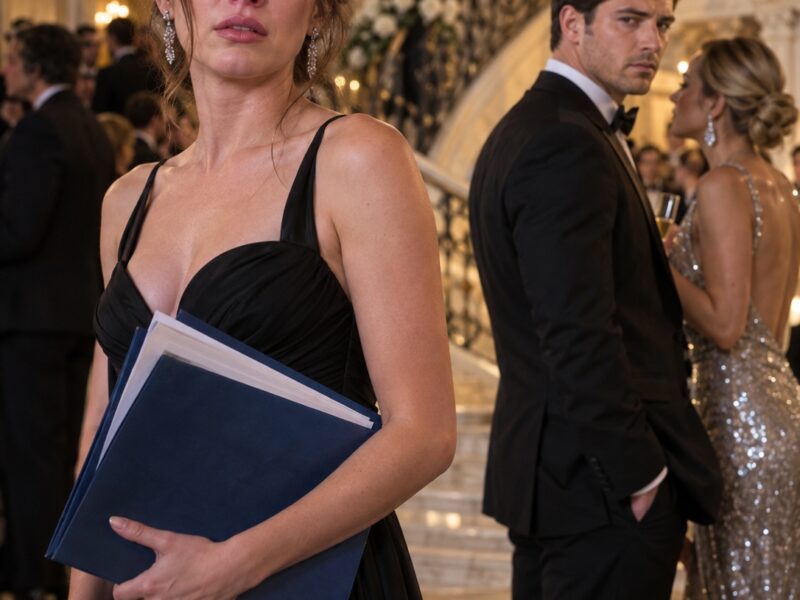
MY HUSBAND LEFT ME FOR ANOTHER WOMAN AT THE GALA—THEN THE MAN HE FEARED MOST ASKED ME TO DANCE

The worst part wasn’t watching my husband leave the ballroom with another woman.
It was realizing, ten minutes later, that he had been planning to leave me with something far more dangerous than a broken heart.
My name is Emma Bennett, and on the night my marriage ended, I was standing beneath a chandelier worth more than the house where I grew up, wearing a black silk dress my husband had chosen because he said my favorite blue one looked “too provincial.”
There were almost four hundred people in the ballroom of the Halston Museum that evening.
Bankers. Surgeons. Investors. Political donors. Philanthropists whose names appeared on hospital wings and scholarship buildings. Women glittering in diamonds stood beside men who could make companies disappear with one phone call.
Everyone looked polished.
Everyone looked expensive.
And almost everyone saw my husband humiliate me.
Daniel Mercer stood near the private balcony with Sophia Grant’s hand resting lightly against his sleeve.
He didn’t pull away when he saw me watching.
That was the first thing I noticed.
The second was that he didn’t look guilty.
He looked irritated.
As if I had arrived early to an appointment where my presence was inconvenient.
“Daniel?”
My voice barely survived the music.
Sophia removed her hand, but not quickly. She was thirty-one, elegant, blond, and born into the kind of money Daniel had spent the last eight years teaching himself to imitate.
Her father controlled an investment group Daniel had been courting for almost a year.
I had met her six times.
She had smiled at me six times.
Apparently, none of those smiles had meant what I thought they did.
Daniel glanced past me toward the ballroom before meeting my eyes.
“Not here, Emma.”
The sentence made my stomach tighten.
“Then where?”
His jaw flexed.
“We need to talk.”
Sophia murmured, “I’ll give you two a minute.”
Daniel caught her wrist before she could step away.
“No.”
One word.
That was all it took.
Something inside me went cold.
I stared at his hand around her wrist.
Then at his face.
“Daniel.”
He released her, but the damage was done.
“What is this?”
His expression hardened.
“I’m tired, Emma.”
“Of what?”
“Of pretending.”
The orchestra continued playing behind us. Glasses clinked. Somewhere near the center tables, people laughed too loudly at something an auction host had said.
But close to us, the air had changed.
People were noticing.
I could feel it before I saw it.
Faces turning just slightly.
Conversations lowering.
The terrible social instinct of wealthy people who wanted desperately to witness disaster while maintaining the appearance that they had not noticed it.
“Pretending what?” I asked.
Daniel looked at me for a long moment.
“That we still belong together.”
There are sentences that sound impossible even after you hear them.
That was one of them.
I actually smiled.
Not because anything was funny.
Because my brain rejected what he had said.
“We were having coffee together in the kitchen this morning.”
“I know.”
“You kissed me before you left.”
“I know.”
“You told me this gala could change everything for us.”
He gave the smallest exhale.
“It will.”
I looked toward Sophia.
She stared at the floor.
“How long?”
“Emma.”
“How long?”
Daniel’s voice dropped.
“This isn’t about Sophia.”
That answer was so insulting I almost laughed.
“Then why is she standing beside you?”
Sophia finally spoke.
“Emma, I think you and Daniel should—”
“Please don’t.”
She fell silent.
I looked at my husband.
Eight years.
Eight years condensed into the expression of a man who appeared less heartbroken by ending his marriage than annoyed by having to explain it.
“What happened to you?” I whispered.
Something flashed across his face.
Not shame.
Anger.
“You want the truth?”
“Yes.”
“You never changed.”
For several seconds, I couldn’t understand what he meant.
Then he continued.
“You’re still that girl from the coffee shop pretending she belongs in rooms like this.”
The cruelty was precise.
That was what made it hurt.
Daniel knew exactly where to place the knife because he had spent years learning where I was softest.
I glanced down at the small black clutch in my hand.
He had given it to me six months earlier on our anniversary.
At dinner, he had told me I looked beautiful.
Now I wondered how much of that night had been real.
“You used to love that girl,” I said.
He looked away.
“I was younger.”
The words landed harder than I expected.
“You’re thirty-eight.”
“That’s not what I meant.”
“No. I know exactly what you meant.”
People were definitely watching now.
I saw a woman near the bar whisper behind her champagne glass.
Daniel noticed too.
His entire posture changed.
He lowered his voice.
“Don’t make a scene.”
For eight years, those four words had been one of the invisible fences around my life.
Don’t make a scene.
Don’t laugh so loudly.
Don’t wear that.
Don’t mention your old job.
Don’t tell that story.
Don’t ask questions at dinner.
Don’t talk about your grandmother’s neighborhood around the Grants.
Don’t embarrass me.
Little by little, I had mistaken disappearing for becoming sophisticated.
And there, beneath the chandeliers, something in me was finally too exhausted to obey.
“You brought another woman to a balcony at a gala I spent six weeks helping organize,” I said quietly. “Then you told your wife you were leaving her in front of half the people you do business with.”
Daniel’s eyes sharpened.
“And you’re worried I’m going to make a scene?”
Sophia touched his arm.
“Daniel, maybe we should go.”
He nodded.
Just like that.
He nodded.
Then he looked at me.
“I’ll have my attorney contact you.”
My attorney.
As if eight years of marriage had already become paperwork.
I could barely breathe.
“You planned this.”
He said nothing.
That silence answered me.
“How long have you been planning this?”
Still nothing.
Then Sophia stepped toward the ballroom.
Daniel followed her.
I reached for his sleeve.
“Daniel.”
He stopped.
For one second, I believed he might turn around.
He didn’t.
I asked the question I would later hate myself for asking.
“Did you ever love me?”
His shoulders rose with a slow breath.
When he finally looked back, his expression was almost tired.
“I loved who I thought you could become.”
Then he walked away.
Sophia went with him.
And I stood beneath the largest chandelier in the room while strangers pretended not to watch my marriage die.
I don’t remember how long I stayed there.
Thirty seconds.
Three minutes.
Maybe longer.
Humiliation changes time.
Everything becomes unbearably detailed.
I remember the cold stem of an untouched champagne glass someone had left on a passing tray.
I remember the sound of a violin.
I remember a waiter looking at me and quickly looking away.
I remember realizing that my wedding ring suddenly felt heavy.
And I remember thinking that if I could reach the ladies’ room without crying, I could lock myself inside a stall until most of the guests left.
I took one step.
Then another.
That was when the ballroom changed.
The murmuring started near the entrance.
Not loud.
But different.
People turned.
Even people accustomed to money and power still reacted when someone entered who possessed more of both.
I followed their eyes.
And saw Adrien Vale.
Daniel had hated him for years.
I never knew why.
Adrien was forty-two, tall, dark-haired, and dressed in a black tuxedo that somehow looked less like formalwear and more like armor.
I had seen photographs of him in business magazines and newspapers.
Founder of Vale Holdings.
Technology, logistics, commercial real estate.
He had built his first company out of a rented warehouse when he was twenty-three and sold part of it before thirty.
But that wasn’t why people lowered their voices when he entered a room.
Adrien had earned a reputation for doing something powerful people feared more than losing money.
He exposed them.
Three years earlier, his testimony had helped uncover accounting fraud inside a regional construction conglomerate.
The year after that, he had publicly challenged a hospital supplier accused of inflating prices on pediatric equipment.
He had enemies.
Daniel had always called him arrogant.
Dangerous.
Self-righteous.
“Stay away from Vale,” he had once snapped after I casually mentioned seeing Adrien interviewed on television.
I had laughed.
“I don’t exactly have him on speed dial.”
Daniel hadn’t laughed.
That memory returned as Adrien crossed the ballroom.
He was supposed to be walking toward the museum director.
Instead, he was walking toward me.
I actually looked behind myself to make sure there wasn’t someone more important standing there.
There wasn’t.
Adrien stopped an arm’s length away.
His eyes moved briefly toward Daniel and Sophia, who had not yet reached the far exit.
Then back to me.
“Mrs. Mercer.”
His voice was quiet.
“Mr. Vale.”
The whispering around us intensified.
I expected him to say something polite.
Perhaps that he was sorry.
Perhaps that I should ignore everyone.
He did neither.
He simply extended his hand.
“Dance with me.”
I stared at him.
“What?”
“Dance with me.”
My throat tightened.
I could see Daniel now.
He had turned around.
For the first time all evening, my husband no longer looked annoyed.
He looked alarmed.
And Adrien Vale saw it too.
“I don’t think that’s a good idea,” I whispered.
“Probably not.”
That almost made me smile.
“Then why ask?”
Adrien’s hand remained between us.
“Because half this room is waiting to see you run.”
I swallowed.
“And the other half?”
“They’re waiting to see if you break.”
I looked around.
He was right.
Adrien lowered his voice.
“You don’t owe them either performance.”
Then he waited.
No pressure.
No pity.
Just an offered hand.
Something about that mattered.
Maybe because everyone else that evening seemed to want something from me.
An explanation.
A reaction.
A collapse.
Adrien was offering me three minutes where I didn’t have to provide any of those things.
So I put my hand in his.
The room noticed.
God, the room noticed.
The orchestra was playing an old jazz standard, slow enough that I didn’t have to think much about the steps.
Adrien placed one hand carefully at my back.
There was nothing romantic about it.
Not yet.
It felt almost formal.
Protective without being possessive.
For the first thirty seconds, I stared at his shoulder because I couldn’t bear to look at anyone else.
“You can breathe,” he said.
“I am breathing.”
“No, you’re pretending to.”
I almost laughed again.
Instead, a strange sound escaped me, half laugh and half sob.
“I’m sorry.”
“For what?”
“This is humiliating.”
“For him.”
I looked up.
Adrien’s expression was unreadable.
“You think I’m humiliating him?”
“No.” His gaze moved briefly over my shoulder. “I think he’s doing a thorough job himself.”
Against every reasonable instinct, I smiled.
Just slightly.
Adrien didn’t mention Daniel again.
He didn’t ask what had happened.
He didn’t ask whether I was all right.
That would have broken me.
Instead, he asked, “Do you still paint?”
My feet nearly stopped.
“What?”
“Do you still paint?”
I stared at him.
“How do you know I paint?”
His expression changed.
Barely.
But enough.
And suddenly I became aware that this dance might not be random at all.
“I’ve seen your work.”
“That’s impossible.”
“Is it?”
“I haven’t shown anything publicly in years.”
“I know.”
A chill moved along my arms.
“How?”
The song ended.
People applauded the orchestra.
Adrien removed his hand from my back.
I expected him to step away.
Instead, he said something that changed the direction of my life.
“We need to talk about your husband.”
My heart dropped.
“What about him?”
“Not here.”
I glanced toward Daniel.
He and Sophia were gone.
Adrien saw me searching.
“He’ll call you tonight.”
“How could you possibly know that?”
“Because he’s running out of time.”
I stared at him.
“Running out of time for what?”
Adrien’s eyes hardened.
“For making you responsible for what he did.”
The room seemed to tilt.
“I don’t understand.”
“You will.”
“That’s not an answer.”
“No.”
“Then give me one.”
Adrien hesitated.
It was the first moment all night when he seemed uncertain.
Finally he said, “Has Daniel ever asked you to sign company documents?”
I almost said no.
Then I remembered.
Tax forms.
Insurance documents.
Trust paperwork.
Corporate acknowledgments.
Pages Daniel had slid across the kitchen counter while taking phone calls.
“Routine stuff,” he always said.
“Initial there.”
“Sign at the bottom.”
“You don’t need to read all of it.”
I felt the blood leave my face.
Adrien saw the answer before I spoke.
“How many?”
“I don’t know.”
“Think.”
“Maybe twelve. Maybe twenty. Over the years.”
“Recently?”
I tried to remember.
Three weeks earlier.
Daniel at the dining table.
A blue folder.
He had been impatient because I asked why my signature was needed.
“You’re my spouse, Emma. It’s standard disclosure language.”
I had signed.
“Oh God.”
Adrien’s voice softened.
“Listen to me carefully.”
“What did I sign?”
“I don’t know yet.”
“Then how can you—”
“Because one document came across my legal team’s desk nine days ago.”
My hands became cold.
“What document?”
“A guarantor certification tied to a charitable investment vehicle.”
I stared at him blankly.
He continued.
“It carries your signature.”
“So?”
“So according to the document, you authorized transfers you may never have known existed.”
For a moment, I heard nothing.
Not the orchestra.
Not the crowd.
Nothing.
“I didn’t authorize anything.”
“I believe you.”
“Why?”
“Because the dates don’t make sense.”
“What dates?”
Adrien looked around the ballroom.
“We shouldn’t do this here.”
Fear sharpened my voice.
“You brought it up here.”
“Because Daniel just left you publicly, and that changed the situation.”
“How?”
“He may be trying to establish distance before an investigation becomes visible.”
I gripped my clutch.
“Investigation?”
A waiter passed beside us.
Adrien waited until he was gone.
“Daniel’s company has been moving money through several subsidiaries. Some transfers connect to charitable entities. One of those entities supports pediatric health programs.”
The gala decorations blurred around me.
Children’s hospitals.
That was why we were all there.
“You’re saying Daniel stole charity money?”
“I’m saying there are transactions that need explaining.”
“And my name is on them?”
“Yes.”
My stomach twisted.
“What happens to me?”
“That depends on what you do next.”
I stepped backward.
“So this is why you came over.”
Adrien frowned.
“You think I asked you to dance because I wanted information?”
“I don’t know what to think.”
“That’s fair.”
“Daniel has hated you for years.”
“I’m aware.”
“And now, five minutes after my husband leaves me, you appear and tell me he may have committed financial crimes using my signature.”
“Yes.”
“That sounds insane.”
“It does.”
“Are you trying to destroy him?”
Adrien’s face went still.
“No.”
“Then why are you involved?”
“Because I almost invested in one of his projects.”
“Almost?”
“My people found discrepancies.”
“And you investigated him.”
“I investigated the deal.”
“That’s not the same thing?”
“No.”
I searched his face for something—satisfaction, revenge, ambition.
I found none.
“Why does Daniel fear you?”
Adrien was silent long enough to make me uncomfortable.
Finally he said, “Because I know what he becomes when he thinks nobody is looking.”
Before I could ask what that meant, someone called Adrien’s name from behind us.
A museum trustee.
He glanced toward the man.
Then back at me.
“Go home.”
The order irritated me.
“I don’t take instructions from strangers.”
“Good.”
For the first time, something like approval passed across his face.
“Then take advice. Go home before Daniel does. Photograph every document in his office. Bank statements, contracts, tax records, anything with your signature. Don’t confront him alone.”
“Why?”
“Because if he believes you know what those documents mean, he may try to remove them.”
My pulse jumped.
Adrien reached into his jacket and handed me a business card.
There was a phone number written on the back.
“This is not my office number.”
“Then what is it?”
“My attorney. Claire Monroe. Call her tonight.”
“I already have a divorce attorney.”
“You may need a criminal defense attorney before you need a divorce attorney.”
I stared at the card.
That was the moment the heartbreak became fear.
I left the gala twelve minutes later.
No dramatic exit.
No confrontation.
No final glance at Daniel.
I walked through the museum lobby with my shoulders straight, passed a row of luxury cars waiting beneath the covered entrance, and climbed into a cab because Daniel had taken our driver.
The moment the door closed, I started shaking.
Not crying.
Shaking.
The driver asked if I was cold.
I said yes.
It was easier than explaining that I had just discovered my husband might have built a legal trap around me while teaching me which fork to use at dinner.
The house was dark when I arrived.
Our house.
A six-bedroom limestone property Daniel had insisted we buy after his company’s third major expansion.
The first time I saw it, I told him it was too big.
He laughed and said I would get used to it.
I never did.
That night it felt less like a home than a crime scene.
I turned on the entry light.
“Daniel?”
Nothing.
I checked the garage.
His Range Rover was gone.
So was the vintage Porsche he rarely drove.
My heartbeat quickened.
Upstairs, our bedroom answered a question I hadn’t realized I was afraid to ask.
Half the closet was empty.
Not messy.
Empty.
His suits were gone.
Shoes gone.
Travel bags gone.
His watches.
Passport case.
Cufflinks.
Everything had been removed with careful planning.
This hadn’t happened after our conversation.
He had packed before the gala.
I stood inside the closet staring at the bare shelves.
Then I noticed one thing he had left behind.
Our wedding photograph.
It had been moved from the dresser and placed facedown on a shelf.
That hurt more than I expected.
I turned it over.
Eight years younger.
A garden behind my grandmother’s church.
Daniel smiling at me like I was the only person there.
My grandmother Ruth beside us, crying openly because she never believed tears were something to hide.
“You found somebody who sees you,” she had told me that day.
I sat on the floor.
And for the first time since Daniel walked away, I cried.
I cried because I missed the man from that photograph.
Then I cried harder because I was beginning to understand he might never have existed.
My phone rang.
Daniel.
I stared at the screen until the call almost ended.
Then I answered.
“Hello.”
“Where are you?”
I looked around our empty bedroom.
“Home.”
Silence.
“You left the gala?”
“You left me at the gala.”
“Emma.”
I heard traffic behind him.
“Where are you?”
“That’s not important.”
“Are you with Sophia?”
Another pause.
“I’m trying to make this easier.”
I laughed.
It sounded terrible.
“For whom?”
“Please don’t do this.”
“There it is again.”
“What?”
“That thing you do. You hurt me, then act exhausted by my reaction.”
He exhaled.
“I knew you’d become emotional.”
“Eight years of marriage just ended between the appetizer course and the charity auction. Forgive me for lacking composure.”
“Emma, I’m not going to fight.”
“Good.”
I stared toward the hallway.
His office was downstairs.
I needed to get there.
Then Daniel asked the question that changed my breathing.
“Did anyone talk to you after I left?”
My fingers tightened around the phone.
“Hundreds of people were there.”
“Anyone specific?”
I said nothing.
His voice became sharper.
“Emma.”
“Why?”
“No reason.”
“Then why ask?”
“Because there are people who enjoy taking advantage of personal situations.”
Adrien.
He wanted to know if Adrien had spoken to me.
I walked slowly toward the staircase.
“Who are you worried about?”
“Nobody.”
“Adrien Vale?”
The silence was immediate.
Too immediate.
Then Daniel said, “Stay away from him.”
I reached the first floor.
“Why?”
“He’s dangerous.”
“To whom?”
“Emma, for once in your life, do not be naive.”
Something inside me broke cleanly.
“For once?”
I entered the hallway outside his office.
“You spent years telling me not to worry about business because you would handle everything. You told me to sign what you put in front of me. You told me to trust you. And now you’re calling me naive?”
I heard movement on his end.
“Who told you about the documents?”
My hand stopped inches from the office door.
He knew.
He knew exactly what I meant even though I had not mentioned documents.
“Daniel.”
“Listen to me.”
“No. You listen to me.”
I opened his office door.
The room smelled faintly of leather and the cedar candles he liked.
His desk drawers were open.
The filing cabinet beside the bookcase was unlocked.
Several folders were missing.
“Did you use my signature?”
He didn’t answer.
“Did you put my name on company transfers?”
“Everything you signed was legal.”
My knees weakened.
“That wasn’t my question.”
“Do not let Vale put ideas in your head.”
“What did I sign?”
“You signed ordinary marital acknowledgments.”
“Then why are your files gone?”
Silence.
I walked to his desk.
His desktop computer was missing.
So was the external hard drive normally kept beside it.
“Daniel.”
“You need to calm down.”
I opened drawers.
Empty.
Then the bottom drawer.
Something was there.
A pale blue folder shoved behind old stationery.
“Where are you?” I asked.
“Emma, do not start going through my office.”
I pulled out the folder.
“Why?”
“I’m serious.”
“I’m your wife.”
“Not anymore.”
I closed my eyes.
Then opened them.
“Exactly.”
I hung up.
He called back immediately.
I ignored him.
Inside the blue folder were seventeen pages.
The first few appeared meaningless.
Corporate resolutions.
Transfer authorizations.
Insurance certifications.
Then I reached page eleven.
My name.
EMMA LOUISE MERCER.
My signature beneath it.
I recognized the shape.
But I didn’t remember signing that document.
At the top was a company name I had never heard.
Mercer Community Initiatives LLC.
My role was listed as managing member.
I whispered the words aloud.
“What?”
I turned the page.
Another signature.
Another document.
This one connected the company to something called Bright Horizons Pediatric Fund.
The gala had raised money for Bright Horizons three years earlier.
My hands started shaking again.
I photographed every page.
Then I called the number Adrien had given me.
Claire Monroe answered on the third ring.
“Monroe.”
“My name is Emma Mercer.”
Her tone changed immediately.
“Are you somewhere safe?”
That question terrified me more than anything Adrien had said.
“I’m home.”
“Is your husband there?”
“No.”
“Lock the doors.”
“What?”
“Mrs. Mercer—”
“Emma.”
“Emma, lock the doors. Then tell me what you found.”
For the next forty minutes, I sat on the floor of Daniel’s office while Claire asked questions.
Had I ever worked for Mercer Community Initiatives?
No.
Had I opened bank accounts for it?
No.
Had I received compensation?
No.
Had I attended board meetings?
No.
Did I know I was listed as managing member?
Absolutely not.
Claire became quieter with every answer.
Finally I asked, “How bad is this?”
She did not soften it.
“Potentially very bad.”
My mouth went dry.
“For me?”
“If these signatures are authentic, prosecutors could initially assume you knew what you were signing.”
“But I didn’t.”
“Then we prove that.”
“How?”
“Emails. Calendars. bank records. Document metadata. Witnesses. Your financial history. Your access—or lack of access—to company systems.”
I pressed my hand against my forehead.
“I feel stupid.”
“No.”
“I signed things without reading them.”
“Yes.”
The bluntness surprised me.
“That was careless. It was not permission for someone to use you as cover.”
That distinction saved me from collapsing.
Then Claire said, “There’s something else.”
I waited.
“The company named in those documents received approximately $2.8 million over eighteen months.”
My throat closed.
“What happened to the money?”
“That’s what federal investigators are trying to determine.”
Federal investigators.
I looked at the wedding ring on my hand.
For years Daniel had told me the most dangerous thing I could do was embarrass him in front of important people.
Now I understood why.
His life depended on appearances.
Maybe his freedom did too.
Claire arranged for me to meet her at seven the next morning.
I slept for forty-three minutes.
At six, someone tried the front door.
I was awake instantly.
The house was silent.
Then the handle moved again.
My phone was in my hand before I realized it.
I called security.
A voice outside cursed.
Then the doorbell camera sent an alert.
Daniel.
I stared at the screen.
He was wearing the same tuxedo from the gala, jacket open, tie gone.
I did not unlock the door.
He rang again.
“Emma.”
I watched through the camera.
“Open the door.”
I answered through the intercom.
“What do you want?”
His head jerked toward the speaker.
“This is my house.”
“Our house.”
“I need something from my office.”
My heart hammered.
“What?”
“Documents.”
Of course.
“What documents?”
“Open the door.”
“No.”
His face changed.
There was the Daniel I had seen on the balcony.
Cold.
Impatient.
Controlling.
“Emma, don’t be ridiculous.”
“Are you coming back for the blue folder?”
His entire body went still.
That was my answer.
He stepped closer to the camera.
“Listen to me very carefully.”
“No.”
“You have no idea what you’re getting involved in.”
“I’m already involved.”
“I can fix this.”
“By doing what?”
“Give me the folder.”
I laughed once.
“You left me six hours ago.”
“This isn’t about us.”
“Apparently nothing ever was.”
His hand curled into a fist at his side.
Then he looked toward the street.
“Did Vale send someone?”
“No.”
“Have you spoken to police?”
“No.”
That was technically true.
“Then there’s still time.”
“For what?”
“To keep you out of this.”
The manipulation was almost impressive.
“You put my name on documents, and now you’re offering to keep me out?”
“You signed them.”
“I didn’t know what they were.”
“That’s not my problem.”
The second he said it, his expression changed.
He knew he had revealed too much.
I felt strangely calm.
“Actually, Daniel, I think it’s about to become your biggest problem.”
I disconnected the intercom.
He stood outside for nearly five minutes.
Then he left.
At 7:12 a.m., I walked into Claire Monroe’s office carrying the folder inside a grocery tote because I had no idea how criminals transported evidence and a grocery bag seemed somehow less dramatic than a briefcase.
Adrien was there.
I stopped.
“I thought I was meeting an attorney.”
“You are.”
Claire rose from behind her desk.
“I asked Adrien to come because his company’s forensic team discovered the first discrepancies. If you want him gone, he goes.”
Adrien stood.
“I can leave.”
I looked at him.
“You knew Daniel might come back for the documents.”
“Yes.”
“You could have warned me more directly.”
“I tried.”
“You said photograph everything.”
“I didn’t know what you would find.”
His voice remained steady, which irritated me.
“Do you ever panic?”
“Frequently.”
“You hide it well.”
“So do you.”
I almost snapped at him.
Then I realized I was wearing yesterday’s dress beneath a borrowed coat and had spent half the night crying on a hardwood floor.
Whatever I was hiding, I wasn’t hiding it well.
Claire examined the folder.
By nine, two forensic accountants had arrived.
By eleven, I understood enough to be sick.
Daniel had formed Mercer Community Initiatives four years earlier.
On paper, I was one of two managing members.
The other was Daniel.
The company received consulting fees and administrative payments from multiple nonprofit organizations connected to Daniel’s philanthropic network.
Large portions of that money were transferred into three shell companies.
Those companies then paid invoices to vendors that either did not exist or performed little verifiable work.
From there, the money traveled again.
Private investment accounts.
Real estate holdings.
Debt payments.
One transfer had been used to cover losses in Daniel’s flagship company.
Another appeared connected to a property Sophia Grant’s family had been approached to invest in.
I stared at the spreadsheets.
“This can’t be real.”
Claire looked at me.
“It is.”
“Why put my name on it?”
Adrien answered.
“Because Daniel needed separation.”
“From what?”
“The decisions.”
He leaned forward.
“If investigators asked who controlled the charitable vehicle, your name was there. Your signatures were there. Your access credentials existed.”
I froze.
“Access credentials?”
One forensic accountant turned her laptop.
An account had been created in my name.
I had never seen it.
It had logged in seventeen times over two years.
“Where were those logins made?” Claire asked.
The accountant enlarged a map.
“Mostly from Mercer corporate offices.”
I felt relief for half a second.
Then she continued.
“One was from the Mercer residence.”
My stomach dropped.
“When?”
She gave the date.
I remembered it instantly.
Daniel had been home.
I had been in Vermont visiting my grandmother before she died.
Claire looked at me.
“Can you prove where you were?”
“I have photos. Hotel receipts. My grandmother’s nursing center will have visitor logs.”
The accountant nodded.
“That helps.”
Helps.
Such a small word.
At noon, I excused myself to the restroom.
I barely reached the sink before vomiting.
When I returned, Adrien was standing by the window.
Claire had stepped out to take a call.
“I’m sorry,” he said.
I dropped into a chair.
“For what?”
“You didn’t deserve to learn any of this in twenty-four hours.”
I stared at him.
“You knew for months.”
“Parts of it.”
“How long?”
“Eleven weeks.”
“And you never told me.”
“I had no legal reason to believe you were uninvolved until recently.”
“Recent meaning when?”
“Last Thursday.”
“What changed?”
He hesitated.
“Daniel asked one of my executives something strange.”
“What?”
“How much criminal exposure a spouse could face for signing corporate certifications.”
The room became very quiet.
“He asked that?”
“Yes.”
“Why didn’t you call me?”
Adrien’s voice softened.
“Because imagine Daniel telling you eleven weeks ago that I was trying to sabotage him. Who would you have believed?”
I wanted to say him.
But the truth was more painful.
“Daniel.”
Adrien nodded.
“That’s why.”
I looked away.
There is a particular humiliation in realizing someone understood the shape of your marriage more clearly from the outside than you did from within it.
“Why did you know I paint?” I asked suddenly.
Adrien blinked.
“Your work was at St. Anne’s Community Center.”
I stared at him.
“What?”
“Years ago. Before you married Daniel.”
My grandmother volunteered at St. Anne’s.
So had I.
I had painted a mural there after college.
Wildflowers and children releasing paper birds into a blue sky.
“I donated to their renovation.”
“You saw that?”
“I saw your name in the corner.”
I laughed softly.
“That mural was terrible.”
“It wasn’t.”
“You’re being polite.”
“I’m rarely accused of that.”
That time, I actually laughed.
For three seconds.
Then Claire returned.
Her face erased the moment.
“Daniel’s attorney contacted us.”
“How does he know I’m here?”
“He doesn’t. He contacted your divorce lawyer, who called me after I reached out earlier.”
She sat down.
“Daniel is offering a settlement.”
My chest tightened.
“What kind?”
“The house. Full ownership.”
I stared.
“And?”
“Two investment accounts. Estimated value around $1.4 million.”
Adrien turned from the window.
Claire continued.
“In exchange, you sign a confidentiality agreement and acknowledge that all financial decisions made during your marriage were jointly understood.”
I almost admired the audacity.
“He’s trying to buy my signature again.”
“Yes.”
“What happens if I refuse?”
Claire slid a paper toward me.
“He filed for divorce this morning.”
I looked at the document.
Petitioner: Daniel Mercer.
Respondent: Emma Mercer.
Irretrievable breakdown.
Irretrievable.
As if we were a file corrupted beyond repair.
“Can I go home?”
Claire studied me.
“Yes.”
“Is that a bad idea?”
“It depends.”
“On what?”
“Whether you still think it’s your home.”
That afternoon, I walked through every room differently.
I saw things I had ignored.
Furniture Daniel chose.
Art selected by decorators.
Books I had never read displayed because their covers matched the room.
A piano nobody played.
A formal dining table where twelve people could sit, though I could barely remember the last time Daniel and I had eaten alone without our phones between us.
Then I found a box in the back of a guest-room closet.
My box.
Inside were old sketchbooks.
Paint tubes.
Photographs.
Letters from my grandmother.
And one notebook from the year I met Daniel.
I sat on the floor and opened it.
The first pages were filled with plans for an art studio.
Not a glamorous gallery.
A community space.
Children’s classes.
Weekend workshops.
Affordable supplies.
An open table for anyone who wanted to create something.
I had drawn floor plans.
Calculated rents.
Listed names.
Sunroom Studio.
Little Bird.
Open Canvas.
I had forgotten all of it.
Not forgotten exactly.
Buried.
There is a difference.
One page had Daniel’s handwriting at the bottom.
Someday, Em. I believe in you.
I pressed my fingers against the sentence.
For a while I hated him for writing it.
Then I hated myself for still loving the memory of the man who had.
My phone buzzed.
A message from Sophia Grant.
Can we meet?
I stared at it for almost five minutes.
Then another appeared.
There are things Daniel lied to both of us about.
I should have ignored her.
Instead, I replied.
Where?
We met in a hotel café the next morning.
Sophia looked different without ballroom lighting.
Tired.
No diamonds.
Minimal makeup.
She kept turning her cup in slow circles.
“I’m sorry.”
I said nothing.
“I know that means almost nothing.”
“It means less than almost nothing.”
She nodded.
“I deserve that.”
“How long?”
“Six months.”
The answer hurt.
Not as much as I expected.
Maybe because so much else had already broken.
“Did you know he was leaving me?”
“He told me two weeks ago.”
“Did he tell you he planned to do it at the gala?”
“No.”
“Would that have stopped you?”
Sophia looked down.
“I don’t know.”
At least she didn’t lie.
“What did he tell you about me?”
Her eyes filled with shame.
“That you hadn’t really been married for years.”
I smiled bitterly.
“Classic.”
“He said you lived separate lives.”
“We ate breakfast together Thursday.”
She flinched.
“He said you stayed because you liked the lifestyle.”
I looked around the expensive café.
“I never wanted the lifestyle.”
“I know that now.”
“How?”
Sophia swallowed.
“Because I saw the divorce offer.”
My attention sharpened.
“What divorce offer?”
“He showed me a draft three weeks ago. He said you were demanding the house and money.”
“He offered those yesterday.”
Sophia looked sick.
“He said you had already agreed.”
The timeline hit me.
Daniel had been constructing a story before he ever left me.
A greedy wife.
Financially involved.
Aware of the companies.
Demanding money.
A woman who might plausibly steal.
“Why are you telling me this?”
Sophia reached into her bag.
“Because my father froze the investment deal this morning.”
She slid her phone toward me.
On the screen was an email from Daniel.
The timestamp was 2:14 a.m., weeks earlier.
It discussed moving capital through “E.M. structures” before “external audit exposure.”
My initials.
Sophia whispered, “I asked him what E.M. meant. He said ‘equity management.’”
I photographed the screen.
“There’s more.”
She opened a message thread.
Daniel had written:
Once the separation is public, liability becomes cleaner.
I read it twice.
Then a third time.
My hands went numb.
“What does that mean?” Sophia asked.
I already knew.
He hadn’t left me because he had found someone better suited to his world.
He had left me because investigators were closing in and he needed to separate himself from the woman whose name he had placed on the paperwork.
The affair was real.
But it was also useful.
Sophia looked at me.
“I thought he loved me.”
The sentence should have made me angry.
Instead, I felt tired.
“So did I.”
She began crying.
I didn’t comfort her.
Some distances should remain.
But before we left, I asked one question.
“Did Daniel tell you why he hates Adrien Vale?”
Sophia wiped her face.
“He said Adrien ruined his first company.”
“That doesn’t make sense. Daniel didn’t own a company before Mercer Equity.”
Sophia looked confused.
“Yes, he did.”
I went still.
“What?”
“He was a minority partner in a logistics startup years ago. My father knew one of the investors.”
“What was it called?”
She thought.
“Northline Freight.”
I had never heard the name.
That evening, I searched it.
The articles were fourteen years old.
Northline Freight collapsed after an internal audit uncovered falsified invoices and hidden liabilities.
Three executives were investigated.
One was charged.
Daniel Mercer was not named in most public reports.
But one article included a sentence buried near the bottom.
Junior finance manager Daniel Mercer provided records that assisted investigators.
At first, I assumed that meant he had been a whistleblower.
Then I found Adrien Vale’s name.
Vale had owned a minority stake.
He had requested the audit.
I called him.
He answered immediately.
“What was Northline Freight?”
Silence.
“Emma—”
“Tell me.”
“Where did you hear that name?”
“Sophia.”
Another pause.
“Northline was the first company I invested in after selling part of my startup.”
“And Daniel worked there.”
“Yes.”
“Why didn’t you tell me?”
“Because it wasn’t relevant until now.”
“That is becoming your favorite sentence.”
“You’re angry.”
“Yes.”
“You should be.”
“Did Daniel commit fraud there?”
“No.”
I exhaled.
Then Adrien added, “But he knew about it.”
My grip tightened.
“What?”
“He was twenty-four. Junior finance. Smart. Ambitious. One of his supervisors was creating false vendor accounts. Daniel found out.”
“And?”
“He stayed quiet.”
“For how long?”
“About eight months.”
“Why?”
“He was promoted.”
The room seemed colder.
“Then when the audit began, Daniel handed over evidence against the others.”
“He cooperated.”
“Yes.”
“So why does he hate you?”
“Because I wouldn’t hire him afterward.”
I sat on the edge of my bed.
“He applied to your company?”
“Twice.”
“And you refused.”
“I told him I didn’t trust his judgment.”
“What did he say?”
Adrien’s voice grew distant.
“He said everyone has a price. I told him that wasn’t the defense he thought it was.”
I closed my eyes.
Daniel had spent fourteen years telling himself Adrien was the villain in a story where Adrien’s actual crime had been remembering who Daniel became when loyalty cost him something.
“I need you to understand something,” Adrien said.
“What?”
“Daniel isn’t stupid.”
“I know.”
“If he believes the documents in your house can protect him, he will fight for them.”
“I gave originals to Claire.”
“Good.”
“He already knows I found the folder.”
Silence.
Then, “You need to leave the house.”
“I’m not running.”
“That isn’t running.”
“It feels like it.”
“Emma.”
“No. I have spent eight years moving every time Daniel decided I was standing in the wrong place.”
Adrien didn’t answer.
I stood.
“This is my home too.”
“It is.”
“I’m staying tonight.”
Another pause.
“All right.”
“You’re not going to argue?”
“No.”
“Why?”
“Because you just told me what you’re going to do.”
I smiled faintly.
“Daniel would argue.”
“I’m not Daniel.”
No.
He wasn’t.
And the fact that I was starting to notice frightened me.
The investigation became public eleven days later.
I learned about it from a television mounted above the treadmill at a gym I had joined simply because I could no longer stand being inside the house.
MERCER EQUITY EXECUTIVES SUBPOENAED IN CHARITY FUND INVESTIGATION.
My knees nearly buckled.
Within an hour, my phone had 126 unread messages.
Friends I hadn’t heard from in years.
Reporters.
Acquaintances from galas.
People asking if I was all right.
People asking if Daniel was guilty.
People who clearly wanted gossip disguised as concern.
By noon, my photograph was online.
Not Daniel’s.
Mine.
The headline:
WHO IS EMMA MERCER? WIFE LISTED AS EXECUTIVE IN CHARITY-LINKED ENTITY.
I stared at it until the words blurred.
My worst fear had happened.
The world did not know me as the woman whose husband betrayed her.
It knew me as a possible participant.
Daniel called that afternoon.
I answered.
“You happy now?” he asked.
The old Emma would have apologized automatically.
The new one said, “For what?”
“You gave Vale exactly what he wanted.”
“Which was?”
“To destroy me.”
“You destroyed yourself.”
He laughed bitterly.
“You think he cares about you?”
“I don’t know what Adrien feels.”
“That wasn’t an answer.”
“It doesn’t need to be.”
Daniel’s voice sharpened.
“He’s using you.”
“For what?”
“To finish what he started fourteen years ago.”
“So you did know about Northline.”
Silence.
Got you.
“How much did you know?”
“Nothing illegal.”
“You knew enough to get promoted.”
“That’s what Vale told you?”
“Did he lie?”
Daniel breathed slowly.
“You have no idea what men like him do.”
“Men like him?”
“Powerful men.”
I almost laughed.
“You mean men like you?”
“I built everything we had.”
“No. You built something.”
I looked around the giant living room.
“I’m still figuring out what it was.”
His tone changed.
Softened.
The same tone that once made me trust him.
“Emma, listen.”
My heart reacted before my mind did.
That hurt.
“I never wanted you involved.”
“You put my name on the company.”
“It was supposed to protect us.”
“From whom?”
“Everyone.”
“That makes no sense.”
“You think business works like your little art classes?”
There it was.
The contempt.
Small.
Familiar.
And suddenly I understood something.
Daniel had not changed all at once.
He had simply stopped hiding the part of him that required other people to become smaller so he could feel large.
“My little art classes,” I repeated.
“I didn’t mean—”
“Yes, you did.”
I took a breath.
“Goodbye, Daniel.”
“Emma, wait.”
I ended the call.
Then I blocked his number.
For forty-eight hours.
I unblocked it afterward because Claire needed a clean record of any attempts he made to contact me.
But those forty-eight hours mattered.
They were the first two days in eight years when Daniel could not enter my head simply by touching a button.
I began therapy.
I hated it.
At first.
Dr. Naomi Ellis sat across from me every Tuesday and asked questions I considered ridiculous.
“When did you stop painting?”
“I don’t remember.”
“When did you stop seeing your college friends?”
“We drifted apart.”
“When did you stop wearing bright colors?”
“That isn’t psychologically significant.”
“Then why did you answer so quickly?”
I glared at her.
She smiled.
I returned the following week.
And the week after that.
Slowly, memories reorganized themselves.
Daniel criticizing my laugh.
Daniel correcting my grammar in front of investors.
Daniel telling me my friend Leah was “too messy.”
Daniel refusing to attend my grandmother’s church fundraiser because “those people” always asked for money.
Daniel telling me my dream of an art studio was sweet, but impractical.
Daniel buying me expensive things after cruel arguments.
Daniel making me feel guilty for not being grateful.
None of those moments alone looked like a prison.
Together, they formed walls.
The legal case moved slowly.
That was perhaps the most difficult part.
Real justice is rarely cinematic.
No dramatic courtroom confession.
No detective arriving with handcuffs while thunder cracks outside.
There were emails.
Depositions.
Account statements.
Metadata.
Meetings.
Hours spent explaining the same timeline to different people.
I learned words I never wanted to know.
Beneficial ownership.
Constructive knowledge.
Material misrepresentation.
Fiduciary responsibility.
Forensic imaging.
Coercive signature practices.
Some nights I woke at three convinced nobody would believe me.
Then Claire would call the next morning because another detail had been verified.
The Vermont hotel receipt.
The nursing facility visitor log.
A security camera showing I was 247 miles away when an account in my name accessed company files.
A former executive assistant who remembered Daniel asking her to print documents “for Emma” even though I had never been in the office.
A notary who admitted she had been instructed to notarize pages after I signed unrelated forms.
Piece by piece, the story Daniel had built around me began collapsing.
And yet, I still missed him sometimes.
That was the part I told almost no one.
Betrayal does not erase love on schedule.
There were mornings when I reached across the bed automatically.
Songs that made me remember road trips.
The smell of cedar.
A particular coffee.
Once, while cleaning out a drawer, I found a ticket stub from our honeymoon and cried so hard I had to sit on the floor.
Then I became angry at myself.
Dr. Ellis corrected me.
“Missing a memory is not the same as wanting the person back.”
I repeated that for months.
Missing a memory is not the same as wanting the person back.
Adrien never rushed into the empty space Daniel left.
That may be why he became important to me.
He did not text every morning.
He did not send flowers.
He did not manufacture opportunities to appear heroic.
Sometimes weeks passed without us speaking.
Then I would receive an email about a document.
Or a message from Claire saying Adrien’s forensic team had uncovered another transaction.
Once he sent me a photograph.
No caption.
It was the old mural at St. Anne’s.
The paper birds.
The blue sky.
I replied:
Still terrible.
He wrote back:
Still disagree.
That was all.
Three months after the gala, Claire called me into her office.
Her expression was different.
Not cautious.
Satisfied.
“We found where part of the money went.”
I sat down.
“Where?”
“Daniel.”
I frowned.
“I assumed that.”
“Directly.”
She placed a series of records in front of me.
A shell company named Ridgewell Consulting had paid $612,000 toward Daniel’s personal margin debt.
Another $380,000 went toward a private real estate development.
Then Claire showed me a third transaction.
$190,000.
Recipient: Vale Strategy Partners.
My head snapped up.
“What?”
Adrien sat across from me.
He looked furious.
“That company is not mine.”
“But the name—”
“Exactly.”
Someone had created an entity with a name close enough to one of Adrien’s legitimate subsidiaries to create confusion.
Claire pointed to the incorporation records.
The registered agent traced back to a Mercer consultant.
I stared.
“He was trying to implicate Adrien too.”
“Yes.”
Adrien’s expression was cold.
Claire continued.
“And there’s more.”
Of course there was.
There was always more.
She handed me an email recovered from Daniel’s deleted archive.
The recipient was his chief financial officer.
The message read:
If Vale pushes, route the advisory exposure through EVP structure and make sure Emma’s authorizations are complete before Q4. She doesn’t review anything.
I stopped breathing.
She doesn’t review anything.
Four words.
That was what eight years of trust had become in his private language.
A vulnerability.
An administrative convenience.
Something exploitable.
I read the message again.
Then once more.
“Can I keep this?”
Claire hesitated.
“A copy.”
“I want it.”
“Why?”
“Because every time I start remembering him kindly, I need to remember he knew exactly what he was doing.”
Adrien looked at me.
“Don’t build your recovery around hating him.”
I turned sharply.
“That’s easy for you to say.”
“No, it isn’t.”
“He tried to frame you too.”
“Yes.”
“And you don’t hate him?”
Adrien considered the question.
“I don’t respect him.”
“That isn’t what I asked.”
“No. I don’t hate him.”
“How?”
“Because hatred is expensive.”
I almost rolled my eyes.
“That sounds like something printed on a billionaire’s meditation app.”
He laughed.
A real laugh.
It surprised both of us.
Then he said, “Fine. I spent years hating people who betrayed me. It made them important long after they should have become irrelevant.”
The room grew quiet.
I looked at the email again.
“She doesn’t review anything.”
Adrien leaned forward.
“He underestimated you.”
“No.”
I surprised myself.
“He understood who I had become.”
Nobody spoke.
“That’s worse,” I said.
“And it’s also temporary.”
That sentence stayed with me.
Temporary.
I had spent years believing personality was fixed.
Daniel was ambitious.
I was accommodating.
Daniel understood money.
I understood people.
Daniel made decisions.
I helped.
But perhaps we are not permanently bound to the versions of ourselves that survive difficult marriages.
Perhaps some versions of us are simply waiting for permission to end.
I started painting again in April.
Badly.
Gloriously badly.
The first canvas was a disaster.
The second was worse.
I painted in the old guest room because I refused to give Daniel’s office any more significance.
At first, I chose quiet colors.
Gray.
Blue.
White.
Then one afternoon I opened a tube of cadmium yellow.
The color was almost offensive.
Bright.
Childish.
Unapologetic.
I covered half the canvas with it.
I laughed so loudly the neighbor’s dog barked.
That night, I called Leah.
We had been roommates after college.
Daniel disliked her because she swore too much and once asked him why he “talked like a quarterly earnings report.”
I had not spoken to her properly in four years.
She answered on the first ring.
“Emma?”
“Hi.”
Silence.
Then, “Are you okay?”
“No.”
“Do you need me?”
Three words.
No judgment.
No punishment.
No “where have you been?”
My throat tightened.
“Yes.”
She drove two hours the following morning.
When she walked into my kitchen, she stared at me.
I stared at her.
Then she opened her arms.
That was all.
I cried into her coat for five minutes.
Afterward she made coffee and said, “For the record, I always hated that bastard.”
I laughed through tears.
“You could have told me.”
“I did.”
“You said he had the emotional warmth of an airport kiosk.”
“Exactly. I was very clear.”
Leah stayed three days.
We packed Daniel’s remaining belongings.
Not dramatically.
No bonfire.
No cutting expensive suits.
No throwing watches into fountains.
We put everything into boxes and documented the contents for attorneys.
On the fourth box, Leah held up a gray tie.
“This one made him look like a funeral director.”
“It cost nine hundred dollars.”
“That somehow makes it worse.”
I laughed until my stomach hurt.
Small recoveries matter.
People expect transformation to arrive as a revelation.
Sometimes it arrives because your oldest friend insults your ex-husband’s tie.
Six months after the gala, federal prosecutors announced charges against two Mercer executives.
Daniel was not among them.
I was furious.
Claire wasn’t surprised.
“They’re building upward.”
“What does that mean?”
“They want cooperation.”
“So other people get charged while he walks around?”
“For now.”
For now.
The phrase became another test of patience.
Then something unexpected happened.
Daniel asked to meet me.
Through attorneys.
Neutral location.
No recording restrictions.
Claire advised against it.
Dr. Ellis asked why I wanted to go.
I didn’t know.
Closure sounded childish.
Answers sounded dangerous.
Curiosity was probably the truth.
We met in a conference room at Claire’s office.
Daniel looked older.
Not dramatically.
Maybe five years.
His company had lost clients.
Sophia’s family had withdrawn.
His face was thinner.
The flawless confidence had cracks now.
For one irrational second, I wanted to hug him.
That frightened me.
Then he sat.
“Hi.”
“Hi.”
He looked at my clothes.
I was wearing a green dress.
Bright green.
Something he would have hated.
“You look different.”
“I am.”
He nodded.
Neither of us spoke.
Finally he said, “I’m sorry about how I handled the gala.”
I almost laughed.
“That’s what you’re sorry about?”
“I’m sorry about a lot.”
“Are you?”
“Yes.”
“Name something.”
His jaw tightened.
There he was.
Still expecting conversations to move according to his plan.
“Emma.”
“No. You asked for this meeting.”
“I know.”
“So name something.”
He looked down.
“I’m sorry I lied to you.”
“About Sophia?”
“About everything.”
I waited.
He seemed to struggle.
“I was scared.”
It was the first honest thing I had heard him say in months.
“Of Adrien?”
“Of losing everything.”
“You almost made me lose everything.”
“I didn’t think it would get that far.”
I stared at him.
“You put my name on corporations.”
“I thought I could fix the numbers before anyone noticed.”
“You created email accounts in my name.”
His face tightened.
“I didn’t personally create them.”
“You told employees to.”
He looked away.
“Same difference.”
I leaned back.
“Why me?”
His eyes returned to mine.
“You were my wife.”
“That’s not an answer.”
“I trusted you.”
I felt something ugly move through me.
“You trusted me?”
“I knew you wouldn’t hurt me.”
“So you used that.”
“No.”
“Yes.”
My voice stayed calm.
“That is exactly what you did.”
Daniel rubbed his hands together.
A nervous habit I remembered from our first years together.
“When the company started losing money, I thought it was temporary.”
“How much?”
“Emma—”
“How much were you losing?”
“Eight million.”
My breath caught.
He continued.
“One contract failed. Then another. Credit lines tightened. I moved money.”
“Charity money.”
“Administrative funds.”
“Money intended to support children’s programs.”
“Not directly.”
The old rationalizations.
The careful vocabulary.
I felt almost nothing hearing them now.
“That’s how you lived with yourself?”
“I was going to put it back.”
“But you didn’t.”
“No.”
“And when Adrien found discrepancies?”
“I panicked.”
“So you built a story where I controlled the entity.”
“I needed time.”
“You needed a suspect.”
He said nothing.
I leaned forward.
“Tell me the truth. Did you leave me because you wanted Sophia?”
His eyes lowered.
“Partly.”
“Partly.”
“I cared about her.”
“Loved her?”
“I thought I did.”
I waited.
“What was the other part?”
He took a long breath.
“If we were separated before the investigation became public, I thought your financial activity would be viewed independently.”
There it was.
The real cruelty.
No music.
No ballroom.
No witnesses.
Just the truth between us.
“You ended our marriage to make the frame believable.”
He flinched at the word frame.
“I wasn’t framing you.”
“What would you call it?”
“I thought the lawyers could keep you safe.”
“After?”
“Yes.”
I stared at him.
“You were willing to let investigators suspect me, then rescue me if necessary.”
“I never thought you’d be charged.”
“How generous.”
His face twisted.
“You think I don’t know I destroyed everything?”
“Do you?”
“I lost my company.”
“You didn’t lose it.”
I stood.
“You burned it.”
He stood too.
“Emma.”
“And you didn’t lose me.”
My voice shook for the first time.
“You traded me.”
He closed his eyes.
That landed.
Good.
For months, I thought I wanted to see Daniel destroyed.
In that moment, I realized I didn’t.
I wanted him to understand.
Not because his understanding would heal me.
Because truth deserved at least one room where he could not manipulate it.
“I loved you,” I said.
He opened his eyes.
“I know.”
“No. I don’t think you do.”
My throat tightened.
“I loved you enough to become smaller because you kept telling me it was maturity. I gave up people I loved. Work I loved. Clothes I loved. Parts of my own voice. And every time I gave something up, you called it growth.”
His eyes were wet now.
“I’m sorry.”
“I believe you.”
He seemed surprised.
“So do I,” I said. “I believe you’re sorry.”
Hope flickered across his face.
Then I finished.
“But being sorry doesn’t make you safe.”
The hope disappeared.
I picked up my bag.
“Goodbye, Daniel.”
This time, when I walked away, he was the one who stayed standing.
Outside, Adrien was waiting near the elevators.
I stopped.
“What are you doing here?”
“Claire asked me to review something upstairs.”
I narrowed my eyes.
“That’s suspiciously convenient.”
“It is.”
“Did she tell you I was meeting Daniel?”
“Yes.”
“Did you plan this?”
“No.”
“Do you ever tell comforting lies?”
“Poorly.”
The elevator arrived.
I pressed the button for the lobby.
Adrien stepped inside with me.
For several floors, neither of us spoke.
Then he asked, “How was it?”
“I don’t know.”
“That bad?”
“That strange.”
We reached the lobby.
Before the doors opened, I said, “He apologized.”
Adrien waited.
“I believed him.”
“And?”
“And I still left.”
Adrien nodded once.
“That sounds difficult.”
It was such a simple response.
Not congratulations.
Not “I told you so.”
Not “you’re better without him.”
Just recognition that leaving someone you once loved can still hurt even when staying would be worse.
The elevator doors opened.
We walked outside.
Rain had started.
Neither of us had an umbrella.
Adrien looked at the sky.
“I have a car.”
“I’m walking.”
“It’s raining.”
“I noticed.”
He gave me that almost-smile.
“Do you always choose the least practical option?”
“I married Daniel.”
“That answers the question.”
I laughed.
Then I walked.
He walked beside me.
We were soaked within two blocks.
I didn’t care.
At a crosswalk, I noticed a vacant storefront.
Old brick.
Tall windows.
A faded sign above the door.
FOR LEASE.
I stopped.
Adrien nearly walked into me.
“What?”
I stared through the dusty glass.
Inside were paint-stained floors from whatever business had been there decades earlier.
High ceilings.
Natural light.
A back room.
Maybe twelve hundred square feet.
Maybe more.
I could see tables.
Shelves.
Children.
Paint.
I whispered, “Oh.”
Adrien followed my gaze.
“What?”
“I found it.”
“Found what?”
I looked at him.
“My studio.”
The lease was too expensive.
The plumbing was ancient.
The heating system needed replacement.
The roof inspection described three separate issues using words I did not understand.
Leah called it “a charming financial catastrophe.”
I signed anyway.
With my own attorney reviewing every page.
That mattered.
I read every word.
Every clause.
Every attachment.
When I reached the signature line, I stared at it for almost a minute.
Then I signed my name.
Emma Louise Bennett.
Not Mercer.
The divorce had been finalized three weeks earlier.
I had kept my married name temporarily because changing records during the investigation was complicated.
But for the studio, I wanted myself back.
The renovation took four months.
I painted walls.
Sanded tables.
Learned more about commercial plumbing than I ever wanted to know.
I bought used easels from a closing school.
Shelves from a restaurant supply auction.
Chairs that did not match.
Children don’t care if chairs match.
Adults pretend they do.
I named it Open Door Art House.
Leah said it sounded like a nonprofit run by lesbians in Vermont.
I said that sounded lovely.
The first Saturday we opened, three children came.
Three.
I had prepared for twenty.
I arranged twenty little water cups.
Twenty aprons.
Twenty sets of brushes.
At 10:05, I stared at seventeen empty chairs and felt something inside me shrink.
Then a girl named Mia held up her painting of a purple giraffe.
“Ms. Emma, look.”
I looked.
“It’s perfect.”
“It has wings.”
“That makes it better.”
Her brother painted his entire left hand blue.
Their mother apologized.
I laughed.
“He’s washable.”
By noon, there was paint on the floor.
Crumbs everywhere.
One broken brush.
Three terrible masterpieces drying near the window.
And I was happier than I had been in years.
Adrien arrived after the class ended.
No entourage.
No expensive gift.
He brought coffee.
I stared at him.
“How did you know?”
“You used to order the same thing at the museum meetings.”
I blinked.
“You remember my coffee order?”
“I remember numbers.”
“That’s not a number.”
“Fine. I remember useful information.”
I took the cup.
“Careful. Someone might mistake that for kindness.”
“I have a reputation to protect.”
He walked around the studio.
Mia’s purple winged giraffe sat drying on a table.
Adrien studied it.
“Strong composition.”
“It’s a giraffe with wings.”
“Exactly.”
I laughed.
He moved toward the back wall.
I had painted something there the night before opening.
A flock of paper birds.
Almost identical to the mural at St. Anne’s.
Adrien stopped.
“You recreated it.”
“Improved it.”
“I prefer the original.”
“You’re impossible.”
He turned.
“No. Just consistent.”
There was a pause.
Different from our old silences.
Warmer.
I became aware of how close he was.
Adrien seemed aware too.
He took half a step backward.
That made me trust him more than if he had moved closer.
“I should go,” he said.
“You can stay.”
He looked at me.
“For coffee.”
“I already brought coffee.”
“You know what I mean.”
His gaze held mine.
“Yes.”
My pulse changed.
Not dramatically.
No thunder.
No swelling music.
Just something quiet and unfamiliar.
Possibility.
Then my phone rang.
Claire.
I answered.
Her first sentence changed everything again.
“They’re charging Daniel.”
I sat down.
“What?”
“The federal indictment was unsealed twenty minutes ago.”
My hands shook.
Adrien watched me.
Claire continued.
“Wire fraud. Conspiracy. False statements. Misappropriation related to nonprofit funds.”
I closed my eyes.
“And me?”
“You are formally listed as a cooperating witness. Not a target.”
The words should have felt triumphant.
Instead, I felt empty.
“Emma?”
“I’m here.”
“You’re clear.”
Clear.
I looked around the studio.
The paper birds.
The mismatched chairs.
The blue handprint one child had accidentally left on an apron.
For months I had imagined this moment.
Vindication.
Justice.
Daniel finally facing consequences.
But when it arrived, I did not feel victorious.
I felt sad.
Adrien sat across from me.
“What happened?”
I told him.
He nodded.
“That’s good.”
“Is it?”
“For you, yes.”
“For him?”
Adrien looked at me carefully.
“Do you want me to answer that?”
“No.”
We sat quietly.
Then I started crying.
Not because I wanted Daniel back.
Not because I believed he was innocent.
I cried for the garden wedding.
The coffee shop.
The first apartment.
The version of us that had once been possible.
Or perhaps never had.
Adrien did not touch me until I reached for his hand.
Then he held mine.
Nothing more.
Months later, Daniel accepted a plea agreement.
His attorneys admitted enough.
Not everything.
People like Daniel rarely surrender the entire story.
But enough.
He would lose the company.
Several properties.
A large portion of his assets.
He would spend time in federal prison.
Sophia moved to California.
Her father’s firm made a substantial donation to Bright Horizons Pediatric Fund after completing its own internal review.
I never spoke to her again.
I did not need to.
The studio grew.
Three children became eleven.
Eleven became twenty-eight.
We added weekday classes.
Then scholarships.
A local foundation funded art therapy sessions for children who had lost parents or experienced family trauma.
One afternoon, a boy sat at a table for nearly an hour without painting anything.
His mother whispered that his father had recently left.
I sat across from him.
“You don’t have to paint.”
He stared at the blank page.
“What if I mess it up?”
“You can’t.”
“Yes, I can.”
I picked up a brush.
“What if we mess it up together?”
He looked suspicious.
I painted an ugly orange line across my own paper.
He laughed.
Then he painted a black one across his.
Twenty minutes later, the entire page was covered in color.
That night, I sat alone after closing.
I thought about how frightened I had been of blank spaces.
A marriage ending.
A house becoming empty.
A future without Daniel.
A canvas.
But blank does not always mean ruined.
Sometimes blank means available.
A year after the gala, we held our first community exhibition.
Children’s work covered the walls.
Parents crowded the studio.
Teachers came.
Neighbors.
Donors.
Leah stood near the food table loudly telling everyone she was responsible for my emotional recovery.
“You answered one phone call,” I reminded her.
“A crucial phone call.”
“Then insulted my ex-husband’s tie.”
“Also therapeutic.”
Near the back wall, Adrien stood alone.
He had arrived quietly.
As always.
I walked toward him.
“You’re late.”
“I’m six minutes early.”
“You were supposed to help move tables.”
“You never asked.”
“You should have known.”
“That sounds dangerously like marriage.”
I laughed.
Then he handed me an envelope.
“What’s this?”
“Nothing expensive.”
“That’s suspiciously specific.”
“Open it.”
Inside was a photograph.
The gala.
My heart stopped for a second.
I had avoided photographs from that night.
But this one was different.
It had been taken during the dance.
Adrien’s back was partly toward the camera.
I was facing it.
My hand rested on his shoulder.
Behind us, people watched.
Daniel stood near the ballroom doors.
Sophia beside him.
But I barely noticed them.
I stared at myself.
I remembered feeling destroyed.
Yet the woman in the photograph did not look destroyed.
Her eyes were red.
Her face pale.
But her spine was straight.
Her chin was lifted.
There was pain in her expression.
And something else.
The beginning of defiance.
“Where did you get this?”
“The museum photographer.”
“How long have you had it?”
“A year.”
I looked at him.
“You kept this for a year?”
“Yes.”
“Why?”
Adrien considered his answer.
“Because I thought someday you might see it differently.”
I looked back at the photograph.
“Back then, I thought you saved me.”
“I didn’t.”
“I know.”
He smiled.
“I think that might be the nicest thing you’ve ever said to me.”
I laughed softly.
“No. You gave me three minutes.”
“What?”
“On the dance floor.”
The noise of the exhibition continued around us.
Children running.
Parents talking.
Glasses touching.
Life.
“You gave me three minutes where nobody could watch me fall apart,” I said.
Adrien’s expression softened.
“That mattered.”
“Yes.”
“But you did everything after.”
“I know.”
There was no false humility in his voice.
No secret demand for credit.
And suddenly I understood something that Daniel never had.
Love should not require a smaller version of you.
Kindness should not create debt.
Protection should not feel like ownership.
I looked toward the center wall.
There was one painting there that belonged to me.
I had almost refused to exhibit it.
Leah insisted.
It showed a ballroom beneath enormous chandeliers.
The figures in the background were indistinct shadows.
Near the center stood a woman in a black dress.
Behind her, a man walked toward darkness.
But the woman was not watching him.
She faced an open door.
Sunlight poured through it so brightly that the edges of her figure almost disappeared.
The title was written on the card below.
SECOND CHANCE.
A few minutes later, someone asked me to explain it.
I hated public speaking.
Daniel used to tell me I rambled.
That I became too emotional.
That important people preferred concise answers.
I stood in front of forty guests.
For one second, I heard his voice.
Then I let it go.
“This painting is about something I misunderstood for a long time,” I said.
The room quieted.
“I used to believe being left was the worst thing that could happen to someone.”
Adrien watched from the back.
Leah held a glass of wine and smiled.
“Then I learned there are things worse than being left.”
I paused.
“Being convinced you have to disappear in order to be loved is worse.”
Nobody moved.
“Being taught not to trust your own judgment is worse.”
My voice steadied.
“Signing your name to a life you never chose is worse.”
I looked at the painting.
“For years, I thought the woman in this picture was abandoned.”
My throat tightened.
“But when I finally painted her, I realized she isn’t watching someone leave.”
I looked toward the open doorway of the studio.
“She’s deciding whether to walk through her own door.”
A woman near the front wiped her eyes.
Someone else reached for her husband’s hand.
I continued.
“Second chances aren’t always about meeting someone new. Sometimes the second chance is getting yourself back.”
When I finished, nobody spoke for a heartbeat.
Then the room applauded.
I hated applause.
Or I used to.
This time, I let myself hear it.
Later, when everyone had gone, I found Adrien helping stack chairs.
“You’re doing manual labor,” I said.
“I contain multitudes.”
“You’re putting them in the wrong place.”
“Of course I am.”
I moved beside him.
Outside, rain had started.
Exactly like the afternoon I first saw the building.
Adrien looked toward the windows.
“Do you remember that day?”
“The rain?”
“The storefront.”
“Yes.”
“You looked at this place for ten seconds.”
“It was longer.”
“Twelve.”
“And you knew.”
“I think I did.”
He placed the last chair down.
Then looked at me.
“Do you know now?”
My heart beat slowly.
“What?”
“What you want.”
It was an unfairly large question.
A year earlier, I would have looked to someone else for the answer.
Daniel.
A therapist.
A lawyer.
A friend.
Maybe even Adrien.
Now I understood nobody could give it to me.
“I want the studio.”
“You have it.”
“I want more programs.”
“Possible.”
“I want to paint again.”
“You are.”
“I want Leah to stop taking credit for saving my life.”
“Impossible.”
I smiled.
Then my expression softened.
“And I want to see what happens with you.”
Adrien did not move.
“Only if that’s what you want too.”
“It is.”
“No rescuing.”
“Agreed.”
“No making decisions for me.”
“Agreed.”
“No telling me which dresses look provincial.”
“I have no idea what provincial means in relation to a dress.”
“Excellent answer.”
He smiled.
I stepped closer.
“Anything else?” he asked.
“Yes.”
“What?”
“If this goes badly, you don’t get the studio.”
“That seems fair.”
“And you’re not allowed to become mysterious and emotionally unavailable because you’re rich.”
“That seems discriminatory.”
I laughed.
Then I kissed him.
It was not the beginning of my second chance.
That is important.
The beginning had happened much earlier.
In a ballroom.
Humiliated.
Terrified.
Holding the hand of a stranger because standing still felt impossible.
Or maybe it began even later.
On the bedroom floor.
When I opened the old box of sketchbooks.
Or when I told Daniel no at the front door.
Or when I read every page before signing my first lease.
Or when three children showed up for a class prepared for twenty and I chose to call the day a success.
We like beginnings to be clean.
They rarely are.
Mine arrived hidden inside the worst night of my life.
Years later, people would still occasionally recognize me from the investigation.
Some remembered Daniel’s company.
Some remembered the scandal.
A few remembered the photograph from the gala.
One woman once approached me after a charity event.
“I saw that picture of you dancing with Adrien Vale,” she said. “That must have been the moment everything changed.”
I smiled.
For a long time, I would have agreed.
But I knew better now.
The dance did not save me.
Adrien did not save me.
The federal investigation did not save me.
The divorce did not save me.
Justice helped.
Truth helped.
Friends helped.
Therapy helped.
Kindness helped.
But eventually there comes a moment when help reaches the edge of what another person can do for you.
Then you have to take the next step yourself.
I still keep the gala photograph.
Not in a drawer.
Not hidden.
It hangs in the small office behind the studio.
Children sometimes ask who the woman is.
They barely recognize me.
My hair was longer then.
My face thinner.
The black dress too formal for the paint-covered room where it hangs.
“That’s me,” I tell them.
One little girl once studied the photograph for a long time.
“You look sad.”
“I was.”
“Why?”
“Someone I loved was leaving.”
She thought about that.
Then pointed to Adrien.
“Who’s that?”
“A friend.”
“Did he make you happy?”
I looked at the photograph.
“No.”
She frowned.
I smiled.
“He reminded me I was allowed to become happy again.”
The child nodded as though that made perfect sense.
Maybe to children, it does.
Adults complicate things.
We confuse sacrifice with love.
Control with protection.
Possession with commitment.
We believe the person who chose us once must keep choosing us forever, even when staying requires us to abandon ourselves.
Daniel’s greatest lie was not that he loved Sophia.
It was not the shell companies.
The false emails.
The documents.
The signatures.
His greatest lie was the one he taught me slowly enough that I began repeating it myself.
That I was lucky he had chosen me.
That his world was more valuable than mine.
That becoming worthy of him meant becoming less recognizable to myself.
He was wrong.
I learned that beneath a chandelier while my marriage collapsed in public.
But it took much longer before I truly believed it.
Sometimes I still dream about the gala.
The ballroom glows exactly as it did that night.
Crystal glasses.
Violins.
Silver dresses.
People whispering.
Daniel stands beside Sophia near the balcony.
He tells me he is tired of pretending we belong together.
In the old version of the dream, I beg him not to leave.
In the new version, I don’t.
I watch him walk away.
Then the room becomes quiet.
Everyone turns toward the entrance.
But Adrien isn’t there.
Nobody is.
The doorway is empty.
And somehow that doesn’t frighten me anymore.
Because in the dream, I look down and realize I am already walking toward it.
Alone.
Not abandoned.
Not rescued.
Just free.
And every time I wake, I remember something my grandmother once told me when I was a child afraid to jump from the high diving board at the community pool.
“You keep waiting for fear to leave first,” she said. “Sometimes it doesn’t. Sometimes you go while it’s still holding your hand.”
I think about that often.
Courage did not arrive after the fear.
It walked beside it.
Through the ballroom.
Through the empty house.
Through the lawyers’ offices.
Through the evidence.
Through the divorce.
Through the first blank canvas.
Through the first empty chairs in my studio.
Through falling in love again without surrendering myself to it.
And perhaps that is why, when people ask me now what I remember most about the night Daniel left me, I rarely mention the humiliation.
I don’t mention Sophia.
I don’t mention the whispers.
I don’t even mention the dance.
I remember standing beneath that enormous chandelier with my entire future destroyed in front of me.
At least, that was what I believed.
I thought one man had just walked away carrying the life I was supposed to have.
I didn’t understand yet that he had left something behind.
Me.
And for the first time in years, I finally had the chance to find out who that woman could become.









