MY HUSBAND LEFT ME FOR THE WOMAN WHO CALLED ME “FORGETTABLE”—THREE YEARS LATER, SHE MOCKED ME INSIDE THE $180 MILLION HOTEL I OWNED

“You may want to ask who owns the building before you laugh at the woman standing in it.”
Vanessa Cole’s champagne glass stopped halfway to her mouth.
For three long seconds, nobody around us moved.
Not Ryan.
Not Charlotte Reed.
Not the two investors who had been smiling politely beside Vanessa.
Not even the server standing behind her with a silver tray balanced against one palm.
Above us, thousands of pieces of crystal caught the light from the chandeliers and scattered it across the ballroom of Caldwell Hospitality’s flagship Manhattan hotel.
Three years earlier, my husband had left me for Vanessa because, according to him, she understood the future he was building.
Now she was standing inside a building controlled by my family’s investment fund, laughing at the navy dress I had bought on sale because I liked the way it fit.
The irony would have been almost funny.
Almost.
Vanessa lowered her glass.
“What did you say?”
I looked at her.
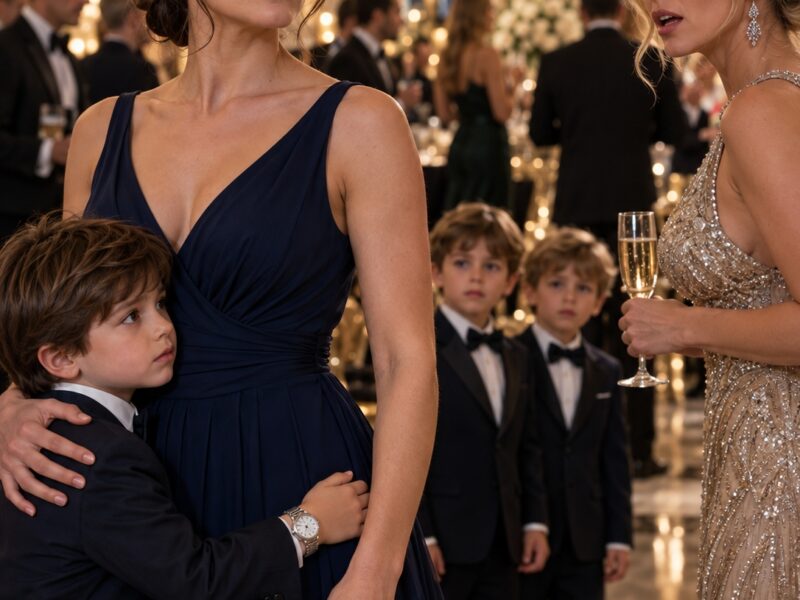
Behind me stood my three sons—Ethan, Luke, and Noah—wearing matching dark jackets because Ethan had decided matching made them look like “a business team.”
They were three years old.
They were also Ryan’s sons.
And although he knew they existed, although he received photographs and school updates and birthday reminders, he had never stood in a room with all three of them long enough to understand what he had missed.
Until tonight.
Charlotte Reed stepped beside me.
“Ms. Whitmore,” she said warmly. “We’ve been waiting for you.”
Vanessa’s smile changed.
It did not disappear immediately.
Women like Vanessa did not surrender expressions that easily.
They adjusted them.
She gave Charlotte a small laugh.
“You know Grace?”
“Of course.”
Ryan was already walking toward us.
I saw the confusion before he spoke.
“Why is Grace here?”
Charlotte looked at him.
“For tomorrow’s ownership meeting.”
Ryan stopped.
“What ownership meeting?”
“The one concerning this property.”
Vanessa actually laughed.
“Grace is involved with the hotel?”
Charlotte’s eyes shifted toward her.
“Whitmore Real Estate Fund controls the ownership group that holds this building. Ms. Whitmore represents the controlling interest.”
The ballroom seemed to lose its sound.
Ryan looked at me.
Not the way an ex-husband looks at an ex-wife.
The way a businessman looks at a number he has misread by several zeroes.
“Whitmore?”
“Yes.”
He knew the name.
Everyone in finance knew the name.
Whitmore Holdings.
Old capital.
Commercial property.
Private equity.
Infrastructure.
Investments spread across several states and buried inside enough trusts, holding companies, partnerships, and funds that most people never knew where the family’s ownership began or ended.
Ryan knew all of that.
What he had never understood was that Grace Whitmore—the woman who packed her own lunch, drove a six-year-old Volvo, argued about grocery prices, and refused to let him buy her a $9,000 bracelet for their anniversary—was one of those Whitmores.
Vanessa stared at me.
“That’s impossible.”
And that was when I said it.
Quietly.
“You may want to ask who owns the building before you laugh at the woman standing in it.”
Nobody laughed.
I didn’t either.
Because the strangest thing about finally standing in front of the people who once made you feel small is realizing that revenge often feels unnecessary by the time you become powerful enough to take it.
I turned toward Charlotte.
“Shall we?”
She nodded.
We had taken perhaps six steps when Ethan slipped his hand from the nanny’s and hurried after me.
“Mom.”
I turned.
As he reached for my hand, his sleeve slid back.
A silver watch caught the chandelier light.
Behind him, I heard Ryan inhale.
I knew exactly why.
Ryan had mailed that watch for Ethan’s birthday four months earlier.
He had been in Singapore.
Or Chicago.
Or Los Angeles.
I honestly couldn’t remember anymore.
There had always been another city.
Another opening.
Another investor.
Another reason.
Ethan looked toward him.
Blue eyes.
Dark blond hair.
Ryan’s mouth.
My stubborn chin.
Then Luke came forward.
Then Noah.
Three boys born six minutes apart.
Three boys who knew their father mostly through scheduled FaceTime calls, expensive packages, photographs, and promises that frequently began with next weekend.
Vanessa looked from them to Ryan.
“Who are they?”
Ryan didn’t answer.
He didn’t need to.
His face had already told her.
And as I stood beneath those chandeliers with my sons beside me, I remembered another version of Ryan Caldwell.
The one who used to come home to me.
The one I had once believed would stay.
Before the hotels.
Before Vanessa.
Before the money.
Before three heartbeats changed everything.
Before I learned that sometimes the person who thinks he has outgrown you has simply stopped looking closely enough to see who you are becoming.
Three years earlier, Ryan Caldwell believed our marriage had become too small for his future.
The cruel part was that I understood how he got there.
Success rarely changes people overnight.
It changes the definitions they attach to things.
When Ryan and I first married, he loved that I hated crowded rooms.
“You make quiet feel expensive,” he once told me.
Years later, my quietness embarrassed him.
When Caldwell Hospitality owned one struggling boutique property in Brooklyn, he admired that I questioned every unnecessary expense.
“You’re the reason I don’t make stupid decisions,” he used to joke.
After the fourth major acquisition, caution became something else.
Fear.
Lack of vision.
Small thinking.
The same qualities he had once admired became evidence that I no longer belonged beside the man he was becoming.
And maybe that should have warned me.
But marriage trains you to explain the people you love long after you should start observing them.
Ryan was stressed.
Ryan was tired.
Ryan was building something.
Ryan needed support.
I repeated those explanations until they became more comfortable than the truth.
Then Vanessa Cole joined Caldwell Hospitality.
Vice president of brand partnerships.
Thirty-two.
Elegant.
Sharp.
Ambitious in a way that never apologized for taking up space.
Vanessa knew how to enter a room as though the room had been waiting for her.
At first, I liked her.
That is something I rarely admitted afterward.
She was funny.
Efficient.
Exceptionally good at her job.
And she understood Ryan’s favorite language: admiration disguised as strategy.
Every aggressive acquisition was “bold.”
Every risky financing package was “visionary.”
Every sleepless week was evidence that Ryan operated at a level ordinary executives could not understand.
Investor dinners became working dinners.
Working dinners became drinks.
Drinks became weekend strategy sessions.
Soon Ryan was discussing decisions with Vanessa before he mentioned them to me.
I noticed.
Of course I noticed.
But noticing betrayal before you can prove it creates a peculiar kind of loneliness.
You begin negotiating against your own instincts.
One Thursday night, the three of us had dinner at a private restaurant overlooking Central Park.
Ryan spent twenty minutes explaining Caldwell’s planned West Coast expansion.
I listened.
Then I asked one question.
“What happens if occupancy softens while you’re carrying the acquisition debt?”
Ryan’s expression changed.
Only slightly.
But marriage teaches you the geography of someone’s face.
“I’ve modeled it.”
“How far?”
“Grace.”
“It’s a reasonable question.”
Vanessa smiled over her wineglass.
“Some companies grow because they’re willing to accept discomfort.”
I turned toward her.
“And some fail because they confuse discomfort with unnecessary risk.”
Ryan put down his fork.
“Not everything needs to become a warning.”
“It wasn’t a warning.”
“It sounded like one.”
Vanessa leaned back.
Then she said the sentence I would remember long after I forgot what we ate.
“Some people fit the life they started in. Others grow past it.”
Silence.
I looked at Ryan.
I gave him time.
Three seconds.
Maybe four.
Enough time to say, That’s my wife.
Enough time to tell Vanessa she had crossed a line.
Enough time to choose basic decency.
Ryan said nothing.
He merely looked down at his plate.
That silence ended something in me before the affair ever did.
In the car home, Manhattan slid past the windows in ribbons of white and red.
I waited until we were halfway across town.
“Do you believe you’ve grown past me?”
Ryan looked toward the window.
“That’s not what she meant.”
“I didn’t ask what Vanessa meant.”
He rubbed his jaw.
“Grace, please.”
“Do you?”
Another silence.
Then he said, “I think we want different things.”
“What do you want?”
He looked at me then.
“Someone who understands where I’m going.”
My throat tightened.
“And what do you think I want?”
“I don’t know anymore.”
That hurt more than I expected.
Because I knew exactly what I wanted.
“I want a husband who still recognizes the woman who was there before everyone started applauding.”
Ryan closed his eyes.
Neither of us spoke again until we reached home.
Several weeks later, his laptop answered the question he wouldn’t.
It was not dramatic.
No lipstick.
No photograph.
No explicit message accidentally appearing on a screen.
Just a hotel confirmation sitting inside an old shared travel account Ryan had forgotten to disconnect.
Caldwell Hospitality conference.
Miami.
Two rooms originally reserved.
One canceled.
One remaining reservation.
Two guest names.
Ryan Caldwell.
Vanessa Cole.
I read it twice.
Then I closed the laptop.
That evening I cooked pasta.
I even grated Parmesan over Ryan’s plate.
He arrived at 9:17, loosened his tie, kissed the air near my cheek, and said, “Sorry. Meeting ran long.”
I watched him put his keys down.
“When did you choose her?”
His hand stopped.
That was all.
No confusion.
No “What are you talking about?”
Just stillness.
“Grace—”
“When?”
“It isn’t that simple.”
“It’s simple enough for me.”
He turned toward me.
His face looked tired.
For a ridiculous moment, I felt sorry for him.
Then he said, “Vanessa understands the life I’m building.”
“And I don’t?”
“You understand who I used to be.”
There are sentences that break your heart because they are cruel.
Others break it because the person saying them believes they are reasonable.
I looked down at my wedding ring.
“When did you choose her?”
“A few months ago.”
“Before Miami?”
His silence answered.
“And when were you planning to tell me?”
“I didn’t know how.”
I almost laughed.
“You knew how to book the hotel.”
“Grace.”
“I’m serious.”
“I never wanted to humiliate you.”
That was when I finally looked directly at him.
“You let her humiliate me at dinner while you sat beside her.”
His face tightened.
“I should have stopped that.”
“You should have stopped more than that.”
He stepped closer.
I raised one hand.
Not dramatically.
Just enough.
“Do you love her?”
He hesitated.
I nodded.
“That’s an answer.”
“I care about her.”
“Then choose her.”
“What?”
“You said she understands the life you’re building. Build it with her.”
“Grace, don’t make a decision tonight.”
I stared at him.
“You made it months ago.”
Our attorneys began the divorce the following week.
I moved into a modest Upper East Side apartment.
Ryan stayed in the home we had shared.
Vanessa did not immediately move in.
I never asked whether she eventually did.
I stopped asking questions whose answers could no longer improve my life.
Then, less than two weeks before the final divorce papers were scheduled to be signed, I woke up exhausted.
I blamed stress.
Three days later, I nearly vomited from the smell of coffee.
The following week, I sat beneath fluorescent lights while Dr. Emily Carter studied a monitor.
Her expression shifted.
Not alarm.
Something else.
“Grace.”
My fingers tightened around the paper covering the examination table.
“What?”
“There’s something I want you to hear.”
A sound filled the room.
Fast.
Rhythmic.
A heartbeat.
I closed my eyes.
Then another rhythm appeared.
I opened them.
Dr. Carter adjusted the monitor.
A third.
I stared at her.
“No.”
She smiled gently.
“Yes.”
“Three?”
“Three.”
I looked at the screen.
Three flickering lives.
Three beginnings inside the wreckage of one ending.
And suddenly my divorce was no longer the largest thing happening to me.
Ryan was informed through my attorney.
He called that evening.
“Triplets?”
“Yes.”
For once, his voice contained no corporate confidence.
“Are they okay?”
“So far.”
“And you?”
“I’m fine.”
“Grace, whatever they need, I’ll provide it.”
On my kitchen table lay three ultrasound images.
I touched one with my fingertip.
“Money isn’t the same thing as being there.”
“I know.”
I stared out the window.
“Do you?”
He had no answer.
Later that night my phone rang again.
The name on the screen belonged to someone I had not seen in years.
Margaret Whitmore.
My aunt.
The only member of my family who had never completely stopped reaching for me.
I answered.
“Aunt Margaret?”
Her voice sounded older than I remembered.
“Grace.”
Something inside me tightened.
“I heard about the babies.”
I sat down.
“News travels fast.”
“In this family? Faster than kindness.”
Despite everything, I smiled.
Then she became quiet.
“Grace, I think it’s time you came home.”
Home.
The word carried a history Ryan knew almost nothing about.
My maiden name had never been a secret.
Its meaning had been.
The Whitmore family had money older than my marriage and rules older than my patience.
My father, Richard Whitmore, believed wealth was responsibility.
Unfortunately, he also believed responsibility gave him the right to control people.
He chose schools.
Introduced “appropriate” men.
Suggested careers.
Offered apartments near jobs he approved of.
When I refused a position at Whitmore Holdings and chose nonprofit finance instead, he called it wasteful.
When I married Ryan without seeking his approval, he froze my access to discretionary trust distributions.
So I walked away.
Completely.
I was never technically disinherited.
I simply refused to live under conditions attached to money I could survive without.
Ryan knew my father and I were estranged.
What he never understood was how much I had walked away from.
And I never told him.
Partly because I was proud.
Partly because I wanted one relationship in my life where my surname did not enter the room before I did.
The following Saturday, I drove to Connecticut.
Margaret was waiting in the library.
She looked smaller.
A gray cardigan hung loosely around her shoulders.
A blanket covered her knees.
But her eyes were still sharp.
“Come here.”
I hugged her.
She held me longer than expected.
Then she leaned back.
“You look tired.”
“I’m carrying three people.”
She laughed.
Then coughed into a handkerchief.
I noticed immediately.
“How sick are you?”
Her eyes moved toward the window.
“Sick enough to stop postponing conversations.”
Between us sat an old silver-framed photograph of me at nineteen beside my father.
I looked away.
Margaret followed my gaze.
“Your father was wrong about many things.”
“He thought money gave him the right to decide who I became.”
“Yes.”
“And now?”
“Now he’s gone.”
I looked at her.
“And there are things he left behind that were never meant to disappear with him.”
Margaret reached beside her chair and lifted a leather folder.
The Whitmore family seal was embossed across the front.
My stomach tightened.
“What is that?”
“You were always a contingent beneficiary of the Whitmore trusts. Richard could restrict certain distributions while he was alive. He could not erase the underlying structure.”
“I don’t want money because my marriage failed.”
“Good.”
Her answer came immediately.
“Because that isn’t why I called you.”
I stopped.
Margaret placed the folder between us.
“These assets are not a consolation prize for surviving Ryan Caldwell. They existed before Ryan. They existed before your father. Some of them existed before you and I were born.”
“Then why now?”
Her face softened.
“Because I may not have much time left.”
I looked away.
She continued.
“And because I refuse to let lawyers explain your own history to you after I’m dead.”
“Aunt Margaret—”
“I wanted to see you before the babies arrive.”
Her hand covered mine.
“Not because of Whitmore Holdings. Not because of trusts. Because you are my niece.”
My eyes burned.
For years I had thought returning would mean surrender.
Instead, sitting beside Margaret, I realized there was a difference between returning to a place and returning to the rules that once governed it.
“I came because you asked me to.”
“I know.”
Margaret smiled.
“That’s why I can finally tell you the rest.”
The leather folder did not change my life that afternoon.
The three heartbeats inside me did.
Over the following months, I traveled between Manhattan and Connecticut for medical appointments, legal meetings, and weekends with Margaret.
Ryan attended some appointments.
Not enough.
There was always an opening.
A lender.
A board meeting.
A delayed flight.
He sent money reliably.
He called.
He promised.
I slowly stopped measuring promises.
I measured presence instead.
Near the end of winter, Dr. Carter entered my hospital room.
“They’re ready.”
Hours later, three cries filled the room.
Ethan came first.
Luke second.
Noah last.
Three healthy boys.
Three tiny faces untouched by adult betrayal.
Margaret sat beside me with tears streaming down her face.
I held Ethan against my chest.
Luke and Noah slept beneath warm hospital lights.
Margaret squeezed my hand.
“You didn’t lose a family, Grace.”
I looked at her.
“You made one.”
Ryan arrived later that afternoon.
He stopped in the doorway.
Three bassinets stood beside my bed.
For perhaps the first time since I had known him, Ryan Caldwell had no polished sentence available.
“They’re so small.”
“They won’t stay that way.”
He approached slowly.
His eyes moved over the cards.
Ethan Caldwell.
Luke Caldwell.
Noah Caldwell.
His expression changed.
“You gave them my last name.”
“You’re their father.”
Nothing more.
No invitation.
No reconciliation.
Just truth.
Ryan signed the necessary acknowledgments and agreed to formal child support.
He promised to make time.
At first, he tried.
Then came Los Angeles.
Chicago.
Miami.
New York again.
Visits moved.
Calls shortened.
Packages arrived precisely when children stopped expecting the person who had sent them.
Margaret became the constant Ryan was not.
She learned that Ethan slept lightly.
Luke hated socks.
Noah would refuse a bottle if it was even slightly too cold.
For almost a year, the Connecticut estate stopped feeling like the house I had escaped.
Then Margaret got worse.
Fast.
I was holding her hand near the end.
She could barely speak.
But she squeezed my fingers.
“Don’t let the money make you afraid of becoming visible.”
I bent closer.
“What?”
“You spent years proving you could live without it.”
Her breathing was shallow.
“You proved your point.”
Tears blurred my vision.
Margaret smiled.
“Now do something useful with it.”
She died two days later.
After the funeral, Daniel Brooks, the family attorney, asked me to meet privately.
The same leather folder sat between us.
“Your aunt finalized everything months ago.”
I stared at the Whitmore seal.
“How much?”
Daniel paused.
“After liabilities, reserves, and expected taxes, slightly above one hundred million dollars.”
I said nothing.
A hundred million dollars sounds imaginary until someone explains the maintenance costs.
The taxes.
The trusts.
The obligations.
The employees.
The property.
The businesses.
The decisions.
I did not wake the next morning transformed into another person.
I still made my own coffee.
I still cleaned blueberry yogurt from Noah’s hair.
I still spent ten minutes searching for Ethan’s missing shoe before discovering Luke had hidden it behind a curtain.
I did not buy a penthouse.
I did not order a new wardrobe.
I did not call Ryan.
Instead, I asked Daniel for the complete asset reports.
He raised an eyebrow.
“All of them?”
“All of them.”
Weeks became months.
The estate contained commercial properties, securities, private-company interests, cash reserves, and assets spread through long-standing Whitmore trusts.
I had worked in finance before motherhood reshaped my schedule.
The language was familiar.
The responsibility was not.
“I don’t want this preserved like a museum,” I told Daniel.
“What do you want?”
“I want it managed like capital.”
A slow smile appeared.
“Margaret hoped you’d say that.”
Over the next two years, I became increasingly involved with Whitmore Holdings.
I reviewed performance.
Questioned management fees.
Sold weak assets.
Protected strong ones.
I learned which executives used complexity to hide incompetence and which quiet employees understood more than the people presenting PowerPoints above them.
Eventually, the board offered me the position of managing director.
I accepted on one condition.
“No ceremonial title.”
Daniel nodded.
“Responsibility or nothing?”
“Exactly.”
Meanwhile, Ryan remained inconsistently present.
Better than before.
Not good enough.
I never poisoned the boys against him.
I didn’t need to.
Children are excellent accountants of time.
They know who arrives.
They know who cancels.
They know whose promises require backup plans.
Then, one Monday morning, Daniel entered my office carrying a thick acquisition file.
“This one may interest you.”
He placed it on my desk.
I opened it.
And felt my pulse change.
A landmark Manhattan hotel.
Operated for years by Caldwell Hospitality under a long-term lease.
Ryan’s flagship property.
His company now wanted to buy the building outright.
Purchase price:
Approximately $180 million.
I looked up.
“Who owns it?”
Daniel smiled faintly.
“We do.”
I stared at him.
“Does Ryan know?”
“He knows the property is held by a Whitmore-controlled real estate fund. I don’t believe he understands the beneficial ownership structure.”
I looked again at the page.
Caldwell Hospitality.
Ryan Caldwell.
For one dangerous second, I imagined his face.
Then I closed the file.
“Is the offer good?”
Daniel’s expression changed.
That was not the question he expected.
“Potentially. We still need valuation work.”
“Then do the valuation.”
“You don’t want to discuss Ryan?”
“This isn’t my divorce.”
I pushed the file toward him.
“It’s an asset.”
A month later, I walked into Ryan’s hotel.
And Vanessa laughed at my dress.
She believed she was looking at the same woman Ryan had left.
What she did not understand was that I had never become powerful because Ryan abandoned me.
I had become responsible for power that had always existed around my name—and I had finally learned how to carry it without letting it carry me.
After the ballroom confrontation, I entered the private meeting room.
Ryan arrived several minutes later.
He sat across from me.
For a moment, neither of us spoke.
Then I opened the acquisition package.
“What debt coverage ratio are you assuming after purchase?”
Ryan blinked.
Then answered.
“And renovation commitments?”
He gave me the number.
“What happens if occupancy softens for two consecutive quarters?”
A pause.
Then another answer.
I continued.
Financing.
Valuation.
Capital improvements.
Tenant obligations.
Debt exposure.
No mention of Vanessa.
No mention of Miami.
No mention of our marriage.
By the end of the meeting, Ryan looked exhausted.
Not because I had attacked him.
Because I hadn’t.
I think that was the moment he finally understood.
I had never lacked ambition.
I had simply never needed applause to prove I possessed it.
Afterward, I found the boys near the lobby.
Ryan approached.
Slowly.
Ethan wore the silver watch.
Luke held a toy airplane.
Noah pressed against my leg.
Ryan crouched.
“Hey, guys.”
Ethan looked at him.
“Hi, Dad.”
Two words.
Polite.
Careful.
Ryan swallowed.
“I like your watch.”
Ethan looked down.
“Mom said you picked it.”
“I did.”
“Okay.”
Ryan smiled, but his eyes were wet.
“Maybe we could have breakfast tomorrow?”
Ethan’s expression changed.
He looked at me.
Then Ryan.
“Are you staying for breakfast this time?”
Ryan’s smile disappeared.
I said nothing.
Three years of missed mornings were already standing between them.
“I’m staying,” Ryan said.
And surprisingly, he did.
At 7:30 the following morning, he arrived twenty minutes early.
No assistant.
No gifts.
No excuse prepared in advance.
He put his phone facedown.
Luke immediately asked, “Do you have a meeting?”
“Later.”
Ethan narrowed his eyes.
“So you’re really staying?”
“Yes.”
Ryan learned that Noah hated blueberries.
Luke wanted blueberries on everything.
Ethan cut his pancakes into perfect squares before eating them.
None of it was dramatic.
That was precisely what hurt.
Ryan had missed thousands of ordinary moments while convincing himself he had only missed a few important ones.
That afternoon, Vanessa entered his office.
“You stayed with them.”
“They’re my sons.”
“I know.”
“Then what are we discussing?”
Her jaw tightened.
“For years, you acted as if everything connected to Grace was finished.”
“Our marriage is finished.”
“That’s not what I mean.”
Ryan said nothing.
Vanessa stepped closer.
“You told me she wanted a smaller life.”
His eyes shifted toward the window.
“You told me she had no ambition. You told me she would never understand what you were building.”
“I was wrong.”
Vanessa laughed once.
“About which part?”
Ryan looked at her.
“More than I want to admit.”
Something in Vanessa’s face broke.
Not jealousy.
Recognition.
“I thought she lost when you chose me.”
Ryan remained silent for several seconds.
Then he said something Vanessa would later tell him she could never forget.
“No.”
He looked down at the acquisition file.
“I think I was the one who misunderstood what winning meant.”
Their relationship did not end that afternoon.
Real relationships rarely collapse on schedule.
But the story holding theirs together had cracked.
Vanessa had spent years believing she was the woman Ryan had chosen because she represented progress.
Grace represented the past.
Grace represented limitation.
Grace represented the life he had escaped.
But what happened when the woman you defeated was never competing?
What happened when she did not want your man back?
Did not want your job?
Did not want your approval?
Did not even need you to fail?
Several weeks later, Vanessa ended it.
“I don’t want to spend another year competing with a woman who isn’t competing with me.”
Ryan did not ask her to stay.
Meanwhile, the $180 million hotel transaction reached final investment review.
Daniel entered my office.
“You control the largest interest.”
“I know.”
“You can vote.”
“I know.”
“And Caldwell is the buyer.”
I closed the file.
“That’s why I’m not voting.”
Daniel studied me.
“Grace.”
“The committee should decide without me.”
“You could block the transaction.”
“That’s exactly why I shouldn’t be in the room.”
So I formally recused myself.
Ryan heard about it from Charlotte.
“She stepped out of the vote?”
“Yes.”
“Why?”
Charlotte looked at him.
“Apparently she’s more interested in governance than revenge.”
Three days later, the independent committee approved the sale at market value.
Just under $180 million.
Fair price.
Sound structure.
Appropriate protections.
The deal benefited Whitmore Holdings.
That was enough.
Ryan sat silently when Charlotte told him.
“She could have stopped it.”
“Yes.”
“But she didn’t.”
“No.”
Ryan looked through the glass toward Manhattan.
For years, he had mistaken my refusal to compete for weakness.
Now he finally understood what it had been.
Discipline.
The sale closed months later.
Whitmore reinvested the proceeds.
Caldwell Hospitality kept the flagship hotel.
Vanessa accepted a senior position elsewhere.
And Ryan?
Ryan did something less impressive than winning me back.
He changed.
Slowly.
Imperfectly.
He stopped sending gifts as substitutes for absence.
When he promised breakfast, he came to breakfast.
When Ethan had a school performance, Ryan was sitting in the third row before the lights dimmed.
When Luke became obsessed with airplanes, Ryan took all three boys to an aviation museum and spent four hours answering questions he mostly did not know the answers to.
Noah took longest.
He was always the quietest around Ryan.
Then one evening, crossing a parking lot, Noah reached up and took his father’s hand.
Ryan froze.
He did not make a speech.
He did not look at me.
He simply closed his fingers around his son’s hand and kept walking.
I noticed.
I did not reward him for it.
Fatherhood was not a favor he was doing for me.
It was a responsibility he was finally accepting for them.
Almost a year after the night in the ballroom, Ryan arrived at my Connecticut home for his weekend with the boys.
Ten minutes early.
Ethan looked at the clock.
“You’re early.”
Ryan smiled.
“I’m learning.”
Luke came flying through the hallway with a backpack that appeared heavy enough for a month-long expedition.
Noah followed.
At the door, he suddenly turned and hugged me.
“Bye, Mom.”
“Have fun.”
Ryan waited.
No impatience.
No glance at his watch.
Outside, the boys climbed into his car.
Three voices immediately began talking over one another.
Ryan opened the driver’s door.
Then stopped.
He looked back at me.
Years earlier, I would have searched his face for regret.
For love.
For proof that losing me hurt.
I didn’t anymore.
There was gratitude in his expression.
Nothing more.
No request.
No hidden hope.
No fantasy that enough good behavior could rewind time.
I gave him a small nod.
He nodded back.
Then he got into the car.
I stood beneath the doorway while they disappeared down the long Connecticut drive.
The house became quiet.
For years, people would tell the story incorrectly.
They would say Ryan Caldwell left a quiet wife for a glamorous woman and discovered too late that his ex-wife had inherited more than $100 million.
They would say Vanessa mocked me inside a hotel I secretly controlled.
They would say the ultimate revenge was watching their faces when they discovered who Grace Whitmore really was.
But money was never the twist.
Not really.
The money had existed before the betrayal.
The Whitmore name had existed before Ryan.
The hotel was just a building.
And revenge would have been easy.
One vote.
One phone call.
One decision made for personal reasons instead of financial ones.
I could have damaged the company Ryan had chosen over our marriage.
I chose not to.
Because eventually I understood something neither Ryan nor Vanessa understood when they sat across from me at that dinner overlooking Central Park.
Winning is not being chosen over another woman.
Winning is not becoming rich enough to embarrass the people who underestimated you.
Winning is not making someone regret leaving.
Sometimes winning is simply reaching the point where their regret is no longer necessary for your healing.
I inherited more than $100 million.
But Margaret had been right.
That number was never the inheritance that mattered most.
Ethan, Luke, and Noah gave me a future no balance sheet could measure.
Margaret gave me back a family history without forcing me to repeat its mistakes.
And Ryan gave me something too, although he never intended to.
He taught me that being underestimated can become a strange kind of freedom.
People stop watching.
They stop asking what you are capable of.
They make decisions based on the version of you that exists only in their own minds.
And while they are busy believing you are standing still, you are allowed to quietly become someone they no longer recognize.
I walked back inside.
Three abandoned cereal bowls waited in the kitchen.
A toy airplane lay beneath the couch.
One tiny sock sat inexplicably on the staircase.
On the refrigerator was a photograph Ethan had drawn.
Four stick figures.
Three small.
One tall.
Above them, in crooked blue letters, he had written:
HOME.
I stood there for a long time.
Then I smiled.
Because Ryan had once told me I wanted a smaller life.
Maybe he had been right.
I wanted breakfasts.
School performances.
Quiet houses.
People who showed up when they said they would.
Work that mattered more than titles.
Money that served a purpose instead of becoming one.
I wanted a life where nobody had to become smaller so someone else could feel important.
If that was a smaller life, I had stopped being ashamed of wanting it.
Outside, the sound of Ryan’s car disappeared beyond the trees.
I touched the photograph on the refrigerator.
Three years earlier, I had stood alone beside an apartment window while my husband told me another woman understood his future better than I did.
I had believed, for one terrible night, that being left meant I had somehow fallen behind.
Now I understood the truth.
Ryan had not outgrown me.
Vanessa had not defeated me.
And I had never needed $100 million to prove either of those things.
They had simply mistaken my quietness for emptiness.
My caution for fear.
My refusal to compete for surrender.
They had looked at a woman who did not need to be seen—
and decided there was nothing there to see.
That had been their mistake.
And in the end, it was the only revenge I ever needed.









