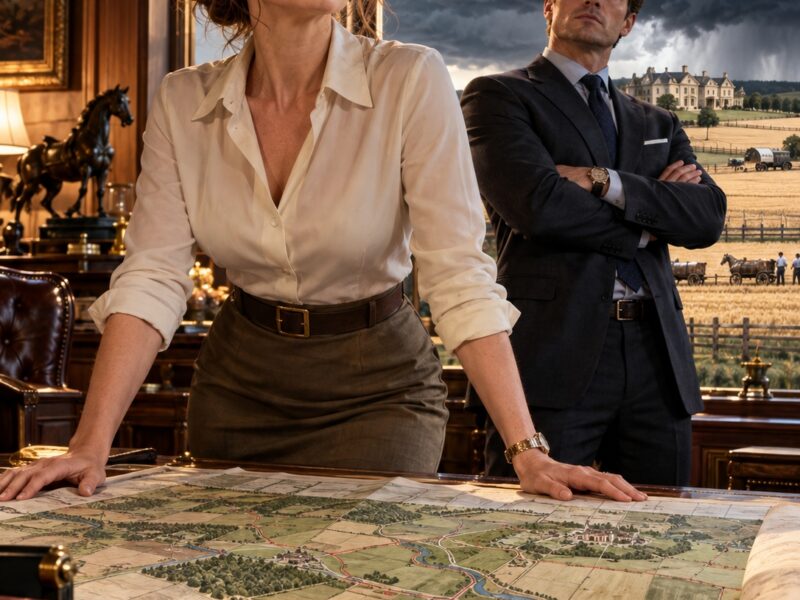
MY HUSBAND MOCKED ME IN FRONT OF HIS ENTIRE STAFF—BY SUNSET, THEY WERE ALL WAITING FOR MY ORDERS
The emergency bell started ringing at 2:17 on a Thursday afternoon.
By sunset, my husband would be standing at the edge of his own land while seventy-three employees waited for me—not him—to tell them what to do next.
But at 2:17, nobody knew that.
Least of all my husband.
I was standing on the second-floor terrace of our house outside Lexington, Kentucky, when the first bell sounded across Dunmere Farms.
Once.
Twice.
Then again.
Not the slow ceremonial ringing we used for weddings or charity events.
Not the measured toll that had sounded when Orand’s father died.
Fast.
Urgent.
Wrong.
I set down my coffee.
Below me, men were already running.
A utility truck swung hard around the equipment barn. Two stable hands hurried three horses toward the covered stalls. Across the north road, a tractor stopped in the middle of a turn while its driver leaned out the cab window, looking west.
Then I looked west too.
The sky had turned almost black.
Not gray.
Black.
A solid wall of clouds stretched across the horizon, swallowing the afternoon light over thousands of acres of wheat, barley, pasture, and orchard.
My phone buzzed.
Then buzzed again.
Before I could answer, an old Ford pickup came through the main gates so fast that gravel sprayed behind its tires.
The driver stopped crooked beside the administration building.
A man stumbled out.
I recognized him as one of the supervisors from Westmere Farms, thirty miles away.
His shirt was soaked through.
Not with rain.
Sweat.
Kelrich Shaw, Dunmere’s operations director, reached him before I could get downstairs.
“What happened?”
The man bent over, hands on his knees.
“Hail.”
He sucked in air.
“Rain. Wind. I’ve never seen anything like it.”
Kelrich looked toward the horizon.
“Westmere?”
“Destroyed.”
One word.
That was all it took.
The man’s voice dropped.
“Roof came off the south equipment building. Corn’s flat. Half the wheat is on the ground. Power lines are down on Route 18.”
“How long do we have?”
The man looked west.
“Maybe five hours.”
Then he added the part nobody wanted to hear.
“Maybe less.”
I looked past him toward Dunmere’s north fields.
Gold.
Everywhere.
A fortune in grain standing beneath a sky that was about to try to destroy it.
Half our wheat had already been cut.
Some was in storage.
Much of it was still lying bundled in the fields waiting for transport.
Thousands more acres remained standing.
And suddenly every minute had a dollar value.
Orand arrived twelve minutes later.
My husband didn’t run.
Orand Vane never ran where employees could see him.
He crossed the yard quickly, but even in an emergency he moved with the controlled confidence of a man who had spent his entire adult life believing panic was something other people did.
At forty-three, Orand was the fourth generation of his family to control Dunmere Farms.
Nearly twelve thousand acres.
Grain.
Cattle.
Orchards.
A breeding operation.
Commercial leases.
Warehouses.
And enough family history to make every disagreement with him feel like an argument with dead men whose portraits still hung in our dining room.
“Conference room,” he said.
No greeting.
No wasted movement.
“Senior staff. Now.”
Twenty minutes later, we were gathered around the long oak table in the estate office.
Kelrich stood near the maps.
Brandon Tyler—everyone called him Bran—had come straight from the north fields, dust still covering his boots.
Owen Crane represented the stables and transport crews.
Three farm supervisors stood along one wall.
Mara Fenwick, who coordinated with the tenant farmers leasing Dunmere acreage, arrived last.
I sat halfway down the table.
Orand stood at the head.
He didn’t ask for suggestions.
He issued orders.
“Every available person goes north.”
Bran nodded.
“Stop orchard work. Stop fencing. Stop maintenance that isn’t essential. Pull people from the south barns if necessary.”
Kelrich began writing.
“Every usable wagon and grain trailer goes into rotation. We cut everything we can before the storm hits and move it to the main grain complex.”
On the surface, it was logical.
A storm was coming.
More workers meant more wheat harvested.
More vehicles meant more grain moved.
Faster was better.
Except faster wasn’t always better.
I stared at the estate map.
Something bothered me.
Not the fields.
The roads.
I traced the north route with my eyes until it narrowed at Miller’s Crossing.
One bridge.
One road.
One main granary.
I had seen this mistake before.
“How many loaded wagons can Miller’s Crossing handle at once?”
The room became strangely quiet.
Orand stopped speaking.
Owen looked at me.
“Three safely.”
“Four?”
He grimaced.
“I wouldn’t put four fully loaded rigs on it.”
“How long does unloading take at the main grain facility?”
“Twelve minutes if the crew’s ready. Longer if trucks arrive together.”
I leaned over the map.
“And how many loads will approach that bridge during the first rotation if every field follows Orand’s plan?”
Owen didn’t answer immediately.
He began calculating.
I watched his expression change.
“More than seventy.”
Nobody said anything.
I looked at my husband.
“You’re sending too many people to cut.”
Orand stared at me.
“A storm is coming, Casara.”
“I know.”
“Apparently not, because you’re suggesting we harvest more slowly.”
“No. I’m saying harvesting isn’t the bottleneck.”
His jaw tightened.
“Moving it is.”
One of the supervisors looked down at the table.
I continued.
“If the cutting crews work faster than the transport system, we aren’t saving more grain. We’re creating more exposed grain.”
“Every available wagon will be working.”
“Toward the same bridge.”
“We’ve managed harvests at Dunmere for more than a century.”
“Not with five hours before a storm.”
His eyes hardened.
And there it was.
The thing beneath the argument.
Not wheat.
Not weather.
Me.
“You’re comparing Dunmere to Red Haven again.”
Red Haven.
My mother’s farm.
Four hundred and sixty acres when I was growing up.
Small enough, apparently, to make everything I learned there irrelevant.
“I am comparing wagons with roads.”
“Red Haven was a modest family operation.”
“Grain doesn’t become easier to move because the man who owns it has more money.”
Silence.
Complete silence.
Orand walked around the table.
There were eleven other people in the room.
I knew he was aware of every one of them.
That mattered to him.
Maybe more than the storm did for those few seconds.
He stopped across from me.
Then came the smile.
Small.
Controlled.
Almost amused.
It was the smile he used when someone junior had spoken too confidently in a board meeting.
“You think you can do better?”
I didn’t answer.
He gestured toward the map.
“Go ahead.”
His eyes held mine.
“Do better.”
It wasn’t permission.
It was a trap.
He expected me to retreat.
To soften my tone.
Maybe laugh and say I was only offering an idea.
That was how I had survived a surprising amount of our marriage.
Not because Orand was cruel.
Cruel would almost have been easier.
He loved me.
I believed that.
But somewhere between loving me and respecting me, he had built a locked door and never noticed I was standing outside it.
I took off my gloves.
Placed them beside the map.
And said two words.
“All right.”
His smile disappeared.
I turned toward Kelrich.
“How many hours until sunset?”
“Just under five.”
“Good.”
I looked around the table.
“Stop sending everyone north.”
Bran frowned.
Orand folded his arms.
I pointed toward the most distant fields.
“Stop cutting those.”
Bran stared at me.
“Your Grace—”
The old nickname had started as a joke among employees because of the size and history of Dunmere. Orand secretly liked it.
I didn’t.
“I know how it sounds,” I said. “But anything cut there won’t reach cover before the storm.”
Orand gave a short laugh.
“So your solution to saving the harvest is leaving it in the field.”
“My solution is leaving standing wheat standing instead of cutting it and letting it rot on soaked ground.”
The laugh stopped.
I pointed to the areas already marked as harvested.
“We save what’s already down first.”
Then I moved my finger toward the buildings surrounding the estate.
“And we stop pretending the main grain facility is the only roof on twelve thousand acres.”
Kelrich leaned closer.
I pointed.
“Old wool warehouse.”
“Empty.”
“Mill loft?”
“Mostly.”
“Carriage sheds?”
“Two are usable.”
“Livestock barns?”
Bran answered.
“Some can be cleared.”
“Tenant barns on high ground?”
Mara stepped forward.
“Several.”
Orand looked at me.
“You intend to scatter the harvest across half the property?”
“For tonight.”
“And tomorrow?”
“We move it properly.”
“That isn’t how Dunmere operates.”
I met his eyes.
“Neither is losing half your wheat before dinner.”
The first six loaded wagons arrived twenty minutes later.
They were following Orand’s original route toward Miller’s Crossing.
I walked into the yard.
“Send them to the old wool warehouse.”
Owen hesitated.
His eyes went to my husband.
That moment lasted perhaps two seconds.
It felt longer.
Because this was the real test.
Not whether my idea worked.
Whether Orand would sabotage it the moment his authority felt threatened.
His face revealed nothing.
Then he said, “You heard her.”
Owen turned.
“North teams! Wool warehouse!”
Engines changed direction.
For the first time that afternoon, Dunmere moved according to my plan.
I didn’t feel triumphant.
I felt terrified.
Because now I had to be right.
“How many teams can make two runs from the nearest north fields before dark?” I asked.
“Twelve,” Owen said. “Maybe fourteen if we rotate horses aggressively.”
“Don’t exhaust them for fourteen. Give me twelve.”
He nodded.
“Which fields can they clear twice?”
Bran stepped to the map.
“Seven. Lower half of nine. Eight is farther, but the ground is higher.”
“Seven and nine first.”
I turned to Mara.
“Which tenant barns are actually dry?”
She thought for a moment.
“Fenwick. Varys. Old Kett Farm.”
“Pelham?”
“West wall leaks.”
“Capacity?”
“Between the three good ones? Fifty loads if we pack tight.”
“Use forty.”
“Why forty?”
“Because I don’t want grain pressed against damp walls just so we can brag about capacity.”
Mara nodded once.
That was the moment the room changed.
Not because I had all the answers.
I didn’t.
That was the point.
At Red Haven, my mother had taught me something nobody at Dunmere seemed to consider sophisticated enough to call management.
You don’t plan with the resources you wish you had.
You plan with the resources that can actually move.
When I was fourteen, my mother kept three chalkboards in our grain office.
One listed acreage.
Another listed equipment.
The third listed problems.
Broken axle.
Sick horse.
Leaking roof.
Mud near the east road.
Driver unavailable after four.
I used to think the third board was the most depressing one.
My mother called it the only honest board.
When I was sixteen, thirty laborers finished cutting a field before noon.
Everyone celebrated.
Then two wagon wheels broke.
A third vehicle overheated.
Half the bundles stayed outside overnight.
Rain came.
We lost enough grain that my mother spent the winter negotiating payment extensions.
I remembered her sitting at our kitchen table at 1:00 a.m., calculator beside her, whispering numbers she thought I couldn’t hear.
I remembered thinking:
We didn’t lose because we couldn’t harvest fast enough.
We lost because nobody asked what happened after the cutting.
I was seventeen when a binding machine tore open two of my fingers.
The scars were still there.
Orand had seen them hundreds of times.
He had never asked where they came from.
I pushed the memory away.
Dunmere wasn’t Red Haven.
It was larger.
More complicated.
That meant I needed the people who understood it.
“Kelrich, how much can the old carriage shed hold?”
“Fifteen loads.”
“Is the floor raised?”
He hesitated.
“Eastern half.”
“Then seven.”
“Probably eight.”
“Seven.”
I turned to Owen.
“Fresh teams?”
“Eight.”
“If we use all eight, what happens if roads are blocked tomorrow?”
He paused.
Then nodded slowly.
“Use six.”
“Good.”
Bran pointed at Field Eleven.
“We could still send cutters there.”
“What happens to the bundles after they’re tied?”
He looked toward the road.
Then at the empty wagons returning from the mill.
“Those can take them.”
“Then send the crew.”
That became the rhythm.
Question.
Answer.
Adjustment.
Another question.
Another adjustment.
Within an hour, the roads around Dunmere looked completely different.
Northern loads turned toward the wool warehouse.
Eastern teams went to the mill.
Southern wagons alone continued across Miller’s Crossing.
Tenant carts carried grain toward the closest dry barns.
Empty vehicles returned on separate routes wherever possible.
The traffic jam Orand’s original plan would have created never happened.
He rode to Miller’s Crossing himself.
Later, Kelrich told me what happened there.
Orand had expected chaos.
Instead, the bridge was nearly empty.
Only southern teams were crossing.
A messenger rode up.
“Mr. Vane.”
Orand turned.
“The Northfield crews want to know where Mrs. Vane wants their next wagons.”
Not where he wanted them.
Where I wanted them.
I wish I could tell you I enjoyed that.
I didn’t have time.
The wind was getting stronger.
The temperature had dropped.
The western sky looked less like weather now and more like a physical thing moving toward us.
By four o’clock, I moved our command point away from the main house and down to the central crossroads.
Messengers could reach me faster there.
Mara brought updates from tenant farms.
Owen tracked horses.
Kelrich tracked storage.
Bran tracked field exposure.
For almost two hours, it worked beautifully.
And then I made the decision that nearly proved Orand right.
Three heavy wagons had been sent west, where cut barley still needed to be moved.
The first crossed the soft ground.
The second struggled.
The third sank almost to its axle.
Bran came back furious.
“I told you that ground was soft.”
I looked past him.
The wagon was visible in the distance.
Workers surrounded it.
One horse was pulling sideways.
The wheels weren’t moving.
“I thought the teams could manage.”
“They can’t.”
Then I saw Orand.
He had arrived behind Bran.
He was still on horseback.
Several supervisors had gathered nearby.
Nobody spoke.
I knew what they were waiting for.
This was it.
The mistake.
The proof.
The moment when Orand could step forward and say, Enough.
For one terrible second, I wanted to defend myself.
The soil reports hadn’t been updated.
The first wagon had crossed.
The rain hadn’t started.
The load distribution—
Excuses arrived instantly.
Pride is efficient that way.
Then I remembered my mother’s third chalkboard.
The honest one.
I looked at Bran.
“You’re right.”
He blinked.
“Pull the heavy wagons.”
No one moved for a second.
I turned to Mara.
“Your tenant farmers use smaller carts on that ground.”
“Yes.”
“Can they carry the barley?”
“Less each trip.”
“Will they sink?”
“Probably not.”
“How many can you gather?”
“Give me twenty minutes.”
“Take them.”
She was gone before I finished speaking.
Bran stared at me.
“Anything else?”
“Yes.”
I pointed toward the stranded wagon.
“Get the horses off before someone hurts them.”
He nodded and left.
I didn’t look at Orand.
Not immediately.
When I finally did, his expression had changed.
I couldn’t read it.
I expected satisfaction.
There wasn’t any.
He looked almost unsettled.
Years later, he would tell me that was the moment he understood something about me he should have understood much earlier.
I wasn’t trying to beat him.
I was trying to beat the storm.
And if that required admitting I was wrong in front of everyone, I would rather lose face than lose the harvest.
Twenty-three minutes later, the first small tenant carts rolled west.
They looked almost ridiculous beside Dunmere’s massive commercial equipment.
But they didn’t sink.
One after another, they carried the barley out.
The estate transformed around us.
Colored cloth markers appeared outside temporary storage buildings.
Stable hands rotated horses.
Older workers swept unused sheds.
Mill workers cleared the loft.
Tenant farmers opened private barns.
Bran reorganized crews according to exposure.
Kelrich shouted updated capacity numbers every fifteen minutes.
Owen refused to release tired teams no matter who asked.
Mara came in covered in dust and left again with another list of barns.
And I stood in the middle of it.
Listening.
Asking.
Redirecting.
Correcting.
The thing I had understood before Orand wasn’t that I knew Dunmere better.
I didn’t.
The thing I understood was that nobody knew Dunmere alone.
Bran knew the fields.
Owen knew the animals.
Kelrich knew infrastructure.
Mara knew the tenant farms.
Drivers knew the roads.
Laborers knew which sheds leaked.
My job wasn’t to know everything.
My job was to make their knowledge meet before the storm did.
At 5:36, the clouds reached us.
The light changed.
Birds disappeared.
A gust tore a clipboard from someone’s hands and sent papers tumbling across the road.
Nobody chased them.
A foreman ran toward me.
“North teams are finished.”
“Field Eleven,” I said. “Half the crews. Bran says those bundles are lowest.”
Before he turned away, another messenger arrived.
“Mill loft’s almost full.”
I looked at Kelrich.
“Capacity?”
“Two loads safely.”
“Two there. Everything after that to Varys.”
Owen approached.
“I can spare six teams from the south.”
“Give Bran four.”
“And the other two?”
“Rest them.”
“We could use them.”
“We may need them more in an hour.”
He nodded.
Mara appeared through the crowd.
“Tenant barns can take twenty more.”
“Which ones?”
“Fenwick and Old Kett.”
“Split the loads.”
Another rider came.
Then another.
Field supervisors waited.
Drivers waited.
Farmers waited.
Messengers waited.
I was answering three questions when I noticed something strange.
The crowd had gone quiet on one side.
I looked up.
Orand stood twenty yards away.
He had dismounted.
Rain-dark wind pushed against his coat.
For several seconds, nobody had noticed him.
That had never happened before.
This was Dunmere.
His land.
His family’s name on the gate.
His signature on the payroll.
His portrait would probably hang in the dining room one day beside his father’s.
Yet nobody was waiting for him to speak.
They were waiting for me.
I watched the realization reach him.
Not anger.
Something more painful.
Irrelevance.
For that one moment, the man who had always equated leadership with being the final voice in the room stood at the edge of his own operation and discovered the operation no longer needed his voice.
I walked toward him.
“How bad is the west road?”
“Getting worse.”
“Trees?”
“Not yet.”
He looked past me.
“How much have you moved?”
Kelrich answered before I could.
“Almost everything already cut.”
Orand turned.
“Everything?”
“Almost. Some barley remains west. Distant wheat is still standing.”
Orand looked at me.
“And if you’re wrong about leaving it?”
There it was again.
But the tone was different now.
No mockery.
Only fear.
“Then tomorrow,” I said, “I’ll tell you I was wrong.”
I looked toward the black sky.
“But tonight, this is our best chance.”
He stared at me.
Then said quietly:
“Our.”
I frowned.
“What?”
“Our best chance.”
His eyes stayed on mine.
“Not yours.”
I didn’t know what to say.
So I turned back to work.
The first rain fell twenty-seven minutes after sunset.
Three enormous drops hit the office window.
Then ten.
Then hundreds.
And the sky opened.
Wind slammed across Dunmere with enough force to bend mature trees.
Hail hammered the roofs.
Rain swallowed the roads.
A section of the eastern orchard was stripped almost bare in minutes.
Two old trees came down across the service road.
One tenant barn lost part of its roof.
Water poured through the lower drainage channel and turned several farm tracks into streams.
Standing wheat flattened in places.
Fencing came down.
A utility shed lost one wall.
Dunmere did not escape.
But inside the old wool warehouse, thousands of bundles remained dry.
Inside the mill loft, more grain remained dry.
Inside carriage sheds nobody had planned to use that morning, grain remained dry.
Inside tenant barns scattered across the property, grain remained dry.
And at Miller’s Crossing, there was no line of seventy loaded wagons trapped in the storm.
I stayed at the crossroads office until sometime after 3:00 a.m.
I don’t remember deciding to sleep.
I remember Kelrich handing me coffee.
I remember Bran reporting that the west barley was finally under cover.
I remember someone saying a barn roof had failed.
I remember writing “CHECK EAST ROAD” across the bottom of a map.
Then nothing.
Morning arrived gray and wet.
Orand rode out with Kelrich before I woke.
They inspected the orchard.
The roads.
The barns.
The drainage channels.
Then they reached one of the distant wheat fields I had ordered left standing.
Much of it was bent.
Some was damaged.
But most of it was still there.
Orand got down from his horse.
He walked into the wet wheat.
“If we’d cut this yesterday?”
Kelrich didn’t soften the answer.
“It would have sat for hours waiting for transport.”
“During the rain?”
“Most of it would’ve been lying directly on saturated ground.”
Orand looked across the field.
“How much would we have lost?”
Kelrich knew what he was really asking.
Not how much the storm cost.
How much Orand’s pride almost cost.
“If we’d followed the original plan?”
“Yes.”
“At least twice what we lost.”
Orand didn’t answer.
He found me an hour later.
I was asleep in a wooden chair inside the crossroads office.
My dress was stained with mud.
One boot was half unlaced.
Maps covered the table.
My phone had died.
My left hand hung over the chair arm.
That was how he finally noticed the scars.
Two pale lines across my fingers.
When I woke, he was sitting across from me.
For a moment, I didn’t know where I was.
Then I saw him.
“What time is it?”
“Almost nine.”
I sat upright.
“The west barn—”
“Handled.”
“Road?”
“Blocked east. South is open.”
“Field Eleven?”
“Fine.”
I rubbed my eyes.
He was still looking at my hand.
“What?”
“Those scars.”
I followed his gaze.
“What about them?”
“Where did you get them?”
I almost laughed.
Not because it was funny.
Because we’d been married eight years.
“A binding machine.”
His brow furrowed.
“When?”
“I was seventeen.”
“You were operating a binding machine?”
“Helping clear a field.”
“You worked harvest?”
“When necessary.”
He looked genuinely confused.
“My mother couldn’t afford enough seasonal workers that year.”
“Why didn’t you ever tell me that?”
That question woke me completely.
I stared at him.
“I did.”
He said nothing.
“Our first year of marriage.”
His face changed.
“I told you about the failed barley season. I told you my mother and I worked with the tenants because we couldn’t afford another crew.”
Memory arrived slowly in his expression.
I could almost see it.
A dinner.
Wine.
Me at twenty-nine, trying to explain the childhood that had shaped me.
And him smiling.
Not cruelly.
Almost affectionately.
“Your little farming childhood.”
That was what he’d called it.
Then he’d changed the subject.
I looked toward the rain-darkened window.
“You keep asking why I never told you what I knew.”
He stayed silent.
“And I keep wondering why I had to prove it before you thought it was worth hearing.”
He looked down.
No shouting.
No accusation.
No dramatic slap.
Nothing I could have said loudly would have hurt him more.
Eventually he spoke.
“I thought listening to you in front of my people would make me look uncertain.”
I turned back to him.
“And did it?”
“No.”
He swallowed.
“Not listening did.”
I wish that fixed everything.
It didn’t.
An apology doesn’t return the years you spent shrinking yourself inside someone else’s certainty.
It doesn’t erase every dinner when your experience became a charming anecdote.
It doesn’t erase every meeting where your question was treated like interruption.
And it certainly doesn’t transform a marriage in one morning.
I didn’t become Dunmere’s chief operating officer.
I didn’t want Kelrich’s job.
I didn’t take Bran’s fields.
I didn’t control Owen’s stables.
I didn’t become the heroic woman who suddenly knew more than everybody else.
That would have missed the entire point.
Dunmere changed in smaller ways.
And perhaps because they were smaller, they lasted.
Before major agricultural decisions, field supervisors were asked what conditions actually looked like on the ground.
Tenant representatives were included when their farms would bear the consequences.
Transport capacity was calculated before ambitious harvest targets were announced.
Storage was treated as part of harvesting rather than something that magically happened afterward.
People were allowed to say, “That won’t work.”
And when I spoke, Orand listened before deciding whether he agreed.
Sometimes he still disagreed.
That mattered too.
Respect isn’t obedience.
I had never wanted a husband who automatically said yes.
I wanted one who understood that my voice didn’t become less valuable because it contradicted his.
Months later, we sat around the same oak table for the spring planting meeting.
Orand.
Me.
Kelrich.
Bran.
Mara.
Owen.
The same map lay between us.
Orand proposed planting the northern acreage first.
I studied the drainage reports.
“I don’t agree.”
The room went silent.
Everyone remembered the harvest.
Everyone remembered the storm.
Everyone remembered the afternoon Orand had looked at me and said, You think you can do better?
He noticed the silence too.
For half a second, the old expression returned.
A faint smile.
“You think you can do better?”
I raised one eyebrow.
Bran froze.
Mara stared at the table.
Then Orand leaned back in his chair.
“Then explain it.”
No mockery.
No challenge.
Just a request.
So I explained.
When I finished, Bran shook his head.
“You’re both wrong.”
Silence.
Six months earlier, that sentence might have ended a career.
Orand looked at him.
“Why?”
Bran pulled the drainage reports closer.
“The north acreage will hold too much water if spring rain runs heavy.”
Mara added figures from the tenant farms.
Owen pointed out that one proposed route would exhaust the teams too early.
Kelrich suggested another sequence.
We chose a third plan.
Not Orand’s.
Not mine.
Ours.
That was when I knew the storm had changed him.
Not because I always won afterward.
Because nobody had to win.
The strongest person in the room no longer had to be the person nobody questioned.
Sometimes strength looked like saying, “I was wrong.”
Sometimes it looked like asking, “What do you see that I don’t?”
And sometimes it looked like letting another person finish speaking before deciding how much their experience was worth.
The following summer, I stood on the terrace overlooking Dunmere.
The fields were green again.
Workers moved between barns.
Wagons rolled down the roads.
The damaged orchard had begun recovering.
You could still see where the storm had broken several older trees, but new growth had appeared around the scars.
Orand stepped outside beside me.
He followed my gaze.
“What?”
“Nothing.”
“That expression has never meant nothing.”
I pointed toward three loaded wagons below.
“They’re loading those incorrectly.”
He studied them.
“You’re certain?”
I watched the crew.
“No.”
He waited.
“But I’d ask Owen before they leave.”
There was a time when Orand would have told me the crew knew what they were doing.
Or that the stable master had already checked.
Or that Dunmere had loaded wagons for a hundred years.
Instead, he opened the terrace door.
“Owen!”
The stable manager came around the side of the building.
“Sir?”
“Check those three loads before they leave.”
Owen walked over.
He inspected the first.
Then the second.
At the third, he stopped.
He climbed onto the wagon, shifted one sack, looked at the axle, then immediately shouted:
“Hold it! Nobody moves this one.”
Workers stopped.
“Weight’s wrong. Redistribute the rear half.”
Orand slowly turned toward me.
I tried not to smile.
“Don’t.”
I pressed my lips together.
“Casara.”
I laughed.
And eventually, so did he.
For anyone watching from below, it probably looked insignificant.
A husband.
A wife.
Three wagons.
A small correction on an ordinary afternoon.
But I knew what I was looking at.
Months earlier, Orand Vane had believed leadership meant having the final word.
Then a storm came racing toward his fields.
His wife questioned his plan in front of his senior staff.
He could have listened.
Instead, he smiled and asked:
“You think you can do better?”
He expected those words to put me back in my place.
Instead, I answered him.
Not with a speech.
Not with revenge.
Not with some secret inheritance, hidden fortune, or dramatic claim to his company.
I answered with wagons going where they could actually travel.
With grain disappearing beneath whatever dry roofs we could find.
With exhausted horses being rested before they collapsed.
With farmers, foremen, drivers, stable hands, and tenants finally sharing what they knew.
With a mistake I admitted before my pride could make it more expensive.
And by sunset, my husband stood on land bearing his family’s name and watched his entire operation wait for my next instruction.
I hadn’t taken his authority away.
I had simply done exactly what he’d challenged me to do.
Better.
But the strangest part was that, in the end, saving the harvest wasn’t what stayed with me.
It was something much quieter.
For years, I thought the deepest wound in our marriage was that Orand underestimated me.
I was wrong.
The deeper wound was that I had slowly become accustomed to it.
I had learned when not to correct him.
When not to offer an idea.
When to let a sentence die before it reached my mouth because I already knew the expression that would appear on his face.
The storm changed that.
Not because I finally proved I was intelligent.
I had never needed proof.
It changed because Orand finally understood that love without curiosity can become another form of loneliness.
You can sleep beside someone every night and still never ask where the scars on her hands came from.
You can know how she takes her coffee, what music she hates, which side of the bed she sleeps on, and still fail to know the experiences that built her.
You can love someone and still reduce them.
Sometimes without ever raising your voice.
Sometimes with a smile.
Sometimes with five harmless words:
“You think you can do better?”
The next harvest came almost a year after the storm.
One afternoon, dark clouds gathered beyond the western ridge.
Nothing serious.
Just summer rain.
Still, I noticed Orand watching them.
Then he looked down at the fields.
“Think we should move the west crews?”
I studied the sky.
“Maybe.”
He waited.
I smiled.
“But don’t ask me.”
His brow lifted.
I pointed toward the road.
“Ask Bran.”
A few minutes later, I watched my husband walk down toward the fields.
Not to issue an order.
To ask a question.
The rain arrived gently that evening.
No hail.
No violent wind.
No emergency bell.
Just water tapping against the terrace roof while Dunmere settled into darkness.
Below us, the grain was safe.
The wagons were empty.
The horses were resting.
And for the first time in years, I didn’t feel like I had to prove anything.
Orand came outside carrying two cups of coffee.
He handed one to me.
For a while, neither of us spoke.
Then he looked toward the wet fields.
“I’ve thought about that day a thousand times.”
“The storm?”
“No.”
He glanced at me.
“The meeting.”
I knew exactly which moment he meant.
“You think you can do better?”
He winced.
“I was an ass.”
“A little.”
“A lot.”
I took a sip of coffee.
“Yes.”
He laughed quietly.
Then his expression changed.
“If you hadn’t challenged me…”
“You would have lost more wheat.”
“That’s not what I mean.”
I looked at him.
He stared across the fields.
“If you hadn’t challenged me, I might still be the man who thought listening made him look weak.”
The rain whispered against the roof.
I didn’t tell him he was forgiven.
Forgiveness wasn’t a door that opened once.
It was more like the fields below us.
Something living.
Something that had to be worked.
Something that could recover and still carry scars from the season that nearly destroyed it.
So I simply stood beside him.
Not behind him.
Not in front of him.
Beside him.
Down by the barns, someone called for another worker.
A truck door slammed.
Then the lights in the main grain building went out one row at a time.
Orand reached for my hand.
His thumb passed over the two faint scars on my fingers.
This time, he knew exactly where they came from.
And somehow, that mattered more than I expected.
Far beyond Dunmere, thunder rolled once across the Kentucky hills.
Neither of us moved.
The storm was already going somewhere else.









