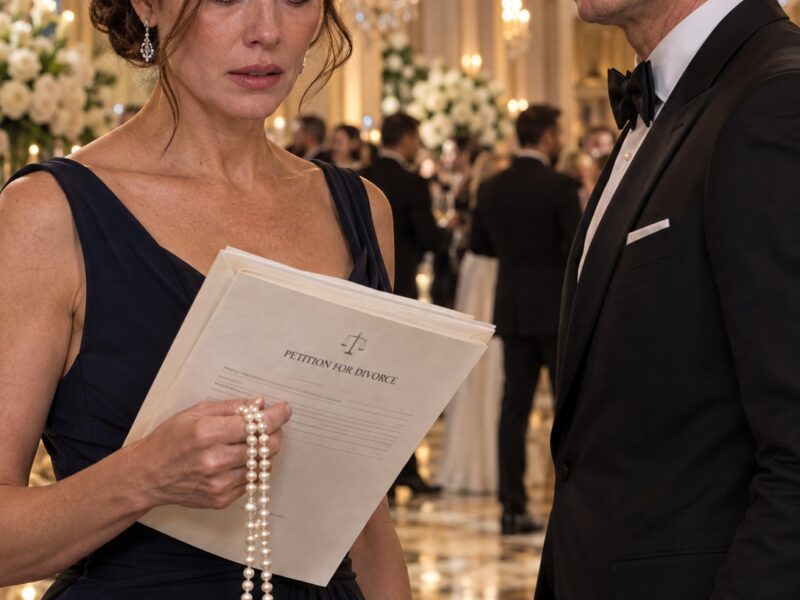
MY HUSBAND SERVED ME DIVORCE PAPERS AT HIS GALA—THEN I REVEALED WHO REALLY OWNED EVERYTHING
The divorce papers arrived at 8:17 on a Saturday night, between the champagne toast and the first course, while my husband stood beneath a chandelier paid for by my dead mother and held another woman by the waist.
That woman was wearing my mother’s pearls.
For eleven years, Martin Whitmore had mistaken my silence for weakness.
By midnight, he would understand the difference.
The ballroom at the Fairmont looked exactly the way Martin liked his life to look—expensive, polished, and arranged around him.
Five hundred white roses climbed from silver centerpieces. A string quartet played beneath the mezzanine. Waiters in black jackets moved between tables carrying champagne that cost more per bottle than Martin had once paid in monthly rent.
Above the stage, his name glowed in gold.
THE WHITMORE CHILDREN’S CARDIAC FOUNDATION.
Martin loved seeing his name in large letters.
He had always called it branding.
I had once called it harmless vanity.
That was before I understood how dangerous vanity became when people started confusing applause with ownership.
I stood near Table Twelve in a navy gown with no sequins, no dramatic neckline, nothing photographers would remember. Martin had complained about it before we left the house.
“You look like you’re attending a board meeting.”
“I am attending a fundraiser.”
“It’s our biggest gala of the year.”
“I know.”
He had sighed, the way men sigh when they want credit for tolerating a woman’s failure to decorate their ego.
“You could make an effort, Clare.”
I almost told him that I had.
Just not in the way he thought.
Three weeks earlier, I’d hired a forensic accountant.
Two weeks earlier, I’d changed the reporting instructions on three trust-controlled accounts.
Nine days earlier, I’d discovered that Martin had used foundation travel reimbursements for a weekend at the St. Regis with Vanessa Hail.
Five days earlier, I’d found the email in which he told his divorce attorney he expected to “retain practical control” of our Fairmont Avenue residence after separation.
And that morning, at 6:42, Evelyn Grant—general counsel for the Ashford family office and the closest thing I’d had to a second mother since I was twenty—had called me.
“He’s filing today,” she said.
I sat on the edge of our bed while Martin showered twenty feet away.
“You’re sure?”
“I’m looking at the docket notice.”
I stared at the closed bathroom door.
Steam curled beneath it.
Martin was humming.
Eleven years of marriage, and my husband had filed for divorce before breakfast, showered beside me, kissed my cheek, and reminded me not to be late for his gala.
“What is he asking for?”
Evelyn was quiet.
That frightened me more than anger would have.
“Temporary exclusive occupancy of the Fairmont house.”
I stopped breathing.
“What?”
“He describes it as the marital residence.”
“It belongs to the trust.”
“I know.”
“So does he.”
“I know.”
My fingers tightened around the phone.
“What else?”
“A preservation order over what he describes as joint investment assets.”
“They aren’t joint.”
“I know.”
“The lake property?”
“Included.”
“The Boston apartment?”
“Included.”
I closed my eyes.
“What about the foundation reserve?”
Another pause.
“He has characterized his role in a way I find… ambitious.”
Martin opened the bathroom door then, a towel around his waist.
He smiled at me.
Eleven years earlier, that smile could stop me in the middle of a sentence.
That morning, it only made me feel cold.
“Who are you talking to?”
“Evelyn.”
His smile changed.
Barely.
But I saw it.
“Family office problem?”
“Something like that.”
He kissed my forehead.
“Don’t let them stress you out. Tonight matters.”
Then he walked into his dressing room.
Evelyn heard the door close.
“Clare?”
“I’m here.”
“Do you want us to move?”
I knew what she meant.
Not steal.
Not hide.
Document.
Secure.
Separate.
For years, Martin had enjoyed discretionary access to accounts and properties that did not belong to him because I trusted my husband not to confuse access with ownership.
Trust was not a contract.
Unfortunately for Martin, the trust documents were.
“Move,” I said.
“Everything?”
“Everything legally mine. Leave anything even arguably marital untouched.”
Evelyn exhaled.
“Good.”
“And Evelyn?”
“Yes?”
“Do not warn him.”
That was the moment my marriage truly ended.
Not when I discovered Vanessa.
Not when I saw the hotel invoice.
Not when I learned Martin had given her my mother’s pearls.
It ended when I realized I needed to protect myself from a man sleeping beside me before he knew I understood what he was doing.
Now, twelve hours later, a nervous young attorney approached me through the ballroom carrying a cream envelope.
“Mrs. Whitmore?”
He couldn’t have been older than twenty-seven.
His eyes kept moving toward Martin.
Toward Vanessa.
Toward the guests.
I almost felt sorry for him.
“Yes?”
“My name is Aaron Lewis. I’m with Bell, Carmichael and Roth.”
Of course he was.
Martin’s new divorce firm.
“I’m required to give you these.”
A cream envelope.
Heavy.
Official.
Public.
Martin had planned every inch of this.
I looked across the ballroom.
He was watching me.
Vanessa stood at his side in white silk.
White.
At a charity gala.
With my mother’s pearls resting against her neck.
She saw the envelope in my hand and smiled.
Not broadly.
Vanessa was too socially intelligent for that.
Just enough.
Martin lifted his champagne glass toward me.
A private little salute.
Checkmate.
That was what his face said.
I opened the envelope.
Petition for Dissolution of Marriage.
Emergency Motion Regarding Exclusive Occupancy.
Temporary Financial Restraint.
I read the first page slowly.
Around me, conversation softened.
People sensed blood before they understood where it was coming from.
Martin approached with Vanessa still holding his arm.
“Clare.”
His voice was warm enough for the donors.
“I wanted you to receive it in a civilized environment.”
I looked at him.
“A civilized environment.”
“No scenes.”
The nearest table went silent.
Martin gave me the sympathetic smile he usually reserved for television interviews with grieving families.
“We both know this has been over for a long time.”
Vanessa lowered her eyes.
Beautifully rehearsed.
Martin continued.
“I thought it was kinder to stop pretending.”
I glanced at the pearls.
“Was that part of the kindness?”
Vanessa’s hand rose instinctively toward her neck.
Martin’s smile tightened.
“Let’s not do this.”
“Do what?”
“Become petty.”
That almost impressed me.
He had filed for divorce in secret, brought his former girlfriend to our foundation gala wearing my mother’s jewelry, arranged to serve me in front of five hundred people, and I was the one in danger of becoming petty.
“I see.”
Martin moved closer.
His cologne smelled like cedar.
I had bought him the first bottle on our fifth anniversary.
For some reason, remembering that hurt more than the papers.
“I want this to remain dignified,” he said.
“For whom?”
“For everyone.”
Vanessa finally spoke.
“Clare, I know this is difficult—”
I looked at her.
She stopped.
Not because I threatened her.
I didn’t.
I simply looked.
There are moments when another woman expects rage because rage would make her victory easier.
I gave Vanessa nothing.
Martin stepped between us emotionally, if not physically.
“She isn’t responsible for the condition of our marriage.”
“Then why is she wearing my mother’s jewelry?”
His jaw hardened.
“You said I could use those pearls for tonight.”
“I said you could take them from the safe for the foundation’s heritage exhibit.”
Vanessa turned toward him.
“Martin?”
He ignored her.
“Clare, not here.”
“You’re right.”
Relief touched his face.
Then I folded the divorce petition, slid it into my clutch and said, “You chose here.”
Something flickered in his expression.
“Excuse me?”
“You filed this morning.”
“Yes.”
“You asked a court for control of my home.”
“Our home.”
“My family’s home.”
“Clare.”
“You asked for restrictions on assets you know are held separately.”
His eyes moved toward the surrounding guests.
“You are emotional.”
That sentence had worked on me for years.
When I objected to a joke at my expense, I was emotional.
When I questioned a foundation expense, I was anxious.
When I asked why Vanessa’s name had appeared twice on his calendar, I was insecure.
When I noticed Martin interrupted me whenever other men listened, I was sensitive.
He had spent eleven years teaching me that naming a wound was more embarrassing than causing one.
I smiled.
“No.”
He stared.
“No what?”
“I’m not emotional.”
“You’re standing in the middle of a gala discussing private financial matters.”
“After being served divorce papers.”
“I asked you not to make a scene.”
“And I haven’t.”
Vanessa whispered, “Martin, maybe we should go somewhere private.”
He didn’t look at her.
He was still watching me, trying to locate the version of his wife he knew how to control.
She wasn’t there.
I looked across the room toward Diane Mercer, the Fairmont ballroom’s security director.
Diane was a retired federal marshal with iron-gray hair, excellent posture, and the emotional warmth of a locked bank vault.
Our eyes met.
She straightened.
That was all.
Martin noticed.
“What are you doing?”
“Choosing procedure.”
He laughed.
“Procedure?”
I nodded toward Diane.
She began walking toward us.
Two security officers followed at a respectful distance.
Martin’s face tightened.
“Clare, this is my foundation gala.”
I looked around.
At the chandeliers.
At the ballroom.
At the donor list prepared by the Ashford family office.
At the hotel contract signed by Ashford Hospitality Holdings.
At the flowers billed through a charitable events budget Evelyn had reviewed personally.
Then I looked back at my husband.
“No,” I said. “It’s a gala for your foundation.”
He frowned.
“What’s the difference?”
“The ballroom belongs to the Ashford Trust.”
Something changed behind his eyes.
Small.
Fast.
Real.
I continued.
“The operating reserve you describe as your foundation’s financial backbone is collateralized by Ashford Holdings.”
His smile disappeared.
“The Fairmont Avenue house is held in my separate trust.”
Vanessa slowly removed her hand from his arm.
“The lake property is mine.”
“Clare.”
“The Boston apartment is mine.”
“Stop.”
“The surgical center lease is controlled through Ashford Medical Properties.”
People at three nearby tables were openly listening now.
“And the donor platform you use for your public fundraising?”
I tilted my head.
“Mine.”
For three seconds, Martin said nothing.
It was the longest I had ever seen him silent in public.
Then he laughed.
Too loudly.
“You’re confused.”
There it was.
Not afraid.
Not yet.
A man like Martin Whitmore did not become frightened when the floor first moved beneath him.
He assumed the floor was wrong.
“You inherited assets,” he said quietly. “That doesn’t mean you understand their structure.”
Vanessa touched his sleeve.
“Martin—”
He shook her off.
I almost pitied her.
Almost.
Diane stopped beside me.
“Mrs. Whitmore.”
“Diane.”
“The private conference room is prepared.”
Martin stared.
“Prepared?”
Diane did not look at him.
“Mrs. Whitmore activated trust security protocol thirty-seven minutes ago.”
The nearest donor actually inhaled.
Martin’s face went still.
“What protocol?”
My phone vibrated.
A message from Evelyn.
ASSET SEPARATION COMPLETE.
TEMPORARY ACCESS FREEZES ACTIVE.
BOARD PACKETS DISTRIBUTED.
PEARL INVENTORY DOCUMENTATION SECURED.
COUNSEL STANDING BY.
I turned the screen facedown.
Martin saw enough to know I had received something.
“Who are you texting?”
“My attorney.”
“You retained an attorney?”
I looked at him.
“Did you expect me not to?”
His mouth opened.
Nothing came out.
And that—more than the papers, more than Vanessa, more than the pearls—told me how he had imagined this night.
I was supposed to break.
I was supposed to cry in a bathroom.
I was supposed to beg him not to humiliate me.
Then, while I was frightened and ashamed, his attorney would explain that the sensible thing was to cooperate.
Leave the house temporarily.
Sign temporary financial agreements.
Protect the foundation.
Protect Martin’s reputation.
Protect everyone except myself.
“You knew,” he said.
It wasn’t a question.
“I knew enough.”
“How long?”
“Long enough.”
Vanessa looked from him to me.
“You told me she had no idea.”
Martin’s head snapped toward her.
“Not now.”
“No, you specifically said—”
“Vanessa.”
She stopped.
He used her name like a warning.
I had heard that tone directed at me hundreds of times.
For the first time, I watched another woman learn what it felt like.
Diane spoke.
“Mrs. Whitmore, would you like the conference room?”
“Yes.”
Martin shook his head.
“No. Absolutely not. We are not turning my gala into some kind of tribunal.”
I met his eyes.
“You already turned it into a divorce hearing.”
Then I walked toward the conference room.
I didn’t look back.
I didn’t need to.
I could hear Vanessa’s heels following.
And Martin’s.
Twenty minutes later, he would learn exactly what he had signed eleven years ago.
But first, I decided he deserved to hear something else.
I stopped beside the stage.
The microphone stood beneath a spray of white orchids.
Martin came up behind me.
“What are you doing?”
I looked at the five hundred people he had tried to use as witnesses to my humiliation.
Then I stepped onto the stage.
His voice dropped.
“Clare.”
Diane moved casually between him and the steps.
Martin stared at her.
“Diane.”
“Doctor.”
“Move.”
“No.”
He actually blinked.
Powerful men rarely remember the first time someone tells them no.
Women remember every time they were afraid to say it.
I tapped the microphone.
The ballroom quieted.
My hands were cold.
My heart was not.
“Ladies and gentlemen, I apologize for interrupting your evening.”
Martin stood below the stage, pale with fury.
“Some of you have just witnessed a private matter become public because my husband elected to serve divorce papers during tonight’s gala.”
A wave moved through the room.
Not sound exactly.
Recognition.
Phones lowered.
Forks stopped.
The hospital board chair, Margaret Ellison, sat perfectly still.
I continued.
“Before anything else, I want to reassure our donors, physicians, patients’ families and staff that tonight’s personal events will not interfere with the cardiac program.”
Martin took a step.
Diane shifted.
He stopped.
“Every surgery currently approved will remain funded. Every research grant already committed will remain protected. Every employee whose work supports those children will continue to be paid.”
I saw Dr. Anika Shaw near the back.
Director of pediatric cardiac care.
One of the best surgeons Martin had ever recruited and one of the few people at the hospital who had never seemed impressed by him.
She gave me one small nod.
I breathed.
“However, effective tonight, the Ashford Trust is beginning an immediate review of all restricted funds, facilities, travel reimbursements and donor resources associated with the Whitmore Children’s Cardiac Foundation.”
Martin forgot the microphone was live.
“Clare, enough.”
His voice traveled through the speakers.
The entire ballroom heard him.
I looked down at him.
He realized his mistake too late.
“You filed for divorce this morning,” I said.
His face drained.
“You have requested court orders involving property represented as marital. Because several of those assets are separately held through the Ashford Trust, counsel has been instructed to document and protect them.”
Vanessa whispered his name.
He did not move.
“You are free to leave this marriage,” I said.
The room was so quiet I heard the ventilation system above me.
“You are free to love someone else.”
His eyes hardened.
“But you are not free to leave with my mother’s jewelry, my father’s properties, my family’s trust, charitable funds intended for sick children, or assets you knew were never yours.”
No one applauded.
Thank God.
Applause would have made it theatrical.
Silence made it real.
I stepped away from the microphone.
Martin waited until I reached the floor.
Then he leaned close.
“You just destroyed us.”
I looked at him.
“No.”
I held up the cream envelope.
“You filed the paperwork.”
The conference room smelled like coffee, walnut paneling, and expensive panic.
Evelyn appeared on the wall screen at 9:04.
Silver hair.
Black blazer.
Thin glasses.
Calm face.
She had been my parents’ attorney before becoming mine.
After the car accident that killed them, she had sat beside twenty-year-old me at a conference table and said something I did not understand until years later.
“People will treat access as proof of ownership if you let them.”
At twenty, I thought she meant money.
At forty-one, I knew she meant everything.
Martin remained standing.
“I will not participate in this.”
Evelyn looked at him.
“Then you are free to leave.”
His eyes narrowed.
“This concerns my divorce.”
“Yes.”
“My attorney will deal with it.”
“Your attorney has received the same preservation packet counsel is reviewing now.”
Martin faltered.
“What preservation packet?”
“The one documenting the separate-property status of assets listed ambiguously in your petition.”
“Ambiguously?”
Evelyn had a gift for making a single word feel like a legal summons.
Martin pointed at the screen.
“You do not speak to me as if I’m some criminal.”
“I haven’t.”
“You’re accusing me of fraud.”
“I haven’t done that either.”
“Then what exactly are you doing?”
“Reading.”
His face reddened.
Mrs. Ellison sat at the end of the table.
Diane remained near the door.
Vanessa sat beside Martin but slightly farther away than she had in the ballroom.
I noticed.
So did he.
Evelyn clicked something.
A document appeared.
ASHFORD TRUST ASSET SCHEDULE.
Martin frowned.
“You expect me to remember documents from eleven years ago?”
“No,” Evelyn said. “That’s why we keep copies.”
Another click.
PREMARITAL DISCLOSURE ACKNOWLEDGMENT.
Martin’s signature appeared at the bottom.
I remembered the afternoon he signed it.
He had been thirty-four then.
Brilliant.
Charming.
Still carrying $180,000 in medical school debt.
He had glanced at the disclosure packet while eating Chinese takeout in my kitchen.
“How much of this do I actually need to read?”
“All of it,” I’d said.
He kissed my temple.
“I trust you.”
Evelyn, sitting across from us, had not smiled.
Martin signed every page.
Now his younger signature covered the screen like a ghost.
Evelyn read aloud.
“Fairmont Avenue residence, all title and beneficial interest retained by Ashford Trust.”
Martin shifted.
“Lake Winnemac property, separate estate.”
Another page.
“Boston Back Bay apartment, Ashford Holdings residential portfolio.”
Another.
“Ashford Medical Properties, including surgical center lease rights.”
Vanessa slowly looked at Martin.
He said nothing.
Evelyn continued.
“All appreciation, distributions and successor assets derived directly from listed trust holdings remain separate property unless expressly retitled.”
Martin finally spoke.
“We lived in the Fairmont house for eleven years.”
“Correct,” Evelyn said.
“I renovated it.”
“With approval.”
“I put money into it.”
Evelyn glanced down.
“Approximately thirty-two thousand dollars of documented personal expenditure over eleven years. Most improvements were paid by the trust.”
Martin looked at me.
“You let me believe that was our home.”
“It was our home.”
“Then how can you stand there and call it yours?”
“Because home and title are different words.”
Vanessa looked at him.
“You told me Clare would have to move.”
His head turned sharply.
“This isn’t the time.”
“You told me your lawyer would get you the house.”
“Vanessa.”
“You said she didn’t understand finances.”
I almost laughed.
Not because it was funny.
Because humiliation has strange cousins, and sometimes one of them is disbelief.
Martin’s gaze came back to me.
“Since when do you understand financial structures?”
The question hurt.
More than the affair.
More than the papers.
More than watching another woman wear my mother’s pearls.
Because I heard eleven years inside it.
Eleven years of letting him speak first.
Eleven years of introducing donors and letting him take the handshake.
Eleven years of reading contracts he never bothered to read because “Evelyn handles that.”
Eleven years of allowing a talented man to mistake my refusal to compete with him for proof that I couldn’t.
I folded my hands.
“Since before I met you.”
He scoffed.
“You were twenty-four when we met.”
“I was twenty-four when I inherited responsibility.”
“You inherited money.”
“No.”
I looked at him.
“I inherited funerals. The money came with them.”
That shut him up.
My parents died six months apart from my twenty-first birthday.
A wet road.
A truck crossing the median.
An officer at my apartment door.
Then lawyers.
Trust officers.
Board meetings.
Properties I had never seen.
Employees whose paychecks depended on decisions made by a girl who still slept in one of her mother’s old sweaters.
Martin knew that.
Or I thought he had.
Maybe he had simply learned the version that benefited him.
Evelyn changed the document.
Annual Foundation Facility Acknowledgment.
Martin’s signature again.
Then another.
Then another.
“You signed updated acknowledgments each year,” she said.
His attorney had trained him well enough not to answer immediately.
Mrs. Ellison spoke.
“Martin, did you represent the Fairmont property or surgical center facilities as personally controlled by you in donor communications?”
Martin looked at her.
“I represented continuity.”
“That wasn’t my question.”
His shoulders tightened.
“Donors do not care about internal holding structures.”
“They care if they were misled.”
“I never misled anyone.”
Evelyn looked down at her notes.
“That will be reviewed.”
Martin stared.
“Reviewed?”
“Yes.”
“What exactly does that mean?”
I answered.
“It means an audit.”
For the first time that night, fear appeared.
Not on his face.
In his stillness.
Martin understood surgery because surgery was control disguised as crisis.
Someone bled.
He knew where to cut.
Someone crashed.
He knew what medication to give.
Someone panicked.
He became calmer.
But an audit was different.
An audit was time traveling backward through every small decision a person believed no one would question.
His eyes found mine.
“You planned this.”
“No.”
“Don’t insult me.”
“I prepared for you.”
“There is no difference.”
“There is.”
I leaned forward.
“You filed for divorce before breakfast and spent the day smiling at me. You arranged to have me served in public. You asked a court for my house before telling me you were leaving. You brought Vanessa into a ballroom my family owns wearing jewelry you stole from my safe.”
“I did not steal anything.”
I looked at Vanessa.
“Take off the pearls.”
Her hand flew to her throat.
Martin stood.
“Don’t you dare.”
I kept my eyes on Vanessa.
“They belonged to my mother.”
Vanessa stared at him.
“You said they were yours.”
His face changed.
Just slightly.
Vanessa saw it.
So did I.
“You said your grandmother left them to your family.”
Martin’s mouth hardened.
“This is ridiculous.”
“Are they hers?” Vanessa asked.
He didn’t answer.
That was answer enough.
She reached behind her neck.
Her fingers shook.
The clasp caught in her hair.
For five horrible seconds, we watched her struggle with jewelry she had entered the ballroom believing represented her new life.
Then the strand came free.
She placed it on the conference table.
The pearls made almost no sound.
But I heard my mother’s voice.
Not literally.
Memory.
She used to wear them at Christmas.
Never with anything flashy.
A black sweater.
Pearls.
Red lipstick.
When I was sixteen, I asked why she wore something expensive with ordinary clothes.
She said, “Because if something only has value when people know what it costs, it probably doesn’t have much value.”
I reached for the strand.
Vanessa looked at me.
“I’m sorry.”
I closed my hand around the pearls.
“I’m not ready to care.”
She nodded.
That was the first honest thing either of us had given the other.
Martin looked disgusted.
“Vanessa, stop letting her manipulate you.”
Vanessa turned.
“Manipulate me?”
“She is doing this to humiliate both of us.”
“You told me those pearls were yours.”
“I said they were family jewelry.”
“Her family.”
“You’re splitting hairs.”
“No. I’m realizing what else you lied about.”
Martin slammed his palm against the table.
Diane moved.
He noticed and lowered his hand.
“This is exactly what Clare wants.”
I almost felt sorry for him then.
A man surrounded by evidence still believed women existed mainly as extensions of his intentions.
Vanessa laughed once.
A small, broken sound.
“You told me she’d leave the house.”
Martin looked away.
“You told me she was basically dependent on you.”
Silence.
“You told me the foundation was yours.”
He looked at me instead.
As if I were responsible for her questions.
Vanessa kept going.
“You told me you built everything.”
“I did.”
I shook my head.
“No.”
He snapped toward me.
“Without me, there is no foundation.”
“Without you, there may not have been a name.”
His nostrils flared.
“That’s the same thing.”
“No, Martin.”
I placed the pearls in my clutch.
“It isn’t.”
The audit began before midnight.
The first irregularity was small.
A hotel upgrade.
Nine hundred dollars.
Not enough to destroy a foundation.
Not enough to destroy a reputation.
But patterns rarely announce themselves with a trumpet.
They begin with something someone expects nobody to notice.
Then came the flight.
A donor-development trip to Miami.
Except the donor meeting lasted ninety minutes.
Martin stayed three nights.
Vanessa stayed in the same suite.
Then a private car invoice.
Spa charges categorized as hospitality.
A dinner for two filed under strategic partner relations.
Martin objected to every item.
“These were legitimate expenses.”
Mrs. Ellison stared at the report.
“Who was the strategic partner at the dinner?”
He paused.
“Vanessa was exploring philanthropic involvement.”
Vanessa laughed.
Everyone looked at her.
She pressed her lips together.
Then she said, “I sell commercial real estate.”
Mrs. Ellison removed her glasses.
“Do you have philanthropic involvement in pediatric cardiology?”
“No.”
“Did you discuss donating?”
Vanessa looked at Martin.
“No.”
His expression could have frozen glass.
“Enough.”
She stared at him.
“You said these trips were from your personal account.”
“They were supposed to be.”
“Supposed to be?”
“Accounting mistakes happen.”
Evelyn finally spoke.
“Yes.”
Martin glared at the screen.
She added, “That’s why audits exist.”
At 12:11 a.m., Margaret Ellison called an emergency vote of the available board officers.
At 12:19, Martin Whitmore’s discretionary financial authority over the foundation was suspended pending review.
He stared at Margaret.
“You cannot do this.”
“I just did.”
“Children depend on decisions I make.”
“Children depend on surgeons, nurses, administrators, researchers and ethical funding systems.”
“I built this program.”
“You helped build it.”
“You think Anika can replace me?”
Dr. Shaw had joined by video now.
She didn’t react.
Margaret’s voice remained level.
“This is not about replacing you in the operating room.”
“It’s about destroying my authority.”
“It’s about protecting the organization from becoming indistinguishable from one man’s ego.”
Martin looked at me.
That sentence was my fault somehow.
Everything was.
He stood.
“Fine.”
He buttoned his tuxedo jacket.
“This circus is finished.”
Diane opened the door.
Martin stopped beside me.
“You’re going to regret this.”
It wasn’t loud.
It didn’t need to be.
I looked up at the man I had slept beside for eleven years.
“Which part?”
His eyes narrowed.
“When people understand what you are.”
I thought about that.
“What am I?”
“A bitter woman with money.”
The insult was so small compared with the damage he had intended that I almost smiled.
“Then telling the truth should be very easy for you.”
He left.
Vanessa remained seated.
He noticed halfway through the doorway.
“Are you coming?”
She stared at him.
“I don’t know.”
His face hardened.
“Vanessa.”
Something in his voice frightened her.
I recognized it.
She did too.
“No,” she said.
The word came quietly.
Martin looked from her to me.
Then he laughed.
“Unbelievable.”
He walked out alone.
At 12:31, Vanessa began to cry.
I did not comfort her.
I returned to the ballroom.
Dessert had been served.
The quartet had gone home, replaced by a pianist who played quietly enough for conversations to survive.
The room hadn’t collapsed.
That surprised me.
For eleven years, Martin had trained me to believe that if I contradicted him publicly, everything around us would break.
The guests would flee.
The hospital would suffer.
Donors would withdraw.
People would whisper.
They were whispering.
But the ceiling remained in place.
Dr. Anika Shaw came toward me.
She touched my elbow.
“Are you okay?”
The question nearly undid me.
Not because of its content.
Because nobody had asked me all night without needing the answer to serve them.
I looked at her.
“No.”
She nodded.
“Good answer.”
I laughed unexpectedly.
It came out like a breath breaking.
“I’m sorry.”
“For what?”
“Tonight.”
She glanced toward the conference room.
“Do you think any child receiving surgery tonight cares whose marriage failed?”
“No.”
“Then protect the program.”
“I intend to.”
“Good.”
She started to walk away.
“Anika.”
She turned.
“Did you know?”
“About Vanessa?”
I nodded.
Her expression became careful.
“I suspected.”
“Why didn’t you tell me?”
“Because suspicion isn’t evidence.”
That answer should have angered me.
Instead, I understood.
She added, “But I knew Martin was becoming careless.”
“Financially?”
“With everything.”
I swallowed.
“What does that mean?”
Anika hesitated.
Then she said something I would remember for months.
“Some people survive success. Some people start believing success means every appetite they have must be justified.”
She walked away.
I returned to the stage.
At 12:52, I announced that the Ashford Trust would match every new donation made that night, dollar for dollar, up to five million dollars.
Not in Martin’s name.
Not in mine.
For the children.
This time, people applauded.
Martin watched from the ballroom doors.
He had returned for his coat.
Or perhaps for one last look at the room he thought belonged to him.
When the applause ended, he approached me.
“You think this makes you noble?”
“No.”
“You think money buys the story you want?”
“No.”
“Then why the performance?”
I held his gaze.
“Because tomorrow’s surgeries still need to happen.”
“You moved funds today.”
“I secured separate trust property.”
“You emptied accounts.”
“I moved trust-controlled resources out of discretionary channels after evidence suggested misuse. Marital accounts remain untouched.”
He stared at me.
“You rehearsed that.”
“No.”
“You’re enjoying this.”
That hurt.
I wish it hadn’t.
Because some part of me still cared what he believed about my character.
That is the humiliating thing about loving someone for years.
You don’t stop wanting to be known correctly just because they betray you.
“I am standing in the room where my husband publicly ended my marriage beside the woman he cheated with,” I said. “I’m holding divorce papers in one hand and my mother’s stolen pearls in the other. If you think I’m enjoying myself, you never knew me.”
Something moved in his eyes.
Maybe shame.
Maybe only anger that shame had been offered.
Then he leaned closer.
“I will tell people you destroyed a medical foundation because you couldn’t keep your husband.”
I looked around.
At donors filling out pledge cards.
At Anika speaking to a patient’s mother.
At staff clearing dishes.
At Margaret reviewing documents with Evelyn on her phone.
“The foundation isn’t destroyed.”
“It will be when I’m gone.”
That was Martin’s deepest belief.
Not that he mattered.
We all want to matter.
He believed nothing could matter without him.
I said, “Then the audit will answer that.”
His face changed.
“What?”
“If you say I destroyed the foundation, we’ll publish the independent audit and let donors decide why oversight was necessary.”
He stepped back.
For the first time all evening, Martin looked at me as if I were dangerous.
Not because I screamed.
Because I didn’t.
The next morning, I entered county family court at 8:42 carrying my mother’s pearls in the pocket of my coat.
I hadn’t worn them.
Not yet.
My attorney, Priya Desai, met Evelyn and me near security with three coffees and eyes that suggested she’d slept less than two hours.
“His lawyer is furious.”
“Good morning to you too.”
She handed me coffee.
“Conrad Bell called me at six fifteen.”
“What did he want?”
“A voluntary cooling-off agreement.”
Evelyn snorted.
Priya smiled.
“That was approximately my reaction.”
“What does cooling off mean?”
“You withdraw the trust-related challenges. Martin withdraws some of the emergency language. Everyone goes home and pretends last night was weather.”
“No.”
“I know.”
Evelyn looked at me.
“You slept?”
“Two hours.”
“Eat anything?”
“No.”
She reached into her bag and produced a granola bar.
Even during divorce warfare, Evelyn remained capable of being offended by skipped breakfast.
I took it.
Outside Courtroom Six, Martin stood beside Conrad.
No Vanessa.
He wore a charcoal suit.
Fresh shave.
Controlled face.
If someone had photographed him without context, he would have looked like a distinguished physician waiting to testify before Congress.
Conrad approached.
“Mrs. Whitmore.”
“Ms. Ashford,” Priya said.
I looked at her.
She shrugged.
“Getting ahead of the paperwork.”
Something warm moved through my chest.
Conrad ignored it.
“I think everyone would benefit if we lowered the temperature.”
Priya smiled.
“Your client served my client divorce papers at a charity gala while attending with his affair partner and simultaneously requesting exclusive control of my client’s separately titled residence.”
Conrad’s smile weakened.
“The temperature has context.”
Martin stepped forward.
“This doesn’t need to become a war.”
I looked at him.
“You filed without telling me.”
“People file for divorce every day.”
“You tried to remove me from my house.”
“Our house.”
Evelyn closed her eyes briefly.
Martin heard himself.
Too late.
I said, “You don’t want privacy. You want quiet.”
“What is that supposed to mean?”
“It means private would have been telling me in our kitchen. Quiet is serving me publicly and expecting me not to answer.”
The courtroom doors opened.
Judge Helena Morris disliked theatrics.
I liked her immediately.
Conrad spoke first.
He described Martin as a respected surgeon seeking temporary stability while navigating the dissolution of a long marriage.
He described me as the beneficiary of a large family trust who had “reacted aggressively” to the filing.
Judge Morris looked over her glasses.
“What does reacted aggressively mean?”
Conrad hesitated.
“She initiated asset transfers.”
Priya stood.
“Transfers of separately titled trust assets from channels to which petitioner had discretionary access. No marital assets were moved.”
The judge looked at Conrad.
“Is that disputed?”
“We need discovery.”
Priya handed over a binder.
“Trust schedules, titles, annual acknowledgments and premarital disclosures.”
The judge turned pages.
Then she looked directly at Martin.
“Did you sign these?”
Conrad stood.
“Your Honor—”
“I asked your client.”
Martin swallowed.
“Yes.”
“And this acknowledgment?”
“Yes.”
“And this one?”
“Yes.”
She looked at Conrad.
“Then why does your emergency petition characterize the Fairmont Avenue residence as marital property?”
“We believed its longstanding use as the marital residence created—”
“Use does not create title.”
Conrad adjusted his tie.
“We understand.”
“Apparently not when the petition was filed.”
I stared at my hands.
They were trembling.
Not fear.
Release.
For eleven years, conflict with Martin had been governed by his mood.
Was he tired?
Was he embarrassed?
Was I pushing too hard?
Could this wait?
Would he sulk?
Would he become affectionate afterward and make me feel cruel for having been upset?
In court, his mood had no legal relevance.
Paper was paper.
Title was title.
A signature remained a signature even when a man no longer liked what he had signed.
Judge Morris denied Martin’s request for temporary exclusive occupancy.
She excluded clearly documented trust property from the emergency preservation language, while maintaining appropriate restrictions over legitimate marital assets.
Then Priya requested preservation of communications concerning Vanessa, foundation travel, reimbursement expenses and planned occupancy of the Fairmont house.
Conrad objected.
The judge narrowed the scope.
But she granted enough.
Outside the courtroom, Martin waited until our attorneys stepped away.
“You enjoyed that.”
I looked at him.
“No.”
“Stop pretending.”
“I did not enjoy learning how thoroughly my husband underestimated me.”
“You weaponized your inheritance.”
“No.”
“That’s exactly what you did.”
“Protecting my house from an improper claim isn’t weaponizing anything.”
“You never cared this much about money before.”
I looked at him.
Finally, there it was.
The misunderstanding beneath everything.
“I don’t care about money the way you do.”
His mouth twisted.
“And how exactly do I care about it?”
“You care about what it makes people think you are.”
“And you?”
“I care about what it protects.”
He laughed.
“Protects.”
“My parents’ work. Employees. Homes. Programs. Commitments. The ability to walk away when someone thinks financial dependence will keep you obedient.”
His expression darkened.
“You built your whole life around me.”
That sentence should have crushed me.
Instead, standing beneath fluorescent courthouse lights beside a vending machine and a security checkpoint, I suddenly saw how absurd it was.
“No.”
I smiled sadly.
“I built a life with room for you.”
His eyes narrowed.
“You mistook the room for ownership.”
I walked away.
He didn’t follow.
The audit began Monday morning.
By Wednesday, Martin requested mediation.
By Thursday, Vanessa called my attorney.
She wanted to talk.
Priya advised against meeting privately.
So Vanessa came to the Ashford family office with her own lawyer.
She looked nothing like the woman who had entered the ballroom in white silk.
No diamonds.
No dramatic makeup.
Gray coat.
Hair pulled back.
Tired eyes.
She placed a small black flash drive on the conference table.
Nobody touched it.
Priya spoke first.
“What is this?”
Vanessa looked at me.
“Everything Martin told me to delete.”
Silence.
Her attorney shifted.
Vanessa continued.
“Texts. Voice messages. Photos. Emails. Travel confirmations.”
“Why didn’t you delete them?” I asked.
Her mouth trembled.
“Because I wanted proof.”
“Of what?”
“That he chose me.”
There are confessions so ugly that their honesty becomes almost beautiful.
Vanessa didn’t ask me to call it love.
She didn’t claim innocence.
She simply told me the truth.
“I knew he was married,” she said. “He told me the marriage was dead. I chose to believe that because it made what I was doing easier to live with.”
I said nothing.
“He said you hadn’t slept together in almost a year.”
I looked at her.
That one surprised me.
“He said what?”
Her face changed.
“You had?”
“Four days before your Miami trip.”
Vanessa closed her eyes.
“Oh.”
Her attorney touched her wrist.
She pulled away gently.
“He told me you were cold. That you cared more about appearances than him. That your family money made you controlling.”
I nearly smiled.
“Of course.”
“He said marrying you was a mistake he made because he thought stability would make him happy.”
“Did he mention why he broke up with you before he met me?”
She looked at me.
“He said timing.”
“He told me you wanted marriage and he wasn’t ready.”
Her mouth tightened.
“We were talking about marriage.”
“I’m sorry.”
She laughed bitterly.
“Which part?”
I didn’t answer.
There were too many.
She pushed the flash drive toward Priya.
“There are messages about the house.”
Evelyn, seated beside me, looked up.
“What messages?”
“Martin wanted the divorce filed before Clare’s annual trust meeting. He thought once temporary occupancy was granted, possession would help him negotiate.”
Evelyn’s face became stone.
Vanessa continued.
“He said Clare hated conflict enough that she’d give up almost anything to keep the divorce out of the press.”
I felt something inside me go very still.
Not because I didn’t know.
Because hearing your own weakness described as another person’s strategy changes it forever.
“What else?”
“The foundation.”
Priya leaned forward.
Vanessa swallowed.
“He said if Clare challenged him financially, he’d tell donors she was destabilizing children’s medical care out of jealousy.”
Evelyn muttered something under her breath that I had never heard her say in forty years.
Vanessa looked at me.
“There’s also a recording.”
“Of what?”
“Martin talking to Conrad before filing.”
Priya’s eyes sharpened.
“How did you get that?”
“He sent me a voice message accidentally.”
Conrad’s name made her attorney intervene.
“We should be careful regarding privileged communications.”
Priya nodded.
“Agreed. We’ll review admissibility through counsel.”
Vanessa pushed the drive farther away from herself.
“I don’t care what can be used in court. I just don’t want him telling everyone this was my plan.”
“You participated,” I said.
She looked directly at me.
“I did.”
“You came to my gala.”
“Yes.”
“You wore my mother’s pearls.”
“Yes.”
“You stood beside him while he had me served.”
Her eyes filled.
“Yes.”
“Why?”
She took a long time to answer.
“Because I wanted to win.”
Nobody moved.
She whispered, “I had spent years telling myself you got the life that should have been mine.”
I inhaled slowly.
“He told you that?”
“No.”
A tear fell.
“That part was me.”
That was the moment I stopped seeing Vanessa as a villain.
Not because she was innocent.
She wasn’t.
But villains are convenient.
People are harder.
She had hurt me because she wanted something.
She had believed lies because the lies gave permission to her desire.
I had done different versions of the same thing.
Not with another woman’s husband.
But with Martin.
I’d believed his apologies because they gave me permission to stay.
I’d called his vanity ambition.
His control confidence.
His dismissiveness stress.
His flirtations harmless.
People rarely destroy themselves because they don’t see the truth.
More often, they destroy themselves because the lie is temporarily more comfortable.
“You need your own counsel,” I said.
She nodded.
“I have one.”
“If you received benefits paid through foundation accounts, there may be consequences.”
“I know.”
“I’m not going to protect you from those.”
“I know.”
“But I won’t allow Martin to make you the sole explanation for decisions he made.”
Vanessa blinked.
“Why?”
I looked at the flash drive.
“Because I know what it feels like to be useful to him until the truth becomes inconvenient.”
The foundation board removed Martin from financial authority six days later.
The hospital removed him from executive leadership two weeks after that.
His surgical privileges remained under review but were not immediately revoked.
Margaret and I agreed on that.
I wanted accountability.
I did not want children losing a skilled surgeon because his marriage had exposed his character.
Martin called that hypocrisy.
Then revenge.
Then public relations.
He called me every word except what frightened him most.
Done.
One evening, three weeks after the gala, my phone rang while I was in my father’s library.
Martin.
I watched it vibrate.
Then answered.
“What do you want?”
Silence.
The confidence was gone from his breathing.
“You destroyed me.”
I looked at the bookshelves my father had built when I was twelve.
“No.”
“You took the foundation.”
“No.”
“You took the house.”
“It was mine.”
“You took the donors.”
“They are people, Martin. Nobody owns them.”
“You poisoned the board.”
“The receipts did most of the work.”
He inhaled sharply.
“You always do this.”
“Do what?”
“Hide behind that calm voice and make everyone else look crazy.”
I sat down.
That accusation was new.
Maybe because anger had stopped getting what he wanted.
“I don’t think you’re crazy.”
“What do you think I am?”
I looked at the photograph on the mantel.
My parents in the garden.
Mother wearing the pearls.
My father laughing at something outside the frame.
“I think you forgot the difference between being admired and being entitled.”
He said nothing.
I continued.
“You were brilliant. You worked hard. You saved lives. People respected you. And somewhere along the way, you started believing every good thing around you was proof that you deserved every other thing you wanted.”
His voice lowered.
“Vanessa?”
“The house. The money. The foundation. Vanessa. Me.”
“You think I didn’t deserve you?”
I closed my eyes.
“No.”
The silence deepened.
“I think you stopped understanding that I wasn’t something to deserve.”
His breath caught.
“I loved you.”
There it was.
The sentence I had been afraid of.
Not because it was false.
Because it wasn’t completely false.
“I know.”
“You don’t sound like you do.”
“I remember you before all this.”
That hurt both of us.
I could hear it.
I remembered a young surgeon sitting on my kitchen floor after losing his first pediatric patient.
He had cried into his hands.
I sat beside him until sunrise.
I remembered him sleeping in an airport chair with my head in his lap when our flight was canceled.
I remembered his terrible pancakes.
His habit of reading medical journals in the bathtub.
The year he drove three hours through a snowstorm because Evelyn had surgery and I was scared.
Love doesn’t become imaginary just because it fails.
That would be easier.
“I loved you too,” I said.
His voice cracked almost invisibly.
“Then how can you do this?”
And there it was.
The reason we could never return.
Because Martin still believed love meant protection from consequence.
“I loved you enough to give you chances you mistook for permission.”
“Clare.”
“No.”
I stood.
“The marriage ended before the petition.”
“That’s not true.”
“You planned to move another woman into my home.”
Silence.
“You told her I would fold.”
Nothing.
“You tried to turn sick children into leverage.”
“I never—”
“You told Vanessa you would accuse me of destabilizing their care.”
“She is lying.”
“She kept the messages.”
Silence again.
“And you told her I was financially dependent on you.”
“Emotionally.”
I almost laughed.
“You still don’t understand.”
“Understand what?”
“I stayed because I loved you.”
My voice shook then.
Finally.
“I could have left financially any day for eleven years.”
He stopped breathing.
Maybe for the first time, Martin understood what his betrayal had actually cost him.
Not a woman trapped by money.
A woman who had been free and chose him anyway.
“There is no us anymore,” I said.
“Don’t say that.”
“You filed for divorce.”
“I was angry.”
“You filed documents.”
“We can withdraw them.”
“You brought Vanessa to the gala.”
“I made a mistake.”
“You gave her my mother’s pearls.”
“I can explain that.”
“No.”
“Clare—”
“The fact that you believe everything can still be explained is part of why we’re finished.”
I ended the call.
Then I cried.
Harder than I had at the gala.
Harder than court.
Harder than when Vanessa returned the pearls.
Because strength does not prevent grief.
Sometimes strength simply gives grief a safe place to arrive.
Three months later, I returned to the ballroom.
The gold letters above the stage were gone.
No Whitmore.
The new name was simple.
ASHFORD CHILDREN’S HEART INITIATIVE.
Anika had refused to let us use her name.
“If this organization learned anything,” she’d said, “it should be that programs are not monuments to individuals.”
The ballroom looked different without Martin in it.
That surprised me.
Same chandeliers.
Same walls.
Same polished floor.
Yet rooms remember power.
And sometimes they breathe differently after it leaves.
I wore a deep green gown.
And my mother’s pearls.
At the entrance, Diane smiled.
Actually smiled.
“Good evening, Miss Ashford.”
I’d restored my birth name after the preliminary divorce order.
The first few times people used it, I felt as if they were speaking to a younger version of me.
Now it simply felt like mine.
“Good evening, Diane.”
“Better gala.”
“So far.”
She nodded toward the bar.
“Give it time.”
I laughed.
Inside, screens displayed patient outcomes, surgical numbers, housing assistance, research grants and transparent administrative costs.
No glamour photographs.
No massive portrait of a surgeon.
No gold signatures.
Near the stage, I saw Vanessa.
I stopped.
She wore black.
Simple.
Her attorney stood beside her.
She had repaid the improper benefits she could document receiving and entered a structured agreement regarding the rest.
She had also given a sworn statement.
Martin’s attempt to portray her as the mastermind of their financial misconduct had collapsed quickly.
Men who tell two women different versions of reality eventually encounter calendars.
She saw me.
Neither of us moved.
Then I walked over.
“I didn’t know if I should come,” she said.
“Why did you?”
“Anika invited me.”
I looked toward Anika.
Of course she had.
Vanessa continued.
“She said accountability isn’t the same thing as disappearing.”
“Sounds like her.”
Vanessa looked at my pearls.
Shame moved across her face.
“They look right on you.”
“They looked right on my mother.”
She nodded.
“I’m sorry.”
I studied her.
She had apologized before.
This one felt different because she was no longer asking the apology to change her circumstances.
“I believe you,” I said.
Her eyes lifted.
“But forgiveness isn’t a receipt,” I added. “I don’t need to hand you something back.”
A sad smile touched her mouth.
“That’s fair.”
“I hope you build a better life.”
She blinked.
“I don’t know how.”
“Neither did I.”
Across the room, applause began.
Anika was taking the stage.
We turned.
A mother named Rachel Morales stood beside her with a six-year-old boy named Mateo who had received surgery seven months earlier.
He wore a tiny navy jacket and sneakers that lit up when he walked.
Rachel spoke about sleeping in hospital chairs.
About driving from Tennessee.
About thinking she would have to choose between losing her job and staying beside her son.
The initiative had paid for lodging, food, transportation and aftercare.
She thanked nurses.
Doctors.
Social workers.
Donors.
Administrators.
Martin’s name was never mentioned.
I cried.
Not because he had been erased.
Because the work had survived him.
That mattered more.
After Rachel finished, Anika returned to the microphone.
“There’s one more person I want to ask up here.”
My stomach dropped.
“Evelyn,” I whispered.
Evelyn sat at the front table.
She smiled.
Traitor.
Anika said my name.
The room applauded.
I almost refused.
Then I remembered Evelyn’s advice after my parents died.
You don’t have to enjoy every room you’re responsible for entering.
You just have to know why you’re there.
I walked onto the stage.
Three months earlier, I had stood in the same place holding divorce papers.
Now my hands were empty.
I looked across the room.
“I didn’t prepare anything.”
Someone laughed softly.
“So this may be brief.”
More laughter.
I looked at Rachel.
At Mateo.
At Anika.
Then at the ballroom doors.
“Three months ago, I stood here on a night I believed I would remember as one of the worst of my life.”
The room became quiet.
“I was wrong.”
Evelyn’s eyes filled.
“That night taught me something I should have understood much earlier.”
I touched the pearls at my throat.
“There is a difference between being quiet and being powerless.”
Nobody moved.
“Quiet can be grief.”
My voice trembled.
“Quiet can be discipline. Quiet can be strategy. Sometimes quiet is simply a person gathering enough truth to speak once.”
I looked around.
“But quiet should never be mistaken for consent.”
Someone began to clap.
Then stopped, realizing I wasn’t finished.
I smiled.
“This initiative will continue funding surgeries, housing, research and aftercare because institutions must be stronger than one person’s reputation.”
Anika nodded.
“Families must be safer than appearances.”
I swallowed.
“And people—especially women—should not be called cruel simply because they refuse to be robbed politely.”
This time, the applause came hard.
I didn’t look for Martin.
That was how I knew I was healing.
Six months after he served me divorce papers, our marriage ended officially on a gray December morning.
No champagne.
No chandeliers.
No Vanessa.
No audience.
Just signatures.
Martin looked older.
Not ruined.
I had never wanted him ruined.
But smaller somehow.
Human-sized.
The settlement confirmed what the documents had always said.
Ashford Trust assets remained mine.
The Fairmont house remained mine.
The lake property.
Boston apartment.
Trust holdings.
Separate.
Legitimate marital property was divided according to law.
Foundation funds were restored through repayment, insurance and settlement agreements.
Martin resigned permanently from foundation leadership.
His hospital executive role ended.
He retained a path back to clinical medicine under institutional oversight.
I did not oppose it.
Whatever else Martin had become, his hands could still save a child’s life.
I no longer needed punishment to prove I had been hurt.
Outside the courthouse, winter wind moved between the buildings.
Evelyn and Priya walked ahead toward the car.
Martin called my name.
“Clare.”
I stopped.
For a moment, neither of us spoke.
Eleven years reduced to a courthouse staircase.
How strange.
We had shared thousands of mornings.
Coffee.
Flights.
Arguments about thermostat settings.
Christmas cards.
Flu.
Sex.
Laundry.
Funerals.
Birthdays.
Friends who divorced before us.
Restaurants we promised to revisit.
A marriage is not one thing.
Neither is its ending.
“I thought you’d fight differently,” he said.
I studied him.
“How?”
He looked embarrassed.
“I don’t know.”
“Yes, you do.”
His mouth tightened.
“I thought you’d cry.”
“I did.”
“I mean with me.”
“I cried because of you.”
He flinched.
“I thought you’d beg me to reconsider.”
“I know.”
“Or…”
He looked toward the street.
“Or you’d try to destroy everything.”
“I know that too.”
His eyes returned to mine.
“You did neither.”
“No.”
“Why?”
I thought about the answer.
“Because you prepared for weakness or revenge.”
He said nothing.
“You never prepared for boundaries.”
The wind lifted my hair.
He shoved his hands into his coat pockets.
“Did you ever think about forgiving me?”
“Yes.”
Hope appeared so quickly in his face that my heart hurt for the man he had once been.
Then I said, “Forgiveness isn’t restoration.”
The hope faded.
“I can stop allowing anger to decide my days without giving you access to my life.”
He nodded slowly.
“Vanessa left.”
I waited.
“She moved to Chicago.”
“Okay.”
“She wrote me.”
I almost smiled.
“Why are you telling me?”
“I don’t know.”
That might have been the most honest answer Martin had given me in years.
He stared at the courthouse doors.
“She said I taught her what it costs to want somebody else’s place.”
I thought about that.
“Maybe.”
He looked at me.
“And what did I learn?”
Bitterness had returned.
Humility never stayed inside him long.
But I no longer needed it to.
I stepped closer.
“That love isn’t ownership.”
His jaw tightened.
“That access isn’t ownership.”
He looked away.
“That silence isn’t weakness.”
Finally, he looked back.
“And that if a woman is quiet while you’re underestimating her, she may still be reading every document you signed.”
For the first time in eleven years, Martin Whitmore had no answer.
I walked down the courthouse steps.
Evelyn stood beside the car holding two coffees.
She handed me one.
“It’s done?”
“It’s done.”
She hugged me.
Evelyn almost never hugged.
That nearly made me cry again.
When she released me, she wiped beneath one eye angrily.
“Cold wind.”
“Obviously.”
“Your mother would be insufferably proud.”
I laughed.
A real laugh.
The kind that doesn’t ask permission from the room.
That afternoon, I returned to the Fairmont house alone.
For years, Martin had complained that the library was too dark and my mother’s studio was wasted space.
I ignored the library.
I went upstairs and opened the studio door.
Boxes filled one wall.
Old frames leaned against another.
Rolled rugs.
Paint brushes.
A cracked ceramic bowl.
Things I’d postponed sorting because life was always about to become calmer.
Life had never become calmer.
I had.
I opened the curtains.
Winter light spilled across the floor.
Dust rose in the air like tiny sparks.
On the desk was a folder Evelyn had sent over.
ASHFORD CHILDREN’S HEART INITIATIVE.
FAMILY RECOVERY RESIDENCE PROPOSAL.
A small apartment facility near the hospital for parents traveling long distances while their children underwent surgery.
Nothing glamorous.
No ballroom.
No magazine spreads.
No surgeon’s face on a banner.
Just bedrooms.
Kitchens.
Laundry machines.
A place where a mother could sleep without folding herself into a hospital chair.
I ran my fingers over the first page.
For months, people had described what happened to me as revenge.
Martin said it.
Commentators said it.
Even strangers online used the word after pieces of the audit became public.
But standing in my mother’s old studio, I understood something.
Revenge had never been the point.
I had not taken Martin’s house.
I kept mine.
I had not stolen his foundation.
I protected a charitable program from becoming his personal instrument.
I had not destroyed his reputation.
I stopped spending my silence to preserve it.
And I had not won because another woman lost.
Vanessa and I had both mistaken something about Martin.
She believed being chosen by him meant she had defeated me.
I believed being loved by him meant I had to keep absorbing what hurt.
We were both wrong.
There is no victory in becoming the woman a dishonest man selects.
There is only the life you build after you stop letting his selection define your worth.
I carried the proposal downstairs.
Before leaving the studio, I looked back.
For years, the room had been filled with things waiting for somebody to decide what they were still worth.
Maybe that was why I had avoided it.
I understood that feeling too well.
I closed the door gently.
Not permanently.
Nothing needed to be buried anymore.
That night, I poured one glass of wine and sat alone in the library Martin used to hate.
The house was quiet.
Once, silence in that house had frightened me.
Silence meant Martin was angry.
Silence meant I had said too much at dinner.
Silence meant another evening waiting to see if he would soften.
Now silence belonged to no one.
It simply existed.
I opened my mother’s velvet jewelry box.
The pearls lay inside.
For a moment, I saw them against Vanessa’s white dress.
Then I saw my mother at Christmas.
Then myself in the ballroom.
Objects carry what we give them.
Pain.
Memory.
Shame.
Love.
Sometimes recovery means touching the same thing again and deciding the worst moment attached to it will not be the final one.
I closed the box.
Outside, snow began falling over Fairmont Avenue.
Somewhere in another part of the city, Martin was beginning a life that no longer included my house, my trust, my family’s name or my willingness to stand three steps behind him.
I hoped he became better.
Not because he deserved access to me again.
Because becoming better is sometimes the only useful thing left to do with regret.
But whether he changed was no longer my work.
That was the freedom I had not understood when I signed the divorce settlement.
Freedom was not watching him lose.
It was no longer needing to know what happened after I walked away.
My phone buzzed.
A message from Anika.
The board approved the recovery residence.
Unanimous.
I stared at the screen.
Then another message appeared.
First family could move in by spring.
I smiled.
Eleven years earlier, I married a brilliant surgeon because I believed we could build something meaningful together.
For a while, we did.
Then somewhere between recognition and entitlement, Martin began believing the meaning belonged to him.
It didn’t.
Meaning doesn’t belong to the loudest person in the room.
Neither does legacy.
Neither does love.
I walked to the window.
Snow covered the front steps where Martin and I had once stood after our wedding, laughing while friends threw rose petals into our hair.
For years, I couldn’t look at that photograph without mourning who we had been.
Now I understood that the woman in the photograph was not foolish.
She had loved honestly.
There was no shame in that.
Her mistake was not loving him.
Her mistake was believing that because she had chosen him once, she had to keep choosing him forever.
I touched the glass.
The streetlights turned the snow gold.
Six months earlier, Martin had served me divorce papers under a chandelier because he believed humiliation would make me surrender.
He thought the woman in the plain navy dress would disappear quietly while he walked out with the house, the foundation, the donors, the jewelry, the narrative and another woman on his arm.
He had been wrong about almost everything.
Except one thing.
I did leave quietly.
I just didn’t leave empty-handed.
I left with my name.
My home.
My mother’s pearls.
My parents’ legacy.
The truth.
And, for the first time in eleven years, a future that belonged entirely to me.









