My Husband Threw Me Out Over a Stolen Necklace—Three Months Later, He Found My Portrait Hanging in a Town He’d Never Heard Of

The first thing my husband took from me was not our marriage.
It was the right to defend myself.
The second was my home.
The third was the belief that, when everything else turned against me, he would still be the one person standing beside me.
By the time I walked down the front steps of Morant House with one suitcase in my hand, there was almost nothing left for him to take.
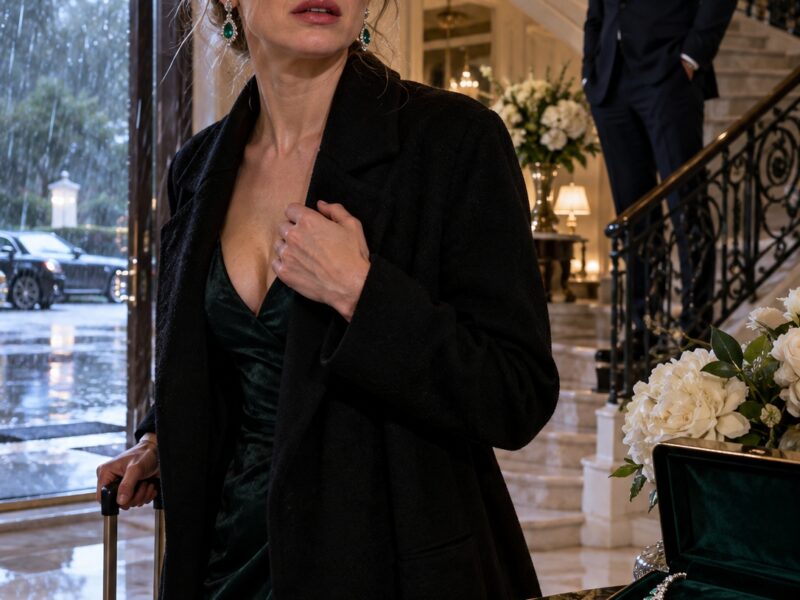
Rain hammered the stone driveway of our estate outside Providence, Rhode Island, turning the October afternoon silver beneath the security lights.
Two members of the household staff stood beneath the covered entrance.
Neither offered to carry my suitcase.
I didn’t blame them.
By then, everyone knew.
Or thought they did.
There had been thirty-seven guests at our house the night before—investors, attorneys, foundation directors, two state senators, old family friends, and the sort of wealthy people who could destroy a reputation over cocktails without ever raising their voices.
Some of them had delayed leaving after breakfast.
They were still inside.
Watching.
I could feel them behind the tall windows as I crossed the foyer.
At the top of the staircase stood my husband, Roderick Morant.
Forty-two years old.
President of Morant Development Group.
Fourth-generation heir to a real-estate and logistics fortune that had put his family’s name on university buildings, hospital wings, waterfront developments, and enough charitable foundations to make the Morants look almost virtuous.
We had been married for eleven years.
That afternoon, he didn’t come downstairs.
He didn’t touch my suitcase.
He didn’t tell anyone to stop staring.
Most importantly, he didn’t tell me not to leave.
Halfway across the foyer, I heard a woman whisper behind me.
“Is that really happening?”
Another voice answered too quietly for me to make out the words.
Then somebody noticed my left hand.
My wedding ring was gone.
The silence changed.
There are different kinds of silence.
There is grief.
There is fear.
And then there is the silence of people realizing they are witnessing a story they will repeat at dinner for the next ten years.
I kept walking.
Eleven years earlier, I had entered Morant House as Eleanor Bennett, the daughter of a public-school librarian from Worcester.
I had left our wedding reception as Eleanor Morant.
For years, that second name entered rooms before I did.
Mrs. Roderick Morant.
Chair of the Morant Community Foundation.
Hostess of the annual winter benefit.
The woman standing beside Roderick in photographs whenever the family needed to appear warm, stable, and human.
Now I was leaving the same house under suspicion of stealing his dead mother’s necklace.
I reached the front door.
Then stopped.
Some foolish part of me was still waiting.
I turned around.
Roderick remained at the top of the stairs.
Our eyes met across thirty feet of polished marble.
For one suspended second, I thought he might finally understand what was happening.
Not what the guests believed.
Not what tomorrow’s whispers would sound like.
What was actually happening.
His wife was leaving him.
He only had to say my name.
He didn’t.
Something inside me became very quiet.
I stepped into the rain.
The driver opened the rear door.
I climbed into the car without looking back.
Three hours earlier, my wedding ring had still been on my finger.
And Roderick had still believed I would eventually forgive him.
He was wrong about both.
The necklace sat between us on the desk in his study.
White diamonds.
Old platinum.
An emerald at the center the size of a thumbnail.
It had belonged to Roderick’s mother, Margaret, who died six years before we married. I had seen photographs of her wearing it at charity galas in Boston and New York, always standing perfectly straight, always looking as though smiling had been negotiated in advance.
Roderick treasured very few objects.
That necklace was one of them.
The previous evening, he had decided to display several pieces of Morant family jewelry during a private foundation dinner.
I’d objected.
Not because I wanted the necklace.
Because I thought turning his mother’s possessions into decoration for a fundraising dinner was grotesque.
“She wasn’t a museum exhibit,” I’d told him.
“It isn’t an exhibit.”
“It’s sitting under glass with a security guard.”
“It’s part of the family’s history.”
“She was your mother, Rod.”
“And I’m trying to honor her.”
We had argued for perhaps four minutes.
Privately.
That should have been the end of it.
Instead, shortly after eleven, the necklace disappeared.
Security checked the display room.
Staff searched the adjacent hallways.
Guests were quietly asked whether they’d seen anyone near the case.
Then, sometime after midnight, the necklace was found.
In my private sitting room.
Inside the locked bottom drawer of my writing desk.
I stared at it now.
“I didn’t put that there.”
Roderick stood at the window.
“I know what you’re saying.”
“No. You’re hearing words. I’m asking whether you believe them.”
He rubbed the bridge of his nose.
“Ellie, several people already know where it was found.”
I actually laughed.
It wasn’t amusement.
It was disbelief arriving before anger.
“That’s your concern?”
“That’s not what I said.”
“Then what is your concern?”
He turned.
“By tonight, everyone who attended that dinner will have heard some version of this.”
“Then you should be very interested in discovering who put it in my desk.”
His jaw tightened.
“You argued with me about displaying it.”
I stared at him.
“So?”
“You were angry.”
“Yes.”
“You said displaying it was disrespectful.”
“Yes.”
He waited.
I felt cold.
“Finish the sentence, Roderick.”
“I think you may have done something impulsive.”
For a moment I couldn’t speak.
Then I looked at the necklace.
Then at him.
“You think I stole your mother’s necklace to teach you a lesson?”
“I didn’t say stole.”
“Wonderful distinction.”
“Eleanor—”
“And afterward, apparently, I panicked so badly that I hid it in a locked drawer in my own private room.”
He looked away.
That was when my anger began disappearing.
Fear replaced it.
Because suddenly I understood the real problem.
He hadn’t investigated.
Not properly.
“Who had access to my room?”
“The staff have been questioned.”
“That’s not what I asked.”
“Eleanor.”
“Who had access to the drawer?”
His patience finally cracked.
“I am not turning this entire house upside down while guests and employees speculate about our marriage.”
I went still.
There it was.
Not the necklace.
Not the accusation.
The truth.
“What?” he asked.
“That’s what you’re afraid of.”
His expression hardened.
“I’m trying to protect this family.”
“No. You’re trying to make an embarrassing situation disappear.”
“I have responsibilities beyond your feelings.”
“And I’m your wife.”
“Which is precisely why—”
“Investigate it.”
He stared at me.
“Excuse me?”
“Investigate. The. Necklace.”
I pointed at it.
“Check the cameras. Check the electronic locks. Ask who entered this wing. Find out who had a master key. Interview every employee who was working last night. You own three security companies, Roderick. Don’t stand there pretending this is some unsolvable mystery.”
“Enough.”
“No. Not enough.”
“There has already been enough humiliation.”
“Then find out what happened.”
His answer came quietly.
“I already have.”
That sentence ended something.
He wouldn’t understand that until much later.
But I did.
I looked at the man I had slept beside for eleven years and realized he had chosen the easiest explanation available because every other explanation required inconvenience.
Questions.
Embarrassment.
Maybe conflict with relatives or friends.
Maybe the admission that someone inside Morant House had deliberately framed his wife.
Believing I had behaved irrationally was simpler.
I was the convenient answer.
Roderick moved behind his desk.
“I think it would be better if you left the house for a while.”
I blinked once.
“You’re sending me away?”
“Until this settles.”
“This?”
“The scandal.”
“You mean until people stop talking.”
His silence answered me.
I almost smiled.
“You don’t want the truth. You want quiet.”
“I won’t have this family dragged through another week of gossip.”
“Then investigate.”
“I’ve made my decision.”
There are moments when love doesn’t die.
It becomes irrelevant.
That was one of them.
I looked at my wedding ring.
Eleven years.
A cathedral in Newport.
Three hundred guests.
My mother’s trembling hands fastening my veil.
Roderick whispering that I would never have to face anything alone again.
I pulled the ring from my finger.
His face changed immediately.
“Eleanor.”
I walked to the desk and placed it beside his mother’s necklace.
“No.”
“What do you mean, no?”
“If I leave this house in disgrace because my husband finds embarrassment more unbearable than doubting me, I will not spend my exile waiting for him to decide when I’m allowed to come back.”
“Don’t turn this into something it isn’t.”
I met his eyes.
“You already did.”
Forty-seven minutes later, I left Morant House with one suitcase.
I expected to cry in the car.
I didn’t.
That frightened me more than tears would have.
My driver, Thomas, glanced at me several times through the mirror but asked no questions.
“Where to, Mrs. Morant?”
I looked through the rain.
My sister lived in Manhattan.
My aunt lived outside Boston.
Three friends had houses where I could disappear indefinitely.
Every one of those places came with the same problem.
They knew the Morants.
They knew me as Roderick’s wife.
I didn’t want explanations.
I didn’t want pity.
I didn’t want to spend the next week watching people carefully avoid asking whether I’d stolen a necklace.
“West,” I said.
Thomas looked confused.
“West where?”
“I don’t know yet.”
For the first time in my adult life, there was no schedule waiting for me.
No foundation luncheon.
No dinner seating chart.
No driver holding tomorrow’s itinerary.
No husband whose calendar determined mine.
Just a road.
For two days, we drove.
On the third morning, severe storms washed out part of the interstate and forced us onto secondary roads through western Massachusetts.
By late afternoon, we reached a town called Bramblewick.
I’d never heard of it.
There were old brick storefronts, a diner with a flickering blue sign, grain silos near the river, two churches, a hardware store, warehouses, and a main street lined with trees already losing their leaves.
It was the kind of place wealthy people described as “charming” because they never had to make a living there.
Thomas stopped outside the Gray Finch Inn.
“Road crew says the bridge should reopen tomorrow.”
“One night?”
“Probably.”
One night.
That was all Bramblewick was supposed to be.
Then the explosion came.
The sound hit first.
A deep concussion that shook the inn windows hard enough to rattle glasses behind the front desk.
For one second nobody moved.
Then black smoke rose beyond the rooftops.
Someone outside screamed.
“The mill!”
I ran into the street.
People were already moving toward the river.
The Bramblewick Grain Cooperative occupied an enormous brick complex beside the water. One entire side of the processing building had blown outward. Smoke poured from shattered windows. Flames crawled along a storage structure.
Sirens screamed in the distance.
Workers stumbled through the gate.
Some were bleeding.
Others were covered in gray dust.
A young woman pushed against two firefighters.
“My brother’s in there!”
“Ma’am, get back.”
“His name is Jamie Arden! He’s on the second shift!”
“You can’t go inside.”
“Jamie!”
Thomas grabbed my arm.
“Mrs. Morant, we need to leave before emergency crews close the road.”
I looked toward our car.
Then toward the burning mill.
For three days, all I had wanted was to go somewhere nobody knew me.
Here it was.
Nobody knew me.
Nobody expected anything from me.
I could leave.
I almost did.
Then the woman near the gate screamed her brother’s name again.
“Thomas.”
“Yes?”
“Open the trunk.”
He stared at me.
“What?”
“We have blankets in the emergency kit.”
“Mrs. Morant—”
“Get them.”
I didn’t run into the burning building.
I wasn’t a firefighter.
I wasn’t a doctor.
I didn’t suddenly become heroic because my marriage had collapsed.
I did the ordinary things that were directly in front of me.
I carried bottled water.
I helped move folding tables.
I gave away every blanket from the car.
When survivors emerged coughing and disoriented, I wrote down their names because families were desperate to know who had made it out.
When an elderly woman couldn’t stop shaking, I sat beside her.
When a boy of perhaps six began crying because nobody could find his father, I stayed with him until an aunt arrived.
The woman from the gate was named Nell Arden.
Near sunset, her brother finally emerged.
Jamie had burns on his left arm and blood across his forehead, but he was walking.
Nell collapsed against him.
Not every family received the same miracle.
By nightfall, three workers were dead.
More than twenty were injured.
And the disaster was only beginning.
The Gray Finch became an emergency shelter.
Its owner, Tilda Harrow, was a sixty-three-year-old widow with silver hair, a smoker’s voice, and the command presence of a Marine colonel.
She saw me carrying a sleeping child through the lobby.
“You’re the woman who rented my best suite.”
“Eleanor.”
She glanced at my ruined cashmere coat.
“Just Eleanor?”
“For tonight.”
Tilda pointed upstairs.
“Your room’s ready.”
I looked toward an injured mill worker stretched across two chairs beside his wife and two daughters.
“Give it to them.”
“You paid for it.”
“They need it.”
“And where exactly are you sleeping?”
I looked around the crowded lobby.
“I’ll figure it out.”
Tilda studied me for several seconds.
She said nothing.
That night, I slept sitting upright in a wooden chair.
At six the next morning, my neck hurt, my clothes smelled like smoke, and I was ready to leave.
My suitcase was repacked.
Thomas had checked the road.
Then I heard arguing in the inn’s back dining room.
Four local officials stood around a table covered with maps and handwritten lists.
One of them was Patrick Shaw, chairman of the town council.
Beside him stood Corin Voss, the mill’s operations supervisor.
Their problem wasn’t merely rebuilding the damaged structure.
The explosion had destroyed much of Bramblewick’s winter grain reserve.
What the fire hadn’t consumed, water had ruined.
Farmers outside the county were already demanding guaranteed payment before sending replacement grain.
Two distributors had raised prices overnight.
If the town couldn’t arrange temporary milling and storage, the price of flour would spike within days.
I stood in the doorway.
“How much usable grain survived?”
Four men turned toward me.
Patrick frowned.
“Mrs. Morant.”
“How much?”
“Not enough.”
“How long before the mill can operate?”
Corin answered.
“Part of it? Maybe three weeks. Full capacity, months.”
“Where can you process grain temporarily?”
Patrick’s irritation became visible.
“Mrs. Morant, with respect, this is town business.”
I nodded.
“Then I suggest the town handle it.”
I left.
By noon, the bridge still hadn’t reopened.
At one fifteen, Patrick found me in the lobby.
He removed his cap.
“I may have been rude.”
“You were busy.”
“I also need a favor.”
I waited.
“There are suppliers in Albany and Hartford who know the Morant name.”
I understood immediately.
“No.”
He blinked.
“I haven’t asked yet.”
“You’re going to ask me to call them.”
“If a request came from you, they might extend credit.”
“No.”
His face fell.
“Understood.”
He turned.
“Wait.”
I opened my suitcase.
At the bottom was a velvet jewelry case.
Inside was a diamond bracelet my grandmother had left me.
Mine.
Not Roderick’s.
Not the Morant family’s.
Mine.
I put it on the table.
Patrick stared.
“What am I supposed to do with that?”
“Use it as collateral.”
His eyes snapped toward mine.
“You’re serious?”
“Completely.”
“You’d pawn a diamond bracelet for people you met yesterday?”
“No.”
I pushed the case toward him.
“I’d pawn it so children don’t pay twice for a disaster they didn’t cause.”
The bracelet did not save Bramblewick.
That mattered.
I didn’t save Bramblewick either.
The bracelet bought time.
Two days later, the first emergency grain shipment arrived.
Then Bramblewick began saving itself.
Corin found two mills within sixty miles that could process part of the town’s supply.
Patrick negotiated transport.
Nell organized assistance for families affected by the explosion.
Tilda coordinated meals.
Farmers negotiated temporary contracts.
Truck owners created rotating delivery schedules.
Churches opened storage space.
High school students carried boxes.
Retired accountants volunteered to track donations.
And I stayed.
First because the road was closed.
Then because the grain shipment needed documentation.
Then because a family had been left off the relief list.
Then because somebody needed to get farmers, merchants, workers, and town officials into the same room without letting them kill one another.
Three days became a week.
A week became two.
I discovered something embarrassing during those weeks.
For years, I had mistaken access for competence.
I had chaired committees.
I had raised millions for charity.
I knew how to speak to donors and bankers.
But Bramblewick didn’t need a rich woman arriving with answers.
It needed somebody willing to ask the right questions.
Who had trucks?
Who had empty storage?
Which families had lost their only income?
Which supplier could deliver immediately?
Who understood the mill?
Who could verify the numbers?
Who wasn’t being heard?
We formed a temporary recovery committee.
I insisted that workers and affected families receive seats alongside business owners and officials.
Then I suggested something that made almost everyone uncomfortable.
A public ledger.
Every dollar donated.
Every dollar spent.
Every shipment.
Every transportation expense.
Every family receiving assistance.
Displayed publicly each week.
“People are going to criticize everything,” Patrick warned.
“Yes.”
“You sound pleased about that.”
“I’m not. But they’ll criticize us anyway. We might as well give them facts.”
The ledger changed the mood of the town.
Not immediately.
But slowly.
Suspicion weakened when people could see where the money went.
And then I made a mistake.
A big one.
I found a supplier whose grain was significantly cheaper than our current contract.
At the committee meeting, I pushed hard.
“The savings over eight weeks are substantial.”
Corin studied my spreadsheet.
“No.”
I looked at him.
“No?”
“This costs more.”
“The price per ton is eighteen percent lower.”
“The grain is.”
He tapped the paper.
“The journey isn’t.”
“I included transportation.”
“You didn’t include winter hauling rates through the Berkshire corridor.”
“I did.”
“No. You used standard commercial rates.”
I felt irritation rise.
“Corin, I’ve checked these numbers.”
“So have I.”
The room became quiet.
He pulled an old binder from his bag and opened it.
Previous winters.
Fuel surcharges.
Weather delays.
Specialized trucking costs.
I read the figures once.
Then again.
I had been wrong.
Everyone was watching me.
Three months earlier, that would have terrified me.
Not because I feared being wrong.
Because I had lived in a world where admitting error was treated as surrender.
I put my pencil down.
“Corin is right.”
Patrick looked surprised.
I crossed out my proposal.
“I missed the seasonal hauling costs. We use his recommendation.”
Corin nodded.
Meeting over.
I thought nothing more of it.
Apparently Bramblewick did.
People were accustomed to powerful people making mistakes.
They weren’t accustomed to hearing powerful people admit them.
The story traveled through town.
So did another story.
That I had pawned my own bracelet rather than borrow against my husband’s name.
For the first time, I began noticing that people had stopped calling me Mrs. Morant.
I was Ellie.
Just Ellie.
Nell became my closest friend.
Which didn’t mean she was impressed by me.
Quite the opposite.
One afternoon, I discovered she’d changed several names on a relief distribution list without asking.
“You should have consulted me.”
She folded her arms.
“I thought you wanted local people making decisions.”
“I do.”
“Apparently only until one of us makes one without you.”
I opened my mouth.
Nothing came out.
Nell raised an eyebrow.
“Well?”
I sighed.
“That was deserved.”
“Very.”
I laughed.
It surprised both of us.
Somewhere along the way, I rented a small apartment above a bookstore.
Two bedrooms.
Uneven floors.
Radiators that clanged at night.
The kitchen was smaller than the pantry at Morant House.
I loved it.
Nobody there knew which fork Margaret Morant had used at Thanksgiving.
Nobody cared where I sat at charity dinners.
Nobody introduced me through my husband.
People judged me by smaller things.
Did I arrive when I said I would?
Did I listen?
Did I keep promises?
Did I admit mistakes?
Did I come back the next morning?
Did I stay when staying became inconvenient?
Meanwhile, 110 miles away, Roderick finally began asking the questions I had begged him to ask.
It started with a housekeeper.
The drawer where the necklace had been found showed no damage.
There were only two ways to open it.
My key.
And the household master key.
The problem was simple.
My key had been with me throughout the dinner.
And I had never possessed the master key.
Roderick ordered security logs reviewed.
Then camera footage.
Then staff interviews.
A server remembered seeing one of Roderick’s cousins, Celia Morant, near my private wing during the reception.
Celia initially denied it.
Then changed her story.
Then blamed alcohol.
Then blamed resentment.
Finally, the truth collapsed out of her.
She had planted the necklace.
For years, Celia had resented my influence over the family foundation.
She believed I’d displaced older members of the Morant family.
She wanted to humiliate me.
She didn’t expect Roderick to end our marriage over it.
That part had been his contribution.
When the confession ended, Roderick remained alone in his study.
His eyes drifted toward the exact place where I had left my wedding ring.
And he remembered my words.
Then find out what happened.
He remembered his answer.
I already have.
He hadn’t.
Worse, he could have.
There had been no brilliant conspiracy.
No perfect crime.
No impossible mystery.
He had simply preferred certainty to discomfort.
He publicly cleared my name.
He removed Celia from every family foundation position.
He sent letters to everyone who had attended the dinner.
Then he tried to find me.
By then, I’d stopped answering.
Three months after I left, business finally brought him west.
Morant Development was part of a regional transportation agreement involving several municipalities.
One of them was Bramblewick.
Roderick arrived on a cold January morning.
He had never visited the town.
Patrick Shaw wasn’t ready for their meeting, so Roderick waited inside town hall.
Then he saw the portrait.
It hung between two tall windows.
A woman in a simple dark dress.
No diamonds.
No Morant Foundation pin.
No husband beside her.
He walked closer.
It was me.
Beneath the portrait was a brass plaque.
ELEANOR BENNETT MORANT
FRIEND OF BRAMBLEWICK
And below that:
SHE STAYED WHEN SHE WAS FREE TO LEAVE.
Roderick stared at it.
Patrick entered behind him.
Roderick didn’t turn.
“Why is my wife’s portrait hanging in your town hall?”
Patrick stopped.
“Your wife?”
Two words.
Not meant cruelly.
Yet apparently they hurt him more than an insult would have.
Because in Bramblewick, I existed completely outside him.
Patrick eventually recognized the name.
“You’re Roderick Morant.”
“Yes.”
Patrick looked at my portrait.
Then he told him everything.
The explosion.
The dead workers.
The grain shortage.
The bracelet.
The first shipment.
The committee.
The ledger.
The neighboring mills.
The families.
The farmers.
The mistakes.
The arguments.
The rebuilding.
Roderick listened.
When Patrick finished, he whispered, “She saved this town.”
Patrick shook his head.
“No.”
Roderick looked at him.
“No?”
“Ellie didn’t save Bramblewick.”
Patrick glanced around the hall.
“She helped Bramblewick save itself.”
The town council had voted to hang the portrait after the immediate crisis ended.
I had objected.
They ignored me.
Not because I was a Morant.
Because I’d stayed when I had no obligation to stay.
Roderick had sent me away believing disgrace would make my world smaller.
Three months later, strangers had hung my portrait in a public building.
“Where is she?” he asked.
Patrick told him.
The rebuilt section of the grain mill was reopening that afternoon.
I was standing beside Nell when I saw the black SUV.
I knew it before the door opened.
Roderick stepped out.
My heart reacted before the rest of me did.
Eleven years cannot be erased by three months.
I remembered his hand on the small of my back at crowded dinners.
His ridiculous habit of reading newspapers in bed.
The night my mother died and he sat on the bathroom floor with me until dawn because I couldn’t stop crying.
Love is cruel that way.
Someone can fail you catastrophically without becoming a stranger.
He approached slowly.
Nell glanced at me.
“Want me to stay?”
“No.”
She squeezed my hand and walked away.
Roderick stopped six feet from me.
“Eleanor.”
“Roderick.”
No sweetheart.
No husband.
No accusation.
Just his name.
“I know.”
I frowned.
“No.”
He looked confused.
“The necklace. I know you didn’t take it.”
“I knew that three months ago.”
His eyes lowered.
The words landed exactly where they belonged.
“It was planted.”
“I assumed so.”
“Celia confessed.”
That surprised me.
Not enough to show.
“Your name has been publicly cleared.”
“Good.”
“I wrote everyone.”
“Good.”
“I was wrong.”
“Yes.”
“I disgraced you.”
“Yes.”
His voice dropped.
“I’m sorry.”
For the first time since he’d arrived, I studied his face.
He meant it.
That was the difficult part.
It would have been easier if he didn’t.
He looked exhausted.
Older.
Human.
And genuinely ashamed.
But remorse is not a time machine.
“I’m glad you’re sorry,” I said.
He swallowed.
“Come home.”
“No.”
He stared at me.
Maybe of all the answers he’d rehearsed, that was the one he hadn’t prepared for.
“Eleanor, I was wrong.”
“Yes.”
“I can repair this.”
“No.”
His expression tightened.
“I’ve cleared your name.”
“You corrected a lie.”
“I can do more.”
“You can tell every person who heard that accusation that I was innocent. You can remove Celia from the family. You can apologize publicly. You can spend the rest of your life admitting you were wrong.”
I stepped closer.
“But you cannot change what you did before you knew I was innocent.”
His face changed.
I continued.
“That’s the part you still don’t understand.”
“I thought the evidence—”
“No.”
My voice remained quiet.
“You didn’t investigate the evidence.”
He said nothing.
“You chose between two discomforts. One was embarrassing the Morant family by asking difficult questions. The other was doubting your wife.”
I looked straight into his eyes.
“You chose me because I was easier to sacrifice.”
He flinched.
“I came here to take you home.”
And there it was.
Even then.
Even after everything.
“You still think home is wherever you are.”
His mouth opened.
Nothing came out.
Behind us, machinery started inside the rebuilt mill.
Metal groaned.
Workers shouted.
Somebody laughed.
Life continuing without waiting for us.
“For eleven years,” I said, “I entered every room as your wife.”
“You are my wife.”
“Listen to me.”
He stopped.
“Every introduction told people what to think before I spoke. Eleanor Morant. Roderick Morant’s wife. Chair of the Morant Foundation. Lady of Morant House, even if nobody actually called it that.”
I looked toward Nell.
Corin.
Patrick.
Tilda.
The workers gathering near the mill entrance.
“When I arrived here, nobody cared.”
“You think I made you invisible?”
“No.”
That question deserved a truthful answer.
“You loved me. I know you did.”
Pain moved across his face.
“But you also believed your world was the thing giving mine value.”
“I never said that.”
“You didn’t have to.”
I glanced toward the mill.
“These people didn’t care who my husband was. They cared whether I showed up.”
Roderick followed my gaze.
“They cared whether I kept my word. Whether I listened. Whether I admitted I was wrong. Whether I came back the next morning. Whether I stayed when things got ugly.”
I paused.
“What you did was wrong, Rod.”
“I know.”
“But something happened after you sent me away.”
“What?”
I smiled sadly.
“I found out I don’t need your name to tell me who I am.”
He looked toward town hall in the distance.
Perhaps he was thinking about the portrait.
Perhaps he finally understood why there was no Morant crest beneath it.
No corporate logo.
No photograph of him standing beside me.
Only my face.
“Is there someone else?” he asked.
I almost laughed.
Men sometimes need another man to explain why a woman leaves.
“No.”
His relief appeared instantly.
I hated that.
“This isn’t about another man.”
“Then maybe there’s still—”
“No.”
The relief vanished.
I softened my voice.
“I loved you, Roderick.”
“Loved?”
I looked away.
“I don’t know what tense belongs there yet.”
That hurt him.
It hurt me too.
But truth doesn’t become cruelty merely because it arrives late.
“I don’t hate you.”
He stood motionless.
“I almost wish I did. It would make this easier.”
“Then don’t end eleven years because of one mistake.”
I looked at him.
“One mistake?”
He realized immediately.
“The mistake wasn’t believing the necklace might be evidence against me. People can be wrong. The mistake was refusing to find out because the truth was inconvenient.”
I stepped backward.
“You weren’t forced to choose against me, Rod.”
“You volunteered.”
Someone called my name from the mill.
I turned.
Then Roderick said, “What am I supposed to do now?”
I looked back at the man I had once imagined growing old beside.
For the first time, he didn’t look powerful.
He looked lost.
“Tell the truth.”
“I have.”
“Keep telling it.”
“And us?”
I had no dramatic answer.
No revenge.
No speech that could make eleven years disappear.
So I gave him the only thing I had left.
The truth.
“I don’t know.”
Then I walked back toward the mill.
I never returned to Morant House.
Months later, I established my own household outside Bramblewick.
I continued working with the recovery committee until it no longer needed me.
That mattered too.
Bramblewick did not become my kingdom.
I didn’t become its savior.
The mill workers ran the mill.
Patrick continued arguing with everybody.
Corin continued correcting bad calculations.
Nell eventually started a nonprofit helping families affected by workplace disasters.
Tilda continued terrorizing anyone who complained about her coffee.
And I built a life among them without needing to own any part of theirs.
Roderick kept his promise.
Everywhere the accusation had traveled, the correction followed.
Celia faced consequences within the family and lost every position of influence she’d used to hurt me.
Roderick did not lose his company.
He did not lose his fortune.
He did not lose Morant House.
Nobody stripped his name from buildings.
No board removed him.
His punishment was quieter than that.
He received exactly what he’d demanded on the afternoon he sent me away.
A life without his wife in it.
Almost a year later, he returned to Bramblewick.
He came alone.
He walked into town hall and stood beneath my portrait.
This time, he noticed something he’d missed before.
Mine wasn’t the only name on the wall.
There were plaques for Corin Voss.
Nell Arden.
Tilda Harrow.
The firefighters.
The three workers who died.
The truck drivers who transported grain.
The farmers who extended credit.
The churches that stored supplies.
The teenagers who carried boxes.
The families who cooked meals.
The people who rebuilt walls.
I had never been presented as the hero of Bramblewick.
I was simply part of its memory.
And perhaps that was why the portrait mattered so much.
Years later, a young woman visiting town hall stopped beneath it.
According to Tilda—who told this story to anyone willing to listen—the girl studied my simple black dress for several seconds before asking the clerk at the desk:
“Who is she?”
The clerk looked up.
“Eleanor Morant.”
“Was she famous?”
“Not really.”
“Rich?”
The clerk smiled.
“Very.”
The girl frowned.
“Then why isn’t she wearing jewelry?”
The clerk considered that.
“I suppose because that isn’t why the portrait is here.”
The girl read the plaque.
“Friend of Bramblewick.”
“That’s right.”
“What did she do?”
Outside the windows, trucks were moving toward the grain mill.
The clerk looked toward them.
“Years ago, that mill exploded.”
The girl’s expression changed.
“Was she from here?”
“No.”
“Did she have family here?”
“No.”
“Then why did she stay?”
The clerk smiled.
“That’s the point.”
The girl looked again at the portrait.
A woman in a plain dark dress.
No diamonds.
No mansion behind her.
No husband beside her.
Nothing identifying her as someone important.
Except the fact that an entire town had decided to remember her.
The clerk leaned back in his chair.
“When our town was burning, Eleanor could have kept driving.”
He paused.
“She stayed.”
And that, in the end, was the difference between the two places that had called me family.
At Morant House, they had known my title, my marriage, my jewelry, my seat at the table, and exactly which staircase I descended when I was sent away.
But when my reputation became inconvenient, the man who loved me had let me walk through the rain alone.
Bramblewick knew almost nothing about me.
Not at first.
It didn’t know my marriage.
It didn’t know my husband’s fortune.
It didn’t care what newspapers had printed or what wealthy people whispered over dinner.
It watched what I did after the fire.
It watched me carry water.
Get calculations wrong.
Come back.
Argue.
Listen.
Fail.
Apologize.
Try again.
Stay.
My name was eventually cleared.
But innocence had never been the only thing Roderick took from me.
A reputation can be repaired with evidence.
Trust cannot.
That requires something evidence cannot provide.
It requires the belief that when the room turns against you, the person who promised to stand beside you will at least ask whether the room might be wrong.
Roderick learned that too late.
And I learned something else.
Being cast out of one person’s world does not mean your world has ended.
Sometimes you stand in the rain with one suitcase, believing someone has reduced your life to almost nothing.
Then a road washes out.
A mill burns.
A stranger needs a blanket.
And without realizing it, you take one small step into a life that was waiting beyond the boundaries someone else had drawn around you.
Roderick believed disgrace would make my world smaller.
Instead, it showed me how large my world could become without him.
Years after the necklace was forgotten, my portrait remained in Bramblewick Town Hall.
There was no Morant company logo beneath it.
No mention of the mansion I’d left.
No photograph of the husband whose name had once seemed inseparable from mine.
Only my name.
And beneath it, the words that mattered more than any title I had ever carried:
FRIEND OF BRAMBLEWICK.
SHE STAYED WHEN SHE WAS FREE TO LEAVE.
My husband had sent me away in disgrace.
Strangers remembered me with honor.
And somewhere between those two truths, I finally became my own.









