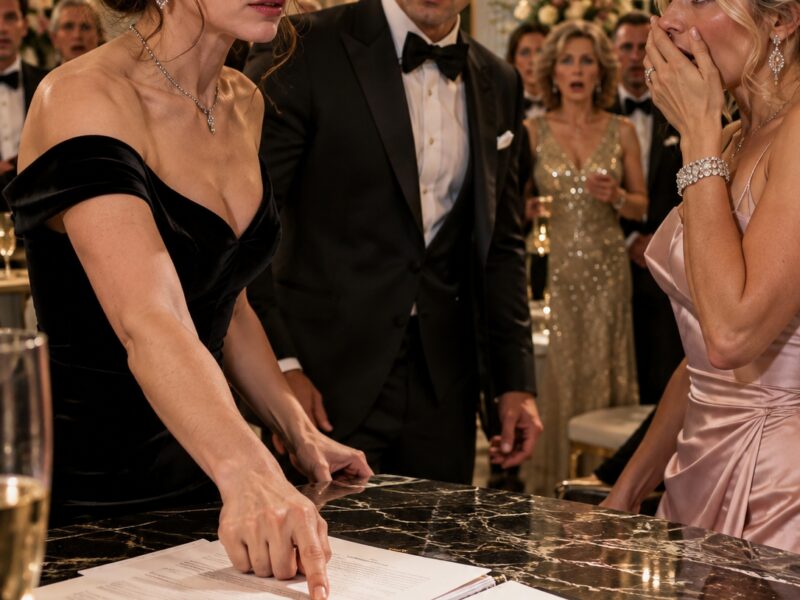
My Husband Told Me to Leave His House in Front of His Mistress—So I Finally Told Everyone Who Had Been Paying for It
“You can keep my husband, Arabella.”
Eleanor Vale said it so calmly that at first, no one understood what had happened.
The pianist in the corner kept playing.
A server carrying champagne continued across the marble floor.
Someone near the fireplace laughed at the end of a conversation that had already died.
Then Eleanor added, almost pleasantly, “But before you decide you’ve won something, you should probably know exactly what Sebastian owns.”
That stopped the room.
Thirty-two people had gathered that Saturday night inside Ravensmere, the Vale family’s sprawling estate outside Greenwich, Connecticut—a limestone mansion with twenty-three rooms, a glass conservatory, a private tennis court, and enough old-money history to make newcomers lower their voices when they walked through the front doors.
Arabella Montfort stood beneath the chandelier in pale pink silk.
On her wrist glittered a diamond bracelet.
Eleanor recognized it immediately.
She had seen the invoice six weeks earlier.
Forty-eight thousand dollars.
At the time, Sebastian had called it “a harmless gift.”
Now his mistress was wearing it inside Eleanor’s home.
And smiling at her.
“You’re upset,” Arabella said softly.
She said it with the careful sympathy of a woman who wanted an audience to believe she was being kind.
Eleanor looked at her.
“No,” she said. “I think I’m finally done being upset.”
Arabella’s smile shifted.
Only slightly.
But Eleanor saw it.
Across the room, Sebastian Vale had finally noticed the silence.
He stood near the bar with two investors and a state senator, one hand around a glass of bourbon, looking every inch the man magazines believed him to be.
Forty-three.
Tall.
Handsome in the expensive, effortless way money was supposed to make possible.
Chairman of Vale Holdings.
Owner of Ravensmere.
Heir to a family name that appeared on hospital wings, university buildings, and black-tie invitations throughout New York and Connecticut.
At least, that was the version everyone knew.
Sebastian started toward them.
Eleanor knew she had perhaps twenty seconds before he reached her.
So she looked back at Arabella.
“He promised you the Manhattan townhouse, didn’t he?”
Arabella froze.
Nobody moved.
Eleanor continued.
“The one on East Seventy-Third?”
Arabella’s fingers tightened around her champagne flute.
“I don’t know what Sebastian has told you—”
“And my grandmother’s emerald necklace.”
This time Arabella’s hand moved instinctively toward her throat, as though the necklace were already there.
That tiny movement told Eleanor everything.
“How do you know that?” Arabella whispered.
“Because the townhouse isn’t his.”
Sebastian was almost there.
Eleanor kept speaking.
“It belongs to an LLC controlled by my family trust. The mortgage, renovations, property taxes, staff, and maintenance have been paid through that trust for the last six years.”
The color began leaving Arabella’s face.
Eleanor glanced at the bracelet.
“And the diamonds on your wrist were purchased on an account Sebastian currently does not have enough liquid cash to pay.”
A murmur moved through the room.
Sebastian reached them.
“Eleanor.”
She turned.
His jaw was tight.
“What the hell are you doing?”
For seven years, that tone had worked on her.
Not because Sebastian shouted.
He rarely needed to.
He had perfected something quieter—the small tightening of his mouth that told Eleanor she had embarrassed him, disappointed him, complicated his life.
For years she had responded by becoming smaller.
Not tonight.
“I’m answering a question,” she said.
“No one asked you anything.”
Arabella found her voice.
“She’s claiming you don’t own the townhouse.”
Sebastian looked at Eleanor.
There it was.
Not guilt.
Fear.
Small.
Fast.
But unmistakable.
Eleanor almost felt sorry for him.
Almost.
“Tell her I’m lying,” she said.
Sebastian’s face hardened.
“This is neither the time nor the place.”
“Interesting.”
“Eleanor.”
“Tell her.”
Silence.
Arabella stared at him.
Sebastian lowered his voice.
“Stop this now.”
Eleanor looked around the room.
These were the people Sebastian valued most.
Board members.
Neighbors.
Investors.
Old friends.
Men who congratulated him on Ravensmere’s restored grounds.
Women who praised his taste.
People who had spent years telling him how brilliantly he had preserved the Vale legacy after his father’s death.
Not one of them knew that seven years earlier, the Vale legacy had been approximately ninety days from collapse.
Eleanor did.
Because she had saved it.
“Sebastian inherited this estate,” she said, “along with twenty-eight million dollars in secured debt, several personal guarantees, two failing agricultural properties, a commercial loan in default, and a company his father had leveraged so aggressively that three banks were preparing enforcement actions.”
“Enough.”
Sebastian’s voice cracked through the room.
Eleanor looked directly at him.
“You told me to stop discussing our finances privately. You told me I was tedious whenever I asked about spending. You invited your mistress into my home after I begged you not to.”
Arabella flinched at the word mistress.
Eleanor did not look away from her husband.
“So no, Sebastian. I don’t think ‘enough’ belongs to you tonight.”
Someone near the windows quietly set down a champagne glass.
Sebastian stepped closer.
“You are humiliating yourself.”
For the first time all evening, Eleanor smiled.
“No. That’s the part you still don’t understand.”
She reached into the slim leather folder she had carried downstairs.
Then she placed one document on the marble console between them.
Sebastian saw the letterhead.
Bell, Harrington & Pierce.
His expression changed instantly.
The attorneys representing Eleanor’s family trust.
“What is that?” Arabella asked.
Eleanor answered without looking at her.
“Reality.”
Sebastian stared at the document.
Seven years earlier, he had signed agreements allowing Eleanor’s trust to purchase distressed loans secured against portions of Vale property.
At the time, he had barely read them.
He had been desperate.
Eleanor had been in love.
The banks had been paid.
Foreclosure had been stopped.
Ravensmere had remained in the Vale family.
And Sebastian had gradually begun behaving as though the crisis had simply disappeared.
It hadn’t.
The creditor had changed.
His wife had merely been kinder than a bank.
Until now.
Arabella whispered, “Sebastian?”
He ignored her.
“Eleanor, whatever you think you’re doing—”
“I know exactly what I’m doing.”
“You’re angry.”
“No.”
“You’re jealous.”
That almost made her laugh.
Seven years.
Seven years of spreadsheets at midnight.
Seven years negotiating refinancing agreements.
Seven years reviewing farm leases, commercial contracts, insurance renewals, payroll, capital expenditures, maintenance budgets, and debt schedules while Sebastian attended dinners and golf weekends and charity galas where people praised his leadership.
And he still believed this was jealousy.
Eleanor looked at Arabella.
“You wanted him,” she said quietly. “Now you should know what comes with him.”
Then she looked back at Sebastian.
“Ravensmere remains yours. Vale Holdings remains yours. Your debts remain yours.”
His face went white.
“But as of Monday morning, my trust will no longer subsidize your personal spending.”
“Eleanor.”
“The existing loan agreements will be honored exactly as written. No special extensions. No informal advances. No emergency transfers because you bought something you couldn’t afford.”
“You cannot make decisions like this without discussing them with me.”
“I’ve spent seven years discussing them with you.”
Her voice never rose.
“That was the problem. You never listened.”
Arabella took a step backward.
Sebastian noticed.
Perhaps that was what finally broke him.
Not his wife’s pain.
Not the affair.
Not the money.
Arabella retreating.
He turned on Eleanor.
“If you cannot behave like my wife in my house, perhaps you should leave it.”
The words landed harder than any shout could have.
No one breathed.
Eleanor looked at him.
For one terrible second, she was thirty-four again, sitting beside him on the floor of his father’s study while foreclosure notices covered the desk.
She remembered Sebastian pressing both hands over his face.
I’m going to lose everything.
She had knelt in front of him.
No, you’re not.
He had looked at her with red eyes.
How can you know that?
Because we’re going to fix it.
We.
That word had cost Eleanor seven years of her life.
She had mistaken being needed for being loved.
Now, standing beneath the chandelier while Sebastian’s mistress wore diamonds he could not afford, Eleanor finally understood the difference.
Her expression softened.
Not with forgiveness.
With goodbye.
“All right,” she said.
Sebastian blinked.
“What?”
“You asked me to leave.”
“Eleanor—”
“I heard you.”
She picked up the folder.
Then she turned toward the guests.
“I’m sorry your evening became uncomfortable.”
Nobody knew where to look.
Eleanor gave them a small, composed smile.
“Please stay. The catering has already been paid for.”
Someone actually choked on a laugh.
Sebastian’s face burned.
Eleanor walked out of the room.
He did not follow her.
That was the last favor he would ever do her without realizing it.
Because if Sebastian had followed Eleanor that night—if he had grabbed her hand, apologized, begged, cried, said one convincing thing—she might have stayed.
Instead, he remained beside Arabella.
And Eleanor kept walking.
Seven years earlier, she had married Sebastian Vale because he once drove four hours through a snowstorm to bring her a first edition of a novel she had mentioned loving.
Back then, Sebastian had not seemed arrogant.
He had seemed alive.
He remembered tiny things.
How Eleanor took her coffee.
Which side of the bed she preferred.
The fact that thunderstorms made her restless.
He could make a table of strangers laugh without humiliating anyone.
He listened when she spoke.
Or Eleanor believed he did.
She was twenty-nine when they married.
Her father had built Harrington Maritime into a national logistics company before selling most of his stake. Her maternal grandfather had spent decades investing the family wealth through conservative trusts, real estate, municipal bonds, and private companies.
Eleanor never advertised any of it.
Sebastian’s money was old.
Hers was quiet.
That distinction would eventually matter.
Before the wedding, Eleanor’s grandfather, Charles Harrington, had asked her to meet him alone.
He placed a thick folder on his desk.
“Prenup?”
Eleanor laughed.
“Trust agreements.”
“Granddad.”
“Read them.”
“I trust Sebastian.”
Charles leaned back.
“I’m not asking whether you trust him.”
“Then what are you asking?”
“Whether you intend to remain capable of trusting yourself.”
That silenced her.
The documents protected Eleanor’s inheritance.
Sebastian would have no automatic control over the principal.
Major distributions required trustee approval.
Assets inherited from Charles would remain separate.
Sebastian had signed without complaint.
“I’m marrying Eleanor,” he told Charles. “Not her balance sheet.”
Charles studied him for a long moment.
“I hope you remember that.”
For the first six months, Sebastian gave Eleanor no reason to doubt him.
Then his father died.
And the truth arrived in banker’s boxes.
The Vale family had wealth everywhere except where it mattered.
Land.
Buildings.
Art.
Memberships.
Horses.
Aircraft shares.
Luxury vehicles.
A company carrying enormous debt.
Ravensmere itself had been refinanced repeatedly.
Sebastian’s father had borrowed against appreciating assets to support a lifestyle the underlying businesses no longer generated enough cash to sustain.
Sebastian inherited prestige.
He also inherited a financial bomb.
Eleanor found him one December night sitting alone in his father’s study.
No lights.
No drink.
No jacket.
Just paperwork spread across the desk.
She had never seen him frightened before.
“What happened?”
He handed her a letter.
A lender intended to accelerate a loan.
Another bank was reconsidering a credit facility.
A commercial property had violated debt covenants.
Ravensmere itself was exposed.
“My father told me everything was handled.”
Eleanor sat beside him.
“Apparently it wasn’t.”
“I could lose the estate.”
“We need to know exactly what you owe.”
“I don’t know.”
She looked at him.
Sebastian stared at the floor.
That was the first warning.
Not the debt.
The fact that a thirty-six-year-old man who had inherited an empire had no idea what it cost to keep it alive.
But Eleanor loved him.
So she treated ignorance like an emergency instead of a choice.
Within weeks, her attorneys were meeting with his.
Eleanor’s trust acquired several distressed notes.
Others were refinanced.
She provided working capital under formal agreements.
She helped restructure Vale Holdings.
She found expenses no one had questioned in years.
Private aviation.
Unused club memberships.
Consulting contracts awarded to friends.
Vehicles assigned to executives who no longer worked for the company.
A landscaping contract charging nearly double market rates.
Sebastian attended the first meetings.
Then fewer.
Then almost none.
“You understand it better than I do,” he would say.
At first, Eleanor heard trust.
Later, she understood it was abdication.
She became indispensable.
And slowly, invisibly, that became the worst thing she could have done for their marriage.
By year three, Vale Holdings was stable.
By year four, Ravensmere’s major repairs were complete.
By year five, several properties were profitable again.
People congratulated Sebastian.
He accepted.
At dinner one evening, an investor praised Eleanor’s restructuring work.
Sebastian laughed.
“My wife loves spreadsheets. Everyone needs a hobby.”
The table laughed.
Eleanor did too.
That night, she lay awake beside him.
Something had shifted.
The more competent she became, the less comfortable Sebastian seemed around her.
Her intelligence had once impressed him.
Now it reminded him of the years when he had needed rescuing.
So he rewrote the story.
The debt had not been catastrophic.
Eleanor had not saved Ravensmere.
The restructuring had been routine.
Her work was “administrative.”
Her money had merely “helped.”
And because Eleanor loved him, she let him tell himself those lies.
Then Arabella Montfort appeared.
She was thirty-seven, divorced, beautiful, socially effortless, and recently separated from a husband whose fortune had turned out to be much smaller than advertised.
Arabella had learned something from that marriage.
Unfortunately, it was not wisdom.
It was due diligence.
She liked wealthy men.
More precisely, she liked men who looked wealthy.
Sebastian looked perfect.
Arabella laughed at his stories.
Asked about his polo horses.
Called Ravensmere extraordinary.
Told him he carried responsibility “so naturally.”
Most importantly, she never knew him when he was afraid.
Eleanor did.
That was the attraction Sebastian could never admit.
Arabella saw the man he wanted to believe he was.
Eleanor knew the man he actually was.
By the time Eleanor understood the relationship had become physical, almost everyone else already knew.
That humiliation hurt more than the affair itself.
Restaurants.
Charity dinners.
Private clubs.
People would stop talking when Eleanor approached.
Women became excessively kind.
Men avoided eye contact.
Sebastian became irritated whenever she asked questions.
Then came the bracelet invoice.
Forty-eight thousand dollars.
Eleanor waited until he returned home.
“Did you buy Arabella Montfort a diamond bracelet?”
Sebastian removed his cuff links.
“How did you see that?”
“That isn’t an answer.”
“It was a gift.”
“A forty-eight-thousand-dollar gift?”
He sighed.
“You make everything sound vulgar when you reduce it to numbers.”
Eleanor stared at him.
“I spent this morning trying to find thirty-five thousand dollars to repair the roof of the community center.”
“That has nothing to do with this.”
“It has everything to do with this.”
Sebastian turned.
“There it is.”
“What?”
“That tone.”
“What tone?”
“The one that reminds me every dollar must pass through your approval.”
Eleanor felt something cold move through her.
“I have never asked you to request permission to spend your own money.”
“Exactly.”
He smiled without humor.
“My own money.”
She understood.
“Sebastian—”
“Do you enjoy it?”
“Enjoy what?”
“Knowing I needed you.”
The question stunned her.
“I thought we were building something together.”
“Of course you did.”
She looked at the man she had protected for seven years.
Suddenly she saw the wound beneath his arrogance.
And something even uglier growing around it.
He was ashamed.
Not of betraying her.
Of owing her.
Arabella had simply given that shame somewhere to escape.
Eleanor could have exposed him then.
She didn’t.
She still hoped he might choose their marriage.
Then he invited Arabella to Ravensmere.
Eleanor asked him not to.
Once.
Privately.
“Everyone knows,” she said.
Sebastian barely looked up from his laptop.
“Everyone knows what?”
“Please don’t do this.”
“Do what?”
“Make me say it.”
He closed the laptop.
“Your jealousy is becoming exhausting.”
Eleanor stared at him.
“My jealousy?”
“Arabella is my friend.”
“You’re sleeping with her.”
His face changed.
Not because the accusation was false.
Because Eleanor had finally said it aloud.
“Be careful.”
The words were quiet.
Threatening without technically being a threat.
Eleanor felt her heart break with remarkable calm.
“I’m your wife.”
Sebastian looked at her as though she had interrupted something important.
“And?”
One word.
That was all it took.
And?
Eleanor walked out.
The following evening, Arabella arrived wearing pink silk and diamonds.
By midnight, Eleanor’s marriage was over.
Sebastian simply didn’t know it yet.
Eleanor did not dramatically pack a suitcase and disappear.
That would have felt satisfying.
It would also have been irresponsible.
Hundreds of people depended indirectly on the estate and Vale businesses.
Employees.
Tenants.
Contractors.
Families.
Eleanor refused to burn their lives down simply because Sebastian had burned hers.
At 7:30 the next morning, she called Daniel Bell, the attorney who had represented her family for eighteen years.
“I’m leaving Sebastian.”
There was a pause.
“Are you safe?”
“Yes.”
“Do you need me there?”
“Yes.”
Daniel arrived before noon.
For two days, they worked.
Eleanor would move into Willowmere, a property she had inherited in Litchfield County.
Her trust would stop funding Sebastian’s personal lifestyle.
Existing contractual obligations would remain.
Essential business operations would not be intentionally disrupted.
Employees would be protected where legally possible.
No revenge.
No sudden foreclosure.
No theatrical destruction.
Just boundaries.
On Monday afternoon, Eleanor walked into Sebastian’s study.
He was reading an email from his banker.
“I hear you’re leaving.”
“Yes.”
“For how long?”
“I don’t know.”
He leaned back.
“This has gone far enough.”
Eleanor almost smiled.
“What has?”
“This punishment.”
“It isn’t punishment.”
“Then what is it?”
She looked around the study.
She had spent countless nights there saving his family’s finances while he slept upstairs.
“The end of something I’ve been trying to repair alone.”
Sebastian’s expression hardened.
“I have already been humiliated enough.”
“So have I.”
“You expect me to beg?”
“No.”
That answer surprised him.
Eleanor placed a folder on the desk.
“Actually, I finally understand how useless begging is.”
He opened it.
Financial statements.
Loan schedules.
Operating budgets.
Debt service.
Personal expenses.
The numbers seemed to offend him merely by existing.
“What am I supposed to do with this?”
“Read it.”
“I have people for that.”
“You have people who can advise you. They cannot be responsible for your life.”
He looked up.
“And what exactly are you doing?”
“Stopping.”
“Stopping what?”
Eleanor held his gaze.
“Saving you from yourself.”
For the first time, real fear entered Sebastian’s eyes.
He covered it quickly.
“And the household?”
“You’ll decide what you can afford.”
“The Manhattan property?”
“My trust owns it.”
“The horses?”
“You own most of them.”
He relaxed slightly.
“You also owe money on several.”
His expression fell.
“The jet share?”
“Sell it.”
“Eleanor.”
“You asked me to leave your house.”
“I was angry.”
“And I was finished.”
She turned toward the door.
“Wait.”
Eleanor stopped.
For one wild second, hope betrayed her.
Maybe he would say it.
I’m sorry.
I was wrong.
Don’t go.
Instead Sebastian asked, “When are you coming back?”
Eleanor closed her eyes.
There it was.
Not Will you come back?
When.
Even now, he believed she was an inconvenience that would eventually correct itself.
“Goodbye, Sebastian.”
She left the next morning.
He watched her car disappear beyond the gates and told himself she would return before Thanksgiving.
Then before Christmas.
Then after New Year’s.
She didn’t.
Without Eleanor, Sebastian discovered that being rich and appearing rich were two entirely different occupations.
Bills arrived.
The wine supplier wanted payment.
A contractor refused additional work until an overdue balance was cleared.
The Manhattan staff required salaries.
Insurance premiums increased.
A dealer called about an outstanding balance on a vintage Porsche.
Then the jeweler called.
Arabella’s bracelet had not been fully paid for.
Sebastian stared at the invoice.
Forty-eight thousand dollars.
For the first time, it looked obscene.
He called his CFO.
“Pay it.”
“With what account?”
Sebastian frowned.
“The household account.”
“There isn’t enough unrestricted cash.”
“That’s impossible.”
“No, sir.”
The answer irritated him.
It also frightened him.
Within six weeks, Sebastian sold four horses.
Then the Porsche.
Then his jet share.
He canceled a New York holiday party.
He reduced household staff.
Every decision felt like a public confession.
And Arabella noticed.
Her texts became shorter.
Her schedule became busier.
When Sebastian finally confronted her, she was sitting in a hotel lounge in Manhattan.
“You’ve been avoiding me.”
“I’ve been busy.”
“For six weeks?”
Arabella looked at him.
“Sebastian, what do you want me to say?”
“The truth would be refreshing.”
She laughed.
That was a mistake.
His face changed.
Arabella sighed.
“You promised me a life.”
“I have a life.”
“You promised me the townhouse.”
“I can still arrange something.”
“When?”
He said nothing.
“And the allowance?”
His jaw tightened.
“Temporarily delayed.”
Arabella leaned back.
The warmth vanished from her face.
“So Eleanor was telling the truth.”
“Don’t.”
“She was.”
“My wife deliberately created this situation.”
“No.”
Arabella’s voice was suddenly sharp.
“Your wife stopped hiding it.”
That landed.
Sebastian stared at her.
Arabella stood.
“You let me believe you had control over all of it.”
“And you let me believe you loved me.”
For several seconds, neither spoke.
Then Arabella picked up her purse.
“Perhaps we both believed what was convenient.”
Three months later, she became engaged to a real-estate developer whose estimated net worth was reported at more than two hundred million dollars.
Sebastian read the announcement alone at Ravensmere’s breakfast table.
At first, he laughed.
Then he threw the newspaper across the room.
For several weeks, he blamed everyone.
Arabella.
Eleanor.
His father.
The banks.
His lawyers.
The economy.
His CFO.
Then one rainy morning, Thomas Harding resigned.
Harding had managed Ravensmere’s operations for twenty-one years.
Sebastian stared at the resignation letter.
“Why?”
Harding stood across from him.
“I’ve accepted another position.”
“I can increase your salary.”
“It isn’t about salary.”
“Then what?”
Harding hesitated.
Sebastian grew impatient.
“Say it.”
The older man looked at him.
“I can’t manage an estate for a man who refuses to manage himself.”
Sebastian went still.
“That is inappropriate.”
“Yes, sir.”
“I’ve been dealing with enormous pressures.”
“Yes.”
“You have no idea what Eleanor has done.”
Harding’s expression changed.
That was when Sebastian knew he had made another mistake.
“What?”
“Mrs. Vale spent seven years ensuring the people on this property never had to know how close things came to failing.”
Sebastian stood.
“My wife is no longer here.”
“No, sir.”
Harding placed the office keys on the desk.
“That’s precisely the problem.”
He left.
Sebastian remained alone.
For once, there was nobody left in the room to blame.
At Willowmere, Eleanor was discovering silence.
Not the hostile silence Sebastian used when angry.
Real silence.
Peaceful silence.
The house was smaller than Ravensmere.
Only six bedrooms.
No ballroom.
No gallery.
No staff waiting outside every door.
There were maple trees behind the house and an old stone wall running beside the garden.
For the first month, Eleanor woke each morning with the strange sensation that she had forgotten something.
A bill.
A meeting.
A crisis.
A husband’s mood.
Then she realized there was nothing to fix.
At thirty-six, Eleanor had to learn something she should have learned at twenty-nine.
How to live a life that did not require her to earn permission to enjoy it.
She started reading again.
She took long walks.
She ate dinner at seven if she wanted and nine if she didn’t.
She ignored calls during breakfast.
She stopped checking Sebastian’s schedule.
She began working with a nonprofit supporting women rebuilding financially after divorce, widowhood, or domestic instability.
One of the first women she met was a thirty-two-year-old mother named Martha Collins.
Martha could sew almost anything.
She had no credit.
No capital.
No business experience.
But she had skill.
Eleanor helped her create a budget and arranged a small loan through a community fund.
Six months later, Martha employed another woman.
Eleanor cried when she saw the first payroll sheet.
Not because the numbers were large.
Because for once, her competence was helping someone become more independent rather than allowing someone to remain dependent.
Still, some nights hurt.
She missed Sebastian.
That embarrassed her.
She did not miss the man who cheated.
She missed the man who once read beside her in bed.
The man who drove through snow because she mentioned a book.
The man who used to put his head in her lap and ask, “What would I ever do without you?”
One evening, Eleanor sat outside Willowmere while the sun disappeared behind the trees.
Her friend Claire sat beside her.
“I think something is wrong with me,” Eleanor said.
“Why?”
“I miss him.”
Claire waited.
“And I’m happier without him.”
“That sounds perfectly possible.”
Eleanor laughed weakly.
“I thought leaving would kill whatever I felt.”
“Maybe leaving only stopped you from killing yourself to prove it.”
Eleanor looked at her.
The sentence stayed with her.
Two weeks later, Sebastian’s first real letter arrived.
Not a text.
Not an email.
A letter.
Eleanor almost threw it away.
Instead, she opened it.
There were no declarations.
No excuses.
No request that she come home.
Sebastian wrote that he had finally reviewed the original restructuring documents.
All of them.
He had discovered how many times Eleanor had covered shortfalls without telling him.
How many contracts she had renegotiated.
How much debt she had prevented from becoming catastrophic.
He wrote:
I spent years telling myself your competence diminished me. The truth is that I used your competence as permission to remain incompetent.
Eleanor stopped reading.
Her eyes filled.
She continued.
I betrayed you because Arabella knew only the version of me I wanted people to see. You knew the frightened, indebted, uncertain man beneath it. Instead of being grateful that you loved that man too, I punished you for knowing he existed.
Eleanor read the letter twice.
Then a third time.
The final paragraph contained the sentence that mattered most.
I am not asking you to return.
She folded the pages.
For four days, she did not answer.
When she finally did, she wrote only that she was glad he had begun facing the truth.
She did not say she forgave him.
She did not say she loved him.
She did not say she was coming home.
Sebastian received the letter.
And went back to work.
That mattered more than Eleanor knew.
He started attending every financial meeting.
At first, he understood almost nothing.
He asked questions anyway.
He sold paintings that had not left storage in twenty years.
He renegotiated vendor contracts.
He personally reviewed major expenses.
He met tenants.
He visited businesses carrying the Vale name.
And everywhere he went, he found Eleanor.
Not physically.
In stories.
A maintenance worker whose daughter had needed surgery.
A tenant whose roof Eleanor had repaired without increasing rent.
A farm manager who showed Sebastian drainage improvements she had insisted on funding.
A local school director who explained that Eleanor had quietly paid for computers when the annual budget fell short.
Sebastian began to understand something brutal.
Eleanor had spent seven years building loyalty.
He had spent seven years assuming loyalty belonged to him because his name was on the gate.
That fall, a hurricane remnant stalled over Connecticut.
Rain fell for nearly two days.
A creek overflowed.
Several low-lying homes on Vale property flooded.
Sebastian received the first call shortly after midnight.
The old version of him would have called Harding.
Harding was gone.
So Sebastian pulled on boots and drove out himself.
For the next thirty-six hours, he worked beside employees and firefighters.
He carried sandbags.
Opened unused guest cottages to displaced families.
Authorized emergency repairs.
Helped an elderly tenant retrieve a metal box containing letters from her late husband.
By the second evening, Sebastian was soaked, exhausted, and running a fever.
Nobody photographed him.
Nobody praised him.
For the first time, that didn’t seem to matter.
News reached Eleanor.
She sent blankets.
Portable heaters.
Food.
Then authorized her trustees to release emergency funds allowed under the existing agreements.
Sebastian wrote to thank her.
His letter barely mentioned himself.
Most of it concerned families who had lost belongings.
Eleanor noticed.
She hated that she noticed.
Fourteen months after she left Ravensmere, Sebastian asked if he could visit Willowmere.
Eleanor stared at the message for a long time.
Then she wrote:
Two o’clock Saturday.
He arrived five minutes early.
No driver.
No tailored three-piece suit.
No performance.
Just Sebastian in a dark coat standing outside her front door looking older than she remembered.
Eleanor’s heart betrayed her immediately.
She hated it for that.
“Hello,” he said.
“Hello.”
They sat in the living room.
Coffee between them.
For ten minutes, they discussed everything except their marriage.
Then Sebastian put down his cup.
“I owe you an apology I should have made years ago.”
Eleanor said nothing.
“I don’t mean for Arabella alone.”
Still she waited.
“I hated needing you.”
There it was.
Sebastian looked at his hands.
“Every time you solved something I couldn’t solve, I felt ashamed. Every time someone praised you, I heard criticism of me. Instead of becoming better, I tried to make you smaller.”
Eleanor felt tears burning behind her eyes.
Sebastian continued.
“Arabella made me feel powerful because she didn’t know anything about me.”
He laughed once, bitterly.
“You knew everything.”
“Yes.”
“And loved me anyway.”
“I did.”
His eyes lifted.
“I think that frightened me more than anything.”
Eleanor looked away.
“You made me feel invisible.”
“I know.”
“No.”
Her voice shook.
“You don’t.”
Sebastian became silent.
So Eleanor told him.
She told him about dinners where she sat alone while he texted Arabella beneath the table.
The parties where everyone knew.
The mornings when he ignored her after she questioned a bill.
The nights she lay beside him wondering what was wrong with her.
The humiliation of watching him become affectionate toward another woman while treating his wife like an accountant he resented.
She told him about the bracelet.
The townhouse.
The invitation.
And finally the worst moment.
“You looked at me and said, ‘And?’”
Sebastian closed his eyes.
“I remember.”
“I told you I was your wife.”
“I know.”
“And you said, ‘And?’”
His eyes were wet when he opened them.
“There is nothing I can say that makes that less cruel.”
For years, Eleanor had dreamed of hearing him admit it.
Now that he had, it did not erase anything.
Strangely, that made the apology more valuable.
Sebastian wasn’t asking her to pretend.
“I don’t expect forgiveness because I finally became intelligent enough to understand what I destroyed,” he said.
“Then what do you expect?”
“Nothing.”
The answer broke something open inside her.
He swallowed.
“I just needed you to know I finally understand.”
They sat quietly.
Eventually Sebastian asked the question he had come to ask.
“Do you think there is any possibility that one day you might come back?”
Eleanor looked at him.
“Not yet.”
Pain crossed his face.
But he nodded.
“Okay.”
No argument.
No accusation.
No wounded pride.
Just okay.
He stood.
At the door, he stopped.
“Can I write to you?”
Eleanor hesitated.
“Yes.”
Sebastian smiled faintly.
“I’d like that.”
He did not touch her.
He did not try to kiss her.
He walked to his car.
Eleanor watched from the window until he disappeared down the drive.
Then she cried.
Not because he had left.
Because for the first time in years, Eleanor had told her husband exactly how much he had hurt her.
And he had listened without asking her to make his guilt easier to carry.
Spring came.
Then summer.
Sebastian visited when Eleanor invited him.
They walked through the gardens.
Discussed books.
Argued about movies.
Sometimes they talked about Ravensmere.
Sometimes they didn’t.
Sebastian became interested in Eleanor’s nonprofit work.
He attended one meeting and spent most of it listening.
That alone nearly made her laugh.
The old Sebastian would have entered the room with a solution before anyone finished explaining the problem.
This Sebastian asked questions.
Eleanor did not trust the change immediately.
She watched him.
People could behave well for weeks.
Even months.
Regret could imitate character for a surprisingly long time.
So she waited.
And Sebastian kept showing up.
Not dramatically.
Consistently.
One afternoon, they walked beside Willowmere’s stone wall.
Sebastian mentioned a dinner invitation.
“The Whitmans invited both of us next Friday.”
Both.
The word tightened something inside Eleanor.
Sebastian noticed.
“What?”
“Nothing.”
“Eleanor.”
She stopped walking.
“There were years when I hated invitations.”
His face changed.
“Because of me.”
“Yes.”
She looked toward the trees.
“I never knew whether I was going somewhere as your wife or as the woman everyone pitied while you flirted with someone else.”
Sebastian’s shoulders dropped.
“I can’t give those years back.”
“No.”
“But I can make whatever years remain different.”
Eleanor looked at him.
“Can you?”
“I can try every day.”
Silence stretched between them.
Then Eleanor did something she had not done since leaving Ravensmere.
She reached for his hand.
Sebastian stared at their fingers.
He did not squeeze too tightly.
He did not pull her closer.
He simply held on.
That small restraint mattered.
Three months later, Eleanor agreed to spend two weeks at Ravensmere.
Nothing more.
Sebastian understood.
When her car passed through the gates, memories came so quickly she almost asked the driver to turn around.
The fountain.
The west lawn.
The stone terrace.
The window of Sebastian’s study.
Then she noticed what had changed.
The grounds looked healthier.
Several extravagant ornamental gardens had been replaced with lower-maintenance native landscaping.
The stables housed fewer horses.
The fleet of luxury vehicles was gone.
Employees greeted Sebastian warmly rather than nervously.
Inside, there was no enormous welcome.
No party.
No photographers.
No roses covering every surface.
In Eleanor’s old sitting room sat a vase of wildflowers, three new books, and a handwritten note.
I’m glad you’re here.
Stay as long as you want.
Leave whenever you need.
Eleanor read the last sentence twice.
Leave whenever you need.
Two years earlier, Sebastian had told her to leave because he believed the house proved his power.
Now he was telling her she was free to leave because he finally understood that love without freedom was merely possession.
She folded the note and put it in her pocket.
During those two weeks, they talked about what returning would actually mean.
Eleanor would keep Willowmere.
Her inheritance would remain separate.
Her nonprofit work would continue.
Sebastian would remain personally responsible for Ravensmere and Vale Holdings.
No secret spending.
No financial rescue without formal discussion.
No silent punishment.
No using affection as leverage.
No pretending disagreements were disrespect.
And no assumption that Eleanor’s return meant the past had disappeared.
On the final morning, she packed.
Sebastian carried her suitcase downstairs.
He did not ask her to stay.
At the car, Eleanor turned.
“I’d like to come back next month.”
His face brightened.
“For another visit?”
She looked toward Ravensmere.
Then back at him.
“Maybe longer.”
That Christmas, almost exactly two years after Eleanor had walked out of the ballroom, she returned to Ravensmere for good.
But the woman who returned was not the woman Sebastian had expelled.
She still owned Willowmere.
She still controlled her money.
She still ran the foundation.
She still disagreed with him.
Frequently.
Sebastian discovered he rather liked that last part.
On Christmas night, after the guests had gone, they sat in the library.
Snow covered the lawn.
A fire burned low.
Eleanor looked up from her book.
“Do you remember something you asked me during our first winter?”
Sebastian smiled.
“I asked many stupid questions.”
“You asked what you would ever do without me.”
His smile faded.
“I remember.”
“For years, I thought the answer was that you would be lost.”
“I was.”
Eleanor shook her head.
“No.”
Sebastian waited.
“You weren’t lost. You were unwilling to find your own way.”
He considered that.
Then nodded.
“That’s fair.”
Eleanor stared into the fire.
“I sometimes think leaving you was the kindest thing I ever did.”
Sebastian gave a sad smile.
“It was definitely the most necessary.”
He reached for her hand.
This time she gave it freely.
“I used to think wealth was what people could see,” he said. “Ravensmere. Cars. Horses. The company. The Vale name.”
“And now?”
Sebastian looked around the quiet library.
“Now I know I spent years looking rich while being incredibly poor.”
Eleanor turned toward him.
“I had a woman who knew every ugly, frightened part of me and still chose to stand beside me.”
His thumb moved gently over her hand.
“And I treated her love like an unlimited line of credit.”
Eleanor laughed softly.
“That sounds like something your CFO taught you.”
“He would be proud.”
She smiled.
Then Sebastian grew serious.
“I don’t think I deserve what we have now.”
Eleanor studied him.
“No.”
He blinked.
She squeezed his hand.
“You don’t.”
A surprised laugh escaped him.
Eleanor leaned closer.
“That’s the point.”
He became still.
“Love isn’t a prize someone earns once and owns forever, Sebastian.”
Outside, snow pressed silently against the windows.
“You don’t deserve trust because you apologized. I don’t owe you forgiveness because you changed. We choose what happens next. Every day.”
Sebastian nodded.
“Then I hope I give you reasons to keep choosing this.”
Eleanor looked at the man beside her.
He had fewer possessions now.
Fewer horses.
No private jet.
A smaller social circle.
A company with less flash and healthier books.
And for the first time since she had known him, Sebastian seemed comfortable with the fact that someone else might be more capable than he was at something.
“What do you have now?” she asked.
He smiled.
“Less money.”
“Definitely.”
“Fewer toys.”
“Thankfully.”
“Better judgment.”
“Debatable.”
He laughed.
Then his expression softened.
“And a wife who isn’t afraid to tell me when I’m wrong.”
Eleanor smiled.
“That may be your most valuable asset.”
“No.”
Sebastian shook his head.
“You’re not my asset.”
The words were simple.
But Eleanor stopped smiling.
Sebastian held her gaze.
“That was the mistake.”
He lifted her hand but did not kiss it.
“You’re not something I possess.”
A long silence passed between them.
“You’re someone who chooses to be here.”
Eleanor felt tears sting her eyes.
Two years earlier, she had stood beneath a chandelier while another woman wore diamonds purchased by her husband.
She had believed that night was the destruction of her marriage.
Now she understood it differently.
The marriage had been dying long before Arabella.
It had begun dying every time Eleanor swallowed a truth to protect Sebastian’s pride.
Every time Sebastian mistook her sacrifice for obligation.
Every time she solved a problem he refused to face.
Every time he accepted the benefit of her strength while resenting her for possessing it.
Arabella had not destroyed their marriage.
She had merely exposed what was already broken.
And Eleanor had not saved it by returning.
She had saved herself by leaving.
Whatever came afterward had only been possible because Sebastian finally learned to do the same.
To save himself.
Not from bankruptcy.
Not from scandal.
Not from humiliation.
From the man he became whenever somebody else carried the consequences of his choices.
Eleanor leaned toward him.
This time, when she kissed her husband, she did not wonder whether he was thinking about another woman.
She did not wonder whether she had been good enough.
Useful enough.
Patient enough.
Beautiful enough.
Forgiving enough.
She simply kissed him because she wanted to.
When they separated, Sebastian rested his forehead against hers.
“Merry Christmas, Eleanor.”
“Merry Christmas.”
Outside, Ravensmere stood beneath the snow, impressive as ever.
The same stone walls.
The same iron gates.
The same family name carved above the entrance.
But Eleanor no longer confused permanence with strength.
Houses could survive generations while marriages collapsed inside them.
Fortunes could disappear.
Titles could become meaningless.
People could look powerful while depending entirely on someone they had taught themselves not to appreciate.
Years earlier, Eleanor believed loving Sebastian meant giving him everything she had.
Her time.
Her money.
Her intelligence.
Her patience.
Her silence.
She knew better now.
Love was not measured by how much one person could sacrifice before the other finally noticed.
It was not staying at any cost.
It was not rescuing someone from every consequence.
And forgiveness was not returning to the exact place where you had been broken and pretending the cracks were beautiful.
Sometimes love meant leaving.
Sometimes it meant allowing the person you loved to experience the full weight of a life you had been quietly carrying for them.
And sometimes—rarely, painfully—it meant discovering that two people could meet again after the wreckage, not because the past had been erased, but because neither of them was asking the other to lie about it anymore.
Later that night, Eleanor passed the marble console where she had once placed the documents that terrified Sebastian.
She stopped.
For a moment, she could almost see the room as it had been.
Arabella in pink.
The bracelet glittering.
Guests pretending not to stare.
Sebastian furious.
And Eleanor standing perfectly still while something inside her finally refused to bend.
She remembered his words.
Perhaps you should leave my house.
At the time, they had sounded like rejection.
Now Eleanor understood them as an accidental gift.
Because Sebastian had been wrong about one thing.
Ravensmere had never truly been the place Eleanor needed to leave.
She had needed to leave the version of herself who believed love required disappearing.
Sebastian appeared in the doorway behind her.
“You okay?”
Eleanor looked at him.
Then at the room.
“Yes.”
He waited.
He had learned to do that.
Not solve.
Not explain.
Not demand.
Wait.
Eleanor crossed the room and took his hand.
Together they turned off the lights.
And for the first time, Ravensmere went dark without Eleanor wondering what might collapse if she stopped watching.
Nothing did.
The house remained standing.
The company remained standing.
Sebastian remained standing.
And so did she.
That, Eleanor finally understood, was the only kind of love worth coming home to.









