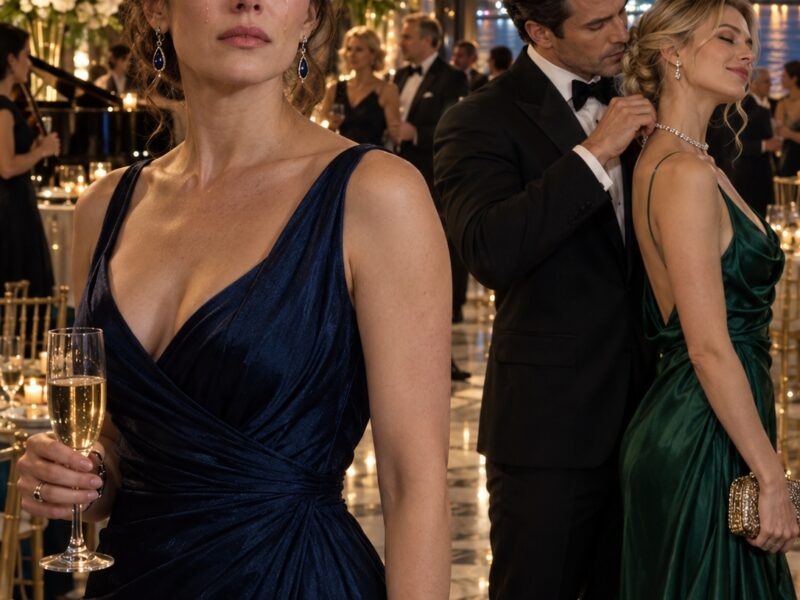
MY HUSBAND TOUCHED HIS FIRST LOVE AT MY GALA—HE HAD NO IDEA I OWNED THE DEBT KEEPING HIS EMPIRE ALIVE

I watched my husband fasten another woman’s necklace at the gala I had spent eleven months building.
His fingers rested lightly against the back of her neck.
Her dark hair had been swept over one shoulder so he could reach the clasp. She tilted her chin, smiling at something he whispered, and then he smiled back.
Not the polite smile he used for board members.
Not the thin, distracted smile he gave me when I asked whether he would be home for dinner.
This one reached his eyes.
For a second, the entire ballroom disappeared.
The string quartet near the staircase became a distant vibration. The laughter of three hundred donors blurred into meaningless noise. Crystal chandeliers glittered above us, champagne moved through the room on silver trays, and somewhere behind me, the mayor of Chicago was thanking one of our corporate sponsors.
But all I could see was my husband’s hand against another woman’s skin.
And the strangest thing was that I didn’t feel jealous.
I felt finished.
I stood twenty feet away in the midnight-blue gown I had chosen three weeks earlier, holding a champagne flute I no longer wanted, and understood with terrifying clarity that something inside me had finally died.
Not my dignity.
Not my confidence.
My hope.
Hope had been the most stubborn part.
It had survived three years of cold dinners and unanswered questions. It had survived the nights Adrian came home after midnight smelling faintly of perfume that wasn’t mine. It had survived the way he turned his phone facedown whenever I entered a room, the work trips that grew longer, the anniversaries that somehow became “bad timing,” and the mornings when I would look across our bed and realize the man beside me could have been sleeping a thousand miles away.
Hope had survived everything.
Until that necklace clasp.
Adrian looked up at last.
For one brief second, our eyes met.
His smile vanished.
He knew I had seen them.
Celeste followed his gaze and found me standing near the ballroom doors.
Her expression changed too, but not into embarrassment.
Into curiosity.
Almost amusement.
She placed one hand lightly over the necklace Adrian had just fastened.
I raised my glass.
A tiny gesture.
A toast.
Then I smiled.
Adrian’s face tightened.
He knew me well enough to understand that my silence was never empty.
He just didn’t know what it contained.
Not yet.
By sunrise the next morning, three law firms would have copies of documents that could dismantle my marriage.
Within forty-eight hours, the board of Adrian’s company would receive information capable of shaking the financial foundation beneath them.
And in ninety days, if the company failed to replace what my family controlled, the empire Adrian Caldwell had spent fifteen years building could begin collapsing under its own weight.
But standing in that ballroom, he still believed I was simply his quiet wife.
That had always been his greatest mistake.
My name is Iris Bennett Caldwell.
For three years, I was the most invisible woman in one of Chicago’s most photographed marriages.
From the outside, Adrian and I were everything people liked to believe money could buy.
He was forty-one, handsome in the severe, expensive way business magazines loved. Dark hair beginning to silver at the temples, tailored suits, disciplined posture, a voice that rarely rose because it never needed to. He had taken Caldwell Strategic Holdings from a regional logistics company into a national conglomerate with interests in commercial real estate, medical technology, freight infrastructure, and private data systems.
Journalists called him relentless.
Investors called him brilliant.
Competitors called him worse things privately.
When Adrian walked into a room, people adjusted themselves.
Assistants stood straighter.
Executives stopped checking their phones.
Bankers leaned forward.
He possessed that rare kind of authority that made people feel as if the air had shifted around him.
At home, however, he was mostly absent.
Not physically.
That would have been easier.
His shoes were still beside the mudroom bench every evening.
His coffee mug appeared in the kitchen sink every morning.
He slept on the left side of our bed and left his watch on the same leather tray every night.
We sometimes ate across from each other at the twelve-seat walnut dining table in our Gold Coast townhouse.
But presence and intimacy are not the same thing.
A man can sit three feet away from you and still make you feel alone.
I learned that slowly.
At first, I thought it was stress.
Caldwell Strategic was expanding aggressively when we married, and Adrian had always been ambitious. He could spend fourteen hours in negotiations and come home already mentally preparing for the next morning.
So I adjusted.
When dinner grew cold, I reheated it.
When he canceled weekend plans, I rescheduled them.
When he forgot small promises, I reminded myself that marriages between busy people required patience.
I had loved him enough to make excuses sound like wisdom.
The first year, I still confronted him.
“Are you happy?” I asked one night.
He looked up from his phone.
We were sitting in the library. A fire burned behind him, throwing warm light across his face.
“What kind of question is that?”
“A simple one.”
“Iris, I have a seven-thirty call with Tokyo.”
“That isn’t an answer.”
He exhaled and set the phone on his knee.
“Yes. I’m happy.”
“With me?”
Something flickered in his expression.
I noticed it.
I noticed everything.
“With our life,” he said.
It was such a carefully chosen sentence that I should have understood it immediately.
Instead, I smiled.
“Okay.”
He picked up his phone again.
I spent another year pretending the difference between those answers didn’t matter.
By the second year, the evidence became less philosophical.
A restaurant receipt from a place he claimed he had never visited.
A late-night call he took on the balcony during a snowstorm.
A bottle of perfume in the glove compartment of his car that he said belonged to his executive assistant.
His assistant was a sixty-two-year-old man named Frank who smelled aggressively of peppermint gum.
I didn’t accuse Adrian.
Not then.
My mother had taught me something when I was seventeen.
“Never demand the truth before you’re prepared for what the truth will require you to do.”
At seventeen, I thought she was talking about business.
At thirty-six, I understood she had been talking about life.
So I stopped asking questions to which Adrian could lie.
I started watching instead.
People mistook that for weakness.
They often did.
At charity luncheons, women occasionally lowered their voices and asked whether I ever felt intimidated by Adrian’s world.
I would smile.
“No.”
They assumed I meant because I trusted my husband.
What I meant was that Adrian’s world had never intimidated me.
He simply didn’t know why.
The public version of Iris Caldwell was elegant, discreet, philanthropic, and apparently uninterested in business.
I chaired the Caldwell Foundation.
I organized fundraising events.
I managed relationships with museums, hospitals, universities, community organizations, and political donors without ever becoming publicly political myself.
I remembered spouses’ names, children’s colleges, dietary restrictions, old grudges, quiet ambitions, and which executives should never be seated next to each other after the third cocktail.
I knew when to speak.
More importantly, I knew when silence would make someone reveal more than any question could.
Three years into our marriage, I could walk into nearly any room in Chicago’s corporate elite and tell within ten minutes who feared whom.
Adrian thought I planned dinners.
I built networks.
He thought I hosted parties.
I created environments in which people made decisions.
He thought the charity foundation existed to polish our public image.
He never realized that half the relationships protecting his reputation belonged to me.
Invisible women learn extraordinary things.
When people think you are decorative, they speak freely around you.
When they assume your influence comes from your husband, they never think to measure your own.
And when a powerful man believes you will always remain where he left you, he becomes careless.
Adrian became careless gradually.
His phone changed first.
He had once left it charging anywhere in the house. Then he started carrying it into the shower.
His schedule changed next.
Meetings appeared that weren’t on his executive calendar.
Then came the new lightness in his voice during certain calls.
That was the part that hurt most.
Adrian still laughed.
I simply wasn’t the person making him do it anymore.
One Tuesday evening, I stood outside his study holding two cups of coffee and heard it.
A warm, boyish laugh.
The kind I remembered from our first year together.
I froze.
“Stop,” he said to whoever was on the phone.
Another laugh.
“You always say that.”
There was softness in his voice.
History.
I waited.
He lowered his tone.
“No. She doesn’t know.”
Something inside me became very still.
I returned one cup of coffee to the kitchen.
Then I carried the other upstairs and drank it alone.
That was the night I stopped crying.
The next morning, I called my brother.
Marcus answered on the second ring.
“What happened?”
He didn’t say hello.
He knew me too well.
“I need you to start reviewing everything.”
Silence.
Then his tone changed.
“What does everything mean?”
“My marriage. My assets. The Caldwell exposure. All of it.”
Another pause.
“Does Dad know?”
“No.”
“Do you want him to?”
“Not yet.”
Marcus inhaled slowly.
“Iris.”
“I’m not leaving today.”
“That wasn’t what I was going to ask.”
“I know.”
He waited.
I looked out the kitchen window at the courtyard where frost covered the stone.
“I need to know exactly what walking away would look like before I decide whether to do it.”
Marcus understood.
“Give me forty-eight hours.”
It took him thirty-six.
The first report arrived encrypted.
By then, Adrian was asleep beside me.
I opened the file on my tablet at two in the morning.
I read every page.
Then I locked the screen, placed the tablet on my nightstand, and stared into the darkness.
The truth was worse than I had expected.
But not for the reason you might think.
There was no secret second family.
No hidden apartment.
No string of hotel charges with one woman’s name.
Instead, there were fragments.
Dinners.
Private calls.
Transfers from corporate hospitality accounts.
Unusual travel overlaps.
Nothing individually explosive.
Together, however, they revealed a man creating space in his life for someone he had not yet publicly acknowledged.
And buried inside Marcus’s notes was one name.
Celeste Morgan.
I knew it before I knew why it mattered.
Some names arrive carrying weight.
I searched my memory.
Then I remembered.
Years earlier, before Adrian proposed, we had been at dinner with one of his college friends when someone mentioned a woman named Celeste.
Adrian’s entire body had changed.
Barely.
But enough.
He had reached for his wine.
His friend had immediately switched subjects.
I had asked about her later.
“Old girlfriend,” Adrian said.
“Serious?”
“College.”
“That doesn’t answer the question.”
He smiled then.
That old smile.
“No, Iris. Nothing you need to worry about.”
That had been six years ago.
Celeste Morgan had moved to Paris after graduate school and built a respected career in luxury fashion consulting. According to the report Marcus sent me, she had returned to Chicago permanently three months earlier.
She had also met Adrian for dinner four times in six weeks.
I sat in my dark bedroom and listened to my husband breathe.
Strangely, I felt calmer than I had in months.
There is a particular kind of peace that arrives when suspicion turns into information.
Painful information is still information.
And information can be acted upon.
The next morning, Adrian entered the kitchen at seven-ten.
I had already dressed.
Black trousers.
Cream silk blouse.
Hair pinned back.
Coffee waiting beside his newspaper, exactly the way he liked it.
He kissed my cheek.
“You’re up early.”
“I’m always up early.”
He looked at me.
For half a second, I wondered if he heard the difference.
He didn’t.
“I’ll be late tonight.”
“Meeting?”
“Yes.”
“With whom?”
His hand paused around the coffee cup.
There it was.
Less than a second.
“A few people from Northbridge.”
I smiled.
“Sounds important.”
“It is.”
Northbridge had nothing scheduled with Caldwell that day.
At seven-forty, he left.
At eight-fifteen, I called Marcus.
“He lied.”
My brother was quiet.
“You sound surprised.”
“I’m not.”
“Then why tell me?”
“Because I wanted to know whether he could still look me in the eye while doing it.”
“And?”
I looked at the untouched second cup of coffee across from me.
“Yes.”
Marcus swore softly.
I closed my eyes.
“It’s okay.”
“No, Iris. It isn’t.”
“I didn’t say it was right. I said I’m okay.”
That distinction became important.
By then, I had begun remembering who I was before I became Mrs. Caldwell.
Adrian had never understood my family completely.
That was partly my fault.
And partly deliberate.
I was born Iris Bennett, daughter of Nathaniel Bennett, founder of Bennett Global Capital.
If that name meant little to most people outside finance, my father preferred it that way.
Bennett Global was not glamorous.
We didn’t sponsor stadiums.
We didn’t put our logo on skyscrapers.
My father avoided magazine profiles and had declined so many television interviews that financial journalists eventually stopped asking.
But through infrastructure funds, private credit, institutional investment vehicles, and long-term debt positions, Bennett Global had interests in dozens of companies across North America and Europe.
My father used to say wealth became noisy when people needed strangers to believe they had it.
Real leverage preferred silence.
Adrian knew my father was successful.
He did not know the full scale.
When we married, Dad had insisted on strict separation between my family holdings and the Caldwell name.
Adrian respected that because he interpreted it as pride.
He believed my father didn’t want his daughter’s wealth absorbed into another family.
That was true.
But incomplete.
What Adrian did not know was that Bennett Global indirectly controlled a significant portion of the institutional credit facilities supporting Caldwell Strategic’s expansion.
Not because I had engineered it after our marriage.
The position predated us.
Years before Adrian and I met, Bennett funds had participated through private lending vehicles in commercial debt supporting one of Caldwell Strategic’s earliest acquisitions.
Over time, as the company expanded, those positions grew.
By the time Adrian married me, entities tied to my family’s investment structure held enough influence over Caldwell’s debt arrangements that withdrawing future support would not destroy his company overnight—but it could make refinancing brutally expensive.
Adrian had built a legitimate business.
I had never wanted to take that away from him.
Nor could I simply “own his company” because I was angry.
Real finance is more complicated than revenge stories.
But companies that expand quickly often depend on confidence.
Confidence depends on liquidity.
Liquidity depends on relationships.
And relationships can change.
My father had always kept business separate from my marriage.
So had I.
Until Adrian began treating my loyalty like infrastructure he could use without maintaining.
Even then, I did nothing immediately.
I still loved him.
That is the part people misunderstand when they hear stories like mine.
Leaving someone does not always begin when love ends.
Sometimes leaving begins because love remains, but dignity can no longer survive beside it.
I gave Adrian chances he never knew were chances.
A weekend in Wisconsin.
Dinner at the restaurant where he proposed.
A walk along the lake on our anniversary.
Each time, I left openings.
He filled them with silence.
Once, during dinner, I said, “Do you ever think about who we were five years ago?”
He checked a message before replying.
“We were younger.”
“That isn’t what I asked.”
His eyes lifted.
“Iris, what is this?”
“Nothing.”
He put the phone down.
“You’ve been strange lately.”
I almost laughed.
“Have I?”
“Yes.”
“How?”
“Watching me.”
The sentence hung there.
He had noticed.
Not my loneliness.
Not my unhappiness.
My attention.
I leaned back.
“Should that bother you?”
His expression hardened.
“No.”
“Then eat your dinner.”
For the first time in years, Adrian looked uncertain around me.
That should have warned him.
Instead, it irritated him.
Celeste’s return became public two months later.
A mutual acquaintance mentioned her at a museum luncheon.
“I heard Celeste Morgan is back from Paris.”
I kept spreading butter across a small piece of bread.
“Is she?”
“You know her?”
“No.”
The woman across from me lowered her voice.
“She and Adrian were apparently inseparable at Northwestern.”
I looked up.
“Inseparable?”
She immediately regretted telling me.
“Oh, college stories. Ancient history.”
I smiled.
“Of course.”
That evening, Adrian mentioned Celeste for the first time.
We were halfway through dinner.
He cut into his steak without looking up.
“An old friend moved back.”
I already knew what was coming.
“Who?”
“Celeste Morgan.”
I took a sip of wine.
“The fashion consultant?”
His fork stopped.
“You know who she is?”
“I read.”
Something unreadable passed over his face.
“She may attend the foundation gala.”
There it was.
He had decided to bring his first love into the event I created.
Into my room.
Into my work.
Into the public space where I had spent years making him shine.
“Wonderful,” I said.
Adrian looked at me, probably expecting something else.
“You don’t mind?”
“Why would I?”
“She’s an old friend.”
“So you said.”
He watched me.
Then nodded.
That night, I walked into my private study and locked the door.
Marcus answered immediately.
“She’s attending the gala,” I said.
“Adrian invited her?”
“Yes.”
A long silence.
Then: “What do you want to do?”
I looked at the framed photograph on my desk.
Adrian and me on our wedding day.
I had never looked happier.
“Move faster.”
Marcus did not ask whether I was sure.
He had been waiting for those words.
For the next six weeks, I lived two lives.
In one, I remained Iris Caldwell.
I reviewed floral arrangements.
Approved security plans.
Adjusted the seating chart when two donors ended a business partnership badly.
Tested the menu.
Reviewed the auction catalogue.
Met with the children’s hospital that would receive the largest grant of the evening.
I smiled for photographs.
I chose table linens.
I listened while Adrian complained about quarterly targets.
Then, when the house went quiet, I became Iris Bennett again.
Attorneys reviewed the prenuptial agreement.
Tax advisers traced assets.
Independent counsel examined every entity connected to me before marriage.
Marcus and our family’s investment committee reviewed Caldwell Strategic’s credit exposure.
No shortcuts.
No threats.
No illegal leverage.
No using confidential marital information to sabotage Adrian.
I wanted the line between justice and vengeance to remain visible.
I was leaving a marriage.
I was not committing a crime.
“Everything has to survive scrutiny,” I told Marcus.
“It will.”
“If a journalist reads it?”
“Clean.”
“If Adrian sues?”
“Clean.”
“If Dad hates what we did?”
Marcus smiled slightly across the conference table.
“Dad taught us how to do it.”
I almost smiled back.
Almost.
The legal separation was easier than the emotional one.
Most of my personal assets had remained separate.
The house Adrian and I lived in belonged to a trust tied to Caldwell.
I had no desire to fight for it.
The art I brought into the marriage could be removed.
My inherited holdings remained mine.
My charitable work could continue independently.
There were no children.
Once, that fact had broken my heart.
Now I sometimes wondered whether life had protected me in a way I had not understood.
The financial piece was more complicated.
Bennett Global could not simply demand repayment of every obligation tied to Caldwell.
Contracts existed.
Terms mattered.
But some financing arrangements were approaching renewal.
Certain discretionary commitments could legally be declined.
Future participation could be withdrawn.
My family did not need to attack Caldwell Strategic.
We simply had to stop protecting its growth.
When I saw the final analysis, I sat back in my chair.
“So the company survives.”
Marcus folded his hands.
“If Adrian responds intelligently, yes.”
“And if he doesn’t?”
“Then leverage becomes expensive. Ratings pressure rises. Expansion stops. Asset sales become possible.”
“I don’t want him destroyed.”
Marcus studied me.
“You still love him.”
I looked away.
“That wasn’t my question.”
“No.”
I waited.
He understood.
“You’re withdrawing your family’s support,” he said. “You’re not causing his mistakes. If the company cannot function without relationships he never bothered to understand, that’s a governance problem.”
I hated how reasonable that sounded.
Because reason does not numb grief.
The gala arrived on a Saturday in October.
The ballroom at the Langham glowed beneath thousands of suspended lights designed to resemble stars.
White orchids spilled from tall glass arrangements.
The Chicago River reflected against floor-to-ceiling windows.
Women arrived in couture.
Men arrived wearing watches worth more than houses.
A jazz trio played during cocktails before giving way to the string ensemble.
Every major sponsor had been placed carefully.
Every speech timed.
Every server briefed.
I had built the evening down to the minute.
At seven-seventeen, Celeste Morgan arrived.
I recognized her immediately.
Emerald gown.
Black hair.
Elegant posture.
Forty years old and beautiful in a way that came from discipline rather than youth.
She entered alone.
But she looked around as though expecting someone.
Then she saw me.
And smiled.
She crossed the room.
“So,” she said, extending one hand, “you’re Iris.”
Not Mrs. Caldwell.
Iris.
A small choice.
Intentional.
I took her hand.
“And you’re Celeste.”
Her eyes moved over my face.
Evaluating.
Women are sometimes accused of being cruel to one another over men.
I’ve always thought that explanation was too simple.
The real cruelty often comes from status.
Who believes she has been chosen.
Who believes the other woman has been tolerated.
Celeste’s expression contained the confidence of someone who believed she already understood the hierarchy.
“I’ve heard a lot about you.”
“Have you?”
“Adrian speaks very highly of the foundation.”
The foundation.
Not me.
I smiled.
“That sounds like Adrian.”
She tilted her head.
“I hope this isn’t awkward.”
There it was.
Presented as kindness.
Designed as dominance.
I leaned slightly closer.
“It isn’t awkward for me.”
Something in my voice made her blink.
I added softly, “I imagine uncertainty is more difficult for the person waiting to see what a married man decides.”
Her smile froze.
I released her hand.
“Enjoy the evening.”
Then I turned to greet a hospital trustee.
I could feel her staring at my back.
At eight-twenty, Adrian arrived at my side.
“What did you say to Celeste?”
I looked toward the stage.
“Hello.”
“Iris.”
“What?”
“She seems upset.”
“How attentive of you.”
His jaw tightened.
“This is an important evening.”
“I know. I created it.”
“That isn’t what I meant.”
I finally turned.
For years, I had avoided public confrontation because I believed protecting our marriage mattered.
That night, something had shifted.
I looked directly into his eyes.
“I know exactly what you meant, Adrian.”
He said nothing.
Neither did I.
A photographer approached.
We turned automatically.
Adrian placed one hand at my waist.
I smiled.
The flash exploded.
The photograph would appear online before midnight.
People would comment on what a beautiful couple we made.
That was the night I learned photographs record proximity, not truth.
Dinner began.
The auction raised more than four million dollars in forty minutes.
I gave a speech about pediatric care, thanked the hospital staff, announced a new grant, and received a standing ovation I had not expected.
When I stepped away from the podium, Adrian kissed my cheek.
“That was good.”
Good.
Three years of my life reduced to an adjective men use for parking spots.
“Thank you.”
Later, during cocktails, I saw Celeste struggling with the clasp of her necklace.
Or pretending to.
She stood near a mirrored column.
Adrian was beside her.
I watched her laugh and touch the chain behind her neck.
He reached out.
“Here.”
My body went cold.
She turned.
He moved her hair aside.
His fingers found the clasp.
And then came the smile.
That smile.
The one I had spent years waiting to receive again.
In that moment, I did not think about money.
I did not think about Bennett Global.
I did not think about lawyers or credit facilities or prenuptial agreements.
I thought about a Tuesday morning two years earlier when Adrian had been sick with influenza and I sat beside him on the bathroom floor at four in the morning because he was too dizzy to stand.
I thought about packing his suitcase for his father’s funeral because grief had made him forget how to move.
I thought about the first apartment we shared before the townhouse.
I thought about every birthday cake.
Every handwritten note.
Every time I defended him when my father said, “Powerful men become dangerous to themselves when nobody in their life tells them no.”
I had told Dad Adrian was different.
Maybe Adrian had been different.
Once.
But people are not judged only by who they were when loving you was easy.
Adrian finished fastening the necklace.
Celeste touched his arm.
Then he saw me.
And I knew.
Not that my husband was having an affair.
I still did not know exactly how far their relationship had gone physically.
I knew something more important.
He had allowed intimacy to grow somewhere else while watching our marriage starve.
The legal definition no longer mattered.
The emotional one was enough.
I raised my glass.
Smiled.
And left the ballroom.
Marcus was waiting in the hotel’s private lounge upstairs.
He stood when I entered.
One look at my face and he stopped speaking.
I removed my earrings.
Placed them on the table.
Then I sat down.
“Send everything Monday.”
He stared at me.
“You saw something.”
“Yes.”
“Do you want to tell me?”
“No.”
He nodded.
“Okay.”
I looked toward the windows.
Chicago glittered below us.
Cars moved along Wacker Drive.
Boats cut through black water.
Thousands of people continued living ordinary Saturday nights while mine quietly ended.
Marcus poured me water.
I drank half the glass.
“Does it hurt?” he asked.
The question nearly broke me.
Not because I didn’t know the answer.
Because I did.
“Yes.”
Marcus looked down.
I had spent weeks speaking like a strategist.
That was the first time I admitted I was still a wife.
He came around the table and crouched beside my chair.
“You can change your mind.”
“No.”
“You can wait.”
“I already waited.”
“You can confront him first.”
I closed my eyes.
“For what? Another lie?”
Marcus did not answer.
I whispered, “I don’t need him to confess before I believe what I saw.”
The following morning, Adrian slept until nine.
I was in the garden room reading when he appeared.
“Why did you leave?”
“I was tired.”
“You disappeared.”
“I came home.”
“You left our event without telling me.”
Our event.
I lowered the newspaper.
“Did the evening survive?”
His expression tightened.
“Iris.”
“Adrian.”
“What is going on with you?”
For several seconds, I simply looked at him.
He wore gray sweatpants and a white T-shirt.
His hair was still messy from sleep.
He looked younger.
Human.
It would have been easier if he looked cruel.
The people who hurt us rarely look like villains when they stand in our kitchens.
“I’m tired,” I said.
“You keep saying that.”
“Maybe you should listen.”
He stared at me.
Then came the question I had been waiting three years to hear.
“Are you unhappy?”
Too late.
Four words.
Three years too late.
I almost told him everything.
Instead, I asked, “Are you?”
He looked away first.
And that was my answer.
The next forty-eight hours moved with almost unbearable normality.
Adrian went to work Monday morning.
I met with my attorney.
He texted that he would miss dinner.
I reviewed the separation agreement.
He came home after midnight.
I pretended to be asleep.
Tuesday morning, I woke at four-fifty.
I showered slowly.
Dried my hair.
Put on an ivory cashmere sweater and tailored trousers.
No black.
I didn’t want the morning to feel like a funeral.
I packed only what mattered.
Documents.
Jewelry from my mother.
Clothes I had owned before Adrian.
Two paintings.
A collection of letters from my grandmother.
My favorite books.
A ceramic bowl my brother made badly in high school.
I left everything else.
By six-fifteen, three discreet moving vans had already taken the items identified by our attorneys.
The household staff had been told I was traveling.
I did not want witnesses.
At six-thirty, I stood in our bedroom.
Adrian was already downstairs taking a call.
The bed was made.
Sunlight had begun entering through the curtains.
I opened my jewelry box.
My wedding ring looked absurdly small in my palm.
How can something weigh so little and carry so many years?
I remembered the day Adrian gave it to me.
Navy Pier after hours.
Cold wind.
His hands shaking.
“I know I’m difficult,” he had said.
“You are.”
“And I know I work too much.”
“You do.”
“And I know your father thinks I’m arrogant.”
“He does.”
Adrian had laughed.
Then his face became serious.
“But I will spend my life making sure you never regret choosing me.”
I had believed him.
That was not stupidity.
I refuse to rewrite my younger self as foolish simply because she trusted someone who later broke that trust.
She loved honestly.
There is nothing shameful about that.
I placed the ring on Adrian’s nightstand.
Not thrown.
Not hidden.
Centered.
Beside it, I placed a cream envelope.
Inside were two letters.
The first was from my attorney.
The second bore the letterhead of Bennett Global Capital.
The separation agreement was respectful.
No theatrics.
No accusations.
No public statements.
No attempt to seize what belonged to Adrian.
The Bennett letter was equally unemotional.
It informed Caldwell Strategic’s finance department that Bennett-controlled funds would not participate in several upcoming refinancing extensions or discretionary support arrangements after their contractual obligations expired.
Professional.
Lawful.
Devastating.
Not because Bennett Global was Adrian’s only source of capital.
It wasn’t.
But our participation had often encouraged others.
Remove the anchor investor, and everyone starts checking the rope.
I carried one final suitcase downstairs.
Adrian stood in the kitchen with his phone against his ear.
He stopped speaking when he saw me.
His eyes moved to the suitcase.
Then back to my face.
“I’ll call you back.”
He ended the call.
“Where are you going?”
I set the suitcase down.
“Out.”
“For how long?”
“I don’t know.”
His face changed.
“What happened?”
The question almost made me laugh.
Instead, I felt something much sadder.
He truly did not know.
Or had trained himself not to.
“I left something upstairs.”
His eyes narrowed.
“Iris.”
“Read it after I’m gone.”
“What did you leave?”
I picked up my suitcase.
Adrian stepped forward.
“Stop.”
I did.
For three years, I had wanted him to stop me.
Not physically.
Emotionally.
To notice.
To ask.
To fight.
Now, standing five feet from the front door, I realized his concern had finally awakened because my departure made my unhappiness inconvenient.
“What is this?” he demanded.
I looked at him.
“This is me believing you.”
His forehead creased.
“Believing what?”
“Everything you never said.”
“I don’t understand.”
“No,” I whispered. “You don’t.”
I reached for the door.
His voice changed.
“Iris, is this about Celeste?”
My hand froze.
There it was.
He knew enough to name her.
I turned slowly.
“Should it be?”
Adrian opened his mouth.
Nothing came out.
Sometimes silence confesses more efficiently than language.
I nodded once.
“Goodbye, Adrian.”
He followed me onto the front steps.
Marcus’s car waited at the curb.
“Iris.”
I kept walking.
“We can talk about this.”
I opened the car door.
“I tried talking to you for three years.”
“That’s not fair.”
I looked back.
The man I loved stood framed by the doorway of the house I had spent years making into a home.
He looked angry.
Confused.
Afraid.
For one dangerous second, my heart remembered everything.
Then I remembered Celeste turning her head while his fingers brushed her neck.
I got into the car.
Marcus drove away.
I did not look back.
At seven-twelve, Adrian found the ring.
At seven-fourteen, he opened the attorney’s letter.
At seven-seventeen, he read the Bennett notice.
At seven-twenty-one, according to phone records later provided during the divorce process, he called me for the first time.
By noon, he had called forty-six times.
By six, sixty-eight.
I answered none.
My attorney answered his.
At eight that evening, Marcus entered the apartment where I was staying and found me sitting on the floor surrounded by unopened boxes.
“He’s losing his mind.”
I kept folding a sweater.
“Is he?”
“His CFO called Bennett.”
“What did you tell them?”
“That contractual obligations remain intact, but future participation will be evaluated independently.”
“Good.”
“Adrian wants to speak to you.”
“No.”
Marcus sat across from me.
“Celeste was at the house.”
My hands stopped.
“When?”
“This morning.”
I looked up.
“How do you know?”
“One of Adrian’s calls came while she was there. He didn’t realize the call had connected to counsel’s voicemail for six seconds before hanging up.”
I felt something cold move through my chest.
“What was she doing there?”
Marcus hesitated.
“Iris.”
“What was she doing there?”
“I don’t know.”
That was the truth.
And somehow uncertainty hurt more.
I resumed folding.
After a moment, Marcus said, “You don’t have to pretend with me.”
“I’m not pretending.”
“You’re folding the same sweater for the third time.”
I looked down.
He was right.
My hands began shaking.
I dropped the sweater.
Then the grief came.
Not gracefully.
Not like movies.
I folded forward, covered my face, and made a sound I did not recognize.
Marcus moved beside me.
For twenty minutes, I cried so violently my ribs hurt.
I cried for the marriage.
For the woman I had been inside it.
For the children we never had.
For the coffee.
For the anniversary trips.
For Adrian’s hand on my back while we slept during the first year.
For every tiny tenderness that had been real before neglect began rewriting our story.
That night, I learned a person can leave with dignity and still collapse afterward.
Strength is not the absence of devastation.
Sometimes strength is choosing correctly while devastated.
Three days later, Adrian sent me a message.
I did not read it immediately.
When I finally opened it, it said:
I never meant for this to happen.
I stared at those words for a long time.
Not “I’m sorry I hurt you.”
Not “I love you.”
Not “I was wrong.”
I never meant for this to happen.
As though our marriage had been weather.
As though he had simply been standing outside when the storm arrived.
I typed three different replies.
Deleted them all.
Then wrote:
Neither did I.
That was the only direct message I sent him for two months.
The consequences at Caldwell Strategic began quietly.
First, one refinancing partner requested additional due diligence.
Then another lender adjusted its risk assessment.
A planned acquisition was postponed.
A bond offering became more expensive.
None of it made dramatic headlines at first.
Real corporate trouble rarely begins with explosions.
It begins with meetings.
Questions.
Emails sent at 11:40 p.m.
Calls from people who used to answer immediately but now say they need to “review internally.”
The board asked Adrian why Bennett Global had changed its posture.
For the first time, he was forced to explain that his estranged wife was Nathaniel Bennett’s daughter.
Apparently, several directors had never understood the relationship.
One did.
An older board member named Warren Pike, who had been in finance longer than Adrian had been alive.
According to Marcus, Warren stared at Adrian during the meeting and said, “You married Nathaniel Bennett’s daughter and never asked what her family controlled?”
Adrian replied, “Our marriage was separate from business.”
Warren said, “Clearly not separate enough for you to understand the risk.”
Adrian hated being embarrassed.
That sentence reportedly ended the meeting.
Celeste disappeared from public view two weeks later.
I knew because people started telling me.
I never asked.
Friends have a strange instinct during divorce.
They bring you information like gifts.
“I heard Celeste isn’t staying in Chicago.”
“I saw her at O’Hare.”
“She deleted photographs.”
“Someone said Adrian ended it.”
“Someone else said she left him.”
I responded the same way.
“I hope she’s well.”
Most people thought I was being elegant.
The truth was more selfish.
If I let Celeste become the center of my anger, I would never confront the person who had actually made vows to me.
She had not promised me fidelity.
Adrian had.
And even Adrian was no longer where I wanted to spend my emotional energy.
Three months after I left, the divorce negotiations began.
Adrian requested mediation.
I agreed.
We met in a conference room downtown.
The first time I saw him after leaving, my body betrayed me.
My heart accelerated.
My palms became cold.
Memory is physical before it is rational.
Adrian looked tired.
He had lost weight.
His suit hung differently.
When I entered, he stood.
“Iris.”
“Adrian.”
Our attorneys sat at opposite sides of a long table.
He kept looking at me.
I refused to fill the silence.
Eventually, he said, “Can we have five minutes alone?”
My attorney looked at me.
I nodded.
Everyone left.
The door closed.
Adrian remained standing.
“You changed your hair.”
I almost smiled.
Of all the things.
“Yes.”
“It’s shorter.”
“I know.”
Silence.
Then he moved around the table.
“I didn’t sleep with her before you left.”
I stared at him.
There it was.
The defense he had apparently been rehearsing.
“I thought you deserved to know.”
“Did you love her?”
His mouth closed.
I nodded.
“Thank you.”
“That isn’t what I said.”
“You didn’t need to.”
“Iris, it wasn’t—”
“What? Simple?”
He ran a hand through his hair.
“She came back into my life at a time when things between us were already…”
He stopped.
“Already what?”
“Distant.”
I felt anger rise for the first time in months.
“Do not do that.”
His eyes narrowed.
“Do what?”
“Describe the distance like it walked into our house by itself.”
“I’m not blaming you.”
“You are dividing responsibility so evenly that neither of us has to remember who kept leaving the room.”
“That isn’t fair.”
I laughed once.
Softly.
“You love that sentence.”
“Because you have rewritten our marriage as if I was some monster.”
“I haven’t told anyone anything about our marriage.”
“I know.”
That stopped him.
I leaned back.
“That’s the part you can’t understand, Adrian. I’m not trying to destroy you. I’m not leaking messages. I’m not calling reporters. I’m not telling donors. I’m not humiliating you.”
“Bennett pulling financing feels pretty close.”
“No.”
My voice sharpened.
“That is business.”
“You expect me to believe your family changed its position at exactly the moment you left by coincidence?”
“No.”
“Then don’t insult me.”
“I’m not. We supported opportunities involving your company partly because I was invested in the future we were building together. That future no longer exists. Bennett Global is under no obligation to keep giving Caldwell preferential confidence forever.”
“Preferential?”
“Yes.”
His face went still.
That word hurt him more than anything else I had said.
“You think I built my company because of your family?”
“No.”
“Because that’s what everyone suddenly seems to think.”
“I think you built an extraordinary company. I also think extraordinary companies still depend on capital. Both things can be true.”
His jaw flexed.
“You could fix this.”
There it was.
Not our marriage.
His company.
Something in me became quiet again.
“I could help,” I said. “That is different from being obligated to.”
Adrian stared at me.
Then realized what he had done.
His face changed.
“I didn’t mean it like that.”
“I know.”
“God, Iris.”
He sat down.
For a moment, neither of us spoke.
Then he looked at his hands.
“I loved her once.”
I waited.
“I think when she came back, I remembered who I was before everything got so heavy.”
“And I represented the heavy part.”
“No.”
“Be honest.”
He closed his eyes.
“You represented responsibility.”
The sentence went through me like glass.
I did not cry.
He continued quickly.
“That sounds worse than I mean it.”
“It sounds exactly like you mean it.”
“You were the house. The foundation. The events. The family expectations. The board dinners. The future. Celeste was…”
“Escape.”
He looked at me.
“Yes.”
I nodded slowly.
Finally.
The truth.
Painful.
Ugly.
Useful.
“So you loved what I carried,” I said, “but resented me because I reminded you it had weight.”
His eyes filled.
It was the first time I had ever seen Adrian Caldwell close to tears.
“I didn’t know I was doing that.”
“I believe you.”
That hurt him more.
“Iris.”
“I believe you didn’t understand. But being unaware of the damage you cause doesn’t make the damage imaginary.”
He looked away.
I stood.
“Let’s bring the attorneys back.”
“Is there really nothing left?”
I paused with my hand on the door.
There had been nights during those first three months when I imagined this exact moment.
In some versions, Adrian apologized perfectly.
In others, I collapsed into his arms.
In the loneliest versions, I returned home because grief convinced me familiarity was the same thing as love.
But standing there, I suddenly saw the future clearly.
If I went back now, I would spend the rest of my marriage wondering whether he had chosen me or simply feared losing everything that came with me.
I could never live inside that question.
“There’s history,” I said.
“That isn’t nothing.”
“No.”
“And love?”
I swallowed.
“Yes.”
Hope appeared in his face.
I finished softly, “But love is not always an instruction to stay.”
Then I opened the door.
Our divorce was finalized seven months later.
I kept my name.
Not Caldwell.
Bennett.
Iris Bennett.
The first time I signed it on a document after the divorce, I stared at the ink until it blurred.
Not because I regretted leaving.
Because names carry versions of ourselves.
I had been Iris Caldwell.
I had loved being Iris Caldwell once.
I did not need to despise that woman in order to become someone else.
A month later, I moved to Boston.
Chicago had become crowded with ghosts.
Restaurants.
Streets.
Hotels.
The corner where Adrian once stopped the car during a thunderstorm just to kiss me because, according to him, “rain makes people honest.”
I needed a city that did not know my marriage.
Boston gave me distance without anonymity.
Bennett Global already maintained an East Coast office, but I had never worked there full-time.
I changed that.
My father did not hand me control.
He would have considered that insulting.
I joined the investment committee formally.
Then I led a restructuring of our healthcare portfolio.
Then a renewable infrastructure deal.
Then a distressed-credit acquisition my father initially opposed.
“You’re too emotionally close to risk right now,” he told me.
We were sitting in his office overlooking Boston Harbor.
I stared at him.
“Did you just tell me I’m too emotional to evaluate risk?”
Dad sighed.
“I knew that sentence would go badly.”
“It should.”
“I’m worried about you.”
“Then say you’re worried about me.”
“I’m worried about you.”
“Thank you.”
He almost smiled.
“But the deal is still too risky.”
“Now we can argue about the deal.”
We did.
For three hours.
I won.
Not because I was his daughter.
Because my numbers were better.
Eighteen months after I left Adrian, Bennett Global closed three of the largest deals in its history.
A financial magazine put my photograph on its cover.
I nearly declined.
Marcus convinced me not to.
“You spent years hiding.”
“I wasn’t hiding.”
“You know what I mean.”
I looked at the proposed headline.
IRIS BENNETT IS DONE STANDING BEHIND THE CURTAIN.
I hated it.
Which meant he was probably right.
The photograph was taken in our Boston office.
No diamonds.
No gala gown.
Navy suit.
White shirt.
My hair shorter now.
My expression calm.
When the issue appeared, hundreds of people sent messages.
The one that affected me most came from a woman I did not know.
She wrote:
I spent fifteen years making my husband’s life possible and thought that meant I had no life without him. Thank you for reminding me that starting over is not the same as starting from nothing.
I read it three times.
Then I closed my office door and cried.
Not because I felt powerful.
Because I knew exactly how she felt.
Success did not heal everything.
Time did some of the work.
Routine did more.
I bought a townhouse in Cambridge with tall windows and a small garden behind it.
The first spring, I planted hydrangeas.
I killed two immediately.
My gardener laughed.
“You’re overwatering.”
“I’m attentive.”
“You’re drowning them.”
The metaphor was so obvious I actually laughed.
A real laugh.
The kind that surprised me.
I hired him to teach me instead of replacing the plants.
Every Sunday morning, unless work made it impossible, I went outside with coffee and learned how to care for things without controlling them.
Some plants needed cutting back.
Some needed shade.
Some needed to be moved.
Some died despite every effort.
And some came back after winter looking like nothing could have survived.
I understood the appeal.
Marcus visited often.
My father pretended he didn’t worry.
My mother worried enough for everyone.
She arrived one weekend carrying groceries and inspected my refrigerator like the collapse of my marriage had somehow made me incapable of buying vegetables.
“You have mustard.”
“I know.”
“And yogurt.”
“Yes.”
“This is not food.”
“I eat at restaurants.”
“That’s worse.”
“I’m thirty-eight.”
“And somehow still my child.”
She made soup.
I let her.
That night, we sat on the kitchen floor drinking wine.
“Did you know?” I asked her.
“About Adrian?”
“Yes.”
“Not specifically.”
“But you knew something was wrong.”
She looked into her glass.
“Mothers know when their daughters start sounding careful.”
I swallowed.
“Why didn’t you say anything?”
“Because you weren’t ready to hear it.”
I thought about my own silence.
“Dad never liked him.”
“Your father liked Adrian.”
“He tolerated him.”
“No. He liked him. Which made him more disappointed.”
I looked at her.
“What did Dad think happened?”
My mother smiled sadly.
“The same thing powerful men often let happen.”
“What?”
“He confused being needed with being loved.”
I never forgot that.
Adrian’s company survived.
I was glad.
Caldwell Strategic sold two divisions, paused a major acquisition strategy, reduced debt, and brought in a new CFO.
The business press described the period as a “strategic reset.”
I knew enough to understand what that phrase meant.
Pain with expensive consultants.
Adrian stepped down as CEO for six months but remained executive chairman.
When he returned, the company was smaller.
Healthier.
Less arrogant.
So, according to people who still moved between our circles, was he.
I never asked.
His life no longer belonged to me.
That should have been the end.
It wasn’t.
Fourteen months after our divorce became final, Adrian appeared in the lobby of my Boston office.
My assistant, Sophie, called me.
“There’s a man downstairs asking to see you.”
“Name?”
A pause.
“Adrian Caldwell.”
I stopped typing.
Outside my windows, rain streaked the glass.
For several seconds, I heard nothing but the soft hum of the ventilation system.
“Did he say why?”
“No.”
“Does he have an appointment?”
“No.”
Sophie hesitated.
“Do you want security to ask him to leave?”
Once, I would have been afraid of what seeing him might do to me.
Now I was curious.
“Send him up.”
Five minutes later, my office door opened.
Adrian walked in.
Time had changed him.
Not dramatically.
He was still unmistakably himself.
Tailored charcoal suit.
Same posture.
Same controlled stride.
But something essential had been removed.
Certainty, perhaps.
The belief that every room would eventually arrange itself according to his preferences.
He stopped several feet from my desk.
“Iris.”
“Adrian.”
His eyes moved over me.
“You look well.”
“I am well.”
“I saw the magazine.”
“I assumed half the country did. Marcus bought enough copies.”
A small smile touched Adrian’s face.
Then disappeared.
“Can I sit?”
I gestured toward the chair.
He sat.
I did not move from behind my desk.
For a few moments, neither of us spoke.
Once, silence between us had felt like abandonment.
Now it felt neutral.
That surprised me.
“I was in New York,” he said.
“And decided Boston was close?”
“No.”
He looked down briefly.
“I came to see you.”
“Why?”
His jaw shifted.
The old Adrian would have prepared a speech.
This man seemed to be searching for honesty in real time.
“I wanted to apologize.”
“You already did during the divorce.”
“No.”
He shook his head.
“I explained. I defended. I admitted things when there was no other option. That wasn’t the same.”
I waited.
He looked directly at me.
“I didn’t see you.”
Four words.
Simple.
Brutal.
True.
Something moved through me.
Not pain exactly.
Recognition.
“I know,” I said.
His eyes became wet.
“I thought I did.”
“You saw what I did.”
He nodded.
“The foundation. The house. The dinners. My schedule. My family. My company.”
“Yes.”
“I saw everything you provided and somehow stopped seeing the person providing it.”
I said nothing.
He rubbed his thumb against his palm, an old nervous habit.
“I blamed you for becoming part of the structure of my life.”
I remembered mediation.
Responsibility.
Escape.
He continued.
“Then you left, and I discovered how much of that structure had been built by you. But that still wasn’t the worst part.”
“What was?”
“I started remembering the first year.”
I looked toward the rain.
“The apartment.”
“Yes.”
It had been small.
Too warm in summer.
Radiator banging all winter.
One bedroom.
Secondhand couch.
We had been happier there than in the townhouse with six fireplaces.
“You used to leave notes in my briefcase,” he said.
“You hated them.”
“I pretended to.”
“You complained they got stuck to documents.”
“I kept them.”
I looked back at him.
That surprised me.
He smiled sadly.
“I still have them.”
I did not know what to say.
He took a breath.
“I’m not here because Caldwell is stable again.”
“I didn’t think you were.”
“And I’m not here because Celeste left.”
I remained silent.
“She left three weeks after you did.”
“I heard.”
“She told me she hadn’t come back to spend her life helping a man rebuild what he had lost.”
I almost laughed.
Adrian did.
A quiet, embarrassed sound.
“She was honest, at least.”
“Eventually.”
“Yes.”
The rain thickened against the windows.
He looked around my office.
Books.
Deal files.
A framed photograph of Marcus and me.
No photographs of my old life.
“I spent a long time angry at you.”
“That doesn’t surprise me.”
“I thought what Bennett did was punishment.”
“It wasn’t.”
“I know that now.”
He paused.
“I had to rebuild our financing without your family. It was humiliating.”
“I’m sure.”
“And good for me.”
That did surprise me.
“I had built a company that rewarded me for believing I was always the smartest person in the room.”
I leaned back.
“Dangerous business model.”
A faint smile.
“Yes.”
Then it faded.
“I started therapy.”
That surprised me more.
“Good.”
“My therapist says I intellectualize when I’m afraid.”
“Your therapist sounds expensive.”
“She is.”
I laughed.
Adrian stared at me.
Not possessively.
Not hopefully.
Almost gratefully.
“I missed that.”
“What?”
“You laughing.”
The old ache flickered.
It passed.
“I laugh a lot now.”
“I know.”
“How?”
“Your interviews.”
I raised an eyebrow.
“You watch my interviews?”
“Sometimes.”
“That seems unhealthy.”
“It probably was at first.”
I almost smiled.
Then his expression became serious.
“I don’t expect you to forgive me in a way that changes anything.”
“I forgave you a long time ago.”
He looked startled.
“Really?”
“Forgiveness and access are different things.”
He absorbed that.
“Yes.”
“I don’t wake up angry anymore. I don’t want you to suffer. I don’t want your business to fail. I don’t even regret loving you.”
His eyes closed briefly.
“But?” he asked.
“There doesn’t have to be a but.”
He looked at me.
“That’s what you came here to understand, isn’t it?”
He was quiet.
Then nodded.
“Is there any version of this where we try again?”
There it was.
The question some part of me had once imagined hearing.
I looked at him for a long time.
Not at Adrian Caldwell the executive.
Not at the man from the gala.
Not at the husband who lied.
At the entire person.
The man who once drove across three states because my grandmother was dying and I could not bear to fly alone.
The man who forgot our anniversary but remembered exactly how I took my coffee.
The man who hurt me.
The man who had apparently been hurt by becoming someone he no longer recognized.
The man I had loved.
Love is complicated because people are complicated.
It would have been easier if all our memories became poisonous after betrayal.
They don’t.
Some remain beautiful.
That does not mean they should become instructions for the future.
I rose from my chair and walked toward the window.
Adrian waited.
“I spent three years waiting for you to choose me,” I said.
His face tightened.
“I know.”
“No. You know now.”
I looked at the city below.
“I would wake up and wonder what version of myself might make you come back emotionally. Quieter. More interesting. Less demanding. More beautiful. More independent. More available. Less available.”
My voice remained steady.
“I kept adjusting myself around your absence because I thought if I found the right shape, you might finally notice.”
“Iris…”
“And eventually, I almost forgot I had a shape of my own.”
He said nothing.
I turned toward him.
“I will never do that again.”
“You wouldn’t have to.”
“You don’t know that.”
“I’ve changed.”
“I believe you.”
His eyebrows lifted.
“I do,” I said. “I believe losing me changed you. I believe losing control changed you. I believe rebuilding changed you.”
Hope entered his expression.
I stepped closer.
“But I changed too.”
The hope faded.
“And the woman I became does not want to rebuild our marriage.”
Adrian looked down.
I continued softly.
“That doesn’t make your growth meaningless. It doesn’t make what we had meaningless. It just means some lessons arrive after the relationship they could have saved.”
For several seconds, neither of us moved.
Then Adrian nodded.
Once.
Slowly.
“I thought you might say that.”
“Then why come?”
“Because there was a time when I let silence make decisions for me.”
He stood.
“I didn’t want to do that again.”
That answer stayed with me.
He straightened his jacket.
Old habit.
Armor returning.
But gentler now.
At the door, he stopped.
“You deserved better.”
I thought of all the nights I had once waited for him to say those words.
“Yes,” I said.
His eyes met mine.
“I did.”
He nodded.
Then he left.
No dramatic embrace.
No final kiss.
No collapse in the hallway.
Just a door closing quietly behind someone who had once been the center of my world.
I stood there for a long time.
Then I returned to my desk.
At six-thirty, I went home.
The rain had stopped.
My garden was wet and shining beneath the patio lights.
I changed out of my suit, made tea, and stepped outside barefoot.
The hydrangeas had finally recovered from my early attempts to drown them.
They were enormous now.
Blue and violet blossoms leaned over the garden path.
My phone rang.
Marcus.
“Did he show up?”
I smiled.
“How do you know everything?”
“He called me.”
“What?”
“Yesterday.”
“He called you?”
“To ask whether coming to see you would upset you.”
I laughed.
“He asked permission?”
“No. He asked for information. I told him I wasn’t his intelligence service.”
“That sounds like you.”
“What happened?”
I sat on the back step.
“We talked.”
“And?”
“He apologized.”
“Properly?”
“I think so.”
Marcus was quiet.
“Did he ask you back?”
“Yes.”
“And?”
I looked at the flowers.
“I said no.”
Another pause.
“Are you okay?”
That question.
The same one he had asked in the hotel lounge the night of the gala.
This time, the answer came easily.
“Yes.”
“You sure?”
“Yes.”
He exhaled.
Then his voice became lighter.
“Good. Because Dad wants to discuss the Seattle acquisition tomorrow and he’s pretending he doesn’t already hate our proposal.”
“He does hate it.”
“I know.”
“He’s going to complain about valuation.”
“I know.”
“And governance.”
“I know.”
“And then Mom will call and tell us not to gang up on him.”
Marcus laughed.
“Exactly.”
We talked for nearly an hour.
Business.
Family.
His daughter’s disastrous attempt at joining a soccer team.
My garden.
Ordinary things.
Beautifully ordinary things.
When we hung up, the sky had cleared completely.
I remained outside.
Bare feet against wet grass.
Tea cooling between my hands.
There was a time when I believed healing would feel triumphant.
I thought one morning I would wake up and suddenly understand that I had won.
That Adrian losing me would become justice.
That Celeste leaving would become justice.
That business success would become justice.
That money, recognition, independence, or some spectacular public transformation would eventually compensate for being unseen by the person I had loved most.
I was wrong.
Healing was quieter.
Healing was sleeping through the night.
Buying groceries for one without feeling abandoned.
Laughing without checking whether someone else was enjoying himself more.
Going to a restaurant Adrian used to love and realizing halfway through dinner that I had not thought about him once.
Healing was learning that a memory could hurt without controlling the rest of the day.
It was understanding that I did not need Adrian to regret losing me in order for leaving to have been right.
I had spent so much of my marriage wanting to be seen.
By him.
By his family.
By the world that referred to me as “Adrian Caldwell’s wife” even when I had raised the money, built the relationship, or created the strategy behind whatever event we were attending.
But visibility is a dangerous thing to outsource.
If you need someone else to tell you that you matter, you eventually begin accepting whatever amount of attention they are willing to give.
I had done that.
Not because I was weak.
Because I loved deeply.
Because I believed commitment required endurance.
Because I had mistaken patience for virtue long after patience stopped protecting anything valuable.
That is the truth I wish more women said aloud.
Staying does not always mean you are foolish.
Leaving does not always mean you are strong.
Life is rarely that clean.
Sometimes staying is courageous.
Sometimes leaving is courageous.
The difference is whether you are protecting a relationship that is still alive or sacrificing yourself to the memory of one.
For three years, I had been tending a memory.
I did not know that until the night of the gala.
I used to think the moment my marriage ended was when I walked out of our townhouse carrying one suitcase.
It wasn’t.
It ended twenty-four hours earlier beneath crystal chandeliers when Adrian moved Celeste’s hair aside and fastened a necklace around her throat.
Not because touching another woman’s necklace was itself unforgivable.
Because I saw his face.
I saw tenderness still existed inside him.
He had simply stopped giving it to me.
And in the silence of that realization, I finally stopped asking what was wrong with me.
Nothing.
Nothing had been wrong with me.
I had been trying to bloom inside a room where all the windows were closed.
The strangest part of becoming free was realizing that Adrian had never possessed my value.
Therefore, he had never truly been capable of taking it away.
Neither had Celeste.
Neither had the marriage.
Neither had the years I lost waiting.
Value does not disappear because someone becomes accustomed to it.
A diamond left in a drawer does not become glass.
A voice ignored does not become meaningless.
A woman unseen does not become invisible.
She is simply being looked at by someone who has forgotten how to see.
Months after Adrian’s visit, I received an invitation to the annual Caldwell Foundation gala in Chicago.
My old gala.
The new chairwoman had enclosed a handwritten note.
I stared at the invitation.
For several minutes, I considered declining.
Then I smiled.
I went.
Not with Adrian.
Not as Mrs. Caldwell.
I attended representing Bennett Global, which had agreed to fund a pediatric research initiative.
The ballroom looked almost identical.
Different flowers.
Different lighting.
Same river beyond the glass.
For a moment, walking through those doors felt like entering an old photograph.
Then people began greeting me.
“Iris.”
Not Mrs. Caldwell.
Not Adrian’s wife.
Iris.
The new foundation chair hugged me.
The hospital director thanked me.
An old donor asked about Boston.
Nothing dramatic happened.
No one gasped when I entered.
Music did not stop.
Adrian was not waiting beside the staircase.
There was no grand confrontation.
And that made the evening perfect.
Near nine, I walked to the spot where I had once stood holding a champagne glass while watching my marriage die.
I looked across the ballroom.
A young couple stood near the mirrored column.
The man was helping his wife fasten a bracelet.
She said something.
He laughed.
Then kissed her forehead.
I smiled.
For the first time, the memory did not hurt.
Someone approached behind me.
“Ms. Bennett?”
I turned.
A young woman stood there.
Maybe twenty-seven.
One of the hospital fellows.
She looked nervous.
“I’m sorry to bother you.”
“You’re not.”
“I heard you speak at the luncheon this morning.”
“Yes?”
She hesitated.
Then said, “You talked about knowing when an institution has become too attached to a failing strategy.”
I laughed softly.
“That sounds very romantic.”
She smiled.
“I know you meant finance.”
“I did.”
“But I kept thinking about my engagement.”
Something in her face changed.
A shadow I recognized.
I did not ask what he had done.
It wasn’t my place.
Instead, I said, “Financial advice and relationship advice should probably not be confused too often.”
She laughed nervously.
Then I added, “But sunk cost is real in both.”
Her eyes filled.
I touched her arm lightly.
“You do not have to decide anything because of something I said.”
“I know.”
“And nobody on the outside understands your relationship better than you do.”
She nodded.
I continued, “Just make sure the years you have already invested are not the only reason you keep investing.”
She swallowed.
“Thank you.”
Then she disappeared into the crowd.
I stood there thinking about the woman I had been.
How badly she had needed someone to say exactly that.
At ten, I left the gala.
Outside, Chicago was cold.
A light snow had begun falling.
My car was still five minutes away, so I stood beneath the hotel awning.
Someone stepped beside me.
Adrian.
Of course.
For a second, we simply looked at each other.
He smiled first.
“Hello, Iris.”
“Adrian.”
“You came.”
“I was invited.”
“I know.”
He had changed again.
Less polished.
Or perhaps I simply no longer saw the polish first.
“How are you?” he asked.
“Good.”
“Still killing hydrangeas?”
I stared at him.
“How do you know about that?”
“Marcus.”
“Traitor.”
Adrian smiled.
“He said they recovered.”
“They did.”
“I’m glad.”
Silence.
Snow drifted past the lights.
A black SUV arrived for someone else.
Neither of us moved.
“You look happy,” he said.
“I am.”
There was no pain in saying it.
No desire to make him regret anything.
Just truth.
He nodded.
“I’m glad.”
And I believed him.
My car pulled up.
The driver stepped out.
I turned toward the curb.
“Iris.”
I looked back.
Adrian put his hands in his coat pockets.
“Thank you.”
“For what?”
His eyes moved toward the ballroom.
“For leaving before we both became people we hated.”
For several seconds, I could not speak.
Then I nodded.
“Take care of yourself, Adrian.”
“You too.”
I got into the car.
As we drove away, I looked through the window.
He did not appear smaller.
That surprised me.
For a long time, I thought recovering my own power would require reducing him.
It didn’t.
He could remain complicated.
Successful.
Flawed.
Human.
And I could still leave.
That may have been the final freedom.
I did not need him to become a villain for me to stop being his wife.
Years earlier, my mother had told me that the most dangerous person in any room was the one nobody was watching.
She had been talking about negotiation.
I spent half my life interpreting it as a lesson about power.
Now I understood another meaning.
Sometimes the person nobody is watching is yourself.
You become so focused on whether your husband is happy, whether your children are okay, whether your boss approves, whether your family needs you, whether the room is comfortable, whether everyone else has enough, that you stop watching the quiet disappearance happening inside your own body.
You stop noticing that you laugh less.
Sleep badly.
Apologize before expressing needs.
Lower your voice.
Choose clothes someone else prefers.
Abandon hobbies because they inconvenience the schedule.
Make smaller dreams because large ones provoke uncomfortable conversations.
You tell yourself you are being mature.
Patient.
Loving.
Easy to live with.
And then one day, you catch your reflection in a window and realize you have become exceptionally skilled at disappearing.
That was me.
I did not leave Adrian because another woman was prettier.
Celeste was beautiful.
So was I.
That was never the contest.
I did not leave because my family had more financial power than he understood.
Money made leaving logistically easier, yes.
I will never pretend otherwise.
Many women remain trapped because leaving is expensive.
Because rent is real.
Childcare is real.
Healthcare is real.
Fear is real.
I had privileges that gave me options others do not have.
But money did not make the emotional decision for me.
There are wealthy women who remain unseen for decades.
There are women with nothing who walk away carrying two bags and rebuild entire lives.
The true turning point was not financial.
It was internal.
I stopped negotiating against myself.
I stopped requiring Adrian’s agreement before believing my own experience.
I stopped waiting for betrayal to become dramatic enough that strangers would approve of my leaving.
There had been no hotel-room photograph.
No public scandal.
No screaming confession.
Just years of loneliness and one necklace clasp.
But sometimes a marriage dies in whispers long before anybody raises a voice.
Sometimes the cruelest sentence is not “I don’t love you.”
Sometimes it is the absence of any sentence at all.
A year after that second gala, my hydrangeas bloomed earlier than expected.
I woke on a Sunday morning and found the garden full of blue.
The air smelled like rain.
I made coffee and walked outside barefoot.
My phone stayed inside.
No emails.
No markets.
No board documents.
No old photographs.
I knelt beside the largest plant and cut away two dead stems.
For a while, I simply listened.
Birds.
A distant car.
Wind moving through the leaves.
My life had become strangely ordinary.
And I loved it.
There had been a time when I thought peace would feel boring after Adrian.
Our marriage had been built around movement.
Events.
Travel.
Deals.
Schedules.
Power.
People constantly arriving and leaving.
Now my happiest mornings sometimes contained nothing more dramatic than coffee and dirt beneath my fingernails.
I understood finally why peace had once frightened me.
When you have lived inside emotional uncertainty long enough, calm can feel like emptiness.
It takes time to realize the emptiness is actually space.
Space to breathe.
Space to think.
Space to become someone without waiting to see how another person reacts.
I stood and brushed soil from my hands.
Inside, the phone started ringing.
I let it.
The hydrangeas moved gently in the morning wind.
For years, I had believed my great love story was the one between Adrian and me.
Maybe part of it was.
He changed me.
I changed him.
We loved.
We failed.
We wounded each other.
We left marks.
That story mattered.
But it was not the only love story.
There was another one beginning underneath it the entire time.
Quieter.
Harder.
One I almost missed.
The story of a woman slowly learning to return to herself.
She was there the night of the gala.
Standing beneath chandeliers.
Champagne in hand.
Watching her husband touch someone else with the tenderness she had been starving for.
She believed something was ending.
She was right.
But she did not understand yet that something else was beginning in exactly the same second.
The moment she stopped asking him to see her—
she finally did.
And once Iris Bennett saw herself clearly again, no man, no marriage, no name, no fortune, and no beautiful woman in an emerald dress could ever make her invisible again.









